




Abstract
Why do some countries send big delegations to multilateral negotiations, whereas others send very small ones? This article looks at both the causes of variation in state delegations to multilateral conferences but also at the consequences of such variation at both micro- and macro-level. It tests the arguments derived from liberal theory of international regimes, using the case of the NPT Review Process. The results suggest that economic and security interests drive states’ participation in the multilateral settings; normative concerns about global public goods matter less. The article also argues that while countries which are more abundantly present in the negotiations do not tend to get more from international organisations; countries which have been less present during the negotiations tended to be more interested in alternative forum shopping in the form of ‘nuclear ban treaty’ negotiations.
Keywords
Introduction
Diplomatic conferences are the bread-and-butter of international politics (Deitelhoff, 2009; Zartman, 2015). States’ ability to influence outcomes depends on how strong their presence is in a conference, to which size of the delegation is relevant. As large conferences frequently consist of multiple sessions taking place simultaneously, countries which want to influence the outcome of the conference need to field a delegation large enough to cover as many of these sessions as possible. Furthermore, given that much of the multilateral diplomacy takes place in corridors and over cups of coffee, an effective delegation needs to factor in these additional needs. This observation is true especially in settings where consensus is the means of decision-making and countries need not win a vote, but rather persuade opponents. In such situations, delegation size matters. Countries that send bigger delegations have a higher ability to influence the outcome of such negotiations, since they can be more present and devote more attention to the issues at hand.
Countries alone determine the size of their national delegations, and it is not inconsequential for states. Research stemming from the climate change negotiations paid detailed attention to the trends in size of state delegations as a relevant variable to study the performance of the regime (Neeff, 2013). Research found that varying size of state delegations had implications for equity in state representation during negotiations (Schroeder et al., 2012). Countries which sent bigger delegations are known to be more successful in getting ahead with their preferences (Bailer and Weiler, 2015; Weiler, 2012).
The issue of state participation in diplomatic conferences has been studied especially in the setting of global environmental governance. However, global environmental governance provides a good example of ‘low’ politics which recently achieved prominence; it does not capture more established ‘hard security’ questions. To fill this lacuna, this article looks at the causes and implications of variation in national delegations to multilateral diplomatic conferences, using the case of the quinquennial Review Conferences of the Treaty on the Non-Proliferation of Nuclear Weapons (NPT RevCons), which have taken place since 1975 and provide a recurrent opportunity for states to review the performance of the NPT. Far from being purely technical discussions, these meetings provide an opportunity to discuss the compliance of states with treaty provisions and chart the future course. Legal scholars have argued that such conferences may be considered as an expression of opinio iuris and state practice, both being constitutive elements of customary international law (Joyner, 2011).
In NPT RevCons, countries repeatedly clash in their attempts to influence the process’ outcomes (Rauf and Johnson, 1995; Shaker, 1980). The existing work on NPT Review Process focuses strongly on individual conferences (Müller, 2011; Potter, 2005; Rauf, 2000; Rauf and Johnson, 1995). In line with the findings of the negotiation research, attention was paid to the skills of individual negotiators (Dhanapala and Rydell, 2005; Rauf, 2000), 1 or larger coalitions (Green, 2000; Potter and Mukhatzhanova, 2012).
This article looks at the patterns in state attendance of the NPT RevCons. Even though some scholars argue that the non-proliferation regime aims at delivering a global public good of nuclear non-proliferation and that the normative stakes in the regime are equal for all states, there is vast variation between countries in terms of the size of the delegations they send to the NPT RevCons.
This article finds that the variation goes beyond the difference between the five Nuclear Weapon States (NWS) and other states, but that the level of development of nations’ nuclear infrastructure and wealth matter too. In lay terms, the countries most likely to have their voices heard are those with extensive infrastructure and/or wealth. The article then looks at the implications of such inequality at both the micro- and macro-level across the nuclear regime complex (for the concept of regime complexity, see Alter and Meunier, 2009).
In particular, at the micro-level, the article looks at whether the states which are better represented at the NPT RevCons are able to benefit more from IAEA technical assistance in advancing the use of nuclear technology for peaceful purposes domestically. The article finds that variation in the presence of states in the NPT meetings does not translate into increased ability to attract funding from the IAEA technical cooperation (TC) funds. At the macro-level, the article looks at the implications of inequality for regime stability, and it relates the inequality present in interstate negotiations to the most recent development in the nonproliferation regime, the Treaty on the Prohibition of Nuclear Weapons (TPNW). The article shows that the countries participating in the nuclear ban negotiations were the ones that were on average less represented in the NPT RevCons. The findings therefore suggest that countries less present in the diplomatic conferences show interest in alternative forum shopping, in this particular case in the form of the ‘nuclear ban treaty’ negotiations.
The remainder of the article continues as follows: the second section outlines the argument about the relevance of the size of state representation in multilateral negotiations and reviews research from other international regimes. The third section advances the theoretical argument about national nuclear programme intensity and the size of delegation, based on the neoliberal institutionalist school of international relations. The fourth section introduces the data and discusses the main trends. The results of the analysis are presented in the fifth section.
Why size matters
In multilateral negotiations, countries negotiate differently than in bilateral settings, because the environment in which they interact is highly institutionalised (Bátora and Hocking, 2009). If consensus is a decision-making mode, then the ability to steer and influence multiple actors at the same time is paramount for the success of one’s negotiating strategy. Therefore, the size of delegation matters – bigger delegations are more readily able to assert, present, and defend their interests.
NPT RevCons today have three main committees and three subsidiary bodies, meetings of which often overlap. These are just the formal meetings; in addition, there are informal meetings of groups (such as the Non-Aligned Movement (NAM), or the European Union), informal consultations conducted by the Conference President, and informal bilateral meetings where diplomats try to iron out details of negotiations. A country sending a small delegation – for example with only three members – is less likely to prevail in negotiations compared to a country that sends two dozen diplomats. While even countries with small delegations might be able to block consensus from emerging, this option is available only to a small group of especially relevant countries.
For example, at the 1995 NPT Extension Conference, Venezuela was first to come with a proposal calling for a limited-term extension (as opposed to the indefinite extension, championed by the Western countries and Russia), but because the delegation had only three members, it was never able to lobby for it (Taylhardat, 2017), despite having a prominent place in the NAM.
These pressures are not particular to the nonproliferation diplomacy alone. Earlier research linked delegation size to equity in climate negotiations, and the ability of countries most affected by climate change to have their preferences heard (Schroeder et al., 2012). It was argued that smaller delegations are more likely give in simply due to negotiation exhaustion. Participation in such conferences is also important because diplomats can build links and networks that can help them to drive agenda setting in the future (Neeff, 2013).
These findings are in line with what the lobbying scholars have found in other settings – lobbies (similar to national delegations in this article) are more likely to be successful if they are bigger, because they are able to mobilise more, as well as more varied, resources (Andres, 2009). Size often matters for lobby groups as they are able to reach out more and mobilise more support (Klüver, 2011, 2013). The delegation size therefore matters for countries; they are more likely to advance their preferences and therefore the results of negotiations are more likely to take their interests into account, as opposed to the interests of smaller and less represented delegations.
Explaining variation: Programme intensity and stakes in the regime
Scholars in the neoliberal institutionalist school of international relations predict that countries seek to establish international institutions to resolve collective action problems and rationally join them on the basis of their interests (Haas, 1997; Keohane, 1984, 1988). According to the institutionalist theory of international relations, countries join regimes because they wish to resolve substantive issues. How much attention countries afford to an international regime is, therefore, a function of how important the subject matter is to them. Countries’ interest in any given regime is proportional to the importance of the issue that is addressed by the regime. It is the countries with a material stake that may reasonably have the highest demand for decreasing the transaction costs and provision of information: two key elements of international regimes (Hasenclever et al., 1997; Mattli, 1999). Because states’ resources are finite, for countries that do not have a material stake in the issue at hand, the motivation to invest in the regime is lower.
As in other areas of global governance, nuclear non-proliferation states’ stake in the regime varies too. The RevCons usually deal with issues related to all three pillars of the NPT – nonproliferation, disarmament, and peaceful uses. Countries with no nuclear programme – whether peaceful or military – may feel little need to attend these conferences, given that the stakes for them may be rather low, following the institutionalist logic. By the same token, countries with significant nuclear programmes should be more interested in attending the NPT RevCons, because they attempt to steer the outcomes of the discussions to their benefit.
Further strengthening the neoliberal institutionalist logic, the available research has argued that peaceful and military nuclear activities are closely interlinked. Countries that benefitted from peaceful nuclear assistance have been more successful in converting their nuclear know-how into military programmes (Fuhrmann, 2009, 2012). This observation does not apply only to bilateral aid – countries receiving multilateral nuclear assistance from the IAEA are also more likely to embark on the nuclear proliferation path (Brown and Kaplow, 2014). 2 Having a peaceful nuclear programme gives states the possession of materials and of knowledge which could potentially give a country the ability to produce nuclear weapons (Jo and Gartzke, 2007). As peaceful uses of nuclear energy share much of the technology and resources with the military nuclear uses (Wohlstetter, 1976), countries with highly advanced peaceful nuclear programmes also have the highest latent nuclear capability.
Yet, there is a difference between countries that went down the military path and those that did not. For the countries that had past military nuclear programmes, the treaty has additional importance because of the potential fear of exploitation. The NPT is, at its core, an arms control treaty, which attempts to solve the Prisoner’s Dilemma through institutional cooperation (Müller, 1993). Prisoner’s Dilemma exemplifies the fear of exploitation (Oye, 1985), where one party complies while the other takes advantage of that party’s compliance in order to improve their own position. The treaty provides a high threshold for states to join and requires continuous monitoring of states’ compliance with their commitments through the IAEA (Erickson and Way, 2011; Way and Sasikumar, 2004). Yet for states, the interest is in making sure that others do not ‘cheat’ on their commitments. The treaty recognises five NWSs; 3 no other country within the treaty can legally develop a nuclear weapon. Therefore, countries joining the NPT have had to give up their nuclear programmes, frequently under threat from the NWSs (see Horovitz, 2015 for the overview of the argument). Countries with past military nuclear programmes can be expected to be interested in NPT politics for two mutually reinforcing reasons: on one hand, they have a specific knowledge related to the production was of nuclear weapons, and on the other hand, they have an even higher stake in maintaining the treaty as a functioning one, given that they gave up the path towards highly sensitive technology.
The highest interest may be expected among the treaty-recognised NWSs. These countries have possibly the largest expertise in the nuclear matters, as they are in possession of nuclear weapons. Therefore, many aspects of the treaty review may be in their interests. However, there are two additional reasons why we may expect the NWSs to pay the most attention to the treaty. First, these countries are not interested in the emergence of another nuclear weapon power. The desire to prevent the emergence of new nuclear powers was present already at the time of negotiation of the NPT (Popp et al., 2017; Shaker, 1980), particularly for the United States. The very idea of the non-proliferation regime has been very strongly supported by the successive American administrations, and the United States has successfully used sanctions to oppose the emergence of new nuclear powers (Gavin, 2015; Miller, 2014). Even countries like France, once paying little attention to the risks of nuclear proliferation, over time have become extremely concerned with such risks and have become very strong promotors of non-proliferation norms (Pouponneau and Mérand, 2017).
Second, the conflict between the NWSs and Non-Nuclear Weapon States (NNWSs) puts the treaty-recognised NWSs in a specific position at each conference – they frequently have to face increased scrutiny, especially in association with their disarmament commitments. As in the past, the obligations related to nuclear disarmament continue to be the main sticking point in the NPT RevCons (Potter, 2016; Smetana, 2016). Therefore, these countries have enormous stakes in preventing the regime turning against their own interests, for example, by making unwanted concessions on nuclear disarmament.
Data and methods
Dependent variable: Attendance of NPT RevCons
The data for this project come from the Final Documents of the NPT RevCons. Final Documents should not be confused with Outcome Documents: whereas the Outcomes Documents represent a political statement issued at the end of the conference adopted consensually by custom, the Final Documents are a bureaucratic document issued at the end of the conference, which summarises the conference’s proceedings and lists all the attendees who requested accreditation in association with the conference.
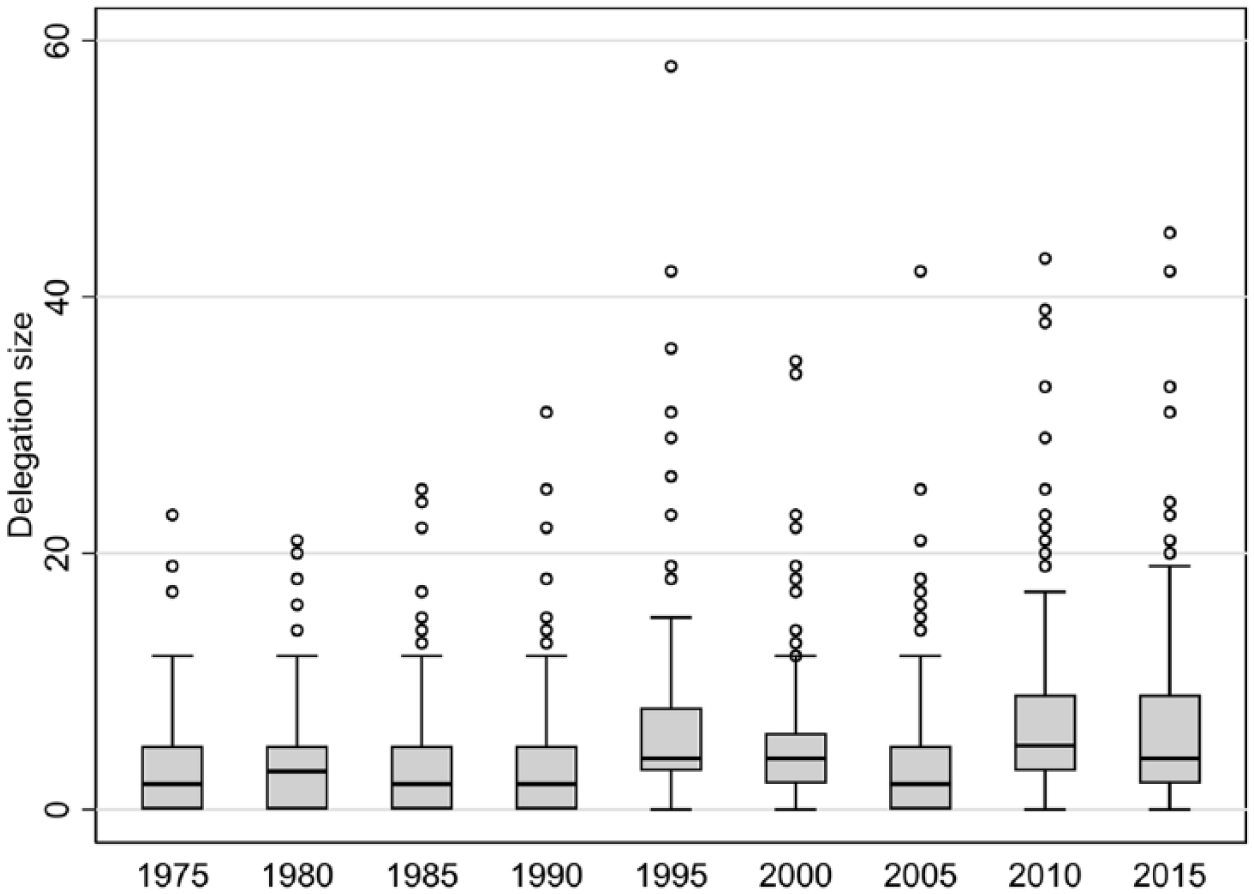
The delegation size differs per country and per year, as countries can determine the size of their delegations. 4 Figure 1 shows the main trends in the size of delegations. The thick line in the middle of the box represents the mean, the box represents the data falling between 25th and 75th percentile. The whiskers represent approximately 95% of the data distribution. At the first glance, it becomes obvious that the delegation size varies enormously. While the median size of delegation is between two and four members (depending on the year), some countries send delegations with more than 20 members. The absolute record is the US delegation to the 1995 NPT RevCon, which included 58 members.
Trends in delegation size.
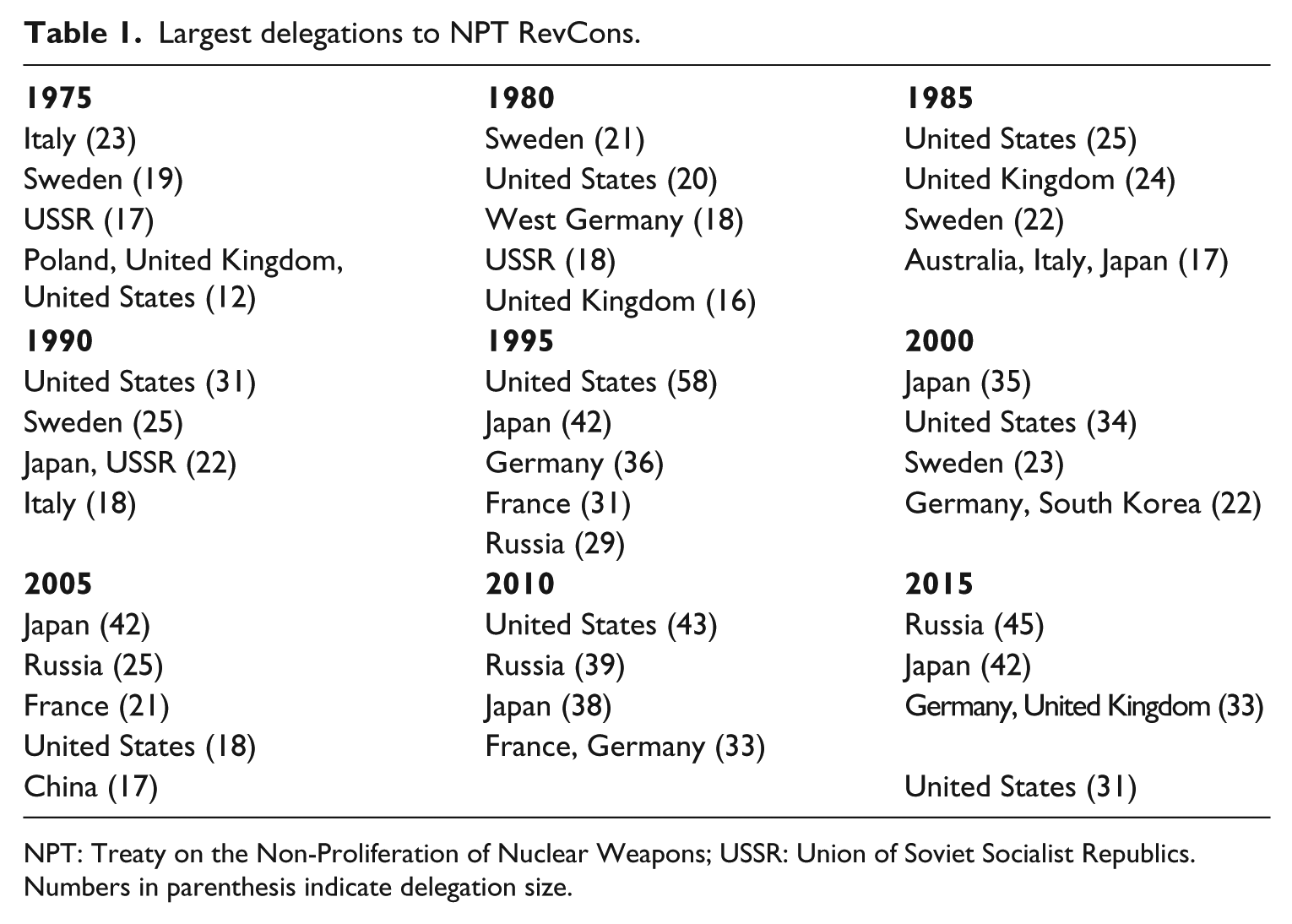
Table 1 presents the five largest delegations over time. The United States is the only country of which the delegation was among the five largest at every conference. Other countries which consistently send large delegations are Russia (earlier the Union of Soviet Socialist Republics (USSR)), Germany (West Germany pre-unification), Japan, and Sweden. In some countries, trends change over time. For example, Italy used to send large delegations during the Cold War, but not so afterwards.
Largest delegations to NPT RevCons.
NPT: Treaty on the Non-Proliferation of Nuclear Weapons; USSR: Union of Soviet Socialist Republics.
Numbers in parenthesis indicate delegation size.
The NPT RevCons in 1995, 2010, and 2015 are the outliers in terms of both the number countries that sent their delegations (with the 1995 conference attended by 163 delegations as the highest number of all RevCons), 5 and in terms of the number of delegates (with the 2010 conference attended by the highest number of attendees). On the other hand, the first NPT RevCon in 1975 was attended only by 306 delegates representing 57 countries.
Independent variable
The intensity of national nuclear programme is measured on an ordered scale. I look at four levels of the variable: having no programme (0), having peaceful energy programme (1), having a past military programme (2), and being a treaty-recognised NWS (3).
To code whether a country has a peaceful nuclear energy programme, I look at whether a country produced electricity using nuclear sources (using the data from Brown and Kaplow, 2014). 6 Countries producing electricity from nuclear sources can be considered as being generally more interested in nuclear politics. Given that issues discussed at the conference may impact countries’ ability to develop new technologies and gain new insights, the outcomes of conferences can plausibly influence national economic performance.
To code past nuclear programme, I look at whether a country has ever had a nuclear weapon programme (using the data by Jo and Gartzke, 2007). Last but not least, the United States, the United Kingdom, France, Russia (USSR), and China have been coded as NWS.
Control variables
Wealth: A country’s wealth is likely to be related to its propensity to have a nuclear programme as well as to its ability to send delegations to the conferences. Furthermore, richer countries are more likely to have bigger diplomatic corps, and therefore may be able to send bigger delegations to such conferences. In the absence of available cross-national data on size of national diplomatic service, capturing national gross domestic product (GDP) offers a possible solution. I measure countries’ wealth by looking at their annual GDP per capita. I use the updated version (Gleditsch, 2014) of the population and GDP data originally developed by Gleditsch (2002). As this data ends in 2011, I use the World Bank (2017) annual GDP growth data to calculate 2015 GDP and World Bank data for population.
Democracy: In the study of nuclear proliferation, scholars argue that domestic regime can influence the calculations countries make with regards to nuclear weapons (Sagan, 1996; Solingen, 1994). At the same time, existing scholarship has shown that democracies tend to be more interested in international institutions (Mansfield et al., 2002). I therefore look at the countries’ Polity IV score (Marshall et al., 2016) 7
Given that the size of delegation is de-facto a count model and many countries do not send any delegation to the conference, the use of a zero-inflated negative binomial model would be appropriate. The panel nature of the data, however, complicates the matter. Following Wooldridge (2002), I use a random effects Poisson estimator with country-clustered standard errors and year-fixed effects. I use this estimator because the development across time is not linear and individual years vary significantly (a similar model was used by Kaya and Schofield, 2015). 8 Two models are estimated – the first one only looks at the main independent variable, while the second adds the battery of controls.
Results
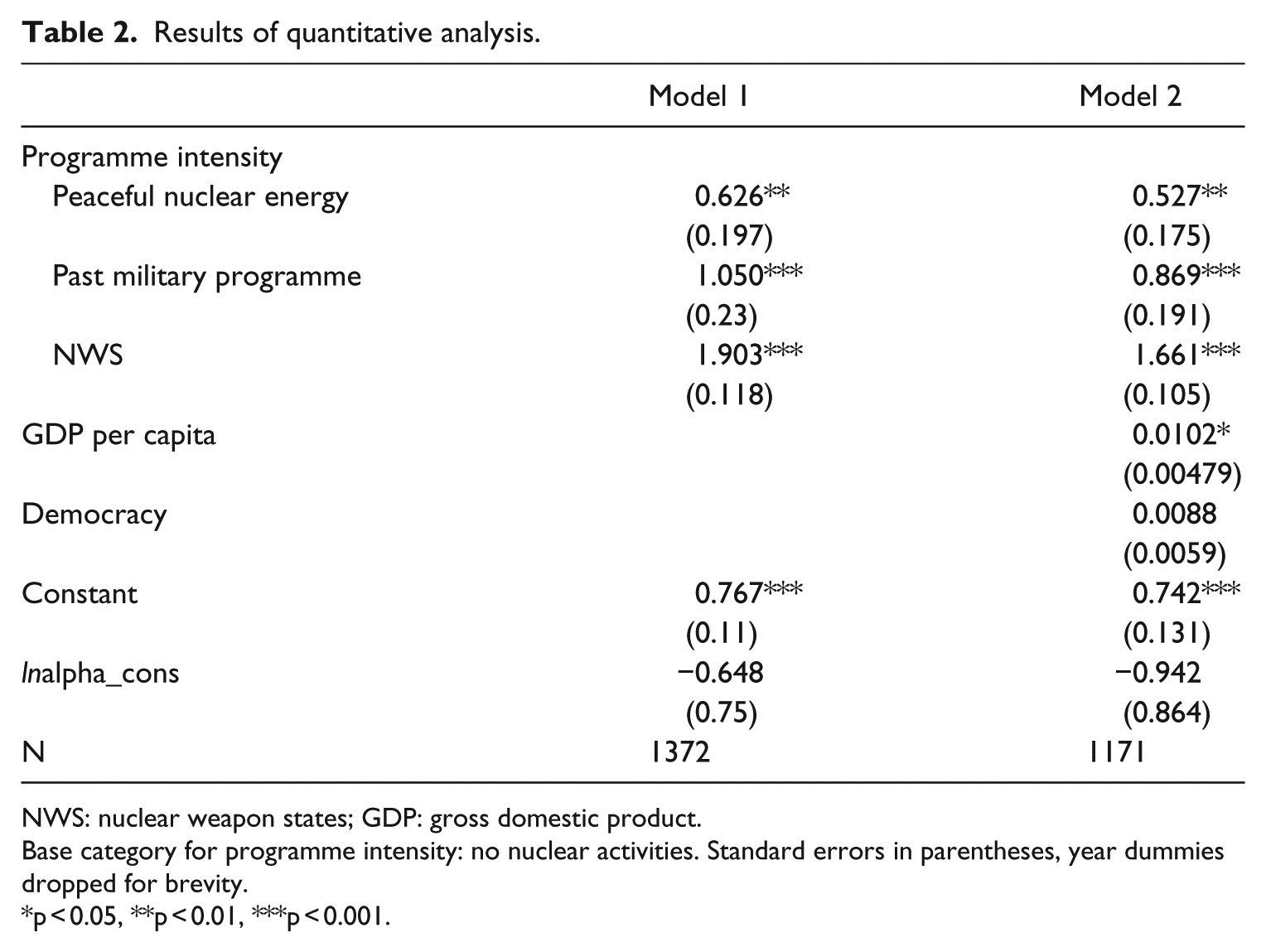
The results are presented in Table 2. Starting with the nuclear capability, the model shows rather straight-forward results. The more intensive nuclear programme countries have, the more active part in delegations they take, although the strength of the relationship varies depending on the number of variables controlled for. This finding confirms the expectation that countries with more active nuclear programmes tend to have a strong interest in NPT (as demonstrated by the size of their delegations). In practical terms, countries that use only civilian nuclear energy have, ceteris paribus, 69% larger delegations compared to countries with no nuclear programme (incidence rate of attendance calculated on the basis of Model 2). These countries have a strong vested interest, given that for many of them possible future non-proliferation steps could be seen as infringing on their legitimate peaceful uses of nuclear energy.
Results of quantitative analysis.
NWS: nuclear weapon states; GDP: gross domestic product.
Base category for programme intensity: no nuclear activities. Standard errors in parentheses, year dummies dropped for brevity.
p < 0.05, **p < 0.01, ***p < 0.001.
The results show that countries which had a nuclear weapon programme are more likely to be better presented at the conference. Countries which had a military nuclear programme in the past send, ceteris paribus, delegations 138% larger than those of countries with no nuclear programme. The effect is even higher for the treaty-recognised nuclear-weapons states, which send 426% larger delegations to the RevCons compared to the countries with no nuclear programme (the effect is even larger when control variables are not taken into account).
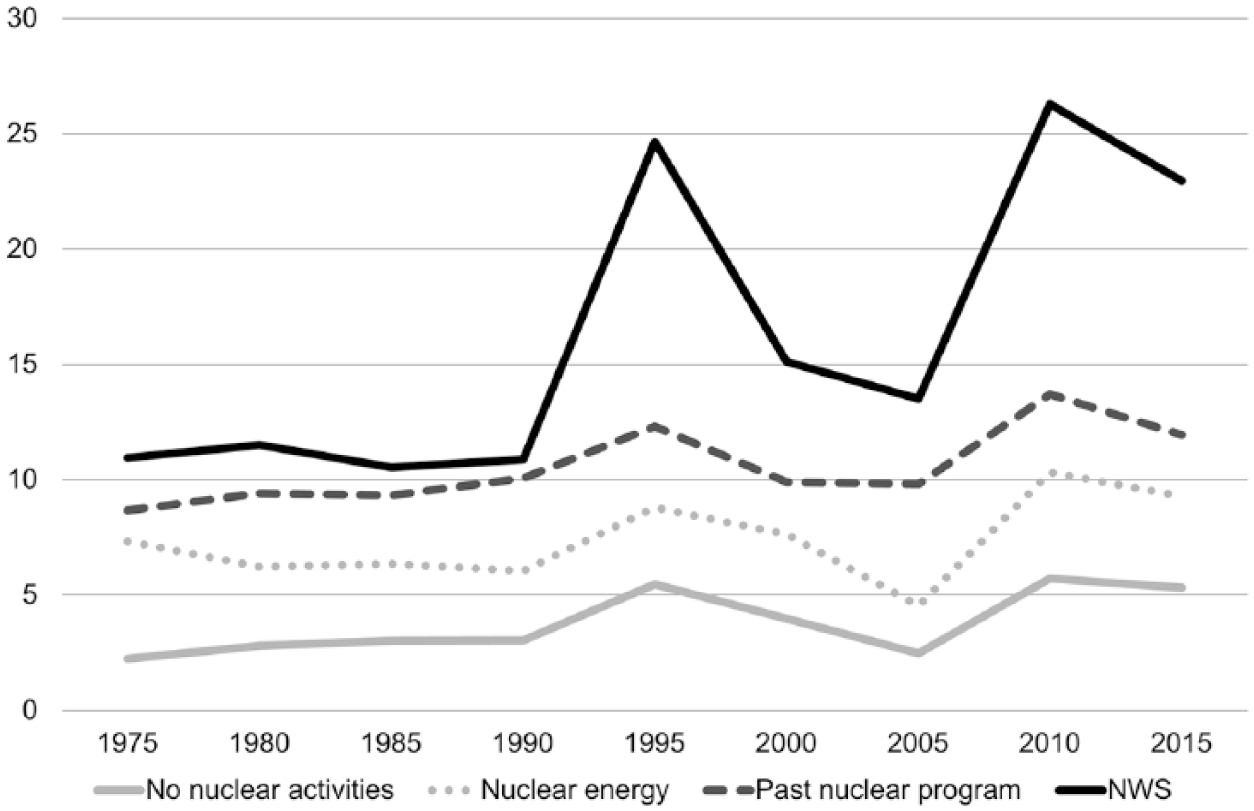
To place these numbers in a more straight-forward setting, I estimated an equivalent of Model 2 for each of the RevCons separately and calculated predicted attendance rates (predictive margins) for each of the category of nuclear programme intensity. The summary of results can be found in Figure 2. This model shows significant variation over time, as well as among countries depending on the intensity of their nuclear programmes. Whereas at the first RevCon, the predicted size of a delegation of a NWS was 11 members, at the latest RevCon, in 2015, it was 23 members. 9 It is also clear that the large divergence among the NWS and other states starts with the 1995 NPT RevCon and has largely persisted since. This pattern is likely because the NWS became more at the forefront of the nuclear agenda after the treaty’s extension, when the disarmament commitments included in the decisions adopted at the conference came to the forefront of the conference.
Predicted delegation size.
The results also suggest that countries with a material stake tend to afford most attention to the regime. Whether electricity production or past military programme (or the current one), these countries are most likely to send larger delegations to the conferences. We see that at the example of Italy, one of the foremost critics of the NPT in the early days of the Treaty, which used to send very large delegations to the conference. Italy was, at the time, very critical of the Treaty (Nuti, 2017), and therefore, it is not surprising that the country used to send large delegations. However, over time, Italy’s interest and the relevance of NPT faded, and the country now sends comparatively smaller delegations. Contrarily, Sweden has been keenly interested in the NPT since the early days, because of the direct connection to the country’s security and continues to act strongly as a norm entrepreneur across the regime (Becker-Jakob et al., 2013; Jonter and Rosengren, 2014).
The article shows that the NPT is mainly appealing for countries with at least some nuclear capacity. This finding is also in contradiction to the argument that non-proliferation reflects a global public good of not having nuclear weapons proliferation (Enia, 2014). Especially, scholars seeing the global non-proliferation regime through the lens of global justice underline this dimension (Müller and Wunderlich, 2013; Tannenwald, 2013). These scholars do not consider the division among the countries as those who have any nuclear capability or not, but between the countries that have nuclear weapons and those that do not. According to these scholars, states’ stakes are unrelated to having a material interest in the regime, but in having a normative stake in disarmament (which all countries share equally). In his more recent writings, Harald Müller (2010, 2012) suggests that the non-proliferation regime answers primarily the normative goal of ridding the world of nuclear weapons, which is as relevant as non-proliferation, because the nuclear weapons present a risk for all countries alike. If this view is correct, possession of nuclear capabilities (at whatever level) should not, per se, be important – the stake in global public good is equal for all countries. However, the results suggest that stakes are not the same for all countries, and indeed the regime with higher material stakes are more represented in the regime. There are very few countries like Austria, which despite having no nuclear infrastructure send large delegations to NPT RevCons (although Austria sent only small delegations until 2005).
As for control variables, wealth has a statistically significant and positive effect. Richer countries tend to be better represented in the NPT negotiations. Richer countries are able to afford to send their delegations to the conferences, and thus more likely to have their views heard.
Implications of differences in state representation
The previous section has discussed the factors influencing state representation in the NPT Review mechanism. But does this inequality translate itself across the wider nuclear regime complex? It is not inconceivable that countries which are better represented at the NPT RevCons are also able to reap the benefits of their presence at these conferences elsewhere. Countries with a bigger presence might be able not only to influence the RevCons, but also train more staff so they are then able to, for example, benefit more from other opportunities across the regime complex. Similarly, because such countries are more important within the NPT Review Process, more powerful countries might be interested in ‘buying them off’.
Earlier research has shown that the United States, as the hegemonic power within the international system, tries to buy off countries when they occupy important positions, such as one of the non-permanent chairs at the UN Security Council (Bueno de Mesquita and Smith, 2010), or when they change votes in the UN General Assembly (Dreher et al., 2008; Dreher and Jensen, 2013; Dreher and Sturm, 2010). A similar example was found in the nuclear field, where countries with dissimilar policy preferences tend to benefit more from their IAEA Board of Governors seats, an act which might be interpreted as an attempt at buy-off (Getmansky, 2017). In the short analysis below, I will reanalyse the data from Getmansky (2017)’s paper, to see whether the countries who are more present at the NPT RevCon are able to reap the benefits in the form of more IAEA technical cooperation support.
Beyond the micro-level, I also look at the macro-level, where I study the consequences of the unequal opportunity of countries to influence the negotiations in the NPT Review Process for the nonproliferation regime as such. In particular, I look at the relationship between the unequal representation in the NPT Review Process and the participation in the negotiations leading to the so-called ‘nuclear ban treaty’ (TPNW). Recent scholarship on the TPNW underlined the relationship between the frustration from the NPT Review Process and participation in the TPNW negotiations (Müller and Wunderlich, 2018). This article looks also at whether those participating in the TPNW negotiations were not only frustrated, but also under-represented.
Micro-level implications
As described above, in assessing the micro-level implications, I will look at whether countries better represented in the NPT Review Process are able to translate that representation into benefits across the nuclear regime complex. To do this, I will look at whether countries with bigger representations in the NPT Review Process are able to benefit more from the IAEA’s technical cooperation assistance. This expectation would be in line with the findings from earlier research, which has shown that countries with higher presence in the United Nations (UN) Framework Convention on Climate Change conferences are better able to draw funds from the Global Environment Facility (Kaya and Schofield, 2015).
For this purpose, I re-estimated all models in the recent paper by Getmansky (2017). Getmansky looked at whether allocation of technical assistance from the international organisations is influenced by political considerations. Getmansky concludes that countries receive more assistance if they accept stricter IAEA safeguards or have a seat at the IAEA’s Board of Governors, as long as they have divergent policy preferences from the United States.
For the purpose of the analysis, I re-estimated all Getmansky’s models, but I report only re-estimated Models 3, 4 (likelihood to participate in TC), 8, 9 (the likely sum to be received from TC), 12, and 15 (the likely participation in sensitive or humanitarian TC project respectively) for brevity. These models capture Getmansky’s main findings. I made a small adjustment to the original analysis by Getmansky – I added a control for the size of the delegation to the preceding NPT RevCon. The results are reported in Table 3. The results from these models (and all other re-estimated models) show not only that the presence in the NPT RevCons does not have strong implications across the regime, but also that the IAEA technical assistance funding depends on other factors than behaviour in the NPT Review Process.
Re-estimation of analysis by Getmansky (2017).
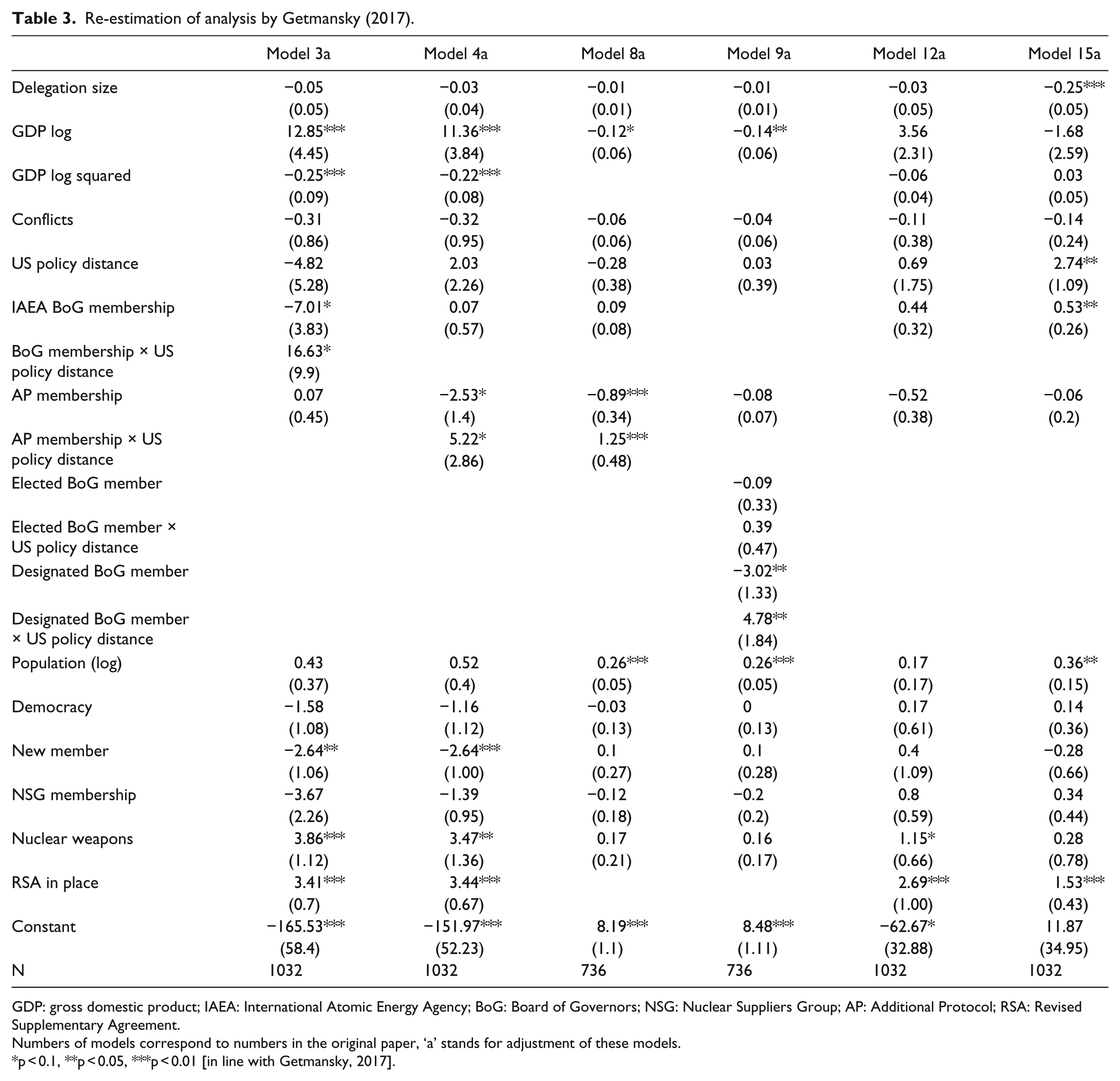
GDP: gross domestic product; IAEA: International Atomic Energy Agency; BoG: Board of Governors; NSG: Nuclear Suppliers Group; AP: Additional Protocol; RSA: Revised Supplementary Agreement.
Numbers of models correspond to numbers in the original paper, ‘a’ stands for adjustment of these models.
p < 0.1, **p < 0.05, ***p < 0.01 [in line with Getmansky, 2017].
In the re-estimation, none of the substantive results from Getmansky’s paper change. What is more, the delegation size is always statistically insignificant, except for the re-estimated Model 15 (Model 15a). In Model 15a, I find that countries which send larger delegations to the NPT RevCons tend to receive less humanitarian technical cooperation assistance. Yet even the findings related to Model 15a are not really surprising. As these relate to the likelihood to receive funding for humanitarian (agriculture and health) technical assistance, it is likely that countries with substantive nuclear infrastructure (such as those abundantly represented during the NPT Review Process) simply do not need assistance in this area.
These results suggest that countries with larger delegations do not tend to get more from international organisations. The finding runs, therefore, not only counter to the received wisdom about the use of international organizations by most powerful countries, but demonstrates the limits of transferring policy advantages across different parts of the regime complex.
Macro-level implications
On the other hand, countries present at the TPNW negotiations tend to be those that were less represented at the NPT RevCons. Again, it might be because these countries have less stake or fewer means, but the simple implication is that faced with inability to advance their preferences in the NPT Review Process (Müller and Wunderlich, 2018), 10 these countries decided to support the TPNW negotiations as an alternative.
Having conducted a simple means test (independent samples t-test), there is a statistically significant difference between the countries taking part and countries not taking part in the TPNW negotiations. On average, countries not taking part in the negotiations have sent 3–4 more diplomats to the NPT RevCons since NPT’s indefinite extension in 1995. Given that the global mean size of the delegation is between 3 and 7 since 1995, difference of 3–4 members is in practice often about doubling the mean size of the delegation.
To illustrate the disparity, we may look at two countries with prominent roles in the nuclear ban movement. New Zealand, one of the main proponents of the ban treaty (and an early ratifier of the treaty) sent a delegation smaller to the 2015 NPT RevCon than that of Slovakia – a country which is not particularly known for its involvement in nuclear politics. Another example is Brazil, a country heavily involved in the nuclear ban movement, which sent only nine diplomats to the 2015 NPT RevCon, compared to Germany, a country with a comparable interest in nuclear politics and a similar level of development of their nuclear technology, which sent 33 members to the conference. With only nine diplomats, Brazil might not be able to attend all meetings and bring as many experts and advisors as other delegations of similar ‘middle powers’.
We observe that state inequality in the nonproliferation negotiations leads to forum shopping and creation of new forums, one of the chief elements of regime complexes (Alter and Meunier, 2009; Morse and Keohane, 2014). Forum shopping allows actors to find suitable institutional locations for having their preferences (or grievances) heard: when faced with multiple options, states choose the forum where they have the highest likelihood of addressing their complaint. If such a forum does not exist, states may be interested in creating one (Drezner, 2007). It is also the case with the TPNW, which represents such forum shopping in the nuclear non-proliferation regime complex.
This finding should be neither novel nor surprising, but it suggests that the TPNW is an expression of a fundamental inequality of states within the NPT Review Process, which goes beyond the states’ treaty-endowed power (that is, the distinction between the NWS and NNWS). The creation of the new forum is therefore not a remarkable feat, but rather a fairly normal consequence of institutionalised regime complex.
Conclusion
This article looked at states’ representation in the NPT Review Process. In particular, the article analysed the size of national delegations to the NPT RevCons. The results of the analysis suggest that the more developed the nuclear programme a country has (or had), the bigger the delegation it sends to negotiations. Similarly, the results suggest that poorer countries with little nuclear infrastructure tend to be underrepresented. Given the complexity of RevCons, small delegations are unlikely to have their preferences heard. A total of 118 of the NPT signatories have no nuclear infrastructure, no use of nuclear energy for electricity production, and GDP per capita of less than the 75th percentile of the NPT signatories. The finding undercuts the argument that the NPT regime reflects universal interests – the interests (re)presented tend to be of the ones who have either security or economic interests in the regime. Hence, a large proportion of the participants in a regime which supposedly reflect the global norms (Tannenwald, 2013) are not heard. If commentators complain that the nuclear nonproliferation regime is not serving the interests of its members (Fihn, 2017; Sauer, 2016), it may be because some of the members are not adequately represented. Looking at the attendance data from the NPT RevCons, it becomes obvious that countries with nuclear programmes and past military activities are more present at the negotiations, and it is not surprising that their preferences get more readily advanced.
The article then looked at the implications of this inequality. On the micro-level, states are not able to translate their presence in NPT meetings into an ability to gain more assistance from IAEA. However, the article also showed that the inability to get preferences advanced in the NPT Review Process meant that the countries which are systematically less present in the NPT RevCons have opted, over time, to create a new forum where they may be able to air their grievances: the ‘nuclear ban treaty’ negotiations. This finding is relevant, because it shows that numerical inequality of countries in the diplomatic conferences can lead to repercussions across wider regime complexes. Forum shopping, and creation of alternative forums, is one of the consequences of such inequality. Counterintuitively, though, complaints about inequality of state representation (and the resulting inability to equally contribute to the negotiations) persist in this new forum: the inequality of states cannot be easily removed.
The article opens doors for future research into conference diplomacy. Despite being a relatively good example of recurring interaction in international politics, comparison with other regimes or settings might show particularities of the politics of the NPT Review Process. Furthermore, as one of the reviewers helpfully suggested, bigger delegations might end up facing internal management problems.
Footnotes
Acknowledgements
I wish to thank BJPIR’s reviewers for their excellent suggestions, which helped making the article better. I also wish to thank Michal Parízek for commenting on multiple versions of the article, and Anna Getmansky for generously sharing her data. I also thank Josh Watts for his invaluable research assistance, and Ashley Longman for proof-reading. All mistakes remain my own.
Funding
The author(s) disclosed receipt of the following financial support for the research, authorship, and/or publication of this article: I thankfully acknowledge funding by the Charles University Research Centre programme UNCE/HUM/028 (Peace Research centre Prague/Faculty of Social Sciences).