




Abstract
This article studies the effect of parliamentary involvement on security policy. Building on Democratic Peace Theory, it examines whether democracies with a parliamentary veto power are indeed less likely to participate in military interventions, than democracies without such a veto power, ceteris paribus. By studying patterns of participation across 25 to 35 countries in five military missions, this paper finds modest evidence for such a parliamentary peace and suggests that it depends on the character of the military mission in question. If a mission is framed as a test case of alliance solidarity, as was the case with OEF and the Iraq War, domestic institutional constraints can be trumped by alliance politics. If, however, countries enjoy more discretion in deciding on the use of force, domestic constraints such as parliamentary war powers have a tangible impact on government policy.
Introduction
In August 2013, the British House of Commons provided a spectacular demonstration of parliamentary war powers. After the use of chemical weapons in a suburb of Damascus had been attributed to the Syrian government, the United Kingdom, France and the United States showed resolve to respond with punitive military strikes against Bashar-al-Assad’s regime. In line with an emerging convention (Mello, 2017; Strong, 2015), the Cameron government asked parliament to approve a strong response, including possible military action. To Cameron’s surprise, the House of Commons voted against the government motion (Kaarbo and Kenealy, 2016). After the British government had declared that it would refrain from any military strike, the French and American governments followed suit. It is no exaggeration to conclude that the House of Commons is responsible for the non-use of force against the Syrian government in 2013.
The 2013 House of Commons vote seems a perfect illustration of the effects of parliamentary involvement on the substance of security policy. What is more, the episode seems a textbook example of the institutionalist version of the democratic peace theory, according to which domestic actors, such as parliaments, constrain the executive in its use of force. However, much of this literature has taken its cues from the US system of checks and balances where Congress is more independent of the executive and legislative–executive relations are frequently antagonistic, especially if the president’s party differs from the majority in Congress. In parliamentary systems, by contrast, the majority party or coalition of parties forms a functional unit with the government and open confrontation between parliament and government is a rare exception. In parliamentary systems, the executive typically either disciplines the parliamentary majority to support its policies or avoids a vote in anticipation of an absent majority (on the executive rationale behind parliamentary votes, see Strong in this Special Issue). From this perspective, the 2013 House of Commons episode is untypical because it first and foremost indicates that the government misjudged the degree of dissent within the governing majority (Kaarbo and Kenealy, 2016). 1
In parliamentary systems, open confrontation between parliament and government is exceptional, therefore parliamentary influence on deployment decisions should not be equated with the former voting against proposals of the latter. Instead, the power of parliaments should manifest itself in the pattern of liberal democracies’ participation in military interventions. As government decides in the shadow of parliament’s war powers, and because war powers differ across democracies, we should see countries with weak parliaments use military force more often than those where prior parliamentary approval is required. Participation patterns are a better way to study the effect of parliamentary involvement on security policy than the actual exercise of legislative veto powers. By studying patterns of participation across 25–35 countries in five military missions, this article contributes to a systematic understanding of the effect of parliamentary involvement on security policy and thus to the second guiding question for this Special Issue (Mello and Peters).
This article finds modest evidence for such a parliamentary peace and suggests that it depends on the character of the military mission in question. If a mission is framed as a test case of alliance solidarity, as was the case with Operation Enduring Freedom (OEF) and the Iraq War, domestic institutional constraints can be trumped by alliance politics. If, however, countries enjoy more discretion in deciding on the use of force, domestic constraints such as parliamentary war powers have a tangible impact on government policy.
The next section discusses the state of the art on the ‘parliamentary peace’ (Dieterich et al., 2015). It outlines the causal mechanisms that specify why parliamentary control is expected to make the use of force less likely and reviews the empirical evidence thus far. I then present the research design of this study and discuss the empirical findings. My analysis of liberal democracies’ (non-)participation in military interventions in 1999 (Kosovo), 2001 (Afghanistan), 2003 (Iraq), 2011 (Libya) and 2014 (Daesh) suggests that countries with a parliamentary ex ante veto power are indeed less likely to contribute to a military mission than countries without one. However, a closer examination of individual missions demonstrates that such a pattern is only statistically significant for two of them: Operation Allied Force (Kosovo) and Operation Unified Protector (Libya). In contrast, countries with a parliamentary ex ante veto power were just as likely to join OEF, the Iraq War and the air campaign against Daesh as countries without.
State of the art
Parliamentary peace: rationale and causal mechanisms
The idea that parliaments constrain governmental decisions on using force has a long pedigree. In the summer of 1914, British MPs founded the ‘Union of Democratic Control’ out of frustration over the government’s secret de facto commitment to come to the defence of France. This commitment contradicted the official British policy to avoid an entanglement in a war on the continent. The founders of the Union, among whom were Ramsay MacDonald and Norman Angell, asked that ‘no treaty, arrangement or undertaking shall be entered upon in the name of Great Britain without the sanction of parliament’ (quoted from Harris, 1996: 54).
Almost 60 years later, the same spirit was midwife to the War Powers Resolution (WPR) in the United States. The WPR obliges the President to consult with members of Congress before introducing US armed forces into hostilities. Moreover, the use of force must be stopped after 60 days unless Congress decides to extend the deployment, effectively providing Congress with an ex post veto power. The resolution had met the stern opposition of President Nixon who used his veto to block it. However, both houses overrode the veto with the two-third majorities required. The WPR was brought forward in a climate of ‘deep distrust of the Presidency’ (Franck and Weisband, 1979: 35) among members of Congress and the public more broadly. To a large extent, this mistrust was fed by the President’s conduct of the war in Vietnam.
Several mechanisms have been identified that link institutional constraints (and parliamentary control in particular) to a less bellicose policy. 2 A first causal mechanism echoes veto player theory, according to which any veto player makes any decision less likely for the simple reason that an additional actor needs to agree. 3 However, as pointed out above, the implicit assumption that parliament has preferences independent of the executive contradicts the logic of parliamentary systems, according to which the government and the parliamentary majority form a functional unit. 4 This logic makes the embarrassment of a veto, such as the 2013 House of Commons veto on Syria, highly unlikely. However, even though the juxtaposition between the government and its majority in parliament, on the one hand, and the opposition, on the other, often trumps legislative–executive relations in a parliamentary system, they do not do so always and entirely. First, backbenchers within the governmental majority parties may be difficult to discipline, especially on questions of using military force, which is often considered a moral issue. Second, governments often aim at a broad consensus in support of their policies that includes at least the major opposition party/parties. This consensus is often the case with military interventions, which are seen and presented as transcending party politics. In both cases, a parliamentary veto power encourages the government to reach out, address concerns and ultimately compromise to secure broad support.
As a second causal mechanism, checks and balances slow down the decision-making process. Bruce Russett emphasised that this slowdown can buy time for a diplomatic solution (Russett, 1993: 40). With a view to the House of Commons’ vote on Syria in 2013, one could add that the requirement to consult parliament can also cool down bellicose emotions: Prime Minister Cameron responded to the use of chemical weapons in a suburb of Damascus with calls for punitive air strikes against the alleged perpetrator, the Syrian government. The British press supported such punitive action. 5 Although there are several reasons for the government’s defeat in the House of Commons (Kaarbo and Kenealy, 2016), the parliamentary debate provided the space for doubts to be voiced and forced the government to address them.
Third, institutional constraints influence the type of conflicts that leaders pick and the way that they are fought. Siverson (1995) has argued that the mere count of war participations does not tell the full story because it does not distinguish between Germany in World War II (with 1.8 million battle deaths), on the one the hand, and the United States in the Spanish-American War (5000 battle deaths), on the other (Siverson, 1995: 483). Instead of counting war participations, Siverson (1995) suggests examining the lethality of conflicts, understood as the logged number of casualties per 10,000 people. Comparing democracies with non-democracies, he indeed finds support for the hypothesis that wars initiated by democracies are significantly less lethal than those initiated by non-democracies. Students of ‘democratic victories’, that is, the finding that democracies tend to win the wars they fight, draw on the same causal mechanism Reiter and Stam (2002), for example, argued that democracies tend to win the wars they fight because democratic constraints make leaders pick only conflicts they are confident of winning.
Of course, the same rationale that distinguishes democracies from non-democracies also applies to differences among democracies with different levels of institutional constraints. Indeed, Saideman and Auerswald (2012) argue that institutional constraints tend to make governments impose caveats, that is, restrictions on how their troops can be used in a military mission. With a view to Germany’s contribution to Afghanistan, they argue that ‘the necessity of maintaining parliamentary support seems to explain why casualty aversion is THE top priority for German officers in Afghanistan, guiding decisions on helicopters, operations, and the like’ (Saideman and Auerswald, 2012: 77).
The discussion above shows that parliamentary control of military missions does not make participation in military missions impossible. Especially if there is broad support for the use of force in parliament and among the public, parliament is unlikely to veto the use of force. More typically, however, public support is modest and decision-makers are aware that an initial wave of support (the ‘rally around the flag effect’) can melt away the longer the mission takes and the higher the number of casualties (Mueller, 1973). We therefore expect that countries with a parliamentary veto power are, ceteris paribus, less likely to participate in a military intervention.
Data and findings
Although this question has attracted growing interest in the wake of the democratic peace debate, our knowledge about the actual effects of parliamentary war powers on governments’ decisions to use military force is remarkably limited.
Peterson (1996), Auerswald (1999, 2000) and Elman (2000) compare decision-making processes on the use of force between democracies with autonomous executives, on the one hand, and executives facing strong legislatures, on the other. While all three find support for the general notion that institutional constraints by parliaments matter, they also hesitate to claim a general relation between strong parliament and conflict avoidance because parliament is not always less hawkish than the executive. Among the three authors, Auerswald comes closest to a general proposition that different institutional systems impact on the likelihood of conflict initiation by the executive. Even if a legislature is initially in favor of conflict, Auerswald argues, institutionally constrained executives will be reluctant to engage in conflict because they are aware of the inherent risks of such an endeavour. However, strong executives run a lower risk of domestic defeat and are thus less risk-averse (Auerswald, 2004: 641f.).
Whereas Peterson (1996), Auerswald (1999, 2000) and Elman (2000) carry out in-depth case studies, a second group of scholars run statistical analyses to examine the hypothesis that the likelihood of a state initiating conflict decreases as legislative control over foreign policy increases. Reiter and Tillman (2002) examine conflict initiation by 37 democracies over the period 1919–1992 with country-years as units of analysis. As a proxy for legislative control, Reiter and Tillman (2002) use treaty ratification power. Their findings are mixed. Although there is a statistically significant correlation between legislative power over treaty ratification and the initiation of so-called Militarized Interstate Disputes, the variable becomes insignificant if only conflicts involving the use of force are included. Clark and Nordstrom (2005) have confirmed these findings. A weak spot in Reiter and Tillman’s (2002: 816) study is their assumption that ‘legislative involvement in treaty ratification is likely to extend to other areas of foreign policy’. Because better data on parliament’s war powers were missing, this assumption was the only way to study a relatively large number of democracies over a relatively long period of time.
The dearth of data on actual war powers was overcome in the late 2000s. Dieterich et al. (2010, 2015) collected data on the actual competences and practice of parliaments of 25 members of the European Union at the time of the 2003 Iraq War. They find strong evidence for a ‘parliamentary peace […] [H]igh parliamentary war powers are associated with reduced war involvement. Countries with a high degree of parliamentary war powers were significantly less militarily engaged in the Iraq War’ (Dieterich et al., 2015: 100). Wagner et al. (2010) collected data on parliamentary war powers in 49 democracies between 1989 and 2004, including countries in Europe, Asia, Africa, the Americas and Oceania. They find that parliamentary veto power over military deployments is relatively widespread, albeit still restricted to a minority of democracies.
Mello (2014) extended the analysis to additional interventions (Kosovo 1999 and Afghanistan 2001) and countries (e.g. Australia, Canada, New Zealand and the United States). Mello uses fuzzy set Qualitative Comparative Analysis as a method to identify configurations of variables that impact on a government’s decision to participate in a military intervention. Using data from Dieterich et al. (2010) and Wagner et al. (2010), Mello (2014: 186) finds ‘no cross-case pattern […] for parliamentary veto rights’. For the Kosovo intervention, Mello finds that the absence of parliamentary veto power is a necessary condition for participation. However, for the Iraq War, Mello finds that constitutional restraints explain the non-participation of numerous states better than parliamentary veto power. In addition, several parliaments that could have vetoed participation did not do so. Haesebrouck (2016a, 2016b) has used a very similar research design to examine the contributions of liberal democracies to the United Nations Interim Force in Lebanon (UNIFIL) and to the air strikes against Daesh. As regards to UNIFIL, he finds that ‘the presence of parliamentary veto […] is associated with the absence of large contributions’ (Haesebrouck, 2016b: 152). With a view to the air strikes against Daesh, he finds that a legislative veto ‘is a relevant condition, irrespective of partisan politics’ (Haesebrouck, 2016a: 15). However, the ‘prospect of legislative meddling did not inhibit participation if the combination of a strong threat and high alliance value provided states a strong incentive to participate’ (Haesebrouck, 2016a: 15).
Testing the parliamentary peace thesis
This section tests the parliamentary peace thesis empirically. I selected five cases of military missions on the basis of criteria that have been established by major works in the comparative study of ‘democratic wars’ (Mello, 2014: 6–8; Schörnig et al., 2013: 25–27): Only military missions after the end of the Cold War are included, to which several liberal democracies made a sizable military contribution (excluding unilateral and minilateral interventions as well as many UN-led peace operations). In addition, decisions to participate must have been politically controversial (excluding many small and low-risk operations), and there must have been variance in liberal democracies’ involvement. Based on these criteria, the following missions are included in this study: (1) Operation Allied Force against targets in Serbia and Montenegro in 1999 to force Milosevic to stop violence against ethnic Albanians in Kosovo (therefore, usually referred to as ‘Kosovo War’), (2) OEF in Afghanistan in 2001 to fight Al Quaida in response to the 9/11 terrorist attacks, (3) the war against Iraq in 2003, (4) the air strikes against Libya in 2011 when massive violence by Gaddafi’s government against civilians was feared and (5) the campaign against Daesh in Iraq and Syria since 2014. 6
In all of these missions, some democracies decided to participate whereas others decided against participation. If the parliamentary peace thesis holds, countries with a parliamentary ex ante veto power should be overrepresented among the non-participants whereas countries without parliamentary veto power should be overrepresented among the participants.
As discussed above, four of the five cases studied here have already been examined with a view to the impact of parliament on (non-)participation in military missions: Kosovo and Afghanistan have been analyzed by Mello (2014), Iraq by Mello (2014) and Dieterich et al. (2015) and the strikes against the so-called Islamic State by Haesebrouck (2016a, 2016b). This article not only adds an analysis of Operation Unified Protector (Libya 2011), it also extends the analysis to additional liberal democracies that were excluded from the studies by Mello (2014) and Dieterich et al. (2015). Finally, in contrast to Mello (2014) and to Haesebrouck (2016a, 2016b), this article does not apply a set-theoretic methodology that treats parliamentary war powers as a possible necessary or sufficient condition in combination with other factors. Instead, this article follows Dieterich et al. (2015) in gauging the influence of parliamentary war powers on (non-)participation in military missions by cross-tabulating the two variables. This difference in methodology, however, is not meant to deny the advantages of a set-theoretic approach. Instead, cross-tabulation is best understood to complement a set-theoretic approach and thus allow for a triangulation of the question that this article shares with those by Mello (2014) and Haesebrouck (2016a, 2016b).
The parliamentary peace thesis only applies to democracies. In order to identify democracies, I rely on the Polity dataset, which has been widely used in International Relations and conflict studies. 7 The dataset includes an 11-point democracy scale (0–10) and an 11-point autocracy scale (0–10). A country’s regime type (‘combined Polity score’) is then measured by subtracting its autocracy score from its democracy score, yielding a 21-point scale (from −10 to +10). The Polity team itself considers states with a Polity score of 6 or higher as democracies (Marshall and Cole, 2014: 20). However, students of democracy and peace have often used a higher cutoff point to identify democracies. In order to include only countries whose democratic credentials are beyond doubt, I follow Gartzke (2001: 478) and Mello (2014: 8) who only include states that score 8 or higher. This cutoff point is plausible as it excludes countries such as Ukraine, Kyrgystan or, at times, Turkey whose democratic credentials have not been beyond doubt and that are thus difficult to compare with ‘mature’ democracies, such as the United Kingdom or the Netherlands.
In addition, I follow democratic peace custom by excluding ‘politically irrelevant’ cases, that is, countries that are very unlikely to participate in one of the military interventions under study in the first place. In studies of inter-state war, a shared border or the involvement of a major power are typically taken as indicators of political relevance because both make armed conflict a real possibility. 8 Of course, geographical distance has lost importance in the era of the ‘wars of choice’ under study here. Indeed, some distant states (e.g. Australia) have joined the coalitions intervening in some of the conflicts studied here. Nevertheless, it seems clear that the non-participation of a Latin American country in, for example, the intervention in Libya, weighs differently than the non-participation of a European country as the former has a much lower baseline probability to even consider participation in the first place. To exclude states that are unlikely to intervene anyway, I limit my study to states that are either full members of NATO or linked to NATO via the Partnership for Peace (PfP) programme because the purpose of the latter has been to allow NATO states to cooperate operationally with non-members. 9
It is beyond the scope of this article to discuss any of the military missions and the (non-)participation of particular liberal democracies in detail. For the interventions in Kosovo/Serbia, Afghanistan and Iraq, I follow the coding by Mello (2014) where possible and add the cases missing in his sample. 10 Data on the participants and non-participations in air strikes against Daesh are taken from Haesebrouck (2016a); data on Operation Unified Protector are based on International Institute for Strategic Studies (2012).
To distinguish countries with and without parliamentary veto power over military missions, I updated and extended the PARLCON dataset that is also used in the studies of Mello (2012, 2014) and Haesebrouck (2016a). In contrast to its earlier version, Albania, Estonia, Latvia, Moldova, Montenegro and Serbia have been added. 11
To examine the parliamentary peace thesis, I carried out a set of cross-tabulations. Where the number of cases is small and cells in the contingency tables are filled with only few entries, Fisher’s exact test is the best way to analyse whether parliamentary ex ante veto power is correlated with non-participation in military missions in a statistically significant way.
Findings
Tables 1 to 6 display cross-tabulations for the military missions studied.
All missions pooled.
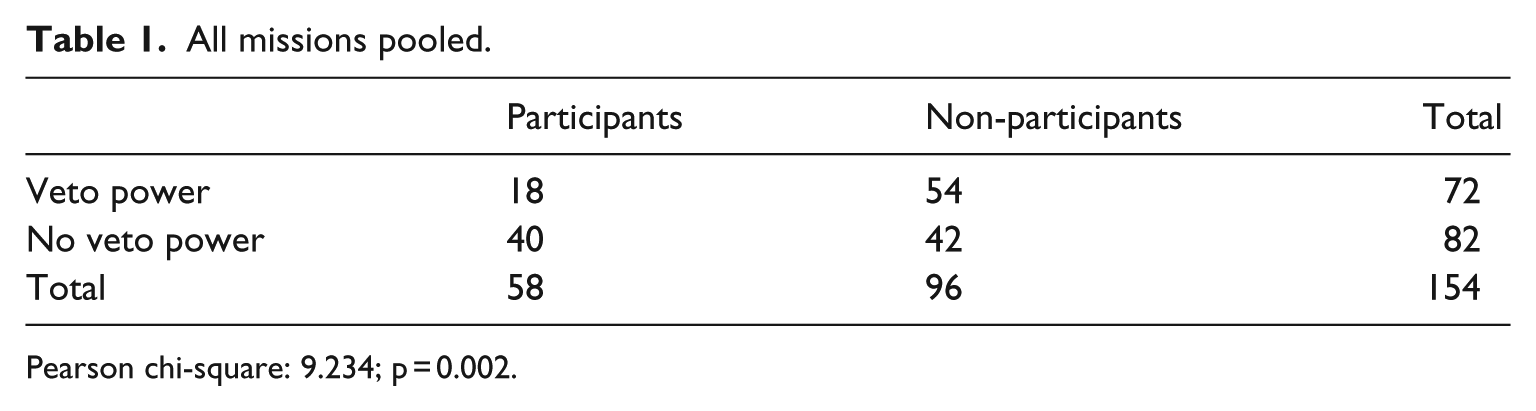
Pearson chi-square: 9.234; p = 0.002.
1999 Operation Allied Force.
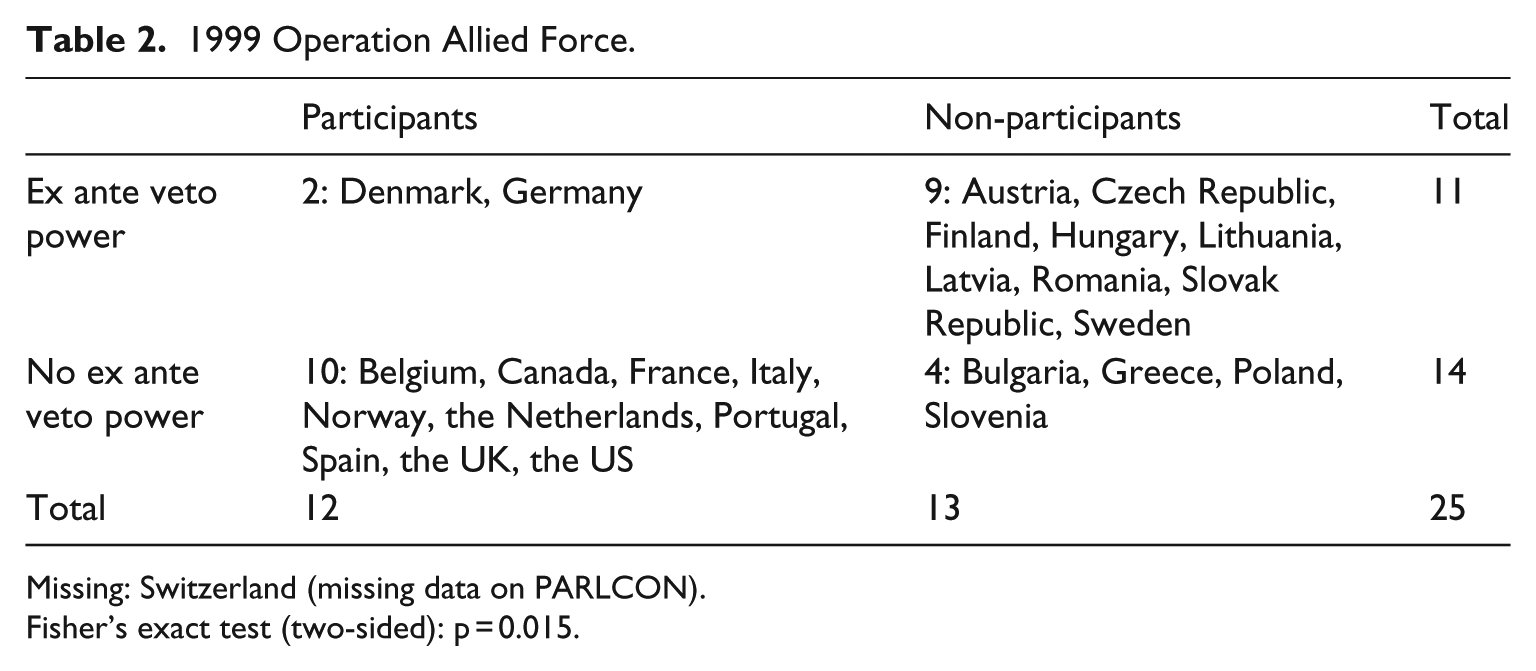
Missing: Switzerland (missing data on PARLCON).
Fisher’s exact test (two-sided): p = 0.015.
2001 Afghanistan.
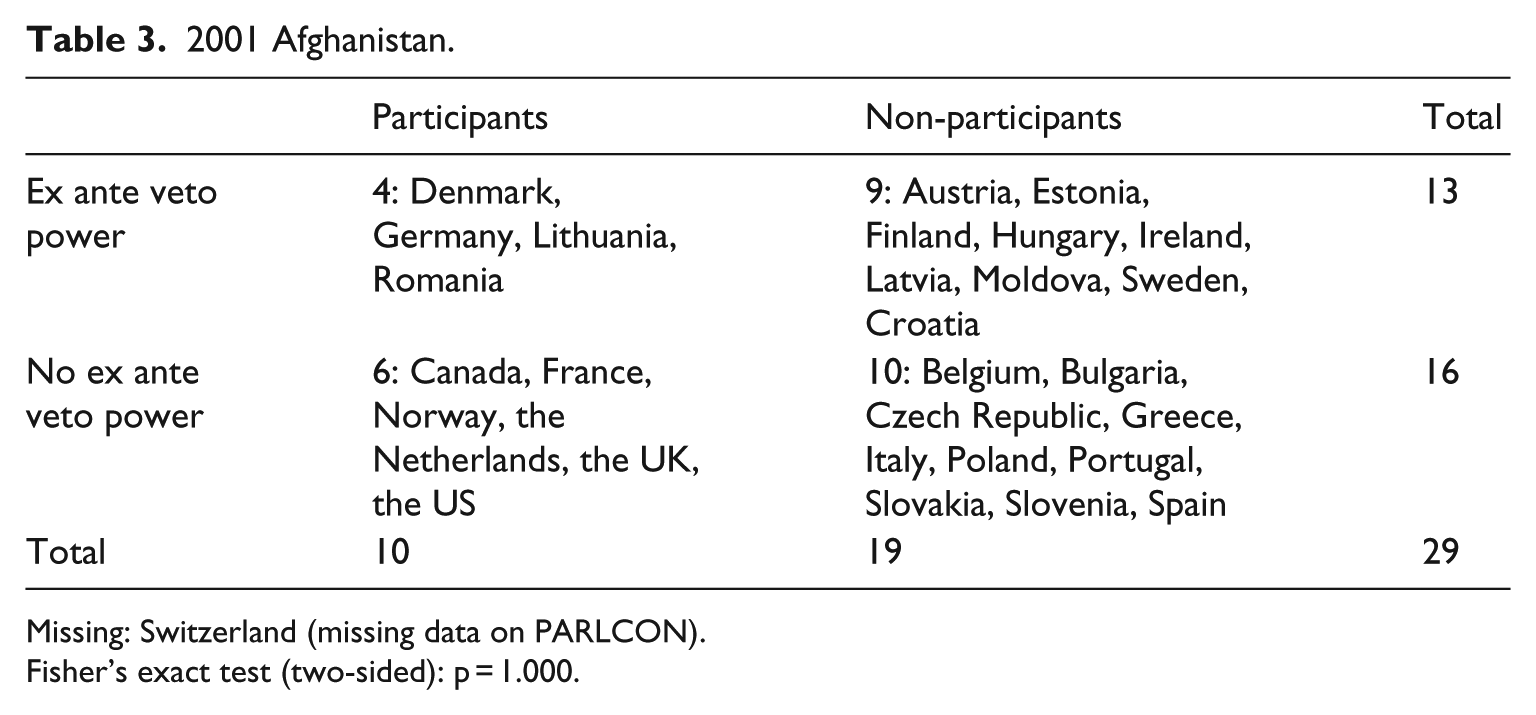
Missing: Switzerland (missing data on PARLCON).
Fisher’s exact test (two-sided): p = 1.000.
2003 Iraq War.
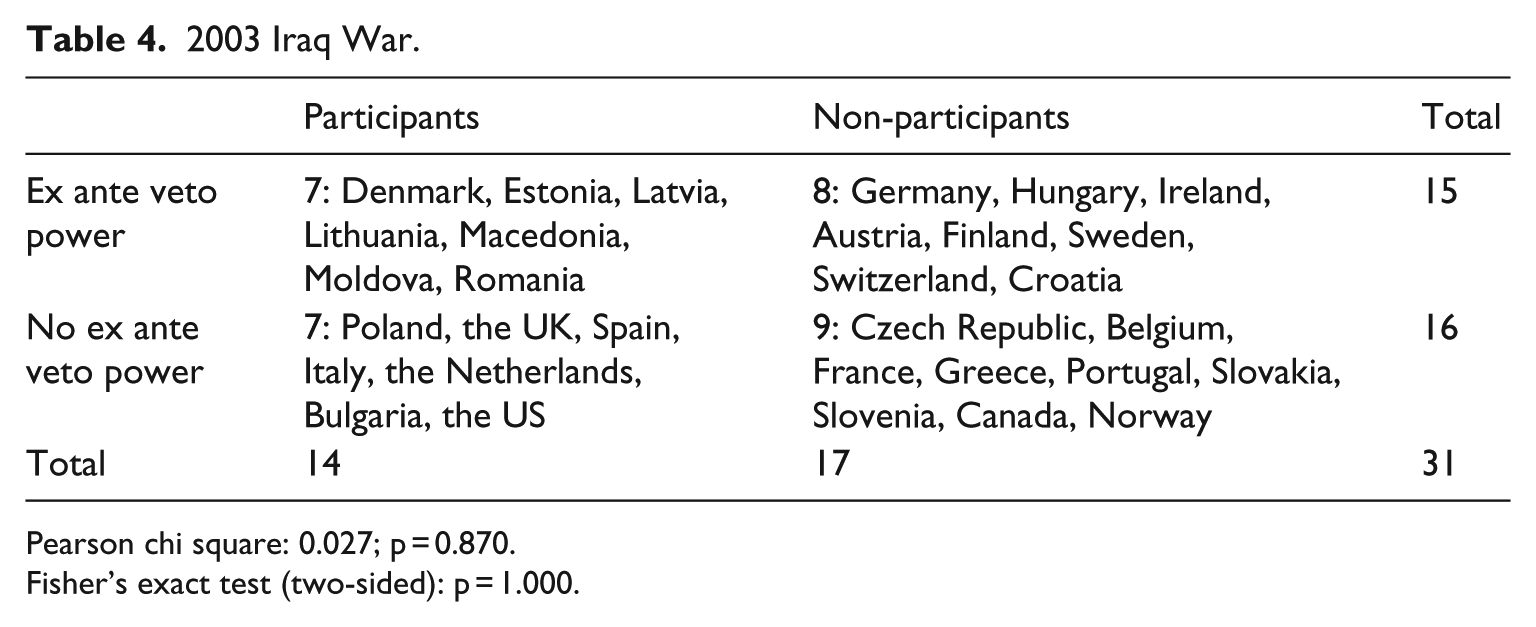
Pearson chi square: 0.027; p = 0.870.
Fisher’s exact test (two-sided): p = 1.000.
2011 Operation Unified Protector (Libya).
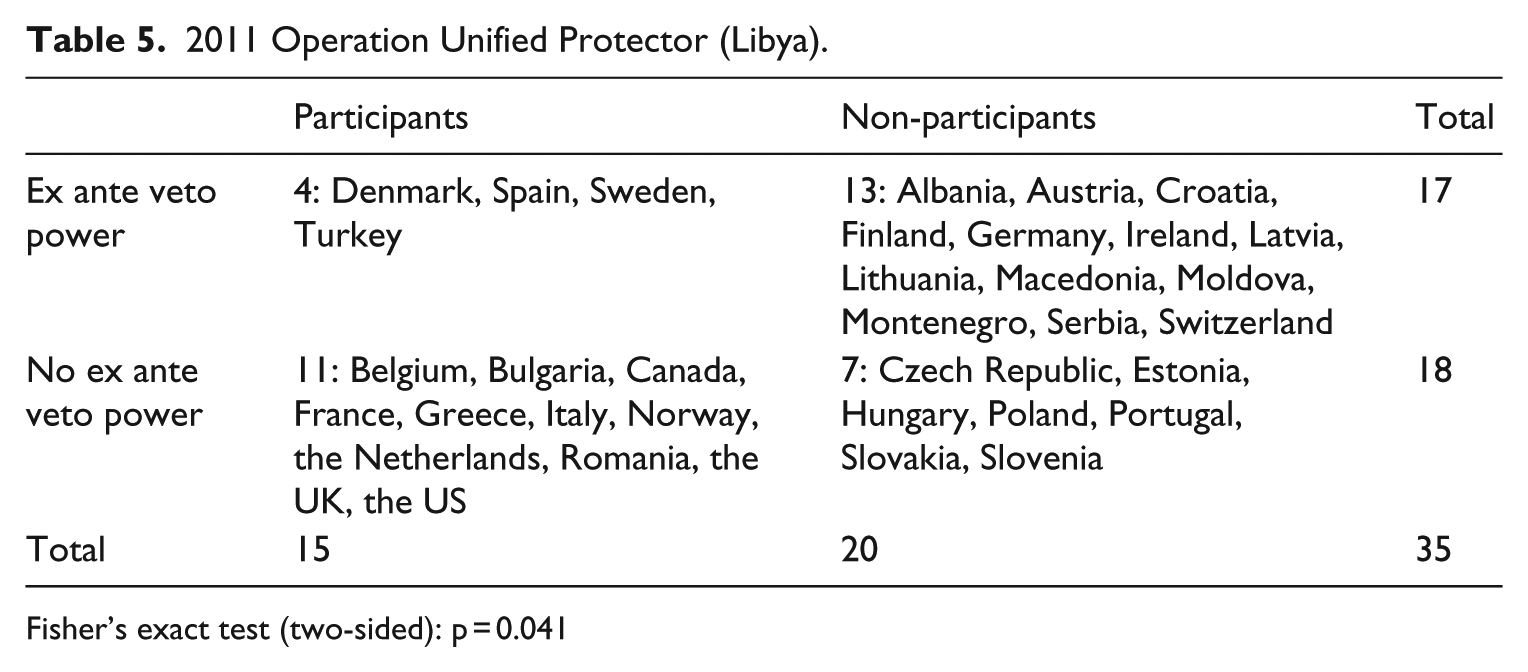
Fisher’s exact test (two-sided): p = 0.041
2014 So-called Islamic State.
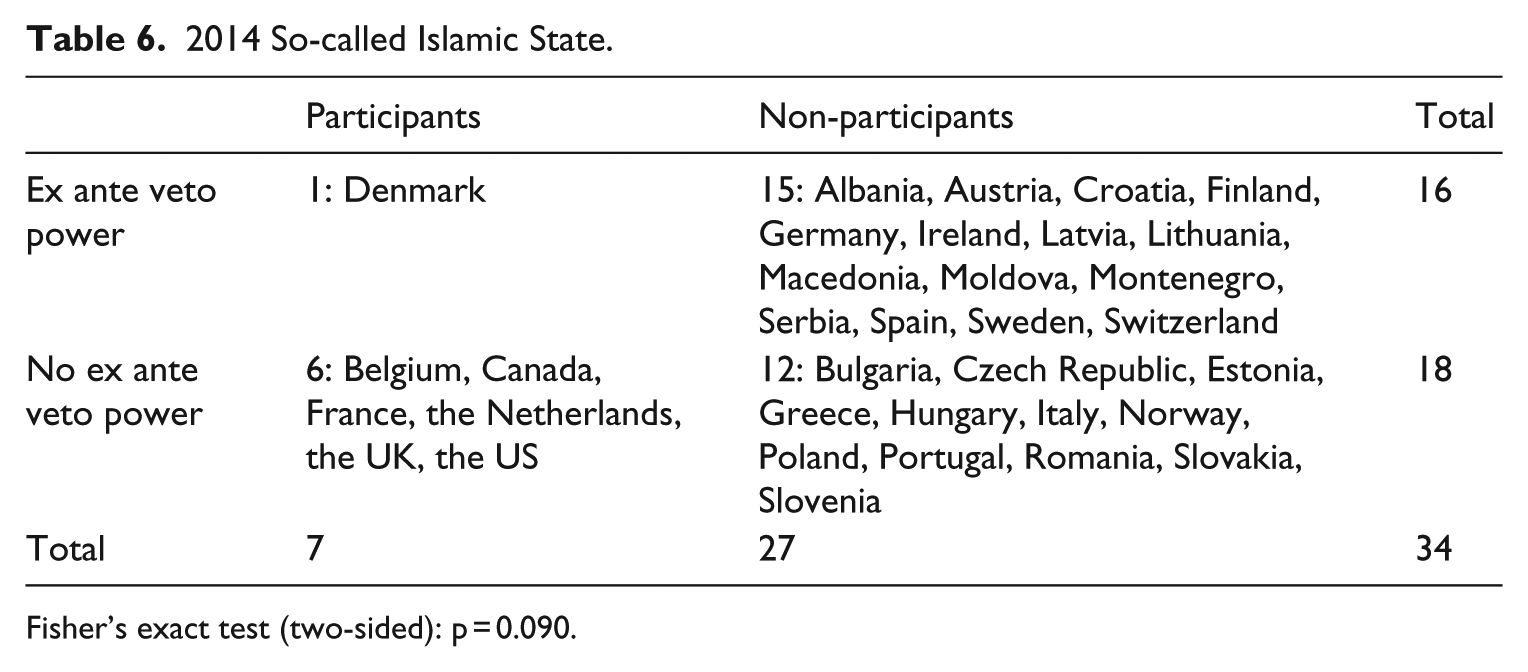
Fisher’s exact test (two-sided): p = 0.090.
The data show that for all missions together, there is support for the parliamentary peace thesis: whereas a majority of intervening states has no parliamentary ex ante veto powers, the majority of non-intervening states has such a veto, and this difference is statistically highly significant. However, this finding does not hold for every individual mission. The correlation between war powers and (non-)participation is statistically significant at the 0.05 level for the 1999 Kosovo mission and the 2011 strikes against Libya and at the 0.1 level for the campaign against Daesh. However, for OEF and Iraq, the expected pattern is not present, let alone statistically significant.
Among the findings on individual missions, the one on Iraq is the most surprising as it directly conflicts with the study by Dieterich et al. (2015), who found strong evidence for a parliamentary peace. A closer look reveals that the difference in findings does not primarily result from the addition of countries that were not members of the EU (and thus excluded by Dieterich et al., 2015). Instead, the difference results from the use of Mello’s data on (non-)participation that include the period between May and August 2003, which is excluded from Dieterich et al. (2015). In this period after the declared end of major combat operations, countries with parliamentary veto powers such as Estonia, Macedonia, Latvia, Lithuania and Romania contributed troops—against the expectation of the parliamentary peace hypothesis. Proponents of the parliamentary peace may point out that countries which contributed troops in the period between March and May 2003 participated in a war of aggression that lacked the authorisation from the United Nations Security Council. In contrast, countries joining the coalition after May 2003 could refer to an appeal by the United Nations Security Council to help rebuild the country and contribute to security and stability. Although this change in international legal status does not lower the risks for the troops on the ground, as subsequent casualties demonstrate, it impacts on public support in liberal democracies. The finding on the 2003 Iraq operation is thus best understood as a qualification, rather than a rejection, of the parliamentary peace.
The pattern of findings across missions suggests that the character of the mission has an impact on whether parliamentary war powers constrain government participation. At the same time, the variation across missions makes it unlikely that relatively stable factors such as military capabilities or government system can account for this variance. 12
What sets the missions in Kosovo and Libya apart from OEF and the Iraq War is their justification as humanitarian interventions. In 1999, air strikes against targets in Serbia were justified by the necessity to stop the violence by Serbian forces against ethnic Albanians in Kosovo. Similarly, the 2011 strikes against Libya were based on United Nations Security Council resolutions 1970 and 1973 that invoked the Responsibility to Protect (Adler-Nissen and Pouliot, 2014) after statements by Libya’s Muammar Gaddafi led to fears of an imminent massacre of civilians. In contrast, the justifications for OEF and the Iraq War emphasised self-defence: OEF started a day after an ultimatum, issued by the US government to the Taliban regime in Afghanistan to hand over the leadership of al Qaida, elapsed. On 18 September, Congress had authorised the US President ‘to use all necessary and appropriate force against those nations, organisations, or persons he determines planned, authorised, committed, or aided the terrorist attacks that occurred on September 11, 2001, or harbored such organisations or persons’. 13 Prior to this, the North Atlantic Council of NATO decided that the attacks ‘shall be regarded as an action covered by Article 5’ 14 in case they were directed from outside the United States. On 2 October, the North Atlantic Council noted that the attacks indeed were externally directed and therefore considered an attack against all members of NATO.
Humanitarian and self-defence rationales blend in the justification of air strikes against Daesh in the case of the imminent threat to the Yazidis in northern Iraq. Thus, a humanitarian motive was the main trigger for air strikes in 2014. At the same time, however, the initial air strikes were justified with a reference to a request from the Iraqi government that had asked for support in its efforts to defend itself against Daesh (Ruys and Verlinden, 2015). Moreover, later extensions of the air strikes against targets in Syria followed a self-defence rationale that was fuelled partly by Daesh’s use of Syrian territory as a base for operations against the Iraqi government, partly by the invocation of (collective) self-defence by the French government after the terrorist attacks in Paris in 2015.
The limited impact of parliamentary war powers on (non-)participation in (collective) self-defence missions can be attributed to the efforts of states to signal their support for key allies, either out of genuinely felt solidarity or in anticipation of future support in return as well as to the political pressure that key proponents of intervention exert on reluctant states.
After the 9/11 terrorist attacks, the United States left little doubt that it was ‘willing and able to take successful military action against the Taliban and Al-Qaeda without allied support’ (Davidson, 2011: 131). However, many liberal democratic governments expressed their readiness, if not eagerness to actively support the United States in its war against terror. OEF became the umbrella for a broad coalition of states that wanted to join an intervention in Afghanistan. The extent to which support resulted from genuinely felt solidarity or from opportunism, that is, in anticipation of reciprocal future support from the United States, is difficult, if not impossible to determine. In any case, to the community of liberal democracies, it was clear that their participation was not militarily necessary but of potentially high symbolic value. As a consequence, ‘alliance value’ (Davidson, 2011), that is, an assessment of the importance of ties with the United States, played a key role in decision-making. The German case may serve as an illustration. After his declaration of ‘unconditional solidarity’, Chancellor Schröder was determined to contribute troops to OEF. Given widespread opposition in the governing coalition, the only way to have his parliamentary majority endorse this decision was to link the deployment vote to a motion of confidence. With 336 to 326 votes, the decision to participate in OEF was the tightest in more than 140 deployment votes.
After two years, self-defence was again invoked by the United States while preparing for the war against Iraq. 15 In contrast to the immediate aftermath of 9/11, however, the eagerness among allies to participate was rather low, and the Bush administration resorted to a comprehensive set of carrots and sticks to create what critics called a ‘coalition of the bribed, bullied and blind’ (Gilfeather, 2003, quoted from Newnham 2008: 183). Newnham (2008) has argued that this policy of economic linkage has often been effective. Furthermore, Newnham (2008: 197) argues that some states such as the Baltic countries, participated in the Iraq War to secure US support in a future conflict with Russia. Although some states, most prominently France and Germany, resisted the pressure, many others, especially in central and eastern Europe, seized the opportunity to demonstrate transatlantic solidarity (Schuster and Maier, 2006).
To be sure, alliance politics also played a role for Operation Allied Force and Operation Unified Protector. The former in particular was widely seen as a test for NATO in its 50th year of existence, and Germany’s abstention in the UN Security Council vote on authorising force against Libya was certainly frowned upon. Nevertheless, neither the United States nor other proponents of intervention exerted much pressure on liberal democracies to make a military contribution.
Conclusion
This article provides modest evidence for a parliamentary peace. Taking five prominent military missions of the past twenty years together, countries with a parliamentary ex ante veto power are less likely to contribute to a military mission than countries without one. However, a closer examination of individual missions demonstrates that such a pattern is only statistically significant for three of them: Operation Allied Force, Operation Unified Protector and, though only on the 0.1 level of statistical significance, the campaign against Daesh. In contrast, countries with a parliamentary ex ante veto power were just as likely to join OEF and the Iraq War as countries without such a veto.
Proponents of the parliamentary peace may of course point to the limited number of cases and the skewed distribution between participants and non-participants in some military missions, all of which make statistically significant correlations less likely. At the same time, however, the findings reported here echo the studies reviewed above: the effect of parliamentary war powers is not robust and unconditional; instead, it depends on context conditions. Whereas Mello has identified government ideology, that is, the party political composition of government, as an important factor that interacts with institutional constraints, this article argues that the character of the respective mission qualifies the effect of parliamentary war powers. If a mission is framed as a test case of alliance solidarity, as was the case with OEF and the Iraq War, domestic institutional constraints can be trumped by alliance politics. If, however, countries enjoy more discretion in deciding on the use of force, domestic constraints such as parliamentary war powers have a tangible impact on government policy.
Open confrontation between parliament and government is rare in parliamentary systems and thus in the vast majority of countries studied in this article. Although the 2013 House of Commons vote that prevented the British government from striking Syria is a highly visible demonstration of parliamentary war powers, it is also deceptive. A more typical manifestation of parliamentary influence on decisions to use armed force are governments refraining from a military mission in the shadow of a parliamentary veto in case support is weak or absent. Although governments can always decide to whip the MPs of their party/parties into supporting the government line, such action is politically costly and more likely to be taken under international pressure than in its absence.
Footnotes
Funding
The author(s) received no financial support for the research, authorship, and/or publication of this article.
Notes
References
Supplementary Material
Please find the following supplemental material available below.
For Open Access articles published under a Creative Commons License, all supplemental material carries the same license as the article it is associated with.
For non-Open Access articles published, all supplemental material carries a non-exclusive license, and permission requests for re-use of supplemental material or any part of supplemental material shall be sent directly to the copyright owner as specified in the copyright notice associated with the article.
