




Abstract
Our present is marked by multiple failures: of governance; of care; of hope. Amidst the wreckage, we see numerous attempts – real and imagined – to keep hope alive by dreaming of a better future. Such utopian exhortations are fuelled by the idea that it is not too late – we still have time to correct our failures. This secures a particular futurity for failure: we speculate on a utopian tomorrow to counteract the pressing failures of today, and we implement lessons today to course correct for a better future. We argue that it is already too late for such social dreaming. We turn instead to the uneven potentialities of the current ‘failure-scene’ through accounts of non-redemptive failure that refuse the normative coordinates of hope; flatten the elongated present of the ruins; endure the event-oriented temporality of crisis thinking; and improvise with whatever tools and energies are available to us.
In the early weeks of 2025, a series of colourful posters and billboards were erected in major cities across the UK. Bold white letters on blue and red colour palettes announced It's the hope that keeps us here (see Figure 1).
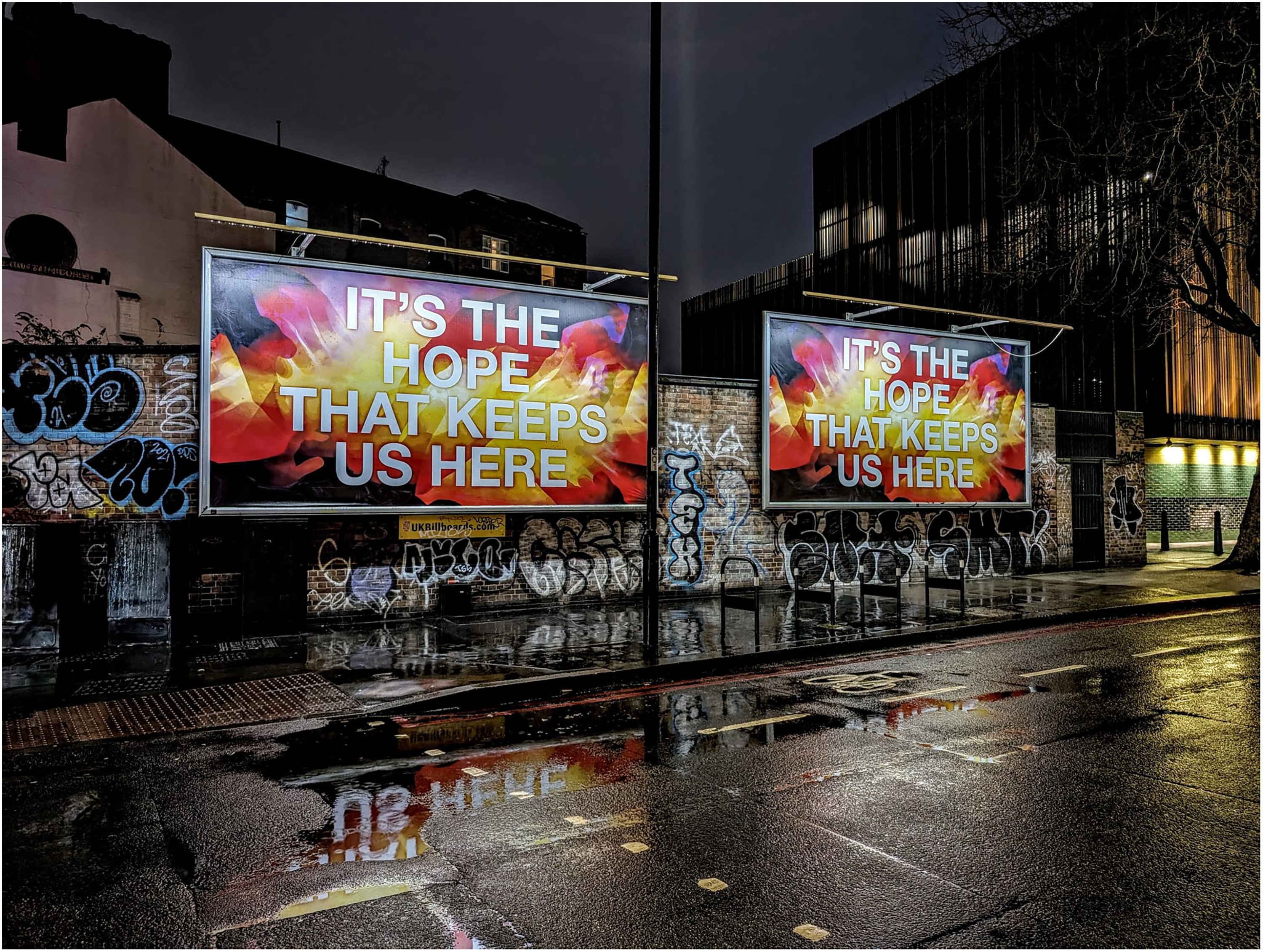
Poster, London, 17 February 2025 (Photo © Martin Coward).
The posters are the work of artist Mark Titchner in collaboration with BuildHollywoodTH (2025) – a collection of ‘creative street advertising specialists’ dedicated to bringing art and culture to the UK's urban landscapes (Burnham, 2025). The physical juxtaposition of these colourful exhortations to hope against the crumbling infrastructures of UK cities is striking. But perhaps more significant is the timing of their emergence – a reassuring message that hope persists despite the mounting global catastrophes of the moment (e.g. new Covid strains, bird flu outbreaks, violence in Ukraine, starvation in Gaza, famine in Sudan and the ever-present climate change-induced flooding, heatwaves and droughts).
We begin with these posters because they exemplify the most common – and indeed, most seductive – response to the increasing quantity, scope and force of the global failures we currently face. Encouragements to be hopeful in the face of such devastation express a longstanding theme in Utopian Studies and utopian thinking more generally (Levitas, 1990; Moylan, 2020; Zournazi, 2002). Indeed, Titchener's posters channel a utopian sensibility in which hope enables us to collectively confront the mounting failures of the here-and-now and work hard to produce a better future. Such hopefulness operates through a redemptive dynamic: the promissory note of hope will be redeemed for a better future if we endure our present failures. Importantly, the utopian insistence on hope is not naïve or superficial – it does not shy away from the palpable evidence of our current failures. In this dynamic, failure is a necessary prompt to utopian thinking, and ‘hope’ gives shape to whatever better future is imagined – whether an abstract utopia of a distant place and/or future time, or a concrete utopia oriented to a better future but actively lived in the present. In Titchener's posters hope sustains us – it ‘keeps us here’ and prevents us from abandoning the present and giving up on our ability to repair our current failures. We start with these posters because they reveal the political temporality that brings failure, hope and utopia together. All imaginings of utopia, from the most abstract to the most concrete, construct a tether from a broken, failed present to a projected, better future. That tether – whether thick or thin – is constructed and maintained by hope.
In our contemporary milieu of overlapping failures, the tether of hopefulness is consolidated through appeals to urgency. The impact of our current failures can be avoided with sufficient hopeful action in the present, provided that such action begins immediately (Lynch & Veland, 2018). Hope is necessary now, or it will be too late. Urgency, then, is central to a utopian mode of address because it reassures us that we still have time to make a difference – the ‘not yet’ future is still flush with possibility and if we act now, we can course-correct into a better tomorrow. Urgency is therefore the ground for hope; after all, there is no possibility for hope if it is too late. Importantly, ‘acting now’ can only begin by directly confronting the grim realities of our present day failures – a confrontation that consolidates the mutually productive relation between failure and hope in utopian thinking. The key relation here is a temporal one in which present failure is redeemed for a better future and the two are connected by hope grounded in urgency (we can hope, but only if we act quickly). If hope is the temporal thread between failed present and redeemed future, urgency is the anchor that makes this tether possible.
In contrast to discourses of urgency, we offer an alternative reading of the political temporality of failure: we argue that it is already too late. As such, there is no urgency to anchor our hopefulness. We cannot, therefore, rely on hopeful (utopian) dreaming to deliver us from the grim realities of the present into a shiny new future: we will have to live fully with failure in the present without any tethers to a better future. The politics of catastrophic climate change are instructive in this regard: in March 2023 The International Panel on Climate Change (IPCC) warned: ‘There is a rapidly closing window of opportunity to secure a liveable and sustainable window for all’ (IPCC, 2023), but by the end of 2024 the world passed the 1.5° warming threshold marked as the tipping point by previous IPCC reports (Poynting et al., 2025). Despite increasingly hysterical calls for urgent action, a failure of global policy will soon become a failure of global ecosystems. It is too late to rely on hope, too late to enact methods of repair, and too late to believe in a better tomorrow: we are already in an era of unrelenting and irreparable failure. We argue, following Calvin Warren (2015, 2018, 2021), that hope in fact does the opposite of what is imagined in Titchener's posters: instead of sustaining us by giving us a tether to a better future, hope traps us here in a present through a focus on the yet-to-come future rather than the failures of the present. The tether of hope captures us in an endless deferral of meaningful responses to present-day failures. All of our hopefulness in the face of the crushing failures of the present actually sustain those ruins, and, perhaps worse, keep us from generating the arts of living required to live and die well in the rubble of our failures.
In this paper, we challenge the redemptive temporality of utopian hopefulness by considering what it might mean to dwell in the ruins of a world when we acknowledge that it is too late: there is no hope to tether us to a utopian future. Instead of formulating another normative template for mitigating present-day failures, we consider practices that unfold in the ruins but are not tethered to a utopian future. We are interested in present-day modes of persisting, living and dying that are not beholden to the temporal logic of utopian hopefulness and therefore do not operate with pre-arranged modes of escape into a better future. Instead, we recognise that it is already too late, the disaster is here, and we must attend to the arts of living in the present rather than trying to transform catastrophe into a productive lesson for a better future. In this way, we seek to go beyond utopian understandings that suture the catastrophes of the present to a better future and instead move towards a politics of non-redemptive failure that unfolds in an elongated present.
The failure-scene
Our contemporary moment is characterised by multiple, simultaneous, interacting failures at the global level. World leaders and politicians acknowledge that combined anthropogenic catastrophes such as climate change, pandemics, financial collapse, geopolitical conflict, income inequality and disruptive technologies are amplifying each other. As UN Secretary-General Guterres acknowledged at the annual Davos meeting in 2023, ‘our world is facing a perfect storm’ (World Economic Forum, 2023). Instead of prioritizing one single crisis over another, the UN now issues an annual ‘Interconnected Disasters Risk Report’ (IDRR) to acknowledge how global failures are coalescing (UNU-EHS, 2023). Because it now considers climate change, disease and the dangers of AI alongside its original focus on nuclear annihilation, the famous Doomsday Clock has moved 10 s closer to midnight (Bulletin of the Atomic Scientists, 2024). All of these narratives of interconnected risk represent interlinked failures: of governance, action, ecosystems and more.
Public discourse has offered neologisms to help us understand these connections: polycrisis, metacrisis, permacrisis and cascading failure. All of these indicate that the world is now more vulnerable because it consists of complex systems and infrastructures that are deeply interconnected; that is, failure in one domain cascades into all the other domains (Homer-Dixon & Rockström, 2022; Lawrence et al., 2024). Statesmen, leaders, diplomats and scholars acknowledge the growing interconnectedness of failure, but we all feel these pressures, to different degrees, in our everyday lives (Morton, 2018; Scranton, 2015). Mental health experts have shown how this abundance of systemic failure produces greater levels of depression, anxiety and unhappiness in individuals (Gordon, 2023; Teepe et al., 2023). The infrastructures, institutions and networks designed to hold our collective lives together seem to be crumbling as hospitals, schools, community centres, transport networks and supply chains are in a state of collapse with no prospect of repair. Right-wing and populist leaders are capitalizing on these systemic failures to challenge the liberal-democratic norms designed to manage social and economic differences (Abrahamsen et al., 2024). President Trump, for example, began his first term by itemizing the multiple failures caused by previous administrations: Mothers and children trapped in poverty in our inner cities; rusted-out factories scattered like tombstones across the landscape of our nation; an education system, flush with cash, but which leaves our young and beautiful students deprived of knowledge; and the crime and gangs and drugs that have stolen too many lives and robbed our country of so much unrealized potential. (Trump, 2017)
All of this confirms that we are living in an era of multiple failures. We use failure-scene to distance our formulation from dominant crisis-framings that shape failure as a discrete event with an implied origin, duration and ending. In contrast, we understand failure as a pervasive and defining dynamic of our time that cannot be reduced to a singular problem/solution logic (Lisle, 2025). Failure is our mise-en-scene – an irreducible aspect of the Anthropocene that cannot be ignored, escaped or overcome. Rather than hope our way out of the interconnected and overlapping failures we find ourselves in, we propose to dwell more fully inside them in order to identify practices that are indifferent to the lures of hopeful utopian dreaming.
Failure, social dreaming and the utopian impulse
It comes as no surprise that the interconnected failures of our time have led to a resurgence of utopian thinking to help channel our hopefulness into solutions for the future. This (re)invigoration of utopian thought is a reminder that people have always responded to failure by imagining, and sometimes enacting, better worlds. The most prominent formulation of failure within Utopian Studies is articulated by Jameson: ‘failure is a condition of possibility for the utopian impulse’ (Happe, 2024, p. 176; Jameson, 1982, 2005; see also Levitas, 2013; Sargisson, 2012). While Jameson was noting how utopian thought is built on – and animated by – an implicit understanding that dreams of better futures will fail, we read him in a more empirical manner: utopian dreams are anchored in hopeful encounters with present failure. Central to this logic is the utopian practice of ‘social dreaming’ – the acts of imagining, speculating and projecting a better future that arise in the collective encounter with present-day failures. Utopian social dreaming is a mode of thinking that seeks to respond to failure, and as such, positions failure as the central driver for thinking and acting otherwise. For utopian thinkers, failure is not an irretrievable marker of collapse or despair, but rather a productive force animating the social dreaming required to imagine and enact the ‘yet-to-come’ better future. Failure may be difficult, but it is intended to spur us on to action that will achieve a better future. For Thaler (2023, p. 446), the resurgence of utopian engagements with failure is an effort to ‘rehabilitate what is positive about failing’. As such, the challenge for Utopian Studies is to ‘find opportunities for safe failure’ – that is, failure that is not failure at all, but some kind of curated opening for social dreaming. This is what he means by ‘failing better’ in the future (Thaler, 2023, p. 447).
By developing Jameson's insight that utopian social dreaming is animated by failure (not least because we cannot escape the ideological structures of our current moment and so the utopian dream will never be fully other than the current catastrophe), recent utopian thinkers have focused on the capacity for social dreams to change present conditions. In comparison with the disappointing failures of the present day, Levitas (2013, p. xvii; see also 107) argues that a future of non-failure functions as a ‘regulative ideal’ that governs our present-day concerns. This aligns with our claim that hope tethers our present conditions to an always yet-to-come better future. Critical Utopian scholars, drawing largely from Bloch, focus on concrete or ‘everyday utopias’ in the here-and-now, and therefore construct a minimal tether between the present-day ruins we are trying to rearrange, and the better future guiding that rearrangement (Cooper, 2013; Davis, 2021; McManus, 2003). This work asks important questions about the character, scope and effects of this minimal tether to a better future and explores the extent to which it guides action in the present. For example, Happe (2024, p. 173) reconfigures this tether to a better future as a kind of estrangement from the failures of the present day rather than a regulative ideal – a more complicated and opaque attachment that ‘enacts the piecemeal building of another world even as it is grounded in present-day possibilities’. Garforth (2009, p. 9) goes further by dispensing with the linear intentionality that guides the utopian impulse to escape present-day failures, and instead and offers a more ‘processual, critical, reflexive, open-ended and immanent’ formulation of utopian thinking that attempts to tether it more carefully to the present.
These critiques of the regulative force of futurity within utopian accounts of failure are important because they open up the ‘here and now’ not as a lamentable wasteland that must be escaped, but as a powerful site where better forms of living are being dreamed and enacted. To be sure, these critical formulations offer more heterogeneous and perhaps less dogmatic understandings of the way hope tethers the failures of the present day to some kind of better future. For us, however, the central normative project of utopian thinking remains: to find productive future possibilities in failure. These commitments may be minimal, open-ended and oriented to the concrete utopias being forged in the here-and-now, but a palpable – and hopeful – attachment to futurity remains. Thaler (2023, pp. 435–436) offers the most succinct account of the normative energy in utopian thinking that shapes its approach to failure: the point is not just to offer ‘a more granular analysis of how failures occur concretely’, but also to figure out ‘what can be done about them’ (our emphasis). In this formulation, Utopian Studies must diagnose failure and propose trajectories out of it.
While we appreciate these critical formulations, we are troubled by the normative energy of utopian thinking that constantly subjects failure to the demands of transformation, improvement and uplift. Failure can never be left as it is: unruly, turbulent, irretrievable. While explorations of concrete utopias helpfully challenge the regulative ideal of futurity, the central impulses of redemption and repair that guide utopian social dreaming remain intact. In other words, the overriding goal of utopian thinking is to respond to our present-day failure-scene in a way that corrects, repairs and redeems it as a way to build a better future. To be sure, critical formulations of concrete utopias offer more attenuated, heterogeneous and present-focused tethers to a better future, but these reconfigurations do not dispense with the temporal drive to make the failures of the present productive for a better future. For us, the idea that we can fail better tomorrow works to retain futurity as a regulative ideal – albeit immanent, reflexive and open-ended – that continues to disavow the political demands of our present-day failures. Being ‘open’ to the experience of failure in the present tense is always pre-oriented to the lessons that failure's discomfort can teach us. The content of the lessons from failure may be plurivocal and heterogeneous, but even for critical utopians, there must always be a lesson learned from failure that will guide us to a better future (Lisle, 2025).
This reassurance that we can redeem – or recover from – our present-day failures is especially important when those failures are understood to be urgent. Our ability to transform failure into something productive gives us confidence that no matter how urgent a failure is there is always time to make things better. It is this temporal core that makes utopian accounts of failure hopeful: there is still hope because there is still time to act. And it is this hopefulness that is directly challenged if we start from the position that it is already too late. No amount of acting in the present can reverse, correct or repair the damage that has already been done. Failure is irretrievable. It cannot be made productive or redeemed. Its intractability, recalcitrance and withdrawal make it unavailable for uplift and improvement, and therefore immune to utopian social dreaming of a better future. By putting the current failure-scene together with the generative work of critical utopians, we open a doorway to a different consideration of failure. We are not interested in producing a template for action or a recipe for repair: we are interested in moving towards a politics of non-redemptive failure that is not tethered to a regulative futurity and therefore not available for repair.
Hope and the toxic politics of deferral
For us, the redemptive promises of utopian dreaming – however minimal – constitute a toxic politics of deferral in which the resolution of impending catastrophe always takes place in the future. Such deferrals are constructed to enable specific interventions in the present that pre-emptively bring into existence a singular future that favours the architects of such present-day interventions. This is exemplified by Warren's (2018) account of the ‘tyranny of hope’ of black electoral politics in the US. For Warren, hope is a deferral of politics towards a never fully realised future. The promise is clear: present grievances and past injustices will be resolved in the future through active present engagement with the electoral system. However, that promise operates through a constitutive deferral. While any election may deliver a particular result, no election delivers a full resolution of grievance or injustice. For Warren, this deferral demands living with present injustices delivered by an imperfect electoral system in exchange for the promise of future redemption. Thus, desires for justice, reparation or equality are subordinated to an electoral system that promises representation that will lead to a better political future, but never fully delivers this promise. What Warren demonstrates is that the electoral system itself – the infrastructure of democracy – is a tyrannical deferral of politics now (e.g. demands for justice, equality, reparation) in favour of the promise of the realisation of a future political ideal. And since that ideal is only ever approximated at any given election, the deferral becomes infinite. The concrete problem, for Warren, is the racialized nature of the way this plays out in the American electoral system – it's not just that racialized groups must subordinate more claims for justice than others (because they have been so unjustly treated by white supremacy), it's also that the benefits of subordinating these claims to the electoral promise are never evenly distributed. What we are left with is an electoral system that relies on the constant subordination of demands for justice, unequal distribution of any gains, and thus the constant deferral of the ideal. Voting for historically marginalised groups is thus a cyclical deferral of politics – a constant subordination of present claims to the promise of a better future that is never fully realised and thus requires a further subordination to yet another promise.
One answer to this logic of deferral has been proposed by advocates of ‘radical hope’ – the more catastrophic the present day has become, the more radical our hope for the future must be. We hear these claims in the current resurgence of utopian thinking, including variations of ‘creative’ and ‘deep’ adaptation (Bendell & Read, 2021; Lear, 2008), manifestos for ‘collapsology’ (Servigne & Stevens, 2020) and Thaler's (2024, p. 324) advocacy of ‘a diffuse, but efficacious faith in the redemptive potential of a fraught and uncertain future’. However, because we start from the proposition that it is too late, these articulations of hope – however radical – always install a temporal dynamic of deferral. That is, any confrontation with present-day failures is always tethered to the promise of future redemption – but it is a redemption that never arrives. Instead, we turn to Warren's (2015) formulation of black nihilism because it exposes the ‘devastating logic’ of hope: any normative fantasy of ‘perfection, betterment and redress’ – even the most radical – works to sustain suffering. For Warren, any futurity generated by the contemporary norms of politics – even futures acknowledged to be uncertain, open-ended, undisclosed, or immanent to the present – entail the enactment of violence on black bodies. There is no ‘redemptive potential’ in hope or the toxic politics of deferral it enacts. Such ‘solutionism’ evacuates the messy catastrophes of the present in order to install a course-corrected pathway into an already-redeemed future (Lisle, 2025). Warren's critique of hope is important because it challenges the temporal politics of utopian social dreaming that is tethered to a better future. Insofar as utopian thinking makes failure productive in the present and recuperates it with the promise of things being otherwise in the future, its hopeful politics are also a toxic politics of deferral. As such, it evades the question of what it means to live with the failures of the present day without escape. We do not read Warren's critique as simply nihilism, miserabilism or catastrophism; rather, we understand it as a necessary exposure of the politics of deferral and a deep reckoning with our current failure-scene without the toxic promise of a utopia yet-to-come.
A different starting place
For us, utopian thinking – including explorations of concrete utopias and radical hope – remains wedded to a politics of deferral that holds onto the temporal structure of both possibility (i.e. there is still time to respond to catastrophe) and progress (i.e. actually doing something in the here-and-now orients us to a better future). Such utopian thinking – insofar as it offers ways to move on from failure – affirms a normative futurity. Our point is that utopian thinking is impotent in the failure-scene of the here-and-now. If it is already too late, there is no non-failing future to tether ourselves to. This is what we mean by the irretrievability of failure – it cannot be made productive in a way that discharges its difficult and painful effects. We may not want to admit to ‘ugly feelings’ (Ngai, 2005) like despair, resignation and ennui because they undercut the tenacious discourses of optimism that doing something now will deliver good results later. We take the opposite view: we see these ‘ugly feelings’ as important acknowledgements that our actions are already too little, too late. Instead of trying to retrieve failure and make it productive for any kind of futurity, we mark these feelings as the starting place to lean more fully into the failure scene. What might happen if we stop all this dreaming and hoping?
For us, failure's irretrievability encourages a stubborn presentism. If it is already too late for hopeful futurity, we must turn our attention instead to the potentialities of an elongated present – what Tsing (2015) calls the ‘arts of living in capitalist ruins’. We see failure as a central feature of these ruins and we are deeply curious about the multiple affects, forces and attachments currently circulating there. We are not overwhelmed by the too late – quite the opposite. We look carefully at what is already happening and what has always been happening for those that operate (and have always operated) under the duress of failure. By inhabiting a relentless and elongated present without a tether to the future, we ask what is already unfolding in the failure-scene under conditions of precarity, duress and exposure? What modes of relation come to matter in the failure-scene? Is there something meaningful – something non-redemptive – that might orient us differently to the multiple formations of catastrophe already unfolding in our midst? Instead of comforting ourselves with reassuring normative futurity, we seek instead to honour failure's irretrievability by examining already existing efforts to live in, through and with its irresolvable predicaments. We are not interested, therefore, in investing more energy in utopian social dreaming: instead, we want to think about modes of present-day persisting, living and dying in the ruins that are not pre-scripted by the arc of redemption. To foreground the irretrievability of failure, we consider four modes of engagement – refusing, flattening, enduring and improvising – that do not traffic in hope or optimism but instead reveal the kind of politics that might be possible when we sit with failure in all its uncomfortable forms.
Stubborn refusal
We develop failure's irretrievability by turning to Frank Wilderson's (2015, 2020) refusal of narratives of redemption. As Wilderson (2015) explains, [f]oundational to the labors of disciplines housed within the Humanities is the belief that all sentient beings can be emplotted as narrative entities, that every sentient subject is imbued with historicity, and this belief is subtended by the idea that all beings can be redeemed.
Crucially, he goes on to argue that such narrative emplotment is ‘inaccessible to Blacks’ who are not part of the historicity that promises redemption: they are the ‘abject inhumanity’ who do not possess a narrative arc at all – only a ‘flat line’ of ‘historical stillness’. Wilderson's point is that the humanity taken by Slavery can never be redeemed – it can only ever be endlessly deferred because it is the constitutive source – the ‘master signifier’ – of redemption's power for everyone else. Like Warren, Wilderson refuses the temporal structure of deferral. If there is no redemptive arc, only stillness, there is no futurity, no time in which failure can be retrieved and made productive of another way of being. It is a powerful refusal of the utopian desire currently animating progressive politics (which might explain why it has been so controversial in liberal-left political circles). It is a profound recognition of the constitutive stuckedness (Hage, 2009) of black subjectivity – a refusal of the idea that such subjectivity could, with enough dreaming, become unstuck and move forward. We take these Afropessimist accounts of refusal seriously because they expose the limitations of the redemptive utopian dream of progressive politics.
The stubborn refusal articulated in the works of Warren and Wilderson is the starting point for understanding failure differently. These ideas show us what it means to turn away from the overwhelming desire to be redeemed – to actively refuse the seductive dreams of re-entering supposedly ‘universal’ categories such as humanity. Their configuration of black subjectivity as a ‘flat line’ aligns with our understanding of failure's irretrievability: if it is already too late, then nobody can be redeemed. Refusal fully recognizes that when it is already too late, promises of redemption are not only hollow, they are also pointless. There is no time left for filling in the perceived absence with whatever equilibrium is thought to have been disrupted, damaged or lost. This gesture of refusal reorients us to what else is going on in our elongated present: it gives us a way to reconsider a much bumpier terrain of failure and explore the lively political formations that persist in this ‘abandoned site of inquiry’ (Warren, 2018, p. 27).
Afropessimist accounts of refusal are important because they contest the dominant frame of affirmatory politics that seeks to transform failure into something productive. Refusing hope, affirmation and redemption are necessary opening gestures that allow us to think about what it means to live in a condition where failure is irretrievable. This is not a form of unrepentant nihilism, nor does it mean that nothing can be done. Rather, it means that we refuse the temporal logic of a futural politics – a politics in which a present day of multiple failures is always judged to be lacking in relation to a bright, shiny future. If it is too late, we must turn to what we already have, to what we are already doing, to how we are already living and dying amongst the ruins of the present.
Flat sensibilities
In order to take up the challenge of living in the failure-scene in a way that refuses the redemptive arc of social dreaming, we put Wilderson's concept of the ‘flat line’ in conversation with Tsing's formulation of ‘life in the ruins’. For us, the ruins include everything that is used up and discarded by modernity's ordering fantasies of progress. This includes any body, life-world, mode of relation, or communal endeavour that does not (or will not) fit into those ordering fantasies. Like Tadiar (2022), we understand the ruins as the remainders of those life-worlds that have been colonised, extracted, emptied and abandoned. We do not romanticize the ruins as a nostalgic vision of a past fallen into abeyance that we seek to revitalise (as nationalists frequently do). To do so would only reinstall an order that is structured through futurity as a regulative ideal and foreground a pathway towards redemption that would allow us to ‘get back’ what has been lost in the ruins.
In contrast, we understand the ruins of the present as the rubble, detritus and waste within which humans and non-humans co-ordinate to make worlds. Following Tsing and Tadiar, we are interested in the common structures of feeling that emerge and endure in these ruins but are not pre-attuned to repair, resolution or redemption. These structures of feeling – like the mushroom pickers foraging in Oregon's Cascade Mountains (Tsing, 2015) – represent a way of living with and in the ruins. We see these affective orientations as deeply speculative, but not in a way that references hope, installs a progressive futurity, or demands an affirmative politics that recovers failure as a productive force. Rather, we look to practices of dwelling within the ruins with no predetermined escape route. Referencing Wilderson, we might call this a flat, non-redemptive politics – what Lisle (2025) has referred to as ‘muddling through’. It is a politics of failure that seeks to inhabit an elongated present without a regulative future ideal that would, once again, defer the political task of enduring the present failure-scene.
Critical utopians have attempted to reclaim social dreaming ‘for those who have lacked access to normative subjectivities, temporalities and the affects attached to them’ (Happe, 2024, p. 173). This might be understood as trying to make utopianism work for those who most bear the burdens of our present-day failures – the excluded, the marginalized, the remaindered, the dispossessed: those dwelling in the ruins. But in addressing life in the ruins, we access a very different archive than the utopian tradition. We are interested in those who have long endured living in and through failure – not just their sustained (and sometimes ferocious) contestations of normativity, but also their much more capacious, dynamic and creative engagements with failure. Our account of non-redemptive failure resonates with an archive of thought that resists the regulative ideal of hopefulness: the sociality and fugitivity of the Undercommons (Harney & Moten, 2013); the figurations of mobility and waywardness that do not obey the dictates of either shame or uplift (Hartman, 2019); the stubborn modes of cruel optimism that keep us attached to toxic modalities of progress even as they work against our thriving (Berlant, 2011); the uneven aftermaths of structural violence that refuse to disappear (Sharpe, 2016); the speculative forms of coordinated action that are attempted by abandoned, disposable and exhausted populations (Povinelli, 2011, 2016); and the creative opportunities for reconfiguring oppressive social norms offered by what Halberstam (2011) calls the queer art of failure.
Importantly, we do not access this archive in order to build new foundations of resilience, tenacity or even adaptability. Indeed, fantasies of resilience are also structured by a futurity that promises an escape out of the ruins of failure and into a redeemed future (i.e. failure is impossible in the future because we possess the skills to ‘bounce back’ from any misfortune). But as our archive of failure-oriented thought indicates, this bulletproof future is always out of reach – constantly deferred by its architects to ensure obedience, striving and docility. The flat sensibility we invoke here is simultaneously a determined refusal of those lures to productivity, and an equally determined investment in microsocial navigations of, adjustments within and manoeuvres through, the failure-scene.
Crafting endurance
Reorienting ourselves to the elongated present of the failure-scene requires a reconfiguration of not only its sensibility, but also its temporality. This means taking failure out of its familiar frames of catastrophe, crisis and spectacle (i.e. a discrete ‘event’ with a linear pathway to ‘solution’) and understanding it in much more mundane, everyday registers. Drawing on Nixon's (2013) formulation of slow violence, we seek to understand failure as a durable process of collapse that often unfolds over centuries rather than a discrete, time-bound and solvable crisis. When failure is understood outside of crisis frames and event-oriented epistemologies, it becomes possible see how life-worlds have always been crafted and adjusted in the midst of the collapse of modernity. Here, we draw on an eclectic archive of failure-thinking proposed by scholars, activists and artists practicing from within given landscapes of failure – Feminist, Black, Queer, Crip, Indigenous, Neurodiverse and Other bodies that conceptualize what it means to make life worlds in the ruins of the already failed (Halberstam, 2011; Lisle, 2025; Smigles, 2023).
Of particular interest for us are reconfigurations that contest a progressive trajectory from a failed present to a successful future in which we have learned and implemented the lessons of our failure. A good example of this temporal reordering can be found in Indigenous claims that they have already lived through the apocalypse and survived (Alter, 2020; Roanhorse, 2018). This is not a story of courageous ‘survival-against-all-odds’ that can be commodified into digestible ‘Lessons from Native Americans’ or used to amplify dominant strategies of resilience. Rather, it is a much more critical schematic of long survival and endurance that aligns with our account of failure's irretrievability (Whyte, 2018). Unsurprisingly, Indigenous scholars echo their Afropessimist comrades in formulating long survival as a modality of refusal that rejects the lures of hope and foregrounds endurance in the midst of catastrophe (Simpson, 2017; Tallbear, 2018; Wrightson, 2020). Particularly helpful are more elongated accounts of Indigenous life-worlds (e.g. Vizenor's (2009) ‘survivance’ and Gross's (2016) ‘Post-Apocalyptic Stress Syndrome’) that do not position Indigenous culture as having ‘bounced back’ from the apocalypse at all but instead articulate a very different mode of endurance in which failure is chronic and ongoing.
In order to think more carefully about failure's irretrievability in an elongated present, we draw on Baraitser's (2017, p. 10) formulation of failure that ‘can be worked with, worked through, but cannot be overcome’. Indeed, we find a great deal of affinity in her formulation of: modes of waiting, staying, delaying, enduring, persisting, repeating, maintaining, preserving and remaining – that produce felt experiences of time not passing. These are affectively dull or obdurate temporalities. They have none of the allure of the time of rupture, epochal shift, or change. They involve social practices that are mostly arduous, boring, and mundane, or simply unbearable. (Baraitser, 2017, p. 2)
What we find so generative in Baraitser's work is her insistence on foregrounding the experiences of suspension in the register of the everyday as a counterpoint to the privileged temporalities of the crisis or the event. What she points to, and what we seek to develop, is a formulation of endurance that unworks the dominant event-oriented temporality of crisis thinking that enables failure's utopian arc of repair, redemption and hopeful futurity. We are more interested in the everyday dynamics of failure as it is endured over time, not as a big event or rupture, but rather as much quieter and often slower practices of adjustment, manoeuvre and navigation. Our formulation of failure-as-endurance aligns with critiques of the dominant neoliberal mode of resilience in which one constantly improves by learning from failure. As Lisle (2023, p. 22) has argued: Endurance does not have the reparative arc of resilience: it carries no fantasies of correction, improvement, or progress. Instead, it is attuned to a much longer time horizon that facilitates small acts of simply getting on – of persisting – amid the structures, forces and fantasies arrayed against you … It is the cultivation of small adjustments in routine, the crafting and re-crafting of tentative attachments, and the ability to manoeuvre within landscapes of failure produced by dominant norms and discourses.
This non-resilient account of endurance helps us attune to what is already happening in the failure-scene that has accrued in the backwash of modernity. Non-resilient endurance shows us the ordinary, everyday and contingent registers of failure that are neither legible through event-oriented thinking nor pre-scripted towards redemption. It is not about failing better in order to craft a much improved future through social dreaming: it is about the everyday practices of persisting, living and dying without the lure of an escape route.
Improvising in the failure-scene
What interests us are the patterns of getting by that are more than survival but less than success, more than defeat but less than affirmation. From the gig economy to subsistence agriculture, we find patterns of life that endure the interlocking forms of precarity, vulnerability and contingency that structure the failure-scene without ever coalescing into an affirmative political project animated by the futural norm of social dreaming. Following formulations of refusal, time-in-suspension and non-resilient endurance, we explore creative forms of improvisation that unfold through practices of adjustment, manoeuvre, navigation and tweaking in landscapes supposedly devastated by failure. Improvisation, here, is not pre-oriented to resolve itself into a fully realised narrative – it is not a staging post on the way to a recognized or settled story. Rather, we understand improvisation as a much more speculative, tentative practice that must be taken seriously as a durable pattern of life whose minimal aim is to just keep going. Because these improvised arts of living unfold in the most mundane registers of everyday life, we do not conceive of them as an exceptional form. Instead, they are the microsocial movements, rhythms and practices that unfold in registers other than the dominant trajectory of redemption. While it may be deemed conservative to focus on enduring the present, we see this critique as itself predicated on the temporal lure of hope. It is a disavowal of innovative arts of living in favour of a dreaming that promises only deferral. It replicates the familiar politics of a self-appointed vanguard devaluing the everyday arts of living that have enabled the masses to live in the here-and-now, rather than deferring to an always yet-to-come future. Of course, these arts of living often subvert dominant social structures – they generate subcultural worlds that are parasitic on, but never fully dominated by, the norms of modernity.
Within broadly sociological efforts to bring theories of improvisation from music, dance and theatre into the register of everyday life (Closs Stephens et al., 2021; Dipiero, 2022; Hallam & Ingold, 2007; Peters, 2009), we are most interested in accounts that do not frame improvisation as liberation. Through Moten's (2003, p. 90) work, we understand improvisation as an anarchic disturbance that unfolds ‘between utopian aspiration and political despair’. In the black radical tradition, improvisation is a necessity rather than a choice: it is what happens when marginalized bodies under the duress of racial capitalism coordinate to make lives for themselves above the minima of survival but without succumbing to the normative lures of an always already racialized modernity. Although this creative life-making is always susceptible to commodification, co-optation or extinction by such norms, it is, for Moten, a generative modality of ongoing action (Harney & Moten, 2013, 2021). In the Undercommons, improvisation is what we do when we make something out of nothing, and it becomes both the method of our survival, but also the object of study for us as we try to understand our survival … Improvisation is life, it's what you do, it's what you need to do when you get up in the morning, because we don’t have any foresight about what's going to happen next. We prepare ourselves, as rigorously as we can, and improvisors prepare. But they prepare for the unforeseen, ‘cuz that's what life is’. It's the unforeseen. (Moten, 2014, 2:49–3:53)
Drawing on Lewis's (2007a, 2007b) claim that improvisation is ‘the ubiquitous practice of everyday life’, Moten's intervention suggests a more generative understanding of how the suspended temporality of the failure-scene might be inhabited. This is not a desire for re-entry into modernity's norms, the dogmatic zeal of revolution, or a collapse into defeat. Rather, it is a slower, more localised activity of getting by, of seeing what happens, of making it up on the fly.
We understand this suspended temporality as central to Moten's (2003, 2013) political reconfiguration of improvisation – an elongated present within which the liberal individuation so central to modernity can be refused and something else can unfold instead. Improvisation constantly troubles modernity's already-laid plans for futurity. It is not naïve about the future-to-come and the modes of duress that such a future will bring for already marginalized bodies, but it looks askance at the grid of intelligibility that social dreaming places on an unforeseen future (Moten, 2003, p. 63). Improvisation is a relentless effort to both stay in the elongated present and do the work required to reconfigure it otherwise, without a blueprint for what that otherwise will be. For Müller and Trubina (2020, p. 665), improvisation is ‘a generative concept to theorise the different modes of carving out a living between dominant structures and creative destruction’. For example, we hear ‘improvisation’ in Berlant's description of ‘the kind of movement one makes to keep some things open and to deflate and shift the shape of the others’ (Berlant & Povinelli, 2014). Because improvisation is a continuous practice of experimentation, it is always in-the-midst of happening. As Tsing (2004, p. 2) argues, ‘it is necessary to begin again, and again, in the middle of things’. Through Moten, we understand this continuous ‘beginning again’ as a wary acknowledgement of constitutive ongoingness – a habitual form of everyday interpretation through which we keep going, keep navigating, keep adjusting. Importantly, this modality of continuous improvisation is also a form of low-frequency refusal: undramatic, ongoing and persistent.
We do not romanticize the work of improvisation as always harmonious. It is not necessarily a smooth collaboration between improvisers who work seamlessly with one another in the service of a coherent storyline or melody. Following Tsing (2004, p. xi), we understand the failure-scene to be comprised of ‘zones of awkward engagement’ in which improvisation is sustained more by friction than it is by harmony. This does not prevent coordination but rather tempers improvisation within a pragmatic register of action in which tentative gestures towards collaboration are made with the full knowledge that they may not stick. It is a practice of collaborative tinkering, adjusting, trying, attuning and experimenting. It eschews the language of hope in favour of a stubborn pragmatism that feels much more appropriate to our reconfiguration of failure in the ruins of the elongated present.
Conclusion
Utopian social dreaming is part of the linear temporality of modernity – ceaselessly retrieving failure as a productive impetus for momentum into a better future. Such efforts to redeem failure are premised on the tyranny of hope, and, therefore, endlessly defer the delivery of promised redemption – whether justice, equality and diversity; or unity, loyalty and aggrandizement. We have proposed that the failure-scene requires us to confront the irretrievability of failure and refuse the futurity and hopeful narratives of redemption that characterise utopian social dreaming. Such a refusal demands a fundamentally different orientation to the failure-scene – a politics that is much more about dwelling, enduring and getting by than it is about optimism, hopefulness or striving. One of the most important modes of navigating such a refusal is improvisation – playing with, reconfiguring and riffing on the ruins without giving in to modernity's seductive story of progress. Improvisation is more than survival, but much less than an affirmative programme for a better future. It does not preclude moments of joy, but it never disavows ugly feelings such as discomfort, misunderstanding and loss. Improvisation is by no means the only non-redemptive practice in the failure-scene, and there is much more to be done exploring, for example, modalities of tinkering, maintenance and adjustment that endure as patterns of life but do not resolve into an affirmative political project. Our intention in this article has been to outline a politics of non-redemptive failure beyond utopian desire, beyond dreams of redemption, and beyond hope: a politics of refusal and improvisation that sits with the irretrievability of failure.
Footnotes
Acknowledgements
We would like to thank the organizers and participants of the Politics at the End of the World workshop at QMUL, and the organizers of the AHRC Fail Again, Fail Better? Network; the editors of EJST, and especially Reviewer 1, who asked the most generative and challenging questions.
Declaration of conflicting interests
The authors declared no potential conflicts of interest with respect to the research, authorship, and/or publication of this article.
Funding
The authors received no financial support for the research, authorship, and/or publication of this article.
