




Abstract
This article considers how the relational, post-anthropocentric and monist ontology of the new materialisms can inform a theory of the contemporary capitalist state, and how this perspective offers a distinctive resolution of some of the negative consequences of a capitalist mode of production. It summarises Deleuze and Guattari’s analysis of capitalism as an international/ecumenical social formation, founded upon a ‘capitalist axiomatic’: namely, the free flows of capital and labour required for the everyday workings of the capitalist market. The state is a material realisation of this capitalist axiomatic. The article then undertakes a more-than-human analysis of capitalist production and markets, supply and demand, in terms of affects and assemblages. The article invokes the metaphor of a ‘black hole’ to suggest that capitalism is not merely exploitative of workers, but a formation from which neither worker nor entrepreneur can escape once a participant. Furthermore, it is these more-than-human affects that produce undesirable consequences including uncertainty, waste and social inequalities. This second analysis further refines a monist understanding of the capitalist state and suggests immediate measures to counter the unintended consequences of a market economy.
Introduction
‘The state’ has been a topic that many major names within social theory – Durkheim, Weber, Marx, Parsons, Elias and Bourdieu among them – considered as a necessary topic. All in one way or another offered descriptions that favoured their own theoretical analyses of the social world (Dobratz et al., 2011). Despite this, no single understanding of the state has gained hegemony. Even within the critical neo-Marxist political economic thought of the last century – which asserts that the capitalist state has the overarching task of assuring the continued and efficient accumulation of capital (Engels, 1972 [1884], p. 231; Holland, 2019, p. 319), there remains no final consensus upon how exactly the state and capitalist economy articulate (Jessop, 1982, pp. 258–259).
Despite this lack of agreement, the capitalist state is as pertinent an issue for social theory today as it ever was. There are a number of reasons for this and associated questions to address. First, capitalism is now almost unchallenged as the premier global economic mode of production and consumption (Robinson, 2017, p. 173), though in a multiplicity of formations from social democratic to state capitalist to totalitarian. How, if at all, has the state been implicated in this socioeconomic hegemony?
Second, capitalism is increasingly implicated in many of the great contemporary challenges facing both humanity and the natural environment, including climate change and environmental degradation (IPCC, 2013), migration (Hayes & Peréz-Ganan, 2017), wealth and health inequalities both within jurisdictions, and between global North and South (Sell & Williams, 2020, p. 5–7), and disputes and wars over territory and resources (Bieler & Morton, 2018). What part has the state played in either exacerbating or ameliorating these challenges?
Finally, the contemporary state no longer simply has a coercive role in sustaining the status quo (a feature that was emphasised in many of the historical social theory accounts developed by the scholars listed earlier). In social democratic jurisdictions, the state performs a broad range of further ‘civil society’ functions. According to Dunleavy (2014, pp. 12–14), this pluripotential state will deliver (to greater or lesser extents, dependent upon overarching political objectives or ideologies and the wealth of a jurisdiction) the following: an adequate and reliable flow of tax revenues; a legal system and/or constitution; a bureaucratic system to manage the state’s affairs; a means to assemble and process information; a regulatory framework to secure economic and social objectives; security and defence of the state’s territory; and a system to deliver health and welfare benefits to citizens.
What then is the balance in the contemporary state between the traditional coercive function emphasised in early accounts and this contemporary range of civil society duties, and how is this balance achieved?
For all these reasons, and also to underpin policy and activism, a sophisticated understanding of the contemporary capitalism state and its articulation with the capitalist economy is of paramount importance. Though perhaps the question to ask now is not what the capitalist state is, but what does it do?
One perspective on the state that has not gained great attention in social theory literature derives from the work of social philosophers Gilles Deleuze and Félix Guattari (Deleuze, 1992; Deleuze & Guattari, 1984, 1998) and the scholars (including the present author) who have used their relational, post-anthropocentric and monist perspective to analyse capitalism and the capitalist state. This combination of ontological features supplies the prospect for an analysis that diverges from previous sociological and political economic accounts, thereby contributing further to social theories of the capitalist state. The article will use this Deleuzo–Guattarian ontology to develop what will be described as a ‘new materialist’ (Fox and Alldred, 2017; Coole & Frost, 2010) analysis of capitalism and the contemporary capitalist state, informed by feminist materialist (Fox and Alldred, 2020; Lupton, 2019) and post-humanist theory (Bennett, 2010; Braidotti, 2013). It will depart significantly from both mainstream and critical social theories, both in terms of its ontology and its recommendations for policy and activism to address the pressing issues in which capitalism is implicated.
Following an overview of differing sociological and critical theories of the state, this objective is achieved via two differing analyses. First, the article summarises the Deleuzo–Guattarian understanding of capitalism as highly ‘de-territorialised’ (generalised), enabling the free flows of materials, labour and money through a society (Deleuze & Guattari, 1988, p. 448). These constitute what they called a capitalist ‘axiomatic of decoded flows’ (Deleuze & Guattari, 1988, pp. 453–454), which has driven the globalising momentum of capitalism to become what they described as an ‘international ecumenical’ social formation that extends beyond economic or commercial realms (Deleuze & Guattari, 1988, p. 435). As will be seen, in this ontology the capitalist state serves, they suggest, as the material realisation of this capitalist axiomatic (Deleuze & Guattari, 1988, p. 456), unrelated to state forms such as archaic or medieval city states, imperial and feudal states (Deleuze & Guattari, 1988, pp. 429, 432).
Second, the article undertakes a detailed exploration of the consequences of these de-territorialised flows, based in a Deleuzian ‘ethological’ toolkit of assemblages, affects and capacities (Deleuze, 1988, pp. 125–128). This ethological inquiry re-balances conventional assessments of the social relations of capitalism, by taking into account the more-than-human aspects commonly excluded or ignored in sociological or political economic analyses (Lettow, 2017), most notably commodities and their capacities. It treats capitalism not as a ‘social structure’ somehow independent of everyday events, but as an interactive (‘affective’) assemblage of human and non-human matter. Consequently, the focus of analysis is necessarily upon the concrete manifestations of capitalist economics and politics in actual places of production and exchange. An ethological and post-anthropocentric analysis of capitalism discloses previously unacknowledged more-than-human affects (capacities to affect or be affected) associated with supply and demand that operate beyond the intentionality of human actors (DeLanda, 2006, p. 36). This insight alters the conventional sociological and political economic evaluations of capitalism (either as a flawed but generally benign economic model or alternatively as an exploitative system serving the interests of a capitalist class as the expense of workers). Instead, capitalism is like a ‘black hole’ that draws progressively more citizens – workers and owners of capital – into a self-perpetuating vortex (Fox, forthcoming).
Together, these two cognate analyses establish the contemporary capitalist state not as an institution (whether benign or malignant) separate from society but as an integral part of the social, economic and political fabric of capitalism. Consequently, in a contemporary social democratic state, policies may veer erratically between progressive principles of social justice and inclusion, and neoliberal advocacy of a free market in commodities and labour (Patton, 2005, p. 441). The article concludes by considering how the capitalist state may be transformed from acting as the unwitting ally of the non-human supply and demand affects that are drawing more and more aspects of human existence into the black hole of neoliberal capitalism, into the means to wrest control from these supply and demand affects and their negative consequences.
Sociological conceptions of ‘the state’
Sociological and lay assessments of the capitalist state range through a generally benign institution supplying infrastructure, health and welfare services, justice and security; conceptions of a self-serving elite of politicians and bureaucrats; a reactionary and violent regime repressive of minorities or subcultures; a ‘deep state’ of secret or unauthorised powers; or a coercive body that seeks to preserve the interests of the owners of capital or the land-owning classes at the expense of the working class.
Durkheim regarded the state as a rational entity, but one charged with governing the moral direction of a society, that is, a set of rules for individual and collective behaviour (Durkheim, 1986, p. 46). The state is a social group of officials endowed with sovereign powers (Durkheim, 1986, pp. 35, 40): in Durkheim’s (1986, p. 45) view a necessary condition for higher societal organisation. A state is answerable only to itself and is ‘the supreme authority to which the political society as a whole is subordinate’ (Durkheim, 1986, pp. 37–38). However, the state’s role is deliberation on the best course for collective conduct, rather than acting as executive agency. The latter is the responsibility of administrative bodies established to deliver on the state’s deliberations: the state’s ‘principal function is to think’ (Durkheim, 1986, p. 41).
Weber drew a wider boundary around the state than Durkheim, defining it as an institution organised according to ‘rational statutory orders’ (Weber, 2019 [1922], p. 134). In its purest form, he suggested, a state combines administrative and regulatory means: the former oriented towards some particular policy, economic or social objectives; the latter addressing the legislative framework governing citizens’ actions and behaviour (Weber, 2019 [1922], p. 133). Furthermore, a political institution might be called a state ‘if, and to the extent that, its administrative staff can lay claim to a monopoly of legitimate physical force in the execution of its orders’ (Weber, 2019 [1922], pp. 135–136; see also pp. 137–138). 1
For Parsons (1969, p. 312), a nation state was a social system, characterised by its capacity to control activity within a territorial area, impose strict controls over the use of force within its boundaries and ‘act concertedly’ as an interest group in relation to other nation states. From his perspective, the state was consequently a benign institution, whose dual purpose was to protect and encourage the plurality of competing internal interests within a modern civil society (Dobratz et al., 2011, p. 52; Parsons, 1963, p. 311), while also facing outward towards other nation states with their own interests (Chernilo, 2010, p. 230). The exception to this, said Parsons (1963, p. 213), was the ‘totalitarian state’: which sought to subordinate independent social structures within its ambit.
This pluralism was rejected in Bourdieu’s perspective, in which the state is not a neutral institution but is shaped by dominant social and economic interests, with the dual objectives of domination and social integration (Bourdieu, 2018, p. 222). The state is a field where various social groups, including elites and marginalized communities, intersect and compete for control and influence (Bourdieu, 2014, pp. 3–4). Bourdieu emphasised the role of cultural and symbolic capital in influencing state policies and decisions; accordingly, these struggles are often mediated through institutions like education and the media (Bourdieu, 2014, pp. 183–184, 228).
Elite theories of the state argued that by occupying and controlling access to key positions within the political, regulatory and administrative elements, power and authority has been concentrated among an elite group of citizens, to the exclusion of the majority (Dobratz et al., 2011, p. 53; Pakulski, 2012). Unlike the class theories to be discussed in a moment, elites are not necessarily drawn from the propertied class, but may achieve their positions by membership of exclusive groups or networks such as graduates of elite educational institutions, religious orders, political parties or dynasties, or in the case of the post-Soviet Russian state, the political apparatchiks of the former Communist party and KGB (Rutland, 2018, pp. 284–285). Consequently, political and social developments in the modern period have depended heavily upon choices made by a self-interested establishment (Higley, 2018, p. 25).
These theorists have been less interested in the precise detail of a state’s composition and more in the shape and features of this or that elite government; and the successes and failures of particular elite states (Pakulski, 2012). Higley (2010, p. 171) suggests that political rebellions against elite forms of government degenerate sooner or later into a state run by a different elite. Some scholars have suggested that the early Marx was sympathetic to an ‘elite’ view of a state independent of all classes and ‘parasitical’ upon the remainder of society (Miliband, 1965, pp. 283–284; Sanderson, 1963, pp. 951–952), most notably in his analysis of the rule of Louis Bonaparte (Marx, 2003 [1897], pp. 103–105). Meanwhile, in Origin of the Family, Private Property and the State, Engels (1972 [1884], p. 231) offered further historical examples of states that had served the interests of one minority fraction within a territory.
However, Marx and Engels are more generally recognised as the authors of a class theory of the capitalist state, most floridly expressed in the Communist Manifesto (Marx and Engels, 2017 [1848]), which equates the state with ‘a committee for managing the common affairs of the whole bourgeoisie’ (pp. 52–53). This perspective considered the capitalist state as a systemic or structural element that serves to keep class antagonisms between workers and the owners of capital in check, so that the process of capital accumulation might not be disrupted (Engels, 1972 [1884], p. 231). This is achieved by means of laws to assure the continuity of production and limit the power of labour, backed by coercive forces of the law or even military/police action against the civil population (Sanderson, 1963, p. 947). This proposition by Marx and Engels into the relation between capitalism and its state was further unequivocally (if tautologically) summarised by Lenin (1999 [1918], p. 16) when he declared that The state is a product and a manifestation of the irreconcilability of class antagonisms. The state arises where, when and insofar as class antagonisms objectively cannot be reconciled. And, conversely, the existence of the state proves that the class antagonisms are irreconcilable.
The other proposition set out in the Manifesto was that once society transformed from capitalist social relations to a situation in which ‘all production has been concentrated in the hands of a vast association of the whole nation’, then the state would lose its political character (Marx & Engels, 2017 [1848], p. 83) and become the ‘mere superintendence of production’ (Marx & Engels, 2017 [1848], p. 98). Later writings by both Marx and Engels (e.g. Marx’s The Poverty of Philosophy and Engels’ Anti-Duhring) and by Lenin (1999 [1918]) suggested that as the political functions of the state died out or ‘withered away’ (Lenin, 1999 [1918], pp. 22–23) under communism, it would revert to the kind of public and social functions described in some of the Weberian perspectives reviewed earlier in this section. 2
Despite these propositions, neither Marx nor Engels offered a fully developed ontology of how the capitalist state served the interests of the capitalist class (Jessop, 1978, p. 24; Miliband, 1965, p. 278), and at differing points in their lives appeared to offer contradictory understandings. Exegesis of their later empirical studies of historical and contemporary events by neo-Marxian scholars such as Jessop (1978, 1982) and Miliband (1965) suggest that both Marx and Engels were troubled by the precise relation between state and capitalist mode of production, veering between the primacy of the economics of capitalist production and markets, and acknowledgement of the independence of the political formations of the state. The former view (economic determinism) implies that the form and actions of the state (the political ‘superstructure’) simply reflect the economic process of capital accumulation (the ‘base’). If this is the case, then the capitalist economy ‘is ultimately (if not immediately) self-sufficient’ (Jessop, 1978, p. 50), and action at the level cannot alter the social relations of capitalism independent of economic necessities. The latter understanding of the state as an instrument of coercion and administration autonomous from the capitalist mode of production (the ‘instrumentalist’ ontology) implies the potential for this state to be co-opted to an alternative use by a different class interest. Having initially embraced this latter view, Marx and Engels stepped back from this position following the real-life case study of the Paris Commune of 1871, which they considered demonstrated that the ready-made state machinery of the capitalist state could not simply be adapted to the differing objectives of a revolutionary working class (Jessop, 1982, p. 27).
This debate over the relation between capitalist economy and state engaged neo-Marxist scholars into the mid-twentieth century, most notably in the Miliband–Poulantzas dispute over the capitalist state’s autonomy from the entrepreneurial class. Poulantzas (1978 [1968]) argued that, structurally, the state has as its sole purpose the maintenance of capital accumulation and exercises a certain degree of independence from the entrepreneurial class (Poulantzas, 1978 [1968], p. 346). This establishes the state’s capacity to mediate between different fractions of the ruling class, balance competing class interests and maintain social stability via strategic use of repressive ‘state apparatuses’ including the administration, judiciary, police and army (Poulantzas, 1978 [1968], p. 299, 308) and ideological formations such as the Church, media, schools, family and political parties (Poulantzas, 2012 [1969], p. 77).
Miliband (1969) questioned this autonomy of the political from the economic, emphasising the close connection between state and capitalist class, with many key institutions such as the judiciary, military and bureaucracy populated by ruling-class elites subservient to capitalist interests and consequently intent on assuring the continuity of capitalist enterprise. Poulantzas’s (2012 [1969], p. 70) riposte was to argue that the apparatuses of the state should not be reduced to ‘inter-personal relations’ between members of the elite ruling class and indeed that the entire notion of an elite political class should be rejected as an ‘uncritical’ concept.
Despite these differences over the relative autonomy of the state in Marxist and neo-Marxist theory, neither position took the radical step of dissolving entirely a dualism of state/society, of the political and the economic. It is to address this possibility that the current article explores the alternative monist and more-than-human ontology of capitalism supplied by the new materialisms. Rather than attempting to describe what the capitalist state is, it asks instead what are its capacities: what does it do?
The following section launches this effort, setting out a more-than-human ‘new materialist’ ontology and its methodological operationalisation in Deleuzian ethology (Fox and Alldred, 2022; Deleuze, 1988, pp. 125–126). This ontology will subsequently be applied: first to explore the monist perspective on the ‘capitalist axiomatic’ (Deleuze & Guattari, 1988, p. 454) and the contemporary capitalist state (Deleuze & Guattari, 1988, p. 456) and second to use this DeleuzoGuattari’s ontology of the capitalist axiomatic and the state to challenge radically the anthropocentrism of Marxist and neo-Marxist theories of capital accumulation and the role of the state. This anthropocentrism is replaced with an affective, more-than-human analysis of the assemblages of capitalism, exploring how de-territorialised flows of matter, labour and capital in these assemblages sustain and broaden the capitalist mode of production with the collusion of advocates of neoliberal capitalism.
A more-than-human, monist ontology
Since the millennium, a skein of materialist and more-than-human ontologies have been gaining traction within the social sciences, though not notably within political sociology. These include approaches described as new or neo-materialist (Author, 2017; Coole & Frost, 2010), feminist materialist (Lupton, 2019); vital materialist (Bennett, 2010), post-humanist (Braidotti, 2013), non-representational (Thrift, 2004), agential realist (Barad, 2007) and post-qualitative (St Pierre, 2021), while also articulating with more-than-human indigenous ontologies that predate Western humanisms (Rosiek & Adkins-Cartee, 2023, pp. 7–8). These materialist ontologies offer a combination of three distinctive features.
First, they are relational rather than essentialist, focusing not on the stable attributes of human and non-human matter but instead upon the context-specific capacities that matter gains when interacting/assembling with other materialities (Deleuze, 1988, p. 123). This emphasis replaces a concern with being with becoming, and continuity with flux and undecidability. Rather than asking what a body is, the question that these ontologies ask is ‘what can matter do?’
Second, they are post-anthropocentric in place of humanist (Braidotti, 2011, p. 327), acknowledging that all matter has capacities to affect or be affected. In contrast with a narrow focus upon human agency, they recognise the multiplicity of ways in which both human and non-human matter produce and reproduce the world. For some new materialist scholars, matter is invested with a vitality or liveliness, as opposed to being inert and passive (Bennett, 2010, p. 62). This acknowledgement cuts across many conventional social science dualisms, including nature/culture, animate/inanimate and human/non-human (van der Tuin & Dolphijn, 2010, pp. 155, 157).
Finally, they stand back from social science perspectives that impute ‘another level’ to the social world beyond the everyday. In place of social structures, systems or mechanisms operating behind the scenes, these materialist and more-than-human ontologies are monist or ‘flat’ (Fox and Alldred, 2018; Deleuze & Guattari, 1994, Lazzarato, 2006, p. 35–42; Latour, 2005, p. 8). From this it follows that power is immanent to the everyday interactions that constitute the social world, rather than imposed from above, or mediated via unobserved and unobservable mechanisms (Authors, 2018; Braidotti, 2011, p. 137).
The monist ontology of the new materialisms thus refocuses attention towards ‘events’: the endless flow of material interactions that produce the world and the flow of human history (Author, 2018, p. 23). This quotidian flow of events may subsequently be memorialised in official or unofficial archives and other records; personal or collective recollections; cultural practices, rituals and myths; policies and acts of government; buildings, memorials and other cultural artifacts. All these in turn contribute to the unending cascade of events. It follows that in a monist approach to social inquiry, this rhizomatic flow of events is the only ‘level’ of data to be explored, with no ‘hidden’ structures, systems or mechanisms requiring explication (Latour, 2005, p. 8). This monist ontology has particular import for the current article’s topic, as ‘the state’ has often been considered (most significantly within Marxism) as independent of the society it aims to govern.
Ontology does not necessarily translate directly into workable social science methodology, but one approach that has been successfully applied derives from the ethological framework first set out in Deleuze’s (1988) exegesis of Spinoza. This was later developed by Deleuze and Guattari (1984, 1988) to address a range of social and political topics and subsequently applied to explorations of the state by political science and sociological scholars including Delanda (2006, 2016), Hardt and Negri (2000), Holland (2019), Lazaretto (2014) and the present author (Fox, 2022a, 2022b). Ethology operationalises the relationality, post-anthropocentrism and monism of the new materialisms in terms of four conceptual tools: affect, capacity, assemblage and micropolitics.
In place of ‘agency’, an essentialist concept understood as an attribute of a body (most typically human), ethology substitutes the relational concept of affect. Affects, according to Deleuze (1988, pp. 125–126), are ‘capacities to affect or be affected’ that establish the ways in which matter of all sorts interact. In this ontology, non-human matter (for instance, rain or foodstuffs) can affect human matter, as human can affect non-human. Nor is there any qualitative distinction to be made between whether the affects of non-human matter (say, a piece of limestone) are ‘natural’ or have been established by human processing (for instance, the affects of cement manufactured from the limestone rock).
Capacities are what human or non-human matter can do (how it may affect or be affected) when assembled with another particular materiality. Capacities are not fixed but relational and context-specific (DeLanda, 2016, pp. 143–144; Deleuze, 1988, p. 123): what a body or a non-human object can do (its affective capacities) depends entirely upon its context – the other human and non-human materialities within a specific encounter.
Affects constitute, and glue together, the assemblages of human and non-human matter that produce all the events, interactions, aggregations and becomings of everyday life (Deleuze, 1988, p. 124). Consequently, the capacities of matter to affect or be affected are specific to these assemblages.
Finally, micropolitics are the flows of power and resistance that derive from the affects within and between more-than-human assemblages. These flows produce aggregations, continuities and inequalities; becomings, opportunities and difference (Deleuze & Guattari, 1988, pp. 215–216). The term ‘more-than-human’ is used in this article to flag that, because all matter is affective, the micropolitics of assemblages may be a consequence of the capacities of both human and non-human matter. While, by definition, human bodies will always be part of ‘social’ assemblages, many such assemblages will also involve non-human affects, ranging from natural and built environment to tools and technologies to a multiplicity of physical items. This acknowledgment will become highly relevant later in the article, when ‘supply and demand’ are explored, revealing that the flow of affect between human desires (affects) and the capacities of physical matter determines prices of goods and quantities sold.
This toolkit of concepts has been used productively in empirical social science research to explore a range of topics including ageing (Cluley et al., 2022), education (Bazzul & Kayumova, 2016; Ringrose, 2011), health (Fox, 2011; Duff, 2014, 2023), sexualities (Fox and Alldred, 2013, Renold & Ringrose, 2017), social class (Author, 2022a, 2022b), social media (Marston, 2023) and well-being (McLeod, 2017). This ethological approach will be applied later, when this article asks the Deleuzian question ‘what does capitalism actually do?’ To inform that analysis, the following section summarises Deleuze and Guattari’s (1984, 1988) monist and materialist perspective on the capitalist state.
Deleuze, Guattari and the capitalist axiomatic
Deleuze and Guattari presented their fullest analysis of the state in A Thousand Plateaus (Deleuze & Guattari, 1988, pp. 424–473), grounded in the monist ontology just outlined. In place of the society/state, economic base/political superstructure dualism that was foundational to the theory of the state in the work of Marx, Engels, Lenin and subsequent neo-Marxist writers (Surin & Hasty, 1994, p. 19), in their ontology, the state (in both capitalism and non-capitalist societies) is an apparatus or assemblage (Deleuze & Guattari, 1988, p. 223) entirely integral to the social, economic and political affects of a society. This elision of state and society by Deleuze and Guattari resolves at a stroke the problematic issue of how one affects the other, which (as discussed earlier in this article) troubled Marx and Engels and subsequent neo-Marxist scholars, without final resolution.
To make sense of what these state/society assemblages do in different societies, Deleuze and Guattari offered a typology of societal formations, ranging from so-called ‘primitive’ societies which possess no state apparatus and do not develop into states, through to complex societies including contemporary capitalist nation states and supranational states such as the EU (Deleuze & Guattari, 1988, pp. 427–434). These differing societal formations are in no way an evolutionary sequence; rather, they are discontinuous and defined not by modes of economic production but by specific and distinct flows of affect (Surin & Hasty, 1994, p. 19) that in their discussion of the state, Deleuze and Guattari (1988, p. 435) called ‘machinic processes’.
Among these machinic processes are ‘apparatuses of capture’ (Deleuze & Guattari, 1988, Hornborg, 2017, p. 435–448), which states use to seize whatever comes within their grasp by means of coercion and/or legislation/regulation. Deleuze and Guattari suggested that the apparatus of capture exercised by ‘archaic imperial states’ (such as those found in Rome, Carthage and the ancient Middle East) incorporated ‘primitive’ societies by linguistically ‘overcoding’ (i.e. redefining) specific aspects of social relations (Deleuze & Guattari, 1988, pp. 62, 427–428). Thus, ‘territory’ was redefined as ‘land’, and ‘activity’ as ‘work’, while money replaced barter (Adkins, 2015, p. 221). (Similarly, when Europeans settled countries such as Australia and the Americas, the colonial apparatus of capture states overcoded/redefined the unownable ‘country’ of indigenous peoples (Lucashenko, 2005) into ‘land’ that could by privately owned and bought/sold.) Such overcodings, suggested by Deleuze and Guattari (1988, p. 440), in turn enabled the development of economic formations such as land rent, taxation, surplus value (profit) and surplus labour (Deleuze & Guattari, 1988, pp. 441–445).
Capitalism, as Deleuze and Guattari argued, becomes possible only as an unintended consequence of the kinds of overcodings just described. When overcodings redefine land, labour and money, this has the side effect of ‘freeing a large quantity of decoded flows’ of these materialities from previous cultural constraints on their capacities (Deleuze & Guattari, 1988, pp. 448, 453) – for instance, slavery and indentured labour. This latter unintentional de-territorialisation (generalisation) of capacities swept aside the rules governing exchange between citizens, who were now free to sell their labour or purchase goods and services, independent of social position (Deleuze & Guattari, 1984, pp. 223–225). When these de-territorialised flows of labour, land and money were sufficiently strong, ‘a threshold of de-territorialisation’ (Deleuze & Guattari, 1988, p. 453) was reached, enabling the assemblages of capitalist production and exchange (see next section) to break free from the overcoded regimes of feudalism and medieval European city states.
With the advent of what Deleuze and Guattari (1988, p. 435) called the ‘international/ecumenical’ social formations of capitalism, the state apparatus of capture was replaced with a different machinic process. This is a ‘worldwide enterprise of subjectification’ (Deleuze & Guattari, 1988, pp. 456–457) by social technologies such as the emergence of private property and incorporation of citizens into consumer culture, with a concomitant subjection to the capitalist state (see also Adkins, 2015, p. 227; Hardt & Negri, 2000, pp. 344–348). 3 As they put it, the state became the ‘model of realisation’ for what they describe as an all-pervasive ‘capitalist axiomatic’ (Deleuze & Guattari, 1988, p. 456). This capitalist axiomatic (and its realisation in the capitalist state) is no more and no less than the decoded and de-territorialised flows of materials and labour that make capitalist accumulation possible (Deleuze & Guattari, 1988, p. 453). This axiomatic imposes order via the general equivalence deriving from money’s capacity to quantify all matter (Hardt & Negri, 2000, pp. 326–327; Holland, 2019, p. 319). All aspects of social and political life are drawn into the logic and processes of capitalist development, making capitalism into ‘one vast machine’, thereby redefining every aspect of human life, including ‘work, childhood, love, life, thought, fantasy, art’ (Guattari & Negri, 2010, p. 26).
As a consequence of this axiomatic of decoded flows, Deleuze and Guattari (1988, p. 453) argued, capitalism is actually far less dependent upon an oppressive ‘state’ apparatus for its continuity than previous societal formations. Moreover, the capitalist axiomatic can transcend the seemingly divergent forms of modern states, including ‘democratic, totalitarian, liberal and tyrannical’ as well as ‘state capitalist’ formations (Deleuze & Guattari, 1988, p. 455). All that a capitalist economy needs to do is find ways to harness or sustain the free flows of commodities and labour that feed capitalist accumulation (Holland, 2019, p. 319) and deflect and dissipate resistance by citizens by representing capitalist modes of production and reproduction as ‘natural and inevitable’ (Surin, 1991, pp. 109–110).
While both novel and suggestive of a resolution of the base/superstructure conundrum, Deleuze and Guattari’s argument concerning decoded flows, the international/ecumenical capitalist axiomatic and its realisation in an atrophying capitalist state are deductive, abstracted and ultimately conjectural derivations from their broader monist and non-evolutionary social ontology of power and resistance (Deleuze & Guattari, 1988, p. 423). To give more substance to their propositions around how the capitalist axiomatic smooths out the social terrain, the next section explores the current author’s analysis of the flows of affect within actual production and market assemblages to answer the very Deleuzian question; ‘what does capitalism actually do?’
A more-than-human ethology of capitalism
Marx’s (2011 [1906]) meticulous study of capitalist transactions in Volume 1 of Capital offers a useful point from which to derive a more-than-human analysis of capitalism. In this work, Marx described a production transaction, which adds (use-)value to matter (Marx, 2011 [1906], pp. 186–187), and a market transaction that exchanges this added-value product for money or other material resources (Marx, 2011 [1906]), pp. 43–45), thus allowing a producer to recoup the investment in production, with the objective also of supplying ‘surplus value’ or ‘profit’ (Marx, 2011 [1906], p. 168).
While some scholars have emphasised Marx’s focus upon ‘sensuous human activity and practices’ (Lettow, 2017, p. 114) or indeed celebrated an anthropocentrism that relegated commodities, raw materials and tools to a non-agential background role (Hornborg, 2017, pp. 98–99), others have seen in Marx a more nuanced perspective. Indeed, it is notable that the first 100 pages of the first volume of Capital was devoted to non-human matter: commodities. Nail (2020) has argued that, for Marx, non-human matter, like commodities, also possesses a sensuous quality and that Marx’s materialism recognises the dynamic interplay between human and non-human elements, including commodities. Similarly, Foster’s (1999, 2000) analyses of Marx underscore the importance of circulations of matter between humans and the environment, emphasising their interdependence for well-being. It is capitalism itself that regards non-human matter as simply a resource to be exploited (Foster, 1999, p. 387; Moore, 2015, p. 12).
Arguably, Marx’s emphasis in Capital upon human agency was intended to establish his broader political focus upon capitalism as exploitative of workers’ labour, and the following re-analysis from a more-than-human perspective would not be entirely inimical to his ontological sensibilities. The ethological framework outlined earlier in this article enables Marx’s two capitalist transactions to be re-analysed in terms of more-than-human flows of affect, assemblages and the capacities of both human and non-human matter within actual production- and market-assemblages such as a factory and a physical marketplace (DeLanda, 2006, pp. 17–18). Thus, a factory assemblage produces commodities (for instance, steel) from less refined matter such as iron ore or pig iron.
4
It comprises at least (and in no particular order): workers; raw materials; physical means of production (built environment, tools, technology); managers; boss (owner or shareholders); outputs.
The key affect here assembles workers and means of production to establish new relational capacities in the manufactured commodity. For instance, steel is a strong and malleable material with versatile capacities that make it valuable in a number of contexts, including construction, for cutlery and weapon manufacture. (This affect simultaneously supplies steel workers with the capacity to sell their labour for a wage.)
A market assemblage serves the human objective of exchanging a commodity for money or another material resource within a physical or virtual marketplace.
5
The main material components in the market assemblage are at least (and in no particular order): commodity; trader; customer; competitor traders; competitor customers; money/material resources; physical market environment.
The market affect in this more-than-human assemblage enables a capitalist producer to realise the monetary ‘exchange-value’ of their product, thereby closing the circle of capitalist enterprise. It thereby supplies the funds to purchase new supplies of raw materials and workers’ labour and, in principle, also generate a return on investment.
However, ethological analysis of these two transactions reveals additional more-than-human affects in the capitalism assemblage (Author, forthcoming). These are associated with what classical and neoclassical economists described as ‘laws of supply and demand’ (Marshall, 2009 [1890], pp. 284–287; Moore, 1925; see also Marx, 2010 [1865], p. 109, 115), derived from their empirical observations of how capitalist markets operated in practice. According to these ‘laws’, if the supply of a commodity increases (and demand stays the same), the price of that commodity will fall over time. Conversely, if supply stays the same (or diminishes) while demand increases, then the price of a commodity will rise. Over time – according to these ‘laws’, supply and demand will establish an equilibrium (see Figure 1), both in terms of market price and the quantity of sales (Moore, 1925, p. 358).
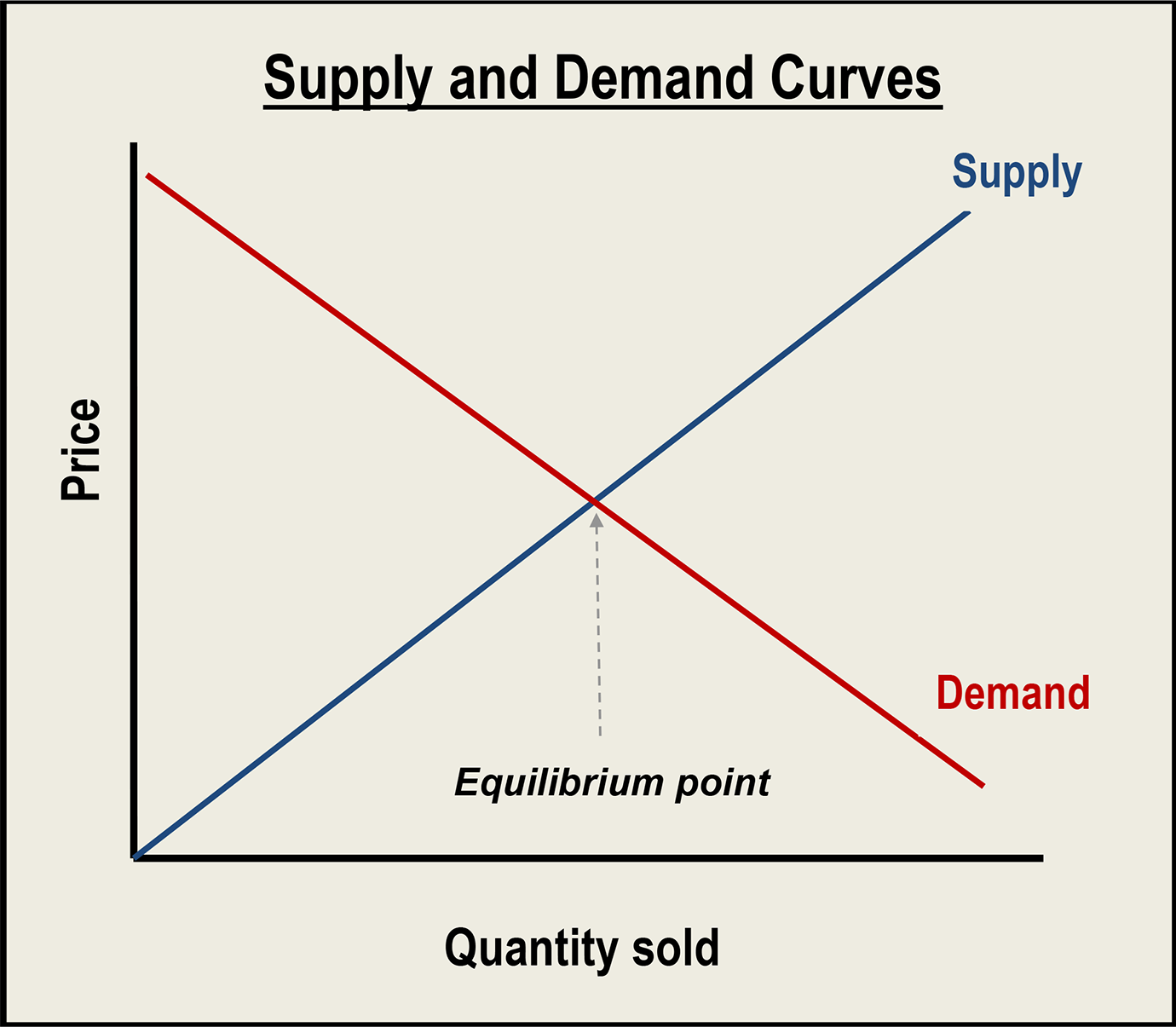
The ‘laws’ of supply and demand.
With both classical economists’ and Marx’s efforts to make sense of these phenomena focused upon human intentionality and desires (see e.g. Inoua & Smith, 2022; Marx, 2010 [1865], p. 115), the relational capacities of commodities have remained unexamined. 6 This lacuna is significant because, as Manuel DeLanda (2006, p. 36) has noted, while human intentionality motivates decisions to buy and sell commodities, prices are set impersonally beyond the intentionality and immediate control of individual human actors within actual marketplaces. Analysing the dynamics of capitalism ethologically reveals these supply and demand phenomena as more-than-human affects associated with commodities’ relational capacities (Author, forthcoming). These affective capacities are not essential attributes of a commodity but emerge relationally between commodities and other human or non-human matter. They constitute the supply, while the desires or needs for these capacities by customers (and consequently the quantity of money available in a marketplace to acquire them) constitute the demand. Highly prized capacities will be in greater demand than less desirable capacities.
This more-than-human affect establishes a fundamental feature of a de-territorialised free market: competition – both between producers and between customers. Consider, as a hypothetical, the capacities of washing powder in relation to textiles. These might include affective capacities to clean fabrics without damaging them and to impart a pleasant smell to fabrics once washed. These affects will be demanded by customers to a greater or lesser extent. Assuming that cleaning capacity is more highly prized by consumers than smell, a brand of washing powder with this affect will be in higher demand than one that smells good but rots fabrics, while one with both affective capacities will be most frequently sought by potential customers. If these three brands are marketed at the same price, it is the demand for these various affects (capacities) that will determine relative levels of sales. Brands with the most prized combination of affects can sustain a premium price, while producers or retailers of commodities with less attractive affects may have to reduce the price of their products to compete with their rivals in a marketplace.
While this analysis reveals how commodities’ affective capacities shape the dynamics of capitalist markets for both commodities and labour, these ‘supply and demand’ affects are also implicated directly in three aspects of a capitalist free market often regarded as its most undesirable features: uncertainty, waste and inequalities. First, these affects create uncertainty for both producers and workers, as the price that a commodity can command in a competitive market environment will depend upon the capacities of rival commodities, over which producers have no control. Faced with competition from these capacities, they have two choices: either to fix a price and lose market share to products with more attractive capacities or lower prices, or lower prices to attempt to sustain market share (Wrenn, 2016, p. 63). Both routes lead to uncertainty over future market viability and in turn to employment insecurity for workers.
These unattractive options also lead to a second negative consequence: waste. Excess supply by competing producers seeking to sustain market share leads not only to the inexorable growth in production that is a feature of capitalism (Gordon & Rosenthal, 2003) but also inevitably (given finite demand) to unsold products. Unsold commodities may go to landfill. Alternatively, if commodities are sold at a loss, the raw materials and human labour will have been ‘wasted’, as from a producer’s viewpoint, it does not generate surplus value. And if producers maintain their prices and accept loss of market share, this may over time lead to business closure, leading to wastage of means of production (factories, tools, technology) and of skilled labour, as occurred when heavy industry in the global North was undercut by production in newly developed countries, leading to de-industrialisation and social and economic devastation (Strangleman et al., 2013).
Finally, supply and demand affects operate independently of individual consumers’ capacity to pay for commodities. In a society imbued with the consumerism of the capitalist axiomatic, such differential capacities bake in social inequalities between those with more or less disposable income and between high and low wage economies. Those unable to pay cannot gain access to commodities or services supplying premium capacities. Meanwhile, the uncertainty over business continuity noted a moment ago when that when or if demand for a commodity falls, its producer may need to limit outgoings by downsizing workforce, by hiring lower cost labour such as migrants or ethnic minorities or by cutting back the size or quality of the work–place environment or infrastructure (Author, 2022b).
Returning to Deleuze and Guattari’s understanding of the capitalist axiomatic and state set out in the previous section, this ethological analysis has added some flesh to the bones of their proposition that it is the decoded and de-territorialised flows of labour and capital that have established the international/ecumenical formations of contemporary capitalism. A more-than-human analysis not only reveals the affective flows constituting the production and market assemblages of capitalism but also discloses that it is the de-territorialised more-than-human affects associated with supply and demand that establish the dynamics of capitalism and the unintended (from a human point-of-view) consequences of uncertainty, waste and inequalities. Furthermore, it suggests how capitalism has become the dominant global economic model. For new businesses, the free market supplies an enticing and irresistible opportunity to purvey products with novel capacities, generating swift profits. But once established, competitors swiftly move in as supply and demand affects enable rival commodities to poach market share with more attractive capacities or lower prices. 7 The original enterprise has no choice other than compete: trimming margins or investing resources to develop more attractive products.
This analysis implies that, over the past 200 years, an evermore pervasive market economy operating beyond individual human intentionality has drawn more and more workers and enterprises into the capitalism assemblage. Driven by more-than-human affects associated with supply and demand, capitalism is progressively incorporating more and more economic and social activity into its ambit, like a cosmological ‘black hole’ (Author, forthcoming). Once inside this black hole, there is no escape: for commercial enterprises there is nowhere beyond the capitalist market to trade; for workers there is nowhere else to make the money that capitalism has established as the medium of exchange (Deleuze and Guattari, 1988, p. 444).
What then do these two analyses together offer to a sociological understanding of the capitalist state, and perhaps more importantly, what are their implications for how the state might mitigate the negative consequences of a market economy?
Discussion: A capitalist state beyond neoliberalism?
Both the two materialist and post-anthropocentric analysis considered in this article acknowledge flows of affect through the more-than-human assemblages of capitalism. However, while cognate, they suggest somewhat different perspectives on the self-sustainability of capitalism, and consequently upon what the capitalist state does and what it might do. For Deleuze and Guattari (1988, pp. 448–449), decoded and de-territorialised flows of labour and capital made capitalism both possible and eventually the inevitable global economic and social formation (Deleuze & Guattari, 1988, p. 453). A ‘capitalist axiomatic’ (Deleuze & Guattari, 1988, p. 456) has established all matter (human and non-human) as potential commodities and all human bodies as both workers and consumers, while subjecting the processes/assemblages of capitalism to pervasive and intensive management and assessment (Deleuze & Guattari, 1988, pp. 456–459). Furthermore, they argued, the international character of the decoded flows of capital and labour in global capitalism has rendered much of the traditional notion of a nation state redundant (Deleuze & Guattari, 1988, p. 453). All that remains of a state is the materialisation of this capitalist axiomatic (Deleuze & Guattari, 1988, p. 456), inasmuch as it privatises property and establishes a consumerism in which all citizens are necessarily both ‘subjected’ and ‘enslaved’ (Deleuze & Guattari, 1988, p. 458).
A comprehensive focus upon the affective flows of labour and capital through the assemblages of capitalism, however, suggests an alternative to the ‘worldwide enterprise of subjectification’ offered by Deleuze and Guattari (1988, pp. 456–457) as an explanation of capitalism’s dynamic and the role of the contemporary capitalist state. More-than-human supply and demand affects associated with commodities’ relational capacities operate independently of individual intentionality and control within actual marketplaces (DeLanda, 2006, p. 36). These affects determine both the prices and quantities of commodities sold, with profound consequences for uncertainty, growth, waste and inequalities as more and more workers and enterprises into this capitalist ‘black hole’.
This second analysis downplays the proposition that capitalism has become self-sustaining by subjecting and enslaving its citizenry via consumer culture and the privatisation of all aspects of life. Rather, it is the internal logic of the marketplace constituted by the affective capacities of matter itself that has both globalised capitalism and made it a self-sustaining mode of economic life as it closes down alternative economic modes. Capitalism has become the globally dominant mode of production (Delanty, 2019, p. 12), not simply at the behest of its human advocates and supporters but also due to the more-than-human supply and demand affects that operate every time a commodity or service is bought or sold. These supply and demand affects are indeed the so-called ‘invisible hand’ of capitalism (Bishop, 1995; Whyte, 2019, pp. 158–159).
However, in contrast to the views of classical economists such as Adam Smith and Friedrich Hayek – who considered this invisible hand as the means by which wealth and well-being would be disseminated across societies (Bishop, 1995, p. 165), this analysis reveals these supply and demand affects as instead the source of many of the negative consequences of neoliberal capitalism. Capitalism is not simply a mode of production that oppresses workers. Rather, the universalising calculability of value that the capitalist axiomatic entrenched (Hardt & Negri, 2000, p. 327) – manifested through the more-than-human affects associated with supply and demand – has established capitalism as a mode of production beyond human control, with potential disastrous consequences for societies and the planetary environment. In addition to the negative consequences already noted, extractive capitalism not only lays waste to the environmental and produces the greenhouse gases from fossil fuels that are hastening climate change but has also been the causes of conflicts and wars over territory for the past 300 years and of colonialism, slavery and a continuing racist legacy (Crook et al., 2018, pp. 306–307; McCreary & Milligan, 2021).
While the hegemony of the capitalist formation has also contributed to the gradual ‘withering’ of the traditional nation state, it suggests that the contemporary capitalist state has a rather different role from that of ‘social subjection’ envisioned by Deleuze and Guattari (1988, p. 457). This state comprises a compendium of interlocking affective ‘machines’, including a security and defence machine; justice and judiciary machines; local, regional and national policymaking and governance machines; public and welfare service machines; central bank and fiscal management machines; a public or civil administrative machine; and increasingly, a communication and information management machine. These machines are elements within the assemblages of capitalism. For instance, a central bank machine ensures a flow of money and credit to oil the wheels of capitalist enterprise; policymaking, judiciary and justice machines make and service laws to protect private property, prevent fraudulent/unfair trading and tax evasion and manage migration of labour; health, welfare and education machines ensure the supply of a fit and suitably trained workforce.
However, the analysis of the capitalist state set out here also indicates that the consolidation of the capitalist axiomatic is not uncontested. On one hand, for political and economic advocates of a perfect, global free market in commodities and labour holds out the promise of efficient capital accumulation freed of ‘distortions’ produced by state interventions, trade union rights, trade tariffs and subsidies (Palley, 2005, p. 22). Since World War II, politicians and industry lobbyists of this persuasion have extended the breadth of such a free market nationally and globally by means of free trade deals, globalisation of production and consumption, and economic colonialism. Meanwhile, more and more aspects of daily life, including education, healthcare, welfare services, public transport and security services have been gradually marketised (Mudge, 2008, p. 706).
On the other hand, this overarching belief in the market has been challenged by lawmakers and civil society members (predominantly of the ‘Left’ or green persuasions) who reject the neoliberal ideology that the market knows best, and alone should be ‘the source and arbiter of human freedoms’ (Mudge, 2008, p. 704). They have sought to roll back some of the excesses of neoliberalisation and globalisation, which they have regarded as a pernicious and immoral aspect of a market economy, responsible for driving down wages, increasing employment precarity, creating pressures on international migration and plundering energy, communication, transport and utilities infrastructure for the short-term benefit of capitalist entrepreneurs. Meanwhile, they point to how the quality of privatised or marketised services such as utilities and public transport have deteriorated, as profits are directed towards shareholder dividends rather than research and development (Flecker & Hermann, 2012, p. 122), thus widening inequalities between those dependent upon public services and those who can afford to access private education, healthcare or transport options (Clifton et al., 2011, p. 663; UNCTAD, 2008, p. 140).
Recognition of this contest at the heart of the contemporary social democratic capitalist state, along with the discovery of the more-than-human supply and demand affects acting independently of human intent, suggests an opportunity to co-opt the affective machines of the state towards addressing some of the worst features of a market economy – instigating progressive social and economic policies without the requirement for wholesale and radical political change (as has always been argued by neo-Marxist scholars). Such reforms would stop short of overturning the capitalist assemblages of production and markets altogether, while directly targeting the more-than-human supply and demand affects that drive uncertainty, waste and social inequality.
Such a strategy entails three strands. First, to elucidate to policymakers, media and the public that the momentum behind capitalism’s inexorable advance is not a benevolent ‘invisible hand’ that is widening prosperity across society. Rather, it is an epiphenomenon of the market economy (and the ‘capitalist axiomatic’) that is having far-reaching negative consequences for all caught up in its grip, as well as for the natural world and the climate, which are being devastated both by rampant extraction of resources, inexorable growth and runaway waste. This strand would be particularly targeted at advocates of globalised free trade and of the marketisation of services.
Second, to support fiscally a range of alternative economic models, including not-for-profit and social enterprises, workers’ cooperatives and voluntary and third sector organisations while taking back into public ownership utilities, transport, digital services and energy production, and taking a golden share in key industries and services. All these alternatives to a free market serve to disrupt the free operation of supply and demand affects at the point of sale of commodities.
Third, to target the dynamics of capitalist accumulation driven by more-than-human supply and demand affects by reintroducing ‘distortions’ into the capitalism market, including price regulation, fiscal policies to support socially useful innovations and penalise resource extraction, overproduction and waste. Use windfall taxation on company profits to increase benefit rates to average earnings. Alongside these programmes, increase international aid to reduce inequalities between global North and South and enable newly developed countries to enact this strategy, while working with nations to overcome conflict and wars caused by territorial or resource disputes and fuelled by inequalities generated by the affects of international capitalism.
In conclusion, the relational, monist and post-anthropocentric ontologies of the new materialisms offer new insights into the contemporary capitalist state, but also some new opportunities to roll back the excesses of the capitalist axiomatic. Together, the monist perspective of Deleuze and Guattari and an innovative analysis of the affects and assemblages of capitalism have enabled a move beyond the theories of the state developed by neo-Weberian and neo-Marxist scholars, while overcoming the ontological problematics of state/society dualism that troubled Marx and Engels (see earlier discussion). They supply an exposition of a state integrated within, rather than standing above and beyond, the economic and social milieu it governs.
Moreover, analysis of the affective dynamics of capitalism exposes the delusional beliefs in a free market of some, which are hastening the descent of both workers and entrepreneurs into a black hole of economic stagnation, widespread impoverishment, wars over territory or natural resources and climate catastrophe from inexorable growth. These insights into capitalism and the capitalist state supply opportunities to swiftly counter misguided efforts to bolster the capitalist axiomatic rather than moderate its effects. The contemporary social democratic state may be repurposed to rapidly roll back the worst impacts of capitalist competition, growth, waste and social inequalities without entirely dismantling a market economy, thereby obviating the need to wait for radical and global economic and political transformation: a wait that neither the environment nor its human inhabitants can afford.
Footnotes
Declaration of conflicting interests
The author(s) declared no potential conflicts of interest with respect to the research, authorship, and/or publication of this article.
Funding
The author(s) received no financial support for the research, authorship, and/or publication of this article.