



Abstract
The second-generation critical theory of Apel and Habermas was substantially built on the semiotic pragmatism of Charles Peirce. Along with critical theory generally, this variation requires a theory of society in which to embed its wide-ranging normative commitments. The article proposes re-orienting Habermas’s decades-old theory of communicative action, which contained essential pointers to a critical theory of society that has never been adequately taken up in either the critical social sciences or critical theory proper. Revising Habermas, Peirce is drawn upon to crystallize the preferred critical semiotic realist theory of society. Asemiotic social ontology of the necessary range and scope is accordingly put forward that centres on inferential communal reasoning within the wider contexts of social perception and social actuality. The resulting approach, overcoming established dichotomies, is realist and processual as well as substantive, critical as well as hermeneutic and phenomenological, transcendent as well as immanent, realist as well as idealist, a priori as well as a posteriori, cognitive as well as normative, macro as well as micro, individual as well as collective and creative as well as habitual.
Introduction
That critical theory needs a theory of society seems obvious. Its concern has always been the normative health of society as a whole. Yet, for various reasons, mainly that Horkheimer’s call for the closer integration of philosophy and the social sciences has not sufficiently happened, there is very little in the way of a theory of society in contemporary critical theory. There are a few important exceptions such as the continuing influence of Habermas’s theory of communicative action and Honneth’s account of social freedom (Habermas, 1984, 1987; Honneth, 2014). Of course, beyond critical theory, the theory of society is not at the forefront of scholarship today, even in sociology where the new styles of theorization often eschew macro-sociological intentions. Accordingly, both in critical theory proper and wider sociology, the landscape has changed so as to problematize any possibility of such a theory re-emerging. In what follows, the attempt is made to turn difficulty into opportunity. Important currents in scholarship in the social, cultural and, where different, normative sciences provide new orientation, when suitably reinterpreted and melded with the communicative turn in second-generation critical theory. This new orientation is assumed to require further input from the semiotic theory of Charles Peirce, here tailored specifically for social theoretical goals building on the second-generation legacy. This legacy is emphasized, both because it explicitly builds on Peirce in both cases and, in Habermas’s case specifically, has already been articulated in a theory of society. The latter, for all its brilliance, has left an ambivalent legacy, and it is a goal of this essay to at least begin the task of elucidating a somewhat different if still largely compatible path forward. This goal contains in nuce a choice about the most promising path forward for the critical theory of society. It is taken to lie in the development of the Peircean semiotic frame, emphasising the integration of reasoning with feeling (consciousness) and existence (actuality). Above all, societal dynamism is fundamentally taken to arise not structurally through contradictions and dysfunctions but through the cognitive capacity – in the widest understanding of cognitive that reaches beyond its normally assumed functional circumscription – to collectively feel, imagine, explicate, and ground societal possibilities. Nonetheless, this formulation does not deny that structural forces are indispensable to the triggering of these cognitive capacities. It is assumed, but not systematically demonstrated, that the social ontological scheme outlined in this article derived from these capacities, would be able to incorporate major historical and recent developments in critical theory, so far as it pertains to a theory of society.
The relational social ontology offered below is mainly built upon pragmatist and second generation critical theoretical foundations. Following the intentions of critical theory it is designed both to evaluate existing directions of societal development, and identify potentials for more just re-direction. This applies, in descending level of generality, to the assessment of the emerging world society, national societies, and to sub-societal spheres. Even where critical social research concerns itself with issues of lesser generality than those bearing on society as a whole, it is essential for critical theory to address the general societal context. If the relation between the parts and the general are thought about as intermeshed and inter-operating, it is productive in both directions to have both specific field and general context reciprocally in view, even if is ever more difficult today to establish boundaries between individual societies or between social spheres within them. But a theory of society that is genuinely dynamic and open-ended, that is as much concerned with injustice and pathology as with normative integration, can still productively relate to this state of affairs. Even in the shifting sands of contemporary social formations society-wide constellations can still be identified with the right theoretical-empirical approach. To contribute to advancing such a theory of society is the aim of the following pages, even though the account cannot be progressed beyond a basic outline of what is theoretically, and by implication methodologically, at stake.
Thematic transitions
In the following, three intellectual dimensions of the preferred critical semiotic approach to the theory of society will be amplified. The three dimensions are: (a) Immanent-transcendence in a communicative semiotic register; (b) A cognitive-inferential epistemology; and (c) Inquiry based on reasonable not solipsistic doubt. These three dimensions underpin the proposed social ontology for a critical theory of society outlined in the following section.
Immanent-transcendence
Immanent-transcendence is the capacity from a perspective within the world to reach beyond what is known to what could possibly be known. The dimension of transcendence has to do with what ‘beyond’ consists of. The idea that there is anything transcendentally beyond goes against a deep ‘prejudice’ of the modern world view that holds that there is nothing beyond concretely situated ‘individuals’ other than conventions of naming them, and on this basis aggregating them and identifying directions of movement. According to this nominalist conception of the world, reason appears as dependent upon the evolving forms of grasping concrete individuals in common sense. In his critique of nominalism, Peirce opposed this view (Forster, 2011). And the way he opposed it was vital for second generation critical theory and an appropriate formulation of immanent-transcendence. Accordingly, immanent-transcendence is a realist doctrine that integrally asserts the reality of generals above individuals rooted in the discursive power of communal reason within the unlimited communication community. It entails a shift from common sense to critical common sense where what has been perceived can be critically evaluated. Communal reasoning, the modus operandi of critical common sense, requires intersubjective epistemic operations of generating and validating common meaning. These operations take place at the ‘higher’ end of continua of meaning, those mediating concepts that under underpin reasons and that also incorporate feelings – from immediate consciousness (firstness) – and facts – from worlds of existence (secondness). This mediating conceptual power is general. Without it, the perceived individuals would not be relevant to human purposes. Reasoning with general meaning continua – such as legitimacy, legality, equality in the social-political world relevant to the theory of society –brings qualities perceived in objects into intellectual relations. These relations can be made immanently explicit. In Peirce’s terms, this higher end of continua, which begin in the indeterminate firstness of qualitative possibility, is the space of reasons. As subject to unlimited justification, these reasons are generals. The democratization of such a power is the normative intention of the accompanying theory of deliberation in discourse ethics. In both Apel and Habermas, immanent-transcendence is the outcome of evolutionary formed capacities for intersubjective, pragmatic orientation through language. Such capacities lie beyond what agents consciously know and yet make possible what they do or say. In Apel’s words, it forms a communicative a priori (Apel, 1980). These a priori capacities constitute collective, intersubjective powers to articulate and realize human purposes that are beyond what has already been actualized in the human form of life.
Realism in this sense understands the collective as more than the aggregation of individuals. It is a context of reflective action – Habermas’s communicative action – in its own right. Reasoning takes place in a collective, public context. Its criteria of validity and operations are social through and through. The social act of reasoning, taking a cue from Brandom, makes intersubjectively explicit what were previously unconscious qualitative feelings about objects of any kind (Brandom, 1998). Such acts of collective explication are structured by the interpenetration of various continua of meaning that transcendently underpin possible human purposes, for example, ideas of freedom, equality, responsibility, dignity. Such continua, and the social forms of reasoning that carry them, are intrinsic to the third element, that of validity. Validity is here understood in Strydom’s double sense of transcendentally operating validity concepts and immanent validity goals (Strydom, 2020b). In Peirce, if there were not an active, dynamic sphere of reasoning separate from the senses but yet capable of explicating objective – in the sense of natural and technical – and other kinds of social perception, validity could not be intelligibly conceived. One subjective belief preference would be as good as any other and nothing could ever be explicitly and generally held to be true, or right, or good. Without a process of deciding on validity no common social life would be possible, or certainly none that reached beyond the aggregation of certain kinds of subjective preferences of various possible kinds. Reasons depend on valid generality, whose validity standards can be articulated in ideal schemes, such as the conditions laid down for normative universalization in discourse ethics, and realized though reasoning processes and associated potential rationalization of social practices. The space of reasons is accordingly a space of reasoning, imparting a social, general, normative, and dynamic quality to the idea of a space of reasons. It is an intrinsic consideration for any credible critical theory of society.
Cognitive-inferential generative epistemology
Two basic elements that underpin the epistemology of pragmatism, extensively incorporated in contemporary critical theory, are a preference for process over substance and recognition of the spontaneous, creative, and generative that derive from the learning-guiding quality of feelings. To a certain extent, it is no longer necessary to argue for emphasis on these dimensions as they are already intrinsic to the contemporary transformation of the social sciences. Hence, the processual turn associated with the work of Abbott and others is well established, even if it primarily takes an individualist and contingent form that neglects the elements laid out in the previous sub-section (Abbott, 2016). This processual turn is accompanied by a ‘relational turn’ that emphasizes the decisive nature of the relations that are either extensionally taken to exist between social scientific objects, or those that are intensionally attributed to them by ‘mental’ acts (Peirce, 1897; Emirbayer, 1997). 1 In fact, the relations are assumed in this social scientific way of thinking to constitute the objects whose ‘fixed’ properties or quasi-essence derive from the relational forms in which they are embedded, variously objective, inter-subjective, and subjective. And there has also been an associated generative turn in the social and cultural sciences that is closely associated with constructivism. And this generative turn is itself associated with an agential turn in which the actions of agents, collective or individual, are regarded as not fully subservient to any kind of structural determination, even at certain times and places they are regarded as able to comprehensively break free of such determination. The exact nature of the generative quality is hard to precisely locate, but it has been influenced by Piaget’s genetic epistemology, Chomsky’s generative grammar, Bourdieu’s structuralist constructivism, the general literature on structure-action relations, and the emphasis on the perceptual significance of embodiment in feminist and other literatures. Yet, the widespread assumption has taken hold that knowledge commitments are constructed, true or false, good or bad, producing the intellectual challenge to comprehend the processes and conditions of this construction. Nonetheless, across the social and cultural sciences, this changed assumption about agential power, at least in benign conditions, has not extended to consideration of reason or reasoning, an emphasis that to the contrary it is the historically established intention of critical theory to advance.
Peirce, though further back in time, still offers clarity in these matters of value to contemporary social theory (Peirce, 1992, 1998). A key emphasis that opens the way to a combined cognitive-processual and relational account is his distinction between two kinds of relations, here extended to incorporate social objects. There are, on the one hand, relations between ‘things’ that either exist in their own right outside of humans – Latour’s natural actants – or are the reified – in the descriptive sense – and frequently unintended consequences of human actions (Latour, 2007). Such relations are characterized as extensional or denotational in form. On the other hand, relational forms are also present in the intensional, connotative attribution of meaning to objects of any kind by human actors engaged in inferential activity. Such activity entails relations of reason that underpin reasoning processes. Thus, these constitutive inferential processes establish valid relations of knowing that fit human purposes, not denying at all that that knowledge deemed valid can also be unjust, dysfunctional or pathological. Though human sociation emerges from nature, and internal and external nature is permanently present in human affairs, this second kind of relation also makes possible socio-cultural detachment from nature in various forms of sociation. Thus, relations of reason take effect through reasoning processes and the task of reasoning is to establish the validity of what counts as knowing of any kind, whether knowing is understood as what conditionally would – definitely – be the case or what modally may or might be the case. This distinction between relations associating natural or reified social entities and the dynamic, potentially transformative implications of relations of reason is insufficiently clear in the general social scientific literature, but is essential to critical thinking and to the nature of critical theory.
Understanding the generative process on Peirceian terms remains incomplete unless the remaining category, that of firstness or of sense construction in immediate consciousness, is taken into account. Peirce’s categories are so intricately interwoven that it is far beyond a short article with another principal goal to adequately describe them (Deledalle, 2001; O’Mahony, 2023). Firstness is generative. It is already a form of unconscious proto-reasoning. Building upon Kant’s idea of the synthesis of the manifold, emerging from the streams of sensibility, explicit, logical cognition that characterizes thirdness commences. Such a synthesis giving rise to a perceptual judgement slides over into an explicit conjecture of what could be possible and an abductive reasoning process. A perceptual judgement is actuated by a habit of feeling and becomes logically transposed into a conjecture. Similar to Bourdieu, but embedded directly into a semiotic logical theory, it can be described as a form of generative dispositional, processual realism (Rosenthal, 2007). Unlike the judgement supposed to exist by nominalists in immediate experience, it is not merely the sensible intuition that counts. For Peirce, the immediate experience has a monadic quality that is indifferent to its possible relations. It is only in the higher grade of perception of the judgement, brought on by introducing a predicate about the phenomenal object of experience, that discrimination is made possible. The perceptual judgement of the object can be both discriminated from and integrated with judgements of other objects. Here, habits of feeling come into play, essential to enable the performance of the vast array of possible activities of schematic discrimination and integration. At this point, pre-established dispositions as expressions of such habits of feeling enter into play together with possible new feeling qualities that lead to potential innovation. Such a complex shapes abductive conjectures and begins another, more explicit, intersubjective reasoning process. Reasoning understood in this way cannot be equated with long-established philosophical assumptions about a kind of unreasoned common sense that turns perception into knowledge, but instead involves operations of critical common sense. Perception is fundamental but it can also mislead. Moreover, it must be embedded in an extended reasoning process that addresses perceptual judgements within the wide contexts of experience, and within those cognitive a priori principles that have been distilled out of experience through evolutionary learning processes, in that process becoming quasi-transcendent and experience-structuring. The generative process of perception feeding into the conjectural process of abduction opens up potentials for altered relations of meaning with distinctive validity claims. The validity claim, where abductive inference is explicated deductively, is the first step, but it has to be consolidated through inductive inference to clarify its form as an intervention in the world with practical consequences, and thus to realize the validity concept at the core of Peirce’s pragmatic maxim. The outcome of the reasoning process may lead to change in the disposition or habit of action, completing the learning cycle from an established habit to a potential altered or new habit. The quality of the reasoning, conditioned by the appropriateness of the validity standards employed, will determine how well justified is the outcome. Even poorly justified, for example, regressively justified outcomes, are nonetheless real in their consequences.
The three inferential moments of reasoning, abduction, deduction, induction, respectively, underpin three indispensable moments of critical theory, critique, reconstructive explication and evaluation. These are not discrete but interdependent moments underpinning reasoning processes. Critique is the act of crystallizing initially vague perception that has the potential to bring about habit change, a potential that in fact may also be simply apparent and mistaken rather than actually generative of such change. It carries the many possible kinds of doubt into the reasoning process by means of an abductive conjecture. Critique thus arises first as a diffuse feeling of unease, an unease that may have been ideologically repressed, before becoming crystallized into a conjecture of the kind of ‘we should be equal’, ‘we should be free’, ‘that is unfair’. Anchored in the feeling quality of firstness and incorporating perceptual sense data about the world of possible objects, critique is in the first instance an expression of experience. Yet this first kind of experience must be generalized to become real in another sense, the realities of being socially general and of being comprehensibly formulated. This second moment of reasoning, its deductive moment, reflectively places the abductive moment of critique in the space of general principles. It is a process of generalizing the critical impulse to form a theoretically coherent conjecture, a process that is quintessentially immanent-transcendent and, on that basis, entails reconstructive explication. This is what Apel calls the principle of justification (Apel, 1975; Forst, 2007b; Strydom, 2020a). In the final inductive moment of reasoning, this deductively explicated conjecture, which can be as large as a sociological theory or as small as the implications of the validity claim of a single speech act, is evaluated in its relation to actuality. Such inductive evaluation ranges across the levels of discourse from the fullest consideration of quasi-transcendent dimensions of continua downwards through general, immanent ideals to small variations in habits of action. Precisely how the evaluation is most concentrated within these levels will depend on how radical is the initial critical conjecture and its associated claim to justified validity. There may be many cycles of refinement, spread across these three moments of reasoning about objects, before a stable institutional pattern emerges, if indeed it ever does for its possibility depends on the uncertain process of social coordination in which learning through reasoning may be blocked by social forces.
Variously over evolutionary and historical time, the outcomes of inferential processes of reasoning accumulate into transcendent cognitive structures and immanent idealization, both of which exert a structuring force on cultural orientation of societies of all kinds and levels. Strydom has proposed that furthering Kant’s distinction between conditioning and conditioned offers a way to understand the respective temporal evolutionary and historical structuring forces (Strydom, 2020a). On the side of the conditioning lie the evolutionarily formed and transcendentally located cognitive principles – the infrastructure of extended mind – that are the conditions of possibility of immanent meaning-constituting and validly establishing practices. This overarching cognitive endowment, the genetic code of sociation, consists of the spectrum of fundamental human purposes and of how to go about making logical sense in relation to these purposes. On the side of the conditioned lie the actual immanent practices of generating knowledge and the resultant outcomes. This distinction is basic to the possibility of a critical theory of society if one goes beyond Kant’s transcendental subject to the idea of transcendental collective capacities that underpin immanent human competences. Such an understanding of society asks how are human collective capacities actually deployed in given instances, for example, are they artificially and problematically limited by other actors or by institutional arrangements? And it may on this basis be further asked what kinds of critical competences are available to produce and sustain fully justifiable norms – reciprocal and general in Forst’s sense –, what kinds of pathologies and injustices inhibit their emergence and preservation, and, accordingly, what kinds of ideal are operative, and what kinds of evaluation of ideals are being deployed? All of this, at the core of critical theory, bears on the human ability to question and think beyond existing beliefs. All of it is an expression of the power of extended mind that can be put to good and bad uses. But none of it requires the separation of mind from actuality, whether the various kinds of institutional path dependencies humans themselves create, and that are frequently oppressive or the limiting powers of nature. In an important sense, though, extended mind must be elevated to a new status in the critical theory of society. And within it the cognitive–inferential power of reasoning must be regarded as fundamental, and not just confined to relatively narrow deliberative arenas, nor just normatively well intentioned. The cognitive–inferential, generative epistemology that carries critique of all kinds, bad and good, must be adequately recognized, and within it the issue of validity and validity standards must attain a central status. In this way, publics can be accorded the pivotal status they must have and reflexive justification of validity claims by theorists, themselves publics, must be accomplished.
Reasonable doubt
Habermas is correct in ascribing to Peirce’s doubt/belief model the key to his account of social integration (Habermas, 2019). Peirce emphasized reasonable doubt in place of the solipsistic scepticism he identified in the Cartesian tradition. The essence of reasonable doubt is that it starts from a doubt centred on what is already believed to be known and proceeds from there. It does not start from nowhere with the premise that everything is radically questioned by the sceptical, knowledge-seeking individual. It operates as a model of social integration, whether for the socially situated doubter or the social scientist reconstructing the doubting process of others, in that doubt is conditioned by a social background context while at the same indicating a need for further learning. In Habermas, the social background context is that of the lifeworld, in Peirce, it is an object world made knowable by sign mediation, and, in the case of social worlds, constituted by systems of related signs. The object world, which includes the social lifeworld, though real in its effects, still only offers the background context for a cognitive process that Habermas describes as the problematization of the lifeworld (Habermas, 1984). A previous background certainty is brought into question and opened up by communicative action. In Peirce, doubt can only be resolved by developing a relation to the future through reasoning, a reasoning that must be accompanied by demonstrating the validity of provisional hypothetical conclusions in relation to possible worlds, grasped actually or potentially. Hence, there is a close affinity between doubt and reasoning. In the terms already outlined, reasonable doubt triggers a critical conjecture – critical in the first instance in that it departs from what is already accepted as known or what has not been considered sufficiently or at all. The nature of the doubt is then explored in the intersubjective, iterative process of reasoning, which can be very short or of long duration, for example, extended moral or scientific disagreement.
The appearance of doubt in abductive conjecture, the process of gestating potential new knowledge in the case of successful conjecture, follows the phenomenological construction of possible worlds in perception. The abductive moment in cognition associated with doubt is an impulse to the critical reconstruction of existing knowledge. Critique is socially embedded in being conditioned though not fully determined by existing states of the world, such as contradictions, class struggles, reified structures and alienated subjects. Such conditions can give rise to what Brunkhorst correctly identifies as evolutionary significant communicative negations and create a climate for normative reconstruction (Brunkhorst, 2014). But communicative negation accompanied by regressive kinds of critique can also create a climate for deepening pathology and injustice through extending negative syndromes. Communicative negations of both kinds permeate reasoning, which also implies that reasoning cannot be assumed to only serve justifiable normative ends since negation does not only emanate from them, whatever their form may be. Normative ends, viewed in terms of cultural evolution, commence before concrete acts of reasoning in the here and now, but they can be reinterpreted within and changed by such reasoning. This is vital to the general idea of deliberation as developed by Habermas and others, and more generally to the modal quality of critical theory.
A conflict may be discerned between the general equality and dignity of all in the principle of justification, an indicative second nature, and the continuing influence of those particular elementary social forms in first nature that conduce to domination and oppression, for example contemporary forms of neoliberalism and neoconservativism that emphasize paternalism before autonomy, competition to the exclusion of solidarity, monetary control above dignity, participation and justice. It would be trivializing to understand this as some kind of Manichean struggle that is capable of final determination. What the fact of existing democracy, however, does show, notwithstanding its desperate lack of completion, is that it is no longer possible to justifiably postulate ideals that are based on the subversion of the normative foundations of the human inheritance crystallized in society’s general cognitive orientations. To use the term ‘justifiably’ in this sense involves the moral justification that Forst terms general and reciprocal, whose unconditional validity is the source of any possible social order that could claim to be democratically just (Forst, 2007b). Of course, the fact that certain ideals cannot be postulated justifiably does not mean that they are not postulated at all or indeed not actualized. What is critical for critical theory is to be clear about the basis of their unjustifiability, and with that to have a clear sense of the processes and mechanisms of how they come to be, but also of how they have been or can be overcome.
A social ontology for a critical theory of society
Modern social ontologies are far from the older ontological model of representing the reality of an external world assumed beyond direct human control yet fateful for human action. In the social sciences, these social ontologies recognize the importance of relations and processes (Renault, 2016). 2 Yet, in these accounts, the power of mind, including extended mind, is acknowledged but seldom explicated. A social ontology for a critical theory of society, proposed in outline below, goes far in the direction of recognizing this power of mind, but shifts its primary expression from the individual to extended mind. For significant areas of modern scholarship, this does not represent an unusual emphasis, and, in critical theory, Habermas has laid important foundations for a theory of communicative reasoning in this direction. Nonetheless, the Habermas synthesis, while a vital lodestar, is not fully adequate in a few important dimensions, including the tendency to rely on the individualist and situation specific tendencies of speech act theory rather than inferential relations. The lifeworld, understood via Peirce, would be the product of such inferential relations. It would, moreover, be collectively generated over both evolutionary and historical time. But in Habermas, the concept of lifeworld acquires a rather static quality, with the manner in which it emerges from communicative action not adequately demonstrated. The brilliant account of the rationalization of the lifeworld is highly suggestive but the gap between communicative reasoning and such rationalization is too wide for a convincing generative account. It is in this space that an inferential account of the construction and transformation of the various schemes associated with feeling, reasoning and facts needs to be inserted, adding greater variability and applicability, not least pertaining to a theory of society. Furthermore, in the earlier writing in the theory of communicative action, the systems theoretical perspective is granted excessive autonomy from normatively oriented reasoning, an account that is never systematically revisited but which is at odds with the emphatic democratic–theoretical turn that followed not long afterwards. The challenge then opening up is how to now conceptualize media-steered systems within a democratic theory. 3 Finally, there is insufficient attention to the nature and consequences of unjust and pathological reasoning and to related forms of critique. This emphasis on reasoning marks the fact that Habermas did indeed address various kinds of embedded or structural pathologies of modern society in the theory of communicative action, but not pathologies of reasoning as such.
The most important aspect of that offered here to address these attributed deficiencies, building on the last section, is to propose a more emphatic realist logic, that follows the post-Kantian linguistic, or with Peirce sign-mediated, radicalization of ontology. Peirce views the core of logic as consisting of inferentially structured arguments. Communicative reasoning within a communication community is both autonomous and general. The priority and autonomy of the general organizes particulars, not the other way round. Sociologically translated, this means that the social–inferential form of collective argumentation is decisive for the generation of knowledge (Apel, 1995). What is knowable must be generated and justified according to this social and ultimately collective understanding of logic. But the sociality of logic does not stand on its own. It is bounded by, on the one hand, the embodied quality of perspective-opening feelings that are variously naturally grounded, socially conditioned and epistemically orienting. And, on the other, it is bounded by its applicability to the actual situation of the world, which can be either of the form of consonance with existing facts or carry normatively distilled potentiality to go beyond them in multiple registers. What emerges nonetheless is the sense of a world that is comprehensively permeated by the social logic of reasoning, always bearing in mind that reasoning in some of its forms can be unjust and pathological. Yet, the cognitive form and normative implications of reasoning have been consistently diminished, even ignored, by sociology impeding the emergence of the kind of social theorizing required for any new flourishing of the theory of society in a radical democratic register.
The three themes elaborated above set the stage for the social ontological scheme presented below. In certain respects, as the above manifests, the social ontology stands outside the mainstream of social theory in dimensions such as the immanent–transcendent architecture, the modal quality, the respect for experience and immanent cognizability without jettisoning the a priori, the emphasis on validity and the semiotic inferential realism as opposed to nominalism. In other respects, though in altered form as a result of the differences just emphasized, it moves in broadly similar directions, the relational emphasis, the constructivist or generative quality and the concern for the dispositional, the emphasis on process over substance, and the doubt-belief model that is implicit in the social sciences. The social ontology that emerges on the basis of these themes provides a preliminary skeletal model of the critical theory of society, a model that that would have to be extended to address the relationship between the general social theory, disciplinary theories in relation to their home domains and methodological illustration. Though these last parts cannot be addressed here, the transition to them may become more palpable.
The exposition of the social ontology is guided by Figure 1. Figure 1 is thus centred on Reasoning [1] in the figure. In this respect, it is differentiated from the two dominant traditions in advancing a theory of society, functionalism and Marxism. These latter theories may be mainly associated with quite different variations on operations [8], Symbolic Struggles and Coordination Modes, and [9], Symbolic Order. 4 Yet, the operations [8] and [9] are here by contrast not the centre of gravity of the theory, but instead regarded as conditioned by the overall sign-mediated logic of reasoning, Reasoning [1]. For the present theoretical proposals, operations (8) and [9] are both expressions of what Peirce understood as the symbol, the thirdness of secondness. 5 The symbol is a temporally stable, though not permanently so, outcome of operations of thirdness of all kinds, but especially outcomes of Reasoning [1]. This differentiates it from the other bases of the theory of society, respectively, highly influential in critical theory, that emphasize systemic forms that had already congealed into instituted forces. The generative dimension has in these latter cases become occluded.
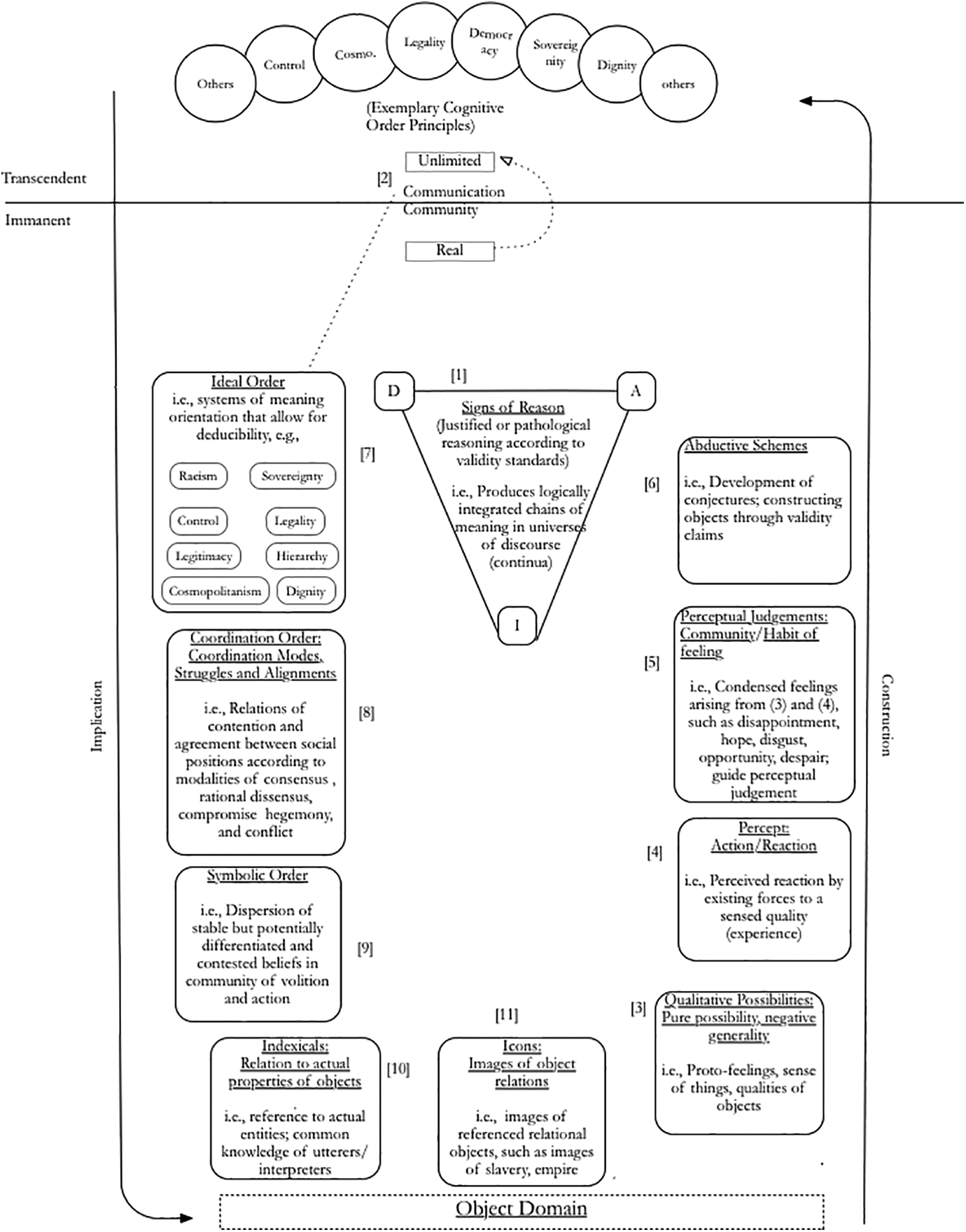
Social ontology for a critical theory of society.
Both secondness, the realm of The Symbolic Order (instituted habits/beliefs/commitments) [9], Indexicals (commonly held relations to objects in the external world), [10], and the Icon (images of objects), [11], and thirdness as the space of logical reasoning are understood as relational forms, albeit of different kinds. Operations [8] and [9] therefore represent relational secondness, which take the form of related forces, that both shape reasoning on the input side and are altered by it on the output side. In the social matters of concern here, this kind of relational secondness involves a ‘fixing’, a relational stabilization, of the operations of reasoning of thirdness in all its facets. Thirdness involves logical reasoning that takes the form of relations of reason. Such relations of reason presume the unending possibility of adding further – and unpredictable – interpretations of relevant objects, including social objects of all kinds. But these relations of reason will, depending on their resonance conditions, also potentially be translated into object relations or relations in re, relations of secondness in the above sense. Thus, once rationalized in signs of secondness, relations can become stable between particulars or existents, through condensing their infinite possibilities in the various belief forms (habits) of the Symbolic Order, [9], and indicated in re by means of Indexicals, [10], and Icons [11]. Ontologically, in terms of the interests of social theory, such particulars, the vast range of what Peirce calls habits of action and volition, include specific norms, values, attitudes, moral and ethical commitments and entitlements. What these have in common is that, as particulars, they have a definite force. They are ‘one thing’, a singular, that has congealed in the social world, a class structure, a person, a natural event or series of events, an empire. They are relationally generated, are internally relational forms and enter into relations with other particulars. Any such relational form that manifests or impels habits of action, dispositions, over time has force, that is, recurrent effects on social relations. Common examples might include a particular norm, a value, a personality type, an individual or collective identity, a substantive moral commitment and a political ideology. To use the term ‘force’ understood in this way is not therefore incompatible with a relational approach, as Emirbayer claims, illustrating a type of general presumption of relational approaches (Emirbayer, 1997). The idea of relationally structured forces opens up a bridge to the structural intentions of much sociological theory, also incorporated in their distinctive ways by both Habermas and Honneth, while understanding the derivation of these structures as much more dynamic and mentally shaped.
These forces enter into the relational operations [8] and [9] to form practical relations between humans and objects, between objects and objects and within institutionalized human–human relations. The intrinsic difference between Peirce’s categories of thirdness and secondness is that the relations of reasoning of thirdness entail a reflexive ‘take’ on what secondness assumes to exist, a take that can either reproductively utilize or change the world-understanding built into the relational and rule order of secondness. The inferential relations of reasoning that constitute thirdness therefore potentially render fluid the relatively stable positional relations of secondness. Both in the reflective possibilities of everyday life and of the social sciences, theories constituted in thirdness mediate the institutionalized relations and forces of secondness. Thirdness is therefore what enables the regularities and transformations of secondness to be theoretically and methodologically grasped and expressed in the kinds of ontological cultural schemas of, in this instance, theories of society. The diagram currently under discussion is one such example. The corresponding distinction between imaginatively guided reflection and institution is vital in building a theory of society, an approach similar to that of Castoriadis (Castoriadis, 1998). But that is not all; the operations of the category of firstness also come into the picture, as will be explored below. The relational turn addressed a particular challenge in social theory. The substantialism of preceding social theory, especially in its macroforms, appeared to allow for the objectively discerned fixing of permanently operating forces, such as class structures or institutions. They changed their form with history but within a progressive telos and behind the backs of agents. Yet, their explanatory power appeared to dwindle when confronted with complex late modern social forms, such as changes in capitalism or patriarchy, and more and more additional adjustments became required that twisted the original assumptions about explanatory force out of coherent recognition. The exigency of addressing these changed conditions, entwined with intellectual change that is more than a mere response to them, has animated the various social theoretical turns. Individually and cumulatively, these turns, relational, processual, cultural, practical and agential, are premises of this article.
As suggested earlier, the stance of modern phenomenologically and hermeneutically inspired sociology, jointly and severally, has been in the main indifferent or even antipathetic to the concerns of a theory of society, yet these approaches generate indispensable orientations and forms of knowledge for building a modern one. In the diagram, taking pivotal works as illustrations, operation [10], the relation to objects, corresponds to Garfinkel’s ethnomethodological concentration on indexicals and operation [11], on the images that underpin the references of these indexes, to Lakoff and Johnson on metaphors (Garfinkel, 1986; Lakoff & Johnson, 2008). The index refers to the worlds of existence, as they are thought to be in themselves. They are everything that can be thought of as actual, has been the case, is the case or will predictably be the case. It can encompass such varied existents as the British Empire, the me, the door that resists opening and the real movement of the economy. Metaphors, and also narratives, immensely influential concepts in contemporary social thought, involve an iconization of indexicals within a timeline (Ehrat, 2016). They serve as background imagistic templates for individual or group orientation to actual worlds, embedding actors in taken for granted worlds. They thus prefigure both perception and reasoning on the input side and represent their outcomes on the output side. In a very general sense, narratives ‘legitimate’ a particular conception of that world when imagistically ‘carrying’ indexicals, such as the British Empire imagined through the assumed avuncular authority of Churchill. When taken together, all the operations from [7], The Ideal Order, 6 through to the [11] delineate the space of the lifeworld in Habermas, here presented integrally with an inferential account of reasoning. The operations of signification, [7] through [11], though subject to change, nonetheless become fixed through habits – individual and collective – of which there are three inter-operating kinds corresponding to Peirce’s three categories of firstness, thirdness, and secondness, thus habits of feeling [5], of thought [2] and of action [9]. 7
The cognitive operations of firstness, [3], Qualitative Possibilities [4], Quality/World Relations and [5], Perceptual Judgement are at the heart of one of the two major vectors in the diagram, that of constructivism, with the other vector being implication and outlined below. Constructivism has become influential in social theory since the loosening of the dominant science paradigm after the Second World War. It has taken many forms, all influenced by phenomenology, from various kinds of subject-centred constructivism, to systems constructivism in Luhmann, to Bourdieu’s structural constructivism, and several others. By now, it has a long and complex history. In the diagram, though generally mindful of this history, a particular kind of reading of constructivism is presented in the tradition of Peirce. Relatively late in his career in the 1890s, further developing his scholastic realist philosophy, Peirce underwent a modal turn (Lane, 2007). This led him to assert both the reality of ‘vagues’ or possibility, not just the reality of (general) necessity. In operation [3] in the diagram, this is characterized as pure possibility or negative generality. Possibilities are general because they are not individuals, and they are negative because they only come to exist as a negation of what does exist, even if only an infinitesimal variation contained in repetition in slightly changed circumstances, for example, later in time. But even where they do not reach the threshold of existence, they remain real, that is, remain possibilities. They are the other side of the reality of necessary generals in reasoning, that which pushes such generals towards the attribution of new meaning or brings into play additional, necessary generals. Operation [3] is termed Quality by Peirce to signify the qualitative possibilities that are ascribed to objects. Qualities are feelings bearing on the possible cognitive construction of objects, such as the sense that the action of another requires responsive ethical, legal or moral cognition. Such qualitative feeling, consisting of idea potentiality, is at the very base of cognition and applies whether the cognition is relatively routine or innovative in some way. In operation [4], the immediate feeling which is the outcome of [3] encounters the existing world, a world that is viewed now from the orientation created by the quality of feeling. In [4], feeling encounters the world, grasped through indexical signs, and that interaction shapes what to address in the world in the gathering perceptual process. Proto suppositions about the nature of reality contained in feelings crash upon the reactive force of the encountered actual world, inducing perceptual orientation. But many qualities of feeling and many perceptual orientations are possible and, for any kind of effective cognition to transpire, they must be organized in the ‘synthesis of the manifold’ generated by the ‘lawlike’ nature of habits of feelings and associated perceptual judgements. Habits of feeling, [5], guiding the perceptual judgement, akin to Bourdieu’s habitus, are those orientations that result from previous interactions with the social and natural world, the distillate of experience. But, on top of this, the perceptual process has the capacity to feel beyond the existing limits of experience by engaging a priori categories and the semiotic continua represented in quasi-transcendental cognitive principles or frames, [1].
Perceptual judgement, [5], represents the beginning of conscious thought. The habits of feelings that underpin it allow condensation of perception. These habits are the residue of much trial and error, not just arising from individual experience but also drawing off group experience and socialization patterns and embedded in supra-individual social and natural evolution. Following Nesher, inference is already at work in the process of firstness that leads to perceptual judgements, which are propositions emerging from the senses in confrontation with external reality. Hence, Peirce concludes that the distinction between, to use the title of Nesher’s article in turn taken from Peirce, the ‘senses as reasoning machines’ and conscious logical reasoning is only relative (Nesher, 2002). Habits of feeling organize perceptual judgements that, in the initial logical process of abduction, cumulate into abductive or Abductive (conjectural) Schemes, [6]. This is where, viewed in a Peircean light, Bourdieu’s theory of the habitus should be further developed as a basic component of a theory of society. It is the most developed account of this space in sociology, though it lacks the inferential dimensions of conscious reasoning and unconscious quasi-reasoning. Nonetheless, it forms a foundation for considering how the perceptual process of firstness leading up to abduction, a selected way of relating to the world, is embedded in quasi-determinate relations of secondness that condition it. Such relations of secondness respond to the ‘object world’ at the very bottom of the diagram, which it is their cognitive task to capture, and potentially to change. The challenge for a theory of society that incorporates the intuitively driven perceptual processes that lead up to abduction is that it is difficult to access. It remains below the level of conscious thought until a perceptual judgement is formed that brings in a dimension of ‘law’, generality, and hence possible explication. Here, interdisciplinary cooperation with, among others, aesthetics and various kinds of psychology is called for, as well as examining the dispositions that must be assumed to exist given actions of all kinds and their consequences. Such work characterizes much ongoing activity in the cultural and social sciences. These investigations are also necessary to shed light on those unconscious codes that in structuralist and neo-structuralist theories are assumed to be lodged in the symbolic order, operation [9] in the diagram, habitually guiding volition and action (Foucault, 1972; Frank, 1989).
Constructivism, associated with the generative process outlined earlier, viewed from the Peirce approach does not remain confined to the operations of firstness, with its progressively higher grades of perception, but continues into logical reasoning. The fact that Peirce’s constructivism continues from the subjective context of firstness into the – for him – through and through social dimension of reasoning is of the first importance. The subjective moment of more or less rationalized feeling continues into and throughout the social moment of logical, intersubjective reasoning. Thirdness, the space of reasoning, is a space of social construction that, consistent with earlier remarks, does not depend on a nominalist interpretation of an assumed determining psychological foundation. Yet, there is a psychic moment, the moment of feeling in perception and beyond perception in reasoning, but this psychic moment does not justify the validity of logical claims. Such claims can only be justified by public validity standards in communication communities. The bridge between the proto-constructivism of firstness and the social constructivism of logical thirdness lies in the first abductive logical step. This abductive move, conjectures about possible realities, tallies with the modern sociological emphasis on reflexivity and, at the same time, recapitulates and goes beyond the Kantian critical moment in establishing a plausible critical sense beyond the formal possibility of critique. It is deficient in the historically dominant theories of society. In functionalism, it is at most weakly present in Parsons’ voluntarism, and in Marxism it is also weakly present in the account of praxis, even if within the history of theory more could have been taken from Marx in this regard. It is present in Castoriadis. It is also present in critical realism but with too great emphasis on a backward looking idea of ‘retroduction’ rather than a more emphatically future-oriented practice of abduction (Bertilsson, 2009). The Kantian constructivist moment is retained in the necessity of social justification, whose transcendent influence is not the transcendental subject but the collective evolutionary inheritance of reasoning capacities and orienting cognitive principles [2].
In social theoretical terms, and here consideration of Reasoning [1] is fully enjoined, abduction involves the crystallization of new ideas. In some form or other, such a crystallization involves contesting existing orders of knowledge, where in the diagram the latter is principally represented by operations [7], Ideal Order, [8], Coordination Order, and [9] Symbolic Order. Abduction is closely associated with the ‘cognitive praxis’ of movements of various kinds. This does not mean only the progressive movements emphasized in critical thought, but conservative and reactionary movements too. At the most radical level, though, emphasized by critical theory and other critical movements, it encompasses the cognitive challenge that emanates from movements seeking fundamental social change, a challenge that must also be normatively justified. More generally still, abduction involves the ongoing construction of the social world on the basis of abductive schemes, [6], that is to say, schemes that entail the willed construction of relational conjectures associated with thirdness. Constructing such relations entails the presence of freedom, even manipulatively or regressively oriented use of freedom. It then becomes a normative task of critical theory to identify and justify what it deems to be normatively progressive relational possibilities, that is, rational conjectures. Following Apel’s account of Peirce, conjectures or hypotheses associated with abduction have an experience-transcending quality, the capacity to generate new conjectures that go beyond existing knowledge, which give rise to validity claims that must be inductively evaluated to assess their actual or possible traction in the world (Apel, 1995). This experience-transcending quality is associated in the diagram with recourse to the transcendently anchored cognitive principles of the cognitive order [2]. Such principles are the outcome of evolutionary learning processes, as explored above. They underpin, within the assumed immanent–transcendent form of knowledge, the continuum of possible learning within any triadic semiotic variation of critical theory.
With the constructivist moment of abduction at its core, thirdness comprises the essence of social theorization. Specifically regarding the theory of society, thirdness integrates the various moments of theory-building, the determinative moment of ‘what is’ of secondness, the perspectival moment of what ‘could be’ of firstness and the generalizing moment of what ‘would be’ of logical thirdness. This entails a seminal change in the theory of society away from its traditional concentration on the first determinative moment to also incorporate the other moments, the modal–phenomenological moment of firstness and the generalizing logical and normative moment of thirdness. The distinction between thirdness and secondness in Peirce also marks a distinction between theorization and knowledge. The theory of society therefore should be understood as a theorization of the process of constructing society, intellectually and practically, that is partly conditioned by existing knowledge, but, as a construction, always exceeds it. This marks the cognitive–processual emphasis addressed in the previous section. The form of theorization entails reflection on the relations identifiable through the signs of secondness, for example, production or consumption relations, or, generally, any object that is or predictably will be the case. But in addition to reflection on these relations of secondness, theorization involves the construction of further cognitive relations ‘beyond’ them. It represents a ‘critical interpretation’ by a mind of some kind of existing relations of secondness in the form of relations of thirdness. As reasoning, thirdness potentially further entails the building of critical relational forms that bring about cognitive and then social change by transforming what counts as legitimate knowledge. For this, Wright-Mill’s discussion of master symbols of legitimation in The Sociological Imagination is instructive (Bagnoli, 2016; Mills, 2000).
The references to critical in the last sentences above do not per se denote a critical approach in the normally understood sense of critical thinking today. Rather, in the Kantian sense of critical, the operations of thirdness animated by any of an infinite range of possible conjectures can animate critical reflection. Putting it simply, critical in this sense is as likely to emanate from ‘conservative’ positions as from ‘radical’ ones, as thirdness is shaped by a quality of mind operating within interpretive communities. Nor can the ‘right’ kind of critique be identified strictly according to the logical soundness of arguments, for arguments that have regressive conclusions can also be logically sound in the light of their premises. By contrast, the critical forms of critical theory depend on the conditions of argumentation, their cognitive forms and contents and the normative validity standards that are deployed within them. Normative validity standards do not simply exist ‘out there’ ready to be deployed. They must be cognitively generated and applied over time in collective learning processes, of which processual and procedural learning processes are of the first importance.
For all this, normative validity standards that are transparent and inclusive play a special role in critical theory. The above referenced cognitive learning processes that accompany their gestation and ongoing application stand on an interesting fault line between constructivism and the other major axis in the diagram, that of implication, which has not yet been treated but which is intrinsic to any treatment of normative validity, including that of the theory of society. The account of constructivism so far offered here has considered the construction of possibilities in situations. Beyond this, yet not inconsistent with it, another kind of constructivism, Kantian constructivism, should be regarded as intrinsic to the normative stance of critical theory (Bagnoli, 2016). Peirce was in the Kantian tradition in emphasizing the necessity of an objective ethics of reasoning, that is, an ethics whose standards and objects would come from reasoning itself and could impose obligations towards certain kinds of rational conduct. For Kant, this made moral universalization in reasoning indispensable. If this position is accepted, as it is in second-generation critical theory, then the next consideration bears on what is necessarily implied in realizing it. In turning to this issue, I will sidestep but indirectly incorporate the relatively well-trodden question of the conditions of communication in the public sphere at the core of critical theory (O’Mahony, 2019, 2021).
The vector of implication runs along the left-hand side of the diagram. It relates to the nature of the presuppositions employed in human activities. ‘Downstream’ symbolic versions of implication have always been used in explanatory sociological accounts of social arrangements. The manner in which the concept of social structure has been employed, for example, has such a quality in the implication that structures exert determinative force on social activities. Yet, such accounts have tended to understand structural presuppositions of different kinds as historically established conditions bringing explanatory force from ‘behind’ or ‘before’ ongoing social activity. A concomitant of the ongoing constructivist revolution has been that the cogency of such assumptions has been substantially eroded, even if they continue in an auxiliary role, for example, the manner in which the concept of capitalism is frequently employed. Even within structuralism, the cultural structuralist or neo-structuralist transformation in the mid-twentieth century progressively opened the way to increasing emphasis on cognition-guiding structures rather than determinative social structures, a transition that had been long on the way in pragmatism and other intellectual movements. In the critical theoretical tradition, such cognition-guiding structures are considered, at least potentially, to occur in line with the directing will of human agents. In this tradition, while the account remains underdeveloped, such cognitive structures, both of evolutionary origin and historically shaped, are deployed and modified in human praxis. Their modification emanates from normative learning processes with short-, medium- and long-term effects. In line with the above, such normative learning processes occur through the interplay of unconscious feeling and conscious reasoning in the wider context of social and natural forces. This interplay is guided by habits of feeling and of thought, though the recurrence of such habits may be altered by learning and hence result in revision or abandonment of the habits. The theory of society is therefore at base about identifying and normatively advocating those mutually intertwined dispositional qualities and modes of reasoning that make the most appropriate use within society’s organizational principles of the evolutionary-formed capacities and historical potentials of the human cognitive endowment. Thus understood, it is both a normative philosophical and social theoretical task in a way that moves beyond Kant’s assumption of the separation of theoretical and practical reason.
In the diagram, the constructivist moment, whose vector runs along the right-hand side, is mainly historical, the creative product of humans, but not entirely. Kantian constructivism, taken further in Peirce and in Apel and Habermas, can be extended to incorporate the evolutionary establishment of modes of reasoning that are essential to normativity. This type of constructivism operates concomitantly along with the a priori force of implication in the operations of the transcendently anchored cognitive order. That is, cognitive order principles have an a priori quality but also make possible distinctive kinds of construction. These cultural evolutionary established principles emerge from the temporally extended rationalization of human reasoning processes in multiple dimensions. It is the essence of reason, [2] in the diagram, its transcendental form. Cultural evolution has involved the selection out of endless possibilities those cognitive principles that have become essential to the common life of humans. It is important to note that they are cognitive principles that provide quasi-transcendental conditions of possibility for feeling and thinking and not normative prescriptions. But they do give orientation to the formation of norms even if they cannot decide what they should be, for such deciding comes about immanently. Speaking of the combination of construction and implication in the cognitive order means that the cognitive order principles give form to the potentiality for fully inclusive reasoning, the Kantian constructivist moment, but also represent, as implication, a quasi-transcendental a priori that imposes orienting limits on the infinitude of possible societally relevant feeling and thinking. The limits – to possible meaning – invested in these principles may be understood as the presuppositions of the creative mental powers of humans. A theory of society must therefore examine in its application what are these limits that serve as enabling conditions for generating knowledge.
To speak of transcendental limits as enabling conditions may seem paradoxical. Limits in this sense are to be understood as sense-making structures that orient possible meaning on the basis of those continua of meaning selected from the infinity of possibility. Limits are thus the crystallization of continua. They are vital to society but rarely systematically analysed in social theory. Thus, to speak of a cognitive principle such as that of legitimacy entails that the competence exist to logically employ such a principle based on supportive feeling and actual or possible states of affairs. Transcendent limits of this kind implicitly operate both as presuppositions and anticipations. They are mirrored on the immanent plane by another kind of limit concept that is directly employed in inferential explication. These immanent limit concepts are ideals, The Ideal order, [7]. Such ideals guide thought, communication and action. Unlike transcendent cognitive principles, they are directly graspable and enter societal disputation. In the diagram, they are represented by operation [7] and, as idealized validity standards, deductively enter into reasoning. These ideals are the organizational principles of society and thus are pivotal to the theory of society. They form variable patterns with differing relative power across societies. Following the theme of implication, they make possible two kinds of orientation. The first is the a priori orientation that emanates from settled consensus on beliefs, morality and truth, where that exists, and, where it doesn’t, the second is their role as disputable cognitive orientations for argumentation about the right interpretation and application of particular ideals and relations between ideals, for example, ideals of equality and hierarchy. In the first instance, examples are ‘all swans are white’ or ‘all should be equal before the law’ and, in the second, an example is moral disputation over the level of material equality, including assumptions about acceptable hierarchy, that should be brought about through policies and other actions. Ideals are not necessarily democratically ‘positive’. A ‘negative’ ideal is that of the moral necessity of social hierarchy, a viewpoint that is growing in relative potency once again.
The selection of appropriate ideals underpins society-wide normative standards, since ideals translate the validity concepts instantiated in cognitive principles into validity achievement standards. The transcendental cognitive principles, the ultimate limit of continua of meaning, supply conceptual orientations, and the selection of ideals are convergent limits within such standards that specify what should be striven for immanently. Equality is a transcendent, universal validity concept, whereas specific dimensions and degrees of equality are general immanent goals that are expressed as recognizable ideals. The dimensions and degrees of ideals in the plural go to form idealized cognitive cultural models, [7] in the diagram. Such models provide general immanent orientation and are continuously further elaborated in societal argumentation and practices. This further elaboration leads to the formation of nearer to action social cultural models, Coordination Models, [8] in the diagram, which consist of modalities of coordinating different validity preferences, whose possibility derive from the higher level of ideals, [7], with a simple example being the historical left/right split in normative culture. Once elaborated and selected in the relational fields of these ‘lower’ kinds of cultural models, the outcome leads downwards, as explored above, to those concrete beliefs that underpin habits of action, [9]. These, at least for the actors who have such habits, manifest ‘achieved validity’, that is to say, a power of action has been acquired, eked out of the social–relational process. Such achieved validity though, contrary to Parsons and the functionalist tradition, should not be assumed to be either consensual or functionally necessary, as extensively, though far from entirely, it is shaped by asymmetrical power relations of many possible kinds. Thus, the power of action may be a very restricted power, and it can also be the denial of a power to some. These last remarks also bear on ‘materialist functionalism’ embedded in Marxism and various other traditions. The semiotic realism of the theory proposed here encompasses the permanent independence of natural objects and the acquired independence of social objects, so far as the latter have stabilized either certain kinds of initially unintended consequences or consequences intentionally visited by some agents on others through disparities of power. The production of consequences are nonetheless bound up with human purposes and learning processes, though in conditions of social and natural constraint, including egregious asymmetries in access to resources. Contrary to strong materialist theories of Marxism, this is broadly consistent with Marx’s own account of capitalism in the forms of the unintended consequences of the practices of capitalists, the willed purpose of ideologically masked capitalist domination, and the counter-power of the willed purpose of transformative socialist praxis.
The reference to ideology entails the possibility of regressive processes and outcomes. To attach centrality to reasoning in the theory of society thus does not entail that reasoning can always be assumed to act as a normative corrective to injustice, alienation and dysfunction. Pathological or unjust reasoning, reflecting the state of the public sphere and societal conditions generally, pervades societal discourse. Within the model of the theory of society proposed here, such reasoning entails constructing bad inferential relations of various possible kinds. To speak of ‘bad’ in such a context, as already suggested, does not automatically entail unsound, for, to take an example, reasoning that asserts the virtues of extreme hierarchy can claim soundness on its own terms following its particular ends. To find such reasoning pathological or unjust still requires identification of the relevant state of affairs and appropriate critical sentiments. Such sentiments can be the outcome of prior experience or emerge from fundamental critical learning that reaches beyond such existing experience, recasting it in a new way in line with the doubt–belief model.
From a critical–theoretical standpoint, the analysis of pathological and unjust reasoning is essential to the theory of society. Such analysis can reveal the kinds of bad organization of society that follows from asymmetrical discursive power (Forst, 2007a). The contention advanced here, which cannot be demonstrated in-depth, is that the various critical standards of critical theory, reification, alienation, dysfunction, non-inclusion and so on, can be expressed as inferential relations that generate and sustain societal pathologies, injustices and contradictions. 8 In the tradition of Kantian constructivism, modified through Peirce for the import of conditions and feelings, reasoning can embark on reconstructive self-critique. In itself, reason is to be equated with the quasi-transcendent implications of the evolutionary formed cognitive principles that underpin human sociation, to whose immanent translation into democratic ideals modernity gave impetus, even if far from unambivalently as the existence of contradictory ideals and bad reason attest. To illustrate, it can readily be asserted, notwithstanding background beliefs in hierarchy, that it is difficult to publicly assert in democratic contexts that some citizens should be regarded as less worthy of equal treatment before the law. This illustration, to which many more could be added, suggests a democratic ‘hardening’ over time of certain commitments, an ongoing process with losses as well as gains and many enduring blind spots. Some ideals harden to the point of universal necessity and achieve the status of functional or moral a priori commitments, while others simply open spaces of contention with open and variable outcomes within certain limits.
Conclusion
The remarks above contain the core, preferred theoretical choices to inform the further development of the critical theory of society. A long labour of application beckons, a labour that without doubt will have reflexive theoretical implications, before such a theory can be shown to work. Key to it is the incorporation of both present consciousness in firstness and future-oriented reasoning in thirdness, together with the implications they both have for the institutionalized regimes of conduct that comprise secondness. Hence, Hegel’s idea of the becoming of reality, refashioned through left-Hegelian thought, here notably Peirce but in the background Marx, firmly enters the theory of society. Notwithstanding, the autonomous capacity for critique beyond the given marks the vital importance of the Kantian Copernician turn. Building on such foundations, there is much further theoretical work to be done to erect a critical theory of society. The theoretical choices apparent in the above text seek to productively conjoin a pragmatist semiotic realism, the advances of second-generation critical theory and the transformations of the social sciences over the last half century. Methodologically, if offers a distinctive space from which to build societal analysis of general normative import and it carries definite potential for integral methodological pluralism. And normatively, it can be expanded in ways, only briefly referenced here, that fully incorporate the inclusive ends of critical theory, without denying the creative capacity of sociation to determine its own future with implications also for such normative ends.
Footnotes
Declaration of conflicting interests
The author(s) declared no potential conflicts of interest with respect to the research, authorship, and/or publication of this article.
Funding
The author(s) received no financial support for the research, authorship, and/or publication of this article.

Notes
References
Supplementary Material
Please find the following supplemental material available below.
For Open Access articles published under a Creative Commons License, all supplemental material carries the same license as the article it is associated with.
For non-Open Access articles published, all supplemental material carries a non-exclusive license, and permission requests for re-use of supplemental material or any part of supplemental material shall be sent directly to the copyright owner as specified in the copyright notice associated with the article.
