



Abstract
The terrorist attacks that struck France in 2015 had reverberations throughout the country’s intellectual fields. Among the most significant was a widespread polemic that turned around whether sociological explanations of the attacks amounted to excuses and justifications for terrorists. When prominent politicians and pundits made allegations of this nature, sociologists reacted in three main ways: most denied the allegations, others reappropriated the derogatory label of excuse, while others still accepted criticism and called for a reformation of sociology. These epistemological stances can be properly understood only by studying the long history of debates around ‘sociological excuses’ in France and by analysing French sociology as a field of forces and struggles.
A few days after the November 2015 Paris attacks, in which 130 people were killed, French Prime Minister Manuel Valls declared in front of the National Assembly that ‘no excuse had to be sought’ for what had happened. ‘No social, sociological, nor cultural excuse! In our Country, nothing justifies taking up arms to harm one’s fellow compatriots’ (Journal officiel de la République française, 2015, p. 9823). Valls was referring to claims that terrorist attacks, along with urban riots and more mundane acts of violence, resulted from the conditions experienced daily by ethnic minorities living in poor urban neighbourhoods: discrimination, segregation and lack of opportunity. Considering that such accounts amounted to an exculpation, he sought to reaffirm the importance of individual responsibility and just deserts.
A heated polemic ensued, involving politicians, pundits, criminal justice practitioners and academics. Were sociologists really absolving terrorists from blame? Should knowing the conditions in which the perpetrators lived alter significantly our moral judgment of their actions and the measures we take to prevent such attacks? Was there a hidden political agenda behind these sociological explanations? Were they the expression of an ideological preference for the ‘underdogs’, or were they rigorous accounts that could be used to improve the conditions of disadvantaged groups and avoid new attacks?
While Valls’ statements provoked strong reactions and the problem of ‘sociological excuses’ remained for quite some time on the public agenda, this quarrel was just an episode in a long history of disputes about the proper understanding of political violence and crime, and the proper role of social scientific knowledge in society. At least since the early 1990s, French sociologists have been accused of being the apologists of violent criminals, drug dealers, sex offenders, rioters and terrorists. How did sociologists react to such accusations? How does an academic discipline protect its status and privileges from this type of political attacks? What does this controversy tell us about French sociology, a distinctive and highly influential tradition that has received much attention from historians and theorists in recent years (Heilbron, 2015; Larregue, 2017; Ollion & Abbott, 2016)?
While providing some context on the most important episodes of the persisting criticism of sociology’s alleged apologetic potential in France, the article focuses on the quarrel prompted in January 2015 by the Charlie Hebdo shooting and exacerbated by the attacks in November the same year. It shows that French sociologists reacted in three main ways: the majority denied the allegations, a few reappropriated the derogatory label of excuse, while others still joined the critics and called for a reformation of sociology. These stances did not consist merely of replies to the critics but developed into full-fledged epistemological theories about what sociological explanations are, how sociologists relate to society and why sociology is different from lay knowledge. Although not all sociologists engaged in the controversy, most of those who did split in three groups of varying size, each defending a different view.
Taking inspiration from Pierre Bourdieu’s (1988[1984], 2004[2001]) theory of fields, I argue that sociologists’ stances on this issue reflected different ‘objective’ features of the sociological field. Sociology is not an empty space over which members float freely and produce new ideas as they please. It is an overcrowded arena in which actors compete for recognition, entering the field with different resources and strategies, and being affiliated with a variety of organisations and networks. Conditions are highly unequal, as are the connections with other social fields, and especially with political, economic and media elites. The knowledge sociologists make is very much influenced by the position they occupy in this division of sociological labour or, more realistically, in this sociological hierarchy. But the field is not merely a ‘field of forces’, characterised by a balance of power at any given time, but also a ‘field of struggles’, in which actors strive to maintain or alter the balance of power, with varying degrees of success. The ‘intellectual interventions’ (Baert, 2012; Eyal & Buchholz, 2010) sociologists deployed in response to the accusation that they were making up excuses for terrorists reflect both these aspects of the field. Although that quarrel largely originated in the journalistic field, in venues such as TV shows, op-eds and mass market books, it quickly percolated into the sociological field, as several members were dissatisfied at how prominent colleagues had reacted to criticism and seized the opportunity to alter the balance of power within the field to their advantage by deploying rival epistemological strategies.
The article first illustrates how sociological excuses came to be portrayed and seen as a social problem in France. It then describes the different ways French sociologists responded to a new wave of criticism during the mid-2010s. Finally, it shows how field theory helps to make sense of the academic controversy that ensued.
‘Sociological excuses’ as a recurring social problem
According to many observers, during the 1990s French society experienced a significant change in the public perception of crime and a series of reforms of the criminal justice system that had long-lasting consequences. People increasingly felt that poor suburban areas were unsafe, that incivilities and the degradation of public spaces were widespread and that immigrant communities were not properly integrated. Urban riots in which vehicles and buildings were burned occurred almost on a yearly basis starting from 1990 (Mauger, 2006). A series of reforms extended punitive sanctions, reinforced the police and introduced repressive crime control initiatives (Mucchielli, 2001).
The fact that several of the stricter penal policies enacted at the time were promoted by a left-wing government is generally taken as proof that something broad had changed in the sensibility and culture towards crime. In fact, shortly after his nomination as prime minister, Lionel Jospin, of the Socialist Party, presided over a colloquium in the Parisian suburb of Villepinte headed ‘Safe cities for free citizens’, in which he asserted the government’s effort to fight crime in poor urban areas. Claiming that crime was disproportionately affecting the poorest sections of society, Jospin called for a strengthening of police presence on the streets and for the implementation of community policing. Two years later, in a 1999 interview to Le Monde, Jospin said that the government had been paying special attention ‘to problems of security’ from the moment it took office and that punishment was as important as prevention. He then conceded that these problems ‘are linked to serious issues of badly managed urbanism, of family breakdown, of social misery, but also to the deficit of integration of part of the youth living in public housing projects’. But he added: these do not constitute, for all that, an excuse for delinquent individual behaviour. Sociology must not be conflated with law. Each person remains responsible for his acts. As long as we will allow sociological excuses and we will not implicate individual responsibly we will not solve these issues. (Le Monde, 1999)
Similar statements occurred regularly in the following years, especially in concomitance with urban riots and terrorist attacks. Elisabeth Guigou, a socialist Minister of Justice, advocated in 1999 ‘a turn towards the reality principle’, chastised the ‘culture of indulgence that subtracts responsibility from individuals’ and asked whether we can properly construct ‘the autonomy of a young man by conceding over and over that his infractions have a sociological, or even political, cause’. In 2006, after a group of minors set a bus on fire in Marseille, severely injuring a woman, Nicolas Sarkozy, then Minister of the Interior, stated that it was necessary to ‘get over with this permanent culture of excuse,’ adding that ‘unemployment, discriminations, racism, or injustice cannot excuse’ an act like that. The following year, a riot occurred in Villiers-le-Bel, in the Northern suburbs of Paris, following the death of two teenagers whose motorcycle collided with a police car. Over 100 police officers were injured by low-calibre gunshots in the ensuing turmoil. Sarkozy, by then President of France, replied to questions linking the events to the socio-economic conditions of urban poor ethnic minorities by stating that ‘when one wants to explain the unexplainable, one ends up excusing the inexcusable’ (Libération, 2007).
Since at least the 1990s, in television talk shows, newspapers and other media outlets, sociologists were invited to explain and discuss these episodes of urban violence. In many cases, they were invited with the expectation that they would represent what was sometimes called the ‘angelic’ side, that is, the side of understanding and compassion for society’s underdogs, against intellectuals, politicians and criminal justice practitioners who represented the ‘realist’ side, according to which ‘a delinquent is a delinquent’ and not all poor people break the law (Sedel, 2009). In spite of attempts to challenge this distinction as a false dichotomy, sociologists themselves ended up being portrayed as split between an ‘angelic’ side and a ‘realist’ side, that is, between those who emphasised social factors in explaining violence and urged to be compassionate towards wrongdoers on the one hand, and those who emphasised individual motives (sometimes conflated with ‘cultural causes’, such as religious beliefs) and favoured repression on the other (Mauger, 2011).
For many, all this shows that sociology has little standing in France. But the opposite might well be true: critics of sociology think that it is much too pervasive and are alarmed by the prospect of it becoming even more influential. Since the 1990s, various sociology books dealing with the condition of the lower working class have become national bestsellers. Popular titles, often focusing on people of African and Arab descent, include Pierre Bourdieu’s La Misère du monde in 1993, Stéphane Beaud and Michel Pialoux’s Retour sur la condition ouvrière in 1999, Stéphane Beaud’s 80% au bac…et après? in 2003, Didier Eribon’s Retour à Reims in 2009 and Didier Fassin’s La Force de l’ordre in 2011. These works were complemented by research on the upper class that denounced the privileges enjoyed by wealthy people living in posh neighbourhoods. Michel Pinçon and Monique Pinçon-Charlot, for example, published several successful books on the French upper class (e.g. Pinçon & Pinçon-Charlot, 2013). Although many sociologists did not approve their overly polemical tone (which included military analogies to portray what the rich do to the poor, such as ‘social war’ and ‘class war’), they built a strong media presence and became heroes for people involved in radical social movements. Accounts like theirs traditionally attracted strong criticism from conservative sectors and were often dismissed as resentful, backward-looking gauchisme.
The 7–9 January 2015 attacks in Paris exploded these tensions. The three perpetrators, who killed 17 people in total, targeted the offices of the satirical newspaper Charlie Hebdo (which over the previous years had sparked controversy for the publication of caricatures of Muhammad) and a kosher food supermarket. As in similar cases the attacks produced a ritualistic mobilisation, involving rallies around symbols such as statues and flags, exaggeration of danger and circulation of rumours of new attacks being prepared (see Collins, 2004). The perpetrators were males in their early 30s, were of Malian and Algerian descent, two of them had spent several years in prison, had alternated blue-collar jobs with theft and drug trafficking and were Islamic extremists. They had planned an attack for many years, had met other extremists in France and abroad and had been well known by the police. Many commentators claimed that more should have been done to stop them and felt the need of a big crack down on people like them.
It is in this context that sociologists made various public interventions in which they offered an interpretation of the attacks and the public response that followed. On 15 January, Didier Fassin, whose work dealt with race, health and policing, published an op-ed in Le Monde, titled ‘Society has created what it now rejects as a monstrosity’. Fassin vividly depicted the lives and sorrows of the jeunes des banlieues, the poor urban youths, often of Arab or African descent, who endure segregation, unemployment, precarity, discrimination and police brutality. Under these unjust conditions, and not even being granted a decent place of worship, they perceive as a travesty the fact that ‘a satirical magazine mocks what is dearest to them’ (i.e. Muhammad) in the name of freedom of speech. Fassin encouraged readers to recognise the social causes at play instead of interpreting acts merely as the result of individual free will. His was not an explanation of the attacks but rather of the deep feeling of resentment experienced by French Muslims, which created a ‘breeding ground’ for crime and terrorism. He noted bitterly that socialism had traditionally embraced the sociological perspective, until Jospin and other socialist leaders started equating social causes to sociological excuses, thus dismissing them.
Fassin’s was not an isolated intervention. Many other sociologists made similar claims, albeit often in less prominent venues. It is true that not all sociologists shared his view: for example, Hugues Lagrange decried (2015) the fact that ‘guilty feeling linked to colonialism’ inhibited intellectuals from properly ‘recognising the moral flaws’ of ethnic minorities coming from former colonies. However, Fassin’s op-ed provoked an unparalleled wave of criticism against sociology. Philippe Val, a former Charlie Hebdo editor, denounced what he called ‘sociologism’ in a book titled Malaise dans l’inculture, published in April 2015: As time passes, it has been more and more common to see intellectuals, and especially sociologists, take the stand to explain that the problem is not the individual, but the way society treats him. All the most abhorrent, violent, regressive acts of the ‘suburban youth’ have been presented as the result of a society of money, a society of wealthy and dominant people that forces people to adopt delinquent, criminal or terrorist behaviours. (Val, 2015, p. 89)
In the days and months following the January attacks, similar accusations were voiced not only by ‘external’ critics like Val but also ‘internally’, from within the field of sociology. Jean-Pierre Le Goff, for example, chastised the ‘reductive sociologism’ according to which ‘hate speech against the West and criminal acts are merely the symptoms of social and economic conditions, of discriminations, of the domination of rich countries over poor ones’. For him, such ‘rhetoric of excuse’ so commonly espoused by ‘leftist intellectuals’ amounted to a ‘perversion of thought that cuts itself from the world’ and led to an irresponsible ‘blindness’ in the face of the threat of Islamic terrorism that was reminiscent of the inability of German intellectuals to understand and face the rise of Nazism (Le Goff, 2015).
On 13 November, 130 people were killed in a new series of attacks in Paris. The profiles of most of the nine perpetrators were similar to the January attackers. In the debates that followed, Valls denounced on multiple occasions those making up ‘sociological’ (as well as ‘cultural’ and ‘social’) excuses, later claiming that ‘nothing could explain’ such violence (Le Monde, 2016). It is unclear whether Valls had particular sociological explanations or particular sociologists in mind when he made these claims. As a matter of fact, his targets likely included prominent politicians such as finance minister Emmanuel Macron, who had stated that French society had ‘a part of responsibility’ because the attacks were not only caused by ‘folly’ and ‘ideological manipulators’ but also by the fact that ‘we have stopped [social] mobility’ and wrecked the ‘open and republican elitism that gives everyone the opportunity to improve’ (Les Echos, 2015).
Still, regardless of Vall’s real grudges, sociology was put in the spotlight and sociologists reacted en masse. They intervened in radio and television shows, wrote op-ed in newspapers, gave speeches at conferences and published mass market books. This was not new, of course. After Jospin criticised the recourse to sociological excuses, sociologists had criticised him (e.g. Wacquant, 2000), but the condition for a sustained and wide public debate had not been met back then. The ‘problem’ of sociological excuses had never before become a proper ‘social problem’, recognised and labelled as such by many people, cast in dramatic terms, and capturing a high level of attention in a saturated public arena (Hilgartner & Bosk, 1988).
Reactions from sociologists in 2015 were not homogenous, however. Disagreements erupted into fierce infighting, adding to the drama and increasing the amount of public attention devoted to the issue. We can distinguish three main epistemological strategies in response to the criticism according to which their explanations amount to an excuse or a justification of wrongdoers: denial, reappropriation and reformation. I will focus on three books that were published after the November 2015 attacks and that are representative of these three stances.
Denial
I call the first epistemological strategy ‘denial’ because it is the only one that denies altogether the idea that sociological explanation can excuse wrongdoings. The clearest illustration can be found in Bernard Lahire’s book Pour la sociologie, published in January 2016 by La Decouverte. Born in 1963, Lahire wrote and edited about 20 books between 1992 and 2015, primarily on education, the family and high culture. As a professor of sociology at the École normale supérieure de Lyon, he developed a theoretical perspective that aims to take into account the heterogeneous bundle of dispositions that pile up within an individual over time (Lahire, 2011 [1998]). His attention to the diversity of contexts and conditions people can go through in their lives, which results in what is generally known in bourdieusian jargon as a ‘cleft habitus’, has led him to define himself and be defined as a ‘heterodox heir’ of Bourdieu. He has long been active in defending the public image of sociology: when astrologer Élizabeth Teissier was awarded a doctorate in sociology in 2001, he carried out and published a critical analysis of her dissertation to demonstrate that it had nothing to do with sociology and called for a collective reflection on the entry conditions to the sociological profession (Lahire, 2002). Before 2016, he did not have a strong media presence, although he had published several op-eds defending the teaching of the social sciences in primary and secondary education and had signed a collective piece against François Hollande's austerity and neoliberal policies (Le Monde, 2014).
In Pour la sociologie, Lahire’s explicit aim is to defend sociology from the attacks it has received from politicians and pundits over the years and especially after 2015. His denial that sociology excuses wrongdoings rests on two main arguments. The first consists in emphasising the dualism between science, theory and facts on the one hand, and politics, practice and values on the other. To equate an explanation to a justification, he writes, is to ‘confuse law and science with each other,’ to make a ‘confusion of perspectives’ and to ‘conflate two distinct planes: on the one hand the non-normative one which is proper to scientific knowledge, and on the other hand the normative one which is proper to the judiciary, the police, and the prison’ (Lahire, 2016, p. 9, 35, 36). Scientists, including social scientists, observe the world, explain the present and the past and make predictions about the future. These acts are theoretical, not practical, and have different causes and consequences than political or practical activities. Lahire writes that scientific understanding is not motivated by the necessity of ‘responding urgently to practical questions’ and that ‘the work of sociologists does not modify in any way, as an act of knowledge, the real situations of individuals’.
The dualism between theory and practice is not only a reality that can be observed but also something valuable that everybody ought to protect. In fact, Lahire states that the ‘political and moral irresponsibility’ is a ‘precious good’ and that scientists ‘do not have to ask themselves if what they discover will please or displease, if it will be useful or useless’ (pp. 115–116). On the contrary, sociologists should ‘abstain from making any judgment’ and should observe Spinoza’s motto: ‘non ridere, non lugere, neque detestari, sed intelligere’ (p. 43, 40). Scholars who emphasise the normative dimension of the social sciences, such as Andrew Abbott, hold ‘scientifically untenable’ and ‘politically problematic’ views: they ‘dangerously play with fire’ and contribute to fostering the myth according to which the social sciences can be reduced to ‘a sort of political moral code in defence of the oppressed’ (p. 37, 137).
Lahire’s second argument is the superiority of determinism over voluntaristic perspectives in the study of social behaviour: It seems to me that abandoning any illusion of non-determined subjectivity, interiority, and singularity, of free will or personality beyond the reach of any influence from the social world, in order to bring to light the internal and external forces and counter-forces to which we are constantly subject since our birth, and which make us feel what we feel, think what we think, and do what we do, is a precious progress of knowledge. (p. 65)
Once the factual (or scientific) perspective is separated from the practical, the former sees no fact without a cause. Individual volition, rather than being a cause itself, is something that must be explained causally: it is an explanandum, not an explanans. Free will, then, is not only useless but also dangerous to the scientific understanding of the world, since ‘the invocation of individual freedom or free will is a subtle form of scientific abdication and an invitation to stop any investigation’ (p. 63).
Lahire also offers an explanation of why sociology is under attack. He maintains that people involved in practical activities such as policymaking and law enforcement often lack the peace of mind to appreciate the specific methods of scientific research. They must be bewildered that there are intellectual endeavours ‘whose only aim is the understanding of reality in the most rational way’ (p. 12). But sociology is under attack also because it is detrimental to the interests of certain social groups. By ‘shedding light on the reality of asymmetries, of inequalities, of relations of domination and exploitation, of the exercise of power and the processes of stigmatisation’, and by explaining inequalities causally, rather than seeing them as the result of individual talent, sociology is troubling for people who benefit from the current distribution of power (p. 8). This is why political leaders who take advantage of the status insecurity experienced by the middle and upper class deprecate what they mockingly call ‘sociological excuses’. Noting that such attacks are particularly common after ‘riots, public-order violations, terrorist attacks and acts of delinquency’, he argues that in these situations ‘political leaders are anxious to ‘hit hard’, to appear as inflexible and uncompromising, and to invoke the law (and, in that way, their authority)’ (pp. 15–16). This is also why critics of ‘sociological excuses’ such as Val are the same who are always eager to defend ‘the dominant people, the bosses, the elites, the winners, and the West’ and to display a staunch ‘class racism’ (p. 158).
By explaining why powerful groups attack sociological knowledge, Lahire shows that it has profound political implications, in a way that contrasts somewhat with his previous emphasis on the separation of science and politics. For example, concerning crime and terrorism Lahire argues that sociology allows us to ‘solve problems in a way that is different from the marginalisation (incarceration, removal, or psychiatric internment) and destruction (capital punishment) of the other’. He believes that only the understanding approach ‘let us conceive collective and durable solutions’ to such problems and ‘avoid new tragedies’ (pp. 45–46). A good sociologist, according to Lahire, will inevitably think that such activities as prostitution and Sunday working should be abolished as they are the result of asymmetrical power relations, even when carried out consensually. Moreover, introducing sociology as a compulsory subject in primary school and teaching how to conduct a sociological interview would enable kids to learn the diversity of social conditions and respect people who struggle more than them.
Denial was by far the most widespread view among French sociologists after 2015. Its main tenets, namely dualism and determinism, can be found in the op-ed signed by the presidents of the two main French professional associations (Association francaise de sociologie and Association des sociologues enseignants du supérieur) as well as in many other interventions in various media platforms (Lebaron et al., 2015). Bourdieu was the main intellectual reference of sociologists adopting this strategy, although Max Weber (for the dualistic side of the argument) and Émile Durkheim (for the deterministic side of the argument) also featured prominently. In Burawoy’s (2005) terms, denial was a common strategy among sociologists who, like Lahire, engage chiefly in ‘professional’ and ‘critical’ sociology: addressing mostly academic audiences, they develop research programs to solve sociological puzzles and reflexively examine their epistemological foundations, with the long-term aim of enriching public debates on social issues, especially through formal learning.
Reappropriation
I call the second epistemological strategy ‘reappropriation’ because it reappropriates the stigmatising label of ‘sociological excuse’ (or ‘culture of excuse’) by operating a resignification that changes its meaning and connotation. The most representative intervention in the debate of this strategy is Geoffroy de Lagasnerie’s Juger, published in January 2016 by Fayard and translated in English in 2018 by Stanford University Press. De Lagasnerie was born in 1981 and obtained his doctoral degree from the École des hautes études en sciences sociales (EHESS) in 2012 with a dissertation on the sociology of intellectual creativity. In the following years, he published relentlessly, averaging a book every year and editing one of Fayard’s collections. A prolific writer and speaker, he is close to Didier Eribon, a sociologist known for his biographies of French intellectuals and his own memoirs, and Edouard Louis, a writer who rose to prominence in the early 2010s for his autobiographical and sociologically inspired novels. He regularly features in newspapers and magazines, on radio and TV programs, and has a strong presence on several social media platforms. He has also been involved extensively in various social movements, notably in protest groups against police brutality against ethnic minorities, and he publicly backed Jean-Luc Mélenchon at the 2017 presidential elections (de Lagasnerie & Louis, 2017). In his writings, de Lagasnerie draws mainly on Michel Foucault and Pierre Bourdieu to criticise state-backed institutions of different sorts, notably the criminal justice system, but also intellectual and scientific institutions such as universities and museums, on grounds that they have normalising and disciplining effects. His head-on attacks on academic institutions and his incendiary rhetoric have contributed to de Lagasnerie’s weak academic standing: as of 2020, he teaches philosophy and sociology in a somewhat peripheral art school and is regularly criticised by several of his colleagues as a fashionable essayist whose work lacks methodological rigour
Juger draws on the observation of several trials at the Paris Assizes court, a criminal court that hears cases which carry a 10-year minimum sentence. By offering a critique of the ‘penal state’, de Lagasnerie responds to criticism against the exculpatory consequences of sociological explanations. To some extent, his argument reminds Lahire’s call for a deterministic perspective on social phenomena, including crimes. But the main difference is the absence of dualism: for de Lagasnerie, there are no two spheres or perspectives (one for the sociologist and one for the judge) that should be kept separated. Instead, the sociological perspective should permeate all other spheres of society: As soon as you enter a courtroom, the reality that the acts being judged are determined by broader social contexts, which should allow them, at least in part, to be understood and explained, is completely suppressed and ignored—kept at a distance, in other words. Any sociological perception of individuals is refused. The slightest attempt to comprehend the cause of their actions is deemed irrelevant to the point that when certain mechanisms or variables—gender, race, class, age—are mentioned, notably by defence lawyers, their importance is dismissed. (de Lagasnerie, 2018 [2016], p. 4)
For most people involved in these procedures, it seems inconceivable to hold ‘a group or collective entity responsible for an act’, instead of an individual, or to allow ‘for the possibility of not judging’. For de Lagasnerie, however, there is nothing necessary to this individualist and punitive perspective. In fact, ‘the development of the modern state didn’t follow a single, unique path’: along with the ‘penal state’, enforcing individual responsibility and punishment, the ‘social state’ developed, ‘moving away from individual responsibility toward a collective perception of phenomena’ (p. 92). These social and political formations have an epistemological component to them: ‘the social state rests on a sociological vision: what happens to each of us is rooted in collective trends that manifest through us’. On the other hand, ‘the penal state operates via individualization, that is, by establishing individuals as causal agents’ (p. 96). The epistemological perspective of the penal state is ‘analytic and antisynthetic: it only sees individuals who act in an atomistic manner’. By fracturing totalities ‘in order to isolate individuals’, the penal state ‘individualizes causality’ (p. 104). It is only through a long and painstaking struggle led by the weaker sections of society that the social state expanded to the point where it is today.
So, what is to be done? In a chapter titled ‘Excuse: A Beautiful Word’, de Lagasnerie notes that the accusation of ‘providing “sociological excuses” for “criminals”’ rests on the tacit assumption that doing so would be wrong. The very expression of sociological excuse ‘seems to designate a pitfall that threatens all discourse critical of justice and a trap that sociologists, at the risk of losing their credibility, should avoid at all costs when trying to understand or explain delinquent careers’ (pp. 118–119). However, such prejudiced opposition to excuses is mistaken: they are part and parcel of contemporary criminal law and they often lead judicial authorities to diminish or remove responsibility. Today, only psychologists and psychiatrist command sufficient authority within state institutions to actually provide excuses in legal proceedings. But ‘why should it be impossible to imagine a similar achievement for sociology?’ (p. 120). In the same way in which the left should recover the word ‘assistance’ (assistanat i.e. state handouts), it should also recover the word ‘excuse’. This does not reflect a value judgment in favour of generosity: de Lagasnerie rejects Lahire’s separation of theory and practice, of judgements of facts and judgements of values. It reflects instead a principle ‘of reality’, which has logically unavoidable moral implications (p. 121).
In media interventions accompanying the publication of the book, de Lagasnerie added that ‘excusing is a beautiful programme for the left’, and denounced the incoherence of the positions adopted by other sociologists who ‘make a depoliticising use of their practice and knowledge’, and who wrongly ‘affirm that the task of knowing things – which would fall under the jurisdiction of “knowledge” – must not be confused with a critical stance on institutions – which would fall under the jurisdiction of commitment’ (Faure et al., 2016). The identity of his main target is clear from a blog post in which he claims that Lahire’s position is ‘scientifically incoherent and ethically shocking’ and urges instead to assert ‘the political power of sociology’ (de Lagasnerie, 2017).
Few sociologists adopted the strategy of reappropriation in the debates that followed the 2015 attacks. Those who sided with Lahire thought that de Lagasnerie’s search for social causes was going too far and, by confusing probabilistic and deterministic reasoning, actually led to a dangerous relief ‘of all individual responsibility’ (Chappe et al., 2017, p. 399). Still, reappropriation was not uncommon among those who shared an anti-statist attitude inspired by a left-libertarian interpretation of Bourdieu and Foucault’s oeuvres, as well as a politically radical stance according to which intellectuals should not withdraw into academic ivory towers but should instead engage in political struggles alongside protest groups. In Burawoy’s terms, reappropriation was common among sociologists mixing ‘critical’ and ‘public’ sociology: nourishing a constant dialogue with radical social movements outside of academia, they support their cause by providing theoretical vision to promote emancipatory projects and unmask ideological distortions. 1
Reformation
I call the third epistemological strategy ‘reformation’ because it accepts criticisms of sociology as currently practiced and advocates to reform its epistemological principles. Instead of erasing individual agency and ending up excusing all sorts of negative outcomes, sociologists should consider individuals as capable of exerting some control over their own lives and being responsible for their own choices. The most emblematic intervention of this type in the debate is Gérald Bronner and Étienne Géhin’s Le danger sociologique, published in October 2017 by the Presses universitaires de France. While Géhin is a rather peripheral figure in French sociology (he is born in 1937, has published only one single-authored book and has worked as a lecturer in a provincial university), Bronner has a much higher profile.
Born in 1969, Bronner is one of the main promoters of a ‘cognitive paradigm’ within French sociology and has stressed the importance of understanding cognitive biases to explain complex social issues since his doctoral dissertation, in which he analysed the connections between sociology and the expected utility hypothesis. Like Lahire and de Lagasnerie, he is a very prolific writer, averaging a book every year between 2009 and 2019. During this period, he developed a sociological analysis and critique of conspiracy theories, of political and religious radicalism and of anti-science movements. Although he is careful not to dismiss strange beliefs and behaviours as simply absurd, he also relentlessly warns against what he interprets as a growing hostility to scientific and technological progress, including opposition to nuclear power and to genetically modified crops in the name of the ‘disturbing’ precautionary principle (Bronner & Géhin, 2010). He is affiliated with various organisations with a technological and medical focus, such as the Académie des technologies and the Académie nationale de médecine, and has connections with several sceptical associations. He served as a scientific advisor for various state and private organisations, including the Pontourny Centre de prévention, d’insertion et de citoyenneté, a centre offering deradicalisation programs for young volunteer participants close to Islamic extremist groups. Bronner regularly features in centre right outlets such as Le Figaro and Le Point but also in centre left ones such as Libération and Le Monde. By and large, his political positions can be described as centrist and liberal: he seldom takes a strong stance in favour of a given policy or candidate and criticise instead what he perceives as political extremism, both left and right.
From the title, Le Danger sociologique hints that there is something deeply worrying about sociology: as Bronner (2017) remarked in an interview, the title suggests both that sociology ‘is in danger’ because sociologists follow bad epistemological principles and that bad sociology ‘poses a danger’ to the rest of society. The authors identify a host of diverse manifestations of French sociology’s poor condition, but most of them depend on the preponderance of an over-socialised conception of the individual. Holism, ‘hyperculturalism’ and determinism are taken for granted by most sociologists and this prevent a proper understanding of individual choices (Bronner & Géhin, 2017, p. 129). Drawing on Weber, Bronner and Géhin urge sociologists to adopt a ‘method of understanding-based explanation’ according to which explanations of actions and beliefs ultimately have to refer to the reasons people adduce of why they do what they do and believe what they believe. If, like the over-socialised conception of the individual assumes, social norms dictated individual behaviour through early socialisation and social pressure, ‘virtue would be without merit because it would not cost anything and, what is worse, it would be impossible to formulate any judgement of morality’. This is absurd: if this were the case, ‘we would be inconsistent’, as judgments of morality are widespread among human beings. Therefore, values ‘can only be the determining cause of just, courageous, or honourable actions if actors determine themselves to be what they command to be, and if they thus make them the reasons of their conduct’. In other words, people are worthy of our praise only if they make a ‘moral effort’ to do something that they could also choose not to do (pp. 93–95). The existence of virtue and depravity, of which no one can seriously doubt, requires the existence of free will.
But rather than defending free will philosophically, Bronner and Géhin offer a scientific defence, grounded in neuroscience. Neuroscience shows that the brain is ‘the tool of thought, of intelligence, of inventiveness, of choice, and, in that way, of a certain free will’ (p. 26). In particular, free will is ensured by the competition among different zones of the brain: certain parts of our brain, notably the hippocampus and the amygdala, react to short-term pleasures, while the orbitofrontal cortex, among others, integrates long-term objectives, and can contrast the desire to enjoy short-lived pleasures. It is then an intra-individual competition which develops around the decision whether to eat or not this last slice of cake. (p. 153).
The brain of each individual thus constitutes an ‘arbitral panel’ that can choose between different options, enabling individual freedom. Displaying a curious mix of reductionism and emergentism, Bronner and Géhin claim, against Durkheim’s appeal to treat social facts as things, that people are different from the objects of natural science: ‘because they are human beings, they are the fathers of their own actions’ (p. 61).
Since people have free will, theories that deny its existence are mistaken and can also have nefarious consequences when they command much public attention in the ‘cognitive market’. Deterministic sociology, especially the kind popularised by Bourdieu, ‘devitalises notions of merit, of responsibility, and of morality’. Even a soft determinism ‘offers an ideal account for any individual tempted by the possibility of explaining his failures, his errors, and his missteps by the fatal action of (social, psychological, and biological) causes on which he has no hold’ (p. 211).
Referring to studies in experimental psychology, Bronner and Géhin argue that deterministic sociological beliefs reinforce individual susceptibility to self-serving bias, so that they become ‘a form of self-fulfilling prophecy’ (p. 214). They provide further evidence of this mechanism by illustrating how beliefs shape educational achievements. In France, pupils of immigrant origin generally do worse in school than natives, with the exception of those coming from Southeast Asia. According to Bronner and Géhin, this is because parents coming from that region tend to share ‘meritocratic beliefs’ and to profess that ‘academic excellence is possible but only if one makes an effort’ (p. 215). In stark contrast to Lahire, who proposes to introduce sociological thinking in the early stages of education, Bronner and Géhin warn about the dangers that a certain type of sociology poses to schoolchildren.
Reformation was a common epistemological strategy among sociologists discontented with the dominance of the bourdieusian approach and for whom sociology should be nonpartisan and more open to other scientific disciplines. This heterogeneous bundle included several ‘pragmatist’ sociologists and researchers claiming that sociology should be ‘interpretive’ rather than ‘explanatory’ (Glevarec, 2016). 2 While Weber was the classic reference, they also brandished the names of various ‘analytical sociologists’, such as Raymond Boudon, Jon Elster and James Coleman, lamenting the fact that they are not nearly as fashionable as Bourdieu and Foucault, who became celebrities by offering easy answers to complex problems. Some reformers were located in various elite establishments, including the College de France, the Centre d’études sociologiques et politiques Raymond Aron at the EHESS and the Groupe d’Etude des Méthodes de l’Analyse Sociologique de la Sorbonne, a research centre founded by Boudon (see the special section on sociology in Le Débat, 2017). In Burawoy’s terms, reformation was a common strategy among sociologists championing a mix of ‘professional’ and ‘policy’ sociology, who develop academic research programs in the pursuit of puzzle solving and offer their expert advice to government agencies and private companies.
Epistemological struggles in an unstable field
To recapitulate, in early twenty-first century France, criticism of ‘sociological excuses’ is part of a rhetorical repertoire used in disputes about how state authorities and citizens should react to more or less violent acts associated with the urban underclass, including antisocial behaviour, violent crime, riots and terrorist attacks. Criticising and mocking appeals to what are labelled ‘sociological excuses’ means that one should first and foremost condemn such harmful acts instead of explaining them away by invoking social factors such as poverty, inequality and racism. This meaning has become prevalent at a time when many prominent sociologists paid close attention to the predicament of urban lower working-class people of Arab and African descent, a group to which most perpetrators of terrorist attacks on French soil during the 2010s belonged. The attacks in 2015 created the conditions that made possible for the epistemological problem of sociological excuses to become a proper ‘social’ problem that was debated at length and divided public opinion. Sociologists reacted to accusations voiced by critics in three ways: by denying that sociological explanations exculpate their subjects, by reappropriating the notion of excuse through a positive resignification and by advocating a reformation of the field entailing the jettison of holistic and deterministic frameworks.
These three strategies can be combined with the that used by outright critics of sociological excuses to form a typology based on two dimensions: (1) an emphasis on the causal power attributed to social forces (‘determinism’) versus an emphasis on the causal power attributed to free will (‘voluntarism’); and (2) an emphasis on the autonomy of (social) scientific knowledge from political influences (‘dualism’) versus an emphasis on the accountability of (social) scientific knowledge to political influences (‘monism’). 3 Critics of sociological excuses asserted the importance of individual agency and the accountability of knowledge to social values: they championed a voluntaristic monism. Deniers stressed the role of social forces in shaping social behaviour and defended the autonomy of sociological knowledge: they championed a deterministic dualism. Reappropriationists emphasised the role of social forces and claimed that it is absurd to separate sociology from politics: they championed deterministic monism. Reformers highlighted the role of free will and the importance of keeping scientific knowledge separated from politics: they championed a voluntaristic dualism. Figure 1 represents these four types. The black square represents the margins of the sociological field, allowing to distinguish between critics who are external to the field from those who can legitimately claim to be sociologists. The larger circle inhabited by deniers represents the fact that theirs was by far the majority opinion within the field, while the fact that reappropriationists’ circle is partly outside the field represents their weak academic standing.
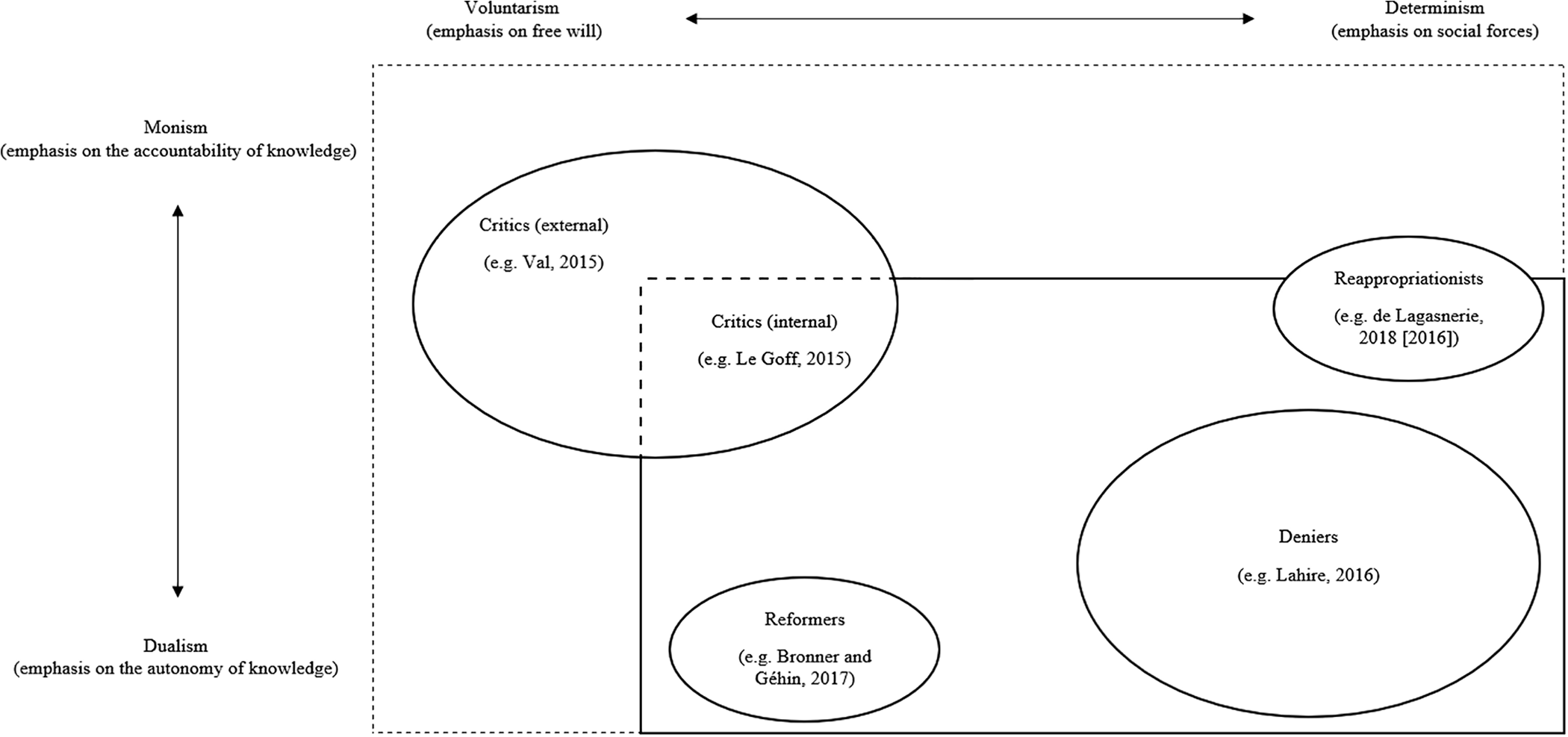
Rival epistemologies on sociological excuses.
This classification of epistemological strategies is not exhaustive and comes with the usual caveats regarding its ideal-typical and fluid nature. A more concerning issue is that there are reasons to believe that the view that sociological explanations amount to excuses, very much like the opposite view that explanations have no exculpatory value, should not be conceived as rigid beliefs that individuals either hold or not but rather as flexible rhetorical tools that disputants select when one of them advances their broader argumentative goals at a given time. As I showed elsewhere (Brandmayr, 2018), there are instances in which the same individual used both arguments almost simultaneously depending on whether explanations dealt with police violence or with terrorist violence. Still, the violent polemic that resurfaced in 2015, which mainly dealt with terrorism and violent crime, forced sociologists to take a stand on whether sociological explanations could amount or not to bad excuses. While not all sociologists were as epistemologically coherent as the representatives chosen here, many if not most understood that there were clearly incompatible conceptions at play and defended the one which they believed to be right. The typology captures these positionings.
But descriptive classifications are not enough. Bourdieu’s theory of field suggests that the three epistemological strategies deployed by French sociologists reflect deep cleavages in the ‘objective’ structure of the sociological field, which can be partitioned in different areas, according to such criteria of differentiation as the level of scientific capital (i.e. how much an individual or institution are recognised as legitimate producers of sociological knowledge), the proximity to and dependence from other academic disciplines (notably the humanities and the natural sciences) and the proximity to and dependence from government officials, media gatekeepers, business leaders, political parties and social movements. According to Mauger (1999), who builds on Bourdieu’s theory, the practices of French sociologists, especially in their relation to the political and media fields, can be distributed along three poles: ‘expertise’, ‘engagement’ and ‘autonomy’. The autonomous pole of ‘free intellectuals’ is opposed to the heteronomous poles of ‘state experts’ and ‘media intellectuals’. If we follow this framework, Lahire represents the autonomous pole, because of his high academic standing and his commitment to promote the institutional existence of sociology, Bronner represents the expert pole, because of his proximity to political elites and his frequent participation in advisory boards of private companies and state agencies. And de Lagasnerie represents the engagement (or media) pole, because of his low academic standing and proximity to radical social movements.
In terms of connection with other academic disciplines, the position represented by Lahire is the most straightforwardly sociological, advancing and promoting sociology against its academic competitors and extra-academic critics. It is appealing to teachers dedicated to the transmission of established sociological knowledge, to sociologists working on traditional topics such as inequality, education and the family, and to those who are involved in professional associations. Bronner’s reformation abounds in positive references and examples from other disciplines that reside in the ‘hard’ side of the academic hierarchy, notably neuroscience, experimental psychology, behavioural economics and in the ‘hardest’ side of the humanities, notably analytic philosophy (which, however, enjoys less social recognition in France than in anglophone countries). Himself a member of several organisations with a focus on medicine and technology, his stance appeals to sociologists with backgrounds in the natural and medical sciences and for those working in interdisciplinary institutions with an applied focus. De Lagasnerie’s reappropriation involves a valorisation of the type of practical and theoretical subversion that is typical of the humanities and of cultural studies, notably (‘continental’) philosophy, contemporary literature, theatre and visual arts. His position attracts sociologists with a background in those fields and for those with attachments to extra-academic institutions like museums, art galleries and theatres.
Furthermore, these epistemological strategies were not politically neutral: reformers tended to be close to liberal, centrist positions represented by the right wing of the Socialist Party and by Macron’s En Marche!, while deniers and reappropriationists by and large sympathised with the radical left embodied at the time by Mélenchon’s La France Insoumise. In some respects, reformers like Bronner were politically closer to law and order politicians and pundits who were attacking sociological excuses than to their colleagues of different epistemological persuasion.
All this suggests that the controversy around sociological excuses was not simply a clash of ideas, but a clash of different social forces, each seeing its own epistemological view simultaneously as the only legitimate one and as a means to promote its goals within the field. Of course, this is a sketch rather than a proper structural analysis of the French sociological field. But it is enough to show that what sociologists say about the political consequences of their knowledge, including its exculpatory potential, is not only highly variable but also dependent on where they speak from. And their theorisations are doubly consequential: first, in the sense that they can nourish the political debate and inform the views and decisions of citizens and rulers; second, in the sense that they can provoke shifts in the balance of forces within the sociological field: taking side in such a dispute is an opportunity that can boost or shrink one’s status in the field, both for established scholars, like Lahire, who aim to conserve and consolidate their position, and for mavericks, like de Lagasnerie, who aim to subvert the current balance of power by introducing new criteria of what counts as good sociology. In writing op-eds, appearing on radio and TV shows, and publishing books for the general public, in other words by making ‘intellectual interventions’ through which they defended rival epistemological theories, sociologists did not merely aim to gain media notoriety but they also attempted to gain recognition in the field and alter its balance of power.
It is too soon to say whether these efforts have made a difference. In a 2017 interview, Valls came back to his statements after the 2015 attacks: ‘Of course I was wrong to say that one should not search for the cause [of political violence]. It must be searched. But first, one must condemn’ (Valls, 2017). Had it all been a misunderstanding? It hadn’t. Valls’ words had been the last episode in a long series of tensions between different ways to respond to violence, and had provided the casus belli to wage a new series of epistemological, and thus social, disputes in an unstable sociological field. What had started as a rough media quarrel mainly involving pundits and politicians mutated into a major intellectual controversy, prompting and affecting a series of debates on such topics as the heritage of Bourdieu (Fabiani, 2016; Joly, 2018), the place of naturalism and neuroscience within sociology (Cordonier, 2018; Giry, 2019) and the normative power of the social sciences (Heinich, 2017; Karsenti & Lemieux, 2017). Sociology was due for another round of permutations of its fundamental ideas.
Footnotes
Acknowledgements
Thanks to Matteo Bortolini, Gerard Delanty, Johan Giry and to participants in the workshop ‘When does explaining becomes explaining away?’, held on 27 September 2019 at the University of Cambridge. Portions of this article were previously published in French in the journal Zilsel and benefitted from the help of Jérôme Baudry, Isabelle Bruno, Cyril Jayet, Jérôme Lamy and Arnaud Saint-Martin.
Declaration of conflicting interests
The author(s) declared no potential conflicts of interest with respect to the research, authorship, and/or publication of this article.
Funding
The author(s) received no financial support for the research, authorship, and/or publication of this article.
