



Abstract
The concept of the future is re-emerging as an urgent topic on the academic agenda. In this article, we focus on the ‘politics of the future’: the social processes and practices that allow particular imagined futures to become socially performative. Acknowledging that the performativity of such imagined futures is well-understood, we argue that how particular visions come about and why they become performative is underexplained. Drawing on constructivist sociological theory, this article aims to fill (part of) this gap by exploring the question ‘how do imagined futures become socially performative’? In doing so, the article has three aims to (1) identify the leading social–theoretical work on the future; (2) conceptualize the relationship of the imagination of the future with social practices and the performance of reality; (3) provide a theoretical framework explaining how images of the future become performative, using the concepts ‘techniques of futuring’ and ‘dramaturgical regime’.
Techniques of futuring: A dramaturgical analysis
The concept of the future is re-emerging as an urgent topic on the academic agenda (Andersson, 2018; Beckert, 2016; Beckert & Bronk, 2018; Bryant & Knight, 2019; Urry, 2016). A response to widespread societal uncertainty about what the future may hold ‘as the twin threats of ecological collapse and technological risk loom ever larger’ (Krznaric, 2019), this renewed attention manifests itself in many domains of public life. The public imagination is infused with visions of future environmental catastrophe and social inequality – as well as visions advocating for and assessing specific technologies and developments such as targeted medicine, nanotechnology and electric mobility. In the social sciences, academics worry about the consequences of technological developments such as the ‘smart city’ and ‘surveillance capitalism’ (Kitchin, 2020; Townsend, 2013; Zuboff, 2019) that increase both the power of ‘big tech’ and global inequality. In the domain of sustainability, scholars question the prevalence of doom and gloom narratives, arguing for ‘desirable futures’ people can act towards (Bai et al., 2016). A shared concern in these debates is the ability of human societies to imagine futures for themselves – and the lack of desirable alternatives. Yet social theoretical questions about how such imagined futures might gain traction are underexplained.
A rich, if scattered, social theoretical scholarship on the status and dynamics of the future exists. Historians have shown how ‘the future of the world’ (Andersson, 2018) became a subject of concerted effort and study. Anthropologists attempt to formulate anthropologies of the future (Bryant & Knight, 2019), often based on the fears and hopes of and in the contemporary world (Appadurai, 2013; Augé, 2014). Sociologists too have focused on how the future manifests in the present – as well as how present trends co-determine the shape of the future (Adam & Groves, 2007; Tutton, 2017; Urry, 2016). For Barbara Adam, ‘a future-less sociology is increasingly hard to defend in a world where socio-scientific products and their effects extend to ever further futures while temporal perspectives and concerns continue to narrow’ (Adam, 2011, p. 592). This social–theoretical interest in the future shares an attention to the way ‘the future’ is a part of – and gives meaning to – daily life in societies around the world (Adam, 2011; Appadurai, 2013; Tutton, 2017). It is well developed in its analysis of the performativity of the future in the present (Beckert, 2016; Bell & Mau, 1971; Borup et al., 2006; Groves, 2017; Jasanoff & Kim, 2015). Studies of performativity show how images of and expectations for ‘the future’ structure decision-making and social organization. How such visions come about, why they become performative and who has the capacity to render their visions performative remain underexplained, however. Drawing on constructivist sociological theory, this article aims to fill (part of) this gap by exploring the seemingly simple question ‘how do imagined futures become socially performative’? We aim to conceptualize the social origin of imagined futures, examining how they come to structure and organize collaborative action. In doing so, we put the ‘politics of the future’ centre stage: we propose to focus on the social practices that allow particular notions about the future to become performative.
We suggest that social–theoretical scholarship focus on the act of futuring, which we define as ‘the identification, creation and dissemination of images of the future shaping the possibility space for action, thus enacting relationships between past, present and future’. This active concept helps to view the future in terms of the imaginative work and practices that negotiate meanings and legitimacy, embed knowledge, engage publics and create relations of trust. In doing so, we argue for making the performative power of ideas and visions about the future into an explanans, something that must be explained. We suggest that the performativity of such visions can be explained through careful analysis of the practices through which imagined futures come to be collectively held. Such imaginative work is a site of agency, and therefore a site for the ‘politics of the future’. We invoke the concept of ‘techniques of futuring’ (ToFs), first defined as practices bringing together actors around one or more imagined futures and through which actors come to share particular orientations for action (Hajer & Pelzer, 2018, p. 222), as an analytical tool to examine futuring practices that attempt to render imagined futures performative.
This article, then, has three aims. First, it identifies the leading social–theoretical work on the future in terms of its insights and shortcomings. Secondly, it fills (some of) these lacunae by describing the relationship between the imagination of the future through social practices and the performance of reality. Finally, building on the ToF concept, it develops a performative understanding of futuring – proposing a dramaturgical analysis to investigate how actors actively ‘bring the future into the present’ through performances using particular narratives, settings and configurations. To further this type of research, we introduce the concept of ‘dramaturgical regime’ and a dramaturgical framework. In short, this article aims to provide a theoretical framework to explain how images of the future gain performative traction.
Visions of the future and their performativity
Until recently, the future received surprisingly little attention in social theory. As Beckert (2016) observes, most important social–theoretical concepts try to explain the present in terms of the past, with notions such as ‘path-dependency’ or ‘unintended consequences’. The future, however, is always also influential in the present. The ‘later-than-now’ always plays a role in decision-making. Individuals and collective actors (businesses, governments, NGOs) ‘anticipate’ futures (Beckert, 2016; Vervoort & Gupta, 2018). Societies develop and adopt tools and social technologies to render the future actionable, such as predictions, models and scenarios (Andersson, 2018; Candy & Dunagan, 2017; Miller, 2018; Wack, 1985). Yet for social scientists, the future’s temporality makes it difficult to study it (Bell & Mau, 1971): how does a sociologist study the ‘not yet’, that which has not yet happened, which has not taken material form in the present time? What counts as knowledge of the future if the future is not considered as already pre-existing? (Tutton, 2017, p. 482)
To the sociology of expectations, expectations function as ‘wishful enactments of a desired future’ (Borup et al., 2006, p. 286). The sociology of expectations shows that discourses about the future are generative, in that they ‘guide expectations, provide structure and legitimation, attract interest and foster investments’ (Borup et al., 2006, p. 285). The factuality of these imagined futures is not important so much as the way that their credibility provides a ‘prospective structure’ (van Lente & Rip, 1998) that shapes actors’ orientations for action (Beckert & Bronk, 2018; Hedgecoe & Martin, 2003; MacKenzie & Millo, 2003). In their capacity to direct action, then, ‘expectation statements are not only representations of something that does not (yet) exist, they do something: advising, showing direction, creating obligations’ (van Lente, 1993, p. 191). They can become ‘real-time representations’ of future situations that attract coalitions through press-releases, conferences and other promissory performances (Sunder Rajan, 2006).
Affect regulates another aspect of the performative relationship between past, present and future. Where the performativity of expectations relies on credibility, on being believed and expected, affect relies on (a form of) emotive investment. A growing body of literature in both sociology and anthropology – such as the sociology of hope (Desroche, 1979; Miyazaki, 2004; Petersen & Wilkinson, 2015) – shows that an affective relationship to the future can also be performative (Adam & Groves, 2011; Adams et al., 2009; Massumi, 2015; Mauch, 2019). Hope, for example, can be understood as ‘an insistence on potentiality or concrete possibility for another world’ (Muñoz, 2009, p. 1), giving meaning to future-oriented practice through the imagination of different futures. Hope, of course, is not the only affective relationship with the future. As Bryant and Knight (2019) outline in their The Anthropology of the Future, there are at least six types of affective relationships with the future: anticipation, expectation, speculation, potentiality, hope and destiny – with utopias and dystopias as particularly powerful affective motivators (Moore, 1966; Sliwinski, 2016).
Affective relationships with the future are performative because they provide actions in the present with meaning, especially when combined with expectations about (the effect of such actions on) the future. This meaning-making aspect of the relationship between an affective engagement with the future and expectations features centrally in literature on the collective imagination. Studies of the collective imagination describe ‘the way people imagine their social existence, how they fit together with others…and the deeper normative notions and images that underlie these expectations’ (Taylor, 2004, p. 23). This collective imagination is a site for meaning-making, affect and the structuring of social relationships and expectations. Imaginaries shape social relationships with the future (Anderson, 1983; Butler, 1988; Ezrahi, 2012). Sociotechnical development, for example, relies on sociotechnical imaginaries (STIs), culturally specific, collectively held imaginations of desirable technoscientific futures, to structure investment and solidify collective belief in the desirability and feasibility of technologies (Jasanoff & Kim, 2015). In this literature, the collective imagination presents itself as a form of social work, imaginaries being ‘neither cause nor effect in a conventional sense but rather a continually rearticulated awareness of order in social life’ (Jasanoff, 2015, p. 26), relying on performance and (re)enactment ‘of a set of meanings already socially established’ (Butler, 1988, p. 26).
The literature on the collective imagination exists in continuous dialogue with material–semiotic approaches, which – in the context of futuring – stress that ‘the material aspects of anticipation – its capacity to draw virtual futures into the present and make them actually effective – extend beyond language’, because ‘anticipation is dependent on the capacity of bodies and of socio-technical apparatuses, distributed through the environments of social action’ (Groves, 2017, p. 29). In this sense, material organization contributes not only to an unevenly distributed anticipatory capacity through the lopsided distribution of the material futuring capabilities, it also structures what is thought of as possible (Adam & Groves, 2007; Jasanoff & Kim, 2015; Urry, 2016). The post-war imaginary of the ‘American Dream’, for example, related to the negative sentiment of living in confined urban neighbourhoods and required the visible existence of the automobile and the construction of motorways and suburban infrastructure to be effective as a STI – as well as the material capacity to present and perform such an imaginary. In the words of Barbara Adam and Chris Groves, ‘matter is to be understood not just spatially as frozen in time but also temporally as extended and enduring, interacting and regenerating, decaying and leaving a record, projecting and entailing […] futurity’. (Adam & Groves, 2007, p. 178). In short, material arrangements embody and embed social relations, as well as images of the future into the design of the present as well as the modes of anticipation they afford.
These four connected literatures all focus on the structuring effects of those imagined futures. They provide distinct views on the performativity of imagined and material futures in the present. The sociology of expectations focuses primarily on the activities that lend credibility to imagined futures and the promise requirement cycles this may induce. Sociologies of affect show the ways in which visions of (alternative) future worlds provide hope, inspiration or despair. The literature on the collective imagination, in turn, merges the study of the affective, meaning-making power of the imagination with the guiding role of expectations and visions in a culturally sensitive way. These three interpretations of performativity are complemented by material–semiotic interpretations that foreground the way imagined futures are enacted in and through material structures. Across the board, these social theoretical approaches to the performativity of imagined and materially embedded futures stress that the future is a cultural fact (Appadurai, 2013), relying on performance, enactment and material embedding in social practice (Malkki, 2001; Mische, 2009). It is not something ‘out there’, or something that is only ‘of the mind’ (Adam, 2011), but a materially and discursively enacted part of the present (Tutton, 2017).
What these approaches leave under-conceptualized is how such visions and imaginaries emerge and gain traction in the collective imagination. While they stress the importance of performance and the continuous repetition of imagined futures through practice, they do not often address explicitly how such visions of the future become a persuasive part of people’s lived experience. Often, they also overlook the contextualized (and unequally distributed) agency of people to both act upon and change such visions. In the next section, we explore precisely this question: how can the performance and enactment of futures be understood as a form of social practice?
A practice approach to futuring
Social–theoretical attention to the future should not only be paid to how visions of the future underpin practices in the present but also to how contextualized practices bring that future into the present. The collective imagination is, as Arjun Appadurai puts it, ‘an organized field of social practices, a form of work (in the sense of both labor and culturally organized practice), and a form of negotiation between sites of agency (individuals) and globally defined fields of possibility’ (Appadurai, 1996, p. 31). Collective imaginations are performed and (re)enacted in practice, needing ‘organized fields of social practices’, media technologies and existing cultural norms and imaginaries through which to travel. An equally important part of what makes those visions persuasive, however, are the contextualized practices that identify, create and disseminate images of the future – and through a ‘stylized repetition of acts’ (Butler, 1988, p. 520) embed them in social reality. Social theoretical approaches to the future often explain such practices structurally, based on existing imaginaries and power structures, paying too little attention to the ways in which ‘the possibility of a different sort of repeating’ (Butler, 1988, p. 520) allows the creative disruption of imagined futures. The social instruments for the dissemination of imagined futures have received significant attention in futures studies and critical futures (e.g. Eelderink et al., 2020; Mangnus et al., 2019) – but those studies often lack a firm grasp of the structurally bounded nature of such social technologies. Steering a middle course, a better understanding of the dynamics of imaginaries becomes possible by examining ‘futuring’ practices – critically investigating how they are embedded in a social world of practitioners, meanings and material realities.
Such an investigation should bring out the active and situated work of futuring, defined here as the identification, creation and dissemination of images of the future shaping the possibility space for action, thus enacting relationships between past, present and future. It should actively probe how visions of the future come about, become persuasive and travel through social practices. According to practice theory, people construct and perform a social world through social practices. It is through these routinized practices that we create and continuously recreate our lived-in reality (Butler, 2011; Mol, 2002; Moser, 2008; Shove et al., 2012; Woolgar & Lezaun, 2013). Applying this social–theoretical notion of ‘practice’ to futuring, we can investigate how people come together around particular visions of the future. Practices mediate, curate, create and enact imaginations of possible futures in the same ways that they create our lived-in reality. Through giving shape to daily life, and the meaning of people’s actions, practices allow for the enactment of imaginations about a shared reality – and of visions of the future. Because they do, futuring practices can be analysed in their potential to both maintain and disrupt visions of the future. Whether it concerns expert-led practices like climate modelling or democratic deliberations, the practices involved are socially codified ways of acting out, presenting and performing images of the future. They require social and material settings that come with specific competences, material requirements and a range of implicit meanings. To take a familiar example, the dissemination of the American Dream as image of the future initially took place via glossy magazines like Harper’s Magazine, Readers Digest and the subsequent material expression in the 1939 New York World Fair called ‘The World of Tomorrow’ (Albrecht, 2012).
Analysing such practices as functionally designed ToFs helps to identify the concrete social practices – and their recognizable social and cultural history – through which people perform imagined futures. Often, these practices are organized around specific ‘tools’ or instruments, such as cost–benefit analysis (CBA), climate modelling, visioning exercises or codified forms of public participation. Rather than delimiting the analysis to studying how CBAs or climate models produce images of the future, a futuring lens would study the social practices that give such tools their performative authority. ToFs contribute to shared imaginaries according to their own internal ‘logics’ (Lascoumes & Le Gales, 2007; Law & Urry, 2004). Since World War II, a wide variety of futuring practices have been developed around technologies and instruments designed to envision the future (Andersson, 2018). Some of these are explicitly ‘futurological’, such as scenario-planning, while others, such as design thinking and trend-watching, are less explicitly future-oriented. A practice-based investigation of these tools sheds light on how they ‘bring imagined futures into the present’. It also highlights how coalitions form around particular expectations and visions, and how they render these visions authoritative orientations for action.
Future-oriented tools are often presented as ‘neutral investigations’ of the future aimed to support political decision-making. There is ample empirical research showing they aren’t. Brian Wynne (1984), for example, showed early on that numerical world-modelling was always a practice of political persuasion and coalition building as well as a scientific project. Not just a morally neutral and ‘rational’ description of the (future) world, world-modelling aimed to bring about a coalition around a particular form of (global) environmental action (Edwards, 2010). In the years since, scientific modelling work has often aimed to make people ‘walk together’ towards shared imagined futures (Andersson & Westholm, 2019). In the present, the Intergovernmental Panel on Climate Change (IPCC) reports fulfil a similar role by bringing political actors together around particular ‘pathways’ for mitigation policy (Beck & Mahony, 2018). Likewise, economic instruments create ‘fictional expectations’ that enable actors to converge around shared imagined futures (Beckert, 2016). CBAs or world models are thus not just tools, they come with a shared background understanding through which actors mutually adjust expectations and evaluate what is feasible and appropriate in a given situation.
Through the ToF concept, it becomes possible to draw out how the usage of models or CBAs helps to create order in the unstable imagination of the future – but also how these imaginings rely on shared background understandings. All ToFs rely on specific ‘logics’, presuppositions and practices that structure how actors can interact and engage with certain images of the future. ToFs come with embedded assumptions about who gets to participate, how the future ought to be presented, what the implications of the presented futures are for sociopolitical practices and what types of knowledge are needed for presenting the future. At the same time, there is always room for creative agency in the presentation of the future (e.g. Hoffman, 2013). This means that ToFs are characterized by a dynamic relationship between the (imaginative) structures within which interaction takes places and the agency of actors to shape those structures and their creativity ‘to do things otherwise’ (Hoffman & Loeber, 2016; Joas, 1996). This structure–agency dynamic is key to understanding how ToFs enable imagined futures to become persuasive. We typically find little attention for this form of mediated agency in practice theory, which tends to privilege the social, material and discursive structures around practices. To address the subtle form of agency inherent to presenting and performing visions of the future, we suggest complementing practice-orientation with dramaturgical analysis.
Understanding futuring as dramaturgy
The structure–agency dynamic relationship can be illuminated by observing the dramaturgy of futuring practices. Borrowed from theatrical studies, the concept of dramaturgy describes how social situations are ‘performed’ and how existing performative imaginations are enacted (Burke, 1969; Goffman, 1959; Hajer, 2009). Dramaturgical analyses capture how practices are structured by conventions, and how actors can assert agency in becoming knowledgeable and capable of shaping that dramaturgy. In doing so, dramaturgical analysis enables the comparative study of different ToFs and a ‘close-up’ of actors in action. It explains how embedded assumptions and norms around the presentation of the future – but also disruption through ‘a different sort of repeating’ – allow images of the future to travel, to become persuasive and to ultimately become performative.
While new to the analysis of futuring practices, dramaturgical social theory has underpinned social and political analysis of the ‘performance’ and ‘enactment’ of collective and shared images of reality for decades (Burke, 1969; Ezrahi, 2012; Goffman, 1959; Hajer, 2009). According to dramaturgical theory, social situations can fruitfully be understood as theatre plays in which actors aim to convey an impression of the world through particular settings, sequences, dialogues, props and even costumes. Through these performances, people come to ‘suspend their disbelief’ and share collective imaginations of political power, authority or, indeed, the future (e.g. Ezrahi, 2012). By foregrounding the importance of setting and sequence, dramaturgical social theory corrects a historical bias to what people say (e.g. Edelman, 1985) by connecting it ‘to how they say it, where they say it, and to whom they say it’ (Hajer, 2009, p. 65). Key to this is what Kenneth Burke calls the ‘scene–act ratio’. In introducing his famous ‘pentad’ of scene, actor, agency, act and purpose, he writes that ‘it is a principle of drama that the nature of the acts and agents should be consistent with the nature of the scene’ (Burke, 1969, p. 3). A dramaturgical analysis thus emphasizes how act and scene, discourse and setting, content and form come together to convey a particular impression of the world. Like sequential scenes of theatre plays create the possibility for the suspension of disbelief by the audience, the dramaturgy of social life creates ‘reality effects’ (Ezrahi, 2012) for social reality – and for images of the future. Individual scenes contribute different elements (scientific and experiential knowledge, legitimacy, resources) that, through sequential organization, stylized repetition and alignment of assumptions and practices, can contribute to formation of an ‘imaginary’ of how the world should be understood and acted upon (Appadurai, 1996; Ezrahi, 2012; Jasanoff & Kim, 2015; Taylor, 2004). Combining the sequential logic and alignment of assumptions with the idea of a scene–act ratio, we define the subject of dramaturgical social theory of futuring here as the sequential social performances that allow particular visions and collective imaginations to become socially authoritative.
This dramaturgical perspective can be employed to investigate how ToFs aid the social journey of imagined futures. A first avenue for such investigation is through the ‘staging’ of successive events, ‘the organization of an interaction, drawing on existing symbols and the invention of new ones, as well as the to the distinction between active players and (presumably passive) audiences’ (Hajer, 2009, p. 67). A second angle is to analyse what futures are made present in each individual act of an overall performance. The future can be presented in myriad ways – numbers, words, images, sounds, smells – employing different sensory systems and forms of meaning-making (e.g. Pelzer & Versteeg, 2019). The medium of this performance is crucially important in what types of engagement it allows and encourages by the instrument’s constituency and its audience. A dramaturgical take on ToFs thus makes possible the study of how images of the future get produced and circulate in society. Moreover, it allows for the investigation of how certain images of the future gain traction – how they come to function as imagined futures and shared imaginaries that structure peoples’ lived-in reality. This becomes possible because ToFs are characterized by particular ‘dramaturgical regimes’, specific sets of arrangements, competencies, meanings and identities underpinning a way of imagining the future and of going about things.
An illuminating example of a dramaturgical regime is that of the climate modelling community, which has in recent years co-structured political debates on climate change through the IPCC, initiated by the World Meteorological Association in 1988 in an attempt to create an authoritative scientific voice on climate change. Through the 1992 United Nations Framework Convention on Climate Change (UNFCCC), it became the privileged ‘science-policy interface’ on climate change. As scientific support for UN politics, the IPCC follows a ritualized sequential logic, of periodic ‘assessment reports’ with tens of thousands of scientists contributing their knowledge. The ‘summary for policy makers’ of these assessment reports is a text agreed upon in a line-by-line procedure, with input from both academics and policymakers (Hulme & Mahony, 2010). For projections of the future presented by the IPCC to be authoritative, this protocol needs to be carefully maintained and executed. Its reports depend on widespread media-attention and continual re-enactment for the political authority of its presented futures. As such, analysing the IPCC as a dramaturgical regime would require the analysis of the many facets that contribute to its periodical performances. Likewise, other ToFs would require a similarly holistic analysis of their dramaturgy. In the next section, we develop this dramaturgical framework further.
ToFs and dramaturgical regimes
Two lines of inquiry are particularly promising for the dramaturgical analysis of ToFs. One avenue is the investigation of dramaturgical regimes of ToFs as durable social practices and communities of practice. Such an approach could study, for example, how presentations of the future are codified in handbooks (as is the case with CBA) and how actors continuously update ToFs to incorporate new demands. In this context, dramaturgical regimes function as more or less stable social practices that come with sequential social performances. They also presuppose imaginative structures and logics that prescribe the presentation of imagined futures in a particular way (e.g. Pelzer & Versteeg, 2019). An analysis of durable ToFs focuses on how particular types of engagements with the future travel and become persuasive through the enduring efforts of its key agents and their widely disseminated and accepted signifiers and symbols. A second promising avenue would be to analyse specific imaginative interventions. In such an analysis, the focus lies on the ways in which actors use particular ToFs to create a certain form of order in a particular social or political situation. This means focusing on how ToFs frame the futurity of issues at hand and how they coordinate action in the face of uncertainty. Analysing ToFs as imaginative interventions means studying exactly how actors perform visions in situ, and how such performances travel to redefine existing imagined futures and futuring practices.
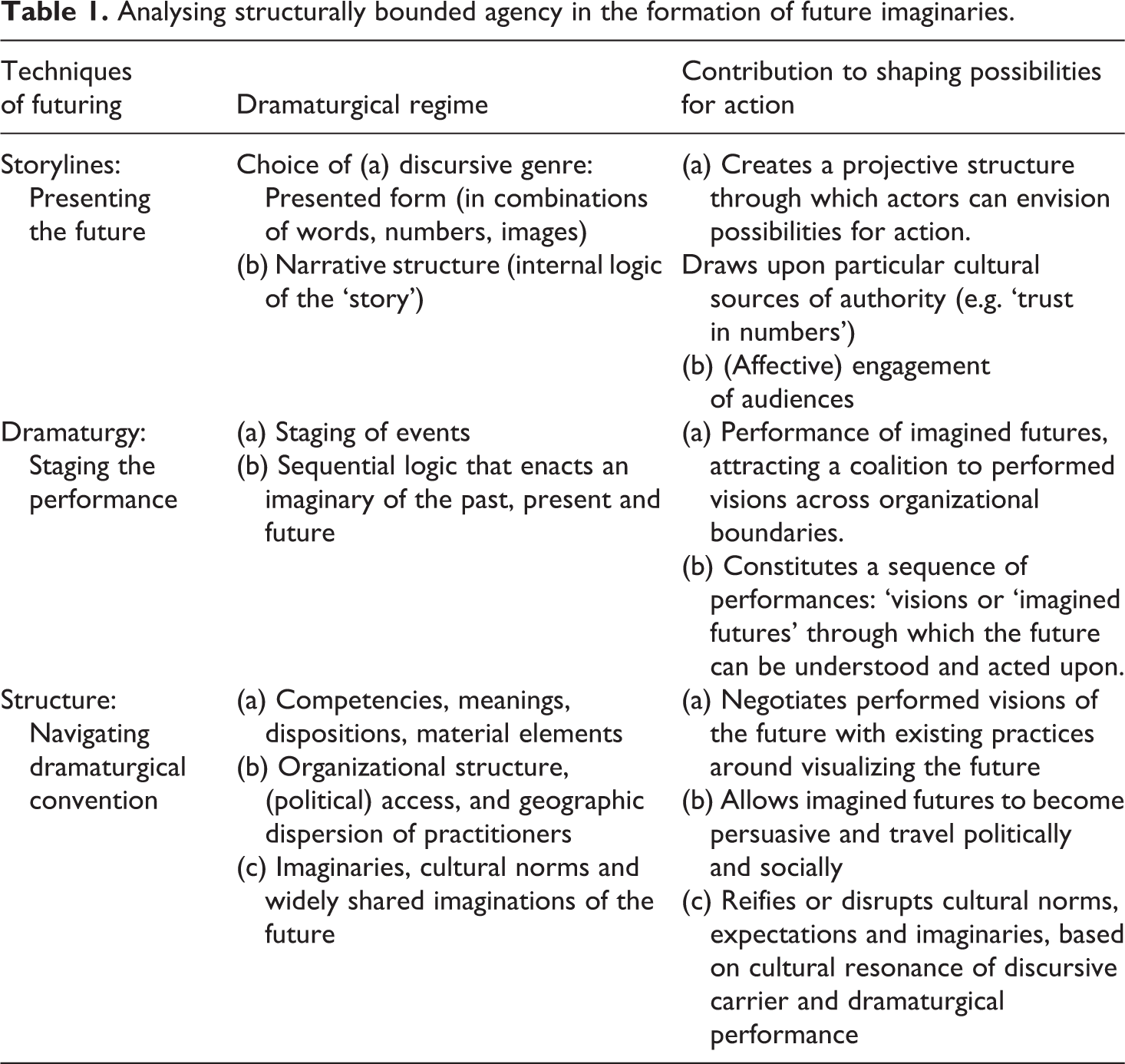
In both these lines of inquiry, three core aspects determine the dynamic relationship between dramaturgy and the structuring of imagined futures: (a) the specific types of genres and storylines through which the future is presented; (b) the particular staging of the performance and its corresponding sequence of events in which people are brought together, both physically and imaginatively; and (c) the existing dramaturgical and discursive conventions that restrain and structure the possibility space for action.
Storylines: The presentation of the future
The dramaturgy of ToFs informs action by presenting a particular storyline about the future. These storylines ‘have the functional role of facilitating the reduction of the discursive complexity of a problem’ (Hajer, 1997, p. 63). ToFs present particular storylines about the future, in which they reduce the unknowability and openness of the future to more manageable proportions, helping to create a shared orientation point for action: ‘If we want to keep the global warming under two degrees Celsius, we will need to radically curb our CO2 emissions over the next decade(s)’; ‘the future of traffic is for self-driving vehicles that are no longer privately owned but are shared as a service’. Such storylines can be affective, can raise expectations or normatively structure imaginaries about the future. The first key element of these storylines is the discursive genre in which they present the future as a combination of numbers, words and images. This discursive genre, to a large extent, determines whether and how specific audiences engage with the future. Discursive genres rely on and imply specific forms of imaginative authority. Quantitative presentations of the future, such as most climate models, speak to what Porter (1996) calls a ‘trust in numbers’ and an assumption of ‘scientific rigor’ and rationality. To safeguard this rigor and public trust in that rigor, there are strict assumptions about who gets to participate in creating these presentations of the future (and in what way) – and often quite severe material constraints to participation such as access to supercomputing or the venues in which the future is performed. This means that quantitative presentations of the future tend to be expert-led. They derive their authority from the numerical projections – using words and images as dramaturgical aids to the presentation, but not as the central claim. Other genres of imagined futures draw on other registers of authority. Back-casting exercises that start from an imagined desirable future derive part of their imaginative authority from pre-existing notions of plausibility, but they may also draw from notions about the value of democratic participation. Yet others draw from their aspirational quality or experiential tangibility or an emotive mix of images. Primarily commercial suggestions that the future is for self-driving vehicles, for example, show a desirable future world via slick video-clips bordering on science fiction. Such choices function as signifiers to help people read, trust and identify with an imagined future. In all genres, discursive and dramaturgical choices are importantly specific to the relevant registers of authority. For climate models to become persuasive, they have to adhere to different conventions in presenting the future than commercial attempts to open up new markets for smart commodities do.
These storylines can be analysed in terms of their narrative structure (Mische, 2009). Like any story or theatrical production, a presentation of the future needs a narrative arc to draw people in. Narrative structures diverge widely across different genres of ToFs, drawing on different forms of affect and expectations. These storylines can privilege continuity from the present into the future or ruptures between past, present and future. They can have shorter or longer time spans, expand or narrow the range of imagined futures. The narrative structure of a presented future doesn’t just determine whether people consider particular imagined futures possible, plausible or desirable in the first place but it also co-determines whether this resonance is strong enough to allow the imagined future to travel and become persuasive. Analysing how a ToF discursively presents the future, in what genre and using what narrative structure, helps to understand how it enables different audiences to engage with the future and in what ways this reinforces, consolidates or transforms an imaginative space of possibilities for action.
Dramaturgy: Staging the performance
The second way in which ToF dramaturgies allow visions of the future to travel lies in the sequential processes of interaction between people and places. The first key element of this is the ‘mis-en-scene’ of social interaction, the particular staging of a presented future. Social interactions take place in particular settings that co-determine the social process and effects of interactions. The setting of such interactions is crucial because settings and stages imbue interaction with certain meanings, often based on imaginative understandings of how particular settings and configuration ‘are supposed to’ work. An ‘excursion’ or a ‘field visit’ provides a different set of opportunities for the sequence of events and allows for meanings and experiences to be imagined differently than, for example, a meeting in office building. This brings out an all-important second aspect of the sequential process of interactions between people and places, namely the particular sequencing of events. As discussed above, a sequence of events can be seen as the step-by-step braiding of knowledge, images of the future and legitimacy. Such a sequential process, facilitated by the specific competencies of the actors, allows imagined futures to find coalitions that rally around its accuracy, probability, (un)desirability or potency. The analytical focus here, then, is not on the power of the ideas, visions or imagined futures themselves but rather on how such performance of visions of the future become persuasive over a sequence of events. Again, material organization and access to anticipatory tools such as integrated assessment models also play an important part in the scripting and staging of futuring performances – as do the bodily competences of the practitioners.
The persuasiveness of imagined futures does not merely depend on how its performance is staged in general but also on how presentations are ‘scripted’ and performed by their organizers, as well as ‘counter-scripted’ by antagonists. Scripting includes, among others, structuring the order of a conversation, what is said and who is allowed to speak or not (and in what way). Climate modelling, especially scenario modelling, for example, is often a response to specific political concerns addressed by a particular community of experts. Sequentially, it allows voices of political demand (through the UNFCCC) and expert judgement (through the IPCC), while excluding other voices. In such a way, climate futures imagined through climate modelling travel sequentially between the desks of expert communities and the IPCC, into the political sphere of the UNFCCC – leading to particular, often narrowly technocratized, imaginaries about possible climate futures (Oomen, 2019; Swyngedouw, 2011).
Analysing a ToF’s sequential logic thus helps to understand how a particular imagined future becomes persuasive, sequentially braiding coalitions around a vision of the future. As the empirical investigation of Hajer and Pelzer (2018) shows, this sequential logic is not always scripted in advance. Their study concerned an immersive experience of how the North Sea transformed from a sea used for the exploitation of oil and gas in 2016 to a sea of offshore windmills providing 90 per cent of the electricity demands of the countries surrounding the North Sea in 2050. It reveals how the suspension of disbelief gradually allowed a desirable imagined future to capture its key audiences. Importantly, this ToF did not work according to a preconceived script but followed the emergent quality of the process, following sequentially the success of particular joint experiences of this new possible future. This, however, was only possible within existing structures and expectations.
Structure: Navigating dramaturgical convention
ToFs do not just rely on particular discursive carriers or sequences of events, they also exist within structures – imaginary, discursive and material – in which assumptions about their value and appropriateness are held and enacted. This means that any analysis of how imagined futures become persuasive is never complete without analysing the structural bounds that allow them to become persuasive. In this article, we used illustrations from different fields and time periods. While all these examples presented particular visions for the future, the 1939 World Expo performed the future in a different environment than climate models do today. ToFs are temporally specific, though some more so than others. Particular expert-based claims about the climate future, for example, rely on an epistemic trust in numbers (Ezrahi, 1990; Porter, 1996) and computer models that solidified over decades (Edwards, 1996, 2010). In the 1960s, model-based ToFs were not widely trusted as accurate descriptors of the future, yet today the imaginative structure around simulation modelling is so strong that modelling has become one of the most authoritative ToFs. Nowadays, simulation modelling is ‘virtually a knee-jerk response, the first and most effective tool for analyzing any problem’, where ‘before about 1970 most sciences had barely begun to think about simulation modeling, let alone to accept it as a fundamental method of discovery’ (Edwards, 2010, p. 358). ToFs are also culturally specific. Transdisciplinary participatory collaborations between government officials, policymakers, academics, activists and civilians are seen as legitimate ToFs in the Netherlands (Hajer & Pelzer, 2018), for example, in ways they wouldn’t be in other cultural contexts. In short, ToFs relate to norms, meanings and competencies that inform how they can present their imagined futures. Such norms and competencies are specific to particular types of ToFs. Modellers operate in structures different from those of theatre makers, although both share a cultural context. Structures delimit the types of claims can be made about the future and how they can be performed and presented. This is an important field for research; the reliance on established routines of depicting the future might often stand in the way of reimagining the range of possible futures.
Taken together, these three general characteristics of ToFs (storyline and narrative structure, sequential dramaturgy and performance and the navigation of structural constraints) constitute a dramaturgical regime. Taking a lead from Anthony Giddens (1984), such a regime can be understood as a more or less structured and routinized way of going about ‘bringing an imagined future into the present’. Each successful ToF can be understood to have a certain coherence in the way storylines are presented, sequences of events organized and meanings and competencies structured. This means that a ToF’s dramaturgical regime informs how and when particular futures can be presented and imagined. Attention to the dramaturgical regime allows for an investigation of how ToFs exist in bounded structures, but also how, in return, purposeful actors can perform such structures dramaturgically. It presents the possibility of a dramaturgical analysis of the ways in which ToFs make imagined futures persuasive through practice, performance and re-enactment and stylized repetition. This interplay between the three aspects of the dramaturgical regime is summarized in Table 1.
Analysing structurally bounded agency in the formation of future imaginaries.
Conclusion
A dramaturgical interpretation of the ToF concept provides a symmetrical analytical lens to reconstruct and understand why certain futuring interventions lead to performative imagined futures while others don’t. Analysing the dramaturgical components that give particular performances of futuring their ‘reality effects’ (Ezrahi, 2012) helps to explain how visions of the future travel from the particular to the collective. It also allows for the further investigation of the interplay between different elements means that each dramaturgical regime, and how they are characterized by different logics. Some logics, such as the ‘imaginative logic’, concern the narrative structure through which the future is brought into the present (Pelzer & Versteeg, 2019). Numerical projections of the future, such as IPCC reports or CBAs, derive their imaginative power from particular imaginative logics based on an extrapolation from the present, while artistic presentations might juxtapose an imagined future to the present. Another set of logics to look into would be the logics of appropriateness (March & Olsen, 2011) that inform action in a situation and prescribe appropriate behaviour and are subject to ongoing effort to create and enact a shared understanding of what is real, valuable, reasonable and right. A third set of logics relates to the temporal logics (Mead, 1932) through which communities tend to organize and understand a sequence of events, who gets to speak at what moment and what audiences are involved at what stage. The combination of these logics, emerging from the underlying conventions, routines, imaginaries and other structural elements, co-determines the dramaturgical regimes that allow ToFs to present and perform imagined futures in persuasive ways. Importantly, this also opens up an avenue for research into how actors participating in ToFs consciously decide what to do, how to organize themselves and reflect on their own futuring work.
A dramaturgical analysis of ToFs, then, allows for careful investigation of the subtle forms of agency that allow for imagined futures to become persuasive. It can show how structurally bounded agency embed visions of the future in the collective imagination. As ‘politics is about who can make his/her claim authoritative in the scenes and at the stages that matter’ (Hajer, 2009, p. 4), the politics of the future revolve around who can make their imagined futures authoritative in the scenes and stages that matter. The uncertainty about the future that manifests itself at the moment is only partially due to geophysical or technological realities. It also connects to a societal ineptitude to make sense of the future and plan for it. Currently, the ubiquity of forecasts, projections and scenario-modelling in public policy, politics and business planning in modern society creates a particular range of imagined futures, delimited in the ways they can imagine futures. Methodically analysing the practices that enact and produce certain visions and the structures that enable them through the ToF prism may make it possible to reconstitute futuring practices. Perhaps, this can constructively reconstitute constructivist analysis of the future too, in ways that are more fit to solve the crises of the twenty-first century.
Footnotes
Declaration of conflicting interests
The author(s) declared no potential conflicts of interest with respect to the research, authorship, and/or publication of this article.
Funding
The author(s) received no financial support for the research, authorship, and/or publication of this article.
