




Abstract
This article examines the centrality of Brazil within the future of climate policy and politics. The state of the carbon sink of the Amazon rainforest has long been an iconic marker of the condition of the Earth. Brazil has been innovative in developing many non-carbon forms of energy generation and use and it has played a major role in international debates on global warming since the Rio Earth Summit in 1992. We examine various ways in which climate change has come to be centrally important in Brazilian public opinion. Survey evidence shows that Brazilians are the most concerned about issues of climate change – with less climate change scepticism as compared with more ‘advanced’ societies. Through using techniques of corpus linguistics we examine how Brazilian media has engendered and stabilized such a high and striking level of climate change concern. We show that the media helped to fix a ‘climate change framing’ of recent often strange weather. The article analyses the newly constructed Brazilian Corpus on Climate Change, presenting data on a scale and reach that is unique in this area of research.
The problem of climate
A new spectre is haunting the ‘globe’ – the changing of the world’s climate, something that was thought impossible until the last few decades. Such change is believed to be caused by increased levels of ‘greenhouse gases’ (GHGs) within the atmosphere which cannot be fully absorbed into the oceans. A climate forcing has resulted from systems that since the mid-eighteenth century in England have involved extracting, burning and distributing fossil fuel based-energy mostly from under the ground. Some unimaginably old and dirty fossil fuels made the shiny modern world contingently possible, a world that country after country wants to be part of, including especially the so-called BRICS (Brazil, Russia, India, China and South Africa) (Tyfield and Urry, 2014).
Through burning fossil fuels, 2,000 billion tons of CO2 have been spewed into the atmosphere and will remain there for hundreds of years (Berners-Lee and Clark, 2013: 26). CO2 emissions in particular increased exponentially from 1850 to the present day and show no signs of slowing down, let alone of going into reverse (Berners-Lee and Clark, 2013: 12). If temperatures continue to increase by anything between 2 to 6 degrees Celsius over this century as emissions rise, then human, animal and plant life upon the Earth will be irreversibly transformed. This is the ‘burning question’ confronting the Earth’s present and future citizens.
Key in articulating and organizing a global response to such apparently changing climates is the Intergovernmental Panel on Climate Change (IPCC), founded by the United Nations Environment Programme in 1988, a year of record temperatures. Every few years scientists from different scientific disciplines examine the links between GHG emissions and climate. The IPCC-organized actions of thousands of scientists, policy-makers and NGOs across the globe have, in the face of hugely powerful commercial and state interests, transformed public, media and policy debate. The IPCC is one of the world’s largest scientific endeavours and is relatively open to industry experts, outsiders and NGOs. It has developed models and arguments that most can sign up to, even the Pentagon, arguing that climate change will cost millions of lives and poses a threat to global security that eclipses global terrorism (Abbott, 2008; National Intelligence Council, 2012).
As early as 2007 the IPCC stated that the evidence is now ‘unequivocal’ that humans are changing the climate (IPCC, 2007). Relatedly Nobel Prize-winner Paul Crutzen argued that there is a new geological period of human history, ‘the Anthropocene’, in which human activities exert such a major impact upon almost all aspects of the Earth system that they can be seen as equivalent to a great force of nature.
Moreover, it is clear that global warming will only be slowed down if the seven billion ‘humans’ on the planet behave very differently. Climate change is not a purely ‘scientific’ problem. Human actions are central to this warming. Climate change is entangled with specific imaginaries of how society is and ought to be and this is why analyses of society need to be positioned at the heart of why climates are changing and of policies that could develop alternatives to high carbon systems (see climate scientist, Hulme, 2009).
So far, however, the framing of ‘humans’ within climate change understanding and debate has been monopolized by the ‘dismal science’ of economics (see Stern, 2007). These economic models encounter serious limitations. While economic institutions are obviously enormously significant, this is often because of their social and political consequences especially since many corporations have vested interests in some version of ‘business as usual’ (see Urry, 2013). Moreover, economists typically regard energy as responsible for about 5% of the GDP of any economy. But fossil fuel-based energy is a unique bundle of commodities that generate ‘external diseconomies’ on such a historical and geographical scale that they seem to change climates and future supplies of energy, water and food. This ‘basic factor’ of energy structures the social, temporal and spatial organization of societies and ‘life’ itself (see Tyfield and Urry, 2014).
Furthermore, most of the time people do not behave as individually rational economic consumers maximizing utility from the basket of goods and services they purchase and use. People are creatures of social routine and habit. These routines stem from how people are locked into social practices and social institutions, including families, households, friendship groups, social classes, genders, work groups, businesses, leisure groups, schools, ethnicities, age cohorts, nations, and so on. Buying and using goods and services help to constitute these institutions and their social practices and it is such practices that are the very stuff of life (Shove, 2010; Shove et al., 2012).
Modern lives totally depend upon burning fossil fuels, to heat, power, manufacture and move people and objects. In the twentieth century, societal changes brought about high carbon forms of life, as well as huge population growth. In the neo-liberal period since the later 1970s, there was a further ratcheting up of such systems. The legacy of excess during the twentieth century can be seen in the limited future alternatives now possible for twenty-first-century populations of developing post-carbon societies. High carbon systems are increasingly central to most aspects of social life across the world and the ways in which those lives are understood and represented within the media (Urry, 2011). In order to overcome this high carbon world it is necessary to bring about a wholesale shift to a low carbon ‘economy-and-society’.
So far, we have presumed that there is consensus in the science of climate change but this is not the case (Hulme, 2009). This area could hardly be more contested with three broad positions or discourses within the climate change literature (Urry, 2011). The first is gradualism, as best represented by the IPCC Reports. These show that climates are changing around the world, human activities are significantly responsible for these changes, these changes are relatively slow, and economies can be adjusted to reduce future temperature increases. Individuals and societies should be induced to transform their behaviour through appropriate incentives, as, for example, elaborated in the Stern Review (Stern, 2007). This also presupposes developing new technologies that will somehow fix the problem of climate change through new ways of generating lower carbon energy. Alongside the IPCC there developed a huge climate politics in science, in the media, including Nobel Prize-winning movies (Al Gore’s An Inconvenient Truth), and in much policy debate involving many major global institutions signing up to the notion of ‘sustainability’.
The second main position is that of scepticism. This involves challenging the sciences of climate change, especially because of the exceptional uncertainties involved in predicting changes in temperatures over future decades. It is said that there are too many ‘unknown unknowns’. Also if climates have altered in the past, sceptics argue that this was the result of ‘natural’ processes such as sunspot activity rather than ‘anthropogenic’ processes. Scepticism critiques the social sciences playing any role here. Some sceptics explain away arguments for climate change as being driven by the vested interests of research scientists and the media, something reinforced since so-called ‘Climategate’ (Montford, 2010). Other sceptics suggest that there will actually be benefits from changing climates (wine growing in SE England?) while some migration of populations happens anyway without that enforced by climate change. Related arguments are developed by political scientist Lomborg (2001, 2008) who maintains that the cost involved in dealing with climate change, as compared with other equally important global challenges, makes it hard to justify moving to a low carbon society.
The power of scepticism has recently grown especially in the US (see McCright and Dunlap, 2010; Klein, 2014). This scepticism is engendered by climate sceptic ‘merchants of doubt’ who are particularly significant on the internet, in the blogosphere and many thinktanks promoting ‘business as usual’ (Oreskes and Conway, 2010). Many ‘front’ organizations suggest especially to the media that there is more uncertainty about climate science than there actually is among scientists who overwhelmingly accept the claim that climate change is generated at least in part by human activities (97% of climate scientists accept in some sense this thesis: Klein, 2014: 31).
Finally, catastrophism critiques both these positions. It takes from the former a belief in the reality of climate change, and from the latter the significance of uncertainty and the limits of science. But it then locates both of these within a ‘complex systems’ framework that emphasizes non-linearity, thresholds and abrupt and sudden change. Some argue that IPCC Reports do not factor in all the potential and uncertain feedback effects such as the rapid melting of ice in Greenland and in the Antarctic. These changes in ice were relegated to a footnote in the Fourth IPCC Report so that there is a 90% certainty claim (Yusoff, 2009). Very modest projections of sea level change, which ignore future uncertainties especially related to the melting of ice sheets, enable sceptics to argue that such increases can be dealt with through modest techniques of adaptation and not more wholesale mitigation (Hansen, 2011).
Overall, catastrophism draws upon historical, ice core and archaeological data to show that positive feedback loops will take the climate system away from equilibrium through positive feedback effects (Lovelock, 2006; Pearce, 2007). Many scientists also argue that the Earth is a single complex system which is subject to very rapid system shifts moving abruptly across thresholds (Wynne, 2010). Some climate scientists and other commentators argue for the possibility of abrupt changes and runaway feedback loops that could lead to the disappearance of whole societies (http://www2.macleans.ca/2014/01/17/climate-refugees/; accessed 24.1.14; Giddens, 2009). 1 There are already many ‘damaged societies’ that are experiencing water and food shortages, rising sea levels, poverty, lack of access to energy, climate change refugees, extreme weather and regime failure. These crises compound and amplify each other through catastrophic convergence. Up to 2.7 billion people are likely to experience increasingly violent conflicts as climate change interacts with other system contradictions (see Parenti, 2011: 7–11, on the ‘tropic of chaos’; see http://www.rtcc.org/2013/02/18/china-and-russia-block-un-security-council-climate-change-action/ on UN debates).
There are thus three main discourses in science and public debate addressing the hugely significant issue of climate change, what we term gradualism, scepticism and catastrophism. This article examines Brazil in light of these debates. We first discuss how Brazil became the society apparently most ‘concerned’ about climate change (according to quantitative survey evidence). We then explore elements of the media treatment of global warming/climate change and how the mass media played some role in Brazil, leading the field in climate change concern. This analysis shows how many issues debated in the Brazilian media came to be framed as evidence of a changing climate. We show how in Brazil much media and popular debate was organized explicitly or implicitly around how to deal with the ‘reality’ of climate change.
Implicit in much writing about the ‘environment’ is a ‘modernization’ thesis, that the more modern the society, the more ‘post-industrial’ values especially relating to the environment will come to be significant (Inglehart, 1997). The interesting case of Brazil directly challenges this modernization thesis; indeed, in some ways, Brazil seems way ‘ahead’ of most supposedly more ‘modern’ societies.
Brazil: from low to high concern
Like other BRICS, Brazil is a major emerging economy. Although it is the sixth-largest emitter of GHGs, its fossil fuel-based emissions are low by global standards, representing only 1.3% of global CO2 emissions from fuel combustion (IEA, 2013). Brazil’s GHG emissions mainly result from agriculture, land-use and deforestation (IEA, 2013). A tree is about 50% carbon and the net effect is large-scale carbon storage as trees take carbon into their cells through photosynthesis. But when trees are burned, harvested, or otherwise die, their carbon is released back into the atmosphere. Around 12% of global GHG emissions is thought to result from deforestation (http://www.cbo.gov/publication/42686; accessed 27.1.14).
In 2005, deforestation accounted for as much as 60% of Brazil’s total GHGs while a further 20% resulted from its agriculture (Lapola et al., 2013). With the implementation of strict legislation and effective law enforcement, deforestation rates dropped sharply to 20% of Brazil’s total GHGs in 2010 but agriculture became the leading source of GHGs (37%) (Lapola et al., 2013). At the same time Brazil developed some very significant low carbon ways of generating energy and pioneered world significant transport innovations (from biofuels to innovative public transport in Curitiba and elsewhere).
Brazilian climate policy-making remained fairly conservative until late 1990s when the country was reluctant to make commitments to cut carbon emissions. But towards the late 1990s environmental groups, scientists, politicians, and businesses gained increasing space within national politics and climate policies changed fundamentally. Brazil’s communication to the 2004 UNFCCC was an important initiative to demonstrate its willingness to take appropriate action. It provided a comprehensive assessment of the state of affairs in Brazil at the time, stressed the risks and challenges it would face if global temperatures rose significantly, and proposed actions to be taken domestically (Held et al., 2013). In 2006, Brazil proposed the creation of a global fund with resources from Annex 1 countries and corporations to help to control deforestation (Viola, 2013). The 2008 initiative went further. Brazil made a voluntary commitment to curb its carbon emissions, irrespective of international actions, by reiterating its decision to support the use of renewable energy and to reduce rates of deforestation (Held et al., 2013). This commitment was announced in the Copenhagen Summit of 2009 and signed into law in the same year. The Amazon Forum – a coalition of states in the Amazon region created in 2009 – also played an important role in increasing the pressure on the Brazilian government to curb deforestation by including the REDD+ (reducing emissions from deforestation and degradation) initiative within its Clean Development Mechanism (CDM) and other market mechanisms (Viola, 2013).
This fundamental shift in Brazil’s position was closely related to widespread public support for stricter climate policies. As recently as 2002, only one-fifth of Brazilians expressed concern about environmental issues (PEW, 2007). This figure was the lowest among all Latin American countries (with the exception of Venezuela, also one-fifth) as well as among the BRICS and some developed nations. But only a few years later, the picture had changed dramatically. More recent surveys show that climate change is now a high priority in Brazilian society (PEW, 2010, 2013), with Brazilians overwhelmingly supporting climate change mitigation policies. Moreover, this change happened as Brazil experienced high rates of economic growth, and there were many protest movements directed against other aspects of government policy (such as over holding the 2014 World Cup).
Our aim in this research is to examine the dramatic increase in climate change concern in Brazil over the past decade or so. We will explore data, actions and attitudes that have triggered such a shift. We hope to understand the relation between the various forces involved. What is the significance of the ‘mediatization’ of such issues? How are such issues framed in the media within contemporary Brazil?
Between 2002 and 2007, the percentage of Brazilians who regarded environmental issues as a major global threat rose sharply, reaching 49% in 2007 (PEW, 2007). Although the degree of concern increased in all societies, Brazil stood out with the most significant rise (29 points). In a Gallup poll conducted in 2009, Brazilians were the most concerned about climate change while climate scepticism was almost non-existent: 94% of Brazilians stated that global warming is a very or somewhat serious threat. Figures for China (33%) and Russia (47%) were much lower.
As with Gallup, the PEW Global Attitudes Surveys also indicated Brazilians’ high degree of concern about global warming (PEW, 2007, 2008, 2009, 2010). Nine-in-ten Brazilians considered global warming a very serious problem in 2007 and figures remained the highest among all 47 countries in the following years: 92% in 2008, 90% in 2009 and 85% in 2010. The proportions were substantially higher than in other BRIC countries as well as higher than the USA or the UK. Also, Brazil (and to a lesser extent, India) again showed the lowest percentage of people who did not consider global warming a serious problem or not a problem at all.
In line with the Gallup and PWE surveys, CNI-IBOPE (2012) found that most Brazilians (90%) thought that global warming is an immediate problem. Such a view was found even though about a quarter of respondents believe it is principally a problem for future generations to deal with. Indeed, climate change seems a widespread cause for concern across most of Latin America. All seven countries surveyed in 2013 (PEW, 2013) listed climate change as more threatening than international financial instability, US power and influence, North Korea’s nuclear programme, Iran’s nuclear programme or Islamic extremist groups. Also Latin Americans seem to show the strongest belief that rising temperatures result from human activities and are not simply ‘natural’ (Gallup, 2009). In the specific case of Brazil, approximately 80% of respondents expressed the belief that global warming results from anthropogenic activities (CNI-IBOPE, 2012).
The Brazilian Shift
In the last decade, Brazil’s public opinion has clearly been influenced by public events, scientific conferences, NGO initiatives, and corporate meetings, thus adding pressure on the Brazilian government to take appropriate action (Viola, 2013). By the mid-2000s, Brazilian politicians were forced to respond to the increasing level of concern about climate change. This was most evident in the 2010 Presidential elections when climate change became a key issue in the political agenda after Marina Silva – renowned environmental activist and Minister of Environment from 2003 to 2008 – joined the race as the Green Party’s candidate (Held et al., 2013). With strong arguments about deforestation and sustainable development Silva transformed public debate. Her opponents (Dilma Rouseff and José Serra) were forced to include environmental issues in their own campaigns.
Environmental issues and sustainable development remained on the agenda in the campaign for the 2014 presidential elections in Brazil. All three major candidates – Dilma Rouseff (Labour Party, current president of Brazil), Marina Silva (Brazilian Socialist Party), and Aecio Neves (Brazilian Social Democracy Party) – defended low carbon initiatives, though the means of implementation and the extent to which they discussed their proposals varied. 2 Hydropower is seen as Brazil’s main source on renewable energy, which has to be complemented with solar and wind power (http://agenciabrasil.ebc.com.br/economia/noticia/2014-09/conheca-propostas-dos-candidatos-presidencia-para-o-setor-de-energia; accessed 22.09.2014). Urban mobility is recognized as a major issue to be addressed by higher investment in public transport (http://agenciabrasil.ebc.com.br/geral/noticia/2014-09/conheca-propostas-dos-candidatos-presidencia-para-mobilidade-urbana; accessed 22.09.2014). While controlling the rate of deforestation was mentioned by all the candidates, only Silva sets a target of ‘zero deforestation’.
Silva transformed Brazil’s 2014 presidential elections. She became the presidential candidate for the Brazilian Socialist Party only seven weeks before the elections after the death of her running mate (Eduardo Campos) in a plane crash. Silva came third, mustering a fifth of the total votes, but still in a strong position to influence Brazilian politics. To gain Silva’s support in the Presidential run-off, Neves announced his commitment to make Brazil a low-carbon economy, and to treat climate change as an urgent priority by working towards ‘zero deforestation’, investing in renewable energy and implementing effective mitigation and adaptation measures (http://veja.abril.com.br/blog/reinaldo/geral/leia-a-carta-publica-de-aecio-que-deve-resultar-no-apoio-oficial-de-marina-neste-domingo/; accessed 13.10.2014).
Although there may be various reasons other than environmental concern to explain Brazilians’ support for Silva, such as, for example, dissatisfaction with Rousseff’s government (Rousseff’s rejection rate is around 30%, the highest among all candidates), this sudden twist in the 2014 Presidential campaign is worth noting. It clearly shows that a fair share of Brazilians would not object to having an ‘environmentalist’ running their country, whose proposals are explicitly associated with sustainable development and environment protection.
Indeed, increased concern with climate change in Brazil has resulted from the presence of dedicated environmentalists in key government positions, such as Silva and Carlos Minc as Environment Ministers in 2003–2008 and 2008–2010 respectively and Carlos Nobre as head of the Brazilian Panel on Climate Change (http://www.pbmc.coppe.ufrj.br/en/; accessed 29.9.2014). Their influence is even clearer if we compare Brazil with its neighbour, Argentina. Although climate change is a major concern of Argentinians and, like Brazil, the country will face disastrous consequences if global temperatures rise, local political forces treat the issue as peripheral (Franchini and Viola, 2013).
Mining and agribusiness enterprises also became strong advocates of stricter climate change policies. Various NGOs (such as Greenpeace, WWF, Friends of the Earth, and Vitoria Amazonica Foundation) and supermarket chains (such as Carrefour, Wal-Mart, and the Brazilian Pão de Açúcar) objected to consuming soy and beef from areas that had been deforested (Viola, 2013). Viola adds that a growing number of extreme weather events, including Hurricane Katrina in 2005 and a severe drought in the Amazon region in 2005, also dislodged climate change skepticism, as such events increasingly came to be framed as indicative of global climate change. With the support of the scientific community, universities, and some local governments, this gradualist discourse on climate change found fertile ground within the media. We now turn to explore how climate change came to be framed within the Brazilian media.
The media and climate change
First, we consider the ANDI (2009) study concerned to determine how much attention climate change received in the Brazilian news media, as well as to assess its content. 3 The study was based on a set of 1,755 news stories collected from 50 Brazilian daily broadsheet papers published between July 2005 and December 2008. According to this report, the shift in public opinion is strongly related to the exponential increase in the number of news reports conveying in some way or other the thesis that climate change is happening and is a matter for significant concern.
Between July 2005 and June 2006, Brazilian newspapers published one news story about climate change every nine days, with a slight rise towards the end of 2005, which ANDI links to Hurricane Katrina. These figures start to rise towards the end of 2006 and a major peak occurs in the first half of 2007, when one story was published every 2.2 days. Despite a decline in the third quarter of the year, 2007 showed an average of one story on climate change every five days. For ANDI, the substantial rise in 2007 reflected a global trend as the issue gained greater prominence as a result of the Stern Review, Al Gore’s An Inconvenient Truth, reports by IPCC, a UN High Level Meeting to evaluate the commitments made in the Kyoto Protocol, COP-13, and the awarding of the Nobel Peace Prize to Al Gore and the IPCC. Climate change coverage significantly declined during 2008. However, the overall average for 2008 of one story every six days was still higher than for the first 12 months of the analysis (once every nine days).
Painter (2011: 49–57) also found much coverage of global warming in the Brazilian media around the launch of the 2007 IPCC Report and ‘Climategate’. His study focused on 873 texts collected from the printed versions of two large broadsheet papers in Brazil (Folha de São Paulo and Estado de São Paulo), covering two periods: 1 Feb. to 30 April 2007 and 19 Nov. 2009 to 18 Feb. 2010.
In a somewhat similar study, Carneiro and Toniolo (2012) examined 676 news reports on global warming published by three Brazilian media outlets between October 2007 and October 2008, all part of an influential communications group based in São Paulo: an internet portal (UOL), and the Folha de São Paulo newspaper in its printed and online versions. The study shows that these three sources refer to global warming as a ‘real’ phenomenon and there was no dispute that it was taking place. Also hardly any articles contested the ‘scientific consensus’ that was articulated by the IPCC.
ANDI (2009) also found evidence that Brazilian news media take a consensus or gradualist view of climate change. Conflicting views were presented in fewer than 10% of the news stories and nearly one third of the stories stressed that climate change is without doubt a serious issue needing to be confronted. Similarly, Painter (2011: 55–9) and Painter and Ashe (2012) also report the almost non-existence of climate change scepticism in the Brazilian media. The range of articles containing voices of climate scepticism was the lowest (no more than 3% of articles) of all six countries analysed (the UK, the USA, France, China, India, and Brazil).
There was also growing recognition in these media reports that human activities directly bring about climate change. This link was made in around 60% of all stories (ANDI, 2009). Carneiro and Toniolo (2012) found that fewer than 1% of articles framed global warming as resulting from natural causes. Their study also shows that the IPCC, the Kyoto Protocol, and the UN were the most cited sources. Greenpeace was regularly mentioned, as were global figures such as Al Gore, Ban Ki-Moon and Rajendra Pachauri, all advocates of gradualist discourse. A striking finding was that there were hardly any references to institutions, agreements, or public figures (such as Bjørn Lomborg, Pat Michaels, Lord Monckton, and Sarah Palin) whose position dramatically differs from the IPCC.
New corpus analysis
Although these are important studies, we concluded that it is necessary to update and enlarge the analysis of climate change discourses within the Brazilian media. We thus constructed our own research materials. The Brazilian Corpus on Climate Change consists of 19,135 newspaper texts (10.8 million words) published between 2003 and 2013. This study is thus based upon a much larger corpus than previous studies have ever examined, including material up to 2013. The texts were collected from a news aggregator service and come from 12 daily printed newspapers. 4 The selection of individual texts proceeded on the basis of a set of words and phrases, following Gabrielatos’ (2007) method: climate change, global warming, greenhouse gas(es), IPCC, UNFCCC, Climate Conference, Kyoto Protocol, carbon emissions, and CO2 emissions. 5
Our first task here was to compare the frequency with which key terms commonly associated with gradualist and climate change scepticism occur within these Brazilian newspapers. Subsequently many other issues will be examined, including the importance of what we termed catastrophist discourse. Here, we examined the names of institutions and organizations generating each discourse, as well as official agreements or manifestos, general meetings or conferences, and public figures who have explicitly aligned themselves with one of these positions. The elements analysed were those elaborated by ANDI (2009), Urry (2011), Painter (2011: 62, 68) and Carneiro and Toniolo (2012), and we also added other elements, as appropriate. Using the software package Wordsmith Tools, version 6 (Scott, 2014), we searched each term in various ways in an attempt to uncover the various forms in which the terms may be found.
Turning now to our analysis, we first examined the degree to which key climate change sceptic organizations are referred to within the Brazilian media. Table 1 lists some key organizations adopting climate change scepticism, most based in the USA. Only one is Brazilian: the Liberdade Institute, a not-for-profit organization which exclusively publishes news articles supporting climate change scepticism. Overall there is a striking lack of such organizations within Brazil. Table 1 shows that many such organizations are never mentioned in the media and most very infrequently. Analyzing this corpus shows that these climate change sceptic organisations are simply not visible within Brazilian media.
Frequency of references to climate-change sceptic organizations.
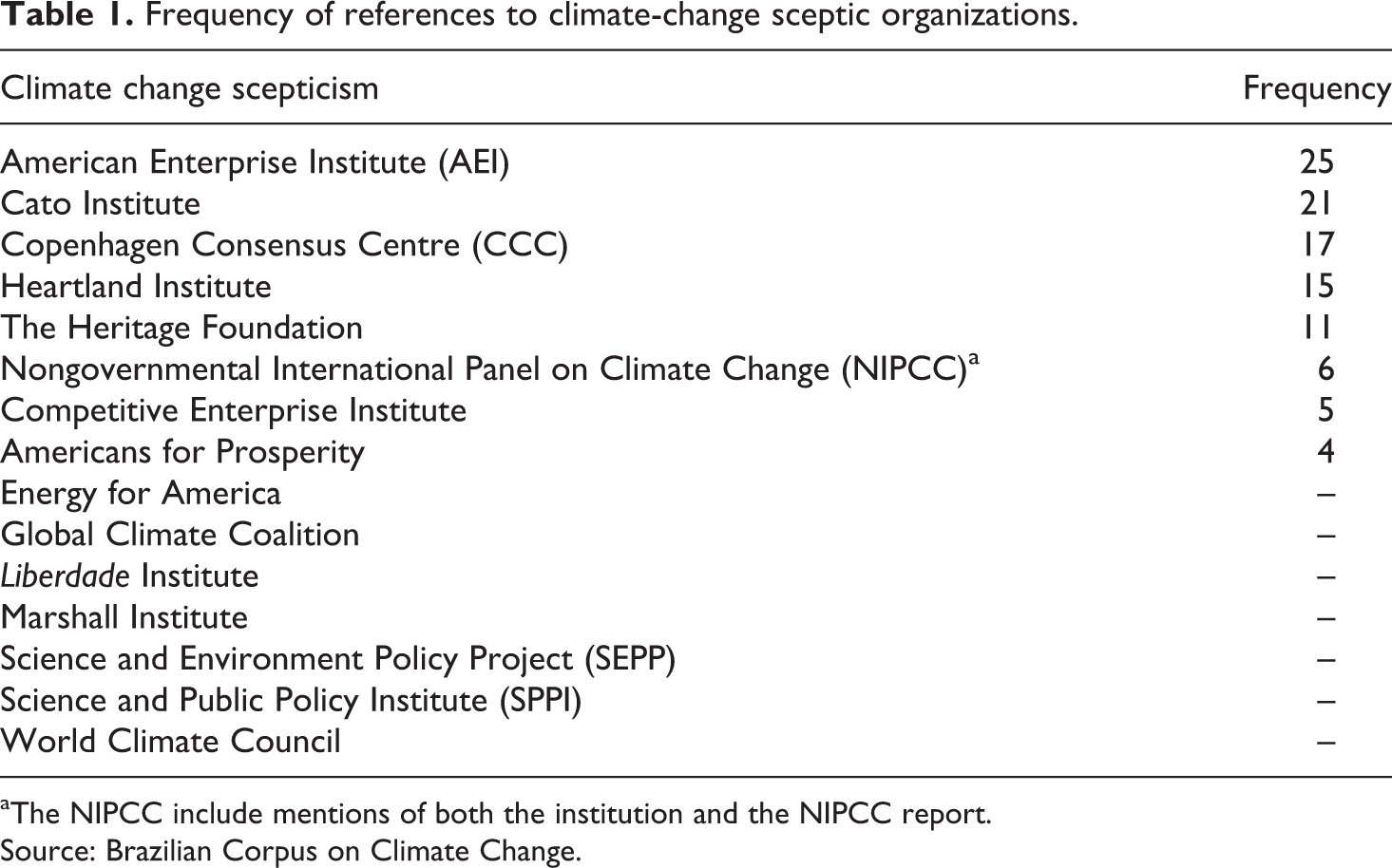
aThe NIPCC include mentions of both the institution and the NIPCC report.
Source: Brazilian Corpus on Climate Change.
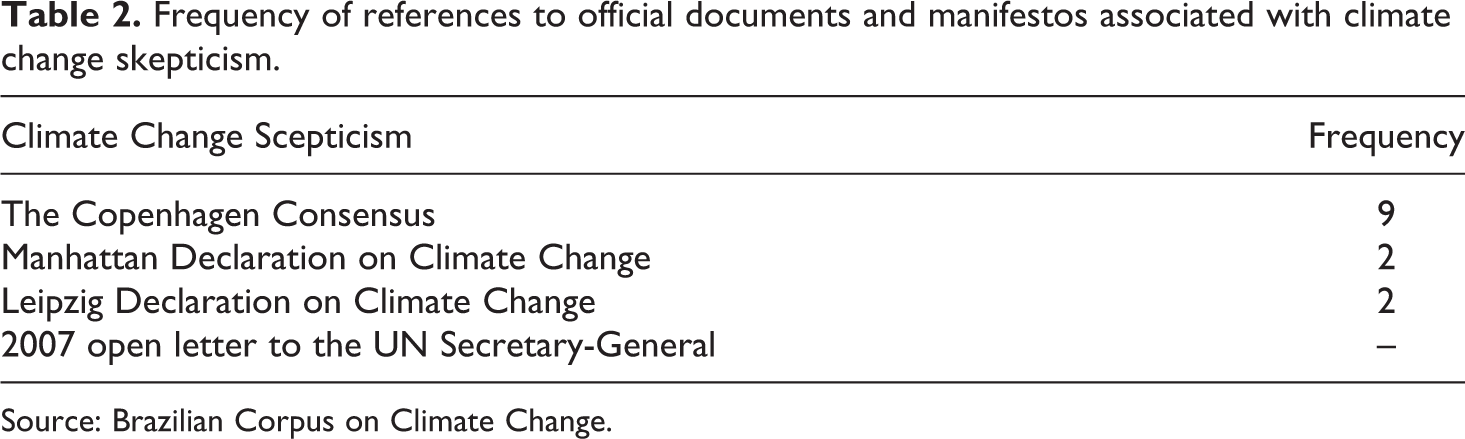
Table 2 sets out the degree to which various major texts within discourses of climate change scepticism are referred to in the Brazilian media. 6 Again the number of references is extremely small.
Frequency of references to official documents and manifestos associated with climate change skepticism.
Source: Brazilian Corpus on Climate Change.
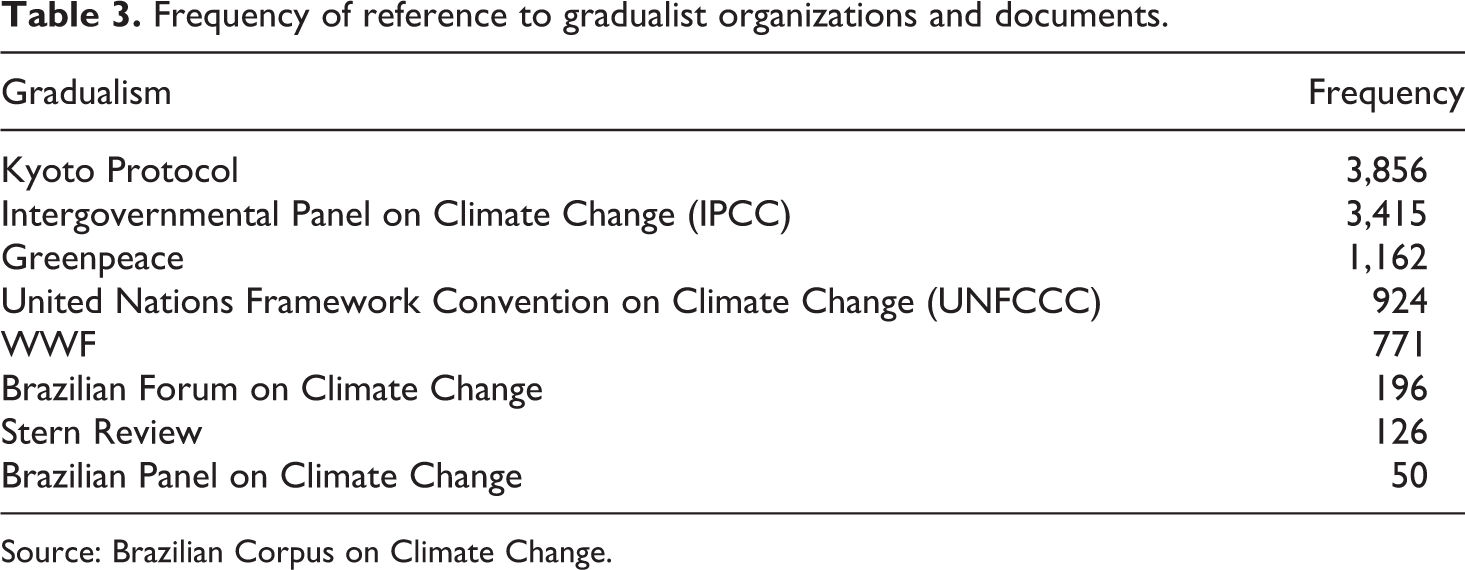
We then examined the frequency of organizations and manifestos commonly associated with the gradualist discourse on climate change (Table 3). The numbers are very much higher than those in Table 1 and 2.
Frequency of reference to gradualist organizations and documents.
Source: Brazilian Corpus on Climate Change.
Another indication of the tendency of Brazilian newspapers to articulate gradualist discourse can be seen from the frequency with which Brazilian newspapers mention ‘interpreters’, scientists, and pertinent public figures who advocate each position. In addition to those persons cited by ANDI (2009), Urry (2011), Painter (2011: 62, 68) and Carneiro and Toniolo (2012), we also searched for leading figures in organizations behind climate change scepticism as well as Brazilians who questioned the gradualist discourse. We also added the names of Brazilian scientists who had contributed to the IPCC’s various assessment reports (http://www.ipcc.ch/pdf/ar5/ar5_authors_review_editors_updated.pdf). This resulted in a list of 31 climate change sceptics (11 Brazilians and 20 non-Brazilians) and 22 gradualist interpreters (17 Brazilians and 5 non-Brazilians). The list does not include Brazilian sceptical politicians or business persons since neither sector strongly voices climate scepticism (Painter, 2011: 69).
Overall, the frequencies of climate change sceptics are extremely small, one third with no occurrence at all. The most discussed figure was the somewhat heterodox Bjørn Lomborg (149 mentions). The American politician Sarah Palin and the climatologist Patrick J. Michaels were referred to 68 and 29 times, respectively. The scientists José Carlos de Almeida Azevedo and Luiz Carlos Molion were the most frequently cited among Brazilian sceptics, with 69 and 28 mentions respectively. The remaining names in the list appeared no more than 15 times.
The numbers for the gradualist interpreters are again strikingly higher than those for climate change sceptics. Marina Silva and Carlos Minc – Brazilian environmentalists and Ministers of Environment 2003–2008 and 2008–2010 – occurred with the highest frequency: 1,788 and 1,347 mentions respectively. Al Gore was mentioned 1,257 times. The 2006–2010 UNFCCC Executive Secretary Yvo de Boer, the UN Secretary-General Ban Ki-Moon, IPCC Chairman Rajendra Pachauri and the British economist Nicholas Stern were each mentioned over 300 times.
Most but not all mentions of Marina Silva and Ban Ki-Moon directly relate to the issue of climate change. The following are illustrative of gradualist discourse: A ministra Marina Silva (Meio Ambiente) defendeu que o governo federal prepare um plano de ação para adaptar o país à nova realidade climática – irreversível, segundo o próprio governo, mas variável em sua intensidade. (Folha de São Paulo. 28 February 2007) [The Environment Minister Marina Silva defends the proposal that the Brazilian government should elaborate an adaption plan to prepare the country to the new climate reality – irreversible, according to the government, but varied in its intensity].
[… the UN Secretary-General, Ban Ki-Moon, recalled that Hurricane Sandy, which killed nearly 200 people in its path through the Caribbean and the USA, is exactly the kind of phenomenon that will be repeated increasingly more often in a world under the effect of global warming.].
A further indication of the prevalence of gradualism in most Brazilian newspapers can be seen by examining references to major conferences commonly associated with the two discourses. The UN Climate Change Conferences are mentioned throughout the period with 4,195 references. By contrast, there was no mention at all of the International Conferences on Climate Change (ICCC) that since 2008 have been promoted by the Heartland Institute, aiming to bring together climate change sceptics.
Conclusion
We have tried to establish some distinctive features of ‘changing climates’ within contemporary Brazil, a daunting task because of the country’s scale and diversity. We have shown that the BRICS are central to the future of global climate policy. The state of the Amazon rainforest in Brazil has been an iconic marker of the state of the Earth, given its function as one of the main carbon sinks. Brazil has also played a major role in international debates on global warming ever since the Rio Earth Summit in 1992. Unlike almost anywhere else, deforestation and agriculture are central to the generating of GHGs within Brazil.
Somewhat consistently with its adoption of gradualist discourse, Brazil has been innovative in developing various ‘lower carbon’ innovations, of biofuel, flex fuel cars, new bus systems and hydropower. However, these do not simply reduce GHG emissions. Heavy investment in hydropower and biofuels may also have damaging effects upon the climate. Also, Viola (2013) more generally notes that once the reduction in deforestation is removed from the GHG calculation, then Brazil has shown increasing carbon intensity since 1994. This was mainly due to increased generation of electricity from fossil fuels and significant increases in oil refining, diesel and gasoline consumption with the continuing expansion of individual/private transport (Viola et al., 2012; Viola, 2013). Moreover, the implementation of the Climate Law in Brazil has shown little progress, while in early 2012 Brazil responded to the international economic crisis by cutting taxes on oil consumption so as to stimulate car manufacturing (as happened in many other countries). So although the adoption of gradualism and the rejection of climate change scepticism are significant in framing debates within Brazil, this has not so far significantly transformed social practices and energy demand.
In this article we examined various ways in which issues of climate change have come to be centrally important in Brazil. Brazilians still show higher scores than almost anywhere else in various sample surveys measuring climate change concern. There is so far little evidence of climate change scepticism in Brazil and this is distinct. There is a strong belief in Brazil of the ontological reality of ‘climate change’. The central debate in Brazilian climate politics would appear to be between gradualism and catastrophism.
In generating and reproducing the view that it is human activities and the resulting GHGs released into the atmosphere that are key, the Brazilian media would seem to play a central role. This issue was examined in two main ways. First, we reported on interesting previous research which summarised developments especially during the mid-2000s. We saw that there was strong support for the view that climate change is a reality and that governments and other major institutions need to engender new significant policies. There was in that period little evidence of climate change scepticism.
We then reported the first findings from our analysis of a new corpus, the Brazilian Corpus on Climate Change. We will use this in the future to examine how Brazilians understand the ‘reality’ of climate change, its possible ‘causes’ and the array of policies, programmes and innovations that might just bring about significant mitigation. We examined here one issue, namely the respective significance of two discourses on climate change, gradualism and climate change scepticism. In terms of the articles in mainstream Brazilian media, we found little evidence of climate change scepticism over the previous decade. There were simply tiny numbers of articles referring to key figures, reports and organizations drawn from the discourses of climate change scepticism. Overall, the mainstream Brazilian media adopted, organized and mobilized a gradualist discourse.
In future work on this corpus we will also examine the degree to which there is evidence of the third position here, namely climate change catastrophism. Our reading of many newspaper articles suggests that there is so far little evidence of catastrophist discourses of the sort now found in many books, reports and films appearing elsewhere. 7 We will also examine the parallels between findings from this quantitative research and various qualitative studies undertaken within Brazil. We will consider what this corpus tells us about what people believe they should do and indeed might do, as opposed to what they say more generally about climate change policy and practice. We need to interrogate the corpus to identify accounts of people’s various social practices and not just of what people think (as argued in Shove, Pantzar and Watson, 2012).
Footnotes
Acknowledgements
This article draws on extensive empirical research set out at much greater length in Dayrell and Urry (2013). This research is part of the Changing Climates project ( ) currently being conducted at the ESRC-funded Centre for Corpus Approaches to Social Science (CASS), Lancaster University (grant reference: ES/K002155/1). We are very grateful for help and assistance from our CASS colleagues, especially Tony McEnery, Andrew Hardie, and Stephen Wattam. We are also grateful for some trenchant criticism of these arguments from Phil Macnaghten.