



Abstract
Even decades after historical traumas, their scarcity shapes victimhood perceptions and beliefs about outgroups. In one correlational (N = 369) and one experimental (N = 510) study, we examined how exclusive versus inclusive victim beliefs predict outgroup, World War II-related, and generic conspiracy beliefs. We also tested the mediating role of three victimogenic cognitive biases: hostile intentions attribution, negative interpretation, and memory bias. Unlike prior work focusing mainly on exclusive victimhood, our studies provide the first direct comparison of both victimhood forms, revealing their distinct and sometimes opposing effects on conspiracy thinking. Correlational results showed that exclusive victim beliefs heightened conspiracy beliefs, with different biases mediating different conspiracy types. Experimental results showed that exclusive victim beliefs increased outgroup and generic conspiracy beliefs through negative interpretation bias, whereas inclusive victim beliefs reduced WWII and generic conspiracies by weakening hostile attribution bias. We discuss the implications of the findings for intergroup relations and post-conflict beliefs.
Introduction
History has long been recognized as central to how groups interpret present events. Halbwachs (1976) argued that collective historical experiences shape contemporary perceptions, with tragic histories leaving especially strong imprints. Because people attend more to negative than positive information (Lewicka et al., 1992; Vaish et al., 2008), groups with victimization backgrounds often interpret new events as evidence of ongoing oppression (Bar-Tal et al., 2009), fueling intergroup delegitimization (Bar-Tal, 2011). Schori-Eyal et al. (2017) described this as “perpetual ingroup victimhood orientation,” where persecution is construed as deliberate (Cairns & Roe, 2003; Enns, 2012). Such tendencies closely align with cognitive styles linked to conspiracy beliefs. Our studies extend this literature by directly comparing exclusive and inclusive victimhood beliefs as predictors of generic, outgroup, and historical conspiracy beliefs. We also examine the mediating role of cognitive biases, showing that victimhood construals exert distinct and sometimes opposing effects. This approach demonstrates that collective victimhood is not a uniform driver of conspiracism but produces divergent outcomes depending on its form.
Exclusive (vs. Inclusive) Victim Beliefs and Conspiracy Beliefs
Exclusive victim beliefs reflect the perception that the ingroup is consistently persecuted by powerful outgroups (Cairns & Roe, 2003; Enns, 2012) and predict negative outcomes, including hostility toward outgroups, social distancing, political exclusion, and intolerance (e.g., Noor et al., 2012; Vollhardt & Bilali, 2015). In contrast, inclusive victim beliefs are associated with forgiveness, prosociality, and support for inclusive leaders and diversity (e.g., Shnabel et al., 2013; Voca et al., 2023; Vollhardt, 2012). Despite these established effects, comparative evidence on how exclusive versus inclusive victim beliefs influence different types of conspiracy beliefs, particularly those rooted in historical trauma, is lacking. Studying exclusive and inclusive victimhood beliefs together within the same model, and the ways they are associated with conspiracy beliefs, is both theoretically and empirically important, yet surprisingly rare. As Vollhardt (2012) and Vollhardt and Bilali (2015) have argued, these beliefs represent distinct psychological orientations. Exclusive victimhood is centered on the uniqueness and competitive nature of ingroup suffering, while inclusive victimhood reflects a broader moral and identity framework that recognizes others’ suffering and supports solidarity. Inclusive victimhood emphasizes perceived similarities between one group’s suffering and that of other groups, fostering a superordinate identity and reducing intergroup threat and hostility perceptions (Schori-Eyal et al., 2017; Vollhardt, 2013), hindering the use of collective loss as a means of intensifying enmity between groups (Bar-Tal et al., 2009). Unlike exclusive victimhood, which heightens intergroup suspicion and defensiveness, inclusive victimhood communicates acknowledgment of ingroup suffering while broadening moral concern, thereby lowering tendencies toward hostile attributions, negative interpretations, and rumination of harms and traumatic intergroup experiences. Εxclusive victimhood has been linked to negative intergroup outcomes such as reduced forgiveness and reconciliation (Shnabel et al., 2013) and heightened ingroup-protective, outgroup-hostile orientations (Klar et al., 2013). Because conspiracy beliefs, like prejudice and mistrust, are themselves negative outcomes aligned with such exclusivist orientations, inclusive victimhood is expected to show non-significant or negative associations with cognitive biases and conspiracy beliefs, in contrast to the strong positive links predicted for exclusive victimhood.
Building on this distinction, we examine the potential protective role of inclusive victimhood against conspiracy beliefs. While exclusive victimhood is closely aligned with intergroup threat and perceptions of intentional outgroup harm, inclusive victimhood foregrounds shared suffering and reduces competitive, zero-sum interpretations of historical trauma (e.g., Rupar et al., 2022). This is theoretically meaningful because, as van Prooijen and van Lange (2014) argue, conspiracy beliefs are rooted in intergroup threat dynamics, emerging when groups feel collectively vulnerable to powerful, hostile outgroups and perceive the ingroup as uniquely targeted (see also, Riek et al., 2006). Such dynamics activate defensive cognitive processes and motivate within-group cohesion against an antagonistic rival. Inclusive victimhood, by contrast, does not construct the outgroup as a malevolent agent nor the ingroup as uniquely oppressed; instead, it broadens perspective, reduces exclusivist threat perceptions (e.g., Vollhardt & Bilali, 2015) and, as such, it may weaken the motivational basis for conspiratorial explanations. Previous research (Bertin, 2024), considering inclusive victimhood as the outcome of exposure to conspiratorial narratives, showed that experimentally manipulating exposure to generic or specific conspiracy narratives had no effects on inclusive victimhood levels. Reversing this pattern, higher inclusive victimhood predicts lower endorsement of conspiracy beliefs. By emphasizing common humanity and shared victimization, it reduces the cognitive and motivational conditions, such as perceived threat, intentionality attribution, and collective vulnerability, which typically fuel conspiratorial thinking that portrays the ingroup as uniquely victimized. Additionally, inclusive victimhood promotes prosocial attitudes toward other groups and prosocial behavior (e.g., Vollhardt & Bilali, 2015), which is often reduced when people are exposed to conspiracy theories (e.g., van Prooijen et al., 2022).
Our primary goal is to build on intergroup relations research by comparatively testing how exclusive and inclusive victim beliefs relate to generic, outgroup, and historical conspiracy beliefs. Prior studies have mainly focused on exclusive victimhood, showing that unique ingroup victimhood predicts conspiratorial thinking about traumatic events such as the Smolensk air crash (Bilewicz et al., 2019). Extending this, Pantazi et al.’s (2022) integrated meta-analysis of studies in Poland and Greece showed that high perceived ingroup victimhood fosters distrust toward other groups, which in turn increases endorsement of conspiracy theories (e.g., conspiracy theories about the Smolensk aircrash, COVID-19, Greek financial crisis). Furthermore, Gkinopoulos and Mari (2023) showed that experimentally primed victimhood following the 2018 Attica bushfires increased generic conspiracy beliefs. A related contribution by Borinca et al. (2025) showed that war-related memories and experimentally induced meta-humanization affect dehumanization, contact intentions, and reconciliation in post-conflict Kosovo. However, this work differs from the current studies in three ways: they manipulate outgroup perceptions rather than ingroup construals of suffering (exclusive vs. inclusive victimhood); they focus on relational outcomes, whereas we examine epistemic outcomes, including conspiracy beliefs; and we test cognitive biases as mediators, revealing distinct pathways through which victimhood shapes conspiratorial thinking. Thus, our study complements and extends this work by linking historical victimhood to biased reasoning and conspiracy formation.
Past research has tested the link between exclusive victimhood and specific conspiracy beliefs, which has been documented not only in the context of historical intergroup traumas (e.g., Skrodzka et al., 2023), but also in relation to numerous contemporary and ingroup-threatening events, such as terrorist attacks (e.g., Mashuri & Zaduqisti, 2015), antisemitic conspiracies in Poland (e.g., Bilewicz & Stefaniak, 2013) or disease outbreaks (e.g., Bertin & Delouvee, 2021). Although past research has often examined them separately and tends to emphasize the harmful outcomes of exclusive victimhood (see also, Mashuri & Zaduqisti, 2015; Szabo & Cserto, 2023), our studies assess both forms simultaneously. This approach enables us to compare their unique effects while controlling for shared variance, allowing clearer conclusions about when victimhood beliefs yield harmful versus constructive outcomes.
Our work therefore moves beyond asking whether victimhood predicts conspiracy beliefs to identifying which construal of victimhood is responsible, and through which cognitive mechanisms. By modeling exclusive and inclusive victimhood side by side, we clarify their distinct and sometimes opposing influences, addressing limitations of studies that considered them independently or focused primarily on exclusive victimhood. Together, our two studies demonstrate that collective victimhood is not a uniform driver of conspiracy beliefs but exerts pattern-specific, bias-mediated effects depending on whether it is construed inclusively or exclusively. To account for the stronger and more consistent associations observed for exclusive victimhood, it is essential to consider how these two forms of victim construal diverge in their cognitive and motivational consequences.
Vollhardt (2015) proposed that inclusive or “common” victimhood reduces competitive victimhood concerns and promotes forgiveness and reconciliation, thereby lowering intergroup hostility. When a shared victim category is salient, people tend to construe harm in terms of common suffering rather than ingroup-specific injury, which in turn attenuates vigilance to outgroup threat (Sharvit & Kremer-Sharon, 2022). In contrast, collective victimhood that is construed exclusively—as targeted, intentional harm against one’s group—reflects a cognitive representation centered on ingroup suffering inflicted by a rival (Bar-Tal et al., 2009). This exclusive construal is associated with heightened sensitivity to cues of malevolence, suspicion toward outgroups, and active scrutiny for signs of hostile intent (Staub, 2006). These distinctions help explain why exclusive victim beliefs tend to show stronger and more consistent associations with cognitive biases and conspiracy beliefs than inclusive victim beliefs. Exclusive victimhood activates a threat-oriented cognitive mindset that readily aligns with biases involving hostile attribution, negative interpretation, and selective recall of past harms—processes that also underlie conspiratorial thinking. Inclusive victimhood, by contrast, embodies a more ambivalent cognitive profile: while it may reduce intergroup threat and competitive motives, it does not necessarily mobilize strong expectations of shared suffering or trust, and thus may or may not predict the biased cognitive processes that sustain conspiracy beliefs. Consequently, inclusive victim beliefs are theoretically—and empirically—more variable in their associations with cognitive bias and conspiracism, whereas exclusive victimhood more reliably activates threat-focused processing that facilitates conspiratorial interpretations of outgroups.
Cognitive Biases as Explanatory Mechanisms of the Relationship between Exclusive Victim Beliefs and Conspiracy Beliefs
Historical collective victimhood experiences influence people’s cognitive processes (Baumeister & Hastings, 1997) by heightening sensitivity to threat-related information (Bar-Tal et al., 2009), partly because threatening cues are less easily filtered under stress (Broadbent, 1971). Individuals who perceive their group as chronically harmed tend to scrutinize social cues for signs of malevolent intent and to confirm information that aligns with pre-existing victimhood beliefs (Kelman, 2007). When victimhood is construed exclusively, this threat vigilance is amplified, fostering distorted cognitive tendencies such as hostile attributions, negatively biased interpretations, and selective recall of past harms. These processes align with work showing that victim mentality involves catastrophizing and exaggerated perceptions of harm (Aquino & Byron, 2002) and with arguments by Andronnikova and Kudinov (2021) that biased cognitive styles may serve as “victimogenic determinants,” increasing vulnerability to perceived threat. Gabay et al. (2020) identified three cognitive biases as core features of the interpersonal victimhood mindset: (a) interpretation bias—perceiving even ambiguous or low-severity actions as harmful, (b) hostile attribution bias—assigning negative intentions to others’ behavior or, intergroup-wise, viewing outgroups as hostile (Schori-Eyal et al., 2017), and (c) negative memory bias—selectively recalling past offenses and negative emotions, often intensified by rumination.
These three biases represent theoretically distinct processing stages—how events are appraised, why harm is attributed, and what is remembered—making it likely they differ in their predictive power for conspiracy beliefs. Hostile attribution bias may be particularly relevant because both it and conspiracy thinking revolve around assumptions of intentional malevolence, whereas negative memory bias may sustain conspiratorial ideation by keeping past harms chronically salient (e.g., Brotherton & French, 2015). Because interpretation, attribution, and memory operate at different cognitive stages, exclusive and inclusive victimhood are not equally aligned with each bias. Exclusive victimhood emphasizes intentional, targeted harm and past injustices, and therefore should be most strongly linked to hostile attribution and negative memory biases. Inclusive victimhood, by contrast, highlights shared or mutual suffering and reduces intergroup threat (Vollhardt & Bilali, 2015), which may weaken attributional hostility—even if some sensitivity to ambiguous cues remains.
Although these biases are linked to interpersonal victimhood (Gabay et al., 2020) and conspiracy beliefs broadly (e.g., Gkinopoulos & Dagnall, 2026; Gligorić et al., 2021), to date, no research has tested whether exclusive versus inclusive historical victim beliefs differentially predict these biases, whether these cognitive biases mediate their links to conspiracy beliefs, or be embedded within a historical intergroup framework as mechanisms explaining the relationship between exclusive victimhood and conspiracism. Moreover, new evidence suggests that rumination plays a central role in sustaining conspiracy ideation by intensifying negative affect and reinforcing pessimistic, threat-focused interpretations (Liekefett et al., 2024; Lyubomirsky & Tkach, 2004)—processes closely aligned with negative memory and hostile attribution biases. The broader conspiracy literature further supports the role of biased cognition: conspiracy beliefs rely on selective, truncated information processing and a tendency to impose intentional causality on ambiguous events (e.g., Gkinopoulos & Dagnall, 2026). Similarly, ideological beliefs can act as cognitive filters that lead people to reject information inconsistent with their worldview (Minhas-Bandeali et al., 2025), a pattern mirrored in identity-serving conspiratorial interpretations.
Taken together, these literatures indicate that cognitive biases are a plausible mechanism linking exclusive victimhood to conspiracy beliefs, particularly when the ingroup’s suffering is construed as intentional and unjust. However, previous research has not integrated these cognitive processes with the socio-political and identity-based functions of collective victimhood. As Wagner-Egger et al. (2022) emphasize, focusing solely on individual-level cognition risks overlooking how biases are shaped by, and serve, group-based motives. The present studies address this gap by examining how these three biases function within a historical, intergroup context. Here, biases such as hostile attribution, negative interpretation, and selective recall are conceptualized not simply as cognitive errors but as identity-driven processes that reinforce exclusivist narratives of victimhood and facilitate conspiratorial thinking about outgroups. By simultaneously testing exclusive and inclusive forms of victimhood and modeling three distinct cognitive biases as mediators, our work moves beyond prior research to clarify which victimhood construals predict conspiracism, why exclusive forms produce stronger effects, and how cognitive biases translate historical narratives into contemporary conspiracy beliefs.
Research Hypotheses
Study 1
Drawing on research linking exclusive victimhood to threat-focused cognitive processing, we predicted that exclusive historical victim beliefs would show positive associations with outgroup conspiracy beliefs, WWII-related conspiracy beliefs, and generic conspiracy beliefs (H1a). In contrast, inclusive historical victim beliefs were expected to show negative or nonsignificant associations with these same conspiracy beliefs (H1b). Given that exclusive and inclusive victim beliefs represent divergent cognitive–motivational orientations, we expected them to display opposite patterns of association with the three cognitive biases. Specifically, exclusive victim beliefs were expected to show positive associations with hostile attribution bias, negative interpretation bias, and negative memory bias (H2a), whereas inclusive victim beliefs were expected to show negative or nonsignificant associations with these biases (H2b). Consistent with prior work suggesting that biased cognitive processing supports conspiratorial ideation, we predicted that all three cognitive biases would show positive associations with each type of conspiracy belief (H3). Finally, because cognitive biases may help explain how different victimhood construals relate to conspiracy beliefs, we predicted that the associations between exclusive (vs. inclusive) victim beliefs and all three conspiracy belief outcomes would be indirectly accounted for by the three cognitive biases operating in parallel (H4).
Study 2
In the experiment, we predicted that participants exposed to the exclusive victimhood condition would report the highest levels of conspiracy beliefs, followed by the control condition, and the lowest levels in the inclusive victimhood condition (H5). We further predicted that the exclusive (vs. inclusive or control) victimhood condition would increase hostile attribution bias, negative interpretation bias, and negative memory bias (H6). Finally, because the manipulation was expected to shape cognitive processing, we predicted that the effects of the exclusive victimhood manipulation on conspiracy beliefs would be mediated by the increased three cognitive biases operating in parallel, while the indirect effects of the inclusive victimhood manipulation on conspiracy beliefs via the three cognitive biases in parallel are expected either in the opposite direction to the exclusive victimhood manipulation effects or non-significant (H7). In both our studies, exclusive and inclusive victim beliefs constitute empirically distinct constructs and are treated as such in all analyses, based on previous literature (e.g., EFA results across four studies by Vollhardt et al., 2021, as well as across preliminary studies focusing on victim consciousness in different contexts; Vollhardt, 2010) showing that exclusive and inclusive victim beliefs load on different factors, as well as have different outcomes (see also, Vollhardt & Bilali, 2015). All analyses for both Study 1 and 2 were conducted using R Studio (Posit Team, 2024), R version 4.4.2 (R Core Team, 2024). The data and R scripts are available on the OSF page: https://osf.io/cz8tw/overview?view_only=efe7e906290c4e1bbedddfe6e212bf69.
Methods
Study 1
This study aims to examine the relationships between victim (exclusive vs. inclusive) beliefs, cognitive biases, and conspiracy beliefs. The study was preregistered, with registration details available on the OSF page: https://archive.org/details/osf-registrations-sj65m-v1. In order to increase the generalizability of our findings, we modified the preregistered protocol by examining generic conspiracy beliefs beyond our originally specified outgroup and World War II-related conspiracy measures, attempting to assess the broader applicability of our observed patterns across more general domains of conspiratorial thinking.
Participants
For this study, 411 Polish participants were recruited through an online panel provided by an external polling company. This sample size was determined by an a priori G*power analysis (Faul et al., 2007), which indicated that a minimum of 320 participants was required to detect an effect size of 0.15 with α = .05 and power = .80 for the planned two-stage linear regressions and mediation analyses. The target sample was slightly increased to account for potential exclusions due to missing responses and attention checks failures. As we changed our analytical approach to parallel mediation, we checked the minimum correlation between variables to achieve power of .80 using Schoemann et al.’s (2017) tool. These analyses indicated that such power was achieved for a correlation between the variables of .25 and standard deviations of 1.5. Importantly, these power calculations were conducted prior to hypothesis testing and were designed to check the sensitivity for detecting indirect effects involving multiple mediators, rather than only direct associations. To ensure data quality, we initially planned to exclude participants based on survey completion time (±50% of mean completion time). However, preliminary inspection of the data revealed considerable variability in completion times, with several legitimate cases requiring extended time to complete the survey thoroughly (which also led to the very high exclusion rate). Given this observation, and the absence of unusually fast responses, we decided to retain the time-based variance in our dataset. Thus, the final exclusion criteria were limited to: (1) failure to complete at least 80% of the items per scale, and (2) incorrect responses to the embedded attention check. After applying these exclusion criteria, the final sample consisted of 369 participants (53.1% women, 46.1% men, and 0.8% non-binary individuals, Mage = 48.68, SDage = 15.74). The study was approved by the Research Ethics Committee of Jagiellonian University.
Measures
Unless otherwise specified, participants rated their agreement with statements on a 7-point Likert scale from 1 (strongly disagree) to 7 (strongly agree).
Inclusive victim beliefs were measured using a four-item scale (Vollhardt et al., 2021) adapted to the Polish context. The scale included both quantitative and qualitative comparisons. Sample items included “Poles have a lot in common with other ethnic, national, or religious groups that have been targeted” and “There are other groups in the world that have suffered as much as the Polish people” (α = .81).
Exclusive victim beliefs were also assessed using a four-item scale (Vollhardt et al., 2021). This measure was also based on both quantitative and qualitative comparisons with sample items: “No other group in the world has suffered as much as the Polish people” and “World history has never seen anything like the persecution of the Polish people” (α = .88).
Outgroup conspiracy beliefs
To assess outgroup conspiracy beliefs, we used three items from the Dong et al. (2024) scale, which was originally developed based on Wood’s (2017) conceptual framework. The items were adapted to capture conspiratorial beliefs about the relationship between Germans and Poles. The scale included items such as “The Germans are always plotting against Poles” (α = .95).
World War II-related conspiracy beliefs
To assess beliefs in World War II-related conspiracy theories, we created a three-item measure. The items captured various conspiratorial beliefs about World War II, including “The Jews purposefully started World War II to cause the destruction of Germany,” or “The Holocaust is a hoax perpetrated by the Allies, Jews or the Soviet Union” (α = .76).
Generic conspiracy beliefs
To measure participants’ overall propensity to endorse conspiratorial explanations, we used a single-item measure (Lantian et al., 2016). Participants first read the following contextual statement: “Some political and social events are debated. It is suggested that the ‘official version’ of these events could be an attempt to hide the truth to the public. This ‘official version’ could mask the fact that these events have been planned and secretly prepared by a covert alliance of powerful individuals or organizations (for example secret services or government). What do you think?”. Participants then rated their agreement with the statement “I think that the official version of events given by the authorities very often hides the truth,” using a 7-point scale ranging from 1 (completely false) to 7 (completely true). We added generic conspiracy mentality as an outcome because we also aimed to test whether the effects of exclusive versus inclusive historical victimhood—and the cognitive biases—generalize beyond group-specific narratives to broader conspiratorial worldviews.
Memory bias
To assess participants’ tendency to be preoccupied with negative historical issues, we adapted the rumination subscale from the Survey of Coping Profile Endorsements (SCOPE; Matheson & Anisman, 2003). Participants were asked, “To what extent do you generally use each of these ways of dealing with problems or stress stemming from the historical past of Poland and its relations with Germany?” They then rated three items: “Worry about the problems a lot,” “Think about the problems a lot,” and “Go over the problems in your mind over and over again” (α = .89). Responses were given on a 7-point scale ranging from 1 (not at all) to 7 (very much).
Hostile intentions attribution bias
To measure interpretations of ambiguous intergroup situations, we adapted three vignettes from Schori-Eyal et al. (2017) to reflect Polish-German interactions. Each vignette described an ambiguous social encounter between members of both groups. After reading each scenario, participants estimated the probability of three possible interpretations of the German actor’s intentions: benevolent, neutral, and hostile (see supplemental material, section “Vignettes of the hostile intentions attribution bias measure in Studies 1 and 2”, for more details). For each vignette, participants assigned probability estimates across the three possible intentions, where the total score had to sum to 100%. Although participants provided estimates for all three types of intentions (benevolent, neutral, and hostile), for our analyses we focused specifically on hostile intention attributions, and the intention attribution bias score was calculated by averaging their probability estimates across all three scenarios (α = .68).
Negative interpretation bias
To assess participants’ tendency to interpret ambiguous German behavior negatively, we adapted the negative interpretation bias subscale of the Negative Cognitive Processing Bias Questionnaire (NCPBQ; Miao et al., 2022). The adapted measure consisted of four items describing ambiguous social situations involving German individuals, e.g., “If I meet a German friend for the first time and he or she says very little to me, I will think he or she doesn’t like me” and “If a German acquaintance walks across the street and does not say hello to me, I will think he or she has a problem with me” (α = .81).
Covariates
In all analyses, we controlled for age, education, and political orientation. Education was originally measured using six categories: primary/middle school education (n = 12), secondary education (n = 168), bachelor’s degree (n = 27), master’s/doctoral degree (n = 81), other professional degree (n = 1), and vocational education (n = 80). Due to the uneven distribution of participants across categories, we recoded this variable into two dummy variables. The first dummy variable included participants with primary, middle, and secondary education. The second dummy variable grouped participants with vocational education and other professional degrees. Higher education (bachelor’s, master’s, and doctoral degrees) served as the reference category. Political orientation was measured on a 7-point scale ranging from 1 (definitely left-wing) to 7 (definitely right-wing).
Analytic strategy
We preregistered a series of two-stage linear regressions to test our mediation hypotheses. However, after finalizing the preregistration but before conducting the analyses, we recognized that the preregistered approach did not adequately reflect our theoretical framework. Specifically, the preregistered analyses treated the three cognitive biases as independent processes, whereas our conceptual model describes them as co-occurring and partially overlapping cognitive tendencies. Running separate sequential models would therefore artificially isolate processes that are theoretically interrelated. For these reasons, we opted for a single parallel-mediation model (PROCESS Model 4; Hayes, 2018), which provides a more appropriate and rigorous test of the hypotheses. This approach allows all three biases to be estimated simultaneously, controls for shared variance among them, and yields clearer estimates of their unique contributions. Importantly, this analytic refinement did not alter any preregistered hypotheses; it simply offers a more theoretically coherent and statistically robust implementation of the preregistered mediation tests.
Each model examined the relationships between exclusive victim beliefs and one type of conspiracy belief (outgroup, World War II-related, or generic conspiracy beliefs as the outcome variable), with hostile intentions attribution bias, negative interpretation bias, and memory bias serving as parallel mediators and inclusive victim beliefs being a main covariate. This analytic approach allowed us to simultaneously test: (1) the direct relationships between both types of victim beliefs and conspiracy beliefs, (2) the relationships between victim beliefs and cognitive biases, (3) the relationships between cognitive biases and conspiracy beliefs, and (4) the indirect effects of exclusive victim beliefs on conspiracy beliefs through cognitive biases. All models also included the preregistered control variables: age, dummy-coded education, and political orientation. Before the main analyses, we assessed correlations to examine variable relationships and detect collinearity issues. To assess the significance of indirect effects in our mediation models, we used bias-corrected bootstrapped 95% confidence intervals with 5,000 resamples.
Results
Means, standard deviations and correlations between all variables included in this study are presented in the supplemental material, Table S1.
Outgroup Conspiracy Beliefs as the Dependent Variable
In the first model (Figure 1), consistent with H1a, the total effect of exclusive victim beliefs on outgroup conspiracy beliefs was positive and significant (B = 0.49, SE = 0.06, p < .001). Even after accounting for the mediating effects of cognitive biases, exclusive victim beliefs remained a significant predictor of outgroup conspiracy beliefs (B = 0.33, SE = 0.06, p < .001). In contrast, the negative association between inclusive victim beliefs and outgroup conspiracy beliefs (H1b) yielded no significant results in both the total (B = −0.10, SE = 0.07, p = .169) and the direct effect models (B = −0.06, SE = 0.07, p = .414), although the effects were in the expected direction. As we hypothesized (H2a), exclusive victim beliefs showed a significant positive association with negative interpretation bias (B = 0.21, SE = 0.05, p < .001), memory bias (B = 0.32, SE = 0.05, p < .001), and hostile intentions attribution bias (B = 1.88, SE = 0.51, p < .001). However, inclusive victim beliefs did not show significant relationships with any of the cognitive biases (H2b): negative interpretation bias (B = −0.07, SE = 0.06, p = .277), memory bias (B = −0.09, SE = 0.07, p = .198), and hostile intentions attribution bias (B = −0.68, SE = 0.64, p = .286), although all effects were in the expected direction. 1 Consistent with H3, each cognitive bias was positively associated with outgroup conspiracy beliefs: negative interpretation bias (B = 0.20, SE = 0.06, p = .001), memory bias (B = 0.27, SE = 0.06, p < .001), and hostile intentions attribution bias (B = 0.01, SE = 0.01, p = .032). Moreover, in line with H4, the indirect effects of exclusive victim beliefs on outgroup conspiracy beliefs through negative interpretation bias (IE = 0.04, SEboot = 0.02, 95% CI [0.01, 0.08]), memory bias (IE = 0.09, SEboot = 0.03, 95% CI [0.04, 0.14]), and hostile intentions attribution bias (IE = 0.02, SEboot = 0.01, 95% CI [0.004, 0.05]) were all positive and significant. 2

The relationship between exclusive and inclusive victim beliefs and outgroup conspiracy beliefs via three cognitive biases.
World War II-related Conspiracy Beliefs as the Dependent Variable
In the second model (Figure 2), the analysis indicated that exclusive victim beliefs significantly predicted World War II-related conspiracy beliefs, with both a total effect (B = 0.33, SE = 0.05, p < .001) and a direct effect (B = 0.20, SE = 0.05, p < .001) being significant, supporting H1a. Once again, however, the hypothesized negative relationship between inclusive victim beliefs and World War II-related conspiracy beliefs (H1b) was not supported by the data in either the total (B = −0.08, SE = 0.06, p = .168) or direct (B = −0.04, SE = 0.06, p = .449) effect models. In line with H3, all cognitive biases significantly predicted World War II-related conspiracy beliefs: negative interpretation bias (B = 0.21, SE = 0.05, p < .001), memory bias (B = 0.20, SE = 0.05, p < .001), and hostile intentions attribution bias (B = 0.02, SE = 0.01, p = .001). Furthermore, supporting H4, the indirect effects of exclusive victim beliefs on World War II-related conspiracy beliefs through each cognitive bias were significant: negative interpretation bias (IE = 0.04, SEboot = 0.02, 95% CI [0.01, 0.08]), memory bias (IE = 0.06, SEboot = 0.02, 95% CI [0.03, 0.11]), and hostile intentions attribution bias (IE = 0.03, SEboot = 0.01, 95% CI [0.01, 0.06]). 3

The relationship between exclusive and inclusive victim beliefs and World War II-related conspiracy beliefs via three cognitive biases.
Generic Conspiracy Beliefs as the Dependent Variable
In the third model (Figure 3), analyses revealed that exclusive victim beliefs significantly predicted generic conspiracy beliefs, demonstrating both a total effect (B = 0.28, SE = 0.06, p < .001) and a direct effect (B = 0.22, SE = 0.06, p < .001), supporting H1a. However, the hypothesized negative relationship between inclusive victim beliefs and generic conspiracy beliefs (H1b) was not significant in both the total (B = 0.06, SE = 0.07, p = .435) and direct (B = 0.08, SE = 0.07, p = .276) effect models. However, this time partial support was found for H3, as only negative interpretation bias emerged as a significant predictor of generic conspiracy beliefs (B = 0.16, SE = 0.06, p = .013), while memory bias (B = 0.06, SE = 0.06, p = .304) and hostile intentions attribution bias (B = 0.01, SE = 0.01, p = .174) showed no significant relationships. Similarly, H4 received partial support, with a significant indirect effect of exclusive victim beliefs on generic conspiracy beliefs through negative interpretation bias (IE = 0.03, SEboot = 0.02, 95% CI [0.01, 0.07]), but non-significant indirect effects through memory bias (IE = 0.02, SEboot = 0.02, 95% CI [−0.01, 0.06]) and hostile intentions attribution bias (IE = 0.02, SEboot = 0.01, 95% CI [−0.01, 0.04]). 4

The relationship between exclusive and inclusive victim beliefs and generic conspiracy beliefs via three cognitive biases.
Discussion
Consistent with our hypotheses, exclusive victim beliefs strongly correlated with outgroup, WWII-related, and generic conspiracy beliefs. This suggests that individuals emphasizing their group’s unique victimhood are more prone to suspicion and threat perception, increasing conspiratorial thinking. However, contrary to expectations, inclusive victim beliefs showed no negative association with conspiracy beliefs, implying that viewing one’s group as part of a broader suffering community does not necessarily reduce conspiratorial tendencies. Mediation analyses revealed distinct patterns across conspiracy belief types. While all three cognitive biases (memory bias, hostile intentions attribution bias, and negative interpretation bias) mediated the link between exclusive victim beliefs and both outgroup and WWII-related conspiracy beliefs, only negative interpretation bias emerged as a significant predictor of generic conspiracy beliefs. This suggests that the psychological mechanisms behind conspiracy beliefs may vary by context. That said, memory and hostile intentions attribution biases may play a more critical role in content-specific conspiracy beliefs targeting historical events or specific groups of historical perpetrators, whereas generic conspiracy beliefs may rely solely on negative interpretation bias that reflects a more ingrained tendency to interpret ambiguous situations in threatening terms.
Study 2
Building on the correlational findings of Study 1, we conducted an experiment to examine the causal effects of exclusive and inclusive victim beliefs on the same set of cognitive biases and conspiracy beliefs. The experiment was preregistered, with registration details available on the OSF page: https://archive.org/details/osf-registrations-3uzwb-v1. By experimentally inducing different forms of historical victim beliefs, this study tests whether the exclusive victim beliefs condition has a positive effect on outgroup, WWII-related, and generic conspiracy beliefs, and the inclusive victim beliefs condition has a negative effect on these dependent variables. We also test whether the effects of conditions on each of the three types of conspiracy beliefs are mediated by hostile intentions attribution bias, negative interpretation bias and memory (rumination) bias. For each hypothesis, we will control for age and political orientation. Education was not included this time as a control variable, because of many non-significant results obtained in Study 1.
Method
Participants and design
A total of 893 Polish participants were recruited for this study, which used a between-subjects experimental design with three conditions: inclusive victim beliefs, exclusive victim beliefs, and control. Because indirect effects are typically small, sample size determination was based on Monte Carlo power estimates for mediation, ensuring sufficient power to detect indirect effects. The sample size of 520 individuals was determined using Schoemann et al.’s (2017) tool, which aims to detect indirect effects with an alpha level of .05, a power of .80, and an average effect size in psychological research (r = .20; Funder & Ozer, 2019). Standard deviations for the variables were estimated from our previous correlational study: 13 for hostile intentions attribution bias and 1.5 for all other variables, with correlations between dummy-coded condition variables expected to be approximately 0.45. We recruited more participants to account for the inattentive competition of the free narrative task. After selecting participants who wrote narratives that were relevant to the questions that were presented to them and applying the pre-registered exclusion criteria, the final sample size consisted of 510 individuals (45.3% women and 54.7% men, Mage = 41.09, SDage = 14.86). However, according to the Schoemann et al. (2017) tool, this did not result in a deficiency in power, as it ranged from .79 to .80. The study was approved by the Research Ethics Committee of Jagiellonian University.
Procedure
Participants were randomly assigned to one of three experimental conditions: an inclusive victim beliefs manipulation, an exclusive victim beliefs manipulation, or a control group. In the inclusive victim beliefs condition, participants were instructed to consider a traumatic historical event experienced by Poland that had similar negative consequences for both Poland and another country. The instructions emphasized the comparability of suffering between nations. Participants were asked to identify the other country, describe the traumatic event, describe how it affected both countries in a similar way, and reflect on the most important lesson learned from this historical event. In the exclusive victim beliefs condition, participants were instructed to consider a significant traumatic historical event that had an overwhelmingly negative impact on Poland without significantly affecting any other country. The instructions emphasized the uniqueness of Polish suffering, and participants were instructed to identify another country for comparison, describe the traumatic event, detail how it affected Poland more uniquely than the other country, and reflect on the most important lesson learned from this event. All participants were given 4 minutes to complete the narrative task before proceeding to the next part of the study. Following the experimental manipulation, participants completed measures of cognitive biases and conspiracy beliefs. Participants in the control condition did not receive the scenario and proceeded directly to the dependent variables. Unlike prior studies using specific vignettes that did not precisely capture real-life intergroup dynamics (e.g., Adelman et al., 2016) or struggled to effectively manipulate both inclusive and exclusive victimhood (e.g., Voca et al., 2023), we employed a free narrative task. Self-generated narratives evoke stronger emotions and cognitive elaboration (Conway & Pleydell-Pearce, 2000). Addressing criticisms of earlier victimhood-inducing methods, our approach better reflects how individuals construct and express collective victimhood, enhancing ecological validity.
Manipulation check: interrater coding procedure
To assess the effectiveness of the victimhood manipulation, two independent coders evaluated participants’ open-ended responses in each condition. Rather than providing a single global judgment of whether a response reflected exclusive or inclusive victimhood, coders rated three distinct components of each participant’s narrative. This approach was chosen to enhance the validity and reliability of the manipulation check by allowing coders to evaluate the full content and meaning of the narrative, rather than relying on a single, potentially superficial, global impression. In the exclusive victimhood condition, coders answered two item-level questions after the prompts “What traumatic historical event did you think of?” and “Please write some details about how this traumatic historical event affected Poland more or in a unique way compared to the other country you thought of.” Specifically, they were asked: (1) “Does this response emphasize Poland’s unique suffering compared to any other country?” and (2) “Considering the language intensity and the content of response, do you consider them as descriptive of exclusive victimhood narrative?” Following the final prompt (“If you had to describe in a few words the most important lesson you learned from this traumatic historical event. . .”), coders provided an integrated evaluation: (3) “Based on the participant’s responses in this block, would you rate the overall victimhood orientation of the task as exclusive?” The same structure was applied to the inclusive victimhood condition. After the prompts about the chosen traumatic event and its consequences for Poland and another country, coders responded to: (1) “Does this response emphasize shared suffering between Poland and another country?” and (2) “Considering the language intensity and the content of response, do you consider them as descriptive of inclusive victimhood narrative?” After the concluding prompt, coders rated: (3) “Based on the participant’s responses in this block, would you rate the overall victimhood orientation of the task as inclusive?”
We deliberately asked coders to evaluate each narrative in three steps rather than providing a single overall judgment because (a) reading and rating each component reduces the risk of superficial or halo-biased coding, (b) the three questions capture conceptually distinct elements of the manipulation (event selection, description of differential/shared suffering, and interpretive lesson), and (c) multi-item coding increases both content validity and the stability of interrater agreement by ensuring coders attend to the full narrative context. This multi-step approach thus provides a more robust assessment of whether participants engaged with the manipulation as intended.
Measures
All the measures used in Study 2 were the same as those used in Study 1. Their reliabilities, means, standard deviations and correlations between these variables are shown in the supplemental material, Table S2. In this study we also included age and political orientation as control variables. Because of the mostly non-significant results that were yielded regarding the effects of education, we did not include it as a covariate in the experimental study.
Analytic strategy
To test our hypotheses, we conducted three separate mediation analyses using PROCESS for R (Model 4; Hayes, 2018) with experimental condition as a multicategorical predictor. The dependent variables were outgroup conspiracy beliefs (Mediation 1), World War II-related conspiracy beliefs (Mediation 2), and generic conspiracy beliefs (Mediation 3). In all analyses, negative interpretation bias, hostile intentions attribution bias, and memory bias were included as parallel mediators. Age and political orientation were included as covariates. For the multi-categorical predictor, we created two dummy variables with the control condition as the reference group. This allowed us to examine the effects of both manipulations relative to the control group. The significance of indirect effects was assessed using bias-corrected bootstrapped 95% confidence intervals with 5,000 resamples. While no specific hypotheses were preregistered for the effect of predictors on mediators and of mediators on outcomes, these paths are essential components of the mediation analysis and are therefore reported with reference to the hypotheses regarding those effects presented in the Research Hypotheses section.
Results
Test of the manipulation effectiveness
To validate our experimental materials, we conducted a separate study to examine whether our manipulation had effectively influenced participants’ endorsement of exclusive and inclusive victim beliefs. A sample of 254 Polish adults was recruited from an online panel. After excluding those respondents who wrote incorrect/irrelevant responses or did not correctly answer the attention check, the final sample consisted of 199 individuals (Mage = 41.87, SDage = 15.51; 60.3% women, 39.2% men, 0.5% non-binary individuals). Participants were randomly assigned to one of three experimental conditions (nExclusive = 66, nInclusive = 67, nControl = 66). The sample size was determined by a power analysis conducted using G*Power (Faul et al., 2007), which indicated that 186 participants would be sufficient to detect a medium effect size (f = .23) with α = .05 and power = .80 for the planned comparisons. After completing the free narrative task, participants completed the exclusive and inclusive victim beliefs scales (four items each; α = .89 and .93, respectively) in a randomized order (or proceeded directly to these measures in the control condition).
To evaluate the success of our experimental manipulation, we conducted separate one-way ANOVAs to examine the effect of condition on exclusive and inclusive victim beliefs (see Figure 4). For exclusive victim beliefs, the results revealed a significant main effect of condition (F(2, 196) = 13.78, p < .001, η² = .12). Post hoc comparisons using Tukey’s HSD method showed that participants in the exclusive victim beliefs condition reported significantly higher levels of exclusive victim beliefs (M = 4.42, SE = 0.19) than those in the inclusive victim beliefs condition (M = 3.03, SE = 0.19; p < .001, d = 0.91) and the control condition (M = 3.78, SE = 0.19, p = .044, d = 0.42). Additionally, participants in the inclusive victim beliefs condition reported significantly lower exclusive victim beliefs than those in the control condition (p = .015, d = −0.49).

Experimental conditions and average scores of both exclusive and inclusive victim beliefs.
Similarly, we observed a significant effect of the condition for inclusive victim beliefs (F(2, 196) = 11.31, p < .001, η² = .10). Participants in the inclusive victim beliefs condition had significantly higher inclusive victim beliefs (M = 5.84, SE = 0.14) than those in the exclusive victim beliefs (M = 4.88, SE = 0.14, p < .001, d = 0.83) and control (M = 5.35, SE = 0.14, p = .042, d = 0.42) conditions. The exclusive victim beliefs and control conditions did not significantly differ in terms of the level of inclusive victim beliefs (p = .056, d = −0.40). Taken together, these findings indicated that our experimental materials successfully induced the intended victimhood beliefs.
Interrater Reliability Scores
To assess the reliability of the coding of participants’ open-ended responses, we calculated three complementary indicators: percentage alignment with the assigned experimental condition, observed agreement (Po) and chance-corrected interrater agreement coefficients. This multi-indicator approach was adopted to address known limitations of relying solely on Cohen’s κ, particularly under conditions of skewed category distributions (Byrt et al., 1993). Results showed that the manipulation elicited the intended frames, as illustrated in Table 1.
Percentage of alignment per condition.
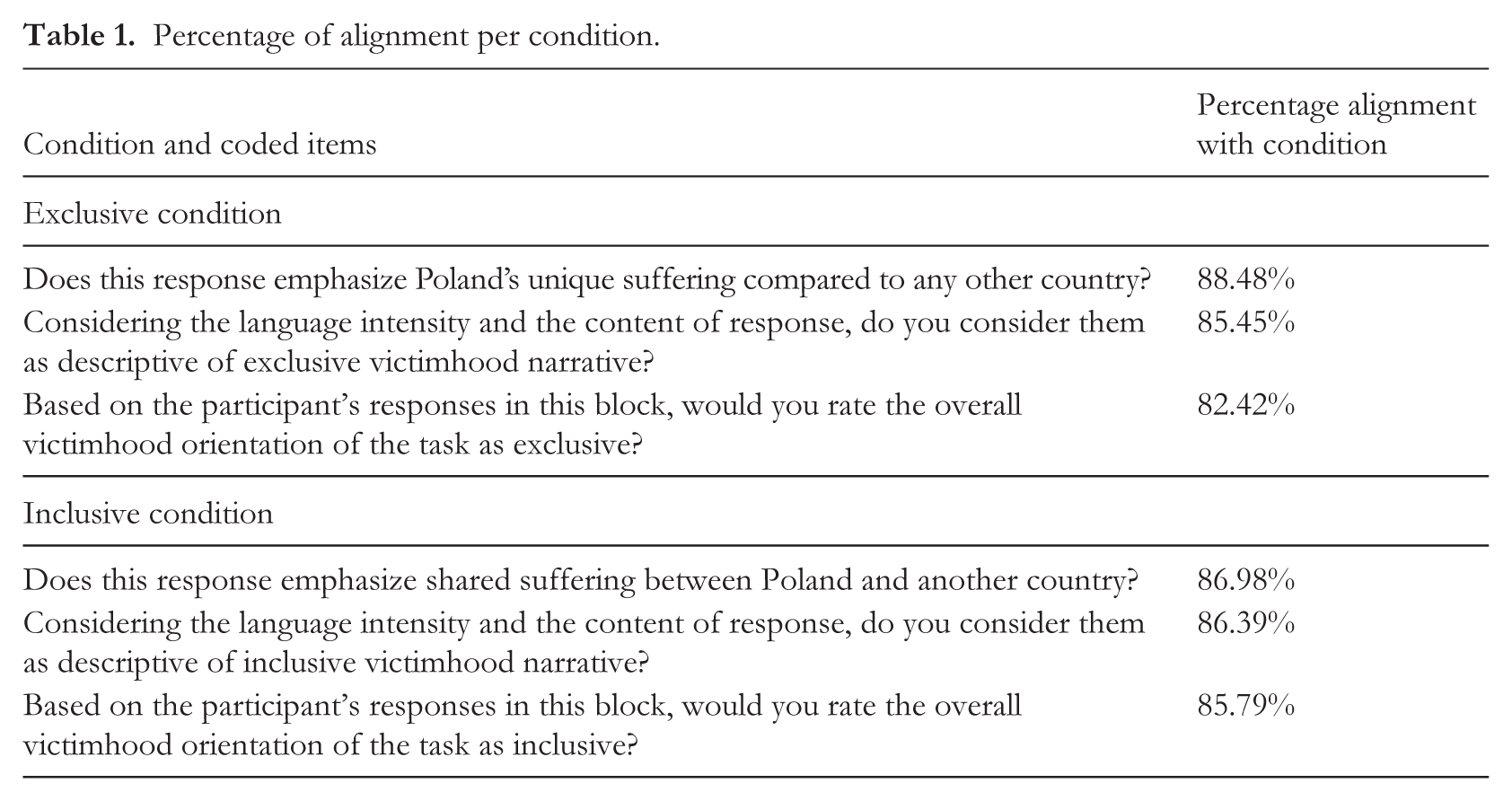
Table 1 presents the percentage of coded responses that are aligned with the intended experimental condition (exclusive vs. inclusive victimhood) for each item. As shown in Table 1, alignment with the assigned condition was high across all six items, ranging from 82.42% to 88.48%, indicating that the manipulation elicited the intended narrative frames. Next, Table 2 reports observed agreement (Po) and chance-corrected interrater reliability estimates. Observed agreement was high across all six items (Po range = .82 to .88), indicating consistent coding across raters. To account for chance agreement under the highly imbalanced category distributions present in the data, we computed Gwet’s AC1 coefficient, which is robust to prevalence effects and provides stable reliability estimates in skewed binary coding schemes (Gwet, 2014). AC1 was calculated using the following formula: AC1 = Po – Pe*/1 – Pe*, where Pe* = 2π (1 – π) and π represents the average marginal probability of category endorsement across coders. As also shown in Table 2, AC1 values ranged from .79 to .87 across the six items, indicating substantial to excellent interrater reliability. For completeness, Cohen’s κ coefficients are reported in the supplemental material, Table S3. As expected given the skewed category distributions, κ values were attenuated due to inflated estimates of chance agreement—a known limitation of this metric in binary coding contexts (Byrt et al., 1993; Feinstein & Cicchetti, 1990).
Interrater agreement scores per item across conditions.

Main Experiment
Outgroup Conspiracy Beliefs as the Dependent Variable
In the first model (Figure 4), we found partial support for our hypotheses regarding the causal effects of the victim beliefs manipulation on outgroup conspiracy beliefs. The total effect of the exclusive victim beliefs vs. control condition on outgroup conspiracy beliefs was positive and significant (B = 0.44, SE = 0.16, p = .007), consistent with H5. Furthermore, after accounting for the mediating effects of cognitive biases, the direct effect of the exclusive victim beliefs manipulation on outgroup conspiracy beliefs was not significant (B = 0.20, SE = 0.14, p = .141). However, the inclusive victim beliefs condition compared to the control group did not significantly reduce outgroup conspiracy beliefs, with nonsignificant results in both the total (B = −0.25, SE = 0.16, p = .115) and direct effect models (B = −0.16, SE = 0.14, p = .233), although in both cases the effects were in the expected direction. Among the mediators, H6 was partially supported, as the exclusive victim belief condition versus the control group showed a significant positive effect on negative interpretation bias (B = 0.50, SE = 0.12, p < .001). However, the exclusive victim belief condition did not affect hostile intentions attribution bias (B = −0.60, SE = 1.37, p = .663) or memory bias (B = 0.22, SE = 0.15, p = .132) accordingly, although in the case of memory bias the effects were in the expected direction. For the inclusive victim beliefs condition vs. control, we found no significant effects on negative interpretation bias (B = 0.11, SE = 0.12, p = .364) or memory bias (B = −0.07, SE = 0.15, p = .655), but there was a significant negative effect on hostile intentions attribution bias (B = −4.27, SE = 1.36, p = .002). 5 Each cognitive bias was positively associated with outgroup conspiracy beliefs: negative interpretation bias (B = 0.34, SE = 0.05, p < .001), hostile intentions attribution bias (B = 0.02, SE = 0.01, p < .001), and memory bias (B = 0.33, SE = 0.04, p < .001).
The indirect effect of the exclusive victim beliefs condition on outgroup conspiracy beliefs through negative interpretation bias was positive and significant (IE = 0.17, SEboot = 0.06, 95% CI [0.08, 0.30]), supporting H7. However, the hypothesized indirect effects through hostile intentions attribution bias (IE = −0.01, SEboot = 0.04, 95% CI [−0.11, 0.06]) and memory bias (IE = 0.07, SEboot = 0.05, 95% CI [−0.02, 0.18]) were not significant. For the inclusive victim beliefs condition, the indirect effect through hostile intentions attribution bias was negative and significant (IE = −0.11, SEboot = 0.04, 95% CI [−0.20, −0.04]) in line with H7, while the indirect effects through negative interpretation bias (IE = 0.04, SEboot = 0.04, 95% CI [−0.04, 0.13]) and memory bias (IE = −0.02, SEboot = 0.05, 95% CI [−0.12, 0.08]) were not significant. 6
World War II-related Conspiracy Beliefs as the Dependent Variable
In the second model, we examined the effects of our manipulation on World War II-related conspiracy beliefs (Figure 5). In contrast to the results for outgroup conspiracy beliefs, the total effect of the exclusive victim beliefs condition versus the control group on World War II-related conspiracy beliefs was not significant (B = −0.01, SE = 0.13, p = .948) not supporting H5. Similarly, the direct effect remained nonsignificant (B = −0.06, SE = 0.12, p = .594). Consistent with H5, the inclusive victim beliefs condition compared to the control group showed a significant negative total effect on World War II-related conspiracy beliefs (B = −0.36, SE = 0.13, p = .006). After accounting for the mediating effects of cognitive biases, the direct effect of the inclusive victim beliefs manipulation on World War II-related conspiracy beliefs remained significant, although with a reduced magnitude (B = −0.23, SE = 0.12, p = .046). Furthermore, hostile intention attribution bias (B = 0.03, SE = 0.004, p < .001) and memory bias (B = 0.22, SE = 0.04, p < .001) were positively associated with World War II-related conspiracy beliefs. However, negative interpretation bias did not significantly predict WWII-related conspiracy beliefs (B = 0.04, SE = 0.04, p = .334).

The effects of exclusive and inclusive victim beliefs manipulations on outgroup conspiracy beliefs via three cognitive biases.
Regarding indirect effects (H7), the exclusive victim beliefs condition showed no significant indirect effects on World War II-related conspiracy beliefs through any of the cognitive biases: negative interpretation bias (IE = 0.02, SEboot = 0.02, 95% CI [−0.03, 0.07]), hostile intentions attribution bias (IE = −0.02, SEboot = 0.04, 95% CI [−0.12, 0.06]), or memory bias (IE = 0.05, SEboot = 0.03, 95% CI [−0.01, 0.12]). For the inclusive victim beliefs condition vs. the control group, we found a significant negative indirect effect through hostile intentions attribution bias (IE = −0.11, SEboot = 0.04, 95% CI [−0.21, −0.04]). The indirect effects through negative interpretation bias (IE = 0.01, SEboot = 0.01, 95% CI [−0.01, 0.03]) and memory bias (IE = −0.01, SEboot = 0.03, 95% CI [−0.08, 0.05]) were not significant. 7
Generic Conspiracy Beliefs as the Dependent Variable
In the third model, we examined the effects of victim beliefs on generic conspiracy beliefs (Figure 6). The total effect of the exclusive victim beliefs condition compared to the control group on generic conspiracy beliefs was positive and significant (B = 0.34, SE = 0.16, p = .036), consistent with H5. Furthermore, after accounting for the mediating effects of cognitive biases, the direct effect of the exclusive victim beliefs manipulation was no longer statistically significant (B = 0.23, SE = 0.16, p = .149). Consistent with H5, the inclusive victim beliefs condition vs. the control condition showed a significant negative total effect on generic conspiracy beliefs (B = −0.32, SE = 0.16, p = .045). After accounting for the mediating effects of cognitive biases, the direct effect of the inclusive victim beliefs manipulation was not significant (B = −0.29, SE = 0.16, p = .067). Both negative interpretation bias (B = 0.17, SE = 0.06, p = .005) and memory bias (B = 0.13, SE = 0.05, p = .011) were significantly and positively associated with generic conspiracy beliefs. Hostile intentions attribution bias showed a non-significant positive relationship with generic conspiracy beliefs (B = 0.01, SE = 0.01, p = .060). Regarding indirect effects (H7), the exclusive victim beliefs condition vs. control group showed a significant positive indirect effect on generic conspiracy beliefs through negative interpretation bias (IE = 0.08, SEboot = 0.04, 95% CI [0.01, 0.18]), supporting H7. The indirect effects through hostile intentions attribution bias (IE = −0.01, SEboot = 0.02, 95% CI [−0.05, 0.03]) and memory bias (IE = 0.03, SEboot = 0.03, 95% CI [−0.01, 0.09]) were not significant, although the observed effects were in the expected direction. None of the indirect effects was statistically significant for inclusive victim beliefs compared to the control group: negative interpretation bias (IE = 0.02, SEboot = 0.02, 95% CI [−0.02, 0.07]), hostile intentions attribution bias (IE = −0.04, SEboot = 0.03, 95% CI [−0.10, 0.0001]), and memory bias (IE = −0.01, SEboot = 0.02, 95% CI [−0.05, 0.04]), although the direction of effects was as expected. 8

The effects of exclusive and inclusive victim beliefs manipulations on World War II-related conspiracy beliefs via three cognitive biases.

The effects of exclusive and inclusive victim beliefs manipulations on generic conspiracy beliefs via three cognitive biases.
Discussion
The results of this study showed that because exclusive victim beliefs are heavily based on intergroup competition and heightened threat perceptions (Vollhardt & Bilali, 2015), they can increase group-relevant (outgroup) and generic conspiracy beliefs via a cognitive bias—the negative interpretation bias—that leads people to interpret reality more broadly in generally negative terms. Conversely, inclusive victim beliefs, i.e. beliefs based on a common identity between victims and perpetrators (Shnabel et al., 2013), significantly reduced generic conspiracy beliefs and conspiracies about WWII, an event that involves the perpetrator group. The indirect effect of hostile intentions attribution bias in the relationship between inclusive victim beliefs and outgroup and WWII-related conspiracy beliefs may also back up our claims with regard to the role of content of such beliefs. Hostile intentions attribution bias appears to be a more specific, perpetrator-oriented bias, which can be reduced by common identity-relevant beliefs and, in turn, reduces conspiracy beliefs that describe an event, in which the perpetrator outgroup has a prominent role.
General Discussion
Through one correlational and one experimental study, this paper examined the associations and the causal effects of exclusive (vs. inclusive) victim beliefs on three types of conspiracy beliefs: outgroup, WWII-related, and generic, separately. Additionally, our paper aimed to test in both studies the mediating effect of three victimogenic (Andronnikova & Kudinov, 2021) cognitive biases: hostile intentions attribution bias, negative interpretation bias, and memory bias. Our studies bring a novel contribution to the literature of conspiracy beliefs, in that they provide comparative evidence about the predictive value of two competing historical victimhood construals on different types of conspiracy beliefs from generic to content and group specific. Additionally, our studies respond to previous calls for de-individualization and contextualization of cognitive biases in identity-relevant contexts (Wagner-Egger et al., 2022). To the best of our knowledge, our studies are the first that place three distinctive cognitive biases in a single model as mediating mechanisms that explain why people with high exclusive or inclusive victim beliefs tend to endorse, to varying degrees, conspiracy theories.
Recent work by Borinca et al. (2025) similarly highlighted the importance of memory in post-conflict cognition, and our work extends this by showing how memory bias—together with other cognitive biases characterized as victimogenic biases—forms a key pathway from historical victimhood to conspiracy beliefs. Furthermore, our findings extend prior work linking historical victimhood—typically in its exclusive form—to conspiracy beliefs (e.g., Bilewicz et al., 2019; Pantazi et al., 2022). By examining exclusive and inclusive victim beliefs within the same model, our studies show that collective victimhood is not a uniform predictor of conspiracism but yields opposite effects depending on how past harm is construed. Importantly, we also identify three cognitive biases characterized as victimogenic biases
Beginning with the correlational study, exclusive victim beliefs were consistently associated with higher endorsement of outgroup-related, World War II-related, and generic conspiracy beliefs. This pattern aligns with prior research linking exclusive victimhood to heightened threat sensitivity, mistrust, and defensive intergroup cognition (e.g., Bar-Tal et al., 2009; Bilewicz et al., 2019), and suggests that construing ingroup suffering as unique and competitive is broadly associated with conspiratorial interpretations across domains. At the same time, inclusive victim beliefs were not significantly associated with conspiracy beliefs or with any of the examined cognitive biases, although associations were descriptively in the expected negative direction. These null findings indicate that inclusive construals do not reliably translate into reduced conspiratorial thinking in correlational contexts, highlighting important limits to their presumed protective role.
The experimental study both replicated and qualified these patterns. Inducing exclusive victim beliefs increased outgroup-related and generic conspiracy beliefs but did not affect WWII-related conspiracy beliefs, suggesting that the impact of exclusive victimhood may depend on the contemporary relevance and identity centrality of the conspiracy domain. Inclusive victim beliefs, in contrast, reduced WWII-related and generic conspiracy beliefs but did not significantly reduce outgroup conspiracy beliefs. This asymmetry underscores that inclusive victimhood is not simply the inverse of exclusive victimhood; rather, its effects appear to be context-dependent and selectively expressed, particularly when conspiratorial narratives are not directly tied to ongoing intergroup competition.
Turning to the proposed cognitive mechanisms, the correlational study showed that exclusive victim beliefs were positively associated with all three cognitive biases—negative interpretation bias, memory bias, and hostile intentions attribution bias, reflecting the victimogenic nature of these biases (Andronnikova & Kudinov, 2021) as aspects of a proneness to victimhood (see also, Gabay et al., 2020, about the cognitive biases that comprise the tendency to interpersonal victimhood). Each bias was, in turn, associated with outgroup- and WWII-related conspiracy beliefs. However, only negative interpretation bias predicted generic conspiracy beliefs. Correspondingly, indirect effects of exclusive victim beliefs were robust for outgroup- and WWII-related conspiracy beliefs across all biases, but for generic conspiracy beliefs only via negative interpretation bias. This selective pattern suggests that while exclusive victimhood is linked to a broader constellation of bias-prone cognition, not all biases contribute equally across conspiracy domains. The experimental mediation findings further underscore this selectivity. Exclusive victimhood increased outgroup and generic conspiracy beliefs primarily via heightened negative interpretation bias, whereas indirect effects via hostile intentions attribution and memory bias were weak or absent. Inclusive victimhood, by contrast, showed indirect effects only through reduced hostile intentions attribution bias, for outgroup and WWII-related conspiracy beliefs. Importantly, many indirect effects were small, domain-specific, or non-significant, cautioning against strong claims about a uniform multi-bias pathway. Rather than indicating theoretical weakness, this pattern helps clarify which cognitive processes are most central under which conditions.
Taken together, these findings suggest that exclusive and inclusive victimhood represent qualitatively distinct psychological orientations rather than opposite poles of a single continuum. Exclusive victimhood appears to foster conspiratorial thinking primarily by amplifying generalized negativity and threat-based interpretation, consistent with siege mentality and biased assimilation frameworks (Bar-Tal et al., 2009; Lord et al., 1979). This pattern is also compatible with insights from the literature on other cognitive biases, such as the hindsight bias, which shows that once outcomes are known, individuals are more likely to impose simplified, intention-focused causal narratives on complex or ambiguous events (Roese & Vohs, 2012). In this sense, exclusive victimhood may promote conspiratorial thinking, particularly in domains where causal ambiguity is high—such as generic or outgroup-related conspiracies—by encouraging myopic, threat-centered interpretations rather than nuanced causal reasoning. Inclusive victimhood, in contrast, does not reliably reshape general interpretive styles but may reduce conspiratorial beliefs when it specifically attenuates perceptions of hostile outgroup intent, especially in contexts involving shared or historically distant suffering. The absence of symmetrical effects between inclusive and exclusive construals thus constitutes a theoretically meaningful constraint on models that treat inclusive victimhood as a uniformly protective orientation, highlighting instead the contextual and domain-specific conditions under which inclusive victimhood may dampen conspiracy beliefs.
Overall, by highlighting both convergences and inconsistencies across studies, outcomes, and mediating pathways, the present research refines the theoretical understanding of how collective victimhood shapes conspiratorial thinking. Rather than operating through a single, uniform mechanism, victimhood beliefs appear to interact with contextual relevance and domain-specific cognitive processes, underscoring the importance of treating null and selective effects as informative for theory development. These findings provide clear guidance for interventions targeting conspiracy beliefs and post-conflict reconciliation. Exclusive victimhood drives threat-focused and intention-biased interpretations of history, suggesting that narrative interventions emphasizing historical complexity, ambiguity, and multiple perspectives can reduce conspiratorial thinking. Inclusive victimhood offers selective benefits, most effectively when tailored to specific contexts that reduce perceptions of hostile outgroups. By highlighting cognitive mechanisms such as negative interpretation and hostile attribution, interventions can directly target the processes sustaining conspiratorial beliefs through bias-awareness training, perspective-taking, and dialogue. Overall, these findings emphasize that reducing conspiracy beliefs in divided societies requires context-sensitive strategies addressing both the framing of historical victimhood and its influence on biased cognition, rather than relying solely on generic appeals to shared identity or reconciliation.
Limitations and Directions for Future Research
Along with the novel contributions of our studies, several limitations should be acknowledged. First, our focus on the Polish–German context—while historically significant—concerns a relatively dormant conflict. Although WWII-related tensions occasionally resurface, our models could be tested in settings of more active intergroup hostility. Prior evidence indicates that higher conflict intensity is associated with stronger conspiracy beliefs (Hebel-Sela et al., 2024), suggesting that future work should examine whether our findings extend to geopolitical contexts characterized by ongoing threat. Second, our experimental manipulation treated victim beliefs as a binary contrast (exclusive vs. inclusive). Yet social identity complexity theory (Roccas & Brewer, 2002) proposes that individuals can hold multiple, context-dependent victim beliefs simultaneously. Given the variation we observed across different conspiracy outcomes, future research could examine whether identity complexity moderates the cognitive processes through which victim beliefs relate to conspiracism. Third, although our three multi-item cognitive bias measures were robust and the outgroup and WWII-related conspiracy beliefs were measured with multiple items, the generic conspiracy mentality measure relied on a single item. Single-item indicators limit reliability and constrain the range of inferences that can be drawn. While we used it intentionally as a broad downstream indicator, future studies should incorporate multi-item scales to better capture generalized conspiratorial worldviews. Additionally, some aspects of the cognitive bias measures warrant consideration. Hostile attribution was assessed via probability estimates applied to open-ended vignettes—a method aligned with prior work (e.g., Gabay et al., 2020; Schori-Eyal et al., 2017) but one that may cue demand characteristics and restrict generalizability. Its internal consistency was acceptable (α = .68), yet not as good as in the case of the measures of other biases, likely reflecting both the concise scale structure and heterogeneity introduced by scenario-based items. The interpretation and memory bias measures, while adapted from validated instruments, may also be sensitive to subtle framing effects. Future research should employ multi-method approaches (e.g., behavioral tasks, implicit measures, longitudinal assessments) to strengthen construct validity and reduce potential response biases. Finally, the dynamic nature of intergroup relations calls for longitudinal approaches. Sociopolitical crises have been shown to amplify uncertainty and threat, conditions conducive to conspiracy beliefs (Franks et al., 2017; Lalot et al., 2021). Longitudinal research could examine whether shifts in collective victim beliefs track fluctuations in political or historical narratives over time. Lastly, the present studies did not include broader ideological and identity-related potential confounding variables that may also be linked to motivated reasoning and conspiracy beliefs, such as national identity or attachment to one’s nation (e.g., Chen et al., 2022; Herrmann, 2017); collective narcissism (e.g., Cichocka et al., 2016); or right-wing authoritarianism (e.g., Grzesiak-Feldman & Irzucka, 2009). Future research should integrate these variables to clarify how victimhood beliefs operate within broader ideological and identity-based frameworks.
Despite these limitations, our research offers the first integrated model linking exclusive and inclusive victim beliefs to conspiracy thinking through distinct cognitive biases, advancing scholarship on conspiracy beliefs and collective victimhood. Crucially, our findings demonstrate that historical collective victimhood is not a monolithic driver of conspiratorial thinking: how past harm is construed fundamentally shapes both cognitive processing and belief patterns. By identifying victimogenic biases as key mechanisms, this research can provide a concrete roadmap for interventions aimed at reducing conspiratorial thinking, fostering intergroup understanding, and promoting more nuanced historical reasoning in post-conflict societies.
Supplemental Material
sj-docx-1-gpi-10.1177_13684302261445317 – Supplemental material for Scarcity of Suffering: How Historical Victimhood Beliefs Shape Conspiracy Thinking via Cognitive Biases of Attribution, Intentionality and Memory
Supplemental material, sj-docx-1-gpi-10.1177_13684302261445317 for Scarcity of Suffering: How Historical Victimhood Beliefs Shape Conspiracy Thinking via Cognitive Biases of Attribution, Intentionality and Memory by Theofilos Gkinopoulos, Maciej Siemiątkowski and Michał Bilewicz in Group Processes & Intergroup Relations
Footnotes
Acknowledgements
The authors would like to thank the two undergraduate psychology students, Zofia Kawczyńska and Kalina Wiśniewska, for their help in coding the open-ended responses from the experimental manipulation to assess inter-rater agreement.

Ethical Considerations
For these studies, ethical approval was granted by the Jagiellonian University Research Ethics Committee in advance prior to data collection, which was the first author’s affiliated institution in 2024, when the study began.
Funding
The authors disclosed receipt of the following financial support for the research, authorship, and/or publication of this article: The work has been supported by an Excellence Initiative Grant of the Faculty of Philosophy, Jagiellonian University (Grant no: 221.6120.39.2024) awarded to the first author and a National Science Center (NCN) Opus grant (Grant no: DEC-2023/49/B/HS6/01428) awarded to the third author. The first and the second author are also part of the research team of the National Science Center (NCN) Opus grant (Grant no: DEC-2023/49/B/HS6/01428).
Declaration of Conflicting Interests
The authors declared no potential conflicts of interest with respect to the research, authorship, and/or publication of this article.
Supplemental Material
Supplemental material for this article is available online.
Notes
References
Supplementary Material
Please find the following supplemental material available below.
For Open Access articles published under a Creative Commons License, all supplemental material carries the same license as the article it is associated with.
For non-Open Access articles published, all supplemental material carries a non-exclusive license, and permission requests for re-use of supplemental material or any part of supplemental material shall be sent directly to the copyright owner as specified in the copyright notice associated with the article.
