



Abstract
Individuals vary in how they approach diversity; some emphasize relationship-building across groups (bridging), while others favor driving systemic change (dismantling). White participants (N = 1224) evaluated an employee who embraced or forewent these approaches. Participants low in social dominance orientation (SDO)—those less supportive of hierarchy—evaluated targets who endorsed bridging (Study 1a) and dismantling (Study 1b) approaches more positively (i.e., warmer, more competent, preferred for leadership) than targets who opposed either of these approaches. However, when directly comparing targets who strongly endorsed both approaches, participants high in SDO distinguished between targets, preferring the target who endorsed bridging over the target who endorsed dismantling approaches (Study 2). This effect was mediated by anticipated discomfort. While both bridging and dismantling can promote equality, these studies uncover a subtle way structural change may be curtailed, even when not outright dismissed, thus limiting the full potential of diversity approaches.
Introduction
Despite widespread implementation of organizational strategies aimed at promoting racial equity and inclusion (Apfelbaum et al., 2016; Costa, 2024), the US workplace remains a site of persistent racial inequality (Roberts & Rizzo, 2021). These inequalities are sustained through structural barriers, such as institutional policies and historical patterns of exclusion, as well as through the everyday beliefs, preferences, and behaviors of individuals operating within organizations (Bonilla-Silva, 2010; Kendi, 2016; Salter et al., 2018).
One factor that may contribute to the maintenance of these inequalities is social dominance orientation (SDO; Pratto et al., 1994), which reflects an individual’s preference for group-based hierarchy and inequality. A robust body of research has linked higher levels of SDO with stronger support for social inequality and the maintenance of group-based hierarchies, particularly among White Americans (Federico & Sidanius, 2002; Ho et al., 2015; Hudson et al., 2019; Kteily et al., 2012; Pratto et al., 1994; Sidanius et al., 2006). Critically, research has documented that SDO operates at both high and low ends. That is, SDO is not only an ideology that predicts outcomes for people who exhibit high levels. Rather, there are also predictions for people who report low levels, or those who act with egalitarian intentions. People who measure higher in SDO tend to more strongly support hierarchy between groups, endorse domination of one (higher-status) group over the other (lower-status) group, and aim to maintain or increase differences between social groups (Kteily et al., 2011; Sidanius et al., 1996). People who measure lower in SDO tend to support the opposite pattern.
In the workplace, SDO is associated with interest in hierarchical organizations and occupations. For example, longitudinal data shows SDO predicts higher likelihood of working in hierarchy-enhancing positions, such as law enforcement, military, and financial occupations, and working in such positions predicts higher SDO over time, indicating a bidirectional relationship between SDO and occupations (Zubielevitch et al., 2022). Similarly, participants higher in SDO were more attracted to demographically similar high-status organizations than low-status organizations (operationalized across studies as having representation of people of color and women), while participants low in SDO either did not show a preference based on organizational status, preferred the low-status organization (Umphress et al., 2007), or preferred organizations with less managerial hierarchy (Bae & Fath, 2025). Additionally, when evaluating a racially homogenous organization, people high in SDO viewed the organization as more diverse if it included diversity in occupations, while people low in SDO did not include occupational heterogeneity in their construal of diversity (Unzueta et al., 2012). Importantly, this construal predicted differences in support for anti-hierarchy policy, such that greater perceptions of organizational diversity were associated with lower support for race-based affirmative action (Unzueta et al., 2012).
Although less tested, SDO is also associated with the selection of individuals to maintain hierarchy, based on characteristics including accent (Hansen & Dovidio, 2016), gender (Hoyt & Simon, 2016), and race (Umphress et al., 2008). For example, people high in SDO are less likely than those low in SDO to prefer Black men or White women job candidates (Umphress et al., 2008; see also Reynolds et al., 2021). Reynolds et al. (2021) found that people who were higher in SDO showed a preference for White job candidates over Black job candidates (that is, they preferred the higher status candidate over the lower status candidate); however, people who were lower in SDO showed the opposite pattern, preferring the Black candidate over the White candidate (the lower status candidate over the higher status candidate). Similarly, when evaluating a highly qualified Black woman candidate, people high in SDO recommended her more for a non-leadership position than a leadership position, while people low in SDO did not differentiate between the two positions (Simmons & Umphress, 2015). Together, these findings suggest SDO is associated with preferences for people who either enable or embody hierarchy enhancement (high SDO) versus hierarchy mitigation (low SDO) in workplace environments. These studies also provide evidence that SDO predicts differential preferences for people based on their hierarchical status at both high and low endorsement.
Thus, we argue that people who are higher in SDO would also prefer people who take approaches that they believe will maintain hierarchy, whereas people who are lower in SDO would prefer people who take approaches that they believe will minimize hierarchy. However, to our knowledge, research has yet to explore how SDO shapes peoples’ beliefs about how others will approach diversity. In the current research, we extend prior work documenting that SDO is associated with attitudes toward abstract diversity policies and individuals based on social identity alone by examining how SDO shapes White Americans’ evaluations of individuals who actively promote different approaches to diversity and inclusion within organizations. We focus on White Americans because they are often resistant to workplace diversity approaches (Dover et al., 2020; Kaiser et al., 2021); understanding the psychological factors that shape their support for (or resistance to) different diversity approaches is therefore crucial.
Individuals within organizations can approach diversity and equity in a range of ways. Here, we focus on two common and theoretically meaningful approaches people may take. Some people prioritize advancing systemic change through structural action and accountability mechanisms (Calliste & Dei, 2000), an approach we term dismantling. Dismantling refers to a strategy of White identity management wherein White people actively work to reduce systemic racial privilege and inequality (Knowles et al., 2014). Others emphasize interpersonal connection, perspective-taking, and communication across racial lines (Ku et al., 2015), an approach we refer to as bridging. These approaches are not (necessarily) mutually exclusive, but individuals may opt to represent themselves as more focused on one approach or another in a given moment. Both approaches commonly lead to positive race-related outcomes: bridging approaches can lead to reduced bias, improved interactions, and lower anxiety (Bernardo et al., 2013; Rosenthal & Levy, 2012; Todd et al., 2012; Vescio et al., 2003; Wang et al., 2014), and dismantling approaches can lead to improved attitudes, greater cultural competency, and increased managerial diversity (Calliste & Dei, 2000; Kalev et al., 2006; Wang et al., 2024). However, bridging and dismantling approaches differ in how directly they challenge existing hierarchies—which may affect how White Americans react to them.
People generally explicitly support diversity approaches in the workplace (Minkin, 2023). Thus, White Americans may evaluate individuals who endorsed both bridging and dismantling approaches more positively (i.e., warmer, more competent, preferred for leadership) than individuals who opposed each of these approaches. However, because dismantling strategies emphasize accountability to enact structural change, they may be perceived more negatively or evoke actual or anticipated discomfort. Indeed, speaking out about others’ racial biases can elicit negative emotions and social evaluations (Czopp et al., 2006), leading some people to avoid race-related discussions to avoid discomfort and conflict (Apfelbaum et al., 2008; Chaney & Sanchez, 2018). Conversely, bridging strategies, which emphasize communication and perspective-taking, may lead people to anticipate greater comfort and connection. Thus, it is possible that White Americans may evaluate individuals who endorse dismantling less positively than those opposing the approach, while still evaluating those who endorse bridging approaches more positively than those opposing the approach. We preregistered that we would observe this outcome.
Most critically, because bridging and dismantling approaches differ in how directly they challenge existing hierarchies, they may elicit divergent responses depending on the perceiver’s beliefs about preserving or attenuating hierarchy. As a result, we test how SDO shapes White American’s evaluations of organizational actors who self-identify as strong in either bridging or dismantling diversity approaches. Specifically, we propose that White Americans, and in particular those who more strongly prefer hierarchy (i.e., higher in SDO), will prefer individuals who take bridging approaches over dismantling approaches when directly compared. This approach also enables us to test hypotheses specific to White Americans who are lower in SDO (more egalitarian). Given past work showing people low in SDO can prefer a low status, or hierarchy-mitigating job candidate (Reynolds et al., 2021), we would expect White Americans who are lower in SDO to prefer dismantling approaches. We also explored whether people’s anticipated comfort, tension and conflict, or productivity at work may explain why people who are high in SDO positively evaluate people who take bridging approaches over dismantling approaches. Thus, we explore whether people evaluate diversity approaches through the lens of anticipated interpersonal experiences, such that people—especially those who are relatively higher in SDO—prefer bridging approaches because they feel more comfortable.
The current research advances prior work in three key ways. First, we address who prefers which approach: we test whether individual differences in SDO are associated with who is likely to show differential preference for one over another, even if generally people like both. Second, we explore which approaches people prefer: we test whether less egalitarian people (i.e., people higher in SDO) prefer approaches seeking to build over those seeking to dismantle. This could document a subtle way in which structural change may be curtailed, even when not outright dismissed, thus limiting the full potential of diversity approaches. Because multiple approaches could effectively address racial inequality, effective solutions require a range of approaches. Third, we test why people hold these preferences: we explore whether people’s preferences are shaped by their individual preference for hierarchy and the amount of discomfort they anticipate each approach bringing. Together, this work offers a novel framework for understanding individual-level variability in the reception and expected outcomes of diversity strategies—an essential step toward designing inclusive initiatives that can succeed across various organizational and societal contexts.
The Present Studies
Studies 1a–b tested people’s perceptions of and preference for someone with a bridge-building approach (or not; Study 1a), and with a dismantling approach (or not; Study 1b). We manipulated a target’s self-reported engagement with bridging or dismantling diversity approaches, and measured participants’ impressions of the target, including perceived warmth and competence, and preference for the target as a leader. Importantly, these studies assess evaluative responses to the target rather than the real or perceived effectiveness of either approach. We also measured participants’ SDO (see supplemental material for additional measures collected) at the end of the study to avoid introducing hierarchy-related beliefs prior to the manipulation. In Study 1a, we hypothesized that participants would rate the target who strongly endorsed bridging higher on warmth, competence, likeability and leadership than the target who weakly endorsed bridging. In Study 1b, we hypothesized that participants would rate the target who weakly endorsed dismantling higher on warmth, competence, likeability and leadership than the target who strongly endorsed dismantling. Because Study 1a and 1b were similar except for the type of diversity approach being manipulated (i.e., manipulating bridging in 1a and dismantling in 1b), we present their Methods together. Further, we present an analysis combining both datasets to examine both the effects of level (high versus low) and approach (bridging versus dismantling) to parallel the Study 2 design and findings. The pre-registered analyses examine each study separately and are reported in the supplemental material.
In Study 2, we directly compared evaluations of targets who endorsed, or opposed, bridging or dismantling approaches, and again measured participants’ impressions of the target using the measures described in Studies 1a–b. Study 2 also measured participants’ anticipated experiences in response to these approaches. All measures and conditions are reported (see supplemental material and https://osf.io/vm4jw for data and materials); sample size, data exclusions, measures, and analysis plans for each study were pre-registered (Study 1a: https://aspredicted.org/kgx7-q5zp.pdf; Study 1b: https://aspredicted.org/s7qf-5pb9.pdf; Study 2: https://aspredicted.org/83w3-xswd.pdf).
Studies 1a and 1b
Participants
A priori power analyses conducted using G*Power (Faul et al., 2007) indicated that 550 participants in each study would provide 85% power to detect a small effect size (R2 = .02) assuming .05 alpha, two tested predictors, and three total predictors in a linear regression. Participants were recruited on CloudResearch. The final sample in Study 1a included 349 White participants (Mage = 41.9 years, SD = 13.2; 51% men) after excluding participants who did not meet the demographic inclusion criteria (White, 18+ years old, residing in the US, fluent in English; n = 127), or who failed the manipulation check (n = 24; i.e., disagreed that the target is able to employ the manipulated diversity approach). No participants met additional pre-registered attention check exclusion criteria. The final sample in Study 1b included 340 White participants (Mage = 43.4 years, SD = 12.0; 54% women) after excluding participants who did not meet the same demographic inclusion criteria from Study 1a (n = 194), or who failed the manipulation check (n = 22). No participants met the additional pre-registered attention check exclusion criteria. Sensitivity power analyses indicated these sample sizes provided 85% power to detect effects of R2S1a = .03 and R2S1b = .03.
Materials
Key Dependent Variables
Unless otherwise noted, all measures were assessed with 7-point Likert type scales with higher values indicating greater agreement (see supplemental material for scale anchors).
Target Warmth and Competence
Participants indicated the extent to which they thought the target was sociable, caring, unfriendly, insensitive (averaged into an index of warmth: αS1a = .96, αS1b = .92), and capable, skilled, lazy, and disorganized (averaged into an index of competence: αS1a = .92, αS1b = .93; Judd et al., 2005).
Target Evaluation
Participants completed four semantic differential scales evaluating the target as unpleasant/pleasant, unlikable/likable, unkind/kind, and irritating/nice (Kaiser & Pratt-Hyatt, 2009). The items were averaged, with higher scores indicating more positive evaluations (αS1a = .97; αS1b = .94).
Leadership Preference
Participants reported how much they want the target to hold the following positions: City council member, School board member, Business leader, Your boss, Your colleague, Your neighbor. The scale was reliable (αS1a = .98; αS1b = .98).
SDO
Participants completed Pratto et al.’s (2013) four-item SDO scale (αS1a = .87; αS1b = .88; 1 = extremely oppose, 10 = extremely favor), which included items like, “We should not push for group equality.”
Procedure
Participants were recruited to a study about how “individuals make quick impressions of others in the workplace.” After providing informed consent, participants were randomly assigned to see a small section of an employee’s self-evaluation form, which included the target’s high or low agreement with bridging (Study 1a) or dismantling (Study 1b) diversity approaches. In the high agreement condition, the target agreed with three items and strongly agreed with one item. In the low agreement condition, the target disagreed with three items and strongly disagreed with one item.
The bridging scale began with the stem: “How much do you agree or disagree that you are able to engage in the following,” with the target’s responses shown on a 7-point scale. The scale listed the following four items: “I am able to communicate equally well with members of different racial groups about race and diversity,” “I am able to truly listen to and understand members of different racial groups with regard to race,” “I wholeheartedly take the perspectives of different racial groups,” and “Without bias or reservation, I communicate the concerns of different racial groups to others” (Wilton et al., 2021).
The dismantling scale began with the stem: “How much do you agree or disagree with the following,” with the target’s responses shown on a 7-point scale. The scale listed the following four items: “I think people should be held accountable for the way they do or don’t work towards racial justice,” “I support effective measures to punish people who treat people unfairly on the basis of their race/ethnicity,” “I think systemic change is necessary in order to achieve full racial/ethnic equity,” and “It is not enough to say you care about racial equality; you also need to strive towards making it happen” (Kaiser & Pratt-Hyatt, 2009).
After completing a manipulation check (Study 1a: “To what extent do you believe that the employee is able to effectively bridge between members of different racial groups?”; Study 1b: “To what extent do you believe that the employee will hold others accountable for increasing racial equity?”) on a scale of 1 (not at all) to 7 (very much), participants reported their perceptions of the target. Participants also reported their beliefs about the targets’ demographics (e.g., race, gender, age); because these are not central to the study hypotheses, we do not address these in the current study. Lastly, participants reported their endorsement of SDO, and demographic information.
Study 1a and Study 1b Results
Effects of Level and Approach
Table 1 presents all condition-level descriptive statistics, and Table 2 presents all ANOVA results, on all combined Study 1a and Study 1b dependent variables. We observed significant main effects of level which were qualified by interactions with approach for all measured dependent variables. Participants rated the high bridging target as significantly warmer, t(685) = 4.98, p < .001, d = 0.52, more competent, t(685) = 5.77, p < .001, d = 0.60, more positive, t(685) = 3.11, p = .002, d = 0.32, and more preferred for a leadership position, t(685) = 4.67, p < .001, d = 0.48, than the high dismantling target. Further, participants rated the low dismantling target as warmer, t(685) = −5.25, p < .001, d = −0.59, more competent, t(685) = −5.81, p < .001, d = −0.65, more positive, t(685) = −3.09, p = .002, d = −0.35, more preferred for a leadership position, t(685) = −3.95, p < .001, d = −0.44 than the low bridging target.
Combined Descriptive Statistics: Studies 1a and 1b.

Note. M = mean. SD = standard deviation. Different a-d superscripts indicate a difference at p < .05 from two-way ANOVAs.
Combined ANOVA Results: Studies 1a and 1b.

Moderation by SDO
There were no effects of level, F(1, 685) = 0.13, p = .723, η p 2 = 0.0002, approach, F(1, 685) = 2.81, p = .094, η p 2 = 0.004, or their interaction, F(1, 685) = 0.13, p = .716, η p 2 = 0.0002 on SDO. There were significant interactions between level, approach, and SDO for perceived warmth, competence, evaluations, and leadership preference (see Table 3 and Figure 1). For significant interactions we report Tukey’s comparisons of level and approach at +1 and −1 SD of SDO.
Combined SDO Moderation Results: Studies 1a and 1b.
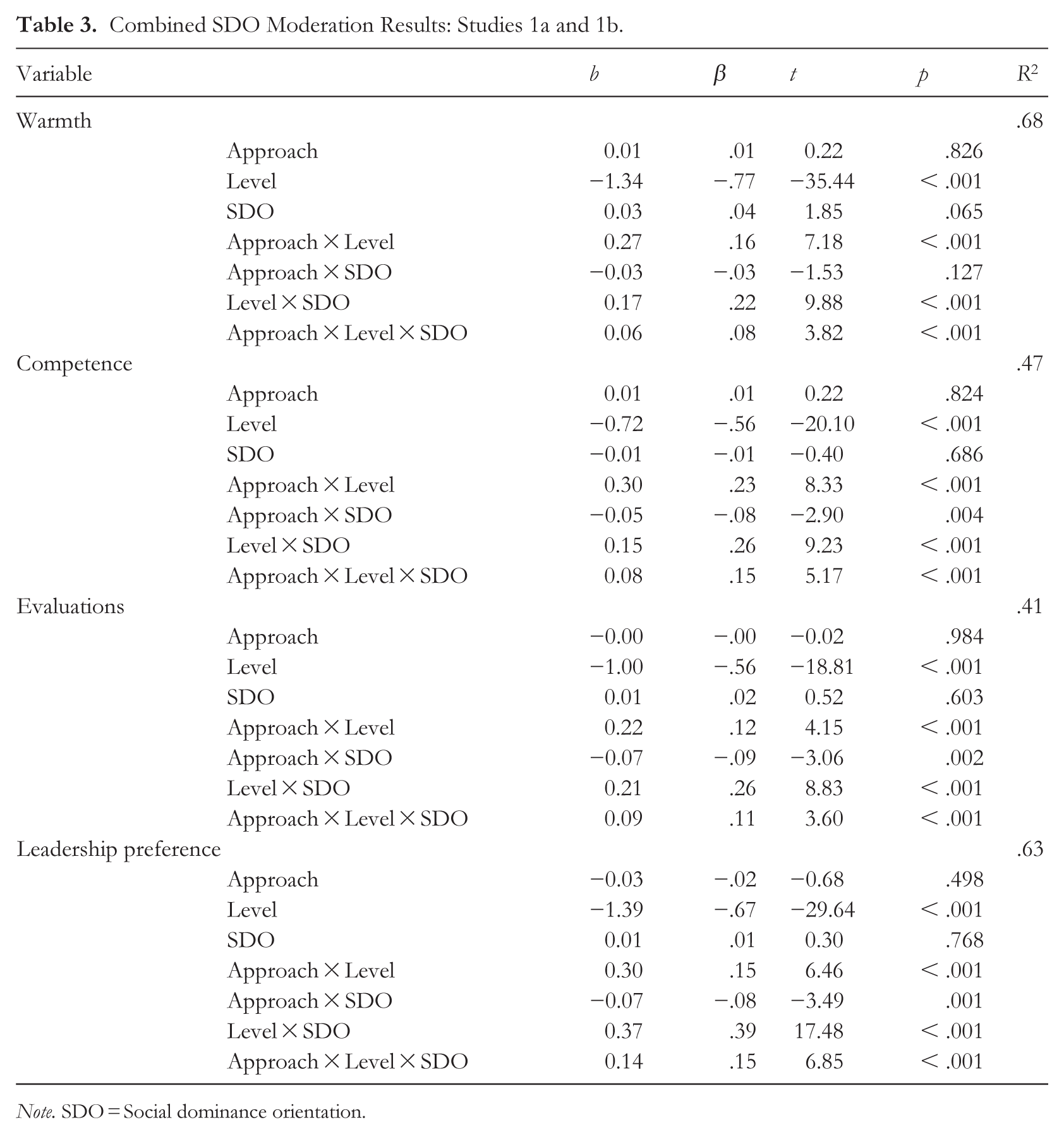
Note. SDO = Social dominance orientation.
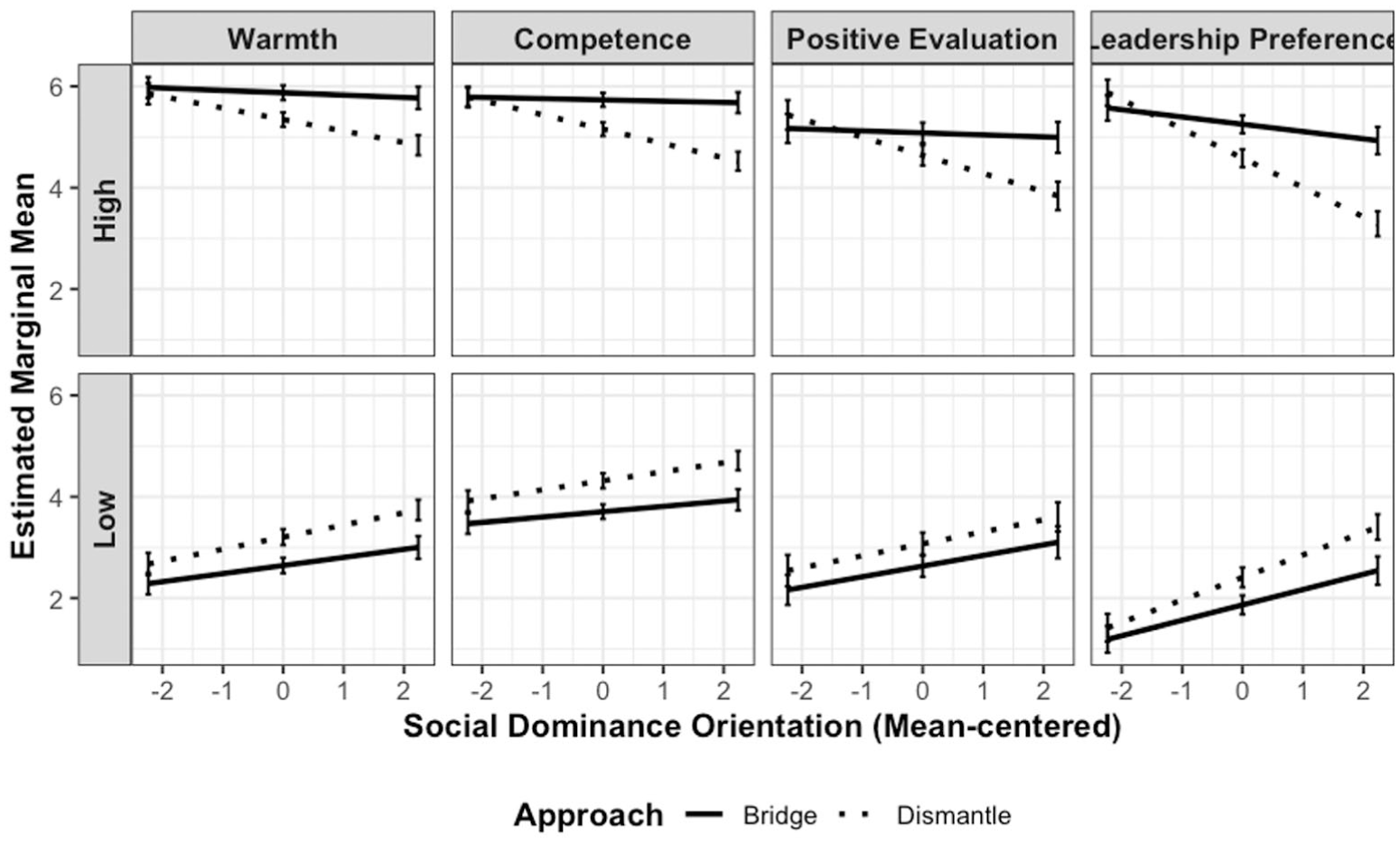
Combined moderation by SDO: Studies 1a and 1b.
Among participants who reported low SDO, there was no difference in the perceived warmth (t(681) = 0.83, p = .843, d = 0.12), competence (t(681) = 0.01, p = .999, d = 0.00), evaluations (t(681) = −1.29, p = .573, d = −0.19), or preference for leadership (t(681) = −1.65, p = .352, d = −0.25) between the high bridging and high dismantling targets. There were also no differences in the perceived warmth (t(681) = −2.49, p = .062, d = −0.39), evaluations (t(681) = −1.75, p = .299, d = −0.27), or preference for leadership (t(681) = −1.18, p = .638, d = −0.19) between the low bridging and low dismantling targets. The low bridging target was seen as less competent than the low dismantling target (t(681) = −3.06, p = .012, d = −0.48).
However, among participants who reported high SDO, the high bridging target was seen as warmer (t(681) = 6.23, p < .001, d = 0.94) and more competent (t(681) = 8.19, p < .001, d = 1.24), evaluated more positively (t(681) = 5.48, p < .001, d = 0.83), and preferred for leadership (t(681) = 8.85, p < .001, d = 1.34) more than the high dismantling target. Further, the low dismantling target was seen as warmer (t(681) = −4.77, p < .001, d = −0.74), more competent (t(681) = −5.32, p < .001, d = −0.83), and preferred for leadership (t(681) = −4.50, p < .001, d = −0.70) more than the low bridging target. The low dismantling target was evaluated similarly as the low bridging target (t(681) = −2.30, p = .100, d = −0.36).
Discussion: Studies 1a and 1b
In Studies 1a–b, the high bridging and high dismantling targets were evaluated more positively and rated as warmer, more competent, and preferred more for a leadership position than the low bridging and low dismantling targets, respectively. These results were consistent with our preregistered hypotheses for bridging (Study 1a), but counter to our preregistered hypotheses for dismantling (Study 1b). This suggests that although dismantling emphasizes accountability and punishment, in hypothetical workplace situations, White Americans are willing to express support for both diversity approaches over opposing action. While the differences in framing—specifically, the emphasis on accountability in the dismantling condition—could have driven the effects if participants had only preferred the high bridging target, this was not the case. Instead, participants evaluated both bridging and dismantling approaches more positively than no action, indicating that the effects cannot be explained solely by a preference for more positively framed strategies. This finding demonstrates that participants were not simply preferring a more positively valenced approach but were agreeing with multiple approaches to diversity over opposing action.
However, critically, these effects all differed by participants’ level of SDO such that the different evaluations by approach were stronger among participants who reported high SDO compared to those who reported low SDO. Participants who reported stronger support for hierarchy viewed the high bridging target more positively than the high dismantling target, and the low dismantling target more positively than the low bridging target. Participants who weakly supported the hierarchy did not differentiate between the high bridging and high dismantling targets or between the low bridging and low dismantling targets. Because we measured SDO after the manipulation, we interpret these results with caution because we cannot completely rule out contamination despite the absence of group-level differences in participant SDO. Still, together, Studies 1a–b suggest that targets who take a high bridging or high dismantling approach to diversity work are evaluated more positively, especially by participants who show low support for racial hierarchy. However, the question remains whether subtle preferences arise when presented with multiple options such that White Americans favor approaches that do not directly challenge structures—or that feel less personally challenging—especially if they favor hierarchy. Therefore, Study 2 tests people’s evaluations for high bridging compared to high dismantling approaches.
Study 2
Study 2 tested a 2 (Diversity approach: bridging, dismantling) × 2 (Agreement level: high, low) between-subjects’ design. Study 2 measured participants’ impressions of the target using the same measures described in Studies 1a–b, as well as a new measure of their anticipated discomfort working with the target. We preregistered a main effect of agreement level condition, such that participants would rate the high target higher on warmth, competence, likeability, and leadership than the low target. We also hypothesized a main effect of diversity approach condition, such that participants would rate the bridging target higher on warmth, competence, likeability, and leadership than the dismantling target. Further, we anticipated a two-way interaction, such that in the high level condition, participants would like the high bridging target more than the high dismantling target, and in the low level condition, participants would like the low dismantling target more than the low bridging target.
Participants
An a priori power analysis indicated 525 participants would be sufficient to capture a small effect size (R2 = .02), assuming .05 alpha, 90% power, and 1 numerator degree of freedom in a linear regression. Higher power in Study 2 compared to Study 1 allowed for a higher threshold to correctly reject the null hypothesis in the more complex analysis. Participants (N = 730) 1 were recruited on Prolific. As pre-registered, participants were excluded if they did not meet the demographic inclusion criteria (White, 18+ years old, residing in the US, fluent in English; n = 100), if they submitted the survey multiple times (the first submission was retained; n = 0), or if they failed the manipulation check (n = 94). Participants were also excluded if they met at least two of five preregistered attention check criteria (n = 1). The final sample included 535 White participants (Mage = 42.7 years, SD = 13.7; 49% women). A sensitivity power analysis indicated this sample size provided 90% power to detect a minimum effect size of R2 = .02.
Procedure
Participants saw a small section of an employee’s workplace self-evaluation form and evaluated the person. Participants were randomly assigned to see a target strongly self-identifying with a bridging approach, a target strongly dis-identifying with a bridging approach, a target strongly self-identifying with a dismantling approach, or a target strongly dis-identifying with a dismantling approach. As in Studies 1a–b, participants next completed the two manipulation checks followed by all main dependent measures of the target’s perceived warmth (α = .83), competence (α = .90), positive evaluations (α = .95), and leadership (α = .98). New to Study 2, participants also completed a measure of anticipated discomfort (described below). Lastly, they completed a measure of SDO (α = .86) and reported demographic information (see supplemental material for additional measures completed).
Perceiver’s anticipated discomfort
Participants indicated the extent to which they would feel comfortable, experience more tension, have more conflict at work, feel seen and heard at work, feel included at work, make connections between groups, and feel it would be harder to make progress on work on a scale with end anchors of 1 (extremely unlikely) to 7 (extremely likely). The scale reliability was good (α = .96), and the composite was scored such that higher scores indicate greater anticipated discomfort.
Results
Effects of Level and Approach
Table 4 presents all condition-level descriptive statistics, and Table 5 presents all ANOVA results, on all Study 2 dependent variables. We observed significant main effects for all measured dependent variables; these were qualified by interactions for warmth, and marginally significant interactions for competence, leadership, and anticipated discomfort. Participants rated the high bridging target as significantly warmer (t(531) = 2.90, p = .004, d = 0.37), more competent (t(527) = 2.66, p = .008, d = 0.34), more preferred for a leadership position (t(531) = 2.20, p = .027, d = 0.29), and causing marginally less discomfort (t(531) = −1.84, p = .067, d = −0.24), than the high dismantling target. However, there was no difference in perceptions of warmth (t(531) = −0.33, p = .739, d = −0.04), competence (t(527) = 0.03, p = .974, d = 0.004), leadership preference (t(531) = −0.10, p = .922, d = −0.01), or anticipated discomfort (t(531) = 0.56, p = .574, d = 0.07), between the low bridging and low dismantling target. Participants rated the high bridging and high dismantling targets more positively than the low bridging and low dismantling targets, t(531) = 18.17, p < .001, d = 1.59.
Descriptive Statistics: Study 2.

Note. M = mean. SD = standard deviation. Different a-d superscripts indicate a difference at p < .05 from two-way ANOVAs.
ANOVA Results: Study 2.

Moderation by SDO
There were no effects of level, F(1, 527) = 0.74, p = .389, η p 2 = .001, approach, F(1, 527) = 0.10, p = .748, η p 2 = .002, or their interaction, F(1, 527) = 1.10, p = .295, η p 2 = .002, on SDO. There were significant interactions between level, approach, and SDO for perceived warmth, competence, evaluations, leadership preference, and anticipated discomfort ratings (see Table 6 and Figure 2). For significant interactions we report Tukey’s comparisons of level and approach at +1 SD of SDO.
SDO Moderation Results: Study 2.

Note. SDO = Social dominance orientation.
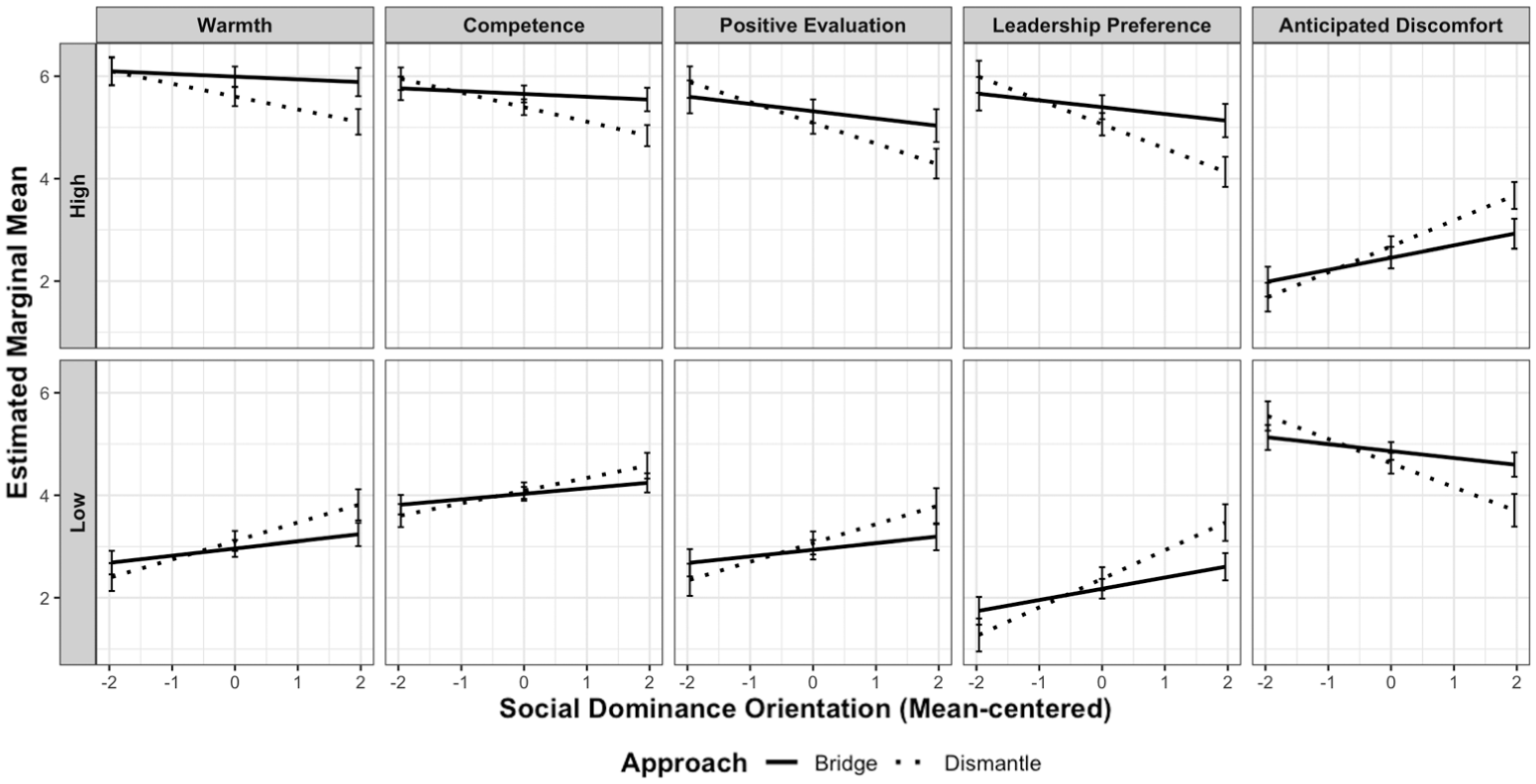
Moderation by SDO: Study 2.
Among participants who reported low SDO, there was no difference in the perceived warmth (t(523) = 0.01, p = .999, d = 0.00), competence (t(519) = −1.20, p = .627, d = −0.22), evaluations (t(523) = −1.27, p = .582, d = −0.23), preference for leadership (t(523) = −1.44, p = .477, d = −0.26), or anticipated discomfort (t(523) = 1.48, p = .454, d = 0.27) between the high bridging and high dismantling targets. There were also no differences in the perceived warmth (t(523) = 1.56, p = .401, d = 0.26), competence (t(519) = 1.05, p = .723, d = 0.18), evaluations (t(523) = 1.59, p = .387, d = 0.27), preference for leadership (t(523) = 2.20, p = .124, d = 0.37), or anticipated discomfort (t(523) = −2.19, p = .127, d = −0.37) between the low bridging and low dismantling targets.
However, among participants who reported high SDO, the high bridging target was seen as warmer (t(523) = 4.10, p < .001, d = 0.73) and more competent (t(519) = 4.67, p < .001, d = 0.83), evaluated more positively (t(523) = 3.38, p = .004, d = 0.60), preferred for leadership (t(523) = 4.47, p < .001, d = 0.79), and expected to cause less discomfort (t(523) = −3.74, p = .001, d = −0.66) than the high dismantling target. Further, the low dismantling target was seen as warmer (t(523) = −2.99, p = .016, d = −0.54), evaluated more positively (t(523) = −2.67, p = .039, d = −0.48), preferred for leadership (t(523) = −3.78, p = .001, d = −0.68), and expected to cause less discomfort (t(523) = 4.40, p < .001, d = 0.79) than the low bridging target. The low dismantling target was seen as similarly competent to the low bridging target (t(519) = −1.85, p = .250, d = −0.33).
Mediation Analysis
An exploratory moderated mediation model (Process Macro Model 12; Hayes, 2017) tested whether the effect of approach on each dependent variable is moderated by level and SDO, whether the effect of approach on each dependent variable is mediated by anticipated discomfort, and whether the effect of approach on anticipated discomfort is moderated by level and SDO (see Figure 3). There was a significant three-way interaction between approach, level, and SDO on anticipated discomfort, b = −0.56, SE = 0.10, p < .001. At high levels of SDO, there was a significant interaction between approach and level, b = −1.62, p < .001. This interaction was not significant at low levels of SDO, b = 0.47, p = .069. Among participants who reported high levels of SDO, participants reported greater anticipated discomfort in the low bridging condition than the low dismantling condition, b = 0.81, p < .001. However, participants reported greater anticipated discomfort in the high dismantling condition than the high bridging condition, b = −0.81, p < .001.

Moderated mediation results: Study 2.
The index of moderated mediation was significant for each dependent variable (warmth: index = 0.33, SEboot = 0.07, 95% CI [0.20, 0.48]; competence: index = 0.24, SEboot = 0.05, 95% CI [0.15, 0.35]; evaluations: index = 0.34, SEboot = 0.07, 95% CI [0.20, 0.48]; leadership preference: index = 0.42, SEboot = 0.08, 95% CI [0.26, 0.58]). Among high SDO participants, participants anticipated greater discomfort from a high dismantling target than a high bridging target, which was associated with evaluating the target as less warm, less competent, more negative, and less preferred for leadership. In contrast, they anticipated greater discomfort from a low bridging target than a low dismantling target, which was associated with evaluating the target as less warm, less competent, more negative, and less preferred for leadership (see Table 7).
Moderated Mediation Results: Study 2.

Note. SDO = Social dominance orientation. SE = standard error. SD = standard deviation. Level was coded as 1 = high, 0 = low.
Discussion: Study 2
Study 2 included a key comparison: whether people preferred a high bridging to a high dismantling approach to diversity. While the low bridging and low dismantling targets were seen as similarly cold, incompetent, unpreferred for leadership, and likely to cause discomfort, participants differentiated between the high bridging and the high dismantling targets. Indeed, the high bridging target was seen as warmer, more competent, preferred for leadership and causing less discomfort than the high dismantling target. Although in Studies 1a and 1b participants expressed preference for both bridging and dismantling over no action, in Study 2 we document that preference for bridging approaches over dismantling approaches when directly compared.
Yet, moderation analyses suggest these effects were driven by participants high in SDO. Among participants who reported high SDO, the high bridging target was seen as warmer, more competent, more positively, preferred for leadership, and causing less discomfort than the high dismantling target. These participants also saw the low dismantling target as warmer, more positive, preferred for leadership, and anticipated less discomfort than the low bridging target. Together, these findings suggest people who strongly support the racial hierarchy prefer a bridging approach compared to a dismantling approach and prefer people who reject a dismantling approach compared to those who reject a bridging approach.
General Discussion
Across the three studies, we demonstrated that White Americans’ preference for group-based hierarchy (i.e., SDO) was systematically associated with preference for bridging (which emphasizes relationship-building across groups) and dismantling (which favors driving systemic change) diversity approaches. While targets who took either bridging or dismantling approaches were generally evaluated positively, particularly when compared to those who take no diversity approach, participants higher in SDO preferred individuals who endorsed bridging over dismantling strategies. Specifically, participants high in SDO anticipated they would be more comfortable with a bridging approach than a dismantling approach, which was associated with more favorable impressions of those targets, and preferring them for leadership. This suggests people’s support for hierarchy may be associated with preferences for diversity approaches that are perceived as the least likely to dismantle existing systems. In contrast, participants lower in SDO did not differ significantly in their evaluations of people taking bridging and dismantling approaches, suggesting openness to a range of strategies. Thus, the current data highlight a subtle, yet consequential, way in which inequalities in workplaces may be linked with people’s preference for hierarchy.
While past work has shown SDO predicts support for policies that maintain inequality, this work extends this to interpersonal evaluations, demonstrating that preferences for hierarchy are also associated with how people perceive advocates of differing diversity approaches. This is a crucial insight because individuals must implement and lead diversity efforts, and their ability to successfully do so is in part shaped by how they are perceived by others. If people who endorse a dismantling approach are met with subtle interpersonal resistance or denied leadership positions by individuals who prefer hierarchy, organizations may default to strategies that demand less accountability, limiting the potential for meaningful structural change.
This is important because leaders are vital to the development of diverse and equitable organizations. People see organizational leaders as more responsible for confronting bias than either themselves or other bystanders, and organizational leaders themselves feel increased responsibility for doing so (Ashburn-Nardo et al., 2020). Both structural accountability and interpersonal approaches are an important part of driving positive changes. By documenting how hierarchy beliefs can shape evaluations of individuals advocating for social change in different ways, the present studies add important nuance to the diversity science literature. Most notably, our data reveal that preference for hierarchy can create preferences for individuals who engage in different diversity approaches—even when they see both diversity efforts as positive. In other words, while individuals may endorse diversity efforts over inaction, hierarchy-motivated beliefs can still shape preferences for less structurally-challenging approaches when multiple options are presented.
The present research builds on previous scholarship documenting various taxonomies of diversity approaches (e.g., Ely & Thomas, 2001; Kaiser et al., 2013; Plaut, 2002; van Knippenberg et al., 2013) and offers a novel framework of bridging and dismantling approaches to distinguish between different approaches to diversity work. Bridging and dismantling approaches both attend to group differences and inequality but are distinguished by a focus on communication and perspective-taking versus a focus on systemic change. Given the prevalence of (inert) workplace diversity initiatives (Dover et al., 2020), this framework allows researchers to examine support with more precision by attending to subtle differences in how these initiatives are approached.
Moreover, the studies present a novel mediator—anticipated discomfort—to identify one reason why White Americans may differentiate between bridging and dismantling diversity approaches. Because dismantling approaches challenge the status quo and introduce accountability, individuals who prefer hierarchy may respond by favoring approaches that seem (to them) as more comfortable. While intergroup anxiety can inhibit productive interracial contact (e.g., Apfelbaum et al., 2008; Chaney & Sanchez, 2018; Stephan, 2014), the current data suggest that anticipated discomfort in interpersonal interactions may also shape receptivity to the individuals promoting diversity work. Thus, anticipated discomfort may act as a hidden barrier to structural change, even when intentions to support diversity are present.
Limitations and Future Directions
Limitations of the study design constrain the interpretation of the findings. For example, we present the mediational relationship cautiously, as our ability to determine causality is limited: we used a cross-sectional empirical design, and we did not manipulate anticipated discomfort as the mediator in the pre-registered exploratory analyses. We suggest that future research could provide causal evidence of the mediator by more specifically measuring and manipulating exactly what White perceivers are expecting when they anticipate more discomfort. For example, do they anticipate heightened interpersonal friction, or lower feelings of interpersonal belonging in situations where there is lower bridging? Or, perhaps they expect their individual workload will increase? Identifying people’s specific forecasts would help build theory and could inform targeted interventions to reduce subtle resistance to structural change.
Another limitation of this work is the timing of our SDO measurement. Because financial constraints prevented us from collecting SDO in a separate study, we assessed it at the end of the study rather than beforehand. Although this introduces the possibility that our manipulation could have shifted participants’ reported SDO, we empirically tested for such contamination and observed no condition differences. We deemed this approach to be preferable to measuring SDO prior to the manipulation, which could have primed hierarchy-relevant beliefs and altered how participants responded to the core experimental materials—a validity threat we could not empirically rule out. Thus, while we interpret the moderation findings with appropriate caution, we believe this choice reflects the more conservative approach to protecting internal validity. Future work should replicate these effects while measuring SDO independently to more precisely establish its role as a moderator.
Future research should also clarify which aspects of the manipulation drive the effects. Like other approaches to diversity, bridging and dismantling approaches are multidimensional. For example, colorblindness can be conceptualized as emphasizing individual traits and focusing on similarities between groups (Rios, 2022), or as a denial of group differences and a denial of racial inequality (Neville et al., 2013). Similarly, bridging and dismantling approaches are conceptualized to differ on the extent to which they are perceived as unsettling the status quo. However, the approaches as manipulated in these studies may also differ on additional dimensions. For example, bridging approaches may see interpersonal interactions as the locus for intervention, while dismantling approaches may be focused on the intergroup level. Similarly, bridging could draw attention to the role of the self while dismantling emphasizes others. Lastly, bridging was presented with descriptive language while dismantling was presented with prescriptive language, which could alter preferences given a tendency to view what is descriptive as prescriptive (Roberts, 2022). Future research would benefit from systematically isolating and testing these dimensions to refine the constructs and understand which are central to the differential evaluations demonstrated here. One possibility is to alter the manipulation to make both conditions prescriptive, thereby testing whether the effect is robust to such differences in framing. Moreover, it is possible that different dimensions of bridging and dismantling predict different outcomes. For instance, the self-focus versus other-focus dimension may predict differences in people’s willingness to personally engage in behaviors, while the interpersonal versus intergroup dimension may predict differential impact of group context or identity. Such future studies can serve to increase the predictive precision of bridging and dismantling.
Future work should also explore how people would evaluate these approaches in different paradigms and contexts, as well as whether one approach is (viewed as being) more effective. Our studies relied on participants’ evaluations of hypothetical individuals based on self-evaluations and within a workplace context, which may not capture the full complexity of real-world dynamics; future research should test these ideas in fieldwork and in other contexts such as political, educational, or medical settings. For example, would low SDO perceivers support approaches first focused on bridging (to establish trust and rapport), and then following up with structural change? Moreover, the present work only tested White American perceivers; future work should test how racially minoritized perceivers evaluate bridging and dismantling approaches to identify diversity approaches that may receive support in racially diverse workplaces. Lastly, these studies focused on just two diversity approaches—bridging and dismantling—but other frameworks exist and may evoke different patterns of support or resistance.
Together, the present work identified who prefers which diversity approaches and why. White participants high in SDO preferred bridging over dismantling diversity approaches, as bridging approaches were seen as more comfortable. This work identifies how individual preferences may hinder structural change and curtail the full potential of a multifaceted approach to addressing racial inequality.
Supplemental Material
sj-docx-1-gpi-10.1177_13684302261442160 – Supplemental material for People High in Social Dominance Orientation Prefer Bridge-Building to Dismantling Diversity Approaches
Supplemental material, sj-docx-1-gpi-10.1177_13684302261442160 for People High in Social Dominance Orientation Prefer Bridge-Building to Dismantling Diversity Approaches by Analía F. Albuja and Leigh S. Wilton in Group Processes & Intergroup Relations
Footnotes

Funding
The authors received no financial support for the research, authorship, and/or publication of this article.
Declaration of Conflicting Interests
The authors declared no potential conflicts of interest with respect to the research, authorship, and/or publication of this article.
Supplemental Material
Supplemental material for this article is available online.
Notes
References
Supplementary Material
Please find the following supplemental material available below.
For Open Access articles published under a Creative Commons License, all supplemental material carries the same license as the article it is associated with.
For non-Open Access articles published, all supplemental material carries a non-exclusive license, and permission requests for re-use of supplemental material or any part of supplemental material shall be sent directly to the copyright owner as specified in the copyright notice associated with the article.
