



Abstract
Inclusive group norms can reduce children’s discriminatory behavior and contribute to positive and diverse peer relationships. Little is known about how outgroup inclusive group norms are associated with children’s behaviors and attitudes towards cross-gender peers. To address this gap, the present study investigated how 7–12-year-old American children’s (N = 983, MAge = 9.64 years, SDAge = 0.89); 51% female; 58.5% White, 17.5% Multiethnic, 8.3% Asian American, 5.6% Black, 4.2% Latinx, 0.6% Other, 5.3% not reported) perceptions of their gender outgroups’ inclusive norms were related to their reported play, desired play, and positive trait attributions of gender outgroup members. Children held higher inclusive norm expectations (INE) for their gender ingroup than outgroup. Children with higher outgroup INE reported and desired more play with gender outgroup members and had more positive attitudes towards them. The associations of INE with reported and desired play appeared to be stronger for boys than for girls.
Keywords
Introduction
Peer friendships and interactions are an important aspect of childhood, as they provide children with support, safety, and enjoyment (Rose et al., 2022; Rubin et al., 2006). Positive aspects of peer relationships, however, are undermined when peer groups create group norms that foster ingroup loyalty at the expense of fair and equal treatment of others (Abrams & Killen, 2014; Levy et al., 2016). For example, children may find themselves in a group that decides to exclude someone because of their nationality (“They aren’t like us; they’re from another country”). Rejecting the group norm about excluding non-Americans may result in being excluded from the group for not showing loyalty, even when the group norm is unfair to others (Abrams et al., 2014). This expectation reflects a conflict for many children and often creates an obstacle to standing up to others in one’s group (Mulvey et al., 2014; Rutland et al., 2015). Thus, peer group norms about inclusion and exclusion can be difficult to navigate in childhood, especially from the ages of 7 to 12 years old (the ages of the participant sample in the current study), as children’s social group understanding increases during this age (McGuire et al., 2019; Rutland & Killen, 2015).
Further, peer norms can influence children’s attitudes and behaviors towards members of outgroups as well as the likelihood of outgroup friendships (Rutland & Killen, 2017). Peer group norms often include criteria for why some individuals are included in one’s group and others are excluded (McGuire et al., 2020; Rutland et al., 2023). Inclusion criteria can include factors explicitly related to the goals of the group, such as the expectation that track teams include fast runners and exclude slow runners to win races (Mulvey et al., 2017). However, groups often have inclusion and exclusion criteria that are not explicitly relevant to the goals of the group. For example, if the track team excludes runners who are Muslim because “they are different” or “they are not like us,” this creates an exclusive criterion that reflects a prejudicial attitude, unrelated to the goals of the group (Mulvey et al., 2017; Rutland & Killen, 2017).
Groups without explicit goals, such as friendship groups, may have exclusionary criteria that keep others out for self-protection reasons (e.g., excluding someone who is a bully) or for biased reasons (e.g., excluding someone due solely to their religion, race, or ethnicity) (Cameron & Abbott, 2017; Mulvey et al., 2017). Children are navigating this terrain, learning about how groups work, about what types of group norms are fair or unfair, and developing beliefs about the group norms of others (Rutland & Killen, 2017). Thus, exclusive peer norms, such as excluding peers who are perceived to be “different” based on group identity (e.g., gender, race, ethnicity), can contribute to children’s prejudicial reasoning and discriminatory behavior (Mulvey, 2016). Furthermore, beliefs that others have exclusive peer norms can negatively impact children’s attitudes towards others, even if a diversity of inclusive attitudes exist within the outgroup (Burkholder et al., 2019; Hitti & Killen, 2015).
In contrast, inclusive peer group norms, such as valuing diversity and inclusion, can increase children’s positive behaviors towards outgroup members and cross-group friendships, or friendships with others from different social group backgrounds (Cameron et al., 2011; Feddes et al., 2009; McGuire et al., 2017). Given the tendency of groups to express exclusionary criteria, groups that convey inclusionary criteria may help to reduce bias and increase positive friendships. When members of a group state that “we like to play with kids who are different from us,” this conveys that their group is inclusive of others even if they may be perceived as a member of an outgroup. Research has found that Anglo-Australian children aged 7 to 9 preferred outgroup members more when their ingroup had an explicit norm of inclusion than when their ingroup had an explicit norm of exclusion (Nesdale & Lawson, 2011). Additionally, 9- to 14-year-old American children’s perception that their ingroup is inclusive towards cross-ethnic friendships predicts their interest in cross-group friendships (Tropp et al., 2014). Given that childhood cross-group friendships have been found to be associated with decreases in bias and prejudice (Killen et al., 2021), inclusive peer norms may have implications for intergroup relationships and prejudice reduction in childhood.
Prior research has found that children attend to inclusive norms beyond just those of their ingroup. Positive outgroup norms of friendships and fair treatment (e.g., a child’s beliefs that outgroup members will treat their ingroup well or fairly), among children aged seven and older, have been shown to reduce intergroup bias through direct or extended intergroup contact (Cameron et al., 2011; Feddes et al., 2009; McGuire et al., 2017) as well as biased-based behavior in intergroup contexts (McGuire et al., 2017). Inclusive outgroup norms may be associated with positive intergroup attitudes and behaviors (“If I think boys are inclusive towards me, I will want to play with them at recess”). Thus, the current study builds on existing evidence highlighting the importance of inclusive peer norms for intergroup relationships and prejudice reduction in childhood by examining whether perceptions of outgroup inclusive group norms (e.g., “do I think others are inclusive or not?”) are related to children’s attitudes and behaviors towards gender outgroup members.
Theoretical Framework: Social Reasoning Developmental Model
The aims, design, and hypotheses of this study were informed by the social reasoning developmental (SRD) model (Elenbaas et al., 2020; Rutland et al., 2010). The SRD model draws from research on developmental social cognition and social psychological theories to understand the experiences that promote moral orientations in group contexts. We drew on developmental social group theories about the impact that group norms have on children’s willingness to be inclusive (i.e., engage in a moral perspective) (Abrams & Rutland, 2011; Nesdale, 2008) as well as intergroup contact theory (Tropp & Barlow, 2018), which has shown that intergroup contact reduces biases.
The SRD model also draws on social cognition theories, such as social domain theory (Smetana & Yoo, 2023; Turiel, 2015), to assert that children care about the moral implications of including others from different backgrounds. Being inclusive enables one to have friends across social groups and reduces negative expectations about others based solely on group identity (Rutland et al., 2024). Children often struggle between recognizing the benefits of diversity and knowing that groups are often exclusive. When groups are exclusive (“We don’t like people who are different from us”) this presents a conflict because it is difficult to challenge one’s group (Mulvey, 2016).
Our study provides a new angle to this model by investigating whether expectations that outgroups will be inclusive positively relate to the desire to have contact with members of the outgroup. A core postulate of the SRD model is that individuals consider their psychological knowledge about others, such as others’ attitudes and intentions, alongside their awareness of groups and moral judgments in intergroup interactions. For instance, attitudes about whether a group is inclusive or exclusive bear on the desire to engage in intergroup contact. Yet, no research has directly investigated this association. Group norms play a significant role in children’s peer interactions, social relationships, and development of social cognition, including in relation to gender groups.
Gender Group Membership
It is critical to understand the relation between outgroup inclusive group norms and cross-gender attitudes and behavior, as much of the past research on inclusive group norms has focused on racial or ethnic groups (e.g., Cameron et al., 2011; Feddes et al., 2009; Tropp et al., 2014). Gender has received less attention in inclusive group norm research, which has left a gap in the understanding of the role of inclusive group norms in reducing childhood gender biases. American children accept gender-based discrimination more than discrimination based on other social groups (Killen et al., 2002), gender segregation is pervasive in early childhood (Maccoby, 2002) and gender bias can limit opportunities for both boys and girls starting early in development (Mulvey & Killen, 2015). Therefore, understanding if outgroup inclusive group norms relate to lower gender bias is essential to address current gender-based inequities, which have origins in childhood. Additionally, it is prudent to explore cross-gender attitudes and behaviors; while many children have limited opportunities for cross-race contact due to the segregation of public schools (Nowicki, 2022) and neighborhoods (Hwang & McDaniel, 2022), most children in the United States have high opportunities for potential cross-gender contact. Thus, it is easier for children to have positive cross-gender interactions if they are motivated to do so, compared to other forms of cross-group contact.
Intergroup Contact and Desired Contact
The relation between gender outgroup inclusive norm expectations (i.e., whether children expect that their gender outgroup is inclusive towards people who are different from them) and reported contact is crucial to explore given the importance of intergroup contact in reducing intergroup prejudice (Pettigrew & Tropp, 2006; Tropp & Prenovost, 2008). Intergroup contact, defined as positive interactions between members of different social groups, ideally under the conditions of equal status, common goals, cooperation, and authority support (Allport, 1954; Pettigrew & Tropp, 2006), has been associated with children’s rejections of race-based exclusion (Ruck et al., 2011, 2015), reduced stereotypic expectations about outgroups (Forbes et al., 2025; Killen et al., 2010), and prosocial bystander behaviors as a reaction to group-based social exclusion (Palmer et al., 2022).
Furthermore, children’s self-reported cross-gender friendships are related to having more positive attitudes towards individuals with gender counter-stereotypic preferences (Zosuls et al., 2016) and both girls and boys develop more positive attitudes towards their gender outgroup when they establish cross-gender friendships (Halim et al., 2021). Research has shown that intergroup attitudes are more malleable in childhood (Lee et al., 2017), and thus it is necessary to explore factors associated with positive gender intergroup contact among children to more effectively reduce biased attitudes and behaviors based on gender group membership.
Examining the association between gender outgroup inclusive norm expectations and desired contact may deepen understanding around the obstacles which hinder cross-gender contact and group norms or stereotypes that restrict cross-gender friendships (Markovits et al., 2001). Thus, it is important to assess children’s desire for cross-gender contact outside of social contexts which limit opportunities for cross-gender contact given the pervasiveness of gender-based school segregation (Bigler, 1995; Ruble et al., 2006). Examining both reported contact and desired contact may reveal differences in the relation between gender outgroup inclusive norm expectations and children’s self-reported behaviors versus their desired behaviors.
Trait Attributions
The association between gender outgroup inclusive norm expectations and trait attributions are also meaningful to investigate. Specifically, determining whether perceived outgroup inclusivity norms are related to trait attributions, such as intelligence and work effort, is important, as these traits are highly valued traits in most societies (Turiel et al., 2016). Furthermore, beliefs about gender group social status as well as gender stereotypes about these highly valued traits (e.g., intelligence and work) emerge early in childhood. For example, American children aged 3 to 6 years old from diverse racial and ethnic backgrounds expect boys to have more status than girls regarding access to resources and decision-making power (Mandalaywala et al., 2020) and American preschool-age girls are more likely to reject gender-based intergroup exclusion in gender-stereotypic activities than boys (Theimer et al., 2001). There is some evidence that by the age of six, children associate these highly valued traits with men and boys (e.g., Bian et al., 2017, 2018; Care et al., 2007), such as girls and boys associating boys with contexts for “smart” people (Bian et al., 2018). However, other research documents more mixed findings regarding whether or not “hardworking” and “smart” are gendered stereotyped traits for children (e.g., Lassetter et al., 2025; Pansu et al., 2016). Prior research suggests that children’s positive cross-gender contact and friendships are associated with more positive trait attributions about gender outgroup members (Forbes et al., 2025; Halim et al., 2021). What has yet to be examined is how different forms of psychological knowledge about social groups, such as inclusive norm expectations, may also be associated with positive trait attributions about both girls and boys. It is possible that, due to gender differences in group status and some evidence of stereotypic associations with gender for these highly valued traits, there would be different associations between gender outgroup inclusive norm expectations and trait attributions for girls than for boys.
As positive trait attributions reflect positive intergroup attitudes (Griffiths & Nesdale, 2006), it is vital to identify possible factors that may be associated with positive trait attributions for both girls and boys, such as inclusive norm expectations. Thus, the present study investigated the relations between children’s inclusive norm expectations towards their gender outgroup and their reported and desired contact with their gender outgroup, as well as their trait attributions regarding intelligence and work effort towards their gender outgroup.
The Present Study
The present study aimed to understand the relation between children’s outgroup inclusive norm expectations (INE) and their reported and desired play as well as trait attributions for “smart” and “hardworking” for gender outgroup members. Children aged 7 to 12 were investigated to test for age-related patterns in the associations between outgroup inclusive norm expectations and attitudes and behaviors towards gender outgroup members. This age range was selected because children are increasingly aware of group norms starting in middle childhood and their understanding of group dynamics becomes increasingly complex with age (McGuire et al., 2019; Rutland & Killen, 2015). Thus, we explored the relations between children’s perceived outgroup inclusive norm expectations and their behaviors and attitudes towards gender outgroup members from middle to late childhood.
Hypotheses
Based on the SRD model and prior research demonstrating associations between group norms and intergroup behaviors and attitudes (McGuire et al., 2017; Nesdale & Lawson, 2011; Tropp et al., 2014), we pre-registered the following hypotheses and analytic plan on Open Science Framework (https://osf.io/akgcp/overview). The hypotheses and analytic plan were developed and registered after data was collected but prior to any data analyses being conducted.
Inclusive Norm Expectations
We hypothesized that participants would have higher inclusive norm expectations (INE) for girls than for boys (H1a). This hypothesis was driven by research suggesting that children believe girls care more about prosocial and communal values than do boys (e.g., Block et al., 2025). As prior research has shown that children become less rigid in gender stereotype enforcement with age (Ruble et al., 2006), children may have less gender-stereotypic expectations regarding differences in INE between girls and boys with age. Thus, we expected that participants’ INE about both boys and girls would increase with age and that the difference in participants’ expectations for girls and boys would lessen with age (H1b).
Reported Cross-Gender Play
Based on prior research which found that inclusive group norms are related to children’s interest in other forms of cross-group contact (Tropp et al., 2014), we expected that participants who perceived that their gender outgroup had an inclusive norm would report more play with cross-gender peers than participants who did not think their gender outgroup had an inclusive norm (H2a). The SRD model argues that as children age, group functioning concerns become increasingly important to children’s decision-making in intergroup contexts (Rutland & Killen, 2015). As group norms help ensure smooth group functioning (Rutland & Killen, 2017), children may give more weight to group norms with age, including inclusive norms about outgroup members. Older children who believe their gender outgroup has an inclusive norm may give increasingly more weight to this group norm expectation, resulting in more reported cross-gender play. We predicted that, with age, participants who believed that their gender outgroup had an inclusive norm would report more play with their gender outgroup than participants who did not think their gender outgroup had an inclusive norm (H2b).
Desired Cross-Gender Play
We predicted that participants who thought their gender outgroup had an inclusive norm would report a higher desire to play with cross-gender peers than participants who did not think their gender outgroup had an inclusive norm (H3a). Additionally, we hypothesized that with age, participants who believed that their gender outgroup had an inclusive norm would report higher desire to play with their gender outgroup than participants who did not think their gender outgroup had an inclusive norm (H3b). This prediction was also motivated by the SRD model and follows the same general argument that older children who believe their gender outgroup has high INE may give more weight to this fact in their decision-making process due to increased group functioning concerns as discussed regarding (H2b).
Positive Trait Attributions
We hypothesized that boy participants who thought that girls had an inclusive norm would report more positive trait attributions for girls than boy participants who did not think girls had an inclusive norm (H4a). We did not hypothesize this association of INE for girl participants. We hypothesized a differential association between INE and trait attributions based on participant gender, as prior research has shown that perceived group status is linked to children’s attitudes and behaviors in intergender contexts (Theimer et al., 2001) and American children associate boys with high status and girls with low status by the age of six (Mandalaywala et al., 2020). This, paired with some evidence of salient gender stereotypes in childhood about intelligence and work (e.g., Bian et al., 2017, 2018; Care et al., 2007), led us to expect that girls would endorse boys as being hardworking and smart, regardless of their INE, whereas boys’ trait attributions would be associated with the degree to which they expected girls had an inclusive norm. We also expected that, with age, boy participants who believed girls had an inclusive peer norm would report more positive trait attributions than boys who didn’t believe girls were inclusive (H4b). This expectation was motivated by the SRD model and follows the same general argument discussed regarding (H2b) and (H3b).
Method
Participants
Participants (N = 983, 502 females) were children from ages 7 to 12 (Mage = 9.64 years, SDage = 0.89 years) from the Mid-Atlantic region of the United States. Participants were 58.5% White/European American, 17.5% Multiethnic, 8.3% Asian American, 5.6% Black/African American, 4.2% Latinx, 0.6% other ethnic and racial groups, and 5.3% not reported. Due to the school and parent report forms, gender was coded as binary (girl, boy). Participants were recruited from elementary schools with a range of low-middle to middle-high income and a mean of 8.1% of students receiving free and reduced-price meals. Regarding sample size, a sensitivity analysis was conducted using G*Power and found that for the planned linear regression models, based on a sample size of 961 (the smallest n of any of the tested models), with α at .05, power at .80, significant effect sizes f2 of .01 or larger could be detected (Faul et al., 2009). Additionally, for the planned repeated measures ANCOVA, based on a sample size of 967 (the smallest n of any of the tested models), with α at .05, power at .80, significant effect sizes f2 of .09 or larger could be detected (Faul et al., 2009). The data were collected in 2018 and 2019.
Procedure and Assessment
Procedure
This project was approved by the Institutional Review Board at the University of Maryland College Park, College Park #1093717-11. All children received written parental consent to participate prior to administration of the study. Data were collected using the Qualtrics web-based survey tool. Children independently completed the survey with a researcher present to answer questions when needed. When not actively assisting a child, the researcher quietly sat at the front of the room where data collection was conducted. In this way, researchers were not able to see any of responses children selected. We evaluated children’s reported play, desired play, trait attributions, and inclusive norm expectations for girls and boys. Children received a small prize (e.g., an eraser) for returning parent consent forms (independent of consent or no consent from parents).
Measures
All children reported their reported play, desired play, trait attributions and inclusive norm expectations for both and girls. Items that asked about “girls” and “boys” were used instead of items that explicitly asked about “gender outgroup members”, as “girls” and “boys” are social group labels that American children aged 7 to 12 frequently encounter in their day-to-day lives.
Outgroup inclusive norm expectations (INE)
Participants’ inclusive norm expectations (INE) were measured by items modified from Liben and Bigler (2002) that asked participants to indicate how many members of a depicted group of peers they thought played with kids who are different from them (Figure 1). Participants reported their INE on a 5-point Likert-type scale (1 = None, 5 = All). All participants completed an item that assessed their INE for boys (“Here are some boys. How many boys do you think like to play with kids who are different from them?”) and an item that assessed their INE for girls (“Here are some girls. How many girls do you think like to play with kids who are different from them?”). In models that reference “outgroup” INE, only the item referencing the child’s gender outgroup was used (i.e., boy participants’ INE for girls and girl participants’ INE for boys).
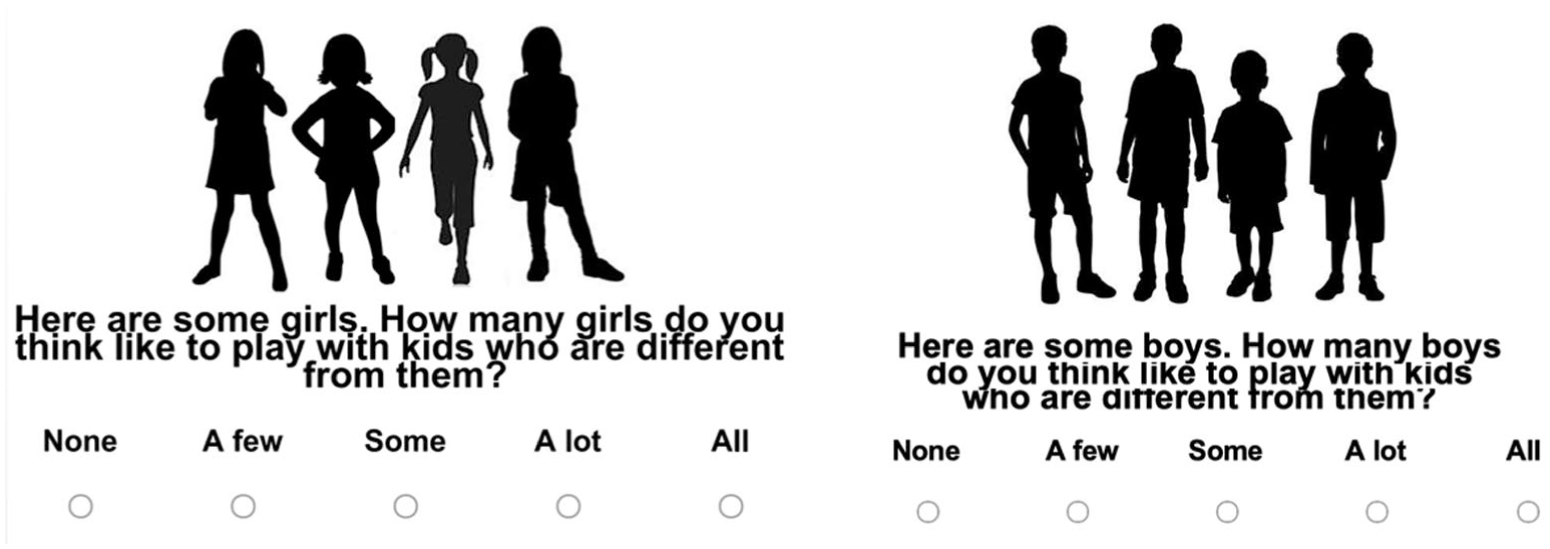
Inclusive norm expectations items.
Reported cross-gender play
Participants’ reported cross-gender play was assessed by items modified from Bierman and McCauley (1987) that asked how often they played with peers from different gender groups (Figure 2). Participants reported their cross-gender play on a 5-point Likert-type scale (1 = Never, 5 = All of the time).

Reported cross-gender play items.
Desired cross-gender play
Participants’ desired cross-gender play was measured by items modified from Bierman and McCauley (1987) that asked how much they desired to play with peers from different gender groups (Figure 3). Participants responded on a 6-point Likert-type scale (1 = Really don’t want to, 6 = Really want to).

Desired cross-gender play items.
Trait attributions
Participants’ trait attribution beliefs were assessed by items modified from Liben and Bigler (2002) that asked participants to indicate how 1) hardworking or lazy and 2) how smart or not smart they thought a depicted group of peers were (Figure 4). Participants responded on a 6-point Likert-type scale (1 = Really [negative trait], 6 = Really [positive trait]). The two individual items were averaged across the depicted gender group memberships to create composites, resulting in two trait attribution outcome variables: trait attributions about girls and trait attributions about boys.

Trait attribution items.
Participant age
Participant’s age was collected by parent report and was treated as a continuous variable.
Data Analytic Plan
Analyses were conducted using R statistical software (Version 4.3.2, R Core Team, 2023). For models which examined “outgroup” variables, outgroup variables were created in R from items that referenced the relevant outgroup. For example, the outgroup INE variable was comprised of boy participants’ INE for girls and girl participants’ INE for boys, and the outgroup reported play variable was comprised of boy participants’ reported play with girls and girl participants’ reported play with boys.
To test the hypotheses regarding differences in participants’ INE about girls and boys (H1a, H1b), we conducted a repeated measures ANCOVA predicting INE by participant gender, age, and target gender with repeated measures on the last factor. We also tested a three-way interaction between participant gender, participant age, and target gender, as well as the following two-way interactions: 1) participant gender and target gender, 2) participant gender and age, 3) age and target gender.
To test hypotheses regarding the associations between outgroup INE and reported play (H2), desired play (H3), and trait attributions (H4), we ran a series of linear regression analyses with outgroup INE, age, and participant gender as predictors of (1) outgroup reported play, (2) outgroup desired play, and (3) outgroup trait attribution.
To test hypotheses regarding participant gender as a moderator of outgroup INE on trait attributions (H4), we conducted a linear regression predicting outgroup trait attributions by gender, outgroup INE, and age, and tested for interactions.
To test hypotheses regarding the impact of age on the relations between outgroup INE and each outcome measure (H1b, H2b, H3b, and H4b), we ran a series of regression models to determine the significance of an interaction between participant age and outgroup INE, while controlling for participant gender.
For each model, we tested the most complex model first, including all potential interactions between INE, gender, and age. If interactions were not significant, we removed the interaction from the model and tested the simpler model. Final models were those with the lowest AIC.
We used follow-up pairwise comparisons to explain significant interactions that had two categorical variables and follow-up linear regression to explain significant interactions that had a categorical variable and a continuous variable. For interactions where participant gender was a significant variable, we conducted follow-up single gender analyses. For the repeated measures ANCOVA and regression models, Holm-Bonferroni corrections were used to correct for multiple comparisons (Eichstaedt et al., 2013; Holm, 1979). All the reported associations in the results section remained significant with the corrected
Results
The following sections report the results of the models described in the Data Analytic Plan. As the current study utilized a survey design, directionality cannot be established for any of the reported associations in this section. For descriptive statistics for key study variables broken down by participant gender and target gender, see Table 1. Table 2 displays descriptive statistics and correlations for key study variables. There is a moderate, positive significant correlation between children’s reported and desired cross-gender play and there are strong, positive significant correlations between both children’s reported and desired play with boys and children’s reported and desired play with girls (See Table 2).
Descriptive Statistics by Participant Gender.

Note. “Overall” refers to children’s responses for both the girl target item and boy target item, averaged. Inclusive norm expectations: 1 = low INE, 5 = high INE. Reported play: 1 = low reported play, 5 = high reported play. Desired play: 1 = low desired play, 6 = high desired play. Trait attributions: 1 = most negative trait attribution about peers, 6 = most positive trait attribution about peers.
Correlations and Descriptive Statistics for Key Study Variables.
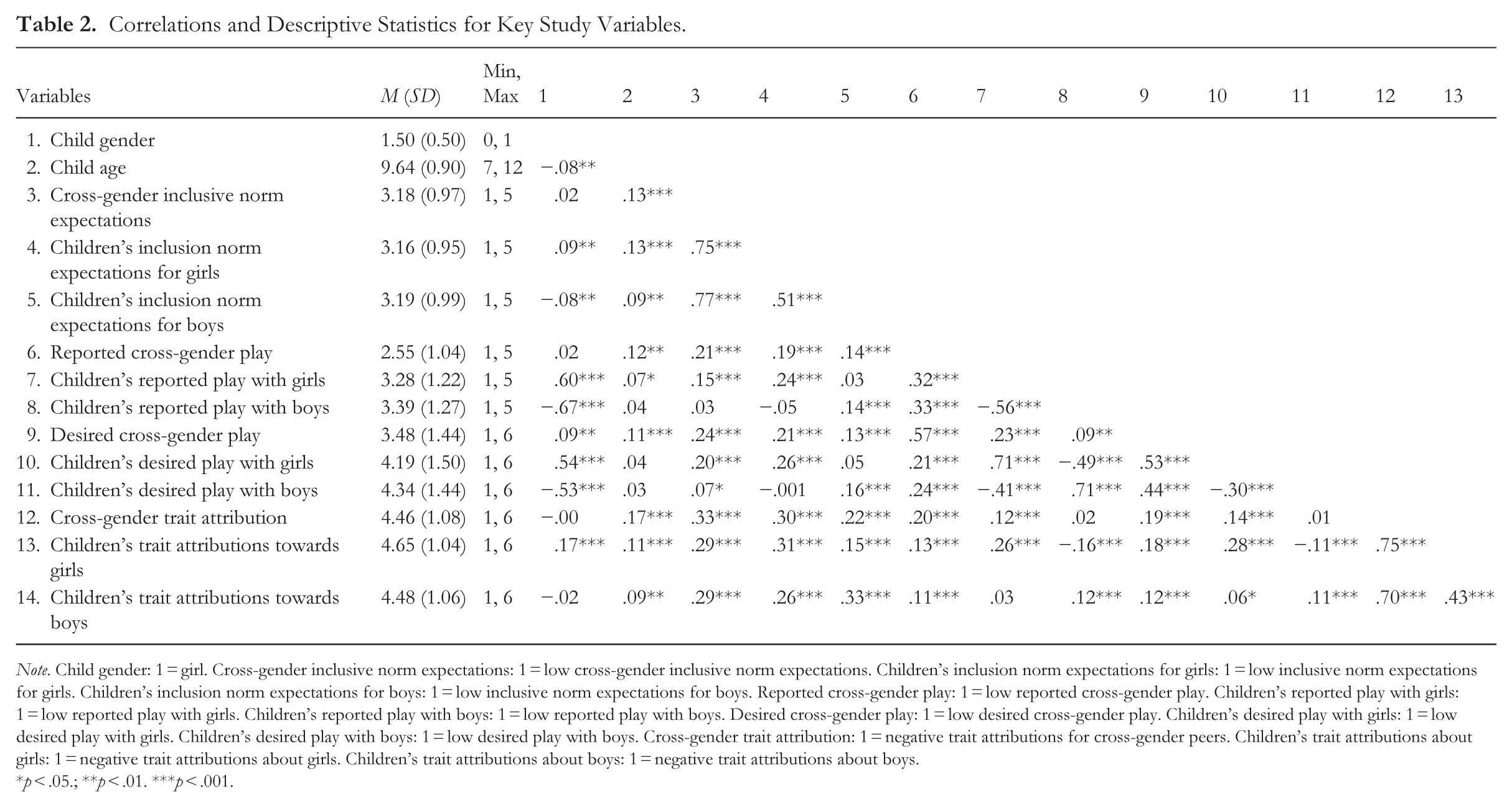
Note. Child gender: 1 = girl. Cross-gender inclusive norm expectations: 1 = low cross-gender inclusive norm expectations. Children’s inclusion norm expectations for girls: 1 = low inclusive norm expectations for girls. Children’s inclusion norm expectations for boys: 1 = low inclusive norm expectations for boys. Reported cross-gender play: 1 = low reported cross-gender play. Children’s reported play with girls: 1 = low reported play with girls. Children’s reported play with boys: 1 = low reported play with boys. Desired cross-gender play: 1 = low desired cross-gender play. Children’s desired play with girls: 1 = low desired play with girls. Children’s desired play with boys: 1 = low desired play with boys. Cross-gender trait attribution: 1 = negative trait attributions for cross-gender peers. Children’s trait attributions about girls: 1 = negative trait attributions about girls. Children’s trait attributions about boys: 1 = negative trait attributions about boys.
p < .05.; **p < .01. ***p < .001.
Inclusive Norm Expectations
Counter to our hypothesis (H1a), a significant interaction between target gender and participant gender was found for INE, F(4, 960) = 32.92, p < .001,
We found a main effect of participant age on INE, F(1, 960) = 13.92, p < .001,
Reported Cross-Gender Play
In our analysis of the effect of INE and participant gender on participants’ reported play with cross-gender peers, we found a significant INE by gender interaction (p = .021; Table 3), which we followed up with linear regressions to examine the effects of INE for each participant gender group. This analysis revealed a main effect of INE on girl participants’ reported play with boys (B = 0.15, p = .002, 95% CI [0.05, 0.24]) and boy participants’ reported play with girls (B = 0.28, p < .001, 95% CI [0.18, 0.37]). These findings demonstrate that participants with higher INE for cross-gender peers reported more play with cross-gender peers, supporting our hypothesis (H2a). The interaction is such that while there is a positive association between INE and reported play with cross-gender peers for both boys and girls, we found the effect of INE on reported play was stronger for boys (B = 0.28) than for girls (B = 0.15). As shown in Figure 5, this is reflected in that girls who reported the lowest levels of INE about boys are estimated to report play with boys slightly more than “a little of the time,” while boys who reported the lowest levels of INE about girls are estimated to report play with girls slightly less than “a little of the time.” However, among participants with the highest INE about their gender outgroup, boys are estimated to play with girls slightly more than “sometimes,” while girls are estimated to play with boys slightly less than “sometimes.” A significant main effect of participant age was also found such that participants reported more play with cross-gender peers with age (B = 0.12, p = .002, 95% CI [0.04, 0.19]).
Main Effects and Interaction Effects for Reported Play With Cross-Gender Peers.
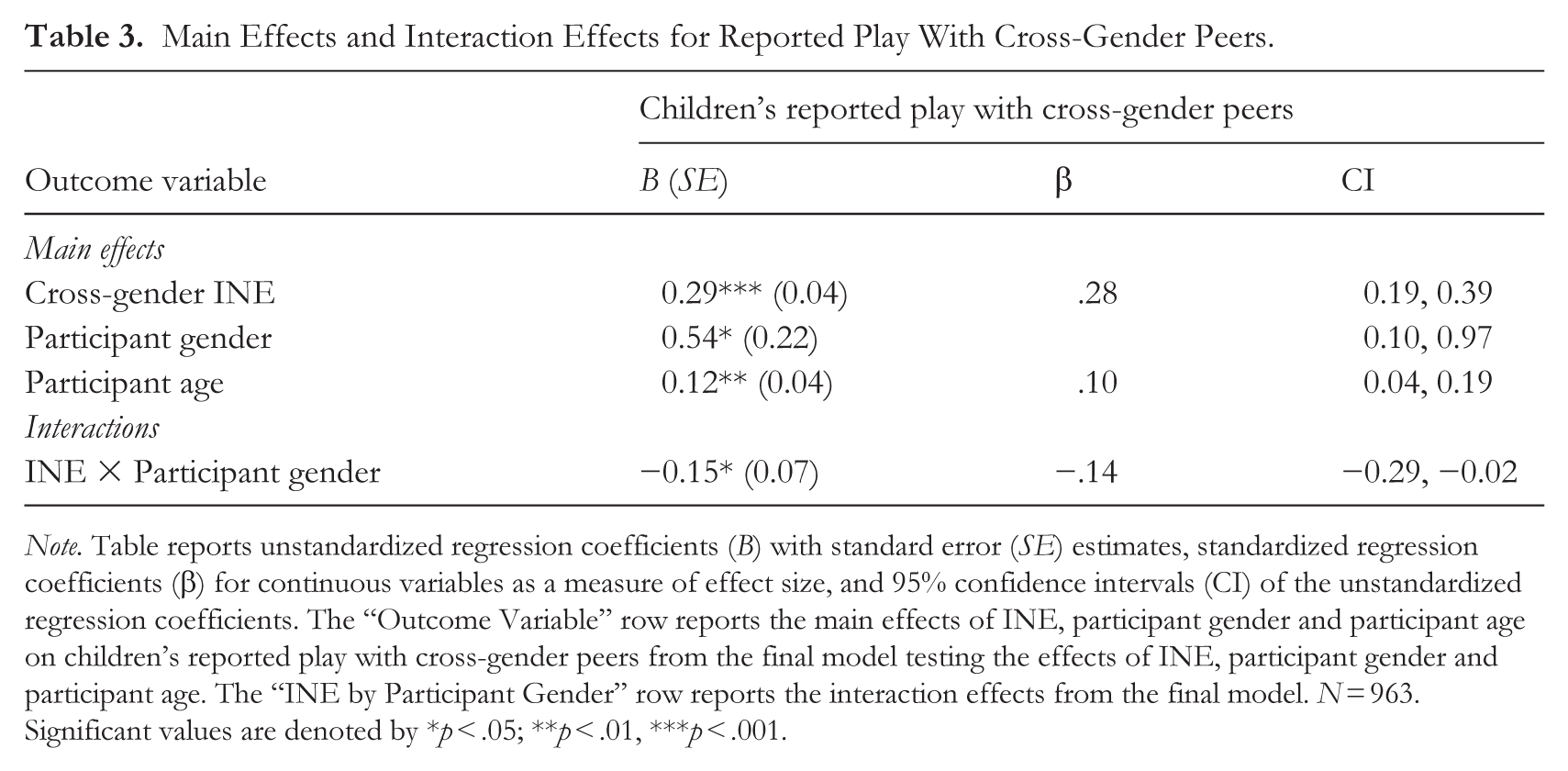
Note. Table reports unstandardized regression coefficients (B) with standard error (SE) estimates, standardized regression coefficients (β) for continuous variables as a measure of effect size, and 95% confidence intervals (CI) of the unstandardized regression coefficients. The “Outcome Variable” row reports the main effects of INE, participant gender and participant age on children’s reported play with cross-gender peers from the final model testing the effects of INE, participant gender and participant age. The “INE by Participant Gender” row reports the interaction effects from the final model. N = 963.
Significant values are denoted by *p < .05; **p < .01, ***p < .001.

Children’s reported play with cross-gender peers by perceived inclusive outgroup norm expectation, moderated by participant gender.
We did not find a significant interaction effect for participant age on the effect of INE on children’s reported play with cross-gender peers. Therefore, our hypothesis (H2b) was not supported.
Desired Cross-Gender Play
There was a significant interaction between INE and participant gender on participants’ desired cross-gender play (p = .015; Table 4), which we followed up with linear regressions to examine the effects of INE for each participant gender group. This analysis revealed a main effect of INE on girl participants’ desired play with boys (B = 0.23, p < .001, 95% CI [0.11, 0.36]) and boy participants’ desired play with girls (B = 0.44, p < .001, 95% CI [0.31, 0.58]) such that boy and girl participants with higher INE for cross-gender peers desired more play with cross-gender peers, supporting our hypothesis (H3a). While there is a positive association between INE and desired play with cross-gender peers for both boys and girls, the effect of INE on desired play appears to be stronger for boys than for girls (Figure 6). As shown in Figure 6, this is reflected in that girls who reported the lowest levels of INE about boys are estimated to “sort of don’t want to” play with boys, while boys who reported the lowest levels of INE about girls are estimated to “don’t want to” play with girls (e.g., boys with low INE are estimated to have lower desire for cross-gender play than girls with low INE). However, among participants with the highest INE about their gender outgroup, boys are estimated to want to play with girls slightly more than “sort of want to,” while girls are estimated to want to play with boys slightly less than “sort of want to” (e.g., boys with high INE are estimated to have higher desire for cross-gender play than girls with high INE). A significant main effect of participant age was also found such that participants desired more play with cross-gender peers with age (B = 0.14, p = .007, 95% CI [0.04, 0.24]).
Main Effects and Interaction Effects for Desired Play With Cross-Gender Peers.

Note. Table reports unstandardized regression coefficients (B) with standard error (SE) estimates, standardized regression coefficients (β) for continuous variables as a measure of effect size, and 95% confidence intervals (CI) of the unstandardized regression coefficients. The “Outcome Variable” row reports the main effects of INE, participant gender and participant age on children’s desired play with cross-gender peers from the final model testing the effects of INE, participant gender and participant age. The “INE by Participant Gender” row reports the interaction effects from the final model. N = 961.
Significant values are denoted by *p < .05; **p < .01, ***p < .001.
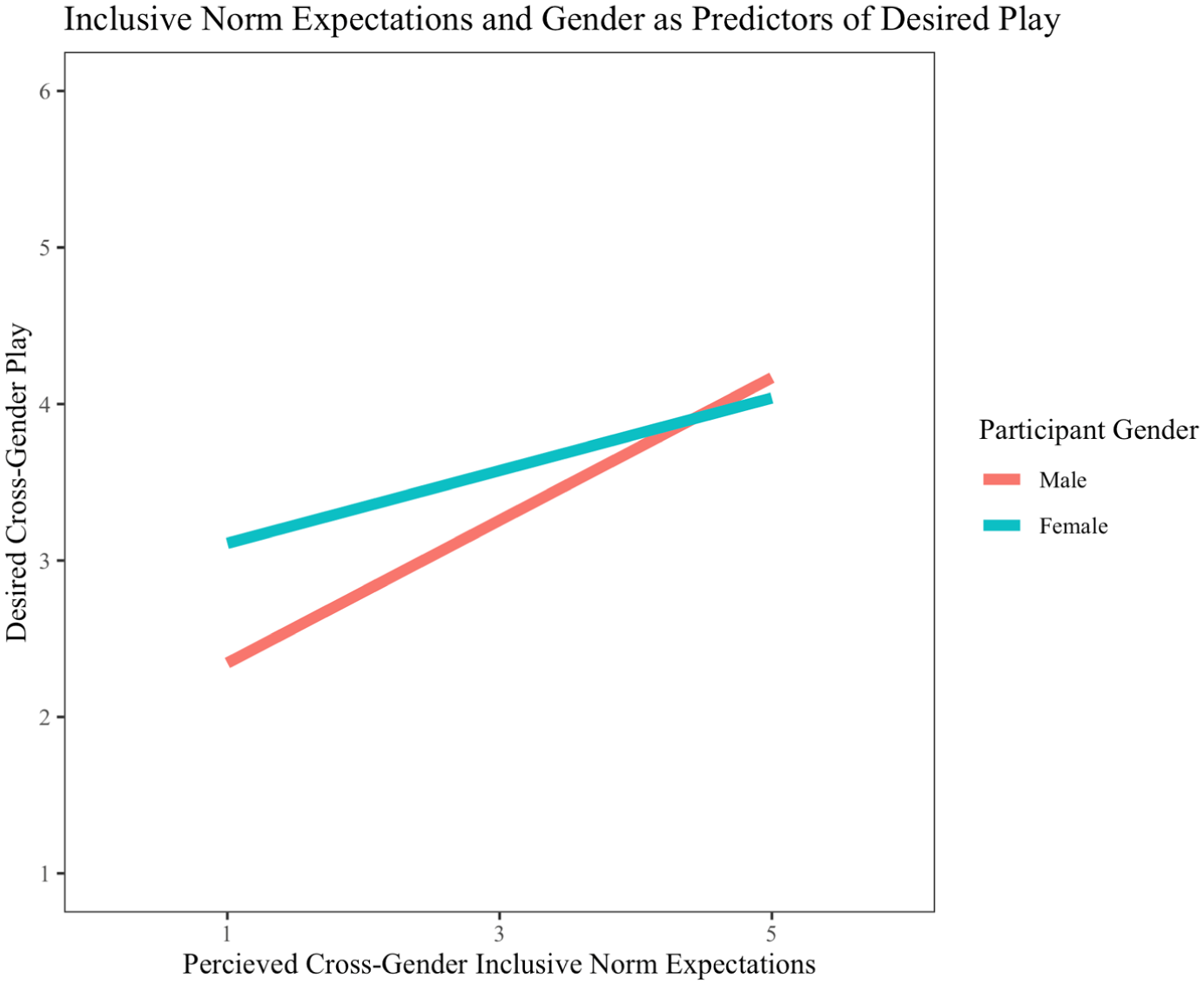
Children’s desired play with cross-gender peers by perceived inclusive outgroup norm expectations moderated by participant gender.
We did not find a significant interaction effect for participant age on the effect of INE on children’s desired play with cross-gender peers (B = −0.06, p = .435, 95% CI [−0.15, 0.04]). Therefore, our hypothesis was not supported (H3b). With age, participants who had higher INE for their gender outgroup did not report more desire to play with cross-gender peers.
Trait Attributions
We did not find a significant interaction effect for participant gender on the effect of INE on children’s trait attributions for cross-gender peers (B = 0.03, p = .620, 95% CI [−0.10, 0.16]). Rather, there was a main effect of INE on participants’ trait attributions for cross-gender peers, such that participants who had higher INE for cross-gender peers had higher positive trait attributions for cross-gender peers (B = 0.35, p < .001, 95% CI [0.28, 0.41]; Table 5). Counter to our hypothesis (H4a), both boys and girls with higher INE for cross-gender peers had higher positive trait attributions for their cross-gender peers. A significant main effect of participant age was also found such that participants had higher positive cross-gender trait attributions with age (B = 0.15, p > .001, 95% CI [0.08, 0.23]).
Main Effects and Interaction Effects for Trait Attributions With Cross-Gender Peers.

Note. Table reports unstandardized regression coefficients (B) with standard error (SE) estimates, standardized regression coefficients (β) for continuous variables as a measure of effect size, and 95% confidence intervals (CI) of the unstandardized regression coefficients. The “Outcome Variable” row reports the main effects of INE, participant gender and participant age on children’s trait attributions for cross-gender peers from the final model testing the effects of INE, participant gender and participant age. N = 964.
Significant values are denoted by ***p < .001.
We did not find a significant interaction effect for participant age on the effect of INE on children’s trait attributions for cross-gender peers (B = −0.03, p = .336, 95% CI [−0.11, 0.03]). Therefore, our hypothesis was not supported (H4b). With age, boy participants who believed girls had an inclusive peer norm did not report increasingly positive trait attributions than boys who didn’t believe girls were inclusive.
Discussion
The current study revealed several novel findings. First, children held higher inclusive norms expectations (INE) for their gender ingroup than for their gender outgroup, and INE increased with age for both boys and girls. Secondly, outgroup INE were associated with all children’s reported and desired play with gender outgroup members, such that children with higher outgroup INE reported more play and desired more play with gender outgroup members. We also found that with age, children reported higher levels of desired and reported play with cross-gender peers. Additionally, children with high outgroup INE more strongly attributed positive traits to their gender outgroup members. Lastly, with age, both boys and girls attributed positive traits more strongly to their gender outgroup members. The current study highlights outgroup INE as a factor associated with positive cross-gender inclusion and low childhood gender stereotypes, as well as cross-gender friendships.
Children Think Their Gender Ingroup Is More Inclusive Than Their Gender Outgroup
Children held a significantly higher INE for their gender ingroup peers than for their gender outgroup peers, with girls having higher INE for girls than for boys, and boys having higher INE for boys than for girls. Despite these differences, both girls and boys expected that “some” of their gender outgroup peers would play with individuals who were different from them. This finding may have been driven by children displaying gender ingroup bias by thinking their own gender group was more inclusive than members of their gender outgroup. While prior research has shown that children believe girls care more about prosocial and communal values than do boys (Block et al., 2025), none of the prior research specifically focused on children’s gendered expectations about individuals including people who are different from them. It’s possible that asking about children’s outgroup INE, when the inclusion norm explicitly involves including outgroup members, increases the salience of children’s own gender ingroup membership, leading children to assume their gender ingroup will be more inclusive towards peers who are different than their gender outgroup. Alternatively, the fact that the items asked about boys’ and girls’ general outgroup INE (i.e., “How many X do you think like to play with kids who are different from them?”) as opposed to specifically asking about their gender outgroup INE (i.e., “How many X do you think like to play with kids who are a different gender from them?”) may have made it such that gender or gender stereotypes about prosociality were not salient enough to participants to impact their responses. Additional research is required to provide evidence for either of these interpretations. Future research can also investigate INE for other forms of group identity such as ethnicity, race, nationality, and other salient group memberships to determine whether ingroup bias regarding INE found in the current study for gender is also present for group identities.
Additionally, this finding builds on prior research documenting ingroup bias in children aged 5–12 years, where Anglo-Australian children more positively rated ethnic ingroup members on several traits (e.g., friendly) than ethnic outgroup members (Griffiths & Nesdale, 2006), and prior research detailing gender ingroup bias in American children from diverse racial and ethnic backgrounds (Halim et al., 2017). This also expands on previous research with children and adolescents aged 12 to 16, where Non-Arab American children and adolescents predicted their ethnic ingroup would include someone based on shared interests, not on group membership, while predicting that their ethnic outgroup would include someone based on group membership, not based on shared interests (Hitti & Killen, 2015). In both Hitti and Killen (2015) and the present finding, American children believe that their ingroup members are more inclusive than outgroup members would be. This assumption could contribute to ingroup inclusion preference and self-segregation in childhood and adolescence within the United States. This finding provides initial evidence that American children aged 7 to 12 display gender ingroup bias regarding their INE for same- and cross-gender peers.
With age, children reported higher INE for members of their gender ingroup and members of their gender outgroup. There is evidence that, with age, children are less interested in enforcing gender stereotypes (Ruble et al., 2006). Additionally, as individuals enter late childhood and early adolescence, the amount of cross-gender friendships they have increases (Feiring, 1999; Poulin & Pedersen, 2007). The combination of increased cross-gender contact and reduced desire to enforce gender stereotypes may have resulted in children holding higher INE for both their gender ingroup and gender outgroup with age. This finding suggests that as American children get older, they may increasingly think that gender ingroup members and gender outgroup members are more inclusive towards people who are different from them. Future research could capture the reasoning that motivates children’s INE to explore possible changes in reasoning with age that may have driven this finding.
Inclusive Norm Expectations Are Related to Reported Cross-Gender Play
We found that children with higher INE for cross-gender peers reported more play with cross-gender peers and that the relation between INE and reported cross-gender play was stronger for boys than for girls. This finding has possible implications for promoting intergroup contact based on gender in childhood, as conversations about common interests and values among children may help to increase INE for outgroup members which has the potential to increase intergroup contact (Turner & Cameron, 2016). Children who play with cross-gender peers have evidence from their play experiences that members of the gender outgroup also interact with peers who are different from them, namely children like themselves. Conversely, children who think that gender outgroup members play with children outside their group may remember more instances where they personally played with members of their gender outgroup, as these instances conformed to their expectations. Children with high INE for cross-gender peers may have reduced expectations of being rejected by their gender outgroup, corresponding to them seeking out cross-gender play more often. Alternatively, these children may view an inclusive outgroup as more appealing to play with. Additional research is required to assess the validity of these interpretations.
Previous research has shown that outgroup norms of friendships and fair treatment reduce intergroup bias based on nationality, culture, and ethnicity (Cameron et al., 2011; Feddes et al., 2009; McGuire et al., 2017). The findings here offer preliminary evidence to extend this pattern of results to the context of gender. We highlight how perceived outgroup norms regarding inclusive behavior are related to positive intergroup contact in the form of reported cross-gender play. It also aligns with prior research showing that children develop more positive and less negative attitudes towards their gender outgroup as they establish and begin cross-gender friendships (Halim et al., 2021). As repeated instances of play with cross-gender peers lead to the establishment and maintenance of cross-gender friendships, it is consistent with this prior research that higher reported cross-gender play was correlated with higher INE, as INE are likely to reflect other positive attitudes towards gender outgroup members. Future research could explore the quality of play with cross-gender peers, to see if high INE has a relation to high quality cross-gender play, as high quality play (i.e., play of a pleasant, intimate, cooperative, and voluntary nature) is more likely to lead to the creation of cross-group friendships (Turner & Cameron, 2016; Turner et al., 2007).
Regarding the finding that the relation between INE and reported cross-gender play appears stronger for boys than for girls, prior research has found that by seven years of age, American children believe that boys have higher social status than girls (Mandalaywala et al., 2020). Specifically, prior research has found that American children from diverse racial and ethnic backgrounds believe that boys have more access to resources and more decision-making power in social play scenarios (i.e., choosing what others get to play with in a play scenario) than girls. As the perceived lower status group, girls in the current study may have felt they have less autonomy in their cross-gender play experiences than boys (e.g., girls feel they are less often the ones making the social inclusion decisions) and may have initiated cross-gender play with boys due to their expectation that playing with boys could give them greater access to resources, such as toys. Even if these children’s perceptions of gender social status are not accurate, these perceptions still impact children’s beliefs, attitudes, and behaviors. These factors related to perceived social status may have resulted in the relationship between INE and reported cross-gender play being weaker for girls than for boys. Future research is needed to explore this possible interpretation. These two findings in conjunction show that while INE is related to reported cross-gender play for both girls and boys, INE may be especially beneficial for children who perceive themselves as being from a high status group, such as boys. It also adds to the understanding of high outgroup INE as a factor associated with high cross-gender play and friendship. It would also be prudent to assess children’s cross-gender play using other methodologies, such as observational approaches and teacher or parent reports, in order to determine whether the association between INE and cross-gender play extends beyond self-reported measures and to clarify its possible relation to children’s actual cross-gender play.
The relation between outgroup INE and reported cross-gender play did not change as a function of participants’ age. Rather, with age, children reported more play with cross-gender peers, for both girls and boys, regardless of their INE. This finding conflicts with some prior research motivated by the SRD model which shows that with age, group functioning concerns, including group norms, become increasingly important in individual’s decision-making in intergroup contexts (Rutland & Killen, 2015). However, outgroup INE may be salient enough to children by seven years of age in relation to reported cross-gender play that outgroup INE do not increase in importance between 7 to 12 years of age. This finding suggests that, on average, the relation between outgroup INE and self-reported cross-gender play may not significantly change between 7 and 12 years of age. Future studies can investigate the relation between INE and reported cross-gender play with children younger than the current sample (e.g., aged 4 to 7) to explore whether or not this relation is associated with age in early childhood.
Inclusive Norm Expectations Relate to Desired Cross-Gender Play
Children with higher INE for gender outgroup members reported a higher desire to play with members of their gender outgroup, and there appeared to be a stronger relation between INE and desired cross-gender play for boys than for girls. If children think that gender outgroup members play with outgroup peers similar to them, then children may assume that gender outgroup members would make good playmates and subsequently desire to play with gender outgroup members. Alternatively, if children want to play with gender outgroup members, they likely believe that this would be a pleasant play experience, that gender outgroup members would treat them well and be inclusive towards them during the interaction. Thus, these children would likely have higher INE towards gender outgroup members. Previous research has found that American children aged 9 to 14 years who perceived their ingroup as having an inclusive norm (ingroup INE) showed greater interest in cross-race and cross-ethnic friendships (Tropp et al., 2014). Our results build on this prior research by showing that outgroup INE are also related to children’s interest in positive cross-group contact.
This finding also highlights how INE are related to children’s interest in positive cross-gender contact, in addition to positive cross-race and cross-ethnic contact. Despite possible contextual obstacles that may stop children from actually engaging in cross-gender contact (Bigler, 1995; Markovits et al., 2001; Ruble et al., 2006), INE were related to both reported and desired cross-gender play, such that children with higher INE reported more and desired more play with cross-gender peers. Future research can investigate if this relation between reported and desired cross-group play with INE is found across social groups or varies based on the specific social group (e.g., wealth, race, ability, status). Additional research can also explore potential mechanisms for the relations between reported and desired cross-group play with INE, such as children wanting to avoid social exclusion and rejection.
In regard to the finding that the association between INE and desired cross-gender contact was stronger for boys than for girls, girls’ desired cross-gender contact may have also been influenced by perceived status-related factors, such as inclusion decisions motivated by boys’ perceived access to resources, thus, INE may have had a lower association with desired cross-gender contact for girls than boys. Additionally, girls’ desired cross-gender contact may also have been influenced by children’s belief that girls care more about prosocial values (such as being inclusive towards others) than do boys (Block et al., 2025). The girls in the current study may have believed they should value prosocial values more than boys and consequently reported a higher baseline desire for cross-gender contact than boys, also reducing the association between INE and desired cross-gender contact for girls. As recent research has shown that for American children aged 6 to 12 years of age, expectations of intergroup inclusion vary based on the intimacy of social context (Luken Raz et al., 2024), future research can investigate if the intimacy level of the inclusion context influences the relation between INE and children’s desired cross-gender play.
We found the association between INE and desired cross-gender contact did not change with age. Instead, with age, children report having a greater desire for cross-gender play, regardless of their INE. This finding demonstrates that for the current sample, the associations between INE and both reported and desired cross-gender contact do not change as a function of age. Future research can explore if the possible associations between ingroup INE and reported and desired cross-gender play vary as a function of participant age, to investigate if the possible age associations of INE differ between ingroup and outgroup INE.
Inclusive Norm Expectations Predicted Cross-Gender Trait Attributions
Inclusive norm expectations (INE) were not only associated with boys’ trait attributions for girls, but were associated with trait attributions for all participants, regardless of gender. Children with higher INE had more positive trait attributions towards their gender outgroup peers. As prior research has shown that positive outgroup norms are related to reductions in intergroup bias (Cameron et al., 2011; Feddes et al., 2009; McGuire et al., 2017), and that positive trait attributions towards ingroup members and negative trait attributions toward an outgroup can be a form of intergroup bias (Hewstone et al., 2002), in the current study, higher INE may have been related to reduced intergroup bias in the form of more positive trait attributions for gender outgroup members. This finding adds complexity to research documenting that prior to seven years of age, American boys are more accepting of gender-based intergroup exclusion than girls (Theimer et al., 2001) and American children are aware of gender-based stereotypes regarding intelligence and work (e.g., Bian et al., 2017, 2018; Care et al., 2007). In the present study, children did not seem to weigh either perceived gender group status or these gender-based stereotypes in their trait attributions. Rather, these gender-based stereotypes regarding intelligence and work, as well as participant perceived gender group status, may not be particularly salient when directly asking children if they think that gender outgroup members are “smart” or “hardworking”, such as in the current study. These stereotypes and perceived gender group status may be more salient when children view vignettes that take place in settings where these stereotypes are more likely to be triggered (e.g., a general classroom or a math classroom) or where perceived group status is more pronounced (e.g., a scenario where boys have more resources or opportunities than girls).
For a trait attribution that is a composite of hardworking and smart, INE are linked to more positive trait attributions for gender outgroup members, suggesting that INE are related to at least some gender outgroup attitudes for characteristics other than general prosocial characteristics. This finding also indicates that INE are related to some more positive outgroup attitudes for children from both perceived high- and low-status gender groups in the United States. Future research can assess whether outgroup INE has a relation to children’s resource allocations between ingroup and outgroup members, and whether it is associated with other forms of ingroup bias. Studies can also explore other trait attributions to see if high INE is associated with a halo effect for gender outgroup members and to explore associations beyond just the traits of “hardworking” and “smart” that were explored in the current study.
Instead of the association between INE and children’s trait attributions becoming stronger with age, as predicted, children’s trait attributions towards gender outgroup members became more positive with age. By the age of seven, children may believe that gender outgroup peers who are inclusive towards individuals who are different from them are socially competent and may believe that this competence expands to other domains such as intelligence and work effort. Further research is needed to support this interpretation. The current study provides initial evidence that the relation between INE and a composite trait attribution for the traits “hardworking” and “smart” does not vary with age for American children aged 7 to 12. Future research can investigate whether age influences the relation between INE and trait attributions for other traits, such as friendly or trustworthy, to explore if possible age associations with INE are based on the specific trait that is being endorsed for outgroup members.
Limitations and Future Directions
The present study provides several novel findings regarding the relationship between children’s outgroup INE and their attitudes and behaviors toward gender outgroups. However, one limitation is that the present study only includes a binary representation of gender, both in the study stimuli and the gender options for participants. Future research could look at how trans and/or gender-diverse children perceive these factors and also measure girls’ and boys’ INE about trans and/or gender-diverse children to explore the relation between these expectations and the outcome variables examined in the current study. This direction for future research also echoes calls in the literature to incorporate gender-diverse children into all areas of developmental psychology, both as participants and as target groups (e.g., how do cisgender children think about the intergroup exclusion of gender-diverse children?) (deMayo et al., 2022).
The current study utilized a survey design, meaning that for all the relations discussed in this paper, directionality cannot be established. Future research should utilize different experimental designs and data analytic approaches to gain further clarity regarding the directionality (or bidirectionality) of the significant relations found in the present study. Additionally, future studies can examine the potential bidirectional or cyclical nature of inclusive norm expectations and cross-gender play. Research has yet to explore whether children who have high inclusive norm expectations with limited prior cross-gender play experiences would also desire more cross-gender play, or whether past experiences of cross-gender play are essential for setting the stage for outgroup INE motivating future cross-group play. Future research should also utilize different experimental designs and data analytic approaches, such as multiple timepoints, to evaluate more complex variable models, in order to better understand the complex interplay between INE, trait attributions and desired and reported play. For example, in the future, studies can use statistical models that allow desired and reported play to have a bidirectional relationship while exploring their connections to other variables.
Future research can also explore outgroup INE and its association with attitudes and behaviors toward the gender outgroup from late childhood through early adolescence (i.e., ages 10–15). In adolescence, concerns about group functioning and group norms become increasingly important and individuals become increasingly aware that intergroup exclusion occurs in social contexts (Gönültaş et al., 2024; Hitti & Killen, 2015; Rutland et al., 2010). Thus, in adolescence, outgroup INE could become stable or even decline with age, and the association between INE and reported contact may differ as individuals place more weight on the acceptance of their peer group. Future research can also explore the relations between outgroup INE and cross-group play and trait attributions with other social groups (e.g., racial or ethnic groups or minimal groups). Such future research would help determine if the associations of INE reported in the current study are unique to gender groups (possibly due to the high salience of gender in childhood), or extend to other social groups.
Conclusion
This study investigated the relation between children’s outgroup inclusive norm expectations and their reported and desired play, as well as trait attributions for “smart” and “hardworking” for gender outgroup members, for American children aged 7 to 12 years from a wide variety of racial and ethnic groups. This study added to the current understanding of how inclusive norm expectations are related to cross-gender play for both girls and boys, suggesting that the relation may be stronger for boys than for girls. Our findings also revealed that gendered effort and intelligence stereotypes as well as gender group status did not play a significant role in children’s trait attributions for gender outgroup peers, and that higher inclusive norm expectations were associated with more positive trait attributions. With age, children reported and desired more cross-gender play, reported higher inclusive norm expectations, and more positive trait attributions. Cumulatively, these findings reveal novel ways in which outgroup inclusive norm expectations may benefit both girls and boys and are significantly associated with cross-gender inclusion and friendships in childhood.
Footnotes
Acknowledgements
We thank the many University of Maryland graduate students and undergraduate research assistants who helped with this project. We are very grateful to the parents and children who participated in this study.

Ethnical Considerations
The Institutional Review Board at the University of Maryland, College Park approved our surveys (project #1093717-11) on September 7, 2018.
Consent to Participate
Written informed consent to participate in this study was provided by the participants’ legal guardians/next of kin.
Funding
The authors disclosed receipt of the following financial support for the research, authorship, and/or publication of this article: This work was supported, in part, by the National Science Foundation [BCS#1728918], and the National Institute of Child Health and Human Development [R01HD093698] awarded to the last author. The second and third authors were supported by the Clara Mayo Award from the Society for the Psychological Study of Social Issues.
Declaration of Conflicting Interests
The authors declared no potential conflicts of interest with respect to the research, authorship, and/or publication of this article.
Data Availability Statement
The datasets generated during and/or analyzed during the current study are available from the corresponding author on reasonable request.