



Abstract
The goal of the present research was to expand on previous work on the dynamics of intergroup helping. Specifically, the present research investigated the responses of Israeli-Arab high school students (Study 1) and Israeli-Arab adults (Study 2) to a scenario in which an Israeli-Arab person receives assistance from an Israeli-Jewish individual. In Study 2, these responses were also compared to assistance from an ingroup member (i.e., an Israeli-Arab individual). In two studies, Israeli-Arab participants learned about a situation in which an Israeli-Arab person receives assistance from an Israeli-Jewish individual. The context of help, with the assistance given either assumptively or in response to a request, and the type of help, either dependency-oriented or autonomy-oriented, were independently varied. In Study 2, conditions in which the helper was an Israeli-Arab individual were also included. Across both studies, context and type of help influenced responses to the outgroup helper (interactively in Study 1 and additively in Study 2) with assumptive, dependency-oriented assistance eliciting the most negative evaluations of the helper. These effects did not occur when, in Study 2, the helper was an ingroup member. For adults (Study 2), perceptions that outgroup assistance weakened the recipient’s sense of control mediated more negative evaluations of the outgroup helper. For both adults and high school students, evaluations of the Israeli-Jewish helper mediated evaluations of Israeli-Jewish people in general. Limitations and implications of the research are considered.
Helping others has generally been considered a prosocial action that benefits the recipient. However, receiving assistance, whether it is actively sought or given without request, may be experienced either positively (e.g., as an act promoting the fulfillment of a need) or negatively (e.g., as a threat to feelings of efficacy and self-esteem) (Halabi & Nadler, 2017; Nadler & Fisher, 1986). The present research, consisting of two experiments, investigated how multiple aspects of intergroup helping—in this case, involving assistance given by an Israeli-Jewish individual to an Israeli-Arab person—influences the responses of Israeli-Arab participants in terms of evaluations of the Israeli-Jewish helper and Israeli-Jewish people generally. We build on previous research that has examined selective aspects of the assistance offered: (a) whether the assistance is requested or not (Study 1, with a sample of Israeli-Arab high school students; Study 2 with a sample of Israeli-Arab adults), (b) the type of help offered (Studies 1 and 2), and (c) whether the assistance comes from an outgroup or an ingroup member (Study 2). Theoretically, the current research builds upon and extends previous empirical findings testing the intergroup helping as status relations (IHSR) model (Nadler & Halabi, 2006) by examining the joint effects of multiple relevant factors simultaneously. We also explored a theoretically relevant mediator of the effect on evaluations of the helper—sense of control.
Intergroup Context
The present research, which investigates Israeli-Arab participants’ responses to help given by an Israeli-Jewish person to an Israeli-Arab individual, also potentially offers new insights into the complex dynamics of Arab-Jewish relations and of intergroup relations generally, even in the context of seemingly prosocial exchanges. Relations between Arabs and Jews are complex and strongly characterized by suspicion and mistrust, rooted in unresolved conflict (Smooha, 2016). This conflict has produced deeply-entrenched negative perceptions of the outgroup and is prone to periodic escalation, with consequent impact on the relations between Arabs and Jews living in Israel. As the events in Gaza in 2023 reveal, this intergroup tension between Arabs and Israeli Jews can erupt into violent and brutal conflict, inducing more suspicion and distrust between Arabs and Jews inside Israel. Even in the absence of such overt conflict (as when the current research was conducted), Arabs in Israel usually have limited confidence in the intentions and actions of the Jewish majority (Smooha, 2016, 2019), which can potentially negatively affect intergroup responses even to actions sincerely motivated by goodwill, as intergroup helping can be.
Theoretical Context
The IHSR model (Nadler & Halabi, 2006, 2015), on which the current research is based, integrates basic principles of social identity theory (Tajfel & Turner, 1979) to explain the dynamics of intergroup helping and its impact on intergroup relations. When one’s social (vs. personal) identity is salient, people tend to be suspicious of the motives of the outgroup (Wildschut & Insko, 2007) and may view an ostensibly prosocial act (such as helping or an apology) as a “manipulative ploy” (Nadler & Liviatan, 2006, p. 461; see also Reinders Folmer et al., 2021) and thus as a collective threat to one’s group and identity. Because of this perceived threat, according to the IHSR model, assistance initiated by a member of another group can become imbued with a negative meaning, eliciting negative responses to an outgroup helper and the outgroup as a whole (Halabi & Nadler, 2017; Nadler & Halabi, 2006).
One element of the threat associated with receiving assistance is that, at least under some conditions, it can undermine the sense of control and autonomy, thereby fostering dependency. For example, in work focusing on helping at the interpersonal level (i.e., between individuals), Nadler and Fisher (1986) in their threat to self-esteem model showed that when receiving help is viewed as limiting one’s control over future consequences, such acts are experienced as a threat to the recipient’s self-esteem.
Relatedly, the IHSR model identifies two characteristics of help from an outgroup member that critically affect responses to help based on the threats to social identity they pose. Based on the hypothesized role of efficacy in responses to assistance, the IHSR model (Nadler & Halabi, 2006) importantly distinguishes between dependency- and autonomy-oriented help. Dependency-oriented assistance is represented by providing a full solution to the problem at hand, which reflects the helper’s view that the needy cannot help themselves and reinforces the differential status of the groups. Dependency on others may elicit a feeling of indebtedness (Greenberg, 1980) that results in perceived loss of freedom and control, and an aversive psychological state of “reactance” (Brehm, 1966). Autonomy-oriented help, which can be reflected in guidance in how people can solve a problem on their own, is instrumental for the less powerful group to improve its position and become independent (Halabi & Nadler, 2010; Nadler, 1998). Because autonomy-oriented help tends to increase recipients’ sense of independence and control, it is generally viewed positively.
Moreover, because people are concerned about the autonomy of their own group (Halabi et al., 2016; Schneider et al., 1996), receiving unsolicited help can convey a message about the recipient’s and the recipient’s group’s lower standing and inferiority (and potentially lower capacity to control their outcomes) relative to the helper and the helper’s group, eliciting particularly negative responses to an outgroup helper and to the outgroup in general (Halabi et al., 2021a, 2021b; Nadler & Halabi, 2006). Because these are collective threats, other ingroup members may feel threatened as well when observing an individual ingroup member receiving assistance from an outgroup helper (Goldenberg et al., 2016), which can affect how they view the outgroup and its members generally (Wölfer et al., 2017), and particularly in a context of conflict (Mousa, 2020).
The Current Research
The goal of the present research, which consisted of studies involving Israeli-Arab high school students (Study 1) and Israeli-Arab adults (Study 2), was to test core premises of the IHSR model and extend previous research derived from the IHSR model. First, we investigated how two key characteristics of intergroup help that have been generally considered separately—type of help (dependency-oriented vs. autonomy-oriented assistance) and context of help (assumptive vs. solicited help)—may operate in combination to determine responses to assistance from an outgroup member. Second, expanding on previous work on the IHSR model, we investigated the potential mediating role of the experience of control of recipients, which provides further insights into the dynamics of intergroup helping relations. Third, we expand previous research on the IHSR model by studying the intergroup impact by focusing on the responses of observers of members of the recipient’s ingroup.
With respect to our first aim, to examine how the type of help and context of help affect responses to outgroup help within the same experimental design, Israeli-Arab participants (high school students in Study 1 and adults in Study 2) read about an Israeli-Jewish person who helped an Arab individual (living in Israel) who asked for help (solicited help condition) or did not ask for help (assumptive help condition) and received assistance in the form of autonomy- or dependency-oriented help. With respect to the type of help, drawing on the research by Nadler and Halabi (2006; see also Chernyak-Hai et al., 2017) and adopting the operationalizations used in that work, dependency-oriented help involved the Israeli-Jewish helper giving the recipient answers without providing any explanation, whereas autonomy-oriented help was reflected in the helper providing a hint about how the recipient could solve the problem on his own. In terms of the context of help, guided by the research of Halabi et al. (2011), assumptive help was assistance that was given without being requested and at the initiative of helper; solicited help occurred in response to the recipient’s request for assistance. In both Study 1 and Study 2, we examined the impact of the type of help and context of help on Arab observers’ evaluations of the Israeli-Jewish helper and Israeli-Jewish people as a whole, as well as perceptions of the Arab recipient’s sense of control. Based on previous findings (Halabi & Nadler, 2010) and our reasoning about the impact of observing intergroup helping (in the conditions in which Israeli-Arab participants learn about an Israeli-Jewish person helping an Israeli-Arab person in both Studies 1 and 2), we expected that Israeli-Arab participants would evaluate the Israeli-Jewish helper in general more negatively in the conditions in which help from an Israeli-Jewish person was (a) dependency-oriented rather than autonomy-oriented (an effect of Type of Help), and (b) assumptive compared to solicited (an effect of Context of Help).
While previous research has demonstrated that manipulations of type of help (Chernyak-Hai et al., 2017) and context of help (Schneider et al., 1996) can each determine responses to outgroup help, the simultaneous consideration of both factors in the present research allows us to explore further the potential interactive effects. For instance, research guided by the IHSR model has demonstrated that recipients respond more negatively to dependency- than autonomy-oriented help (Halabi & Nadler, 2017), particularly when they are suspicious of the motives of the benefactor (i.e., when they are low in trust; Halabi et al., 2021a, 2021b). In the current research, suspicions about the motives of an outgroup helper are likely to be substantially higher when the help is assumptive—initiated by the outgroup member—rather than solicited by the recipient. Because the initiative for assistance originated from the helper, suspicions concerning the motives of an outgroup helper are less relevant, and thus outgroup helpers are likely to be evaluated more favorably when the help is solicited rather than assumptive (Halabi et al., 2011). Moreover, it is possible that responses to the receipt of dependency-oriented compared to autonomy-oriented intergroup assistance that is requested can be quite different than when the help offered is assumptive. While receiving unsolicited (assumptive) help may imply the incompetence and dependence of the recipient on the help giver (which may reflect negatively on the recipient’s group), actively seeking that help can be interpreted as an indication of increased motivation of people in need to succeed and cope on their own (Karabenick & Newman, 2013). Previous research has revealed that even incidental opportunities to exert control, such as giving participants a choice about what kind of experimental task they will engage in (Halabi et al., 2021a, 2021b), can ameliorate the negative consequences of receiving assistance from an outgroup member. Similarly, receipt of solicited assistance, which occurs because of an intentional action by the recipient, may generally be seen as supportive to the extent that it is valuable in facilitating the recipient’s goals and thus may produce positive, nondefensive reactions, including heightened sense of control and favorable evaluations of the helper.
Beyond the simultaneous consideration of multiple factors identified in previous work on the IHSR model, in pursuing our second aim of the current research we also investigated potential processes underlying responses to outgroup help. Building on research that manipulated participants’ opportunities to exert control (Halabi et al., 2021, 2021b), we tested the novel hypothesis that sense of control mediates the effect of receiving help from an outgroup member on evaluations of the helper. We then directly tested the hypothesized mediating role of sense of control on responses to intergroup assistance (Nadler & Halabi, 2006). Specifically, we assessed the potential role of perceived sense of control experienced by a recipient of assistance and tested it as a mediator of the effects of different types of help on evaluations of an outgroup helper. Also, based on the robust literature on how positive or negative experiences with a particular member of another group (e.g., in intergroup contact; Paolini et al., 2021) can influence orientation toward the person’s social group, we considered how the evaluation of an outgroup member who provides assistance can mediate the effects of intergroup helping on the evaluations of the helper’s group in general.
Regarding the third main aim of the current research, whereas previous research on the IHSR model has primarily investigated the responses of those directly receiving help, the present research examined the responses of members of the recipient’s ingroup—that is, Arabs living in Israel who learn about the helping encounter. Furthermore, the inclusion of both high school students and adults between the two studies permits a test of robustness of the hypothesized effects and to potentially different effects that may occur people because intergroup orientations vary across the lifespan (e.g., Rutland & Killen, 2017).
We expanded our focus from responses to an outgroup member to consider intergroup processes more directly in Study 2. Study 2, which recruited Israeli-Arab adults (ages 18 and older), included a set of conditions involving outgroup assistance (i.e., an Israeli-Jewish person providing help) as in Study 1, but it featured an additional factor—a similar set of conditions with an ingroup helper (an Israeli-Arab individual providing assistance). We varied whether the helper was an outgroup or ingroup member to directly investigate the importance of the group membership of the helper. Whereas assistance from an outgroup member may often elicit negative reactions because the act may be viewed as undermining a sense of efficacy or agency (Fisher et al., 1982; Karabenick & Dembo, 2011; Nadler, 2020; Nadler & Fisher, 1986), help received from an ingroup member is more likely to viewed as supportive, which would lead to generally positive evaluations of an ingroup helper.
Study 1
As we noted previously, Study 1 investigated hypotheses concerning the effects of Context of Help (solicited vs. assumptive help) and Type of Help (dependency- vs. autonomy-oriented help) that were derived from the IHSR model, which is based on research conducted largely with older adolescents (undergraduate students) and adults. This investigation offers, in part, a test of the robustness of the IHSR model for reactions to intergroup helping. High school students represent a particularly relevant group to study for this topic because younger adolescents tend to display particularly high levels of prejudice, even compared to adults, against outgroups and their members (Nesdale, 2008; Nesdale & Flesser, 2001). Moreover, specifically in the context of conflicts characterized as intractable (such as between Arab and Jewish people), during early adolescence (beginning at around 12 years), identity concerns and their motivational correlates may lead to a further increase in hostility toward the outgroup (Bar-Tal & Avrahamzon, 2016; see also Bar-Tal & Teichman, 2005; Teichman & Bar-Tal, 2008). On the one hand, the intensity of outgroup bias among adolescents might tend to blunt the effects of the manipulations of context of help and type of help when considering the evaluations of the outgroup helper and Israeli-Jewish people in general; on the other hand, because adolescents often rely on their prejudicial attitudes in evaluating situations in which they need to identify the psychological states of others, including their intentions, desires, and beliefs (Killen et al., 2013), adolescents may tend to show particularly strong effects for the manipulations of Context of Help and Type of Help.
Based on previous findings (Halabi & Nadler, 2010) and our reasoning about the impact of observing intergroup helping (in the conditions in which Israeli-Arab participants learn about an Israeli-Jewish person helping and Israeli-Arab person in both Studies 1 and 2), we expected that Israeli-Arab participants would evaluate the Israeli-Jewish helper in general more negatively in the conditions in which help from an Israeli-Jewish person was (a) dependency-oriented rather than autonomy-oriented (an effect of Type of Help), and (b) assumptive compared to solicited (an effect of Context of Help).
We further explored the possibility of a Context of Help × Type of Help interaction for the evaluation of the Israeli-Jewish helper. Considerable research demonstrates that observers tend to place greater emphasis on actors than on situational elements in their attributions (Bott et al., 2022; Hassin et al., 2005; Kelley, 1972; Kelley & Michela, 1980; Weiner, 2010). As a consequence, whether the help is initiated by another person (i.e., assumptive help) or requested by the recipient (i.e., solicited help) is likely to serve as a primary basis for causal schemas that participants in the present research use to form impressions, specifically influencing how Arab observers evaluate the Israeli-Jewish helper, Israeli Jews in general, as well as perceptions of the Arab recipient’s sense of control. Thus, we also considered the possibility that the context of help—that is, whether help is assumptive or solicited help, would moderate the impact of the type of help—dependency- or autonomy-oriented help—on the attributions and evaluations of observers—in this case, observers from the recipients group. In particular, when help is unsolicited (i.e., assumptive), we anticipated, consistent with the general impact of type of help (Nadler & Halabi, 2006), that when an outgroup member offers dependency-oriented help the recipient would be viewed as having less personal control than when the person offers autonomy-oriented help. However, due to the primacy of personal actions in the attributions that observers make (Kelley, 1972; Kelley & Michela, 1980; Weiner, 2010), we might expect that the personal initiative taken by the recipient in seeking help from an outgroup member would be heavily weighed in the perceptions and attributions of observers, producing a less pronounced effect of type of help than in the solicited (assumptive) help condition.
In addition, we tested two hypothesized mediating pathways. One mediating pathway that we tested was that, due to the importance of collective efficacy in intergroup relations, lower perceptions of control attributed to the Arab recipient would relate to less positive evaluations of the outgroup helper and would mediate the effects of context and type of help on evaluations of the helper. The other pathway that we tested was that evaluations of the helper would mediate evaluations of Israeli-Jewish people in general (Halabi et al., 2021a, 2021b).
In Study 1 (and in Study 2), all conditions and all measures included in the research are reported. The studies were not preregistered, but analyses were planned a priori.
Method
Participants and design
Participants in Study 1 were 148 Israeli-Arab high school students in Israel (82 female and 66 male students), aged between 15.5 and 18 (mean age 16.5 years), who were recruited from the same school, mainly from humanities classes. After obtaining the appropriate informed consent materials from the school and parents (through the school), teachers, and students for students’ participation in the study, a brief presentation on attitude formations was provided to students as part of the class’s program on social involvement, which is a common topic in humanities classes. The experiment was conducted on school premises, and participants were randomly assigned to one of four conditions within a 2 (Context of Help: Assumptive vs. Solicited Help) × 2 (Type of Help: Dependency- vs. Autonomy-Oriented Help) between-participants design. Our power analysis indicated (based on an a priori statistical power analysis using G*Power version 3.1; Faul et al., 2009) that to detect medium-sized main effects, f = .25 (Cohen, 1988) with 80% power and an alpha level of .05 we needed a sample size of n = 128. However, to test the partially attenuated interactions that were hypothesized, we need a larger sample size, n = 349, to test an interaction effect with 80% power and an alpha level of .05 (Sommet et al., 2023). Thus, because of the practical limitations associated with recruiting the sample of adolescents we sought, our tests of interactions were underpowered.
Measures
The three dependent measures were assessed using separate scales. For the extent of control measure, participants were asked to rate four items on 7-point scale, indicating the extent of control the Arab applicant had over his environment. These items were (a) “In my opinion, Ahmad had full control over what happened in his environment”; (b) “I felt that Ahmad had full control over the events around him”; (c) “It looked to me that Ahmad knew exactly what he wanted”; and (d) “Based on what I have read, Ahmad knew exactly what he was doing” (α = .72). These items were averaged to form a control measure, with higher scores representing more control.
For the evaluation of the Israeli-Jewish helper, participants were asked to rate the outgroup helper on eight 7-point bipolar adjective scales identical to those used to evaluate the helper in previous studies of reaction to aid (Nadler et al., 1983; see also Halabi et al., 2021a, 2021b). We asked participants to rate how they perceived the Israeli-Jewish helper on various dimensions (clever-not clever, decent-not decent, warm-cold, nice-not nice, generous-not generous, good-bad, honest-not honest, trustworthy-not trustworthy; α = .87). The items were averaged, with higher scores reflecting more positive evaluations.
For the measure of the evaluation of Israeli-Jews in general, participants were asked to rate the outgroup (Israeli Jews) as a whole. To limit the impact of method variance, we used different items to assess evaluations of the outgroup as a whole than to measure the evaluation of the specific outgroup helper. Specifically, participants were asked to report their evaluations on five 7-point bipolar adjective scales, ones used previously to assess Arabs’ evaluations of Jews in Israel (Halabi et al., 2011, 2021a, 2021b; Smooha, 1987): good-bad, warm-cold, positive-negative, fair-unfair, respectful-disrespectful. The Cronbach alpha (α) was .81, and the items were averaged, with higher scores reflecting more positive evaluation of the Jewish outgroup.
Procedure
The experiment, conducted in the first part of 2020, was described as an assessment of how written information might or might not affect the process of attitude formation among young people. In the study, which was conducted in-person with paper-and pencil measures, participants were informed in Arabic, as with any learning activity in the school, by a research assistant (one of two male Israeli-Arab college students) that the study consisted of two parts. Participants were told that they would first be asked to read a paragraph that describes a real-life scenario, and, after reading the material, they would be asked to answer a few questions regarding the way they perceived the situation. As further explained to participants, this procedure was intended to improve understanding of the different factors that affect the ways people process written information.
Based on the paradigm used in recent research to test implications of the IHSR model (Halabi et al., 2021a, 2021b), participants were asked to read a paragraph on a supposedly real-life story that describes a situation in which a helping interaction occurs. It should be noted that the study was conducted with high school students and in a high school setting—a cooperative learning environment in which students are encouraged to seek and receive help from peers and teachers. Thus, even though the particular scenario had competitive elements, the general educational environment of the school is one likely to minimize suspicions aroused among Israeli-Arab students regarding the described assistance interaction. In the paragraph, a male job applicant (Ahmad) described as an Israeli Arab took an evaluation test along with two Jewish applicants. The Israeli-Arab applicant was presented as having just finished his major in management and applying for a very respectable job. The text then explained that Ahmad was so tense that he was unable to finish the test. For approximately half of the participants (n = 70), Ahmad was described as asking for help from one of the Jewish applicants who realized that “the Arab job applicant was anxious and not doing well in the test.” In the assumptive help condition (n = 73), Ahmad was described as receiving unsolicited help from a Jewish applicant, who realized that Ahmad was “anxious and not doing well in the test” and “decided to help him without any request for help.”
Next, the second independent variable was manipulated. In particular and based on previous research (Nadler, 1998; Nadler & Halabi, 2006), for approximately half of the participants (n = 76) the help offered was described such that the Jewish applicant gave Ahmad the answers to three questions, dependency-oriented help. For the other half (n = 70), participants were told that the Jewish applicant gave Ahmad a hint on how he should address these kinds of questions (autonomy-oriented help).
After presenting the manipulations, participants were asked to answer a “few questions regarding the case they have just read.” Among other items (e.g., whether the paragraph was difficult to read), questions assessed participants understanding of the manipulations and then measured the dependent variables. To assess the understanding of the manipulation, an open-ended question asked participants to recall the name of the Arab applicant and then, in response to a two-alternative item, to indicate whether the Arab person in the story did or did not ask for help. Following these items intended to assess the effectiveness of the manipulations, the dependent measures were introduced: (a) perceived sense of control, (b) evaluation of the helper, and (c) general evaluation of the helpers’ group.
Results
In general, participants understood the manipulations as intended. All participants correctly recalled the Arab name (Ahmad) of the applicant. Moreover, all participants correctly reported, according to the relevant study condition, whether the applicant received unsolicited assistance (i.e., assumptive help) or actively asked for the help (i.e., solicited help) and whether the helper assisted by offering a hint (autonomy-oriented help) or providing full solutions to questions (dependency-oriented help).
Evaluation of the Israeli-Jewish Helper
In our main analyses, we examined the effects of context in which help was given (assumptive vs. solicited help) and the type of help offered (dependency- vs. autonomy-oriented help) on the evaluation of the Israeli-Jewish helper. The results for the evaluation of the helper, presented as a function of the context of help and the kind of help offered, are presented in Figure 1.
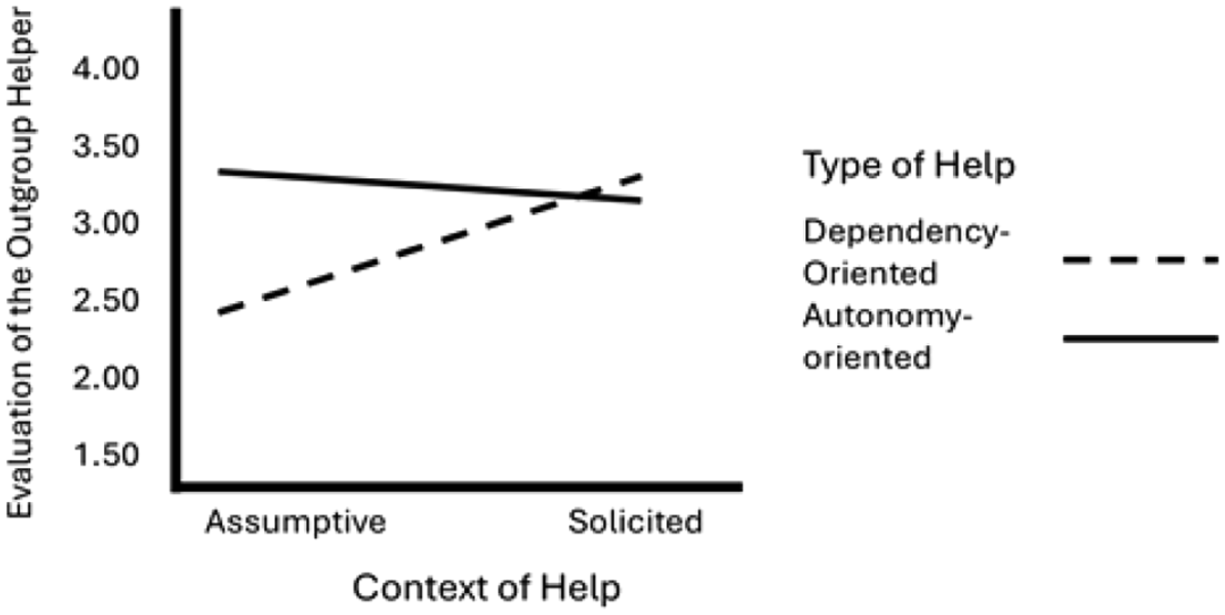
Evaluation of the Israeli-Jewish (outgroup) helper. Higher scores reflect more favorable evaluations.
The 2 (Context of Help) × 2 (Type of Help) analysis of variance (ANOVA) performed on the average score of evaluation of the helper measure revealed a marginally significant main effect for help context, F(1,144) = 3.21, p < .075, η2 = .02. Consistent with previous research on the IHSR model, the outgroup helper was evaluated less favorably when the assistance was assumptive, M = 2.92, SD = 1.22, than when it was solicited, M = 3.29, SD = 1.33. Also, while not statistically significant, F(1,144) = 2.19, p = .141, participants rated the outgroup helper somewhat less favorably when the assistance offered was dependency-oriented, M = 2.97, SD = 1.43, compared to autonomy-oriented, M = 3.25, SD = 1.10.
These effects were qualified by a significant two-way interaction, F(1, 144) = 8.27, p = .005, η2 = .05, which is illustrated in Figure 1. In a test of our specific prediction, we found that when help was assumptive, Arab participants evaluated the Israeli-Jewish helper more negatively when the assistance given was dependency-oriented than autonomy-oriented, Ms = 2.47 (SD = 1.23) vs. 3.36 (SD = 1.05), respectively, t(144) = 3.34, p < .001, d = 0.70. When the help was sought by Ahmad, there was no significant difference as a consequence of whether the help was dependency-oriented or autonomy-oriented, Ms = 3.42 (SD = 1.47) vs. 3.14 (SD = 1.15), respectively, t(144) = .99, p = .320, d = 0.21. Considering the interaction from a different perspective related to our hypotheses, when the assistance was autonomy-oriented, participants did not differ in how they evaluated the helper depending on whether the help was assumptive or solicited, Ms = 3.36 (SD = 1.05) vs. 3.14 (SD = 1.15), respectively, t(144) = .75, p = .450, d = 0.19. However, when the kind of help given was dependency-oriented, participants evaluated the outgroup helper more negatively in the assumptive help condition than in the solicited help condition, Ms = 2.47 (SD = 1.23) vs. 3.42 (SD = 1.47), respectively, t(144) = 3.06, p < .003, d = 0.77.
Tests of Mediation
We tested our hypotheses concerning mediational processes relating to the highest-level effect we observed, specifically the Context of Help × Type of Help interaction. The results of the 2 × 2 ANOVAs for perceived sense of control and evaluations of Israeli-Jewish people in general are presented in the supplementary material. Reflecting the processes we hypothesized, the mediation analyses tested whether (a) sense of control mediated the effect of the Context of Help × Type of Help interaction on evaluation of the outgroup helper, (b) evaluation of the helper mediated the effect of the Context of Help × Type of Help interaction on evaluation of the outgroup as a whole, and (c) there was sequential mediation, considering both mediational steps together.
Mediation by sense of control
Our hypothesis that sense of control would mediate the impact of the manipulations on evaluations of the helper (and potentially of the helper’s group) was not supported. The correlation of evaluation of the helper and evaluation of the outgroup was significant, r(146) = .174, p = .034. However, sense of control was not significantly related to evaluation of the helper or of the helper’s group. The correlations between sense of control and evaluation of the helper, r(146) = −.040, p = .624, and between sense of control and the evaluation of the outgroup, r(146) = −.045, p = .582), were nonsignificant. Indeed, as suggested by these results for the correlations, PROCESS tests of the hypothesized mediating role of sense of control conducted separately for these outcome variables did not demonstrate significant mediation effects: for evaluation of the helper, b = 0.05, SE = 0.078, p = .490; for evaluation of the outgroup, b = 0.03, SE = 0.073, p = .671.
Generalization from evaluation of the helper to evaluation of the outgroup
Based on our hypothesized moderating impact of the context of help on effects of type of help and the anticipated indirect effect on evaluation of the outgroup as a whole through evaluation of the outgroup partner, we also tested a model of moderated mediation using the PROCESS macro (Hayes, 2012: Model 7). Evaluation of the outgroup partner and evaluation of the outgroup as a whole were significantly correlated, r(146) = .174, p = .034. In the model of moderated mediation, Type of Help was the independent variable, Context of Help was the moderator, evaluation of the Israeli-Jewish helper was the mediator, and evaluation of the outgroup was the dependent variable. The results indicated that, as expected, the moderated Type of Help × Context of Help interaction effect was significant for the Evaluation of Helper, b = 1.17, SE = 0.409, p = .004 (consistent with the ANOVA results reported earlier), and the evaluation of helper significantly and positively predicted the Evaluation of Outgroup: this indirect effect, indicating mediation, was significant, 95% CI [0.01, 0.40].
In addition, we performed a sequential mediation analysis (Hayes, 2012: Model 6) to examine the indirect effect of context of help and type of help on sense of control (first mediator), on evaluation of the helper, and then testing the next step of the sequence in which evaluation of the helper mediates response to the group as a whole. Results revealed that the indirect effects of context of help [95% CI = (−0.07, 0.01)] and type of help [95% CI = (−0.03, 0.01)] were not significant.
Discussion
The results of Study 1 were generally consistent with past findings and hypotheses derived from the IHSR model. Nevertheless, we also note some findings that deviated from expectations. Previous work with adult populations of participants has shown, across separate studies, that people respond less favorably to an outgroup helper and to the outgroup as a whole when the assistance is assumptive (not requested) than solicited (Halabi et al., 2011) and when it is dependency-oriented than autonomy-oriented (Nadler & Halabi, 2006). In Study 1 with Israeli-Arab high school students as participants, the main effects for Context of Help (assumptive vs. solicited) and Type of Help (dependency-oriented vs. autonomy-oriented) for the evaluation of the outgroup helper and the outgroup as a whole were not statistically significant. Only the Context of Help × Type of Help interaction was statistically significant. Perhaps because younger adolescents have, developmentally, a particular negative orientation toward outgroup members (Bar-Tal & Avrahamzon, 2016; Nesdale, 2008), the condition in which help was assumptive and dependency-oriented elicited a distinctively unfavorable evaluation of the outgroup helper relative to the other three conditions. This finding is more consistent with the explanation that younger, adolescent participants may be less sensitive than adult participants to the specific elements of intergroup helping, but when it is more obviously potentially problematic (i.e., assumptive, dependency-oriented help) as identified in the IHSR model, they display an especially negative response.
With respect to our hypotheses relating to the recipient’s sense of control, we did find significant correlations showing that perceived lower sense of control experienced by the recipient was associated with less favorable evaluations of the Israeli-Jewish helper, but the test for hypothesized mediation was not significant. Inconsistent with our hypothesis, though, the mediating effects of sense of control on the evaluation of the helper and in the sequential mediation on evaluation of the outgroup were not statistically significant. However, consistent with prior research (Halabi et al., 2021a, 2021b), for the high school participants in Study 1, evaluations of the outgroup (Israeli-Jewish) helper mediated responses to the outgroup as a whole (i.e., evaluation of Israeli-Jews generally).
To further explore our hypotheses about the hypothesized effects of Context of Help and Type of Help and related mediating processes, we conducted Study 2, which had a participant sample of Israeli-Arab adults (18 years and older). Furthermore, to test the hypothesized different dynamics involved in responses to intergroup compared to intragroup helping, in Study 2 we replicated and extended Study 1 while employing an additional factor in the design, the group membership of the helper.
Study 2
Although not preregistered, Study 2 had corresponding hypotheses, used the same materials, and employed analogous analyses as Study 1. Our primary analyses tested the effects of Context of Help and Type of Help on evaluations of the helper and, consistent with Study 1, explored whether sense of control would mediate responses to the outgroup helper and whether evaluations of the outgroup helper would mediate evaluations of the outgroup (Israeli-Jewish people) as a whole. Study 2 was conducted approximately five months after Study 1 and employed a procedure similar to that used in Study 1.
There were two main differences between Study 1 and Study 2. One difference was that the participant population in Study 2 comprised Israeli-Arab adults, whereas in Study 1 the sample consisted of Israeli-Arab high school students. The other main difference, which was reflected in the experimental design, was that we tested the Context of Help and Type of Help effects while varying whether the person providing assistance was an outgroup member (an Israeli-Jewish person) relative to the recipient (an Israeli-Arab person) as in Study 1 or was an ingroup member (an Israeli-Arab individual). We examined the impact of the manipulations on evaluation of the outgroup or ingroup helper and evaluations of the outgroup as a whole.
Study 2 primarily extends Study 1 by further testing the hypothesized intergroup dynamics of helping by investigating the Context of Help × Type of Help interaction when the helper is presented as an outgroup member (i.e., an Israeli-Jewish person as in Study 1) compared to comparable conditions when the helper is presented as an ingroup member (i.e., an Israeli-Arab person).
To the extent that the effects we observed in Study 1 and anticipated when the helper was an outgroup member in Study 2 are reflective of intergroup dynamics, as described in the IHSR model, we would expect to observe differences in responses to help from an ingroup member than from an outgroup member (relative to the recipient and the participants). Specifically, a key mechanism underlying responses to intergroup helping, according to the IHSR model (Nadler, 2002; Nadler & Halabi, 2015), is threat to one’s social (which would primarily be aroused by actions of an outgroup member) and/or personal identity. Thus, the IHSR model posits that, because they erode the prestige and reputation of one’s personal (Nadler & Fisher, 1986) and social identity with implications for structural inequity (Nadler & Halabi, 2015), responses will generally be more negative to help that is dependency- rather than autonomy-oriented and is unsolicited (assumptive) rather than requested. These negative responses are expected to be particularly strong, because of the added threat to social identity, when the help comes from an outgroup member than from an ingroup member (Nadler & Halabi, 2015). Supportive of the latter possibility, Halabi et al. (2014) found that when participants focused on separate academic identities as psychology or social work students, they were less likely to seek dependency- than autonomy-oriented help from a member of the other group (particularly when status relations between groups was unstable), but when participants’ common interest in mental health as a profession was emphasized (promoting a common ingroup identity), they were as likely to seek dependency-oriented as autonomy-oriented help from the potential helper. This reasoning about social identity threat as an important element of intergroup helping dynamics applied to Study 2 suggests both Type of Help (autonomy vs. dependency) × Helper’s Group Membership (ingroup vs. outgroup) and Context of Help (requested vs. assumptive) interactions for the evaluation of the helper.
Beyond investigating the hypothesized differences in responses to help between outgroup- and ingroup-helper conditions, we further considered the potential responses to an ingroup helper (i.e., within only the ingroup helper condition) involving the Type of Help and the Context of Help. Whereas interactions between members of different groups typically activate processes associated with social identity, interactions within a group involve more individuated responses and may be influenced more strongly by process related to personal identity (Dovidio & Gaertner, 2010). Threats to personal esteem can also evoke negative responses to help (Nadler & Fisher, 1986). Thus, as acknowledged by Nadler and Halabi’s (2015) formulation of the IHSR model, helping that undermines personal esteem, such as dependency-oriented (vs. autonomy-oriented) help and assumptive (vs. requested) help may potentially elicit some degree of negative response to an ingroup helper (albeit still significantly less than that for an outgroup helper).
Method
Participants and design
Participants were 196 Israeli-Arab participants recruited through social media platforms (116 female and 79 male), aged between 18 and 67 (mean age 31.92 years; SD = 10.21). They were randomly assigned to one of the eight conditions in a 2 (Context of Help: Assumptive vs. Solicited Help) × 2 (Type of Help: Dependency- vs. Autonomy-Oriented Help) × 2 (Helper’s Group Membership: Ingroup vs. Outgroup) design. The goal was to recruit as many participants as possible up to an n of 171, which would be required (based on an a priori statistical power analysis using G*Power version 3.1; Faul et al., 2009) to test all direct, interactive, and simple effects within a 2 × 2 × 2 factorial design with 90% power and a medium effect size f = .25 (Cohen, 1988). Sensitivity power analysis using G*Power version 3.1.9.2 (Faul et al., 2009) indicated that the current sample size is sufficient to detect a large effect (f = .367) (Cohen, 1988) with power = .90 for α = .05. All of the experimental conditions and all of the measures for this study are reported.
Measures
We measured, in ways identical to Study 1, the dependent variables of (a) the extent of control measure (α = .66), (b) evaluation of the helper (α = .93), and (c) the evaluation of Israeli-Jews in general (α = .88).
Procedure
Study 2, which was conducted online, was described to participants, as in Study 1, as an assessment of how written information may or may not affect the process of attitude formation among young people and that it included two parts: reading a paragraph that describes a real-life situation and a part that included “a few questions” on the paragraph.
Following the procedure of Study 1, participants were asked to read a paragraph in which an Arab job applicant (Ahmad) was described as asking for help (n = 96) or as receiving assumptive help from another job applicant (n = 100). After that, as in Study 1, the Type of Help was manipulated. Specifically, for approximately half of the participants (n = 104) the help offered was dependency-oriented and for the other half (n = 92) it was autonomy-oriented. Next, the group membership of the helper was introduced. In particular, the job applicant from whom the Arab applicant asked or received help was either presented as an Arab person (Ahmad; n = 79) or as a Jewish person (Danny; n = 117) (for similar manipulation see Halabi et al., 2021a, 2021b).
After presenting the manipulations and manipulation check items, participants, as in Study 1, were asked to answer a “few questions regarding the case they have just read.” In fact, these questions were intended to measure the main dependent variable, evaluation of the helper, and, with respect to hypothesized mediation, perceived sense of control and general evaluation of Israeli-Jewish people. After that, participants were fully debriefed.
Results
Participants understood the manipulations as intended. Supporting the manipulation of the helper’s ethnicity, all participants correctly identified the name (Ahmad or Danny) and the mother tongue (Arabic or Hebrew) of the individual who provided help. All participants correctly reported, according to the relevant study condition, whether the applicant received (i.e., assumptive help) or actively asked for the help (i.e., solicited help), whether the helper helped by providing a hint (autonomy-oriented) or providing full solutions to questions (dependency-oriented help).
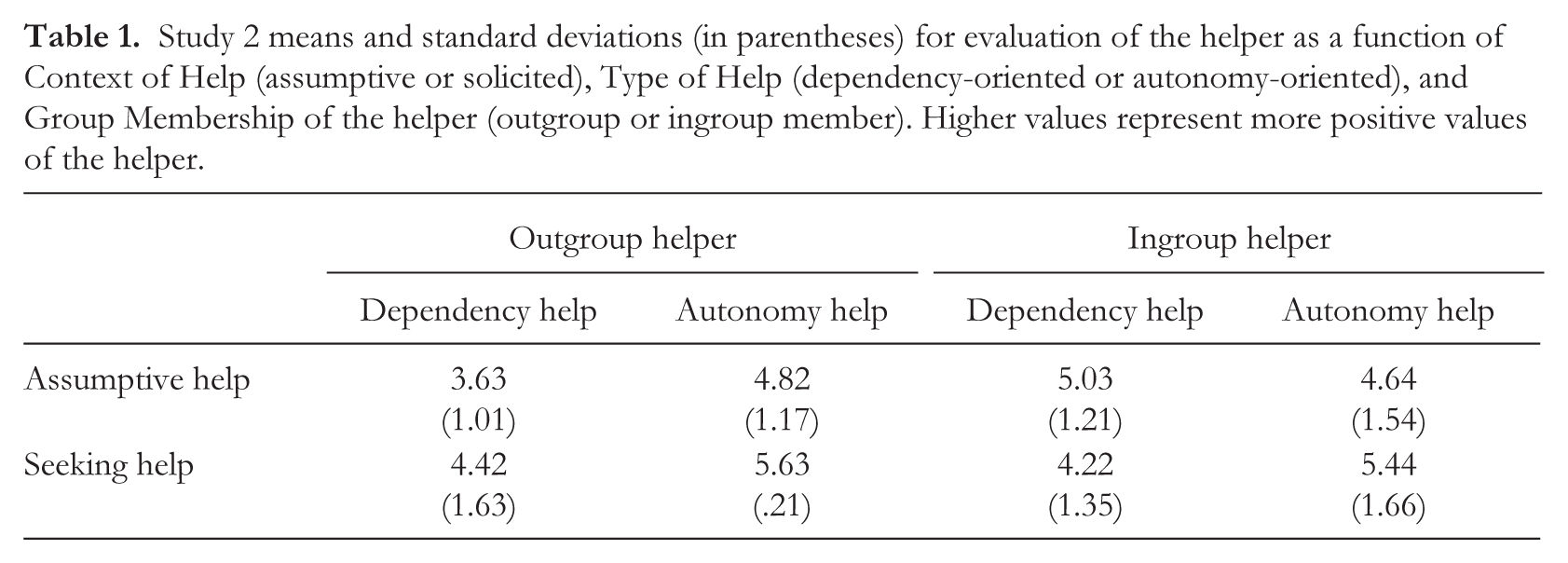
In our main analyses, as in Study 1, we examined the effects of context in which help was given (assumptive vs. solicited help) and the type of help offered (dependency- vs. autonomy-oriented help) and the group membership of the helper on the evaluation of the helper. Means and standard deviations for evaluations of the helper representing conditions in the context of help, the kind of help offered and group membership of helper design are reported in Table 1.
Study 2 means and standard deviations (in parentheses) for evaluation of the helper as a function of Context of Help (assumptive or solicited), Type of Help (dependency-oriented or autonomy-oriented), and Group Membership of the helper (outgroup or ingroup member). Higher values represent more positive values of the helper.
Evaluation of the Helper
The 2 × 2 × 2 ANOVA performed on the evaluation of the helper measure revealed significant main effects for the context of help, F(1,187) = 3.91, p = .049, η2 = .02, with more positive evaluations when assistance was solicited than unrequested (Msolicited = 4.91, SD = 1.55; Massumptive = 4.45, SD = 1.33, and for the type of help, F(1,187) = 16.51, p < .001, η2 = .08, with more favorable evaluation in the autonomy- than dependency-oriented help conditions (Mautonomy = 5.14, SD = 1.39; Mdependency = 4.28, SD = 1.40). Further, the ANOVA revealed significant two-way Context of Help × Helper’s Group Membership, F(1,187) = 4.37, p = .038, η2 = .02, interaction. The more negative evaluation of a helper when assistance was assumptive rather than solicited was greater when the helper was an outgroup member, Ms = 4.18 (SD = 1.23) vs. 4.99 (SD = 1.53), respectively, t(191) = 3.05, p = .003, d = 0.58, than when the helper was an ingroup member, Ms = 4.84 (SD = 1.37) vs. 4.78 (SD = 1.60), respectively, t(191) = 0.20, p = .841, d = 0.04. In addition, the Type of Help × Helper’s Group Membership, F(1,187) = 4.15, p = .043, η2 = .02, was significant. The more negative evaluation of a helper who offered dependency-oriented than autonomy oriented help was also greater when the helper was an outgroup member, Ms = 4.03 (SD = 1.40) vs. 5.23 (SD = 1.22), respectively, t(191) = 4.69, p < .001, d = 0.91, than when the helper was an ingroup member, Ms = 4.65 (SD = 1.32) vs. 4.99 (SD = 1.62), respectively, t(191) = 1.07, p = .285, d = 0.23.
The three-way interaction was also significant, F(1,187) = 3.98, p = .047, η2 = .02 (see Table 1). To test our hypotheses using an analysis strategy that parallels the one we employed in Study 1, we next examined the Context of Help × Type of Help effects separately for the conditions in which the helper was an Israeli-Jewish person (a member of an outgroup relative to the recipient, as in Study 1) or was an Israeli-Arab person (a member of the same ethnic group as the recipient).
Within the outgroup helper condition (Israeli-Jewish helper), there was significant main effect for the Context of Help, F(1,113) = 11.53, p < .001, η2 = .09: Israeli-Arab participants evaluated the Israeli-Jewish helper more positively when the help was solicited by the Israeli-Arab recipient than when the help was unrequested, Ms = 4.99 (SD = 1.53) vs. 4.18 (SD = 1.23). Also, for this set of analyses, there was an effect for Type of Help, F(1,113) = 25.90, p < .001, η2 = .18, with Israeli-Arab participants evaluating the Israeli-Jewish helper more positively for autonomy-oriented help than dependency-oriented help, Ms = 5.23 (SD = 1.17) vs. 4.03 (SD = 1.17).
However, unlike Study 1, in this set of analyses focusing on the outgroup helper conditions, the Context of Help × Type of Help interaction was not significant, F(1,113) = .002, p = .966, η2 = .00 (see Table 1). Nevertheless, given our a priori expectations for particular pairwise effects, we further conducted focused comparisons, in line with Rosenthal et al.’s (2000) recommendations. Rosenthal et al. indicate that this kind of analysis is a much more efficient way to analyze precise predictions based on theoretical ideas. Consistent with the findings of Study 1, when help was unsolicited (assumptive), Israeli-Arab participants evaluated the Israeli-Jewish helper more negatively when the assistance given was dependency-oriented than autonomy-oriented, Ms = 3.63 (SD = 1.01) vs. 4.82 (SD = 1.17), respectively, t(113) = 3.64, p < .001, d = 1.08. However, unlike Study 1, when the help was sought by Ahmad, there was also a significant difference for which the outgroup helper was evaluated less favorably when the help he provided was dependency-oriented than autonomy-oriented, Ms = 4.42 (SD = 1.63) vs. 5.63 (SD = 1.15), respectively, t(113) = 3.55, p < .001, d = 0.85.
Within the ingroup helper condition, only the Context of Help × Type of Help interaction was significant, F(1,74) = 5.89, p = .018, η2 = .07. We explored this interaction by examining first the effect of Type of Help (dependency- or autonomy-oriented) separately within the assumptive help condition and the solicited help condition. When help was unsolicited (assumptive), there was no significant difference in the way Israeli-Arab participants evaluated the ingroup helper, when the assistance given was dependency-oriented or autonomy-oriented, Ms = 5.03 (SD = 1.21) vs. 4.64 (SD = 1.57), respectively, t(75) = 0.89, p = .375, d = 0.27. However, when the help was sought by Ahmad, the ingroup helper was evaluated significantly less favorably when the help he provided was dependency-oriented than autonomy-oriented, Ms = 4.42 (SD = 1.35) vs. 5.41 (SD = 1.66), respectively, t(75) = 2.48, p = .015, d = 0.65.
Looked at differently in an alternative exploratory analysis, in contrast to the outgroup helper condition, participants perceived the ingroup helper more positively in the dependency-assumptive help condition compared to the dependency-solicited help condition, Ms = 5.03 (SD = 1.21) and 4.22 (SD = 1.35), respectively, t(74) = 2.02, p = .050, d = 0.63. In the autonomy-oriented help condition differences between the assumptive help condition compared to the solicited help condition were not significant, Ms = 4.64, (SD = 1.54) and 5.41 (SD = 1.66), respectively, t(74) = 1.62, p = .108, d = 0.48.
Tests of Mediation
We further tested our hypothesized mediational effects in Study 2 in ways that paralleled the tests in Study 1.
Mediation by sense of control
Unlike Study 1, in the outgroup helper conditions of Study 2 we did not observe Context of Help × Type of Help interactions for evaluations of the helper or participants’ perceptions of the recipient’s sense of control (as we did in Study 1). Instead, for the outgroup helper conditions in Study 2 we found main effects, such that participants evaluated the outgroup helper less favorably and perceived the recipient as having a lower sense of control when the assistance was assumptive rather than solicited and when the help offered was dependency-oriented rather than autonomy-oriented. PROCESS tests of the hypothesized mediating role of perceived sense of control conducted for the evaluation of the helper variable demonstrated significant mediation effects: for context of help, 95% CI [0.03, 0.46]; for type of help, 95% CI [−0.40, −0.00].
Generalization from evaluation of the partner to evaluation of the outgroup
In parallel to Study 1, we tested, within the outgroup helper condition (a Jewish helper), a model of moderated mediation using the PROCESS macro (Hayes, 2012: Model 7) to explore the moderating impact of the context of help on effects of type of help and the anticipated indirect effect on evaluation of the outgroup as a whole through evaluation of the outgroup partner. Evaluation of the outgroup partner and evaluation of the outgroup as a whole were significantly correlated, r(192) = .275, p < .001. In the model of moderated mediation, type of help was the independent variable, context of help was the moderator, evaluation of the Israeli-Jewish helper was the mediator, and evaluation of the outgroup was the dependent variable. The results indicated that the moderated Type of Help × Context of Help interaction effect for evaluation of the helper did not reach significance, b = .71, SE = 0.395, p = .071. However, the evaluation of helper significantly and positively predicted the Evaluation of Outgroup: this indirect effect, indicating mediation, was significant, 95% CI [−0.54, −0.13].
Discussion
Study 2 yielded results that supported some key propositions of the IHSR model (Nadler & Halabi, 2015). Specifically, we found that the responses of Israeli-Arab adult participants were more negative (a) to dependency-oriented relative to autonomy-oriented help when the source of assistance was an outgroup member (an Israeli-Jewish helper) compared to an ingroup member (an Israeli-Arab helper)—a Type of Help × Helper’s Group Membership interaction for evaluation of the helper; and (b) to assumptive relative to solicited help when the help provided was an outgroup compared to an ingroup member—a Context of Help × Helper’s Group Membership interaction.
Moreover, in Study 2, we found, as originally predicted for the outgroup helper conditions, that perceptions of the helper’s lower sense of control mediated, separately, the less favorable evaluation of the outgroup helper who provided assumptive rather than solicited help and dependency-oriented rather than autonomy-oriented help. Moreover, as in Study 1 and consistent with expectations drawn from the IHSR model, evaluations of the helper in the outgroup conditions mediated evaluations of the outgroup as a whole.
We also observed in Study 2, a Context of Help × Type of Help × Group Membership of the Helper interaction for evaluation of the helper. It was not of the form we anticipated. As in Study 1, the outgroup helper was evaluated least favorably in the assumptive, dependency-oriented help condition, but the effect in Study 2 was additive (rather than the interactive effect with high school students in Study 1). In the ingroup helper conditions, although the main effects of Context of Help and Type of Help were nonsignificant, the results do not simply indicate that these effects were attenuated as expected. There was a Context of Help × Type of Help interaction for evaluation of the ingroup helper. As indicated in Table 1 and described earlier, the ingroup helper was evaluated similarly favorably when unsolicited assistance (assumptive help) was dependency-oriented or autonomy-oriented, which does appear to represent an attenuation of the effect of Type of Help that was observed in the comparable outgroup helper condition. However, when the help was sought, there was a significant difference between the dependency-oriented and autonomy-oriented conditions for the ingroup helper that was similar in magnitude (mean difference = 1.22, d = 0.65) to the outgroup corresponding effect for the outgroup helper (mean difference = 1.21, d = 0.86). One possible explanation for this pattern of findings is that, because individuals are more trusting of ingroup members than outgroup members (Foddy et al., 2009) and are more suspicious and fearful of the intentions of outgroup members (Wildschut & Insko, 2007), people may perceive the offer of dependency-oriented assistance from an outgroup member as a manipulative ploy to reinforce social control over their ingroup (see Nadler & Liviatan, 2006; also consistent with the mediating effect of Sense of Control in Study 2), while they may attribute dependency-oriented help from an ingroup member to a genuine sense of support and solidarity.
While the present research focused on the sense of control of a recipient of help as a mediator of responses to assistance, to further illuminate the processes underlying these intergroup dynamics future research might directly consider the attributions made about the helper’s intentions for the different types of help offered by outgroup and ingroup members. Another aspect of this pattern of results for ingroup helping, the finding that participants evaluated an ingroup helper who provides dependency-oriented help more positively when the help is assumptive rather than solicited (see Table 1), also merits further research. This finding suggests that other factors, beyond generalized trust for ingroup members, may be involved. Additional research, for instance, might examine how actively seeking assistance, as compared to receiving help without requesting it, may carry different expectations of the helper. That is, when help is sought from an ingroup member, the expectation about the quality of the assistance given may be particularly high (and higher than when help is received without a request), which leads to much less positive evaluations of an ingroup member who offers dependency-oriented than autonomy-oriented help. Thus, while Study 2 provides further support for the basic premises of the IHSR model, it also raises new questions about the potentially complex dynamics of intergroup helping that the design and data of our current work cannot fully answer. These questions, which remain unresolved and require additional research to answer, involve the roles of recipients’ sense of control, perceived intentions of outgroup vs. ingroup helpers, and different expectations of the quality and/or nature of assistance received from ingroup or outgroup members when help is solicited or not. Additional research, stimulated both by the evidence supporting the IHSR model and by new questions about the multiple underlying processes, can potentially lead to an even more comprehensive understanding of the dynamics of intergroup helping.
General Discussion
The objective of the present research consisting of two experiments (Study 1 with Israeli-Arab high school students and Study 2 with Israeli-Arab adults, using similar procedures) was to expand on previous research by investigating the joint roles of context of help (i.e., assumptive vs. solicited) and type of help (i.e., dependency- vs. autonomy-oriented help) on evaluations of the individual who offers assistance to an ingroup (Israeli-Arab) individual. In Study 1, the helper was an outgroup member, an Israeli-Jewish individual; in Study 2, we systematically varied whether the helper was an outgroup member (as in Study 1) or an ingroup member. We also directly measured and tested the potential mediating influence of perceived sense of control of the recipient of assistance on evaluations of the helper and, in support of previous research on the IHSR model, the mediating role of evaluations of an outgroup helper on evaluations of the outgroup as a whole.
Overall, Study 1 and particularly Study 2 produced support for the hypotheses derived from the IHSR model. The findings from both studies showed, as in previous work on the IHSR model, that people generally respond less favorably to autonomy-oriented compared to dependency-oriented help (related to the type of help manipulation) and to help that is given assumptively as compared to requested (reflecting the context of help manipulation). In addition, replicating previous research, in both studies we found that observers’ evaluations of an outgroup helper mediated their evaluations of the outgroup as a whole.
The present research also extends previous work on the IHSR model in two important ways. One way involves the inclusion of manipulations of both the type of help given by an outgroup member and the context of help. Whereas previous research has examined the effects of these factors separately, the simultaneous consideration of the two independent variables revealed their potential interactive effects (obtained in Study 1, with high school student participants). While the effects were additive rather than multiplicative in Study 2 (with adult participants), both studies showed that in the context of outgroup help, assistance that is assumptive (unsolicited) and dependency-oriented elicits the most negative responses. Moreover, the moderating effects of group membership (ingroup or outgroup) of the helper in Study 2 (the only study that manipulated this factor) further established the intergroup nature of these dynamics. A second way that our current research extends previous findings related to the IHSR model is by adding new evidence (in Study 2, but not in Study 1) that perceptions of the impact on a recipient’s sense of control mediated the responses to an outgroup helper, with perceptions of less control of the recipient related to more negative responses to an outgroup member who gives dependency-oriented (rather than autonomy-oriented) assistance or who offers help assumptively (rather than in response to a request).
In addition to replicating previous findings in support of the IHSR model and offering novel findings, some inconsistencies in results between our two studies, which employed similar procedures but differed in the ages of participants, suggest a particular, potentially productive direction for future work on the IHSR model. Specifically, these findings point to the value of further investigation of developmental processes that may influence the dynamics of responses to intergroup help. Systematic developmental changes have been documented with respect to emotional capacities related to prosocial behavior (e.g., empathy; Oh et al., 2020), recognition that helping can be used in strategic ways to achieve a variety of ultimate goals (Grueneisen & Warneken, 2022), and intergroup orientations (Verkuyten, 2022). The present research brings developmental issues to light in the context of intergroup helping and more specifically in work on the IHSR model. High school students tend to display particularly high levels of prejudice, even compared to adults, against outgroups and their members (Nesdale, 2008). Consistent with this general finding, in the current research, across all the outgroup helper conditions, Israeli-Arab high school students in Study 1 evaluated the Israeli-Jewish helper generally less favorably (M = 3.11, SD = 1.28) than did Israeli-Arab adults (M = 4.59, SD = 1.47) in Study 2. In addition, adolescents tend to be more impulsive and reason less deeply than adults (Poon, 2018), which can contribute to weaker attribution-response relations among adolescents than adults (Allen et al., 1987). Differences in attributional processes and their influence are consistent with our finding that perceptions of the sense of control of the recipient significantly mediated responses to the outgroup helper in Study 2 with adult participants but not in Study 1 with adolescent participants. Because the age ranges of participants in Study 1 (15.5–18) and Study 2 (18–67) had some overlap, we examined the data further in Study 2 to compare young adults to older adults. However, less than 10% of participants in Study 2 were under the age of 21, precluding meaningful tests of near-adolescents within the sample. Future research on the IHSR model might thus further examine developmental influences, systematically comparing effects not only between adolescents and adults but also across a broader span of age groups.
Limitations and Future Directions
While our findings provide considerable support for the IHSR model and offer novel insights into factors that can moderate or mediate the dynamics of intergroup helping, we have also identified some inconsistencies in results across the two current studies. While we recognize and acknowledge procedural differences (e.g., face-to-face administration of materials in Study 1 and online materials in Study 2), we propose that some of these differences (e.g., relating to whether the effects of Type of Help and Context of Help are simply additive or multiplicative) might relate to age differences in the samples of participants in Study 1 and Study 2. However, a main limitation of the work is that, while we offered explanations for unanticipated findings or inconsistent results and suggested specific directions for future research, we did not directly empirically test these in a single study. There are a number of theoretically-relevant and practical factors that limited our ability to pursue such additional empirical work within the context of the present studies. First and foremost, even within the particular context that involves the unique aspects of Arab-Israeli relations (Smooha, 2019), the extreme nature of current events relevant to Arab-Israeli relations (including but not limited to the Israel-Hamas conflict and its consequences in Gaza) represents a fundamentally different context than that in which both Study 1 and Study 2 were conducted. These changes in context are directly relevant to the core processes underlying our theoretical rationale, such as identity threat, suspicion and trust, and attributions of intent. Because of these dramatic “history effects,” a new study would not be comparable to the current studies in the manuscript. Such history effects significantly change the meaning and dynamics of even research that is designed to directly replicate the procedures of previous work (Dovidio, 2016), which would limit its value for clarifying “loose ends” in the current findings. Future research might therefore test the generalizability of the effects we observed and extend the current work by directly investigating the proposed moderating effect of participant age group in the context of other instantiations of intergroup relations.
We consider other limitations of the current work, as well. We note that in the present research, participants were observers, not recipients, of the act. Thus, the processes represent vicarious intergroup contact rather a direct, personal form. Because there is a robust literature demonstrating that people who are engaged in a situation (i.e., actors) often make very different attributions than do those who observe the same situation (e.g., Cimpian & Salomon, 2014; Nisbett & Ross, 1980) and the underlying dynamics of direct and vicarious intergroup contact are distinct in several ways (Dovidio et al., 2011), future research on responses to intergroup helping might directly compare the responses of direct recipients of intergroup assistance and those of observers (perhaps representing either the recipient’s ingroup—as in the present study—or the benefactor’s ingroup). Understanding both how and why these perspectives, attributions, and responses differ, as well as when they are similar, can offer new and productive insights into the dynamics of intergroup helping.
It is also important to note that the current study focused on a specific intergroup context, Arab-Israeli relations, which involves groups that have a history of violence, competition, and suspicion. As a consequence, individuals are often skeptical of and reluctant to accept well-meaning acts, offered by members of another group (Hornsey et al., 2015). This skepticism surrounding the genuine intentions and motives of members of other groups, resulting in refusals to accept help or support, can exacerbate intergroup tensions, conflict, and animosity. Therefore, it is important to validate current findings in more neutral context in which division between outgroup and ingroup is achieved by less competitive criteria.
In addition, while such skepticism and suspicions are particularly pronounced during periods of intensive conflict or competition between groups, these effects may still be influential on intergroup contexts that are not presently characterized by open violence—as was the case between Israeli-Arabs and Israeli-Jews at the time the research was conducted. However, future work directly testing such effects under varying conditions of conflict could provide further, valuable insights into the dynamics of responses to intergroup helping. Previous research suggests that conditions of greater conflict, because they increase the salience of differentiation between groups (Brewer, 2001) and involve potentially greater negative consequences for misperceiving the ill-intentions of another group (Kunst et al., 2019), would amplify the differences we observed. However, it is also possible that at very high levels of conflict a different pattern could occur, with even autonomy-oriented assistance being responded to negatively because of high levels of mistrust and defensiveness.
In addition, because of the strong influence of group membership generally among adolescents (Verkuyten, 2022) and the extent to which they rely on biases that they have when identifying the psychological states and intentions of others (Killen et al., 2013), we chose to recruit high school students for our research. This is an important but understudied group with respect to intergroup bias (Verkuyten, 2022). However, focusing our research on participants below the age of research consent, requiring both parental and school permission, and belonging to a “hard-to-reach” population (Giner-Sorolla, 2019) allowed us sufficient power to detect main effects based on the G*Power estimate but limited our ability to recruit a sample large enough to have the desired power (equal to .80) to detect the hypothesized interaction effects, which require a much larger sample (Giner-Sorolla et al., 2024; see also Sommet et al., 2023). Because of limited statistical power due to practical restrictions for sample size, we acknowledge that our findings—particularly null findings—should be interpreted with caution.
Practical Implications
As we noted earlier, the relations between Arab and Jewish people in Israel and more generally have been characterized by suspicion, tension, and conflict, particularly since the establishment of Israel. As evidenced by the recent events in Gaza, these tensions have a cascading impact on Arab-Jewish relations within Israel and internationally. While there are many complex historical and contemporary barriers to resolving this conflict, our research does suggest that, at least when relations are not characterized by violent military conflict, the intergroup biases are not necessarily intractable. That is, we found that Arab participants’ evaluations of a Jewish helper, and Jewish people in general, could vary (and even improve) depending on specific aspects of a helping exchange—i.e., the context of help and type of help. While state-level policy and individual-level attitudes differ dynamically, change and improvement in intergroup attitudes at the individual level can set in motion a range of processes (e.g., increased positive intergroup contact; Gilad et al., 2021; Pettigrew & Tropp, 2008) and joint collective action for change involving both groups (van Zomeren, 2019) that can, over time, create momentum for more constructive intergroup relations. For example, the ways people socially categorize others as ingroup or outgroup members may fundamentally change the nature of prosocial exchanges between members of high and low status groups. Moving from “us” and “them” to “we” may possibly lead Arabs to be more acceptable of assistance that may otherwise be resisted because it promotes dependency. However, we acknowledge that we examined Arab-Jewish relations in a particular context, in Israel. Because Arabs and Jews in Israel share a national identity, this can provide a foundation for further strengthening a sense of common identity—the “we”—that can promote further improvement in intergroup relations. Yet, we also recognize that we performed our research at a particular point in time, before the outbreak of the Israel-Hamas War that began in October 2023. Such events have widened social and political divides, reinforcing “us–them” distinctions within Israel. It is thus important that future research recognize and consider the role of both time and place in studying intergroup relations generally and between Arabs and Jews specifically.
Conclusion
In conclusion, the current research extends the understanding of the dynamics of intergroup helping by demonstrating the roles of receiving vs. seeking help and the kind of help offered in shaping observers’ perceptions of the helper. This research also helps identify the role of perceived control in the responses to the helper and illuminate the way that observations of intergroup exchanges relate to perceptions of groups more generally. The insights gained from the current research can guide more effective interventions for improving intergroup relations.
Supplemental Material
sj-docx-1-gpi-10.1177_13684302261422654 – Supplemental material for Seeking or receiving help: Implications for recipient sense of control, evaluations of the helper and of the helper’s group
Supplemental material, sj-docx-1-gpi-10.1177_13684302261422654 for Seeking or receiving help: Implications for recipient sense of control, evaluations of the helper and of the helper’s group by Samer Halabi, John F. Dovidio, Lysann Zander and Arie Nadler in Group Processes & Intergroup Relations
Footnotes

References
Supplementary Material
Please find the following supplemental material available below.
For Open Access articles published under a Creative Commons License, all supplemental material carries the same license as the article it is associated with.
For non-Open Access articles published, all supplemental material carries a non-exclusive license, and permission requests for re-use of supplemental material or any part of supplemental material shall be sent directly to the copyright owner as specified in the copyright notice associated with the article.
