




Abstract
Girls report lower belonging in STEM (science, technology, engineering, mathematics) than boys, which may carry costs for girls’ later STEM participation. We hypothesized that being socially included within a STEM context supports feelings of belonging—which then contributes to stronger intentions to pursue STEM, especially for girls. To investigate, we recruited girls and boys (N = 1,330; Mdnage = 12; 41% White, 35% East Asian) attending week-long Canadian STEM summer camps. We gathered precamp and postcamp STEM intentions (fit and interest), plus postcamp objective social inclusion and subjective belonging (with distinct metrics computed for female vs. male peers). Consistent with previous findings, girls had lower STEM intentions than boys. In addition, we found that, for girls, being more socially included (particularly by male peers) was associated with stronger STEM intentions, mediated by subjective belonging. For boys, social inclusion (via belonging) was less predictive of STEM intentions. These results highlight how childhood friendships may impact early intentions to pursue STEM education and careers, especially for girls.
People gravitate toward environments where they feel a sense of belonging. Yet in male-dominated STEM (science, technology, engineering, mathematics) fields, boys and men tend to express a stronger sense of belonging than girls and women (Master & Meltzoff, 2020) as well as other gender minorities (Xavier Hall et al., 2022). Indeed, dominant cultural norms reinforce that girls and women do not fully belong in STEM (Hall et al., 2023; Master et al., 2021), and women report lingering gender-based devaluation in these fields (Casad et al., 2019; Steele et al., 2002). These gendered associations begin early in childhood, with male and female participants being relatively faster to associate math/science with boys and men, and arts with girls and women (Cvencek et al., 2011; Gonzalez et al., 2025). In addition, differences in gender–STEM associations among adults predict nation-level gender differences in science and math performance among youth in eight grade (Nosek et al., 2009), suggesting the potential importance of these gendered beliefs for performance and participation in STEM.
In the current research, we focused on belonging as a key mechanism driving gender gaps in STEM participation, examining this theoretical framing in early STEM education through a large field sample of girls and boys in STEM summer camps (N = 1,330). Our theoretical model traces a pathway from objective social inclusion (within camp friendship networks) to STEM intentions, mediated by subjective sense of belonging. In addition, we highlight the gendered nature of social environments in STEM by separately considering dynamics with female versus male peers. Consistent with recent calls to better understand how children’s early social networks affect development and academic trajectories (Burke et al., 2022; Neal, 2020), we sought to make a novel contribution by connecting gendered friendship networks to success in STEM, and determine whether belonging mediates this relation. Given gender stereotypes in STEM fields, our key goal was to enhance our scholarly understanding of the potential impact of adolescent girls’ social connections and sense of belonging as they navigate a critical period of academic and career-related decision making (Lapytskaia Aidy et al., 2021).
Friendship Networks: Objective Social Inclusion
Childhood friendships are marked by a high degree of idiosyncrasies and variability over time (Cairns et al., 1995). Yet some predictability remains, with children (and adults) being strongly drawn to similar others (McPherson et al., 2001), including those who share their social identities. Gender is one of the largest, and earliest, predictors of social bond formation: Researchers have found that gender is a highly salient social identity from very early in childhood (Shutts et al., 2013), with preferences for playing with own-gender peers emerging shortly thereafter (Mehta & Strough, 2009). Most children view gender as binary (Xiao et al., 2023), leading to highly gendered networks of social bonds by as early as 3 years of age (i.e., girls largely socializing with girls, and boys with boys; Shutts et al., 2013). Although race (Joyner & Kao, 2000; Shrum et al., 1988) and other social identities (e.g., religion; Osgood et al., 2022) can also strongly shape social behavior among children, gender is a particularly salient and influential social identity (Martin & Slepian, 2021).
To lay the groundwork for our theoretical model, we mapped 122 networks of children’s friendship nominations. We then calculated what percentage of male and female peers nominated each target child, as “objective” measures of social inclusion within each peer gender group. We defined social inclusion as each child’s centrality within a network of friendships, as friendship is a widely understood concept at this age. Further, friendships are defined by individual preferences, in contrast to other more constrained network tie types (e.g., affiliation due to assigned teams; see Hoffman & Chabot, 2023). In addition, we specifically operationalized objective social inclusion as “indegree,” or the number of received nominations out of possible nominations within a defined network. Indegree primarily stands in contrast to “outdegree,” a method that often centers participants’ self-reports regarding their personal centrality in the network (e.g., the number of sent nominations out of possible nominations). The methodological “flip” associated with measuring indegree allowed us to leverage reports from multiple peers to triangulate each participant’s social inclusion within the broader friendship network, leading to a measure that is decoupled from self-reported, and hence more subjective, measures. Given the gendered nature of social dynamics, we expected that both girls and boys would receive a higher proportion of nominations from peers of their own gender.
Connecting Objective Social Inclusion to Subjective Belonging
The first link in our theorized model considers whether being included translates into feeling included. Although little work has examined the link between children’s objective social inclusion and subjective belonging, some initial support for this connection exists. For example, in one small study, students who were more centrally located within their friendship network tended to report a higher sense of school-based belonging (Zhao et al., 2019), and this held true even for members of some marginalized groups (i.e., Latine; Delgado et al., 2016). Further, Vaquera and Kao (2008) found that adolescents with reciprocated friendships reported greater subjective belonging within their school. Consistent with these findings, we expected that objective inclusion would support subjective feelings of belonging.
Of particular interest was the potential for variations in the link from objective inclusion to subjective belonging based on the interplay of peer and participant gender. One possibility is that being considered a friend by a female peer (vs. a male peer) confers greater belonging benefits, as girls tend to forge more intimate and cooperative peer friendships (Rose & Rudolph, 2006). This might be particularly true for girls, as converging evidence points to gender differences in what is sought from a friendship, with girls valuing emotional closeness (i.e., face-to-face intimacy and support), and boys emphasizing group recreation (i.e., side-by-side companionship and enjoyment; Rudolph & Dodson, 2022), with these gender differences continuing into adulthood (e.g., Caldwell & Peplau, 1982; Fox et al., 1985). A contrasting possibility is that, in STEM contexts, being considered a friend by a male peer provides a greater belongingness boost. Men and boys have greater control than women and girls over who normatively “belongs” in STEM (Akcinar et al., 2011), and women’s sense of otherization in STEM workplaces is especially influenced by their interactions with male (vs. female) colleagues (Hall et al., 2019). This social and relational power arises in part due to the default structuring of STEM spaces around male experiences and preferences (Cheryan & Markus, 2020). As such, the preponderance of evidence suggests that sense of belonging (especially girls’) may be particularly tied to social inclusion by male peers within male-dominated STEM spaces. For completeness, we simultaneously tested the link from objective social inclusion to subjective belonging for each peer gender group (separately among girls and boys).
Connecting Subjective Belonging With Peers to STEM Intentions
We next considered the potential link between subjective belonging and children’s intentions of pursuing STEM education and careers. Some studies have already provided evidence that subjective belonging can be an important antecedent of educational and occupational decisions among college students (e.g., Walton et al., 2023). But past work has tended to examine feelings of belonging within an overall environment (e.g., belonging at school), rather than with respect to specific subgroups of peers (e.g., belonging with peers of a given gender).
Overall, we expected that subjective sense of belonging in the context of STEM summer camps would generally be associated with stronger intentions to pursue STEM. However, we expand our theoretical contribution by separately considering the potential impact of subjective belonging with male versus female peers. Given the overall lack of support that girls express feeling in STEM, we primarily focus on girls’ experiences and intentions.
On one hand, it seems plausible that girls’ friendships with female peers would be the strongest driver of STEM intentions. Previous studies have suggested that girls report stronger intentions to pursue math and science after interacting with a female role model in STEM (Gladstone & Cimpian, 2021; González-Pérez et al., 2020). Further, for women majoring in engineering, having a female mentor (vs. a male mentor or no mentor) was positively associated with emotional well-being and completing an engineering degree (Wu et al., 2022).
On the other hand, some evidence suggests that belongingness with male peers (vs. female peers) may be a stronger driver of STEM intentions. For example, Cyr et al. (2021) found that for women in STEM, social connections with male colleagues were more predictive of perceived fit within the social environment than connections with female colleagues. Further, initial intergroup evidence indicates that girls who observe a higher proportion of different-gender friendships within their classroom later have stronger math achievement (Xiao et al., 2023), and that studying with different-gender partners had an indirect positive effect on grade point average (GPA) scores in STEM majors (Park et al., 2021). As with different-race friendships, which tend to afford greater benefits for racial minority (vs. majority) group members (Shook & Clay, 2012), it may be that feelings of belonging with those from the more privileged gender group in STEM are particularly beneficial to those from more marginalized groups. Given these different possibilities, we again simultaneously considered the effects of male and female peers—specifically, subjective belonging on STEM intentions.
We operationalized STEM intentions using two sets of variables: fit in STEM and interest in STEM. Fit was assessed as a multidimensional construct pertaining to a perceived “match” between the sense of self and the environment (see Schmader & Sedikides, 2018). Interest was assessed through a direct reporting of preferences for specific STEM educational and occupational options. Importantly, both fit and interest were accounted forusing two time-specific measures (e.g., current fit and forecasted fit in early adulthood). As in past work (Cyr et al., 2025), we expected that STEM fit and interest would be interrelated, but in assessing multiple dimensions of STEM intentions (in terms of fit vs. interest, as well as proximal vs. distal measures), we sought to provide a more holistic window into various ways STEM intentions may arise.
The Present Study
We used a large field sample of girls and boys (N = 1,330) attending diverse STEM summer camps to examine the extent to which STEM intentions, operationalized as reported fit and interest in STEM education and careers, are predicted by objective social inclusion and subjective belonging with female versus male peers. First, we tested for gender differences in STEM intentions. Second, we examined whether and when objective social inclusion predicts subjective belonging (separately for each peer gender group). Third, we used structural equation models to test our entire theorized model from peer gender-specific objective social inclusion to subjective belonging, and then to girls’ and boys’ downstream STEM intentions.
Method
Participants and Procedure
We partnered with STEM summer camps hosted by three large Canadian universities. These full-day camps ran from Monday to Friday, covered STEM educational content for students entering fifth to ninth grades, and were broadly advertised to the surrounding communities. Each of the three camp sites offered several topics (e.g., coding, biology; 26 topics total), with campers divided into class sizes broadly mirroring those in Canadian public education (Mdn = 21 campers per class; 88% of classes had 15–28 campers). We recruited as many girls and boys as possible over 3 years (one site in 2017; three sites in 2018 and 2019). Participants were offered a CAD$5 gift card and a science-themed raffle entry. Research ethics boards at the University of Waterloo, Simon Fraser University, and the University of British Columbia approved this study.
For this overall research program, we initially recruited 1,483 participants for two gender-specific field interventions, as described in Cyr et al. (2024) and Cyr et al. (2025; see Supplemental Material for full recruited sample details). Of this newly combined sample, we excluded those with high suspicion of the study objectives (n = 2), poor study engagement (n = 28), or data compromised by a major technical error (n = 2). Further, given the binary nature of our gender-related hypotheses, we excluded those (n = 5) who did not identify within the gender binary (sex was not assessed). Given this paper’s hypotheses about friendships between girls and boys, we here additionally excluded participants (n = 116) from single-gender camp classes. Overall, the current paper integrates 167 previously unanalyzed participants (who had been excluded from prior papers due to not completing their assigned intervention or matched control), plus 1,163 participants analyzed in prior works. Many participants (42%) in this paper’s analytic sample completed one of the interventions detailed in our prior papers, but those interventions did not affect the results presented here (see Gender Differences Controlling for Condition section in the Supplemental Material).
Our final sample included 800 boys and 530 girls (Mdnage = 12 years; range = 8 to 15 years) from 122 camp classes (Mdn = 11 participants per class; Mdn = ~55% participation rate). Participants self-identified as White / European (~41%); East Asian (~35%); South Asian, Middle Eastern, Latine / Hispanic, Black, or Indigenous (each ⩽ ~5%); or another background (~13%).
Procedure and Measures
Girls and boys with parental consent and who assented to participate completed our intake survey on Monday and exit survey on Friday. All focal measures were gathered during the exit survey. Additionally, STEM intentions (fit and interest measures) had baseline measures included in the intake survey (see Table S1 for full measure details).
Objective social inclusion: Friendship network measure
Participants classified each of their camp classmates as a best friend, a friend (but not a best friend), not really a friend, or “I don’t know [this person].” We applied the standard practice of binarizing ties (Kitts & Leal, 2021): counting “best friend” (~11%) or “friend (but not a best friend”; ~14%) as a friendship nomination, and “not really a friend” (~24%) or “I don’t know [this person]” (~51%) as a non-nomination. This strategy allowed us to create a face-valid yet binary measure of friendship with roughly equivalent cell sizes.
We used a group-based approach (e.g., Cyr et al., 2021; Stark, 2016) to calculate two peer gender-specific measures of “indegree.” For each participant, we divided the number of nominations they received from each peer gender group by how many nominations they could have possibly received from that specific group. Thus, for example, a participant nominated by three quarters of female study participants in their class would have an “objective inclusion by female peers” score equal to 0.75.
Subjective feelings of belonging with peers
Two items assessed belonging with male and female peers at camp (“Overall, how much do you feel you belong (fit in) with [boys/girls] at [camp]?”; 1 = not at all, 5 = extremely).
STEM intentions
Current fit in STEM
Four items (e.g., “How much do you feel you can belong (fit in) in [math] classes?”) measured current fit in STEM (1 = not at all, 5 = extremely; all α > .80)
Forecasted future fit in STEM
Eight items (e.g., “Imagine . . . finishing high school and choosing your university classes. How much do you feel like you will belong (fit in) in [math] classes?”) probed forecasted fit in STEM (1 = not at all, 5 = extremely; all α > .87).
Interest in STEM high school classes
Short-term interest in STEM was assessed with three items about high school STEM classes (“How interested are you in each of these high school classes?”: advanced physics, advanced chemistry, advanced math; 1 = not at all, 5 = extremely; all α > .75).
Interest in STEM careers
Long-term interest in STEM was assessed as seven STEM careers (“How interested are you in going into each of these careers?”; e.g., biologist, physicist; 1 = not at all, 5 = extremely; all α > .83).
Results
Analytic Approach
All models are multilevel, with a random intercept accounting for differences across classes (except when too close to zero to be reliably estimated) and Satterthwaite-adjusted degrees of freedom (which vary across models according to variable completion rates as well as levels of interdependence). Structural equation models with 10,000 bootstrapped samples (using the lavaan package; maximum likelihood estimation, and listwise deletion in the event of missingness) assessed the class-level random intercept with cluster-robust standard errors. Variables were winsorized to within ± 3 SDs from their gender group’s grand mean; subjective belonging with male peers and all STEM fit measures were winsorized (< 1% cases affected). Cohen’s ds were computed using the Rosenthal and Rubin (2003) approximation [2t/√df]. Data were analyzed in RStudio Version 2023.06.1; see analytic code for full package list. The de-identified datafile plus reproducible analytic code are available at the Open Science Framework (OSF; https://osf.io/6kaqz) repository.
Gender Differences
We hypothesized that girls and boys would be predominately befriended by, and feel stronger belonging with, own-gender (vs. different-gender) peers, and that girls would report weaker STEM intentions than boys. See Table 1 for means and effect sizes. Further, as seen in the supplemental section Gender Differences Controlling for Age, covarying for age did not affect any gender differences (and age never moderated participant gender).
Gender differences in objective social inclusion, subjective belonging, and STEM intentions.
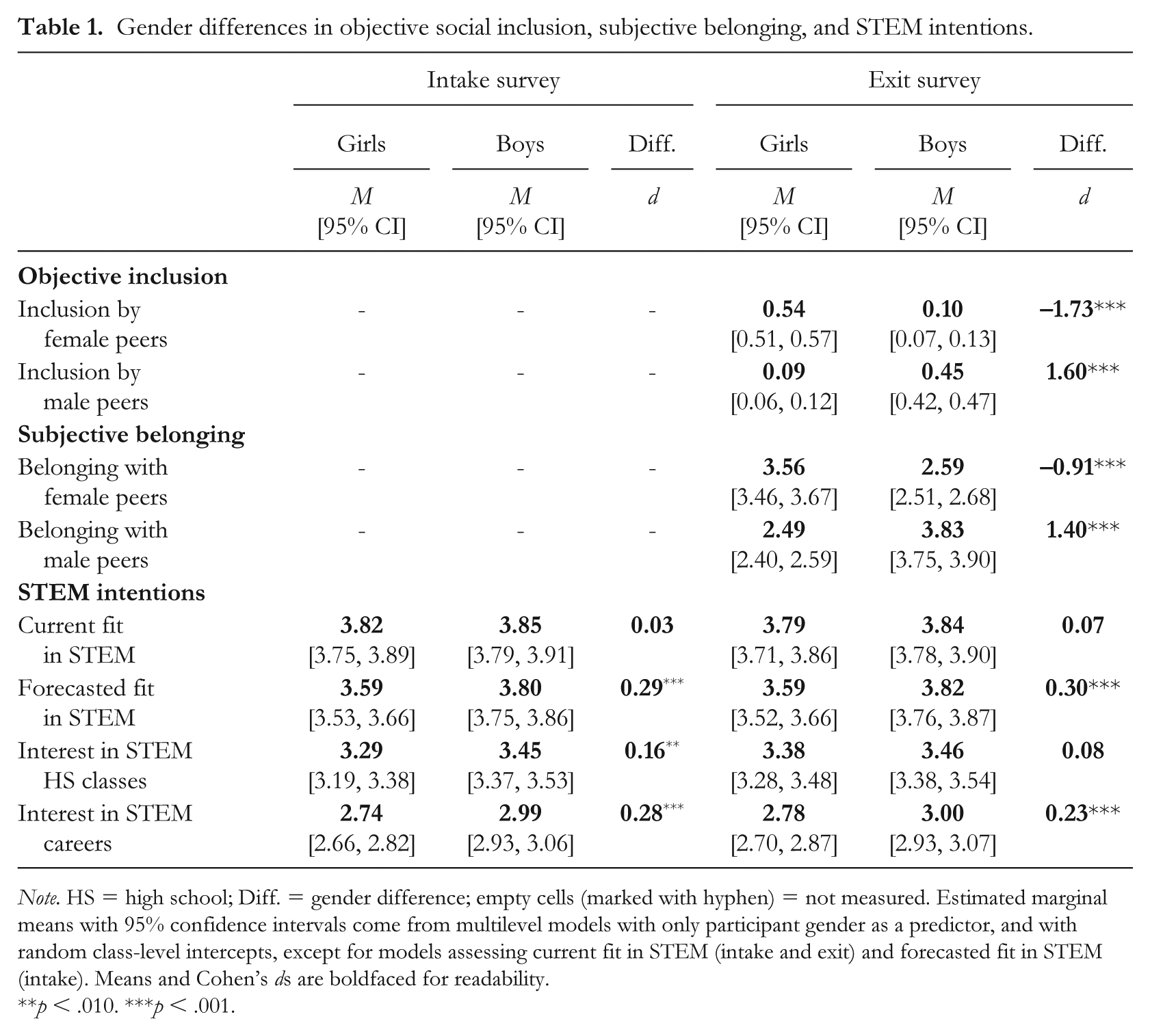
Note. HS = high school; Diff. = gender difference; empty cells (marked with hyphen) = not measured. Estimated marginal means with 95% confidence intervals come from multilevel models with only participant gender as a predictor, and with random class-level intercepts, except for models assessing current fit in STEM (intake and exit) and forecasted fit in STEM (intake). Means and Cohen’s ds are boldfaced for readability.
p < .010. ***p < .001.
Objective social inclusion
As expected, friendship nominations were highly gendered, with girls and boys receiving friendship nominations from about 50% of own-gender peers and only about 10% from different-gender peers. Specifically, when examining objective social inclusion by female peers, girls (relative to boys) were more often nominated as friends, t(1160.14) = 29.38, p < .001, d = −1.73. By contrast, when examining objective social inclusion by male peers, boys were more often nominated than girls, t(1227.27) = 28.02, p < .001, d = 1.60.
Subjective belonging
Similar gender differences emerged for belonging: Girls felt greater belonging with female peers than boys did, t(997.06) = 14.29, p < .001, d = −0.91, and boys felt greater belonging with male peers than girls did, t(1016.01) = 22.25, p < .001, d = 1.40.
STEM intentions (fit and interest)
We found inconsistent gender differences for current STEM fit and interest in high school STEM classes (i.e., the shorter term indicators). No gender differences emerged for current fit in STEM, ts < 1.14, ps > .254, and girls reported less interest than boys in high school STEM classes at the start of camp, t(1079.72) = 2.61, p = .009, d = 0.16, but not by the end of camp, t(1031.24) = 1.29, p = .197, d = 0.08.
Yet we found consistent gender differences for forecasted fit in STEM and interest in STEM careers (i.e., the longer term indicators). Girls forecasted lower future fit in STEM than boys at both the start of camp, t(1117.00) = 4.92, p < .001, d = 0.29, and the end of camp, t(1138.42) = 5.14, p < .001, d = 0.30. Similarly, girls were less interested in STEM careers at the start of camp, t(1261.57) = 4.98, p < .001, d = 0.28, and end of camp, t(1194.11) = 4.02, p < .001, d = 0.23, relative to boys.
Structural Equation Models
We used structural equation modeling to test theorized paths from peer gender-specific objective inclusion to subjective belonging to each STEM intention (see Figure 1). Given the climate faced by girls and women in STEM, we were particularly interested in the pattern of data for girls and report parallel analyses among boys as a comparison group.
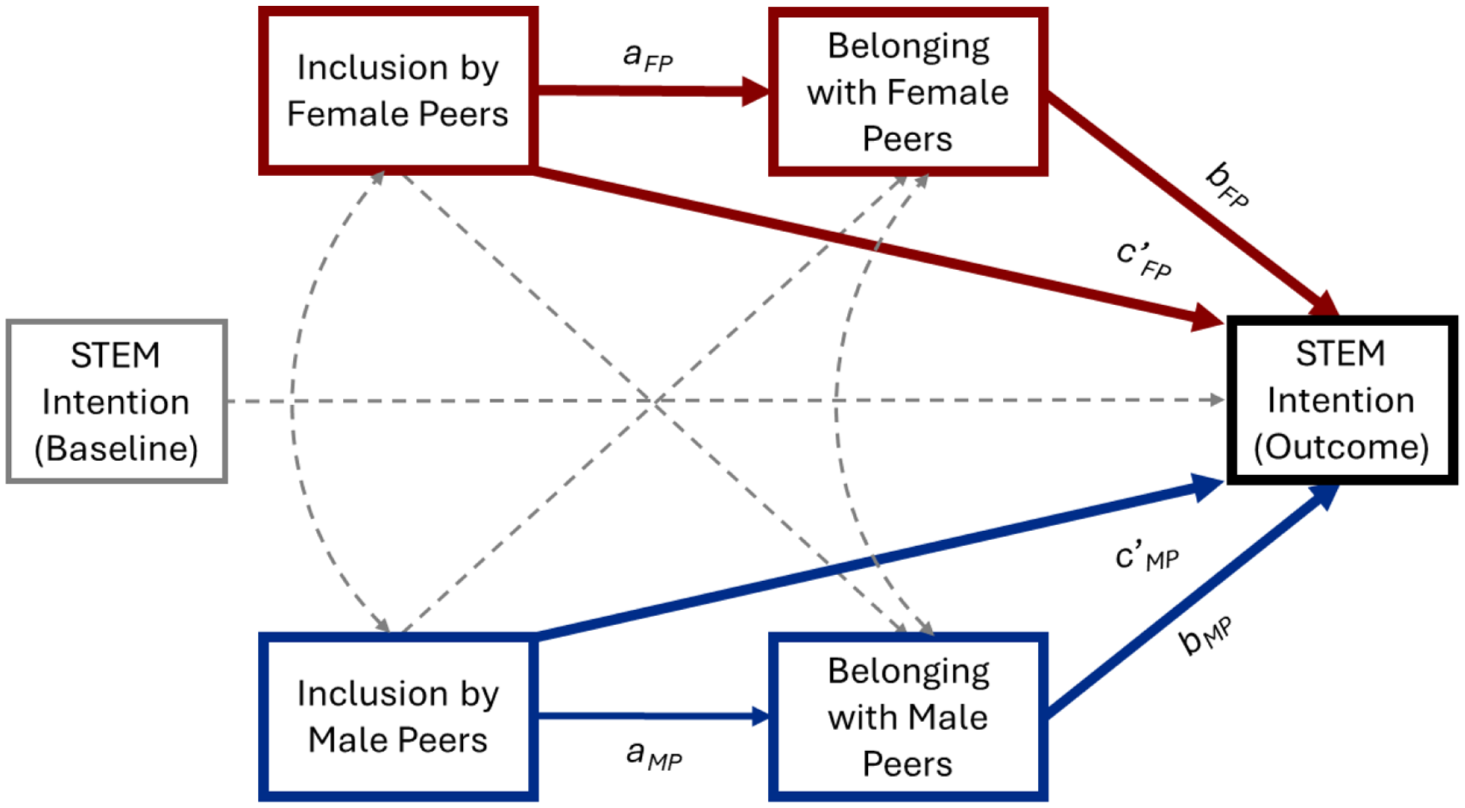
Structural equation model: Objective inclusion and subjective belonging to STEM intentions.
Objective social inclusion to subjective belonging
We first examined the initial step of our theorized model: whether girls’ (and boys’) level of objective inclusion predicted their subjective belonging with each peer gender group. We expected that being objectively included by a peer gender group would primarily translate into a greater sense of belonging with that specific group (i.e., paths aFP and aMP), but also allowed for spillover onto the other group (see supplemental section Additional Parameters From Structural Equation Models). For maximal power, these initial tests retained all participants with data on the relevant measures (regardless of missingness on the STEM intention measures), leading to 516 observations in the model assessing girls and 575 observations in the model assessing boys. Further, these reported pathways were not affected by controlling for the gender ratio of precamp best friends, as assessed by a single item (“Not including friends from camp, what proportion of your closest friends are girls and boys?”; see supplemental section Best Friendships Before Camp).
Objective inclusion by female peers was positively related to subjective belonging with female peers for both girls (b = 0.69, p < .001) and boys (b = 1.01, p = .001). Similarly, objective inclusion by male peers was related to subjective belonging with male peers. Interestingly, as indicated by nonoverlapping 95% confidence intervals (see Table 2), the aMP pathway was meaningfully stronger among girls (b = 1.73, p < .001) than among boys (b = 0.49, p < .001). Finally, nonoverlapping confidence intervals for aFP versus aMP pathways among girls indicate a tighter connection between objective inclusion and subjective belonging regarding male (vs. female) peers (see Figure 2).
Estimated paths to STEM intentions by peer and participant gender.
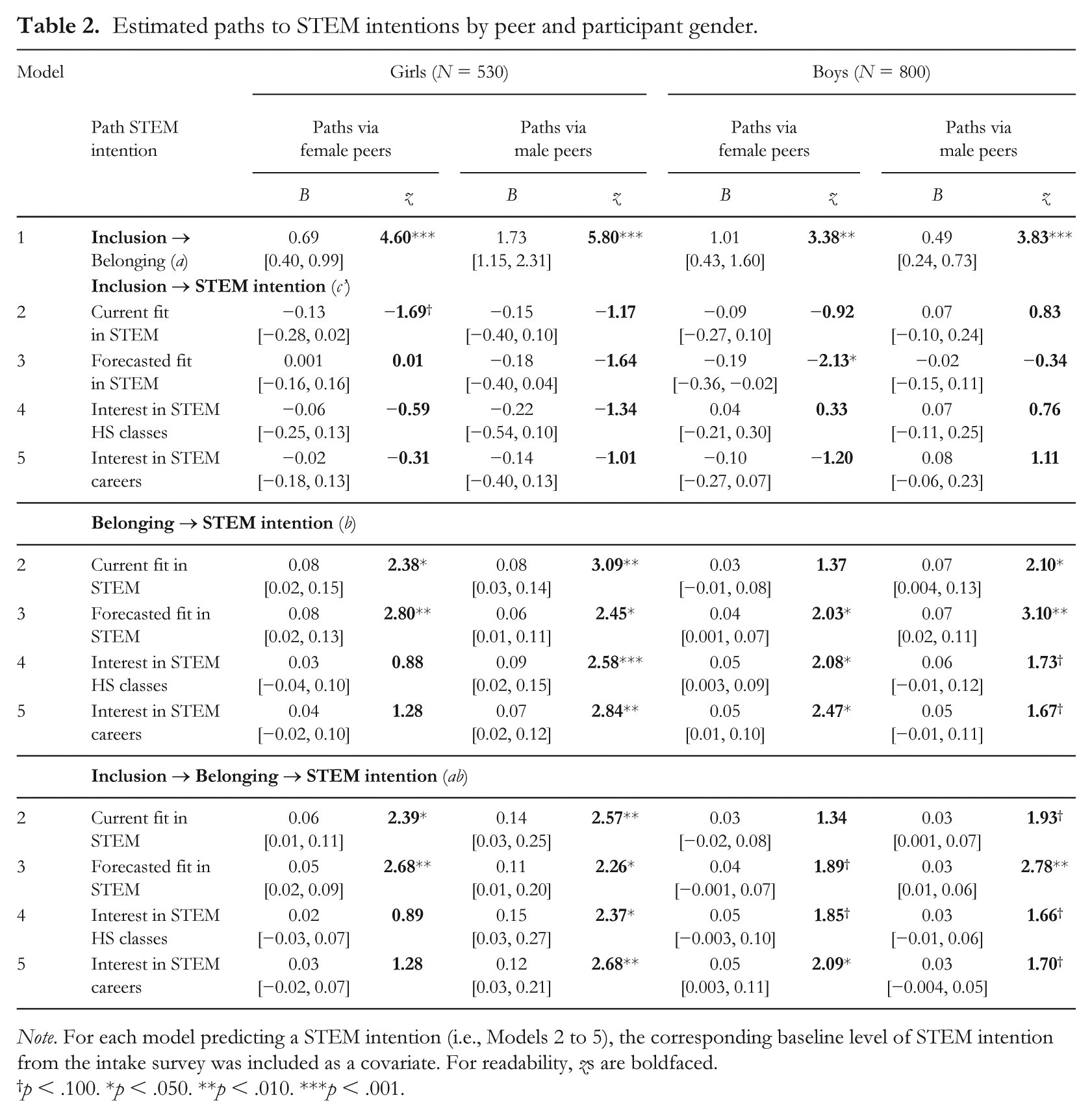
Note. For each model predicting a STEM intention (i.e., Models 2 to 5), the corresponding baseline level of STEM intention from the intake survey was included as a covariate. For readability, zs are boldfaced.
p < .100. *p < .050. **p < .010. ***p < .001.
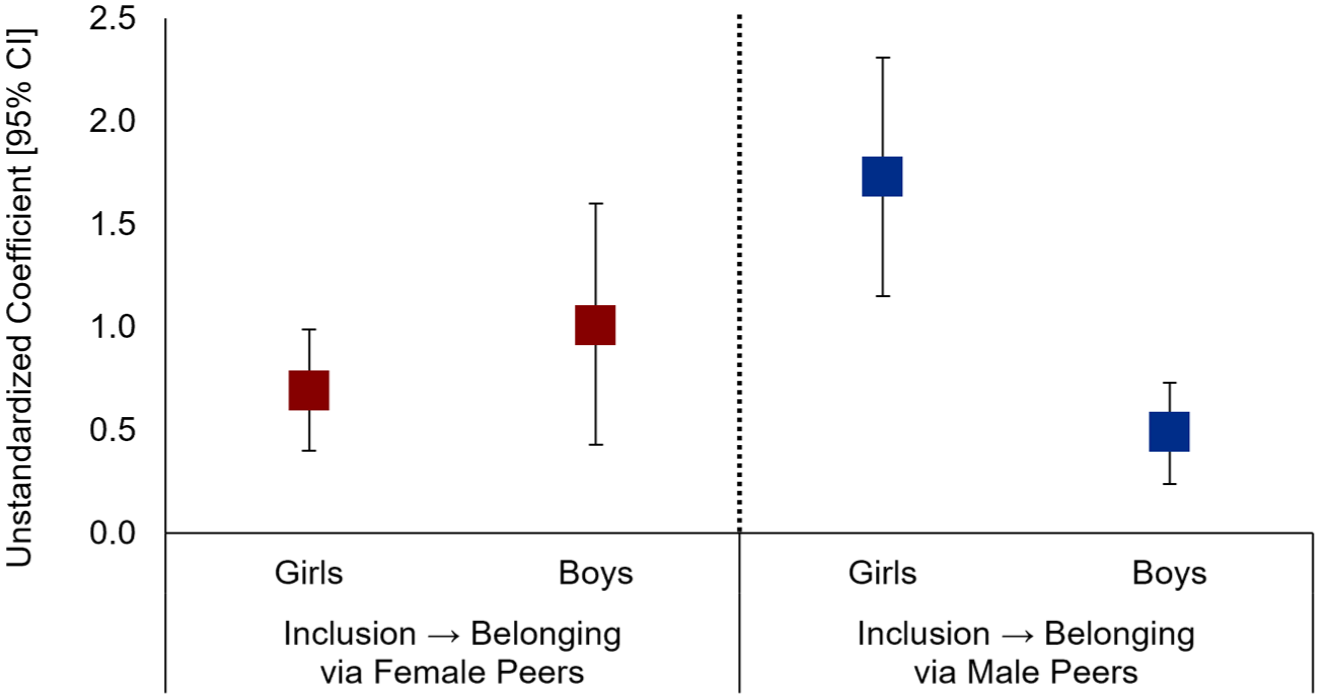
Objective social inclusion predicting subjective belonging, by gender.
Overall, these results suggest that girls (and boys) were aware of how much their peers socially included them, as their level of objective inclusion (privately reported by their peers) predicted their self-reported subjective belonging. Further, these data suggest girls had heightened attunement to their inclusion by male peers.
Connecting objective inclusion to STEM intentions via subjective belonging
We expected that being included (i.e., objective inclusion) and, to a greater extent, feeling included (i.e., subjective belonging) by peers in these STEM camps would predict intentions to pursue STEM (paths bFP and bMP, as well as c’FP and c’MP). Further, we hypothesized that the effects of being objectively included on STEM intentions would be mediated by subjective feelings of belonging. Although we expected that inclusion and belonging would be broadly associated with positive outcomes, we still tested for effects within each participant and peer gender given our specific focus on gendered barriers to girls’ STEM participation. To better isolate variance attributable to objective inclusion and subjective belonging within these week-long camps, we covaried for the corresponding baseline STEM intention in each model. See Table 2 for full results, including 95% confidence intervals. All tests come from four models (one for each STEM intention).
Objective inclusion and STEM intentions
When controlling for subjective belonging (our hypothesized mediator), all direct effects of objective inclusion onto STEM intentions (i.e., the c’FP and c’MP paths) were nonsignificant (ps > .091), with one exception: Boys who were more included by their female peers reported lower forecasted fit in STEM (b = −0.19, p = .033). Overall, we found little evidence that objective inclusion uniquely predicts STEM intentions.
Subjective belonging and STEM intentions
Regarding the relation between subjective belonging and STEM intentions (i.e., paths bFP and bMP), all effects were positive, meaning higher belonging was associated with stronger intentions to pursue STEM. However, in examining which of these positive effects were statistically significant, we see distinct patterns within each participant gender.
For girls, belonging with male peers was associated with significantly stronger current (b = 0.08, p = .002) and forecasted (b = 0.06, p = .014) fit in STEM, as well as greater interest in STEM high school classes (b = 0.09, p = .010) and STEM careers (b = 0.07, p = .004). Although girls’ subjective belonging with female peers was significantly associated with their current (b = 0.08, p = .017) and forecasted (b = 0.08, p = .005) fit in STEM, it was not significantly associated with their interest in STEM classes or STEM careers (ps > .201).
For boys, belonging with female peers was significantly associated with forecasted fit in STEM (b = 0.04, p = .042), as well as interest in STEM high school classes (b = 0.05, p = .037) and STEM careers (b = 0.05, p = .013), but not current fit in STEM (p = .169). Boys’ belonging with male peers was significantly associated with current (b = 0.07, p = .036) and forecasted (b = 0.07, p = .002) fit in STEM, but with neither STEM interest measure (ps > .083).
In summary, for girls, belonging with female peers may contribute to STEM fit but not STEM interest, whereas belonging with male peers may help to lay the groundwork for girls’ fit and interest in STEM. For boys, the pattern of associations between subjective belonging and STEM intentions was somewhat less clear.
Indirect effects
Finally, we examined the extent to which objective inclusion (by female or male peers) was associated with girls’ and boys’ STEM intentions, mediated via subjective belonging, again with female or male peers (paths aFPbFP and aMPbMP). See results including 95% confidence intervals in Figure 3 and Table 2.
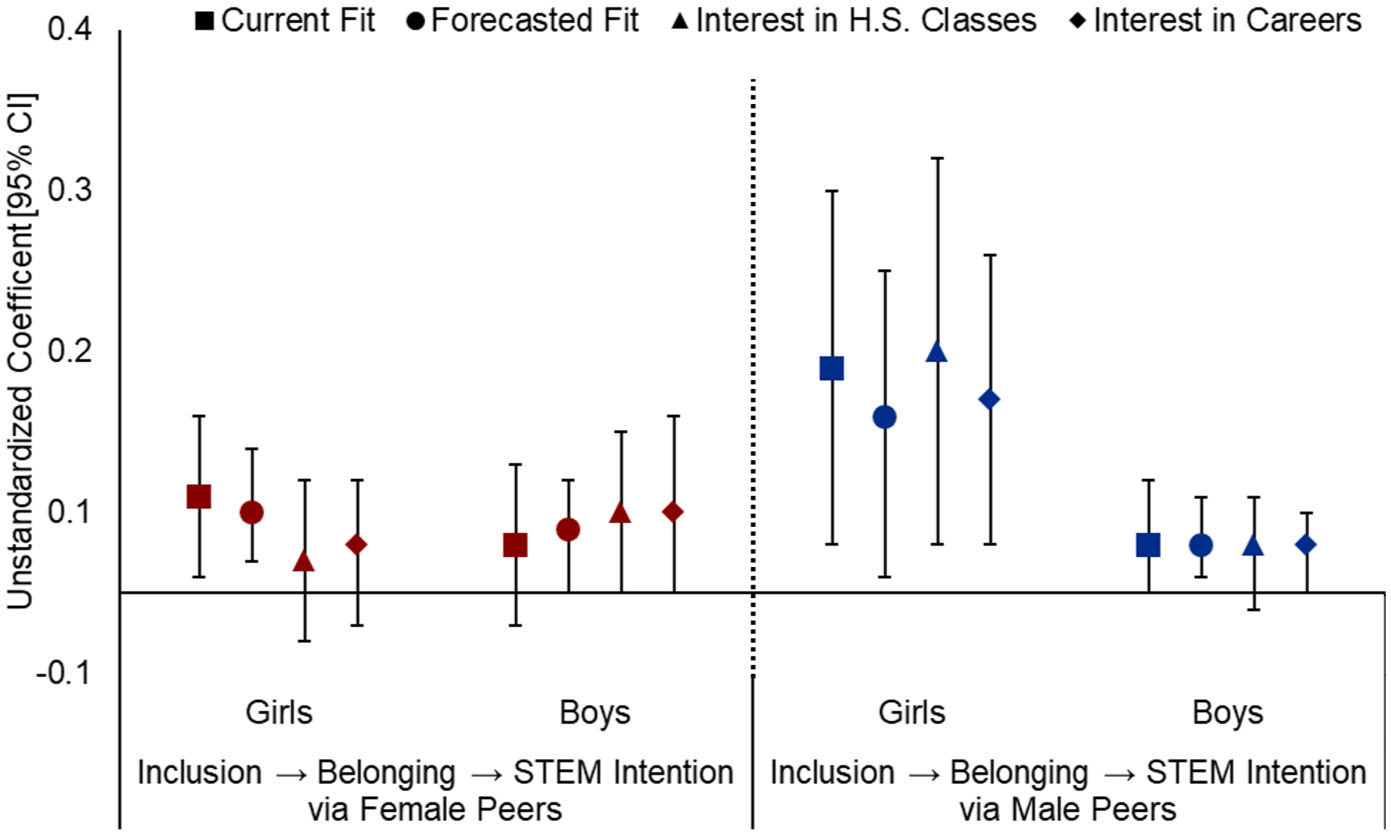
Estimates for indirect effects of objective inclusion on STEM intentions via subjective belonging, by gender.
For girls, we found evidence that inclusion by male peers predicted all four STEM intentions via subjective belonging, with significant indirect effects emerging for current fit in STEM (b = 0.14, p = .010), forecasted fit in STEM (b = 0.11, p = .024), interest in STEM high school classes (b = 0.15, p = .018), and interest in STEM careers (b = 0.12, p = .007). Indirect effects via belonging with female peers were significant for current fit (b = 0.06, p = .017) and forecasted fit in STEM (b = 0.05, p = .007), but not for either STEM interest measure (ps > .200).
For boys, we found significant indirect effects of inclusion by male peers via belonging with male peers on boys’ forecasted fit in STEM (b = 0.03, p = .005), and from inclusion by female peers via belonging with female peers on boys’ STEM career interests (b = 0.05, p = .036). Note also that five of the remaining six effects for boys were marginally significant andin the same direction (see Table 2).
Overall, girls may have particularly positive STEM-related intentions—STEM fit and interest—when their male peers include them as friends. The more mixed findings for boys are suggestive that boys’ STEM intentions are relatively less related to their friendships.
Discussion
The key goal of this research was to increase our scientific understanding of the ways that friendships might support girls’ intentions to pursue STEM, through their sense of social belonging. Using a large field sample (N = 1,330), we mapped naturalistic friendship networks in STEM summer camps onto girls’ and boys’ sense of belonging with their peers and intentions to pursue STEM. As expected, girls reported weaker intentions to pursue STEM than boys, both at the start and end of the week-long camp sessions. Further, being nominated as a friend by a high proportion of male peers held the most consistent predictive power for STEM intentions for girls (mediated via belonging). This finding suggests that mixed-gender friendships may hold unique benefits for girls in STEM environments. In comparison, boys’ STEM intentions were less consistently associated with their level of social inclusion. Taken together, these findings provide evidence that naturalistic friendship patterns in STEM settings meaningfully predict girls’ beliefs about their futures in STEM, mediated through subjective belonging.
Connecting Friendship Networks and STEM Intentions
There is reason to believe that strong social integration in early STEM environments can carry long-term benefits for STEM education and career decisions. In our research, we examined the social integration of girls and boys attending STEM summer camps. Specifically, we leveraged two types of participant-level measures of the social environment: one objective measure (“inclusion”; an indegree metric calculating the percentage of friend nominations they received from female peers and from male peers) and one subjective measure (“belonging”; self-reported sense of belonging with female peers and with male peers). As expected, these two types of measures were positively linked. Although it is logical that being included is associated with feeling included, this finding demonstrates the practical benefits of gathering social network data to go beyond participants’ self-reports. Indeed, by aggregating multiple perspectives on each participant, indegree is a reasonably objective measure of inclusion—distinct from individual psychometric differences that could concurrently affect self-reported belonging and self-reported STEM intentions. As seen in the supplemental section Defining Social Inclusion as Outdegree, a self-report-based metric of social inclusion, outdegree, is even more tightly connected to the self-reported measures of social belonging. That said, we maintain that indegree (vs. outdegree) is a truer measure of objective social inclusion, distinct from the biases associated with comparing multiple self-report measures all generated from the same person. Our indegree measure extracted instead from friendship networks (i.e., how many times peers nominated a person as a friend) lends core strength to our theorized model, as we demonstrate that an externally measured social dynamic is indirectly associated with girls’, and to a lesser extent boys’, STEM intentions.
Further, naturalistic friendship patterns were related to STEM intentions via their pairing with self-reported subjective belonging. Few prior works have directly connected measures of objective inclusion to academic motivation (e.g., Thomas, 2000), and we went beyond these previous findings in three main ways. First, we took a developmental perspective to demonstrate the importance of friendship networks even among youth. Specifically, we found that girls’ long-term assessments regarding their STEM intentions were related to their objective social inclusion at least as early as 12 years of age, mediated through their subjective belonging. Second, we demonstrate the importance of considering the group-based nature of friendships, by using distinct measures regarding relationships with female peers versus male peers. Group-based friendship metrics may be especially important when considering members of underrepresented and marginalized groups, such as girls in STEM. Indeed, our pattern of findings suggests that girls’ friendships—especially those with male peers—may be a critical lever toward closing the gender gap in STEM. Third, we provide practical suggestions for others attempting to connect real-world friendship networks to inner cognitions. Our work suggests that any social network analysis attempting to link objective inclusion (or related constructs) to a fit or interest outcome would be nicely complemented by a subjective measure of belonging as a mediator. Future work could tease out whether mere implicit awareness of objective inclusion (i.e., a more subtle version of our self-reported subjective belonging measure) might be a sufficient mediator.
Gendered Experiences in STEM
Consistent with prior findings (e.g., Lambert et al., 2013; Walton et al., 2023), we found that feeling included (across peer gender groups) may have downstream benefits for STEM intentions. Yet some nuanced differences emerged when separately examining girls’ and boys’ experiences with female versus male peers. Stepping back to consider the links between objective social inclusion and subjective belonging, we found the strongest relation between girls’ inclusion by male peers and their sense of belonging with male peers. Further, we found that belonging with male peers was especially predictive of girls’ STEM intentions. By contrast, we found a less clear pattern of effects for boys.
These gender differences are in line with our initial theorizing that overall social dynamics would have relatively more impact on girls’ (vs. boys’) decisions regarding their long-term futures in STEM. As expected, building supportive friendships with outgroup members might be a particularly fruitful lever for future intervention work—one that provides clear benefits for the marginalized group, as well as potential dividends for the historically more advantaged group. Educators and interventionists could consider how to bolster friendships between girls and boys, and across other group divides, especially in spaces with group imbalances. Relatedly, our prior work demonstrates that boys with fewer stereotypic beliefs regarding girls’ STEM ability are more socially included by female peers (Cyr et al., 2024). Future research might aim to directly connect boys’ beliefs to the STEM outcomes of their female peers.
Finally, although we had the benefit of studying entirely naturalistic friendship patterns, such a design constrains causal conclusions. Questions may linger regarding whether friendships per se increase STEM intentions or whether the reverse is true. Indeed, concerns about directionality motivated us to control for baseline STEM intentions when using objective social inclusion and subjective belonging to predict downstream STEM fit and interest. Results of these models align with our theorized account that social network dynamics flow into individual-level STEM intentions via belonging—in contrast to a plausible alternative account that baseline STEM intentions affect the social network (e.g., girls high in baseline STEM interest may be more likely to form friendships with male peers in STEM).
To examine the distinct question of how STEM intentions affect one’s social behavior toward others, future research in a more controlled social environment may be warranted, for example, by including some approximation of baseline sociometric data, which was not available in the current research. Relatedly, we found that controlling for the gender ratio of precamp best friends did not affect our theorized path model results, as seen in the supplemental section Best Friendships Before Camp. These findings further strengthen our account that intervening at the level of short-term friendship networks could produce long-lasting and robust outcomes. Yet from a practical perspective, in situations with limited resources or ability to conduct interventions to influence friendship networks, directly improving feelings of belonging may be a sufficiently useful strategy.
Constraints on Generalizability
These summer camps were all focused on STEM-related education, which allowed us to test our hypotheses but also constrains the generalizability of our findings to other environments in several ways. First, this sample is likely to be relatively high in STEM intentions (as compared to the general population). Additionally, STEM is a notably male-typed domain, with men and women being quicker to associate men (vs. women) with STEM (Charlesworth & Banaji, 2019; Cyr et al., 2021; Nosek et al., 2007), and biased assumptions regarding who has aptitude for STEM emerging as early as age 6 (Bian et al., 2017). Indeed, we expect that these gendered barriers in STEM combine with androcentric societal expectancies to produce the specific benefits of male peers including girls in STEM. Future research could examine the extent to which benefits of girls’ inclusion by male peers are primarily driven by overarching macro-level societal forces versus more meso-level cultures within specific STEM environments.
Our findings also limit our ability to make inferences regarding gendered friendships in female-typed or more gender-neutral domains. Although we found a stronger pattern of effects for girls in the stereotypically male domain of STEM, it remains to be seen the extent to which girls’ overarching tendencies toward “person orientation” (Graziano et al., 2012) lead to an overall boost in sensitivity to social dynamics distinct from the gendered nature of the domain. Interestingly, initial work regarding HEED (healthcare, early education, and domestic work) suggests that men’s lower interest in HEED is partially explained by their low expectations regarding belonging (Tellhed et al., 2017), lending support for the hypothesis that inclusion and belonging particularly affect the educational and career decisions of those underrepresented within specific contexts. Such work might also be helpful in examining populations of boys who may be particularly oriented toward, or sensitive to, social dynamics and communal goals. Future work could extend our findings by teasing apart the potentiality for distinct effects of men and boys in HEED being, or feeling, socially included by female versus male peers.
Further, an intersectional approach considering the racial/ethnic composition of the friendship network may provide important new insights. With a large majority of our participants identifying as White or East Asian, we did not have sufficient granularity to examine racial/ethnic groups negatively stereotyped in STEM. Drawing from past work showing that racial minorities may especially benefit from intergroup contact (Shook & Clay, 2012), we suspect that negatively stereotyped racial groups would likely see similar effects as those noted among girls in our sample. Future work could additionally examine intersectional experiences (e.g., girls from negatively stereotyped racial groups) as well as those outside the gender binary.
Conclusions
Our large field study demonstrates the importance of considering how peer friendships in early STEM education are related to gender gaps in STEM intentions. Girls reported weaker STEM intentions than boys. However, being socially included by male peers in these STEM summer camps was particularly associated with girls’ subjective belonging, which in turn predicted more positive STEM intentions. Overall, these findings suggest that encouraging genuine friendships, insofar as they boost feelings of belonging, may be a key lever for strengthening girls’ intentions to pursue STEM. As such, improving the overall social environment within early STEM education, with a focus on social connection, could provide benefits to the long-term persistence and representation of girls and women in STEM.
Supplemental Material
sj-docx-1-gpi-10.1177_13684302251385462 – Supplemental material for Friendship networks predict girls’ STEM fit and interest through subjective belonging
Supplemental material, sj-docx-1-gpi-10.1177_13684302251385462 for Friendship networks predict girls’ STEM fit and interest through subjective belonging by Emily N. Cyr, Jennifer R. Steele, Toni Schmader, Kayla Robinson, Stephen C. Wright, Steven J. Spencer and Hilary B. Bergsieker in Group Processes & Intergroup Relations
Footnotes
Acknowledgements
We thank organizational liaisons Alicia Ward, Caity Dyck, Emily Ritz, Jakob Manning, Jess Crawford-Brown, Leanne Predote, Soundous Ettayebi, and Virginia Hall. We also thank the members of the “SPI lab” for comments on earlier drafts.
AI Declarations
Artificial intelligence was not used in any part of this research.
Data Availability Statement

Ethical Approval
All materials are in the Supplement Material as approved by the research ethics boards at the University of Waterloo, Simon Fraser University, and the University of British Columbia. We report all exclusions (see Method) and prior field interventions (see Supplemental Material).
Funding
The authors disclosed receipt of the following financial support for the research, authorship, and/or publication of this article: Funding was provided by a Social Sciences and Humanities Research Council (SSHRC) of Canada Partnership Grant (#895-2017-1025); the Faculty of Arts and Social Sciences at Simon Fraser University; the Provost and Faculty of Arts at the University of Waterloo; and the International Work Learn Award and the Faculties of Science and Applied Science at the University of Waterloo.
Preregistrations
This analytic plan was not preregistered.
Supplemental Material
Supplemental material for this article is available online.
References
Supplementary Material
Please find the following supplemental material available below.
For Open Access articles published under a Creative Commons License, all supplemental material carries the same license as the article it is associated with.
For non-Open Access articles published, all supplemental material carries a non-exclusive license, and permission requests for re-use of supplemental material or any part of supplemental material shall be sent directly to the copyright owner as specified in the copyright notice associated with the article.
