




Abstract
Black racial justice activists often report that White activists engage in more tepid activism that fails to directly point out systemic racism. We examined whether this trend manifested in professional athletes’ decisions regarding social justice messages they display on their uniforms. We tested whether the helmet decal (NFL) and jersey slogan (NBA) choices made by athletes as they participated in league-wide uniform modifications to promote social justice differed as a function of player race. We found that White NFL players were less likely than Black NFL players to choose specific victim names (e.g., “Breonna Taylor”), were more likely to choose generic phrases de-emphasizing racism (e.g., “It Takes All of Us”), and were less likely to choose generic phrases highlighting racism (e.g., “End Racism”). Similarly, White NBA players were more likely than Black NBA players to choose phrases that de-emphasized racism (e.g., “Peace”), and less likely to choose those that emphasized racism (e.g., “Antiracist”).
The United States (US) has been marked by the struggle for racial equality and justice for Black people since its inception (Sitkoff, 2010). This struggle has taken multiple forms, including notable cultural touchstones such as Nat Turner’s revolt and other slave uprisings (Boggus, 2006), and the Civil Rights Movement of the 1950s and 1960s (Morris, 1986). Recently, the push for equality took on the identity of Black Lives Matter. The Black Lives Matter movement started on social media in 2013 after the acquittal of George Zimmerman in the shooting death of unarmed teen Trayvon Martin (Ross, 2015). From there, the movement grew in social and political prominence, particularly as the news of killings of Black community members by police (e.g., Eric Garner, Michael Brown, Tamir Rice, George Floyd, Breonna Taylor) were highly reported in mainstream media. Additionally, societal movements toward racial justice and reform of social institutions (e.g., the carceral system) gained a large amount of support (Russonello, 2020). In the summer of 2020, in the midst of the global pandemic, an estimated 15–26 million people gathered across the US, and were joined by millions more throughout the world, to protest systemic racial injustice, particularly when it came to interactions with the police, making the Black Lives Matter movement the largest in U.S. history (Buchanan et al., 2020).
Although a majority of Americans across racial groups have supported the push for racial equality (Parker et al., 2020), there is varying support for the Black Lives Matter movement by racial group; at its height, Black Americans (86%) supported the movement more so than did people of other races, particularly White Americans (60%; Parker et al., 2020). Still, much of what researchers know about the present state of activism for racial equality comes from surveys/polls (e.g., Mac Intosh et al., 2020; Parker et al., 2020), reporter observations (e.g., Buchanan et al., 2020), and interviews with activists (e.g., Lee & Cunningham, 2019). Lacking are behavioral data to examine whether observable activism choices differ as a function of race. To fill this gap, we examine one very public form of activism: professional athletes’ decisions regarding the social justice messages they display on their uniforms. Consistently, we use a broad definition of racial activism for this paper, which includes all activities aimed at publicly promoting the cause of racial equality, both sanctioned (e.g., wearing uniform slogans) and unsanctioned (e.g., walk-outs, protests). Additionally, we examine such activism against broadly defined anti-Black racism, which includes all forms of interpersonal, systemic, and structural racial inequities and inequalities faced by Black people in the US. That is, we include in our definition of antiracist activism any public-facing message promoting Black racial equality and equity.
Athlete Antiracist Activism
Some of the most prominent and public displays of antiracist protest have occurred among professional athletes. Indeed, athletes are often at the forefront of the push for social justice (Thomas & Neuhaus, 2024; Wiener, 2019). Dating back decades, athletes like Kareem Abdul-Jabbar (Lapchick, 2023; J. M. Smith, 2009), Bill Russell (Hartwell, 2023), and Muhammad Ali (Ezra, 2001) used their position in sport and their celebrity as a platform to promote racial equality (Messersmith, 2021) and civil rights (McCormick, 2016). Indeed, many readers may recall the iconic Civil-Rights-Movement image of sprinters Tommie Smith and John Carlos raising their fists during their medal awards ceremony at the 1968 Olympic Games (Hartmann, 2003; Peterson, 2009; Posley, 2017). In 2012, after the shooting of Trayvon Martin, an unarmed teenager who was shot by a neighborhood watch member who had reported to emergency operators a suspicious person looking “up to no good” who was wearing a “dark hoodie,” 13 members of the Miami Heat dressed in hoodies for a photo, posting messages online like “We Are Trayvon” (Wallace, 2012). Of course, these actions sometimes come with criticism and negative consequences for the athletes. For instance, Smith and Carlos were expelled from the 1968 Olympic Games. More recently, National Football League (NFL) quarterback Colin Kaepernick kneeled during the national anthem before games in 2016 to protest police brutality toward Black Americans and racial inequality in the US. Kaepernick was also joined by U.S. women’s national soccer team star Megan Rapinoe who, in an online essay, noted that she was “kneeling because I have to do something” (Rapinoe, 2016). At the time, both faced sizable backlash from those who believed they were disrespecting the US and its military (Boykoff & Carrington, 2020; Intravia et al., 2020; Rapinoe, 2020; Schmidt et al., 2019; Surya, 2019). While Rapinoe weathered this storm and went on to captain the U.S. women’s national team for several more years, Kaepernick lost his job as a professional football quarterback as a result of his kneeling protests (Robinson, 2020).
Less than 5 years later, as the Black Lives Matter movement became more prominent, kneeling for the anthem became de facto in select professional sports (e.g., in the Women’s National Basketball Association, Vasilogambros, 2016; and the National Women’s Soccer League, Young, 2020), and athletes even staged large-scale strikes to support the push for racial justice (Pickman, 2020). As athletes have increasingly become more engaged in public protest, many athletic associations and leagues started to allow players to actively protest and even set up systems for players to wear items that support racial justice on their uniform (Gerson, 2020; Minutaglio, 2020; Vasilogambros, 2016; Young, 2020; Zillgitt, 2020).
For instance, in 2020, the NFL launched the “It Takes All of Us” campaign for their 101st season to “integrat[e] the important causes vital to players and fans, such as social justice . . . throughout the season” (NFL, 2020). As part of this initiative, the NFL painted the border of their end zones with the phrases “It Takes All of Us” and “End Racism” (Gordon, 2020). Additionally, they allowed players to elect to replace the team decal on the back of their helmet with a preapproved social justice phrase that could either be a specific victim of (mostly racial) violence (e.g., Breonna Taylor, George Floyd, Ahmaud Arbery) or one of four approved generic phrases: “It Takes All of Us,” “End Racism,” “Stop Hate,” and “Black Lives Matter” (“Source: NFL Planning to Allow,” 2020). Similarly, the National Basketball Association (NBA) painted “Black Lives Matter” on its courts (Lowe & Shelburne, 2020) and formed a social justice coalition with its players’ association (NBA, 2020). Like the NFL, during their 2020 season, they also allowed players to select from a set of approved messages to wear on their jerseys, including messages like “Black Lives Matter,” “Say Their Names,” “Equality,” and “Vote.” In the present study, we examine NBA and NFL players’ decisions regarding which social justice messages to wear on their uniform, with a particular focus on differences in Black and White players’ decisions.
Potential Differences in White and Black Activist Behavior
Theoretically speaking, several accounts of activism and human behavior more broadly suggest that Black and White athletes might differ in their choices of social justice messages. First, Black and White activists occupy different positions in the broader racial activism space (Gorski, 2019; Gorski & Erakat, 2019). Although all activists who work toward racial justice may share goals for society at large, Black and White activists’ own racial identity positions them differently within those movements (Berg & Simon, 2013; DiAngelo, 2018; Gorski & Erakat, 2019; Sullivan, 2014). Indeed, although achieving racial equality is good for everyone, the personal benefits for Black activists might be more immediately obvious than those for White activists. Whereas Black activists are working to improve conditions for themselves and other members of their racial in-group, White activists are working to improve conditions for racial out-group members, often in a way that necessitates condemnation of their own in-group (Eichstedt, 2001). As a result, Blackness and antiracist activism are mostly complementary identities, but Whiteness can feel and be problematic in antiracist activism (Gorski, 2019; Gorski & Erakat, 2019; Hughey, 2012).
Second, when engaging in activism, White antiracist activists can face a multiple-audience problem (Fleming, 1994; Fleming et al., 1990)—wanting to present themselves as staunch activists to other activists and racial out-group members, but also wanting to preserve goodwill with racial in-group members, who often have norms of not discussing race and racism (Eichstedt, 2001; Gorski, 2019; Gorski & Erakat, 2019; Hughey, 2012). That is, White antiracism activists simultaneously perceive stigma from other activists and racial out-group members for their Whiteness, White privilege, and inaction on racial justice, while also perceiving stigma from racial in-group members for violating social norms by taking action on racial justice (Hughey, 2012). As a result, when they engage in activism, White people will sometimes choose actions that are less radical and may seem more tepid than their Black counterparts’ actions (Gorski & Erakat, 2019). As one Black activist that was interviewed in Gorski & Erakat (2019) put it: “a lot of White folks want to benefit from [identifying with racial justice] . . . But they don’t want to call [racism] out because they don’t want to hurt anyone’s feelings. They don’t want to press it” (p. 798).
This multiple-audience problem is likely exacerbated for White athletes, who might worry about offending their Black teammates and fans by failing to take a stand, while simultaneously worrying about offending their White teammates and fans as well as their White family and friends. And perhaps this concern is valid; an econometric analysis of NFL attendance during the 2016 season, the first in which Colin Kaepernick kneeled during the national anthem, showed that higher level of racial bias in a market was related to a decline in consumer interest in attending games (Watanabe & Cunningham, 2020), and found similar trends for attendance at college stadiums after college football teams engaged in protest (Watanabe et al., 2019). Consistently, research broadly shows that fans reject athletes who engage in social justice messaging that conflicts with their own worldviews/opinions (Brown et al., 2022; Mac Intosh et al., 2020; Mudrick et al., 2019; B. Smith & Tryce, 2019; L. Smith, 2019), and suggests that White fans’ emotional reactions to athlete activism are stronger when a White athlete is engaging in the activism (L. Smith, 2019). Consistently, we suspect that when given the opportunity, White athletes will engage in activism, but that their participation will be less active than that of their Black counterparts—failing to overtly call out racism specifically and to de-emphasize their personal contribution to the push for social justice. Such behavior would be consistent with an idea of more performative allyship—that is, “easy and costless actions that do not challenge the status quo and are motivated primarily by the desire to accrue personal benefits” (Kutlaca & Radke, 2023). Performative allies are people who engage in action that make them seem like allies in a push for social justice—sometimes considered a form of “virtue signaling”—without doing meaningful work to advance the cause.
Related to this last point, research and theorizing suggest that, at least to some extent, White players, as members of an advantaged group, might be motivated to participate in allyship behavior for selfish reasons, in a way that benefits themselves or their own in-group (Kutlaca & Radke, 2023; Radke et al., 2020). Indeed, a variety of research suggests that some advantaged-group activism (e.g., White activism in favor of racial equality) is particularly likely to occur when the benefits of participation outweigh the costs (Van Zomeren & Spears, 2009). By engaging in a more tepid form of action—that does not specifically call out racism—White players can avoid the costs of seeming like they are not an ally to their Black teammates as well as the costs of seeming like they are anti-White to their White family, friends, and fans, while still reaping the benefit of appearing socially conscious and engaged in pushing society to be better (Radke et al., 2020).
Of course, in addition to being more likely to be performative allies, on average, White people are also less likely to be in favor of pushes for racial justice and more likely to hold anti-Black attitudes themselves (Horowitz et al., 2019). As such, when they are given opportunities to participate in social justice movements, they might simply be milder because they do not support the movement, or because they support the movement in the abstract but their concern does not rise to the level of willingness to engage in concrete action. Moreover, if there are social norms of participation in social justice movements, they may participate in more moderate ways to fit in with the group (i.e., their teammates) without having to actually do anything substantive with which they do not privately agree.
This line of thinking is consistent with the finding that, compared to Black people, White people are more likely to endorse a “colorblind” racial ideology (Plaut et al., 2011; Ryan et al., 2007; Verkuyten, 2005). In contrast with the multicultural perspective that attaining equality requires acknowledging and appreciating group differences, colorblind ideology holds that equality is best achieved by downplaying group differences (Rattan & Ambady, 2013). This ideology is succinctly and clearly exemplified in the slogan “we’re all one race—the human race.” Other perspectives on colorblind ideology go even further and hold that, in addition to the perspective that race should not matter, individuals who subscribe to colorblind ideology also believe that race does not matter (i.e., a denial of racism and its influence on Black people’s everyday lives; Neville et al., 2000).
In sum, whereas Black athletes are directly negatively affected by racism, and thus should be likely to stand against it, White athletes are likely to face a variety of barriers to directly calling out racism, including (a) a social identity that conflicts with antiracism (Hughey, 2012), (b) a multiple-audience problem when it comes to drawing attention to racism (Gorski & Erakat, 2019), (c) colorblind ideologies that make them want to minimize racism (Ryan et al., 2007), (d) or even hostile racial attitudes that deter them from participating in racial protest (Horowitz et al., 2019).
In the present paper, we examine whether the social justice decal and jersey messages chosen by NFL and NBA players differ between White and Black professional athletes. Specifically, we examine whether Black players are more likely than White players to choose social justice messages that specifically call out racism. We do so by investigating the helmet decal choices made by the players on three NFL teams, and the jersey slogan choices made by all players in the NBA.
As mentioned earlier, NFL players during the 2019–2020 season could choose to include a helmet decal that mentioned a specific victim of racialized violence (e.g., Breonna Taylor, George Floyd, Ahmaud Arbery) or one of four approved generic phrases: “It Takes All of Us,” “End Racism,” “Stop Hate,” and “Black Lives Matter.” We predicted that White players would be less likely than Black players to choose specific victim names (Hypothesis 1) and, when choosing generic phrases, would be more likely than Black players to choose the generic phrases that de-emphasize racism (i.e., “It Takes All of Us” and “Stop Hate”) than those that emphasize racism (i.e., “End Racism” and “Black Lives Matter”; Hypothesis 2).
NBA players had the choice of 27 phrases to put on the back of their jersey in place of their last name. Approximately half of the phrases explicitly emphasized racism (e.g., “Antiracist,” “Black Lives Matter,” “Say Their Names”), whereas half did not (e.g., “Equality,” “Peace,” “Vote”). We expected that White players would be less likely than Black players to choose phrases that emphasized racism (Hypothesis 3).
Method
All data are available at the Open Science Framework (OSF; https://osf.io/967kp/). Preregistration of all methods and analyses are available online (NFL: https://osf.io/6vxzn/ and NBA: https://osf.io/3x98n/).
Participants
We examined the helmet decal social justice message decisions of 159 NFL players on the active rosters of the Atlanta Falcons (Ledbetter, 2020), Denver Broncos (Denver Broncos, 2020), and Buffalo Bills (Skurski, 2020) during Week 1 of the 101st NFL season. These three teams were the only teams who provided full rosters of their players’ decal decisions publicly and, as such, were the only ones for which the behavior of the entire rostered team was observable. We copied the full active team rosters for the first week of the NFL season from the teams’ websites.
We also examined the jersey social justice message decisions of 383 NBA players across all 22 teams who were rostered for the season restart of the NBA in July 2020 (Zillgitt, 2020). 1 We downloaded the full rosters from the teams’ websites. For the purpose of this study, we focus primarily on Black (NBA = 81.2%; NFL = 67.1%) and White (NBA = 18.1%; NFL = 29.1%) players, and do not discuss other players (e.g., Asian players), of whom there were very few (NBA = 0.8%; NFL = 3.8%; n = 9 total). With 156 White and Black NFL players, we had statistical power of 1 − B = .80 to detect an effect of Φ ~.23 at α = .05; with 380 White and Black NBA players, we had statistical power of 1 − B = .80 to detect an effect of Φ ~.15 at α = .05.
Measures and Coding
The first author (a White woman) coded all data. Additionally, two trained coders (both Latina women) coded the race of the players and helped to confirm the sorting of the NBA social justice messages.
Player race
We coded race visually by examining the roster picture of the players as either Black, White, or other (e.g., East Asian, South Asian, Pacific Islander). When we were unsure of the player’s race, we conducted Google searches to find reports on the player’s race and/or their parents’ race. In the case that the first author and a rater did not agree on a person’s race (n = 3; 99.5% agreement), additional Google searches were conducted, and a decision was made together. These racial categories may not necessarily match how a player personally identifies; however, in the absence of the ability to ask the players about their racial identity, we believe they likely reflect society’s view of the players and thus, at least to some extent, their experience (Blair & Judd, 2011; Blair et al., 2004; Halberstadt et al., 2011; Ho et al., 2011; Sanchez & Bonam, 2009; Shih et al., 2007).
NFL messages
We coded whether each player chose to wear a helmet decal (71.5%) or not (28.5%). Next, among those phrases chosen, we coded whether the phrase chosen was a name (35.4%) or not (64.6%). Then, among the generic phrases chosen, we coded whether the phrase mentioned racism (i.e., “End Racism” and “Black Lives Matter”; 42.5%) or not (i.e., “It Takes All of Us” and “Stop Hate”; 57.5%).
NBA messages
We coded whether each player chose to wear a social justice message (78.1%) or not (21.9%). Then, we coded whether the phrase implied or directly mentioned racism/racial justice (e.g., “Anti-Racist,” “Black Lives Matter,” “Say Their Names”; 44.5%) or not (e.g., “Equality,” “Peace,” “Vote”; 55.5%). A full list of chosen phrases and how we coded them appears in Table 1 alongside the number of players that selected that phrase.
Coding of NBA phrases and number of players choosing each.
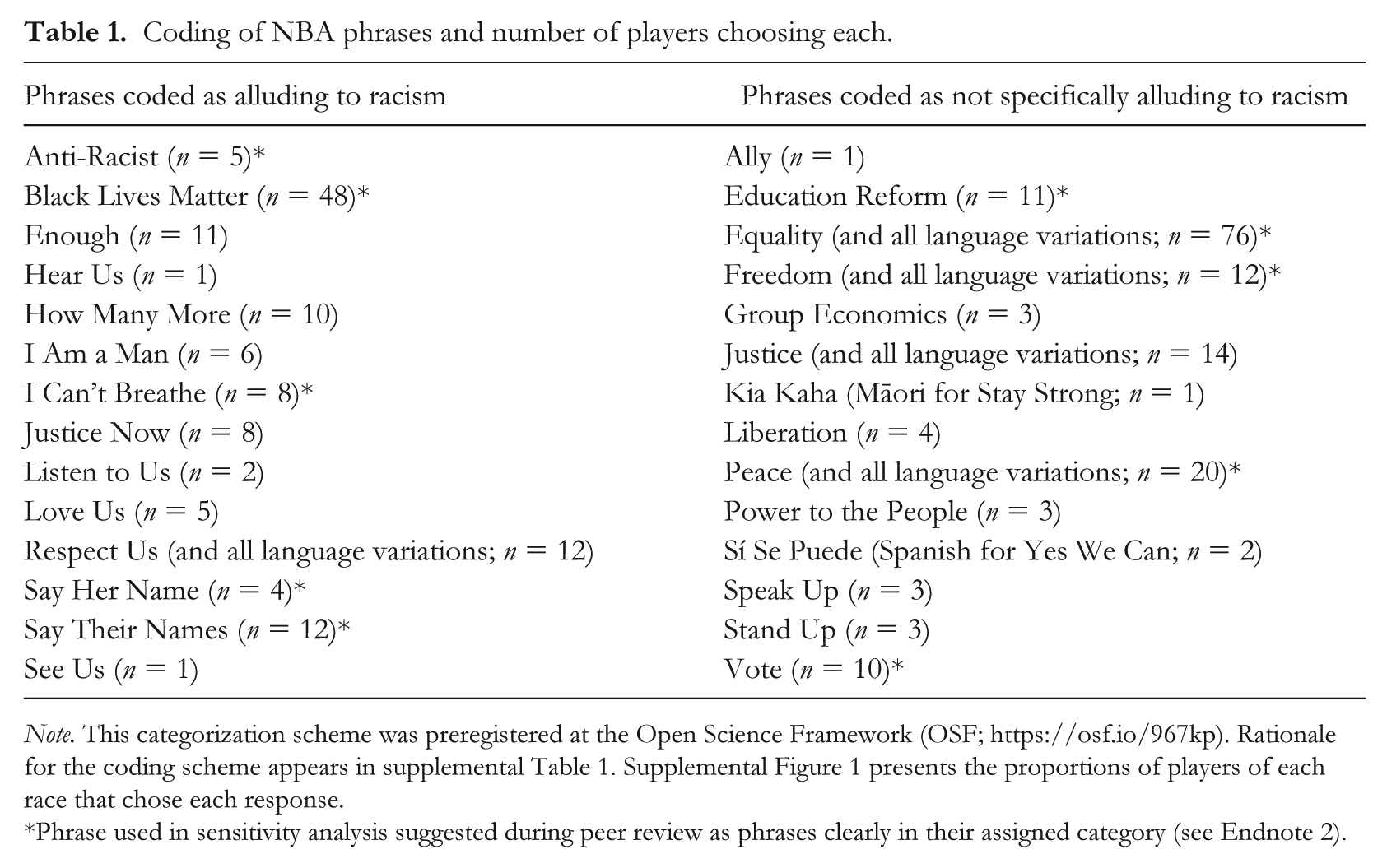
Note. This categorization scheme was preregistered at the Open Science Framework (OSF; https://osf.io/967kp). Rationale for the coding scheme appears in supplemental Table 1. Supplemental Figure 1 presents the proportions of players of each race that chose each response.
Phrase used in sensitivity analysis suggested during peer review as phrases clearly in their assigned category (see Endnote 2).
Because we recognize that others may disagree on the coding structure, prior to coding, we evaluated all of the phrases and determined whether we believed they were overtly referring to racism/racial justice, and preregistered this categorization prior to any data manipulation or analysis. Our rationale for these decisions appears in supplemental Table 1 (Supplemental Material). Of note, a portion of the phrases (8.7%) would likely only be interpreted as focused on racial injustice if worn by Black players (e.g., “I Am a Man,” “Respect Us,” “Listen to Us”). No White players chose to wear these phrases, and thus they are all included as focused on racism. Removing players who chose these phrases (n = 27) from the analysis does not change any of the patterns of the observed effects.
Perhaps one of the more controversial decisions we made was to include “Justice Now” in phrases alluding to racism and “Justice” in phrases not specifically alluding to racism. As mentioned in supplemental Table 1, we coded “Justice Now” as a phrase alluding to racism because, at the time of jersey selection, “Justice Now” was a specific phrase used to call for punishment of the police who killed Breonna Taylor, and a rallying cry of the Black Lives Matter movement. By contrast, “Justice” was used widely by a variety of groups and was, at the time, explicitly used by the “Blue Lives Matter” pro-policing organization to call for responses to police deaths. As such, we did not see it as specifically referring to racism. Importantly, the effects reported here persist even when removing players who chose these phrases (n = 22).
Results
Choosing Generic Versus Specific Phrases: NFL Only
White NFL players chose generic phrases (90.3%) rather than specific names (9.7%) significantly more often than did Black players (53.2% choosing generic phrases, 46.8% choosing specific names), χ2(1, N = 110) = 13.28, p < .001, Φ =.35. These effects persisted even after controlling for dependence of data within teams using a generalized linear mixed model (GLMM) and estimating both fixed and random intercepts, b = 2.11, p = .002, 95% CI [0.82, 3.39]. Full GLMM output for all models is available in the Supplemental Material.
Choosing Racism-Related Phrases
As Figure 1 shows, and consistent with Hypotheses 2 and 3, Black players chose racism/race-related phrases significantly more often than did White players. In the NBA, White players chose race/racism-related phrases half as often (25.0%) as did Black players (50.0%), χ2(1, N = 296) = 12.08, p = .001, Φ = −.20. 2 A similar pattern emerged in the NFL, where, among players who chose a generic phrase, White players chose the two phrases related to racism 6 times less often (10.7%) than did Black players (64.3%), χ2(1, N = 70) = 19.69, p < .001, Φ = −.53. The NBA effects persisted even after controlling for dependence of data within teams using a GLMM and estimating both fixed and random intercepts (NBA: b = −1.09, p = .001, 95% CI [−1.75, −0.44]). 3 The GLMM would not converge with a positive-definite Hessian matrix when attempting to model different intercepts for the three NFL teams.
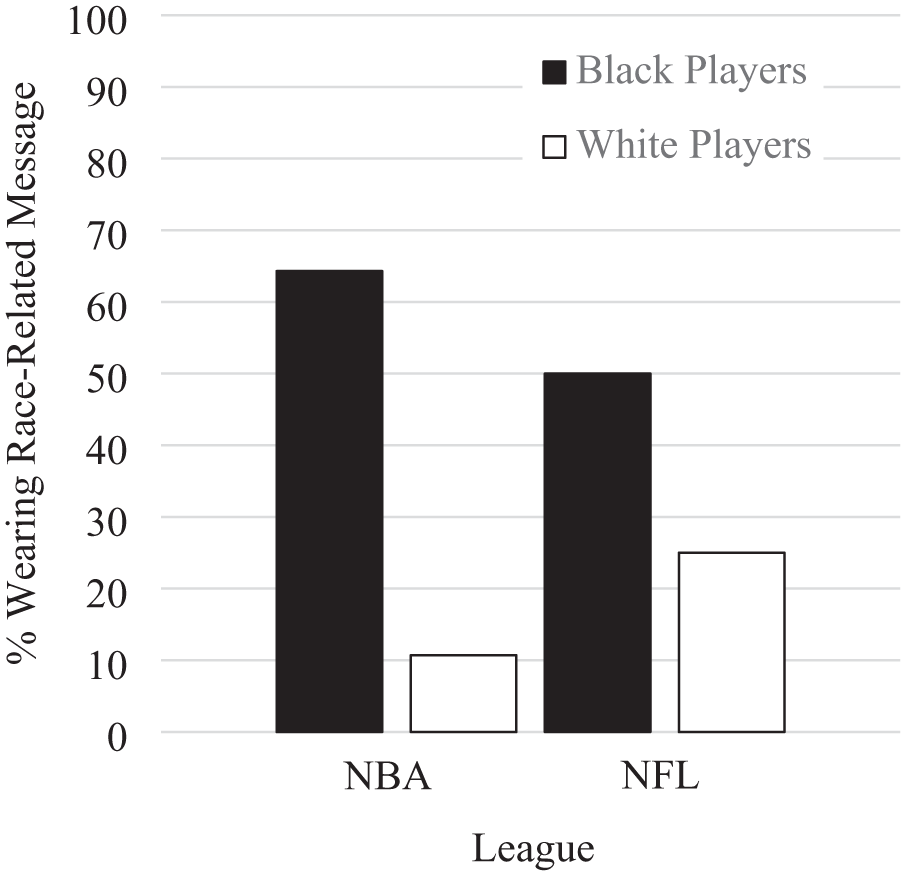
Percentage of Black and White players choosing to wear a social justice message about race/racism in the NFL and NBA.
Exploratory Analysis: Opting In
Although we had no initial hypotheses about who would participate in the social justice messages, we explored whether opt-in rates differed as a function of race. In the NBA, White players (87.0%) were slightly more likely than Black players (76.1%) to choose to include a message on their jerseys, in general, χ2(1, N = 379) = 3.87, p = .048, Φ = −.10. In the NFL, participation did not differ significantly between Black (74.5%) and White players (67.4%), χ2(1, N = 152) = 0.82, p = .366, Φ =.07.
Exploratory Analysis: White Inclusion: NFL Only
We also explored whether White NFL players were disproportionately likely to choose the phrase “It Takes All of Us,” which explicitly actively includes them. Suggesting that they were, among players who chose a generic phrase, White players chose “It Takes All of Us” (53.6%) significantly more frequently than did Black players (23.8%), χ2(1, N = 70) = 6.48, p = .011, Φ =.30. The GLMM would not converge with a positive-definite Hessian matrix when attempting to model different intercepts for the three NFL teams.
Discussion
An examination of the social justice uniform messages selected by NFL and NBA players demonstrated that compared to Black players, White players were generally more likely to choose generic phrases, unlinked to race or racism, and (in the NFL) especially those that emphasized the role of White people (i.e., “It Takes All of Us”). This confirms our hypotheses that White players would make choices that de-emphasize race but still allow them to participate in supporting social justice.
As activism goes, it might be easy to dismiss adding a social justice message to one’s uniform as a relatively minor form of activism and thus not worthy of study. While we acknowledge that wearing a uniform message might be generally categorized as performative—in that it does not upend the societal racial status quo—these messages represented a massive step forward in public activism in the leagues (Thomas & Neuhaus, 2024). Additionally, the messages were seen by millions of people—NBA regular season games averaged 1.3 million viewers per game that season (Adgate, 2021b), and the NFL averaged 14.9 million viewers per game (Adgate, 2021a)—meaning that in one single regular season game, nearly the same number of people were exposed to Black Lives Matter messages as there were total number of protesters participating in the entire Black Lives Matter movement that summer. Additionally, many of those watching might not have otherwise been exposed to any antiracist messages. Finally, the celebrity endorsement of a message is something for which organizations would typically pay millions of dollars, because they are seen as effective at swaying hearts and minds. Suggesting such is the case, the NBA’s efforts to support social justice that year are credited with significantly increasing Black fan turnout to vote in the 2020 election (Butler et al., 2024), and Senator Raphael Warnock credited the Women’s National Basketball Association’s (WNBA) support for his candidacy as being the key to his victory in his 2020 race against then majority-owner of the Atlanta Dream, Kelly Loeffler (Chazaro, 2024).
Additionally, our measure is advantageous for at least three reasons. First, examining these social justice message choices is a particularly useful way to understand base rates of activism behavior across an entire bounded unit of people (e.g., team, league). The decision (what, if any, message the player will wear) and its display (the same place on every player’s uniform) were identical for everyone involved. As such, it avoided confounds that might arise from focusing on other forms of activism behavior such as protesting (e.g., athletes might have been traveling during major protests in their cities or feared for their physical safety in public because of obsessive fans), donations (e.g., some players have more disposable income than others), or time spent volunteering (e.g., not all players are invited to participate in the same events). Second, because it represented a relatively minor change in the uniform, it offered a powerful test of our hypothesis. Given that wearing an antiracist message was so simple, it is perhaps surprising we observed such sizable effects here. Particularly in the NFL, where the back of most players’ helmets was unlikely to be seen or studied by the public, it would have been very easy for White players, particularly those who knew they would be sitting on the bench most of the time, to be bold in their choices and select phrases like “Black Lives Matter” without having to worry about fans’ reactions. We thus suspect that the large effects observed here would only be exacerbated if players had to be more engaged or public with their antiracist activism. Finally, there has been no other league-wide effort in either the NBA or NFL to which every player could either opt in or out and make a specific, publicly visible choice regarding activism. Examining this behavior thus offered the first robust, standard, and consistent metric of engagement in activism at the team/league level.
Why Social Justice Message Choice Differs by Race
We can think of several reasons why, compared to Black players, White players might have chosen more generic statements rather than those that highlighted racism. First, as mentioned in the introduction, White players who wanted to engage in activism likely suffered from a multiple-audience problem (Fleming, 1994)—they wanted to present themselves as advocates for social justice and being on the “right side of history” to their peers and fans who care about social justice, while also adhering to both the White norm of not discussing race/racism publicly and fans’ possible distaste for activism (DiAngelo, 2018; Eichstedt, 2001; Hughey, 2012; Modiano, 2016). Choosing generic phrases like “Stop Hate” allow them to signal allyship to those who care about racial justice while also remaining above the metaphorical fray when it comes to issues of race. The ambiguity in the terms makes them slightly more conservative in nature; they are statements of general values of egalitarianism and equality, but not necessarily about race. One could theoretically stop hate toward or give equality to Christians or conservatives, as an example. By choosing generic messages, they could “support” a cause without making their White fans, family, and peers feel discomfort at the mention of race (DiAngelo, 2018).
Related to this notion, a critical discourse analysis of NFL team owners’ statements in response to U.S. President Donald Trump’s public criticism of Colin Kaepernick in 2017 suggested that the NFL owner statements downplayed race and racial justice and instead drew on abstract symbols of shared values and patriotism. Owners often focused on the importance of football in uniting communities and the nonracial charity work of their players in the community (McGannon & Butryn, 2020). The authors of the critical analysis note that the owners’ messages reflected a general colorblind ideology and an attempt to assuage calls for justice from liberal fans and fans of color while still pandering to conservative White fans. Of course, these may be genuinely held beliefs on the part of the owners rather than pandering; no NFL team has had a Black owner in the league’s history. It is perhaps not surprising, then, that a few years later, the league opted to use the message “It Takes All of Us” as the slogan for their antiracism campaign, and that so many White players chose the slogan for their helmets.
Second, White players might have felt uncomfortable taking up the banner of a cause that they did not view as being directly relevant to them personally. Research suggests that White people who try to engage in antiracist activism often feel a sense that they do not necessarily belong in antiracist spaces or movements (Hughey, 2012). Additionally, compared to Black activists, White activists are seen as less sincere when they push for racial equality (Burns & Granz, 2023). Moreover, research on activism often argues that White people can sometimes co-opt movements—making them about their own feelings and identities—and recommends White people to work to minimize their own role in social movements, thus playing a more supportive, rather than active, one (Droogendyk et al., 2016). Thus, White players might worry that others will assume they have ulterior, selfish motives if they wear messages specifically related to racism (Bliege Bird & Smith, 2005), making engaging in that behavior costly to their reputation (Berman & Silver, 2022). Consistently, White players, many of whom are not overt activists, might have felt that it was not their place to wear race-related messages, worried that it would represent cultural appropriation or be perceived as virtue signaling, or wanted to play a private, supportive role, lest they seem insincere.
Third, and related to the second point, White players might have been specifically attracted to phrases that emphasized their role in promoting social justice. That is, they might have felt more comfortable taking phrases which specifically and positively reflected on their in-group membership (e.g., requiring the work of “all of us”). Notably, although these statements include White people, they do not point to any special responsibility on the part of White people. Rather, as with the colorblind ideology mentioned previously, they make race invisible. A more active message would say something like, “Racism is a White problem.” It is worth stating that all three of the reasons we have come up with, although above reproach on their surface, look a good deal like “passivism”—that is, “an apathy toward systems of racial advantage or denial those systems exist” (Roberts & Rizzo, 2021, p. 483)—which is argued to be one of the signal tenets of the American brand of racism (Roberts & Rizzo, 2021).
Finally, until this point, we have discussed the idea of White players as antiracist activists. While some of them might be quite publicly committed to reducing racism (e.g., Kyle Korver of the Milwaukee Bucks, who chose “Black Lives Matter”; Korver, 2019), it is likely that some of them are not. At least some of the White players might not have thought racism was a problem that needs to be addressed either because they feel prejudice and discrimination against Black people is justified (i.e., racism), believe that claims of racism are overblown and something society has moved past (e.g., modern racism; McConahay, 1986), or simply do not support modern antiracist movements such as the Black Lives Matter movement. As such, they would be rather unlikely to choose slogans that suggested racism is problematic.
Relatedly, Black players might have been particularly likely to choose racially oriented messages. Indeed, the messages about racism likely feel more meaningful, personal, and identity-affirming to Black players. Still, half of Black NBA players and 40% of Black NFL players chose non-race-related generic messages. These numbers more closely resemble picking one of the generic messages randomly (as half of all of the messages were race-related). As such, it is perhaps more telling that only 25% of White NBA players and 11% of White NFL players chose race-related messages.
We suspect that all of these factors, alongside others (e.g., idiosyncratic interactions, league social norms), might have contributed to players’ decisions. And of course, players are making those decisions within a system in which they are employed by team owners—none of whom are Black; 4 they are certainly aware of the financial consequences to players like Colin Kaepernick. As such, future work is needed to both investigate activism decisions as well as the motives underlying those decisions that could potentially mediate the effects observed here. Additionally, research is needed to examine the impact of these social justice message decisions on fans, other team members, and the broader social discourses. For instance, it would be interesting to examine the extent to which fans found each of the messages to be conservative or believed they were more geared toward White versus Black players. Moreover, it would be interesting to examine what fans think of Black and White players as a function of the message they choose.
The Observed Discrepancy in Participation in the NBA
One particularly interesting finding that might seem to contradict the idea that Black players were stronger antiracist activists than were White players was the fact that, in the NBA, White players were more likely to wear any message on their jersey than were Black players. While we are hesitant to make too much out of comparing behavior to nonbehavior, we can think of a few reasons why this might have occurred. From a psychological perspective, this might have resulted from White players “bending over backwards” to appear nonprejudiced (Harber, 1998; Saucier & Miller, 2003; Von Hippel et al., 1997). That is, it might have been that White players believed that their participation, in general, was necessary to signal that they were nonprejudiced in a way Black players did not. On the other hand, Black players might have found the effort purely performative and therefore opted out. There is some anecdotal evidence for this. Perhaps most famously, LeBron James, who has strongly and publicly pushed for racial equality, including in postgame interviews during that season (McMenamin, 2020b), opted not to wear a slogan, saying it “didn’t really seriously resonate with [his] mission” (Chiari, 2020). Instead, he modified his uniform on his own, writing “#Justice4BreonnaT” (justice for Breonna Taylor) on his shoes (McMenamin, 2020b). James’s teammate, Anthony Davis, similarly opted out, noting that players would “have a ton of ways to kind of represent what we stand for” (McMenamin, 2020a). Indeed, this turn to alternative forms of activism is precisely why we are hesitant to use participation (vs. not) as a marker, and instead find the comparison of the choice of messages among those who did in fact participate more informative.
NBA Versus NFL
Some U.S. sports fans might find it surprising that we observed a similar pattern of results in both the NBA and the NFL, as these two contexts are somewhat distinct, despite both existing in the broader context of the US. For example, the NFL has a politically diverse fanbase, whereas the NBA has the most liberal fanbase in U.S. professional sport (Paine et al., 2017). Moreover, at the time these data were collected, in the NBA, 23% of head coaches were Black (Lapchick, 2021a), whereas only 9% of NFL head coaches were Black (Lapchick, 2021b). Additionally, the NFL has long grappled with accusations of racism, resulting in the need for active policy changes to promote the hiring of people of color (NFL Football Operations, 2025) and, at the time these data were collected, renaming a team whose moniker was long considered racist (i.e., the “Redskins”; Freeman, 2020). We believe that the observation of similar effects in both of these contexts speaks to the robustness of the differences in White and Black athlete activism behavior.
Limitations and Future Directions
Of course, this study does not represent all athlete activism as is limited in scope in multiple ways. First, we were unable to get the decisions of all NFL players. It is possible that the trends observed here were particularly exacerbated among the teams who reported on their full roster’s decisions regarding decals, though we have no reason or data to suggest this would be the case. Second, the choices made here were necessarily dichotomous and limited in scope—athletes could only choose one message to include on their uniform. It is possible that they displayed antiracist activism in other ways (e.g., sweatbands, warm-up shirts, specific shoes) that the choice of a decal/jersey phrase does not cover. Additionally, they might have made a different decision if given the choice to regularly change or rotate their social justice message. Third, we only examined two professional sports: both of which have a majority of Black players and both of which are all-male leagues. Unfortunately, for potential archival analyses, most activism among female professional athletes during this time was taken on by the whole team (e.g., WNBA teams wearing “Black Lives Matter” warm-up shirts; Bowman, 2020). Because these players did not have individualized behaviors, there was no way to analyze the behaviors individually as a function of race. Nevertheless, future investigations might endeavor to examine other forms of activism (e.g., kneeling during the national anthem), in different sports, and among female professional athletes, who have shown particularly strong activism trends and play in leagues where racial activism is perhaps more normative (Buckner, 2021; Carlisle, 2021; Minutaglio, 2020; Pickman, 2020; Schmidt et al., 2019; Vasilogambros, 2016; Young, 2020). Related to examining other forms of activism, the present research did not address how or why the options for slogans were chosen and approved by the leagues and players’ associations. Future research might benefit from examining what goes into decision-making surrounding social justice uniform messages—that is, what kinds of messages are approved, and what kinds of messages might be banned.
Despite its limitations, the present study demonstrated a tendency for White NFL and NBA players to choose generic and general messages rather than specific antiracist ones much more often than did Black players. These decisions are consistent with observations by researchers conducting interviews of White activists, identifying that they percieve stigma for both participating in activism and for not doing enough activism, leading them to engage in weak forms of activism (Eichstedt, 2001; Hughey, 2012), general White timidity surrounding activism toward racial justice (DiAngelo, 2018; Gorski & Erakat, 2019), a tendency to engage in “performative activism” (Phillips, 2020), as well as more mixed support for modern antiracist movements (Parker et al., 2020). As such, we do not suspect that these results are idiosyncratic to the present observation, but rather reflective of a larger trend of more tepid racial activism by White people. That is, we believe these data offer a clear demonstration that, despite their willingness to participate in social justice activities, compared to Black professional athletes, White professional athletes are likely to be more behaviorally reticent to use their platform to promote antiracist messages.
