



Abstract
This study investigates the critical role of social identity in leadership, specifically examining identity leadership (IL) and the unique contributions of its four subdimensions: identity prototypicality, identity advancement, identity entrepreneurship, and identity impresarioship. To date, research has largely focused on the global construct of identity leadership and shown that in organizational contexts, it is a predictor of a range of outcomes, including group members’ burnout and organizational citizenship. However, the distinct roles of the four subdimensions remain little understood. Extending earlier findings, we address this gap by testing the hypothesis that the four subdimensions are differentially implicated in two key mechanisms that underlie the relationship between IL and group outcomes: (a) trust in the leader and (b) team identification. The present study explores this proposition by using structural equation modeling with latent factors to test a mediation model in 2020–2021 data from the Global Identity Leadership Development project (GILD; N = 7,855). As hypothesized, we found that identity prototypicality and identity advancement predominantly predicted greater trust in the leader, whereas identity entrepreneurship primarily predicted greater team identification. Contrary to our hypothesis, identity impresarioship showed a negative relation with trust. In turn, both trust in the leader and team identification were positively associated with organizational citizenship behavior (OCB), and negatively with burnout. We conclude by reflecting on the implications of these findings for both the theory and practice of leadership.
For about two and a half millennia, scholars have sought to understand and explain the nature of leadership, leading to the development of a range of different approaches to the topic. Haslam et al. (2015) organized these approaches into three distinct perspectives: classical, contextual, and identity. The classical perspective views leadership as an individualist process rooted in the unique psychology of each leader. This perspective includes theories such as the “great man” approach (Carlyle, 1840; Plato, 380 BC/1993), which portrays leaders as exceptional and superior individuals (Haslam et al., 2015). In contrast, the contextual perspective emphasizes that leadership needs to be sensitive to context and that leaders need to be attuned to group needs. Leadership models such as the transformational approach (Bass & Avolio, 1997; Burns, 1978) reflect this by exploring followers’ motivations and expectations (Haslam et al., 2015). The identity perspective extends this understanding by suggesting that leadership involves not only addressing the group’s needs but also the leader’s identification as part of the group. This view emphasizes the importance of leaders aligning their sense of identity with that of the group in ways that build and advance a shared sense of purpose and collective commitment within the group (Haslam et al., 2015). Building on this foundation, the social identity approach to leadership has gained increasing scientific attention in recent years (Epitropaki et al., 2017; Haslam et al., 2020).
This approach argues that leadership is fundamentally a group process in which leaders exert influence by virtue of their capacity to mobilize a sense of social identity (a sense of “us-ness”) in the groups they lead—a process referred to as identity leadership (Haslam et al., 2020; Steffens et al., 2014; van Dick et al., 2018).
Early work on the social identity approach to leadership focused largely on identity prototypicality, which refers to the leader being seen to represent the group by embodying what it means to be “one of us.” Speaking to the importance of this, a meta-analysis of 35 independent studies by Barreto and Hogg (2017) found a strong positive relationship (r = .49) between leaders’ identity prototypicality and followers’ positive evaluations of their leadership. This relationship was subsequently corroborated by Steffens et al. (2021) in a meta-analysis of 128 studies which found that the relationship between leader prototypicality and leader effectiveness held not only for evaluations of leaders but also for measures of leaders’ behavioral impact (overall r = .39).
However, social identity researchers have argued that there is more to leadership than simply being seen to represent the group. In particular, Haslam et al. (2020) argued that identity leadership also involves being seen to champion and promote the group’s interests (“doing it for us” or identity advancement; Haslam & Platow, 2001), being seen to create a sense of shared identity in the group (“creating a sense of us” or identity entrepreneurship; Reicher et al., 2005), and, ultimately, being seen to create opportunities and structures that allow followers to live out their group membership in meaningful and positive ways (“making us matter” or identity impresarioship).
To assess these claims, Steffens et al. (2014) developed an instrument that sought to capture these four dimensions of identity leadership—the Identity Leadership Inventory (ILI). The ILI’s construct and discriminant validity were supported in a series of studies that showed both that the four dimensions of identity leadership are conceptually distinct, and that identity leadership itself is distinct from other leadership constructs (e.g., authentic leadership). Following on from this, van Dick et al. (2018) went on to explore the predictive validity of the ILI in over 20 countries as part of the Global Identity Leadership Development (GILD) project. This found identity leadership to be linked to multiple positive work outcomes, including those related to both productivity (notably, job satisfaction, organizational citizenship behavior (OCB), and innovative work behavior) and health (notably, reduced burnout; van Dick et al., 2021).
Yet despite there being a conceptual and empirical case for seeing the four components of identity leadership as distinct, to date, researchers have tended to treat this as a unitary, global construct. With a view to developing a more nuanced understanding of the workings of identity leadership, the present research therefore seeks to explore the (potentially) distinct role of different dimensions of identity leadership in affecting the performance-related outcome OCB and the health outcome burnout. In other words, it seeks to establish whether different dimensions of identity leadership might have an impact on followers via different processual pathways.
The possibility that this might be the case is suggested by previous work by Krug et al. (2021), which focused on the distinct role of (a) trust in the leader and (b) team identification as processual correlates of identity leadership. This research showed that both these mechanisms were predicted by identity leadership, and indeed, by manipulating identity leadership, it showed that this link was causal.
Again, though, Krug et al.’s (2021) experimental research focused on the overall construct of identity leadership when studying its relationship with group member outcomes and mediating processes. Consequently, we know little about how the distinct components of identity leadership contribute to these outcomes via distinct pathways.
Theoretically, there is good reason to think that they might. In particular, on the basis of arguments put forward by Haslam et al. (2020), Steffens et al. (2014), and Krug et al. (2021), it seems reasonable to hypothesize that leaders who represent and advance social identity (i.e., who are “one of us” and who “do it for us”) would be effective because they are trusted by team members (H1a, H1b), whereas leaders who build and embed social identity (i.e., who “create a sense of us” and who “make us matter”) would be effective because they help build team members’ identification with the group (H2a, H2b). It is these twin hypotheses that the present research seeks to test. We will do so by simultaneously testing the two mediation pathways illustrated in Figure 1—where both trust in the leader (H3a) and team identification (H3b) are linked both to group members’ performance (i.e., OCB) and their psychological health (i.e., burnout). Note, however, that we do not presume that the identity leadership dimensions only relate to either trust or team identification but rather that both links exist with one relationship, respectively, being dominant. Consequently, we also allow the other pathways (i.e., that identity prototypicality and identity advancement also relate to team identification, while identity entrepreneurship and identity impresarioship also relate to trust in the leader), as we do not exclude their respective associations.
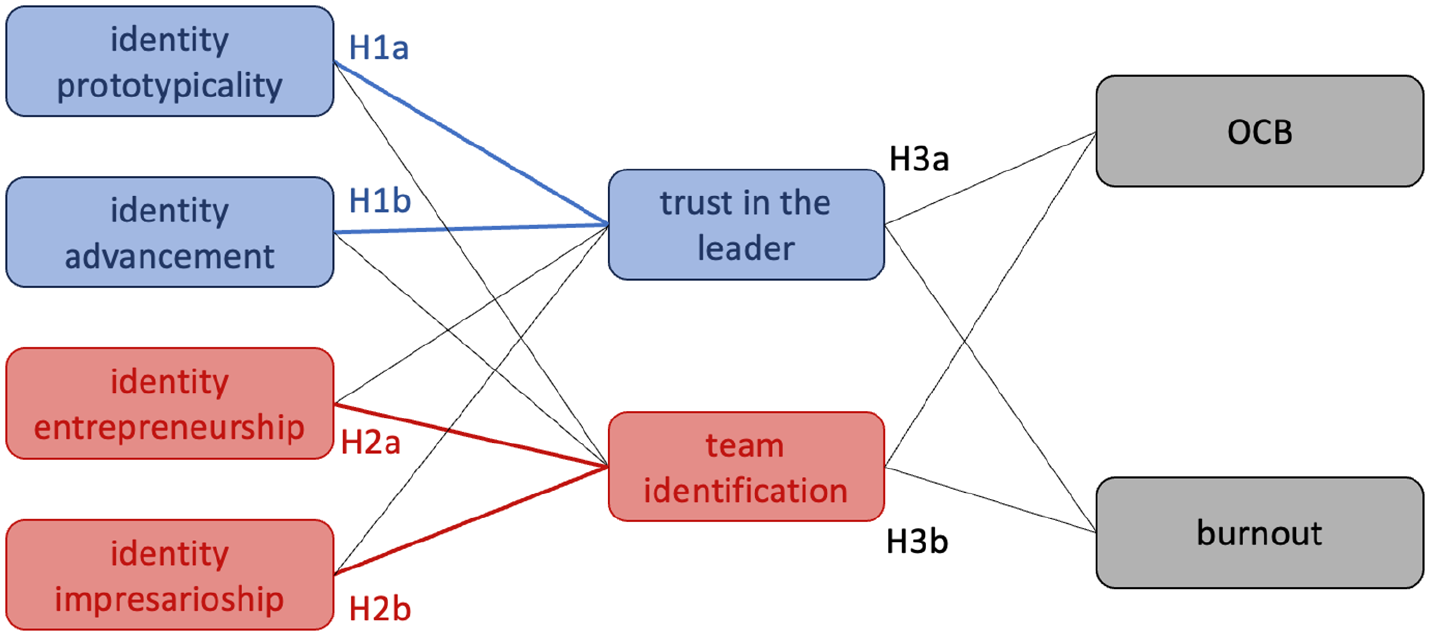
Proposed structural equation model and anticipated relationships of all variables.
Theoretical Framework
Identity Prototypicality and Identity Advancement Build Trust
A widely accepted definition by Rousseau et al. (1998) refers to trust as “a psychological state comprising the intention to accept vulnerability based upon the positive expectation of the intentions or behavior of another” (p. 712). Researchers stress that definitions may have changed over the years, yet vulnerability and expectation have always been core elements (Evans & Krueger, 2009). Although trust in leadership is by now a widely studied phenomenon, it remains to be answered what exactly leaders must portray to shape trust. Based on theoretical understandings of identity leadership, there is good reason to assume that trust in the leader is primarily triggered by the first two dimensions of identity leadership: identity prototypicality and identity advancement.
The first dimension, identity prototypicality (“being one of us”) has received the most attention from scholars thus far (e.g., Steffens et al., 2021). A leader who is perceived as highly prototypical represents and embodies the group’s unique core qualities (Haslam et al., 2020; Hogg, 2001). In contrast to differentiating oneself from the group, the focus is placed on highlighting similarities and thus being an exemplary group member. A scientific review by van Knippenberg (2011) argued that prototypical leaders are perceived as embodying the identity of the in-group, including its values and norms. This shared sense of identity and connectedness, in turn, might foster a feeling of trust. In line with that reasoning, experimental studies by Giessner and van Knippenberg (2008) showed that leaders who emphasize and embody in-group qualities are more trusted by their fellow group members than those who do not.
Furthermore, meta-analyses emphasized a strong and consistent association between leader identity prototypicality and group members’ trust in the leader (Barreto & Hogg, 2017; Steffens et al., 2021).
Identity advancement (“doing it for us”) means the leader stands up for and, if necessary, defends the group’s goals and interests. In other words, this captures the leader’s encouragement and promotion of the group’s main interests. A leader high in identity advancement, therefore, supports them in realizing group objectives (Haslam et al., 2020). Interestingly, Giessner and van Knippenberg (2008) suggested that leaders who are highly invested in their group and behave in ways that benefit the in-group (thus showing more identity advancement) convey a sense of trust, as group members perceive their leader to be acting in the group’s best interest (Giessner & van Knippenberg, 2008; Hogg et al., 2012). Thus far, little research has focused on the isolated effects of identity advancement. However, the limited existing research showed that trust in the leader was mainly associated with the dimension of identity advancement (van Dick et al., 2018). Moreover, considering the elements of vulnerability and positive expectation of the trust definition (Evans & Krueger, 2009; Rousseau et al., 1998), group members make themselves vulnerable by trusting their leader’s good intentions as well as having positive expectations concerning the leader’s action. Therefore, if leaders are evaluated as highly prototypical and simultaneously have the group’s best interests at heart when acting (identity advancement), this is suggested to predominantly strengthen group members’ trust in their leader. Thus, we predict:
Hypothesis 1: Employees’ evaluation of their leader’s (a) prototypicality and (b) advancement is more strongly associated with their trust in the leader than with their team identification.
Identity Entrepreneurship and Identity Impresarioship Promote Team Identification
Team identification is the degree to which people feel a psychological connection and a sense of belonging to a specific team. It reflects the extent to which a person defines themselves as a member of that team, seeing it as an integral part of their social identity (e.g., Riketta & van Dick, 2005). As team identification is characterized by a deep emotional attachment (e.g., shared goals and a strong “we” and “us” sense), it influences people’s attitudes and behaviors within the context of that team—it is that powerful capacity to influence different group outcomes positively that shaped and still shapes the keen interest in its antecedents (Haslam et al., 2020).
As both dimensions, identity entrepreneurship and impresarioship, conceptually emphasize creating a shared team identity, there is a rationale assuming that they must share a strong relationship. In fact, the dimension of identity entrepreneurship (“crafting a sense of us”) involves the leader bringing group members together and thereby generating a shared understanding of what it means to be a part of the group (a sense of “we” and “us”; Haslam et al., 2020). By fostering a sense of inclusiveness, the different members should have a stronger feeling that the group is one to which they can belong. Moreover, group norms and values should be clear and well established so that group members know what the group stands for (Haslam et al., 2020). Besides theoretical arguments, scientific indication for the strong relationship between identity entrepreneurship and team identification was provided by van Dick et al. (2018), as multiple regression analyses revealed that team identification was mainly associated with identity entrepreneurship.
Ultimately, identity impresarioship focuses on the leader embedding the sense of the group in physical and material reality by promoting events, activities, and structures that allow group members to experience their membership (e.g., through a team logo, team meetings, and other team activities such as retreats). From a theoretical perspective, similar to identity entrepreneurship, identity impresarioship is inherently collaborative in nature. For instance, planning and participating in a team retreat involves contributions from both leaders and followers. In other words, identity impresarioship relies on interactions between leaders and followers, as well as followers’ participation and contributions (Haslam et al., 2020).
So, as both dimensions rely on the participation and cooperation of the respective group members, it is reasonable to assume that identity entrepreneurship and identity impresarioship relate more to the sense of team identification (rather than to trust in the team leader).
Up to now, studies lack exploration of the unique effects of identity impresarioship. Nevertheless, examining previous studies (e.g., van Dick et al., 2018), impresarioship was more closely related to team identification than to trust in the leader. Consequently, more formally, we hypothesize that:
Hypothesis 2: Employees’ evaluation of their leader’s (a) entrepreneurship and (b) impresarioship is more strongly associated with their team identification than with their trust in the leader.
Trust and Team Identification Facilitate Performance and Psychological Health
Contemporary organizational research investigates mechanisms that reinforce a healthy and effective work environment. Both, trust in the leader (Dirks & de Jong, 2022) and team identification (van Dick et al., 2018) are hitherto well recognized mechanisms contributing to both performance-related and health-related group outcomes.
Organ (2014, p. 95) defined OCB as “performance that supports the social and psychological environment in which task performance takes place.” More practically, this means that OCB captures whether employees exceed expectations delineated in their job role responsibilities to support overall organizational functioning. Due to the expectation of OCB being positively associated with overall organizational effectiveness (N. P. Podsakoff et al., 2009), studying its antecedents still represents a leading aspiration.
Past meta-analytic findings have already established a consistent link between trust in the leader and OCB (Dirks & Ferrin, 2002); but also, a more recent meta-analytic review by Dirks and de Jong (2022) confirmed previous findings and identified numerous positive work outcomes accompanied by trust, including organizational as well as team citizenship behavior.
Perhaps even more crucial than employees’ performance capabilities in contributing to a functional working environment is employees’ health. When talking about employee health, it is almost unavoidable to think of burnout syndrome—specified as an ongoing emotional reaction to continuing stressors at work (Maslach & Leiter, 2016). Impairing personal and social functioning manifests in exhaustion, professional inefficacy, and cynicism (Maslach & Leiter, 2016). The immense interest in burnout might be due to the wide-ranging consequences, which are severe on an organizational and individual level. The scope of the issue is, for instance, illustrated by a recent study of over 20,000 healthcare workers during the COVID-19 pandemic (Prasad et al., 2021). Results demonstrated that up to 49% of respondents suffered from burnout. As the consequences of burnout are so extreme, studying factors that help mitigate its occurrence remains very relevant.
A recent review of burnout in the healthcare sector identified 39 studies demonstrating the importance of working relationships and leadership (Dall’Ora et al., 2020). Though these studies all underline the importance of relationships and given that trust is known to play an elementary role in relationships (e.g., Rousseau et al., 1998), the role of trust in one’s leader was rarely included in the studies (Dall’Ora et al., 2020).
However, a study by Lambert et al. (2012) demonstrated the major value of trust in acting as a practical resource, buffering against stress-related burnout factors. It was argued that employees’ trust in supervisors creates positive emotions. In contrast to feeling left alone with problems or job demands, trust in supervisors contributes to feelings of support, security, and confidence (Lambert et al., 2012), which all potentially buffer against stress.
Overall, extending earlier findings, we suggest that trust in the leader can enhance citizenship behaviors in the organizational context (OCB) while simultaneously acting as a safeguard, mitigating symptoms of burnout. Consequently, we hypothesize:
Hypothesis 3a: Trust in one’s leader is positively associated with employees’ OCB and negatively associated with burnout.
Besides trust in the leader, team identification has been determined as another crucial factor for increasing OCB. A meta-analysis by Lee et al. (2015) identified a strong correlation between OCB and organizational identification. Additionally, in their systematic review and meta-analysis about employees’ identification types and citizenship behaviors within organizations, Sidorenkov et al. (2023) discussed that compared to overall organizational identification, other forms of identification (e.g., team identification) are little studied. Greco et al. (2022), in their meta-analysis, found a relation between OCB and organizational identification in over 100 studies, but only in 23 studies was OCB related to team identification. The fact that other identification levels within organizations play a significant role, too, is, for example, highlighted in a study by Haslam et al. (2009) in which it was shown that people who identify strongly with their direct team are also more likely to engage in citizenship behaviors. Having this finding in mind and additionally addressing the need to attend to various identification types in OCB research (Sidorenkov et al., 2023), we consider it of great importance to continue investigating the relationship of OCB with team identification.
Speaking of employee health, various studies that targeted the reduction of burnout rates in organizational settings also stressed the protective role of team identification. For example, the same longitudinal study by Haslam et al. (2009) that found high team identification to be positively associated with OCB, additionally demonstrated that those people who more strongly identified with their team also showed lower burnout rates. Furthermore, a meta-analytic review conducted in the organizational setting reported that fostering a collective identity, characterized by a shared sense of “us”, positively affects individuals’ perceived social support, resilience, and overall well-being (Steffens et al., 2017). Simultaneously, this shared sense of “us” acts as a protective factor, shielding individuals from the negative impacts of stress and averting burnout.
Addressing the need to further examine different identification types in OCB research, together with verifying team identification’s shielding capabilities against burnout, we hypothesize:
Hypothesis 3b: Team identification is positively associated with employees’ OCB and negatively associated with burnout.
As illustrated in Figure 1, combining hypotheses H1a–b and H3a, we expect indirect relationships of identity prototypicality and identity advancement on OCB and burnout via trust in the leader. At the same time, combining hypotheses H2a–b and H3b, we expect indirect relationships of identity entrepreneurship and identity impresarioship on OCB and burnout via team identification.
Method
Sample and Procedure
To test our hypotheses, we used the most recent wave of the Global Identity Leadership Development (GILD) project, collected in 2020–2021. Participants were recruited via convenience sampling in all countries. Participants were employees who responded to questions about their supervisor and organizational experiences. In every country, researchers employed snowball methods to disseminate the online survey link, intending to collect data from diverse and varied working samples. The overall sample included 7,855 participants from the respective countries: Australia (n = 269), Belgium (n = 285), Bosnia and Herzegovina (n = 241), Brazil (n = 222), Canada (n = 353), China (n = 445), Czech Republic (n = 256), France (n = 123), Germany (n = 859), Greece (n = 210), India (n = 192), Israel (n = 215), Italy (n = 191), Japan (n = 284), Kazakhstan (n = 161), the Netherlands (n = 270), Norway (n = 200), Pakistan (n = 172), the Philippines (n = 281), Poland (n = 375), Portugal (n = 202), Slovenia (n = 96), Spain (n = 692), Switzerland (n = 216), Turkey (n = 190), Russia (n = 171), United Kingdom (n = 263), United States (n = 318), and Uzbekistan (n = 103). Overall, the sample was heterogeneous in age and gender. We assessed five different age groups: between 18 and 25 years (18.2%), between 26 and 35 years (33.4%), between 36 and 45 years (23.8%), between 46 and 55 years (17.3%), and 56 years or older (7.2%). Furthermore, 56.9% were female, 42.6% were male (and the rest being of another gender). Table 1 provides an overview of sample characteristics (see Monzani et al., 2024, for further information).
Sample characteristics.
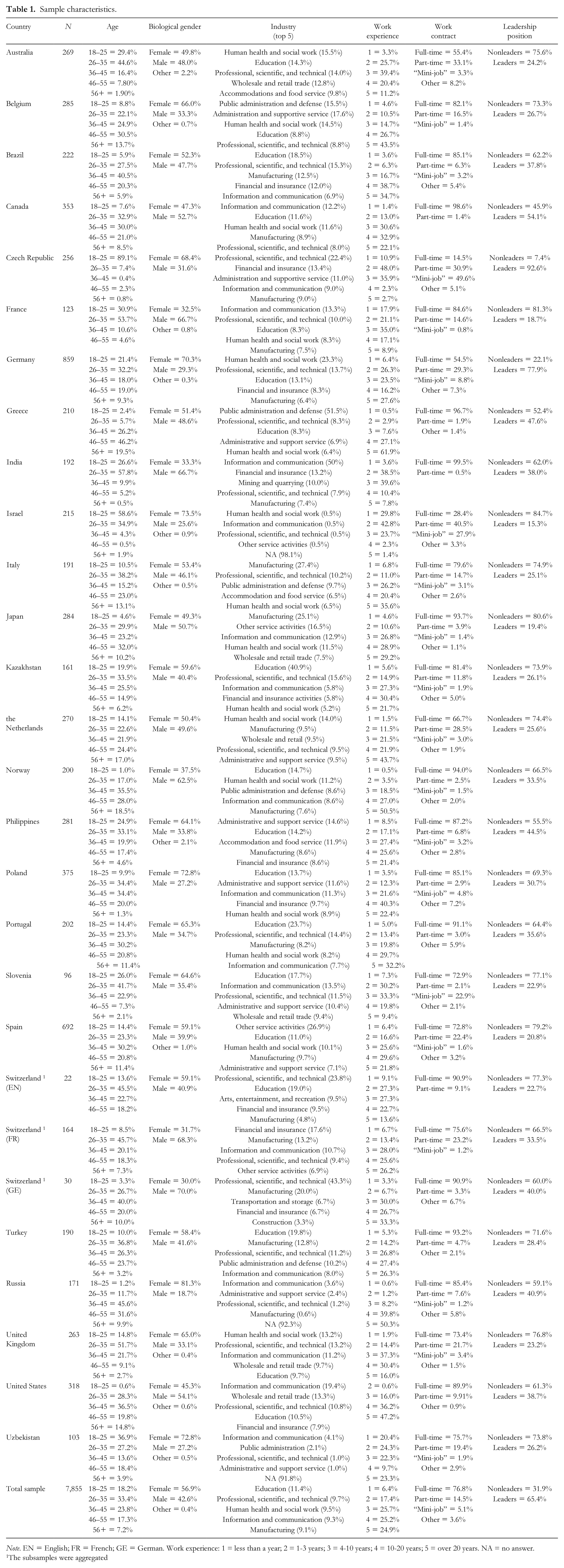
Note. EN = English; FR = French; GE = German. Work experience: 1 = less than a year; 2 = 1-3 years; 3 = 4-10 years; 4 = 10-20 years; 5 = over 20 years. NA = no answer.
The subsamples were aggregated
Measures
Perceived identity leadership
To assess how participants perceived the identity leadership of their supervisors at work, we made use of the ILI developed by Steffens et al. (2014) and validated across all implicated languages by van Dick et al. (2018, 2021). Overall, the ILI consists of 15 items measuring the four distinct dimensions: identity prototypicality (four items; e.g., “My team leader embodies what the team stands for”; α = .94), identity advancement (four items; e.g., “My team leader acts as a champion for the team”; α = .94), identity entrepreneurship (four items; e.g., “My team leader creates a sense of cohesion within the team”; α = .95), and identity impresarioship (three items; e.g., “My team leader creates structures that are useful for team members”; α = .92). All dimensions were measured on a 7-point scale (1 = disagree completely, 7 = agree completely). 1
Trust in the leader
Trust in the leader was measured using the scale by P. M. Podsakoff et al. (1990), consisting of six items (e.g., “I have complete faith in the integrity of my leader”; α = .87). Responses were made on a 7-point scale (1 = does not apply, 7 = applies fully).
Team identification
To assess team identification, we used a four-item measure by Doosje et al. (1995; e.g., “I consider myself as a part of my team”; α = .93). Responses were given on a 7-point scale (1 = disagree completely, 7 = agree completely).
Burnout
We used the nine-item Emotional Exhaustion Subscale from Maslach and Jackson’s (1981) Burnout Inventory. All items were measured on a 7-point scale (1 = never, 7 = every day; e.g., “I feel emotionally drained from work”; α = .93).
OCB
To measure OCB, we used a five-item scale proposed by van Dick et al. (2006; e.g., “I gladly help orient new colleagues”; α = .73). Responses were given on a 7-point scale (1 = disagree completely, 7 = agree completely).
Statistical Analysis
We conducted the statistical analysis with SPSS Version 29 (IBM Corp, 2022) and Mplus Version 8.8 (Muthén & Muthén, 1998–2017). Using SPSS, we calculated scale mean scores, descriptive statistics, and Pearson correlations of all study-relevant variables.
All hypotheses were tested in one structural model. First, we regressed trust in the leader and team identification on the identity leadership dimensions (i.e., identity prototypicality, identity advancement, identity entrepreneurship, and identity impresarioship). Second, we simultaneously regressed OCB and burnout on trust in the leader, team identification, and all four identity leadership dimensions. We ran this model twice. In Structural Model 1, we constrained the regression weights linking every identity leadership dimension to the respective mediators (i.e., trust in the leader and team identification) to be equal. Thus, for instance, the regression weight indicative of the relationship between identity prototypicality and trust in the leader was constrained to be as strong as the regression weight representing the relationship between identity prototypicality and team identification. In Structural Model 2, we allowed the regression weights to differ, and statistically compared them to determine whether the identity leadership dimensions related more strongly to trust in the leader or to team identification (testing H1a–H2b). We statistically compared Model 1 and Model 2 with the Satorra–Bentler scaled chi-square difference test (Satorra & Bentler, 2010), and model fits were determined through the established fit indices: nonsignificant χ2, p > .05; root mean square error of approximation (RMSEA) < .08; standardized root mean square residual (SRMR) < .08; comparative fit index (CFI) > .90; Tucker–Lewis index (TLI) > 0.90 (Wang & Wang, 2020). The product of the unstandardized regression coefficients was calculated to determine the indirect effect, and we used 95% CIs to obtain the direct and indirect effect. We also took the cultural diversity of our sample into account by performing culture-specific analysis. We present the complete results in the Supplemental Material.
Results
We specified two measurement models to test the statistical independence of our constructs, in particular, the distinctiveness of the four identity leadership dimensions. In Model 1, we treated all observed items as indicators of their a priori latent factors, χ2 = 13,070.45, df = 637, p < .001, scaling correction factor multiple linear regression (MLR) = 1.36; CFI = .94, TLI = 0.93, RMSEA = .05, 90% CI [0.049, 0.051], SRMR = .04. In Model 2, we allowed all identity leadership items to load on one latent factor, while the remaining items loaded on their a priori latent factor, χ2 = 21,077.08, df = 655, p < .001, scaling correction factor MLR = 1.37; CFI = .90, TLI = 0.89, RMSEA = .06, 90% CI [0.062, 0.064], SRMR = .04. To further improve model fit, we removed Item 6 of the Trust Scale as this item loaded exceptionally low on the latent factor and was the only negatively worded item (“I have a divided sense of loyalty towards my leader”). Results of the Satorra–Bentler (Satorra & Bentler, 2010) scaled chi-square confirmed that Model 1 was superior to Model 2, which supports the statistical independence of the four identity leadership dimensions (Δχ2 = 6,438.81, Δdf = 18, p < .001).
Descriptive statistics and correlations between all variables are depicted in Table 2. Structural Model 1, in which the regression weights were constrained to be equal, had an acceptable fit to the data, χ2 = 14,433.07, df = 642, p < .001, scaling correction factor MLR = 1.36; CFI = .93, TLI = 0.92, RMSEA = .05, 90% CI [0.052, 0.053], SRMR = .07. However, Model 2 (χ2 = 13,593.80, df = 638; p < .001, scaling correction factor MLR = 1.36; CFI = .93, TLI = 0.93, RMSEA = .05, 90% CI [0.050, 0.053], SRMR = .05), in which the regression weights were allowed to differ, was superior to Model 1 (∆χ2 = 839.27, ∆df = 4, p < .001). This result indicates that the associations between the identity leadership dimensions and the respective mediators differ in strength. As can be seen in Table 3, a more detailed examination of Model 2 revealed that identity prototypicality was more closely related to trust in the leader than to team identification (γ = 0.23, SE = 0.04, z = 6.45, p < .001, 95% CI [0.16, 0.30]). Accordingly, the results support H1a. In line with H1b, identity advancement was more closely related to trust in the leader than to team identification (γ = 0.42, SE = 0.04, z = 12.10, p < .001, 95% CI [0.35, 0.49]). Supporting H2a, identity entrepreneurship was more closely associated with team identification than with trust in the leader (γ = −0.14, SE = 0.04, z = −3.62, p < .001, 95% CI [−0.22, −0.07]). Finally, identity impresarioship was negatively related to trust in the leader and positively associated with team identification. In line with H2b, these associations differed in strength (γ = −0.11, SE = 0.02, z = −5.34, p < .001, 95% CI [−0.15, −0.07]).
Descriptive statistics and pearson correlations of all study variables.
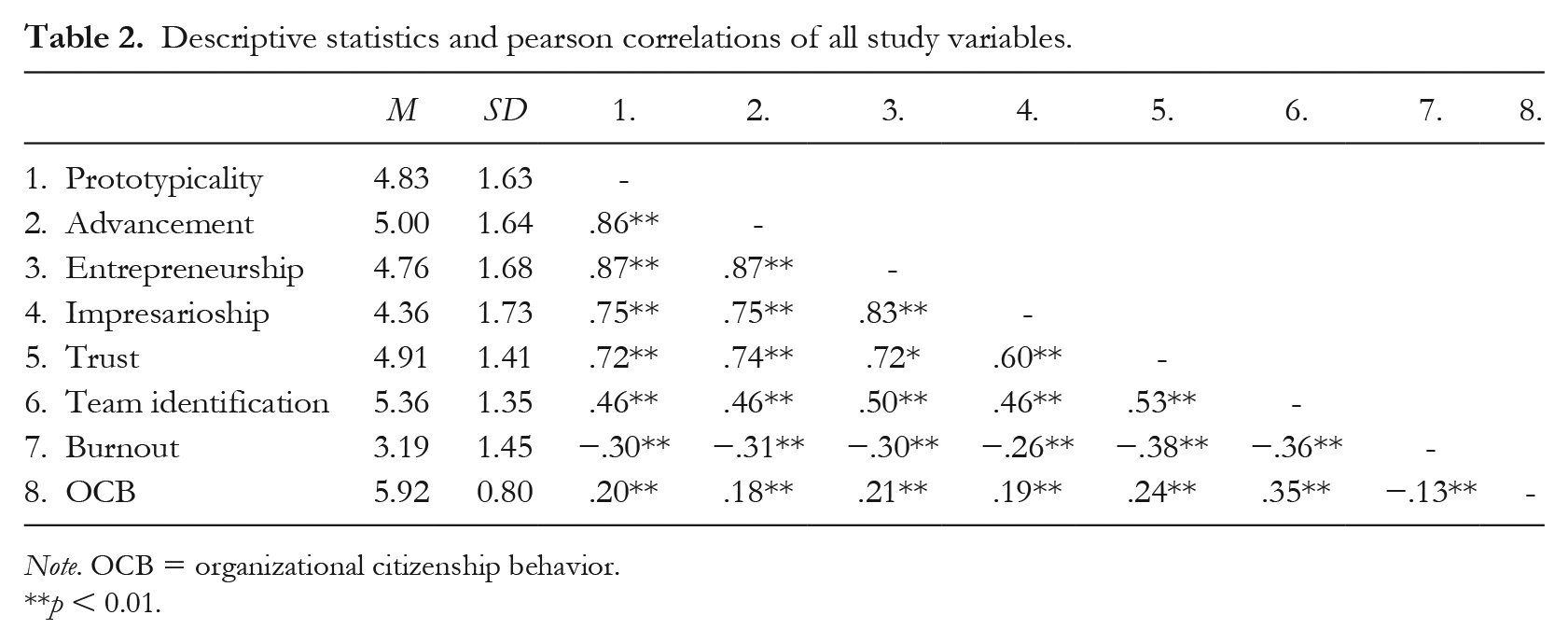
Note. OCB = organizational citizenship behavior.
p < 0.01.
Unstandardized results of the structural model (Model 2).
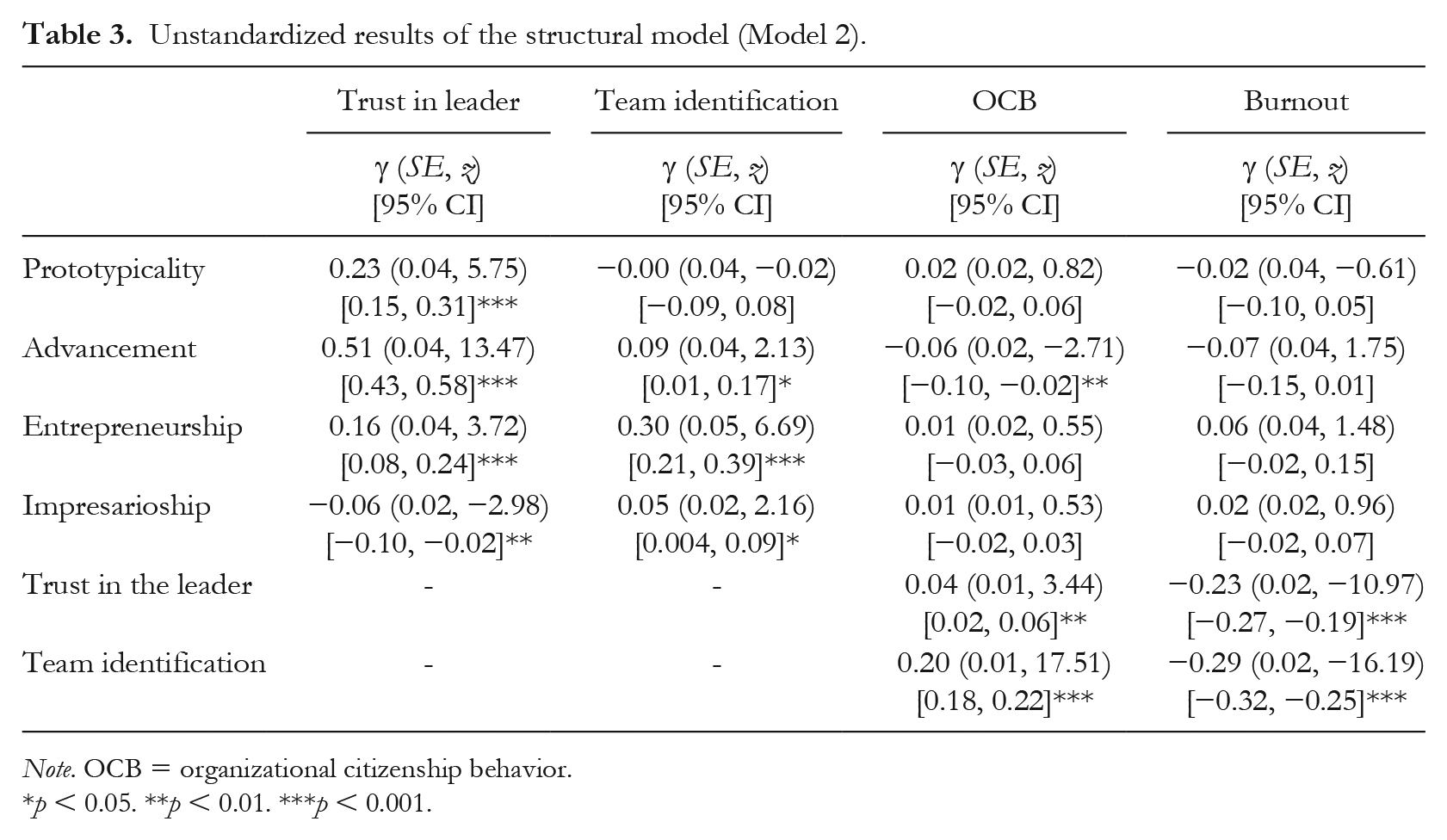
Note. OCB = organizational citizenship behavior.
p < 0.05. **p < 0.01. ***p < 0.001.
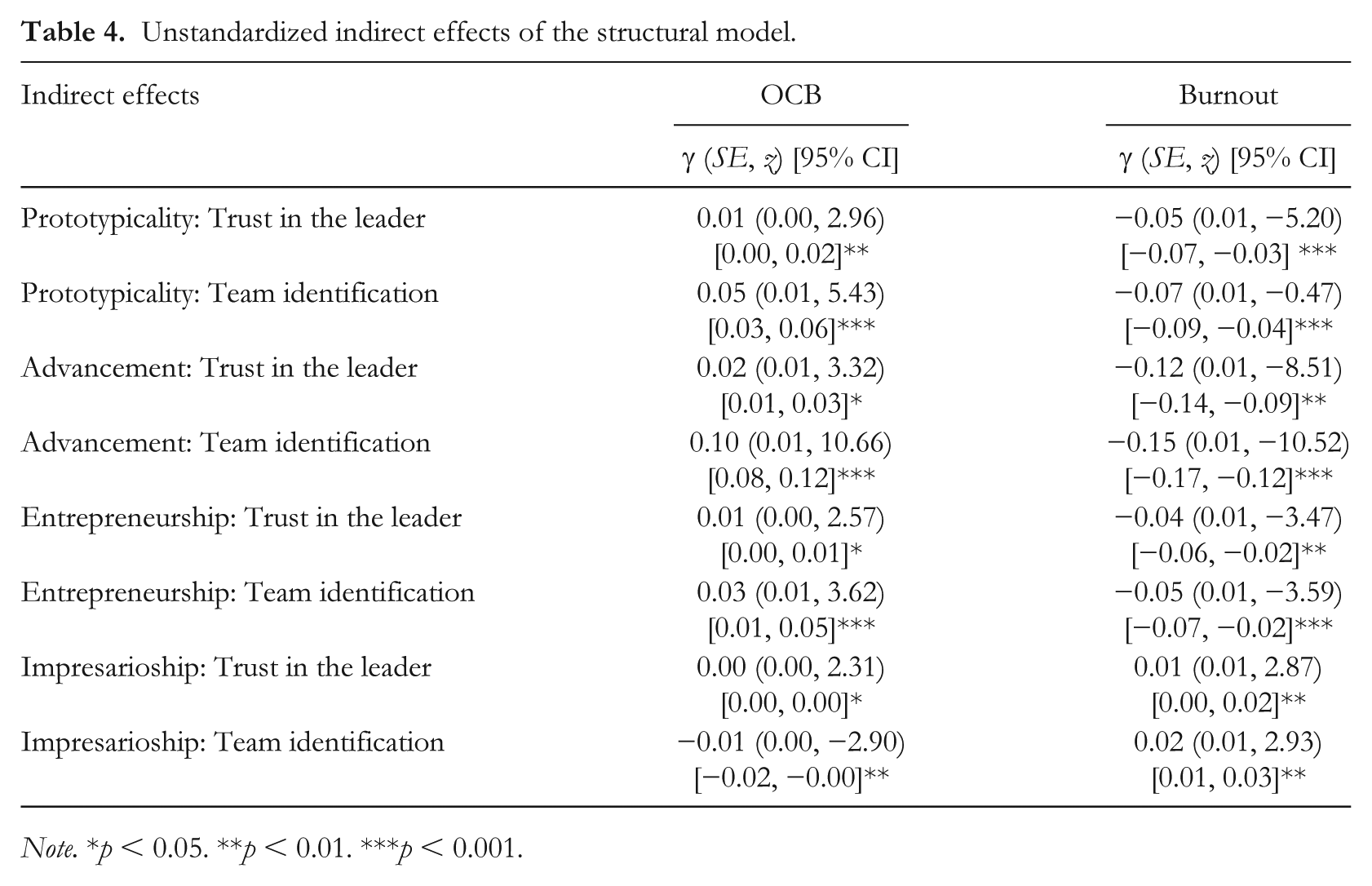
Moreover, trust in the leader was positively associated with OCB (γ = 0.04, SE = 0.01, z = 3.44, p = .001, 95% CI [0.02, 0.06]) and negatively related to burnout (γ = −0.23, SE = 0.02, z = −10.97, p < .001, 95% CI [−0.27, −0.19]). Thus, the results support H3a. Finally, and in line with H3b, team identification was positively related to OCB (γ = 0.20, SE = 0.01, z = 17.51, p < .001, 95% CI [0.18, 0.22]) and negatively related to burnout (γ = −0.29, SE = 0.02, z = −16.19, p < .001, 95% CI [−0.32, −0.25]). Therefore, the identity leadership dimensions were indirectly related to OCB and burnout via trust in the leader and team identification (see Table 4 for the indirect effects). Mediation analyses were significant except for the indirect effects of prototypicality via team identification on OCB and burnout.
Unstandardized indirect effects of the structural model.
Note. *p < 0.05. **p < 0.01. ***p < 0.001.
For exploratory purposes, we also tested models in the opposite direction, namely whether the identity leadership dimensions mediate the relationship between team identification, trust, OCB, and burnout. All indirect effects reached significance, but model fits were poor. Detailed results are reported in the Supplemental Material.
Discussion
Our study had two primary goals. First, we explored the four distinct dimensions of identity leadership (identity prototypicality, identity advancement, identity entrepreneurship, and identity impresarioship) and their associations with the two key underlying mechanisms trust in one’s leader and team identification. Specifically, we examined whether the two dimensions of identity prototypicality and identity advancement were predominantly associated with enhanced trust in one’s leader. At the same time, we investigated whether identity entrepreneurship and identity impresarioship were more strongly related to employee team identification than to trust in one’s leader.
Second, we explored the relationship between trust in the leader and team identification with the key group outcomes OCB and burnout. Lastly, combining the study’s two aims, we tested the indirect relationships of the identity leadership dimensions on OCB and burnout via the two processual mediators trust in one’s leader and team identification.
Concerning the study’s first aim, our results show that identity prototypicality and identity advancement were indeed more strongly associated with trust in one’s leader than with team identification. Also, as expected, identity entrepreneurship showed a stronger association with team identification than with trust in one’s leader. Not entirely consistent with our hypothesis was the effect of identity impresarioship, which showed only a small relation to team identification and even a negative relationship with trust in the leader. This finding was rather unexpected and probably due to high correlations between the constructs. Nevertheless, the predicted association between identity impresarioship and team identification was stronger than the relationship to trust in one’s leader.
In line with our hypotheses, it appears that leaders who portray in-group qualities (identity prototypicality) and act in in-group-serving ways (identity advancement) first and foremost are trusted more. Besides supporting literature that associated prototypical leader qualities with trust (see e.g., Giessner & van Knippenberg, 2008; Hogg et al., 2012), our study goes even further as it highlights the relationship’s actual power by including a comparative value in the model (team identification). Moreover, we provide support for the proposition that leaders who act in in-group-serving ways, thereby portraying more identity advancement, also might predominantly encourage trust. Consistent with van Dick et al. (2018), by using team identification as a comparative value in the model, we present additional substantial support for the idea that identity advancement primarily relates to more trust.
Equally noteworthy is the dominant relationship between entrepreneurship and team identification. Our results support the view that identity entrepreneurship is far more dependent on interactive processes, requiring the cooperation of the respective group members (Haslam et al., 2020), and, therefore, relates to team identification. Also, in this case, we demonstrated the association’s dominance through the strength comparisons. Furthermore, the discovery that identity impresarioship was negatively linked to trust (as opposed to H2b) can probably be attributed to the strong correlations between the constructs.
Considering the study’s second objective, both trust in one’s leader and team identification were related to the key group outcomes OCB and burnout. Additionally, in most cases, trust in the leader and team identification mediated the identity leadership subdimensions to work outcomes. Instances in which the mediational links are not significant (e.g., the indirect effects of prototypicality via team identification on work OCB and burnout; see Table 4) further promote our assumption that the dimension prototypicality might predominantly work via the underlying mechanism of trust in the leader.
Theoretical Implications
We present empirical support for the idea that the dimensions of identity leadership operate differently in the sense that they vary in their strength with which they relate to the two mechanisms of trust in the leader and team identification. Hitherto, studies either mainly focused on the dimension of identity prototypicality (e.g., Barretto & Hogg, 2017; Steffens et al., 2021) or on the global construct of identity leadership (e.g., van Dick et al., 2018)—including all four dimensions—and linked them to valuable work-related outcomes. The present study is an important advance upon this prior work by showing the unique contributions of the distinct dimensions of identity leadership to key mechanisms and key outcomes. Though prior findings presented high correlations among the dimensions (e.g., Steffens et al., 2014; van Dick et al., 2018), our study further highlights the relevance of considering these dimensions separately, as also pointed out by Laguía et al. (2021).
Implications for Practice
An in-depth understanding of the identity leadership dimensions’ operating principles offers valuable practical implications for future work-related interventions such as leadership trainings. For example, the 5R identity leadership development program (Haslam et al., 2017, 2023) places great emphasis on establishing a collective identity between leaders and followers through five structured steps: readying (“why is it important to engage with the ‘we-concept’?”), reflecting (“who are we?”), representing (“what defines us, and what do we want to become?”), realizing (“how do we become what we want to be?”), and reinforcing (“are we evolving in the way we want to?”). Together, these steps help foster team engagement and inclusiveness. In contrast to traditional leadership programs that practically focused on shaping the leaders’ identity exclusively, 5R holds that for creating healthy and engaged teams, reinforcement of “a sense of us” is vital (Haslam et al., 2017, 2023). For such programs, the findings that leadership qualities such as identity prototypicality and identity advancement predominantly relate to the mechanism of trust, whereas identity entrepreneurship and identity impresarioship primarily correlate with team identification are useful by allowing for a more tailored application of social identity theorizing. Simply put, if the blind spot is lack of trust in one’s leader, future programs using identity leadership might focus on the leader’s prototypicality of the team and advancement of the team’s interests. Alternatively, if there is a lack of team identification among members, prioritizing working on creating a strong sense of “us” (identity entrepreneurship) and devising more activities and events that strengthen that sense of cohesion (identity impresarioship) might be more beneficial. In this way, identity leadership programs could be implemented and tailored on a content level, thus being more mindful of the individual team’s needs.
Limitations and Future Implications
The first limitation we must acknowledge is the cross-sectional nature of the data, which makes it impossible to infer causality. However, this design choice was necessary in light of our goal of collecting a large global dataset. In order to make causal claims, future research should test our hypotheses in experimental studies that manipulate each subdimension separately and then assess their relative impact on trust and team identification.
Moreover, although our dataset is heterogeneous, with participants from 29 different countries, including both individualistic and collectivistic cultures, we cannot ensure that participants of each country were representative of the respective country’s population. While we have such an extensive dataset, with countries from almost every continent, which is clearly an asset of the present study, future data collections about identity should also include countries from the African continent—this would be an essential step towards generalizability.
Another point worth mentioning is that due to the large sample size, the likelihood that even minor effects become significant increases. Nevertheless, our analysis centers mainly on comparisons of the strength of effects, and so we do not see this as inherently problematic for our conclusions.
Conclusion
Our findings suggest that the identity leadership subdimensions differ in the strength with which they relate to the two mechanisms trust in the leader and team identification, respectively. Furthermore, our study demonstrates that trust in one’s leader and team identification relate to essential group outcomes that advance performance and facilitate health. These findings have the potential to fundamentally contribute to future leadership training and interventions, as those can be designed to be more responsive to a company’s specific demands.
Supplemental Material
sj-docx-1-gpi-10.1177_13684302251341818 – Supplemental material for The value of leaders we trust and leaders who make us stronger: Exploring the distinct contributions of different components of identity leadership to group member outcomes
Supplemental material, sj-docx-1-gpi-10.1177_13684302251341818 for The value of leaders we trust and leaders who make us stronger: Exploring the distinct contributions of different components of identity leadership to group member outcomes by Kira Bibic, Svenja B. Frenzel, Rudolf Kerschreiter, Jeremy Wilson-Lemoine, Niklas Steffens, S. Alexander Haslam, Lucas Monzani, Serap Arslan Akfirat, Christine Joy A. Ballada, Tahir Bazarov, John Jamir Benzon R. Aruta, Lorenzo Avanzi, Aldijana Bunjak, Matej Černe, Charlotte M. Edelmann, Olga Epitropaki, Katrien Fransen, Cristina García-Ael, Steffen Giessner, Ilka H. Gleibs, Dorota Godlewska-Werner, Ronit Kark, Ana Laguia Gonzalez, Hodar Lam, Anna Lupina-Wegener, Yannis Markovits, Mazlan Maskor, Fernando Jorge Molero Alonso, Juan A. Moriano Leon, Pedro Neves, Daniela Pauknerová, Sylwiusz Retowski, Christine Roland-Lévy, Adil Samekin, Sebastian Schuh, Tomoki Sekiguchi, Lynda Jiwen Song, Joana Story, Jeroen Stouten, Liliya Sultanova, Srinivasan Tatachari, Lisanne van Bunderen, Dina Van Dijk, Sut I Wong, Xin‘an Zhang and Rolf van Dick in Group Processes & Intergroup Relations
Footnotes
Funding
The authors disclosed receipt of the following financial support for the research, authorship, and/or publication of this article: This research was supported by a grant from the Karl Schlecht Stiftung and by the ConTrust Research Center at Goethe University.
ORCID iDs

Supplemental Material
Supplemental material for this article is available online.
Notes
References
Supplementary Material
Please find the following supplemental material available below.
For Open Access articles published under a Creative Commons License, all supplemental material carries the same license as the article it is associated with.
For non-Open Access articles published, all supplemental material carries a non-exclusive license, and permission requests for re-use of supplemental material or any part of supplemental material shall be sent directly to the copyright owner as specified in the copyright notice associated with the article.
