




Abstract
Economic inequality significantly influences people’s thoughts and actions regarding wealth gaps. Global trends show an increase in collective action tendencies, such as protesting or signing petitions for ingroups. Our research explores collective action goals among middle-status group members responding to economic inequality. Drawing on social identity theory, we hypothesised that heightened inequality leads to increased collective action intentions. Experiment 1 (N = 74) establishes a causal link between economic inequality and intentions for middle-status group members both to reduce inequality and enhance ingroup status. In a preregistered second experiment (N = 432), we investigated legitimacy appraisals and intergroup comparison direction as explanatory variables. Legitimacy of ingroup status and societal inequality mediated the impact of economic inequality on distinct collective action goals. Upward intergroup comparison heightened intentions to improve ingroup status, but not to reduce inequality. These findings contribute to understanding the consequences of economic inequality and drivers of collective action.
Economic inequality refers to disparities among groups’ or individuals’ incomes and wealth, and it is a major global issue. The World Inequality Report 2022 shows that the bottom 50% of the global population own 2% of global wealth, while the top 1% own 38% of global wealth, showcasing the large extent of economic inequality globally (Chancel et al., 2022). Wilkinson and Pickett (2017) highlight income inequality as an underacknowledged source of a wide range of social issues, such as civil unrest and reduced social cohesion. Studies suggest that higher inequality goes along with worse social relations in the form of more discrimination between groups, lower levels of trust, and more status anxiety (Buttrick & Oishi, 2017; Easterbrook, 2021; Layte & Whelan, 2014; Melita et al., 2021; Uslaner & Brown, 2005; Wienk et al., 2022). This is a concern in almost all countries and societies around the world, where groups of people are in economic situations that lead them to consider ways to reduce the inequality that exists or to improve the status of their ingroup.
Collective action tendencies are any actions that individuals undertake as group members to pursue group goals, such as social change (Agostini & van Zomeren, 2021; van Zomeren et al., 2018). Collective action is an important part of how people respond to various socioeconomic phenomena. All around the globe, mass protests are an increasing phenomenon fuelled by economic and political issues (Barrett, 2022; Witte et al., 2020). This paper examines normative collective action—such as joining a protest, signing a petition, or voting behaviour, which conform to the norms of the dominant social system’s laws and regulations (Becker & Tausch, 2015; Shuman et al., 2021)—as a potential response to economic inequality between social groups.
Extending previous research, we investigate whether income inequality between social groups drives intentions of middle-status group members towards two distinct collective action goals: the reduction of inequality and the improvement of their ingroup status. Focusing on middle-status groups allows to test whether economic inequality increases collective action intentions for those who are in the majority status position (most people do not belong to the very upper or lower echelons of the economic distribution), and it extends previous literature which tends to focus on those in a high versus low status position (Caricati, 2018; Jetten, Mols, et al., 2017; Thomas et al., 2020; Wright & Tropp, 2002). We hypothesise that both goals of collective action intentions of middle-status group members are higher in situations of high, compared to low, inequality. Furthermore, we test mechanisms that may contribute to the hypothesised effect of economic inequality on both goals of collective action intentions. Specifically, we examine the direction of intergroup comparison as well as legitimacy appraisals, adding to existing knowledge by considering two different forms of legitimacy appraisals and their consequences for different goals of collective action.
Collective Action as a Response to Economic Inequality
Economic inequality has been suggested as a driver of collective and political behaviour such as far-right populism or the Yellow Vest movement (Jay et al., 2019; Jetten et al., 2020). Following a social identity approach (SIA), comprised of social identity theory (Tajfel, 1974, 1979; Tajfel & Turner, 2004) and self-categorisation theory (Turner & Reynolds, 1987), economic inequality maximises the differences between “us” and “them” (Jetten, Wang, et al., 2017; Peters et al., 2022). Economic inequality increases the salience of wealth as a social category to examine and compare social groups (Jetten et al., 2021; Peters et al., 2022), and is thought to foster high levels of social comparison between those of different economic statuses (Cheung & Lucas, 2016). Economic inequality creates status anxiety (Layte & Whelan, 2014; Melita et al., 2021) and has also been shown to make individuals feel less wealthy (Sánchez-Rodríguez, Jetten, et al., 2019; Sánchez-Rodríguez et al., 2023) and more willing to seek out wealth and status improvement (Wang et al., 2023). How group members respond to increased intergroup comparison and status concerns is a topic of great importance, especially in the context of high levels of economic inequality and collective action globally (Barrett, 2022).
Whereas previous research has investigated collective action in general, to our knowledge, none of the existing literature accounts for the different goals that can underlie collective action in response to economic inequality. First, economic inequality may facilitate collective action to improve one’s ingroup status. This is in line with most of the research in the SIA tradition (Agostini & van Zomeren, 2021; Thomas et al., 2020; van Zomeren et al., 2018). Secondly, economic inequality may facilitate collective action to reduce such inequality in society. This is still in line with the SIA suggesting that one way to deal with intergroup comparison and status anxiety associated with economic inequality (Cheung & Lucas, 2016; Melita et al., 2021; Sánchez Rodríguez, Willis, et al., 2019) is to engage in collective action to change the status quo, which may imply either increasing one’s own status or reducing inequality (Di Bernardo et al., 2021; Jetten et al., 2020). Research has also demonstrated that people prefer much lower rates of inequality than exist. A preference was shown for a ratio of 7:1 between those with the most and those with the least wealth compared with the actual pay ratio of, for example, the US, which is 354:1 (Kiatpongsan & Norton, 2014; Norton, 2014).
Previous research focused on either collective action to improve ingroup status (e.g., Thomas et al., 2020) or collective action to reduce inequality (e.g., Di Bernardo et al., 2021), without explicitly distinguishing between these two goals of collective action. Here, we suggest that distinguishing between both goals is relevant as they are likely to be driven by different psychological processes, and we elaborate on two key processes as they relate to economic inequality: intergroup comparison and legitimacy appraisals.
Middle-Status Groups and Intergroup Comparison
Research examining collective action intentions tends to focus on comparing disadvantaged groups with advantaged ones (Di Bernardo et al., 2021; Jetten, Mols, et al., 2017; Teixeira et al., 2020; Thomas et al., 2020; Wright et al., 1990; Wright & Tropp, 2002). For disadvantaged groups, comparison with groups of higher status may be most salient because most other groups have higher status than theirs. However, societal distributions of wealth suggest that most people belong to social groups that are somewhere in the middle of the economic distribution (neither the wealthiest nor the most impoverished group; see Kochhar, 2018). Furthermore, most people view themselves as belonging to the middle class (Pressman, 2007; Ravallion & Lokshin, 2002). Thus, most people can compare upwards (with a higher status group) or downwards (with a lower status group).
The triadic social stratification theory (TSST, based on a SIA; Caricati, 2018; Caricati & Monacelli, 2010) has examined the importance of intergroup comparison for middle-status groups by highlighting how comparing one’s middle-status group to an outgroup on a relevant outcome, such as economic status, is related to behavioural outcomes. Additionally, intergroup comparison has been shown to be particularly prevalent under conditions of high economic inequality (Cheung & Lucas, 2016). Intergroup comparison enhances the distinction between the ingroup and an outgroup (Jetten, Wang, et al., 2017), and fosters social anxiety (Melita et al., 2021). Therefore, intergroup comparison is likely related to collective action intentions to improve ingroup status in economically unequal societies. Specifically, upward comparison will motivate more collective action intentions to improve ingroup status than downward comparison, given the lack of positive distinction when comparing upwards.
Predicting the influence of intergroup comparison on collective action to reduce inequality is less clear. Middle-status group members who compare upwards may be motivated to reduce inequality to achieve a relative improvement in status; as such, we expect that upwards (vs. downwards) intergroup comparison will increase collective action to reduce inequality. However, Caricati and Sollami (2017) suggests that upward comparison can foster legitimisation of the social structure in defence of one’s middle-status position despite a potential improvement in status. Conversely, a reduction of inequality for middle-status groups may imply a decline of status if people compare downwards; thus, people may be reluctant to promote collective action to reduce inequality if they compare downwards.
The Role of Legitimacy Appraisals
The second psychological process relevant for our examination of collective action intentions and economic inequality are legitimacy appraisals. Building upon the SIA to economic inequality, research suggests that appraisals of inequality as unfair or illegitimate will enhance the willingness to engage in collective action in response to it (Jetten, Wang, et al., 2017). Appraisals of illegitimacy are also a key sociostructural variable associated with greater social change motivation towards a more equitable society (Di Bernardo et al., 2021; Ellemers, 1993).
We suggest that legitimacy appraisals can explain the relationship between economic inequality and collective action responses; however, legitimacy is a complex concept as it relates to economic inequality. We suggest that legitimacy of the extent of inequality in a society is not the same as legitimacy of the status of one’s ingroup within a society/system. Ellemers (1993) highlights how legitimacy appraisals are a key factor in identity management strategies, and that groups’ status legitimacy influences collective group mobility strategies aimed at status improvement (Ellemers et al., 1993). Similarly, the social identity model of collective action (SIMCA) suggests that group-based feelings of injustice are key to driving collective action intentions to improve ingroup status (Thomas et al., 2020; van Zomeren et al., 2008, 2018). Evidently, legitimacy appraisals of ingroup status could drive collective action intentions to improve one’s group status in response to inequality.
Appraisals of the legitimacy of the extent of economic inequality appear to be different from appraisals of the legitimacy of ingroup status. Jetten, Wang, et al. (2017) suggest that if wealth gaps enhance the perception that inequality in society is unfair, this will increase the willingness to engage in collective action to redress it. Additionally, a system justification theory perspective discusses the motivations to maintain social inequalities through the legitimation of economic differences (Jost et al., 2017).
Building on these different lines of research, we suggest that there are two distinct targets of legitimacy appraisals: appraisals of the legitimacy of ingroup status and appraisals of the legitimacy of economic inequality. They both relate to economic inequality; however, they are likely to influence different goals of collective action intentions, which have not been examined together before. We aim to advance research and assess both targets of legitimacy appraisals that may specifically influence different goals of collective action intentions— intentions for status improvement versus intentions for inequality reduction—in response to high levels of economic inequality.
The Present Research
We present two experiments that manipulate income inequality between social groups in a fictional society, and investigate collective action intentions of middle-status group members. In both experiments, we manipulated the distribution of income inequality across three social groups and assigned all participants to the middle-status ingroup (based on the Bimboola paradigm created by Jetten et al., 2015). For both experiments, we gained ethical approval from the Faculty Ethics Board of the first author’s institution. Experiment 1 is a preliminary attempt to test the hypothesised main effect of economic inequality, compared to economic equality, on both goals of collective action intentions. We additionally assessed and explored legitimacy appraisals of ingroup status. Experiment 2 extends and improves Experiment 1. Specifically, in addition to manipulating the extent of economic inequality (high vs. low), we manipulated the direction of intergroup comparison. Importantly, we assessed both targets of legitimacy appraisals along with both goals of the intended collective action. We preregistered the following hypotheses on the Open Science Framework (OSF) before Study 2 data collection (see https://osf.io/vkqy4).
Hypothesis for Studies 1 and 2
H1: High levels of economic inequality will increase both goals of collective action intentions—intentions to improve ingroup status and intentions to reduce economic inequality—compared to economic equality (Study 1) and low levels of economic inequality (Study 2). 1
Hypotheses for Study 2
H2a: Comparing one’s group upwards will increase collective action intentions to improve ingroup status and to reduce inequality, versus comparing it downwards.
H2b: Direction of comparison will moderate the effect of economic inequality on both goals of collective action intentions. Specifically, comparing one’s group upward versus downward will increase collective action intentions to improve ingroup status and intentions to reduce inequality when inequality is high, but less so when inequality is low.
H3: Legitimacy appraisals will specifically mediate the relationship between economic inequality and the related goal of collective action intentions. Legitimacy appraisals targeting one’s own ingroup status will specifically explain collective action intentions to improve one’s ingroup status, while legitimacy appraisals targeting societal inequality will specifically explain collective action intentions to reduce inequality.
Experiment 1
In Experiment 1, we manipulated economic inequality versus equality between three social groups in a new society (which we called Plasseyville), and assigned participants’ chosen ingroup as the middle-status group before we assessed their collective action intentions to increase ingroup status and those to reduce economic inequality. This experiment mainly aimed to establish the hypothesised effect of economic inequality on both goals of collective action intentions (H1). Beyond this, we explored the impact of inequality on legitimacy appraisals of ingroup status among middle-status group members.
Method
Design and participants
Experiment 1 manipulated economic inequality (inequality vs. equality) between professional groups between subjects and assessed two dependent variables: collective action to improve ingroup status and collective action to reduce inequality. Furthermore, we assessed legitimacy of ingroup status as potential mediator. We recruited 74 participants via email and social media outlets connected to the first author’s university. To be included in the research, participants were required to be over 18 years old and be fluent in English. We collected data during a 3-week timeline. Data were gathered from 200 participants; however, 126 participants did not progress far enough in the survey to be included in data analysis (did not complete dependent variable measures). The analysed sample consisted of 24 men (32.4%) and 50 women (64.1%) from 18 to 65 years of age (Mage = 24.91, SDage = 10.68). A post hoc sensitivity analysis using G*Power (Faul et al., 2009) revealed that the study was sensitive to detect an effect size of d = 0.66 with 80% power.
Economic inequality manipulation
We manipulated the income of the two outgroups. Participants’ chosen ingroup in Plasseyville had the same income (PD50,000, indicated in Plasseyean dollars [PD]) in both conditions that was either the same (equality condition) or in between the two outgroups’ income (inequality condition). In the equality condition, the two outgroups had the same incomes as the participant’s ingroup (PD50,000). In the inequality condition, one of the outgroups had a low income (PD5,000), whereas the other outgroup had a high income (PD750,000). This income distribution presented participants with a ratio of 150:1 between those who have the most and those who have the least income.
Measures
Manipulation check
To examine whether the manipulation of economic inequality was effective, participants rated the level of inequality on two questions that we presented in random order: “To what extent is Plasseyville’s wealth distribution among the different groups unequal?” (1 = not unequal at all, 7 = very unequal) and “To what extent is Plasseyville’s wealth distribution among the different groups equal?” (1 = not equal at all, 7 = very equal). After reverse-scoring the latter item, we averaged both items (r = .74). Higher scores reflect higher perceived inequality.
Collective action intentions to improve ingroup status
Collective action intentions to improve group status were measured using six items adapted from Shi et al. (2015; e.g., “I will participate in a [participant’s chosen ingroup] led meeting bringing together others in my profession to increase wages”; 1 = very unlikely, 7 = very likely). Items were presented in random order. All items were averaged, and higher scores indicate more collective action intentions to improve ingroup status (α = .93).
Collective action intentions to reduce inequality
We modified three of the six collective action intention items to assess intentions to reduce inequality (e.g., “I would join a protest asking for a change in the wage structure that favours equal payment in Plasseyville”; 1 = very unlikely, 7 = very likely). Items excluded intent to change the absolute wealth of any group(s). Items were presented in random order. Again, all items were averaged, and higher scores indicate more collective action intentions to reduce inequality (α = .92).
Legitimacy of ingroup status
Participants completed one item adapted from Mummendey et al. (1999) to assess legitimacy appraisals of the status of their ingroup within society. Participants were presented with the following information and asked to rate on a 7-point scale (1 = not at all legitimate, 7 = completely legitimate): The status or standing of a social group in society is determined by a number of factors. Some of the factors determining societal standing are reasonable and fair while others seem unjust. Therefore, a group’s status can seem legitimate or illegitimate. For [participant’s chosen ingroup], please indicate how legitimate their status in Plasseyville seems to you.
Procedure
The experiment was set up in Qualtrics. Participation was voluntary and without incentive. First, participants read an information sheet and consented to take part before they entered a fictional society called Plasseyville in which they were informed of three occupational groups: Foodlees, Woodlees, and Waterlees—each with their own set of described responsibilities in Plasseyville.
Participants were asked to imagine their lives in Plasseyville as vividly as possible. First, they chose their occupational group from the three options. The chosen group was always assigned the middle status (i.e., income of PD50,000). To increase the validity of the income manipulation, participants were asked to choose a car, a house, and a holiday from a list of options, which ranged from cheap to expensive. In the equality condition, participants could choose any option. In the inequality condition, participants could only afford the lowest or middle priced options. Participants then verbalised their feelings about life in Plasseyville to make the fictitious life in Plasseyville society more salient. After some measures that are not relevant to the current study’s aim (for all materials, see https://osf.io/vkqy4), participants completed the manipulation check followed by the legitimacy appraisal of ingroup status, collective action intentions to improve ingroup status, and collective action intentions to reduce inequality. Lastly, participants answered questions on their age and gender.
Results and Discussion
Manipulation check
To test whether the inequality manipulation was successful, we compared the perceived inequality ratings between conditions using a between-subjects t test. Participants in the inequality condition perceived higher inequality in Plasseyville (M = 5.94, SD = 1.18) than those in the equality condition (M = 1.87, SD = 1.33), t(72) = −13.94, p < .001, d = 1.26, indicating that the manipulation of economic inequality was successful.
Collective action intentions
In line with the hypothesis (H1), an independent t test on collective action intentions to improve ingroup status showed that participants in the inequality condition indicated stronger collective action intentions to improve their ingroup status (M = 5.10, SD = 1.22) than those in the equality condition (M = 4.43, SD = 1.51), t(72) = −2.10, p = .040, d = 1.38 (see Figure 1).
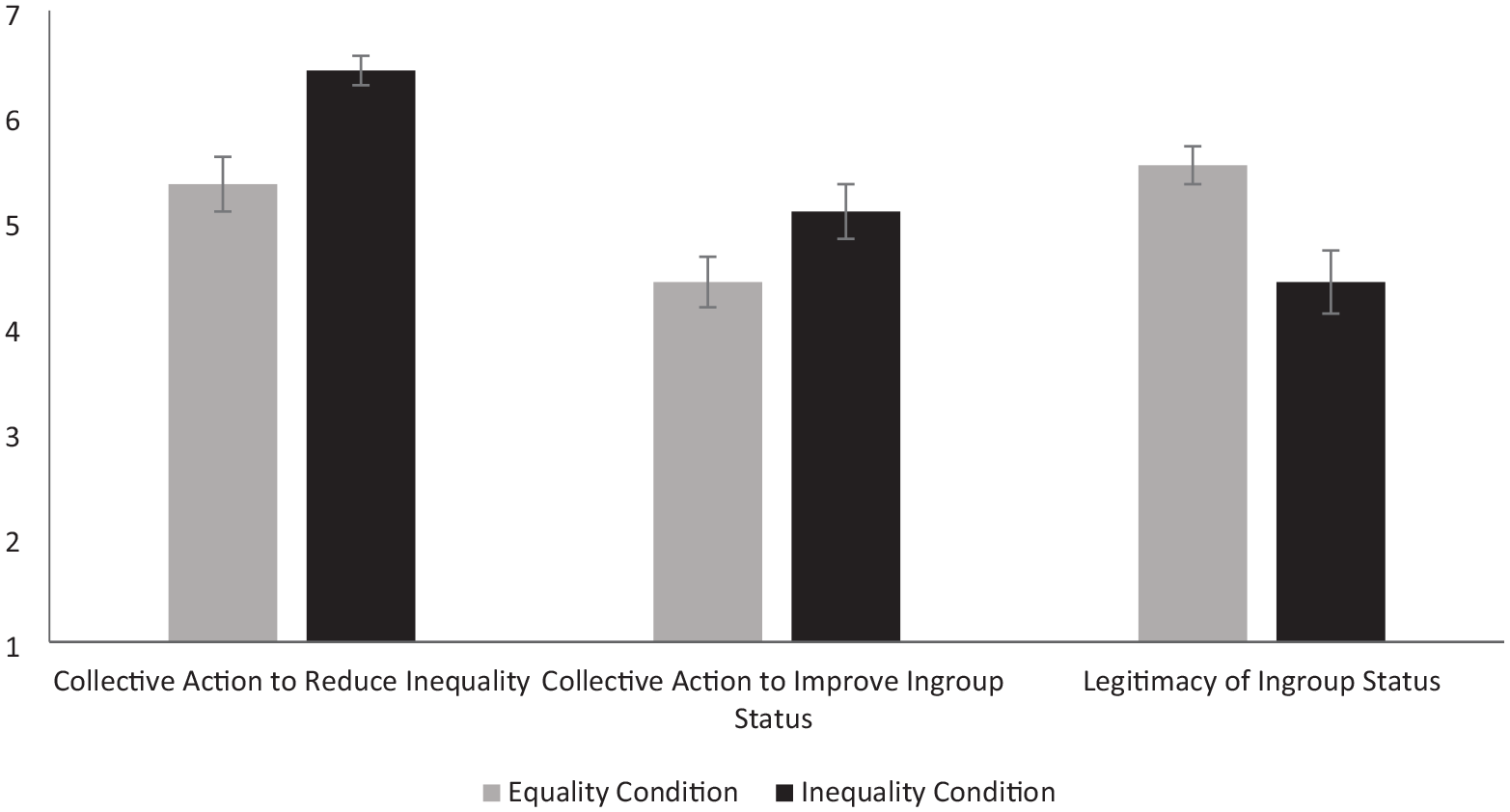
Mean scores for both goals of collective action intentions and legitimacy of ingroup status.
Similarly in line with H1, an independent t test on collective action intentions to reduce inequality indicated that participants in the inequality condition (M = 6.44, SD = 0.90) showed stronger collective action intentions to reduce inequality than those in the equality condition (M = 5.35, SD = 1.62), t(72) = −3.53, p < .001, d = 1.32 (see Figure 1). Despite the exact same income of participants in the economic inequality and equality conditions, economic inequality between social groups led to higher collective action intentions to improve group status as well as higher collective action intentions to reduce economic inequality, compared to economic equality.
Legitimacy appraisals
Exploration of legitimacy appraisals indicated that participants in the inequality condition perceived their ingroup status as less legitimate (M = 4.41, SD = 1.80) than those in the equality condition (M = 5.53, SD = 1.11), t(73) = 3.25, p < .001, d = 1.50 (see Figure 1).
To explore whether legitimacy appraisals of ingroup status mediated the effect of inequality on any of the distinct goals of collective action intentions, we conducted two separate mediation analyses, one on each goal of collective action intention, using PROCESS Model 4 (Hayes, 2017). Legitimacy of group status did not significantly mediate the effect of inequality on collective action to improve group status (indirect effect −0.23, 95% CI [−0.60, 0.01]) nor on collective action to reduce inequality (indirect effect −0.16, 95% CI [−0.39, 0.05]). One reason may be that a low sample size (N = 74) rendered the study underpowered to detect mediations based on the analysis used and the recommendations of Fritz and MacKinnon (2007). Another reason may be the implemented measure of legitimacy appraisals. This single-item measure may not have allowed us to reliably measure legitimacy appraisals. Furthermore, the concept of legitimacy appraisals regarding economic inequality is complex and, based on current literature, there are two types of appraisals of legitimacy (of group status and of economic inequality) that relate to economic inequality, both of which are likely to influence collective action intentions in different ways but have not been examined together in the same study before.
Experiment 2
In Experiment 2, we compared high economic inequality with low inequality to address a limitation of Experiment 1. We improved our legitimacy measure to comprise multiple items and accounted for legitimacy appraisals of ingroup status as well as legitimacy appraisals of inequality. To test our reasoning that intergroup comparison by middle-status group members will impact collective action intentions in unequal societies, we additionally manipulated whether our middle-status participants compared their ingroup upwards or downwards. We tested the four hypotheses set out at the beginning of the paper. Preregistration of Experiment 2 can be found on the OSF (see https://osf.io/vkqy4).
Method
Design and participants
Experiment 2 used a 2 (economic inequality: high vs. low) × 2 (comparison: upwards vs. downwards) between-subjects experimental design with two dependent variables: collective action to improve ingroup status and collective action to reduce inequality. Furthermore, legitimacy of ingroup status and legitimacy of inequality served as potential mediators.
We recruited 450 participants via Prolific, from whom we collected data. Inclusion criteria were that participants were 18 years or older and spoke fluent English. Sixteen participants did not progress far enough in the survey to be included in data analysis, resulting in missing data on the dependent variables. One participant failed an attention check asking them “It is important for our studies that participants are paying attention to the questions. Please select ‘no’ to tell us you are paying attention,” by selecting yes. The analysed sample (N = 433) consisted of 205 men (47.2%), 221 women (50.9%), one participant who selected “prefer not to say” (0.2%), and six (1.4%) participants that selected “other.” Participants were between 18 and 63 years of age (Mage = 27.17, SDage = 8.42). Participants were compensated €2.37. A post hoc sensitivity analysis using G*Power (Faul et al., 2009) showed that the study was sensitive to detect effect sizes of d = 0.27 with 80% power.
Manipulation of economic inequality
We manipulated economic inequality as in Experiment 1 but added variation in income between the three groups in the low-inequality condition. In the low-inequality condition, incomes of the groups were PD49,500, PD50,000, PD50,500 (a ratio of 1.02:1), and in the high-inequality condition, the three incomes were PD10,000, PD50,000, PD750,000 (a ratio of 75:1).
Manipulation of direction of intergroup comparison
In the upward comparison conditions, participants were instructed that “In Plasseyville the [participant’s chosen ingroup] is often compared with the [high-status outgroup] please consider your answers to the following questions as a [ingroup] in comparison with the [high-status outgroup].” In the downward comparison conditions, the ingroup was compared with the low-status outgroup. Additionally, participants were asked to write some words about how they felt in comparison to the instructed comparison group.
Measures
We used the same inequality manipulation check as in Experiment 1 (r = .54). Collective action intention to improve ingroup status was measured using the same six items as in Experiment 1 (α = .95). Collective action intention to reduce inequality was measured using the same three items as in Experiment 1 (α = .93).
Comparison direction manipulation check
To examine whether the manipulation of upward versus downward comparison was effective, we asked participants to rate on a 7-point scale (1 = strongly disagree, 7 = strongly agree) to what extent they compared their ingroup with (a) the high-status outgroup and (b) the low-status outgroup (i.e., “To what extent do you agree with the following statement: I compare my group membership as a [ingroup] with the [higher status group]”). We subtracted the score for comparison with the low-status outgroup from the score for comparison with the high-status outgroup. The higher and positive the value on that difference score, the more participants indicated to have compared upwards (negative scores indicate more downward comparison).
Legitimacy of ingroup status
We adapted three items (Caricati & Sollami, 2017; Mummendey et al., 1999) to assess legitimacy appraisals of ingroup status. Participants rated how legitimate, fair, and just they perceived the status of their group to be (e.g., “For [ingroup], please indicate how legitimate their status in Plasseyville seems to you”; 1 = not at all legitimate, 7 = completely legitimate). We averaged all items, with higher scores reflecting higher legitimacy of ingroup status (α = .83).
Legitimacy of inequality
We adapted the same three items (Caricati & Sollami, 2017; Mummendey et al., 1999) to assess appraisals of the legitimacy of inequality. Participants rated how legitimate, fair, and just they perceived the distribution of income in Plasseyville to be (e.g., “For Plasseyville’s income distribution, specifically the range of income between your group compared to others, please indicate how legitimate this distribution seems to you”; 1 = not at all legitimate, 7 = completely legitimate). We averaged all items, with higher scores reflecting higher legitimacy of the inequality (α = .94).
Procedure
Experiment 2 followed the same procedure as Experiment 1. Participants completed the manipulation checks followed by legitimacy appraisals of ingroup status, legitimacy appraisals of economic inequality, collective action intentions to improve ingroup status, and collective action intentions to reduce inequality (in this order). The attention check was included after these measures. Other measures that are not of relevance to the current study’s aim were also included (for all materials, see https://osf.io/vkqy4). Lastly, participants indicated their age and gender.
Results and Discussion
Economic inequality manipulation check
An analysis of variance (ANOVA) with economic inequality (high vs. low) and comparison direction (upwards vs. downwards) as independent variables, and perceived economic inequality as dependent variable showed a successful and specific effect of the economic inequality manipulation. Participants in the low-inequality condition (M = 3.78, SD = 1.33) perceived the inequality in Plasseyville to be significantly lower than participants in the high-inequality condition did (M = 5.95, SD = 1.21), F(1, 429) = 318.57, p < .001, η2 = .42. Comparison direction did not affect perceived economic inequality, F(1, 429) = 0.09, p = .763, η2 = .01 (upward comparison: M = 4.89, SD = 1.68; downward comparison: M = 4.86, SD = 1.67). Comparison direction also did not moderate the effect of economic inequality on perceptions of it, F(1, 429) = 0.02, p = .878, η2 < .001.
Comparison direction manipulation check
The same ANOVA with the extent of upward comparison as dependent variable also showed a successful and specific effect of the comparison direction manipulation. Participants in the upward comparison condition (M = 0.65, SD = 2.82) compared their group with the group of higher status significantly more than participants in the downward comparison condition did (M = −1.54, SD = 2.59), F(1, 429) = 71.90, p < .001, η2 = .14. The economic inequality manipulation did not affect the level of upward comparison, F(1, 429) = 3.44, p = .065, η2 = .14 (high inequality: M = −0.69, SD = 3.00; low inequality: M = −0.20, SD = 2.83). However, the strength of the effect of the comparison direction on upward comparison depended on economic inequality, F(1, 429) = 4.50, p = .034, η2 = .01. Surprisingly, the comparison direction manipulation was stronger in the low-inequality condition (upward comparison: M = 1.17, SD = 2.46; downward comparison: M = −1.57, SD = 2.51) than in the high-inequality condition (upward comparison: M = 0.14, SD = 3.10; downward comparison: M = −1.54, SD = 2.70).
Collective action intentions to improve ingroup status
To test whether high (vs. low) economic inequality and upward (vs. downward) comparison increase collective action intentions to improve ingroup status, we conducted an ANOVA with both factors as independent variables, and collective action intentions to improve ingroup status as the dependent variable. Results replicated the findings of Experiment 1 in support of H1, in the high economic inequality condition, participants showed more collective action intentions to improve ingroup status (M = 5.58, SD = 1.27) than in the low-inequality condition (M = 4.62, SD = 1.51), F(1, 429) = 51.72, p < .001, η2 = .11 (see Figure 2).
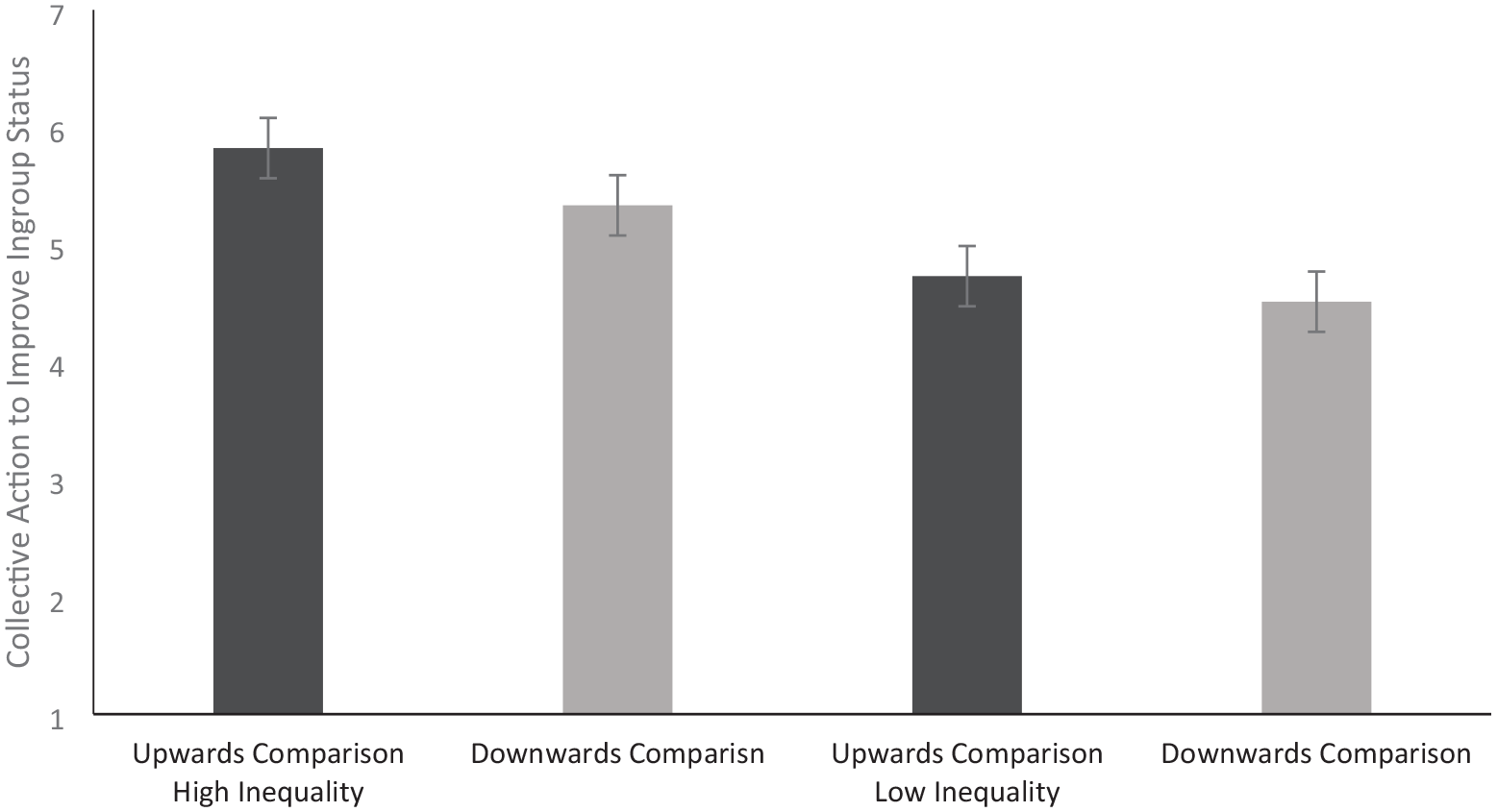
Collective action intentions to improve ingroup status dependent on upward versus downward comparison and high versus low economic inequality.
Additionally supporting H2a, those who compared their group upwards (M = 5.27, SD = 1.41) showed more collective action intentions to improve ingroup status than those who compared it downwards (M = 4.92, SD = 1.51), F(1, 429) = 7.04, p = .008, η2 = .02. However, we did not find the hypothesised interaction (H2b) between economic inequality and comparison direction on collective action to improve ingroup status, F(1, 429) = 1.03, p = .310, η2 = .01. These results suggest that comparing upwards does increase collective action intentions to improve ingroup status but that this effect is not stronger when inequality is high compared to low. Thus, the present data do not indicate that the effect of economic inequality on collective action intentions to improve ingroup status is driven by stronger upward comparison under high economic inequality.
Collective action intentions to reduce inequality
To test the effect of high (vs. low) economic inequality and comparison direction (upwards vs. downwards) on collective action intentions to reduce inequality, we conducted the same ANOVA with collective action intentions to reduce inequality as the dependent variable. Results again replicated the findings of Experiment 1 in support of H1: in the high economic inequality condition, participants showed more collective action intentions to reduce inequality (M = 6.19, SD = 1.07) than in the low-inequality condition (M = 5.25, SD = 1.57), F(1, 427) = 51.72, p < .001, η2 = .11 (see Figure 3).
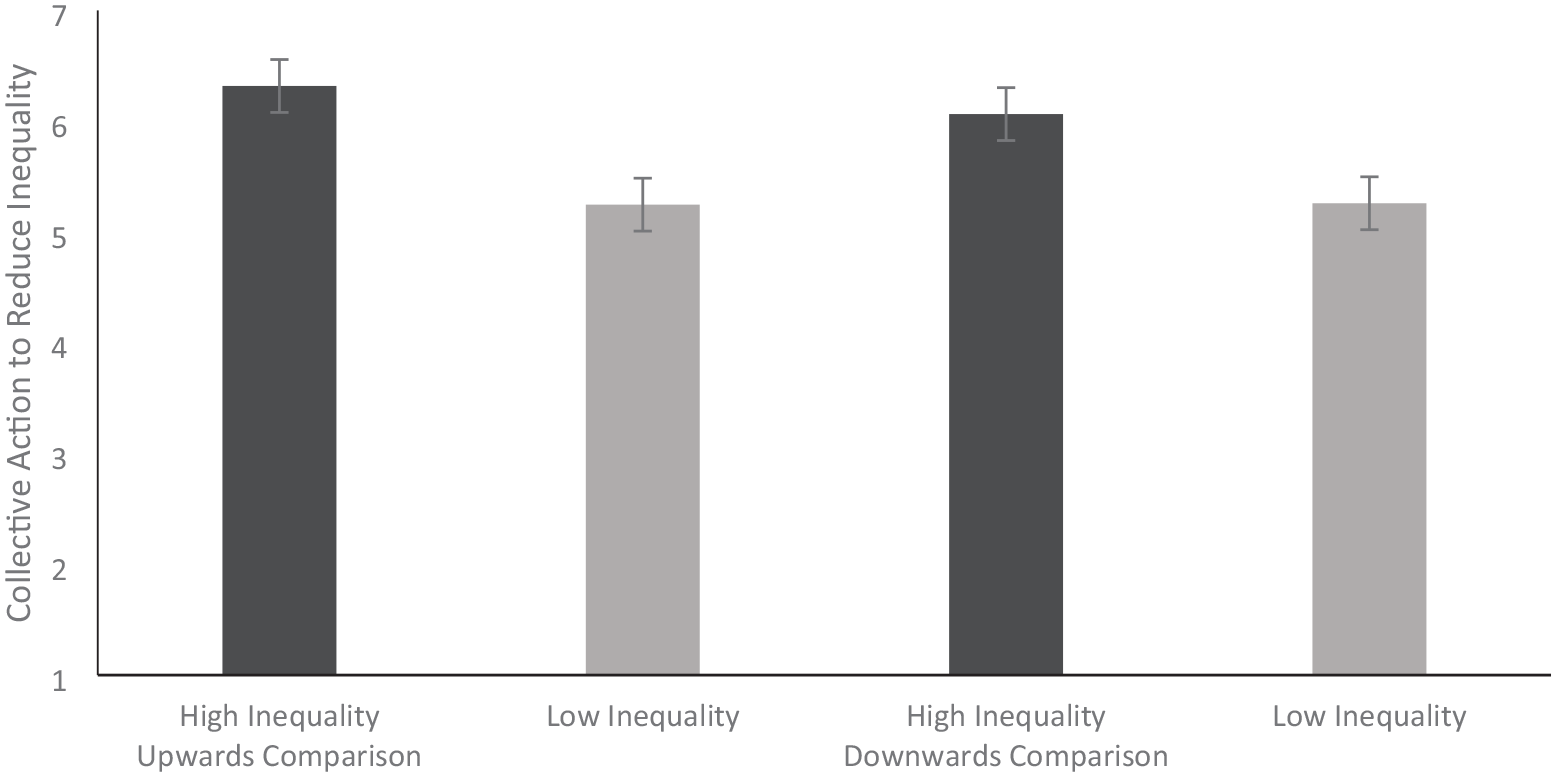
Collective action intentions to reduce inequality dependent on upward versus downward comparison and high versus low economic inequality.
There was no support for H2a or H2b: those who compared their group upwards (M = 5.78, SD = 1.41) did not show statistically more collective action intentions to reduce inequality than those who compared it downwards (M = 5.66, SD = 1.44), F(1, 427) = 0.87, p = .351, η2 = .01. The interaction of economic inequality and comparison direction was also not significant, F(1, 427) = 1.03, p = .310, η2 = .01. These results suggest that comparison direction does not explain why higher economic inequality increases collective action intentions to reduce inequality.
Legitimacy of ingroup status
An ANOVA on legitimacy appraisals of group status showed that high economic inequality (M = 4.79, SD = 1.26) decreased legitimacy of one’s group status compared to low inequality (M = 5.95, SD = 0.97), F(1, 429) = 116.80, p < .001, η2 = .21. Upward comparison (M = 5.30, SD = 1.25) did not significantly decrease legitimacy appraisals of ingroup status compared to downward comparison (M = 5.44, SD = 1.28), F(1, 429) = 1.63, p = .202, η2 = .01. Comparison direction did also not moderate the effect of economic inequality on legitimacy of ingroup status, F(1, 429) = 0.87, p = .350, η2 = .01. These results indicate that economic inequality drives appraisals of one’s ingroup status as illegitimate independently from comparison direction. In fact, higher economic inequality led to higher illegitimacy/lower legitimacy appraisals despite the same status of the participant’s ingroup in both inequality conditions.
Legitimacy of economic inequality
An ANOVA on legitimacy appraisals of economic inequality showed that high economic inequality (M = 4.94, SD = 1.41) decreased legitimacy of inequality compared to low economic inequality (M = 2.43, SD = 1.34), F(1, 429) = 359.39, p < .001, η2 = .46. Upward comparison (M = 3.77, SD = 1.88) did not significantly decrease legitimacy appraisals compared to downward comparison (M = 3.59, SD = 1.85), F(1, 429) = 1.71, p = .191, η2 = .01. Comparison direction did also not moderate the effect of economic inequality on its legitimacy, F(1, 429) = 0.22, p = .642, η2 = .01. These results indicate that economic inequality drives appraisals of inequality as illegitimate. Again, this effect of economic inequality on its legitimacy appraisals was independent from comparison direction.
Mediation of the effect of economic inequality on collective action by legitimacy appraisals
To test H3, we examined whether the effects of economic inequality on collective action intentions to improve ingroup status and to reduce inequality were specifically mediated via legitimacy of ingroup status and legitimacy of inequality, respectively (for simple correlations between all variables, see the Appendix). Therefore, we conducted two separate parallel mediation analyses (a) on collective action to improve ingroup status and (b) on collective action to reduce inequality, using Model 4 of the PROCESS macro for SPSS (Hayes, 2017). The indirect effects were tested using 10,000 bootstrapped estimates.
Collective action to improve ingroup status as dependent variable
The first parallel mediation model included collective action to improve group status as criterion, economic inequality as predictor, and legitimacy of group status and legitimacy of economic inequality as parallel mediators. Results showed support for H3, that high (vs. low) economic inequality increased collective action to improve group status through decreasing appraisals of legitimacy of ingroup status, but not through legitimacy of economic inequality. As shown in Figure 4, the 95% bias-corrected confidence interval indicated that the indirect effect through legitimacy of group status, controlling for legitimacy of economic inequality, was significant, β = .10, SE = 0.05, 95% CI [0.01, 0.21]. The indirect effect through legitimacy of economic inequality was not significant, β = .04, SE = 0.11, 95% CI [−0.24, 0.15]. Results from this mediation model supported our hypothesis that legitimacy of ingroup status specifically mediated the relationship between economic inequality and collective action to improve ingroup status.
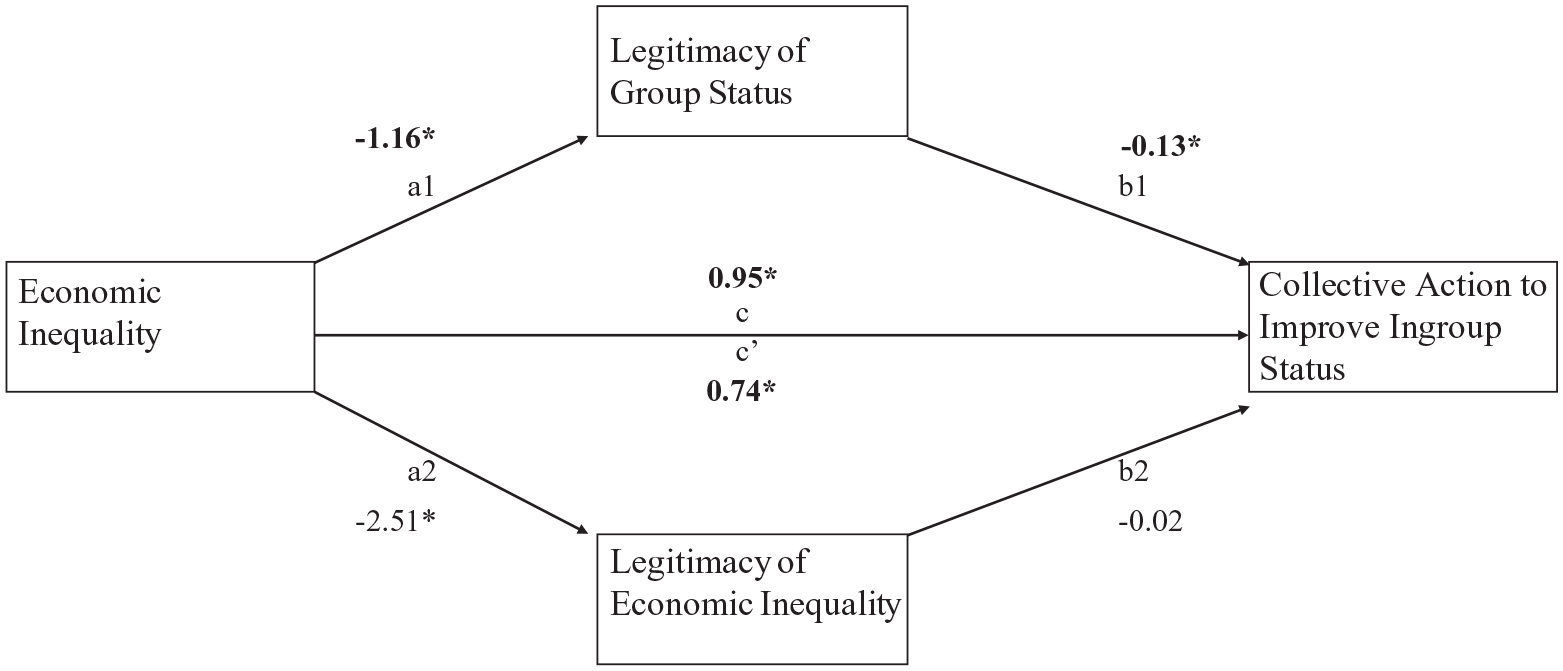
Parallel mediation model examining the effect of economic inequality on collective action intentions to improve group status with two types of legitimacy appraisals as mediators.
Collective action to reduce inequality as dependent variable
The second parallel mediation model included collective action intentions to reduce inequality as criterion. Results showed support for H3, that economic inequality increased collective action to reduce inequality through its relationship with legitimacy of economic inequality, but not legitimacy of group status (see Figure 5). The 95% bias-corrected confidence interval showed that the indirect effect through legitimacy of economic inequality, controlling for legitimacy of group status, was significant, β = −.41, SE = 0.12, 95% CI [−0.63, −0.18]. The indirect effect through legitimacy of group status was not significant, β = .04, SE = 0.05, 95% CI [−0.05, 0.14]. These data suggest that specific legitimacy appraisals account for the effect of economic inequality on different goals of increased collective action intentions.
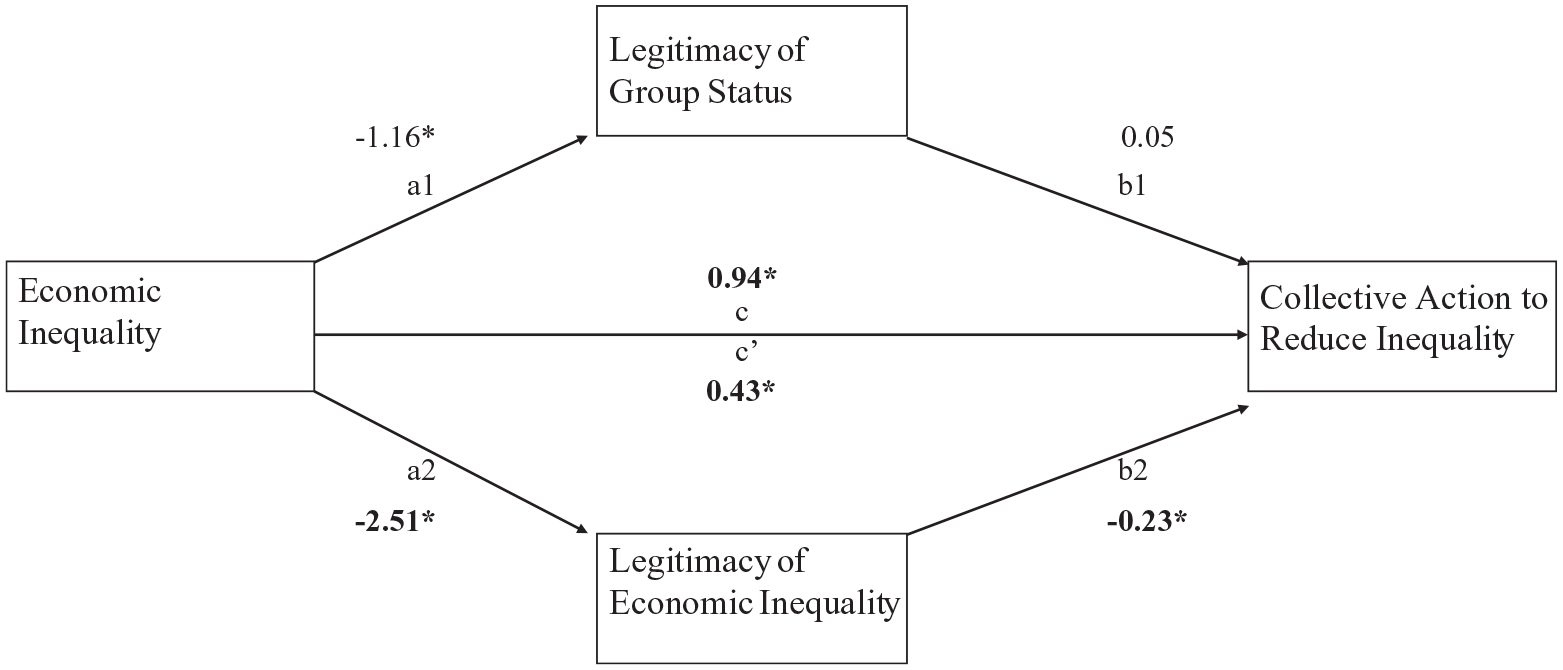
Parallel mediation model examining the role of economic inequality on collective action to reduce inequality with two types of legitimacy appraisals as mediators.
General Discussion
Two experiments examined two goals of collective action intentions of middle-status income groups in response to economic inequality. Results of both experiments consistently supported Hypothesis 1, that high levels of inequality between social groups increase collective action intentions towards both goals: to reduce inequality in society and to improve the status of the ingroup. Experiment 1 compared high inequality with a condition of economic equality; Experiment 2 replicated the findings when comparing high economic inequality with low economic inequality. Despite people having the same income in both conditions, if the gap in income between professional groups in society was high compared to low, people had higher intentions to act to improve their ingroup status and to reduce the inequality in society.
Moreover, high economic inequality led to reduced appraisals of the legitimacy of ingroup status in both experiments. High economic inequality also reduced appraisals of the legitimacy of inequality in society, as demonstrated in Experiment 2. Experiment 2 further provided evidence that specific appraisals of legitimacy explain the effect of economic inequality on specific goals of collective action intentions: whereas perceived legitimacy of ingroup status explained the effect of inequality on intentions to improve ingroup status, perceived legitimacy of the inequality explained the respective effect on intentions to reduce such inequality.
Whereas upward (vs. downward) intergroup comparison predicted collective action intentions to improve ingroup status, it did not increase the effect of inequality on any of the goals of collective action intentions. In the following, we will discuss findings with respect to previous research.
High Inequality Led to More Collective Action Intentions
Results demonstrate that people are driven to take collective action to improve their ingroup status in unequal societies, which supports a SIA suggesting economic inequality as a driver of collective action intentions (Jetten et al., 2020) and a creator of environments where people seek out wealth and status (Wang et al., 2023). Furthermore, our results show that economic inequality not only drives motives of ingroup interest but also motives of societal change (Di Bernardo et al., 2021). Our results support our suggestion that people are driven to collectively act to achieve a more equal pay ratio in society when inequality is high, despite no direct gain in status for their ingroup. This is in line with the claim that people prefer lower levels of inequality than exist in reality (Norton, 2014), and adds to the understanding of collective action intentions from groups of high versus low status (Wright & Tropp, 2002) by showing the preferences of middle-status groups. We add to previous literature in demonstrating a causal effect of economic inequality on collective action intentions.
Role of intergroup comparison direction
Middle-status groups have their own unique motivations in reaction to group differences (Caricati & Sollami, 2017). Intergroup comparison has been shown to be particularly prevalent under conditions of economic inequality (Cheung & Lucas, 2016). Upward comparison by middle-status group members who face economic inequality implies that they will feel relatively deprived and anxious about their status, particularly if levels of economic inequality are high (Layte & Whelan, 2014; Melita et al., 2021; Sánchez-Rodríguez, Willis, et al., 2019). Our results support these perspectives and add that middle-status group members are more driven to take collective action to improve ingroup status when comparing their group upwards (vs. downwards).
We investigated the direction of intergroup comparison as a potential driver of the effect of economic inequality on collective action intentions in middle-status group members. We argued that if people compare their group upwards, then higher levels of economic inequality will make them feel more deprived and anxious about their status, motivating collective action intentions. However, the present data do not support this suggestion: our middle-status group members showed higher intentions to collectively act to improve their ingroup status when comparing upwards versus downwards, independently from the level of economic inequality.
Furthermore, comparison direction did not matter for collective action intentions to reduce inequality. This finding could be explained by Caricati’s (2017) suggestion that upward comparison can foster legitimisation of the social structure in defence of one’s position despite a potential improvement in status, whereas downward comparison may not inspire inequality reduction as it may mean a relative reduction in status (see also Caricati & Owuamalam, 2020). Moreover, mobility beliefs (i.e., the hope of class ascent) may be made salient by intergroup comparison in unequal societies (Jetten et al., 2020) and can increase the tolerance for inequality in general (Cheung, 2016).
Role of legitimacy appraisals
We investigated legitimacy appraisals as a key sociostructural variable that impacts collective action responses to economic inequality (Di Bernardo et al., 2021; Ellemers et al., 1993; Jetten, Wang, et al., 2017). Our findings show that legitimacy appraisals of the extent of inequality in a society and legitimacy appraisals of the status of one’s ingroup within a society relate to different goals of collective action intentions. While perceiving the ingroup status as illegitimate correlated with collective action intentions to increase this status, perceiving inequality as illegitimate correlated with collective action intentions to reduce it. These results fit with theorising (e.g., Ellemers et al., 1993; Jetten et al., 2021; van Zomeren et al., 2018) suggesting that economic inequality fosters appraisals of legitimacy, which can drive collective action intentions. However, the specific type of legitimacy matters in determining the related outcome goal of collective action intentions. We believe this research is the first to distinguish these two targets of legitimacy appraisals and their specific role for different goals of collective action intentions.
The specification of the target of legitimacy appraisals adds to research examining the social psychology of economic inequality, specifically that examining the impact of sociostructural variables such as legitimacy appraisals. This finding adds empirical support to the claim that inequality enhances the perception of its unfairness in society, which enhances the willingness to engage in collective action to redress it (García-Sánchez et al., 2022; Jetten et al., 2020). Jetten, Mols, et al. (2017) have suggested a sociostructural hypothesis proposing that if wealth gaps enhance the perception that inequality in society is unfair or illegitimate, this will enhance the willingness to engage in collective action. Additionally, Jetten et al. (2020) explored the rise of the Yellow Vest movement as a collective response to perceptions of growing levels of economic inequality in France, whereby collective action was triggered by legitimacy appraisals. Our research reveals that when people appraise inequality itself to be illegitimate, they show higher intentions to collectively act to reduce it. Similarly, the SIMCA suggests that group-based feelings of injustice (i.e., individuals’ appraisals of unfairness or experience of anger) are key to driving collective action intentions to improve group status (Thomas et al., 2020; van Zomeren et al., 2018). Evidently, the results presented here reveal that legitimacy appraisals of ingroup status, rather than legitimacy appraisals of inequality specifically, could drive this form of collective action intentions.
Implications
To our knowledge, this is the first empirical evidence of a causal effect of economic inequality on collective action intentions. Our results suggest that the specific target of legitimacy appraisals (ingroup status vs. inequality) matters for the related goal of collective action. Research that considers legitimacy as a key sociostructural variable in relation to collective action should specify the target of legitimacy appraisals and the goal of the collective action initiative.
Among middle-status groups, relating economic inequality to appraisals that the ingroup status is illegitimate or that inequality itself is illegitimate is likely to drive different goals of collective action intentions. Creating messages that reveal the illegitimacy of the extent of economic inequality may inspire people towards protests, petition signing, voting behaviour, etc., to reduce inequality. Promoting messages that highlight the illegitimacy of an ingroup status as well as upward comparison could drive collective action intentions to improve the status of said ingroup. This is important given fiscal responses to economic distribution and the responses of middle-status groups. Some reforms are directed towards improving ingroup status, such as workers’ rights or trade union power, while others address inequality, such as tax or public expenditure measures. Which reform is sought after by the public through collective action has consequences for the levels of economic stratification in a society, which, in turn, is linked to a range of health and social outcomes (Wilkinson & Pickett, 2017).
On the other hand, our research indicates that, in fact, economic inequality drives unrest in society by motivating people’s collective action endeavours. It speaks to the cross-national evidence of Wilkinson and Pickett (2017) that societies with higher economic inequality show more unrest and intergroup hostility. In fact, the present studies demonstrated that despite enjoying the same income, middle-status ingroup members aimed to invest in collective action to improve their own status, which may disenfranchise lower status or less privileged groups such as those on welfare payments. More work is needed to unpack the complexities around group hostility and collective action responses to economic inequality.
Despite widespread improvements in living standards, deep divides exist within and across countries (Chancel et al., 2022). Recent years have seen an increase in the prominence of collective action (Barrett, 2022). Our results have practical implications for the promotion of collective action in unequal societies. In developing an understanding of economic inequality and what drives group-level responses, we aimed to offer insight into the reduction of negative health and social outcomes, in keeping with the United Nations Sustainable Development Goal 10 (United Nations, 2018).
Study Limitations
The studies have two main limitations. First, to test that economic inequality between social groups increases collective action intentions, we relied on a scenario where participants were assigned to social groups in a fictitious society. This may affect the generalisability of the results to real-world incidences of collective action. However, this paradigm has been utilised in several studies, some of which have replicated findings in real-world settings (e.g., Evans et al., 2022; Jetten & Peters, 2019; Jetten et al., 2020; Sánchez-Rodríguez, Willis, et al., 2019), suggesting that findings using this paradigm can be generalised. Still, future research could test the present predictions in a real-world setting.
Secondly, we only investigated behavioural intentions but not actual collective behaviour. Even though intentions are a precursor of actual behaviour (Ajzen & Fishbein, 1973; Sheeran & Webb, 2016), additional factors can influence whether people will show the intended action (e.g., perceived group efficacy). Future studies could address this by recruiting participants who attend collective action initiatives.
Conclusion
Two experiments showed that economic inequality increases intentions to take collective action to improve one’s group status as well as collective action intentions to reduce inequality. We examined two key psychological processes driving these effects. High inequality made people deem their status as less legitimate, and this was associated with intentions to take collective action to improve the group’s status. It suggests that people are driven to take collective action to reduce inequality when they feel that inequality itself is not legitimate. Legitimacy of group status did not impact collective action intentions to reduce inequality. The target of legitimacy appraisal matters, which we note as a novel distinction. Comparing upwards fostered greater intentions to take collective action to improve status irrespective of the level of economic inequality. These studies are an important addition to the understanding of inequality and collective action intentions with respect to middle-status groups.
Supplemental Material
sj-docx-1-gpi-10.1177_13684302251334064 – Supplemental material for Fighting for what’s fair: Distinguishing specific legitimacy appraisals and their role in different collective action responses to economic inequality
Supplemental material, sj-docx-1-gpi-10.1177_13684302251334064 for Fighting for what’s fair: Distinguishing specific legitimacy appraisals and their role in different collective action responses to economic inequality by Finn Lannon, Jenny Roth, Roland Deutsch and Eric R. Igou in Group Processes & Intergroup Relations
Supplemental Material
sj-docx-2-gpi-10.1177_13684302251334064 – Supplemental material for Fighting for what’s fair: Distinguishing specific legitimacy appraisals and their role in different collective action responses to economic inequality
Supplemental material, sj-docx-2-gpi-10.1177_13684302251334064 for Fighting for what’s fair: Distinguishing specific legitimacy appraisals and their role in different collective action responses to economic inequality by Finn Lannon, Jenny Roth, Roland Deutsch and Eric R. Igou in Group Processes & Intergroup Relations
Footnotes
Appendix
Data Availability
Study material including study data, survey material, and codebooks will be openly available at the Open Science Framework (https://osf.io/vkqy4). Experiment 2’s preregistration is also available ( ).
).
Declaration of Conflicting Interests
The author(s) declared no potential conflicts of interest with respect to the research, authorship, and/or publication of this article.
Ethics
The authors adhere to the American Psychological Association’s (APA) ethics code as well as their national ethics guidelines.
Funding
The author(s) received no financial support for the research, authorship, and/or publication of this article.
Supplemental Material
Supplemental material for this article is available online.
Notes
References
Supplementary Material
Please find the following supplemental material available below.
For Open Access articles published under a Creative Commons License, all supplemental material carries the same license as the article it is associated with.
For non-Open Access articles published, all supplemental material carries a non-exclusive license, and permission requests for re-use of supplemental material or any part of supplemental material shall be sent directly to the copyright owner as specified in the copyright notice associated with the article.
