



Abstract
As mass violence—especially that occurring during periods of war, colonialization, or foreign occupation—is generally accompanied by contested perceptions of geopolitical space, the subsequent question of where the violence took place is inevitable. This issue is of central importance for how we understand, commemorate, and teach these important historical events. Did the violence take place in the country that existed there before the violence began, in the country that existed at the time of the violence, in the country that covered that area after the violence had ended, or in the country to which that region now belongs? This set of four studies (N = 841) examines how the geopolitical framing of historical violence influences perceptions of collective responsibility for that violence, and whether the effects of geopolitical framing extend across time and interpersonal communication partners. The findings suggest that by placing the violence within a given country, that nation was perceived as more responsible for it, an effect that continued to influence memory and assessments of responsibility over time. These effects also influenced how people told others about the violence, thereby influencing the subsequent assessments of others in a similar fashion.
Let’s face it . . . [this] . . . has been deeply disturbing for those of us who know a little history, and remember which side of the border Auschwitz was on. It’s sad to see it, that members of Congress have gotten to this low level. They don’t understand history. They don’t understand the Holocaust. It was not just Nazi Germany, it was Poland where some of its most severe, serious concentration camps were—Auschwitz and Birkenau.
These two quotations illustrate the porous border between perceptions of geopolitical space and judgments of collective responsibility for past violence. Here, geopolitical space in the form of national borders is used as the explicit rationale for holding Poles and Poland responsible for the World War II (WWII) German era of violence. How we depict national borders therefore seems to matter for our moral assessments of historical violence (e.g., how responsible we believe different groups to be for the violence). As mass violence—especially that occurring during periods of war, colonialization, or foreign occupation—is generally accompanied by contested perceptions of geopolitical space, the subsequent question of where the violence took place is inevitable. This issue is of central importance for how we report on, understand, commemorate, teach, and otherwise depict these important historical events.
If the national framing of historical violence truly matters, one should expect it to not only be replicable, but also to constitute a lasting effect across time. What is more, one should also expect that this form of framing should have meaningful social implications, affecting how people talk about the violence in question and, as a result, how others come to assess those cases of violence themselves. This project examines precisely these wider reaching implications of national framing. More specifically, the current set of four studies (N = 841) examines how the national framing of historical violence influences perceptions of responsibility for that violence (Studies 1 and 2), and whether the effects of national framing last over time (Study 3) and transfer to others via interpersonal communication (Study 4), and thus constitutes a considerable expansion of the findings of Mazur (2021). The present research further builds on current literature by focusing on members of a group involved in the historical violence in question, rather than studying members of unrelated third parties. This set of studies lends further support to the claim that how we speak about the geopolitical space in which historical violence took place is of consequence for current intergroup attitudes and understandings of history.
National Framing and Assessments of Responsibility for Historical Violence
There is a large body of research on framing. Given the heterogeneity of this research, some scholars have called for greater standardization in framing research, while others have praised precisely this diversity of theory, conceptualization, and operationalization (e.g., D’Angelo, 2002; D’Angelo et al., 2019; Entman, 1993; D. A. Scheufele, 1999). Among media effects models, framing is understood to be different from priming and agenda setting (D. A. Scheufele & Tewksbury, 2007). Scholars agree that media framing can play a large role in shaping public opinion (Borah, 2011; McQuail, 2005; Pan & Kosicki, 1993), including the ways in which people assess responsibility for violence (Brooten, 2015; Irom et al., 2022; Iyengar, 1991; Speer, 2017). People often make dispositional inferences regarding others on the basis of how headlines position events within wider social contexts (Singh et al., 2011), attribution processes important for framing research (Speer, 2017). Framing research is an important component of ascriptions of collective responsibility across a wide range of issues, such as health initiatives, immigration, and perceptions of mass violence (Brooten, 2015; Entman, 1993; Iyengar, 1991; Pan & Kosicki, 1993). Of particular relevance for the current study, researchers have conceptualized and operationalized frames as national borders, showing that such national framing can influence a wide range of phenomena, such as decisions made under perceived risk, perceptions of infectious disease, and presumptions of ethnic identity (Lewicka, 2006; Meyer et al., 2024; Mishra & Mishra, 2010; Poirier et al., 2020). Frames are therefore often understood as underscoring or highlighting certain features of the concept or context (Dan & Raupp, 2018; Entman, 1993); features that often reflect, and in turn further influence, how these issues are understood and what attitudes we hold towards them (B. Scheufele, 2004).
Since the rise of modern nationalism, national borders have come to play an important role in shaping collective identities (Anderson, 1983). Conceptualizations of geopolitical space are not neutral depictions of objective facts, a blank canvas on which human action unfolds, but are themselves richly meaningful and consequential for how we understand and otherwise engage with the world (Golledge, 2001; Kitchen, 1994; McCleary, 1987). As borders shift in the wake of wars or the crumbling of empires, territories come to be located within different nations—in other words, the same geographical space comes to be located within different geopolitical space. The histories of such regions can be, and often are, presented in several ways in terms of geopolitical space, especially national borders, making this an appropriate topic for framing research. Framing can be thought of as an important aspect of both ascriptions of moral responsibility to collectives and the perception of those collectives in the first place (Bazargan-Forward & Tollefsen, 2020; May & Hoffman, 1992). In other words, how “we” and “they” are constituted and where the borders of those groups are located is in large part a matter of national framing. This is related to research on perceived group entitativity and collective responsibility (Denson et al., 2006; Lickel & Onuki, 2015).
Evidence in support of geopolitical framing effects has been recently reported within the context of Central and Eastern Europe, as well as the Indian subcontinent (Mazur, 2021). Differing depictions of the geopolitical space in which British colonial violence was said to have taken place (i.e., India, British India, the British Empire) differently affected third-party assessments of Indian and British responsibility for that violence. While locating the violence in India increased the ascription of moral responsibility to Indians and decreased that ascribed to the British, the opposite was the case when the violence was said to have taken place in British lands. Similarly, violence committed by Germans during WWII was differently ascribed to Germans, Poles, and Ukrainians depending on whether it was depicted as having taken place in the German city of Lemberg, Polish Lwów, or Ukrainian Lviv (different names for the same city).
Past research on geopolitical framing has examined the moral assessments of collective responsibility solely on the part of members of groups not historically involved in the violence in question. It is therefore important to examine whether members of groups historically involved in the violence in question also respond to the geopolitical framing of that violence. By recruiting German participants, and conducting the studies in German, the current study extends this research by focusing on members of a group historically connected with the violence in question. What is more, as WWII-era violence is widely discussed and taught in Germany, were the geopolitical framing of Nazi-era violence to influence contemporary German assessments of collective moral responsibility for that violence, we would have a uniquely telling illustration of this effect. This set of studies also examines whether the effects of geopolitical framing last over a meaningful period of time, and whether they influence how information is passed along communication chains, thereby impacting the moral assessments made by others.
The Context of WWII Violence in “the Bloodlands”
Central and Eastern Europe is a particularly useful context for the study of how geopolitical framing affects assessments of responsibility for historical violence. A tremendous amount of violence occurred on Polish, Ukrainian, and Belarussian lands during the 20th century, so much so that this region has been called “the Bloodlands” (Snyder, 2010). It is also important for our current considerations to point out that the borders of these nations have considerably shifted numerous times over the last several hundred years. Thus, within this part of the world, a tremendous amount of violence was committed on lands that belonged to different nations at different times. This leads to the inevitable question of where we are to say that any given episode of violence took place—in the nation that existed there before the violence began, in the nation that existed according to the European map at the time of the violence, in the nation that covered that area after the violence had ended, or in the nation to which it now belongs? Different answers to this question in effect place the violence in different nations, thereby framing that violence in a manner that may very well have implications for how people assess collective responsibility for that violence.
Within the Polish context, the issue of the geopolitical framing of historical violence is of particular real-world relevance (Lubecka, 2020). As much of the Holocaust took place on Polish lands, Poland is repeatedly mentioned alongside the German concentration camps and death camps, associations that many find misleading, problematic, and even offensive. For example, in posthumously awarding the Pole Jan Karski with the U.S. Medal of Freedom, U.S. President Barack Obama referred to Karski’s time in a “Polish death camp,” a statement for which he subsequently apologized (Landler, 2012). Nevertheless, the director of the Federal Bureau of Investigation (FBI) later made similar statements (“Poland fury at Holocaust comment by FBI’s James Comey,” 2015; Sobczyk, 2015). Such phrases as “Nazi Poland,” “Polish Holocaust,” “Polish concentration camps,” and “Polish death camps” appear time and again in various public forums, such as newspaper articles, movies, television series, museums, history books, school textbooks, and even children’s games (Landler, 2012; Pengelly, 2015; Sobczyk, 2015). It was for this reason that in 2007, the UNESCO World Heritage Committee, with the support of such institutions as Yad Vashem, officially changed the name of the Auschwitz Concentration Camp to Auschwitz-Birkenau, the Nazi German Concentration and Extermination Camp (1940–1945) (“Yad Vashem or renaming Auschwitz,” 2006). Similarly, official changes have been made over the past few years to the style guidelines of such news sources as The New York Times, The Washington Post, and the Associated Press (e.g., Bota, 2015; R. L. G., 2011; Starozynski, 2011). The Head of the Jewish American organization, the Anti-Defamation League, Abraham Foxman (2012), wrote that the phrase “Polish death camps” is “dead wrong, highly unfair to Poland, and corrosive to a true understanding of what the Holocaust was.” Following the lead of Holocaust denial legislation in numerous countries (such as Israel, Germany, France, and Poland), in 2018, Poland banned the use of speech that ascribes responsibility for the crimes of Nazi Germany to Poland, evoking protests from Israel. Irrespective of what one might think about laws that regulate speech, it is clear that the geopolitical framing of historical violence is a very serious matter of both academic and real-world concern. The powerful role played by depictions of geopolitical space within historical memory of past collective violence is also very much evident in the narratives underlying, and undergirding, the current fighting in Ukraine. The question of “who did what to whom” is often built on more basic assumptions of “who was who” in the first place—something which is itself shaped by more basic perceptions of geopolitical space, such as projecting the national borders and populations of today into the past (Lewicka, 2006, 2020).
Given the real-world significance of these discussions, it is important to examine if such framing effects not only affect immediate judgments of responsibility, but also whether they are robust enough to affect perceptions of collective responsibility in a manner that is sustained across time. In other words, does the way we frame historical violence in geopolitical space truly affect people’s memory of those events? A closely related and equally important question is whether such framing also affects how people subsequently talk about that violence, and thus, whether the framing will be of consequence across social interactions, becoming integrated into the social narratives created around the cases of historical violence in question. These questions are considerable extensions of the limited empirical study of geopolitical framing of historical violence to date (Mazur, 2021), and make a considerable contribution to our understanding of the power of such framing for the “real-world” life of historical memory. As such, the current study is of value to a wide range of research areas not only in psychology but also in related areas such as pedagogy, history, and political science.
The Current Research
The current research addresses three basic hypotheses:
H1: The geopolitical framing of historical violence affects subsequent assessments of collective responsibility for that violence, such that the nation within which it is said to have taken place is understood to be more responsible for the violence. (Studies 1 and 2)
H2: This effect will last over time, influencing people’s assessments of collective responsibility after a significant amount of time has passed. (Study 3)
H3: This effect will be transmitted over subsequent interpersonal retellings of historical narratives of violence, influencing the assessments of subsequent receivers of the retold stories. (Study 4)
Study 1
All four of the studies presented below received university institutional review board approval, 1 and data can be provided upon request. Study 1 tests, among members of the historical perpetrator group of the violence in question, for the effects reported in Mazur (2021) among members of social groups not involved in the violence.
Methods and Procedures
German participants were recruited via online research platforms (e.g., Survey Swap, Survey Circle, Poll-Pool). Participants were recruited via a very generic request for participation, which informed them that they would be asked to read a brief text and answer a few questions about it. They were then asked to carefully read a brief text taken from an ostensible newspaper report. In the control condition, where no particular geopolitical location was mentioned, the text read as follows: S. K. was arrested for aiding the Nazis in the murder of at least 28,000 Jews at a concentration camp during World War II. A year later, he was convicted of those murders, as well as several of other crimes committed at the concentration camp.
2
There were three additional conditions in which the camp was called either a “German concentration camp,” a “Polish concentration camp,” or a “Ukrainian concentration camp.” Participants were randomly assigned to one of these four conditions.
Measures
All the measures used in Studies 1–4 are reported below. After reading this brief text, participants rated the collective responsibility of Germans (α = .83), Ukrainians (α = .85), Poles (α = .83), Jews (α = .78), and the French (α = .82) via the four-item scale used by Mazur (2021): “How responsible are the following peoples for the murders committed at the concentration camp?” (1 = not at all responsible, 6 = very responsible); “How would you label the following groups regarding the violence of World War II?” (1 = definitely victims, 6 = definitely perpetrators); “In simplistic language, how would you rate these groups in World War II?” (1 = definitely “good guys,” 6 = definitely “bad guys”); and “After reading the text, how do you feel towards the following people?” (1 = very positively, 6 = very negatively). Participants were then asked to assess the likely nationality of the man, “S. K.,” who served as a guard at the camp, rating the five groups in question (1 = very unlikely, 6 = very likely). Participants were then asked their sex, age, and nationality/ethnicity. They were then asked to assess their level of knowledge regarding WWII and their level of knowledge regarding the Holocaust (1 = not at all knowledgeable, 6 = very knowledgeable). After being provided with space to provide comments or feedback, participants were thanked and debriefed.
As Germans are widely collectively identified as the perpetrator group during WWII, it was hypothesized that ceiling effects would render geopolitical framing ineffective (at least in response to the brief manipulation used). For similar reasons, it was expected that assessments of Jewish responsibility would not differ across different national framings. Importantly, it was also expected that there would be no framing effects in the case of the French, a group not geopolitically associated with that region of the world. The effects were expected in the case of Poles and Ukrainians, two groups that might plausibly constitute the geopolitical space in which the violence took place and whose perceived collective responsibility for the violence in question might be affected as a consequence.
Participants
Six participants were removed for not completing the questionnaire, leaving a total of 191 participants for analysis (Mage = 26.93, SDage = 6.65; 111 women, 79 men, one diverse; German condition = 49, Polish condition = 49, Ukrainian condition = 45, control = 48). There were no differences in the random assignment by participant sex in conditions, χ2(3, N = 190) = 3.07, p = .380. There were no differences in age across the four conditions, F(3, 190) = 0.22, p = .883. There were also no differences in knowledge about WWII, F(3, 190) = 0.91, p = .435, or about the Holocaust, F(3, 190) = 1.01, p = .386.
Results
A one-way multivariate analysis of variance (MANOVA) was run to test whether manipulating the nation in which the concentration camp was located impacted perceptions of responsibility for the five groups in question, F(15, 555) = 4.79, p < .001, partial η2 = .12. A test of between-subjects effects found no differences in assessments of German responsibility, F(3, 187) = 0.05, p = .985; Jewish responsibility, F(3, 187) = 0.94, p = .421; or French responsibility, F(3, 187) = 1.19, p = .315. There were, however, differences across conditions for assessments of Ukrainian responsibility, F(3, 187) = 8.20, p < .001, partial η2 = .12, and for assessments of Polish responsibility, F(3, 187) = 2.91, p = .036, partial η2 = .05. Least significant difference (LSD) post hoc test found differences in assessments of Ukrainian responsibility between the Ukrainian condition and the Polish condition, p < .000, 95% CI [0.44, 1.22]; the German condition, p < .000, 95% CI [0.48, 1.26]; and the control, p = .005, 95% CI [0.17, 0.95]. Post hoc tests revealed differences in assessments of Polish responsibility between the Polish condition and the Ukrainian condition, p = .027, 95% CI [0.05, 0.82]; the German condition, p = .007, 95% CI [0.15, 0.90]; and the control, p = .044, 95% CI [0.01, 0.77]. 3 Means and standard deviations are reported in Table 1.
Means and standard deviations: Study 1.
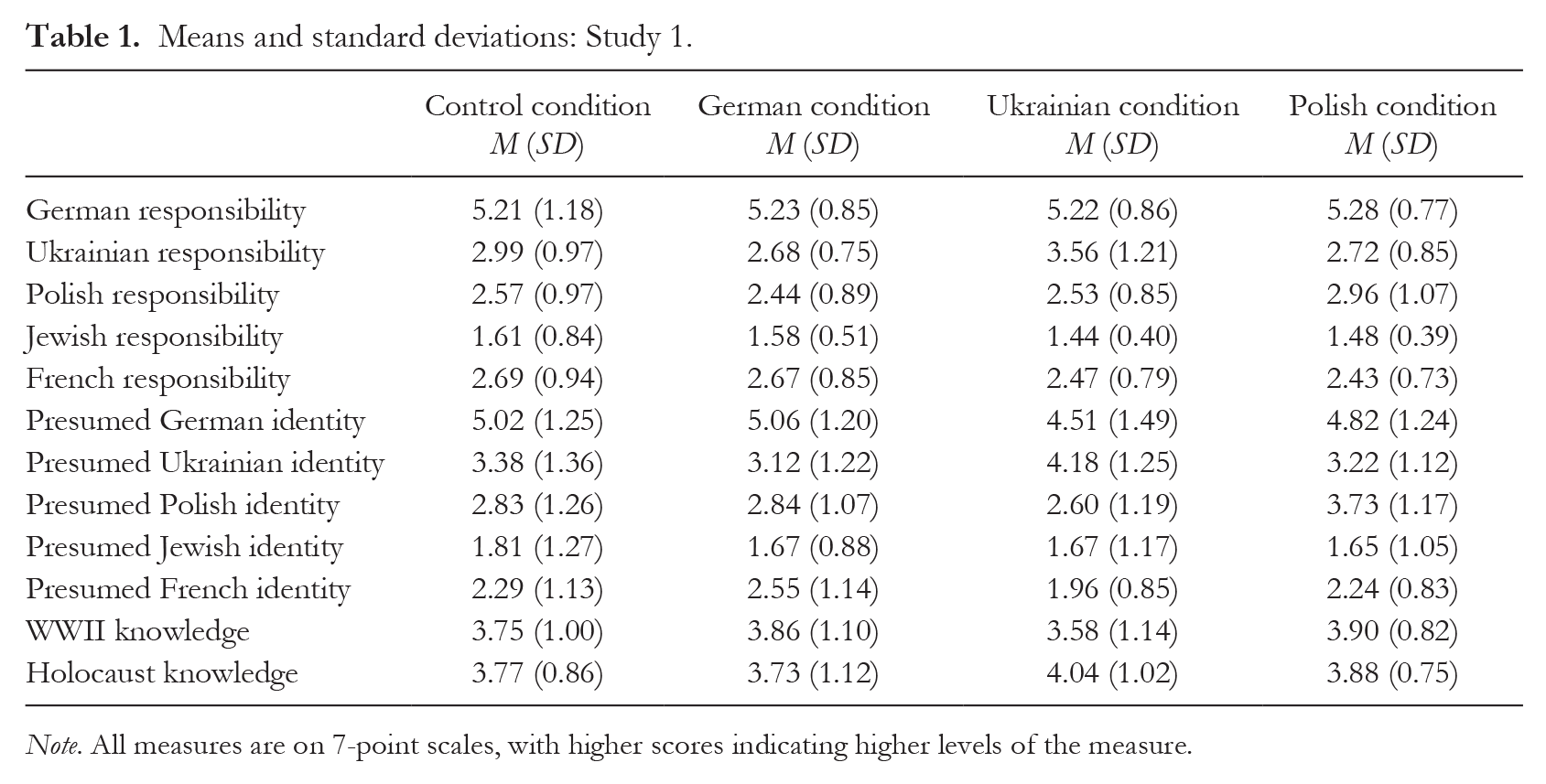
Note. All measures are on 7-point scales, with higher scores indicating higher levels of the measure.
A one-way MANOVA was also run to test whether the manipulation affected participants’ assumptions regarding S. K.’s nationality, F(15, 555) = 5.07, p < .001, partial η2 = .12. A test of between-subjects effects found no differences for assumptions of German identity, F(3, 187) = 1.76, p = .176, or Jewish identity, F(3, 187) = 0.22, p = .882. There were, however, differences across conditions for assessments of Ukrainian identity, F(3, 187) = 6.90, p < .001, partial η2 = .10; for assessments of Polish identity, F(3, 187) = 8.77, p < .001, partial η2 = .12; and for assessments of French identity, F(3, 187) = 2.79, p = .043, partial η2 = .04. An LSD post hoc test found differences in assessments of Ukrainian identity between the Ukrainian condition and the Polish condition, p < .000, 95% CI [0.45, 1.46]; German condition, p < .000, 95% CI [0.55, 1.56]; and control, p = .002, 95% CI [0.30, 1.31]. Post hoc tests revealed differences in assessments of Polish identity between the Polish condition and the Ukrainian condition, p < .001, 95% CI [0.66, 1.61]; German condition, p < .001, 95% CI [0.43, 1.37]; and control, p < .001, 95% CI [0.43, 1.37]. Post hoc tests revealed differences in assumed French identity between the Ukrainian condition and the German condition, p = .004, 95% CI [−1.00, −0.19]. Means and standard deviations are reported in Table 1.
In line with Hypothesis 1, Study 1 thus provides support for the effects of geopolitical framing on assessments of responsibility for historical violence, and it does so within the context of German assessments of Nazi-era violence. The location in which historical violence was said to have taken place affected how participants assessed collective-level responsibility for that violence. This effect appeared after reading the very short text used in Study 1.
Study 2
Study 2 tests for the same effect by means of a longer, richer narrative that could subsequently be retold, and the memory of which could be tested over time (Study 3) and across subsequent retellings and subsequent assessments of collective responsibility made by different interaction partners (Study 4).
Methods and Procedures
Participants were recruited in the same manner as in Study 1. Participants were asked to read a roughly 300-word story about a man, “W. P.,” who spoke reluctantly about his life during WWII. During the war, W. P. was said to have lived in either Lublin, Poland and other parts of Poland (Poland condition), or in Linz, Austria and other parts of Austria (Austrian condition). In the story, his daughter finds out from distant family members that he had served as a “Hiwi” for the Germans during WWII. As she did not know what a WWII Hiwi was, W. P.’s daughter looked up the term online, and the brief description she found is presented in the story. The description of the “Hiwis” references the concentration camp Mauthausen in the Austrian condition, and Majdanek in the Polish condition. All other elements of the story are consistent across the two conditions. The story can be found in the Appendix. 4
Measures
After reading the story, participants were given the same four items measuring collective responsibility as used in Study 1. They assessed the responsibility of Austrians (α = .80), Germans (α = .72), Poles (α = .79), Jews (α = .73), and the French (α = .81). Participants then indicated what percentages of the Hiwis were constituted by these four groups (open-ended answer). Participants were then asked what they believed W. P.’s nationality/ethnicity to be, and assessed the likelihood that he was a German, Austrian, Pole, Jew, Frenchman, or “other”; and they were given the chance to write in other groups that came to mind (answers were given on a 6-point scale: 1 = very unlikely, 6 = very likely). Demographic information was then gathered (i.e., age, sex, and nationality). As in Study 1, participants also assessed their level of knowledge about both WWII and the Holocaust. Participants were then given with the chance to provide comments, and then thanked and debriefed.
Participants
German participants were recruited via the same online research platforms used in Study 1. A total of 157 questionnaires were completed (49 men, 106 women, two diverse). There were 84 participants in the Poland condition, and 73 participants in the Austria condition. There were no differences in the random assignment of participants by sex in the two conditions, χ2(1, N = 157) = 1.26, p = .262. There was no difference in the age of participants in the two conditions (Polish: Mage = 27.19, SDage = 8.26; Austrian: Mage = 25.86, SDage = 4.98), t(2, 155) = 1.20, p = .233. There was also no difference in participants’ level of knowledge regarding WWII (Polish: M = 3.80, SD = 0.94; Austrian: M = 3.58, SD = 1.00), t(2, 155) = 1.43, p = .154. Participants in the Polish condition reported a slightly higher level of knowledge regarding the Holocaust (M = 3.85, SD = 0.94), relative to participants in the Austrian condition (M = 3.56, SD = 0.90), t(2, 154) = 1.96, p = .052.
Results
A one-way MANOVA was run to test whether geopolitical framing would impact perceptions of responsibility ascribed to the five groups in question, the percentage of Hiwis who were from each ethnic group, and the likelihood that the character “W. P.” was a member of each ethnic group, F(16, 140) = 9.91, p < .001, partial η2 = .53. Tests of between-subjects effects were then run to identify for which variables there were significant effects of the manipulation (Table 2). As expected, ratings of Polish responsibility, the percentage of Hiwis who were Polish, and the likelihood that W. P. was a Pole were higher in the Poland condition relative to the Austrian condition. Also as expected, ratings of Austrian responsibility on the three measures were higher in the Austrian condition relative to the Poland condition. Scores for German and French responsibility were not affected by the location of the story (although there was a trend for the percentage of Hiwis assumed to be French). While assessments of Jewish responsibility and of the percentage of Hiwis who were assumed to be Jewish were not affected by the location manipulation, participants thought it more likely that the story’s protagonist, W. P. was Jewish in the Poland condition than in the Austrian condition. These analyses were also run with knowledge about the Holocaust as a covariate. Wherever there was an effect of the manipulation of national framing, that effect remained, and wherever there was a correlation between Holocaust knowledge and ascribed collective responsibility, it remained significant. There were no interactions.
Means and standard deviations: Study 2.
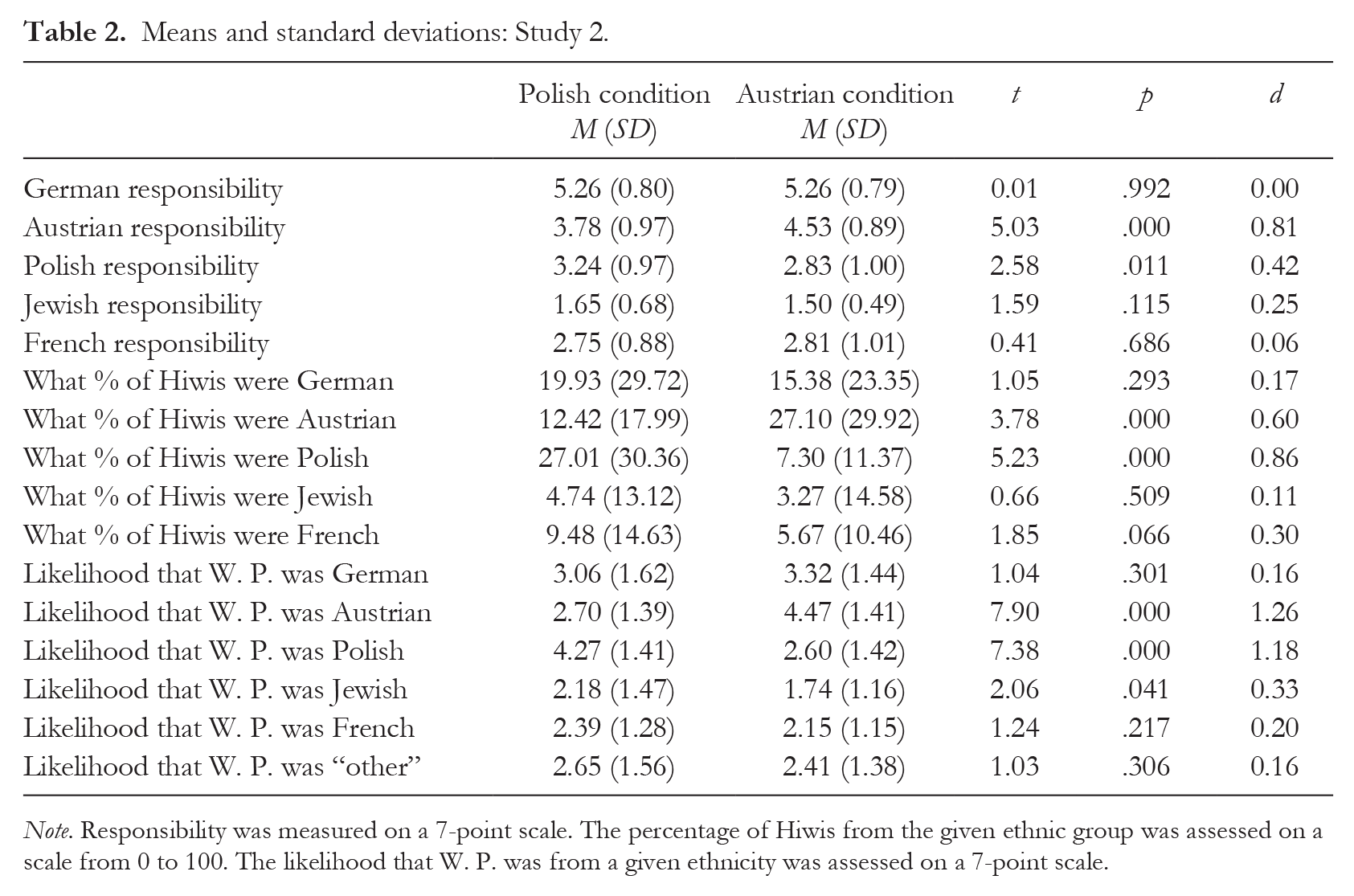
Note. Responsibility was measured on a 7-point scale. The percentage of Hiwis from the given ethnic group was assessed on a scale from 0 to 100. The likelihood that W. P. was from a given ethnicity was assessed on a 7-point scale.
In line with Hypothesis 1, Study 2 lends yet further support for the effects of geopolitical framing on assessments of collective responsibility for historical violence, and it does so within the uniquely powerful context of German assessments of Nazi-era violence. German participants believed Poles to be more responsible for the violence when it was said to have happened in Poland relative to when it was said to have happened in Austria, and they perceived Austrian responsibility as higher when the violence took place in Austria rather than in Poland. Despite the relatively high level of educational efforts put into cultivating robust knowledge among the German population about the Holocaust and WWII, geopolitical framing nevertheless influenced perceptions of collective responsibility for the Nazi-era violence in question, thus providing a particularly illustrative example of the effect.
Study 3
Study 3 examined whether the geopolitical framing effect found in Study 2 would be sustained over time—continuing to influence how people think about responsibility for the historical violence in question after a significant amount of time has passed. If the effects of geopolitical framing on judgments of collective responsibility for historical violence are truly of relevance for our social lives beyond the “psychological lab,” those effects should be of a lasting nature, at least to some degree. After all, educational and commemorative efforts regarding such matters are also undertaken with the hope that those efforts will bear fruit that does not fade when students leave the classroom or the moment someone closes the book or leaves the museum. Such a finding would thereby considerably strengthen the value of this research for applications of a more practical nature.
Methods and Procedures
Participants were recruited in the same manner as in Studies 1 and 2. However, this time, they were informed that the study consisted of two parts, and that the second part would be sent to them a few days after they completed Part 1, and that they would learn more about the study after having completed Part 2. Thus, Study 3 consisted of two parts, separated from each other by several days. In Time 1, participants were presented with the same story as in Study 2. After reading the story, participants were given a timed distractor task—an online trivia game—that lasted roughly 5 minutes. Participants were then asked to retell the story as if they were telling it to someone who did not know the story (“Please think about the short story you read at the start of the study. Imagine that you are explaining it to someone who had not read the article and write it into the space below”). Subsequently, participants completed the measures used in Study 2 (i.e., collective responsibility, the percentage of Hiwis constituting each of the four groups in question, and the likelihood that W. P. was from the various ethnic groups in question), as well as the control variables (i.e., knowledge about WWII and the Holocaust) and demographic variables (i.e., sex, age, and nationality/ethnicity).
Five days after completing Time 1, participants were invited to complete the second part of the study (Time 2), and reminder emails were sent out every other day thereafter for the next 4 days. Participants were given the following instructions: A few days ago you read a short story about the life of Walther P., the Second World War, and a group of soldiers known as “Hiwis.” Imagine you are now telling the story to someone else who has not read the article and write that story into the text box below.
After writing the story down, participants were asked the same short set of questions asked at Time 1. Participants were then thanked and debriefed.
Measures
Participants were then given the same set of questions used in Study 2, with the addition of the following question: “Had you ever heard of the Hiwis in WWII before this study?” (1 = definitely not, 6 = definitely yes). This question was used to ensure that we did not have participants in Study 3 who had taken part in Study 2. As in Study 2, the four items assessing collective responsibility were combined into single scores of collective responsibility: German (Time 1: α = .79; Time 2: α = .84), Austrian (Time 1: α = .56; Time 2: α = .88), Polish (Time 1: α = .85; Time 2: α = .90), Jewish (Time 1: α = .71; Time 2: α = .78), French (Time 1: α = .77; Time 2: α = .84).
Participants
Based on the planned use of the same materials as in Study 2, and with effect sizes d ranging from 0.42 to 1.26 in Study 2 (depending on the particular measure in question), a two-way power analysis for independent samples t tests (with power at 1 − β error probability set at 0.80) suggested a sample size from 22 to 180 participants, and from 18 to 142 with a one-way test. Recruitment was done in waves by refreshing the advertisement on the websites Survey Swap, Survey Circle, and Poll-Pool, and repeating this procedure until a total of 150 participants were obtained at Time 2 (108 women, 41 men, one “other”; Mage = 26.52, SDage = 5.09). That occurred after having recruited 260 participants at Time 1 (195 women, 63 men, two “other”; Mage = 26.08, SDage = 4.57).
After removing 15 participants from analysis for not retelling the story, 5 there were 144 participants in the Polish condition and 116 participants in the Austrian condition at Time 1, and 76 participants in the Polish condition and 74 participants in the Austrian condition at Time 2. At Time 1, participants were just as likely to have heard of the WWII Hiwis in the Poland (M = 2.42, SD = 1.47) as in the Austria condition (Mage = 2.28, SDage = 1.22), t(1, 258) = 0.87, p = .385. There was also no difference in age between the Polish (Mage = 26.20, SDage = 4.93) and Austrian (M = 25.94, SD = 4.09) conditions, t(1, 258) = 0.46, p = .647. There was also no difference in participant knowledge about WWII between the Polish (M = 3.49, SD = 0.89) and Austrian (M = 3.48, SD = 0.94) conditions, t(1, 258) = 0.03, p = .977, nor was there a difference in participant knowledge about the Holocaust between the Polish (M = 3.51, SD = 0.97) and Austrian (M = 3.56, SD = 0.87) conditions, t(1, 258) = 0.34, p = .687. There were also no differences between conditions on any of these items at Time 2: age: t(1, 148) = 1.07, p = .285; knowledge about the Hiwis: t(1, 148) = 0.33, p = .739; knowledge about WWII: t(1, 148) = 0.42, p = .678; and knowledge about the Holocaust: t(1, 148) = 1.34, p = .183.
Results
As in Study 2, it was broadly hypothesized that the geopolitical framing in question would affect judgments of responsibility of Poles and Austrians, but that it would not affect those of Germans, Jews, and the French. What is more, it was expected that these results would be found not only at Time 1, but also at Time 2, thereby illustrating the substantial effect of this particular form of framing on how such cases of historical violence are remembered.
Time 1
The average length of the retold story was 61.25 words (SD = 34.75). There were no differences in the random assignment of participants by sex in the two conditions, χ2(1, N = 260) = 0.31, p = .576. There was no difference in word length between the Polish (M = 59.86, SD = 36.53) and Austrian (M = 62.97, SD = 32.49) conditions, t(2, 258) = 0.72, p = .474 (Table 4). A one-way MANOVA was run to test whether geopolitical framing would impact perceptions of responsibility ascribed to the five groups in question across the same dependent variables, F(16, 243) = 19.36, p < .001, partial η2 = .56. Tests of between-subjects effects were then run to identify for which variables there would be significant effects of the manipulation (Table 3). As expected, Poles were assigned greater collective responsibility when the initial story had taken place in Poland, relative to when it had taken place in Austria. Similarly, relative to the Austrian condition, when the story took place in Poland, Poles were thought to represent a higher percentage of the Hiwis, and participants thought it was more likely that the main character from the story, W. P., was Polish. These three ratings of Austrian responsibility were higher when the story took place in Austria relative to when it took place in Poland. In the Austrian condition, relative to the Polish condition, participants also thought that the percentage of Hiwis who were German was higher, and that W. P.’s nationality was more likely German. Perceptions of Jewish, French, and “other” responsibility did not differ between conditions nor did their supposed percentage participation in the Hiwis or the ethnicity of W. P.
Means and standard deviations: Study 3, Time 1.
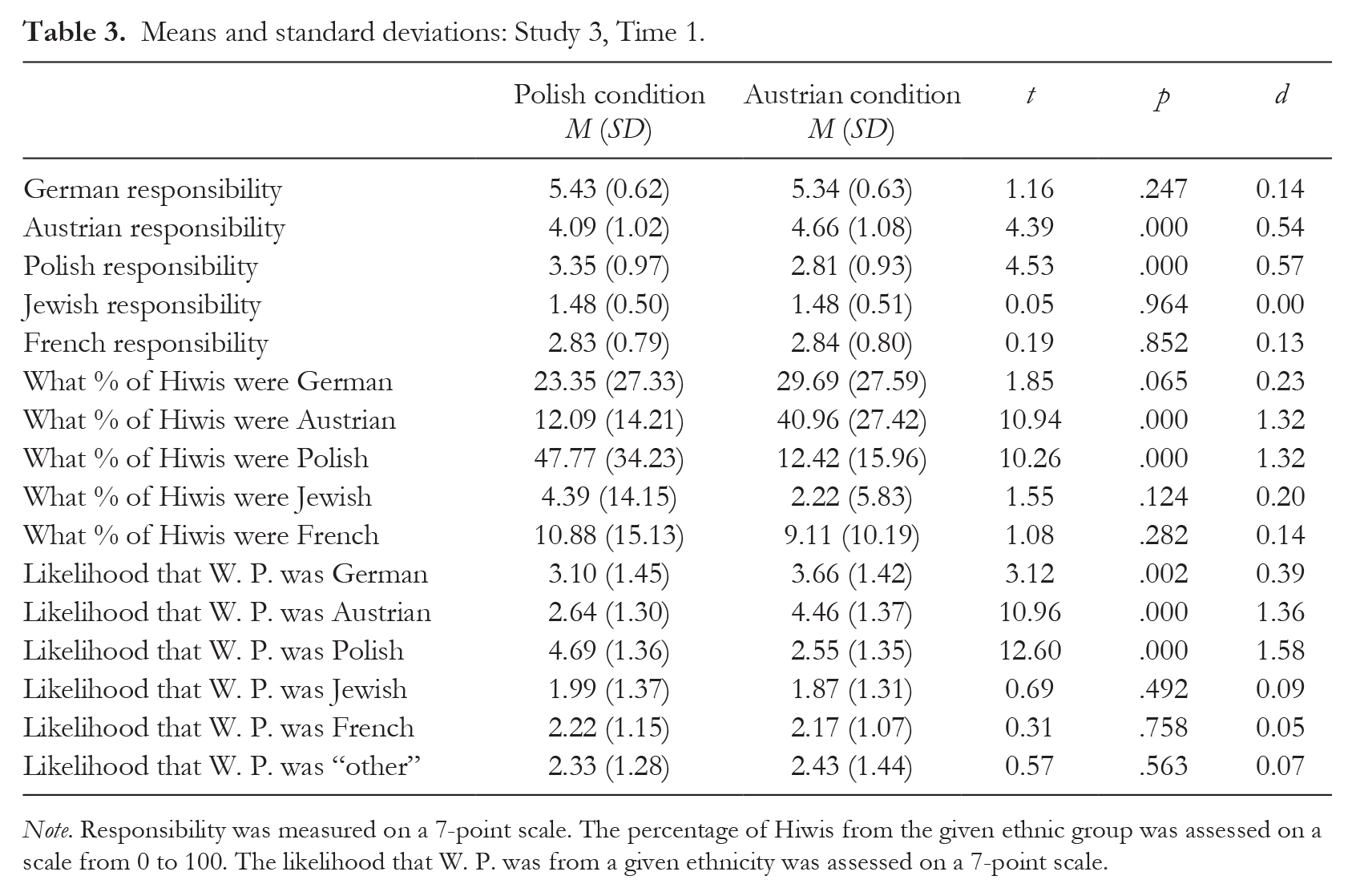
Note. Responsibility was measured on a 7-point scale. The percentage of Hiwis from the given ethnic group was assessed on a scale from 0 to 100. The likelihood that W. P. was from a given ethnicity was assessed on a 7-point scale.
Time 2
On average, participants completed the second part of the study 6 days after Part 1 (M = 5.95, SD = 0.92). The average length of the retold story was 60.90 words (SD = 33.72), a word length that was not different from the retellings at Time 1, t(2, 408) = 0.10, p = .921. There was no difference in word length between the Polish (M = 60.88, SD = 36.78) and Austrian (M = 60.92, SD = 30.57) conditions, t(2, 148) = 0.01, p = .995 (Table 4). A one-way MANOVA was run to test whether geopolitical framing would impact perceptions of responsibility ascribed to the five groups in question across the same dependent variables, F(16, 133) = 12.01, p < .001, partial η2 = .59. Tests of between-subjects effects were then run to identify for which variables there would be significant effects of the manipulation (Table 5).
Means, standard deviations, and correlations of main variables: Study 3, Time 1 (below diagonal) and Time 2 (above diagonal).
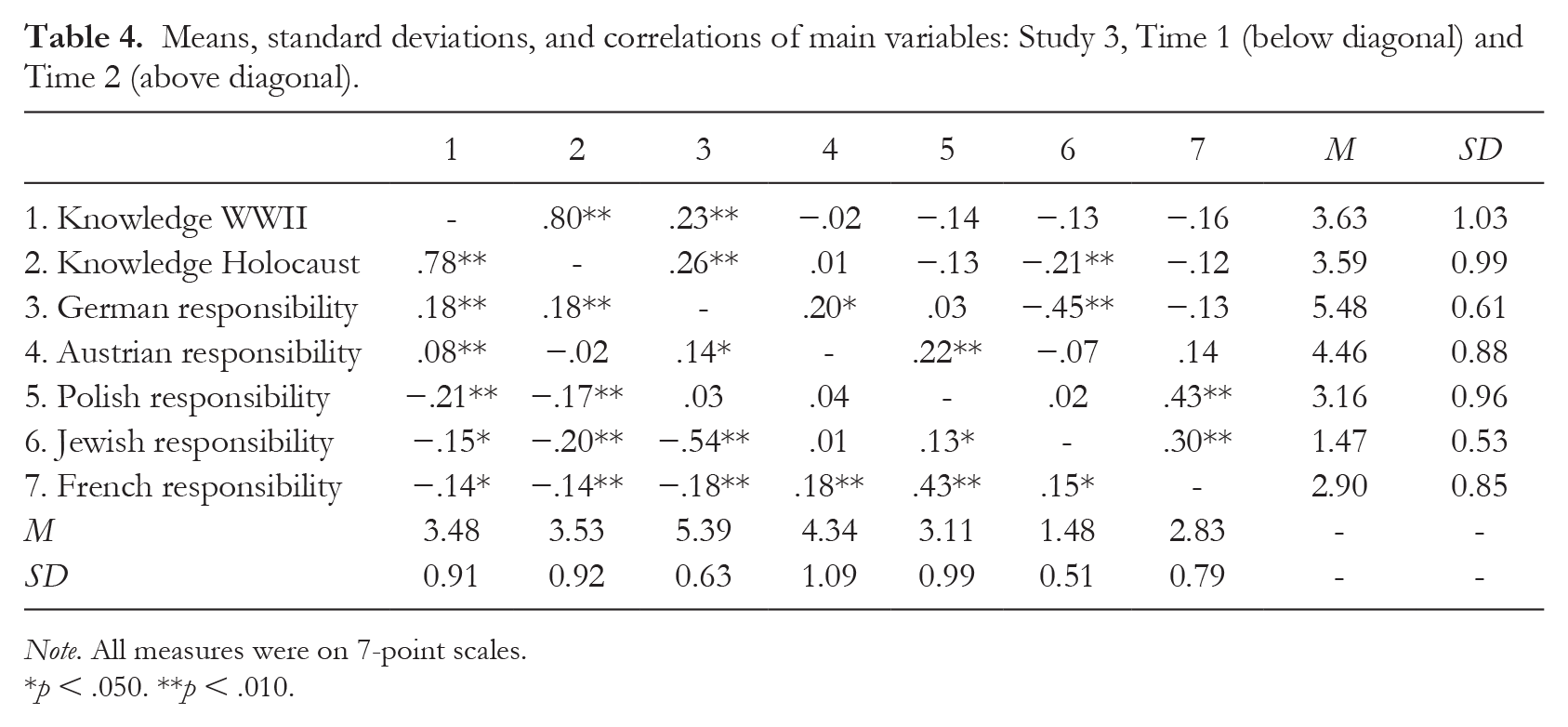
Note. All measures were on 7-point scales.
p < .050. **p < .010.
Means and standard deviations: Study 3, Time 2.
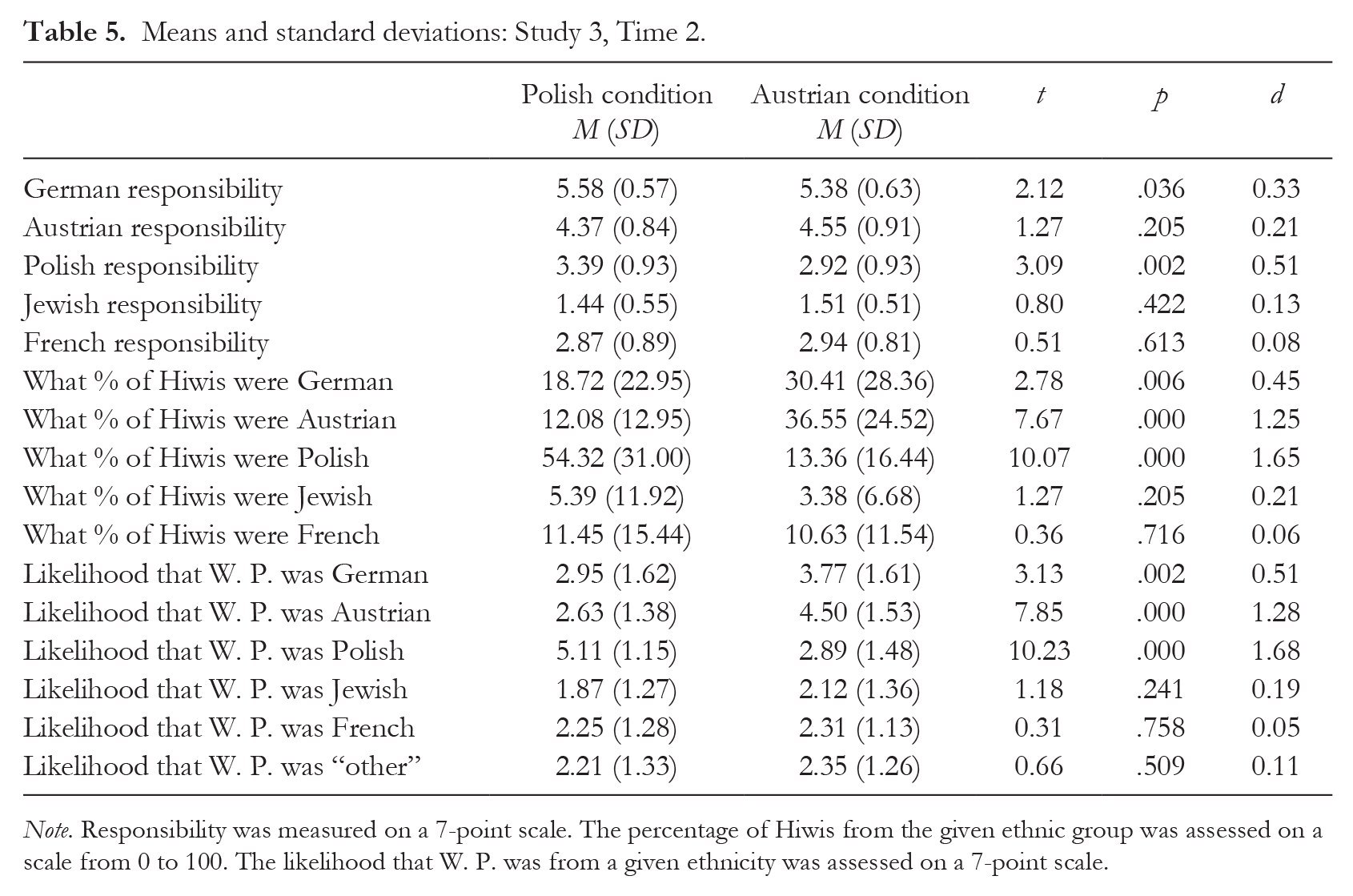
Note. Responsibility was measured on a 7-point scale. The percentage of Hiwis from the given ethnic group was assessed on a scale from 0 to 100. The likelihood that W. P. was from a given ethnicity was assessed on a 7-point scale.
The subsequent ratings of Polish responsibility differed as expected between the Polish and Austrian conditions at this second time point. As expected, participants thought Poles to represent a larger percentage of Hiwis in the Polish condition, and they thought that Austrians and Germans represented a larger percentage in the Austrian condition. Ratings of Jewish and French responsibility did not differ between conditions. The percentages assumed to have been constituted by Jews and the French did not differ between conditions. W. P. was thought to be more likely Polish when the story took place in Poland, and more likely to be German and Austrian when it took place in Austria. Location did not affect participants’ perception of the likelihood that he was Jewish, French, or from another nation provided by the participants themselves. Somewhat surprisingly, while ratings of Austrian responsibility did not differ, ratings of German responsibility did. This may be due to the various connections (linguistic, ethnic, cultural, etc.) between Germans and Austrians, a point that will be discussed further in the General Discussion section.
There were no differences in length of the retellings by condition at Time 1 (Poland: M = 59.86, SD = 36.53; Austria: M = 62.97, SD = 32.49) nor at Time 2 (Poland: M = 60.88, SD = 36.78; Austria: M = 60.92, SD = 30.57). Perhaps unsurprisingly, at Time 1, the retellings of participants who took part only at Time 1 (M = 51.82, SD = 30.96) were shorter than those of participants who took part at both times (M = 68.17, SD = 35.84). Also unsurprisingly, among the participants who retold the story twice, the first retelling was on average somewhat longer (M = 68.17, SD = 35.84) than the second retelling (M = 60.90, SD = 33.75), t = 1.81, p = .072. There were significant correlations between the key variables at Time 1 and Time 2 (see Table 6).
Correlations between two time periods: Study 3.
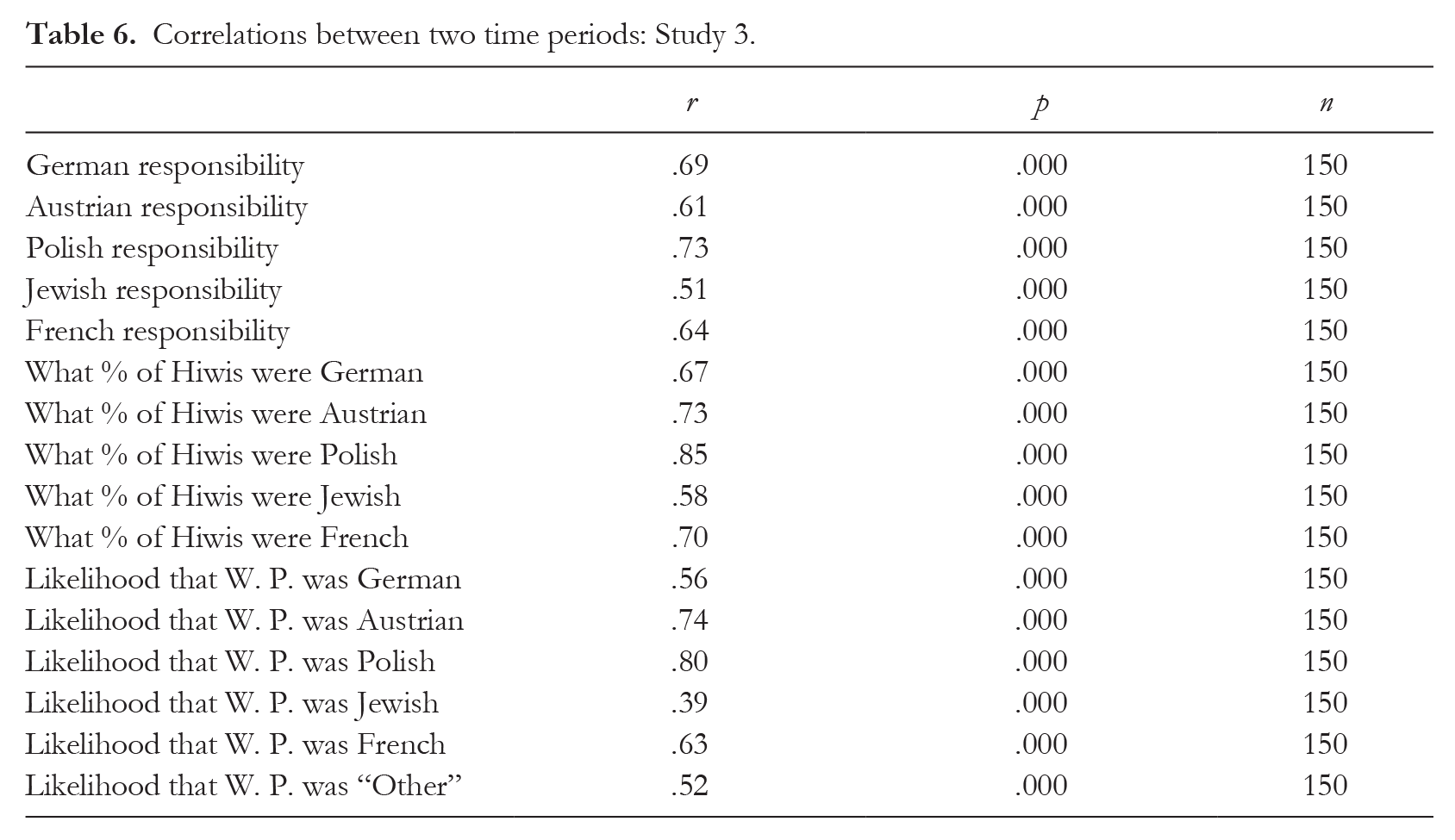
There is no compelling reason to believe that the participants who took part in the study at both times (N = 150) meaningfully differed from those who only took part at Time 1 (N = 110). Of the 19 measures of interest (collective responsibility of the five groups; percentage of Hiwis from the five groups; W. P.’s presumed ethnicity, including “other”; knowledge about WWII, the Holocaust, and the Nazi Hiwis), there were differences between these two groups on only three measures (i.e., Jewish responsibility, French responsibility, and knowledge about WWII), 6 and not on the primary measures of interest related to Austrian and Polish responsibility. There was also no significant difference in participant age, and a chi-square test found no significant differences in the representation of participant sex across the two groups.
Study 3 provides not only further support for the effects of geopolitical framing on assessments of responsibility for historical violence, but, in line with Hypothesis 2, it shows that the effects last over time, as these effects remained when participants retold and reassessed the initial story roughly a week later. Thus, how we frame past violence within geopolitical space does indeed appear to be a matter of considerable importance for a range of “real-world,” applied areas beyond the psychological lab.
Study 4
Study 4 tests whether the effects of geopolitical framing found in Studies 1–3 carries over into sequential retellings of the story, thereby affecting the assessments of responsibility for the historical violence in question made by subsequent recipients of the story. This study is of fundamental importance for determining whether these effects, which appear to be sustained over time, are also of wider social relevance. In other words, this study allows us to address the questions of whether geopolitical framing not only affects how people remember cases of historical violence, but also how they pass on information about that violence to others, thereby affecting how other people make assessments of responsibility for that same violence.
Participants
We recruited 200 German participants to take part in this online study (127 women, 72 men, one diverse; Mage = 26.77, SDage = 7.51). Participants were recruited in the same manner as in Studies 1 and 2. To ensure that the participants had not taken part in one of the earlier studies, at the end of the questionnaire, we asked if they had taken part in a study on this topic before (1 = definitely not, 7 = definitely yes). None of the participants reported having taken part in such a study earlier (M = 1.04, SD = 0.33). There was no difference in participants’ level of knowledge regarding WWII across the two conditions (Polish: M = 3.58, SD = 1.01; Austrian: M = 3.62, SD = 0.91), t(2, 198) = 0.30, p = .768. There was also no difference in participants’ level of knowledge of the Holocaust (Polish: M = 3.67, SD = 1.02; Austrian: M = 3.83, SD = 0.84), t(2, 198) = 1.21, p = .227. There was a difference in the degree of familiarity with the Hiwis in WWII, but the levels were very low in both conditions, indicating that participants had not heard of this particular group before participating in the study (Polish: M = 1.90, SD = 1.17; Austrian: M = 2.12, SD = 1.14), t(2, 198) = 2.03, p = .044. There was also no difference in participant age across conditions (Polish: Mage = 26.64, SDage = 7.45; Austrian: Mage = 26.89, SDage = 7.60), t(2, 198) = 0.24, p = .815.
Methods and Procedure
For Study 4, we used the 200 longest retold stories from Study 3; 100 from the Austrian condition (the longest 50 from each time point) and 100 from the Polish condition (the longest 50 from each time point) based on word count alone (the retellings that were shorter than this were generally too short to meaningfully constitute retellings, but were generally collections of single words or phrases). By adopting this single selection criterion, we did not select stories based on their content. 7 In this way, we were also able to obtain a sample size of sufficient power (with the effect sizes based on Study 3, Time 1, ranging from 0.54 to 1.58, an a priori power analysis for a one-way independent samples t test suggested a sample size between 90 and 12 participants). These retellings ranged in length from 30 to 198 words (Mwords = 86.74, SDwords = 29.53). Each participant read one retelling of the initial study produced in Study 3. Participants then completed the same measures as in the earlier studies, after which they were thanked and debriefed.
Measures
The measures were the same as in Studies 2 and 3. The measures of collective responsibility were internally consistent: German (α = .82), Austrian (α = .85), Polish (α = .82), Jewish (α = .74), French (α = .81).
Results
This study examined whether the differences in responsibility judgments produced on the basis of geopolitical framing (Studies 1–3), which were also found to last over time (Study 3), would also be found to persist across retellings of the story, thereby affecting the judgments of other people (Hypothesis 3). As can be seen in Table 7, the pattern found in Studies 1–3 is indeed found to carry over to other people via retelling of the initial story. Polish responsibility was assessed as higher when the initial story was set in Poland relative to when it was set in Austria, and Austrian responsibility was higher when the story was set in Austria. The percentage of Hiwis assumed by the participants to be Austrian and Polish also differed in the expected direction, as did the likelihood that the story’s main character, “W. P.,” was Austrian.
Means and standard deviations: Study 4.
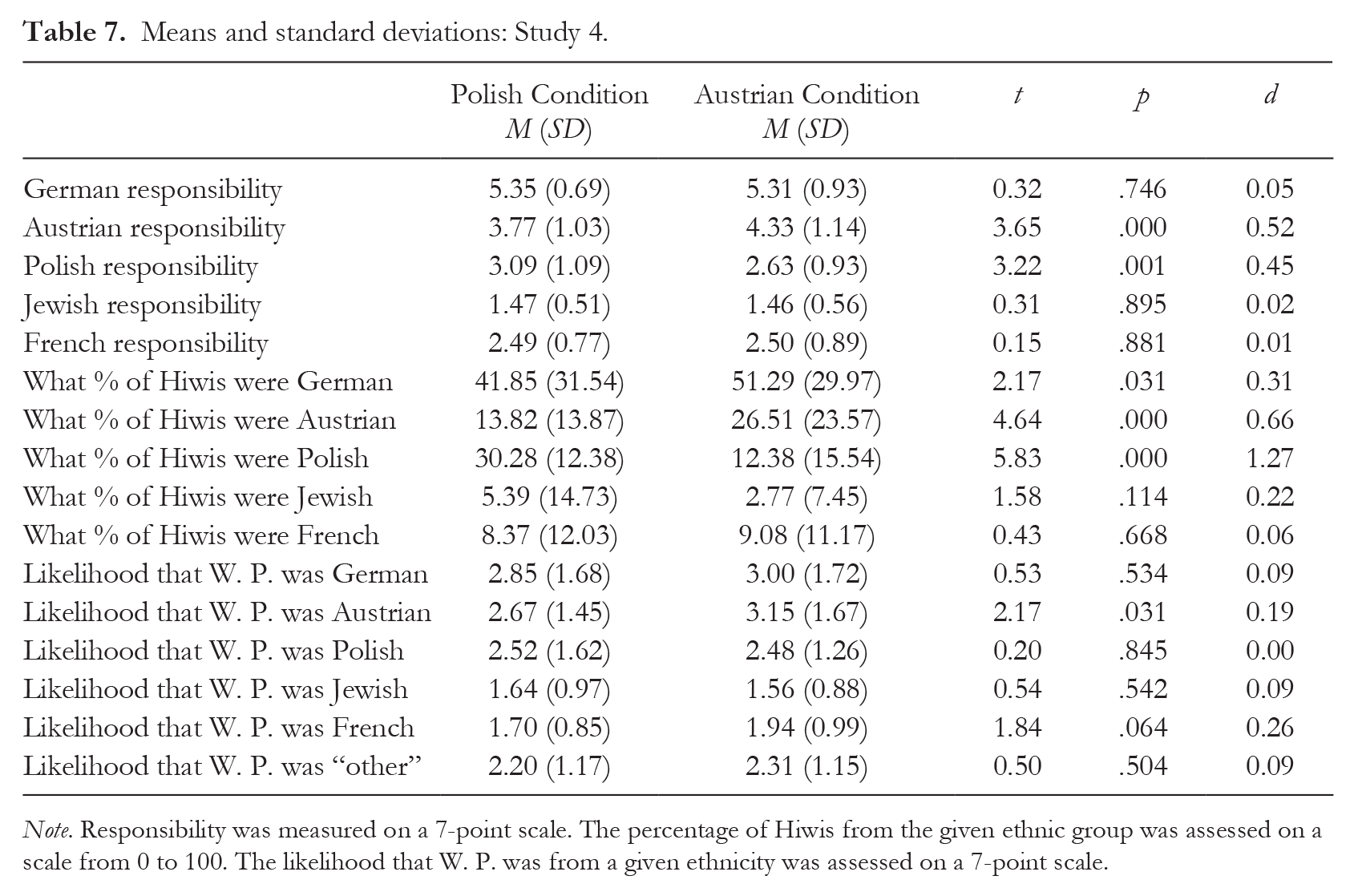
Note. Responsibility was measured on a 7-point scale. The percentage of Hiwis from the given ethnic group was assessed on a scale from 0 to 100. The likelihood that W. P. was from a given ethnicity was assessed on a 7-point scale.
We also found positive correlations between the responsibility judgments of the reteller of the story and the judgments of the reader of the retold story. While the correlations were not significant for responsibility judgments or for the supposed ethnicity of the character “W. P.,” there were significant correlations in the percentage of the Hiwis assumed to be German, r(200) = .16, p = .022; Austrian, r(200) = .11, p = .003; and Polish, r(200) = .22, p < .000; but not Jewish, r(200) = .00, p = .968, or French, r(200) = .03, p = .364. Thus, in line with Hypothesis 3, the effects of geopolitical framing on assessments of responsibility for historical violence appear to persist across interpersonal communication about the events in question.
General Discussion
In a series of four studies, we found that the way in which historical mass violence is framed within geopolitical space does indeed influence judgments of collective responsibility for that violence. Not only does geopolitical framing affect immediate judgments (Studies 1–3Time 1), but its effects last over time (influencing judgments roughly a week later in Study 3Time 2) and influences the judgments of others along chains of interpersonal communication (Study 4). Indeed, geopolitical space is not a meaning-free blank canvas by which we depict neutral “facts,” but rather serves as a guidepost for judgments of collective responsibility for historical violence. It is also important to highlight that this research was conducted among a population historically involved with the violence in question, and one that has received a unique degree of education about the period of history in question. Holocaust education has been required by the German government in secondary schools since 1992, and over the past several decades, considerable efforts have gone into Holocaust education, including not only schooling, but also museums, memorials, etc. (Boschki et al., 2010; Zülsdorf-Kersting, 2008). By examining the effects of national framing of WWII-era violence within the German context, we therefore have a stronger test of these effects than we would if the study had been done among a more distant population (e.g., in the US or the UK). One might expect that this population would be particularly well-educated not only in regional history, but also in regional geography, regional historical ethnic identities, etc., thereby making them less susceptible to national framing effects. Similarly, given that conversations regarding the Holocaust and WWII are very much alive in Germany (Hesse, 2024), this research shows the effects of national framing within what are living, breathing social discourses. Thus, these findings are important not only to psychologists, but also to historians, political scientists, and educators (in schools, museums, etc.), not to mention the peoples who lived or are living where the violence took place. The current study heeds Wood’s (1987) still-relevant call to make the psychological aspects of geography “matter,” and more recent calls by the wider psychological community to make psychological research of value to the various social challenges of our day (e.g., Eaton et al., 2021).
The study of how events are placed relative to national borders is an important part of the much broader literature on framing. Differing depictions of national borders have been shown to influence perceptions of threat levels posed by natural disasters, as well as subsequent decision making (Mishra & Mishra, 2010). Similarly, how the media frame infectious diseases within national borders, such as COVID-19, can affect how those illnesses are understood (Meyer et al., 2024; Poirier et al., 2020). The issue of national framing is undoubtedly of importance in today’s increasingly globalized world, in which various historical narratives about historical violence circulate among different communities (Hanke et al., 2013). Lewicka (2006, 2020) has shown how the national borders and populations of today are projected into the past, thereby distorting the assumed ethnic identities of the people who lived in those same places in the past. For example, she found that Poles overestimate the size of the Polish population and underestimate the German population in pre-1945 Wrocław (Breslau), while Ukrainians overestimate the Ukrainian population and underestimate the Polish population in pre-1945 Lviv (Lwów). The current research thus builds on, and extends, the larger framing literature, particularly that making use of national borders.
While various geopolitical framings of the past can simultaneously be historically “true”—as different depictions of geopolitical space are not necessarily “wrong” or “inaccurate”—some may nevertheless be misleading in the moral sense explored in this piece. A particularly telling, concrete example of this can be seen in discussions around an article published by the German newspaper die Welt (“Die Welt bedauert zutiefst,” 2008) about what they called “the former Polish concentration camp Majdanek.” Following the public protests this wording evoked, the Austrian newspaper die Presse attempted to underscore the purely geographic meaning of “Polish” by referring to the Majdanek camp as “the former German concentration camp in Eastern Poland” (“Polnisches KZ”: Polen will Zeitung “Die Welt” klagen, 2008). While acknowledging the morally problematic nature of the adjective Polish to describe the camp, this rephrasing also suggests that references to geopolitical space within descriptions of mass violence are free of connotations of collective responsibility. As the current research shows, this is not the case.
The current research would suggest that people attempting to communicate histories of mass violence—such as journalists, educators, and museum curators—should give very careful consideration to where they place that violence in geopolitical space. Recent research has further highlighted the importance of these issues within the presentation and reception of autobiographies containing depictions of historical violence, once again showing how the placement of this violence within geopolitical space affects our understandings of the violence and of the larger story (Mazur, 2025b). The violence certainly happened somewhere, but where? The current research would suggest that a good approach would be to follow the strategy taken, at least in part, on the website of the National Holocaust Museum in Washington, DC. As of October 2023, within their “Introduction to the Holocaust” page, there is a subpage devoted to depicting the course of the Holocaust by means of maps and brief descriptions (roughly 100–150 words). These maps depict the geopolitical landscape of Europe in line with the expanding occupation(s) of, and political order established by, Nazi Germany. In other words, rather than simply using prewar or postwar maps of Europe, the museum uses various maps whereby geopolitical space more accurately reflects the dynamic course of the war, including the Holocaust and the expanding reach of Germany and the Soviet Union. Thus, as concentration and death camps such as Auschwitz and Majdanek appear on the map, they are located within the given administrative district of the greater German Reich at the given time. Thus, Auschwitz is depicted neither as a Polish concentration camp nor as a concentration camp in Poland, but as a camp created within the administrative district of Germany known as the General Government (Generalgouvernement, in German).
Unfortunately, not all of the materials on this website follow this pattern. On the same page as the maps and descriptions mentioned above is a brief educational video that traces the course of the Holocaust. Throughout the duration of the video, viewers are presented with a prewar map of Europe on which only three countries are labeled: Germany, Poland, and the Soviet Union. As the video traces the timeline of the Holocaust, Poland is increasingly populated with concentration camps and death camps. When discussing the mass executions committed by the German Einsatzgruppen, once again we see these locations marked on the prewar map, first in an area clustered around the label “Poland” and then slowly expanding across the eastern part of the country. The current research would suggest that such depictions of German mass violence may very well leave the viewer with the impression that Poles as a collective, and Poland as a country, are responsible for that violence. The more nuanced depictions mentioned above may help to reduce this effect, and help to more accurately represent and more effectively teach these historical events.
More nuanced depictions of WWII-era violence are more historically accurate than the simpler depictions based on either pre- or postwar maps. Similarly, they convey morally evaluative information that is more in line with that understanding of history. However, they come at a cost. The map of Europe under German occupation during WWII is likely to be unfamiliar to many viewers. As this political framework is unrecognizable to many, viewers may have a difficult time getting their bearings. This may be one of the reasons why more familiar depictions of geopolitical space are so often used by the creators of such educational materials. People may not know what the General Government is, but they will more easily recognize Poland. The current research would suggest that taking such shortcuts to avoid this challenge may very well be ethically problematic. History is complex and we should rise to the challenges of teaching it accurately and thoughtfully, especially when it comes to the depiction of such morally charged cases of historical violence.
Future research should examine the possible effects of geopolitical framing within other contexts in other parts of the world. To date, research has only examined perceptions of historical violence in Europe and the Indian subcontinent, so research in other contexts would allow us to better understand both the possible reach and limits of these effects. Taking an interpretive approach to these effects, one would not expect them to be found in all places at all times (Bevir & Blakely, 2018). Rather, these framing effects appear within webs of meaning that are found within particular historical and social contexts. Such concepts as “nation,” “border,” “violence,” and “responsibility” have their own cultural histories (Korzeniewski, 2006; Mazur, 2023, 2025a). Further research in other contexts would not only help to identify the limits of these framing effects, but would also help us to better understand those elements of our own cultural setting that make them possible in the first place. For example, future research should also more thoroughly explore what geopolitical space means in the first place from a psychological perspective, and how this space is related to our understandings of mass violence. There is a large body of research showing the robustness and cross-cultural similarity of core metaphors, whereby depictions of the physical world and our physicality therein are understood to contain evaluative information (e.g., positive emotions going upwards or being thought of as “high,” and negative emotions going downward or being “low”; Kovecses, 2010; Lakoff & Johnson, 1980). It may very well be that our understandings of physical space, and ownership thereover, and our understandings of responsibility are in some ways connected in a similarly robust manner, with the two being related on some more basic level of understanding (as captured in such phrases as “not on my backyard”). Similarly, in line with the Gricean maxim of relevance, future research may also look at why people mention the location of mass violence at all, and how recipients of those stories understand the reasons for providing this information.
The current study suggests that we ought to take the geopolitical framing of historical violence seriously within efforts to give voice to historically victimized communities. It is understandable that when teaching about events that took place during periods of war, occupation, or colonialization, people may want to assert the continued presence of the invaded, occupied, or colonized peoples, and that they may do so by means of geopolitical labels when telling those stories. However, by doing so, we may in effect render these collectives more responsible for that violence in the eyes of others. By asserting their continued presence as geopolitical entities during such periods, such peoples may in effect turn themselves into the heirs of collective responsibility for the violence that others perpetrated on their lands. A better understanding of geopolitical framing would therefore help social scientists, historians, and educators to more accurately and more responsibly convey the histories of such painful periods of the past.
Footnotes
Appendix
Acknowledgements
I would like to thank Christina Reiniger for her hard work with data collection and for her overall devotion to the project.
Declaration of Conflicting Interests
The author declared no potential conflicts of interest with respect to the research, authorship, and/or publication of this article.
Funding
The author received no financial support for the research, authorship, and/or publication of this article.
