



Abstract
Recent abortion restrictions in the US and Poland sparked widespread protests. This research examined how personal threat influenced collective action intentions through alliances with men and the LGBTIQ+ community (from women’s perspective), and alliances with women (from men’s perspective). It focused on two representations of intergroup cooperation: recategorization as one group and coalitions between distinct groups. In both countries, higher threat levels were linked to greater collective action intentions. For women, this was mediated by coalitions with men in Poland, but not in the US, while coalition with the LGBTIQ+ community mediated the relationship in both countries. Recategorization as one group mobilized women only in Poland when involving the LGBTIQ+ community. For men, coalitions with women mediated the link between threat and collective action in both countries. The findings suggest that coalitions preserving distinct group identities are more effective in advancing women’s rights than recategorization, especially when involving advantaged allies.
Women all over the world face restrictions on their reproductive rights (Center for Reproductive Rights [CRR], 2023). In recent years, there have been increasing efforts to restrict abortion rights in both Poland and the US. On October 22, 2020, Poland’s Constitutional Tribunal declared abortion due to fetal deformities unconstitutional. In the US, the Supreme Court overturned Roe v. Wade in June 2022, thus granting individual states the authority to decide on abortion legality (Cohen, 2023). These restrictive policies have pushed women to turn to unsafe and unlicensed abortion methods (Human Rights Watch, 2022). Such restrictions have sparked massive protests, in both countries, led by feminists supported by sexual minorities and allied men. In the present article, we discuss the role of men (an advantaged group) and the LGBTIQ+ community (a disadvantaged group) as allies of women in supporting protests against the abortion ban in Poland and the US. More specifically, we investigate how personal threat regarding restricting reproductive rights fuels collective action intentions via different representations of intergroup cooperation—either as coalitions between different groups or as recategorization into one group—between women and men (an advantaged group) or between women and the LGBTIQ+ community (a disadvantaged group). Our work builds on previous research into collective strategies for coping with threats to personal motives, such as control or autonomy, triggered by large social, political, and economic crises (e.g., Bukowski et al., 2019; Fritsche, 2022; Fritsche & Jugert, 2017). According to this research, when personal motives are threatened, people turn to their social self and seek to restore these motives at the group level. But could a personal threat also enhance intergroup cooperation and collective action?
Personal Threat as a Trigger for Intergroup Cooperation
Reactive collective actions can occur in response to group threats such as an introduction of laws that limit civil rights—which can trigger group-based anger, perceived injustice, and moral indignation (Agostini & van Zomeren, 2021)—or group relative deprivation (Kawakami & Dion, 1995). Such events also threaten basic individual motives, such as personal control, autonomy, and certainty (Fritsche & Jugert, 2017; Kruglanski & Orehek, 2012), shifting people towards interdependence (Milyavsky et al., 2022) and cooperation (Orehek & Kruglanski, 2018). According to Fritsche (2022), during crises, threats to personal control could push individuals towards collective action, as group efforts are often more effective than individual responses. Similarly, threats to personal control increased solidarity with outgroups perceived as sharing a common fate (Bukowski et al., 2019). In the context of interethnic relationships, Bukowski et al. (2024) found that COVID-19 threat experienced at a personal level was associated with increased solidarity-based collective help and reduced prejudice, whereas collective-level threats had the opposite effect.
By demonstrating agency through the collective self (e.g., acting as a group), people can reduce feelings of individual helplessness. In the context of a Polish women’s strike, Szóstakowski and Besta (2024) found that realistic threat (i.e., a belief that people seeking a complete ban on abortion have too much political power in Poland) increased collective action intentions via perceived injustice and identification with those opposing the changes in law. Similarly, Sheehan et al. (2022) showed that the police shooting of an unarmed Black American heightened personal threat among Black participants, which produced greater endorsement of collective action for racial equality. Thus, personal threats, beyond collective ones, can also be an important antecedent of prosocial and collective actions.
In the present research, we investigate how representations of cooperation with advantaged versus disadvantaged groups mediate the link between personal threat and collective action. Based on the aforementioned evidence, we argue that feelings of personal threat, including factors such as individual helplessness and lack of control, motivate people to cooperate with other groups to pursue shared goals.
Threats and Different Types of Group Representations
When facing large-scale problems, like threats to human rights, individuals may feel both helpless and interdependent with others. As stated in the group-based control model (Fritsche, 2022; Fritsche et al., 2011, 2013), people experiencing threat on a personal level may be more inclined to think of themselves as members of social groups, as this enables them to derive control from a collective identity. Problems such as the collapse of democratic governance or abortion bans cannot be solved individually, making people more inclined to form alliances in order to effectively pursue collective goals (such as putting pressure on the government by organizing protests). We argue that personal threats may encourage individuals to form alliances, which in turn motivate them to still take action on large-scale issues, despite feelings of helplessness.
Threats may lead to forming a shared identity with other groups, subsequently decreasing bias towards outgroup members (Adam-Troian & Bagci, 2021; Dovidio et al., 2022), and enhancing collective action intentions (del Fresno-Díaz et al., 2022). For disadvantaged groups, building a shared identity with advantaged groups can increase agency (Drury & Kaiser, 2014), however, it might also threaten their distinctiveness if the differences between the groups are not acknowledged (e.g., Spears et al., 2002). On the contrary, it may be easier to build a shared identity between two disadvantaged groups. For example, threats to women’s rights, provoked by abortion law restrictions, can fuel alliances between women (disadvantaged) and men (advantaged group), but also with the LGBTIQ+ community (disadvantaged group).
Fighting for a common cause with members of groups that hold a different social position might raise concerns about the distinctiveness of the disadvantaged group (Spears et al., 2002). However, a joint response to threat does not have to hamper distinctiveness from other groups, on the contrary, people may still hold a heterogeneous and diverse representation of subgroups that are united by a common goal (Brown & Hewstone, 2005; Gaertner et al., 2000). Representing intergroup cooperation in terms of a common group identity (recategorization as one group) or in terms of maintaining separate identities (coalition between diverse groups) may have different antecedents and social consequences. For example, COVID-19 threat was associated with lower modern prejudice among White Americans towards outgroup members (racial minorities) via coalitional representations of cooperation, but simultaneously increased prejudice when cooperation was represented as recategorization into one cohesive group (Bukowski et al., 2024). These results suggest that, at least from the perspective of advantaged groups, the representation of one homogeneous identity with disadvantaged group members may lead to negative consequences for targets of discrimination. From the perspective of disadvantaged groups, different factors, such as vulnerability or cultural distinctiveness, influence their preference for coalition or recategorization. For example, less vulnerable migrants (e.g., those with higher education) and the most vulnerable migrants from distinct cultural or ethnic backgrounds (e.g., Africans in Spain) prefer forming a coalition with Spanish allies who share their goal of promoting migrants’ rights. In contrast, other migrants who share a cultural background with the host population (e.g., Latinxs) prefer recategorization (Urbiola et al., 2023).
Alliances Between Women and Other Groups
Allies from advantaged groups can contribute to promoting social change (Subašić et al., 2008). Male allies can be quite effective in confronting sexism and discrimination (e.g., Drury & Kaiser, 2014; Testa et al., 2021). Their presence in protests against sexism increases the belief that solidarity is a normative behavior and expectations of peaceful protest among observers (Kutlaca et al., 2022). Men’s equality-supportive allyship actions can have positive consequences for women’s self-esteem (Cihangir et al., 2014), as well as empowerment and well-being (Estevan-Reina et al., 2021, 2024), enhancing anticipated respect, support, and gender-equality norms for women in the general population (Moser & Branscombe, 2021). As allies, men can support women’s efforts by increasing the acceptability of the message or protest, while also promoting women’s well-being and reinforcing gender-equality norms.
However, sometimes, harmonious contact between advantaged and disadvantaged group members can affect disadvantaged group members’ perceptions of inequality between groups and decrease their own support for social change toward equality (Saguy et al., 2009). In line with this, men’s involvement as allies can inadvertently undermine disadvantaged groups’ resistance and reinforce social hierarchies (Dixon et al., 2010; Droogendyk et al., 2016; Wright & Lubensky, 2009). For example, the presence of male (vs. female) leaders in an organization seeking to combat gender inequality reduced collective action intentions among female participants (Iyer & Achia, 2021). Also, male allies communicating their support in a dominant (compared to neutral) manner can decrease women’s motivation to take part in collective action (Radke et al., 2022).
Psychological processes underlying joint collective action between advantaged and disadvantaged group members may be different from those underlying ingroup collective action (Hasan-Aslih et al., 2020). For example, hope may motivate participation in collective action in general (Wlodarczyk et al., 2017); however, hope for harmonious relations can decrease collective action intentions among disadvantaged groups (Hasan-Aslih et al., 2019). Moreover, advantaged group members can have varied motives, such as self-interest (Radke et al., 2020) or paternalism (Estevan-Reina et al., 2020), which divert attention from structural inequalities, thus not always aligning with social change. Thus, the involvement of advantaged group allies in social movements towards changing the status quo may act as a double-edge sword.
One way to navigate these potential costs of allyship between men and women relates to the type of alliance built to promote social change. Highlighting a shared identity between advantaged and disadvantaged groups can inspire members of the advantaged group to actively participate in collective actions for the benefit of the disadvantaged group (Reicher et al., 2006; Selvanathan et al., 2020). However, this approach can threaten disadvantaged group members’ need for empowerment, distinctiveness, and agency (Shnabel & Nadler, 2008, 2015; Shnabel et al., 2009). Thus, disadvantaged groups might prefer alliances emphasizing both superordinate and subgroup identities, rather than solely a shared group identity, because it enhances members’ awareness of injustice and strengthens their collective action intentions (Banfield & Dovidio, 2013; Glasford & Dovidio, 2011). We propose that women will express a stronger willingness to take part in collective action via intergroup cooperation represented in terms of coalition (vs. one-group recategorization) because it implies a more instrumental basis of cooperation between groups that does not require resigning from group distinctiveness (e.g., Urbiola et al., 2023).
Disadvantaged groups can also increase their chances for successful social change by combining efforts with other disadvantaged groups. Shared experiences of discrimination can promote positive relations between stigmatized groups via empathy or perceived similarity (Cortland et al., 2017), and promote alliances between disadvantaged groups when they perceive common threats and goals (Craig & Richeson, 2016). Social threats can blur group boundaries prompting members of stigmatized groups to categorize themselves in terms of a common “oppressed” identity (i.e., a common ingroup identity; Gaertner & Dovidio, 2000). This shared identity can drive collective action intentions among both discrimination targets and other disadvantaged allies who solidarize with them. We argue that under personal threat, women and members of the LGBTIQ+ community might also express a willingness to take part in joint collective actions via both coalition and recategorization as one group, because such situations can increase perceived similarity (e.g., Galván-Hernández et al., 2025) and reduce the need for distinctiveness.
Current Research
In the present research, we investigate how abortion-related personal threat impacts women’s representation of intergroup cooperation with men and with members of the LGBTIQ+ community—in the form of coalition between different groups versus recategorization as one group—and how these representations relate to their willingness to get involved in collective action on behalf of women in two countries: Poland and the US. Furthermore, we examine men’s perceptions of cooperation with women, via coalition and recategorization, in supporting abortion protests.
In Study 1, we explore men–women alliances in Poland using a mixed-gender sample. In Studies 2a and 2b, we test our predictions separately for Polish women and men. In Studies 3a and 3b, we replicate the findings for both gender groups in a different cultural context: the US. Studies 1 and 2 (a, b) were conducted in Poland after the introduction of an almost total abortion ban in October 2020, and the subsequent massive protests against this decision. Studies 3a and 3b were conducted in the US immediately after mass protests against an expected decision by the Supreme Court in 2022 to overturn Roe v. Wade—a ruling that established a constitutional right to abortion in the US.
We tested the following hypotheses:
Higher levels of personal threat induced by abortion restrictions will be positively related to a higher willingness to engage in collective action defending reproductive rights (Studies 1, 2a–2b, and 3a–3b).
The relationship between threat and collective action intentions will be mediated via the representation of cooperation in terms of coalition (but not as one-group recategorization) when it comes to men and women (disadvantaged–advantaged groups alliance), from the perspective of women (Studies 2a and 3a). We will explore whether the same is true from men’s perspective (Studies 2b and 3b).
The relationship between threat and collective action intentions will be mediated via recategorization as one group and coalition when it comes to women and LGBTIQ+ community members (an alliance between two disadvantaged groups; Studies 2a and 3a).
Study 1
Method
Participants
We collected our sample via a snowballing procedure on social media (e.g., Facebook). Three hundred thirty-three Polish participants filled in the questionnaire. We excluded 23 who failed at least one attention check. This left us with a final sample of 310 participants (231 women, 71 men, eight other/didn’t want to answer; Mage = 29.03, SDage = 10.17); 60% of participants held a university degree.
Measures
Personal threat induced by abortion restrictions
We measured threat with four items (e.g., “I feel threatened by abortion restrictions”; α = .92). 1
Representations of intergroup cooperation
Recategorization as one group
We measured recategorization with three items (e.g., “Women and men in Poland share a common fate”; α = .74; based on Bukowski et al., 2024).
Coalition between different groups
We measured coalition between different groups with three items (e.g., “Women and men in Poland should cooperate in fighting against the restrictions of the abortion law”; α = .87; based on Bukowski et al., 2024).
When conducting an exploratory factor analysis with all the items (see online Supplemental Material [OSM]), two factors emerged, which, when extracted, explained 76.55% of the variance: coalition loadings: 0.91–0.78; recategorization loadings: 0.90–0.50. The Kaiser–Meyer–Olkin (KMO) measure was equal to .68. Items 1–2 from the recategorization measure loaded onto the first factor. All coalition items loaded onto the second factor. Item 3 from the recategorization measure loaded onto both factors similarly (coalition loading: 0.59; recategorization loading: 0.50).
Collective action
Willingness to take part in collective action against abortion restrictions was measured using four items (e.g., “If possible, I will take part in the protest against the abortion ban”; α = .85).
Demographics
We asked participants about their sex, age, and education level.
Results
First, we present the correlations between the main variables together with their means and standard deviations (see Table 1). Personal threat was positively related to the coalition representation of intergroup cooperation and to collective action intentions, but negatively related to recategorization as one group. Only coalition was positively related to collective action intentions.
Descriptive statistics and correlations among main variables: Study 1 (women and men sample in Poland).
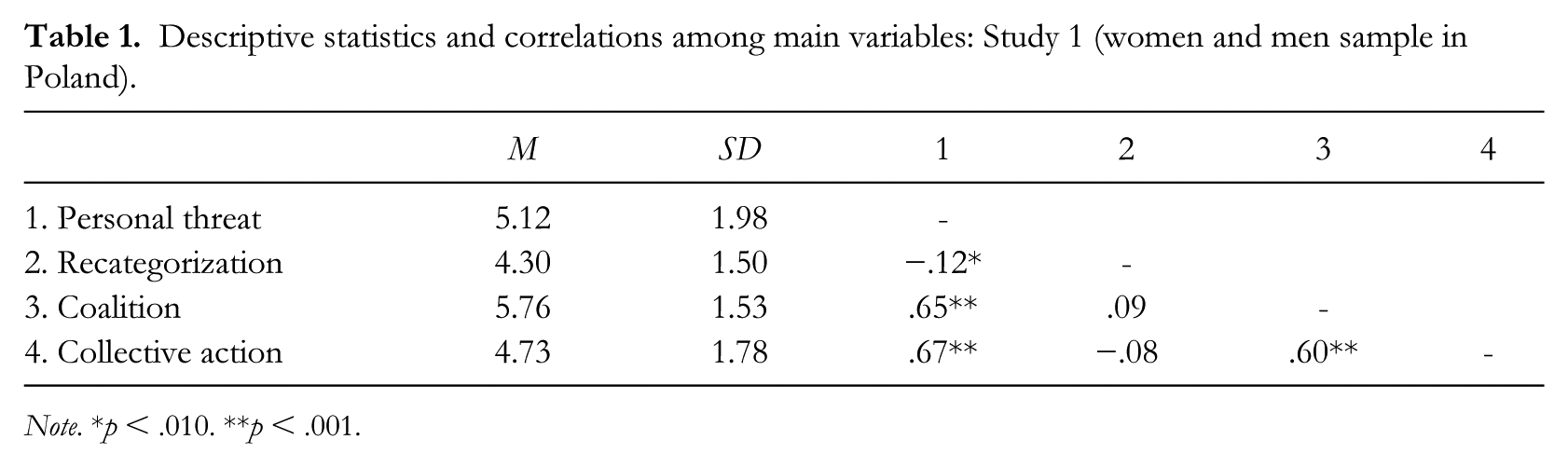
Note. *p < .010. **p < .001.
Next, we compared whether any representation of cooperation between groups was supported more by participants. Indeed, coalition (M = 5.76) was supported more than recategorization (M = 4.30), t(309) = −12.54, p < .001. In the next step, we performed parallel mediation analyses using the PROCESS macro, Model 4 (Hayes, 2018), introducing abortion-ban-related personal threat as a predictor, recategorization and coalition as mediators, and collective action intentions as the outcome variable. We found a significant positive indirect effect of threat on collective action intentions through the representation of intergroup cooperation as a coalition between men and women (IE = 0.18, 95% CI [0.12, 0.25], SE = 0.03). However, no such effect was found for recategorization as a mediator (IE = 0.01, 95% CI [0.00, 0.02], SE = 0.01). For the full model description, see Figure 1.
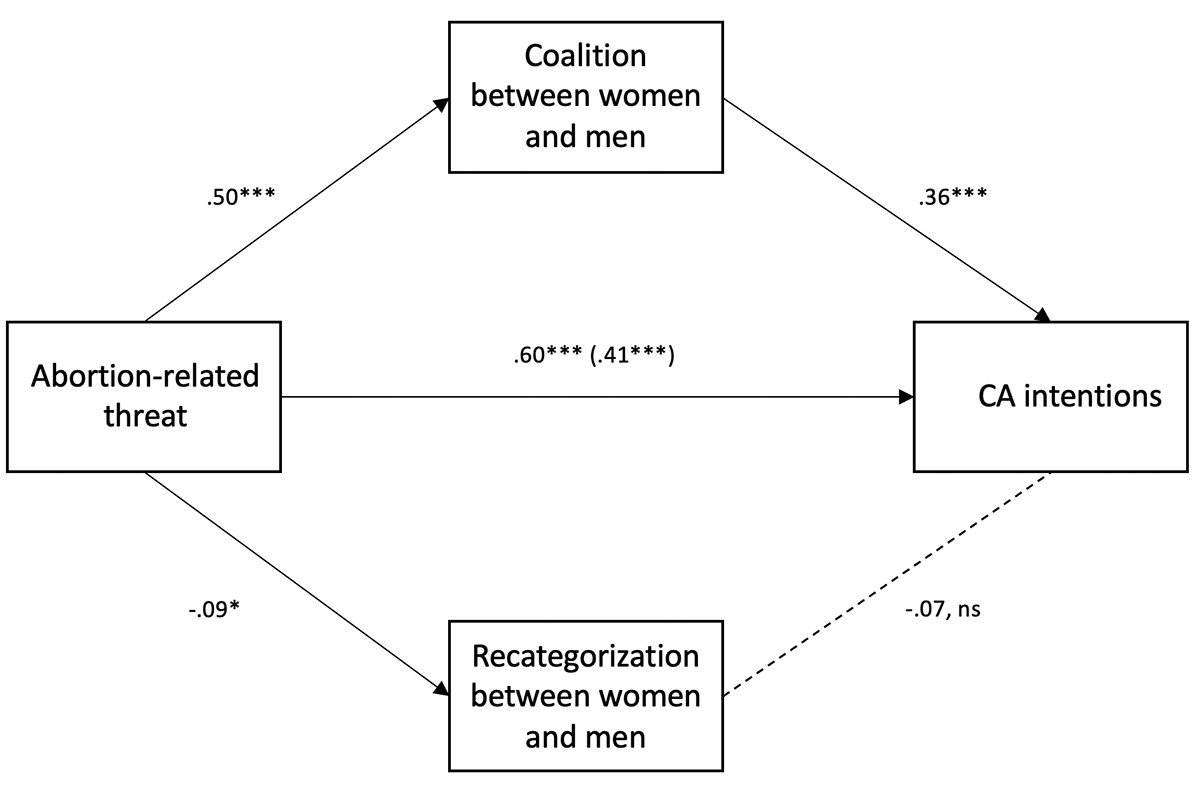
Parallel mediation model of abortion ban personal threat on collective action (CA) intentions: Study 1 (women and men sample in Poland).
Discussion
We found that abortion-related threat is positively linked to collective action intentions, mediated by perceptions of cooperation between women and men as a coalition, but not by recategorization as one group. One limitation is that the sample included both men and women, who may interpret alliances differently depending on their group status (Kutlaca et al., 2020). For women, abortion restrictions represent a direct threat, whereas for men, the threat may arise from solidarity or broader human rights concerns. Another limitation is the inclusion of both supporters and opponents of protests, which could confound results since mediators like coalition and recategorization reference resistance to abortion laws (e.g., “Women and men in Poland should cooperate in fighting against the restrictions of the abortion law”). This mix makes it difficult to differentiate those opposing the representation of cooperation from those dismissing the fight altogether. Next studies addressed this by analyzing men and women separately and by focusing on participants who supported the Women’s Strike in Poland and U.S. protests.
Study 2a
In Study 2a, we aimed to, first, replicate the aforementioned pattern with a female sample and, second, to test the model in a cooperation scenario between two disadvantaged groups. We hypothesized that while only coalition (and not recategorization) with men would mediate the relationship between threat and collective action intentions, both coalition and recategorization would mediate this relationship with the LGBTIQ+ community. All the measures, hypotheses, and analyses were preregistered prior to data collection (https://osf.io/gqcfj). 2 We conducted a power analysis using G*Power; for a dependent t test with a small effect size (0.2), alpha = .05, and power = .80, we needed 156 participants. Based on Fritz and MacKinnon’s (2007) indications regarding a bias-corrected bootstrapping approach in mediation analyses for medium–small effect sizes to achieve enough power (.80), we would need 148–462 participants, depending on the effect sizes of each path of the mediation. Thus, we aimed to recruit up to 462 participants.
Method
Participants
To collect our sample, we used a snowballing procedure via social media (e.g., Facebook), and offered participants to take part in a raffle (10 prizes of 50 PLN, equal to US $12.00 each). At the start of the survey, 96 participants who did not support the Women’s Strike were excluded from the questionnaire. We recorded 462 answers to the survey in which we excluded three participants who did not identify as women, 20 who failed at least one attention check, and two who attempted to take the survey for a second time. These exclusion criteria were preregistered. This left us with a final sample of 437 female participants from Poland (Mage = 28.51, SDage = 9.66). The sample was left-leaning, with M = 2.31 on a 7-point scale (1 = definitely left-wing, 7 = definitely right-wing); 62% of participants held university degree. With regard to sexual orientation, 77% identified as heterosexual; 19% as lesbian, bisexual, or asexual; and 4% preferred not to answer.
Measures
Support for Women’s Strike
At the beginning of the survey, we asked participants whether they supported the Women’s Strike. We gave 10 exemplary methods of support (e.g., protesting on the streets, wearing symbols of the strike on their clothing, etc.) as well as a possibility to specify their own ways of supporting the protest. We also included the answer option “I do not support the Women’s Strike”; participants who chose this last option were thanked and debriefed regarding the aim of the study.
Personal threat induced by abortion restrictions
We measured threat with the same four items as in Study 1 (α = .85).
Representations of intergroup cooperation
Recategorization as one group
We measured recategorization with the same items as in Study 1 separately for men (α = .84) and members of the LGBTIQ+ community (α = .88).
Coalition between different groups
We also measured coalition with the same items as before separately for men (α = .56) and members of the LGBTIQ+ community (α = .82).
Collective action
The Collective Action Scale consisted of three items measuring willingness to protest, to sign a petition, and to show resistance on social media (α = .55). Reliability analysis showed that excluding any item would further decrease the alpha, we therefore decided to average the three items for comparison purposes between studies.
Results
First, we checked correlations between the main variables (see Table 2). Again, threat was positively related to collective action intentions. Similar to Study 1, threat was positively related to coalition representation for men, but this time there was no relationship between threat and recategorization representation for men. However, threat was positively related to both coalition and recategorization representations with the LGBTIQ+ community.
Descriptive statistics and correlations among main variables: Study 2a (women sample in Poland).
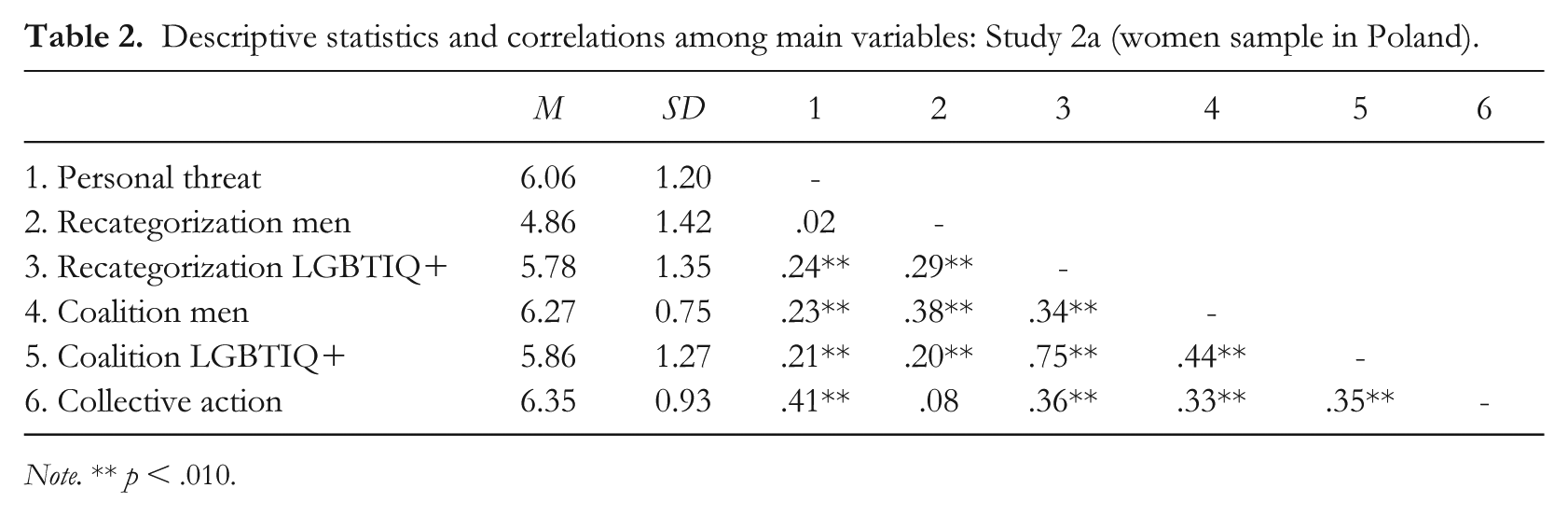
Note. ** p < .010.
In the next step, we checked whether our preregistered hypotheses found support in the data. Our first prediction stating that women would support more a coalition with men than recategorization was confirmed (M1 = 6.27, M2 = 4.86), F(1, 436) = 495.85, p < .001. Second, we predicted that women would support more an alliance based on recategorization as one group with members of the LGBTIQ+ community than with men. This was also true (M1 = 5.78, M2 = 4.86), F(1, 436) = 133.97, p < .001. We also confirmed that the relationship between threat and collective action intentions was mediated via coalition (but not recategorization) representations of cooperation with men. We found a significant positive indirect effect of threat on collective action intentions through coalition between men and women (IE = 0.05, 95% CI [0.01, 0.10], SE = 0.02), but we found no such effect for recategorization as a mediator (IE = 0.00, 95% CI [−0.01, 0.00], SE < 0.01). For the full model description, see Figure 2.
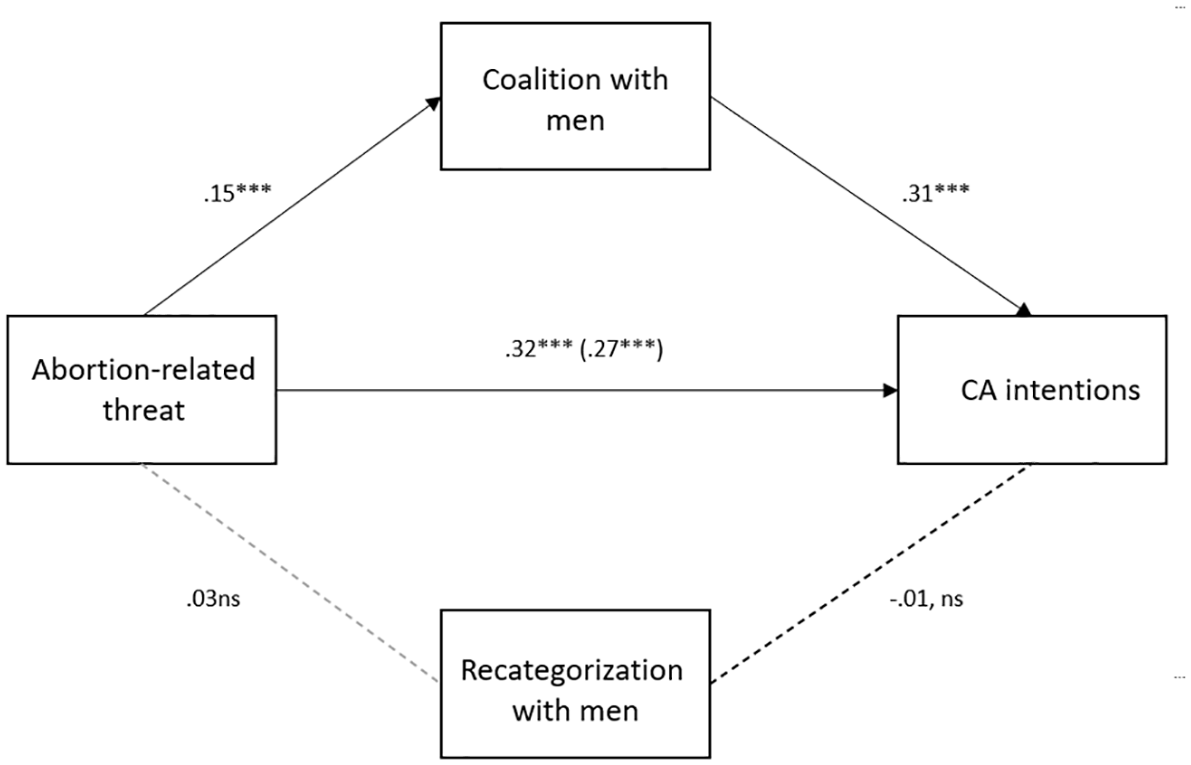
Parallel mediation model of abortion ban personal threat on collective action (CA) intentions: Study 2a (women sample in Poland).
Finally, as predicted, we found a significant positive indirect effect of threat on collective action intentions through both coalition between members of the LGBTIQ+ community and women (IE = 0.02, 95% CI [0.001, 0.06], SE = 0.01), and recategorization of those two groups (IE = 0.03, 95% CI [0.01, 0.07], SE = 0.02). For the full model description, see Figure 3.
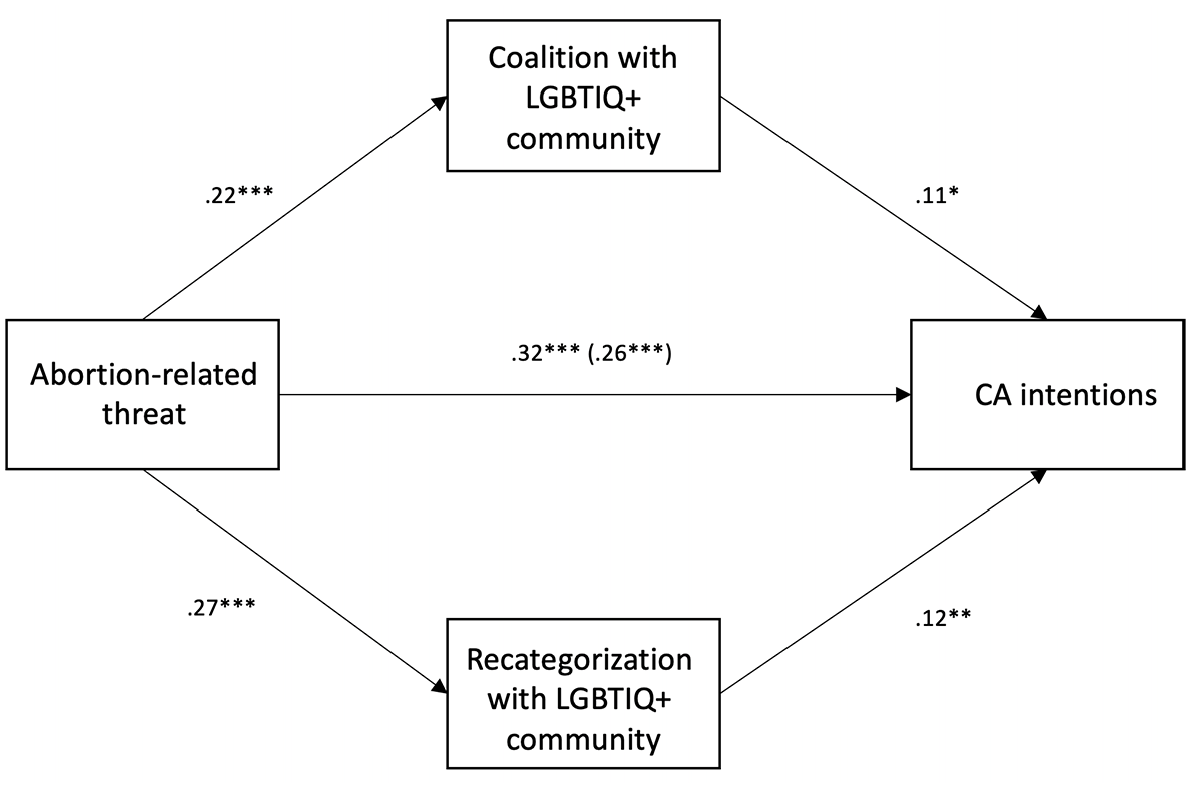
Parallel mediation model of abortion ban personal threat on collective action (CA) intentions: Study 2a (women sample in Poland).
Discussion
In Study 2a, we found that women were more likely to form a coalition with men than recategorizing into a single group with them. We replicated the pattern from Study 1 showing that the relationship between threat and collective action intentions is mediated via the representation of intergroup cooperation in terms of coalition, but not recategorization with men. Regarding alliances between women and the LGBTIQ+ community, we found that both recategorization and coalition with LGBTIQ+ members serve as mediators between threat and collective action intentions. Additionally, women supported recategorization with LGBTIQ+ members more than recategorization with men.
Study 2b
In this study, we wanted to explore the same parallel mediation model with men—the advantaged group—as participants. We were interested in whether the pattern of results observed in women would also apply to men, or whether recategorization would similarly mediate the relationship between abortion-ban-related threat and collective action intentions in men.
Method
Participants
We used a snowballing procedure to collect the sample. Participants could take part in a raffle (10 prizes of 50 PLN, equal to US$12.00 each). One hundred thirty-three of them declared at the beginning that they did not support the Women’s Strike and thus did not proceed with the questionnaire. Two hundred and fifty Polish male participants finished the survey. We excluded seven participants who did not identify as men, 12 who failed at least one attention check, and six who attempted to fill in the survey a second time. This left us with a final sample of 225 male participants (Mage = 29.46, SDage = 11.74). The sample was left-leaning, with M = 2.66 on a 7-point scale (1 = definitely left-wing, 7 = definitely right-wing); 56% of participants held a university degree; 72% were heterosexual, 24% were either gay or bisexual, and 4% did not want to answer the question regarding sexual orientation.
Measures
Personal threat induced by abortion restrictions
We measured personal threat with the same three items as in Study 1 and 2a (α = .81).
Other measures
Using the same items as in Study 1, we measured coalition (α = .88) and recategorization as one group (α = .80) with women in the fight for reproductive rights, as well as collective action intentions to support reproductive rights (using the same scale as in the previous study; α = .74).
Results
In the first step, we checked correlations between the main variables (see Table 3). Again, threat was positively related to collective action intentions and coalition, but also to recategorization. Both recategorization and coalition were positively related to collective action intentions.
Descriptive statistics and correlations among main variables: Study 2b (men sample in Poland).
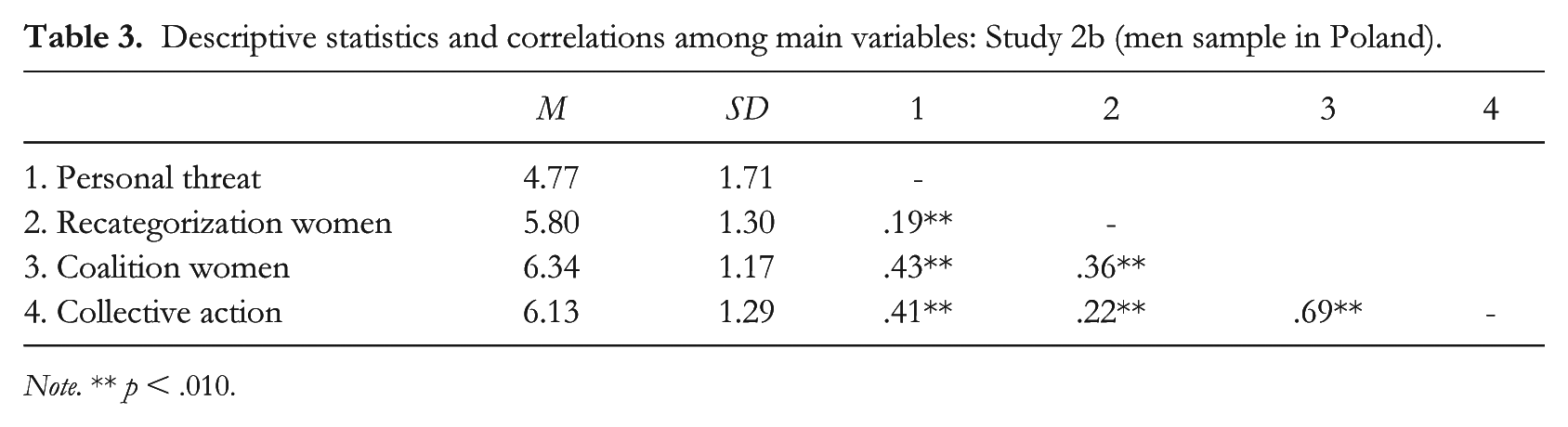
Note. ** p < .010.
In the next step, we explored whether our mediation model was confirmed by the data. The mediation model revealed a significant positive indirect effect of threat on collective action intentions through coalition between men and women (IE = 0.21, 95% CI [0.09, 0.33], SE = 0.06), but we did not find such an effect for recategorization as a mediator (IE = −0.01, 95% CI [−0.02, 0.01], SE = 0.01). For the full model description, see Figure 4. Thus, the results showed that the relationship between threat and collective action intentions was mediated via coalition (but not recategorization) with women.
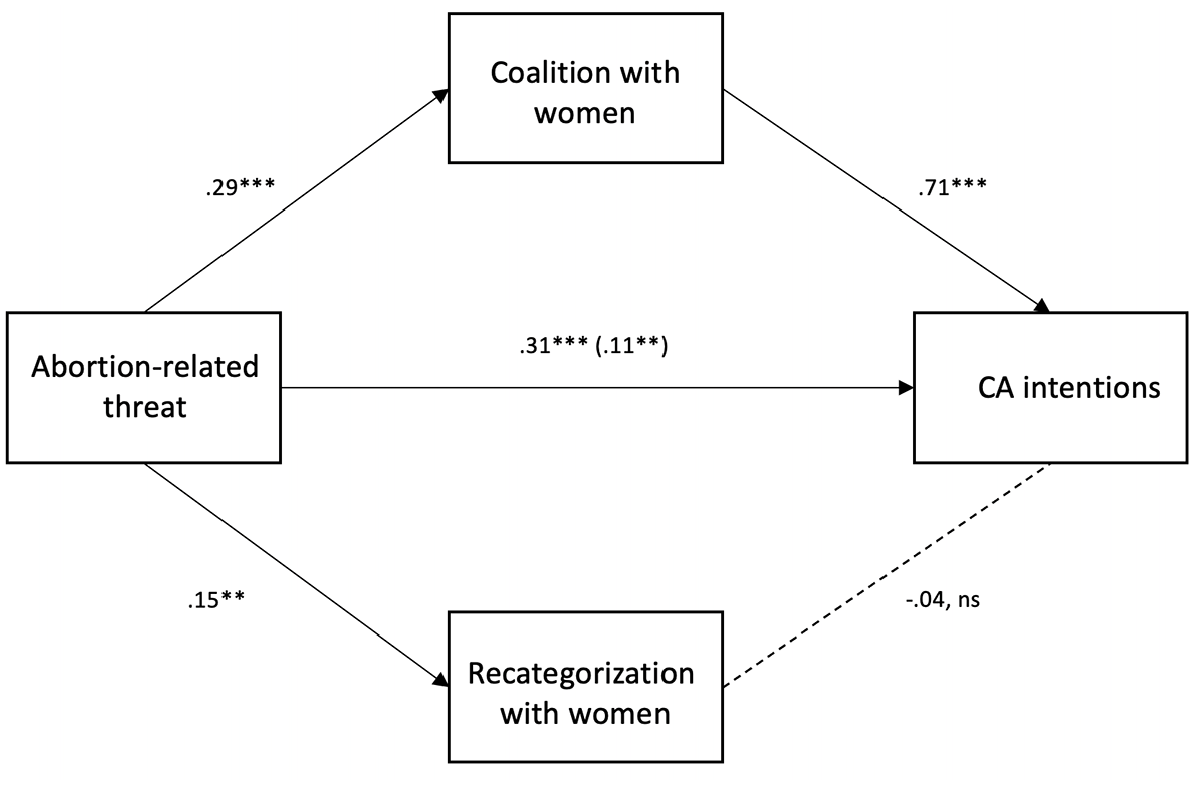
Parallel mediation model of abortion ban personal threat on collective action (CA) intentions: Study 2b (male sample in Poland).
Discussion
In Study 2b, we replicated the findings from Studies 1 and 2a, showing that only coalition mediates the link between abortion-related threat and collective action intentions. Notably, we demonstrated this pattern among advantaged group members (men) for the first time. As the study was exploratory, we did not have specific hypotheses. However, based on previous literature (Galván-Hernández et al., 2024; Shnabel & Nadler, 2008, 2015), one could assume that advantaged group members will not be as sensitive to the representation of the type of intergroup cooperation as disadvantaged groups (because their distinctiveness is not threatened). Thus, both forms of cooperation might similarly explain the relationship between threat and collective action intentions. This, however, was not the case for men in the context of abortion protests in Poland. This result is encouraging as it suggests that, in this context, male supporters of the abortion protest might be sensitive to women’s need for distinctiveness. This sensitivity could explain why the path between threat and collective action works better through coalition (vs. recategorization). It is important to determine if this result replicates in different contexts. Studies 3a and 3b extend this work to antiabortion-ban protests in the US, addressing earlier limitations in measure equivalence. Previous studies assessed coalition prescriptively (“how things should be”), but recategorization descriptively (“how things are”). To resolve this, we introduced new measures of preferences for both constructs (see OSM).
Study 3a
In the previous studies, we consistently found that when it comes to cooperation between advantaged (men) and disadvantaged (women) group members, only coalition, but not recategorization, explains the relationship between personal threat related to the abortion ban and collective action intentions both from women’s (Study 2a) and men’s perspectives (Study 2b). However, when two disadvantaged groups (LGBTIQ+ community and women) cooperate, both recategorization and coalition mediate the relationship between threat induced by restrictions to abortion and collective action intentions (Study 2a).
These results were obtained in the specific context of Poland, where feminist movements have only recently become more publicly visible due to the mass protests organized after the abortion ban. It is possible that in countries where feminist and LGBTIQ+ movements have been more visible over the past decades, the alliances between them and advantaged groups might look different. Where activism has been more pronounced, such social movements might be seen as more agentic, that is, they not only have a common goal but also coordinate actions towards achieving it (Fritsche et al., 2013). To check the generalizability of these results, we conducted another study in the context of abortion ban threat in the US in June 2022, just after massive protests erupted against an expected decision by the Supreme Court to overturn Roe v. Wade—the landmark ruling from 1973 that had previously established a constitutional right to abortion. We preregistered the study (https://osf.io/af5mp/?view_only=fa997c7de9c5431aa99664c14b6de3b5). According to a power analysis conducted using the “pwr2ppl 0.5.0” package (Aberson, 2019), we needed 210 participants to replicate previous results.
Method
Participants
The study was conducted via Prolific. As we aimed to include in the sample only those participants who supported the protests, we used a prescreening criterion and invited only women who declared themselves to be pro-choice (vs. pro-life) to take part in the study. Among participants, 18 declared they did not agree with recent pro-choice protests and therefore did not continue with the study. Participants who did not pass the attention checks were also not allowed to proceed with the questionnaire. Three hundred and two American female participants finished the survey. We excluded 13 participants who did not identify as women. This resulted in a final sample of 289 female participants (Mage = 37.11, SDage = 14.41); 58% held a university degree. Seventy-three percent identified as heterosexual; 26% as homosexual, bisexual, or asexual; and 1% did not want to answer this question. The sample was again left-leaning, with M = 2.33 on a 7-point scale (1 = I’m a Democrat, 7 = I’m a Republican).
Measures
Personal threat
Threat was measured with three items similar to those in the previous studies (i.e., “I feel threatened by the restrictions of abortion laws,” “The tightening of the abortion law makes me feel helpless,” and “I am concerned about how the tightening of the abortion law will affect me in the future”; α = .86).
Representations of intergroup cooperation
Recategorization
We used the same items as in previous studies (men: α = .84; LGBTIQ+ community: α = .86).
Coalition between different groups
We asked participants to respond to four items (e.g., “Women and men should cooperate in the fight against stricter abortion laws in the US”; α = .84). We asked analogous questions with regard to the LGBTIQ+ community (α = .94).
Collective action
The Collective Action Scale consisted of the same three items as in previous studies (α = .74).
Results
First, we checked correlations between the main variables (see Table 4). As before, threat was positively related to collective action intentions. Threat was, however, not related to recategorization with men, but it was related to coalition with them. Similar to Study 2a, threat was correlated with both recategorization and coalition with the LGBTIQ+ community. Recategorization with men was not correlated with collective action intentions. Contrarily, both types of alliances with the LGBTIQ+ community, and coalition with men, were positively correlated with collective action intentions.
Descriptive statistics and correlations among main variables: Study 3a (women sample in the US).
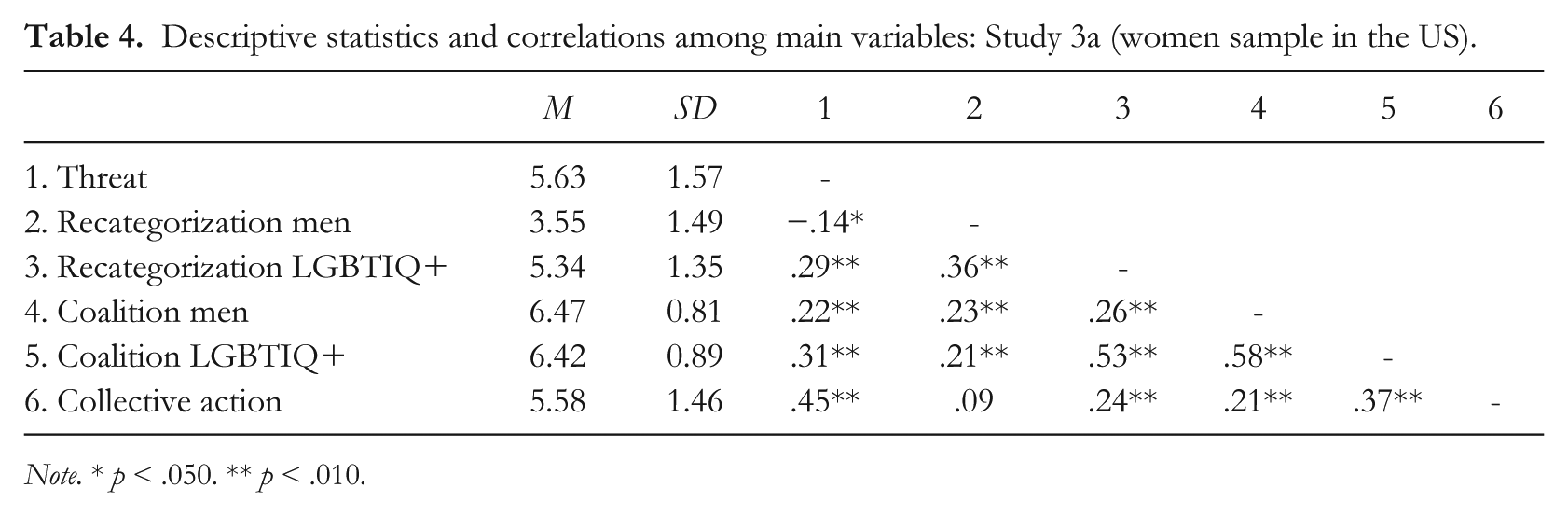
Note. * p < .050. ** p < .010.
Next, we checked whether our preregistered hypotheses were supported by the data. In line with our first prediction, women supported a coalition with men more than recategorization with them (M1 = 6.47, M2 = 3.55), F(1, 288) = 1108.79, p < .001. Confirming Hypothesis 2, women supported cooperation based on recategorization with the LGBTIQ+ community more than with men (M1 = 5.34, M2 = 3.55), F(1, 288) = 367.48, p < .001. However, we did not find a significant indirect effect of threat on collective action intentions neither through coalition between men and women (IE = 0.01, 95% CI [−0.01, 0.05], SE = 0.02) nor for recategorization as mediator (IE = −0.02, 95% CI [−0.05, 0.00], SE = 0.01). For the full model description, see Figure 5.
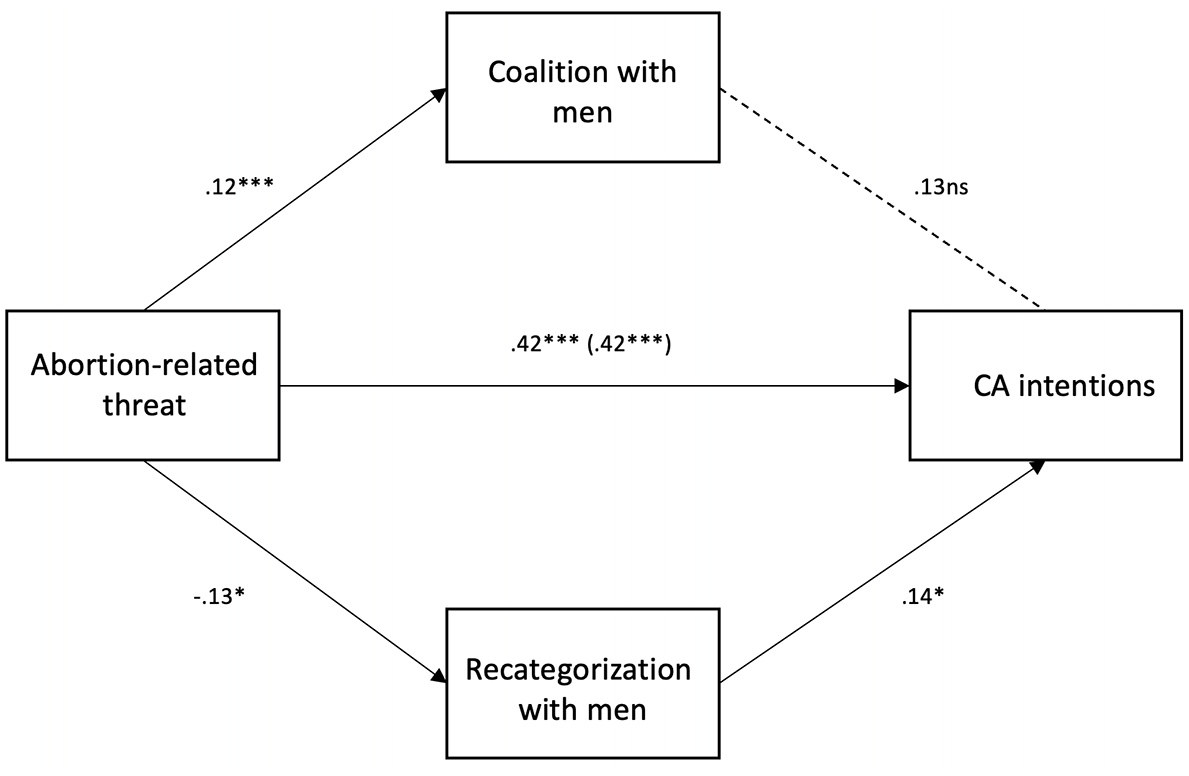
Parallel mediation model of abortion ban personal threat on collective action (CA) intentions: Study 3a (women sample in the US).
Finally, we found a significant positive indirect effect of threat on collective action intentions through willingness to cooperate in the form of a coalition between LGBTIQ+ community members and women (IE = 0.07, 95% CI [0.03, 0.13], SE = 0.03), but not through recategorization (IE = 0.00, 95% CI [−0.03, 0.04], SE = 0.02). For the full model description, see Figure 6.
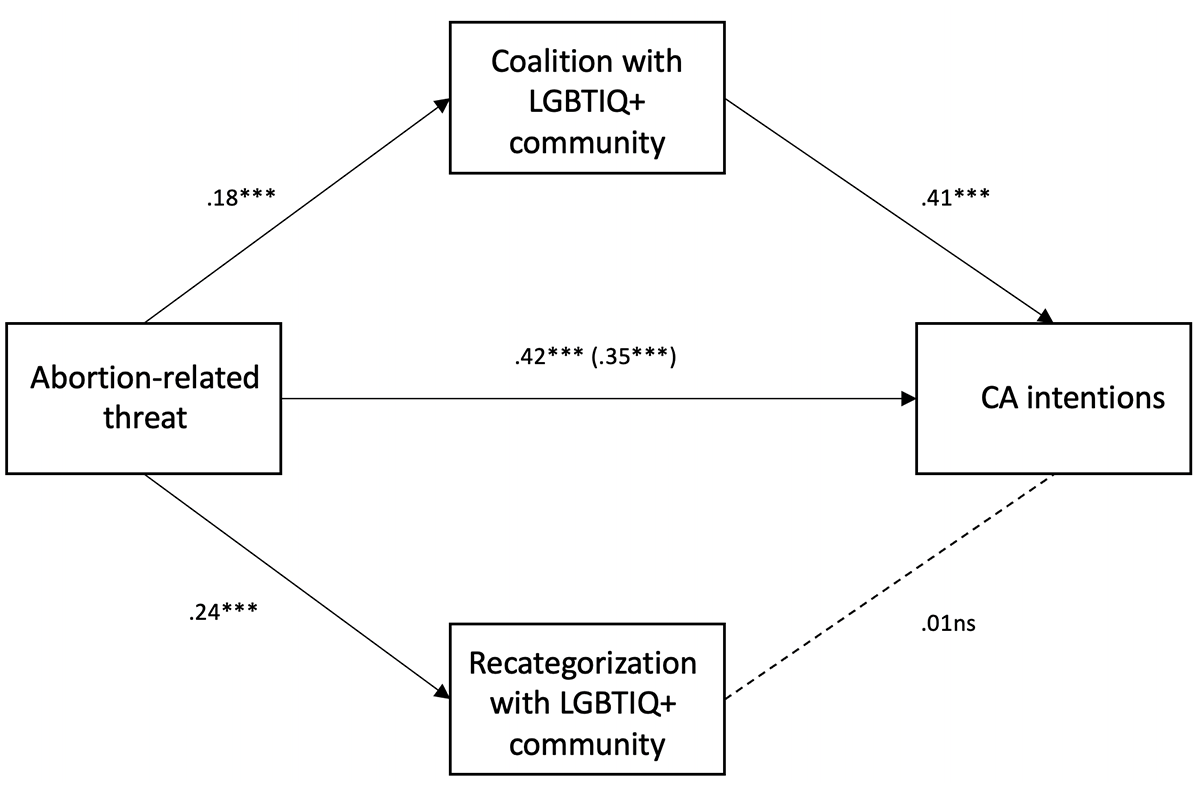
Parallel mediation model of abortion ban personal threat on collective action (CA) intentions: Study 3a (women sample in the US).
Discussion
In Study 3a, we found that women in the US, like in Poland, favored coalition with men over recategorization. They also preferred recategorization with the LGBTIQ+ community over that with men. However, unlike previous studies, neither coalition nor recategorization with men mediated the link between threat and women’s collective action intentions. For the LGBTIQ+ community, coalition, but not recategorization, mediated this relationship. Analyses with new measures yielded similar results, with one exception (when it comes to the allyship with LGBTIQ+ community, the path through coalition was non-significant); thus, for the sake of simplicity, we report the original measures in the manuscript and include the new ones in the OSM together with the results.
The distinct feminist context in the US may explain these differences. The more established feminist movement might lead women to perceive greater group agency, reducing reliance on alliances. Alternatively, they may view alliances, no matter whether these groups are advantaged or disadvantaged, with more suspicion. For instance, greater hostility towards noncisheterosexual women has been observed in pro-abortion protests in the US. Slogans such as “No uterus, no opinion,” “not your body, not your choice,” or “off our bodies” imply that abortion is a women’s issue and that opinions from other groups are not welcome. Also, the pro-choice movement in the US has been historically mainly White-women-centered, making it easier for them to see it as a single-gender issue, and not rely on similarities with sexual minorities rights. The voices of LGBTIQ+ people are still underrepresented in reproductive justice activism in the US (Watson et al., 2023). Thus, it is not surprising that coalition with sexual minorities, but not recategorization, is the only process that promotes mobilization in this context.
Study 3b
In our final study, we wanted to check whether the results from Study 3a for men in Poland replicated in a different cultural context, namely the US. The study was conducted in the same time frame as Study 3a. We preregistered the study (https://osf.io/8wkhm/?view_only=0e8d2eb74fb64304a59a537a5175d1ec). According to a power analysis conducted using the “pwr2ppl 0.5.0” package (Aberson, 2019), we needed 350 participants to replicate the previous results.
Method
Participants
Same as Study 3a, this study was conducted via Prolific. We had the same prescreening criterion. Twenty-eight participants declared they did not agree with recent pro-choice protests, thus we thanked and debriefed them. Participants who did not pass the attention checks were not allowed to proceed with the questionnaire. Eventually, 347 American participants finished the survey. We excluded 14 participants who did not identify as men. This left us with a final sample of 333 male participants (Mage = 37.70, SDage = 13.05). The sample was left-leaning, with M = 2.52 on a 7-point scale (same as in Study 3a); 58% had a university degree. Eighty-four percent of participants identified as heterosexual; 15% as homosexual, bisexual or asexual; and 1% did not want to answer this question.
Measures
Personal threat
Threat was measured with the same three items as in Study 3a (α = .90).
Representations of intergroup cooperation
Recategorization as one group
We measured recategorization with women with the same items as in Study 3a. The alpha coefficient for the scale including the initial items and one additional item was .79.
Coalition between different groups
We measured coalition with women with analogous items to those in Study 3a (α = .93).
Collective action intentions
The Collective Action Intentions Scale consisted of the three items used in the previous studies (α = .80).
Results
As in previous studies, threat was positively related to collective action intentions. Threat was also positively related to perceived recategorization with women, as well as to coalition. Both types of cooperation with women were positively correlated with collective action intentions. Correlations between the main variables are shown in Table 5.
Descriptive statistics and correlations among main variables: Study 3b (men sample in the US).
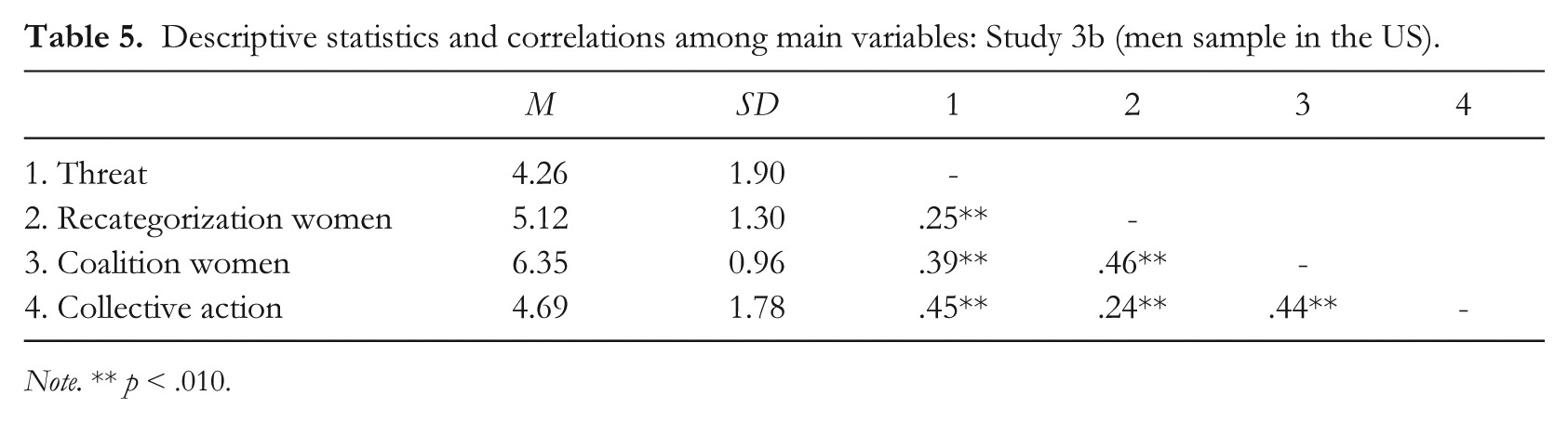
Note. ** p < .010.
As we hypothesized, the relationship between threat and collective action intentions was mediated via coalition (but not recategorization) with men. We found a significant indirect effect of threat on collective action intentions through willingness to cooperate in the form of a coalition between men and women (IE = 0.11, 95% CI [0.07, 0.16], SE = 0.02), but not for recategorization as a mediator (IE = 0.00, 95% CI [−0.02, 0.03], SE = 0.01). For the full model description, see Figure 7.
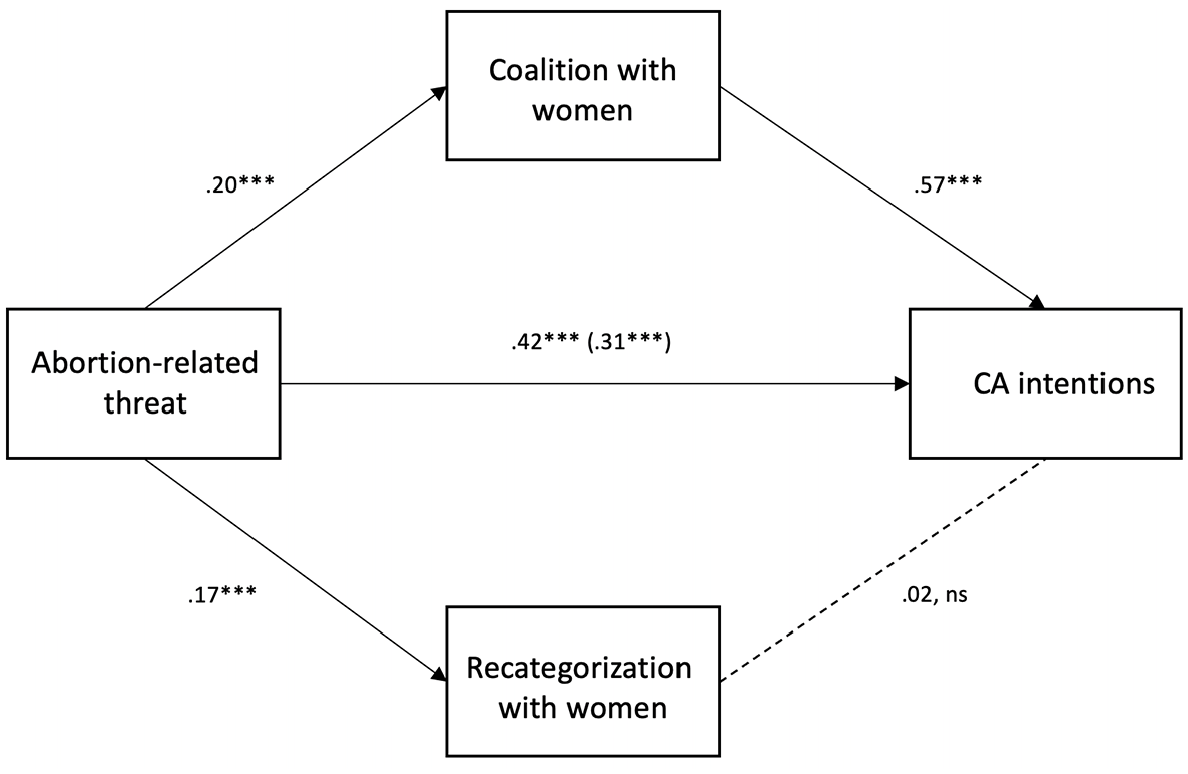
Parallel mediation model of abortion ban personal threat on collective action (CA) intentions: Study 3b (men sample in the US).
Discussion
In Study 3b, we aimed to replicate the results from Study 2b in a different cultural context, the US. As in Poland, only coalition with women, but not recategorization, mediated the link between threat and collective action intentions among men. These results suggest that, in the US, coalition between men and women is seen as more necessary by the advantaged group (men) compared to the disadvantaged group (women), who may strive for greater independence, as indicated in Study 3a.
General Discussion
In the present research, we investigated how abortion-related threat impacts different representations of cooperation between groups (coalition vs. recategorization), and how these alliances are further related to the willingness to get involved in collective action for women’s reproductive rights. We looked at the processes of building allyship in two countries (Poland and the US) with two different types of allies: an advantaged group (men) and a disadvantaged group (LGBTIQ+ community). We also explored alliances between women and men from the perspective of the advantaged group (men).
Our main predictor variable across five studies was perceived personal threat stemming from restriction of the abortion law. Consequently, across studies, we showed that higher levels of personal threat were related to a higher willingness to engage in collective action on behalf of one’s own group (for women respondents) or disadvantaged group members (for men respondents).
When it comes to alliances from the perspective of the disadvantaged group (women), higher levels of representation of cooperation with men in terms of coalition were related to collective action intentions in Poland, but not in the US. Why was this the case? In the US, a country with a stronger tradition of feminist movements advocating women’s abortion rights, women might assume that they do not need alliances with men to engage in collective action. Contrarily, for Polish women, coalitional alliances with men could be perceived as strategic for goal achievement. The feminist movement in the US has a much stronger tradition—the first wave of feminism dates back to the first women’s rights convention held in 1848. A similar movement started in Poland 60 years later. A promising period for women’s rights in 20th-century Poland was squandered after 1989, when the Catholic Church began strongly influencing politics. This resulted in restrictions on abortion, the removal of sexual education from schools, and the withdrawal of contraception support from the state budget. The feminist movement became niche for many years, but it was reborn in 2020 after an almost total ban on abortion. On October 28 2020, police registered 410 protests across the country, which gathered more than 430,000 participants. These were not only the biggest demonstrations after the fall of communism, but arguably the largest street protests in the history of Poland. However, it should be noted that, despite this success, this phenomenon is quite new in the Polish society and not as well established (similarly to the Polish LGBTIQ+ movement), compared to the feminist movement in the US.
Further, both coalition and recategorization with LGBTIQ+ members were found to promote collective action intentions in Poland. In contrast, only coalition mediated the effect of personal threat on collective action intentions in the US. In countries where the rights of women and sexual minorities are not respected or even strongly threatened, any form of alliance may have a mobilizing effect because it increases the agency of the group against a common enemy. However, the historical background of feminist and LGBTIQ+ struggles in the US makes their identities more salient, and only coalitions (not recategorization) with sexual minorities are seen as promoting allied actions. Thus, the power of different alliances to promote social change is strongly context-dependent, as they rely on power relations and social status.
From the advantaged group’s perspective, in both Poland and the US, we found that willingness to form a coalition with women explained the relationship between personal threat and pro-abortion collective action intentions, but the same was not true for recategorization as mediator. More specifically, willingness to recategorize with women was not related to men’s willingness to take part in protests defending abortion rights. A similar pattern was observed in the mixed sample and female-only sample in Poland in Studies 1 and 2a. This would suggest that coalitional forms of cooperation are better suited to encouraging involvement in collective action compared to recategorization. A similar pattern of results showing that advantaged group members (White Americans) tend to form coalitions with disadvantaged group members (Black Americans) was found in the context of a shared COVID-19 threat (Bukowski et al., 2024). Thus, coalitions seem to facilitate equality-based cooperation between groups with a different social position. This might be particularly meaningful for disadvantaged groups because coalition can help to protect their need for distinctiveness (Urbiola et al., 2023), compared to recategorization into one group. But why do advantaged group members, whose distinctiveness is not threatened, still support coalitional forms of cooperation with disadvantaged members more readily? One possibility is that forming coalitions requires an appreciation for diversity and an understanding that cooperation as equals, while maintaining group distinctions, is more effective for intergroup collaboration between societal groups that hold varying positions.
It is also worth noting the relationship between personal threat and different representations of intergroup cooperation. When it comes to coalition, personal threat was always positively related to this type of representation in each of the studies (with male and female samples) and for both types of allies (men and LGBTIQ+ community). When it comes to recategorization, the correlations varied depending on the sample: in Study 1 and Study 3a, where samples consisted predominantly of women, the relationship between threat and recategorization with men was negative—the more participants felt threatened, the less they wanted to think of creating a common identity with men. For the female sample in Study 2a, this relationship was nonsignificant. By contrast, in male-only samples (Studies 2b and 3b), higher levels of threat were associated with higher recategorization intentions with women. When considering LGBTIQ+ community as allies by women, personal threat was positively related to recategorization intentions in Studies 2a and 3a.
Why was this the case? In our view, coalitions that do not undermine the distinctiveness of the groups that constitute them are more likely to encourage the fight for the rights of minorities. These results align with findings by Bukowski et al. (2024), who showed that threat can decrease modern prejudice toward minorities through coalition intentions. On the other hand, coalitions are temporal, based on power fluctuations, and focused on cooperation to achieve common goals (Cikara, 2021). Our results from the U.S. female sample suggest the strategic nature of coalitional forms of cooperation—they endure only if there is mutual interest. However, they may still change how groups perceive each other, potentially fostering respect for differences and a better understanding of each other’s needs and goals.
By contrast, one-group recategorization, which suggests that both advantaged and disadvantaged group members share a common fate and are “in the same boat,” may lead to the belief that empowering disadvantaged group members through collective action is no longer necessary. Indeed, Bukowski et al. (2024) showed that recategorization between advantaged and disadvantaged group members was associated with higher modern prejudice toward the disadvantaged group. In our research, threat was positively related to recategorization with the LGBTIQ+ community from the perspective of women, and with recategorization with women from the perspective of men. We believe this may have occurred for several reasons: alliance with the LGBTIQ+ community through recategorization could increase agency and solidarity with another disadvantaged group, while for men, supporting recategorization could be a way to protect their moral status through paternalism and reinforce the status quo.
This research had several limitations. First, we provide only correlational evidence for our claims, which prevents us from making assumptions about the causal relations between the examined constructs. Second, the main measures we used (coalition vs. recategorization) are not necessarily equivalent. When it comes to the latter scale, we asked participants about how things are (e.g., “Women and men in Poland share a common fate”), while in the former, we asked how things should be (e.g., “Women and men in Poland should cooperate in fighting against the restrictions of the abortion law”). This difference reflects a focus on current conditions versus an ideal state of affairs. Additionally, the fight for abortion rights was mentioned directly more frequently in the coalition items, as compared to the recategorization ones, which could partly explain why the first measure correlated more strongly and consistently with collective action intentions. Furthermore, while the disadvantaged–advantaged group scenario (women vs. men) allows for a clear distinction between the ingroup and the outgroup, things are less clear in the two-disadvantaged-groups scenario (women vs. LGBTIQ+ community), where both groups partly overlap. This all speaks to the fact that, taking into account these differences between the coalition and recategorization measures, these results should be interpreted with caution. We also did not collect some important information from participants, such as race, ethnicity, socioeconomic status, previous experience with abortion, or having kids. Finally, we offer investigation into behavioral intentions rather than actual behavior.
Despite these drawbacks, we still find this research novel and valuable in several ways. First, we show that personal threat can be related to constructive and respectful ways of intergroup cooperation. Second, our research was conducted at a very sensitive time, mainly in the middle of protests resulting from an abortion ban in Poland and the US, enabling us to capture willingness to take part in such collective action. Third, it was based on preregistered, theory-based assumptions of differences between different kinds of alliances. Additionally, it covers both the perspective of the disadvantaged group (women) and of the advantaged allies (men) about one relevant social issue that has large implications for society. Finally, it focuses on a promising way to cooperate between diverse groups by treating their members as allies. Cooperation in the form of a coalition implies that its partners do not have to lose their distinctiveness, which can enhance respect-based coordinated action that promote the rights of minorities. We believe that this research can inspire further studies on inclusive forms of cooperation between groups of different socioeconomic positions, encouraging dialogue, mutual respect, and the creation of a collaborative environment that promote equitable opportunities. Also, we hope that these results will be helpful in understanding the dynamics of cooperation in promoting collective action as a response to various threats in contemporary societies: restrictions to freedom of choice, violation of human rights, and threat to democracy.
Supplemental Material
sj-docx-1-gpi-10.1177_13684302251328035 – Supplemental material for “Abort the government!” Alliances between diverse groups and collective action intentions as a response to threat evoked by abortion bans
Supplemental material, sj-docx-1-gpi-10.1177_13684302251328035 for “Abort the government!” Alliances between diverse groups and collective action intentions as a response to threat evoked by abortion bans by Anna Potoczek, Marcin Bukowski, Lucia Estevan-Reina, Dominika Gurbisz, Anna Stafiej and Soledad de Lemus in Group Processes & Intergroup Relations
Footnotes
Author Contributions
AP conceptualized the research idea, designed the study, prepared the research materials, collected the data, conducted data analyses, interpreted the results of statistical analyses, wrote the original manuscript, provided comments on the manuscript, corrected the manuscript after reviews.
MB conceptualized the research idea, designed the study, prepared the research materials, collected the data, interpreted the results of statistical analyses, wrote the original manuscript, provided comments on the manuscript, corrected the manuscript after reviews, supervised the research process.
LER conceptualized the research idea, designed the study, prepared the research materials, interpreted the results of statistical analyses, wrote the original manuscript, provided comments on the manuscript, corrected the manuscript after reviews.
DG prepared the research materials, provided comments on the manuscript, corrected the manuscript after reviews.
AS collected the data.
SL conceptualized the research idea, designed the study, prepared the research materials, interpreted the results of statistical analyses, wrote the original manuscript, provided comments on the manuscript, corrected the manuscript after reviews, supervised the research process.
Funding
The author(s) disclosed receipt of the following financial support for the research, authorship, and/or publication of this article: This research was supported by a grant No. 2018/30/M/HS6/00298 from the National Science Centre awarded to the second author and by grant PID2022.141182NB.I00 funded by MICIU/AEI/10.13039/501100011033 ERDF/EU (Spanish Ministry of Science and Universities) awarded to the last author. Foundation for Polish Science (FNP) supported the first author. This work was supported by a grant funded by the Strategic Program Excellence Initiative at the Jagiellonian University.

Supplemental Material
Supplemental material for this article is available online.
Notes
References
Supplementary Material
Please find the following supplemental material available below.
For Open Access articles published under a Creative Commons License, all supplemental material carries the same license as the article it is associated with.
For non-Open Access articles published, all supplemental material carries a non-exclusive license, and permission requests for re-use of supplemental material or any part of supplemental material shall be sent directly to the copyright owner as specified in the copyright notice associated with the article.
