




Abstract
While emotions are pivotal in intergroup conflicts, individuals are less motivated to feel peace-promoting emotions in extreme conflicts. In the current research, we investigated whether virtual reality (VR) can be harnessed to overcome this limitation by utilizing two of its features: (a) the ability to simulate reality in an immersive way, and (b) to allow people to experience a situation from different perspectives immersively. Two studies done outside the lab (N = 346) on Jewish-Israelis showed that watching conflict-related scenes using VR increased empathy and other peace-promoting emotions and attitudes. Additionally, the results showed that VR could be used to assist emotion-regulation interventions, namely, cognitive reappraisal (CR) and perspective-taking (PT), by allowing participants to immersively experience a scene from the desired perspective (a “bystander,” detached perspective for CR and an outgroup perspective for PT). Both features were found to have a distinct contribution in affecting participants’ emotions. However, most effects were found only among rightists, suggesting VR is beneficial when motivation to feel peace-promoting emotions is low. Our findings suggest that interventions should be carefully tailored to the audience, the context, and the desired effect.
Keywords
Introduction
Emotions play a significant role in intergroup relations and conflicts (Pliskin & Halperin, 2016). Prosocial emotions, like empathy toward the outgroup, can promote positive change by leading to increased support for conciliatory policies and helping behaviors (Stephan & Finlay, 1999), while negative emotions (e.g., anger) can increase support for aggressive or militant policies (Halperin & Gross, 2011b; Skitka et al., 2006; Spanovic et al., 2010). Thus, various interventions have been tested to improve intergroup relations by using emotion-regulation methods (Avichail et al., 2024; Čehajić-Clancy et al., 2016; Halperin et al., 2011, 2013; Porat et al., 2016).
Unfortunately, when empathy and prosocial emotions are needed the most, such as in intractable and violent conflicts, generating and affecting them is challenging. The low motivation to empathize with the other side and the extreme emotions involved are crucial factors significantly reducing the efficiency of interventions to improve emotions (Behler & Berry, 2022; Čehajić-Clancy & Halperin, 2024; Cikara et al., 2011; Klimecki et al., 2020; Vorauer et al., 2009; Weisz & Zaki, 2018). In fact, in competitive or conflictual contexts, interventions aimed at increasing empathy and understanding an outgroup’s perspective can even backfire (Epley et al., 2006; Klimecki et al., 2020; Vorauer et al., 2009).
In this context, the barrier of motivation is most prominent among right-wing individuals. First, rightists are generally less motivated to empathize with outgroups (Hasson et al., 2018). Moreover, especially in extreme conflicts, political orientation mainly reflects attitudes and emotions regarding the conflict and the parties involved, with rightists holding a more negative and hawkish stance toward the outgroup while tending more to glorify their ingroup. Thus, in line with their views, rightists are motivated to feel more anger and less empathy toward the specific outgroup in conflict (Porat et al., 2016). Their opposing views and motivations can also result in a backlash when presented with an intervention aimed at increasing their empathy and perspective-taking toward an outgroup (Berndsen et al., 2018; Klimecki et al., 2020). Although shaping rightists’ emotions in a peace-promoting direction might be more challenging, it is highly necessary due to their opposing stance. The challenge of affecting emotions in extreme contexts and audiences, when the motivation and willingness to engage and invest mental effort is extremely low, has led us to offer an approach that could overcome this limitation by harnessing the vividness and immersiveness enabled by virtual reality.
Virtual reality (VR) can produce immersive 360-degree environments that provide vivid, all-encompassing experiences. Consequently, VR allows people to experience events and environments as though they are physically there in space or time (Banakou et al., 2013; Ehrsson et al., 2007; Hasler et al., 2017; Landau et al., 2020; Rubio-Tamayo et al., 2017; Tassinari et al., 2022). This simulation can trigger cognitive and affective processes; for example, studies that examined empathy and helping behaviors toward others used 360-degree VR experiences to portray humans in need or social suffering (e.g., Dyer et al., 2018; Herrera et al., 2018; Schutte & Stilinović, 2017; Tong et al., 2020; Ventura et al., 2020).
Furthermore, VR has been widely employed in recent years to improve intergroup relations by changing emotions and attitudes and reducing biases in various intergroup contexts, including racial, ethnic, economic, and age differences (Farmer & Maister, 2017; Hasler et al., 2021; Maister et al., 2015; Tassinari et al., 2022). Importantly, VR is capable of simulating reality from various points of view. This ability to experience outgroup members’ perspectives using VR was found to increase empathy toward them in the context of the Israeli-Palestinian conflict (Hasson et al., 2019).
In this research, we focused on the Israeli-Palestinian conflict. As an intractable, violent conflict, hostile emotions (Halperin & Gross, 2011b) and a lack of empathy (Levy et al., 2016) are prevalent on both sides. In two studies, we investigated several questions and hypotheses regarding using VR for interventions to improve intergroup relations within a conflict. For the current studies, we used two very different virtual reality (VR) 360-degree videos created by an interdisciplinary group of experts from assorted fields: scientists from various disciplines, creators, film producers, screenwriters, and artists. In the 360-degree video used for the first study, participants watched the story of Arab, a Palestinian who swore to avenge his sister’s death by Israeli soldiers but years later became a peace activist. During the video, Arab tells his story to the camera but also invites the viewers to be part of his daily life and experience his discussion with his friends and family first-hand. The video used for the second study illustrated an emotionally loaded encounter between Israeli soldiers and a Palestinian couple at a checkpoint (Hasler et al., 2021; Hasson et al., 2019) and was filmed from three perspectives: the Israeli, the Palestinian, and an external perspective (bystander’s perspective).
We were interested in investigating two features of VR: (a) the medium itself and its ability to immerse the viewer in the experience more than other media types and (b) its ability to assist the viewer in experiencing a scene from different perspectives immersively. Our rationale was that the immersiveness would improve participants’ emotions as it would (a) increase their engagement with the experience and (b) assist them in taking other perspectives on the situation without investing the mental effort usually required for emotion regulation (Lewczuk et al., 2022). By lowering the need for active mental effort, we hypothesized that the dependence on one’s motivation would be reduced. Overcoming the motivation barrier could open the door to robust interventions that can be used even in extreme conflicts and among unmotivated individuals and groups.
The current paper investigates this rationale in two studies. The first study focused on VR’s immersiveness. It examines whether experiencing a scene using VR would result in peace-promoting emotions and attitudes compared to experiencing it in a non-immersive way. It also explores the mediating effect of participant engagement with the experience. The second study also investigates the effect of immersiveness. However, it mainly focuses on examining whether VR can assist participants in taking other perspectives on a situation, bypassing their lack of motivation, hence resulting in more peace-promoting emotional responses.
Study 1
In this study, we investigated whether watching a video using VR would result in more empathy toward the Palestinian characters. Despite VR being called an “empathy machine” (Bujić et al., 2020), a closer examination of the literature reveals that little empirical evidence supports the claim that immersive 360-degree video enhances empathy. While several studies did show the potential of VR to induce empathy (i.e., factors that make VR more effective in triggering empathy), they did not show any significant increase in empathy in VR compared to non-VR stimuli (Ho & Ng, 2022). For example, many studies reported no difference in empathy levels between immersive 360-degree video and 2D video (Hasler et al., 2021; Sundar et al., 2017; Weinel et al., 2018) or between VR-based and traditional perspective-taking (Hasson et al., 2019; Herrera et al., 2018). In only a handful of empirical studies, immersive 360-degree video resulted in higher levels of empathy than watching the same video on a flat screen (Schutte & Stilinović, 2017). Noteworthy, although the video was conflict-related as it portrayed a Syrian refugee, the participants in that experiment were not related to the conflict. Furthermore, a meta-analysis shows inconclusive results on whether VR/360-degree videos impact empathy (Martingano et al., 2021, 2023). The mixed literature may suggest that we should turn away from asking whether VR is an empathy machine toward a refined question asking when or for whom VR can effectively induce empathy.
Since motivation greatly shapes emotions and empathy (Porat et al., 2016; Weisz & Zaki, 2018), we hypothesized that VR’s main contribution would be to allow unmotivated individuals to feel empathy by immersing them in an experience and increasing their engagement. Hence, our research focuses on context and audiences with extremely low motivation to empathize with the other group—specifically, in an intractable, violent intergroup conflict and among rightists, who are less motivated to feel empathy toward outgroups (Hasson et al., 2018), especially in a violent conflict (Porat et al., 2016). This hypothesis was supported by a series of recent neural studies suggesting that rightists’ empathic reactions are more dependent on the stimuli’s vividness (Zebarjadi et al., 2023, 2024).
We proposed that viewers’ lack of motivation can be overcome by increasing their engagement, i.e., their involvement in the media experience (Wiebe et al., 2014). While many studies have found that VR-based interventions enhance engagement compared to non-immersive media and can moderate empathy effects (Bouchard et al., 2013; Schutte & Stilinović, 2017; Shin, 2017, 2018; Shin & Biocca, 2018), others have not observed these benefits (Bindman et al., 2018). Given these mixed findings, we sought to identify factors that might moderate VR’s impact on scene engagement. Based on the abovementioned research showing that stimulus vividness can moderate empathy among rightists (Zebarjadi et al., 2024), we hypothesized that political ideology would moderate VR’s influence on perceived engagement, our hypothesized mechanism, which we believed would mediate VR’s effect on empathy.
Finally, even when empathy is successfully evoked toward the rival group, it may not necessarily impact individuals in a way that would be translated into constructive action (De Rivera et al., 2009), such as conciliatory attitudes that implicate willingness for political compromises—a key factor in moving from conflict escalation to de-escalation (Bar-Tal, 2013), and an essential component of peace (Rosler et al., 2017). Hence, an important question would be whether VR can extend beyond the immediate context of the experience (i.e., empathy toward the specific outgroup member portrayed in the video) and yield an increase in support for peace-promoting policies (i.e., leading to conciliatory attitudes).
To conclude, three hypotheses were formulated for the first study. First, we hypothesized that an immersive encounter (i.e., VR condition) with an outgroup member in intergroup conflict would enhance engagement, empathy toward the video’s protagonist, and support for concessions compared to a non-immersive presentation of the same 360-degree video (i.e., No-VR condition). Second, we examined whether these potential effects are moderated by political orientation such that the effect will be stronger among rightists. Finally, we assessed whether the hypothesized effects are mediated by the perceived immersiveness (i.e., engagement).
Methods
The Intervention
The study used a 15-minute 360-degree documentary film produced and directed by Fabian Vetter in cooperation with EastEnd Productions as part of the People2People project 1 to enhance intergroup empathy and support peace. The documentary film follows Arab Aramin, a young Palestinian man living in the West Bank, whose sister was killed by soldiers of the Israeli Defense Force. Today, Arab is a member of a joint Israeli-Palestinian peace organization dedicated to facilitating dialogue between the two peoples. In the film, Arab takes the viewer to different places in his hometown of Jericho to meet town residents. He tells the story of how his sister was murdered when he was a kid, which made him seek revenge by acting violently against Israeli soldiers. Over the years, Arab adopted a peaceful way to avenge his sister’s death by teaching people about the “common humanity” that unites us all. He describes the fear and hatred that consume the lives of both Palestinians and Israelis and shares his vision for a future where Israelis and Palestinians live in peace.
Procedure and Design
Due to the COVID-19 pandemic and the nationwide lockdowns that took place, the study was administrated remotely. Participants who signed up for the study were randomly assigned to watch the video using either VR cardboard (VR condition) or a regular, 2D computer screen (No-VR condition). Before the study, participants assigned to the VR condition were sent VR cardboard via mail to watch the video using their cellphones. In the no-VR condition, participants watched the same video on a regular computer screen and were asked to watch it using full-screen mode. In both conditions, we measured how long the instructions screen was displayed before they proceeded to the next page. The duration was used to indicate whether the participants watched the entire length of the manipulation video. Participants were asked to proceed with the online questionnaire immediately after watching the film.
The questionnaire included the measures specified below (i.e., engagement, empathy, hope for peace, conciliatory attitudes, and expressions of empathy), followed by control questions about the film’s content to verify whether the participant watched the whole film. Demographic variables and political ideology were measured at the end of the questionnaire to prevent potential priming effects. After completing the questionnaire, participants were debriefed about the purpose of the study and compensated for their participation.
Participants
This study was based on similar previous studies on the effect of VR on empathy that compared VR vs. 2D screen conditions (e.g., Schutte & Stilinović, 2017). Sixty-five Jewish Israeli students (44 women, 21 men) between the ages of 20 and 39 years (M = 24.42, SD = 2.93) were recruited and participated in the study for academic credits. Fifteen participants who failed to answer the control questions correctly were excluded from the final sample, resulting in a sample of 50 participants (20 in the VR condition and 30 in the No-VR condition).
Measures
Empathic emotions
Similar to previous studies (Hasler et al., 2021), a three items (α = .90) scale was used to assess the extent (1 = not at all; 7 = very much) to which participants experienced empathy, sympathy, and compassion toward Arab, the film protagonist. These measures were assessed immediately after watching the video.
Engagement
Engagement was measured using five items from the engagement scale (from 1 to 7) of the Temple Presence Inventory (TPI; Lombard et al., 2009) (α = .88). The items were (a) “To what extent did you feel mentally immersed in the experience?,” (b) “How involving was the experience?,” (c) “How completely were your senses engaged?,” (d) “To what extent did you experience a sensation of reality?,” and (e) “How engaging was the story?”
Conciliatory attitudes
Conciliatory attitudes were measured by asking participants to indicate the extent to which they are willing to agree (from 1 to 6) to each of the following peace-promoting policies (adapted from Cohen-Chen et al., 2014; Halperin, 2011) (α = .83): (a) “Israel should allow funds to be channeled to Palestinians in Gaza and the West Bank from peace-promoting international organizations for infrastructure development there,” (b) “Israel should promote joint economic and social projects for Israelis and Palestinians,” (c) “Israel should allow Palestinians access to roads in the West Bank,” and (d) “Israel should freeze settlement construction in order to advance negotiations with the Palestinians.”
Political orientation
Participants were asked: “how would you describe yourself in terms of political ideology?” and rated themselves on a five-point rating scale, ranging from 1 (very right) to 5 (very left).
Control questions
To test whether participants had actually watched the film and paid attention, we asked three multiple-choice, basic questions about the content of the film: “Who was the main person who helped Arab change from seeking revenge to seeking dialogue with Israelis?”; “Which members of Arab’s family were killed by an Israeli soldier?”; “In which vehicle/s did you see Arab driving?” Two of the above questions allowed choosing multiple answers (using checkboxes) to reduce the chances of correct guessing. Participants who answered one or more control questions incorrectly were removed from the analysis.
Results
Control Questions and Exclusion of Participants
Before addressing the four hypotheses, we examined the response to the control questions. One out of 21 participants in the VR condition and 14 out of 44 participants in the No-VR condition failed to correctly answer the questions about the content of the documentary film and were excluded from the analysis. Hence, the number of participants that had to be excluded from the desktop condition was significantly larger than in the VR condition, χ2(1, N = 65) = 4.44, p = .035. Thirteen out of the 15 participants who failed to correctly answer the control questions proceeded to the questionnaire in less than 15 minutes and thus, are likely not to have watched the entire fifteen minutes of the film. Political ideology did not predict exclusion based on these criteria (b = −.36, Wald(1) = 1.78, SE = .27, p = .182). In addition, the distribution of political ideology did not significantly vary across the two conditions in the remaining sample, χ2(2) = .62, p = .733. Hence, condition and ideology were not confounded variables. Descriptive statistics and correlations between the main variables can be found in Table 1.
Means, standard deviations, and correlations between the variables.

Note. Variables’ labels: Condition [0 = No-VR, 1 = VR], Support for concessions [1 = not at all to 6 = to a large extent], Empathic emotions [1 = not at all to 7 = to a large extent], Engagement [1 = not at all to 7 = to a large extent], Gender [1 = male, 2 = female], Political ideology [1 = right, 3 = center, 5 = left].
p < .05. **p < .01.
Virtual Reality Effect
We compared the two experimental conditions to test whether watching the video using a VR headset (vs. 2D screen) increases empathy for the film’s protagonist, the participants’ engagement, and support for concessions while controlling for political orientation due to its correlation with support for concessions. As shown in Figure 1, significantly higher levels of empathy and support for concessions were found in the VR group compared to the No-VR group, while no such effect was found for engagement.
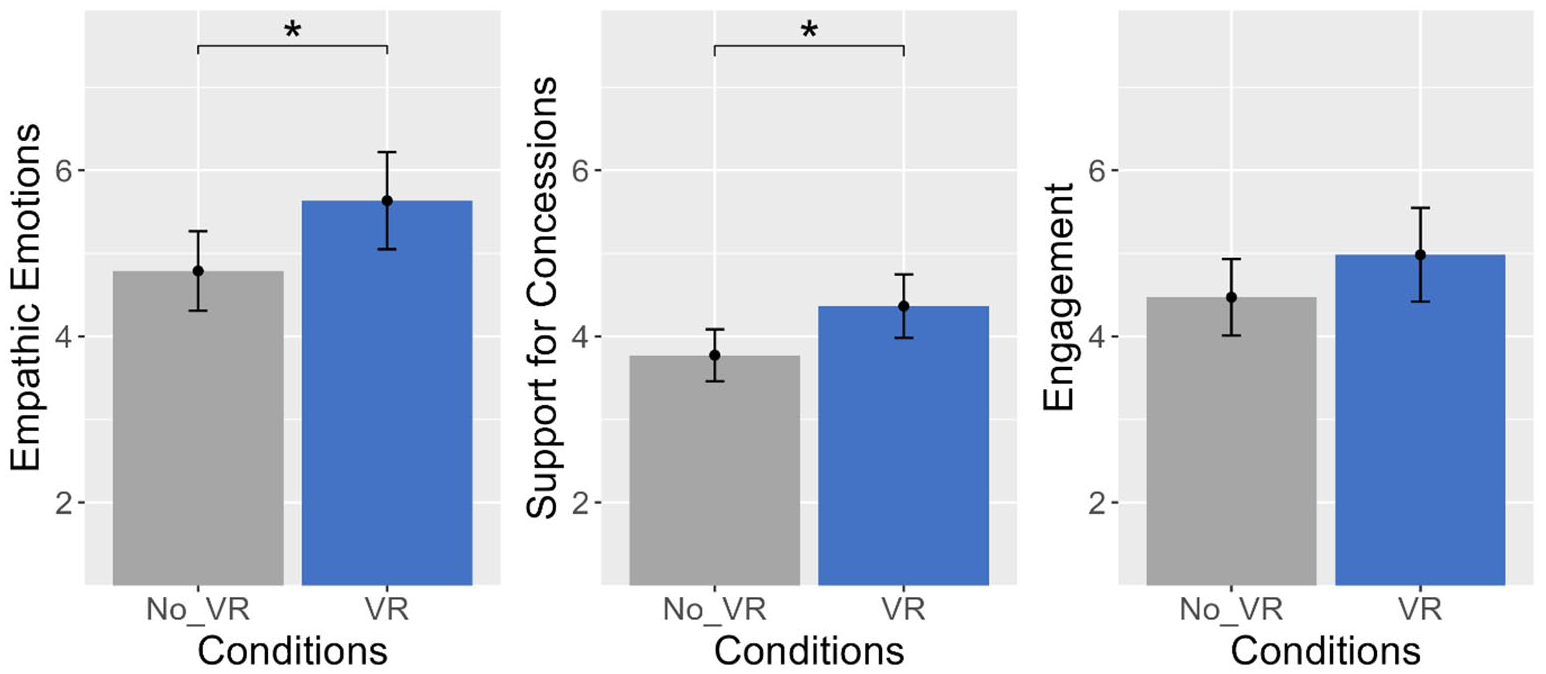
Means, CIs, and manipulation effects on the main measures.
The moderating effect of political ideology
To explore a potential moderating effect of political ideology, we performed a moderation analysis on the three measures (empathy, support for concessions, and engagement). These analyses revealed significant interaction effects on empathic emotions and engagement but not on support for concessions; full details can be found in Table 2. The simple effects within each political camp are illustrated in Figure 2, indicating that while VR increased empathy and engagement among rightists, it does not seem to impact leftists or centrists.
Interaction effects of political orientation and experimental condition.

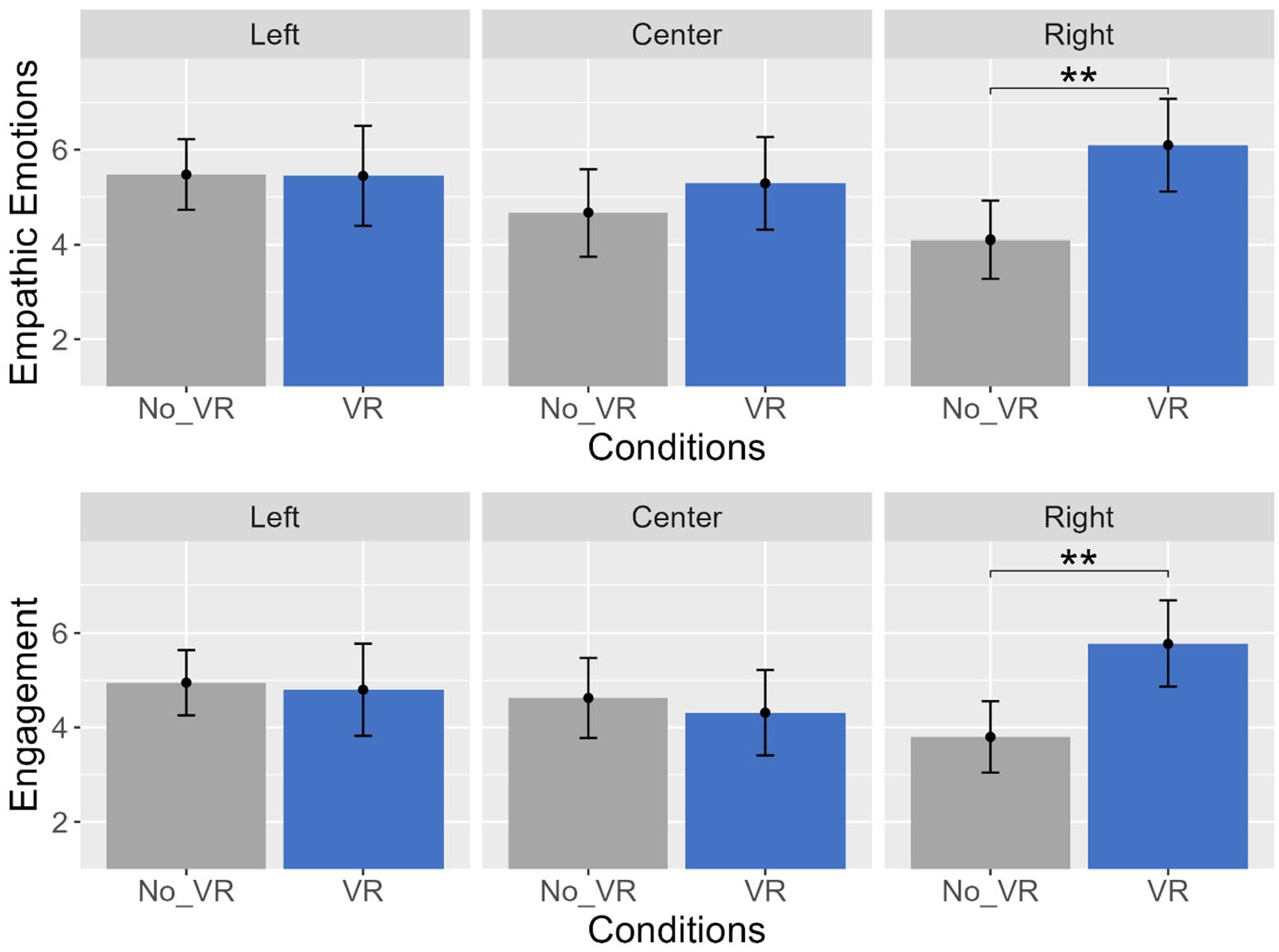
Means, CIs, and manipulation effects by political camps.
Finally, to test our hypothesis that engagement mediates the impact of VR on empathic emotions, we ran moderated mediation, as only rightists showed increased engagement when watching the video using VR. Our results suggest that, among rightists, engagement mediates the effect of VR on empathic emotions toward the video protagonist (b = 1.06, CI = [0.20, 2.42], p = 0.010). No significant mediation effects were found among centrists (b = −0.17, CI = [−0.58, 0.21], p = 0.388) or leftists (b = −0.08, CI = [−0.74, 0.31], p = 0.706), which is no surprise, considering no effect of VR on engagement was found among them.
Discussion
Study 1’s findings showed that watching the same video using VR can increase empathy and even support for concessions compared to watching it using a 2D screen (No-VR). However, the effect is mainly among rightists. Political orientation was found to moderate VR effects not only on empathic emotions but also on the participants’ perceived engagement levels, so rightists were more affected by VR than leftists. Our results also showed that the increased empathic emotions among rightists who watched the video in VR were mediated by their level of engagement. Similar to the findings about neural differences in empathy between rightists and leftists (Zebarjadi et al., 2024), it seems that rightists’ empathy depends more on the quality and vividness of the stimuli.
Interestingly, while the VR impact on engagement and empathy was moderated by political orientation, no such effect was found regarding support for concessions. This finding might be related to the fact that while engagement was positively correlated with empathic emotions, no such correlation was found regarding support for concessions. It is possible that the experience-related measures (engagement, empathy toward the protagonist) were affected differently from cognitive, general attitude regarding the conflict.
These findings show that VR as a medium, with its vividness and immersiveness, can be harnessed to increase empathy and support for concessions in conflicts. The fact that the intervention was found efficient among rightists echoes other interventions that showed similar results (Elad-Strenger et al., 2019; Hameiri et al., 2014). The findings reported here further strengthen the validity of personalized intergroup interventions (Halperin & Schori-Eyal, 2020).
While Study 1 showed the benefits of VR as a medium, we believed that VR has more potential and could be used in additional ways to facilitate strong emotional experiences that are difficult or impossible to create otherwise. While meeting Palestinians and hearing their stories might be challenging for most Israelis, experiencing the world through Palestinians’ eyes is almost impossible. Thus, we were interested in utilizing the ability to experience the world through different perspectives to assist participants in changing their perspectives.
Study 2
While Study 2 repeats the main comparison examined in Study 1 (VR vs. No-VR), its main goal focuses on another aspect—VR’s ability to immerse the viewer in different perspectives. Specifically, we assessed whether experiencing a scene from different perspectives could assist participants in regulating their emotions in accordance with traditional emotion-regulation instructions. The two interventions investigated in the current study are Cognitive Reappraisal (CR) and Perspective-Taking (PT); both are widely used to improve emotions and attitudes in intergroup conflicts, among other contexts (Čehajić-Clancy et al., 2016; Halperin & Gross, 2011a; Halperin et al., 2013; Pliskin et al., 2018).
Cognitive reappraisal refers to changing the interpretation of an emotional-inducing situation (Gross, 2015; McRae et al., 2012), while PT refers to imagining the world from another person’s perspective (Galinsky et al., 2005). Although both are used to improve emotions in similar contexts, CR and PT seem to have different effects. While CR was found to reduce outgroup anger among other hostile emotions (Halperin & Gross, 2011a; Halperin et al., 2011), PT is mainly associated with increasing empathy toward the outgroup (e.g., Batson & Moran, 1999; Hasson et al., 2019), reducing intergroup biases (e.g., Dovidio et al., 2010; Eyal et al., 2018; Galinsky & Moskowitz, 2000), as well as promoting acknowledgment of ingroup discrimination and wrongful acts toward outgroups (Todd et al., 2012).
While CR and PT are often effective in intergroup contexts (CR: Halperin et al., 2011; Porat et al., 2020; PT: Todd & Galinsky, 2014; Todd et al., 2012), there is a significant body of research suggesting that their beneficial effects are limited, and they may backfire, mainly in competitive or conflictual contexts (Epley et al., 2006; Ford & Troy, 2019; Klimecki et al., 2020). As noted above, in highly intense and violent conflicts, emotions are more difficult to regulate effectively (Pliskin et al., 2018), and the motivation to regulate them is low (Porat et al., 2016). Hence, their reliance on active investment of mental effort (Lewczuk et al., 2022), and, as a result, their dependency on prior motivation, could make them less efficient in extreme conflicts. To overcome these limitations, instead of asking participants to invest mental efforts to regulate their emotions following CR or PT instructions, we utilized VR’s ability to place the viewer in different perspectives to assist them.
In the current study, participants watched a video of an argument between Israeli soldiers at a checkpoint and a Palestinian couple who wished to pass it on their way to the hospital (Hasler et al., 2021; Hasson et al., 2019). The same video was filmed from three perspectives: The Israeli, the Palestinian, and the external perspective of a bystander. The video is more intense compared to the one used for Study 1 and was found to elicit moral judgment and even hostile emotions toward the ingroup soldiers (Hasler et al., 2021).
Since our participants were Israelis, the three perspectives—Israeli, Palestinian, and bystander—matched the participants’ default (ingroup) perspective, a PT intervention, and a CR intervention of taking an objective stance, respectively. We hypothesized that watching the scene from a matching point of view could facilitate processes involved in CR and PT while requiring minimal motivation or effort, as people are almost physically situated in either a detached position or in the outgroup members’ shoes. This model of a traditional intervention (namely, PT) combined with a respective perspective in VR previously resulted in more prosocial behavior than just receiving instructions to imagine the other’s perspective (Herrera et al., 2018). Although some evidence of its efficiency exists, this method of assisting traditional interventions by combining them with experiencing a matching perspective has not been implemented in intergroup conflicts. Additionally, no previous studies in that domain have focused on more than one emotion-regulation strategy or investigated VR-assisted cognitive reappraisal.
The study used two control conditions, one for each research question. In the first control condition (“No-VR”), participants did not watch the video. Instead, they read a description of the situation as it would be described in the Israeli media; the article included a snapshot from the video (taken from the Israeli perspective). We used this method as it is more ecologically valid, as Israeli media usually will not broadcast videos of Israeli soldiers misbehaving or harming Palestinians. Thus, Israelis are less exposed to it, and when they are, it will frequently take the form of a short, laconic description. We hypothesized that comparing the no-VR condition to the VR conditions would result, similar to Study 1, in increased peace-promoting emotions regarding both Israeli and Palestinian protagonists.
The second control condition (“Control”), in which participants watched the VR from the Israeli perspective, was used to test our main hypothesis regarding the added value of viewing points in assisting two traditional emotion-regulation interventions—cognitive reappraisal and perspective-taking. A few studies have compared traditional PT, in which the participants were asked to try and imagine the other’s perspective, and VR-based PT, in which the participants watched a situation from the other’s perspective using VR (e.g., Hasson et al., 2019; Herrera et al., 2018). Although comparing traditional and technological interventions is essential, from an applicative approach, it is common and beneficial to combine them to maximize effect. However, no study has explored the added value of experiencing the situation from a perspective that matches a traditional intervention (aka assisted intervention).
To that end, we matched a traditional CR intervention, instructing the participants to try to take an objective position, with the VR video filmed from a bystander perspective, physically placing them outside the situation, making it easier to take a detached mental position. Similarly, we matched the PT intervention, instructing the reader to take the Palestinian perspective with a video from the actual perspective of the Palestinian. 2 Our approach relies on the assumption that combining an intervention with a perspective that matches it could assist the participants to regulate their emotions according to the instructions (CR or PT), resulting in an intervention stronger and more robust than its components. Using this approach, we, for the first time, isolated and investigated the VR-added value compared to traditional methods. This assessment holds a theoretical but also applied importance.
Finally, although not pre-registered, following the first study, we hypothesized that the assisted interventions would be effective mainly among rightists. While in the first study, motivation was needed only to feel empathy in response to empathy-eliciting content, the current study used emotion-regulation interventions that require an active investment of mental effort (Lewczuk et al., 2022). The more demanding an intervention is, the more vulnerable it is to a lack of motivation. Allowing participants to experience the desired perspective almost physically may decrease the mental effort required to regulate emotions. Doing so can overcome the motivational barrier (Landry & Halperin, 2025), and as rightists are less motivated, we expect to observe effects mainly among them.
To conclude, our hypotheses were as follows: (a) Experiencing the situation immersively, compared to just reading about it, will lead to more peace-promoting emotions. Specifically, it will decrease empathic emotions and increase critical moral emotions (i.e., anger toward the ingroup aggressors) toward the ingroup. Respectively, it will increase empathic emotions and decrease anger toward the outgroup. (b) As the Israeli-Palestinian conflict is violent, and motivation is required for the traditional emotion-regulation techniques (CR and PT instructions), we hypothesized that the traditional interventions would be less effective in modifying empathy and anger compared to the assisted interventions and might even backfire. Since the assisted interventions, in which the participants are experiencing the situation from a matching perspective, would help them regulate their emotions in accordance with the instructions received (CR or PT), it would be more efficient than receiving the exact instructions while watching the situation from the default, Israeli perspective.
We further hypothesized that (c) different emotion-regulation techniques would affect the emotional response in distinct ways. Namely, CR would down-regulate emotions, specifically anger toward the outgroup (Halperin et al., 2011) and empathic emotions toward the ingroup aggressors. On the other hand, PT would up-regulate emotions, specifically empathic emotions toward the outgroup members (Hasson et al., 2018; Herrera et al., 2018) and anger toward the ingroup aggressors (Hasler et al., 2021), but not vice versa. Finally (d), we hypothesized that the effect of the assisted interventions would be strongest among rightists as they are both less motivated to invest efforts in improving their emotions toward the Palestinians and are more dependent on the stimuli’s vividness. Our main hypotheses were pre-registered, 3 but some changes were made, as further detailed in the discussion.
Methods
For the interventions, short 360-degree VR videos were produced, presenting the same scene of an argument between soldiers and Palestinians at a checkpoint from three perspectives: the soldiers, the Palestinians, and a bystander perspective. The study included six conditions (as detailed below) to allow for the full examination of our hypotheses. According to the conditions they were assigned, participants received emotion-regulation instructions (CR or PT) or no specific instructions (in the control conditions) before being exposed to the situation. Following the video, participants were asked about their emotions regarding the soldiers and Palestinians in the movie.
The Interventions
The interventions consisted of two parts: traditional emotion-regulation instructions (either CR or PT) followed by a VR video. Before watching the VR video, participants received either CR instructions to appraise the situation from a detached, objective stance or PT instructions to try to take the perspective of the outgroup members in the upcoming video. The 360-degree video was about a minute long and presented an emotionally loaded encounter between Israeli soldiers and Palestinian civilians at a checkpoint (Hasler et al., 2021; Hasson et al., 2019). The same situation was filmed from three perspectives, as demonstrated in Figure 3: the soldiers’, a bystander’s, and the Palestinians’. Each participant watched one version of the video while wearing a VR mask and noise-canceling headphones. In addition, as mentioned above, there were two control conditions in which participants only read about the scene (“No-VR”) or watched the scene from their default Israeli perspective without any emotion-regulation instructions (“Control”). The conditions and procedure are detailed in the “Procedure and Design” section.
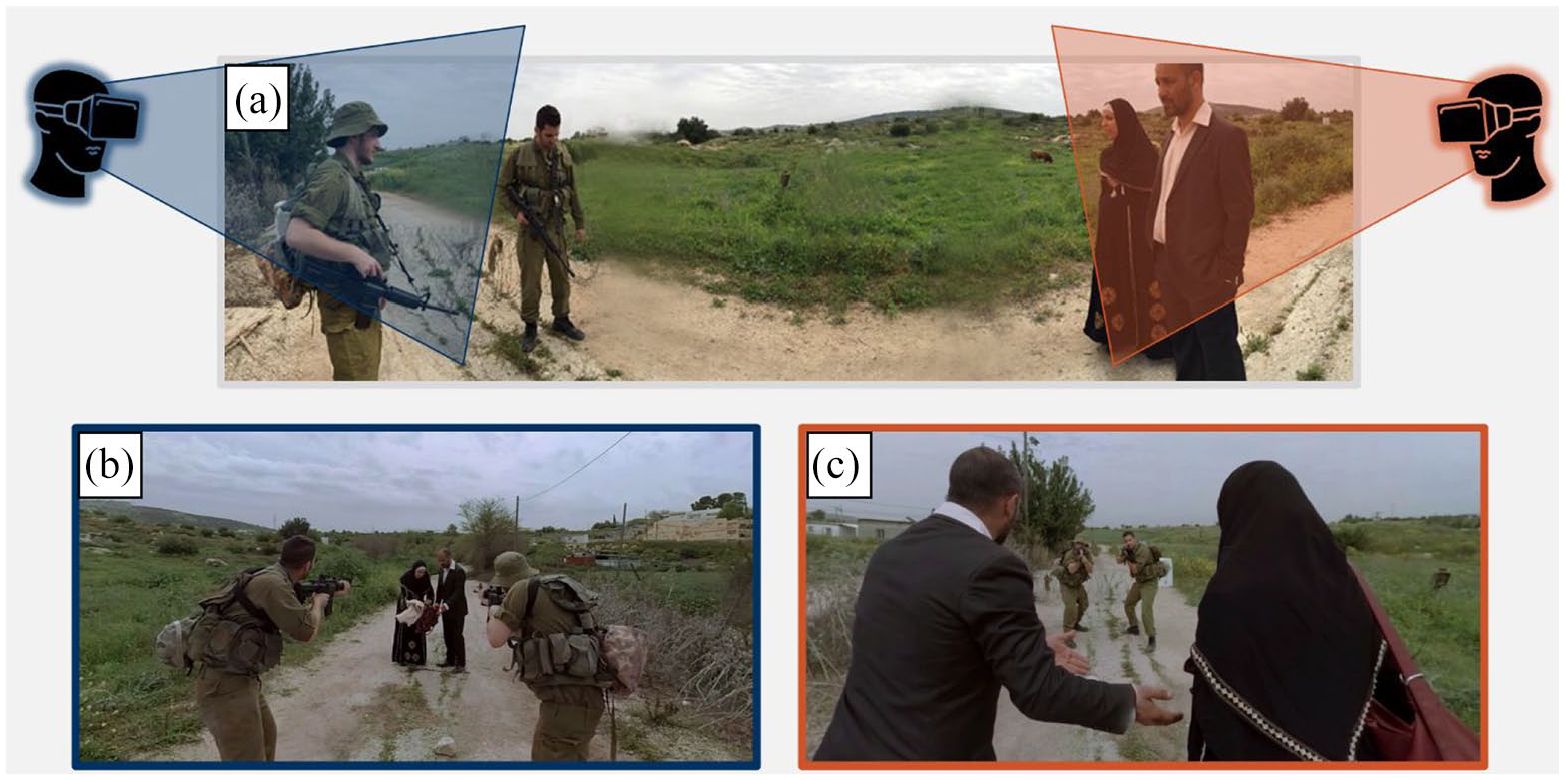
The three perspectives of the manipulation video.
Procedure and Design
Participants were randomly assigned to one of six conditions, as shown in Table 3. Two conditions were used as controls (conditions 1 and 2). In condition 1, participants only read an article describing the scene depicted in the VR video. The article was accompanied by a picture from the video, taken from the Israeli perspective. The second control condition (condition 2) added the VR experience, where the participants watched the VR video from the Israeli (i.e., default) perspective with no further instructions. Conditions 3 and 4 included traditional emotion-regulation techniques, so the participants were instructed to try to take a neutral, detached perspective (CR, condition 3) or the Palestinian perspective (PT, condition 4) while watching the VR video from the Israeli perspective. Conditions 5 and 6 were the same, except participants watched the video from a perspective matching the instructions: bystander perspective in condition 5 (CR instructions) and Palestinian perspective in condition 6 (PT instructions). These conditions were used to compare and examine the added value of vividly experiencing a perspective that matches and assists traditional emotion-regulation instructions. After watching the video, participants answered questionnaires assessing emotions toward the ingroup and outgroup protagonists.
The study conditions.

Participants
A power analysis based on the results of a previously published study (Hasson et al., 2019) (d = .44) indicated that a sample size of 276 would be sufficient to detect an effect at 80% power. We oversampled by about 10% to account for possible attrition. Thus, 299 Jewish Israelis were invited to participate in the study for monetary compensation or university credits and were randomly assigned to one of the six experimental conditions. Due to the COVID-19 outbreak and the closure of universities, about half of the participants were recruited through different communities of young people. These communities widely differ in their political orientations and attitudes. Three participants were excluded due to errors in the intervention process, resulting in a final sample of 296 participants. In this sample (Mage = 24.42, SDage = 4.39), 59.8% were females. Regarding political orientation, 41.2% were rightists (1.4% defined themselves as extreme rightists, 16.6% as rightists, and 23.3% as moderate rightists), 23% defined themselves as centrists, and 35.8% as leftists (1.7% as extreme leftists, 10.8% as leftists, and 23.3% as moderate leftists).
Measures
Self-reported emotions
Three items assessed the extent (1 = not at all; 7 = very much) to which participants experienced empathy, sympathy, and anger toward the ingroup (soldiers) and outgroup (Palestinian couple) characters. These measures were assessed immediately after watching the VR video. Following Hasson et al. (2019), and due to high correlations between the two, we merged empathy and sympathy into one composite—empathic emotions. In addition to anger and empathic emotions, which were found to be affected by this video in previous studies (Hasler et al., 2021; Hasson et al., 2019), several other emotions were assessed to complete the emotional picture: hate and fear regarding both the soldiers and the Palestinians. The participants were also asked about the levels of guilt and shame they felt because of the soldiers’ behavior during the situation. All the analyses were done on the control emotions and can be found in the Supplemental Material.
Political orientation
Before watching the VR video, participants rated their political orientation on a seven-point scale (1 = extreme right; 7 = extreme left). During the simple effect analyses, we grouped the participants into three political camps: right (extreme right to mild right), center, and left (extreme to mild). This was done to draw simplified, applicable conclusions regarding each group.
Demographics
Demographic variables included gender and age.
Results
Correlations were computed to evaluate the associations between the main emotions toward the ingroup and outgroup characters. As can be seen in Table 4, all the main emotions regarding the soldiers were significantly correlated, as were all the emotions regarding the Palestinian couple. As mentioned, due to the high correlation and the similarity between empathy and sympathy, we used them as one measure called empathic emotions.
Means, SD, and correlations of the main variables.

Note. Variables’ labels: Emotions [1 = not at all to 7 = to a large extent], gender [1 = male, 2 = female], political ideology [1 = extreme right, 4 = center, 7 = extreme left].
p < .05. **p < .01.
Due to the high number of conditions and comparisons, the results section was divided into three parts based on the investigated hypotheses. In the first part, we assessed the effect of VR immersiveness by comparing the no-VR condition to all the other conditions. Next, we addressed the effects of each emotion-regulation technique (CR/PT) separately while comparing the control VR (Israeli perspective without emotion-regulation instructions) to each technique’s traditional and assisted versions. These comparisons allowed us to investigate the distinct effects of each method (CR and PT) on the hypothesized affected emotions while assessing the added value of watching the VR video from the corresponding perspective (assisted interventions). The interaction effects between political orientation and experimental conditions were tested in each part. All analyses were done while controlling for the participants’ age due to the strong correlations between age and the target emotions.
Virtual Reality Immersiveness
First, similar to Study 1, we assessed the effects of the immersiveness of the experience. Thus, experiencing the situation using VR was contrasted with reading an article describing it. These effects were investigated regarding emotions toward the ingroup (soldiers) and the outgroup (Palestinian couple) characters. To compare the group effects, we used a linear regression model to compare condition 1 (“No-VR”) to all the other conditions in the experiment (conditions 2–6; “VR”) while controlling for age. As shown in Figure 4, empathic emotions toward the soldiers were lower in the VR conditions (2–6) compared to the no-VR condition (condition 1), while anger levels toward them were higher.
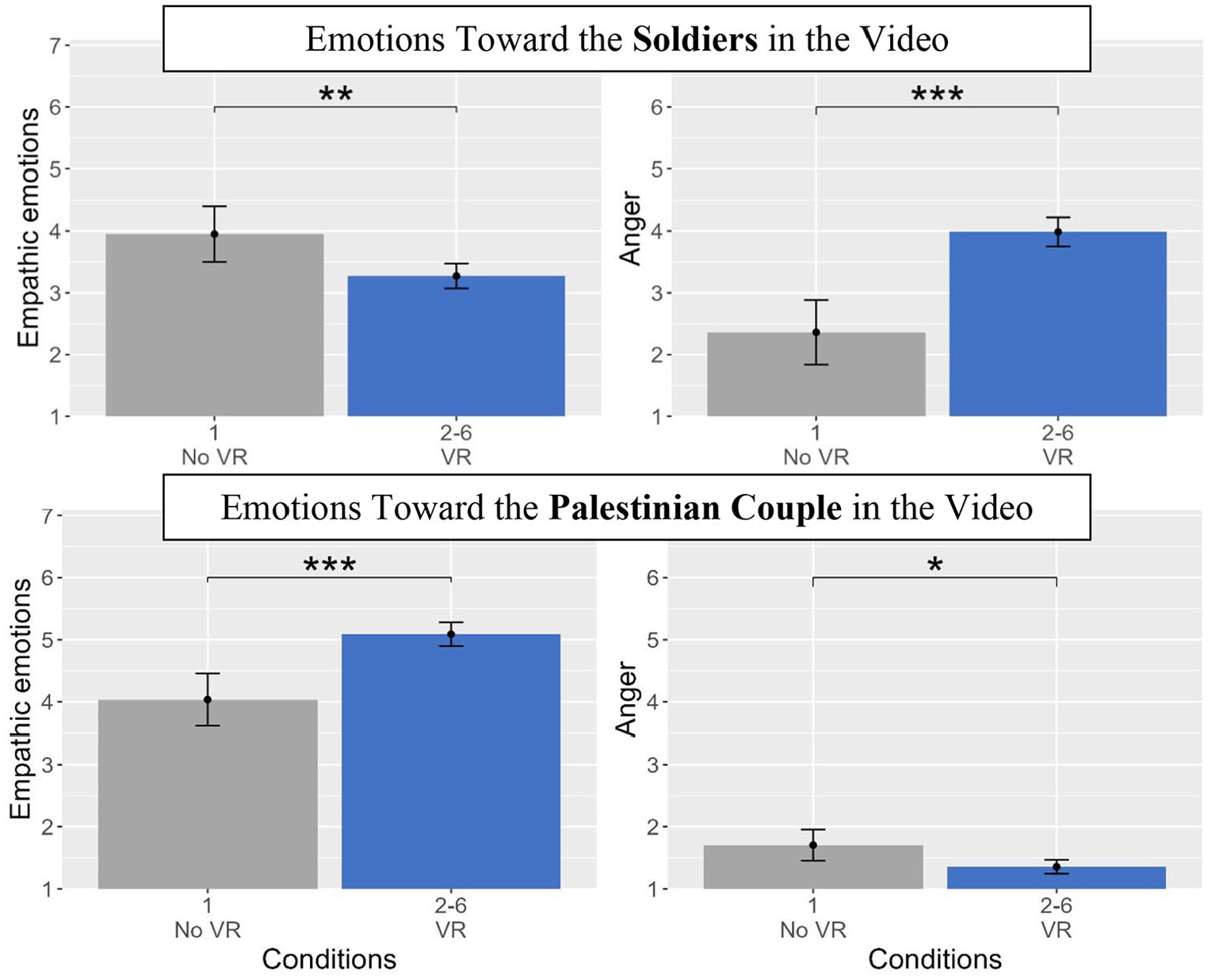
Comparisons of emotions toward the protagonists comparing no-VR and all VR conditions.
A mirror image can be seen regarding the outgroup characters in the VR video. Watching the video using VR was associated with elevated levels of empathic emotions toward the Palestinian couple, as well as lower levels of anger toward them. A similar pattern was found regarding both the Palestinian couple and the soldiers when condition 1 (No-VR) was compared only to condition 2 (Control), except the effect regarding anger toward the Palestinian was not significant. In conclusion, experiencing the situation in an immersive way (VR) affected the investigated emotions in a more peace-promoting direction, as found previously by Hasler et al. (2021). Contrary to Study 1’s findings, participants’ political orientation did not moderate these effects.
Perspective Changing
In the next phase, we focused on VR’s ability to change one’s perspective efficiently and enhance emotion-regulation techniques. To assess the effects of traditional and enhanced interventions on the relevant emotions and their interaction with political orientation, we used ANCOVAs. The experimental condition was a three-level categorical variable, as each ANCOVA compared either the VR control (condition 2) and the two CR (3 and 5) conditions or the VR control (condition 2) and the two PT (4 and 6) conditions. Thus, the CR ANCOVAs included conditions 2, 3, and 5, and the PT ANCOVAs included conditions 2, 4, and 6. The political orientation scale was used as a continuous measure (7-point scale). Each ANCOVA was controlled for participants’ age, as it was the only demographic variable consistently correlated with the dependent variables.
After the ANCOVAs, if a main effect of the conditions was found, we used post-hoc comparisons to compare the three groups to each other. If an interaction of condition and political orientation was found, we used post-hoc comparisons to compare the simple effects of the experimental condition within each political group separately. The post-hoc pairwise comparisons were made using the Emmeans package (version 1.10.3) in R and were controlled for age, similar to the ANCOVA models. All reported post-hoc comparisons’ p-values were corrected for multiple comparisons using the Tukey method.
Cognitive reappraisal
To examine the CR conditions on the target emotions (empathic emotions toward the soldiers and anger toward the Palestinians), we used the abovementioned ANCOVAs of three political camps (right, center, and left) by three relevant experimental conditions: (1) control (Israeli perspective with no instructions), (2) traditional CR (Israeli perspective with CR instructions) and (3) assisted CR (CR instructions with Palestinian perspective), while controlling for participants’ age.
Empathic emotions toward soldiers
Investigating the three effects on empathic emotions toward the soldiers showed a significant interaction effect, F(2, 142) = 5.48, p = .005. Political orientation was divided into three groups to reveal the nature of the interaction: rightists, centrists, and leftists. Pairwise comparisons between the three conditions were made for each political group separately. As can be seen in Figure 5, among rightists, assisted CR was found to reduce empathic emotions toward the soldiers compared to the control condition (b = −1.15, SE = 0.48, p = .048), but not significantly compared to traditional CR (b = −0.95, SE = 0.48, p = .114). Traditional CR also did not significantly differ from the control group (b = −.20, SE = 0.48, p = .911), as well as all the comparisons in the other political camps. All p-values in these analyses and the following were adjusted for multiple comparisons.
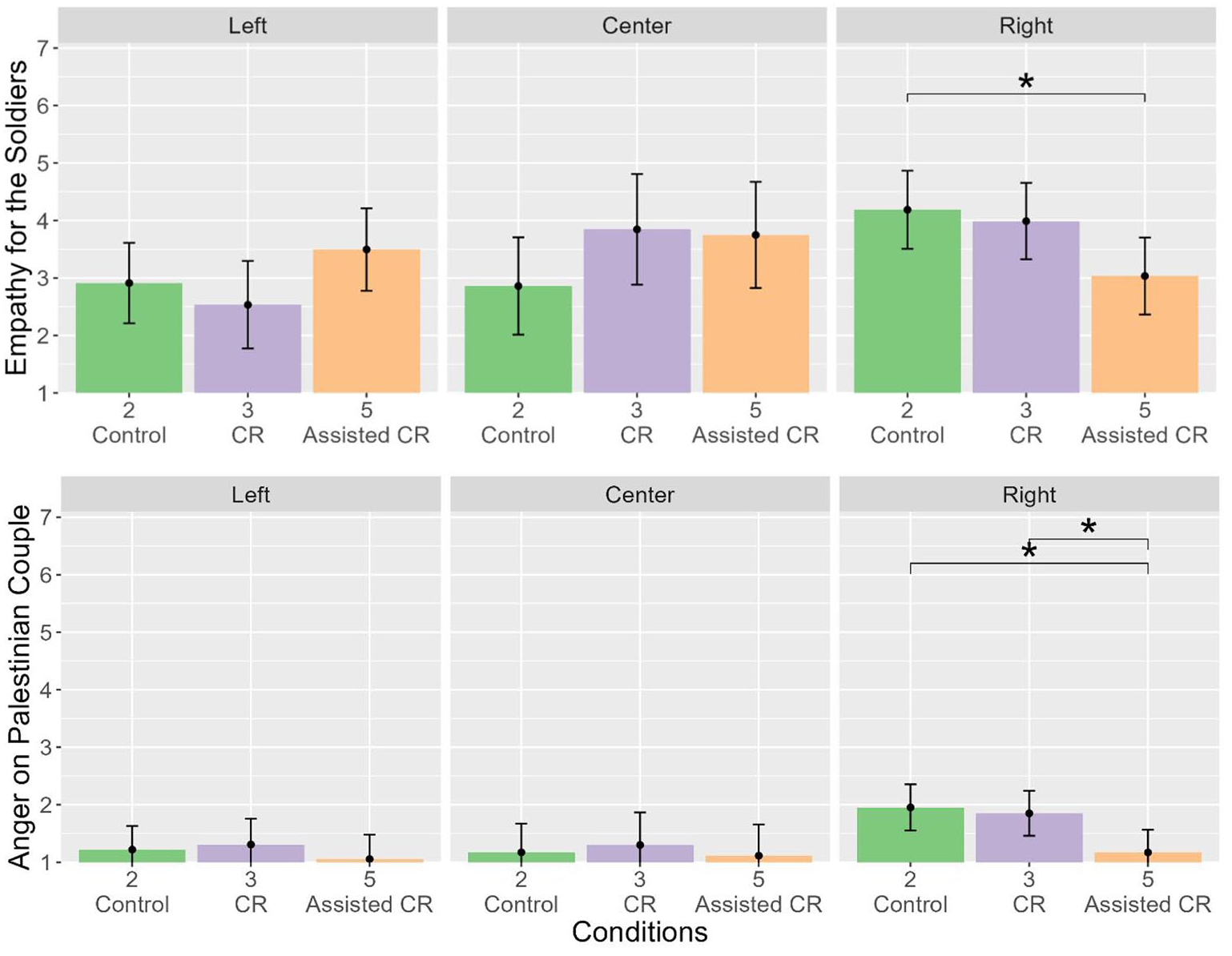
Emotions by Control and CR interventions, grouped by political camps.
Anger toward the Palestinian couple
Assessing the effects of the study’s conditions, political orientation, and their interactions on anger toward the Palestinian couple, significant main effects were found both for political orientation, F(1, 142) = 10.03, p = .001, and for the experimental conditions, F(2, 142) = 3.45, p = .034. Even though the interaction effect was not significant, as can be seen in Figure 5, significant differences across conditions were found among rightists, where assisted CR was found to reduce anger toward the Palestinian couple both compared to control (b = −0.78, SE = 0.28, p = .019) and traditional CR (b = −0.68, SE = 0.28, p = .043) conditions. In contrast, the traditional CR did not differ from the control condition (b = −.10, SE = .28, p = .932). No other comparison was found significant.
The same statistical model was used to assess the CR conditions, political orientation, and their interactions on anger toward the soldiers and empathic emotions toward the Palestinian couple. A significant interaction effect was found for anger toward the soldiers, F(2, 142) = 3.12, p = .047, but no pairwise comparison was found to be significant (p > .12). Regarding empathic emotions toward the Palestinian couple, no significant effect was found for the study’s conditions, their interaction with political orientation, nor for any pairwise comparisons. These findings suggest that CR can down-regulate anger toward outgroup members and empathic emotions toward ingroup aggressors, but only among participants identified as rightists and only when assisted by the matched perspective.
Perspective-taking
Anger toward soldiers
Regarding levels of anger toward the soldiers, results showed significant main effects for condition, F(2, 142) = 3.22, p = .043, and political orientation, F(1, 142) = 18.43, p < .001, as well as significant interaction between them, F(2, 142) = 3.84, p = .024. Even though the condition factor was significant, no significant pairwise comparisons between the conditions were found. To investigate the interaction effect, we examined the condition effect on the different levels of the political orientation scale while dividing it into three political camps, as mentioned above. As can be seen in Figure 6, significant effects were found only among rightists, in which traditional PT did not differentiate significantly from the control group (b = 0.18, SE = 0.58, p = .945). However, assisted PT predicted higher levels of anger toward the soldiers, both compared to traditional PT (b = 1.54, SE = .57, p = .020), and compared to the control condition (b = 1.72, SE = .56, p = .007). All pairwise comparisons’ significance levels were adjusted for multiple comparisons using Tukey’s correction.
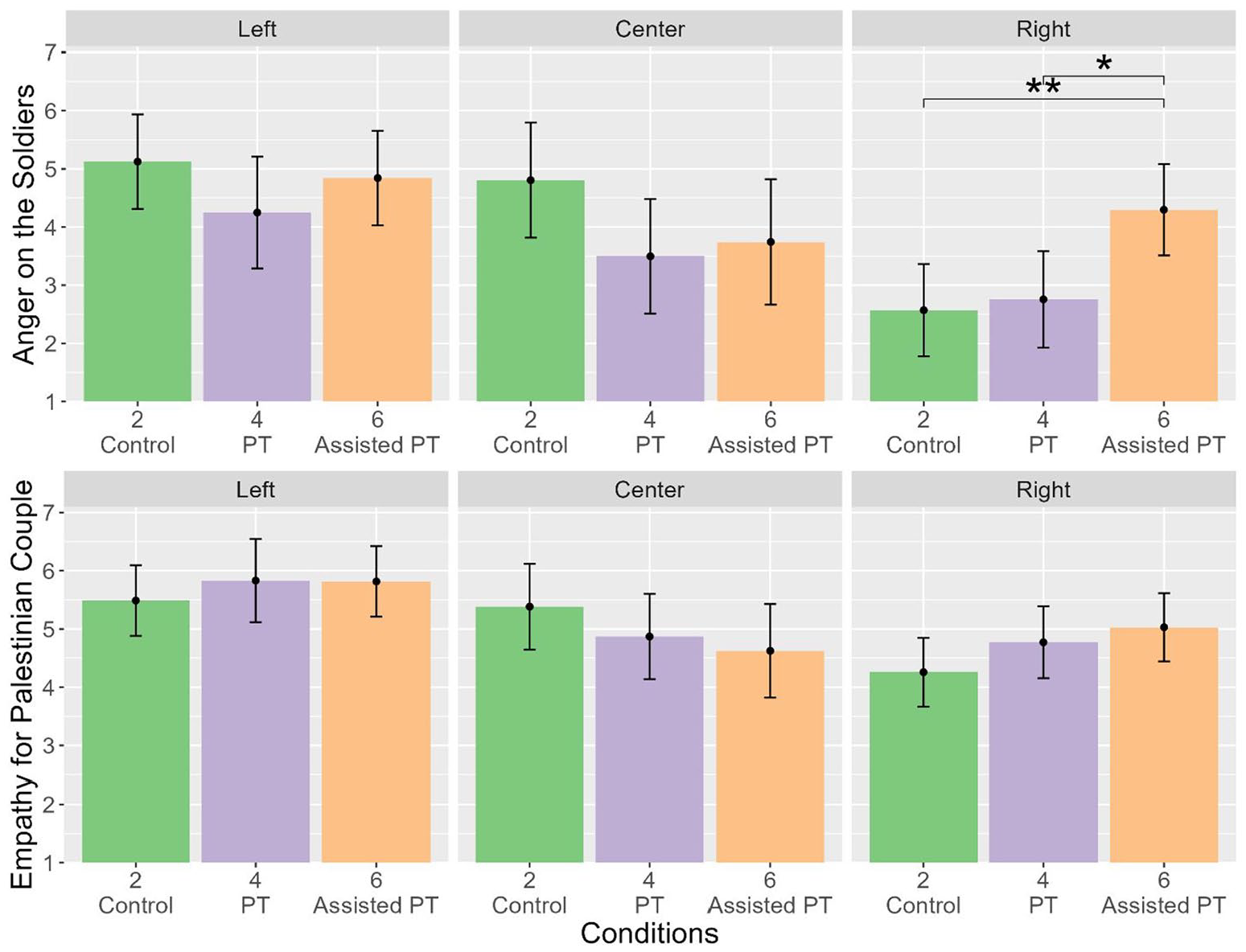
Emotions by Control and PT interventions, grouped by political camps.
Empathic emotions toward the Palestinian couple
A two-way ANCOVA was used to assess the effects of the three conditions, political orientation, and their interaction on empathic emotions toward the Palestinian couple while controlling for participants’ age. Results showed no significant effect for condition, F(2, 142) = 0.47, p = .625, or interaction, F(2, 142) = 0.76, p = .468, but a significant main effect was found for political orientation, F(1, 142) = 15.58, p < .001. All differences between the conditions in general and when divided into the three political groups were non-significant, as can be seen in Figure 6. However, the strongest pairwise effect was a non-significant trend within rightists, between the assisted PT and the control conditions (b = 1.74, p = .160).
The same model was used to examine the conditions’ effects on anger toward the Palestinians and on empathic emotions toward the soldiers. No significant effect was found with respect to the study conditions (condition simple effect, interaction with political orientation, or pairwise comparisons). These findings suggest that PT interventions can increase moral emotions toward ingroup aggressors, but only when assisted by a matching perspective. In addition, its effect is limited to right-wing participants.
Discussion
This study examined whether virtual reality can be harnessed to improve intergroup emotions in an intractable violent conflict. We focused on two advantages of VR: its immersiveness (Hasler et al., 2021) and the added value of its ability to vividly simulate different perspectives (Hasson et al., 2019; Herrera et al., 2018) to assist participants in regulating their emotions in line with traditional interventions (e.g., perspective-taking and cognitive reappraisal). Our findings reveal that immersiveness can have prosocial outcomes and affect empathic emotions and anger toward ingroup and outgroup characters. Second, as we have pre-registered, 4 combining traditional emotion-regulation techniques with matching perspectives showed better results. Interestingly, the added value of the perspectives was dependent on political orientation. While traditional interventions were ineffective in our study when participants were assisted by experiencing the scene from a matching perspective, they showed positive emotional effects but only among people who identified as rightists. The effects of the assisted interventions were in line with the ones found in previous studies. CR reduced both anger toward the outgroup characters and empathy toward the ingroup characters. On the other hand, PT increased anger toward the ingroup characters and showed a trend of increased empathy toward the outgroup characters.
These differential effects in which CR down-regulated emotions while PT improved the emotional response by up-regulating emotions are consistent with previous research on CR (Halperin & Gross, 2011b; Halperin et al., 2013) and PT (Batson & Moran, 1999; Herrera et al., 2018). This finding emphasized that the desired emotional goal should dictate the intervention selection. Alternatively, as frequently used in the field, an inclusive approach can be adopted, combining different interventions to achieve wider and more robust effects. This multidimensional approach can overcome specific intervention limitations or enhance their effectiveness, which is highly important considering real-world problems (Bar-Tal & Hameiri, 2020; Paluck et al., 2021).
Even though the study included multiple conditions, we were limited in addressing and isolating all potential factors. The conditions and comparisons were chosen based on several considerations. For example, we did not include conditions where the participants watched the bystander and Palestinian perspectives without CR/PT instructions, as this comparison was already conducted (on PT) by Hasson et al. (2019). We also considered real-world implications and took the popular “kitchen sink” approach. Following this rationale, we preferred to use assisted CR/PT (traditional instructions + bystander/Palestinian perspective) rather than perspective-induced CR/PT (bystander/Palestinian perspective without emotion-regulation instructions).
General Discussion
In this research, we asked several questions regarding VR as an interventional measure to improve emotions in violent, intractable conflicts. The presented studies used very different videos and comparisons and sometimes differed in their results. Nevertheless, similar conclusions can be drawn from previous studies that used these videos (Hasler et al., 2021; Hasson et al., 2019) or others. First, we found that VR can increase engagement and the emotional and attitudinal effects of stimuli. Second, our results emphasize the utility of using VR in highly conflictual situations when traditional interventions are less effective or may even backfire (Klimecki et al., 2020; Pliskin et al., 2018). Additionally, its ability to allow viewers to take other perspectives and “walk in others’ shoes” can overcome psychological and ideological barriers where traditional interventions failed. Finally, these studies emphasize the importance of considering potential factors that can moderate the interventions’ efficiency.
These factors can explain the inconsistency in the literature on VR efficiency. In this research, we found that on the stimuli level, different videos or perspectives, and the level of immersiveness, can affect the results. On the experimental level, the control used can isolate different aspects of VR, and on the individual level, the viewers’ political orientation can moderate the video effect. These moderators shed new light on the importance of tailoring interventions using specific individual parameters by addressing the relevant mechanisms (Halperin & Schori-Eyal, 2020). Interventions cannot be implemented without closely considering the context, the audience (Cohen-Chen et al., 2020), the exact desired goal, and the mechanisms underlying the interventions.
The fact that rightists seem to be mainly affected by VR’s advantages echoes recent neuroimaging studies by Zebarjadi et al. (2023, 2024) suggesting that rightists’ empathy depends on the vividness and tangibility of the other’s distress. Although the measured empathy in these studies was not conflict-related, it seems to reflect a basic mechanism related to political worldviews. Due to the pivotal role of emotions in conflicts, a deeper understanding of this mechanism and addressing it using designated interventions can significantly impact conflicts, especially since rightists hold hawkish attitudes and tend to oppose peace processes and concessions more than leftists. In the Israeli context, impacting rightists is crucial, also due to their vast proportion among the Jewish-Israeli population and the decades-long trend of Israelis toward the right-wing (Anabi, 2022).
Our results replicated some previous findings, such as a higher level of moral emotions toward ingroup members when watching the scene immersively (Hasler et al., 2021) or the effect of watching it from a relevant perspective (Herrera et al., 2018). However, they did not fully replicate the results of a previous study conducted with the same VR videos (Hasson et al., 2019), where both traditional PT and just watching from the Palestinian perspective increased empathy across political camps compared to a control group. This could result from the specific sample, the time, or other factors. Our studies were conducted during the COVID-19 pandemic, which negatively affected the nature of intergroup relations in Israel (Adler et al., 2022). Additionally, the quarantines and the suspension of university activities forced us to step out of the lab and into people’s houses, communities, and dormitories. This led us to various groups differing in age, political orientation, religiosity, and education, which resulted in a more representative sample than most lab studies.
In a broader view, the non-significant effect of empathy toward the outgroup members following the assisted PT may suggest a limitation of the measures used. We measured empathy by asking the participants how much empathy and sympathy they felt toward the different characters. This approach measures perceived explicit empathic emotions rather than empathic experience of the situation. However, Schutte and Stilinović (2017) used items assessing empathic concern and perspective-taking regarding their video protagonist. In their meta-analysis, Ventura et al. (2020), used another approach by separating perspective-taking items from items measuring empathy, finding effects only for PT measures. Another meta-analysis chose to distinguish emotional and cognitive empathy (Martingano et al., 2021). These discrepancies mirror the struggle to define and measure empathy. Finally, the measures should consider the specific features of the stimuli, as different stimuli can elicit different dominant emotions, and thus, the empathic reaction will take other shapes. To address this issue, we will employ a multi-method approach in future studies, using various measures of empathy.
This research provides a glimpse into the advantages of using cutting-edge technology like virtual reality to deal with fundamental psychological and sociological issues. From the opposite perspective, it also demonstrates how traditional techniques and psychological theories can be used to develop technological interventions. This study suggests only one out of infinite possible models of beneficial synergy between classic psychological science and technology. With the emerging metaverse, the boundaries between physical and virtual realities are becoming vaguer than ever. Alongside the new challenges it brings, this new reality may promote a solution to some of the oldest ones.
Supplemental Material
sj-docx-1-gpi-10.1177_13684302251324892 – Supplemental material for Virtual regulation: Can immersive virtual reality be used to assist intergroup interventions? The moderating effect of political ideology
Supplemental material, sj-docx-1-gpi-10.1177_13684302251324892 for Virtual regulation: Can immersive virtual reality be used to assist intergroup interventions? The moderating effect of political ideology by Eli Adler, Béatrice S. Hasler, Yossi Hasson, Daniel Landau, Guy Baratz, Eran Halperin and Jonathan Levy in Group Processes & Intergroup Relations
Footnotes
Correction (September 2025):
Article updated online to correct the article type to “Research article”.
Funding
The author(s) disclosed receipt of the following financial support for the research, authorship, and/or publication of this article: This work was supported by the Mind and Life Institute PEACE grant (ID: A-73755384) to JL and EH, and by the Academy of Finland Research Fellow grants to JL (328674 & 352670).

Supplemental Material
Supplemental material for this article is available online.
Notes
Author’s Notes
Béatrice S. Hasler is also affiliated to Department of Information Systems, University of Liechtenstein, Liechtenstein
Jonathan Levy is also affiliated to Department of Neuroscience and Biomedical Engineering, Aalto University, Espoo 02150, Finland
References
Supplementary Material
Please find the following supplemental material available below.
For Open Access articles published under a Creative Commons License, all supplemental material carries the same license as the article it is associated with.
For non-Open Access articles published, all supplemental material carries a non-exclusive license, and permission requests for re-use of supplemental material or any part of supplemental material shall be sent directly to the copyright owner as specified in the copyright notice associated with the article.
