



Abstract
Competitive victimhood has significant implications for intergroup attitudes, including discrimination and hostility. The current two studies reveal the dynamic and context-dependent nature of competitive victimhood. We directly and simultaneously compared competitive victimhood among members of two groups: high-power and low-power. In Study 1, we found that under the transient threat circumstances of COVID-19, the high-power group (secular Israelis) experienced higher levels of competitive victimhood compared to the weaker group (ultra-Orthodox Israelis), indicating that intergroup threat may override group power in determining competitive victimhood. Study 2 further highlighted the dynamic nature of competitive victimhood by revealing, 18 months later, when the COVID-19 situation had changed, a contrasting image of the results obtained in Study 1, demonstrating that relative competitive victimhood levels can shift among the same groups when the transient threat and circumstances change. The findings suggest that competitive victimhood is a more agile and context-dependent construct than previously believed, especially in the context of power dynamics. The current research suggests a unique approach to conducting research: namely, a “mirror study,” in which two different groups provide a detailed reflection of the “same” reality, but through their own unique perspectives.
Keywords
Competitive Victimhood in Intergroup Conflicts
Collective victimhood expresses a shared narrative of a social group based on actual or reconstructed experiences of ingroup suffering. Within this narrative, the outgroup is portrayed as causing deliberate harm to the ingroup (Green et al., 2017). Even when only some group members suffer, other members of that group may experience victimhood merely due to their identification with the group as a whole. Shared discourses and beliefs transmit this feeling beyond time and place (Noor et al., 2017). In every intergroup conflict, at least one group is convinced that they are the “real victim” (Vollhardt et al., 2021), and in many conflicts, both groups claim the victim title (Bar-Tal et al., 2009). This attempt to appropriate victimhood status for one’s own ingroup rather than the outgroup is defined as “competitive victimhood” (Noor et al., 2008). Competitive victimhood has a considerable influence on hostile emotions between groups, the moralizing of violence, and the prevention of reconciliation (e.g., Demirel & Eriksson, 2020; Freel & Bilali, 2022; Halabi et al., 2021; Halperin & Bar-Tal, 2011).
The competitive victimhood literature has widely focused on the context of power relations. Social groups compete for victimhood status regardless of their actual power position, although research often implies that the motives and intensity are different for members of weak vs. strong groups (Noor et al., 2017). For low-power groups, competitive victimhood is a fairly natural claim. Low-power groups suffer from a lack of power, wealth, and health compared to other groups (Leach et al., 2007). Accordingly, much of the research on the subject of competitive victimhood has focused on the less obvious motivations that lead to competitive victimhood among the high-power group (e.g., Güler et al., 2022; Halabi et al., 2021; Leviston et al., 2021; Uluğ et al., 2021).
One leading and typical explanation can be found in the “needs-based reconciliation model” (Shnabel & Nadler, 2008), by which members of the low-power group need agency (control, power, status), whereas members of the high-power group need to improve their moral image. Other studies have focused on emotions that lead to competitive victimhood among the high-power group, such as anger (Leach et al., 2007), perceptions of stigma reversal and the alleviation of guilt (Young & Sullivan, 2016), and collective narcissism (Kaval, 2021). Common to most of these suggested competitive victimhood antecedents is their reliance on group membership. Belonging to a high- or low-power group creates specific needs, which lead individuals to adopt competitive victimhood as a coping strategy. This suggests that the needs, threats, and emotions that drive competitive victimhood mediate its relationship with group power.
Given that objective power gaps between social groups are relatively stable (as are their derived needs), it is reasonable to expect that the levels of competitive victimhood experienced by these groups would exhibit a similar stability (Kay & Friesen, 2011). However, this inference is at odds with a wide range of findings demonstrating that contextual circumstances may have effects on similar intergroup attitudes, no less than those of their group’s power (Major et al., 2018). The general focus of competitive victimhood studies in the context of social inequality on inherent, fixed, “power-specific” mechanisms is important, as it is beneficial for generalized frameworks and predictions of competitive victimhood in power relations. However, this focus may underscore the categorical (and perhaps, at times, more dominant) role played by contextual and dynamic mechanisms. Hence, it is important to explore whether there is a difference in the formation of competitive victimhood when influenced by threats and evaluations not inherently derived from mere power distribution. Understanding these nuances can provide a more comprehensive view of how competitive victimhood develops and manifests in different contexts.
An additional and corresponding limitation of current competitive victimhood studies is that despite the “competitive” nature of competitive victimhood, little research has been conducted on competing high- and low-power groups in conjunction with one another, as well as measuring potential changes in this ratio over time and context. Such research would allow a comparison between pairs of high–low power groups in a relative form. In the few studies in which competitive victimhood levels of dyad groups have been examined simultaneously, it was found that low-power group members’ competitive victimhood levels were higher than those of their corresponding high-power group members (e.g., Kahalon et al., 2019; Shnabel et al., 2013; Sullivan et al., 2012). Most scholars have attributed these differences to the natural implications of asymmetrical power relations or, more simply, to the objectively greater deprivation that low-power groups are subject to. However, these structural explanations may underscore the potential role of social context, such as transient threats or circumstances, in determining intergroup competitive victimhood.
Most research on competitive victimhood has been conducted in the context of very clear differences existing between the two groups, such as between Protestants and Catholics in Ireland (Adelman et al., 2016) or between Palestinians and Jews in the Middle East (Shnabel et al., 2013). In the current studies, however, we focused on competitive victimhood in a context in which the two rival groups shared an identity but at the same time had strong and significant differences and conflicts between them. In these studies we explored the concept of power, focusing on its intersection with threat, and the dynamic nature of power as influenced by contextual factors. By emphasizing the contextual elements that shape perceptions of threat, one may be able to see how these factors activate mechanisms that foster competitive victimhood.
Our hypothesis was that viewing competitive victimhood solely through the lens of power dynamics would be limiting. Such a perspective would overlook the impact of contextual threats, wherein different groups at different times perceive a greater threat from the other, potentially influencing competitive victimhood beyond structured power relations. We proposed that transitory threats could trigger competitive victimhood regardless of the group’s power level. High-power groups might experience more competitive victimhood at certain times, whereas low-power groups might experience this phenomenon to a greater extent at other times. The varying weight among the components of threat itself creates the basis for differences between power and threat. Therefore, in the two current studies we investigated the role of contextual factors in competitive victimhood, suggesting that these factors could significantly influence its mechanisms and prevalence.
The studies we conducted serve as an exploratory attempt to assess our suggested hypothesis in the context of secular and ultra-Orthodox Israeli sectors amidst the COVID-19 outbreak. Across these two studies, we examined the general and unique associations between group power and perceived threat, in relation to the competitive victimhood of these asymmetrically powered groups, while comparing their relative competitive victimhood. We address the threat component prevalent in conflicts and discuss how context, such as place and time, infuses threat above and beyond the current “power-based” perspective; the way these factors are related to the dynamic nature of power and threat in various contexts; and the ways these fluctuations in threat facilitate competitive victimhood.
Threat, Power, and Competitive Victimhood
As competitive victimhood expresses the ingroup mindset that rests on a sense of suffering and damage or loss to the group (Lynch & Joyce, 2018), it is associated with perceptions of threat. Indeed, many studies have measured competitive victimhood via perceptions of past and present threats. For example, researchers have asked participants to express the extent to which they agree with statements such as, “overall, the proportion of trauma due to ‘The Troubles’ has been more severe in my community than in the other community” (Noor et al., 2008) or “Jews in Israel suffered greater injustice compared to Palestinians concerning physical suffering, number of casualties, psychological trauma, emotional pain, human rights, dignity, threats to their safety, stigma, economic loss, and political isolation” (Halabi et al., 2021). The articulation of competitive victimhood in terms of threat, damage, and hurt has been replicated in numerous studies (e.g., Adelman et al., 2016; Andrighetto et al., 2012; Bilali & Vollhardt, 2013; Cohrs et al., 2015; Rupar et al., 2022; Shnabel et al., 2013; Uluğ et al., 2021). That said, there is a need to sharpen our understanding of the differences between the three concepts: perceived power, threat, and victimhood (or competitive victimhood).
Rouhana and Fiske (1995) distinguished between group power and intergroup threat. Power is defined as the group’s ability to reach its own goals. Threat, on the other hand, represents the group’s ability to interfere with or prevent and damage the outgroup’s ability to reach its goals. In a relationship between groups, power is also the ability to impose things on the other group; that is, power represents the consistent ability of a group to take care of itself and to control existing resources for its own benefit. Threat, on the other hand, represents the group’s ability to hurt the other group. Power is an inward construct; threat is an outward construct. From the perspective of the group that perceives the threat, realistic threats threaten this group’s power (i.e., the group’s resources or well-being). Symbolic threats threaten the group’s values, identity, or way of life (Rios et al., 2018). Indeed, there is an interrelationship between power and threat, as both groups (i.e., the high- and low-power groups) may feel threatened that their power will be overshadowed by the power of the other group (Stephan et al., 1999, p. 621). Although low-power groups experience more threat than do high-power groups (Kamans et al., 2011), high-power groups may be threatened by different things, for example, the pressure under which their position of power exists (i.e., will their power come to an end?) (Hornsey et al., 2003). This last example is particularly interesting, as the distinction between “power” and “threat to the position of power” is sometimes difficult to identify precisely because of the interrelationship between them. Therefore, in this paper we also use the Stephan et al. (2015) definitions of these terms: namely, (1) “threat” is a subjective perception and not necessarily an objective reality, of expecting negative consequences from another group regarding power and status, well-being and security, beliefs and values, etc., and (2) “power” is the existing positive perception of all these.
These somewhat deterministic perspectives on the relations between power and intergroup threat in the context of social inequality may suggest that power is the major determinant of intergroup threat, and that threat (defined as a potential inhibition of ingroup power) is a mere mediator between group power and competitive victimhood. In other words, social groups may experience different types and intensities of intergroup threats, regardless of their power. Moreover, the relations between group power and intergroup outcomes are often mediated by the threats derived from these power positions.
Hence, focusing on group power, rather than on intergroup threat, may undermine the centrality of threats in the formation of intergroup competitive victimhood. Croucher (2017) found that the threat posed by immigrants to the dominant culture and society led to prejudice and discrimination against them by the (native) high-power group. Other studies that have examined the effect of demographic threats from minority groups to majority groups found that such threats strengthened conservative positions and encouraged support for discrimination, regardless of the group’s status or its relative power (e.g., Craig & Richeson, 2014; Major et al., 2018). These findings suggest that intergroup threat determines intergroup outcomes such as prejudice and discrimination, above and beyond group power, making it reasonable to suggest that the effects of threat and power on competitive victimhood may exhibit similar results.
Moreover, the seminal “integrated threat theory of prejudice” shows that threats cause psychological pressure to the extent that the majority group has a sense of being a minority (Stephan & Stephan, 2013). In other words, threat may even overturn the relative power in its effect on various intergroup attitudes and behaviors. However, such a potential “override” has scarcely been addressed in the context of competitive victimhood. Although the high-power group is by definition more capable of causing harm to the low-power group (Kamans et al., 2011; Rousseau & Garcia-Retamero, 2007), in some unique contexts it is the high-power group that experiences a stronger intergroup threat by the minority group. Threats are dynamic and subject to contextual variations. In contrast, power relies on structural advantages that are slow to change in society. These advantages confer power to groups through factors such as wealth, health, and demographic strength.
COVID-19, which descended on the world unexpectedly in 2019, and arrived in Israel (where the current studies were conducted) at the beginning of 2020, can be seen as an unfortunate but particularly instructive example of a sudden, temporary, fleeting, and destabilizing threat. It was, of course, a real threat, but it also involved a symbolic threat. Previous research has established that pathogen threats, such as those posed by Ebola and cholera, increase perceived threats from social outgroups (Dutta & Rao, 2015; Kim et al., 2016). Notably, the implications of the COVID-19 pandemic extended beyond health risks to include economic and social insecurity. These additional factors heightened the perceived threat associated with the pandemic, with the high-power group attributing this threat to the low-power group (Lu et al., 2021). For instance, in the United States, the perceived threat of COVID-19 led to increased distrust toward outgroups and heightened racist attitudes toward Asian individuals (Tsai et al., 2020). In Germany, Asians reported higher levels of discrimination during the pandemic (Dollmann & Kogan, 2021). Similarly, in South Korea, the outbreak led to increased perceived threat levels from North Koreans, resulting in greater support for hostility toward them (Nir et al., 2022).
Although evidence suggesting that the perception of a common identity may have reduced the perceived threat from COVID-19, this relationship was complex and depended on additional factors such as the need for cognitive closure, contact with a low-power group, and more (Fuochi et al., 2021). Indeed, as the pandemic progressed, group and intergroup identity challenges increased intergroup tensions, and existing fractures became more extreme, with low-power groups becoming targets of blame or stigmatization related to their perceived dangerous behavior, their vulnerability to the virus, or both (Abrams et al., 2021). Group members who did not adhere to the guidelines in place during COVID-19 were seen as a disruptive minority of deviants from the ingroup, symbolically “expelled” from the group and given a stigmatized label (Prosser et al., 2020).
Secular and ultra-Orthodox Jews in Israel amidst COVID-19
The current studies were conducted among two groups in Israel, ultra-Orthodox and secular Jews, during a period of COVID-19-related restrictions, between November 2020 and May 2022. The ultra-Orthodox community is a distinct and extreme religious group that culturally and ideologically isolates itself from the rest of Israeli society (Friedman, 1991). Against the backdrop of daily life in Israel, the noticeable and significant differences between various groups often overshadow the presence of a common Jewish (and also Israeli) identity, which is sometimes forgotten. This situation resembles the dynamic between Republicans and Democrats in the United States, where despite sharing an American identity, the active conflict between them persists. When faced with a substantial external threat, the internal divisions may become even more apparent. Thus, the relations between the ultra-Orthodox and the secular in Israel are often managed on the basis of “us” vs. “them” perceptions, as well as distinctions between ingroup and outgroup terms (Lamont & Molnár, 2002). In our work we wished to explore competitive victimhood between these two groups. The situation in this context (i.e., of secular vs. ultra-Orthodox Israeli Jews) is more complex than that which typifies the typical ingroup/outgroup dynamic, and the fact that the two groups have a strong shared identity is only one part of the complexity. People within each group identify dissatisfaction with the regulations with other members of their group as “ingroup” while viewing those outside the group as “outgroup.” The core issues of the conflict revolve around religious tensions and the question of Israel’s identity as Jewish vs. democratic (Statman & Sapir, 2009). Power is defined as the asymmetrical control by a group over resources (Fiske, 2010), or the degree of control exerted by a group over its own fate and that of other groups (Jones & Ashmore, 1973), which often (but not always) corresponds with the size of the group, whether it is a minority or a majority within a given society (Tajfel & Turner, 1978).
Based on these characteristics, the ultra-Orthodox in Israel can be perceived as a low-power group. This group is a demographic minority estimated to comprise 13% of the Israeli population (Malach & Kahaner, 2020). Moreover, it is the poorest group in Israel, with 42% of its members living below the poverty line (Endblad et al., 2021). In addition, the education rate is low compared to that of Israeli society at large (Naor et al., 2022). These characteristics designate the ultra-Orthodox community as a low-power group compared to the secular majority (Malovicki Yaffe et al., 2018). During the COVID-19 pandemic, the relationship between the ultra-Orthodox and the secular community deteriorated to a new level of hostility (Friedman, 2020).
The ultra-Orthodox community, primarily organized around its strong social norms (Malovicki-Yaffe et al., 2023), was required to change its norms due to COVID-19-related government regulations (despite some involvement of community representation in designing the restrictions), such as lockdowns, etc. Although morbidity rates within the ultra-Orthodox community were significantly higher than those among the rest of the country’s population (Hananel et al., 2022; Stern, 2020), the sentiment within the ultra-Orthodox community was largely one of dissatisfaction with the regulations rather than fear of death. These regulations were seen as a political act rather than as a necessary survival measure, and the enforcement mechanisms were identified as harassment of the ultra-Orthodox lifestyle. As a community that highly values social gatherings, any enforcement of the lockdown was experienced as targeting the community. On a practical level, large segments within the community continued their regular routines, praying in a minyan (a quorum of 10 men), sending their children to school, and conducting routine meetings, mainly around religious events (Hananel et al., 2022), dismissing government regulations. Meanwhile, the secular community locked itself down and was horrified by the ultra-Orthodox community’s negligence, viewing it as a realistic threat (i.e., the physical threat of disease spread) (Harel, 2021). They also saw this negligence as undermining their position of power as policy makers, which constitutes a threat that, according to some researchers, is considered a realistic one (Hornsey et al., 2003; Stephan et al., 2015).
As stated, the research we conducted in these two studies is unique as it provides an opportunity to examine questions of power and threat. COVID-19, though unfortunate, served as an instructive opportunity to study a situation in which threats from one group to another were significant. Despite media and societal attention to the conflict between ultra-Orthodox and secular Israelis, this conflict has yet to be conceptualized through the lens of power relations. As no quantitative empirical study has previously been conducted, we had no baseline. Beyond its novelty, therefore, situating these charged relations within intergroup dynamics offers valuable insights into the conflict between the two groups.
The Current Studies
To examine whether the association of perceived intergroup threat and competitive victimhood went above and beyond group power, and was indeed a dynamic, context-affected phenomenon, we compared measurements of competitive victimhood and threat among the abovementioned groups at two timepoints, using two independent samples. These samples were characterized according to differing levels of COVID-19 threat and infection rates, as well as different governmental restrictions. The first study was conducted between the pandemic’s first two waves: a time of increased morbidity and disobedience on the part of the ultra-Orthodox, and the peak of tension between the ultra-Orthodox and secular communities. The second study was conducted in a completely different setting, during a lull in the pandemic and at a point when the number of ill individuals was low. The public discourse became more moderate, and the focus was on the vaccines rather than on the restriction violators. It was a time in which the threat had diminished.
As described above, the current work consisted of two studies in which we measured both groups’ perceptions of threat and competitive victimhood in different contexts (mainly differing in the salience of the COVID-19 threat), allowing us to compare the associations of competitive victimhood with power and threat among both groups simultaneously. This design enabled us to compare how different levels of threat may be associated with shifting levels of competitive victimhood, regardless of group power. If group power is the main determinant of intergroup threat and competitive victimhood, one would expect that both groups would exhibit similar levels of competitive victimhood across time measurements, with the low-power group exhibiting stronger competitive victimhood. But if transient threats affect competitive victimhood regardless of power, one would expect to see a change in perceived competitive victimhood levels according to the salience of that transient threat, regardless of group power.
Our main hypotheses were thus as follows. (H1): Intergroup threat is to be positively associated with competitive victimhood, independent of the relative power between groups. Specifically, while the secular group may experience a more realistic threat due to the COVID-19 outbreak, we propose that competitive victimhood may still be more pronounced within the stronger group. This is because the stronger group perceives its status as more threatened, even if the weaker group is facing primarily symbolic threats. The difference in the perception of threat is expected to heighten competitive victimhood within the stronger group, despite its lower power (Study 1), and (H2): In the absence of a transient threat, low-power groups would be expected to experience higher levels of intergroup threat (due to structural power-based threats), which would in turn lead them to experience higher levels of competitive victimhood, compared to the high-power group (Study 2). Thus, once the pandemic threat weakened, the threat perception as well as the competitive victimhood levels of each group would change accordingly. Hence, we postulated that in Study 1, during the first measurement (conducted at the height of the COVID-19 pandemic), threat, and therefore competitive victimhood, would be higher among members of the secular group than among the ultra-Orthodox group. We expected to find opposite rates in Study 2 (during a lull in the pandemic). That is, if power was the dominant predictor of competitive victimhood levels, regardless of contextual and transient threats, then the ultra-Orthodox group would be expected to exhibit higher levels of competitive victimhood. In our final hypothesis (H3) we postulated that intergroup threat would make a significant unique contribution to the prediction of competitive victimhood, above and beyond group membership.
Study 1
The first study was based on data collected between November 2–10, 2020 by the aChord Center of the Hebrew University, which applies social psychology for social changes. The study was conducted between two waves of COVID-19, when the intergroup relationship between the ultra-Orthodox and the secular populations was at one of its lowest points. Our goal was to examine the difference between ultra-Orthodox and secular respondents’ perceptions of threat and competitive victimhood, assessing whether the threat posed by the low-power group would result in higher competitive victimhood among the high-power group.
Method
Preliminary qualitative measurement development: A mirror study
The threat and suffering that groups experience is often unique and experienced along content- and context-specific histories and political dimensions. For example, in terms of the current paper, whereas the ultra-Orthodox community may have felt they were victims to over-policing by the secular establishment (i.e., in the context of COVID-19) and portrayed in a prejudicial manner by the mainstream secular media, the secular community’s sense of victimhood may have arisen as a result of the inequality in mandatory military service (i.e., in the overall larger context of secular/ultra-Orthodox relations in Israel, not in relation to the COVID-19 pandemic), from which the ultra-Orthodox are exempt. Hence, it was important to capture the most relevant victimhood dimensions per each group in our given context. To design an accurate questionnaire, with context-specific victimhood items, we designed a mirror study, whereby each group received statements formulated to reflect their own experiences and also those of the other group. This mirror approach differs from the approach typically taken by most studies, in which there is a division into two conditions. Despite the asymmetry between the groups, this method allowed participants to feel fully seen and understood, as the statements were precisely formulated with input from experts in both groups. Namely, in Phase A, we interviewed ten secular experts whose expertise lay in secular/ultra-Orthodox relations, and eleven ultra-Orthodox experts whose expertise also lay in secular/ultra-Orthodox relations. These experts were asked to describe different dimensions of the suffering and victimhood experienced by each group at the hands of its respective outgroup, as well as specific intergroup concerns posed to each of these groups. The victimhood descriptions were coded into eight statement items according to thematic issues raised by each expert group. The threat descriptions were used to adjust and make more robust the threat measurement (both scales are presented and detailed in the Measures section below). This process enabled us to formulate the questionnaire items with the aim of capturing each group’s specific experience of victimhood and threat.
Quantitative study
Participants from the secular and ultra-Orthodox communities were recruited by survey companies for conjoint mirror studies. The ultra-Orthodox respondents were sampled from an online database managed by an ultra-Orthodox survey company using stratified sampling. The stratification variables included sector, geographic dispersion, and gender. Quotas for these variables were defined according to demographic data published in previous studies (Regev & Gordon, 2020) to ensure a representative sample. Secular respondents were recruited from an online database managed by a survey company. The demographic data of the secular participants, including gender and age, were collected in advance by the survey company. This information, along with geographic distribution, was compared to demographic reports published by the Central Bureau of Statistics in Israel, confirming that the sample represented the Israeli secular Jewish population. The sample of the secular group (N = 505) included 48% women, between the ages of 18 and 71 (M = 46, SD = 14.7). The sample of the ultra-Orthodox group (N = 500) included 46% women, between the ages of 18 and 74 (M = 31.3, SD = 8.6). The full demographic information is provided in Appendix B.
Measures
Competitive victimhood scale
A Likert-type scale was developed with the assistance of the experts who were consulted in Phase A. It consisted of eight items, four of which represented the ingroup sufferings inflicted by the outgroup, and the remaining four addressing the outgroup sufferings as inflicted by the ingroup. Respondents were asked to rate their agreement with all eight statements. Responses were given on a Likert scale ranging from 1 (I don’t agree at all) to 7 (I agree to a large extent).
The secular group’s sense of competitive victimhood was captured by the following items: (1) “The burden of IDF service is unfairly placed on the secular”; (2) “The closure of public transportation and places of entertainment on Shabbat is a form of religious coercion on the secular way of life”; (3) “The ultra-Orthodox representatives in the government use their political power disproportionately to their number in the Knesset”; and (4) “The secular public is discriminated against in the state budget” (α = 0.93).
The ultra-Orthodox group’s sense of competitive victimhood was captured by the following items: (5) “The ultra-Orthodox public is discriminated against by the police”; (6) “The ultra-Orthodox public is discriminated against by the National Insurance Institute (NII)”; (7) “The ultra-Orthodox public is discriminated against by employers”; and (8) “The ultra-Orthodox public is discriminated against in the state budget” (α = 0.87). Competitive victimhood, which reflects the tendency to see one’s group as comparatively suffering relative to an outgroup (Young & Sullivan, 2016), was calculated as the gap between participants’ perceived sense of competitive victimhood of their ingroup, and their perceived sense of competitive victimhood of their respective outgroup (M = 3.41, SD = 1.26). Thus, a positive sense of competitive victimhood score reflected participants’ belief that their ingroup was more victimized than the outgroup, whereas a negative sense of competitive victimhood score indicated participants’ perception that the outgroup was victimized, compared to the ingroup (with 0 indicating equal victimhood status).
Outgroup threat scale
This scale was based on the threat theory of Stephan and Stephan (1996) and adjusted in consultation with our experts, with the aim of measuring specific perceptions of intergroup threat. The scale consisted of three items: (1) “The secular/ultra-Orthodox strive to abolish the Jewish/democratic character of the state”; (2) “The secular/ultra-Orthodox strive to change ultra-Orthodox/secular people to be like them”; and (3) “The secular/ultra-Orthodox in Israel violate my rights as an ultra-Orthodox/secular person” (α = 0.78). Members of each group received the wording as relevant to their own group’s threat.
Demographic variables
From the demographic data collected, we used the following information as control variables: age, gender, and monthly income (see Appendix A). These variables have been previously established to be associated with threat perception and/or competitive victimhood (Craig & Richeson, 2014; Sullivan et al., 2012).
Analyses strategy
In a first step we performed a multi-group analysis (MGA) analysis on the scales and the variables that make them up: ingroup victimhood (four items), outgroup victimhood (four ingroup victimhood items but reversed between the groups) and threat. The purpose of this step is to examine whether the two groups perceive the structure of the ingroup victimhood and the outgroup victimhood in a similar way. If the items are loaded similarly in both groups, we can argue that although the items are not the same in each group, they similarly reflect the perception of both groups regarding the value being measured. In a second step, we assess the threat and competitive victimhood levels of our two samples, their associations, and differences by comparing the descriptive statistics of each sample, as well as the correlations between our variables. In a third step we then proceeded to assess whether the sample differences in threat and competitive victimhood could be explained by group membership, as well as by background demographic variables, by conducting hierarchical regression analyses on the combined sample.
Results
Multiple-group confirmatory factor analysis
A multi-group analysis was conducted to assess measurement invariance of the ingroup victimhood, outgroup victimhood, and threat scales across secular and ultra-Orthodox groups. Configural invariance was established, confirming a consistent factor structure across groups. Metric invariance was also achieved (∆CFI = 0.01, p = .002), suggesting similar relationships between items and constructs across groups. However, the metric model differed significantly from the configural model, indicating potential issues with item loadings. Therefore, we did not proceed to test scalar invariance. Instead, we improved the model by addressing discrepancies, including removing two problematic items from the outgroup victimhood scale in subsequent analyses.
After removing these items, we tested revised models. The configural invariance of the revised model was supported, and metric invariance was achieved without significant differences in fit (∆CFI < 0.06, p = .345), indicating that comparisons of factor loadings between groups were valid. However, scalar invariance was not achieved (∆CFI = 0.20, p < .001), suggesting differences in measurement error. Fit indices for each stage are summarized in Table 1.
MGA results of comparing latent means and relationships across the secular and ultra-Orthodox groups.

Includes both full scales.
Without two items in the outgroup victimhood scale: “The ultra-Orthodox public is discriminated against by the National Insurance Institute (NII),” “The secular/ultra-Orthodox public is discriminated against in the state budget.”
Comparison and regression analyses
Table 2 provides means, standard deviations, and correlations for all Study 1 variables, per each sample. As can be seen, participants in the secular sample felt higher levels of competitive victimhood, M = 3.41, SD = 1.26, than did participants in the ultra-Orthodox sample, M = 2.34, SD = 2.34. Similarly, participants in the secular sample felt higher levels of threat, M = 4.49, SD = 1.23, than did participants in the ultra-Orthodox sample, M = 4.09, SD = 1.25.
Means, standard deviations, and correlations with confidence intervals.

p < .05. **p < .01. ***p < .001.
Threat was found to be positively correlated with competitive victimhood in both samples, with a moderate association, r = . 45 in the secular and r = .48 in the ultra-Orthodox samples.
To assess whether the threat and competitive victimhood differences between samples were significant, we conducted a t-test with the sample as our grouping factor, and intergroup threat and competitive victimhood serving as the outcome variables. The t-test revealed a significant difference between samples in both outcomes, as the secular sample experienced significantly higher levels of both threat, t(998) = 5.04, p < .001, Cohen’s d = 0.32, and competitive victimhood, t(943) = 11.80, p < .001, Cohen’s d = 0.77, compared to the ultra-Orthodox sample. Next, we conducted a hierarchical regression analysis to examine whether the significant difference in threat perception between the groups went above and beyond the effects of demographics on the dependent variables. In Step 1 we used the demographic variables as the independent variables, including the income variable which may explain (perhaps) some of the differences between the groups. In Step 2 we added membership in high/low power groups (secular or ultra-Orthodox). As seen in the summary Table 3, the difference between the two groups in threat perception level was significant even above and beyond the demographic variables, with the secular group still reporting higher levels of threat than the ultra-Orthodox group. Moreover, Step 2 had a better fit with the data than did Step 1, RSS1 = 1542, RSS2 = 1522, F = 12.7, p < .001, and R2 was greater, R21 = 0.02 and R22 = 0.03.
Hierarchical regression analysis results: Step 1 presents demographic variables; Step 2 includes demographic variables and group membership; and Step 3 incorporates threat perception as an additional predictor of competitive victimhood across both measurements.

Secular = 0, ultra-Orthodox = 1.
Next, we conducted an additional hierarchical regression analysis to examine whether the significant difference in competitive victimhood between the groups went above and beyond demographics and whether threat perception explained competitive victimhood above and beyond the demography and the sample. In Step 1 we used the demographic variables as the independent variables, including the income variable which may explain (perhaps) some of the differences between the groups. In Step 2 we added membership in high/low-power groups (secular or ultra-Orthodox). In Step 3 we included threat perception as another independent variable. As seen in Table 3, the difference between the two groups in the competitive victimhood level was significant even above and beyond the demographic variables, with the secular group still reporting higher levels of competitive victimhood than the ultra-Orthodox group. Step 2 had a better fit with the data than Step 1, RSS1 = 2804, RSS2 = 2661, F = 65, p < .001, and R2 was greater, R21 = 0.04 and R22 = 0.09. However, the threat perception included in Step 3 predicted competitive victimhood, β = .41, above and beyond demographics and membership in a high/low-power group, β = −.20 (secular/ultra-Orthodox), exhibiting the strongest unique contribution in predicting participants’ competitive victimhood, and Step 3 had a better fit with the data than Step 2, RSS2 = 2661, RSS3 = 2179, F = 220, p < .001, and R2 was greater, R22 = 0.09 and R23 = 0.26.
Discussion
The results from Study 1 indicated that during the peak of the COVID-19-related restrictions, the secular group experienced higher levels of outgroup threat and higher levels of competitive victimhood, compared to the ultra-Orthodox group, despite the latter group holding significantly lower power. Moreover, intergroup threat made the most significant unique contribution to the prediction of competitive victimhood, above and beyond membership in a high/low-power group as well as various demographics. Thus, the results of Study 1 seem to indicate some descriptive affirmation of our initial hypothesis, which was that threat, rather than membership in a low vs. high-power group, would determine competitive victimhood. During times of threatening circumstances and contexts, transient threats can override the threat structured by group power asymmetries in determining intergroup competitive victimhood.
However, this study had several limitations. First, the indices of competitive victimhood between the two groups were not symmetrical. These indices were developed through qualitative work with experts on the conflict between ultra-Orthodox and secular groups in Israel, reflecting the core issues of their conflict. The ultra-Orthodox community primarily feels a deep sense of discrimination. In contrast, the secular group feels exploited, perceiving an unfair use of resources and power on behalf of the ultra-Orthodox. The notion of exploitation is usually discussed in the context of high-power groups taking advantage of low-power groups in a colonial or postcolonial setting. The opposite phenomenon, in which a low-power group is perceived as taking advantage of a high-power group, has scarcely been investigated. The literature on policy and philosophy has mainly addressed this notion regarding welfare and ethics (Somers & Block, 2005; Vrousalis, 2013). The concept of exploitation is rarely discussed within social psychology, and its scope goes beyond this paper. However, to address the lack of symmetry in the competitive victimhood measure in Study 1, in Study 2 we used a different symmetrical measure.
In addition, although the findings of Study 1 suggest that threat may override group power, they do not necessarily validate the dynamic nature of competitive victimhood. For example, it may be that secular Israelis always experience higher competitive victimhood levels than do ultra-Orthodox Israelis, due to a more stable threat. For example, perhaps secular individuals feel consistently more threatened by religious coercion than ultra-Orthodox individuals feel by secular coercion, as the laws in Israel related to the cycle of life (birth, marriage, and burial) are governed by religious jurisprudence and rely on ultra-Orthodox interpretations (Fisher, 2016). To examine our second hypothesis, we needed to explore whether the intergroup threat levels experienced by each group could shift, as well as whether the relative competitive victimhood relationship between them could shift. In addition, the items used in the competitive victimhood and threat scales were relatively narrow, potentially leaving out some important components and, more to the point, they were asymmetrical.
To address these issues, as well as to examine our second hypothesis regarding the agile and context-dependent influence of transient threat on competitive victimhood, we conducted Study 2. This study was conducted a year and a half after the first study, once the intensity of the COVID-19 outbreak had lessened, leading us to believe that the intergroup threat, as well as competitive victimhood, would be mostly explained by the baseline intergroup power asymmetry while revealing, by time comparison, how truly dynamic threat and victimhood were.
Study 2
The second mirror study was conducted between April 27 and May 1, 2022, 18 months after the first study. The catastrophic phase of COVID-19 was over, and there were no more pandemic-related governmental restrictions in place, with the public discourse shifting to other pressing matters. We used a similar method, again sampling intergroup threat and competitive victimhood, among both secular and ultra-Orthodox Israelis. However, in Study 2 we included an additional measure of competitive victimhood, assessing a more symmetric, direct, and past-oriented comparison of competitive victimhood. Furthermore, we widened the threat measure to include eight items measuring threat on a wider range of issues.
We hypothesized that due to the decline of COVID-19, the two groups would exhibit an intergroup threat based on their group membership (i.e., the low-power group would experience higher levels of threat compared to the high-power group). We further postulated that the higher levels of threat would be associated with higher levels of competitive victimhood among the low-power group, exhibiting a contrasting image of the results obtained in Study 1. More specifically, our hypothesis was that in Study 2, the ultra-Orthodox group would experience higher levels of threat and competitive victimhood compared to the secular group, and that the unique contribution of group membership to competitive victimhood would be similar to or higher than that of threat perception (contrary to the findings of Study 1, during which threat made the strongest unique contribution to competitive victimhood). Hence, in Study 2 competitive victimhood (in both measures) and threat perception would be higher among the ultra-Orthodox respondents, in accordance with their group power.
Method
Sample
Both samples were representative. The ultra-Orthodox respondents were sampled from an online database managed by an ultra-Orthodox survey company using stratified sampling. The stratification variables included sector, geographic dispersion, and gender. Quotas for these variables were defined according to demographic data published in previous studies (Regev & Gordon, 2020) to ensure a representative sample. Secular respondents were recruited from an online database managed by a survey company. The demographic data of the secular participants, including gender and age, were collected in advance by the survey company. This information, along with geographic distribution, was compared to demographic reports published by the Central Bureau of Statistics in Israel, confirming that the sample represented the Israeli secular Jewish population. The secular sample (N = 388) included 53% women, between the ages of 18 and 84 (M = 47.0, SD = 17.1). The ultra-Orthodox sample (N = 389) included 48% women, between the ages of 18 and 83 (M = 30.7, SD = 9.6). The full demographic information is provided in Appendix D.
Measures
Symmetrical competitive victimhood scale
In addition to the original competitive victimhood measure utilized in Study 1 (M = 2.6, SD = 1.7, α = 0.90), we included two additional items that measured a more direct, general, and past-oriented sense of competitive victimhood, on the basis of Štambuk et al. (2020). These items were phrased as follows: A. “When you think about the past, how victimized was the ingroup (secular/ultra-Orthodox community)?” B. “When you think about the past, how victimized was the outgroup (ultra-Orthodox/secular community)?” The respondents expressed their responses on a scale between 0 (not at all) and 100 (entirely victimized). The competitive victimhood score of each respondent was calculated as the difference between their perceived sense of ingroup and outgroup victimhood (M = 19.38, SD = 36.08). We referred to this measure as the symmetrical competitive victimhood scale.
Expanded threat scale
We expanded the threat scale used in Study 1 to an 8-item scale, which encompassed additional structural threat domains, in a more direct and symmetrical comparison. These items were based on Galtung’s (1969) structural measure, making sure that wordings were symmetrical and relevant to both sides. Participants answered these items on a Likert scale ranging from 1 (do more harm) to 7 (do less harm). Examples were: “As time passes, ultra-Orthodox/secular Jews do more harm to the political power of secular/ultra-Orthodox Jews”; “As time passes, ultra-Orthodox/secular Jews do more harm to the influence of secular/ultra-Orthodox Jews” (α = 0.86). Items of the full scale appear in Appendix C.
Results
Multiple-group confirmatory factor analysis
In similar to the first study, we began by evaluating the structure of the complete model, including all the items, and the degree of similarity of the items’ loadings on the latent factors. Next, we examined the similarity between the groups in the perception of the structure of the latent variables after omitting the two outgroup victimhood items, which were omitted from Study 1.
A multi-group analysis was conducted to assess measurement invariance of the victimhood scales across secular and ultra-Orthodox groups. Configural invariance was established, confirming a consistent factor structure across groups. Metric invariance was also achieved (∆CFI = 0.00, p = .006), suggesting similar relationships between items and latent constructs across groups. However, the metric model differed significantly from the configural model, indicating potential issues with item loadings. Therefore, we did not proceed to test scalar invariance. Instead, we improved the model by addressing discrepancies, including identifying problematic items from the outgroup victimhood scale in subsequent analyses.
To maintain consistency with Study 1, we removed both the item identified as problematic in this study and the additional item removed in Study 1, then repeated the analyses. The configural invariance of the revised model was supported, confirming the same factor structure across groups. Metric invariance was also achieved for the revised model (∆CFI = 0.00, p = .129), indicating that comparisons of factor loadings between groups were valid. However, scalar invariance was not achieved (∆CFI = 0.14, p < .001), suggesting differences in measurement error. Fit indices for each stage are summarized in Table 4.
MGA results of comparing latent means and relationships across the secular and ultra-Orthodox groups.

Includes both full scales.
Without two items in the outgroup victimhood scale: “The ultra-Orthodox public is discriminated against by the National Insurance Institute (NII),” “The secular/ultra-Orthodox public is discriminated against in the state budget.”
Comparison and regression analyses
Table 5 provides means, standard deviations, and correlations for all of the study variables. As shown in the table, intergroup threat and the two competitive victimhood measures had a higher average among ultra-Orthodox than secular respondents. Threat was found to be positively correlated with competitive victimhood in both samples. However, the association between threat and competitive victimhood was lower among ultra-Orthodox participants compared to the same association in Study 1, RSS2 = .29 compared to RSS1 = .48. In the secular sample they remained similar, r S2 = .43 compared to r S1 = .45.
Means, standard deviations, and zero-order variable correlations.

p < .05. **p < .01. ***p < .001.
To determine whether the sample mean differences in threat and competitive victimhood were significant, we conducted an independent samples t-test for equality of means, with the sample as our grouping factor, and intergroup threat, the original competitive victimhood scale, and the symmetrical competitive victimhood scale being defined as our outcome variables. In accordance with our hypothesis, and in contrast to the findings of Study 1, the analyses revealed that outgroup threat was higher among ultra-Orthodox participants compared to secular participants, t(808) = −2.57, p < .05, Cohen’s d = −0.18. More importantly, competitive victimhood was found to be significantly higher in the ultra-Orthodox sample than in the secular sample, on both the original scale (used in Study 1), t(784) = −2.07, p < .05, Cohen’s d = −0.15, and on the new symmetrical scale, t(808) = −11.84, p < .001, Cohen’s d = −0.83, exposing the dynamic nature of competitive victimhood.
Next, we conducted a hierarchical regression analysis to examine whether the significant difference in threat perception between the groups went above and beyond the demographics. In Step 1, we used the demographic variables as the independent variables, including the income variable which may explain some of the differences between the groups. In Step 2, we added membership in high/low-power groups (secular or ultra-Orthodox). As seen in the summary Table 6, the difference between the two groups in threat perception level was significant even above and beyond the demographic variables, with the ultra-Orthodox group reporting higher levels of threat than the secular group. Moreover, Step 2 had a better fit with the data than Step 2, RSS1 = 1460, RSS2 = 1451, F = 265.18, p < .001, and R2 was greater (although it was small in both steps), R21 = 0.002 and R22 = 0.008.
Results of hierarchical regression analysis: Step 1 includes demographic variables; Step 2 contains demographic variables and group membership; and Step 3 adds threat perception as an additional predictor of competitive victimhood for both measurements.

Secular = 0, Ultra-orthodox = 1.
As seen in Table 6, the differences between the two groups in both measures of competitive victimhood were significant even above and beyond the demographic variables. Table 6 shows that the ultra-Orthodox group reported higher levels of competitive victimhood on the original scale than did the secular group. Step 2, with membership in the high/low power group as an additional variable, had a better fit with the data than Step 1, RSS1 = 2333, RSS2 = 2288, F = 17.9, p < .001, and R2 was greater, R21 = 0.02 and R22 = 0.04. However, threat perception, included in Step 3, predicted the original scale of competitive victimhood, β = .33, above and beyond demographics and membership in the high/low power group, β = .13, (secular/ultra-Orthodox). Step 3 had a better fit with the data than Step 2, RSS2 = 2288, RSS3 = 2027, F = 104.0, p < .001, and R2 was greater, R22 = 0.04 and R23 = 0.15.
The ultra-Orthodox group also reported higher levels of competitive victimhood in the symmetrical scale, compared to the secular group. Step 2, with membership in the high/low power group as an additional variable, had a better fit with the data than Step 1, RSS1 = 1183702, RSS2 = 1036146, F = 133.6, p < .001, and R2 was greater, R21 = 0.03 and R22 = 0.15. However, threat perception, included in Step 3, predicted the original scale of competitive victimhood, β = .35, above and beyond demographics and membership in the high/low power group, β = .38, (secular/ultra-Orthodox), and Step 3 had a better fit with the data than Step 2, RSS2 = 1036146, RSS3 = 889380, F = 132.8, p < .001, and R2 was greater, R22 = 0.15 and R23 = 0.27.
Finally, to assess whether the change in competitive victimhood levels across time was significant, we compared the original competitive victimhood measurement taken in both studies, among each group. Independent samples t-test were conducted with time collection (Study 1/Study 2) as our independent variable, and with the original competitive victimhood scale as the outcome variable (i.e., comparing our outcome mean differences between Study 1 and Study 2, conducted separately for each group). The analyses revealed that the competitive victimhood mean of secular participants in Study 2 was significantly lower than the competitive victimhood mean of secular respondents as measured in Study 1 (mean difference: 0.73; t(775) = 6.64, p < .001, Cohen’s d = 0.48), whereas a more moderate change in competitive victimhood, but in the opposite direction, occurred among the ultra-Orthodox group (mean difference: −0.56; t(892) = −4.9, p < .001, Cohen’s d = −0.33) (see Figure 1).
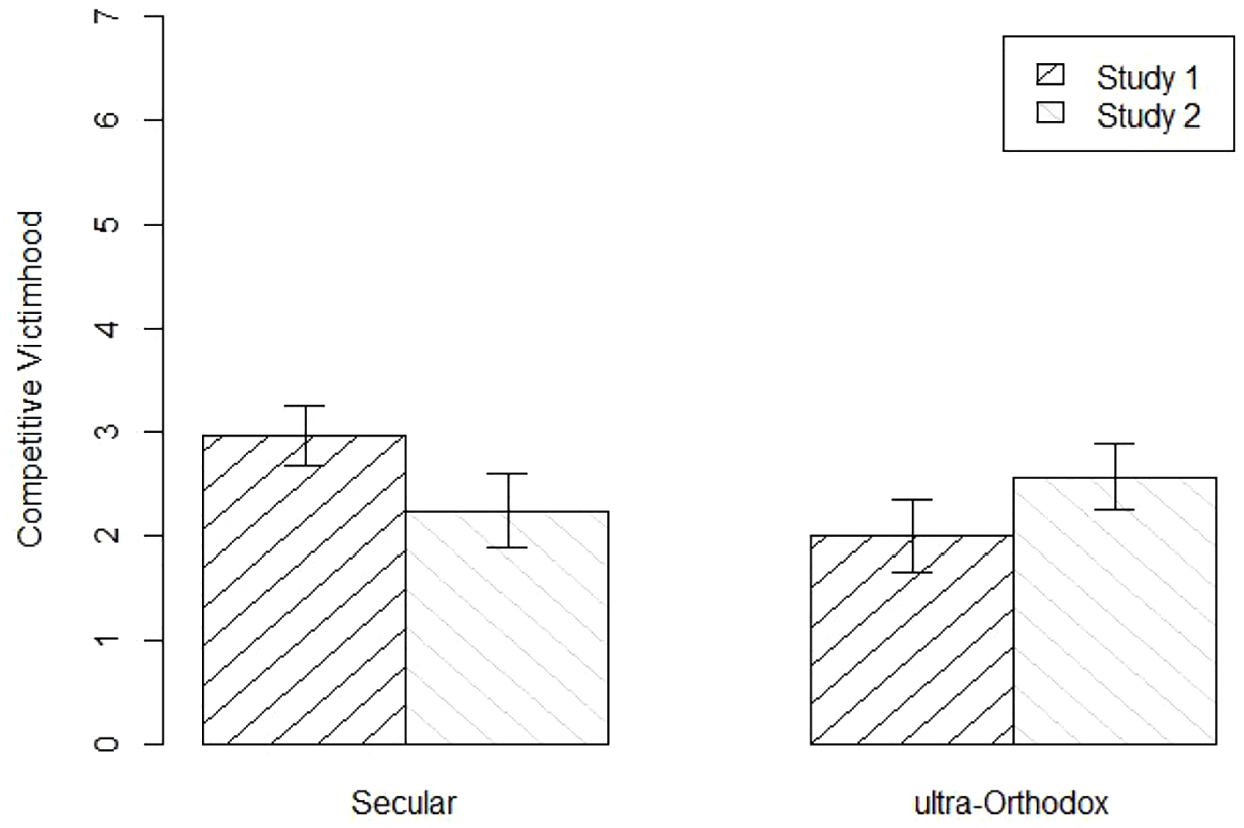
Means of competitive victimhood in the two groups at two measurement timepoints. In the first study, the secular group engaged in competitive victimhood more than did the ultra-Orthodox group, but in the second study, the competitive victimhood of the ultra-Orthodox group was higher than that of the secular group.
Discussion
Taken together, the results of Studies 1 and 2 provide a compelling indication of the agile nature of competitive victimhood, and suggest that both low- and high-power group members may experience competitive victimhood regardless of their actual power. They may, in fact, experience it as a function of intergroup threat. Furthermore, these empirical findings are novel in demonstrating for the first time that members of high-power groups may experience a relatively higher sense of competitive victimhood compared to their weaker counterparts, and that this relatively competitive victimhood ratio can change. The findings present a mirror image of the relative sense of competitive victimhood experienced by low- and high-power groups during and after the height of the COVID-19 pandemic. Amidst a transient threat, members of the stronger group experienced higher levels of competitive victimhood than did members of the weaker group. Moreover, in a matter of one and a half years, this competitive victimhood ratio flipped, as in Study 2 it was the weaker group who experienced greater levels of threat and competitive victimhood compared to the (same) majority outgroup. Hence, it seems that indeed, even in the context of nonviolent intergroup tensions and social inequality, competitive victimhood is a much more context-specific phenomenon than one largely based on intergroup power distribution.
General Discussion
Competitive victimhood is a significant phenomenon that influences intergroup attitudes, such as discrimination and hostility. Previous research on competitive victimhood has primarily focused on power dynamics between groups as the main determinant, overlooking contextual influences. Additionally, most studies have failed to measure both groups involved in competitive victimhood dynamics. This approach may have neglected addressing the practice of “victim blaming” by stronger groups, which has historically led to atrocities against weaker or minority groups. In the current studies we explored whether competitive victimhood is solely derived from power relations between groups or whether it is a more dynamic phenomenon driven by contextual threats, even if unrelated to power status.
The state of Israel is legally defined as “Jewish and democratic,” a definition that grants the ultra-Orthodox a special position of power as they control the Jewish aspect of the state. Although some might say that this position of power renders them the “stronger” group, the current studies depict a more nuanced and complex situation: Regardless of who is strong or weak, the dynamics shift, suggesting that the meaningful factor is the changing level of threat, not the power, regardless of who possesses more of it.
The implications of these findings are significant. If competitive victimhood is more agile and influenced by contextual threats than previously believed, social work researchers and practitioners could develop psychological tools and interventions to manipulate group experiences of competitive victimhood, mitigating its detrimental consequences. Understanding the contextual circumstances unrelated to power structure that cause strong groups to perceive themselves as victims while maintaining their power can be beneficial for policymakers and conflict resolution researchers. Failure to address these issues may lead high-power group members to justify and perpetuate social inequality, even resorting to violent persecution.
Our analysis using multi-group analysis (MGA) reveals a significant finding. While the items on the ingroup victimhood scale load consistently and are perceived similarly by both groups, they do not load similarly on the outgroup victimhood scale. The items on the central scale of competitive victimhood, which were designed for this study using a method termed “mirror research,” were formulated by members of both groups to accurately capture their sense of victimhood. This indicates that each group’s perception of its own victimhood is indeed comparable, despite differences in item formulation. However, the recognition of the outgroup’s victimhood varies between stronger and weaker groups.
Notably, the only item that did not show similar loading in both studies was the one with symmetrical wording: “The secular/ultra-Orthodox public is discriminated against in the state budget.” Despite identical phrasing, each group’s attitude towards this item differed, unlike the responses to items specifically tailored for each group, which loaded similarly.
This observation leads to two key conclusions. First, each group more readily understands its own victimhood while being relatively “blind” to the victimhood of the other group. The symmetrical item with differing perceptions supports this conclusion. For example, items related to budget discrimination, despite having symmetrical wording, do not achieve symmetrical perception. The secular group may interpret such items as indicative of exploitation, while the ultra-Orthodox group may view them as reflecting dominance and deprivation. This disparity in interpretation, despite identical phrasing, highlights the different perspectives each group holds.
Conversely, the item on “Employer Discrimination” reflects the economic advantages perceived by the secular group, which the ultra-Orthodox do not share. The mirror frame of “the disproportionate political power of ultra-Orthodox Members of Knesset (MKs)” underscores a critical aspect of perceived inequality. This frame highlights how these Israeli parliament members, despite representing a minority, are seen as wielding outsized political influence and leveraging it to secure preferential budgets for their community. This perception of inequitable power distribution and its use in resource allocation contributes to broader social tensions, as it highlights how MKs are seen as securing budgets specifically for the ultra-Orthodox community.
Therefore, the advantage of mirror research is its ability to capture each group’s experience of non-symmetrical power relations through research that employs relatively symmetrical perception but non-symmetrical formulation. This approach provides valuable insights into the dynamics of perceived inequalities between groups.
Several limitations of the current studies should be mentioned. First, as these studies were the first studies to quantitatively examine power relations between ultra-Orthodox and secular individuals in Israel, the religious issues related to power sources and the perceived threat to the minority group (the ultra-Orthodox) necessitate further, comprehensive research. It is crucial to investigate these issues deeply within both ultra-Orthodox society and Israeli society at large.
Second, the change and expansion of measurements between Study 1 and Study 2 slightly hinders the ability to confidently determine that the change in competitive victimhood was context dependent. Additionally, it is worth noting that the participants in Study 1 and Study 2 were different individuals from the Haredi community, rather than the same participants being followed longitudinally. This diversity in sampling, while providing a broader perspective, also introduces some limitations in direct comparisons between the studies. Nevertheless, the current studies established symmetric indices between the two sample groups, enhancing the overall analysis. Furthermore, given that these studies were correlational, we cannot establish causality. Additional studies comparing the effects of power and other threats on competitive victimhood can provide a deeper understanding of the underlying mechanisms that lead high-power group members to experience greater competitive victimhood, which often perpetuates social inequality and potential remedies.
Furthermore, given that these studies were correlational, we cannot establish causality. Additional studies comparing the effects of power and other threats on competitive victimhood can provide a deeper understanding of the underlying mechanisms that lead high-power group members to experience greater competitive victimhood, which often perpetuates social inequality and potential remedies.
Conclusion and Recommendations
In conclusion, the findings from Studies 1 and 2 highlight the dynamic nature of competitive victimhood, revealing that low- and high-power group members may experience competitive victimhood regardless of their actual power; they may, in fact, experience competitive victimhood as a result of intergroup threat.
At the time of writing (June 2024), it is crucial to acknowledge the ongoing conflict in Israel, which involves other groups, namely Israelis and Palestinians in Gaza. Both groups perceive themselves as ultimate victims, each holding onto narratives and measures that validate their experiences. However, this conflict inflicts suffering, destruction, death, and terror on both sides, and has persisted for decades. It is imperative to acknowledge the plight of competitive victims. Recognizing the universality of this phenomenon and understanding that each group genuinely believes itself to be the ultimate victim can have significant consequences for conflict resolution. Policymakers and conflict resolution researchers must develop appropriate interventions to raise awareness of this phenomenon and devise solutions for its eradication.
Footnotes
Appendix A
Appendix B
Appendix C
Appendix D
Declaration of conflicting interests
The author(s) declared no potential conflicts of interest with respect to the research, authorship, and/or publication of this article.
Funding
The author(s) received no financial support for the research, authorship, and/or publication of this article.
