



Abstract
The current research tests the Marley hypothesis—the role of historical knowledge as a mediator between racial group differences and perceptions of racism—in the context of voter suppression. In Study 1 (N = 205), Black and White participants completed a voting rights history test, racial identification measures, and perceptions of racism items in the context of voter suppression. Moderated mediation analyses revealed that when racial identity was high, historical knowledge was a significant mediator of the effect of racial category on perceptions of racism and voter suppression. Study 2 (N = 243) examined whether a critical educational intervention about historical racism in voting policies (vs. a control) increased perceptions of racism in voting domains. Study 2 suggested that the intervention was most effective for White and Black Americans reporting low levels of racial identity, but the intervention decreased racism perceptions among highly identified White participants.
Recently, there has been some debate as to whether contemporary state policies that restrict voting access (i.e., strict voter ID laws, voter roll purges, and reductions in polling locations and hours; Cox, 2021) constitute contemporary forms of racist voter suppression (Combs, 2022; Hajnal et al., 2017; Johnson, 2020; Wickert, 2021). A recent poll of Black Americans in the United States (US) indicated that a large majority (84%) of Black voters are concerned about voter suppression (Hamel et al., 2022). According to another poll, when asked about the different problems that impact U.S. elections, Black (62%) and Latinx respondents (60%) were much more likely than White respondents (27%) to express concerns about voter access and voters being denied the right to vote (Vandermaas-Peeler et al., 2018). These divergent perspectives likely reflect racialized experiences with voting in the US—for instance, Black and Latinx voters are more likely to experience problems when trying to vote than White voters (Vandermaas-Peeler et al., 2018)—but they may also reflect differences in knowledge and understanding of the extent to which voting access has been limited for various minoritized groups in the US.
Who has been allowed to participate in America’s democracy through voting is profoundly tied to America’s history of ethnocentrism, racism, and sexism. The legal foundations for decentering Whiteness and maleness in the context of voting rights were not introduced until the ratification of constitutional amendments granting citizenship to formerly enslaved persons (United States Constitution (1868) amend. XIV) and the prohibition of voter disenfranchisement on the basis of race (United States Constitution (n.d) amend. XV) or sex (United States Constitution (n.d) amend. XIX). Even after these amendments, further legislative acts were still needed to protect voting rights of racial and language minorities in the US. For example, although Amendment XV granted all U.S. citizens the right to vote regardless of race, it was not until the Snyder Act/Indian Citizenship Act in 1924 that Native Americans could claim the rights granted by the Constitution (U.S. Department of the Interior Indian Affairs, n.d.). The 1965 Voting Rights Act outlawed continued discriminatory practices that disenfranchised Black voters, like poll taxes and literacy tests, and its 1975 expansion facilitated broader participation among language minority groups by mandating access to voting materials in languages other than English (Congressional Research Service, n.d.). Familiarity with the U.S. racial history of restrictive voting rights may shape whether one perceives contemporary efforts to restrict access to voting as similar. The current paper examines whether knowledge about racism in America’s voting history is related to perceptions of restrictive voting policies as contemporary forms of systemic racism. The idea that there may be differences in knowledge about the histories of restricted voter access offers a new domain in which to test a social-psychological theory called the Marley hypothesis (Nelson et al., 2013).
The Marley Hypothesis and Perceptions of Racism
Differences in how Black and White Americans perceive the problems of voter access mirror differences in perceptions of racism highlighted in prior research and national poll data. In comparison to their Black American counterparts, White Americans tend to see less racism in society and tend to construct racism as a problem of isolated incidents rather than a structural one (e.g., Carter & Murphy, 2015; Pew Research Center, 2016; Rucker & Richeson, 2021; Schaeffer & Edwards, 2022). One account for this group-based difference is explained by the Marley hypothesis, which showed that differences in critical Black history knowledge can help explain why Black and White Americans differ in their perceptions of whether various events or situations constitute examples of racism (Bonam et al., 2019; Nelson et al., 2013).
In the original study, the authors tested two hypotheses. The first assessed perceptions of racism as “reality attunement,” a reflection of accurate historical knowledge (Nelson et al., 2013, p. 214). White and Black Americans completed a historical knowledge quiz, measures of racial identity, and questionnaires on perceptions of racism in isolated incidents and systemic events (Nelson et al., 2013). Nelson et al. (2013) found that differences in accurate historical knowledge mediated Black–White differences in perceptions of racism. The second hypothesis assessed the “identity relevance” of racism perception, or the idea that different identity concerns for Black and White participants would shape their responses (Nelson et al., 2013, p. 214). As anticipated by Nelson and colleagues, views on racism were moderated by racial identification, such that racial identification was negatively related to perceptions of racism for White participants, but positively related to perceptions of racism among Black participants. Their findings were in line with prior research suggesting that racism perception can be threatening to White identity, producing motivations to deny racism (e.g., Adams et al., 2006; Lowery et al., 2007). For White Americans, acknowledging racism can threaten an image of a fair, colorblind, and/or egalitarian society; because they hold a privileged status in this context, perceiving racism can threaten the positive image of the group as nonprejudiced (Knowles et al., 2014). Their findings were also in line with prior research showing that perceptions of racism and discrimination tend to be the highest among the most highly identified members of target groups (e.g., Branscombe et al., 1999; Major et al., 2003; Operario & Fiske, 2001; Sellers & Shelton, 2003), perhaps because they are likely to experience more prejudice (Kaiser & Pratt-Hyatt, 2009). For Black Americans, acknowledging racism can affirm an important ingroup reality, one for which vigilance can be protective (Sellers & Shelton, 2003).
Direct follow-up studies to the Marley hypothesis have generally used the same materials as Nelson and colleagues and tested the idea in different samples (Bonam et al., 2019; Strickhouser et al., 2019; Zell & Lesick, 2022). Bonam et al. (2019) replicated the findings of the original study in a diverse university student body and introduced a novel intervention. Zell and Lesick (2022) extended the study to compare White Republicans and Democrats, whereby White Republican–White Democrat differences in perceptions of racism were mediated by their differences in Black history knowledge. Strickhouser et al. (2019) tested the idea in a diverse southern university (Black students were almost one third of the population), where they found no Black–White differences in knowledge of Black history; but, overall, Black history knowledge was positively related to perceptions of systemic racism, and racial identity was a key predictor of perceptions of racism.
Research consistent with the Marley hypothesis reflects two major influences on perceptions of racism. One source is informational (what does one know or what has one learned about historical and contemporary forms of racism?), and the other is motivational and identity-relevant (what self- and group-esteem factors or the desire to be viewed positively shape motivations to perceive or deny racism?; e.g., Knowles et al., 2014; Rucker & Richeson, 2021). But these two influences are not necessarily independent of one another. Research studies show a bi-directional relationship between historical knowledge and identity defensive mechanisms (e.g., Mukherjee et al., 2017; Salter & Adams, 2016). For example, Mukherjee et al. (2017) asked participants in India to rate historical events that either glorified India or acknowledged wrongdoing against marginalized groups. As expected, the nation-glorifying events were rated as more relevant and important for the study of Indian history, especially by participants who had higher average scores on national identification. Notably, exposure to glorifying themes about collective achievements in India also produced higher national identification, and exposure to critical narratives about collective wrongdoing decreased national identification. Previous research has shown that social identification not only shapes evaluation of historical events but can impact which historical events come to mind (Sahdra & Ross, 2007). Sahdra and Ross found that participants highly identified with their ingroup were less likely to recall historical instances of violence or hatred perpetrated by their group.
Historical Knowledge Interventions
Although the original study was correlational, an important implication and extension of the work suggests that perhaps exposure to critical history can increase perceptions of racism (e.g., Bonam et al., 2019; Martin & Johnson, 2023; Neufeld et al., 2022; Salter & Adams, 2016). Bonam et al. (2019) designed an intervention aimed at increasing participants’ knowledge of historical racism and their recognition of contemporary racism. They showed that White participants exposed to a place-focused narrative discussing the government involvement in the creation of Black ghettos (in comparison to a control) had a greater perception of current racism. Importantly, racial identification moderated the effect of the treatment condition on perceptions of systemic racism. As racial identity increased, the treatment backfired and predicted lower perceptions of systemic racism; a pattern highlighting that interventions can trigger defensive identity motivations to protect personal and collective self-worth (Major & O’Brien, 2005). Similarly, Onyeador et al. (2020) aimed to disrupt false racial progress beliefs about the racial wealth gap by exposing participants to critical information on the persistence of racism; that is, because of racism, the wealth gap has not gotten significantly better over time. While participants in the treatment condition shifted their views to be more “accurate”—the distance between the wealth gap in the past and present has not narrowed as much as previously thought—this adjusted view was primarily the result of participants shifting their perceptions about the past, protecting their beliefs about income equality in the present (Onyeador et al., 2020). There is a dynamic relationship between historical knowledge as a source of information and as a potential identity threat.
Overview of Current Studies
The current research tests the Marley hypothesis—the role of historical knowledge as a mediator between racial group differences and perceptions of systemic racism (Bonam et al., 2019; Nelson et al., 2013)—in the context of voter suppression. Study 1 measures critical voting history knowledge, and Study 2 manipulates it. In Study 1, we hypothesized that Black participants would show greater knowledge of critical voting history compared to White participants, and, in turn, would perceive more racism (systemic and voting suppression). Additionally, we hypothesized that racial identification would moderate the relationship between one’s racial group and their perception of racism, in line with prior research. In this way, racial identification will be negatively related to perceptions of racism among White participants, but positively related to perceptions of racism among Black participants. Extending prior research, we also directly test the relationship between racial identification and knowledge of critical history. This extension follows from prior work on the relationship between historical memory and identity (e.g., Kurtiş et al., 2010; Mukherjee et al., 2017; Sahdra & Ross, 2007).
Study 2 aimed to increase people’s awareness of historical racism in America’s voting policies. We hypothesized that exposure to the historical racism embedded in U.S. voting history would increase one’s perceptions of racism in contemporary voting policies and voter suppression. We also hypothesized that the relationship between the critical education condition and perceptions of racism would be moderated by racial group, such that the critical education condition would have a greater effect on White participants than Black participants. We anticipated that Black participants would show greater perception of racism in voting policies and voter suppression compared to White participants, regardless of condition. We also anticipated that the impact of the critical education condition would be moderated by racial identification.
Study 1 hypotheses, procedures, and exclusions were preregistered on the Open Science Framework (OSF; https://osf.io/u2h58). The primary statistical analyses (PROCESS Model 8) used in Study 1 were preregistered as exploratory. Study 2 procedures, hypotheses, and analyses were not preregistered; however, hypotheses were generated before data collection for a thesis project. Data for Study 1 and 2 can be found on the OSF (https://osf.io/vu6fk/).
Study 1
Method
Participants
Two hundred and twenty-two Black and White Americans (Mage = 40.03, SDage = 11.92) were recruited based on self-reported race/ethnicity from Amazon Mechanical Turk (MTurk) via CloudResearch.com (Litman et al., 2017). Participants received US$2.00 for a 20-min study. Participants included 103 Black Americans, 102 White Americans, and 17 multiracial Americans. Participants included 126 cisgender women, 95 cisgender men, and one transgender woman.
A priori power analyses indicated a sample size of 210 would be sufficient to provide 95% power to detect a medium effect (d = 0.50; similar to the group difference effect size found in Bonam et al., 2019, Study 1). However, participants were excluded from analyses if they identified with more than one racial group (n = 17) or failed at least one of two attention checks (n = 18), not mutually exclusive. The final sample had 99 White and 90 Black Americans. This sample size allowed us to detect a Cohen’s d effect size of 0.41 with 80% power. Therefore, we were underpowered to detect small effects.
Procedure
Following informed consent, participants indicated their racial/ethnic group and completed measures of racial identity relevance. Then, they completed a historical voting knowledge test before indicating their perceptions of racism in voting policies, systemic racism, and voter suppression. For exploratory purposes, participants also completed measures of political ideology, voting beliefs, and voter registration status. These measures are discussed briefly in the Supplemental Material. Lastly, participants completed an attention check and a debriefing (see supplement for study materials).
Materials
Racial identity relevance
The Private Regard Subscale of the Collective Self-Esteem Scale (Luhtanen & Crocker, 1992; α = .86) has four questions related to participants’ feelings regarding their racial group (e.g., “In general, I’m glad to be a member of my racial group”). Responses were given on a 7-point scale (1 = strongly disagree, 7 = strongly agree).
Voting history test
Participants were presented with 20 statements regarding historical voting policies. All statements were created using publicly available information. Fourteen items were true (e.g., “Citizenship is required for voting in the United States and Native Americans were not considered citizens until the Snyder Act [Indian Citizenship Act of 1924]”), and six items were false (e.g., “In the 1960s, the FBI illegally purged several prominent Black voting rights activists from voter rolls in order to discredit their activism”). After reading each statement, participants selected either true or false, and indicated their confidence level ranging from 1 (guessing) to 5 (certain).
The test was scored in line with signal detection theory and prior research (Nelson et al., 2013). For each participant, a historical knowledge (d’) mean score was calculated via signal detection theory. Signal detection theory uses the following equation to calculate how well participants distinguish fact from fiction: d’ = Z (hit rate) − Z (false alarm rate). Hit rates were calculated by dividing one’s total hits (the number of times one viewed true items as true and indicated at least “3” in confidence about their answer) by the total number of true items (14). False alarm rates were calculated by dividing one’s total false alarms (the number of times one viewed a false item as true and was confident about their answer) by the total number of false items (six).
Perceptions of racism in voting policies
Six statements measured perceptions of racism regarding contemporary voting policies (α = .89; e.g., “Some states have strict voter ID laws that accept a driver’s license, passport, military identification, or gun permits for voting, but do not accept student ID, employee badges, or public assistance ID cards”). Participants rated questions on a 4-point Likert scale (1 = racism is not a factor at all, 4 = racism is a major factor).
Perceptions of systemic racism
Five items measured participants’ perception of systemic racism (α = .91; adapted from Nelson et al., 2013; e.g., “High rates of unemployment in African American communities”). Participants rated statements with a 7-point Likert scale (1 = not at all, 7 = certainly).
Perceptions of voter suppression
Ten statements assessed participants’ perceptions of voter suppression as a problem in the US (α = .90; e.g., “I have doubts that all the eligible votes from racial minorities will be counted”). Participants rated each statement on a 7-point scale (1 = strongly disagree, 7 = strongly agree).
Results
Racial group differences
An independent samples t test was conducted to test the effects of racial category on historical knowledge (d’). Black participants (M = 0.54, SD = 0.83) showed greater knowledge of historical voting policies compared to White participants (M = 0.31, SD = 0.87), d = 0.27. However, this difference did not reach traditional levels of significance, t(187) = 1.91, p = .058. As expected, Black participants scored higher than their White counterparts on racial identity relevance, t(187) = 5.90, p < .001, d = 0.86; perceptions of racism in voting policies, t(187) = 3.15, p = .002, d = 0.46; perceptions of systemic racism, t(187) = 4.92, p < .001, d = 0.72; and perceptions of voter suppression, t(187) = 2.77, p = .005, d = 0.41. Refer to Table 1 for a summary of racial group differences.
Group differences in means for Study 1 variables.
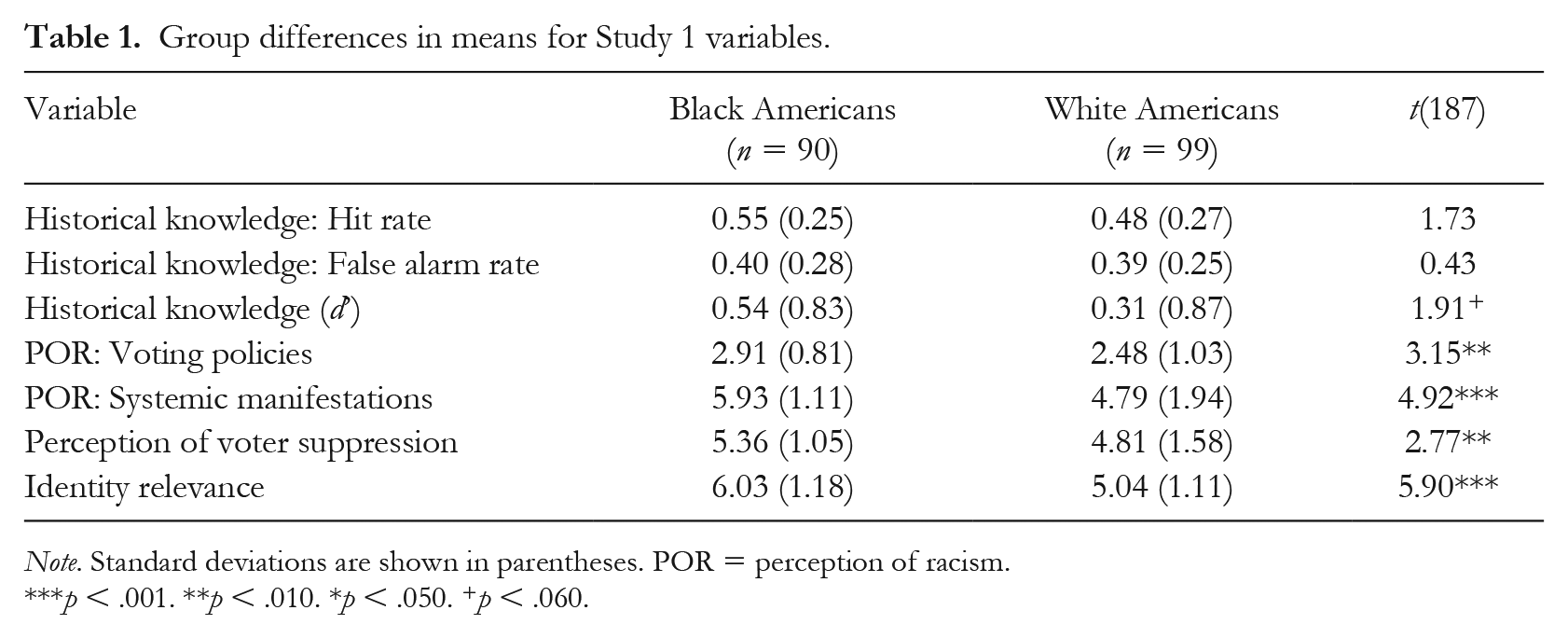
Note. Standard deviations are shown in parentheses. POR = perception of racism.
p < .001. **p < .010. *p < .050. +p < .060.
The Marley hypothesis and identity relevance
To test the Marley hypothesis and the moderating role of racial identity relevance in the voting domain simultaneously, we conducted conditional process regression analyses that included mediation and two moderations using Model 8 of the SPSS PROCESS macro (Version 3.5), with 10,000 bias-corrected bootstrap resamples (Hayes, 2018). See Figure 1 for all path estimates.
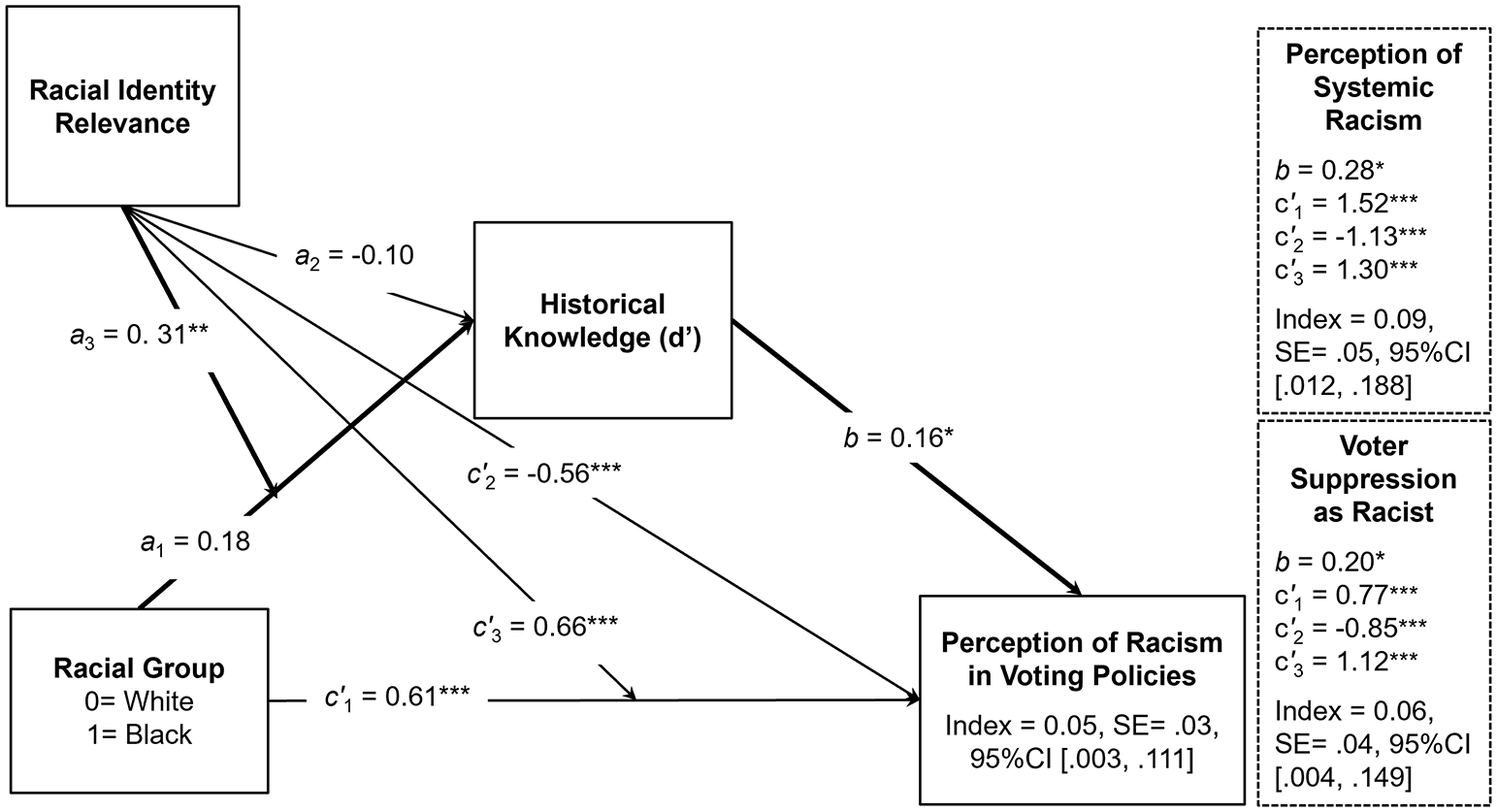
Conceptual model testing the Marley hypothesis via moderated mediation analyses: Study 1.
Perception of racism in voting policies
The interaction between racial category and racial identity relevance predicted historical knowledge, b = 0.31, SE = 0.11, p = .005, 95% CI [0.10, 0.52]. As seen in Figure 2, higher levels of Black racial identification were associated with more critical history knowledge, but higher levels of White racial identification were associated with less critical history knowledge. Accordingly, the index of moderated mediation (index = 0.09, SE = 0.03, 95% CI [0.01, 0.19]) indicated that the racial group → historical knowledge → perception of racism in voting policies indirect effect was conditional, based on racial identity relevance. Historical knowledge mediated the relationship between racial category and perceptions of racism in voting policies when racial identity relevance was high (+1 SD above the mean), b = 0.09, SE = 0.05, 95% CI [0.01, 0.20], but not when it was low (−1 SD below the mean), b = −0.03, SE = 0.04, 95% CI [−0.12, 0.02], or average, b = 0.03, SE = 0.02, 95% CI [−0.01, 0.08]. These results suggest that the differences in knowledge of critical voting history among highly identified Black and White Americans accounted for the differences in perceptions of racism in strict voting policies. Racial identity relevance also moderated the effect of participant’s race on perceptions of racism in voting policies, b = 0.65, SE = 0.10, p < .001, 95% CI [0.44, 0.85]. See Figure S2.
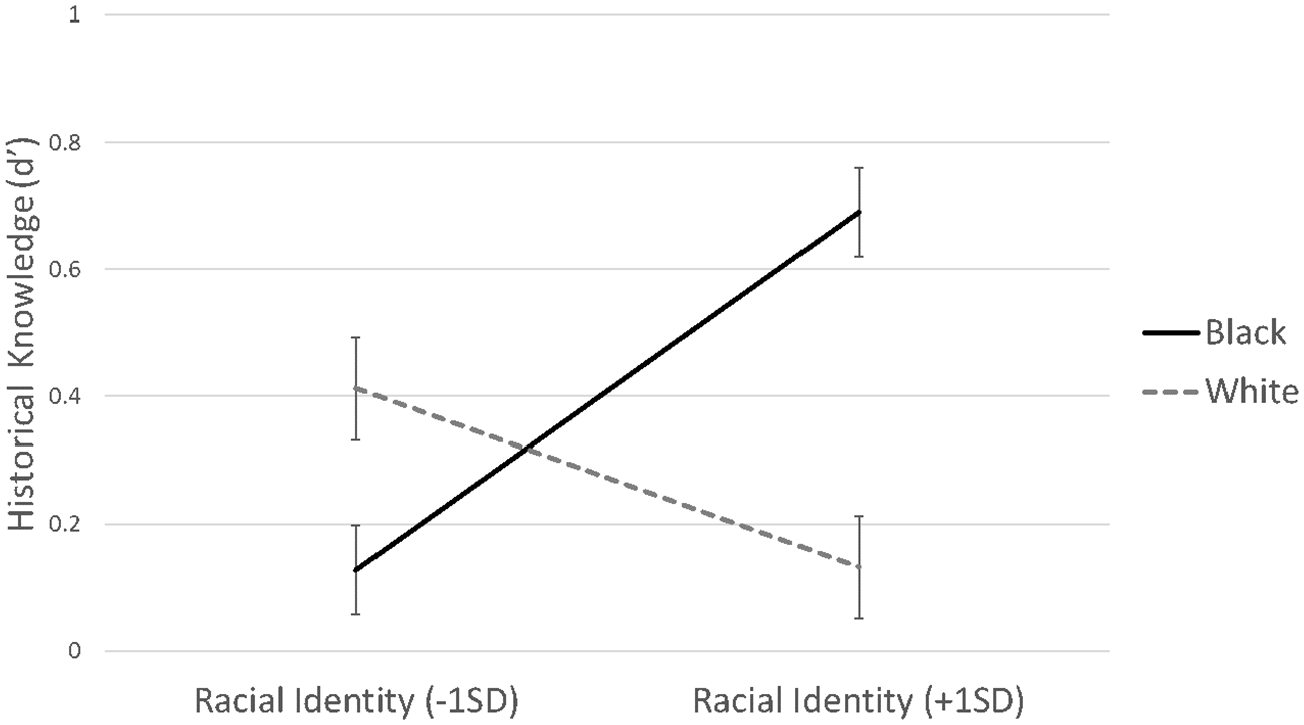
The interaction between racial identity relevance and racial category on historical knowledge: Study 1.
Perception of systemic racism
The interaction between racial category and racial identity relevance predicted historical knowledge, b = 0.31, SE = 0.11, p = .005, 95% CI [0.10, 0.52]. Again, the index of moderated mediation (index = 0.09, SE = 0.05, 95% CI [0.01, 0.19]) indicated that the racial group → historical knowledge → perception of systemic racism indirect effect was conditional, based on racial identity relevance. Historical knowledge mediated the relationship between racial category and perceptions of systemic racism when racial identity relevance was average, b = 1.52, SE = 0.20, 95% CI [1.12, 1.92], and high (+1 SD above the mean), b = 3.13, SE = 0.29, 95% CI [2.55, 3.71], but not when it was low (−1 SD below the mean), b = −0.10, SE = 0.29, 95% CI [−0.67, 0.48]. In this case, these results suggest differences in perceptions of systemic racism among Black and White Americans can be accounted for by differences in their knowledge of critical voting history, except among those least identified with their racial groups. As predicted, racial identity relevance moderated the effect of participant’s race on perceptions of systemic racism, b = 1.30, SE = 0.17, p < .001, 95% CI [0.97, 1.63]. See Figure S3.
Perception of voter suppression
The interaction between racial category and racial identity relevance predicted historical knowledge, b = 0.31, SE = 0.11, p = .005, 95% CI [0.10, 0.52]. Similarly, the index of moderated mediation (index = 0.06, SE = 0.04, 95% CI [0.004, 0.15]) indicated that the racial group → historical knowledge → perceptions of voter suppression indirect effect was conditional, based on racial identity relevance. Historical knowledge mediated the relationship between racial category and perceptions of racism in voting policies when racial identity relevance was high (+1 SD above the mean), b = 0.56, SE = 0.19, 95% CI [0.19, 0.93], but not when it was low (−1 SD below the mean), b = −0.20, SE = 0.19, 95% CI [−0.58, 0.17], or average, b = 0.18, SE = 0.13, 95% CI [−0.08, 0.44]. Again, differences in knowledge of critical voting history among highly identified Black and White Americans (also see Figure S1) accounted for the differences in perceptions of racism in strict voting policies. As predicted, racial identity relevance also moderated the effect of participant’s race on perceptions of voter suppression, b = 1.12, SE = 0.15, p < .001, 95% CI [0.83, 1.41]. See Figure S4.
Summary
Findings supported the Marley hypothesis; broadly, differences in critical Black history knowledge can explain why Black and White Americans differ in perceptions of racism. In this case, White Americans, particularly those highly identified with their racial group, knew less about America’s critical voting history, while Black Americans who were highly identified with their group knew more; in turn, the more one knows about this critical history, the more likely one is to perceive racism in present-day voting policies, perceive racism in systemic manifestations, and view voter suppression as a racism-relevant problem. However, it is important to note the correlational nature of Study 1, and the limitations associated with drawing causal inferences from cross-sectional designs. Study 2 begins to address this limitation by using an experimental design.
Study 2
Study 2 tests whether critical history exposure can increase perceptions of racism in strict voting policies and voter suppression. Extending prior research, the study examines how both Black and White people are impacted by exposure to critical history. In this study, we explore several Marley hypothesis-relevant questions, including whether: (a) Black participants will show greater perception of racism in the voting domain compared to White participants (replicating Study 1); (b) exposure to critical history will increase one’s perceptions of racism; (c) critical education will have a greater effect on White perceptions than Black perceptions of racism (bridging the gap); and (d) the impact of critical history will be conditional based on racial identity relevance (given the results of Study 1). The design was similar to Bonam et al.’s (2019, Study 2); participants were exposed to critical history information (vs. a control condition) and were asked questions regarding their perceptions of voting policies and voter suppression.
Method
Participants
Two hundred and fifty-nine Black and White Americans (Mage = 40.25, SDage = 13.50) were recruited based on self-reported race/ethnicity from Amazon MTurk via CloudResearch.com (Litman et al., 2017). Participants were compensated US$1.50 for a 15-min study. The sample included 141 cisgender women, 114 cisgender men, three nonbinary individuals, and one person who preferred not to disclose. Sample size was determined by available funds. Participants were excluded from analyses if they failed at least one of the three manipulation checks (n = 16) or identified as multiracial (n = 14), not mutually exclusive. The final sample had 120 White and 110 Black participants. A sensitivity analysis indicated that our sample size would allow us to detect a Cohen’s d effect size of 0.37 with 80% power. This is a larger effect size than what was found in Bonam et al.’s (2019) Study 2 (d = 0.27); thus, we were underpowered to detect smaller effects.
Procedure
Participants consented to participation and were randomly assigned to a condition. They were presented with one fact at a time, followed by its corresponding content check question and a correct answer reinforcement. Participants answered attention checks and rated their learning. Next, they completed measures of perception of racism in voting policies, voter suppression, and racial identity relevance.
Materials
The measures for perceptions of racism in voting policies (α = .90), perceptions of voter suppression (α = .90), and private regard 1 (α = .87) were the same items used in Study 1.
Historical fact condition
Participants were randomly assigned to engage with one of two sets of facts. The education condition had eight historical voting facts (e.g., “Civil rights activist, Fannie Lou Hammer, was threatened, beaten, and shot at for trying to register for and exercise her right to vote in the 1960s”). The second set served as a control condition (eight facts about U.S. presidents). Facts about U.S. presidents were chosen as a control condition because the topic is similarly historical, political, and focused on the US. Items could also be broadly matched based on time periods.
Self-reported learning
Participants responded to two items about their learning (α = .98; e.g., “Please indicate the extent to which the historical facts helped you learn more about the history of racism in voting policies”). Participants indicated that they learned more about the history of racism and voter suppression in the critical education condition (M = 4.40, SD = 0.77) than in the control condition (M = 1.51, SD = 1.03), t(241) = 24.89, p < .001. See Supplemental Material for additional analyses.
Results
We conducted moderated moderation regression analyses using Model 3 of the SPSS PROCESS macro (Version 3.5), with 10,000 bias-corrected bootstrap resamples (Hayes, 2018). The three-way moderation model included education condition as the primary predictor, racial group as the primary moderator, racial identity relevance as a secondary moderator, and perceptions of racism in voting and voter suppression as outcome variables. Table 2 summarizes the condition and racial group means for primary dependent variables and racial identity relevance. Correlations between primary variables appear in the Supplemental Material (Table S1).
Condition and racial group differences in means for Study 2 variables.
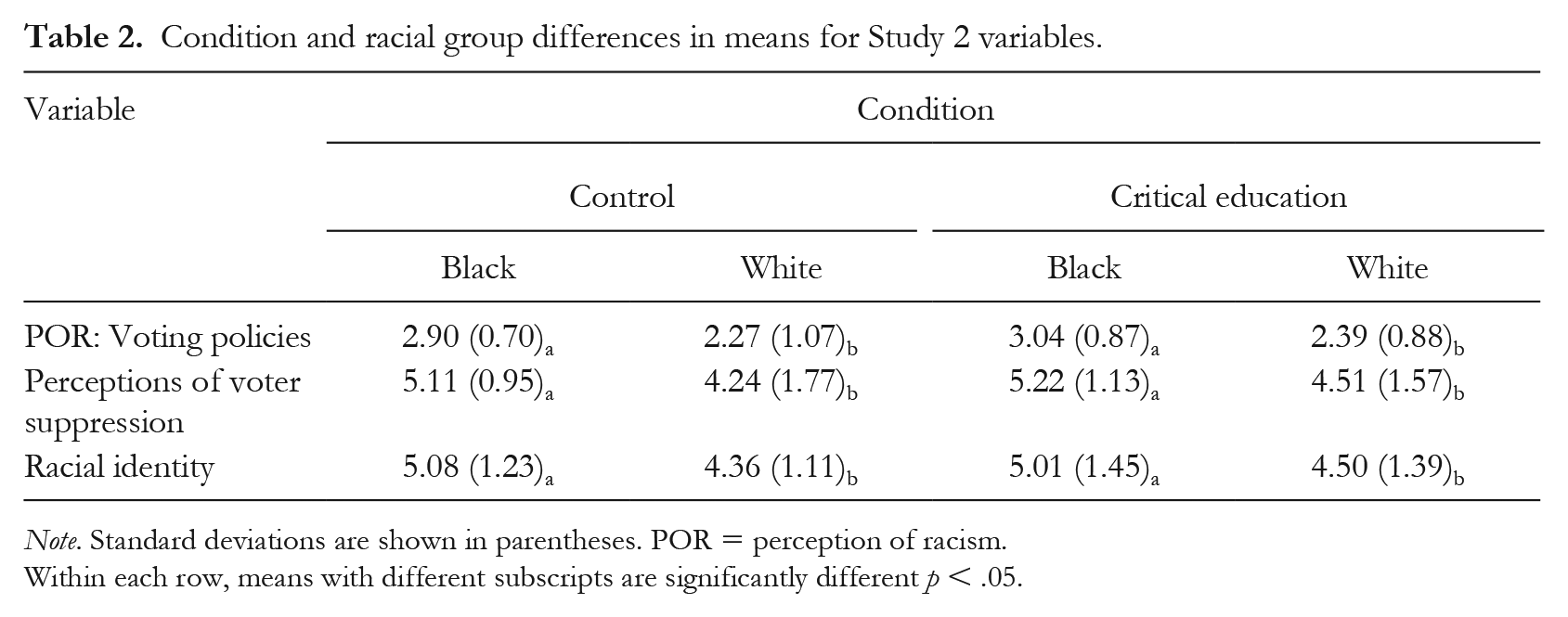
Note. Standard deviations are shown in parentheses. POR = perception of racism.
Within each row, means with different subscripts are significantly different p < .05.
Perception of racism in voting policies
Contrary to our expectations, the three-way interaction between racial identity relevance, education condition, and racial group was not significant, b = 0.10, SE = 0.16, p = .536, 95% CI [−0.22, 0.42]. However, there were two significant two-way interactions within this model (see Table 3). When tested separately, the interaction between the education condition and racial identity was significant, b = −0.19, SE = 0.09, p = .027, 95% CI [−0.36, −0.22], such that there was an effect of condition at low levels of racial identity, b = 0.37, SE = 0.17, 95% CI [0.04, 0.70], but not at high levels, b = −0.16, SE = 0.16, 95% CI [−0.50, 0.17]. The interaction between racial identity relevance and racial group was also significant, b = 0.29, SE = 0.08, p = .0003, 95% CI [0.14, 0.46], such that there were Black–White differences at high levels of racial identity relevance, b = 1.07, SE = 0.16, 95% CI [0.76, 1.39], but not at low levels, b = 0.25, SE = 0.16, 95% CI [−0.69, 0.56]. The two-way interaction between racial category and education condition was not significant, b = 0.01, SE = 0.23, p = .095, 95% CI [−0.45, 0.47]. See Figure 3.
Education condition, racial group, and racial identity relevance on perceptions of racism in voting policies: Study 2.
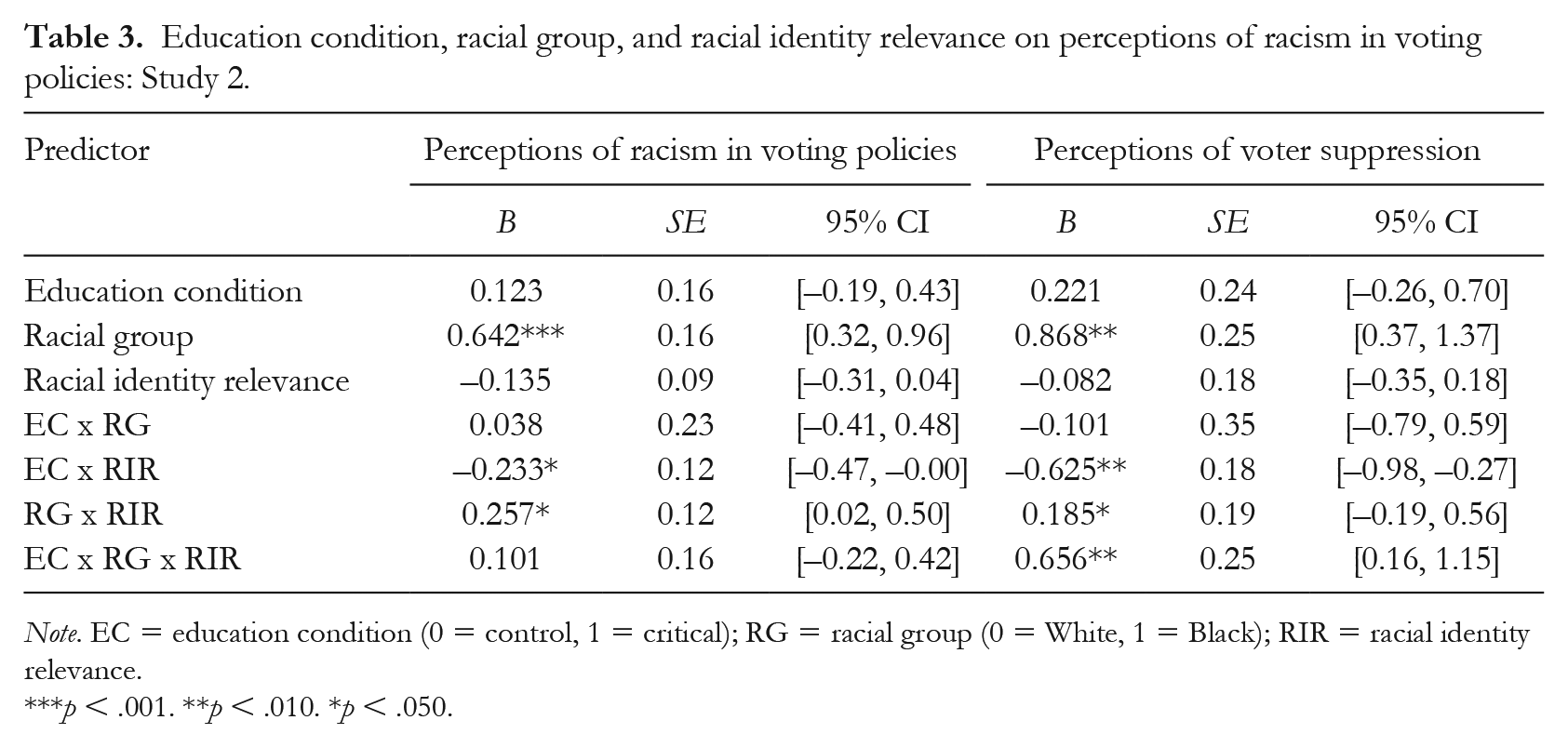
Note. EC = education condition (0 = control, 1 = critical); RG = racial group (0 = White, 1 = Black); RIR = racial identity relevance.
p < .001. **p < .010. *p < .050.
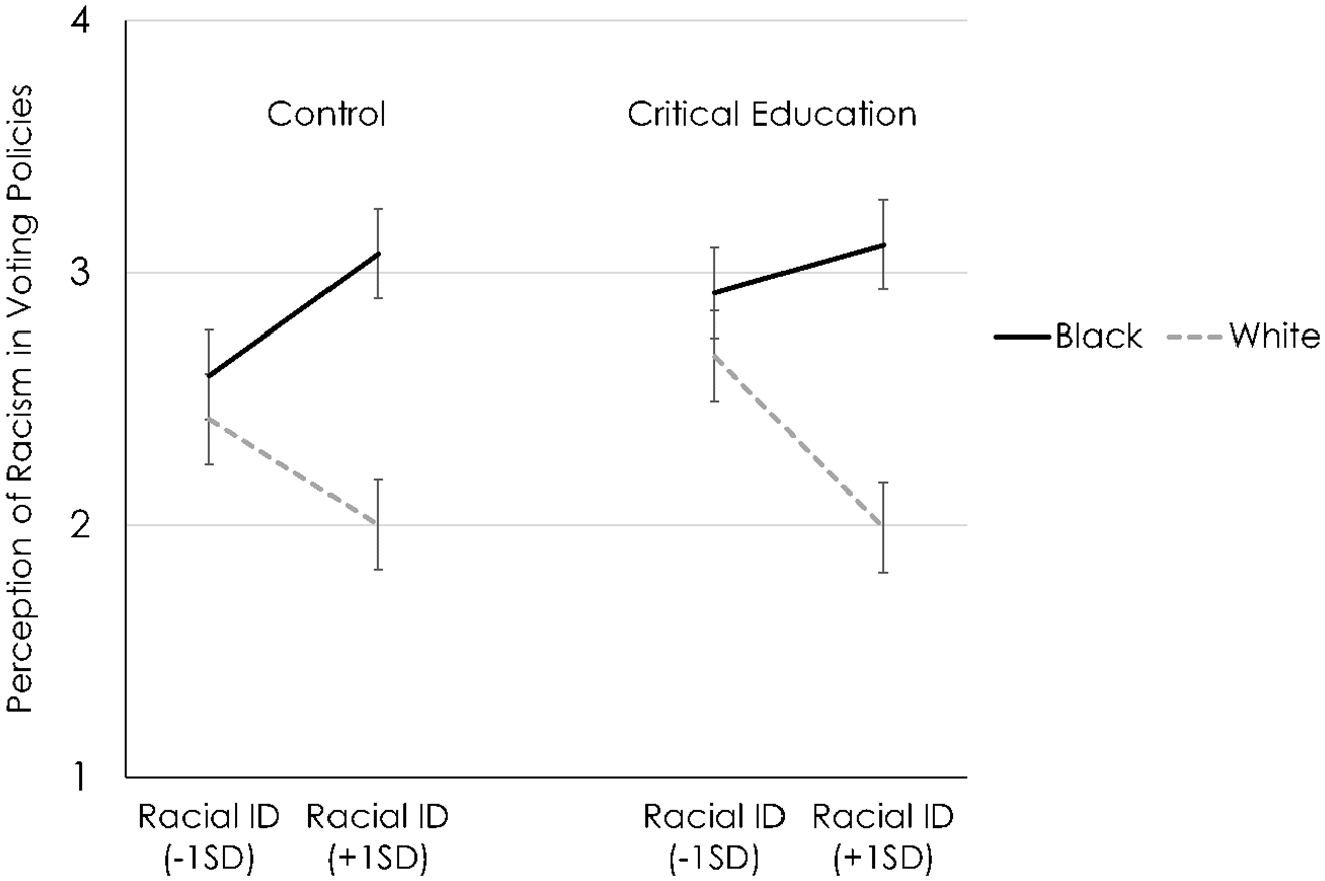
Perceptions of racism in voting policies by racial identity relevance, education condition, and racial group category: Study 2.
Perceptions of voter suppression
As expected, there was a three-way interaction between racial identity relevance, education condition, and racial group, b = 0.66, SE = 0.25, p = .010, 95% CI [0.16, 1.15], see Figure 4. Within the critical education condition, racial identity relevance was negatively associated with perceptions of voter suppression among White participants, b = −0.70, SE = 0.12, p < .0001, 95% CI [−0.93, −0.46], but not related to perceptions among Black participants, b = 0.13, SE = 0.11, p = .024, 95% CI [−0.09, 0.35]. Within the control condition, the relationship between racial identity relevance and perceptions of voter suppression did not differ from zero for Black, b = 0.10, SE = 0.13, p = .44, 95% CI [−0.16, 0.37], or White participants, b = −0.082, SE = 0.13, p = .054, 95% CI [−0.35, 0.18]. See Table 3 for overall summary of model estimates.
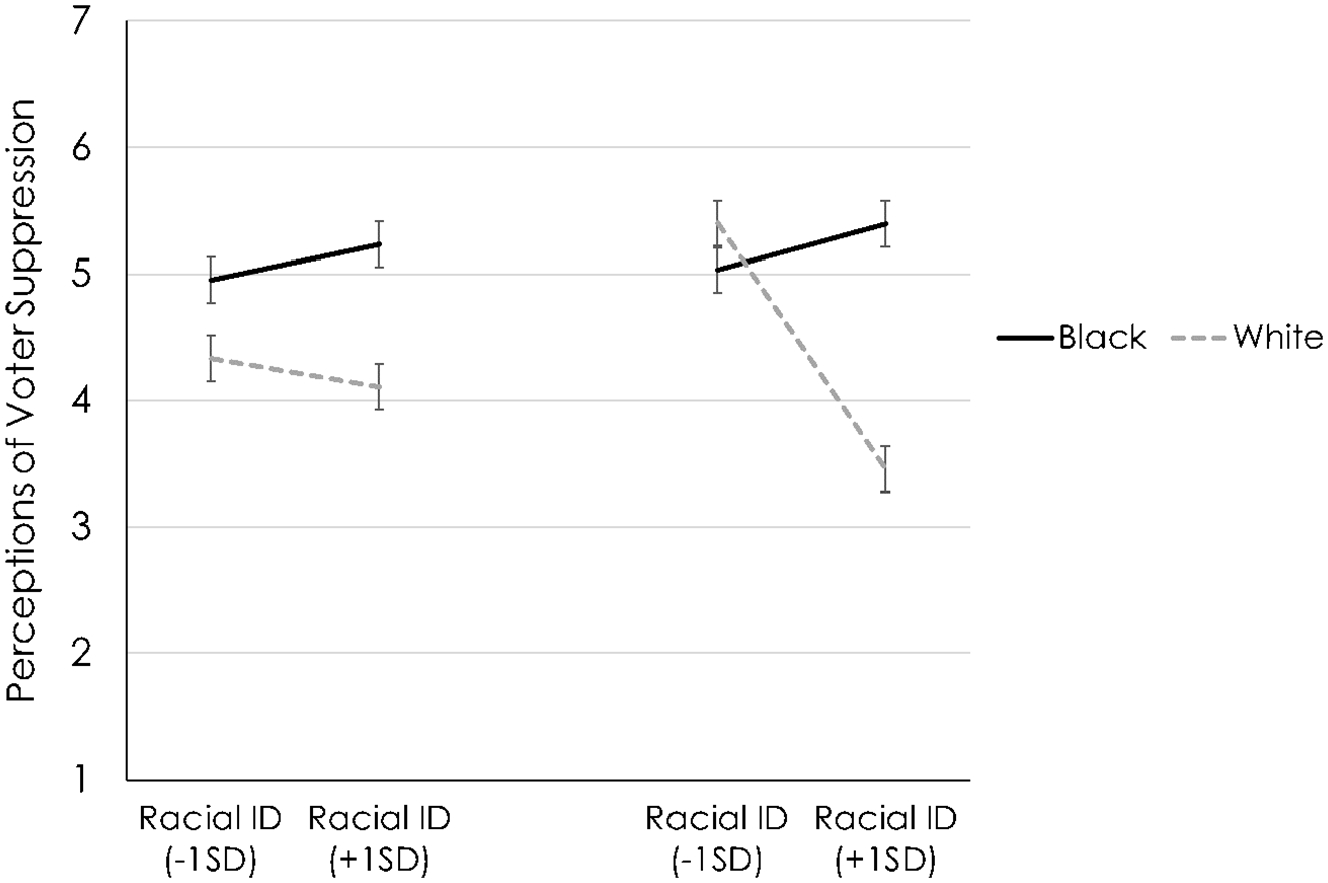
Perceptions of voter suppression by racial identity relevance, education condition, and racial group category: Study 2.
Summary
Replicating Study 1 findings, Black participants indicated greater perceptions of racism in the voting domain compared to White participants. There was not a main effect of intervention on perceptions of racism or voter suppression as anticipated; instead, the effects of the critical education condition were contingent on the identity profiles of the participants. Critical education increased perceptions of racism in voting policies at low levels of racial identity broadly, suggesting that critical education can have an impact among both Black and White individuals who are not highly identified with their racial group. For perceptions of voter suppression, however, critical education only increased perceptions among White participants who reported relatively low racial identity relevance. Critical education decreased perceptions among White respondents reporting relatively high levels of racial identity. For Black respondents, critical education did not significantly impact their perceptions of voter suppression.
General Discussion
The Marley hypothesis has been directly replicated (Bonam et al., 2019), tested in different cultural contexts (Strickhouser et al., 2019), and with different comparison groups (Zell & Lesick, 2022). However, these studies all relied on the same broad measure of critical Black history knowledge. Therefore, the current study extends prior research conceptually by broadening the theory’s application in a new domain: voting history. Like prior research, there was general support for the Marley hypothesis. The Marley hypothesis suggests that differences in critical Black history knowledge can explain why Black and White Americans differ in perceptions of racism. As a first step, Study 1 showed racial group differences on all of the racism perception measures and racial identity relevance. Differences in Black and White participants’ perceptions of systemic racism replicated previous findings (Bonam et al., 2019; Nelson et al., 2013; Strickhouser et al., 2019), and the present study examined these differences in a new domain: voting policies and voter suppression. Despite the novelty of the scales used to measure these variables (developed for this study), they were reliable and consistent across studies.
As a second step, Marley hypothesis studies have examined differences in historical knowledge. In this research, the difference in participants’ knowledge of historical voting policies (d’) was not as large as in prior studies (Black respondents in our study showed similar patterns of greater historical knowledge compared to White respondents). This may be due to the nature of the test (the content and specificity diverge from prior studies), the makeup of the sample (e.g., White Democrats performed better than their White Republican counterparts in similar studies), or to decreases in critical knowledge gaps over time. Although the knowledge differences were not significant (p = .058), we examined the Marley hypothesis with a conditional PROCESS model (Model 8; Hayes, 2018) that would allow us to consider racial identity relevance as not only a predictor of our key dependent variables, but also our proposed mediator (historical knowledge). This relationship was not considered in the original Marley hypothesis paper (Nelson et al., 2013), by Bonam et al. (2019), or by Strickhouser et al. (2019). These prior papers primarily considered racial identity as a moderator in the relationship between racial group and perceptions of racism. Extending this research, we considered whether racial identity moderated two separate paths—the relationship between racial group and perceptions of racism as well as the relationship between racial group membership and historical knowledge (PROCESS Model 8).
As expected—and observed in Bonam et al. (2019), Nelson et al. (2013), and Strickhouser et al. (2019)—racial identity relevance was negatively related to perceptions of racism among White participants, but positively related to perceptions of racism among Black participants. Importantly, we also found that racial identity relevance was negatively related to critical voting history knowledge among White participants, but positively related to critical voting history knowledge among Black participants. Moderated mediation analyses indicated that historical knowledge mediated the relationship between racial category and perceptions of racism, but primarily when racial identity relevance was high. In other words, the differences in perceptions of racism among Black and White individuals could be accounted for by the differences in historical knowledge among the most highly identified members of their racial groups.
In Study 2, Black participants showed greater perception of racism in voting policies and voter suppression compared to White participants. This replicates gaps in perception of racism in earlier studies, including Study 1. However, the primary goal of Study 2 was to test whether increasing people’s awareness of historical racism in America’s voting policies via a brief intervention would increase perceptions of racism in the voting domain. There was not a main effect of education condition on participants’ perceptions of racism in voting policies or perceptions of voter suppression. However, significant interactions revealed that the impact of a critical education intervention depends on participants’ racial identities. Notably, the critical education condition increased racism perceptions among those with low levels of racial identity in the case of strict voting policies (Black and White respondents) and voter suppression (White respondents only). This suggests that participants indicating low levels of racial identity may have been more open to the influence of the manipulation than their highly identified counterparts; and thus, more willing to perceive racism as relevant in voting policies and voter suppression. In the case of voter suppression specifically, critical education decreased perceptions among White participants who indicated relatively high racial identity.
These findings have both encouraging and discouraging implications for teaching about historical racism. On one hand, the critical education condition does not give participants a narrative that explicitly connects past discrimination to present racial inequity in voting access (as did Bonam et al., 2019), so the shifts among participants with low levels of racial identity in their perceptions of racism resulting from this treatment are particularly striking. Participants are making the connection between past and present themselves. Conversely, this finding also suggests that participants with higher levels of racial identity relevance were less open, and some potentially reactive, to the information conveyed in the intervention. Recall that in Study 1, historical knowledge differences and racism perception gaps were the largest among the most highly identified members of each racial group (see Figure 2 and Figures S1–S3). For highly identified Black respondents, a critical history intervention may not be effective because of ceiling effects. Perhaps there is less room for an intervention to bolster their perceptions because (a) they are already relatively high in their racism perceptions in comparison to their counterparts and/or (b) they may already know about some of the racism-relevant historical events and policies that we are trying to “teach” them. For highly identified White respondents, perhaps the information conveyed in the intervention constituted an identity threat (e.g., Knowles et al., 2014). For example, in a recent study, White racial identity was positively related to collective racial nostalgia, a concept reflecting a positive regard for the group’s racial past (Reyna et al., 2022). The critical education intervention directly challenges an idealized, exclusively positive racial past in the US, and highly identified White participants may have rejected our critical historical account. Our results also mirror an effect found in Bonam et al. (2019) where the treatment became less likely to increase systemic racism perceptions as racial identity increased. Moreover, once they statistically controlled for their indirect effects, their critical history treatment produced decreased perceptions of racism among their White American sample (see Bonam et al., 2019).
Limitations and Future Directions
The Marley hypothesis consists of two key ideas: (a) accurate historical knowledge about past racism will be greater in marginalized communities than in dominant-group communities, and (b) differences in historical knowledge will mediate group differences in perception of racism in current events (Nelson et al., 2013). In Study 1, the racial group difference in participants’ knowledge of historical voting policies (d’) was smaller than anticipated, given effects found in earlier studies (Bonam et al., 2019; Nelson et al., 2013). The change in survey content from critical Black history in general to the voting domain specifically may have contributed to this. Also, we collected the data during Black History Month 2021. 2 Perhaps Black history facts were generally more salient and accessible during this month, accounting for smaller Black–White differences in knowledge. Importantly, the group differences were in the predicted direction. Moreover, though conditional, the second key idea was supported. Differences in historical knowledge accounted for the Black–White differences in perceptions of racism when racial identity (private regard) was high. In other words, the differences in racism perception among highly identified Black and White participants could be explained by their differences in historical knowledge. Providing additional insight, the findings support the application of the Marley hypothesis in a new domain.
Study 2 provided additional support for a nuanced view of the Marley hypothesis with an experiment. The education condition increased perceptions of racism in the voting domain, but that was conditional and depended on low levels of racial identity (particularly for White participants). It is important to acknowledge the constraints posed by having a relatively small sample size on the reliability of our findings, especially when exploring three-way interactions. Replicating these findings in a larger sample is an important next step in understanding the potential impact of critical history interventions on different groups. Another limitation of this study is that it is brief, and the intervention is unidimensional. Presenting information in an experiment does not necessarily equate to “knowledge” about a topic. Participants were presented with relevant information once, and we did not test the longevity of effects. Typically, knowledgeable people have spent time learning and thinking about a topic. Future studies should provide more historical context for each fact, implement opportunities for meaningful engagement with the material beyond reading facts on a computer screen, and assess impact longitudinally. Instead of a one-time intervention, reinforcement of the presented ideas would potentially increase ecological validity, mapping onto what teachers do in a classroom. Further work in this area should consider existing cultural tools embedded in educational contexts that promote or challenge ignorance about U.S. racism (Salter et al., 2018).
Across both studies, participants’ age ranged from 18 to 70, which differs from the previous studies’ undergraduate samples. An online crowdsourcing platform has its own limitations (e.g., sampling bias for internet users). In order to recruit quality participants, we used CloudResearch’s recommended settings and included attention, seriousness, and manipulation checks. Future research should aim to replicate the study within a controlled environment where concerns about potential multitasking, carelessness, or looking up answers could be monitored and/or addressed. Analyses were also restricted to participants self-identifying as Black or White. By excluding participants who also identified as Latinx, Native American, or Asian, for example, we did not examine how the Marley hypothesis applies to other racially marginalized groups. Future research should aim to replicate these findings in diverse racial groups within the US. Moreover, our Black and White samples skewed liberal and Democrat (see Supplemental Material). Prior research has found that the relationships between political orientation, historical knowledge, and perceptions of racism matter among White Americans (Zell & Lesick, 2022). Therefore, another interesting future direction would be to specifically recruit Black and White Republican and conservative-leaning respondents 3 to further understand any effects that may be due to political orientation or party identification.
Finally, it is worth noting that the racism in voting policies and the perception of voter suppression measures were developed for this study. Their novelty and level of specificity (e.g., racism in voting policies vs. racism in America) allowed us to conceptually replicate the Marley hypothesis in a different domain. Although these measures showed high levels of scale reliability and correlated with prior measures of systemic racism with similar patterns across our two studies, one should further examine how these scales relate to other constructs measuring the same concepts, and how well they work for different participant samples.
Implications
Scholars are increasingly calling for psychologists to study the relationships between systemic racism, historical context, and policy, theoretically and empirically (Rucker & Richeson, 2021; Trawalter et al., 2022). Because there is a direct line to be drawn between restrictive voting rights and structural racism, this is a critical line of work. Our findings reinforce the importance of knowing about the racial history of the US, and signal the need to integrate historical narratives with critical perspectives into the educational system. This research is particularly timely as various state legislatures continue to restrict voting access in ways that disproportionately impact communities of color (Hajnal et al., 2017). Activists and scholars are documenting how racial minorities continue to face voter suppression and discrimination in political and legal matters (Johnson, 2020; Worland, 2020); however, our data suggest that only some people are positioned and/or open to hearing that message (also see Haugen et al., 2018). Thus, it is vital to continue to examine different methods of increasing one’s perception of racism as it relates to voting and policy.
Given our research findings, it is notable that voter suppression efforts align with ongoing efforts to ban knowledge of the very history and actions that necessitated federal-level intervention in the context of similar restrictive policies and legislation in the past. These efforts appear to be consistent with an active “racial unknowing” (Mueller, 2018, p. 12) of critical history. Between January 1 and May 14 2021, 14 states enacted 22 new laws that restricted access to the vote (i.e., tightening of voter ID laws, voter roll purges, and reductions in voting place availability by location and fewer hours). Several of those same states pushing for new restrictive voting legislation (e.g., Alabama, Arizona, Arkansas, Florida, Georgia, Iowa, Montana, Texas) also have or are introducing legislation that bans or restricts educational lessons on racism, bias, and the history of marginalized racial groups in the US. The current research affirms that these issues should not be considered in isolation.
Throughout this paper, we have discussed voting as a right as opposed to a privilege. This view aligns with a majority of Black (77%), Hispanic (63%), and Asian (66%) Americans who considered voting a fundamental right for every U.S. citizen, according to a national poll (Gómez & Doherty, 2021). In contrast, White Americans were split, with 51% indicating that voting should be an unrestricted fundamental right, and 48% considering it a privilege that should be limited (Gómez & Doherty, 2021). The implication of viewing voting as a right is that it must be protected. When it is considered a privilege, it must be restricted to those deemed deserving. A long history of political resistance, protests, and demonstrations in the US secured citizenship and voting rights for a variety of marginalized groups in U.S. history. Engagement with this critical history reveals that the groups most likely to be impacted by restrictive voting policies have already earned the right to vote, tenfold.
Supplemental Material
sj-docx-1-gpi-10.1177_13684302241309576 – Supplemental material for Perceptions of racism in voter suppression: Testing the Marley hypothesis and a brief educational intervention
Supplemental material, sj-docx-1-gpi-10.1177_13684302241309576 for Perceptions of racism in voter suppression: Testing the Marley hypothesis and a brief educational intervention by Maria F. Rojas Melo Silva, Phia S. Salter and Courtney M. Bonam in Group Processes & Intergroup Relations
Footnotes
Declaration of Conflicting Interests
The author(s) declared no potential conflicts of interest with respect to the research, authorship, and/or publication of this article.
Funding
The author(s) disclosed receipt of the following financial support for the research, authorship, and/or publication of this article: Data were collected as a part of an undergraduate thesis project at Davidson College and was funded by an Abernethy Research Award to the first author.

Supplemental Material
Supplemental material for this article is available online.
Notes
References
Supplementary Material
Please find the following supplemental material available below.
For Open Access articles published under a Creative Commons License, all supplemental material carries the same license as the article it is associated with.
For non-Open Access articles published, all supplemental material carries a non-exclusive license, and permission requests for re-use of supplemental material or any part of supplemental material shall be sent directly to the copyright owner as specified in the copyright notice associated with the article.
