



Abstract
Considering the rise of far-right groups in Western countries, we examined whether exposure to media coverage on the far-right is associated with attitudes toward it, using surveys in 15 Western democratic countries (total N = 2,576). We hypothesized that greater media exposure to the far-right will be associated with greater perceived prevalence and acceptability of it, which will in turn be associated with divergent attitudes. On the one hand, greater perceived prevalence may be associated with more unfavorable attitudes toward the far-right (a threat response). On the other hand, greater perceived acceptability may be associated with more favorable attitudes toward the far-right (a normalization response). Overall, there was more evidence for a threat response than a normalization response: media exposure was consistently related to greater perceived prevalence (but not acceptability) of the far-right. This research underscores the importance of studying the consequences of the rise of the far-right.
In societies across the Western world, far-right mobilization continues to take hold (Norris & Inglehart, 2019; Pahnke, 2021). In Italy, for example, CasaPound is a fascist, extreme neo-Nazi group that has made headlines over the last decade for its confrontational street demonstrations and the occupation of public buildings (Gattinara & Froio, 2014). In Germany, the Alternative for Germany (AfD) is a radical, far-right, populist political party that has won seats in federal elections in 2017 and 2021 (Hansen & Olsen, 2022; Lees, 2018). Such far-right groups that were previously part of the periphery have now been increasingly featured in mainstream public discourse and have therefore grown to become influential actors in the sociopolitical sphere (Brown & Mondon, 2021; Gattinara & Froio, 2019). As far-right groups continue to mobilize in public spaces, they are also increasingly portrayed in mainstream media. However, relatively little is known about the consequences of media coverage of far-right movements for public opinion towards such movements.
While far-right movements are diverse in their goals and philosophies, they are typically rooted in a nativist and nationalist ideology that seeks to protect and defend the traditional values of a dominant group that are perceived to be under threat from other groups within society (Mudde, 2007; Rydgren, 2007). The far-right encompasses both the extreme and radical right; the extreme right rejects democracy and tends to resort to violence, whereas the radical right draws on populist ideals to oppose liberal ideologies (Mudde, 2007). The repertoires of the far-right range from grassroots activism and direct action to party politics and electoral campaigns—all of which aim to mobilize broader public support. As such, the rise of the far-right can be understood as a social movement (Gattinara & Pirro, 2019; Simi et al., 2024).
A key question is whether the broader public’s exposure to media coverage of the far-right has implications for societal beliefs and attitudes toward these groups. Are far-right groups viewed as becoming increasingly prevalent in society, and if so, does that promote public concern about the potentially negative effects of the far-right on society? Or, are far-right groups viewed as becoming increasingly accepted in society, and if so, do people come to tolerate these groups’ ideology and their right to mobilize? In the present research, we investigated for the first time whether and how exposure to media coverage of far-right groups could potentially be related to divergent perceptions of social norms about these movements, and, subsequently, how these perceived norms relate to personal attitudes toward the far-right. We address these questions through cross-national surveys conducted in 15 Western countries that have witnessed the rise of the far-right. Specifically, we focused on people who were not ideologically aligned with the far-right and may therefore constitute a potential audience targeted by far-right mobilization efforts.
The Role of the Media in Shaping Social Norms
One of the ways that people come to understand and construct social norms about various ongoing social and political issues is through the media. Media exposure can make certain issues or perspectives more dominant in the public sphere (McCombs, 2002). Scholars have long noted that the media serves an agenda-setting function whereby the topics and issues covered by the media increase their salience and subsequently influence public opinion (for a review, see Bryant & Oliver, 2009). There is extensive evidence that the media plays a role in shaping sociopolitical attitudes. In the context of immigration in Europe for example, mass coverage about immigration was correlated with anti-immigrant policy attitudes and socially conservative voting preferences (Eberl et al., 2018). The heightened visibility of immigration in the news can exert an influence on anti-immigrant attitudes regardless of the actual rates of immigration (Van Klingeren et al., 2015). This research is largely based on linking fluctuations of news coverage on various topics with panel surveys of relevant public attitudes over time. Relatedly, studies have investigated self-reported media consumption and attitudes toward minorities, showing for example that greater consumption of mass media that includes representation of gender and sexual minorities is associated with more positive attitudes towards lesbian, gay, bisexual, and transgender (LGBT) individuals (Calzo & Ward, 2009; Yan, 2019).
Although these studies largely did not explicitly examine the role of the media in social norms per se, it has been theorized that the mechanism through which the media shapes attitudes is by influencing perceived norms, that is, people’s understandings of the informal rules that guide one’s beliefs, attitudes, and behaviors within a society (Lapinski & Rimal, 2005). In Italy, it was found that exposure to right-wing media was related to weaker beliefs in the existence of a social norm that condemns discrimination, which in turn predicted greater prejudice towards immigrants (Vaes et al., 2015). Given the role of the media in shaping social norms, norm-based interventions have often used media campaigns to promote desirable behaviors in society (for reviews, see Cialdini & Goldstein, 2004; Tankard & Paluck, 2016; Wakefield et al., 2010). People’s subjective perceptions of what is considered normative are highly malleable—and these perceptions tend to guide their own attitudes. As such, social norms, as derived from one’s environment including the media, constitute an important vehicle for social influence. The present research will extend this work to the context of exposure to far-right mobilization in the media.
This focus is important because far-right movements are increasingly featured in mass media, and they also have actively mobilized online by posting content on social media, blogs, and online news sites (Gallaher, 2020; Mondon & Winter, 2020). Big data analysis has shown an increased prevalence of terms focused on political extremism in media outlets between 1970 and 2019 both in the UK and the US; this is particularly pronounced for terms denoting right-wing political extremism (Rozado & Kaufmann, 2022). Research by media and communication scholars has further shown that media coverage of radical far-right groups often employs discursive strategies that accommodate their views, effectively providing them with a platform to disseminate racist, exclusionary rhetoric as a legitimate political stance (de Jonge & Gaufman, 2022; see also Ekström et al., 2020). This phenomenon underscores the media’s crucial role in shifting societal norms in terms of what is considered commonplace and normal in public discourse. Increased media coverage of the far-right can have far-reaching implications, including affecting the treatment of minority groups, eroding social cohesion, and posing challenges to the foundations of democracy (Mondon & Winter, 2020; Norris & Inglehart, 2019).
We propose two processes for how the media might affect perceived social norms regarding far-right groups. First, by increasing the salience of an issue, exposure to media coverage of far-right groups could promote the perceived prevalence of these groups. People may come to believe that far-right groups are increasingly popular and have been gaining more supporters, simply because of their regular portrayal in the news. Drawing on the social norms literature, such perceptions can be conceptualized as descriptive norms; that is, the perceived prevalence of a behavior in society, or behaviors that are believed to commonly occur (i.e., what others typically do; Cialdini et al., 1990; Kallgren et al., 2000).
Indeed, related evidence suggests that media exposure can lead people to perceive certain behaviors as more typical in society. For example, news exposure has been linked to fear about crimes independent of actual crime rates (Romer et al., 2003), and consumption of news that depict immigrants negatively leads people to overestimate the frequency of immigrants as criminal offenders (Arendt, 2010). Similarly, as the news may sensationalize coverage of terrorism, the consumption of news media can heighten the perceived risk of terrorism (Nellis & Savage, 2012). By extension, by virtue of seeing mass coverage of far-right groups, people may come to think about these groups as becoming increasingly widespread in society and view their activities as quite common, regardless of the actual situation. We propose that greater exposure to media coverage of the far-right will be linked to greater perceived prevalence of this type of groups (i.e., strong descriptive norms).
Second, exposure to news coverage of the far-right may increase the sense of how tolerated or appropriate these groups are within society. Simply being featured in mainstream outlets could contribute to the perception that the activities of the far-right are not so fringe as they perhaps once were; as such, the far-right may come to be viewed as increasingly acceptable by the public. Indeed, scholars have argued that the media has been mainstreaming far-right groups by providing coverage of their activities and agenda (de Jonge & Gaufman, 2022; Ekström et al., 2020). Regardless of the tone or framing of the coverage, media content about the far-right provides the group with a platform to share their views with the broader society. As this happens more frequently, it could create a perception that far-right groups are not so radical after all, but rather, they are a normal and acceptable part of the political sphere. Drawing on the social norms literature, we propose that such perceptions can be conceptualized as injunctive norms, which comprise the perception of acceptable or approved standards of behavior in society (i.e., what others should do; Cialdini et al., 1990; Kallgren et al., 2000).
As with any social movement, media portrayal is key to raising awareness and ultimately galvanizing support from the public (Baugut & Neumann, 2019; Walgrave & Vliegenthart, 2012). In the same way, a far-right movement’s appeal, and ability to disseminate their message, is partially dependent upon gaining widespread news coverage (Ellinas, 2010). Since the media holds agenda-setting power, media attention on issues that are central to the far-right, such as immigration or crime, can condone and vindicate their policy agenda (Boomgaarden & Vliegenthart, 2007; Walgrave & De Swert, 2004). As such, the far-right may come across as a legitimate political group that should be tolerated and respected. Specifically, we propose that greater exposure to media coverage of the far-right will be linked to greater perceived acceptability of this ideology (i.e., strong injunctive norms). By extension, we propose that these perceptions of the social norms around the far-right (i.e., descriptive and injunctive norms) as a result of media exposure will be linked to differing attitudes toward the far-right.
Threat and Normalization Responses to the Far-Right
We propose that perceived norms around the far-right as a result of media exposure can result in a dual process: a threat response and a normalization response. First, why might people show a threat response? The influence of social norms on attitudes and behaviors is well established in various literatures (e.g., Lapinski & Rimal, 2005; Tankard & Paluck, 2016). People tend to internalize and comply with the descriptive norms within their ingroup—that is, the groups with which people are strongly identified (Cialdini et al., 1990; Hogg et al., 1990; Smith & Terry, 2003)—while rejecting outgroup norms (Turner & Reynolds, 2012). In the case of the far-right, members of the broader society are likely to view this movement as a vilified outgroup. They are typically viewed as ideologically opposed to broader mainstream values within a country, and, as a result, tend to be stigmatized or portrayed as political outcasts (e.g., Mendes & Dennison, 2021; Van Spanje & Van Der Brug, 2007). It has further been found that groups that are viewed as threats to the dominant culture and worldview are believed to be more pervasive in the community, in the sense that people tend to overestimate the presence of the group (Ponce de Leon et al., 2022).
Past research has also shown that, at times, people may be motivated to resist a social norm (Hornsey et al., 2003). When people believe that their ideological position is losing ground within society, they are more likely to want to speak out and resist the change (Louis et al., 2010). Further, people experience collective anger, guilt, and shame in response to the actions of their country that they are ideologically opposed to (e.g., the U.S. occupation of Iraq), which promotes political protest (Iyer et al., 2007). What this literature suggests is that people are likely to demonstrate a threat response by opposing and mobilizing against societal norms that are not in line with the norms of their ingroup. Thus, we hypothesized that viewing the far-right as becoming increasingly prevalent in society (high descriptive norms) will be linked to more negative attitudes toward this movement, constituting a threat response.
Second, why might people show a normalization response? Injunctive norms tend to shape people’s attitudes and behaviors in line with the norm because it is an indicator of what is expected and acceptable in a society (Cialdini et al., 1990). Perceived injunctive norms are related to what people personally value. Within the domain of prejudice for example, the perceived normative acceptability of prejudice towards various groups corresponds strongly with people’s own prejudice levels towards these groups (Crandall et al., 2002), and being exposed to nonprejudiced individuals tend to promote nonprejudiced behaviors and attitudes in others (Masser & Phillips, 2003). What this suggests is that people’s personally held attitudes are bound up with their perceptions of what others find acceptable. Perceptions of injunctive norms have also been found to shape what people think is normal (Rettie et al., 2013).
Within the context of fringe groups such as the far-right, the literature suggests that when they are viewed as becoming more accepted in society, people tend to change their publicly espoused views to be in line with the perceived social norms. For example, people were far less likely to publicly oppose a far-right political party in the 2012 French presidential election when they thought others in their surroundings voted in support of that party (Portelinha & Elcheroth, 2016). There is also a demonstrated effect of desensitization that is related to the phenomenon of normalization. Essentially, repeated exposure to hateful speech towards a group can make such sentiments appear commonplace and acceptable (Soral et al., 2020). This sets a dangerous precedent as people’s tolerance for derogatory speech increases with greater exposure to such speech (Bilewicz & Soral, 2020; Soral et al., 2018). In fact, it has been found that when Americans perceive the Alt-Right movement in the US as gaining acceptance in society, they are more likely to personally accept and tolerate far-right views, regardless of their own political allegiance (Selvanathan & Leidner, 2022). Consequently, we propose that perceiving the far-right as becoming increasingly acceptable in society (i.e., high injunctive norm) will be associated with more favorable attitudes toward that movement. This constitutes a normalization response.
Present Research
We hypothesized that exposure to media coverage of the far-right will be associated with normative beliefs about the far right, both in terms of greater perceived prevalence (i.e., high descriptive norms) and greater perceived acceptability (i.e., high injunctive norms). In line with prior research, we further hypothesized that these normative beliefs would have differential associations with personally held attitudes toward the far-right (Selvanathan & Leidner, 2022). Specifically, on the one hand, greater perceived prevalence of the far-right is expected to be associated with less favorable attitudes toward it, thereby constituting a threat response. On the other hand, greater perceived acceptability of the far-right is expected to be associated with more favorable attitudes toward it, thereby constituting a normalization response. For a conceptual model of the hypothesized effects, see Figure 1.
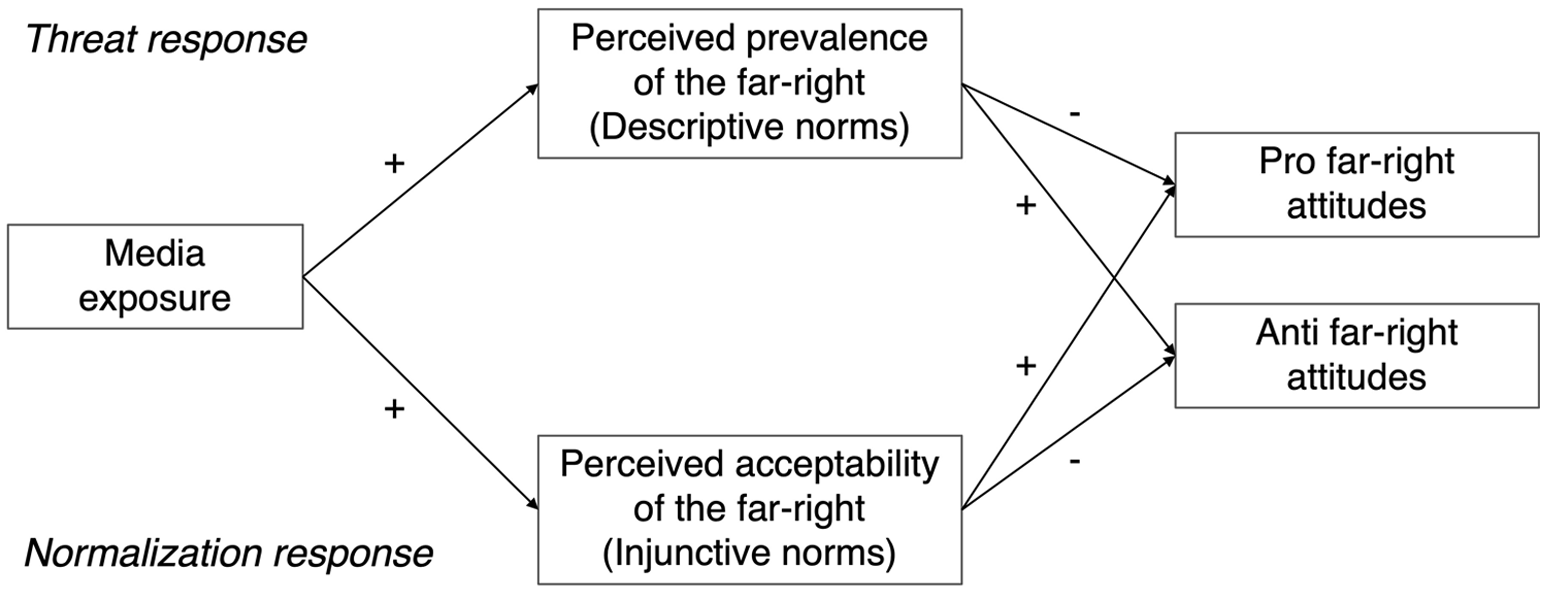
Conceptual model of the hypothesized effects.
We examined these questions in 15 Western democracies focusing on different far-right movements within those countries (see Table 1 for details). The present research is a crucial extension of our past research that has shown experimental evidence for the effect of perceived acceptability (but not prevalence) of the Alt-Right (a far-right, White nationalist movement in the US) on more positive public attitudes towards the movement (Selvanathan & Leidner, 2022). The present research examined the role of media exposure as a precursor to perceived social norms and public attitudes towards far-right movements. We also examined for the first time whether the hypothesized mechanisms (i.e., a threat and a normalization response) emerge across a range of countries with different sociopolitical contexts that have witnessed the rise of the far-right.
Information on far-right groups by country.

It is important to note that our conceptualization of public attitudes toward the far-right was not about directly joining the group, which we expected would be low at the societal level. There may be social desirability concerns because explicitly supporting far-right groups may be a taboo (Terman, 2020). As such, we instead captured related beliefs and appraisals that would imply indirect support for (or opposition towards) the far-right, and potentially more insidious and hidden effects. Anti-far-right attitudes relate to concerns over the negative effects of the far-right, including perceived harm of their speech (Cowan et al., 2002), negative emotional responses to the movement (Leets, 2001), perceived threat from it (Riek et al., 2006), and support for pro-minority policies (Iyer et al., 2007). Together, we took these perceptions to imply unfavorable attitudes towards the far-right.
By contrast, pro-far-right attitudes were about supporting the rights and ideas of the far-right. Pro-far-right attitudes encompass believing that the far-right’s speech (including explicitly racist speech) should be protected as free speech (Roussos & Dovidio, 2019; White & Crandall, 2017), having tolerance for far-right mobilization activities (Nelson et al., 1997), and perceiving bias against the dominant group within society (Wilkins & Kaiser, 2014), which reflects the sentiment of victimization espoused by far-right groups (Forscher & Kteily, 2020). These perceptions would together imply that people are showing some degree of sympathy towards the far-right, albeit indirectly. Taken together, our outcome variables of attitudes toward the far-right (i.e., pro- and anti-far-right attitudes) relate to the extent to which people show leniency to them versus how much they are alarmed by the rise of this movement.
Method
Participants
We recruited samples from 15 countries: Australia, Austria, Belgium, England, Finland, France, Germany (led by researchers based in Berlin and Heidelberg), Greece, Hungary, Italy, the Netherlands, Poland, Scotland, Sweden, and the US. Two samples from Germany were recruited to ensure sufficient response rates: one from a research team located in Berlin and one from a research team located in Heidelberg; however, the participants were recruited from all over the country and were combined into a single sample. 1 In each country, participants were recruited from colleges/universities. It is worth noting that this sampling strategy means that our participants are likely to be quite different from the general population (Hanel & Vione, 2016), thereby limiting the generalizability of findings. However, it was not possible for us to recruit community samples or more representative ones due to funding constraints and lack of feasibility in some regions. To ensure our samples were somewhat comparable across the different national contexts, we recruited undergraduate students in each country so that the samples were at least similar in terms of key demographic background such as age, education level, and political leaning (i.e., young adults who are pursuing a college education and who tend to be politically left-wing; see Table 1 for participants’ demographic information per country).
Our exclusion criteria were as follows: (a) not being a citizen of the specific country, (b) not racially identifying with the majority racial group within the country (because some far-right groups endorse racial ethno-nationalist ideologies that target racial minorities), (c) being a member of the target right-wing group, and (d) not being a student. After applying these exclusion criteria in each country, a total of 2,576 undergraduate students remained in our final sample. In this sample, 1,992 students were female, 563 were male, and 21 were nonbinary or indicated another gender identity. Participants’ age ranged between 17 and 64 years (M = 21.39, SD = 4.68). In terms of political orientation, the sample was generally left-leaning (M = 3.75, SD = 1.86) on a 9-point scale (1 = very left-wing, 9 = very right-wing).
Procedure
The surveys were fielded online in 2019. In countries where English is the official language (i.e., Australia, England, Scotland, and the US), the questionnaire was administered in English. In all other countries, the questionnaire was translated into the official language of the country and then back-translated by the local research team to ensure that it was compatible across languages. There was at least one member of the research team that lived and worked in each of the 15 countries we studied. This approach ensured that the survey in each country was appropriately adapted to the local cultural and political context. To select the specific far-right movement in each country, local collaborators were consulted to ensure that the far-right groups selected were somewhat comparable and grounded in similar ideologies, especially in terms of holding ethno-nationalist values, xenophobic beliefs, and endorsing right-wing populism. Furthermore, the far-right groups we selected have been described as radical-right groups in the media (e.g., see “Europe and right-wing nationalism: A country-by-country guide” 2019) and have been classified as far-right groups by scholars who have conducted comparative research of these groups (e.g., Davis & Deole, 2017; Golder, 2016; Lubbers & Coenders, 2017; Lubbers et al., 2002; Mudde, 2016; Rydgren, 2018).
All measures except media exposure were identical to a recent investigation conducted by members of the research team (Selvanathan & Leidner, 2022). Scale reliabilities for each country and measurement invariance tests are reported in the Supplemental Material. The study was preregistered (see https://aspredicted.org/PCV_TBN), and we note any deviations from the preregistration. Data and study materials are available on the Open Science Framework (OSF): https://osf.io/n8esu/.
Media exposure
Seven face-valid items were developed to assess media exposure to the far-right: (1) “In general, over the past month, how often would you say you have seen or heard news coverage on [far-right group of each country]?”; (2–7) “Over the past month, how often have you come across news about [far-right group of each country] in each of the following news media?” (a) print news media, (b) online news articles, (c) online blogs or commentaries, (d) television or cable news, (e) radio stations, (f) social media. All responses were anchored on a 9-point scale (1 = not at all, 9 = frequently).
Perceived prevalence
Five items measured perceived prevalence of the far-right (descriptive norms) by asking participants about their opinion on the current situation in their country regarding the presence of this movement. An example question is, “The [far-right group] in [country] is. . .,” with various labels for the scale anchors (e.g., 1 = not prevalent at all, 9 = very prevalent; 1 = not common at all, 9 = very common).
Perceived acceptability
Five items measured perceived acceptability of the far-right (injunctive norms) by asking participants to indicate their perceptions of how other citizens in their country feel about the far-right. An example question stem was, “I believe that most [country citizens] find [far-right group]. . .,” with various labels for the scale anchors (e.g., 1 = unacceptable, 9 = acceptable; 1 = intolerable, 9 = tolerable).
Public attitudes toward the far-right
Pro-far-right reactions
We computed the average of three aspects that capture pro-far-right attitudes: (a) support for the protection of far-right speech under the consideration of free speech (six items adapted from Cowan et al., 2002; e.g., “I think that the ideas and beliefs [far-right group] has expressed in public are about free exchange of ideas, and must be allowed in a free society”; 1 = strongly disagree, 9 = strongly agree); (b) support for the notion that the far-right should be allowed to promote their ideas in the general public (three items adapted from Skitka et al., 2004; e.g., “In your opinion, should [far-right group] be allowed to have a public forum to give speeches?”; 1 = no, absolutely not, 9 = yes, absolutely); (c) perceived bias against the dominant racial/ethnic group (four items adapted from Wilkins & Kaiser, 2014; e.g., “Prejudice and discrimination against White people are on the rise”; 1 = strongly disagree, 9 = strongly agree).
Anti-far-right reactions
We computed the average of four aspects that capture anti-far-right attitudes: (a) perceptions of far-right speech as harmful (six items adapted from Cowan et al., 2002; e.g., “I think that the ideas and beliefs [far-right group] has expressed in public can violate the civil rights of groups that are targeted by it”; 1 = strongly disagree, 9 = strongly agree); (b) negative emotional reactions when thinking about the far-right (nine items; e.g., “When thinking about [far-right group] in [country], to what extent do you feel worried?”; 1 = not at all, 9 = extremely); (c) perceived threat from the far-right (five items adapted from Brambilla et al., 2013; e.g., “[Far-right group] represents values that are not compatible with [country’s] values”; 1 = strongly disagree, 9 = strongly agree); (d) support for efforts aiming to improve the lives of racial and ethnic minorities in their nations (six items generated by the research team; e.g., “To what extent do you support each of the following efforts directed at improving the situation of racial and ethnic minorities in [country]? . . . Creating and maintaining safe spaces for minorities”; 1 = strongly oppose, 9 = strongly support).
Demographics and other characteristics
Participants reported their age (in years), gender, political orientation (“In general, I am . . .”; 1 = very left-wing, 9 = very right-wing), citizenship status, student affiliation, race/ethnicity, membership in the target far-right group (“Are you a member of [far-right group]?”; yes/no).
Results
The far-right group that we focused on for each country as well as the descriptive statistics and psychometrics of the variables by country are presented in Table 2. As seen in Table 2, perceived prevalence of the far-right was significantly higher than perceived acceptability of the far-right, t(15) = 4.80, p = .002, Mdifference = 1.07, SE = 0.22. Anti-far-right attitudes were significantly higher than pro-far-right attitudes, t(15) = 6.94, p < .001, Mdifference = 1.43, SE = 0.82.
Demographic information by country.
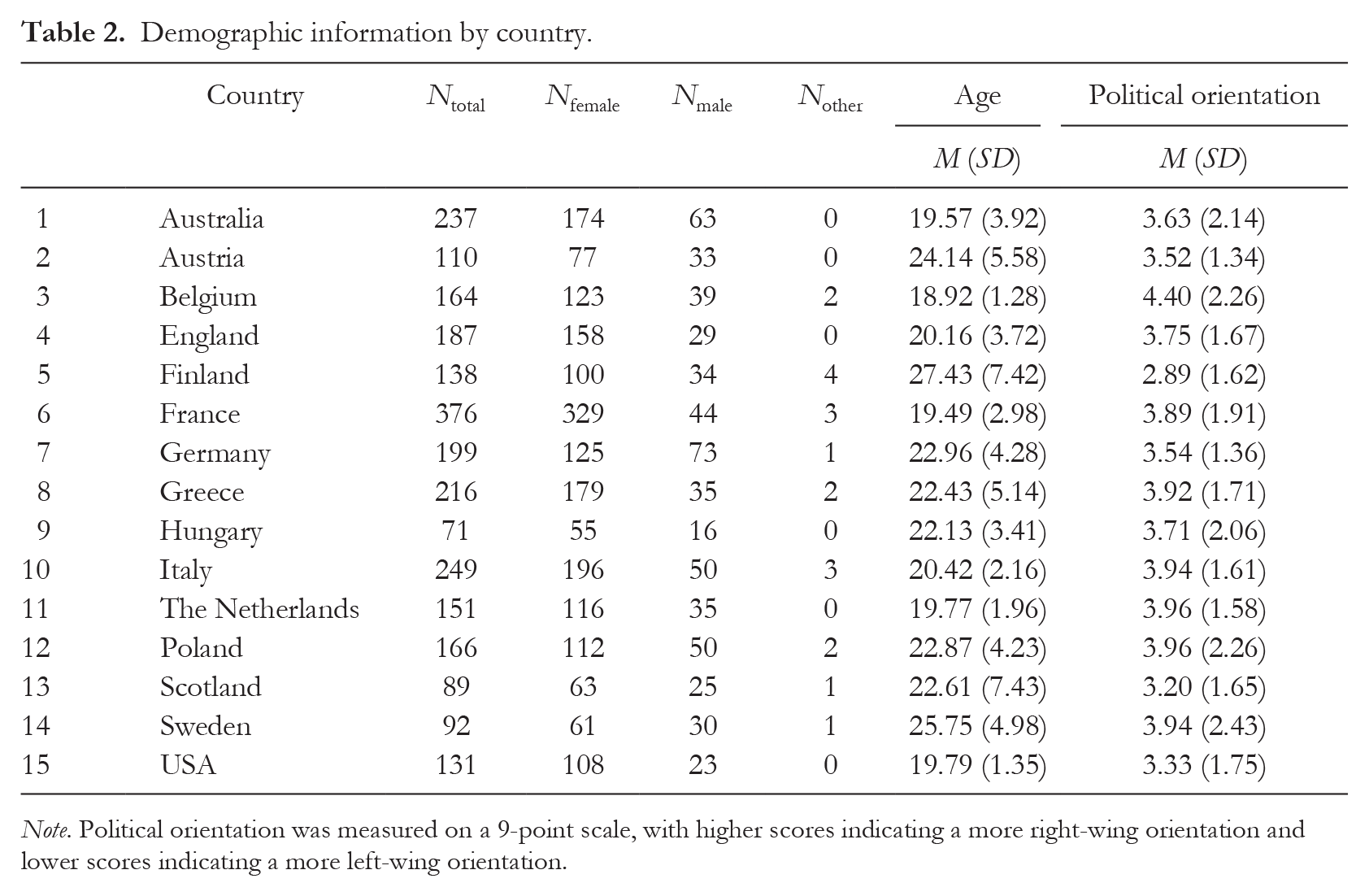
Note. Political orientation was measured on a 9-point scale, with higher scores indicating a more right-wing orientation and lower scores indicating a more left-wing orientation.
Analytical Procedure
Participants in our sample were nested in different countries (and as an extension, nested in different universities). Although for such a design the norm is to utilize a multilevel modelling approach (see Raudenbush & Bryk, 2002), our primary analysis involved analyzing the data independently for each country using multigroup path analysis, for three reasons. First, our interest resided in testing whether the association between media exposure, perceptions of acceptability and prevalence of the far-right, and attitudes towards this movement would emerge in each country. A multilevel modelling approach would provide an estimate across all participants and groups, and would thus be unable to answer our question about country-specific variation in the hypothesized associations in each specific country. Second, even if we followed a multilevel modelling approach, our number of Level 2 groups (n = 15) was too low to provide a highly reliable estimate for such an effect. Third, we reasoned that since the target far-right group was different for each country, conducting an analysis assuming that each outgroup is conceptually the same could be potentially misleading. Although each far-right group we selected in our study adhered to a general far-right ideology that was conceptually similar across nations, each group had its own independent agenda and history that varied greatly. Considering all these factors, we opted to report results based on a multilevel analytical approach as secondary analyses in the Supplemental Material.
To test the direct and indirect associations for our variables in each country independently, we computed a multigroup path analysis in SAS Version 9.4. In this model, media exposure to far-right movements was the exogenous variable, perceived prevalence and perceived acceptability of the far-right movement were the two parallel mediators, with pro- and anti-far-right attitudes as simultaneous outcomes (see Figure 1). Finally, we also conducted a meta-analysis to produce an overall effect across countries.
Multigroup Path Analysis
We evaluated model fit based on the recommendations made by Kline (2016), which state that a model provides a good fit to the data if the chi-square value is not significant. Importantly, this value is often disregarded as it is inflated by a large sample size, which was the case for our sample. Instead, in these cases, Kline (2016) recommends evaluating model fit based on cut-off values for incremental model fit indexes. These are: CFI > .95, RMSEA < .08, and SRMR < .08. The estimated multigroup path model provided an acceptable fit to the data: χ2(44) = 107.72, p < .001, CFI = .974, RMSEA = .092, SRMR = .073. Detailed results for each country, together with the meta-analytical findings, are displayed in Table 3. Figure 2 presents a visual representation of the meta-analytical effects.
Path coefficients from multigroup path analysis and meta-analytic findings.

Note. The values are unstandardized beta estimates; standard errors are reported within parentheses. Entries in bold were statistically significant. For the Q test of heterogeneity, df = 15.
p < .05. **p < .01. ***p < .001.
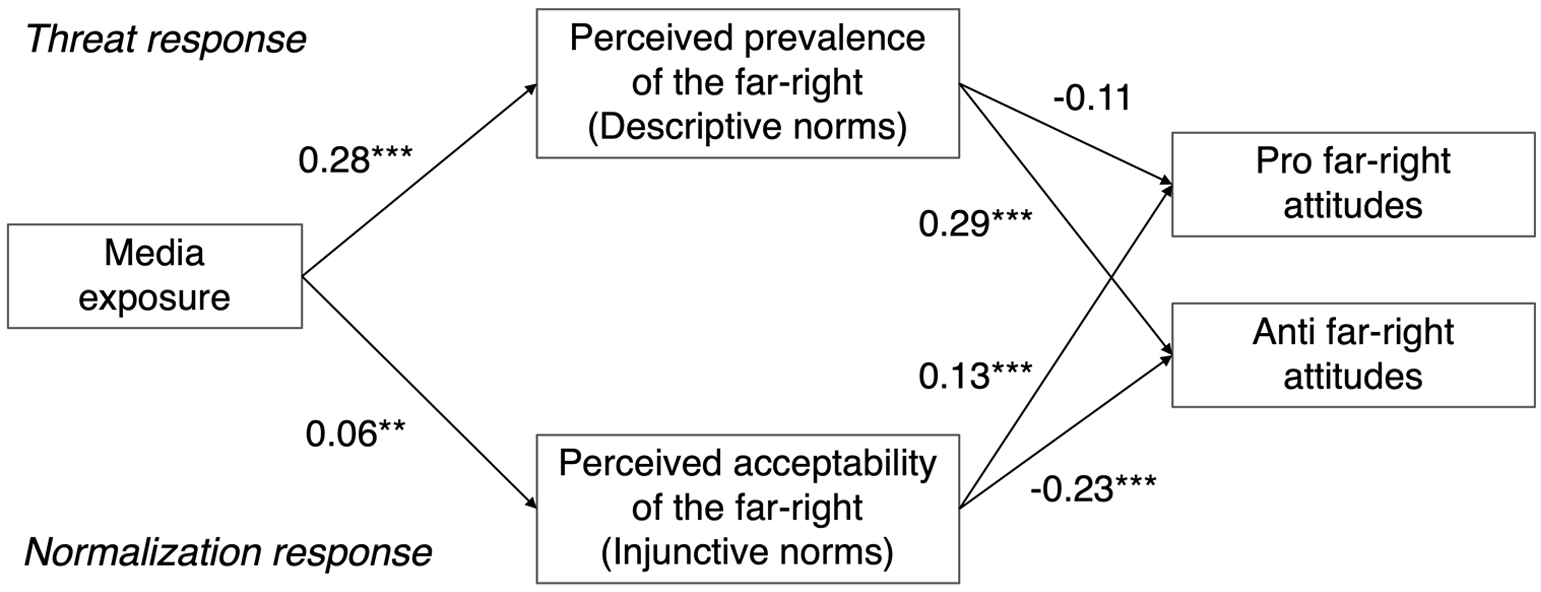
Meta-analytical associations for the hypothesized model.
Effects of media exposure
Media exposure to the far-right was significantly and positively associated with perceived prevalence of this movement in each of the 15 samples. The overall association was significant, b = 0.28, p < .001, 95% CI [0.24, 0.32]. Media exposure to the far-right was significantly and positively associated with perceived acceptability of the movement in only five out of 15 samples; however, the overall association was significant and in line with our hypothesis, b = 0.06, p = .004, 95% CI [0.02, 0.11].
Effects of perceived prevalence of the far-right
Perceived prevalence of the far-right was more consistently associated with anti-far-right attitudes than with pro-far-right attitudes. For anti-far-right attitudes, a significant positive association emerged in 13 out of 15 samples, while for pro-far-right attitudes, a significant negative association emerged in three out of 15 samples. Only the meta-analytical association for anti-far-right attitudes was significant (anti-far-right attitudes: b = 0.29, p < .001, 95% CI [0.21, 0.37]; pro-far-right attitudes: b = −0.11, p = .056, 95% CI [−0.22, −0.002]).
Effects of perceived acceptability of the far-right
Perceived acceptability of the far-right was seemingly more consistently associated with anti-far-right attitudes than with pro-far-right attitudes. For anti-far-right attitudes, a significant negative association emerged in nine out of 15 samples, while for pro-far-right attitudes, a significant positive association emerged in six out of 15 samples (five of which also showed the negative association with anti-far-right attitudes). Both meta-analytical associations were significant (anti-far-right attitudes: b = −0.23, p < .001, 95% CI [−0.32, −0.15]; pro-far-right attitudes: b = 0.13, p < .001, 95% CI [0.08, 0.18]).
Indirect effects of media exposure on public attitudes towards the far-right
As seen in Table 4, the indirect effects of media exposure on public attitudes towards the far-right via the mediating mechanism of perceived prevalence of the far-right (threat response) showed more consistent findings for anti- than for pro-far-right attitudes. For anti-far-right attitudes, this indirect effect was significant in 10 out of 15 samples. For pro-far-right attitudes, the indirect effect was only significant in two samples. However, for both indirect effects, the overall effect across samples was significant (anti-far-right attitudes: b = 0.07, p < .001, 95% CI [0.05, 0.09]; pro-far-right attitudes: b < −0.01, p = .040, 95% CI [−0.06, −0.001]).
Indirect effect coefficients from multigroup path analysis and meta-analytic findings.

Note. The values entries are unstandardized beta estimates; standard errors are reported within parentheses. Entries in bold were statistically significant.
For the Q test of heterogeneity, df = 15.
p < .05. **p < .01. ***p < .001.
When examining the indirect effects of media exposure on public attitudes towards the far-right via the mediating mechanism of perceived acceptability of this movement (normalization response), the results were largely nonsignificant for most samples. For the media exposure → perceived acceptability of the far-right → anti-far-right attitudes pathway, only two indirect effects were significant. However, the overall indirect effect across samples was significant, b = −0.01, p = .004, 95% CI [−0.02, −0.002]. For the same indirect effect on pro-far-right attitudes, no indirect effect was significant. Similarly, the overall indirect effect was not significant, b = 0.001, p = .113, 95% CI [−0.001, 0.002].
Exploratory analysis: Moderation by political orientation
We considered the possibility that political orientation could moderate the associations between news consumption and perceived injunctive and descriptive norms, as well as the associations between perceived norms and pro-/anti-far-right attitudes. We tested this possibility in a multilevel path model with the interaction term between news consumption and political orientation, as well as the interaction terms between injunctive norms and political orientation, and between descriptive norms and political orientation, inserted as predictors (on the mediators and outcomes, respectively). Overall, only one interaction term was statistically significant. Specifically, there was a significant interaction between injunctive norms and political orientation on anti-far-right attitudes (b = −0.03, p < .005, 95% CI [−0.05, −0.02]), suggesting that for those who had a more right-wing orientation, the negative association between injunctive norms and anti-far-right attitudes was stronger. However, given the fact that all other interaction terms were not significant (including the coefficient for the same interaction for pro-far-right attitudes), we recommend interpreting this effect with caution.
Discussion
Across 15 Western countries, we examined how media exposure to news coverage of the far-right was related to perceived norms and attitudes toward this movement. We found that media exposure to the far-right was consistently related to greater perceived prevalence of the far-right (i.e., perceived descriptive norms), but greater media exposure was not always related to greater perceived acceptability of the far-right (i.e., perceived injunctive norms). This suggests that seeing more instances of far-right news coverage in the media was related to believing that these groups were becoming more pervasive and commonplace in society. However, media exposure was not similarly accompanied by the sense that far-right movements were more welcomed and tolerated by others. Specifically, the association between media exposure and perceived prevalence of the far-right emerged in all 15 countries. However, the association between media exposure and perceived acceptability of the far-right emerged only in five countries (i.e., Austria, England, France, Greece, and Italy).
In addition, we found some evidence that perceived prevalence was related to less favorable attitudes toward the far-right, indicative of a threat response, whereas perceived acceptability was related to less unfavorable attitudes toward the far-right (i.e., weakening of negative attitudes), indicative of a normalization response. These divergent findings for the effects of perceived descriptive and injunctive norms on attitudes toward the far-right were in line with our recent work in the context of the Alt-Right in the US (Selvanathan & Leidner, 2022). Notably, however, comparing the findings cross-nationally, the threat response (but not the normalization response) emerged more consistently for each country.
In terms of the underlying mechanisms, we again found more consistent evidence for a threat response related to media consumption, rather than a normalization response. Media exposure was related to more unfavorable attitudes toward the far-right via greater perceived prevalence (found in 10 countries: Australia, Austria, England, France, Greece, Hungary, Italy, the Netherlands, Poland, and the US). However, there was less evidence of a link between media exposure and more favorable attitudes toward the far-right via perceived acceptability (only found in two countries: Poland and the US). This suggests that media consumption of news on the far-right is more likely to be associated with an alarmed response – viewing the far-right as a threat – rather than with the normalization of their views. Thus, the purposed normalization effects of the far-right are not inevitable, as at least a portion of society may be galvanized to mobilize against this movement. The inconsistent findings around the role of perceived acceptability and a normalization response suggest that there may be potential moderators of this effect, which we discuss below.
Theoretical and Applied Implications
The current findings add to extant literature on how the media affects norms and public attitudes surrounding fringe movements. A considerable amount of research has demonstrated that social norms can potentially sway public opinion and behaviors (McDonald & Crandall, 2015; Tankard & Paluck, 2016), however, much less work has considered the impact that everyday media exposure has on perceived norms. Moreover, there appears to be an implicit contradiction between research demonstrating that the rise of opponent groups can provoke counter-mobilization (Freel et al., 2022; Louis et al., 2010), and research demonstrating that the rise of a minority can attract emulation and conformity (Sparkman & Walton, 2017; see also Portelinha & Elcheroth, 2016), particularly by changing perceived norms (Crandall et al., 2018). Our work directly tests both possibilities by conceptualizing a threat and a normalization response to capture both potential reactions.
Integrating the media effects literature with social norms research, our findings are consistent with the agenda-setting function of the media (McCombs, 2002). Specifically, we provide direct evidence for the link between news consumption and perceived norms. This suggests that featuring far-right groups in the media is not without consequence, and may be important in shaping the normative climate of society. In our case, media exposure was related to a threat response rather than having a normalization function. The present research is consistent with the social norms approach (Lapinski & Rimal, 2005; Tankard & Paluck, 2016), which suggests that regardless of the reality of a situation, the perceptions that people hold about a situation are important in shaping their attitudes. Moreover, by contributing to an understanding of attitudes around conservative, ring-wing movements, we extend the collective action and social movements literature that has focused predominantly on progressive, left-wing movements (Simi et al., 2024; Thomas & Osborne, 2022).
Our findings also hold relevance to journalists’ and political commentators’ reporting on far-right groups. Routinely featuring far-right groups in news stories can have the consequence of shaping people’s perceptions of reality, and even distorting them. Several commentators have warned that repeatedly featuring far-right groups in the media, even critically, may inadvertently normalize them (Beckett, 2017; Wodak, 2020). However, our findings showed limited support for this proposition. We found considerably less evidence for a normalization response, and more consistent evidence for a threat response. Thus, bringing the far-right into the mainstream may have divergent consequences that could lead to polarization. While it could perhaps legitimize their platform and policy agenda, media coverage can also cause alarm and prompt people to mobilize against the perceived threats of the far-right. People do not merely follow along with new normative standards in society, but they also oppose and mobilize against these changes when they are perceived to be against their own values as well as broader norms within a community (see Ruisch & Ferguson, 2022). This aligns with the warnings from the United Nations Secretary-General António Guterres, who has emphasized that far-right extremism, including White supremacy and neo-Nazi groups, constitutes a “transnational threat,” and has called for “global coordinated action to defeat this grave and growing danger” (“White supremacy,” 2021).
Limitations and Future Directions
Despite the consistency in our findings and the overall significant meta-analytical effects (and multilevel regression effects), our investigation had several noteworthy limitations. First and foremost, this research focused on Western populations and was Eurocentric by design. This by no means suggests that far-right mobilization is limited to the Western world. For example, far-right groups have gained popularity and political appeal in India, Myanmar, and Brazil (Mustaffa, 2021; Weld, 2020). It is possible that our findings will similarly apply in other regions in which the far-right has mobilized; however, the large cross-national variability observed in our study indicates that the strength of effects will undoubtedly vary. Our samples were also limited to undergraduate student populations who were largely left-leaning, which suggests that our findings may not generalize to the broader population. Future research should investigate the extent to which threat and normalization processes occur in heterogeneous or nationally representative samples.
Relatedly, we collected data in 15 countries, which resulted in a substantial dataset, but, at the same time, implied that we could not systematically assess country-level moderators. It is possible that political conditions in certain countries make the normalization effect more prominent, while in others, a threat response is more likely. For example, factors such as country-level conflict, the current political party in power, or media freedom could shape these outcomes. These hypotheses await further empirical testing with a larger number of countries to be able to assess country-level moderation. One interesting possibility is that when the political party in power is right-wing, a normalization response is more likely because there is a perception that right-wing ideas are broadly supported (see e.g., Portelinha & Elcheroth, 2016). The specific content of the media coverage may also emerge as a potential moderator. Perhaps when mainstream media is critical of the far-right, a threat response may be more likely because of media framing effects (Nelson et al., 1997) whereby the subtle ways in which issues and stories are presented by journalists, reporters, or news anchors can influence the public’s perceptions.
Although we did not find strong evidence that political orientation moderated the results, our findings may have been limited by the lack of diversity in our sample, as most participants were relatively left-leaning or progressive. A more politically diverse sample might have revealed that a threat response is stronger amongst political progressives, while a normalization response is stronger amongst political conservatives. This possibility aligns with research on political polarization, which shows that exposure to opposing views can cause partisans to become more entrenched in their preexisting views (Bail et al., 2018). For example, political progressives who are exposed to far-right ideologies may become more firmly opposed to those views, perceiving them as a greater threat. By contrast, political conservatives may interpret the same exposure as a sign of increasing acceptance of those ideologies, thereby reinforcing their support for them.
Furthermore, our design was cross-sectional and relied exclusively on self-reports. Although this is a common approach in the literature (e.g., Calzo & Ward, 2009; Nellis & Savage, 2012; Romer et al., 2003; Vaes et al., 2015), it raises the possibility of memory bias as people may not accurately recall whether and how much they saw coverage of far-right groups in the news. Research has found that self-reported media exposure is moderately reliable (Lee et al., 2008; Scharkow, 2019). Lee et al. (2008) argue that observed associations between self-reported media exposure and outcome variables would likely be an underestimation of their true association. Building on our findings and conclusions, future investigations could link actual media coverage of focal far-right groups with surveys of public opinion (e.g., Boomgaarden & Vliegenthart, 2007). Future studies could also examine the links longitudinally, or experimentally manipulate media exposure to establish a cause–effect relationship which could solidify the potential downstream consequences that media exposure has for attitudes towards the far-right.
Concluding Remarks
The rise of the far-right across many Western democracies means that they are increasingly featured in the media. In the present research, we examined the link between media exposure and perceived norms around the far-right, and how this relates to personal attitudes toward this movement. We found more consistent evidence for a threat response whereby media exposure was related to greater perceived prevalence, which in turn predicted more unfavorable attitudes toward the far-right. By contrast, there was considerably less evidence of a normalization response, where only in some instances, media exposure was related to greater perceived acceptability, which in turn predicted more favorable attitudes toward the far-right. Our findings suggest that although public debate has centered on the potential normalization effects of the far-right, we should be cautious in inferring solely this outcome because of the competing and potentially stronger effects of threat.
Supplemental Material
sj-docx-1-gpi-10.1177_13684302241309554 – Supplemental material for Far-right movements in the Western world: How media exposure relates to normative beliefs and attitudes toward the far-right
Supplemental material, sj-docx-1-gpi-10.1177_13684302241309554 for Far-right movements in the Western world: How media exposure relates to normative beliefs and attitudes toward the far-right by Hema Preya Selvanathan, Bernhard Leidner, Stylianos Syropoulos, Winnifred Louis, Levi Adelman, Aphrodite Baka, Christina Bauer, Martijn Blikmans, Maja Becker, Eszter Beran, Michał Bilewicz, Peggy Chekroun, Tobias Greitemeyer, Bettina Hannover, Inga Jasinskaja-Lahti, Peter Kardos, Mengyao Li, Torun Lindholm, Steve Loughnan, Theresa Mros, Maria Paola Paladino, Marina Papadopoulou, Daniel R. Rovenpor, Kathrin Sadus, Jeroen Vaes, Alain Van Hiel and Martijn van Zomeren in Group Processes & Intergroup Relations
Footnotes
Acknowledgements
We would like to thank Gabriela Küchler, who assisted with the survey translation in Germany, and Evan Bottomley, who assisted with data collection in Scotland.
Author’s Note
The first four authors are listed based on their contributions to the manuscript. All other authors are listed alphabetically by last name.

Declaration of Conflicting Interests
The author(s) declared no potential conflicts of interest with respect to the research, authorship, and/or publication of this article.
Ethical Approval and Informed Consent
This research received ethics approval from the Institutional Review Board at the University of Massachusetts Amherst, and all participants provided informed consent prior to taking part in the study.
Funding
The author(s) received no financial support for the research, authorship, and/or publication of this article.
ORCID iDs
Supplemental Material
Supplemental material for this article is available online.
Notes
References
Supplementary Material
Please find the following supplemental material available below.
For Open Access articles published under a Creative Commons License, all supplemental material carries the same license as the article it is associated with.
For non-Open Access articles published, all supplemental material carries a non-exclusive license, and permission requests for re-use of supplemental material or any part of supplemental material shall be sent directly to the copyright owner as specified in the copyright notice associated with the article.
