



Abstract
Intragroup empathy is vital for resilience. However, it is often impaired in advantaged-dominated environments when one adopts advantaged-group characteristics to climb the social ladder. The current work examines contextual factors that may affect intragroup empathy: the motivation behind adopting the advantaged-group characteristics, and negative encounters with members of the advantaged group. We hypothesized that coercively, versus willingly, adopting advantaged-group characteristics will increase intragroup empathy both when the outcomes are negative and positive. We further hypothesized that a negative encounter with an advantaged-group member would increase intragroup empathy, compared to no encounter. In three studies, Palestinian students in Israeli academia were assigned to read scripts depicting the academic experience of a Palestinian student adopting advantaged-group characteristics. We tested (a) the effects of motivation following a negative outcome (N = 182); (b) the effects following a positive outcome (N = 205); and (c) the interaction between a negative encounter with an advantaged-group member and motivation, and its effect on intragroup empathy (N = 282). Intragroup empathy was higher in the coerced condition compared to the free-willing condition both for negative and positive outcomes. A negative encounter with an advantaged-group member increased intragroup empathy in the willing condition. By illuminating contextual variables that shape intragroup empathy, this research shows that impairment in intragroup empathy is not inevitable. This work may serve as a foundation for future interventions.
Sayed Kashua [a famous writer] can’t find his place in Israel. The Jews do not like him because he is an Arab. The Arabs do not like him because he is successful among the Jews.
There is ample evidence showing that disadvantaged intragroup empathy is crucial for resilience (Bou Zeineddine & Leach, 2021; Grant & Kinman, 2012; Halabi, 2016; Leach & Zeineddine, 2021; Morrison, 2007; Segal et al., 2011). In his work, Halabi (2016) demonstrates that intragroup empathy is one of the main factors contributing to the resilience that disadvantaged students display in advantaged environments. Moreover, studies in the realm of education show that effective interventions for advancing disadvantaged-group members are based on the efforts of the disadvantaged group to support each other (Dennehy & Dasgupta, 2017).
Yet, members of disadvantaged groups may face a dual empathy barrier from both their ingroup and the outgroup in the advantaged-dominant environment. They experience diminished empathy from the advantaged group members as they are still considered an outgroup despite sharing the same environment. Moreover, when aiming to attain resources and consequently needing to adapt by adopting characteristics and behaviors associated with the advantaged group (Johnson & Kaiser, 2013), their status within their ingroup is hampered as they become associated with the advantaged group environment (Johnson & Ashburn-Nardo, 2014; Johnson & Kaiser, 2013).
Together, these two patterns display the tension that disadvantaged-group members face in the advantaged-group-dominated context: they are dependent on support from their ingroup, but, in certain circumstances, do not receive it due to their efforts to integrate into the outgroup environment. An important question, hence, pertains to the factors that can potentially attenuate or amplify that process of reduced intragroup empathy.
Extensive research has been conducted on intergroup empathy, including empathy between members of advantaged and disadvantaged groups (Cikara, 2015; Cikara et al., 2011; Cikara et al., 2014; Han, 2018; Klimecki, 2019; Levy et al., 2016; Xu et al., 2009; Zaki & Cikara, 2015). Results of this line of work show not only decreased empathy towards outgroup members but also counter-empathic responses such as feeling pleasure in response to outgroup members’ pain, known as the schadenfreude (Cikara & Fiske, 2013; Heider, 1958; Ouwerkerk et al., 2018). However, few studies have been conducted on disadvantaged intragroup empathy, and thus little is known about the contextual factors shaping it. The current research examines contextual variables that may lead to increased or decreased intragroup empathy when disadvantaged members adopt advantaged-group-related characteristics and behaviors. We specifically focus on two such variables: the motivation behind adopting the advantaged-group-related characteristics, and negative encounters with the advantaged group.
Adoption of Advantaged-Group-Related Characteristics and Behaviors
Disadvantaged-group members are individuals who, as a result of racial or ethnic discrimination or prejudice, are denied equal access to resources in society (Schmitt & Branscombe, 2002). Consequently, disadvantaged-group members may attempt to integrate into advantaged environments to raise their social status. In advantaged environments, dominant-group-related characteristics and behaviors prevail, while disadvantaged-group-related characteristics and behaviors are marginalized and underrepresented (Agbaria, 2017; Kassem et al., 2022; Salter et al., 2018). Therefore, to adapt to such environments, disadvantaged members may adopt advantaged-group-related characteristics and behaviors, for example, speaking the advantaged group’s language, dressing similarly, and having friends who belong to the advantaged outgroup.
Such adoption of the advantaged-group-related characteristics and behaviors comes at a high cost, which includes psychological distress manifested in increased levels of anxiety, emotional exhaustion, and inner turmoil (Akhtar, 2014; Bhugra & Becker, 2005). For example, using the language of the advantaged group decreases positive emotions compared to using one’s native language (Kassem et al., 2022). On the collective level, the use of advantaged-group-related characteristics and behaviors may result in an impairment in intimacy and the ability to maintain social bonds (Durkee & Gómez, 2022; Neal-Barnett et al., 2010). Klar et al. (2020) demonstrated that a common practice among the disadvantaged, code-switching—alternating between Arabic and Hebrew—leads to a loss of credibility among ingroup members, even when expressing full support for their own group’s independence. This impairment in maintaining social bonds may extend to empathy (Johnson & Ashburn-Nardo, 2014; Johnson & Kaiser, 2013).
Empathy has numerous definitions (Batson, 2009); in this paper, we define empathy as the capacity to feel with and understand another person (Johnson & Ashburn-Nardo, 2014; Johnson & Kaiser, 2013; Zaki & Cikara, 2015). Empathy serves as a strong proxy for prosocial behavior (Batson, 2009; Zaki & Cikara, 2015). A counter-emotional response to empathy is the experience of pleasure when witnessing the suffering of the other. This emotion is known as schadenfreude (Cikara & Fiske, 2013; Heider, 1958; Ouwerkerk et al., 2018), It has been mainly examined toward the outgroup, but there is also evidence showing that it can be expressed toward the ingroup (Hudson et al., 2019). Schadenfreude can lead to either a sense of indifference towards the pain of others or, in more extreme cases, it can contribute to causing harm to them (Cikara & Fiske, 2013), exhibiting aggressive behavior towards the suffering person (Cikara et al., 2011). Schadenfreude tends to be more prevalent when an individual perceives another person as a threat or holds negative feelings toward them. The experience of pleasure upon witnessing misfortune among others may be viewed as an instrumental, potentially adaptive reaction in situations where resources are limited (Cikara & Fiske, 2013).
Past research shows that adopting the advantaged-group-related characteristics and behaviors on the part of a disadvantaged-group member decreases intragroup empathy towards that disadvantaged-group member. In one study, Black participants at a predominantly Black university were asked to read scenarios depicting a Black law intern at a prestigious law firm who was discriminated against (Johnson & Kaiser, 2013). When the Black intern was presented as wealthy rather than nonwealthy, Black participants reported decreased empathy towards him using self-report measures of empathic concern. Another study showed that Black students reported decreased intragroup empathy (using general self-report measures of empathic concern) towards Black peers when they were associated with White friends (Johnson & Ashburn-Nardo, 2014). In this latter study, Black students also from a historically Black university were presented with a Facebook profile of a Black or White male. The profile included a “Top Friends” section signaling the peers that the owner of the profile associated with the most, which included two White or two Black friends in the pictures. When the section displayed two White rather than Black friends, the participants reported decreased empathy for the disadvantaged-group member.
Both studies demonstrate that when disadvantaged-group members adopt advantaged-group-related characteristics and behaviors, they are denied empathy to some degree. They further suggest that the decrease in disadvantaged intragroup empathy may be an inevitable side effect of adapting to an advantaged-group environment. The authors also support their findings with social identity theory, which suggests that minorities, even more so than majorities, benefit psychologically from having a clearly defined and positive social identity (Tajfel et al., 1979). Consequently, members of minority groups often respond to marginalization by distancing themselves from the outgroup in self-defense, reasoning that they have unique and better characteristics, and punishing ingroup members who adopt advantaged-group-related characteristics and behaviors. This is also in accord with optimal distinctiveness theory (Brewer, 1991), which proposes that individuals have two fundamental and competing human needs—the need for inclusion and the need for differentiation. In advantaged-group-dominated contexts, the disadvantaged group shares the same advantaged environment and, thus, the need for distinction may have to be fulfilled by their own group characteristics and behaviors.
These studies showed a reduction in disadvantaged intragroup empathy when a member adopted advantaged-group-related characteristics and behavior, however, schadenfreude was not examined. Moreover, little is known about the contextual factors that may facilitate or impede this reaction. The current work aims to examine contextual variables that may enhance or weaken intragroup empathy within the context of adopting characteristics and behaviors of the advantaged group. We specifically focus on two such variables—the motivation behind adopting the advantaged-group-related characteristics, and negative encounters with members of the advantaged group.
Contextual Variables Shaping Intragroup Empathy
Motivation
An important variable that may affect empathy is whether the motivation behind a member’s adoption of advantaged-group-related characteristics is internal or external. In the advantaged environment, disadvantaged-group members are often forced or strongly encouraged to use advantaged-group-related characteristics and behaviors (e.g., speaking the dominant language). Yet past findings show that when a disadvantaged-group member is associated with advantaged-group-related characteristics and behaviors without providing context, it results in other disadvantaged-ingroup members denying his or her racial identity (Johnson & Ashburn-Nardo, 2014; Johnson & Kaiser, 2013). This paradox could be explained by the classic fundamental attribution error theory: when observing others, individuals tend to attribute causes to internal factors, such as personality characteristics, and to ignore or minimize external contextual variables (Ross, 1977).
It may be argued that, without explicitly referring to the root causes of the motivation, ingroup members tend to perceive individual motivation to adopt the advantaged-group-related characteristics and behaviors as internal. This should be the case both when there are negative outcomes and when there are positive outcomes for the group members. This internal motivation is often associated with a perception of individual mobility, a phenomenon in which disadvantaged-group members advance their status without necessarily changing the status of their ingroup. In return, the individuals are often denied empathy and ostracized by their ingroup members (Agbaria, 2017; Guiffrida & Douthit, 2010). On the other hand, when the source of adoption of the signs is external, meaning that the adoption of the signs is forced, this could lead not only to not punishing the individual but also to increasing levels of empathy towards them, as coercive advantaged signs are associated with increased outgroup threat and increased ingroup favoritism (Everett et al., 2015).
Negative encounters with the advantaged group
Past research (Cortland et al., 2017) shows that shared experiences of discrimination between groups can be used to facilitate positive intergroup relations. Moreover, when exposed to outgroup discrimination, disadvantaged members band together and perceive all members of the group as sharing a common connection (Branscombe et al., 1999; Sellers et al., 2006). This finding is in line with consistent results showing that perceptions of threat from outgroups contribute to ingroup cohesion and favoritism (Everett et al., 2015). Thus, it may be argued that even when disadvantaged-ingroup members willingly adopt atypical characteristics and behaviors, exposure to outgroup threat will lead to more tolerance for such adoption and, hence, levels of empathy will not decrease.
The Current Research
Through a set of three experiments, we aim to understand the influence of contextual variables on empathy towards a group member adopting advantaged-group-related characteristics and behaviors. The first study examines the impact of motivation—choosing or being forced to adopt advantaged-group-related characteristics and behaviors—on different aspects of empathy in the case of a negative outcome. The second study documents whether empathy is affected the same way when the outcome turns out positive. Finally, the third study explores the interaction between negative encounters with advantaged-group members and motivation, and its effect on intragroup empathy.
Our study context is the state of Israel. Palestinian citizens of Israel face discrimination in all spheres of life, including education, health, welfare, and political representation, among others (Daoud et al., 2018; Halabi, 2016; Lewin-Epstein & Semyonov, 2019). Deprivation of resources includes lack of representation of the Palestinians’ native language and the banning of the founding of an Arab university in Israel (A’li, 2017). This deprivation of equal rights, together with full reliance on Jewish, Hebrew-speaking Israeli institutions, leads to ample yet hostile adoption of advantaged-group-related characteristics and behaviors (Halabi, 2016; Jamal, 2011). Our study participants are Palestinian students at Israeli universities in which the official language is Hebrew, and the majority of the student body is Hebrew-speaking and Jewish. Therefore, Palestinian students are often required, explicitly or implicitly, to adopt and employ advantaged-group-related characteristics and behaviors on a daily basis (e.g., speak Hebrew and collaborate with Jewish Israeli peers). In this study, we examine instrumental signs—indicators that must be adopted and are explicitly part of the codes of the advantaged-group environment. Examples include using the language of the advantaged group, collaborating with colleagues from the advantaged group, and working on academic material related to the advantaged group.
Study 1: The Impact of the Motivation Behind Adoption of Advantaged-Group-Related Characteristics and Behaviors on Disadvantaged Intragroup Empathy
The first preregistered study (https://aspredicted.org/8w2fj.pdf) examined whether the motivation behind adopting characteristics and behaviors that are related to the advantaged group influences intragroup empathy. By motivation, we mean adopting the advantaged group characteristics coercively or voluntarily. Our main hypothesis is that participants will report increased disadvantaged intragroup empathy and motivation to help, and decreased schadenfreude measures in the coercive condition compared to the willing condition. The control group would be in between, sometimes closer to the willing condition and, other times, to the coercive condition.
Methods
The studies’ analysis codes and raw data can be found on the Open Science Framework (OSF; https://osf.io/nqhj3/?view_only=3af991b2fd3446fcba3c057279b45c38).
Participants
Participants were recruited via social media—specifically, the Facebook groups of Palestinian students in Israeli academia. The participants were invited to take part in a raffle for a tablet. They needed to meet the following criteria: (a) to be Palestinian students in an Israeli university; (b) to pass an attention check which asked the age of the American President Abraham Lincoln, selecting the right answer from a set that also included three irrational answers; and (a) to respond to the main questions of the survey (regarding empathy, schadenfreude, togetherness, 1 and motivation to help). Also, as part of the exploratory measures, we included a racial identification measure. 2
Since previous studies examining disadvantaged intragroup empathy found a medium to large effect (Johnson & Ashburn-Nardo, 2014; Johnson & Kaiser, 2013), a sample size of 159 participants was determined via G*Power Version 3.1.9.4 (Faul et al., 2007, 2009), with an effect of f = .25 and power set to .80 (df = 2). Since we recruited participants through social media platforms, we had no control over the exact final number of valid participants. Eventually, we reached 182 valid Palestinian students enrolled at Israeli universities who provided answers to the main measures of the survey, and they were included in the study.
Design and procedure
The experiment used a between-subjects design. Participants were randomly assigned to one of three conditions in which they read a script describing a female student who adopts advantaged-group-related characteristics and behaviors (using the advantaged language as well as the group affiliation and research interests of her colleagues) willingly, coercively, or, in the control condition (baseline), the student still studies in the advantaged-group environment but the identity of the signs she adopts is not revealed nor her motivation for adopting them. In all three conditions, the student eventually fails the seminar paper.
Scripts
Control condition
Amal is a student at an Israeli university in her final semester, and she is currently working on her seminar paper. Amal is writing the seminar paper with two students from the department on the subject of education. Throughout the writing process, Amal faces a number of challenges. As a result, she was not able to write her seminar well, and so she failed.
Willing condition
Amal is a student at an Israeli university in her final semester. Amal was accepted to several universities both in Israel and abroad, but she chose to study at an Israeli university. Amal is currently working on her seminar paper. Despite being given the opportunity to write the project in various languages, Amal chooses to write it in Hebrew instead of Arabic or English. Furthermore, Amal chose to collaborate on the seminar with Orna and Rachel [Jewish Israeli names]. The general theme of the seminar is education, and Amal specifically chooses to write about Israeli education. Throughout the writing process, Amal faces a number of challenges. As a result, she was not able to write her seminar paper well, and so she failed.
Coercive condition
Amal is a student at an Israeli university in her final semester. Due to the absence of an Arab university in Israel and because Amal wanted to study at a university, she was compelled to study at this Israeli university. Amal is currently working on her seminar paper. The instructions for writing the seminar paper were to write it in Hebrew, so Amal writes the seminar in Hebrew. Amal was assigned to work on the seminar with Orna and Rachel [Jewish Israeli names]. The general theme of the seminar is education, and specifically, the topic of Israeli education was designated by the course instructor. Throughout the writing process, Amal faces a number of challenges. As a result, she was not able to write her seminar well, and so she failed.
After reading one of the scripts, participants rated their levels of empathy, schadenfreude, and motivation to help the protagonist.
Measures
Empathy
Participants were asked, “How do you feel in response to Amal [the protagonist] following her failure?” Eight broadly defined empathy questions followed, referring to the intensity of empathic care (sympathy, compassion, feeling moved, concerned) and empathic distress (feeling uneasy, upset, overwhelmed, distressed), adopted from Israelashvili et al. (2020). Items were answered using a 6-point scale (1 = not at all, 6 = very much). Cronbach’s alpha reliability of the different empathy items in the scale was α = .89.
Schadenfreude
Participants were asked, “How do you feel in response to Amal following her failure?” They indicated the intensity of the following measures: happiness, comfort, content, and schadenfreude, using a scale adapted from Brigham et al. (1997) and Smith et al. (1996), and answered using a 7-point scale (1 = not at all, 7 = very much). Cronbach’s alpha reliability of the different schadenfreude items in the scale was α = .88.
Motivation to help
Motivation to help was divided into two measures: (a) Personal help, gauged by the response to the question, “Following Amal’s failure, she would appreciate the help of a colleague, whether it is academic or moral support; how much time would you like to volunteer to support her?” The item was answered using a scale ranging from 0 to 6 hours. (b) Institutional help, gauged by the response to “Following Amal’s failure, she needs to register for an additional semester. She does not have the money to fund her studies. If you had the choice, would you dedicate a university scholarship to her, from a fund dedicated to Arab students? If so, what percentage of a scholarship would you like the university to dedicate to Amal?” The scale choices were 0, 25, 50, 75, and 100%. Reliability of these two measures was exceptionally low (α = .03), thus they were analyzed separately.
To analyze the quantitative measures, we averaged the items relating to each of the measures to produce one score for the schadenfreude components and one score for empathy. For the latter, empathic care and distress were merged across the studies, as they reflected high reliability; the measures were also analyzed separately, and that analysis can be found in the supplemental material.
Then, we ran one-way ANOVAs to compare the scores of the different measures for the three groups (control, willing, and coercive). Finally, we ran a post hoc analysis with Tukey adjustment to compare differences among the three groups.
Results
Empathy
There was a significant effect for the motivation behind adopting the characteristics and behaviors of the advantaged group, F(2, 179) = 11.08, p < .001; η2 = .11, 95% CI [0.04, 1.00]. Participants were more empathic in the coercive condition (M = 4.27, SD = 1.12) compared to the willing condition (M = 3.33, SD = 1.25), t(179) = 4.65, p < .001, d = 0.79, 95% CI [0.46, 1.42], as well as compared to the control condition (M = 3.73, SD = 0.94), t(179) = 2.75, p = .018, d = 0.52, 95% CI [0.08, 1.00]. There was no difference between the willing and control conditions, t(179) = −1.93, p = .132, d = −0.37, 95% CI [−0.90, 0.09]. See Figure 1a.
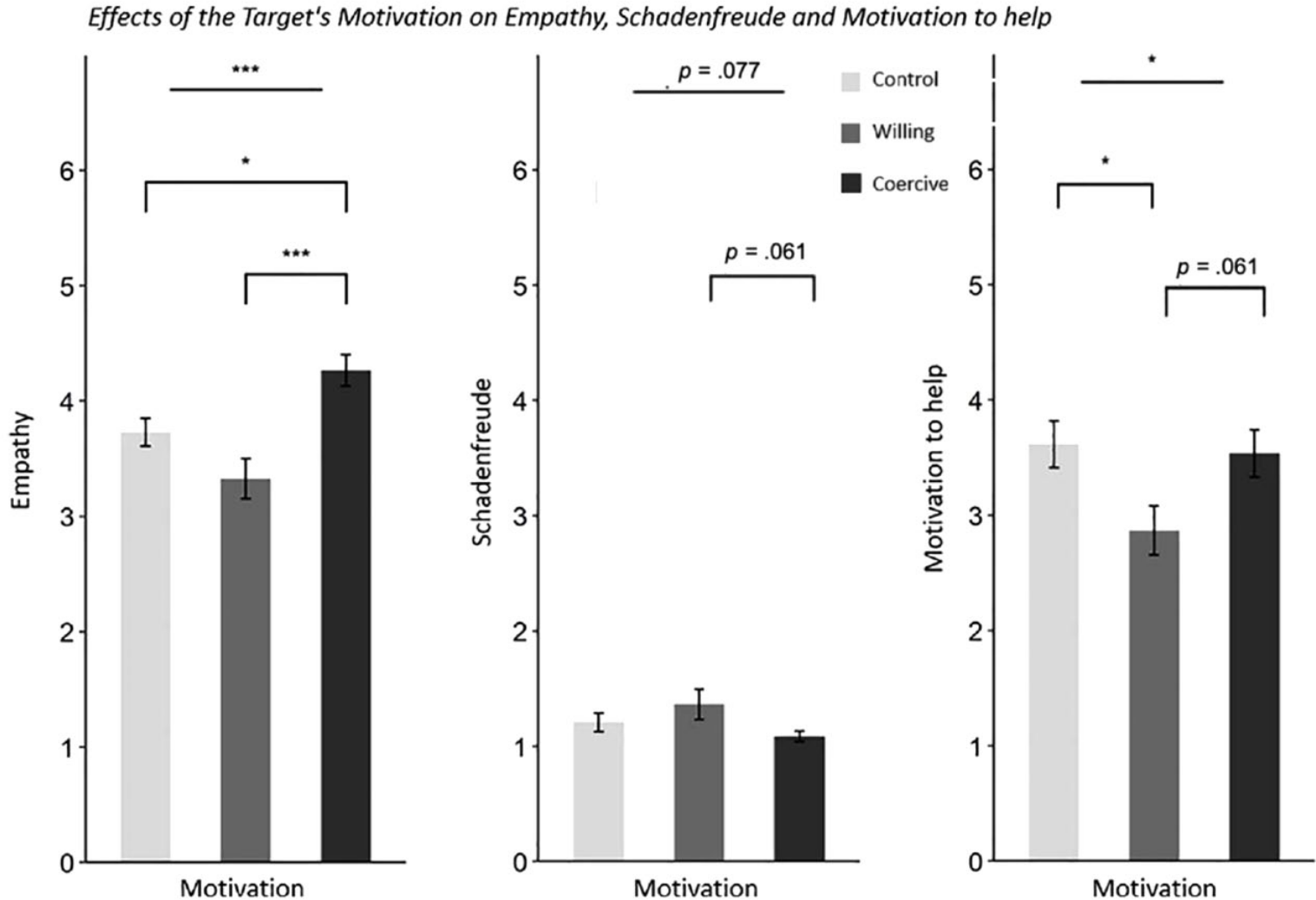
Empathy (a), schadenfreude (b), and motivation to help in the personal help component (c) in the control, willing, and coercive conditions, as rated by participants.
Schadenfreude
While results for schadenfreude were not significant, the trends were, as hypothesized, in the opposite direction of the empathic measures, F(2, 179) = 2.61, p = .077, η2 = .03, 95% CI [0.00, 1.00]. Participants felt less schadenfreude in the coercive condition (M = 1.09, SD = 0.36) as compared to the willing condition (M = 1.36, SD = 0.96), t(179) = −2.28, p = .061, d = −0.40, 95% CI [−0.56, 0.01]. No difference was found between the coercive and control conditions (M = 1.21, SD = 0.61), t(179) = −1.04, p = .554, d = −0.25, 95% CI [−0.40, 0.16]. Also, no difference was found between the willing and the control conditions, t(179) = 1.24, p = .431, d = 0.20, 95% CI [−0.14, 0.45]. See Figure 1b.
Motivation to help
The personal help component revealed a similar pattern to that of the empathy results. The main effect of the motivation behind adopting the characteristics and behaviors of the advantaged group was statistically significant, F(2, 179) = 3.67, p = .027, η2 = .04, 95% CI [0.00, 1.00]. Participants were more willing to help in the coercive condition (M = 3.54, SD = 1.69) compared to the willing condition (M = 2.87, SD = 1.53), t(179) = 2.27, p = .061, d = 0.41, 95% CI [−0.03, 1.36]. No difference was found between the coercive and control conditions (M = 3.62, SD = 1.56), t(179) = −0.28, p = .956, d = −0.05, 95% CI [−0.75, 0.59], whereas participants felt less motivated to help in the willing condition than in the control condition, t(179) = −2.47, p = .037, d = −0.48, 95% CI [−1.46, −0.03]. See Figure 1c.
For the institutional help component, the effect of the motivation behind adopting the characteristics and behaviors of the advantaged group was not significant (control: M = 59.17, SD = 26.83; willing: M = 57.07, SD = 29.57; coercive: M = 63.04, SD = 31.39); F(2, 179) = 0.66, p = .521, η2 < .00, 95% CI [0.00, 1.00], although the direction was as hypothesized (highest for the coercive, lowest for the willing condition).
Study 1 presents evidence that highlighting the coercive policies led to increased empathy for the disadvantaged ingroup member, following a negative outcome. An alternative explanation for these results is that since adoption of the advantaged characteristics resulted in failure, this contributed to enhanced empathy when coercion was behind such behavior. Therefore, in the next study, we examined disadvantaged intragroup empathy following a positive outcome (positive empathy)—when adopting the advantaged characteristics results in attaining resources.
Study 2: Intragroup Positive Empathy
The second study examines the effect of using the advantaged-group characteristics and behaviors on intragroup empathy following a positive outcome. In the first study, we found that participants experienced increased empathy in the coercive condition compared to the willing condition. We wanted to examine if this would still be the case if the adoption of advantaged characteristics were in fact beneficial, that is, resulting in a positive outcome. In our study, we focus on a positive personal experience following the adoption of the advantaged-group signs, rather than a positive outgroup encounter.
We modified the story and outcomes accordingly and mainly hypothesized that coercively using advantaged characteristics will result in increased positive intragroup empathy and motivation to help, compared to the willing condition. The control condition would be somewhere in the middle: higher than the willing condition and lower than the coercive condition. This study was preregistered (https://aspredicted.org/4bq5f.pdf).
Method
Participants
The participants needed to meet the same criteria as in the first study. A sample size of 159 participants was determined via G*Power Version 3.1.9.4 (Faul et al., 2007, 2009), with an effect size of f = .25 and power set to .80 (df = 2). 3 As in Study 1, we recruited participants through social media platforms, eventually reaching 205 valid Palestinian students enrolled at Israeli universities who met the criteria.
Design and procedure
Similar to the first experiment, the second experiment used a between-subjects design. Participants were randomly assigned to one of three conditions where they read one of three scripts describing a student who adopts advantaged characteristics and behaviors willingly, coercively, or (in the control condition) does not adopt them. We used the same scripts as in Study 1 but changed the final line to “the student excelled in her seminar paper.” After reading the scripts, participants rated their empathy and motivation to help in relation to the figure in the script.
Measures
Since this experiment examined empathy in the case of a positive outcome, we modified the previous measures. The empathy measure consisted of positive emotions felt for and with the protagonist, and motivation to help was assessed in the context of helping her practice a speech following her achievement.
Empathy
Participants were asked, “How do you feel in response to Amal following her success?” They were instructed to indicate the intensity of the following emotions: happiness, excitement, satisfaction, warm-heartedness, thrill, and joy using a continuous 6-point scale (1 = not at all, 6 = very much). Cronbach’s reliability among the empathy items was α = .92. 4
Pride
Participants were asked to what extent they felt proud of Amal on a scale ranging from 1 to 6. 5
Motivation to help
This measure contained two items: (a) personal help: participants were asked how much time they would like to volunteer to assist Amal in practicing her speech for an international conference (on a scale ranging from 0 to 6 hours); and (b) institutional help: participants were asked the percentage of scholarship that they would like the university to dedicate to Amal in order to fund her studies in an excellence program (using the following scale: 0, 25, 75, and 100% of the scholarship). Since the two items had exceptionally low reliability (α = .06), we analyzed them separately. Two additional measures were obtained in which the source of the funding was manipulated. One source was a Palestinian entity, the other was Swedish. The two measures were added to examine whether there would be a difference if the source of funding were not from the advantaged-group entity (results are presented in the supplemental material).
Results
Empathy
There was a significant effect for motivation behind adopting the characteristics and behaviors of the advantaged group, F(2, 202) = 4.16, p = .017, η2 = .04, 95% CI [0.00, 1.00]. Participants were more empathic in the coercive condition (M = 4.68, SD = 1.11) compared to the willing condition (M = 4.17, SD = 1.38), t(202) = 2.50, p = .035, d = 0.40, 95% CI [0.03, 1.00]. While there was no difference between the coercive and control conditions (M = 4.67, SD = 1.00), t(202) = 0.09, p = .995, d = 0.02, 95% CI [−0.45, 0.49]. Moreover, participants felt less empathy in the willing condition compared to the control condition, t(202) = −2.51, p = .034, d = −0.41, 95% CI [−0.96, −0.03]. See Figure 2a.
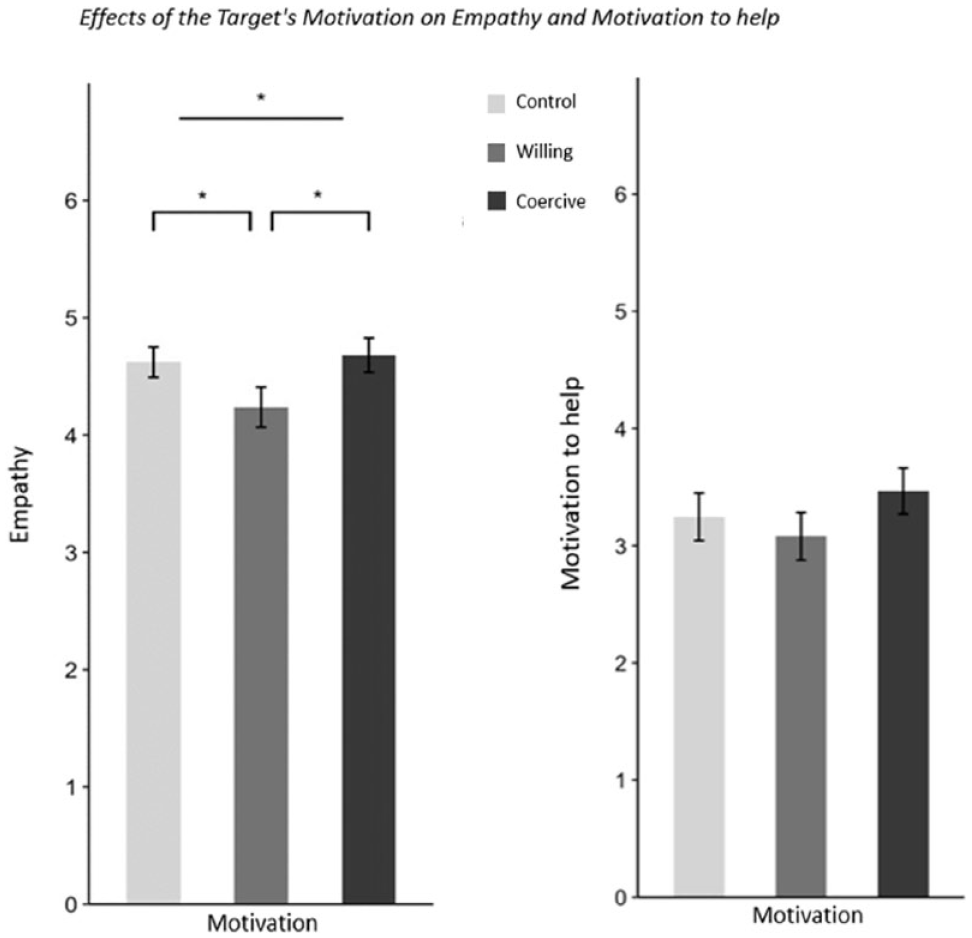
Empathy (a) and motivation to help in the personal help component (b) in the control, willing, and coercive conditions, as rated by participants.
Motivation to help
There was no effect of the motivation behind adopting the characteristics and behaviors of the advantaged group on motivation to help. In terms of the personal help component, the main effect of motivation was not statistically significant (control: M = 3.27, SD = 1.62; willing: M = 3.02, SD = 1.62; coercive: M = 3.53, SD = 1.54), F(2, 202) = 1.70, p = .192, η2 = .02, 95% CI [0.00, 1.00], see Figure 2b. The institutional help component was also not statistically significant (control: M = 75.75, SD = 28.85; willing: M = 66.29, SD = 31.47; coercive: M = 71.19, SD = 31.04), F(2, 202) = 1.70, p = .185, η2 = .02, 95% CI [0.00, 1.00].
The first two studies showed that adopting the characteristics and behaviors of the advantaged group results in decreased intragroup empathy both when the outcome for the protagonist was negative and when she attained resources from adopting the characteristics and behaviors. Next, we wanted to examine the boundaries of this effect. Specifically, we were interested in whether a negative encounter of the protagonist with the outgroup would lead to increased empathy for the disadvantaged ingroup member despite her adoption of advantaged-group-related characteristics and behaviors.
Study 3: The Impact of Negative Outgroup Encounters on Intragroup Empathy
In advantaged environments, encounters with the advantaged outgroup are a common experience and affect disadvantaged intragroup relations (Alexander & Carter, 2022). Thus, we decided to frame the negative outcome as one that was caused by the advantaged-group members, and to examine the effect on intragroup empathy for the disadvantaged-group member who adopts the characteristics and behaviors of the advantaged group either willingly or coercively. We conducted a third preregistered study (https://aspredicted.org/it6d7.pdf). First, we hypothesized that we would replicate our past findings demonstrating that disadvantaged-group members who are forced to adopt the characteristics and behaviors of the advantaged group will receive higher levels of empathy and motivation to help, and a lower level of schadenfreude than those who willingly adopt the characteristics and behaviors of the advantaged group. Second, we hypothesized that there would be an interaction effect such that differences in intragroup empathy between the forced and willing conditions will be smaller when a negative encounter with the advantaged group is involved, compared to lack of a negative encounter.
Method
Participants
A sample size of 132 participants was determined via G*Power Version 3.1.9.4 (Faul et al., 2007, 2009), with an effect size of f = .27 and power set to .80 (df = 2). To be able to reach an adequate number of participants and due to the novel nature of the study, we overrecruited participants via social media platforms. Since we had no control over the final exact number, we eventually reached the number of 282 participants enrolled at Israeli universities.
Design and procedure
We used a 2 × 2 between-subjects design where the first variable was the motivation behind sign adoption (willing, coercive), and the second variable was a negative encounter with the advantaged group (yes, no). As in Study 1, the dependent variables were the rating of empathy, motivation to help, and schadenfreude. Each participant read a script about a Palestinian student who willingly/coercively adopted the advantaged-group characteristics and behaviors, and due to the difficulties she encounters, she fails her seminar. In half of the scripts, there was a reference to negative encounters with advantaged-group members as the source of the protagonist’s failure (“Amal had multiple challenges while working with Orna and Rachel, her Jewish Israeli colleagues”). Then, the participants responded to the measures of empathy, schadenfreude, and motivation to help.
Measures
The measures used in this study were identical to those in Study 1.
Empathy
Participants were asked to indicate the intensity of empathic care and empathetic distress (α = .90).
Schadenfreude
Participants were instructed to indicate the intensity of schadenfreude items (α = .66).
Motivation to help
This measure was divided into two measures: personal assistance and institutional assistance. Reliability of these two measures was exceptionally low (α = .07), thus, they were analyzed separately. As in Study 2, two additional measures were obtained in which the source of the funding was manipulated (Palestinian and Swedish institutions).
Results
A multivariate analysis of variance (MANOVA) was conducted to examine the effects of the negative encounter and motivation behind adoption of characteristics on the dependent variables: empathy, schadenfreude, and motivation to help. The results showed that the main effect of the negative encounter was not significant, Pillai’s V = .02, F(1, 275) = 1.60, p = .175. However, the main effect of motivation was significant, Pillai’s V = 0.06, F(1, 275) = 4.42, p = .001. Additionally, the interaction effect of exposure and motivation was not significant, Pillai’s V = .02, F(1, 275) = 1.35, p = .250.
Empathy
The main effect of the motivation behind adopting the characteristics and behaviors of the advantaged group on empathy was statistically significant. Participants experienced more empathy in the coercive condition compared to the willing condition (willing: M = 3.64, SD = 1.20; coercive: M = 4.16, SD = 1.14), F(1, 278) = 13.87, p < .001, η2 = .05, 95% CI [0.01, 1.00]. The main effect of negative encounter on empathy was not statistically significant (yes: M = 4.01, SD = 1.15; no: M = 3.81, SD = 1.24), F(1, 278) = 1.84, p = .176, η2 = .00, 95% CI [0.00, 1.00]. The interaction between the negative encounter and motivation was marginally significant, F(1, 278) = 3.79, p = .052, η2 = .01, 95% CI [0.00, 1.00]. Since this was one of our main registered hypotheses, we ran a post hoc analysis with Tukey adjustment. This analysis revealed that in the case of the protagonist willingly adopting the advantaged-group-related characteristics and behaviors, participants experienced marginally significant increased empathy when negative encounters with the advantaged group were mentioned (M = 3.90, SD = 1.18) compared to when they were not mentioned (M = 3.44, SD = 1.20), t(278) = 2.33, p = .092, d = 0.39, 95% CI [−0.05, 0.98]. No such difference was found in the coercive adoption of the characteristics and behaviors (negative encounter condition: M = 4.12, SD = 1.12; lack of it: M = 4.20, SD = 1.18), t(278) = −0.42, p = .975, d = −0.07, 95% CI [−0.60, 0.43]. See Figure 3a.
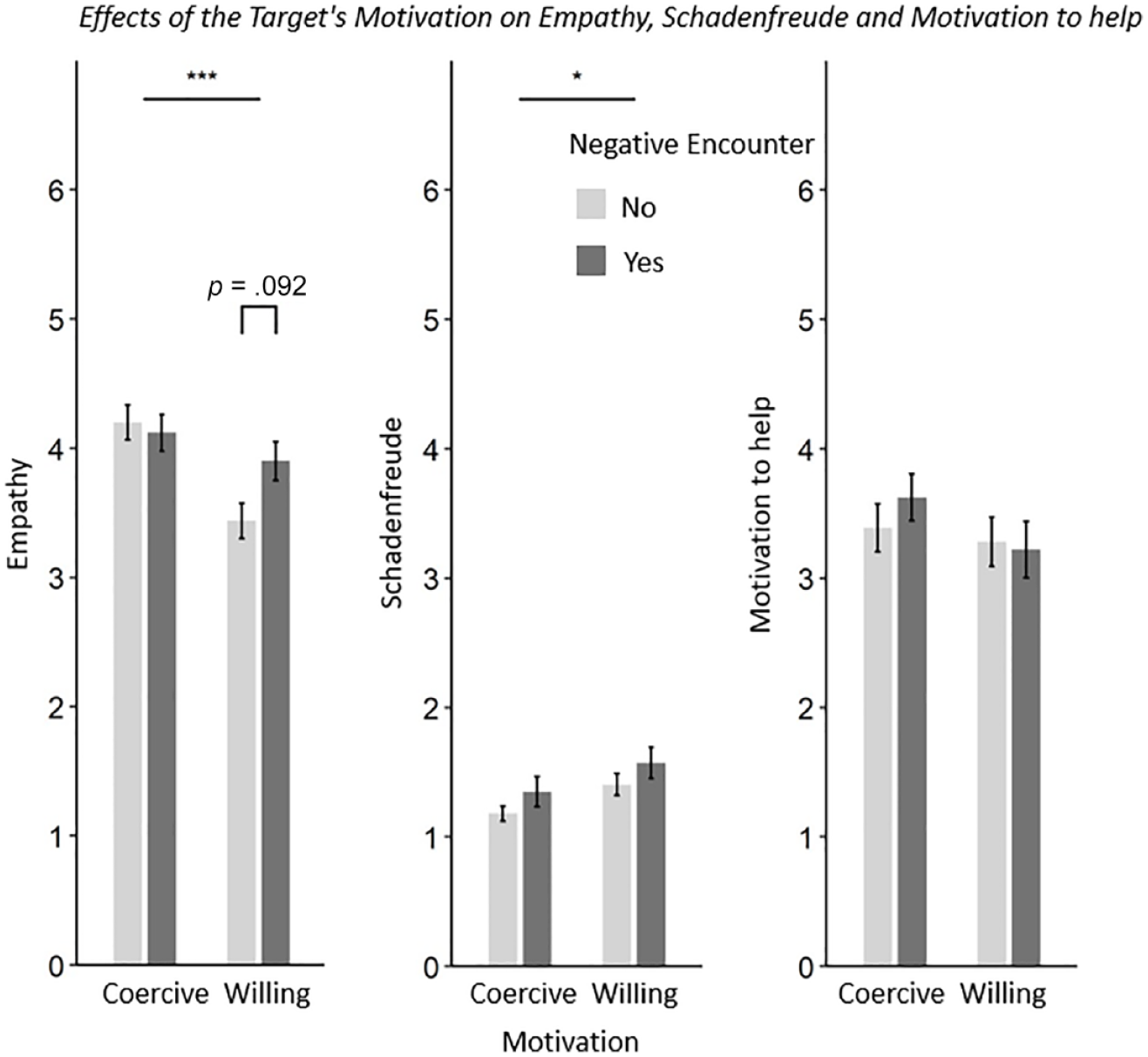
Empathy (a), schadenfreude (b), and motivation to help in the personal help component (c), as rated by participants.
Schadenfreude
The main effect of the motivation behind adopting the characteristics and behaviors of the advantaged group on schadenfreude was statistically significant. Participants experienced increased schadenfreude in the willing adoption of the characteristics and behaviors compared to the coercive condition (willing: M = 1.48, SD = 0.84; coercive: M = 1.25, SD = 0.72), F(1, 278) = 5.61, p = .020, η2 = .02, 95% CI [0.00, 1.00]. The main effect of negative encounter on schadenfreude was marginally significant. Participants experienced marginally significant increased schadenfreude in the negative encounter condition compared to the lack of it (yes: M = 1.45, SD = 0.94; no: M = 1.29, SD = 0.64), F(1, 278) = 3.11, p = .079, η2 = .01, 95% CI [0.00, 1.00]. However, the interaction between motivation and negative encounter was not statistically significant, F(1, 278) = 0.00, p = .993, η2 = .00, 95% CI [0.00, 1.00]. See Figure 3b.
Motivation to help
In terms of the effect of motivation and negative encounter, no main effects or interactions were significant (all ps > .1).
Discussion
Intragroup empathy is highly important for every group, but especially so for disadvantaged groups in advantaged-group environments. Amidst discriminatory policies and unequal access to resources, empathy fosters pursuit of equality and resilience (Leach & Zeineddine, 2021). Relatively few studies have examined the effect of adopting advantaged-group characteristics on disadvantaged intragroup empathy (Johnson & Ashburn-Nardo, 2014; Johnson & Kaiser, 2013). These studies point to an impairment in empathy following such an adoption. The current study goes beyond the existing literature in important ways: (a) We examined intragroup empathy outside the American context, where it has predominantly been studied; (b) we examined empathy among disadvantaged-group members who all share advantaged-group-dominated environments and thus are familiar with the advantaged signs; (c) importantly, we examined contextual factors shaping intragroup empathy, as well as additional measures related to empathy: schadenfreude and motivation to help.
Our study sample was composed of Palestinian citizens of Israel. On the one hand, they are citizens in a state where they encounter widespread discrimination and unequal treatment. On the other hand, they are dependent on Israeli institutions for their livelihood since they are deprived of their own institutions. Specifically, we focused on Palestinian students in Israeli academia. Behavior results replicate past findings that point to a decrease in empathy following the adoption of advantaged-group-related characteristics and behaviors (Johnson & Ashburn-Nardo, 2014; Johnson & Kaiser, 2013). We extended this research by demonstrating that a decrease in intragroup empathy is not an inevitable outcome of adopting advantaged-group-related characteristics and behaviors: when coercive policies were highlighted, levels of empathy were preserved and, at times, increased, and there was a trend suggesting decreased schadenfreude. Decreased empathy is experienced only when disadvantaged members’ adoption of characteristics is presented without the context of coercive policies. However, when coercive policies are showcased, disadvantaged members report increased levels of empathy compared to the willing condition.
The impairment in empathy could be explained by the fundamental attribution theory. Without providing a context, disadvantaged members will tend to attribute the student’s academic choices to personal preferences of identifying with the outgroup, and thus the adopter will be ostracized by the ingroup in order to preserve a positive social image (Johnson & Ashburn-Nardo, 2014; Johnson & Kaiser, 2013; Tajfel et al., 1979). Yet, when the context is provided and coercive policies are showcased, indicating that the individual was forced to adopt the advantaged-group-related characteristics, the attribution of such adoption is external, and disadvantaged intragroup empathy is preserved.
Positive Empathy
Our findings extend to positive outcomes. Our research is the first to examine disadvantaged intragroup empathy also following a positive outcome. Past research in the field of intragroup empathy had suggested that atypical positive characteristics and behaviors (wealth and academic excellence) could lead to the exclusion of a disadvantaged-ingroup member regardless of their own racial identification. We point to a more complex picture. Here, again, an individual’s successful attainment of resources can result in either fostering or hindering collective intragroup empathy, depending on the motivation behind the sign adoption—if the student chose to adopt the characteristics and behaviors, or was forced to do so. Moreover, we observed that in cases where the outcome was positive, a baseline of assimilation (control condition) was acceptable; empathy was preserved as the adoption of the advantaged signs led to the acquisition of resources. However, this tolerance does not extend to situations where the motivation for adopting the signs is internal and not forced.
These are highly important findings since they indicate that empathy could be fostered even when the disadvantaged climb the social ladder and, in turn, it could further boost this success. This is in accordance with lines of research that show marginalization is much more than negative difference. It is also a source of difference that can be linked to cultural values, skills, and multicultural knowledge that can promote resilience among members of marginalized groups (Brannon, 2022; Brannon & Lin, 2021).
Negative Outgroup Effect
Furthermore, we highlight a boundary condition to explore the effect of intergroup encounters on intragroup empathy. Even though disadvantaged-group members who willingly used advantaged-group-related characteristics and behaviors were denied empathy in the first two studies, a negative encounter with advantaged-group members preserved disadvantaged intragroup empathy. Though marginally significant, these findings could point to the effect of intergroup conflict on intragroup social texture. Negative encounters and coercive policies could possibly be associated with increased threat. Thus, such threat may lead disadvantaged-group members to express more positive attitudes toward ingroup members, and more negative attitudes toward outgroup members (Branscombe et al., 1993; Ellemers et al., 1997; Everett et al., 2015). Further research is needed to better understand the effect of negative outgroup encounters.
Schadenfreude and Motivation to Help
Throughout three studies, we examined intragroup empathy and two additional measures that frequently accompany empathy: schadenfreude and motivation to help. Schadenfreude refers to the experience of positive emotions in response to outgroup members’ pain (Cikara & Fiske, 2013; Heider, 1958; Ouwerkerk et al., 2018). The observed trend of increased schadenfreude being associated with a decrease in empathy suggests that adverse emotional reactions may go beyond intergroup relations and extend to intragroup ones. Schadenfreude has severe negative implications, including refraining from helping others in need and engaging in harmful actions towards them (Cikara, 2015). This leads to our last measure, motivation to help. Past research shows a direct relation between empathy and motivation to help (Batson, 2010; Decety et al., 2016; Klimecki et al., 2016; Pavey et al., 2012; Weisz & Cikara, 2021). Our three studies showed a consistent trend of increased motivation to help in the coercive condition compared to the willing condition given both positive and negative outcomes. Though nonsignificant, these findings suggest potential implications of providing a context for adopting advantaged-group-related characteristics for the willingness of disadvantaged-group members to help each other.
Limitations
This study has several limitations. First, we used written scenarios rather than more ecological paradigms that could better mimic the emotional experience of a disadvantaged-group member in an advantaged-group environment. The nature of our methodology could have especially affected the results of the motivation to help measure, since it assessed willingness to take action by self-report measures rather than assessing the actions themselves (e.g., real donations, real time). Moreover, due to the nature of our stimuli, our scripts included explicit references to the adopted characteristics and behaviors, whereas different behaviors may arise from more subtle, implicit cues. Future studies could use videos or real interactions, and manipulate more implicit behavior. Second, our study examined one specific environment—the Palestinian native minority in the Israeli context. Future work could explore the research questions at hand in additional settings. Third, we replicated previous findings showing that voluntarily adopting the advantaged characteristics leads to reduced empathy. However, it remains unclear whether this was due to explicitly choosing the outgroup characteristics or to implicitly rejecting those of the ingroup. Future studies could examine the differences between these two alternatives. Lastly, the current project examined empathy as a general construct. In the future, studies could probe which facet of empathy, cognitive or affective, is most impaired when willingly adopting the advantaged-group signs. More specifically, they could examine whether the adoption of advantaged characteristics prevents disadvantaged members from accurately understanding their fellow ingroup members due to, for example, a decreased inability to evaluate emotions expressed in a foreign language (Yoshida, 2020). Alternatively, the impairment could be linked to decreased motivation to share the emotion of the other.
Conclusions and Future Directions
The findings of this study shed light on the emotional experiences of disadvantaged minorities in an advantaged-group-dominated environment, following the adoption of advantaged-group-related characteristics and behaviors. We examined contextual variables—the motivation behind adopting the advantaged-group-related characteristics and behaviors, and the effect of a negative encounter—that shape intragroup empathy and related constructs. We demonstrate that decreased intragroup empathy is not an inevitable outcome of adopting the advantaged-group signs; rather, intragroup empathy is shaped by contextual variables that could strengthen or impair it. Intragroup empathy has a powerful influence, with multiple implications for disadvantaged minorities, possibly affecting the ability to climb the social ladder and engage in collective action to further advance the disadvantaged group’s status. This study may serve as a base for developing intervention tools to strengthen intragroup empathy, as it shows that certain factors can enhance it.
Based on our research findings, several pertinent suggestions for preserving intragroup empathy arise. Notably, when depicting the experience of disadvantaged-group members—even when they attain resources—coercive policies should be explicitly acknowledged. Moreover, our study highlights the importance of disadvantaged-group sign representation in advantaged environments. Given the possible negative implications of using advantaged-group-related characteristics and behaviors, it would be helpful to implement procedures like giving disadvantaged languages equal status and providing spaces free of advantaged dominance for disadvantaged-group members.
Supplemental Material
sj-docx-1-gpi-10.1177_13684302241262253 – Supplemental material for Bonding versus fragmentation: What shapes disadvantaged intragroup empathy in advantaged contexts?
Supplemental material, sj-docx-1-gpi-10.1177_13684302241262253 for Bonding versus fragmentation: What shapes disadvantaged intragroup empathy in advantaged contexts? by Nur Kassem, Noa Cohen-Eick, Eran Halperin and Anat Perry in Group Processes & Intergroup Relations
Footnotes
Declaration of Conflicting Interests
The author(s) declared no potential conflicts of interest with respect to the research, authorship, and/or publication of this article.
Funding
The author(s) disclosed receipt of the following financial support for the research, authorship, and/or publication of this article: This work was supported by an ISF grant #354/21 for AP and by European Research Council 864347 for EH.

Supplemental Material
Supplemental material for this article is available online.
Notes
References
Supplementary Material
Please find the following supplemental material available below.
For Open Access articles published under a Creative Commons License, all supplemental material carries the same license as the article it is associated with.
For non-Open Access articles published, all supplemental material carries a non-exclusive license, and permission requests for re-use of supplemental material or any part of supplemental material shall be sent directly to the copyright owner as specified in the copyright notice associated with the article.
