



Abstract
This article discusses a timely and recent domain of intergroup relations scholarship that focuses on communication between police and the public—a domain we have previously described as intergroup par excellence. We begin with a brief overview of research on this topic, and then introduce four interrelated areas of research that illustrate the diversity and relevance of this approach: policing and stereotyping, communication accommodation (and nonaccommodation) by police officials, intergroup contact and communication interventions that seek to improve relations between the police and the public, and the role of intergroup communication in translating scientific evidence into police policy and practice. Finally, we provide a critical research agenda that includes an integrated model of intergroup communication and policing.
Keywords
A shared understanding achieved through better communication [emphasis added] can help improve public trust, which is imperative to effectively protecting public safety.
Communication issues play a central role in the dynamics of intergroup relations, and a growing body of scholarship on intergroup communication has appeared in this journal (e.g., Keblusek et al., 2017) and elsewhere (e.g., Gardikiotis et al., 2023; Hogg, 1996). This growing field of study has now been the focus of two international conferences (International Symposium on Integroup Communication, Thessaloniki in 2017 and Bologna in 2019), with a third being organized in Warsaw for 2025 (https://isic3.psych.uw.edu.pl/). The study of intergroup communication goes back at least 60 years with the seminal article of Lambert et al. (1960) in Quebec on attitudes towards groups with different dialects that was critiqued and reinterpreted by Tajfel (1959) a year before it was published. The intergroup communication (IGC) literature draws on a wide range of disciplines, cultures, topics, methodologies, and theories (for a history of the field, see Rakić & Maass, 2019). Indeed, the breadth of social groups studied under the language and communication lens is broad, including research on groups representing different generations, religions, genders, races, ethnicities, and other categorizations (see Pines et al., 2018). Furthermore, the IGC landscape includes a wide variety of communicative forms, from dance, music, dress styles, and appearances to linguistic features such as prejudiced discourse, hate speech, ethnophaulisms (ethnic or racial slurs), derogatory language, and group labels (Keblusek et al., 2017).
This article discusses a fairly recent and currently salient domain of intergroup relations, namely communication between the police and the public (Giles, Maguire & Hill, 2023). We begin with a brief overview of research on this topic. Next, we introduce four interrelated areas of research that illustrate the diversity and relevance of this scholarship: (a) policing and stereotyping, (b) accommodation and nonaccommodation by police officials, (c) intergroup contact and communication interventions that seek to improve relations between the police and the public, and (d) the role of intergroup communication in translating scientific evidence into police policy and practice. Finally, we provide an agenda for future research on these issues that includes an integrated model of IGC and policing.
Introducing Policing as “Intergroup” Communication
On several occasions, we have argued that relationships between police and the public can be characterized as intergroup par excellence. This is due to several factors, including clear and visible group markers such as the distinctive police uniform, the badge, lethal and less lethal weaponry, and marked police vehicles. More fundamentally, police are uniquely authorized to deprive people of their liberty and even their lives under certain circumstances (Bittner, 1970; Giles, Maguire, & Hill, 2021). Police and the public both tend to construe encounters with one another in intergroup rather than interpersonal terms (for this distinction, see Dragojevic & Giles, 2014). Not every aspect of a police–citizen encounter is based on the social or group identities of the participants involved. Some aspects of these encounters are also due to the personal identities, temperaments, moods, and idiosyncrasies of the participants involved. Thus, police–citizen encounters represent a blend of interpersonal and intergroup dynamics. Research on policing from an intergroup perspective emerged about five decades ago and has expanded rapidly (e.g., Reicher, 1984). Research on policing from an intergroup communication perspective is newer, dating back about two decades (e.g., Giles, 2002).
Communication accommodation theory (CAT) explains the verbal and nonverbal adjustments people make when communicating with others, together with the causes and consequences of these adjustments (Zhang & Pitts, 2019). Below, we introduce some of the core principles of CAT that will play a key role in the remainder of this article. CAT serves as the framework for numerous analyses of communication in policing (e.g., Hill et al., 2023; Italiano et al., 2021). This theory has a robust 50-year history of seeking to understand individual and intergroup adjustments in speech and communication (see Giles, Maguire & Hill, 2023). Below are three of the core principles of CAT.
CAT serves as the most frequently invoked and well-known theory for understanding communication in policing. Below, we summarize some of the key points arising from scholarship that has applied CAT and related perspectives to policing:
Research shows that individuals across many cultures have more positive attitudes towards the police when they report being treated, or seeing others being treated, in more accommodative ways by officers. More specifically, people who perceive the police as more accommodative report a sense of greater moral alignment with police as well as a greater willingness to comply with police directives and to provide police with information about crime. Perceived accommodation not only has direct effects on these prosocial outcomes, but also exerts indirect effects through trust in police (e.g., Choi et al., 2019). These findings provide potent support for CAT’s Principle 2.
Research also shows that the public tends to have more favorable attitudes towards police when they perceive the police as behaving in a procedurally fair manner (Johnson et al., 2017; Maguire, Lowery, & Johnson, 2017). This is the principal contribution of procedural justice theory, an influential social psychological theory that is built upon an intergroup foundation (e.g., Radburn & Stott, 2019; Tyler & Blader, 2003). Police-focused interventions based on procedural justice theory can have a variety of beneficial effects, including improved public perceptions of police and decreases in crime (e.g., Weisburd et al., 2022). When police behave in a manner that is perceived as procedurally unfair, they can trigger the opposite effects, inducing anger, defiance, and rebellion (e.g., Maguire, Lowrey, & Johnson, 2017; Sherman, 2010). These findings are consistent with CAT’s Principle 2. While procedural justice and communication accommodation are conceptually distinct, treating somebody in a fair manner can be considered a form of accommodation. There is, thus, overlap between these two, largely separate bodies of research.
Studies that code videotaped traffic stops have in recent years documented disrespectful, condescending, unnecessarily authoritative, and other nonaccommodating actions by officers when engaging the public (for a review, see Lowrey-Kinberg, 2021). Tellingly, even initial verbal comments of such a nature can trigger the subsequent escalation of unsatisfactory outcomes. Rho et al. (2023, p. 1) found that traffic stops by police that “end in escalated outcomes sometimes begin in an escalated fashion, with adverse effects for Black male drivers and, in turn, police–community relations.” This escalation pattern is consistent with the idea of a “sequential standoff,” in which the parties involved in police–citizen encounters sometimes behave in a mutually nonaccommodative manner toward the other, which can increase the likelihood of conflict and violence (Raymond et al., 2023; also see Lowrey-Kinberg & Buker, 2017). These findings about the relationship between nonaccommodation and escalation are consistent with CAT’s Principles 2 and 3.
Numerous high-profile incidents in the US have drawn attention to unreasonable or excessive use of force by police. Some of the most prominent incidents involve the police using deadly force under controversial circumstances, such as when the suspect is a child and/or is unarmed. These issues are particularly controversial in those instances in which White officers kill minority group members, thereby raising questions about racial and ethnic bias in policing (Maguire & Giles, 2022). Unreasonable or excessive use of force by police can be interpreted in CAT terms as extreme nonaccommodation. However, Fridell et al. (2023, p. 22) note that “while a significant number of community members perceive that many uses of force are excessive, police agencies and the criminal courts rarely find that force is unreasonable.” The authors refer to this phenomenon, which is inherently intergroup, as the “reasonableness divide” between police and the public.
Excessive use of force by police has often led to protests focusing on racial and social justice (see Leach et al., 2024). Protesters, in turn, are often subjected to violent and excessive crowd control tactics by the police (Giles, Hill, et al., 2021; Maguire, 2022). The intergroup dynamics between police and crowds are well documented in the social psychology literature, dating back to Reicher’s (1984) classic analysis of riots in St. Pauls, England. These dynamics often involve significant nonaccommodation by police and/or crowds, which can result in tension, conflict, and violence. The accommodation and nonaccommodation dynamics that occur during protests are consistent with all three of the CAT principles outlined earlier.
Armed with this backdrop, next, we focus on four examples of current scholarship on policing from an IGC perspective, much of which derives from work in the United States.
“Us Versus Them” Communication and Stereotypes
Because of their unparalleled functions in society, police are often seen as a distinct group separate from other members of the public. Accordingly, Hill and Giles (2021) provide insight, from a communication perspective, into police culture and the “us versus them” nature of the relationships between police and the public. Here, we suggest that empirical evidence from the study of intergroup communication offers a pathway towards more accommodative policing. This body of evidence provides an understanding of how to reduce intergroup anxieties, encourage empathy, and reduce prejudice between ingroups and outgroups, including the police and the public. Relatedly, research evidence on CAT offers a path forward for reducing unnecessary conflict by clarifying the psychological dynamics that occur during police–public interactions and showing how those interactions can be adjusted for more beneficial outcomes.
The fact that police officers in the US are referred to as “sworn,” a unique legal status not afforded to others, is an example of the group boundaries separating the police from other members of the public. Group identities influence how individuals perceive themselves and others. As a result, the communicative processes that unfold between interactants are often intergroup in nature (see Dragojevic & Giles, 2014). The resulting intergroup dynamics sometimes take on an “us versus them” orientation in which people identify as a member of a group and see those similar to them as ingroup members, and those dissimilar to them as outgroup members (see Hartman et al., 2023). As a result, ingroups communicate differently with those they see as similar than with those they see as dissimilar. “Us versus them” (or “we versus they”) orientations have been discussed in the policing literature for decades (e.g., Boivin et al., 2020; Paoline, 2003). More recently, some scholars and practitioners have distinguished between warrior and guardian orientations in policing (McLean et al., 2019; Stoughton, 2016). The warrior views police as “detached and separated from the community” and waging a war on crime, whereas the guardian “operates as part of the community, demonstrating empathy and employing procedural justice principles” (Rahr & Rice, 2015, pp. 3–4). “Us versus them” orientations such as the warrior mentality can have deleterious effects on relationships between police and the public. The warrior worldview diminishes the perceived importance of public trust among officers and encourages styles of policing that undermine that trust (Stoughton, 2016). Public trust has been identified as a pillar of 21st century policing and as crucial to fair and effective policing (President’s Task Force on 21st Century Policing, 2015).
Hill and Giles (2024) examine how social status, and the desire to maintain or elevate one’s group status, influences the development and maintenance of stereotypes. The stereotypes that dominant groups (those in a position of authority) have toward lower status groups are often negative or even contemptuous (see Fiske, 2018). Conversely, positive stereotypes allow one’s group to promote and maintain high social status (see Molloy & Giles, 2002). The field of intergroup communication—specifically work in social cognition—explains how linguistic biases (i.e., stereotypes) promote ingroup solidarity and collective narcissism (see Golec de Zavala, 2024), forge further distance from outgroup members, and reinforce status divisions (Reid, 2012). As a result, social stereotypes are often used by high-power groups to exert power over lower status groups. It can be helpful to examine the role of stereotypes like these when considering the intergroup relationships between the police and the public.
Group members can stereotype themselves by taking on (or pretending to take on) the attributes they believe (or wish) characterize their own group (see e.g., Hogg & Turner, 1987). For example, Katz (1997) reported that in a city without a significant gang problem, police gang unit officers would sometimes lie about their work when making presentations to community groups. In an effort to make the city’s gang problem appear more serious than it really was (and therefore to portray their work as more vital to public safety), the officers would tell “war stories” about their experiences based on scenes they had observed in movies. As a result of self-stereotyping (Turner et al., 1987), ingroup members are able to identify and communicate more easily with other ingroup members because they share many of the same perspectives (in this regard, see Anjewierden et al., 2024; Hogg et al., 1990). Perhaps even more important in the context of police culture, police officers are more likely to be open to those within their specific workgroup (and particularly to their own on-duty partners)—and to the messaging within that workgroup and partnership—than to groups they perceive as polarized outgroups, such as administrators, politicians, and certain segments of the public (Ingram et al., 2013; Reuss-Ianni, 1983).
Although there has been limited research conducted on stereotypes in this intergroup arena—and little on how police view sectors of the public—there is much work on stereotypes that the public has towards police (e.g., Choi et al., 2019; Fine et al., 2019). Hill and Giles (in press) contend that while it may be true that police officers engage in stereotyping at a rate consistent with the rest of society, their position in society (as authority figures who can deprive people of their liberty or their lives) makes police stereotyping especially concerning. The “us versus them” mentality is a feature of “cop culture” (Myhill & Bradford, 2013) that permeates policing. Such ingroup norms can perpetuate the power and social status that police maintain in society.
Hill and Giles (in press) examine how the phrase “thin blue line” can be viewed as an example of police culture that seeks to elevate the profession’s social status through the use of a potent metaphor. Intergroup metaphors can be a powerful means of stereotyping (see Maass et al., 2014). The thin blue line metaphor is used by law enforcement to portray their belief that, as sworn officers, they are the only group in society that is able to hold the line between good and evil (Kappeler et al., 2010). The thin blue line and similar metaphors are commonly used in commercial products marketed toward police officers, and is popular in police culture. This metaphor can be conceptualized as a nonaccommodative perspective on outgroup members (i.e., the public) within the police culture. 1 A related metaphor that treats most citizens as “sheep,” criminal offenders as “wolves,” and police officers as “sheepdogs” is similarly nonaccommodative. For example, according to Grossman (2006, p. 292), “We know that sheep live in denial; that’s what makes them sheep. They do not want to believe that there is evil in the world.” As a result of their denial, the sheep need sheepdogs who “live to protect the flock and confront the wolf.” These vivid metaphors set police apart from their communities and constitute the intergroup stage on which policing is carried out.
We now examine the intersection of leadership and intergroup relations (see e.g., Hogg & Rast, 2022). We focus on two related areas of study. First, we examine how police executives sometimes find themselves facing “accommodative dilemmas” when seeking to appease both internal and external stakeholders. Second, we examine the extent to which police leaders and other law enforcement representatives express empathy and/or sympathy when issuing public statements following controversial uses of force against minorities.
Intergroup Dynamics and Communication Accommodation in Police Leadership
Police leaders are boundary spanners who are positioned at the interface between police organizations and their external environments (Aldrich, 1979; Maguire, 2021). As a result of their unique role, police leaders must engage in strategic communication with stakeholders both inside and outside of their organizations. The nature and content of this strategic communication—including both intentional and unintentional messaging—are vital for structuring the relationships between police and communities.
Maguire, Hill, & Giles (2023) examine the role of “accommodative dilemmas” that police leaders encounter when trying to accommodate the needs of both police officers and communities. The concept of accommodative dilemmas comes from the literature on CAT (e.g., Dragojevic, 2019), which focuses on the communicative adjustments people make to converge toward or diverge away from others. However, in the turbulent intergroup settings in which police leaders work, decisions about how to accommodate the needs of multiple groups can be fraught with uncertainty and peril. Police leaders must often navigate through accommodative dilemmas in which it is difficult to accommodate the needs of both police officers and communities. In certain jurisdictions, relationships between police and the community (or certain segments of the community) are particularly tense, involving zero-sum or “us versus them” dynamics in which efforts to accommodate one group are perceived by the other group as an unwillingness to accommodate their needs.
For example, following the death of George Floyd in Minneapolis in the summer of 2020, racial justice protests were held throughout the United States. During one such protest in New York, Terence Monahan, Chief of the New York City Police Department, took a knee in solidarity with Black Lives Matter protesters (see Leach et al., 2024). When asked later why he decided to kneel alongside protesters, Monahan said, “We can’t be fighting against one another. It can’t be one side against the other. To get this city back, we all have to work together as New Yorkers, not as one side versus the other” (Tracy, 2021). After Chief Monahan’s accommodative gesture, NYPD officers began to refer to him disparagingly as “the kneeler.” Lower ranking command staff who took a knee were also harassed by their peers. In seeking to accommodate one group (protesters), Monahan and other command staff inadvertently alienated another group (NYPD officers).
Similar dynamics often result when police leaders seek to accommodate their officers. For example, during the 2020 racial justice protests in Milwaukee, police deployed less lethal weapons, including chemical agents, toward protesters (Milwaukee Police Department, 2020). Critics alleged that Milwaukee police used excessive force against protesters. For example, the American Civil Liberties Union (ACLU) of Wisconsin (2020) issued a statement that accused police of using “excessive force, firing tear gas, shooting rubber bullets, and making unlawful arrests.” The statement noted that “this type of militarized approach only escalates emotionally-charged situations and reinforces the very conduct and culture protesters are demonstrating against.” Milwaukee Police Chief Alfonso Morales defended his officers, noting that “law enforcement is being crucified” by “angry mobs” (Lewis, 2020). He criticized protesters for their behavior, stating that “a peaceful civil disturbance does not exist” (Milwaukee Police Association, 2020). Following this controversy, the City of Milwaukee’s Fire and Police Commission voted unanimously to demote Chief Morales. Certain community members viewed Chief Morales’s defense of his officers as insensitive to the community’s needs. In short, his efforts to accommodate one group (police officers) alienated the other group (the community). This is a common pattern that results from accommodative dilemmas in intergroup settings. Police leaders are sometimes “caught in the middle” when attempting to navigate these challenging intergroup issues (for discussions of crisis communications and related interventions, see Diers-Lawson, 2018; Scrivner, 2021).
However, the decision by police leaders to accommodate communities, particularly in the aftermath of controversial police shootings or deaths in police custody, often involves communicating empathetic or sympathetic messages through conventional media or social media channels. Empathy and sympathy share conceptual similarities as well as differences, and their relationships have been discussed in the context of organizational communications (e.g., Clark et al., 2019; for a CAT analysis of empathic speeches, see Wang, 2020). Research in other settings shows that expressions of empathy and sympathy can be useful for acknowledging harms and reducing intergroup tensions (Klimecki, 2019; Stephan & Finlay, 2003). Maguire and Giles (2022) examined the language used by different types of law enforcement officials (including police executives, police department spokespersons, and others) in the immediate aftermath of all known killings (n = 30) of unarmed African Americans by U.S. police in 2020. They focused on public expressions of empathy or sympathy directed toward two groups: the decedent and their loved ones, and the community at large. The statements they analyzed came from three primary sources: news releases, social media postings on Twitter and Facebook, and press conferences. The most surprising finding from this study was how infrequently law enforcement officials released any public statements at all following the death of unarmed African Americans at the hands of the police (see Leach & Teixeira, 2022). Moreover, even when they made such statements, whether written or verbal, those statements often did not express empathy or sympathy for the decedent or his/her loved ones, or for the community at large.
Maguire and Giles (2022) found that police executives (such as police chiefs and sheriffs) issued statements expressing empathy or sympathy for the decedent or his/her loved ones in only 26.7% of cases, and for the community in only 20% of cases. As noted earlier, police leaders have a boundary-spanning role that involves negotiating relationships between the organization and its environment (see Mastrofski, 2002). In that role, they must satisfy demands from both internal and external stakeholders. Police leaders are enmeshed in multiple, often conflicting, intergroup settings that impose demands or constraints on the nature of the public statements they issue. Police leaders often appoint spokespersons—usually referred to as public information officers [PIOs]—to handle interacting with the media and issuing press releases. Maguire and Giles (2022) found that these spokespersons issued statements expressing empathy or sympathy for the decedent or his/her loved ones in only 10% of cases. More surprisingly, these officials did not express empathy or sympathy for the community in any of the cases. Instead, their statements were typically characterized by an emotionless “just the facts” orientation. Such statements can be perceived by communities and other stakeholders, in CAT terms, as nonaccommodative. In allowing such statements to be issued, police leaders are missing a valuable opportunity to engage in more strategic forms of communication that can help reduce intergroup tensions and strengthen the relationships between police and the public.
Intergroup Interventions for Improving Relationships Between Police and the Public
Intergroup contact interventions offer a promising path for improving relationships between groups in conflict. There is now a well-established body of evidence showing that intergroup contact can reduce prejudice. In fact, research inspired by Allport’s (1954) intergroup contact theory in The Nature of Prejudice has shown that direct intergroup contact, under optimal conditions, reduces prejudice across a variety of contexts, including race, ethnicity, religion, and other social and political divisions (see Paolini et al., 2021). A meta-analysis on the effects of intergroup contact—including 515 studies and more than 250,000 subjects from 38 countries—found that direct contact “typically reduces intergroup prejudice” (Pettigrew & Tropp, 2006, p. 752). Research also shows that the effects generalize beyond those immediate outgroup members engaged in the contact to other outgroup members not present (however, see Sengupta et al., 2023; Van Assche et al., 2023). Direct contact interventions are a promising tool for improving relationships between groups—such as police and communities—with high levels of anxiety, tension, and/or conflict between them. Pettigrew and Tropp (2006) found that direct intergroup contact that takes place under Allport’s (1954) optimal conditions—including equal status; common goals; intergroup cooperation; and the support of laws, authorities, or customs—can facilitate even more positive outcomes.
Based on the intergroup contact scholarship, as well as additional research from the study of intergroup communication, we have designed and begun testing an intergroup intervention called VOICES that is intended to improve relationships between police and the public. It has been pilot tested several times with police officers and marginalized community groups, including Hispanic immigrants, adults who were formerly incarcerated, currently incarcerated juveniles, and LGBTQIA+ community members. The VOICES intervention involves organizers bringing together approximately equal numbers of community members and police officers with a neutral facilitator, in an environment designed to create power neutrality (in line with Allport’s equal status factor above). For example, in one VOICES intervention, five police officers and five Spanish-speaking community members (including three adults and two youth) participated in a structured dialogue session led by an experienced facilitator trained in restorative practices. The event started with police officers and community members dining at small tables together. Following the dinner, the chairs were formed into a circle (often referred to as a peace circle) and the facilitator invited participants to describe their perceptions and expectations of the other group. The goal was to allow both groups to see the other’s perspectives in a safe and neutral environment primed for discussions about intergroup experiences. Initial assessments of VOICES have shown promising results, including increased trust and empathy (Hill et al., 2021; Nuño et al., 2023). More rigorous experiments are underway.
Research from the study of intergroup contact and communication provides more than 60 years of useful scientific evidence that can be translated into practice to improve relationships between police and the public. Additional ideas from this research can also be incorporated into testable interventions. Some examples include efforts to avoid polarization between parties, elevate authentic engagement (Reinig et al., 2023), establish communities of dialogue that foster mutual communicative receptiveness in and beyond interventions (Oliver-Blackburn & Chatham-Carpenter, 2023), and instill a sense of social justice between the participants (Mady & El-Khoury, 2023). We encourage researchers to continue working with police agencies and communities to develop and test intergroup interventions intended to improve relationships between police and the public, particularly those elements of the public for whom these relationships are most tenuous.
Intergroup Dynamics in Translational Criminology
Criminologist John Laub coined the term “translational criminology” to describe the importance of producing high-quality research and disseminating it to people who could use it to improve criminal justice policy and practice. According to J. H. Laub (2011, p. 17), the goal of translational criminology is: To break down barriers between basic and applied research by creating a dynamic interface between research and practice . . . it is not just about finding evidence that something works; it is figuring out why it works and how to implement the evidence in real-world settings.
As such, the mere availability of research evidence is often insufficient to promote reform (J. R. Laub & Frisch, 2016). Translation and implementation have arisen as a primary barrier in using research to improve policy and practice in policing and other criminal justice settings (Nichols et al., 2019). Furthermore, one of the key challenges in translational criminology is that those who produce the research (researchers) and those who are in the best position to apply the findings from that research (policymakers and practitioners) are often from different occupations and work in different institutions with different cultures and reward structures (Lahti & Valo, 2018).
The scientific literature on intergroup communication and accommodation contains theories, concepts, and empirical evidence that can be useful for learning how to navigate these challenging intergroup and intercultural dynamics and improve the diffusion of translational criminology (Giles et al., in press). The field of intergroup communication is based on the premise that when people from different groups come together, they tend to operate based on different social identities and, thus, see the world differently through the lens of those identities (e.g., Giles & Harwood, 2018; Giles & Maass, 2016). Social identity, as contrasted with personal identity, is concerned with how people envision themselves based on the social groupings with which they are affiliated. Put differently, social identity is “that part of an individual’s self-concept which derives from his knowledge of his membership of a group (or groups) together with the value and the emotional significance attached to the membership” (Tajfel, 1981, p. 225). The study of intergroup communication is useful for thinking about how to bring people with different social identities together to express and support each other’s common and respective goals and needs—or at least not have either party’s affordances thwarted or dismissed as irrelevant (Neel et al., 2023).
Intergroup communication research is derived heavily from the wider social psychological subfield of intergroup relations (see Reid, 2012) and, within that, social identity theory (SIT; Tajfel & Turner, 1979). SIT posits that people identify with their ingroup and understand it in terms of the similarities amongst ingroup members that make them distinct from outgroups. Hence, social identities can exert a powerful influence over how we think, behave, and communicate (e.g., Giles, 1978; Kienzle & Soliz, 2017), thereby setting in motion a range of intergroup cognitive and communicative biases (Hewstone et al., 2002; Skinner & Meltzoff, 2019). Maguire, Giles, & Hill, 2022 notes that these communicative and social identity dynamics play a crucial role in shaping the translation of criminological knowledge into policy and practice. The processes involved in disseminating criminological research evidence and adopting and testing evidence-based criminal justice practices involve a range of intergroup communication challenges, including both written and spoken forms of communication. Understanding these challenges, and drawing on evidence-based methods for addressing them, will be an important step in increasing the uptake of translational criminology in policing.
Communication and Policing: A Research Agenda
In this section, we propose some priorities for future scholarship on intergroup communication in policing. We begin with the general premise that IGC scholarship—including its application to policing—could reap considerable benefits from adopting a wider range of theories, methods, and substantive foci. For example, Gallois et al. (2018) emphasized the methodological and theoretical narrowness in existing scholarship on IGC, as evidenced by the hegemony of social identity theory and quantitative methods (see also Taylor et al., 2010). Furthermore, while studies of IGC have relied on extant work on ingroup love and outgroup hate (see Cervone et al., 2021; Moscatelli & Rubini, 2018), the very nature and complexities of intergroup attitudes demand more in-depth analyses of how people (including police and the public) perceive ingroup and outgroup members (see Hartman et al., 2023). Indeed, research shows that the racialized relationships between police and the public are much more nuanced and complex than previously assumed (e.g., Dan-Irabor et al., 2023; Johnson et al., 2017). One of the many ways in which future IGC research on police and the public can make a meaningful contribution is by clarifying how members of these two groups view both their own group and the other. Little is known about the extent to which both groups—or major subgroups within them—view each other as homogeneous and stereotype accordingly (Brewer & Kramer, 1985). 2
One area of police research in which these ideas have already played a central role is in the study of interactions between police and crowds, including protests, riots, and sporting events. Stott and Reicher (1998) note that police tend to view crowds as homogeneous even when such groups are obviously heterogeneous. As a result, if a handful of crowd members begins to engage in violent or destructive behavior, police tend to choose indiscriminate crowd control responses that treat the entire crowd as a threat rather than choosing targeted responses against specific individuals. These indiscriminate police responses set in motion a chain of intergroup psychological dynamics that can lead ordinarily law-abiding crowd members to resist and rebel against police, sometimes violently. These dynamics have led crowd psychology scholars to recommend police responses that treat crowds as heterogeneous and involve more targeted responses to individual crowd members rather than indiscriminate responses against entire crowds (Maguire, Tyler, et al., 2023; Reicher et al., 2004). When police perceive greater heterogeneity within a crowd, they are more likely to adopt more accommodative forms of communication and more proportionate responses to crime and disorder (Stott & Reicher, 1998).
Another key opportunity for future IGC research on police and the public is to study encounters between police and the many subgroups that comprise communities. There are numerous subgroups worthy of such investigation, including (but not limited to) the homeless, immigrants, the mentally ill, the disabled, the elderly, racial and ethnic minorities, and victims of various types of crime (see Frisch et al., 2023; also see Rios, 2024). Applying an IGC perspective to relationships between police and these subgroups can help to clarify the intergroup dynamics between police and their various publics. For example, studying how police interact with people who have autism and other intellectual and developmental disabilities can help to clarify the dynamics of these encounters and improve police training and service delivery (Wallace et al., 2022). Relatedly, studying how police interact with immigrants from a variety of backgrounds, including those who emigrated from nations where police are known to be brutal and corrupt, can provide similar benefits (see Pryce, 2018).
Another topic worthy of consideration in IGC research on policing is the nature of officers’ “identity salience.” This concept refers to “the activation of a certain identity as a response to a social or contextual situation” (Diamond, 2020, p. 1135; see also Anjewierden et al., 2024; Pinto & Marques, 2024). It acknowledges that individuals have multiple social identities, some of which are more salient than others at any particular time. Clarifying the identity salience of police officers is crucial to understanding (a) how they frame their work, and (b) their response to the various types of people and encounters they face while on the job. Identity salience has been linked to protectively coping with threats to identity (Breakwell, 2021). The social identities of police officers may vary as a function of the places and types of work to which they are assigned, the shifts that they work, and the people with whom they work (e.g., behavior of health care providers). These factors, together with the intersectionalities experienced across these groupings and the potential for so-called “social identity switches” between them (Zinn et al., 2022), are worthy of further investigation (for the notion and value of “social prescribing” identities with even new communities, see also Haslam et al., 2024). While these marginalized groups are often historically categorized and interpreted as, and limited to, having deficits, their strengths are often underappreciated (see Silverman et al., 2023). Acknowledging and leverging these strengths could improve efforts in policing diverse communities.
A Heuristic Model of Communication, Policing, and Society
Finally, as a framework for understanding policing and its communicative parameters, Figure 1 shows a heuristic model of communication, policing, and society that builds on previous models (e.g., Giles, Hill, et al., 2021; Hill & Giles, in press). This model constitutes a visual schematic framework indicating not only how IGC and stereotyping are embedded within more macro-contextual processes of police–community communication, but also how different communicative accommodative strategic outcomes and dilemmas, together with intergroup interventions and changing social policies on policing, can be intertwined.
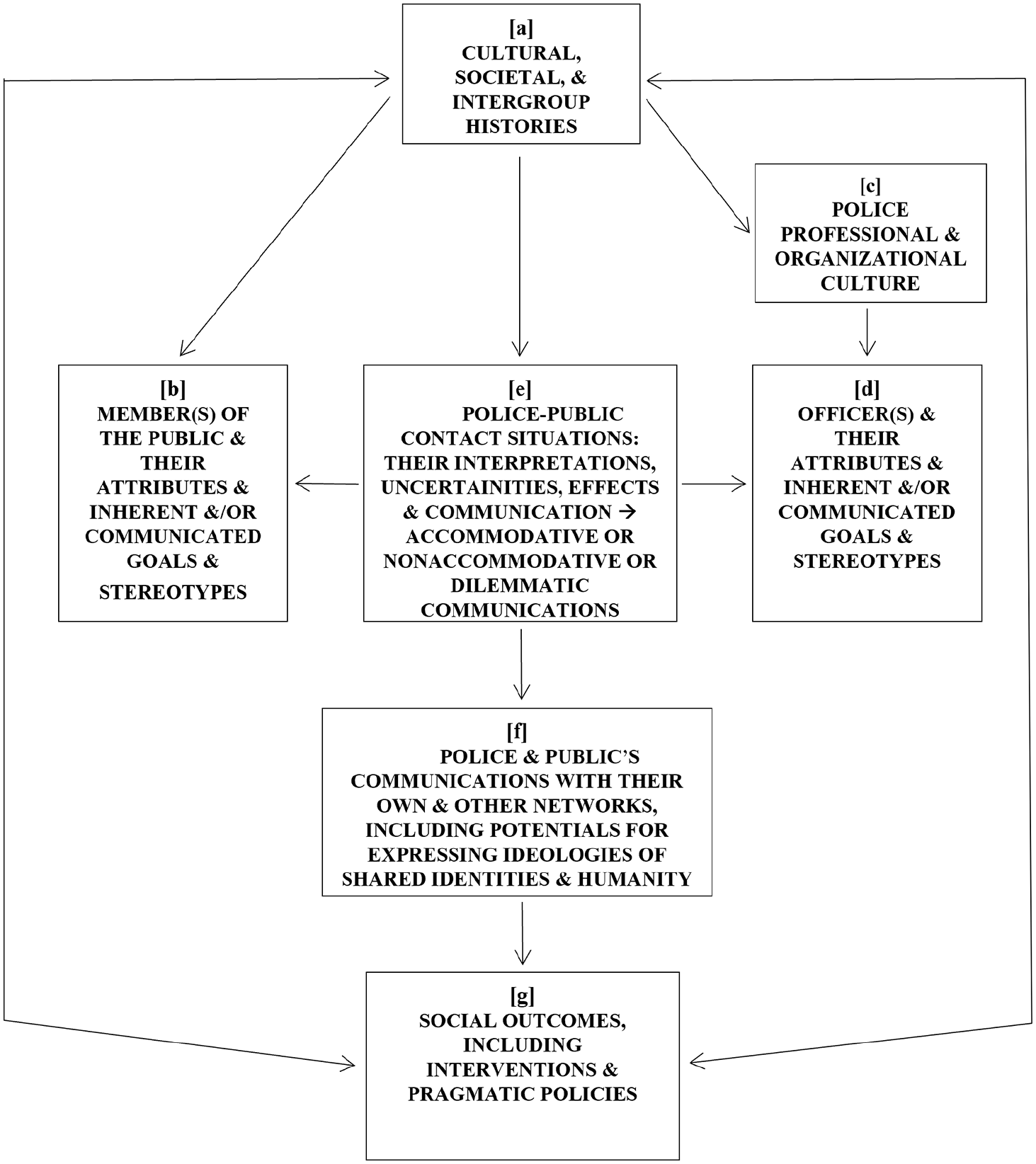
An elaborated model of intergroup communication and policing.
At the top of the model [a] is an amalgam component that refers to distinctive cultural and societal values, including the media activities that reflect them (Mustafaj & van den Bulck, 2021; Perlmutter, 2000). This component critically includes the objective and subjectively perceived social histories (e.g., of slavery, lynchings, and civil rights movements) as well as past and recent policing incidents that have gained significant attention (Maguire, Nix, & Campbell, 2017). Changes over the decades in racial equality and police reform have been considered elusive and intransigent by some. Further, many approaches have been discordant, and certain communities demand more transparency and influence on how they are policed. Nonetheless, this (top central) contextual conglomerate [a] can shape and enable three entities. First, [b] the attributes of members of the public are highlighted, including their gender, age, ethnicity, values, personalities, and the manner in which they communicate stereotypes about the police. Also relevant are people’s social networks and social identities (see Blanchard, 2024; Ellenberg & Kruglanski, 2024), attitudes towards and expectations of police, and their community resilience. Second, [c] police culture (and allied professional associations and unions) is featured, including recruitment and retention procedures, leadership and management practices, their media communiques, as well as community and reform orientations. These, in turn, [d] mold officers’ attributes, including their gender and ethnicity schemas, personalities, worldviews, communication skills, resilience, well-being, and intergroup biases as well as, in turn, their communicated stereotypes about the public.
All these components depicted in Figure 1 impinge upon the ingredients of contact between police and the public [e], be they traffic stops, domestic violence situations, suicide attempts, hostage negotiations, or other types of encounters. Contact situations is pluralized as it can be a specific contained incident and/or its subsequent aftermath, which can be prolonged, as in the weeks of protest after the killing of George Floyd in Minneapolis in May 2020 (see Giles, Hill, et al., 2021). Processually, this component embraces how these situations are interpreted and with what kinds of experiences and expressed affect (including uncertainties), stereotypes enacted, and communication patterns. These may include accommodation or nonaccommodation, de-escalation or accommodative dilemmas, the use of procedural justice principles, and the exercise of various levels of force. This [f] can result, thereafter, in both groups’ messages to their own and other networks that may or may not highlight both groups’ common superordinate identities and humanities. This could be evident in mutual aid from other internal units, such as special weapons and tactics (SWAT) and detectives, and, arguably, affiliated external units and institutions such as other first responders (fire fighters, medics), coroners’ offices, social workers, medical and mental health professionals, and in public (including social media) messages about traumatic events (Walther, 2021). All these factors together have a wide range of longer term social (and intergroup) outcomes [g], such as officer indictments, police complaints and legal procedures, certain communities’ willingness or not to report crime, community support, and collaborative dialogue on the one hand, and aggravated public mistrust on the other (see Tyler & Huo, 2002). They also have career implications for officers, as well as effects on officer health and wellness.
Transactionally, all these forces feedback to [a], and continually refashion societal and cultural values and practices, and the very nature of the evolving intergroup histories associated with police–public relations and the evolution of intergroup communicated stereotypes.
While, admittedly at this juncture, this model is an unlikely candidate for a global assessment of the sum of its chained parts, each of the constituent links from [a] through [g] can be transformed into a predictive proposition and be investigated in their own right. Moreover, and with the appropriate procedures, each link in the model can be causally examined quantitatively with attention to possible and multiple mediating mechanisms, as well as naturalistically by recourse to an array of qualitative analyses (see methodological chapters in Giles & Harwood, 2018).
Conclusions
Although we began with caricaturing police–community communications as quintessentially “intergroup” in nature, involving contrasting social identities, we readily acknowledge that this description does not fit every situation. Certain police–community encounters can be characterized as more interpersonal (Dragojevic & Giles, 2014), and thus more embedded in personal rather than social identities. Indeed, many police–community encounters often contain weighted or sequential elements of both intergroup and interpersonal dynamics (Giles & Hewstone, 1982; Stephenson, 1981). Unpacking how intergroup and interpersonal identities shape interactions between police and the public is a key challenge for scholars.
We titled this article, “Policing at the Crossroads”. The compelling metaphor of a crossroads originated in ancient times to emphasize the importance of managing intersections where two or more roads meet. It has been invoked continually in a variety of social contexts, myths, and folklore across cultures (Ammer, 2003). Here, the crossroads represents the intersection between two largely separate bodies of theory and research: policing and intergroup relations. In thinking about how to move this scholarship forward, we consider it wise to heed Averbuj’s (2014) warning: not to linger at crossroads. If we pause for too long, frozen by fear or indecision, what dangers are we exposing ourselves to? One of the obvious practical dangers is that we’ll miss an opportunity in front of us (a path will close) unless we grab it while we have the chance. Sometimes, making any decision is more important than making sure it’s the right one. If indeed there is a right one.
Accordingly, how can we move beyond this crossroads into fertile terrain to build a body of interdisciplinary scholarship that can be used to improve policing and communities, and the relationship between them?
Our article has some modest implications for Averbuj’s cautionary counsel. First, we argue that our work on police culture and stereotyping underscores and provides a rationale for Cauley et al.’s (2023, p. 45) policy orientation that: It is essential police leaders invest as much time and energy into culture [emphasis added] as they do for training. . .. Providing police personnel with top-notch training, the best equipment, and state-of-the-art technology means nothing without a healthy culture that pulls it all together. In fact, culture is so important [emphasis added], all police chiefs and sheriffs should also consider themselves the “chief of culture.”
In tandem, we acknowledge the severe and multiple physical and psychological traumas that police officers endure on a regular basis (e.g., Maguire & Paoline, 2023; Rogers, 2023). A clinical therapist who specializes in treating police officers has issued a series of recommendations for engaging more effectively with this population, many of which are associated with bridging challenging intergroup and intercultural boundaries to “see the person behind the uniform” (Rogers, 2023, p. 42).
Second, while we feel our well-intentioned research is aimed at enriching interdisciplinary scholarship and those who carry it out, our remit is much broader. Scholars should ensure that their work is made available in a wide variety of genres and formats that are accessible and understandable to police and communities who can benefit from this work. In parallel, we should lend our findings and theories with a view to encouraging police and community leaders to work together in creating and testing intergroup interventions like VOICES. Such efforts need to accommodate the local specific (as well as national) history and context as well as the changing circumstances unfolding in society, and help to move towards policing approaches that are community-centered.
Third, while we have gently accused communication scholars of not engaging in a sufficient volume of scholarship that addresses ordinary people’s needs, desires, and social concerns (Giles, 2023), both police executives and scholars might find mutual benefits from accommodating one another to more effectively place evidence-based practices in the hands of practitioners. Heavy investments should be made in incentivizing researchers to make their work accessible to, and to collaborate with, police practitioners, and vice versa. For example, programs such as the National Institute of Justice (NIJ) Law Enforcement Advancing Data and Science (LEADS) program offer a promising direction for cooperation between researchers and academics with the aim of improving police practices. Hopefully, our model in Figure 1 and the research agenda we espouse will be a small step in crossing that road.
Footnotes
Declaration of Conflicting Interests
The author(s) declared no potential conflicts of interest with respect to the research, authorship, and/or publication of this article.
Funding
The author(s) received no financial support for the research, authorship, and/or publication of this article.
