



Abstract
By assuming that a group of nefarious actors collude to harm a perceiver’s ingroup, conspiracy theories are an intergroup phenomenon. What are the group-oriented motivations underlying belief in conspiracy theories? This contribution proposes that conspiracy theories are associated with both symbolic, identity-based motivations and realistic, harm-based motivations. As symbolic motivations, conspiracy theories help people develop, maintain, and protect a positive social identity. Conspiracy theories can unite people through a shared belief system, provide a basis for favorable intergroup comparison, and enable perceivers to attribute ingroup status threats to external forces beyond their control. As realistic motivations, conspiracy theories prepare people for conflict with other groups. Conspiracy theories transform an abstract sense of distrust into concrete allegations of misconduct. This provides a signal that an outgroup is threatening, mobilizes the ingroup, and promotes a readiness to fight. I discuss the implications of these processes for theory and practice.
Conspiracies always contain multiple interdependent actors. The original Latin word “conspirare” means “to breathe together.” Common scientific definitions of a conspiracy typically include a group of actors that colludes in secret agreement to pursue nefarious goals (Douglas & Sutton, 2023; van Prooijen, 2018). Lone actors hence do not represent conspiracies, even when they can commit a lot of harm. Moreover, the scientific study of conspiracy theories is particularly concerned with beliefs about conspiracies that seek to harm a different group. Common conspiracy theories describe ingenious plots of how governmental organizations deceive citizens, how Democrats harm Republicans (or vice versa), how pharmaceutical companies mislead the public to sell vaccines, and how mysterious organizations (e.g., the Illuminati) strive for world domination to suppress citizens. People may also believe that others conspire against them personally, but that is more commonly conceived of as paranoia (Imhoff & Lamberty, 2018; van Prooijen & van Lange, 2014). As such, belief in conspiracy theories essentially is an intergroup phenomenon.
Accordingly, believing conspiracy theories is associated with a range of common group-oriented motivations. Some theoretical perspectives have specifically focused on symbolic, identity-based motivations. Douglas et al. (2017) proposed that, besides epistemic and existential motives, the social motive to feel good about one’s ingroup drives conspiracy beliefs. For instance, conspiracy theories enable people to attribute negative group outcomes to malevolent external forces (e.g., Abalakina-Paap et al., 1999; Goertzel, 1994), and imply downward social comparison by emphasizing the immoral qualities of competing outgroups (Mao et al., 2023). Conspiracy theories thus seem associated with the motivation for a positive social identity.
Other theoretical perspectives have highlighted the realistic motivation to protect the ingroup from the threats of dangerous conspiracies, and therefore emphasize the role of conspiracy theories in preparing the group for conflict with hostile outgroups. Specifically, the existential threat model has described how the sense-making processes that people experience following distressing events may lead to conspiracy theories, but only when an antagonistic outgroup that one can blame is salient (van Prooijen, 2020). Relatedly, the adaptive conspiracism hypothesis has stipulated that the psychological tendency to easily suspect conspiracies in distressing situations has evolved as an adaptive response to the realistic dangers of hostile outgroups throughout human history (van Prooijen & van Vugt, 2018). Conspiracy theories make the possible dangers of distrusted outgroups concrete, and therefore provide an urgent signal for group members to prepare for the possibility of intergroup aggression.
These symbolic (identity-based) versus realistic (harm-based) motivations were inspired by, yet are conceptually different from, the common distinction between symbolic versus realistic threats (Stephan & Stephan, 2017; see also Martinez et al., 2022). The current arguments pertain to the symbolic versus realistic qualities of the goals that people pursue, which can be independent from the types of threat that people perceive. For instance, symbolic threats (e.g., the belief that one’s culture is disappearing) can stimulate the realistic goal to violently attack ethnic minorities (Obaidi et al., 2022). Likewise, realistic threats (e.g., a terrorist attack) can stimulate the symbolic goal for a positive social identity by disassociating one’s own group from the event (e.g., widespread beliefs in Muslim countries that Arabs did not commit the 9/11 attacks; Gentzkow & Shapiro, 2004).
The current contribution is designed to provide a comprehensive review of the group-oriented motivations that contribute to belief in conspiracy theories. Table 1 provides an overview of these group-oriented motivations, the means to fulfill the goals associated with these motivations, and specific manifestations of these processes. For the symbolic motivations, I will describe how conspiracy theories help people to develop, maintain, and protect a positive social identity. For the realistic motivations, I will describe how conspiracy theories prepare people for intergroup conflict. Specifically, conspiracy theories provide a signal that outgroups are threatening, mobilize the ingroup by polarizing its members, and ultimately promote a readiness to fight.
Group-oriented motivations underlying belief in conspiracy theories.
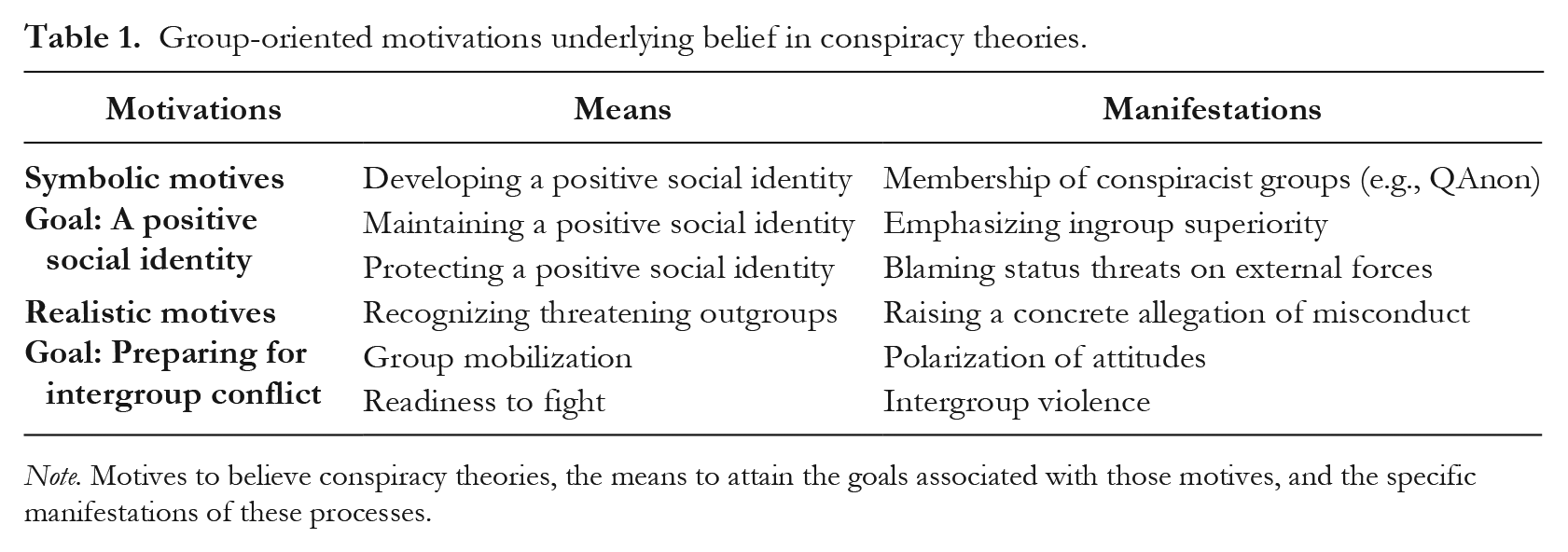
Note. Motives to believe conspiracy theories, the means to attain the goals associated with those motives, and the specific manifestations of these processes.
Symbolic Motivations: A Positive Social Identity
A common assumption is that conspiracy theories are associated with the desire for a positive social identity (Douglas et al., 2017; Robertson et al., 2022). This can manifest itself in various ways, however, and at different stages of group formation. Conspiracy theories can be a source of social identity themselves as people may form or start participating in social groups that are defined by their shared belief in a conspiracy theory (e.g., online antivaccination groups; see Schlette et al., 2022). Conspiracy theories may therefore help people develop a positive social identity. For a broader range of groups, conspiracy theories can also be functional for a positive social identity, however. Specifically, conspiracy theories help people maintain a positive social identity by enabling a perception of their ingroup as superior, and by highlighting the moral inferiority of other groups. Finally, conspiracy theories help people protect a positive social identity. When people’s favorable impression of their group is threatened (e.g., due to a low intergroup status position), conspiracy theories provide them with an external attribution for the disadvantaged position of their group.
Developing a Positive Social Identity
One key basis for a positive social identity is a shared belief system. People prefer to connect mostly to like-minded others, with similar beliefs about the world (Tajfel & Turner, 1979). Such like-minded others reinforce feelings of self-worth by validating one’s own beliefs, and they facilitate the development of a set of shared norms and values. A shared belief system is therefore a potent factor to form social groups. Indeed, many common social groups are based on a shared understanding of reality, including political parties and social movements. This basic insight is also visible in the online environment, where people form “echo chambers” with like-minded others. On Twitter (“X”), people connect mostly to users with similar political ideologies, and cross-cutting interactions between the political left versus right are much less common (Barberá et al., 2015). In a study of over 10 million U.S. Facebook accounts, users were far more likely to consume news or information when it resonated with their own ideology. This selective exposure to ideologically aligned content depended more strongly on users’ own choices than on algorithmic ranking (Bakshy et al., 2015).
Conspiracy theories have various properties that make them a powerful type of belief system to unite people into social groups. For instance, conspiracy theories tend to be interesting, exciting, and attention-grabbing narratives that convey a mystery waiting to be solved. These entertaining features of conspiracy theories make them appealing to a broad audience and stimulate a joint interest in them (van Prooijen, Ligthart, et al., 2022). Moreover, conspiracy theories have a signaling function. Believing conspiracy theories imply that one takes the threat of a potentially hostile coalition seriously, which signals to others that one is willing to contribute to group goals (Marie & Petersen, 2022). For instance, people may easily connect over an antiestablishment worldview (assuming that an evil and powerful elite seeks to oppress citizens), as endorsing such a narrative advertises a willingness to oppose these elites by cooperating with like-minded others. While this signaling function is also relevant for the realistic motivation to oppose potentially dangerous outgroups by mobilizing the ingroup, it helps people connect into communities that may become an important part of their social identity (see also Wagner-Egger et al., 2022).
The notion that conspiracy theories can form the basis of social groups is reflected in the existence of various conspiratorial communities in the online and offline environment. QAnon is a widespread conspiratorial movement at the far-right that opposes a left-wing “deep state,” and its members share joint symbols to express their allegiance (e.g., the sign “Q,” which is commonly visible at Trump rallies), as well as shared rhetoric suggesting strong group commitment (“Where we go one, we go all”; M. K. Miller, 2023). Likewise, the Flat Earth movement is an active online community that regularly organizes offline conferences. Members also have a shared group symbol, namely a flat horizontal hand with the palm down (referring to the Earth’s assumed flatness). The antivaccination movement is rather active online, and many closed or semiclosed Telegram groups exist in which people unite over their shared belief that vaccines are part of a malevolent plot by pharmaceutical companies and the government, for instance, to make profit at the expense of people’s health (Schlette et al., 2022).
The idea that conspiracy theories help people develop a positive social identity by enabling new group memberships contains a paradox, however. Publicly endorsing conspiracy theories increases the likelihood of being excluded from social relationships that do not endorse a conspiratorial worldview. Expressing conspiracy theories increases people’s fear of being socially excluded due to the expectation that others may evaluate them negatively (Lantian et al., 2018). Subsequent studies have revealed that this fear is justified. In a Dutch sample, believing conspiracy theories about COVID-19 during the first lockdown of April 2020 predicted an increased likelihood of having lost valuable social relationships, and of job loss, 8 months later (van Prooijen, Etienne, et al., 2023). Moreover, conspiracy beliefs are associated with vaccination hesitancy (Enders et al., 2022; Hornsey et al., 2018; van Prooijen & Böhm, 2023). In a study conducted in 21 countries, people who were vaccinated against COVID-19 held more discriminatory attitudes—as reflected in negative affect, stereotypes, and exclusionary attitudes—towards unvaccinated people than vice versa (Bor et al., 2023).
These social costs of conspiracy theories may be related to their appeal. Believing conspiracy theories imply that one deviates from the mainstream, emphasizing people’s uniqueness (Imhoff & Lamberty, 2017; Lantian et al., 2017) and thus the distinctiveness of the social identity associated with conspiracist groups. Moreover, such conspiracist groups may satisfy epistemic motives by providing people with unique information not provided by mainstream sources. Wagner-Egger et al. (2022) have noted that conspiracist groups develop over time through increased disengagement from mainstream groups, promoting increased engagement with like-minded others. This process shows clear parallels with the formation of extremist groups. In the process of radicalization, people increasingly get isolated from their nonradical social network, which, at the same time, increases their commitment to the extremist group that shares their cause and resonates their ideologies (Doosje et al., 2016; Ellenberg & Kruglanski, 2024; Kruglanski et al., 2014). Altogether, believing conspiracy theories can be a basis for group membership, and therefore may contribute to the development of a positive social identity (see also Anjewierden et al., 2024).
Maintaining a Positive Social Identity
Many citizens believe in conspiracy theories yet are not members of active conspiracist groups. How do conspiracy theories contribute to a positive social identity for nonconspiratorial groups such as one’s country, political party, or ethnic group? For such nonconspiratorial groups, symbolic motivations may also promote conspiracy beliefs: Conspiracy theories help people maintain a positive social identity by contributing to ingroup favoritism. People regularly suspect conspiracies among competing outgroups, which provides a basis for favorable intergroup comparison. Conspiracy theories often portray a struggle between good and evil groups, and the “good” groups are typically those that perceivers identify themselves with (e.g., election fraud theories assuming a struggle between morally elevated “truth-seekers” trying to expose a conspiracy of cheating partisans). Accusing outgroups of immoral or criminal collusion with nefarious purposes underscores their moral inferiority. Believing conspiracy theories hence can serve to highlight the moral superiority of one’s own group in comparison with other groups.
The general prediction that follows from this idea is that a stronger orientation towards group goals—implying stronger ingroup favoritism—is associated with stronger belief in outgroup conspiracy theories. Accordingly, one stream of evidence indicates that vertical collectivism—a cultural dimension of interdependence that includes within-group hierarchy and a willingness to submit to group authorities (Triandis, 1995)—is associated with belief in conspiracy theories. Two studies found stronger intergroup conspiracy theories among Chinese citizens (i.e., theories that U.S. conspiracies try to harm Chinese society) than among American citizens (i.e., theories that Chinese conspiracies try to harm U.S. society). Vertical collectivism was one of the mediators of this finding, which was also associated with the perceived superiority of Chinese society as reflected in collective narcissism (van Prooijen & Song, 2021). Furthermore, a series of large-scale multination studies (comprising participants from 25, 19, and 18 countries) found an association between collectivism and belief in conspiracy theories (Adam-Troïan et al., 2021).
Such an orientation towards group goals can take various forms, however. It may imply regular ingroup identification (e.g., a sense of ingroup pride), but also perceived ingroup superiority (i.e., collective narcissism, defined as the belief in the ingroup’s exceptionality that is not sufficiently recognized by others; Golec de Zavala, 2024; Golec de Zavala et al., 2019). Of importance, only perceived ingroup superiority appears reliably associated with increased conspiracy beliefs. Studies have found that while collective narcissism positively predicted conspiracy beliefs, regular ingroup positivity negatively predicted conspiracy beliefs (Cichocka et al., 2016). Extensive research has confirmed that collective narcissism is a consistent predictor of belief in conspiracy theories. Collective narcissism was associated with beliefs in COVID-19 conspiracy theories during the pandemic in 56 countries (Sternisko et al., 2023). Also, collective narcissism predicted conspiracy beliefs during the 2016 U.S. presidential election among both Republicans and Democrats (Golec de Zavala & Federico, 2018), and antisemitic conspiracy beliefs in Poland (Golec de Zavala & Cichocka, 2012). This suggests that conspiracy beliefs are particularly helpful to maintain a positive yet fragile social identity, for instance, by downgrading competing outgroups that do not sufficiently recognize the ingroup’s greatness.
While many studies have examined the link between collective narcissism and conspiracy beliefs, a limitation of this research domain is that most data are cross-sectional (for an overview, see Golec de Zavala et al., 2022). Theoretically, one might expect this relationship to be bidirectional. Perceiving the ingroup as superior can motivate belief in outgroup conspiracy theories to maintain that positive image; likewise, believing that a competing outgroup is conspiring may fuel the belief that one’s ingroup is morally superior. Some preliminary evidence exists for both causal orders. Longitudinal research has supported the idea that collective narcissism predicts a growth in conspiracy beliefs over time (Golec de Zavala & Federico, 2018). Moreover, an experiment manipulated whether Chinese participants were exposed to the conspiracy theory that the coronavirus was created by the US in a military lab in Maryland and then brought to Wuhan (a conspiracy theory that is popular in China). Exposure to this conspiracy theory causally increased collective narcissism about Chinese society as compared to a control condition (Mao et al., 2023, Study 2).
At a societal level, conspiracy beliefs are associated with a tendency to justify the societal and political system that citizens live in. Threatening the societal and political status quo increases conspiracy thinking; moreover, exposing participants to a conspiracy theory increases system justification when the status quo is threatened (Jolley et al., 2018; Mao et al., 2021). This insight contains a paradox, however. Believing conspiracy theories is also associated with increased dissatisfaction with society (Abalakina-Paap et al., 1999) as well as with a “need for chaos,” that is, a desire to burn existing societal institutions to the ground (Petersen et al., 2023). Indeed, rapid social change increases conspiracy thinking, yet believing conspiracy theories is associated with a desire to change society (Federico, 2022). How may this paradox be resolved?
A possible answer is that the link with system justification depends on the extent to which conspiracy theories highlight the moral inferiority of outgroups. Some perceived conspiracies may be located within one’s own political system (e.g., beliefs that one’s own government is conspiring), while other perceived conspiracies may be located outside of one’s own political system (e.g., beliefs that a hostile nation is conspiring). An experiment manipulated whether Chinese and American participants were exposed to the conspiracy theory that the U.S. government had a secret deal with pharmaceutical companies such as Pfizer during the COVID-19 pandemic. Exposure to this conspiracy theory about the U.S. government decreased the extent to which U.S. participants justified the U.S. system; however, it increased the extent to which Chinese participants justified the Chinese system (Mao et al., 2023, Study 4). These findings support the idea that conspiracy theories can help people maintain a positive social identity insofar they contribute to a favorable intergroup comparison.
Protecting a Positive Social Identity
Although maintaining a positive social identity is a central motive for people, often this favorable perception of the ingroup is threatened by a low ingroup status position. For instance, compared to other groups, the ingroup may suffer from deprivation, have less power, or lose a competition. In such situations, conspiracy theories can help people protect a positive social identity by blaming the group’s low status on external hidden forces that are hostile to the group. This basic idea is resonated in the theoretical perspective that “conspiracy theories are for losers” (Uscinski & Parent, 2014): Particularly members of marginalized and powerless societal groups are likely to believe conspiracy theories to make sense of their deprived circumstances (see also Abalakina-Paap et al., 1999; Goertzel, 1994).
Conspiracy beliefs indeed increase among voters of political parties or candidates after losing elections. Most well-known (and particularly impactful) are the election fraud theories among Republicans that inspired the January 6, 2021 Capitol Hill insurgence, although election fraud theories are also common among Democrats. A five-wave longitudinal study indicated that in the weeks before the 2020 U.S. presidential election, particularly Biden voters worried that Republicans would rig the elections. After the election results were known, however, particularly Trump voters believed that Democrats had rigged the elections (Wang & van Prooijen, 2023). Other studies have also yielded results consistent with the notion that election losers are more likely to believe conspiracy theories than election winners (Edelson et al., 2017; Kim et al., 2022).
In sports, supporting a losing team is associated with increased conspiracy beliefs. During the 2018 FIFA World Cup, many conspiracy theories circulated about the newly introduced VAR (Video Assistant Referee). These theories, for instance, assumed that the VAR was designed to be biased against non-European—and particularly African and Middle Eastern—soccer teams. A Twitter content analysis indicated that tweets spreading VAR conspiracy theories peaked particularly by the end of the group phase, when half of the teams were eliminated. Moreover, there were substantial differences between matches: Some soccer matches yielded only few VAR conspiracy tweets, but others—particularly those where the VAR’s decisions had influenced the game and the result—inspired many VAR conspiracy tweets by supporters of the losing teams. Moreover, conspiracy tweets were associated with increased group-level self-categorizations, as indicated by pronouns such as “we” or “our.” These findings are consistent with the idea that supporters of soccer teams use VAR conspiracy theories to protect their social identity from the threat of losing an intergroup competition (Bertin et al., 2023).
While lost elections and sports matches represent incidental identity threats, some societal groups suffer from deprivation more structurally. Various indicators of low social-economic status are associated with increased conspiracy beliefs, including low education levels (van Prooijen, 2017), feelings of powerlessness (Abalakina-Paap et al., 1999), and feelings of precarity (Adam-Troian et al., 2023). Moreover, conspiracy beliefs are higher among citizens of countries with worse economic prospects, as reflected in the national GDP (Hornsey, Pearson, et al., 2023). Also perceived economic inequality is associated with conspiracy beliefs, which is partly due to anomie (i.e., the feeling that society is breaking down; Casara et al., 2022; Jetten et al., 2022), but also partly to negative moral evaluations of wealthy groups (Zeng et al., 2023).
Likewise, group-based oppression and injustice can stimulate conspiracy beliefs. Conspiracy theories are common among groups that have a history of victimhood and collective trauma (Bilewicz, 2022; Pantazi, Gkinopoulos, et al., 2022). Furthermore, members of ethnic minority groups that suffer from prejudice and discrimination are more likely than members of the dominant majority group to believe conspiracy theories. A study in the US indicated that Black college students were more likely than White college students to believe theories about conspiracies that harm Black communities (e.g., theories that the HIV virus was deliberately created to infect Black people). These findings were related with a tendency to blame problems of African Americans on prejudice and discrimination (Crocker et al., 1999). A study in the Netherlands replicated these findings for Muslims (van Prooijen et al., 2018). Interestingly, Muslims were also more likely than non-Muslims to believe conspiracy theories unrelated to their Muslim identity (e.g., beliefs that bankers deliberately cause economic crises, or theories that the moon landings were fake). Feelings of deprivation promote the perception that the societal system is rigged, which also has downstream implications for conspiracy theories unrelated to people’s identity. Altogether, these findings are consistent with the idea that members of low-status groups use conspiracy theories to protect a positive social identity, by attributing their deprived circumstances to the immoral actions of powerful groups.
Implications
While the findings reviewed here mostly pertain to people’s conspiracy beliefs, they are likely to hold implications for the reasons why people spread conspiracy theories (e.g., Biddlestone et al., 2022). One implication is that the motivation for a positive social identity can enhance people’s willingness to transmit false information in online social groups. It has often been noted that online “echo chambers” provide fertile soil for misinformation and conspiracy theories (e.g., Bakshy et al., 2015; Del Vicario et al., 2016). Why are so many people so eager to spread information that is clearly false? One answer is that truth may not be people’s only motivation to disseminate information within their social network. The design of many social media platforms enables people to receive social approval for their posts (e.g., “likes”), which addresses belongingness and within-group status needs. For instance, strong partisans may be tempted to share hostile information about political opponents within their network to gain social approval, even when the information is of dubious quality. Accordingly, one set of studies showed that financially incentivizing people to correctly distinguish between true versus false information significantly increased their accuracy. Also, it decreased their willingness to post false information online. Additional results indicated that the motivation to share information that appeals to the ingroup decreases accuracy (Rathje et al., 2023). The motivations to gain social approval versus to be truthful do not always align, contributing to the spread of conspiracy theories.
A second implication is that people can spread conspiracy theories strategically by appealing to people’s social identity needs, to gain support for their cause. Through conspiracy theories, people can portray outgroups as immoral and fuel sentiments of ingroup superiority among followers. For instance, political candidates may deliberately spread conspiracy theories about their opponents during elections to decrease their opponents’ support base and highlight their own desirable qualities. Likewise, it has been noted that authoritarian leaders in times of instability often strategically use conspiracy theories to strengthen their power. Through conspiracy theories, leaders can appeal to people’s social identity needs by attacking opponents, galvanizing followers, and blaming the realistic problems of their followers to others, while also undermining those democratic institutions that threaten their power (Ren et al., 2022). Conspiracy theories can help leaders manipulate public opinion for their own self-interested purposes.
Realistic Motivations: Preparing for Intergroup Conflict
Conspiracies are coalitions that pursue goals which are antagonistic to the perceiver, the ingroup, and the common interest. Allowing conspiracies to attain their goals hence is potentially harmful for one’s community. Ample examples exist of actual conspiracies that have significantly damaged others, such as the Volkswagen diesel scandal, the FIFA corruption scandal, the Tuskegee syphilis experiment, and the Watergate scandal. Believing conspiracy theories therefore may be driven by the realistic motivation to prepare the group for conflict with the suspected conspiratorial group, aiming to protect the group from harm (van Prooijen & van Vugt, 2018). This realistic motivation is likely to consist of three means that may unfold sequentially. First, conspiracy theories increase people’s perception of outgroups as threatening. A conspiracy theory makes an abstract sense of distrust concrete by attributing blame to an outgroup for a distressing event, and by accusing an outgroup of immoral or criminal behavior that they deliberately keep hidden (van Prooijen, 2022). Second, conspiracy theories mobilize group members by polarizing them against the suspected conspiratorial group. The notion that a hostile outgroup conspires against them increases the importance that people attribute to group goals, values, and ideologies, while also fueling antagonism towards the outgroup. After such mobilization has taken place, a third step is that conspiracy theories stimulate a readiness to fight against the suspected conspiratorial group to neutralize its dangers.
Recognizing Threatening Outgroups
One key predictor of belief in governmental conspiracy theories is institutional distrust (Abalakina-Paap et al., 1999; Einstein & Glick, 2015; Meuer & Imhoff, 2021; Pummerer et al., 2022). Indeed, it stands to reason that people distrust those powerful groups that they suspect of conspiring. Distrust and conspiracy theories are also conceptually distinct, however. While distrust refers to an abstract, general feeling that one prefers to avoid being in a vulnerable position in relation to a specific actor or group, conspiracy theories contain concrete and specific allegations of malpractice (van Prooijen, Spadaro, & Wang, 2022). Conspiracy beliefs essentially are judgments of injustice by describing how a hostile group has planned harmful, immoral, or criminal acts in secret (van Prooijen, 2022). Consistently, one of the most well-known insights in this research domain is that distressing events—such as a terrorist strike, a pandemic, a natural disaster, a fire, or a war—increase conspiracy beliefs that highlight the dangers of competing outgroups, by accusing them of deliberately causing these events (e.g., Douglas et al., 2017; Hornsey, Bierwiaczonek, et al., 2023; van Prooijen, 2020). Conspiracy theories hence are associated with the motivation to understand which distrusted outgroups are dangerous, and why. This, in turn, is a first step towards protecting the ingroup from harm by other groups, and to prepare members of the ingroup for the possibility of intergroup aggression.
Consistent with this line of reasoning, conspiracy theories are associated with prejudice and hostile attitudes towards other groups. This is for instance reflected in antisemitism (Golec de Zavala & Cichocka, 2012; Kofta et al., 2020) and prejudice towards immigrants (Jolley et al., 2020). Moreover, belief in specific conspiracy theories is associated with personality traits commonly linked with prejudice, notably social dominance orientation and right-wing authoritarianism (Abalakina-Paap et al., 1999; Swami, 2012). At the same time, these personality traits are distinct from a general tendency to believe conspiracy theories. While social dominance orientation and right-wing authoritarianism mostly predict prejudice towards low-power groups, conspiracy mentality is more clearly associated with prejudice towards powerful groups (e.g., anti-Americanism in a German sample). Of importance, participants rated these powerful groups as more threatening than groups with low power (Imhoff & Bruder, 2014). These findings are consistent with the assertion that conspiracy beliefs transform generalized negative feelings about an outgroup into a concrete threat perception.
Believing conspiracy theories indeed appears closely associated with perceiving outgroups as threatening. In a study among Chinese and American participants, a major predictor of intergroup conspiracy theories was the extent to which participants of one national group perceived the other national group as threatening (van Prooijen & Song, 2021). Moreover, an experiment among Indonesian participants indicated that describing the Western world as threatening increased participants’ conspiracy beliefs that the West was behind terrorist strikes in Indonesia (Mashuri & Zaduqisti, 2015). Other studies underscore the close relationships between prejudice, perceiving outgroups as threatening, and conspiracy beliefs (Krüppel et al., 2021).
These processes are also visible in the political domain, where members of opposing political parties often accuse each other of conspiring to harm society. For instance, Democrats are more likely to believe theories suggesting a Republican conspiracy (e.g., 9/11 was an inside job by the George W. Bush administration; the war in Iraq was about oil), and Republicans are more likely to believe theories suggesting a Democratic conspiracy (e.g., Obama forged his birth certificate; global warming is a hoax by liberal scientists; Smallpage et al., 2017; see also J. M. Miller et al., 2016). While these effects may be partly due to the symbolic motivation for a positive social identity, realistic motivations to protect one’s political ingroup, or society at large, from harm also appear to be part of these effects. Left-wing participants endorsed left-wing conspiracy theories (blaming for instance rich people or corporations) more strongly in countries with higher levels of actual corruption; likewise, right-wing participants endorsed right-wing conspiracy theories (blaming for instance ethnic minorities or NGOs) more strongly in countries with higher levels of corruption (Alper & Imhoff, 2023). This suggests that, to some extent, partisan conspiracy theories are tied to the goal of identifying how distrusted outgroups cause real harm to society. In sum, by specifying concrete allegations of misconduct, conspiracy theories are associated with perceiving outgroups as threatening.
Group Mobilization
Once people recognize an outgroup as threatening, conspiracy theories subsequently mobilize the ingroup by increasing the importance that members place on group values and ideologies while also increasingly rejecting the outgroup (Marie & Petersen, 2022). Put differently, group members polarize against those outgroups suspected of conspiring. For instance, when people believe the government is conspiring, they are more likely to support activist or radical political movements that oppose the government. These polarizing qualities are reflected in two elements of the notion that conspiracy theories can serve as a “radicalization multiplier” (Bartlett & Miller, 2010). First, by emphasizing their threatening qualities, conspiracy theories demonize outgroups, thus highlighting an enemy to rally against. This, in turn, increases cohesion within, and polarization of, the group. Second, conspiracy theories enable group members to deflect outside criticism of their joint beliefs and ideologies. Critical voices such as the media can be seen as part of a broader conspiracy to mislead the public and harm the ingroup. This contributes to further polarization by enabling stronger confidence in people’s beliefs and ideologies.
Belief in conspiracy theories indeed is associated with more radical attitudes and polarization. Conspiracy beliefs in general predict overconfidence (Oettingen et al., 2022; Vitriol & Marsh, 2018), which is an aspect of radical antiestablishment attitudes and behaviors (van Prooijen & Krouwel, 2020). Moreover, as many conspiracy theories assume malpractice among elected power holders, conspiracy theories are associated with a rejection of democracy. Specifically, conspiracy beliefs predict decreased support for the current system of representative democracy in which citizens elect politicians in office for a designated period. Instead, conspiracy beliefs predict increased support for direct democracy where citizens can disempower politicians through referenda (Pantazi, Papaioannou, & van Prooijen, 2022), and for autocracy where a strong leader has excessive power to make impactful decisions (Papaioannou et al., 2023a). While simultaneously supporting direct democracy and autocracy appears counterintuitive, a common thread is that conspiracy beliefs are associated with a rejection of the established social order (see also Petersen et al., 2023).
Conspiracy beliefs are common in social movements that mobilize against the establishment (Bertuzzi, 2021). This is particularly apparent in the link of conspiracy beliefs with populist movements. Populism is commonly defined as a political mentality that construes society as an ongoing struggle between “corrupt elites” and the “noble people” (Mudde, 2004). This political mentality is often described as a “thin-layered” ideology that can be attached to both left- and right-wing political ideologies (Akkerman et al., 2014), and that predicts protest attitudes (Schumacher & Rooduijn, 2013). Ample research underscores that increased populist attitudes and voting are associated with increased conspiracy beliefs (e.g., Erisen et al., 2021). This relationship held in 13 EU countries, although the link was generally more pronounced in Western European countries than in Eastern European ones (van Prooijen, Cohen Rodrigues, et al., 2022). Moreover, one consistent mediator of the link between conspiracy beliefs and populist attitudes is political cynicism, suggesting a rejection of the political establishment (Papaioannou et al., 2023b).
Holding relatively extreme political ideologies is also associated with conspiracy beliefs. Various studies have observed stronger conspiracy beliefs at both the left and right extremes of the political spectrum (Krouwel et al., 2017; Nera et al., 2021; van Prooijen et al., 2015), although some studies have observed stronger conspiracy beliefs mostly at the far-right (van der Linden et al., 2021). A large-scale multination study (including data from 26 countries) supported the notion that extremism at both the left and right is associated with increased conspiracy beliefs. Moreover, while there were differences between countries, on average, conspiracy beliefs appeared to be more pronounced at the far-right than at the far-left. Additional analyses indicated that conspiracy beliefs predicted voting for parties at the extreme left or extreme right, particularly when these parties were not in power themselves (Imhoff et al., 2022).
While the evidence discussed above pertains mostly to mobilization against the government or the political establishment, conspiracy beliefs can also mobilize people against different groups. Underground extremist groups have mobilized against a wide range of groups, depending on their ideologies and beliefs. For instance, radical right-wing groups, as well as Muslim and Christian fundamentalist groups, tend to mobilize against Jewish groups due to antisemitic conspiracy theories. Likewise, radical left-wing groups mobilize against international bankers and corporations. Cults mobilize against any group that they perceive as hostile to their movement (Bartlett & Miller, 2010). Conspiracy theories mobilize the ingroup by polarizing its members against those outgroups identified as threatening.
Readiness to Fight
An ultimate step in the motivation to protect one’s ingroup from harm is a willingness to fight against those outgroups perceived as hostile. For instance, the insurgence on January 6, 2021 appeared largely inspired by the conspiracy theory that Democrats had stolen the election, leading Trump supporters to violently storm the Capitol. Likewise, in 2022, German security agencies prevented an attempted coup d’état by armed members of the Reichsbürger movement—a far-right conspiratorial movement that does not recognize the German government. After mobilizing into activist or radical groups, a third element of the notion that conspiracy beliefs may serve as a “radicalization multiplier” is that conspiracy theories can install the belief that violence is the only remaining option. For instance, conspiracy theories can create the belief that the group is under attack, or that violence is the only way to reach the group’s goals (Bartlett & Miller, 2010). Moreover, conspiracy theories highlight the perpetrator group that is supposedly responsible for one’s suffering, motivating extremist violence (Kruglanski et al., 2022).
Research findings are consistent with the notion that conspiracy beliefs lower the threshold for people’s willingness to use violence. One set of studies shows that while the link between overall protest intentions and conspiracy beliefs is not linear, conspiracy beliefs are clearly related to willingness to protest violently. Conspiracy beliefs are negatively associated with normative forms of protest, that is, peaceful forms of collective action that take place while adhering to the rule of law. But conspiracy beliefs are positively associated with nonnormative forms of protest, that is, illegal forms of collective action. This, for instance, may manifest as an increased willingness to violently attack people in power, physically attacking police officers, and intimidating or harassing people with a different opinion online (Imhoff et al., 2021). Likewise, in a nationally representative sample of the German population, conspiracy beliefs were positively associated with violent extremism, defined as people’s willingness to engage in illegal and violent action on behalf of the group (Rottweiler & Gill, 2022).
Conspiracy beliefs are also related to an increased willingness to destroy property (Imhoff et al., 2021). At the onset of the COVID-19 pandemic, activist groups committed arson attacks on telecommunication masts in various countries, including the UK, the Netherlands, and France. These attacks appeared to be inspired by the belief that the installation of the 5G mobile network had caused the COVID-19 pandemic. Accordingly, belief in these 5G conspiracy theories, as well as generalized conspiracy mentality, is associated with justification of arson attacks on telecommunication masts, and with a general willingness to use violence (Jolley & Paterson, 2020). Other studies have found similar relationships between conspiracy beliefs, support for violence against property, and support for violence in general (Šrol et al., 2022).
While conspiracy theories are common among both violent and nonviolent radical groups, it has been noted that conspiracy theories can be a factor that contributes to the processes that make radicalized groups turn violent (Bartlett & Miller, 2010). Moreover, various far-right terrorist attacks in recent history (e.g., Anders Breivik’s attacks in Oslo and Utøya, Norway, in 2011; Brenton Tarrant’s attacks in Christchurch, New Zealand, in 2019) were motivated by the Great Replacement Theory—that is, the theory that there is a conspiracy to gradually replace the White population of Western societies with immigrants and Muslims. Studies have confirmed that belief in the Great Replacement Theory predicts an increased willingness to use violence and persecute Muslims (Obaidi et al., 2022). Conspiracy theories thus are associated with a readiness to fight against groups that are perceived as threatening.
Implications
Conspiracy theories highlight the dangers of other groups by portraying them as the “enemy.” Conspiracy theories therefore can disrupt the fabric of society by creating tensions between subgroups and legitimizing harmful behavior against other groups. This may be reflected in a myriad of ways, such as increased unethical behavior (e.g., crime; see Jolley et al., 2019), societal unrest (e.g., the Capitol Hill riots; violent protests during the coronavirus pandemic; see also Imhoff et al., 2021), increased support for populist parties, particularly at the far-right (Erisen et al., 2021; van Prooijen, Cohen Rodrigues, et al., 2022), and unwillingness to compromise in politics. Moreover, the processes described here have implications for health. When conspiracy theories promote the perception that groups of medical experts are dishonest, people are more likely to ignore important health advice, such as physical distancing during the pandemic (Bierwiaczonek et al., 2022; van Prooijen, Amodio, et al., 2023), using condoms (Grebe & Nattrass, 2012), and getting vaccinated (Hornsey et al., 2018).
In extreme cases, the processes described here can contribute to genocide. Hitler regularly referred to the “Protocols of the Elders of Zion” (describing that there is a Jewish conspiracy for world domination), which contributed to the Holocaust. Repressive regimes frequently use imperialistic conspiracy theories to justify killing groups of citizens (e.g., the Khmer Rouge in the late 1970s, who justified their genocidal actions through the theory that Cambodia was infiltrated by the “imperialist West”). Finally, authoritarian regimes regularly justify imprisoning or killing political opponents through these processes. In the former German Democratic Republic (DDR), criticizing the communist regime would easily be interpreted as evidence that one was conspiring with the West as a spy (for a more elaborate overview of these historical events, see Pipes, 1997).
At a geopolitical scale, the processes described here have contributed to violent conflict and war. Vladimir Putin has justified his decision to invade Ukraine with the theory that the Ukrainian government is a regime of Nazis that commits genocide on Ukrainian citizens. Such conspiratorial rhetoric to legitimize war is not an anomaly in the history of humanity. Conspiracy theories played a role in the tensions between Southern and Northern states leading up to the U.S. Civil War (Olmstead, 2019). Hitler’s decision to invade the Soviet Union in 1941 was partly driven by the belief that communism was a Jewish conspiracy for world domination (Pipes, 1997). One of the reasons why Saddam Hussein decided to invade Iran in 1980 was the belief that the new revolutionary Iranian government conspired with Shia militant groups in Iraq to overthrow his regime (Nelson, 2018). Democratic nations sometimes also are seduced into war due to conspiracy theories. The U.S. decision to invade Iraq in 2003 was justified with the false conspiracy theory that Saddam Hussein was hiding weapons of mass destruction. The motivation to protect one’s group from the perceived (and often imaginary) threat of other groups has contributed to the biggest tragedies in human history.
Conclusions
Through a narrative that highlights the secret and immoral actions of an outgroup towards a perceiver’s ingroup, conspiracy theories are situated in an intergroup context. Previous research has emphasized both the symbolic, identity-based motivations for a positive social identity, and the realistic, harm-based motivations to prepare the group for conflict with a hostile outgroup, as part of the processes underlying conspiracy beliefs. The present review has synthesized the accumulating research literature to assess how these two types of group-oriented motivations shape belief in conspiracy theories, and what they imply for theory and practice.
Two qualifications of the conclusions presented here are in order. First, conspiracy theories sometimes implicate groups that may be construed as part of a perceiver’s ingroup (e.g., theories that one’s own government is conspiring). While such ingroup conspiracy theories have different effects on people than outgroup conspiracy theories (Mao et al., 2023), it is important to keep in mind that perceivers construe such conspiracies as part of an “ingroup” only at a relatively high-order level of categorization (e.g., own nation’s government vs. other nations’ governments). It is likely that conspiracy theories often lead citizens to also perceive their own government as an outgroup. Conspiracy beliefs are associated with alienation from the government (Abalakina-Paap et al., 1999). Likewise, populist movements portray society as consisting of two antagonistic groups, the “people” versus the “elites” (Mudde, 2004). Second, the present contribution has only focused on the intergroup processes and motivations that shape belief in conspiracy theories. A wealth of research has indicated that many factors shape conspiracy beliefs, at the individual level (e.g., personality variables; emotions), the group level (e.g., intergroup conflict), and the societal level (e.g., economic inequality; for an overview, see Hornsey, Bierwiaczonek, et al., 2023).
The key conclusion that emerges from this contribution is that the group-oriented motivations associated with conspiracy beliefs are complex and multidimensional. Both the symbolic motivations for a positive social identity and the realistic motivations to prepare the group for intergroup conflict are part of the reasons why people believe conspiracy theories. These motivations are not mutually exclusive and, indeed, may often complement and reinforce each other (e.g., radical conspiracist groups offer a positive social identity, which is also instrumental in preparing their members for conflict). To understand the widespread belief in conspiracy theories in society, it is crucial to take into account the intergroup context in which they transpire.
Footnotes
Declaration of Conflicting Interests
The author(s) declared no potential conflicts of interest with respect to the research, authorship, and/or publication of this article.
Funding
The author(s) received no financial support for the research, authorship, and/or publication of this article.
