



Abstract
The present research aims to probe the associations of one-group perceptions with collective action intentions among majority group members, by relying on a non-WEIRD sample, that is, from a tribal context in Nigeria. Considering their role in contact and collective action literatures, moral convictions, outgroup attitudes, and feelings were tested as parallel mediators. Participants were Yoruba adults (N = 200; one of the most prominent tribes in Nigeria). Deviating from a binary logic, we considered two outgroups varying in social status. Specifically, outgroups were represented by other two Nigerian tribes, including both a minority (Edos) and a majority group (Igbos). Results showed that identification with the common Nigerian identity was positively associated with collective action intentions toward both groups via greater moral convictions. Outgroup feelings worked as mediator only toward the minority group (Edo tribe). We discuss results in terms of the importance that a relevant one-group identity can have in determining morality attributions and ultimately engagement in collective action to promote a more equal society.
Ensuring worldwide social equality amongst groups represents an essential goal, especially in situations marked by conflict. Consistently, identifying ways to foster collective action oriented toward a more equal society has recently attracted the attention of researchers. A burgeoning line of research shows that intergroup contact can motivate individuals to engage in collective action to benefit a disadvantaged outgroup (Reimer et al., 2017, Studies 1b and 2b; Selvanathan et al., 2018; Tropp et al., 2021; Vezzali & Giovannini, 2011) or a common ingroup that includes the individuals’ own group as well other similarly disadvantaged groups (Bikmen & Sunar, 2013; Cocco et al., 2022; Rompke et al., 2019). In particular, research on common ingroup identity has shown that a shared identity can play a key role in promoting positive intergroup relations (Gaertner & Dovidio, 2000). And, although surprisingly understudied, a common ingroup identity could also be relevant in increasing intentions to engage in egalitarian actions toward disadvantaged groups. However, existing empirical evidence on the association between common ingroup identity and collective action has been scarce and mixed, perhaps due to the “binary” (Dixon et al., 2020) nature of the societal context in which the studies have been conducted. A product of American race relations context, European and African Americans, the theory and empirical research have mostly opted to study common ingroup identity within two-group situations. This “single factor fallacy,” that is, focusing on one variable, one dimension, or one group of a phenomenon (Pettigrew & Hewstone, 2017), stands in contrast with the social realities of both traditional and more recent multicultural societies across the globe. In the present research, we aim to combine the broader literature on prejudice reduction and on collective action, testing such associations in a tribal context in Nigeria, a historically multicultural society; an amalgam of religions, cultures, and ethnicities (Mustapha, 2002). In doing so, we also consider the role played by moral convictions, which are largely involved in collective action processes (van Zomeren et al., 2012, 2018). Although it is widely recognized that social identities prescribe shared values, norms, and moral beliefs, scholars have yet to look into the links between common identity, moral convictions, and collective action.
This paper aims to fill these gaps and overcome the current binary nature of the research on common ingroup identity by exploring the associations among common identity, moral convictions, and collective action intentions. In doing so, we also consider other possible parallel mediators strongly implied in both one-group perceptions and collective action processes, which are outgroup feelings and attitudes (Crocker & Luhtanen, 1990), in one of the most religiously, ethnically, and culturally diverse societies. We tested our hypotheses in a highly conflictual and underresearched setting, the tribal context in Nigeria, where social change represents an urgent need. The choice to rely on a non-WEIRD (Western, educated, industrialized, rich, and democratic; Cemalcilar et al., 2021; Henrich et al., 2010) sample allows us to replicate and extend common ingroup identity and collective action research generally conducted in Western contexts, which suffers from the single factor fallacy. Such a context also allowed us to deviate from this binary logic where society is often dichotomized into two groups, hiding the true nature of intergroup relations—generally, majority and minority (Dixon et al., 2020). In particular, we tested our hypotheses by considering the relationship between majority group participants and another majority and minority group in Nigeria.
Common Identity and Collective Action
Social identity processes are deeply involved in social change. According to social identity theory (SIT; Tajfel & Turner, 1979), individuals rely on their social identity to obtain positive self-esteem. Consistently, collective action models have given a prominent role to social identity in mobilization processes (e.g., Becker & Tausch, 2015; Thomas et al., 2009; van Zomeren et al., 2008). Collective action research has generally focused on subordinate or politicized identities (e.g., identification with a social movement, such as the LGBTQ+ community; Simon & Klandermans, 2001). There also is a growing literature attempting to understand precursors of majority groups’ intentions to engage in collective action to help disadvantaged groups to achieve equal rights (e.g., Çakal et al., 2021; Di Bernardo et al., 2021; Reimer et al., 2017; Tropp et al., 2021). However, research has rarely considered alliance between groups in terms of identification with a superordinate level of categorization and its underlying processes.
According to the common ingroup identity model (Gaertner & Dovidio, 2000), the change in individuals’ cognitive representation from two groups to one group can reduce intergroup biases. Common ingroup perceptions allow to direct biases generally reserved for the ingroup to former outgroup members. In particular, bias reduction is the result of improved attitudes toward outgroup members (Gaertner et al., 1989).
The political solidarity model of social change (Subašić et al., 2008), one of the main collective action models, also attributes a relevant role to superordinate group identities in improving intergroup relations, with specific reference to collective action. According to this model, alliance among groups is the result of a shared social identity. This model focuses its attention on the majority group. It proposes that the activation of a superordinate identity that allows recognition of subgroups can form the basis to act in favour of a social change benefitting the minority disadvantaged group. In other words, political solidarity is possible because groups share a social identity, allowing members from majority and minority groups to mobilize for a change in the status quo toward social equality.
Research has provided scarce and mixed evidence for the role played by common identity in fostering collective action. There is evidence that one-group perceptions can allow recognition of differences between groups and promote the engagement of the advantaged group in collective strategies supporting the disadvantaged group. Bikmen and Sunar (2013) examined majority members’ (Turks) willingness to discuss power differences in an imaginary dialogue with two minority groups (Kurds and Armenians). To the extent that Turks share a common religious identity with Kurds, the authors hypothesized that the willingness to discuss power differences with this group would be greater compared with that to discuss with Armenians (with whom they do not share a common identity). As expected, when religious identification was high, participants were more willing to discuss power differences with Kurds than with Armenians. Cocco et al. (2022) found, in a cross-sectional study, that common ingroup identity perception (predicted by contact) was associated with greater majority participants’ (Italians) collective action intentions supporting the disadvantaged group (immigrants). Rompke et al. (2019) also found (although not in the context of intergroup relations) that identifying with a common identity, in terms of humanity, was associated with intentions to act collectively, and specifically to engage in globally responsible actions. Çakal et al. (2018) investigated the role of a common ingroup identity in instigating collective action across a variety of majority and minority groups. Their findings suggest that common ingroup identity at the national level is associated with collective action for the subingroup as well as the suboutgroup across both majority (Muslims in Iraq; Muslims in Kashmir; Hindus in Delhi, India; Muslims in Indonesia) and minority (Christians in Iraq; Hindus in Delhi, India; Christians in Indonesia) groups facing existential threats.
There also are indications that, in some cases, a dual identity (where both superordinate and subgroup identities are salient) is needed for collective action to occur. Banfield and Dovidio (2013; see also Ufkes et al., 2016) explored the role played by different group representations in influencing Whites’ recognition of discrimination of Blacks. They found that a one-group perception allows the recognition of discrimination leading to social change intentions, but only when common identity was embedded in a dual identity. Therefore, a shared identity can obscure subgroups’ differences, inhibiting the salience of the minority group and, as a consequence, the awareness of intergroup inequality.
In the present research, we focus on the link between common identity, which is the result of a cognitive alliance among groups, and collective action that aim to promote equal rights. In particular, we focus our analysis on the context of Nigerian tribes, considering the relationship between majority groups and a minority group from the perspective of the majority group. Importantly, we also investigate potential underlying processes.
Mediating Processes
The Power of Moral Convictions
Collective action researchers have recently directed attention to the role played by moral convictions linked to social identities as drivers of collective action processes. The social identity model of collective action (SIMCA; van Zomeren et al., 2012, 2018) posits that moral convictions, intended as a broad set of moral beliefs, can connect people to higher order principles on moral issues, requiring adherence to these principles. Previous research has shown that moral convictions are different from beliefs that are not rooted in moral convictions (Skitka et al., 2005). Firstly, from a theoretical point of view, moral convictions refer to strong and absolute beliefs about what is right or wrong and, differently from nonmoral beliefs, they can be perceived as transcending the boundaries of persons and cultures (universalism). Secondly, moral convictions are perceived as facts about the world that imply moral judgments and that can work as motivational guides to action, resulting in subsequent behavior and providing inherent justifications (moral convictions as experiences of facts). Thirdly, moral convictions involve stronger emotions than those evocated by nonmoral beliefs, such as anger, guilt, shame, and disgust (strong emotions). In conclusion, moral convictions reflect personal opinions about issues of fairness and equity that are experienced as universal truths and that can motivate people to act in order to eliminate injustice from the world (Skitka et al., 2005; van Zomeren et al., 2011, 2012, 2018).
If these absolute stances on moral issues are perceived as violated, people can feel the need to intervene by acting in defense of these principles, serving as motivational guides to action (Skitka & Bauman, 2008; Skitka et al., 2005). For instance, van Zomeren et al. (2011, Study 1) assessed non-Muslim Dutch participants’ moral convictions operationalized as perceptions of the moral importance of equal treatment of Muslim Dutch people and found that such perceptions were associated with greater intentions to engage in collective action in support of Muslim Dutch people. Moral convictions can therefore serve as predictors of collective action on the basis of identification with a specific social identity that incorporates these principles. Research has consistently shown that moral convictions are associated with greater intentions to engage in collective action (Pauls et al., 2021; Skitka & Bauman, 2008; Skitka et al., 2005; van Zomeren et al., 2011, 2012, 2018; Zaal et al., 2011).
In our study, we tested common ingroup identity as a predictor of moral convictions and, in turn, of collective action. Identifying with a meaningful superordinate identity should fuel the moral principles associated with this identity. In other words, being part of the same group could constitute a precondition for making moral convictions salient. We are aware of only one study providing preliminary evidence for this hypothesis. Cocco et al. (2022) found, in a sample of Italian adults with cross-sectional data, that common identity (stemming from contact) was indirectly associated with greater intentions to engage in collective action supporting immigrants via perceived outgroup morality. However, the authors did not assess moral convictions as activated on the basis of membership to a common ingroup identity. Rather, they assessed morality attributed to the outgroup (tapping on stereotypes), with the hypothesis that perceiving outgroup members as belonging to a common identity would allow to extend to them the morality characterizing the ingroup. In line with our hypotheses, relating to moral convictions as psychological processes activated by a common ingroup identity, we argue that more direct evidence can be provided by a measure assessing general moral beliefs in relation to the superordinate identity.
Outgroup Attitudes and Feelings
We also tested outgroup attitudes and feelings as further parallel mediators of common identity. On one side, contact literature has provided evidence that common identity predicts more positive attitudes toward the outgroup and more positive feelings toward its members (Gaertner et al., 1994). For instance, Capozza et al. (2013) conducted two correlational studies using Italians (Study 1) and Northerners (Study 2) as majority group participants. They found that common identity as Italians was associated with increased empathy and lower anxiety toward immigrants and Southerners, respectively, and in turn, greater humanity attribution.
On the other side, collective action research has identified outgroup attitudes and feelings as predictors of collective action independent of morality convictions (Becker & Tausch, 2015; Thomas et al., 2012; van Zomeren et al., 2008, 2012), and as mediators between factors aimed to promote intergroup harmony (i.e., contact) and collective action. For instance, Graf and Sczesny (2019), in the Swiss context, examined the association between different types of intergroup contact and minority group support. They found that both positive and negative types of contact were associated with support for migrants through improved outgroup attitudes, highlighting the relevance of this variable in promoting collective action. Similarly, Ünver et al. (2022) found that Turkish and Kurdish university students’ reciprocal feelings (assessed with feeling thermometers) were indirectly associated with greater collective action intentions toward refugees via more positive feelings toward refugees (also assessed with a feeling thermometer).
The decision to test these mediators simultaneously largely rests on the main aim of the present research, which was to shed light on the association between common identity and collective action, testing the possible key mediating role of moral convictions. Which, despite seeming to be largely involved in both social identities and collective action processes (van Zomeren et al., 2012, 2018), have never been tested within the framework of common ingroup identity. To test this hypothesis, we reasoned that the inclusion of other possible simultaneous mediators, strongly implied in both one-group perceptions and collective action processes, should allow us to conduct a more stringent test of our hypothesis, testing not only mediation by moral convictions but also the mediator role over and above other relevant variables implied in collective action processes. This test provides us with greater confidence in estimating the role of moral convictions in explaining the path from common identity to collective action, avoiding inflation of the effects.
We propose that common identity will be indirectly associated with greater intentions to act in favour of outgroups included in the common identity via the following parallel mediators: greater moral convictions, more positive attitudes, and stronger feelings towards these groups.
The Present Research
We conducted a study to explore the role of common ingroup identity, moral convictions, outgroup attitudes, and outgroup feelings in predicting collective action. Departing from the larger literature, we used a non-WEIRD sample recruited in Lagos (southwestern Nigeria), and specifically Nigerians from the tribe of Yoruba, one of the most prominent tribes in Nigeria. Outgroups were represented by both a majority group (Igbos) and a minority group (Edos).
The intergroup context in Nigeria is multicultural and complex with the existence of salient multiple identities such as religion, political party, and ethnic or tribal affiliations. From a religious point of view, Muslims are mainly concentrated in the north of the country, while the south of Nigeria has a predominantly Christian population (Stonawski et al., 2016). This division also resonates with the ethno-religious nature of the conflict between predominantly Muslim Hausa-Fulani in the north and mostly Christian Yoruba, Igbo, and Edo in the south of the country (Osaghae & Suberu, 2005). We are motivated to focus on the Nigerian identity as our common ingroup identity for two key reasons. First, the Nigerian identity accommodates all the tribal/ethnic and religious identities at the group level. Second, the religious aspect of the identity and the accompanying religious conflict are more pronounced in the northern parts of the country, making this dimension slightly irrelevant to our research questions. Accordingly, in the present research, we focus on the “ethnicity or tribal” dimension of the social identity and choose to focus on Yoruba, the most dominant ethnicity/tribe in Lagos and southwest Nigeria, where the data were collected. In line with our decision to focus on the ethnicity/tribe at the group level, we chose Igbo and Edo groups, which represent relevant outgroups concentrated in the southwest of the country. The independence and establishment of present-day Nigeria in 1960 marked the beginning of a common ingroup identity as “Nigerian.” The current federal state of Nigeria established at the end of the military rule in 1999 further enshrines the Nigerian identity that accommodates these multiple ethnic identities. It is in this context that we conducted our study.
The consideration of the Nigerian context and the choice to assess Yoruba individuals’ attitudes toward two outgroups differing in social status allow us to deviate from a binary logic where only dyadic relations between majority and minority groups are considered (Dixon et al., 2020). By focusing our attention on one of the largest tribes in Nigeria, which holds most of the power in society and whose support is essential to promoting greater social equality, we examined attitudes of a relevant social group that is in the power position to achieve social change. By considering its collective action intentions toward two relevant tribes varying in social status, we tried to understand the extent to which common identity predicts intentions to act for social change independently of the outgroups’ social status. In other words, rather than generalizing our conclusions to the whole context by only considering the relation with another group, we include groups capturing a wide social status range so that our conclusions are more likely to be generalizable to the whole social context.
As the relevant common identity, we focus on the Nigerian identity in the context of ethnicity/tribes in Nigeria. We argue that identifying with the superordinate Nigerian identity, where Nigerian tribes are included, represents a form of alliance among groups, which may lead to greater intentions to take part in collective actions oriented to safeguard the other groups included in this identity. Past research, from a historical perspective, documents that all three groups have not been involved in an ethnicity-based conflict with each other (Osaghae & Suberu, 2005). Therefore, we do not expect any differences in terms of psychological processes toward Igbo and Edo.
In conclusion, we will combine the literature on prejudice with that on collective action avoiding the use of a WEIRD sample and leaving a binary logic by focusing our attention on one of the largest tribes in Nigeria (Yoruba), which holds most of the power in the region and whose support is essential to promoting greater social equality, while taking into account its position toward not one but two different relevant tribes in this context (Edo and Igbo tribes) to understand the right conditions under which the well-being of society as a whole can be promoted.
To assess collective action, we relied on a measure of intentions to engage in normative actions to support other groups that is widely used in collective action research (e.g., Reimer et al., 2017; van Zomeren et al., 2011).
Moral convictions, which have a prominent role in the collective action literature (van Zomeren et al., 2018) but have not been tested as a mediator of common identity, are tested as a potential underlying process. Specifically, we referred to the moral belief that all Nigerians deserve equal opportunities in the Nigerian society. In the present study, we assess moral convictions with a set of items focused on personal opinions about fair treatment of all individuals included in the Nigerian identity and how this equity is a relevant moral part of participants’ self that has a universal value. These items were adapted from the classic measure used by van Zomeren et al. (2011, 2012) to integrate moral conviction with the SIMCA (van Zomeren et al., 2008).
As further parallel mediators, in line with literatures on prejudice reduction and collective action, we tested outgroup attitudes and feelings. Outgroup attitudes were assessed with the General Evaluation Scale by Wright et al. (1997), while outgroup feelings were measured with a feeling thermometer. The choice to opt for widely used measures allows the comparison with results obtained in the extant literature.
Considering previous research suggesting that mere exposure to stimuli, including faces, can influence the degree of likeability (mere exposure effect; Zajonc, 1968) and that increased familiarity between members of different groups can have positive effects in intergroup relations (Zebrowitz et al., 2007), we decided to include a measure of diversity perceptions as a control variable. Indeed, to the extent that participants’ perceptions toward the outgroup might depend at least in part on exposure to outgroup members rather than on perceptions of common identity, partialling out the role of this variable allows us greater confidence that eventual effects on collective action are due to our predictor and underlying processes.
We predict that common identity will be indirectly associated with greater intentions to engage in collective action via greater moral convictions and more positive outgroup attitudes and feelings. We do not predict differential effects for the two target groups considered.
Method
Participants and Procedure
An a priori power analysis indicated about 200 (exact N = 189) participants as an adequate sample to test a mediation model with five predictors (one independent variable, three parallel mediators, one control variable) with a power of .80 for detecting a small to medium effect size (f = .07; Faul et al., 2007).
The sample was composed of 200 Yoruba Nigerians (Mage = 29.86, 18–66 years, SD = 10.75; 88 males, 107 females, five missing data). Participants, who completed an online or a paper-and-pencil questionnaire, were all recruited in Lagos at social venues (such as cafes and restaurants) or approached through emails, messaging apps, or social networks. After completing the survey, participants were thanked and debriefed.
Measures
Unless otherwise indicated, all measures were answered on 7-point scales (1 = strongly disagree, 7 = strongly agree).
Predictor variable
Common identity
Common identity was measured using five items assessing national identification adapted from measures used in literature (e.g., Jetten et al., 2001, 2003; Spears et al., 1997): “Being Nigerian is an important part of my identity,” “Being Nigerian is the most important part of my identity,” “I am very happy to be a Nigerian,” “I have a strong sense of belonging to the Nigerian community,” “I am very proud to be a Nigerian.” Scores were averaged to create a reliable composite score (α = .84).
Mediator variables
Moral convictions
Five items adapted from van Zomeren et al. (2011) were used to assess the relevance of moral beliefs about the Nigerians’ current condition: “My opinion about improving the current condition of all Nigerians is important to me,” “My opinion about improving the current condition of all Nigerians is an important part of my moral norms and values,” “I believe that my opinion about improving the current condition of all Nigerians has a moral character,” “My opinion about improving the current condition of one’s own community is a universal moral value that should apply everywhere in the world,” “My opinion about improving the current condition of all Nigerians reflects an important part of who I am.” Scores were averaged to create a reliable composite score (α = .97).
Outgroup feelings
We used a single-item feeling thermometer (Haddock et al., 1993) for each target outgroup (Edos/Igbos). Participants were asked to indicate their overall feelings toward outgroup members with a response scale ranging from 0 (extremely cold) to 100 (extremely warm).
Outgroup attitudes
Attitudes toward outgroup members (Edos/Igbos) were measured by four bipolar 7-point items (four represented the mid-point; going toward the two extremes of the scale, growing numbers represented greater agreement with the adjective of reference at the pole of the scale) from Wright et al.’s (1997) General Evaluation Scale (1 = cold/warm, 2 = positive/negative, 3 = friendly/hostile, 4 = suspicious/trusting). Responses were coded so that higher scores represent positive attitudes toward the outgroups. Scores were averaged to create a reliable composite score (αEdos = .86; αIgbos = .80).
Outcome variable
Collective action
Collective action intentions were assessed by asking participants to rate their willingness to partake in actions that promote equality for outgroup members (Edos/Igbos) on four items adapted from the larger literature (e.g., Reimer et al., 2017; van Zomeren et al., 2011). The items used were: “I would vote for a candidate who would be willing to improve the current situation of Edos/Igbos in Nigeria,” “I would be willing to sign a petition to improve the current situation of Edos/Igbos in Nigeria,” “I would be willing to participate in a peaceful demonstration to improve the current conditions for Igbos in Nigeria,” “I would be willing to become a member of an organization that supports the equal rights of Edos/Igbos in Nigeria.” For both groups, scores were averaged to create a reliable composite score (αEdos = .92; αIgbos = .92).
Covariate
Perceived diversity
We used three items assessing the perceived amount of outgroup members (Edos/Igbos) residing in the participants’ area/neighbourhood, city, and in general in Nigeria (1 = none, 7 = many). For both groups, scores were averaged to create a reliable composite score (αEdos = .84; αIgbos = .78).
Results
Means and standard deviations are presented in Table 1. To test the hypotheses, we conducted a mediation analysis using the PROCESS macro for SPSS (Model 4; Hayes, 2013). We ran two mediation models with parallel mediators, one for each dependent variable (collective action toward Edos and toward Igbos). In both models, common identity was the independent variable; moral convictions, outgroup feelings, and outgroup attitudes were the mediators; and perceived diversity was the control variable.
Means, standard deviations, and correlations among variables.
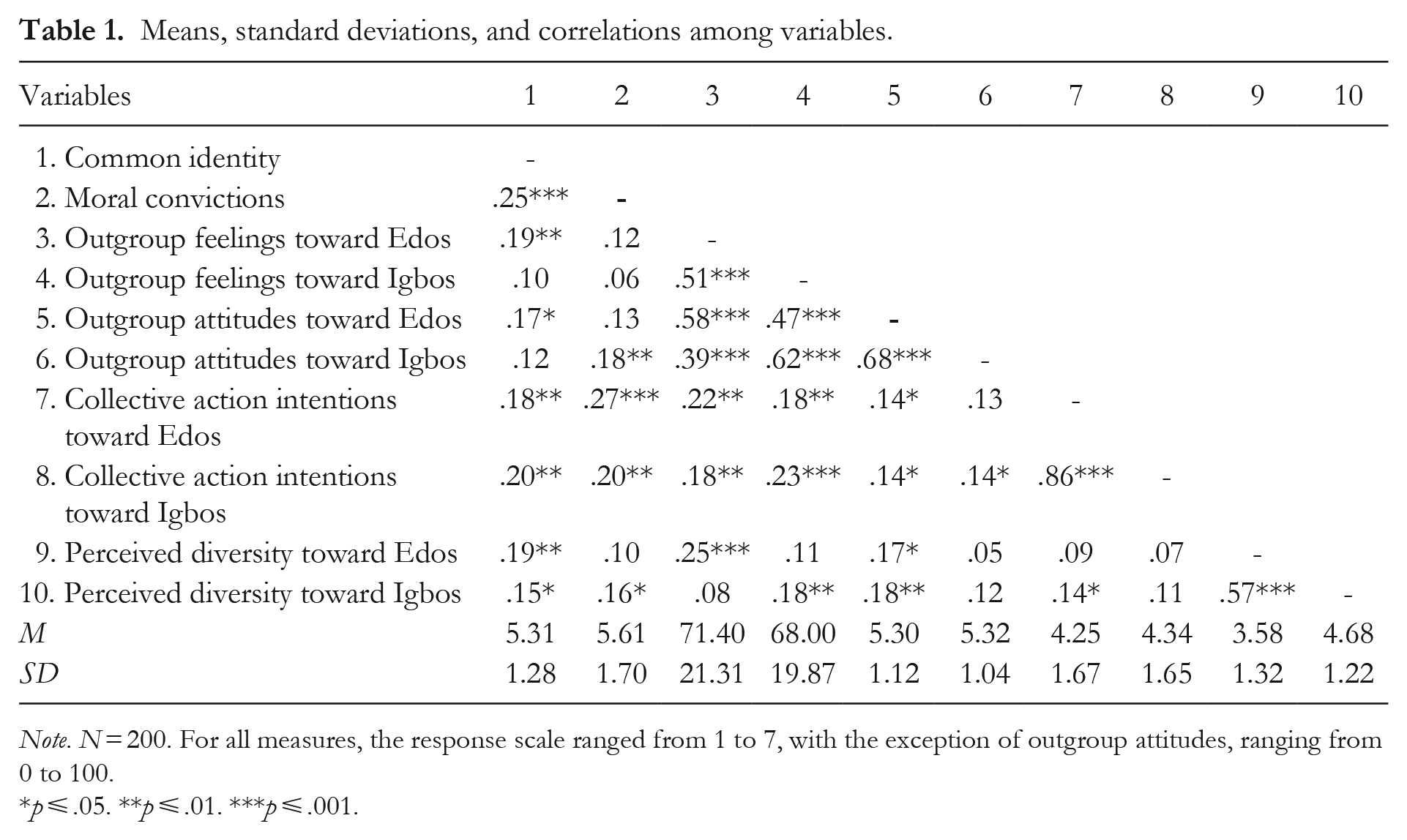
Note. N = 200. For all measures, the response scale ranged from 1 to 7, with the exception of outgroup attitudes, ranging from 0 to 100.
p ⩽ .05. **p ⩽ .01. ***p ⩽ .001.
First, we tested the hypotheses with respect to the Edo tribe (minority group). As can be seen in Table 2, common identity was positively associated with all hypothesized mediators (moral convictions, outgroup feelings, and outgroup attitudes). In the final regression including the independent variable and mediators, moral convictions and outgroup feelings were positively associated with collective action (see Figure 1). Partly in line with the hypothesis, as can be seen in Table 3, bootstrapping estimates (5,000 bootstrap samples) indicated a significant indirect effect of common identity on collective action toward Edos via greater moral convictions and outgroup feelings.
Linear regressions testing the predictive role of common identity and hypothesized parallel mediators on collective action.
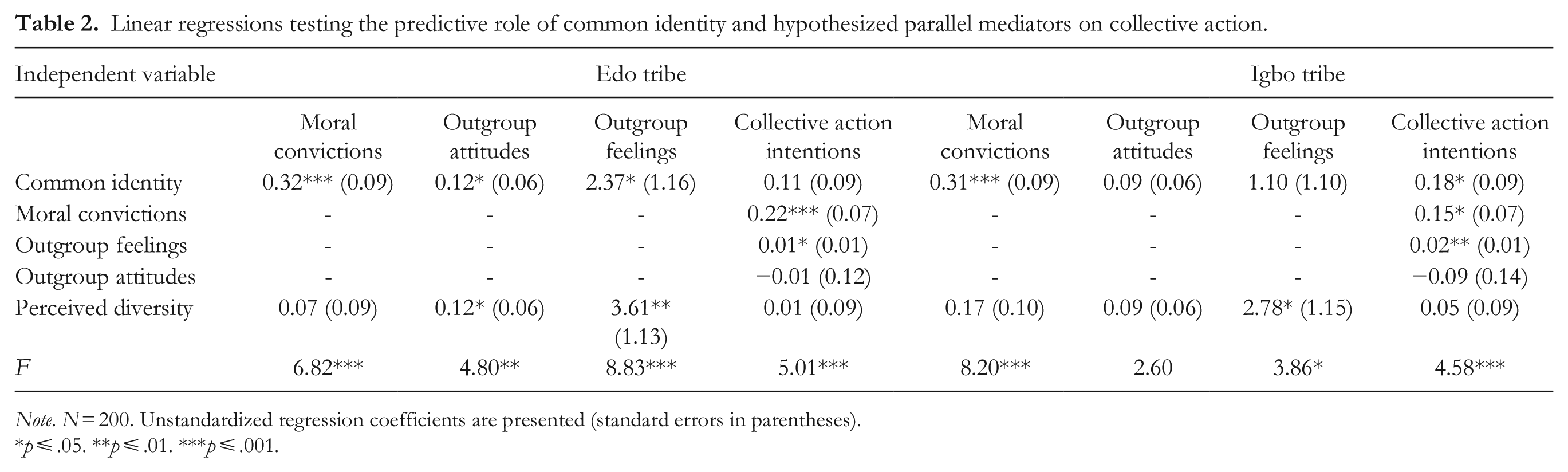
Note. N = 200. Unstandardized regression coefficients are presented (standard errors in parentheses).
p ⩽ .05. **p ⩽ .01. ***p ⩽ .001.
Indirect effects estimation of common identity on collective action intentions via hypothesized parallel mediators.
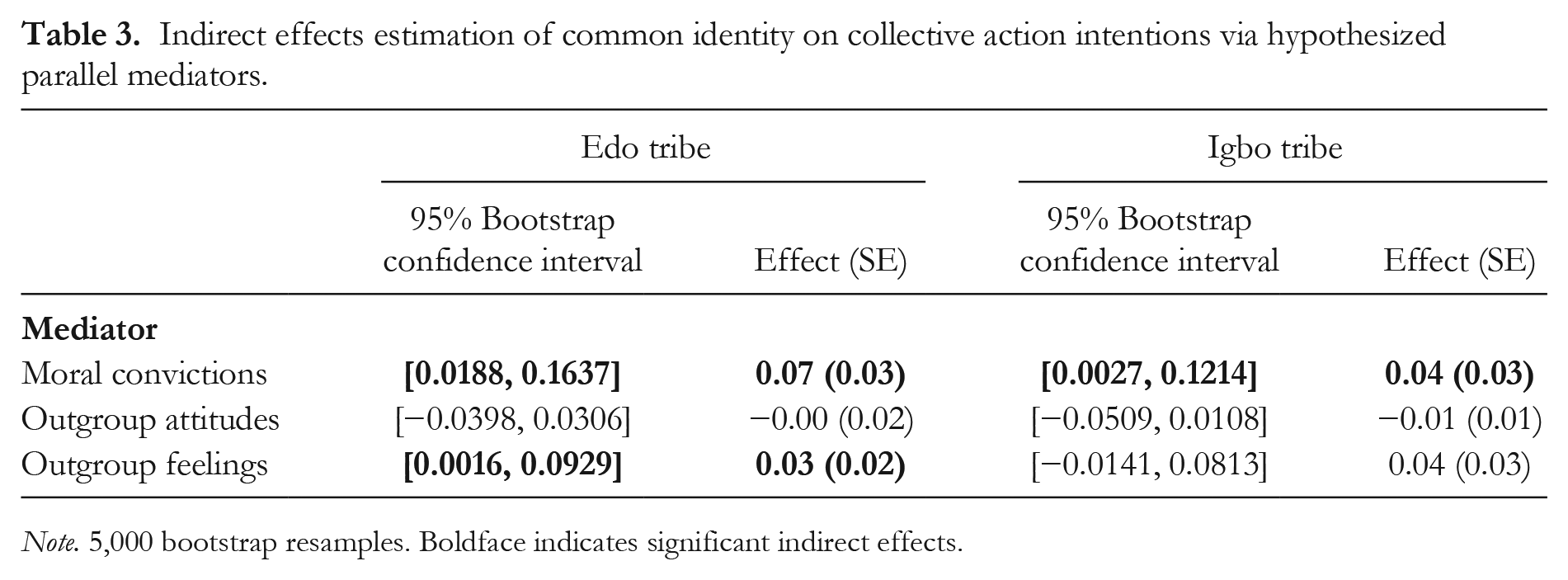
Note. 5,000 bootstrap resamples. Boldface indicates significant indirect effects.
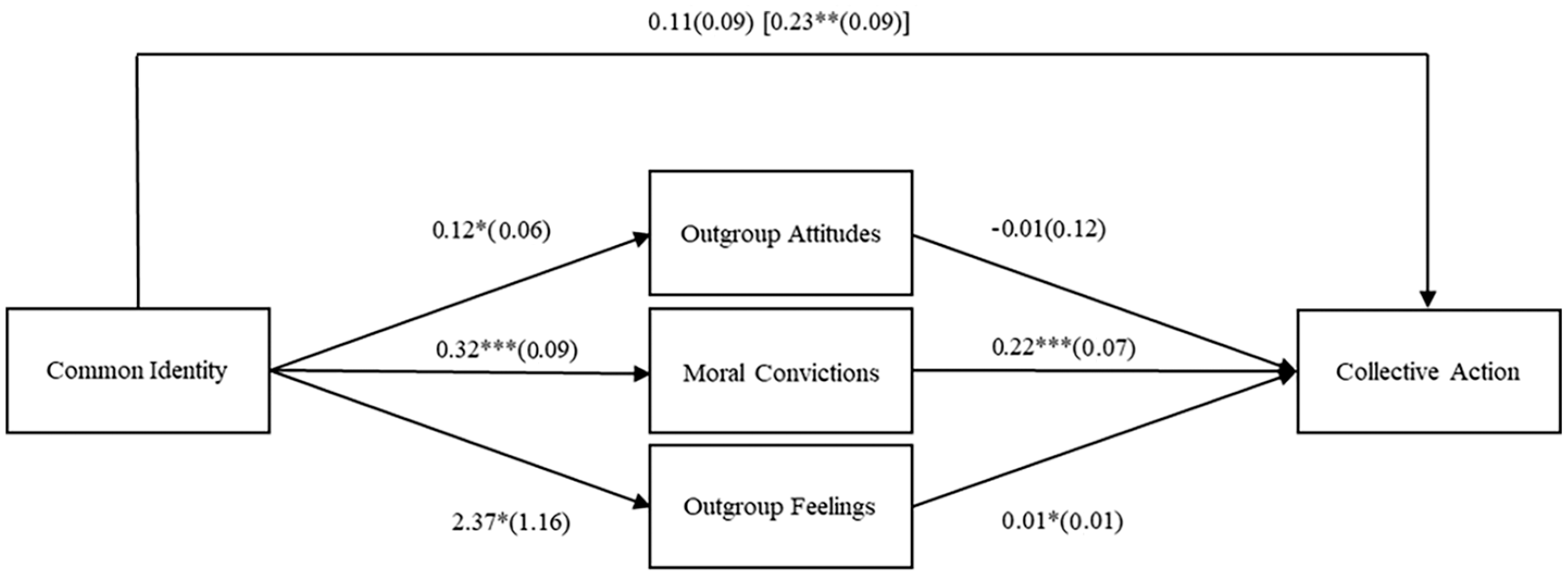
Parallel mediation model with three mediators to test the hypotheses with respect to the Edo tribe (minority group).
Regarding results considering Igbos (majority group) as the target, as shown in Table 2, common identity was positively associated with moral conviction; associations of common identity with the other two mediators were nonsignificant. When common identity and the three mediators were included in the regression equation, both morality convictions and outgroup feelings were positively associated with collective action (see Figure 2). Bootstrapping estimates (based on 5,000 bootstrap samples) indicated a significant indirect effect of common identity on collective action toward Edos only for moral convictions (see Table 3). 1
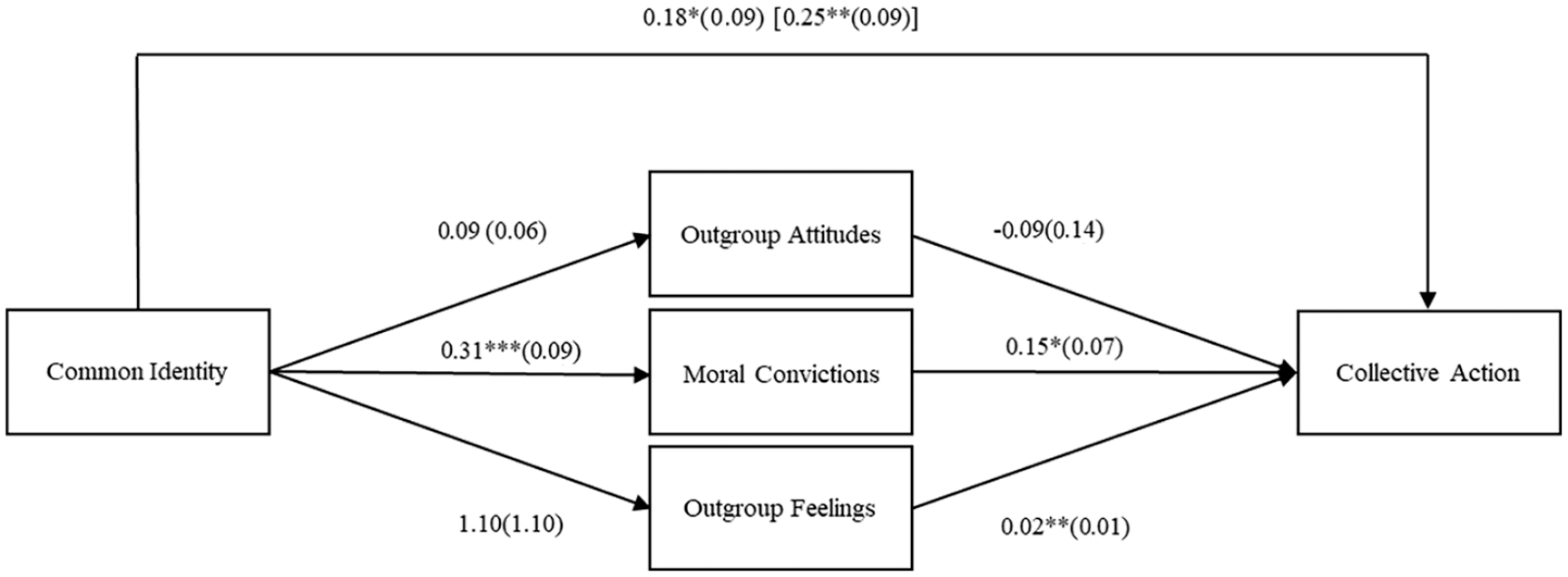
Parallel mediation model with three mediators to test the hypotheses with respect to the Igbo tribe (majority group).
Discussion
With the aim of clarifying the role of one-group perceptions in collective action processes, we conducted a cross-sectional study aimed to explore the link between a superordinate group identity and the engagement of a majority group in collective action strategies aimed to achieve a more equitable society in favour of both an advantaged and a disadvantaged group. In doing so, we considered a rare, non-WEIRD sample from a tribal context in Nigeria, which is characterized by a high level of conflict among tribes. Results revealed that common identity was indirectly associated with collective action intentions toward the two outgroups via morality convictions and (but in this case, only when the outgroup was represented by the minority group) outgroup feelings.
At the theoretical level, the current research attempted to address a research gap in the collective action literature by integrating relevant factors from the broader contact literature. Despite the powerful role of common ingroup identity in promoting positive intergroup relations (Gaertner & Dovidio, 2000), current empirical evidence on the association between this factor and collective action is scarce and somehow mixed. The present study supports the benefit that a common identity can have in promoting alliance between groups, qualifying as a possible strategy to obtain a united front that can claim social justice.
The mixed evidence on the role of common identity in fostering collective action may be due to the low number of studies conducted. However, it may also be a function of the common identity tested. Subašić et al. (2008) argued, in their political solidarity model of collective action, that the common identity should preserve subgroup distinctions. Similarly, Dovidio et al. (2016) argued that conditions that promote intergroup harmony (like common identity) may lower collective action because they inhibit group distinctiveness. These two positions are not necessarily in contradiction. The fact that subgroup differences should not be obscured (Subašić et al., 2008) refers to a common identity that does not lead to assimilation of the minority group, but on the contrary, represents the premise for the recognition of groups included in it (cf. van Zomeren et al., 2018). In the case of the present study, tribal identities are relevant social identities characterized by loyalty and strong identification (Clark et al., 2019). The common Nigerian identity, therefore, is unlikely to “overwrite” these identities, but can provide the meaningful context within which these identities can be expressed and positively acknowledged and recognized. On the other hand, inhibition of group distinctiveness can be mostly referred to the salience of subgroup identities, such that minority groups’ rights can be promoted when the subgroup identities remain salient within the larger superordinate identity that includes them (dual identity; Banfield & Dovidio, 2013). While in this study we did not explicitly assess the salience of common and subgroup identities, future studies should investigate whether subgroup salience is an essential dimension to foster collective action.
It is worth noting that scholars have mainly focused their attention on politicized identities as relevant social identities working as predictors of greater collective action. Although politicized identities can be highly effective in fostering collective action (van Stekelenburg, 2013), they are not always available. Moreover, politicized identities can cease to exist, for instance, if specific aims are achieved. To the extent that a superordinate identity (like the national identity), which can be stable over time, does not need to be politicized toward a specific aim (like a national one), in some cases it can provide the basis for acting toward social equality over time.
Research has shown that common identity can be fueled by a range of factors, like an external threat (Vezzali et al., 2015) or intergroup contact (Capozza et al., 2013). There is evidence that common identity mediates the relationship between contact and collective action. For instance, Rompke et al. (2019; see also Cocco et al., 2022) showed that German university students’ contact with foreigners was associated with identification with humanity (assessed 6 months later) and, in turn, with greater support for social policies benefitting the refugee group. Our study complements and extends these findings, showing that the effects of common identity on collective action are primarily mediated by moral convictions.
Group membership implies different values, norms, and moral beliefs to which members tend to adhere as a function of their membership. According to the social identity model of collective action (SIMCA; van Zomeren et al., 2012, 2018), moral beliefs, connecting individuals to higher order principles on moral issues, require the defense of these absolute stances whenever they are violated. Therefore, moral convictions can serve as motivational guides to act, fueling the intention to undertake collective actions. For this reason, moral convictions, besides representing an effective predictor of social change, represent a meaningful mediator of a relevant social identity whose well-being is undermined by social injustice.
It should be noted that, while we argued that moral convictions are rooted in the superordinate identity that we considered (and in fact, we tested them as stemming from it), we assessed moral convictions in terms of personal convictions about the importance and morality of treating Nigerians as all the same. In other words, although we linked them to the Nigerian identity, we did not explicitly assess whether participants regarded them as directly deriving from the superordinate identity. Although the empirical association between our measures of common identity and moral convictions indirectly supports our interpretation, future studies can test the association of a specific common identity with moral convictions related or unrelated to this identity. In addition, since van Zomeren et al. (2012, 2018) intended moral convictions as a broad set of beliefs, future studies might consider different operationalizations of moral convictions (including the violation of them; van Zomeren et al., 2018) and their predictivity for collective action.
The original version of the SIMCA (van Zomeren et al., 2008) was mostly focused on the minority group, investigating social identity, group efficacy, and perceptions of injustice as predictors of collective action. Van Zomeren et al. (2012, 2018) extended their model to include moral convictions, which represent motivating factors that can mobilize majority group members to engage in collective action on behalf of the minority group. In the current study, we provided support for the model, extending the current literature by showing that moral convictions motivated by a relevant social identity predict collective action not only toward a disadvantaged minority group but also toward a further majority group. In other words, moral convictions are key processes to motivate action for social equality toward a wider social system within which the different subgroups (tribes, in our study) coexist. Furthermore, the inclusion of different groups allows to avoid the binary logic through which the complexity of society is often observed and which, by forcibly imposing a simplification, hides the true nature of intergroup relations (Dixon et al., 2020). This would be particularly relevant in a tribal context, as that analysed in this study, in that it is necessarily characterized by different social identifications that are distinct from each other and that imply high levels of loyalty to the ingroup.
Considering the evidence provided by contact literature showing how outgroup attitudes and feelings can represent well-known common identity outcomes (Gaertner et al., 1994), and taking into account findings emphasized by collective action research showing their strong implication in social change processes (Graf & Sczesny, 2019; van Zomeren et al., 2008, 2012), these variables were tested as further mediators. Surprisingly, we found that outgroup feelings worked as mediator only toward the minority group, while outgroup attitudes were nonsignificant for both groups, highlighting the prominent role played by moral convictions in driving collective action intentions. Considering that attitude measurement can be highly context-dependent (Schwarz, 1999), we argue that a possible explanation for these outcomes may be related to the context in which the data were collected. Indeed, looking at Tables 1 and 2, it is possible to observe rather favourable attitudes and feelings toward both groups. After all, participants came from Lagos, which is not only the largest city in Nigeria but also the largest in Africa where all tribes cohabit. Therefore, Lagos could represent a context mainly characterized by aggregation rather than segregation among tribes. Future studies could explore such associations in different contexts where segregation is more salient.
Although the present study helps to reconcile two different literatures highlighting relevant processes in the struggle for social change, these findings represent only a first step in understanding the driver role that a meaningful common identity can have in shaping intergroup perceptions. It should be noted that the results of the present study may be limited to normative forms of collective action (like the one we assessed), while it can be ill-suited to understanding how to mobilize groups for nonnormative collective action. Engaging in nonnormative forms of collective action may somehow violate the values attributed to the superordinate group and create resistance among majority group members (especially among members highly identified with their group; Teixeira et al., 2019). In other words, a common identity may be an obstacle rather than an incentive to engage in nonnormative collective action.
The novelty of our findings notwithstanding, our results should be interpreted with some caution. As with most research on the topic, one relevant limitation is the correlational nature of the data; future studies should investigate this association with longitudinal and/or experimental designs. Note, however, that the tested relations are based on established psychological models, which provided evidence for causality (e.g., the common ingroup identity model with respect to the effects of a common ingroup identity; Gaertner & Dovidio, 2000). Further, we did not assess the content of identity (such as its complexity or the values and moral traits characterizing it), which can instead be relevant to understand how it relates to collective action (van Zomeren et al., 2018). For instance, a possible explanation for the key role played by common identification in the pursuit of social change can be found in the metacontrast principle (Turner et al., 1987), which can be used to calculate the degree of perceived prototypicality of the different subordinate identities (for an example of the use of the metacontrast principle applied to collective action, see Di Bernardo et al., 2023). It could be plausible that focusing on a broader social identity, individuals would be willing to engage in collective action only for highly prototypical subgroups. Finally, we used a convenience sample; future research should try to use representative samples.
In conclusion, our findings show that a common identity, which plausibly does not obscure subgroups’ distinctiveness, may represent a meaningful driver in social change processes promoting the well-being of society as a whole, and that moral convictions play a key role in this process. All in all, we believe the present research has merit in the sense that it was conducted in the context of a very complex web of identities and intergroup relations, and thus constitutes an important step toward a more universal and democratic social psychology of intergroup relations beyond the traditional constraints imposed by the binary perspective.
