



Abstract
Drawing from the social psychological model of schisms (Sani, 2005) and moral foundations theory (Haidt & Graham, 2007), we hypothesized that liberals would be more likely to schismatize from a group following an individualizing moral violation, whereas conservatives would be more likely to schismatize from a group following a binding moral violation. We additionally hypothesized that perceptions of identity-subversion would mediate the interaction between ideology and moral violation on schism intentions. We conducted four high powered studies (total N = 1,614) using different designs (correlational, experimental) to test our hypotheses across different groups. Results from Studies 1 and 2 partially supported the hypotheses, while results from Studies 3 and 4 fully supported the hypotheses. The results suggest that people’s political ideologies make them more susceptible to perceiving different types of moral violations, and that moral violations can elicit a schism process.
People and factions leaving groups is a ubiquitous phenomenon. For instance, in 2016, people in the United Kingdom voted to leave the European Union. That same year, people in the Catalan region of Spain overwhelmingly voted in favor of independence. On an individual level, people across the globe leave groups such as political parties, community organizations, occupations, university clubs, and religious communities. Thus, the process of an individual or faction of individuals exiting a group seems to be a common phenomenon within group life.
There is an extensive social psychological literature on why people join groups (e.g., Hogg et al., 2008; Kraut et al., 2020; Leary & Baumeister, 2000), but the notion of leaving a group is often examined as a schism, which is defined as when, “a faction can secede from the parent group to either create a breakaway group or join an already existing group” (Sani & Pugliese, 2008, p. 242). The predominant model to examine schisms is Sani’s (2005) social-psychological model of schisms, which outlines how a change in a group can violate a person’s understanding of the group. This, in turn, can produce certain psychological processes (e.g., weakened identification, increased anger) that predict schism intentions.
Although this model shows the psychological processes that are elicited once a change occurs within the group, the model does not account for what types of events or changes in a group violate people’s understanding of the identity of the group nor for the individual differences that would make people susceptible to perceiving identity-subversion. Because perceiving morality within the in-group is pivotal to obtaining a positive social identity (Leach et al., 2007), perceiving a moral violation could violate people’s understanding about the core aspects of the group’s identity. However, people hold different ideas about what is morally right or wrong, suggesting that people could differ in their perception about what events or changes constitute moral violations. To our knowledge, there has been no investigation into how moral violations produce schism intentions nor into what individual differences make people more susceptible to perceiving the moral violation as fundamentally violating the group’s core identity. The aim of this research is to extend previous work on schisms by incorporating ideological asymmetries in moral intuitions to predict the experience of identity-subversion and subsequent schism intentions. An examination of how ideology and moral violations interact to impact the schism process can enhance the field’s understanding of why people exit groups and increase the utility of Sani’s model by determining the types of changes that elicit schisms.
The Social Psychological Model of Schisms
Social psychological studies focusing on schisms have primarily been grounded in Sani’s (2005) framework, which is further based on social identity theory (SIT; Tajfel & Turner, 1979). SIT proposes that people define part of their self-concept through their group memberships and strive to maintain a positive image of their group. When people encounter situations that inhibit their obtainment of a positive social identity, they are more prone to engage in “individual mobility” to distance themselves from their group and obtain a positive self-image elsewhere.
Sani’s (2005) social psychological model of schisms builds on SIT by proposing that people are more likely to schismatize when they perceive a core aspect of the group’s identity has been undermined. For example, Sani and Reicher (1999, 2000) studied how the ordination of female priests—which went against historical tradition within the Church—caused a divide within the Church of England and led to a mass exodus of members. These researchers concluded that the individuals who left the Church did so because they felt the change violated the group’s principles and fundamentally changed its essence. This phenomenon was termed identity-subversion.
Researchers have shown that identity-subversion predicts schism intentions through two paths (Sani, 2005; Sani & Pugliese, 2008; Sani & Todman, 2002). First, identity-subversion weakens perceptions of the group’s entitativity. Lowered perceptions of entitativity weaken individuals’ identification with the group, which increases the likelihood of a schism. Second, identity-subversion corresponds to stronger aversive emotions. Based on Higgins’s (1987) self-discrepancy theory, Sani (2005) proposed that a perceived discrepancy between one’s personal values and the group’s identity creates negative emotions toward the group, which can lead to a schism. Finally, Sani’s model states that perceptions of voice can impact schism intentions; specifically, people who feel that they can voice their dissent are less likely to schismatize, even when perceiving identity-subversion (Sani, 2005; Sani & Pugliese, 2008).
Overall, the social psychological model of schisms provides a framework to understand the process by which people exit their group following a perceived violation of the group’s identity. However, research has yet to identify the factors that lead people to perceive that a change or action has violated the essence of their group. For instance, in research that focused on the schism within the Church of England (e.g., Sani & Reicher, 1999, 2000), some members viewed the ordination of female priests as subverting the group’s identity, while others saw the change as enhancing the defining principles of the Church. Sani and Pugliese (2008) focused on the schism in Alleanza Nationale, an Italian right-wing political party with a fascist ideology that valued Mussolini. Their results showed that members who still respected Mussolini and valued fascism experienced identity-subversion when a newly elected leader spoke out against Mussolini and the harm caused by fascism. Conversely, people who lacked respect for Mussolini or fascism experienced identity enhancement upon this event.
We propose that ideological asymmetries in moral intuitions could explain why people differently perceive identity-subversion in their groups. Specifically, because liberals and conservatives harbor different moral intuitions, they are potentially predisposed to perceiving different events or changes as moral violations.
Ideological Asymmetries in Morality
Perceiving morality within the in-group is a pivotal component of a positive social identity. Researchers have found that people have stronger group identification when their groups are perceived as moral (Ellemers et al., 2011; Leach et al., 2007), and derogate in-group members who are perceived as immoral (Ramdass & Hogg, 2019). Leach et al. (2018) further note that maintaining a moral self-image is pivotal to obtaining self-esteem from one’s in-group. Although people want their in-groups to be perceived as moral, a body of research shows that liberals and conservatives hold different moral intuitions about what is morally right or wrong.
One theory that highlights the existence of ideological asymmetries in morality is the moral foundations theory (MFT; Graham et al., 2009, 2013; Haidt & Graham, 2007). MFT is based on the social intuitionist perspective of morality (Haidt, 2001), which claims that people’s moral judgments are derived from their intuitive, automatic responses to situations, and are rarely based on a slower, post hoc reasoning process.
According to MFT, people evolved five moral intuitions that serve as templates for moral judgments. Two of these moral foundations are categorized as individualizing morality because they focus on the treatment and welfare of others. The “care/harm” foundation relates to people’s sensitivity to the suffering of others and motivation to help those in need, while the “fairness/injustice” foundation relates to people’s sensitivity to reciprocity in zero-sum relationships and to cues of justice within cultures. The remaining three moral foundations are categorized as binding morality because they are intuitions that lead people to focus on a group’s norms and traditions over its individual members. “Loyalty/betrayal” is related to people’s perceptions of others exhibiting commitment and sacrifice toward their in-group. The “authority/disobedience” foundation highlights how people’s moral judgments are affected by whether people respect and obey authorities that are perceived as legitimate. Finally, “purity/degradation” serves as a foundation for the avoidance of stimuli that elicit disgust.
MFT also proposes that there are ideological asymmetries in these moral intuitions. Graham et al. (2009) found that liberals consistently valued individualizing more than binding morality, and that liberals placed a greater value on individualizing morality than conservatives did. These studies also showed that conservatives valued binding morality more than liberals; however, conservatives had similar levels of individualizing and binding morality.
Research on MFT further suggests that these moral intuitions influence people’s moral judgments. Smith et al. (2019) found that conservatives dislike people who engage in violations of binding (vs. individualizing) morality, whereas liberals dislike people who engage in violations of individualizing (vs. binding) morality. Researchers also have found that liberals show stronger support for policies framed in individualizing (vs. binding) moral terms, whereas conservatives show stronger support for policies framed in binding (vs. individualizing) moral terms (Day et al., 2014; Feinberg & Willer, 2013). Finally, research by Hatemi et al. (2019) found that political ideology predicts whether people hold certain moral intuitions (and not vice versa), meaning that perceiving a moral violation does not make one liberal or conservative, but that liberalism or conservatism will predict whether people even perceive a moral violation.
Integrating MFT and the Social Psychological Model of Schisms
Based on the evidence highlighting ideological asymmetries in moral intuitions (e.g., Graham et al., 2009) and the findings that people’s political ideology determines whether they perceive a behavior as a moral violation (Hatemi et al., 2019), it is possible that ideology will predict perceptions of identity-subversion in response to different types of moral violations. Specifically, it is probable that liberals are more likely to perceive identity-subversion in response to violations of individualizing morality, whereas conservatives are more likely to perceive identity-subversion following violations of binding morality. In both instances, perceiving identity-subversion could drive people to schismatize from their group.
Previous research on schisms can be interpreted through the lens of MFT. As noted, much of Sani’s research focused on people leaving the Church of England after the ordination of female priests (e.g., Sani, 2005; Sani & Reicher, 2000). From an MFT perspective, the ordination of female priests could have violated people’s binding moral values related to purity (as it went against a religious norm) and authority (as it went against previous traditions set out by authorities). Sani and Pugliese’s (2008) examination of the Alleanza Nationale fracture can also be interpreted from a MFT perspective. Specifically, speaking out against Mussolini could be perceived as a violation of binding morality because it disrespected their ideal leader (an authority violation) and involved talking negatively about the in-group to the out-group (a loyalty violation). Although binding moral intuitions are supposed to keep people loyal and dedicated to in-group norms and authorities, the given interpretation suggests that people will exit a group if people do not uphold the binding moral values that are prescribed to one’s group members.
Finally, research by Ditrich et al. found that university students’ were more likely to perceive identity-subversion and exit a student organization when one of its members or its leader supported a xenophobic organization (Ditrich et al., 2017, 2019). These researchers assumed that support of xenophobia violated the university’s norms due to the predominant liberal ideology of their student population. From a MFT perspective, liberals were focusing on whether individuals could be harmed or mistreated by this xenophobic organization, and thus had intentions to exit it over a perceived violation of individualizing morality.
Although previous schism research can be interpreted through the lens of MFT, an empirical investigation of whether ideological asymmetries in morality can predict schism intentions is required to fully understand how schisms arise.
The Current Research
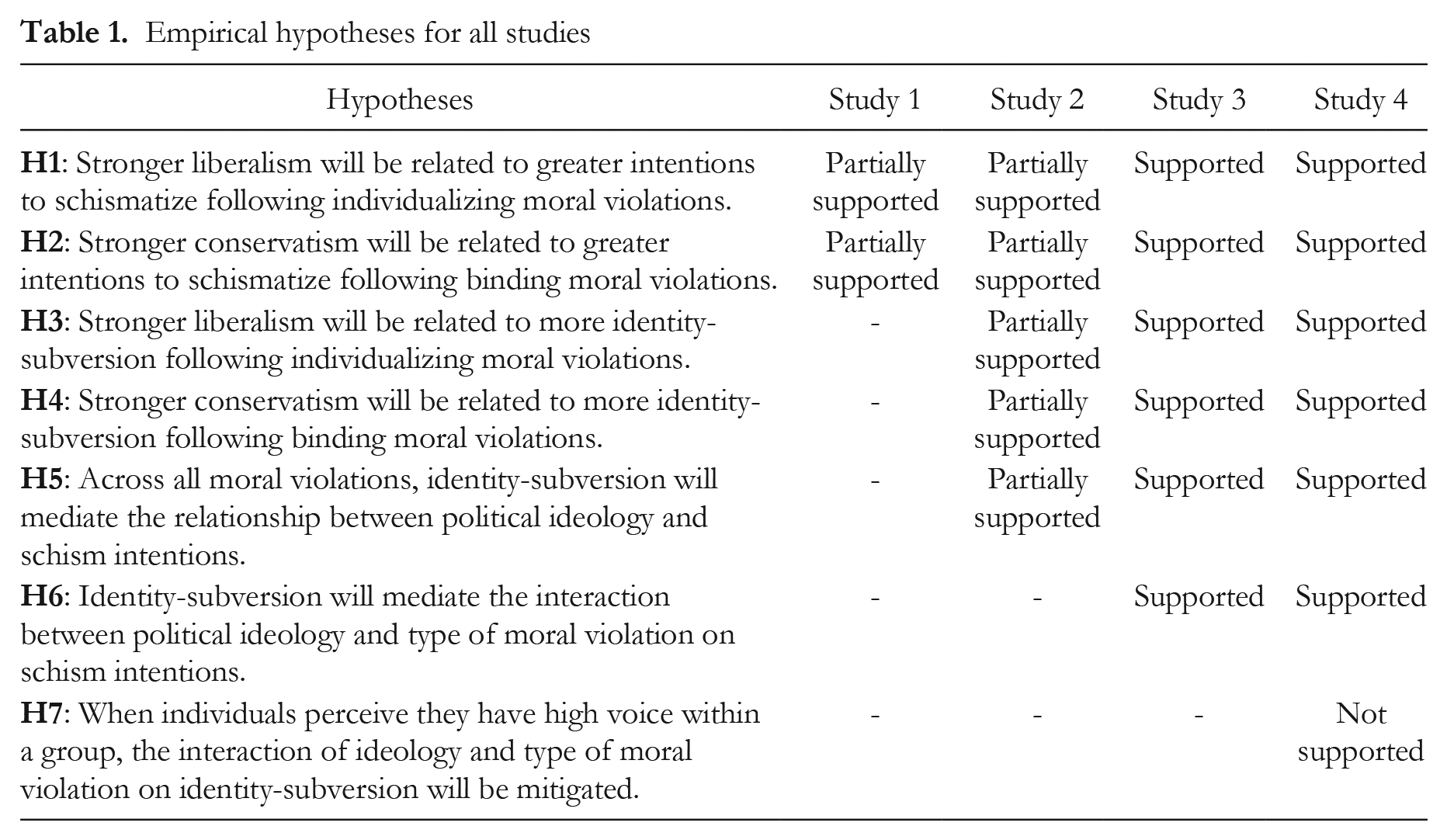
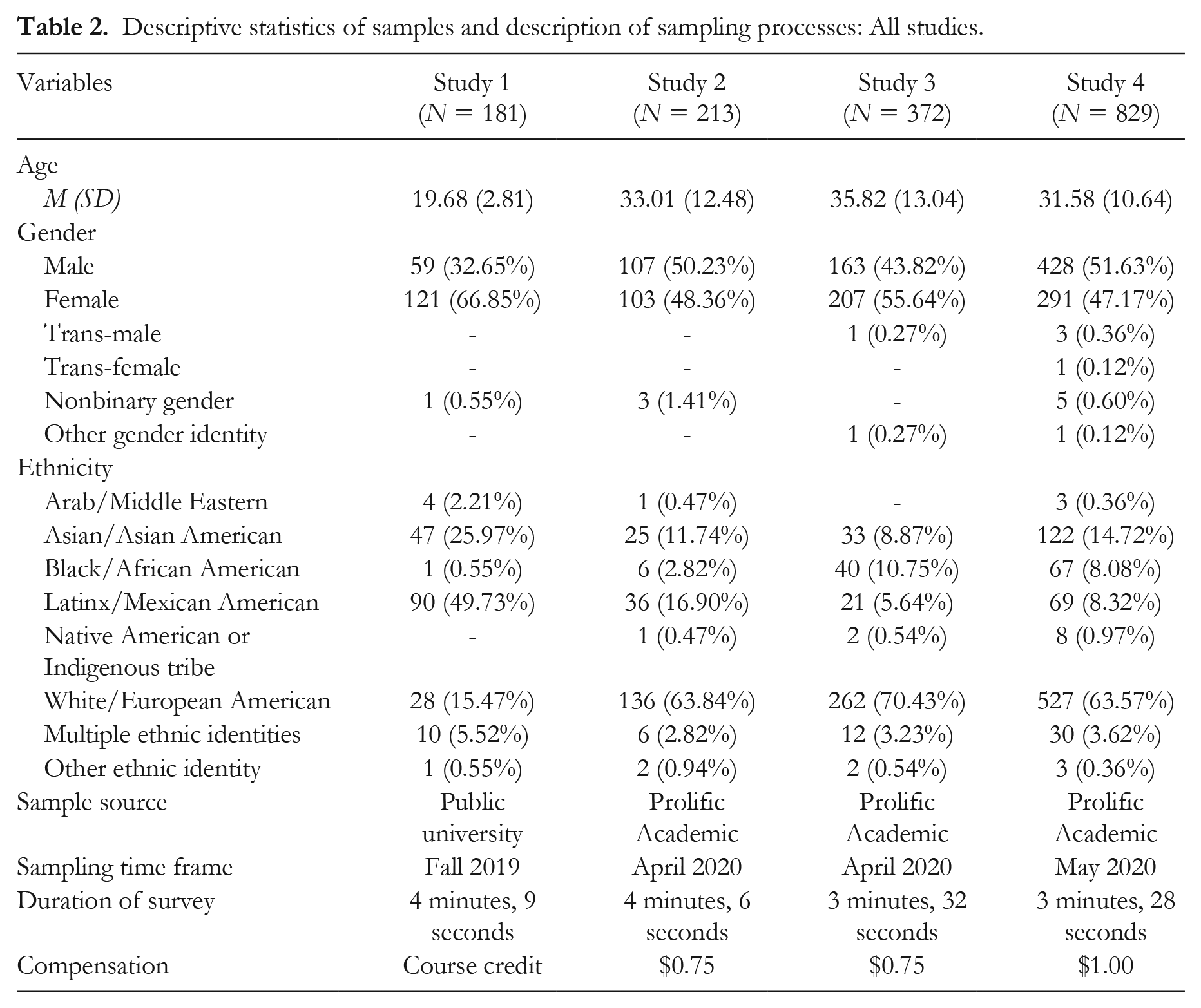
The current work aimed to extend previous work on schisms by examining factors that predict when individuals will perceive identity-subversion, and consequently be more likely to schismatize. Four studies investigated the general hypothesis that ideological asymmetries in morality would predict identity-subversion and subsequent schism intentions in response to different types of moral violations within the group (see Table 1 for hypotheses across all studies; see Table 2 for demographic statistics and sampling information for all studies; see the supplemental material for specific items used for all studies. All studies were administered using Qualtrics).
Empirical hypotheses for all studies
Descriptive statistics of samples and description of sampling processes: All studies.
Study 1 tested H1 and H2 by examining whether people’s political ideology related to their schism intentions in response to violations of each of the five moral foundations.
Methods
Participants
Using G*Power (Faul et al., 2009) with the parameters of ρH1 = .30, ρH0 = .00, p = .01 (two-tailed) and power = .95 for a Pearson’s r correlation, we targeted 189 participants. 1 We sampled 201 individuals. We retained 181 participants after removing 20 individuals who currently belonged to a fraternity or sorority.
Procedure and materials
The study was advertised as a survey examining why people exit groups. People who consented reported the gender they identified with the most (male, female, transgender, nonbinary, other gender identity). We asked their gender identity because this study had participants imagine that they were part of a sorority or fraternity. Males were assigned to imagine they were in a fraternity, while females were assigned to imagine they were in a sorority. 2 For the purpose of assigning them materials, people who did not identify as male or female were asked whether they would prefer to be in a fraternity or sorority.
Next, participants read through 15 different scenarios that depicted their fellow sorority (or fraternity) members engaging in behaviors that represented some type of moral violation. Although no manipulation check was used in this study, these scenarios were adapted from a validated taxonomy of vignettes describing violations of the five moral values outlined by MFT (Clifford et al., 2015). Three scenarios for each of the five moral violations were presented in a randomized order (see Table 3). For each scenario, participants reported the likelihood that they would exit the group over the depicted behavior on a 9-point Likert scale (1 = not very likely, 9 = very likely).
List of moral violations: Study 1
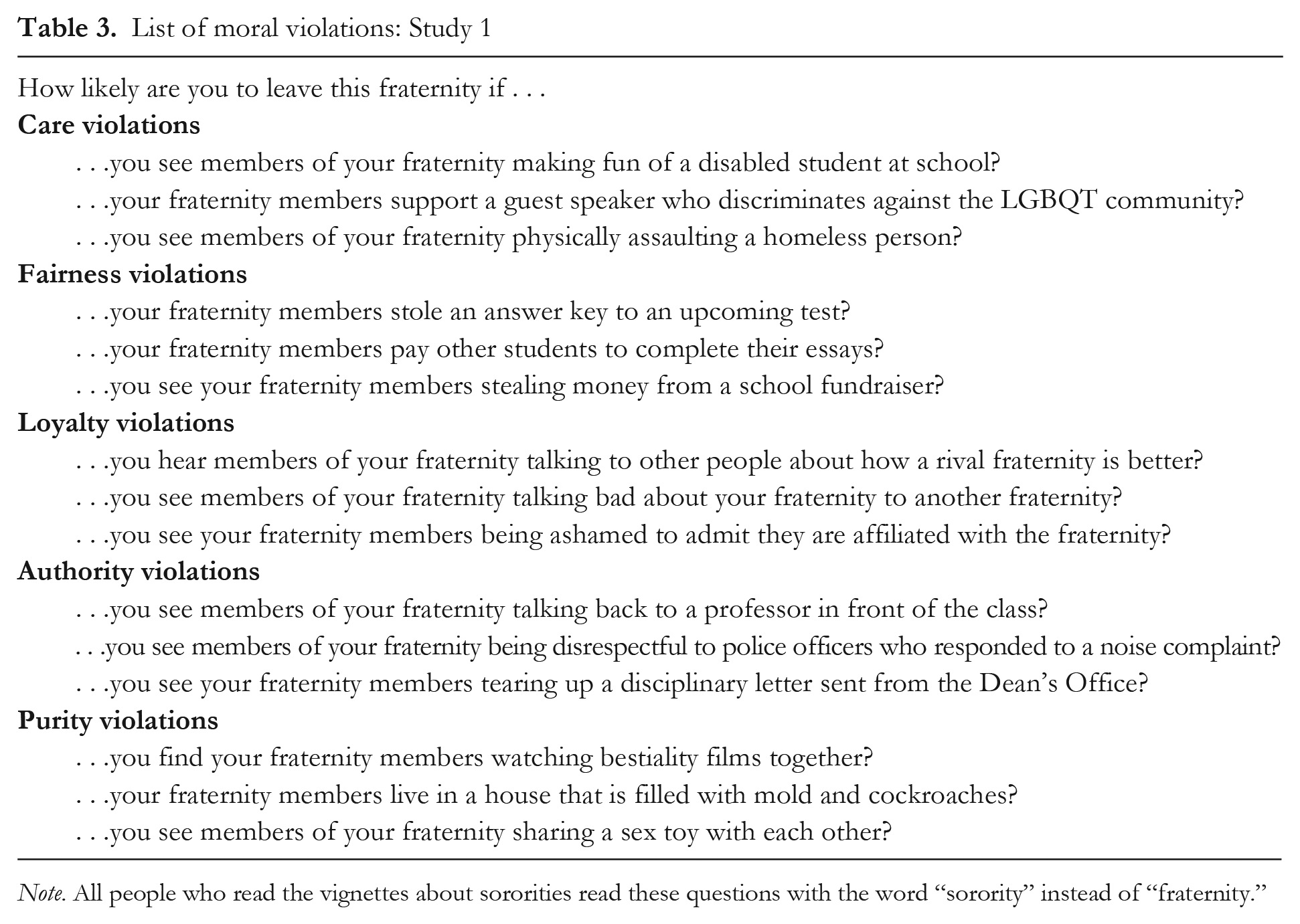
Note. All people who read the vignettes about sororities read these questions with the word “sorority” instead of “fraternity.”
Finally, participants reported their age, ethnicity, and political ideology before being debriefed and compensated. Political ideology was measured on a 9-point Likert scale (1 = very liberal, 9 = very conservative).
Results
Scale creation and background analyses
We averaged the three items for each moral violation to create five separate intentions to exit scales. Table 4 presents descriptive statistics, Cronbach’s alphas, and Pearson’s r correlations. 3
Descriptive statistics, Cronbach’s alphas, and Pearson’s r correlations: Study 1.
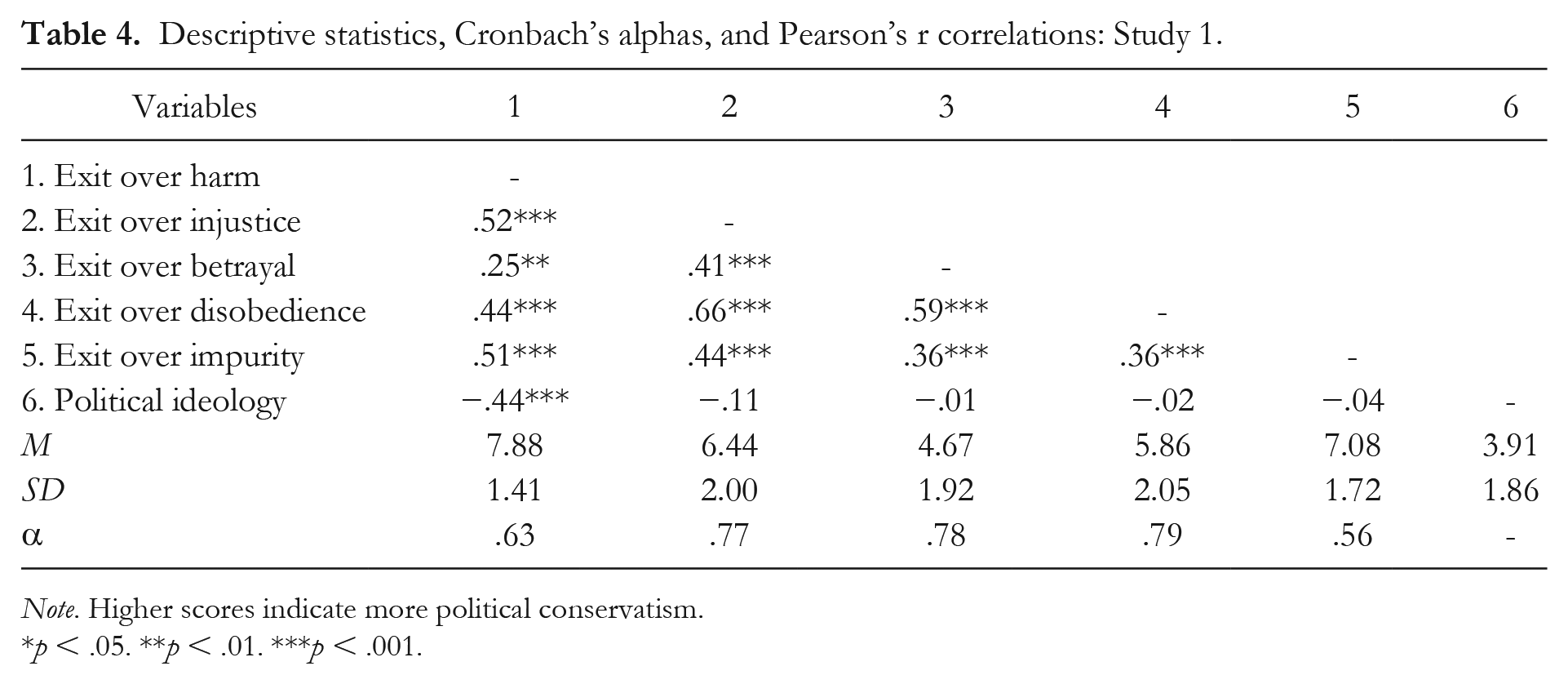
Note. Higher scores indicate more political conservatism.
p < .05. **p < .01. ***p < .001.
Focal analyses
We conducted partial correlations to test our hypotheses that liberals and conservatives would exit groups over different moral violations. For each partial correlation, we examined whether political ideology related to a particular domain of exit (e.g., care) while controlling for the other four domains of exit (e.g., fairness, loyalty, authority, purity).
Results showed that liberalism was related to stronger schism intentions over a care violation. Results also showed that conservatism was related to stronger schism intentions over an authority violation and a purity violation. People’s political ideology was unrelated to their schism intentions over a fairness violation or a loyalty violation (see Table 5 for partial correlations, p values, and 95% confidence intervals).
Partial correlations for ideology and schism intentions over moral violations: Study 1.
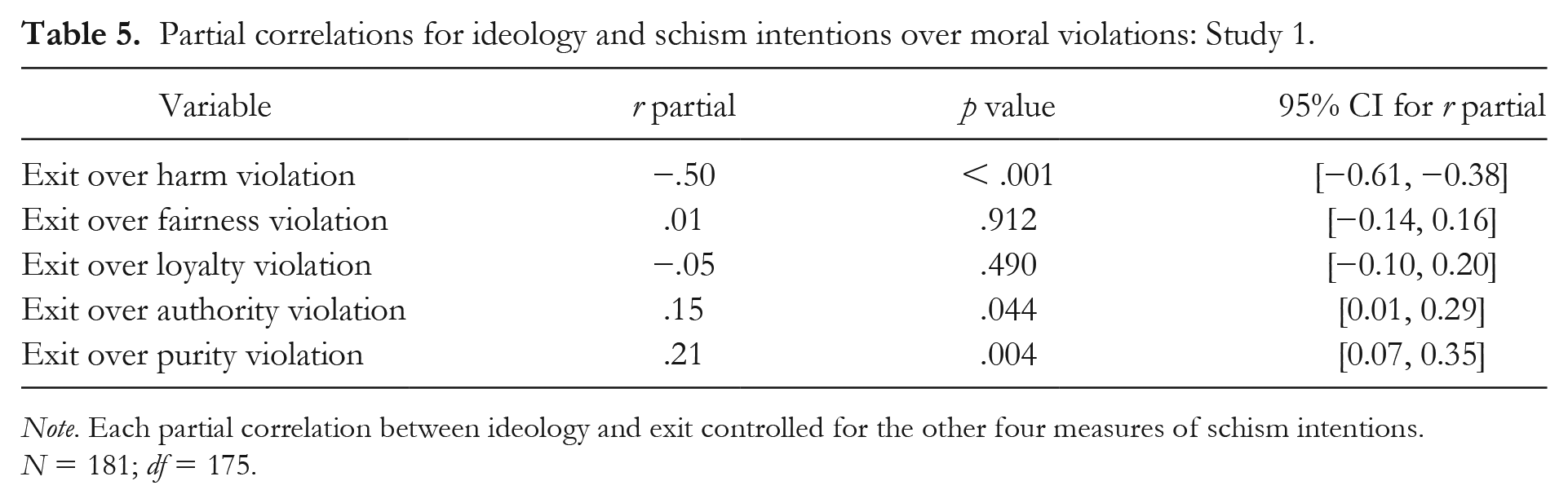
Note. Each partial correlation between ideology and exit controlled for the other four measures of schism intentions.
N = 181; df = 175.
Discussion
Results of Study 1 partially supported H1 by showing that liberals had stronger schism intentions when group members harmed others. Results partially supported H2 by showing conservatives had stronger schism intentions when group members disobeyed an authority figure or engaged in a purity violation. Political ideology was unrelated to people’s schism intentions when their in-group members engaged in unfair behavior or betrayed the group. Overall, we obtained preliminary support for our hypothesis that liberals and conservatives exit their groups over different moral violations.
Study 2
In Study 2, we examined whether perceiving identity-subversion mediates the relationship between political ideology and intentions to schismatize across different moral violations. Although speculative, it is unlikely that schism intentions lead to an ideological worldview because schisms reflect behavioral intentions while political ideology reflects a dispositional construct composed of many psychological factors. Furthermore, we feel that perceptions of identity-subversion are more likely to elicit behavioral intentions (rather than vice versa) due to schisms being an identity maintenance strategy, which is typically engaged in after perceiving an identity threat. Thus, in addition to H1 and H2, we tested H3, H4, and H5 (see Table 1).
Methods
Participants
Using MedPower (Kenny, 2017) with the parameters of βa.path = .30, βb.path = .30, βc’.path = .10, p = .01, power = .95, we determined the targeted sample size was 221 for a mediation analysis. 4 We sampled self-identified Catholics from the United States of America. We recruited participants from Prolific Academic—an online crowdsourcing website that allows researchers to compensate individuals for their time (Palan & Schitter, 2018). We sampled 221 individuals; we retained 213 after removing eight individuals who did not identify as Catholic.
Procedure and materials
The study was advertised as a survey examining people’s attitudes towards the Church. People who consented to the study were told that they would read through five scenarios that depicted a priest of their congregation engaging in a behavior and that they would be asked to evaluate it. Participants read through five scenarios in a randomized order that depicted a priest engaging in a moral violation (see Table 6). We conducted two pilot studies ahead of Study 2 to verify the construct validity of these scenarios (see supplemental material).
List of moral violations: Study 2
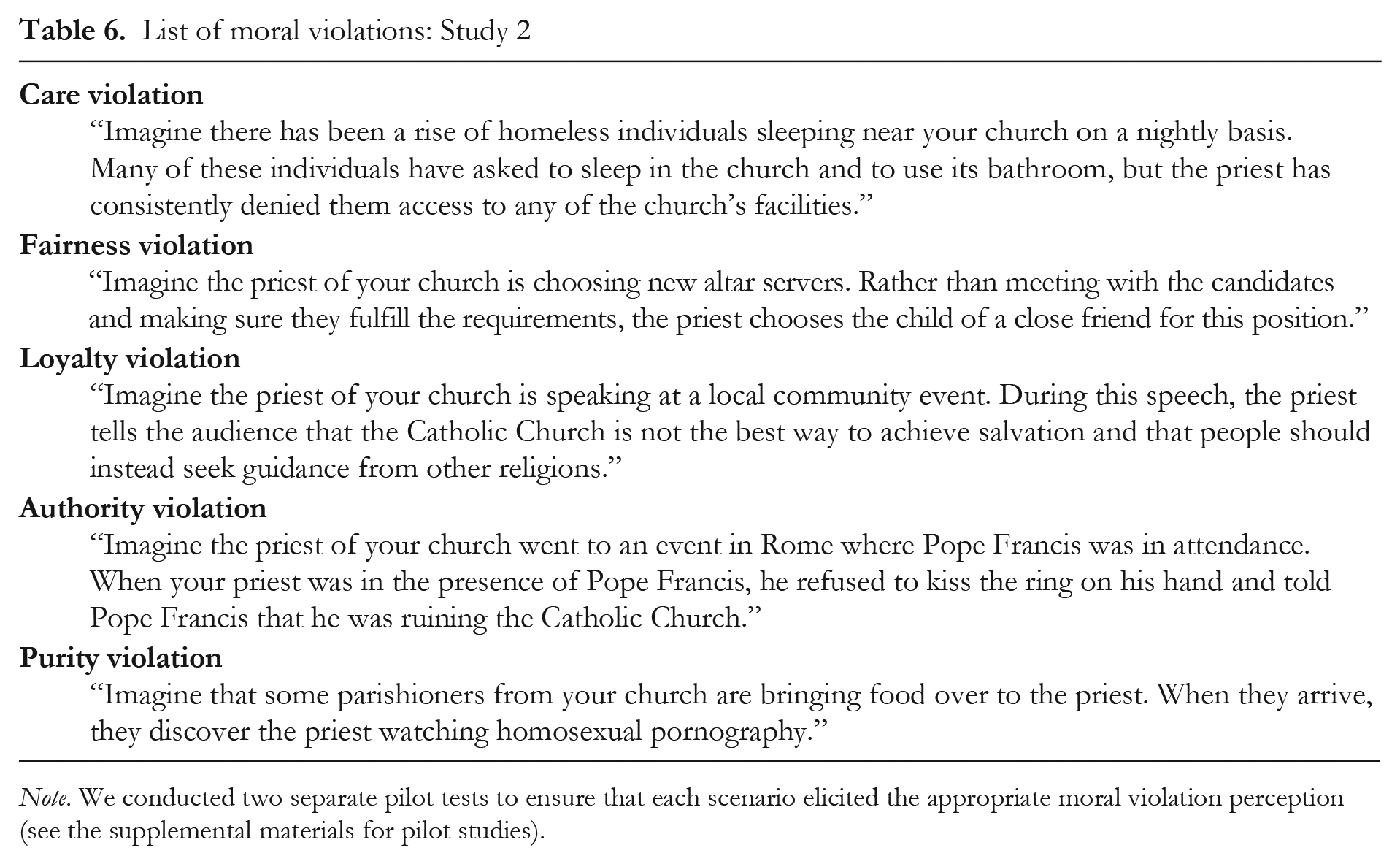
Note. We conducted two separate pilot tests to ensure that each scenario elicited the appropriate moral violation perception (see the supplemental materials for pilot studies).
After reading each scenario, participants reported their perceptions of identity-subversion and schism intentions on 9-point Likert scales (adapted from Sani & Pugliese, 2008). For identity-subversion, participants completed four items assessing if the priest’s behavior violated their understanding of the Catholic Church’s core values and identity (1 = not at all, 9 = extremely). For schism intentions, participants completed two items indicating whether they would leave the congregation over the priest’s behavior (1 = strongly disagree, 9 = strongly agree).
Participants then reported their demographics and political ideology before being debriefed and compensated for their time. Political ideology was again measured on a 9-point Likert scale.
Results
Scale creation
We created five separate measures of identity-subversion and five measures of schism intentions, one for each moral violation. Table 7 displays the descriptive statistics, Cronbach’s alphas, and Pearson’s r correlations. 5
Descriptive statistics, Cronbach’s alphas, and Pearson’s r correlations: Study 2.
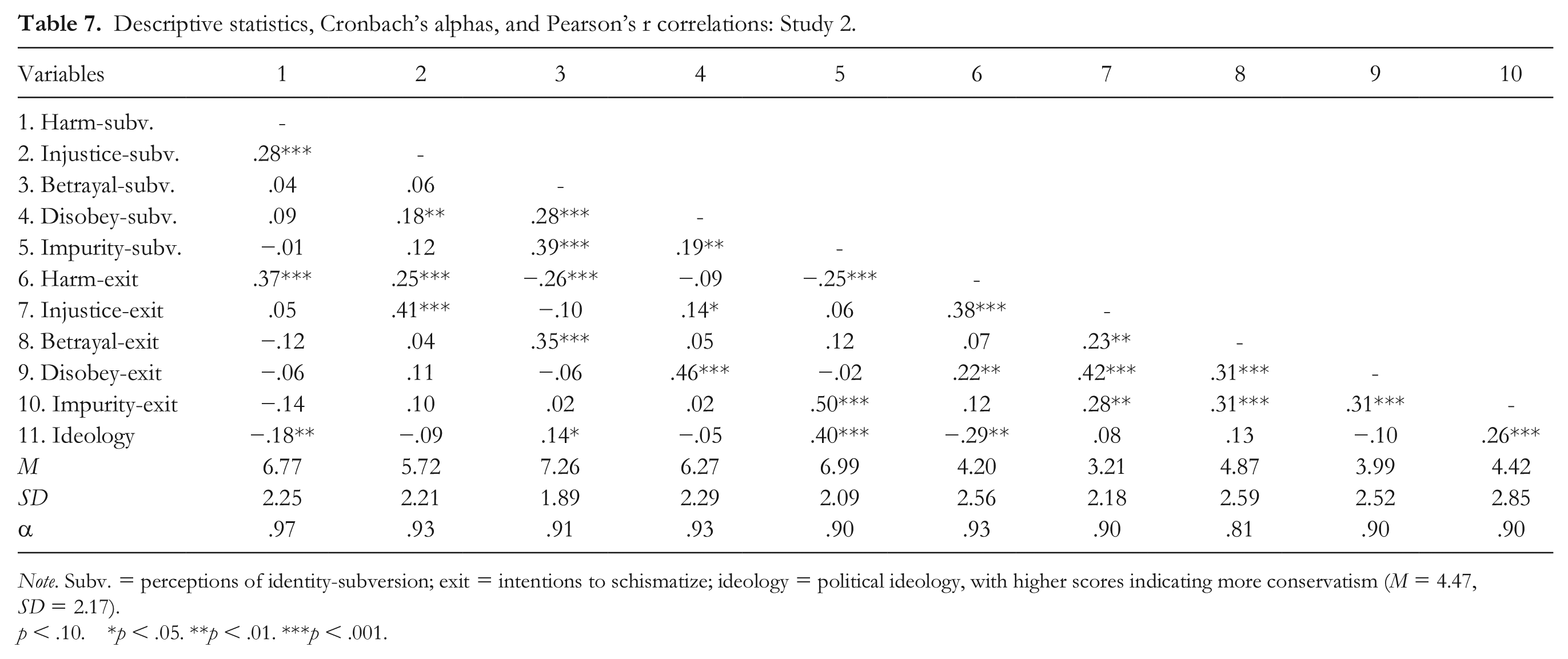
Note. Subv. = perceptions of identity-subversion; exit = intentions to schismatize; ideology = political ideology, with higher scores indicating more conservatism (M = 4.47, SD = 2.17).
p < .10. *p < .05. **p < .01. ***p < .001.
Focal analyses
For each of the five moral violations, we created a mediation model with 5,000 bootstraps using the PROCESS macro (Model 4; Hayes, 2013) in SPSS. For each model, political ideology was the predictor variable, schism intention was the dependent variable, and perception of identity-subversion was the mediator variable. Table 8 reports the 95% confidence intervals for the standardized regression coefficients for the mediation paths in each model.
Paths for mediation analysis across moral violations: Study 2.
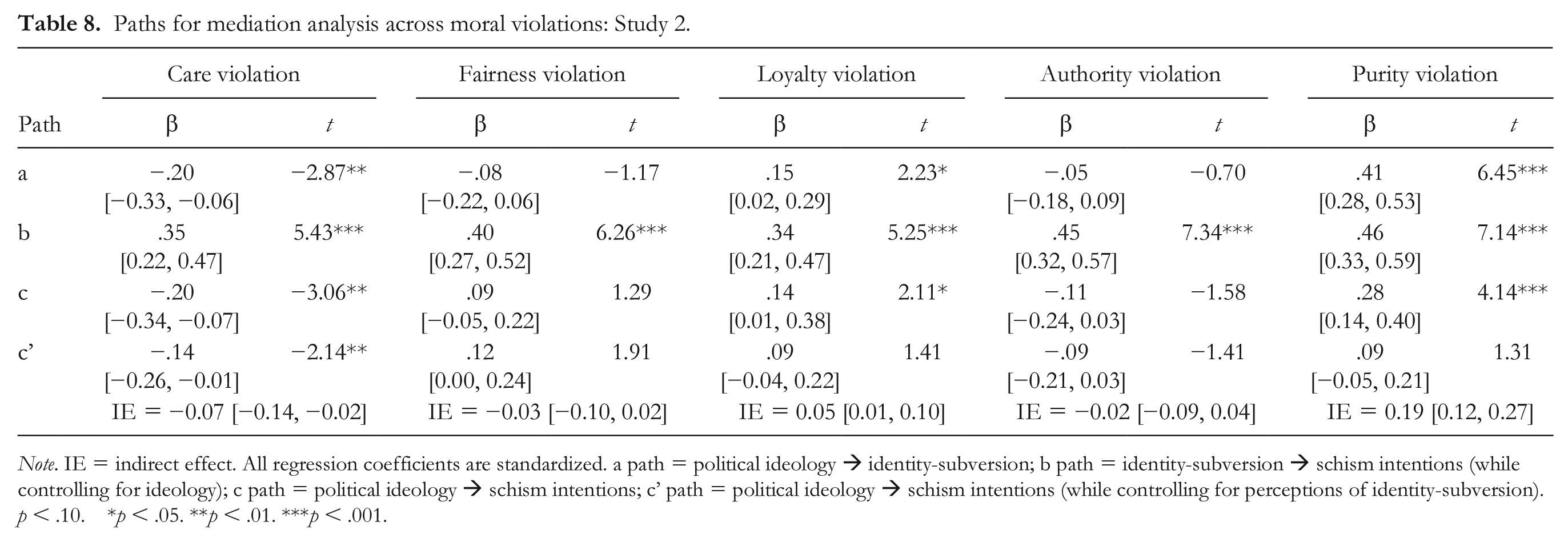
Note. IE = indirect effect. All regression coefficients are standardized. a path = political ideology → identity-subversion; b path = identity-subversion → schism intentions (while controlling for ideology); c path = political ideology → schism intentions; c’ path = political ideology → schism intentions (while controlling for perceptions of identity-subversion).
p < .10. *p < .05. **p < .01. ***p < .001.
Results showed that for a care violation, more liberalism was related to perceiving more identity-subversion and having stronger schism intentions. When controlling for political ideology, perceiving identity-subversion over a care violation predicted schism intentions. Finally, the indirect effect of ideology on schism through perceptions of identity-subversion was statistically significant.
In contrast, for both loyalty and purity violations, more conservatism was related to perceiving more identity-subversion and having stronger schism intentions. When controlling for political ideology, perceiving identity-subversion in response to one of these violations predicted schism intentions, and the indirect effects of ideology on exit through perceptions of identity-subversion were significant.
For the fairness and authority violations, political ideology was unrelated to perceptions of identity-subversion and schism intentions. Controlling for political ideology, perceptions of identity-subversion predicted stronger schism intentions, but the indirect effects of ideology on schism through perceptions of identity-subversion were not statistically significant.
Discussion
Study 2 partially supported our hypotheses. H1 and H3 were partially supported by showing that liberals perceived more identity-subversion and had stronger schism intentions when perceiving harm. H2 and H4 were partially supported by showing conservatives perceived more identity-subversion and had stronger schism intentions when perceiving disloyalty or impurity. People’s political ideology did not predict identity-subversion or schism intentions when perceiving unfairness or disobedience.
Results provided partial support for H5 by showing that perceptions of identity-subversion mediated the relationship between political ideology and schism intentions over care, loyalty, and purity violations. Political ideology was not related to identity-subversion following fairness and authority violations, so mediation did not occur.
Study 3
Although our previous studies provided some support for the proposition that liberals and conservatives will lean towards schism over different moral violations, there were a few limitations to these designs. One issue was that we used a single-item measure of political ideology. Although single-item assessments can be limited in grasping all the complexities of a multifaceted construct, many single items have been shown to have test–retest reliability and construct validity (Allen et al., 2022). Our single-item measure of political conservatism has been found to have strong correlations (rs > .60) with multifaceted dimensions of conservatism and other conservative worldviews (e.g., right-wing authoritarianism [RWA], social dominance orientation [SDO]; Everett, 2013). Nonetheless, we decided to use a broader measure of political ideology for subsequent studies to better capture the nuances and complexity of this construct.
Furthermore, our previous designs were correlational, which limited our ability to make causal inferences. To overcome these limitations, we conducted a third study that measured participants’ political ideology using a broader measure of conservatism, and randomly assigned participants to read about their group engaging in either an individualizing or binding moral violation. The changes to the study’s design allowed an examination of whether an interaction between political ideology and moral violations on schism intentions is mediated through perceptions of identity-subversion. If schism intentions are a consequence of perceiving identity-subversion over a moral violation, then any interactive effect on schism intentions should be contingent on perceiving identity-subversion. Overall, in addition to H1–5, we tested H6.
Methods
Participants
We targeted 420 participants for this study. Based on recommendations for examining interactions that contain slopes with reverse directions (Giner-Sorolla, 2018), we doubled the sample size recommended by G*Power for a two-way interaction of N = 210 with the following parameters: f = .25, p = .05, power = .95, four groups, df = 1. We recruited participants who lived in the United States and self-identified as “Protestant Christian” or “nondenominational Christian.” We sampled 424 individuals. We retained 372 participants after removing 52 people who did not identify as either Protestant or nondenominational Christian. 6
Procedure and materials
The study was advertised as a survey examining people’s attitudes towards their church. Participants began by completing the Social and Economic Conservatism Scale (SECS; Everett, 2013). This scale consisted of 12 feeling thermometers ranging from 0 (very negative) to 100 (very positive), with all scales starting at the midpoint of 50. The 12 issues that were evaluated were abortion, limited government, military and national security, separation of Church and State, welfare benefits, gun ownership, traditional marriage, traditional values, fiscal responsibility, capitalism, traditional family unit, and nationalism. The items measuring abortion, separation of Church and State, and welfare benefits were reversed-coded. For the aggregated scale, higher scores indicated more conservatism (M = 59.77, SD = 16.68, α = .85). Research on the SECS shows that this aggregated variable has a strong correlation with a single-item measure of conservatism (r = .71; Everett, 2013).
Next, participants were randomly assigned to read one of two scenarios that depicted their congregation engaging in one of two responses to a local LGBTQ pride parade (see Table 8). For the individualizing violation, participants were told their church would be protesting the LGBTQ pride parade and donating to an organization supporting traditional family values in school. For the binding violation, participants were told their church would be supporting the LGBTQ pride parade and donating to an organization that promoted LGBTQ curriculum in school (see Table 9).
Vignettes for moral violations: Study 3
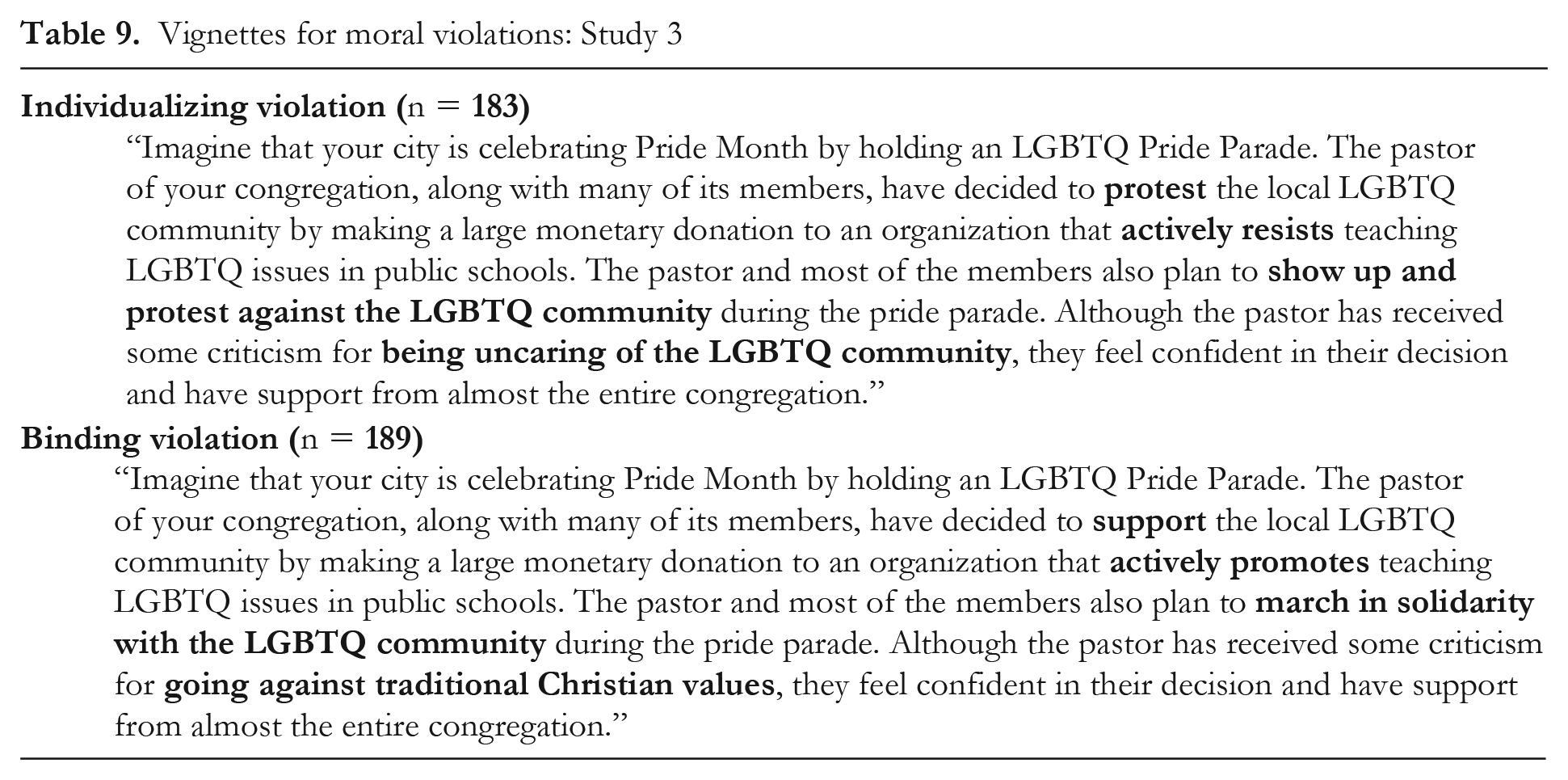
After reading through the vignette, participants were asked two questions for a manipulation check: (a) “Do you feel your church’s decision to support [protest] the LGBTQ community aligns with traditional Christian values?” and (b) “Do you feel your church’s decision to support [protest] the LGBTQ community is uncaring toward the LGBTQ community?” (1 = not at all, 9 = extremely). We reverse-coded the first item so that higher scores correspond to the perception that the church’s decision does not align with traditional Christian values (i.e., a binding moral violation). The second item was meant to assess the perception of an individualizing moral violation, with higher scores corresponding to the perception that the church’s decision is uncaring.
Participants then completed two outcome variables: a four-item measure of identity-subversion (1 = not at all, 9 = extremely; M = 5.35, SD = 2.89, α = .95) and a two-item scale focusing on “schism intentions” that measured participants’ intentions to exit their congregation based on the church’s decision to support (protest) the LGBTQ community (M = 4.77, SD = 3.16, α = .98). These scales were adapted from Study 2. Participants then reported their demographics before being debriefed and compensated for their time.
Results
Manipulation check
We conducted a mixed-subjects ANOVA with type of violation (individualizing, binding) as the between-subjects variable, and the measure of violation (perceiving harm, perceiving nontradition values) as the within-subjects variable. There was a significant main effect of type of violation, F(1, 370) = 85.68, p < .001, ηp2 = .19, and a significant main effect of measure of violation, F(1, 370) = 78.30, p < .001, ηp2 = .18. Importantly, there was a two-way interaction between type of violation and measure of violation on participants’ ratings, F(1, 370) = 215.29, p < .001, ηp2 = .37.
Participants who read about an individualizing moral violation perceived their congregation more as doing harm to the LGBTQ community (M = 6.56, SD = 2.92) than as not adhering to traditional Christian values (M = 5.73, SD = 2.82), F(1, 370) = 14.44, p < .001, ηp2 = .04. Alternatively, participants who read about a binding moral violation perceived their congregation as not adhering to traditional Christian values (M = 5.92, SD = 2.71) more than as harming the LGBTQ community (M = 2.28, SD = 2.18), F(1, 370) = 290.99, p < .001, ηp2 = .44. Furthermore, participants’ ratings of perceived harm were higher after reading about an individualizing (vs. binding) moral violation, F(1, 370) = 258.03, p < .001, ηp2 = .44. However, ratings of perceived nonadherence to traditional Christian values were similar across the two moral violations, F(1, 370) = 0.43, p = .512, ηp2 = .00. Overall, we concluded that participants’ perceptions of morality were effectively manipulated by the vignettes.
Focal analyses
Our hypotheses were tested using the PROCESS macro in SPSS (Hayes, 2013). We first examined the interaction between political conservatism and type of moral violation on both identity-subversion and intentions to exit the group (Model 1). Afterwards, we conducted a moderated mediation analysis (Model 8) with 5,000 bootstraps to examine whether identity-subversion mediated the interactive effect of political conservatism and type of moral violation on schism intentions. Standardized coefficients with 95% confidence intervals are presented in Table 10. 7
Effects of political conservatism and type of moral violation on identity-subversion and schism intentions: Study 3.
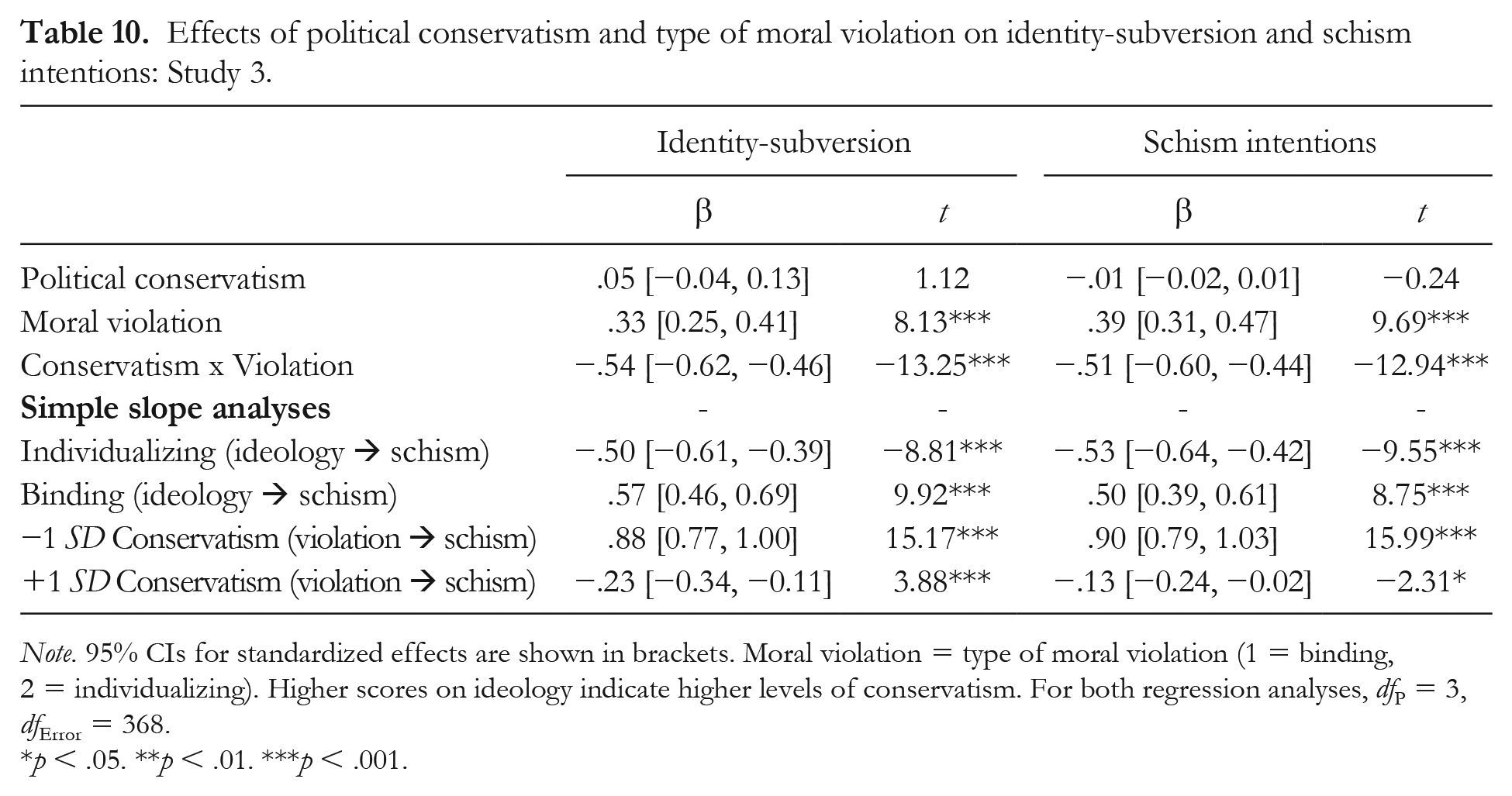
Note. 95% CIs for standardized effects are shown in brackets. Moral violation = type of moral violation (1 = binding, 2 = individualizing). Higher scores on ideology indicate higher levels of conservatism. For both regression analyses, dfP = 3, dfError = 368.
p < .05. **p < .01. ***p < .001.
Identity-subversion
Results showed that political conservatism was not significantly related to perceptions of identity-subversion, but the type of moral violation was. There was a significant two-way interaction between political conservatism and type of moral violation on perceptions of identity-subversion. The simple slopes of the two-way interaction were analyzed to test our hypotheses.
Within the individualizing moral violation condition, lower conservatism was related to higher levels of identity-subversion perception. Alternatively, within the binding moral violation condition, higher conservatism was related to higher levels of identity-subversion perception. Additionally, participants who were more liberal (−1 SD) perceived moreidentity-subversion when their congregation engaged in an individualizing (vs. binding) moral violation. Participants who were more conservative (+1 SD) perceived more identity-subversion when their congregation engaged in a binding (vs. individualizing) moral violation (see Figure 1).
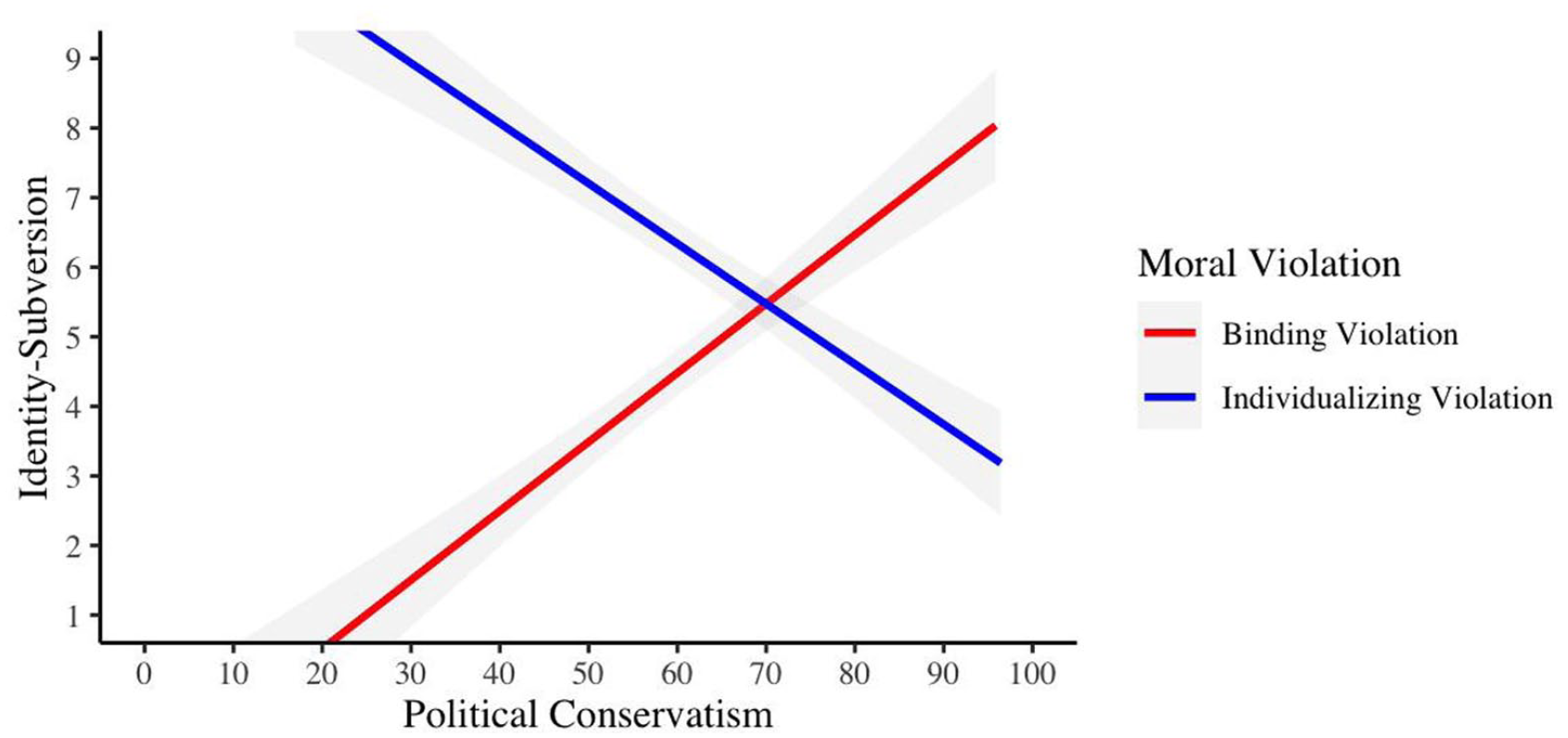
Two-way interaction between political conservatism and type of moral violation on perceptions of identity-subversion: Study 3.
Schism intentions
Results showed that political conservatism was not significantly related to schism intentions. However, the type of moral violation was related to schism intentions, and there was a significant two-way interaction between political conservatism and type of moral violation on schism intentions (see Table 9). The simple slopes of the two-way interaction were analyzed to test our hypotheses.
Within the individualizing moral violation condition, lower conservatism was related to stronger schism intentions. Within the binding moral violation condition, higher conservatism was related to stronger schism intentions. Additionally, participants who were more liberal (−1 SD) had stronger schism intentions when their congregation engaged in an individualizing (vs. binding) moral violation. Participants who were more conservative (+1 SD) had greater schism intentions when their congregation engaged in a binding (vs. individualizing) moral violation (see Figure 2).
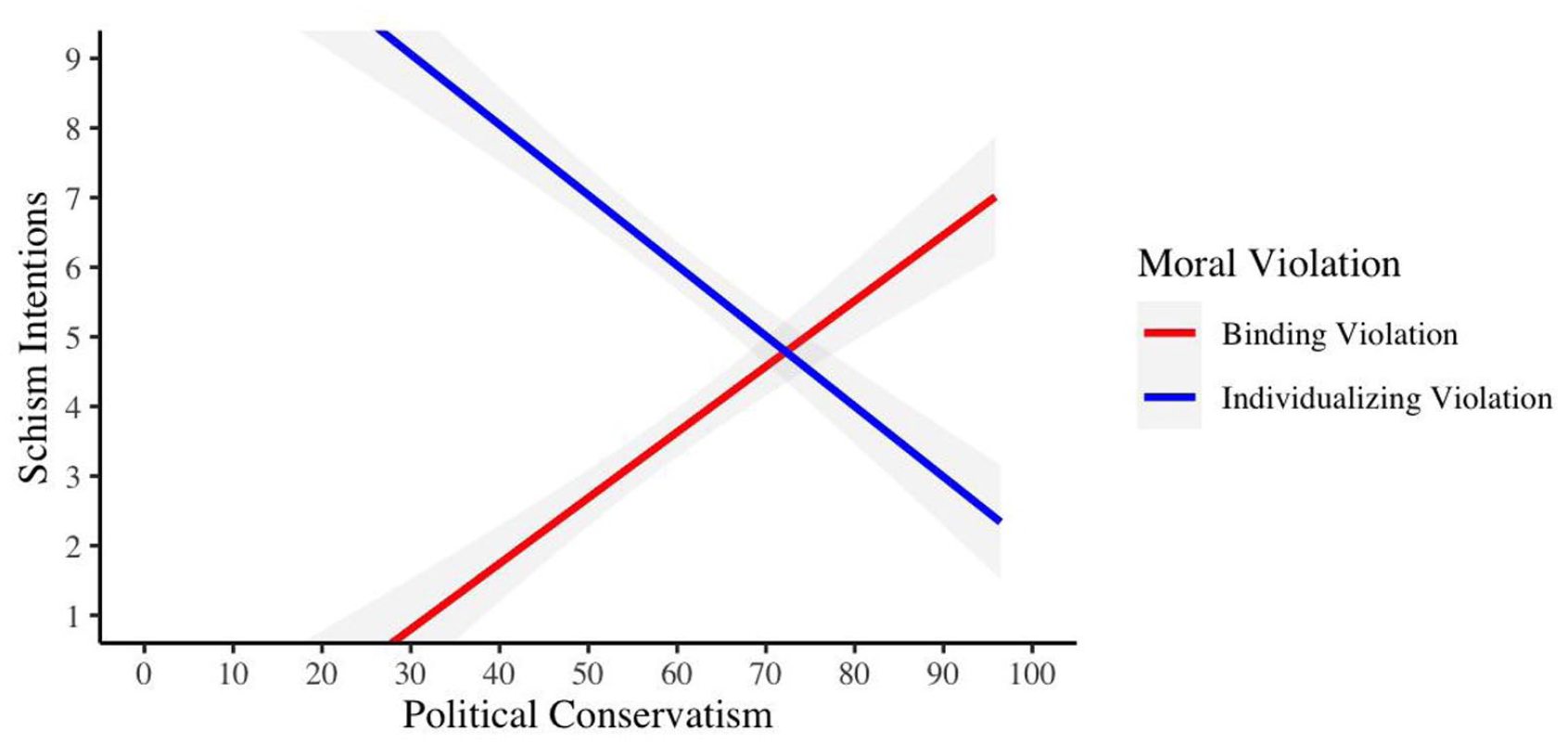
Two-way interaction between political conservatism and type of moral violation on schism intentions: Study 3.
Moderated mediation analysis
Results indicated that there was significant moderated mediation. The conditional indirect effect of political conservatism on schism intentions through identity-subversion was significant in both the individualizing moral violation and the binding moral violation conditions (see Table 11 for moderated mediation statistics, and Figure 3 for moderated mediation).
Moderated mediation indices: Studies 3 and 4.
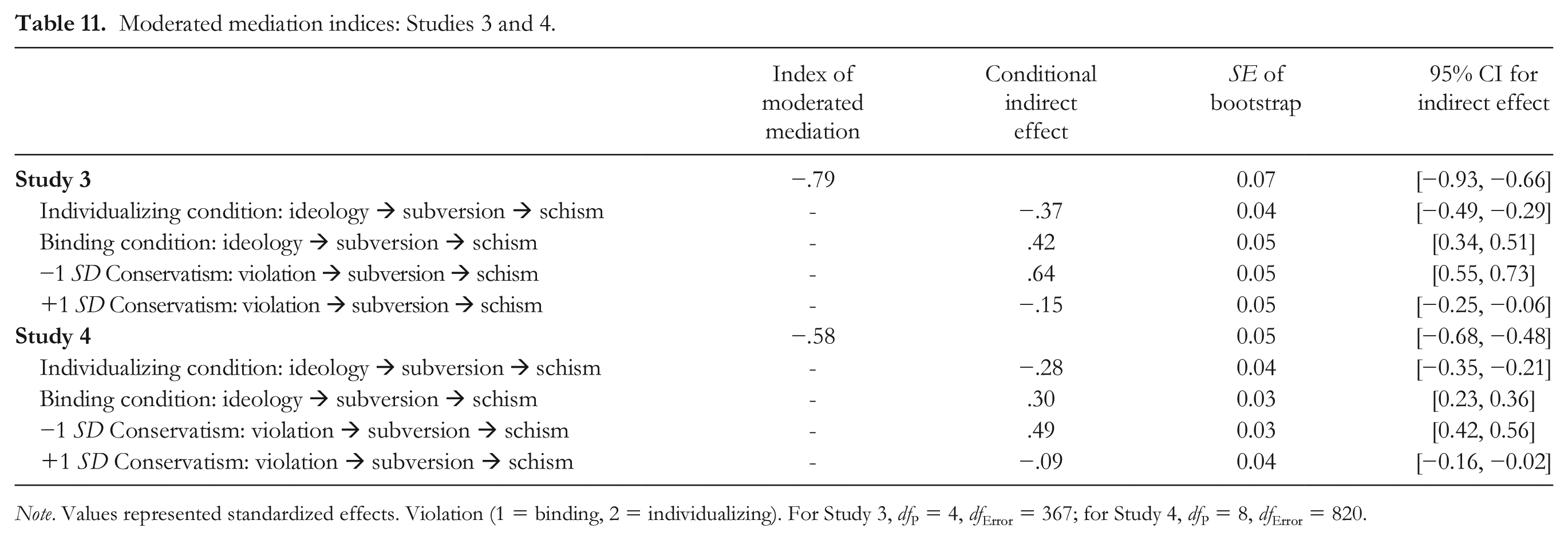
Note. Values represented standardized effects. Violation (1 = binding, 2 = individualizing). For Study 3, dfP = 4, dfError = 367; for Study 4, dfP = 8, dfError = 820.
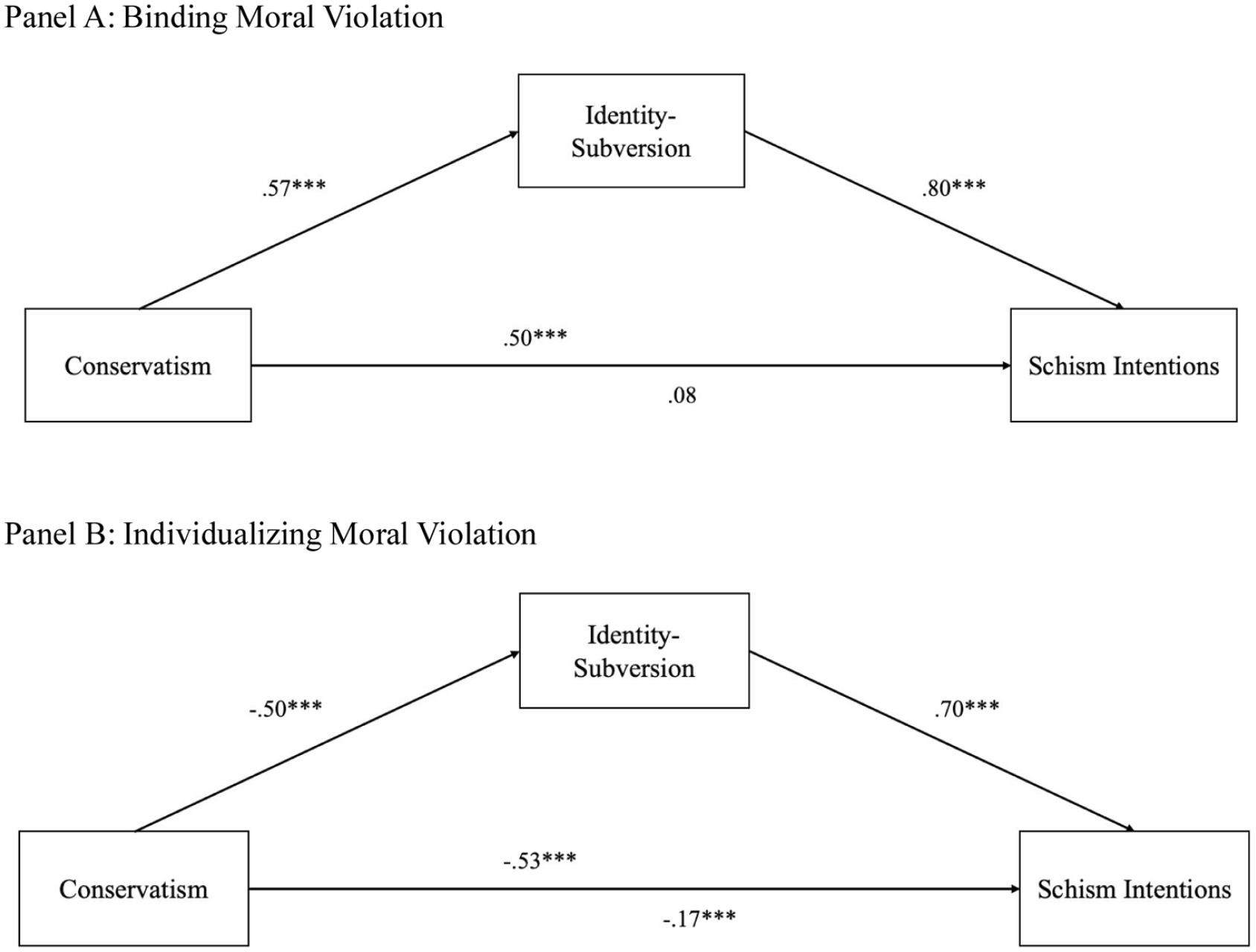
Mediation of conservatism on schism intentions through identity-subversion across moral violations: Study 3. Panel A: binding moral violation; Panel B: individualizing moral violation.
Discussion
The results of Study 3 provide support for our hypotheses that liberals are more likely to perceive identity-subversion and experience intentions to exit their group over an individualizing moral violation, while conservatives are more likely to do so over a binding moral violation. Additionally, the results support the hypothesized moderated mediation model from H6 by showing that identity-subversion perception mediates the interactive relationship between political ideology and type of moral violation on schism intentions.
Study 4
In Study 4, we aimed to overcome some limitations from our previous studies. First, we wanted to test our hypotheses within a nonreligious context since moral violations could be perceived as more severe in groups that prescribe and proscribe moral values. Second, our measure of identity-subversion focused on whether events violated a religious identity (Catholicism, Christianity), but our measure of schism intentions focused on whether people would exit their specific church. Finally, in Study 3, people perceived a violation of individualizing morality to a stronger degree in the individualizing (vs. binding) moral violation condition, but people equally perceived a violation of binding morality across conditions. It is possible that the item assessing a binding moral violation (“going against Christian values”) is differently interpreted across the ideological spectrum. We addressed these issues in Study 4.
We also included a second moderator variable: voice. Sani’s (2005) model originally showed that perceiving having a voice in a group moderates the relationship between identity-subversion and schism intentions. However, research shows that perceived voice has a strong, negative relationship with identity-subversion (Sani & Pugliese, 2008; Wagoner et al., 2019), suggesting that perceiving having voice in a group could directly affect people’s perceptions of identity-subversion. We thus tested H7 in addition to our previous hypotheses in this study.
Methods
Participants
We quadrupled the sample size of N = 210 from G*Power (f = .25, p = .05, power = .95, eight groups, df = 1) for this study because of our hypothesized three-way interaction. We targeted 840 participants from the United States who self-identified as current members of a gym. We sampled 856 individuals, and we retained 829 after removing six people who did not complete all the dependent variables and 19 people who reported not belonging to any gym. 8
Procedure and materials
The survey was advertised as examining people’s attitudes towards their gym. Participants who consented to the study completed the same 12-item measure of political conservatism (SECS) that was used in Study 3 (M = 32.23, SD = 11.99, α = .62). They were then randomly assigned to conditions of a 2 (type of moral violation: individualizing, binding) x 2 (level of voice: high, low) between-subjects design in which they read one of four vignettes telling them that their gym was going to implement a policy that affected people’s access to bathrooms and locker rooms and that members would (or would not) be able to provide feedback before the policy was implemented (see Table 12).
Vignettes for moral violations: Study 4.
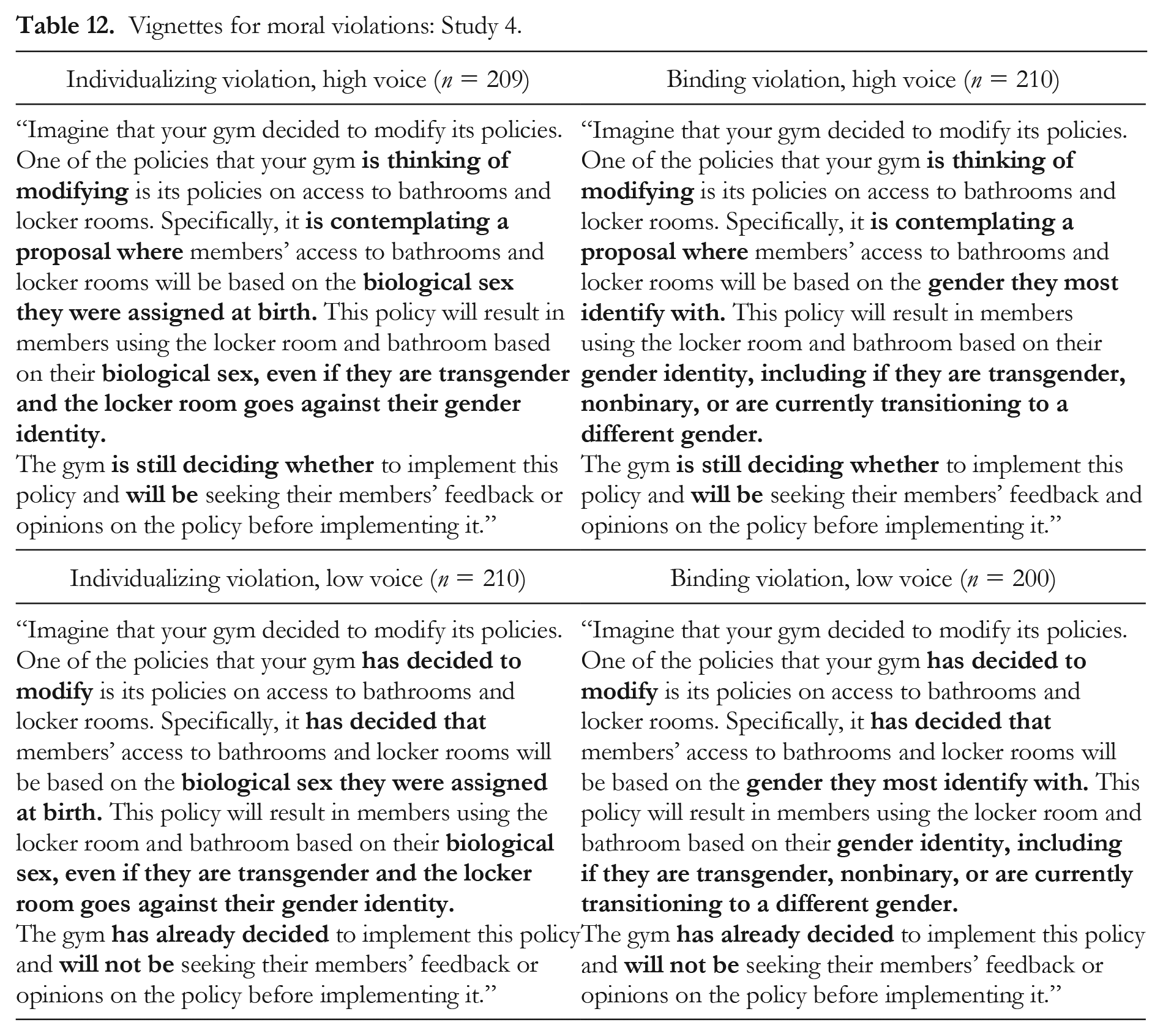
Type of moral violation was manipulated by telling participants that their gym was going to implement a policy that affected people’s access to bathrooms and locker rooms. Participants in the individualizing moral condition were told that the policy would mean that people who are transgender and nonbinary will need to use the locker room based on the biological sex they were assigned at birth. Participants in the binding moral violation were told that the policy would make access to bathrooms and locker rooms be based on the gender people identify with, which would allow people who are transgender or nonbinary to use the locker room of their choice. The operational definition for the moral violation manipulation was based on previous studies showing that binding moral values (especially purity) predicted negative attitudes towards transgender individuals and other sexual minorities, while individualizing moral values predicted positive attitudes towards the LGBTQ community (Barnett et al., 2018, 2020).
Level of voice was also manipulated within this vignette. Participants in the high voice condition were told that their gym had not yet made a final decision and would be seeking feedback from its members before implementing this policy. Participants in the low voice condition were told that the gym had already made its decision and was going to implement this policy without seeking any feedback from its members. The voice manipulation was based on Sani’s (2005; Sani & Pugliese, 2008) conceptualization of “voice” as group members being able to express their disagreement with changes within the group without being ostracized.
After reading through one of the four vignettes, participants completed two manipulation checks. First, participants completed two items assessing their perception of an individualizing moral violation (“harms the transgender community”) and a binding moral violation (“violates traditional values”). Participants then completed two items examining their perception of their level of voice at their gym on 9-point Likert scales (1 = not at all, 9 = extremely; rs = .82).
Participants then completed a four-item measure of identity-subversion (M = 4.25, SD = 2.52, α = .93). We adapted the two items from Studies 2 and 3 and added a new one to our measure of schism intentions (M = 3.85, SD = 2.95, α = .98). Participants reported their demographics before being debriefed and compensated for their time.
Results
Manipulation checks
We conducted a three-way mixed-subjects ANOVA with type of moral violation (individualizing, binding) and voice (high, low) as the between-subjects variables, and dimension of immorality (uncaring, nontraditional) as the within-subjects variable. There was a significant main effect of dimension of immorality, F(1, 824) = 31.05, p < .001, ηp2 = .04, and a significant main effect of type of moral violation on the ratings, F(1, 824) = 63.10, p < .001, ηp2 = .07. There was also a significant two-way interaction between dimension of immorality and type of moral violation, F(1, 824) = 512.61, p < .001, ηp2 = .38.
Participants who read about an individualizing moral violation rated the policy as more uncaring (M = 6.69, SD = 2.52) than nontraditional (M = 3.51, SD = 2.33), F(1, 824) = 401.99, p < .001, ηp2 = .33. Participants who read about a binding moral violation rated the policy as more untraditional (M = 5.02, SD = 2.80) than uncaring (M = 3.09, SD = 2.29), F(1, 824) = 144.23, p < .001, ηp2 = .15. Furthermore, participants’ ratings of perceived harm were higher after reading about an individualizing (vs. binding) moral violation, F(1, 824) = 462.23, p < .001, ηp2 = .36. Finally, participants’ ratings of nonadherence to traditional values were higher after reading about a binding (vs. individualizing) moral violation, F(1, 824) = 71.04, p < .001, ηp2 = .08. Therefore, we concluded that our vignettes were effective in producing perceptions of either an individualizing or a binding moral violation.
We also conducted a two-way ANOVA to test the effectiveness of our voice manipulation. The independent variables were the type of moral violation and the level of voice, while the outcome variable was perceptions of voice. Results showed that participants in the high voice condition (M = 6.28, SD = 1.93) perceived members of their gym as having a higher level voice compared to what participants in the low voice condition reported (M = 4.24, SD = 2.69), F(1, 825) = 169.81, p < .001, ηp2 = .17. Unexpectedly, participants perceived a higher level of voice in the individualizing moral violation (M = 5.48, SD = 2.62) than in thebinding moral violation condition (M = 5.06, SD = 2.47), F(1, 825) = 7.60, p = .006, ηp2 = .01. There was no significant interaction between type of moral violation and level of voice on perceived voice, F(1, 825) = 2.26, p = .133, ηp2 = .00. Although the main effect of moral violation was unexpected, we concluded that the vignette effectively elicited the desired perceptions of voice.
Focal analyses
Our hypotheses were tested using the PROCESS macro in SPSS (Hayes, 2013). First, we examined whether there was a significant three-way interaction between political conservatism, type of moral violation, and level of voice on both identity-subversion and intentions to exit the group (Model 3). We had originally planned on conducting a moderated mediation analysis (Model 12) to examine whether identity-subversion mediated the interactive effect of political conservatism, type of moral violation, and level of voice on intentions to exit the group. We report the standardized coefficients with 95% confidence intervals in Table 13.
Effects of political conservatism and type of moral violation on identity-subversion and schism intentions: Study 4.
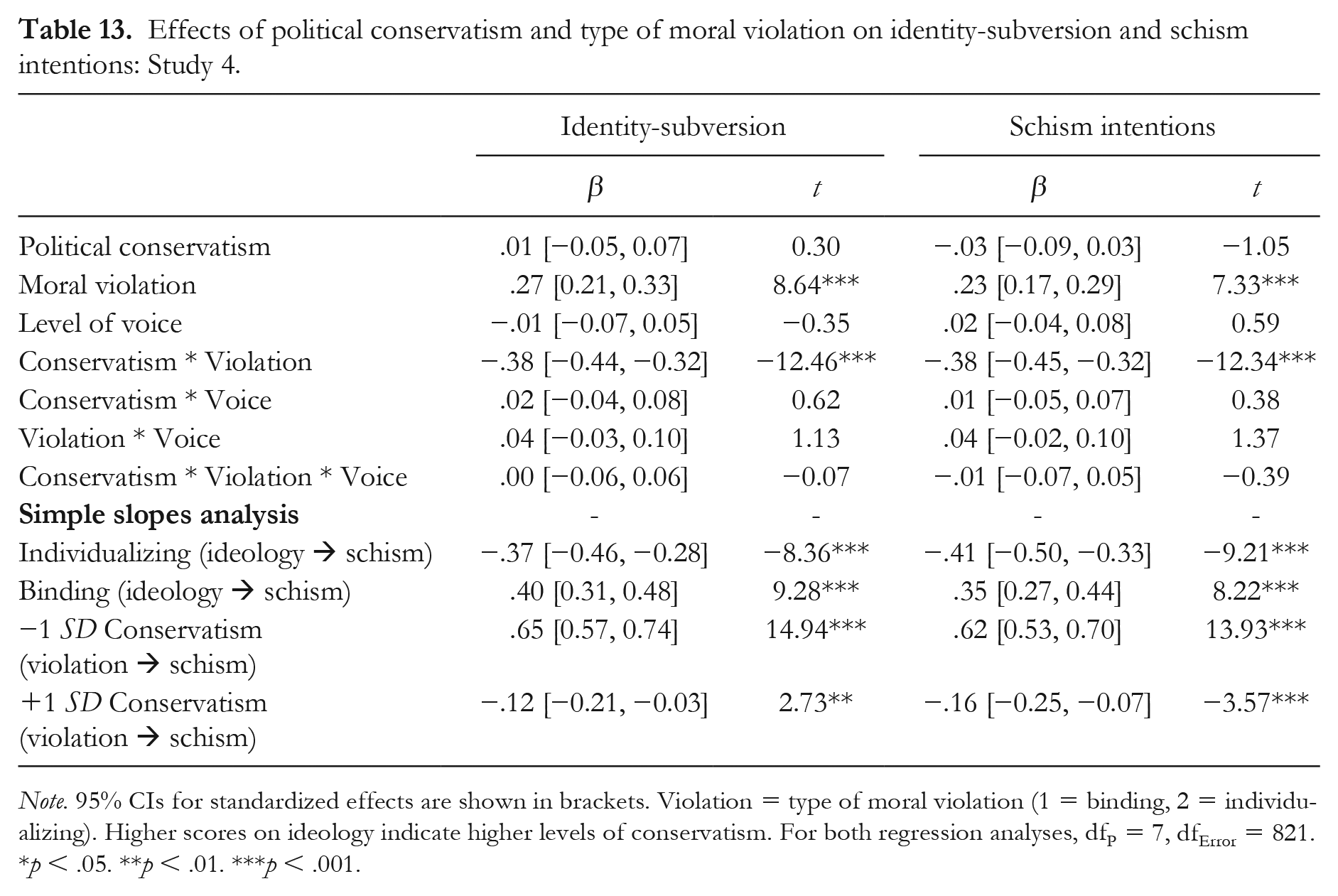
Note. 95% CIs for standardized effects are shown in brackets. Violation = type of moral violation (1 = binding, 2 = individualizing). Higher scores on ideology indicate higher levels of conservatism. For both regression analyses, dfP = 7, dfError = 821.
p < .05. **p < .01. ***p < .001.
Identity-subversion
Political conservatism was not significantly related to perceptions of identity-subversion. In contrast, the type of moral violation was significantly related to perceptions of identity-subversion. Importantly, there was a two-way interaction between political conservatism and type of moral violation on perceptions of identity-subversion. There were no other significant main effects or interactions. The simple slopes of the significant two-way interaction were analyzed to test our hypotheses.
Within the individualizing moral violation condition, lower conservatism was related to higher levels of identity-subversion perception. Alternatively, within the binding moral violation condition, higher conservatism was related to higher levels of identity-subversion perception. Additionally, participants who were more liberal (−1 SD) perceived more identity-subversion when their gym implemented a policy that was perceived as an individualizing (vs. binding) moral violation. Participants who were more conservative (+1 SD) perceived more identity-subversionwhen their gym implemented a policy that was perceived as a binding (vs. individualizing) moral violation (see Figure 4).
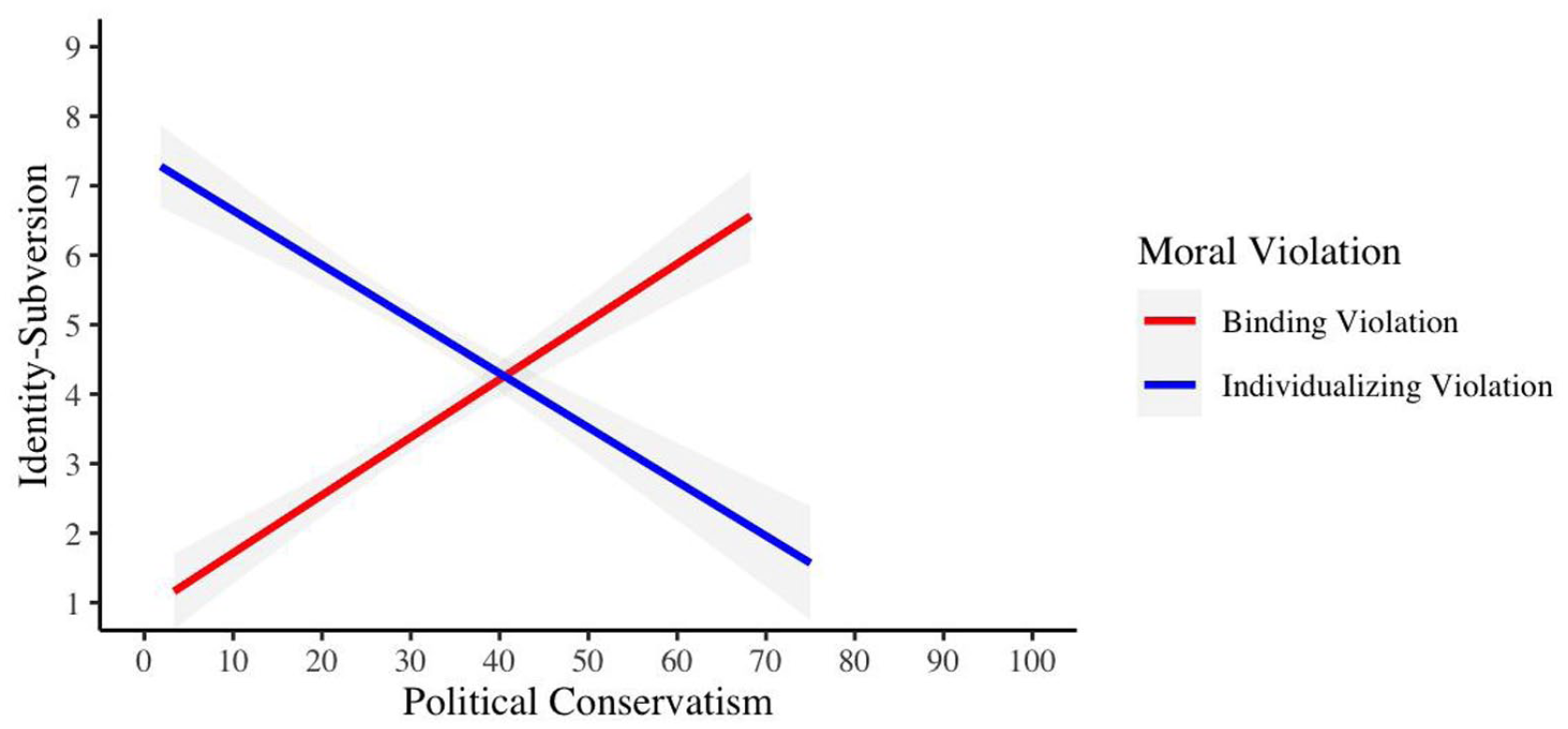
Two-way interaction between political conservatism and type of moral violation on perceptions of identity-subversion: Study 4.
Schism intentions
Results showed that political conservatism was not significantly related to schism intentions, but that the type of moral violation significantly affected people’s schism intentions. There was a two-way interaction between political conservatism and type of moral violation on schism intentions. There were no other significant main effects or interactions. The simple slopes of the significant two-way interaction were analyzed to test our hypotheses.
Within the individualizing moral violation condition, lower conservatism was related to stronger schism intentions. Alternatively, within the binding moral violation condition, higher conservatism was related to stronger schism intentions. Additionally, participants who were more liberal (−1 SD) had greater schism intentions when their gym implemented a policy perceived as an individualizing (vs. binding) moral violation. Participants who were more conservative (+1 SD) had greater schism intentions when their gym implemented a policy that was perceived as a binding (vs. individualizing) moral violation (see Figure 5). 9
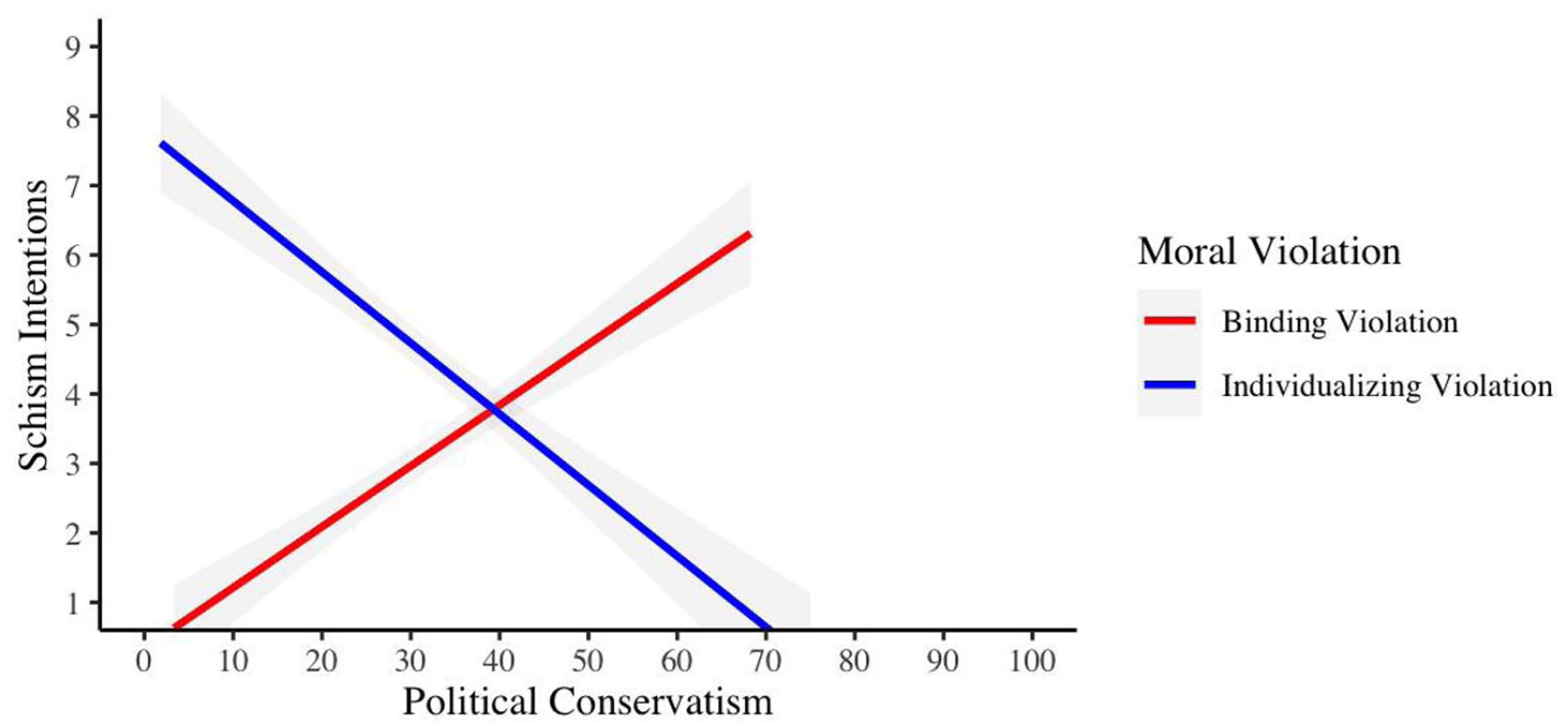
Two-way interaction between political conservatism and type of moral violation on schism intentions: Study 4.
Moderated mediation analysis
Because there was no significant effect of level of voice on either identity-subversion or schism intentions, we used PROCESS Model 8 with 5,000 bootstraps to test whether identity-subversion mediated the two-way interaction between political ideology and type of moral violation on schism intentions (H6). We controlled for level of voice and its interaction terms in the analyses.
Results indicated that there was moderated mediation. The conditional indirect effect of political conservatism on schism intentions through identity-subversion was significant in both the individualizing moral violation and the binding moral violation conditions (see Figure 6).
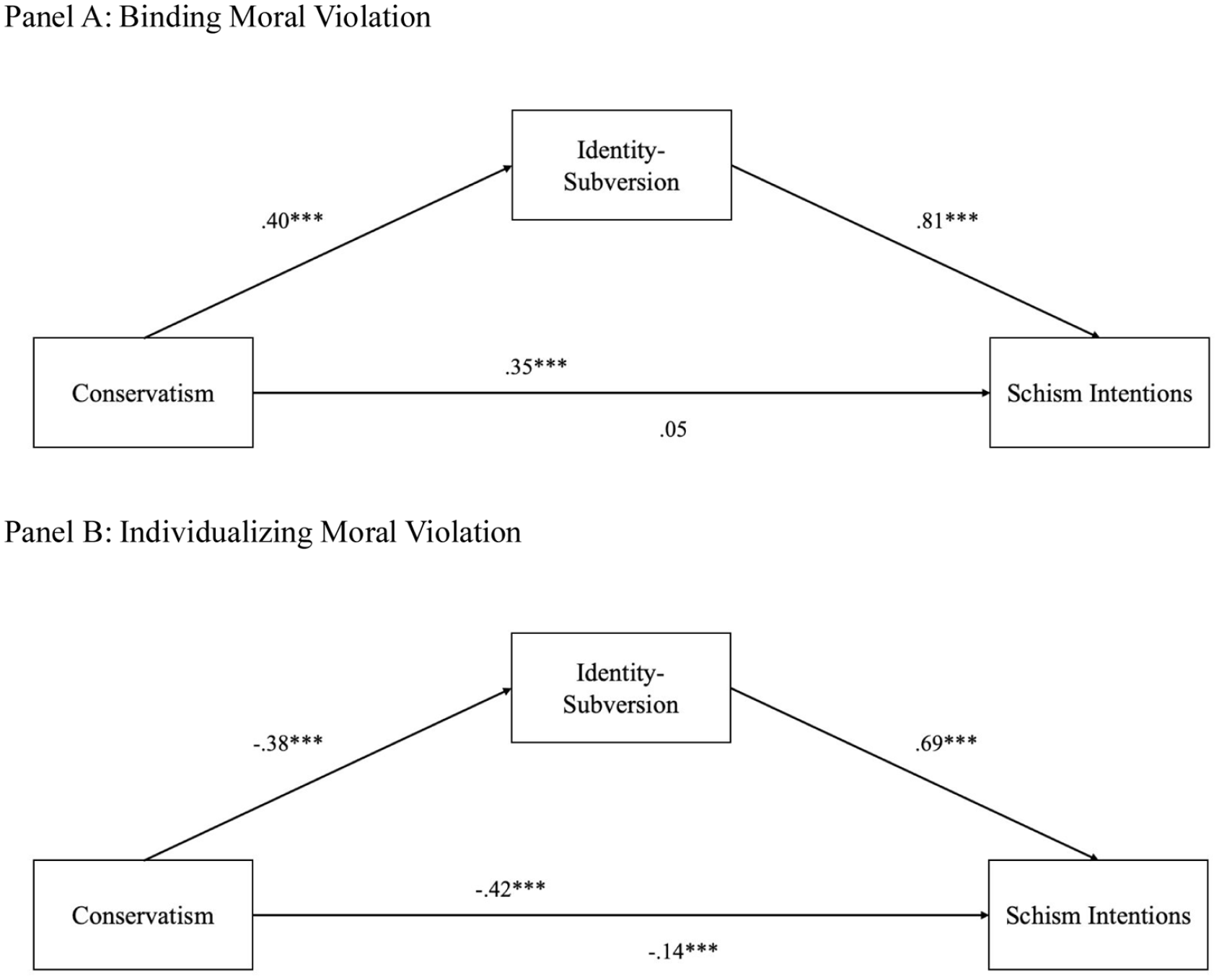
Mediation of conservatism on intentions toward schism through identity-subversion across moral violations: Study 4. Panel A: binding moral violation; Panel B: individualizing moral violation.
Discussion
The results of Study 4 provided support for some of our hypotheses. Again, we supported Hypotheses 1–4 by showing that liberals are more likely to perceive identity-subversion and exit their group over an individualizing moral violation, whereas conservatives are more likely to do so over a binding moral violation. We also found support for H6 that perceptions of identity-subversion mediate the interaction of ideology and moral violation on intentions to exit the group. However, our manipulation of voice did not impact either of our dependent variables nor interact with any of our independent variables, failing to support H7.
General Discussion
The predominant social psychological framework for investigating schisms has been Sani’s (2005) model, which focuses on how changes in a group can produce the perception of identity-subversion and subsequently lead to an exodus from the group. Although this model shows the psychological consequences of identity-subversion that can predict schism intentions, it is unclear which types of events produce the perception of identity-subversion or if there are individual differences that impact people’s perceptions of identity-subversion. We integrated findings from moral foundations theory that show ideological differences in morality (Graham et al., 2009) to investigate whether people’s political ideology interacts with different types of moral violations to impact their perceptions of identity-subversion and their consequent schism intentions. We hypothesized that liberals would have stronger schism intentions when perceiving an individualizing moral violation, whereas conservatives would have stronger schism intentions when perceiving a binding moral violation. We also hypothesized that identity-subversion would mediate the relationship between political ideology and schism intentions.
Studies 1 and 2 partially supported these hypotheses. Study 1 found that liberalism was related to stronger schism intentions when the group committed a care violation. Additionally, conservatism was related to stronger schism intentions when the group committed an authority or purity violation. However, we did not find evidence that political ideology was related to schism intentions after fairness or loyalty violations. Study 2 showed that liberalism was related to perceiving more identity-subversion and stronger schism intentions when one’s group committed a care violation. Additionally, conservatism was related to perceiving more identity-subversion and stronger schism intentions when one’s group committed a loyalty or purity violation. We also found that identity-subversion mediates the relationship between political ideology and schism intentions across these three moral violations. However, people’s political ideology was unrelated to their perceptions of identity-subversion and schism intentions over fairness or authority violations. Therefore, across both studies, we found that liberals are willing to exit the group over perceived harm, while conservatives are willing to exit when perceiving impurity.
Studies 3 and 4 built upon these findings by experimentally framing a scenario to elicit perceptions of an individualizing or binding moral violation. Across Studies 3 and 4, we supported our hypotheses that liberals perceived more identity-subversion and had stronger schism intentions over an individualizing moral violation, while conservatives perceived more identity-subversion and had stronger schism intentions over a binding violation. Additionally, identity-subversion mediated the interactive effect of political ideology and type of moral violation on schism intentions. Levels of voice did not significantly impact people’s responses in Study 4. Thus, while we did not support our final hypothesis, we obtained robust support for our general prediction that liberals and conservatives will schismatize over different moral violations. These findings make a unique contribution to the social psychological literature focusing on why people exit their group, suggesting that changes or events that violate people’s moral values can produce a schism, and that people’s political ideology is an individual difference that makes one more or less susceptible to leaving a group.
Our findings also fit with Motyl’s (2014; Motyl et al., 2014) research on “ideology migration,” which shows that both liberals and conservatives will exit a group when perceiving an opposing ideology to be predominant within the group. Perceiving an ideological mismatch elicits a lack of belonging, which leads people to migrate away from their group. We alternatively propose that people’s political ideology makes them willing to leave a group because it makes them susceptible to perceiving a moral violation, which can violate their understanding of what the group stands for. Considering people strive for a positive social identity, which is primarily obtained through perceptions of morality, we posit the importance of perceiving a sense of morality is a unique factor in why people stay in (or leave) a group beyond a feeling of belonging.
Our findings also fit with a body of research showing a mix of ideological symmetries and asymmetries in group processes, including avoidance of counter-attitudinal information (Frimer et al., 2017) and prejudice (Brandt et al., 2014). Specifically, liberals and conservatives react negatively to different stimuli (asymmetry), but the psychological processes are similar when they react (symmetry). In our studies, even though liberals and conservatives showed asymmetry in what type of moral violations produced perception of identity-subversion, they showed symmetry in that identity-subversion predicted greater schism intentions.
Limitations and Future Directions
Although our findings make a unique contribution to the topic of schisms, there were limitations to be considered. First, there were instances in which we failed to support our theorizing or found inconsistent support for our hypotheses. In Study 1, we found that conservatism was related to stronger schism intentions over an authority violation but not over a loyalty violation. In Study 2, we found that conservatism was related to stronger schism intentions over a loyalty violation but not over an authority violation. One explanation could be the groups that were used in each study. Study 1 asked college students to imagine they were in a fraternity (or sorority), while Study 2 asked Catholics to focus on their congregation. It is possible that people weighted loyalty and authority differently across these groups.
We also did not find any evidence that political ideology was related to people’s intentions to exit the group over fairness violations. This nonsignificant finding could be a consequence of our operationalizations of fairness: cheating in a university (Study 1) and biases in a selection process (Study 2). Skurka et al. (2020) recently divided the moral foundation of fairness into the components of proportionality (outcomes are based on inputs) and equity (outcomes are equal regardless of inputs) and found that political ideology was only related to moral reasoning over equity. Therefore, liberals and conservatives may have been equally likely to exit over fairness violations because our scenarios corresponded more to the proportionality component than to the equity component. Future research should dissect these conceptualizations of fairness when examining how liberals and conservatives react to moral violations.
Furthermore, we did not support previous findings showing the importance of voice in schism intentions. Although studies have continuously shown the importance of possessing a voice within groups, we did not find any support for voice impacting perceptions of identity-subversion or schism intentions. This lack of support could merely be a consequence of how voice was used in our design. It is possible that measuring perceptions of voice after identity-subversion, instead of manipulating levels of voice prior to measuring identity-subversion, could have replicated Sani’s findings. Alternatively, people may be more willing to exit over a moral violation even when possessing high levels of voice within a group, which would imply that perceiving morality in one’s group is more important than having a voice in it. Future research should further assess this possibility.
A final limitation of these studies is that we did not investigate the entirety of the schism process. For instance, we focused on the link between identity-subversion and schism intentions from Sani’s (2005) model. However, this model includes other outcome variables such as group identification, perceived entitativity, and feelings of aversive emotions. Wagoner et al. (2019) also proposed that people can exit their group as a faction or as an individual. However, our studies operationalized schism intentions as people’s individual intentions to exit their group. Future research focusing on how moral violations drive schism intentions should incorporate other outcome variables from Sani’s model and newer operationalizations of schisms.
Future research should also test alternative explanations for why moral violations elicit schism intentions. Studies 2, 3, and 4 only assessed whether the transgression violated participants’ understanding of their group’s norms and identity (i.e., identity-subversion). It is possible that people were motivated to distance themselves from the transgression simply because it violated their personal moral values, not their understanding of their group’s identity. Although we did not test these two mechanisms against each other, the possibility that there are individual and group-level processes operating simultaneously provides a fruitful path forward for investigating why people exit groups.
In conclusion, findings show that liberals and conservatives will schismatize from their group over different moral violations, and that moral violations lead to schism intentions by provoking perceptions of identity-subversion. 10
Supplemental Material
sj-docx-1-gpi-10.1177_13684302231156398 – Supplemental material for Ideological asymmetries in morality predict schism intentions
Supplemental material, sj-docx-1-gpi-10.1177_13684302231156398 for Ideological asymmetries in morality predict schism intentions by Joseph A. Wagoner and Mark J. Rinella in Group Processes & Intergroup Relations
Supplemental Material
sj-docx-2-gpi-10.1177_13684302231156398 – Supplemental material for Ideological asymmetries in morality predict schism intentions
Supplemental material, sj-docx-2-gpi-10.1177_13684302231156398 for Ideological asymmetries in morality predict schism intentions by Joseph A. Wagoner and Mark J. Rinella in Group Processes & Intergroup Relations
Footnotes
Funding
The author(s) disclosed receipt of the following financial support for the research, authorship, and/or publication of this article: The first author received financial support for this research from an Early Career Small Research Grant that was awarded by the Society of Personality and Social Psychology. However, the authors received no financial support for the authorship and/or publication of this article.

Supplemental material
Supplemental material for this article is available online.
Notes
References
Supplementary Material
Please find the following supplemental material available below.
For Open Access articles published under a Creative Commons License, all supplemental material carries the same license as the article it is associated with.
For non-Open Access articles published, all supplemental material carries a non-exclusive license, and permission requests for re-use of supplemental material or any part of supplemental material shall be sent directly to the copyright owner as specified in the copyright notice associated with the article.
