




Abstract
Collective action is often equated with progressive politics, but are there aspects of group mobilisations that generalise across contexts? We examine general social and personality psychological factors behind endorsement of group-based violence across different types of violent group mobilisation. Specifically, we focus on the endorsement of group-based violence amongst supporters of the Black Lives Matter (BLM) movement (N = 394), an immigration-critical group (N = 252), and soccer supporters (N = 445). Across three preregistered studies, we tested an integrative model including personality and social psychological factors. Several effects were consistent across all three contexts, with group-based relative deprivation positively, and honesty-humility negatively, predicting support for violence. Further, amongst BLM supporters and the immigration-critical group, emotionality negatively predicted support for violence, violent intentions, and self-reported aggression/violence. Overall, our results suggest that individuals who endorse violence in different contexts have some psychological factors in common.
Recently, we have witnessed a resurgence in public engagement in different forms of activism (Chenoweth et al., 2019), with increasing public support for using violence for political ends (Institute for Economics & Peace, 2020). In Western countries, some activists from both far-right (e.g., the alternative [“alt”] right) and left-wing movements (e.g., the Black Lives Matter [BLM] movement) have resorted to violence for their cause (Institute for Economics & Peace, 2020). The forms of violence (as well as the targets) may differ across contexts. For example, violence perpetrated by activists within the far-right include hate crimes such as physical assault or acts of arson towards ethnic or religious minority groups and places they occupy (Koehler, 2016). Violence perpetrated by activists from left-wing movements (such as the BLM movement) includes violent demonstrations such as fighting against the police, vandalism, arson, or looting (The Armed Conflict Location and Event Data Project [ACLED], 2020).
However, what these different forms of collective violence have in common is that they are acts of violence that are perpetrated by group members, for a specific cause (usually some form of grievance against the outgroup), targeted towards outgroup members. Collective violence is distinct from interpersonal violence (where individuals engage in violence targeted towards an individual and for reasons tied to the dyadic relation) as well as from collective action more broadly (when a group member engages in any action directed at improving the conditions of the entire group; Wright et al., 1990). Collective violence may indeed fall within the broader category of nonnormative collective action, defined as collective action that violates the norms of the wider social system (Tausch et al., 2011; Wright et al., 1990). However, nonnormative collective action is not synonymous with group-based violence, since it has been recognised that nonnormative collective action can be violent or nonviolent (e.g., nonviolent yet socially disruptive behaviour, such as disturbing events or blocking traffic; Tausch et al., 2011). Thus, our present research is concerned with group-based violence, which is roughly equivalent to definitions of violent nonnormative collective action (Tausch et al., 2011).
Although previous research suggests that violent nonnormative collective action and (nonviolent) normative collective action have different antecedents, and are predicted by different psychological variables (e.g., Obaidi et al., 2018, 2020; Tausch et al., 2011), previous research has focused on one type of group (e.g., Obaidi et al., 2018, 2020) or did not include support for violence, intentions, and self-reported behaviour within the same study (e.g., Tausch et al., 2011). Further research examining the link between psychological variables and different indicators of group-based violence (e.g., support for violence, intentions, and self-reported engagement in violence) in different group-based contexts is therefore an important extension of earlier research.
In this research, we examine the extent to which there are common explanations for different types of violent group mobilisation. We focus on three main factors of relevance: (a) identity processes, (b) a subjective sense of group-based disadvantage, and (c) personality factors that facilitate or prevent individuals from resorting to violence for their cause. We cover these three factors and their relevance in explaining endorsement of violent group mobilisation, and test both social and personality factors and their interaction within the contexts of violent BLM protests, right-wing extremist violence, and soccer hooliganism.
Identity Processes and Perception of Group-Based Disadvantage
Identification processes and perceptions of disadvantage are often recognised as significant predictors of collective action. For example, social identity theory (SIT; Tajfel & Turner, 1979) and models of collective action based on SIT, such as the social identity model of collective action (SIMCA; van Zomeren et al., 2008), hold that identification with a disadvantaged group is a predictor of collective action. Moreover, proponents of this “traditional” collective action approach point out that the subjective perception of disadvantage rather than objective disadvantage per se (van Zomeren et al., 2008) explains why some individuals mobilise for their group. Although more recent work has built upon or extended SIT and SIMCA (e.g., Saab et al., 2016; Thomas et al., 2012), it is important to note that members of advantaged as well as disadvantaged groups can view their group as unfairly treated (e.g., Leach et al., 2007), and that motivation to engage in collective action can stem from belonging to the group and hence first-hand experiences of disadvantage, but also from alliance or solidarity with a group (Saab et al., 2014) and hence more vicarious experiences of disadvantage.
Members of disadvantaged groups who view their group as unfairly treated engage in collective action to improve the circumstances of their group, as it is the case for Black Americans within the Black Lives Matter (BLM) movement. On the other hand, members of historically advantaged groups may also perceive their group as disadvantaged and/or losing ground (e.g., Leach et al., 2007; Zick et al., 2008), with far-right movements aiming to protect the status or rights of such groups (Forscher & Kteily, 2019). This underscores the subjective nature of perceived disadvantage, but also suggests that identification with an objectively disadvantaged group per se is not a necessary element for collective action to occur.
One psychological construct that focuses on subjective disadvantage is group-based relative deprivation (GRD). GRD refers to the subjective perception that a social group to which one belongs is unfairly deprived or disadvantaged relative to another group, resulting in anger and resentment (Smith et al., 2012). Although GRD has been found to be associated with various forms of group mobilisation (e.g., Abrams & Grant, 2011), researchers studying GRD have focused primarily on individuals belonging to and identifying with disadvantaged groups (e.g., Obaidi et al., 2019).
However, individuals do not necessarily have to belong to a disadvantaged group in order to engage in collective action. For example, the BLM movement has attracted supporters who do not necessarily identify as Black. Researchers studying the role of identity processes in group mobilisation tend to focus on individuals taking action on behalf of their own group (e.g., van Zomeren et al., 2008). However, some researchers have argued that identity fusion—a visceral sense of oneness with a group (Swann et al., 2009)—can extend to outgroups. For instance, White Americans on the political left can fuse with other groups (e.g., Palestinians), and this may underpin engagement in extreme activism (Kunst et al., 2018). 1
Moreover, proponents of the relative deprivation theory have recognised that advantaged group members can also experience “relative deprivation on behalf of others,” and that this may explain their tendency to engage in mobilisation to help outgroup members (Runciman, 1968; Tougas & Beaton, 2002, p 124). However, to our knowledge, no research has examined whether relative deprivation on behalf of other groups may also motivate individuals to resort to violence to help outgroup members. Thus, an important avenue for research is to examine whether GRD is associated with violent group mobilisation across groups who experience GRD as a member of an objectively disadvantaged group, on behalf of another group, and as members of an objectively advantaged group. Both of these objectives—(a) vicarious concerns about disadvantage and (b) perceived disadvantage among objectively advantaged groups—provide a novel examination on the role of perceived disadvantage in violent group mobilisation.
Personality Explanations
Theorising and research on collective action have been dominated by social psychological explanations, with models emphasising the role of factors such as identification, injustice, and efficacy (e.g., Abrams & Grant, 2011; Becker & Tausch, 2015; van Zomeren et al., 2008). However, personality has the potential to explain why individuals engage in group-based violence. Specifically, previous research has shown that personality predicts engagement in normative forms of collective action such as protest (Ha et al., 2013). Importantly, further research has also shown that personality traits are associated with violent intentions among Muslims (Obaidi et al., 2020). However, to the best of our knowledge, the extent to which personality is associated with different indicators of group-based violence in different contexts has yet to be examined. Furthermore, Duncan (2018) argued for the integration of personality explanations, proposing a model in which personality may moderate the association between social psychological factors and collective action. To our knowledge, however, research has yet to examine such a model in the context of violent group mobilisation.
We provide such a model based on combining insights from the HEXACO model of personality (Ashton et al., 2014) and significance quest theory (Kruglanski et al., 2014). The HEXACO model of personality (Ashton & Lee, 2007) outlines six personality factors—honesty-humility (H), emotionality (E), extraversion (X), agreeableness (A), conscientiousness (C), and openness to experience (O). Although it overlaps somewhat with Big Five models, HEXACO includes an additional factor, honesty-humility, that has proven relevant for predicting group attitudes (Bergh & Akrami, 2016). Honesty-humility refers to the degree to which one is fair, modest, sincere, and greed-avoidant (Ashton et al., 2014). We focused on HEXACO rather than more specific individual differences in group attitudes (e.g., social dominance; Sidanius & Pratto, 1999) because of concerns about tautological explanations for group behaviours. Specifically, when predictors match the outcome exceedingly well by definition, like explaining hostile group behaviours with aggressive group attitudes, the model becomes explanatorily superficial (see e.g., Baumert et al., 2017).
According to significance quest theory (Kruglanski et al., 2014), “all individuals have a fundamental desire to matter, merit respect, and be someone” (Kruglanski et al., 2018, p. 108). Significance quest theory suggests that loss of significance can lead particular individuals to be drawn to extremism, since it “lifts them from their experienced inferiority” (Kruglanski et al., 2018, p. 109). However, individual differences in honesty-humility could potentially explain why individuals engage in “quests for significance” in an effort to restore their loss of significance. Individuals who believe they deserve special treatment and more respect than others could reasonably have a stronger need to “matter, [to] merit respect, and [to] be someone.” Such dispositions are also well captured by honesty-humility from the HEXACO personality model (Ashton et al., 2014). Individuals who score low in honesty-humility tend to be driven by social status and feel entitled to privileges, special treatment, and more respect than others (Ashton et al., 2014). Thus, individuals with low honesty-humility—who arguably have a stronger need to “matter, merit respect, and be someone”—may be more aware of cues suggesting a potential loss of significance, thus making them more inclined to engage in “quests for significance.” Furthermore, individuals low in honesty-humility are more likely to hold negative attitudes about disadvantaged groups (Bergh & Akrami, 2016; Sibley et al., 2010), engage in antisocial behaviour (Allgaier et al., 2015), overt revenge (Thompson et al., 2016), and act aggressively in response to provocation (Diníc & Smederevac, 2019). Given these findings, it is plausible that honesty-humility negatively predicts antisocial/aggressive behaviour in different group contexts. It is also plausible that honesty-humility interacts with GRD. As individuals with an inflated sense of self-worth react aggressively in response to ego threats (Baumeister, 1997), the perception that one’s group is disadvantaged (i.e., GRD) can be considered an ego threat, suggesting that individuals low (but not high) in honesty-humility may be especially likely to endorse violence, if they score high on GRD.
Other dispositions may prevent individuals from engaging in extremist quests for significance. Specifically, violence carries risks of physical harm to oneself, and personality could play a role here too. In the HEXACO framework, emotionality refers to the dispositional tendency to experience anxiety, fear, and sentimentality (Ashton et al., 2014). As such, individuals low in emotionality may be more prone to endorse violence on behalf of a group (Obaidi et al., 2020), possibly because they are less fearful and anxious about the potential risks inherent in their behaviour (van Gelder & De Vries, 2012).
Another personality factor that might be implicated in the endorsement of collective violence is openness to experience (openness). Specifically, low openness has been found to be associated with willingness to engage in political violence, at high levels of uncertainty (Gøtzsche-Astrup, 2019). A general explanation for these findings is that individuals low in openness see the world in black and white terms and are more inclined to endorse simplistic solutions to their problems, such as violence in various forms. As such, individuals low in openness and high in GRD could be especially susceptible to endorsing collective violence (Obaidi et al., 2020). On the other hand, research indicates that low openness tracks intolerance toward nonconventional targets, but high openness tracks intolerance towards conventional targets (Brandt et al., 2015), which suggests that the nature of the interaction could also depend on the targets of violence. In any case, the different predictions that could follow from previous work, focused on different types of groups (e.g., progressive and conservative ones), further beg the question if there are any general effects of openness on violent group mobilisation.
Overview and Aim
The aim of the present research was to uncover common personality and social psychological factors associated with endorsement of group-based violence across three different contexts. We hypothesised that regardless of the group to which one belongs, or the objective advantage/disadvantage of one’s own group, perceptions of group-based relative deprivation increase the likelihood to endorse collective violence. Further, we propose that personality factors play a role in preventing or facilitating individuals’ resort to violence for their cause.
In Study 1, we focused on the endorsement of violent protest, sampling among American supporters of the BLM movement. In Study 2, we focused on the endorsement of right-wing extremist violence, sampling amongst immigration-critical Swedes. Finally, in Study 3, we examined whether our findings generalise to collective violence that is not tied to political ideology, turning to a common form of collective violence, namely, soccer-related hooliganism. We focused on these three contexts because individuals within them have been known to engage in collective violence.
Across all three contexts, we examined the joint impact of personality and social psychological factors predicting collective violence. In order to capture attitudes, intentions, and behaviour, we operationalised endorsement of collective violence as support for group-based violence, violent intentions, and self-reported engagement in violence. 2
Support for violence captures the attitudinal component towards collective violence, such as sympathy or understanding for individuals who engage in such violence, whereas violent intentions capture personal intentions to engage in collective forms of violent behaviour. Furthermore, self-reported engagement in violence captures whether an individual has actually engaged in collective forms of violent behaviour for their specific cause.
We had specific predictions about direct effects, but the examination of interaction effects was more exploratory (see preregistrations): 3
H1: GRD will positively predict support for violence (H1a), violent intentions (H1b), and engagement in violence (H1c).
H2: Openness will negatively predict support for violence (H2a), violent intentions (H2b), and engagement in collective violence (H2c).
H3: Emotionality will negatively predict support for violence (H3a), violent intentions (H3b), and engagement in collective violence (H3c).
H4: Honesty-humility will negatively predict support for violence (H4a), violent intentions (H4b), and engagement in collective violence (H4c).
H5: Identity fusion (Study 1) would positively predict support for violence (H5a), violent intentions (H5b), and engagement in collective violence (H5c).
H6: Identification (Studies 2–3) would positively predict support for violence (H6a), violent intentions (H6b), and engagement in collective violence (H6c).
For all three studies, data exclusions are reported in this manuscript and all measures are reported in the online supplemental material. Although we did not perform a priori power analyses, a discussion of sample size and sensitivity analyses can be found in the online supplemental material.
Study 1
In Study 1, we examined the endorsement of violent protest within the context of the BLM movement in the United States. Although the BLM movement started in 2013, the killing of George Floyd led to a global uptick in protests within this movement (see Buchanan et al., 2020), attracting peaceful as well as violent protesters (Davenport & Scruggs, 2020). This context fits with the traditional focus on disadvantaged groups in collective action research (e.g., Tausch et al., 2011; van Zomeren et al., 2008). However, since the BLM movement has attracted individuals who do not identify as Black, it also offers the potential for examining similarities between identification-based and alliance-based activism. In particular, we examined whether GRD on behalf of one’s own group (i.e., perceptions of Black Americans’ GRD by Black Americans) has similar associations with endorsement of collective violence compared to GRD on behalf of other groups (i.e., perceptions of Black Americans’ GRD by non-Black Americans). To this end, we needed to include an identity measure that could apply for both Black and non-Black people, and we used the identity fusion pictorial measure for this purpose (Swann et al., 2009). The study was preregistered (see https://osf.io/y5j2r).
Method
Participants
American workers on Amazon Mechanical Turk were recruited through CloudResearch (Litman et al., 2016) 6 weeks after the killing of George Floyd, a time of ongoing protests across the US. Participants were compensated with $1.20 and debriefed. The final sample consisted of 394 respondents (Mage = 32.81, SDage = 10.71; 54.8 % women) after excluding those failing attention checks, as was preregistered (see supplemental material). See supplemental material for a discussion of sample size and sensitivity analyses for all studies.
The sample was comprised of 46.4% Black American, 33.5% White American, 11.2% mixed-race Black, 3.8% Asian American, 0.3% American Indian or Alaskan Native, 2.3 mixed-race other, and 2.5% “other” participants. Because we were interested in examining the differences between Blacks and non-Blacks, all non-Black participants were collapsed into one category and coded as 0 (N = 167), and Black participants including those who identified as mixed-race Black were coded as 1 (N = 227). See supplemental material for further demographic characteristics of this sample and subsequent study samples.
Measures
The personality variables included honesty-humility (e.g., “I think that I am entitled to more respect than the average person is”; α = .71), emotionality (e.g., “When it comes to physical danger, I am very fearful”; α = .71), and openness to experience (e.g., “I am interested in learning about the history and politics of other countries”; α = .71) from the HEXACO-PI short-form (Ashton & Lee, 2009; 10 items per personality factor 4 ). Identity fusion was measured with the pictorial measure of identity fusion (Swann et al., 2009). The measure depicts the self and a specific group (in this case, Black Americans) as separate entities represented by circles. Respondents were asked to choose the picture that best represented their relationship with Black Americans, from A (completely separate circles/entities) to D (completely fused with Black Americans).
GRD was adapted from Obaidi et al. (2019) and was measured with six items framed in terms of Black American disadvantage relative to White Americans (e.g., “I feel angry over Black Americans’ limited opportunities to improve their lives”; α = .76). Since violence in the context of BLM tends to be heterogenous, with varying targets of violence (e.g., some individuals resort to violence against the police, others might start riots or light fires; ACLED, 2020), we included broad measures of endorsement of violent protest partly adapted from previous measures (Moskalenko & McCauley, 2009; Obaidi et al., 2020; Tausch et al., 2011; e.g., “I fully support individuals who resort to violence during their protests for the BLM movement,” “I am willing to engage in violent actions whilst protesting for the BLM movement,” “I have personally engaged in violent acts whilst protesting for the BLM movement”). All measures were answered on Likert scales ranging from 1 (completely disagree) to 7 (completely agree), with the exception of the identity fusion pictorial measure. Further details can be found in the supplemental material. 5
Results and Comments
We conducted path analyses in Mplus (Muthén & Muthén, 2012), with mean-centred predictors and robust maximum likelihood (MLR) estimation to deal with missing data and skewed distributions. We used a multigroup framework to assess if there were any differences between Black and non-Black respondents. Initially, we tested a general model where all paths were constrained to equality for Black and non-Black respondents. Openness, honesty-humility, emotionality, GRD, and the interaction terms (Openness × GRD, Honesty-Humility × GRD) were positioned as predictors. Since some research has found that GRD predicts identity fusion and identification (Kunst et al., 2019; Zubielevitch et al., 2020), and because we wanted to rule out indirect effects of personality through identity fusion as well as possible moderated mediation effects, identity fusion was positioned as a mediator. Support for violent protest, violent intentions, and self-reported engagement in violent protest were positioned as dependent variables. For exploratory purposes and to rule out alternative explanations, we also included paths in the path model for which we did not have a theory-driven a priori prediction (e.g., Honesty-Humility → Identity Fusion, Emotionality → Identity Fusion, Openness × GRD → Identity Fusion, Honesty-Humility × GRD → Identity Fusion). This constrained model had good fit, χ2(27) = 34.40, p = .15, CFI = .99, RMSEA = .04, 90% CI [0.00, 0.07], SRMR = .05, thus supporting a general model of violent group mobilisation (see Figure 1). The fully constrained model indicated that emotionality and honesty-humility negatively predicted all three measures of endorsement of group-based violence (support, intentions, and engagement). In contrast, openness negatively predicted engagement in violent protest only. Also, GRD positively predicted support for violence, engagement in violent protest, and identity fusion. Finally, identity fusion predicted support for violence. We found no interactions between the social psychological and personality variables.
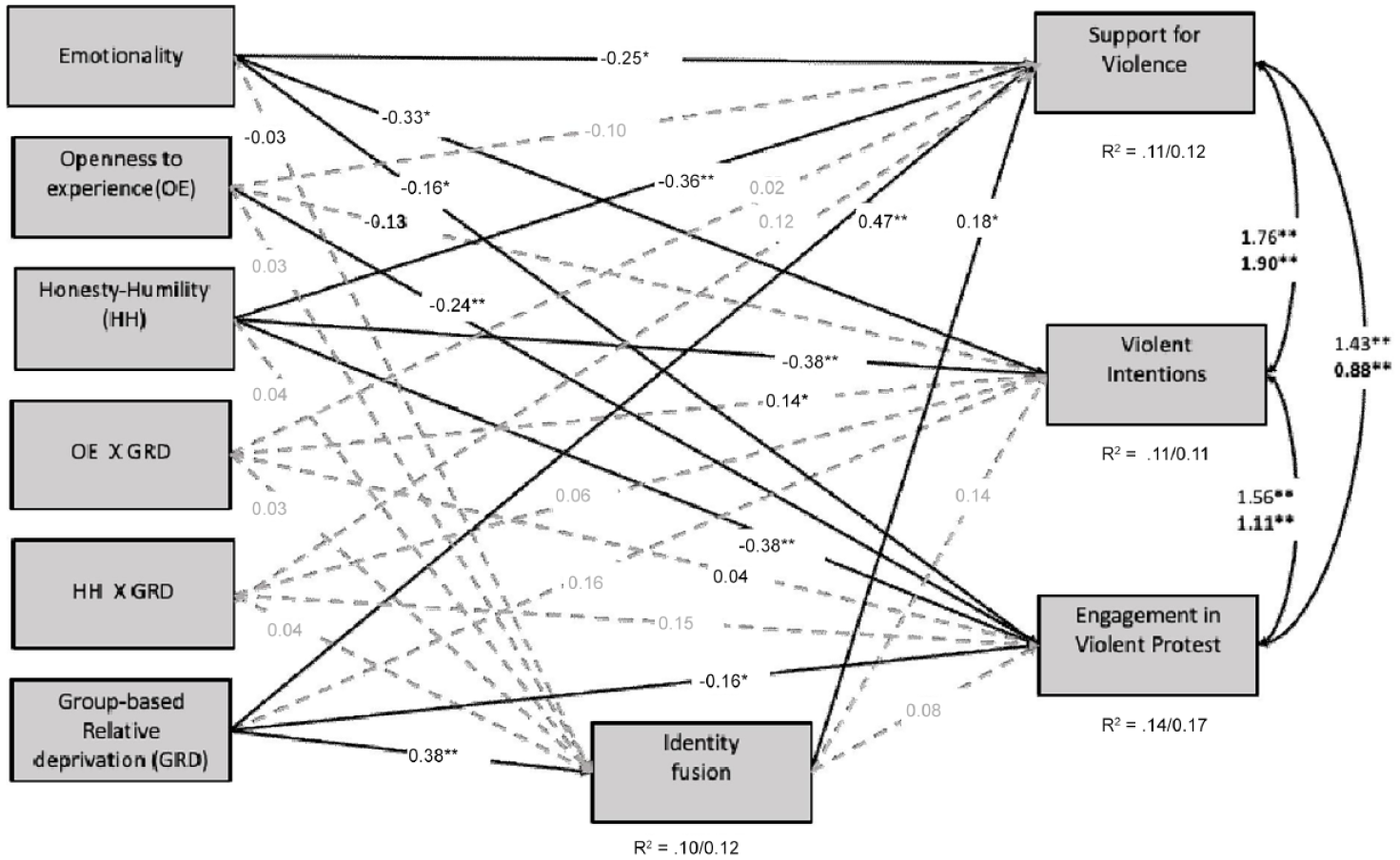
Unstandardised results of multigroup path analysis (fully constrained model) predicting support for violence, violent intentions, and engagement in violent protest for BLM supporters: Study 1.
We were also interested in examining particular paths that might differ for Black and non-Black respondents, so we inspected modification indices. The fit improved when we released the constraint from Openness × GRD to engagement in violent protest, scaled Δχ2(1) = 4.20, p = .04, CFI = .99, RMSEA = .03, 90% CI [0.00, 0.07], SRMR = .05. More specifically, when GRD was high, the effect of openness on engagement in violence was significant for non-Black respondents only (see Figure S3 in the supplemental material). For transparency, we also include a path diagram with all freely estimated coefficients for Black and non-Black respondents in the supplemental material (see Figure S2).
We also tested for indirect effects by deriving bootstrapped confidence intervals based on 5,000 draws, using robust maximum likelihood estimation since bootstrapping is not available in conjunction with MLR. We observed an indirect effect of GRD on support for violence through identity fusion (b = 0.07, 95% CI [0.01, 0.14]), and an indirect effect of GRD on violent intentions through identity fusion (b = 0.05, 95% CI [0.00, 0.12]). 6 Finally, to rule out the possibility of an interaction between emotionality and GRD, we also ran a model with the interaction term (Emotionality × GRD) predicting identity fusion, support for violence, violent intentions, and engagement in violent protest. For Blacks and non-Blacks, all paths were nonsignificant (ps < .05).
Together, the results of Study 1 demonstrated that both personality and social psychological factors underpin the endorsement of violent protest. The multigroup path analysis suggested that the relationship between the personality and social psychological predictors and endorsement of violent protest is similar for those who do not identify as Black American and those who self-identify as Black American. Specifically, fusion with Black Americans predicted support for violent protest, but not violent intentions or self-reported engagement in violent protest. Furthermore, GRD predicted support for violent protest, but not violent intentions. However, GRD negatively predicted self-reported engagement in violent protest (see the General Discussion section for a discussion of this finding).
Further, honesty-humility and emotionality negatively predicted support for violent protest, violent intentions, and self-reported engagement in violent protest. These findings provide preliminary support for the premise that low honesty-humility and emotionality may increase individual tendencies to engage in risky or violent behaviour. Further, openness negatively predicted engagement in violent protest, but not support for violence or violent intention.
Finally, an examination of specific differences between Black and non-Black BLM supporters showed that for Black BLM supporters, GRD negatively predicted engagement in violence when openness was low, whereas for non-Black BLM supporters, GRD negatively predicted engagement in violence when openness was high. Although this is difficult to interpret, these findings may suggest that interactions between openness and GRD may depend on whether GRD is based on deprivation of one’s own group or whether GRD is experienced on behalf of other groups.
Study 2
In Study 2, we focused on endorsement of right-wing extremist violence in Sweden. Sweden has witnessed growing support for the right-wing radical party Swedish Democrats (Jylhä et al., 2019), and Sweden has been described as “the most Alt-right country in Europe” by leading figures in the Alt-Right movement (Feder & Mannheimer, 2017). Although there are several different targets of right-wing extremist violence, violence often takes the form of hate crimes towards Muslims and other immigrant groups (Brå, 2019; Gardell, 2018). Such hostility is often explained on the basis that these groups threaten the economic standing and the cultural values of the majority (Zick et al., 2008). GRD in this study was therefore framed as Swedish disadvantage relative to immigrants in Sweden.
We deemed it unrealistic to sample specifically from right-wing nationalist movements due to mistrust of researchers and our sample size requirements. Instead, our sampling targeted a broader group of Swedes who prefer decreased immigration to Sweden (see Method section for details). We included a measure of Swedish identification since right-wing movements are usually underpinned by identification with ethnic majority groups. As the Swedish Democrats hold a strong anti-immigration stance, for exploratory purposes, we also measured identification with Swedish Democrats.
To improve upon the methods used in Study 1, we measured support for right-wing extremist violence and violent intentions with multi-item scales adapted from previous studies (see details in what follows). Furthermore, because right-wing rhetoric is primarily spread through the internet, with many high-profile White supremacists active on social media forums, we included a measure of cyber hate towards immigrants. This study was also preregistered (see https://osf.io/znkhd).
Method
Participants
This study was advertised as a survey study examining the experiences of Swedes critical to current immigration policies. Specifically, participation in the study required that participants were Swedish, preferred decreased immigration to Sweden, and were at least 18 years old. Participants were recruited through a website advertising research studies in Sweden and via several Facebook groups for Swedish Democrat supporters. Participants received a gift card (with an approximate value of €5.00) as compensation. Our target sample was 250 participants, following rule-of-thumb recommendations for structural equation modelling (e.g., Klein, 2011). We included the same attention checks as in Study 1 and anticipated excluding respondents who failed these checks. Thus, we specifically oversampled, obtaining 304 responses. A total of 52 participants (17.1%) failed one or more attention check items and were excluded, in line with our preregistration. The final sample consisted of 252 respondents (Mage = 33.76, SDage = 11.65; 50.5% men).
Measures
As in Study 1, honesty-humility (α = .72), emotionality (α = .77), and openness to experience (α = .71) were measured with the HEXACO-PI short-form (see Study 1 for examples of items). Swedish identification was measured with four items adapted from Doosje et al. (1995; e.g., “Being a Swede is an important part of my self-image”; α = .88), and GRD with five items adapted from Obaidi et al. (2019; e.g., “I feel angry about Swedes’ limited opportunities to succeed due to immigrants”; α = .92). Since right-wing extremist violence in Sweden usually takes the form of violence towards ethnic and religious minority groups (Brå, 2019; Gardell, 2018), we included more specific measures of endorsement of violence, which (compared to Study 1) were more specific regarding the targets of violence. Specifically, support for violence was measured with five items adapted from Tausch et al. (2011; e.g., “I understand why some Swedes have burnt down mosques around Sweden”; α = .79), and violent behavioural intention with seven items adapted from Obaidi et al. (2019; e.g., “As the last resort, I am prepared to use violence for the sake of Swedes”; α = .89). Engagement in violence was measured with one item (“I have never acted violently towards immigrants in Sweden” [reverse-scored]), and aggression towards immigrants was measured with one item (“I have never acted aggressively towards immigrants in Sweden” [reverse-scored]); however, since these items were highly correlated (r = .70), we averaged across them to obtain one measure of violence/aggression, herein referred to as violence (α = .82). Cyber hate towards immigrants/Muslims was measured with one item adapted from Álvarez-García et al. (2016;“I have at some point posted posts/comments/materials on the internet with offensive, hateful, or threatening content that contained rumours or sensitive information about immigrants/Muslims”).
Results and Comments
Path analysis was conducted in Mplus using MLR estimation and mean-centred predictor variables. We first examined our preregistered model with honesty-humility, openness, GRD, and the interaction terms (Openness × GRD; Honesty-Humility × GRD) as the independent variables; identification as a mediator; and support for violence, violent intentions, and engagement in violence as the dependent variables. This path model was similar to those in Study 1, but we did not include some of the exploratory paths that were nonsignificant in Study 1. 7 This model had excellent fit, χ2(4) = 3.02, p = .55, CFI = 1.00, RMSEA = .00, 90% CI [0.00, 0.08], SRMR = .02 (see Figure 2).
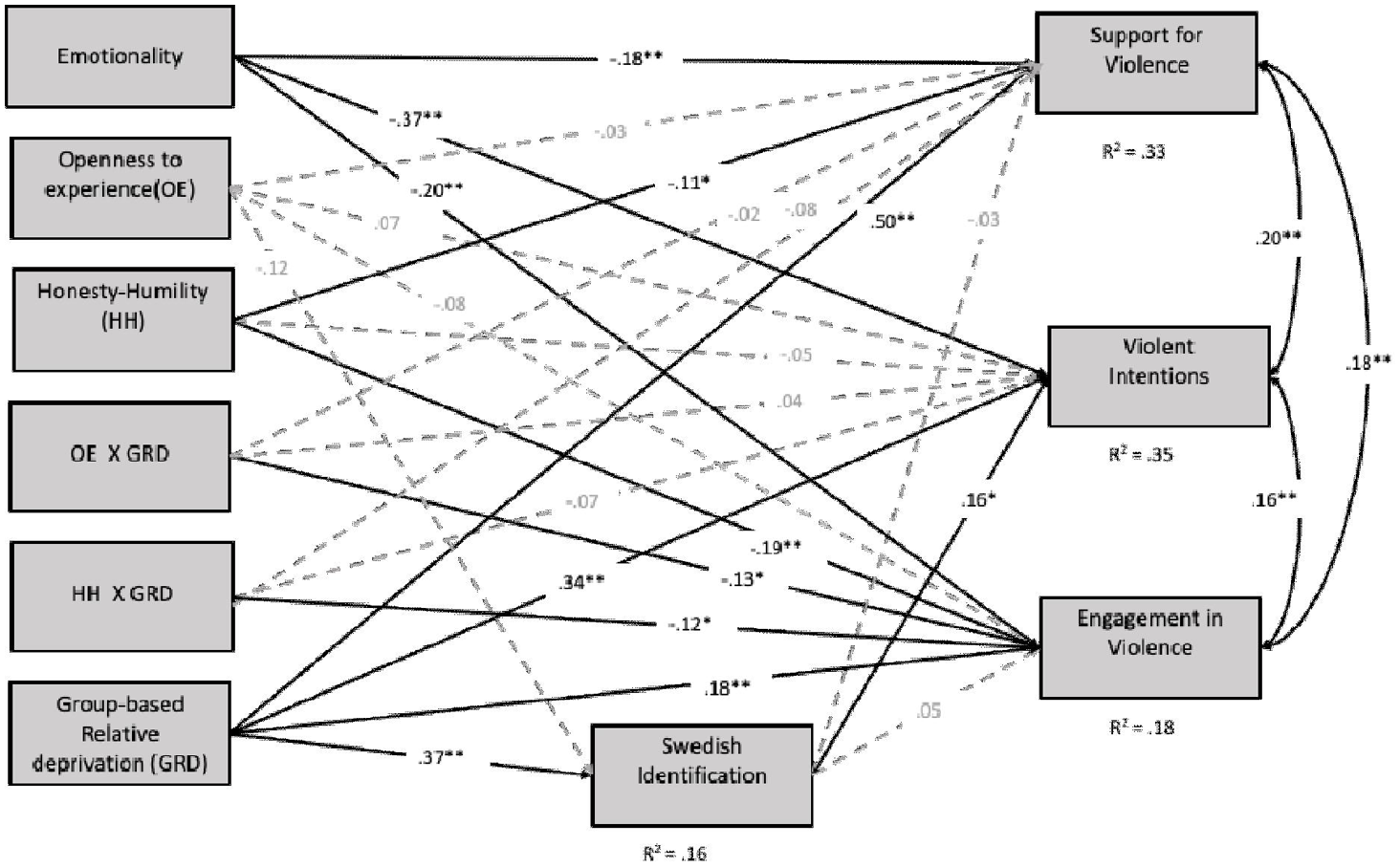
Standardised results of path analysis predicting support for violence, violent intentions, and engagement in violence among immigration-critical Swedes: Study 2.
As in Study 1, emotionality (negatively) predicted all of our measures of violent group mobilisation. Similarly, GRD as well as Swedish identification predicted all outcomes. The other effects varied for the different outcomes (see Figure 2 for details). For instance, there was a significant interaction between openness and GRD specifically predicting engagement in violence, and a significant interaction between honesty-humility and GRD predicting engagement in violence.
Further, we conducted simple slopes analysis to examine the interaction effects. The slope of GRD predicting engagement in violence was significant when openness was low (β = .25, t = 3.23, p < .001) and at mean levels (β = .16, t = 3.02, p < .001), but nonsignificant when openness was high (β = .08, t = 1.15, p = .25). Meanwhile, the slope of openness predicting engagement in violence was nonsignificant when GRD was low and at mean levels (ps > .05), but significant when GRD was high (β = −.28, t = −2.41, p = .02). Inspection of the other interaction effect revealed that the slope of GRD predicting engagement in violence was significant when honesty-humility was low (β = .26, t = 3.63, p < .001) and at mean levels (β = .16, t = 3.02, p < .001), but nonsignificant when high (p > .05). Further, the slope of honesty-humility predicting engagement in violence was nonsignificant when GRD was low (p > .05), but significant when at mean levels (β = −.26, t = −2.96, p < .001) and when high (β = −.42, t = −3.66, p < .001). See Figure S10 in the supplemental material for interaction plots. As in Study 1, we also tested for indirect effects, observing an indirect effect of GRD on violent intentions through identification (β = .06, 95% CI [0.02, 0.11]).
Finally, when cyber hate was also included in the model, in addition to a similar pattern of results as the preregistered model, honesty-humility and emotionality negatively predicted cyber hate, and GRD positively predicted it (see Figure S11 in the supplemental material).
Collectively, the findings of Studies 1 and 2 show that several predictors of violent group mobilisation are observed consistently across widely differing contexts (in terms of culture, ideology, and historical advantages/disadvantages, etc.). Given that several effects were observed consistently across left-wing and right-wing contexts, this raises questions regarding the extent to which similar findings would also be observed when examining other (nonpolitical) forms of violent group mobilisation.
Study 3
In Study 3, we turned to a context where individuals engage in violent group mobilisation, but unrelated to any specific ideology. Sports teams and their supporters are frequently used to illustrate social identity phenomena (e.g., Cikara et al., 2011; Hogg & Hardie, 1991); hence, in this study, we focused on soccer supporters, specifically supporters’ violence towards supporters of rivalling teams. We focused on supporters of a soccer club (Hammarby) recognised as having the most hooligans in Sweden (Edwinson, 2013) and known as the “underdog” (financially and in terms of sporting success) relative to its local rival teams (see Radmann & Andersson, 2018). Hence, GRD in Study 3 was framed as disadvantage relative to rival soccer teams, and we included the majority of the variables used in Studies 1 and 2, adapted for the soccer context. However, neither emotionality nor self-reported engagement in violence were included in this study. 8
Method
Participants and procedure
Hammarby supporters, aged at least 18 years old, were recruited through Facebook groups for supporters. Participants were compensated with a gift card (with an approximate value of €5.00). Data were collected at two time points (n = 230, n = 247), the second of which was preregistered 9 (see https://osf.io/zcqpd). We combined the two datasets in our analysis to obtain better power and given that the recruitment, procedure, and measures were practically identical in the two of them (for transparency, see supplemental material for separate results from the two datasets). In total, we obtained 477 responses, but 32 did not fill in any of the main variables and were excluded. Thus, the final sample consisted of 445 participants (Mage = 36.76, SDage = 11.88; 76.5% males).
Measures
Personality variables, honesty-humility (α = .72), and openness to experience (α = .78) were measured with the HEXACO-PI short-form (see Study 1 for examples of items). Group identification was measured with three items from Doosje et al. (1995), adapted for our group context (e.g., “Being a Hammarby supporter is an important part of my self-image”; α = .79). GRD was measured with seven items, with GRD framed in terms of team and supporter disadvantage relative to rival soccer teams and supporters (e.g., “I feel frustrated over the limited success Hammarby has experienced compared to AIK/Djurgården, and the fact that their clubs have a financial advantage”; α = .77). Support for violence was measured with three items (Tausch et al., 2011; e.g., “I understand why some Hammarby supporters have been violent towards AIK and Djurgården supporters”; α = .94), and violent behavioural intentions was measured with seven items (Obaidi et al., 2019; e.g., “As the last resort, I am prepared to use violence for the sake of Hammarby”; α = .91).
Results and Comments
Main analyses
We first estimated a model with honesty-humility, openness, GRD, and the interaction terms (Openness × GRD; Honesty-Humility × GRD) as the independent variables; identification as a mediator; and support for violence and violent intentions as the dependent variables. This was a just-identified model (see Figure 3).
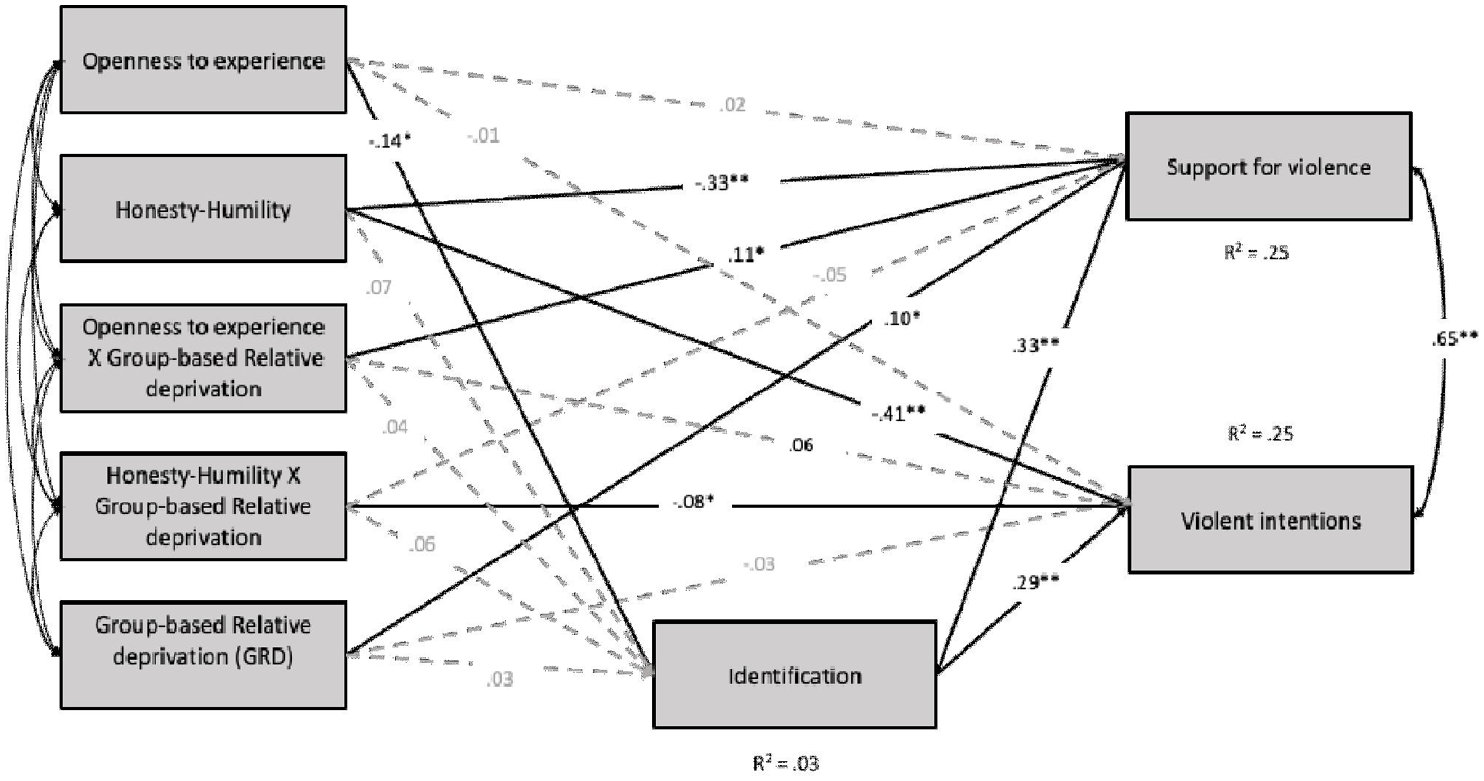
Standardised results of path analysis predicting support for violence and violent intentions among soccer supporters: Study 3.
Results of the path analysis showed that honesty-humility and identification both predicted our measures of violent group mobilisation, whereas GRD only predicted support for violence. Openness only (negatively) predicted identification (see Figure 3 for further detail). The analysis also revealed a significant interaction between openness and GRD predicting support for violence (β = .11, p = .03), and a significant interaction between honesty-humility and GRD predicting violent intentions (β = −.08, p = .04).
To further examine the interaction effects, we conducted simple slopes analysis (Cohen et al., 2003). The slope of GRD predicting support for violence was nonsignificant when openness was low (β = −.18, t = 0.09, p = .920), but significant when openness was at mean levels (β = .19, t = 2.23, p = .030) and when openness was high (β = .37, t = 3.00, p < .001). On the other hand, the slope of openness predicting support for violence was marginally significant only when GRD was high (β = .22, t = 1.81, p = .070). See Figure S15 in supplemental material for interaction plots.
Examination of the other interaction effect revealed that the slope of GRD predicting violent intentions was nonsignificant when honesty-humility was low, at mean levels, or high (all ps > .05), whereas the slope of honesty-humility predicting support for violence was steeper at higher levels of GRD. Specifically, when GRD was low (β = −.57, t = −5.24, p < .001), when GRD was at mean levels (β = −.69, t = −8.97, p < .001), and when GRD was high (β = −.81, t = −8.25, p < .001). We also observed an indirect effect of openness on support for violence (β = −.05, 95% CI [−0.08, −0.01]), and of openness on violent intentions through identification (β = −.04, 95% CI [−0.07, −0.01]). For additional exploratory analyses with demographic variables included in the models, see the supplemental material.
As preregistered (and because support for violence and violent intentions were highly correlated), we also estimated a model with a latent factor derived from support for violence and violent intentions as the dependent variable. Although this model fit reasonably well, it showed a clear deterioration in model fit, χ2(5) = 16.72, p = .01, CFI = .97, RMSEA = .07, 90% CI [0.04, 0.12], SRMR = .02, compared to the model with separate outcomes (for path model, see Figure S17 in the supplemental material).
The results of Study 3, with soccer supporters as the target group, replicated many of the effects observed in the previous studies, with honesty-humility negatively predicting support for violence and violent intentions, and GRD predicting support for violence. With regard to interactions, similar findings to Study 2 were also observed; GRD interacted with both openness (in predicting support for violence) and honesty-humility (in predicting violent intentions). However, the nature of the interaction between openness and GRD differed to that observed in Study 2, with a combination of low openness and high GRD associated with support for violence against rival teams.
General Discussion
The studies we presented here show that individuals who resort to group-based violence for their cause share common personality and social psychological signatures. Similar findings were also observed when we examined a nonpolitical form of violent group mobilisation (soccer hooliganism). In our discussion of the results, we will primarily focus on the effects observed consistently across the different contexts.
GRD and Collective Violence
Our results suggest that violent group mobilisation is driven by subjective perceptions of disadvantage that do not necessarily have to be rooted in objective disadvantage (i.e., structural disadvantage). Thus, our findings extend upon the traditional collective action literature (e.g., van Zomeren et al., 2008) by examining violent collective action, different group contexts, subjective grievances of advantaged groups, and violent action on behalf of other groups. Importantly, our findings extend current knowledge by demonstrating that the subjective perception of group-based disadvantage (i.e., GRD) is associated with support for group-based violence across group members who experience GRD as a member of an objectively disadvantaged group (Black BLM supporters), on behalf of another group (non-Black BLM supporters), and as members of an objectively advantaged group (Swedes in Sweden). Such findings even extended to groups in “trivial” hierarchies (soccer supporters), with GRD also underlying support for violence in this nonpolitical context. Thus, our findings suggest that regardless of group membership or ideology, feelings of GRD may lead individuals to sympathise with collective violence. In general, such findings converge theoretically with the notion of intergroup competitive victimhood as a precursor to the justification of ingroup violence (Noor et al., 2012).
Although there were similarities across the studies in terms of the relationship between GRD and support for violence, whether or not GRD motivates violent intention or actual violence towards certain groups may depend on the power dynamics of the context. Specifically, among anti-immigration Swedes, GRD predicted violent intention and self-reported violence towards immigrants as well as cyber hate towards immigrants, whereas it “only” predicted support for violence—but not violent intentions—on behalf of nondominant groups (Black Americans and an “underdog” soccer team). This might suggest that GRD may be a more potent predictor of collective violence amongst members of historically advantaged groups, or among right-wing movements.
Wright and Tropp (2002) have proposed that specific patterns of collective action (i.e., normative vs. nonnormative collective action) or inaction (i.e., inaction with acceptance vs. inaction with anger and frustration) are more likely to occur depending on whether individuals view the relative position of the group as controllable or uncontrollable and as legitimate or illegitimate. For example, inaction with acceptance is more likely if the relative position of the group is viewed as legitimate and uncontrollable. However, nonnormative forms of group mobilisation are more likely to occur when the relative position of the group is perceived as illegitimate and controllable (and hence amenable to change; see also Lizzio-Wilson et al., 2021), and when peaceful tactics are perceived to be ineffective (Saab et al., 2016). In line with this theorising, subjective perceptions of disadvantage experienced by members of historically advantaged groups (e.g., Swedes in Sweden in the present study) may have been perceived as more illegitimate but controllable, since historically their group has been more privileged than other groups. Relatedly, among members of historically advantaged groups, perceived disadvantage may also stem from perceptions that their groups’ social status is being threatened (Kunst & Obaidi, 2020; Power et al., 2020). This may not be the case for perceptions of disadvantage by members of historically disadvantaged groups, since they are accustomed to their group being low-status. Thus, right-wing rhetoric may be especially effective in inciting violence and aggression towards immigrant groups in the West because such rhetoric often centres on the presumed illegitimacy of the disadvantages faced by White Europeans/Americans (e.g., by invoking narratives of White replacement and genocide), the ineffectiveness of peaceful methods, and the possibilities for collective control.
Although GRD positively predicted engagement in violence towards immigrants, it negatively predicted engagement in violent protest within the BLM movement. There are several interrelated explanations for these findings. First, the onset of the BLM protests was precipitated by the salience of police violence towards Black Americans. It is possible that BLM supporters, who view Black Americans as unjustly oppressed, may have also perceived a heightened risk associated with engaging in actual violence during protests, with high levels of experienced GRD generally deterring individuals from engaging in violence during BLM protest. Such a risk may not be apparent to members of majority groups when they decide to act aggressively or violently towards immigrants/minority groups. Second, it could be argued that historically, nonviolent (normative) protest in the civil rights movement was more effective in driving social change than violent protest (Wasow, 2020). If this view is widely held by BLM protesters, then GRD experienced by BLM supporters may be more likely to motivate them to engage in nonviolent protest, which is largely supported by the results examining predictors of peaceful protest (see supplemental material).
Personality and Collective Violence
In general, across all three studies, some personality effects were observed consistently across the contexts, extending similar research among Muslims (Obaidi et al., 2020). There were also some indications that personality interacted with GRD. Although openness has been found to track ideology and political behaviour (Blankenship et al., 2017; Gerber et al., 2010), the association between openness and endorsement of collective violence appears to be more complex. We found interactions between openness and GRD in all studies but in different forms. This could reflect random variation and should be interpreted with caution (as we discuss further in what follows), but there are also possible theoretical reasons why they differed.
In particular, in Study 2, the association between GRD and self-reported engagement in violence towards immigrants was moderated by openness to experience, with a stronger association between GRD and violence at lower levels of openness. Similar results were observed by Gøtzsche-Astrup (2019), who found the positive association between uncertainty and political violence to be significant when openness was low. At first glance, these results support the idea that individuals low in openness tend to endorse simplistic solutions (e.g., violence) to their problems (e.g., perceived disadvantage and uncertainty).
However, the nature of the interaction was different amongst soccer supporters, that is, a combination of high openness and high GRD was associated with greater support for violence in this context. Research shows that low openness is associated with intolerance towards unconventional groups, but high openness is associated with intolerance towards conventional groups (Brandt et al., 2015). Although we attempted to choose a nonpolitical context, we sampled from supporters of a soccer team known as a “working class” team, often attracting “left-leaning” supporters. Hence, we cannot rule out the possibility that the observed interaction effects were not “contaminated” by other factors such as perceived conventionality of the target of violence (i.e., supporters of rivalling teams). Future research should investigate whether perceived conventionality of targets of violence influences interactions between GRD and openness in predicting collective violence.
We also suspected that GRD would interact with honesty-humility in predicting endorsement of collective violence, and we found some support for this across the studies. In Study 2, amongst Swedes, the negative association between honesty-humility and violence towards immigrants was greater at higher levels of GRD. Similarly, amongst soccer supporters, the negative association between honesty-humility and violent intentions was greater at higher levels of GRD. Previous research shows that individuals low in honesty-humility have narcissistic tendencies (Ashton et al., 2014), which in turn is linked to reacting aggressively in response to ego threats (Baumeister, 1997). Our findings align with such research, suggesting that the perception that one’s group is relatively disadvantaged is considered a threat to one’s ego or self-image. That self-image could include social identities (i.e., based on group membership). It is possible that we did not observe an interaction between honesty-humility and GRD amongst BLM supporters because we also sampled from non-Black BLM supporters. Although the results of the multigroup path analysis provided support for a more general model (rather than separate models for Black and non-Black Americans), non-Black BLM supporters may not experience Black American GRD (i.e., vicarious GRD) as an ego threat.
We acknowledge, however, that the observed (ordinal) interactive effects should be interpreted with caution, because the studies were not designed to provide well-powered tests thereof. This could also explain why the interactions varied across the studies. As such, the findings regarding interactions should be considered preliminary at best, and corroboration would require considerably larger samples (see e.g., Giner-Sorolla et al., 2019).
Interaction effects aside, our findings suggest that high levels of honesty-humility and emotionality make people less likely to endorse collective violence even when controlling for other predictors of group mobilisation (e.g., identification, identity fusion). Across all three studies, low honesty-humility was associated with support for collective violence. Low honesty-humility was also associated with violent intentions amongst BLM supporters and soccer supporters, but not among immigration-critical Swedes. Interestingly, comments from one participant suggest that some of the violent intention items may have been interpreted in terms of willingness to go to war to defend Sweden, even though none of the items explicitly mentioned war. The association between honesty-humility and willingness to go to war for one’s country is likely to be different than the association between honesty-humility and violent intentions towards immigrants, which could account for this finding. Nevertheless, low honesty-humility was also associated with self-reported engagement in violent protest (amongst BLM supporters) and self-reported violence towards immigrants (amongst immigration-critical Swedes), and this also extended to self-reported engagement in cyber hate towards immigrants.
Similarly, findings amongst BLM supporters and immigration-critical Swedes consistently showed that low emotionality was associated with support for violence, violent intentions, and self-reported engagement in violence. Amongst immigration-critical Swedes, we also observed that this pattern of results extended to self-reported engagement in cyber hate towards immigrants. Thus, regardless of ideology or the group with which one identifies, the dispositional tendency to experience fear, anxiety, and sentimentality may act to deter individuals from endorsing collective violence. Individuals low in emotionality seem to not be “held back” by fear or worry about the potential risks or repercussions of endorsing collective violence. Collectively, our findings provide an alternative yet complementary explanation to significance quest theory (Kruglanski et al., 2014), because our findings suggest that dispositions (i.e., high emotionality and honesty-humility) may prevent individuals from engaging in extremist “quests for significance” to restore loss of significance (e.g., GRD).
Identification and Fusion
With regard to the effects of identification and identity fusion across the three contexts, there were some similarities and differences. One similarity was that identity fusion predicted support for violence amongst BLM supporters, and identification predicted support for violence amongst soccer supporters. There were also differences between the different contexts but such differences are difficult to interpret. However, the present research was not primarily concerned with the role of identification or the differences between identification and identity fusion (for research examining this issue, see Gómez et al., 2019).
Limitations and Strengths
Aside from general concerns about cross-sectional, self-report data, there are also some specific limitations. 10 One limitation is that we included a measure of group identification in Studies 2 and 3, but a measure of identity fusion in Study 1. Identity fusion was included in Study 1 (the BLM study) because “traditional” identification measures would not be appropriate when including individuals who do not identify as Black, but nevertheless support the BLM movement. Since identity fusion has been applied to contexts in which individuals do not necessarily belong to the group in question, but nevertheless have an affinity for an outgroup (Kunst et al., 2018), we treated it as a proxy measure of identification when dealing with affinity for an outgroup. This, however, limits the extent to which we can draw conclusions regarding the consistency of identification and identity fusion effects across the studied contexts.
Further, we did not include emotionality and self-reported engagement in violence in Study 3. Thus, we could not identify similarities between soccer supporters and the other two contexts in relation to these variables. We also examined one soccer team that is slightly disadvantaged relative to rival teams in Sweden. GRD may not predict support for violence amongst other soccer teams or other team settings. Another caveat is that we examined what predicts violence on behalf of a group once an element of violence has already been observed on behalf of that group. Of course, not all groups or social movements include violent factions. Our results should not be taken to suggest that identification, fusion, or personality will always predispose individuals toward violence. There are also groups and movements where GRD might be prevalent, but where violence is still exceedingly rare (e.g., feminism). A limitation of this work is that we do not have a model that speaks to the boundary conditions of when GRD and the other independent variables do not produce violence. We consider this an important avenue for future research. Finally, we acknowledge that our samples may not have been sufficiently powered for all the paths we examined, especially the interaction effects. Our findings regarding interaction effects should therefore be interpreted with caution. Nevertheless, our results can hopefully inform the design of future research in terms of expected effect sizes.
Several strengths of the present research could also be noted. Furthermore, our research is rather unique in terms of including both social and personality factors for predicting violent collective action. Personality and social identity researchers have been reluctant to generate integrative models in general, particularly in explaining group mobilisation or political behaviour, and have been engaged in a long-standing “either-or” debate (see e.g., Hodson, 2009; Reynolds et al., 2010). Nevertheless, our results suggest that researchers studying collective violence could benefit from considering both personality and social psychological factors, if they seek a comprehensive and nuanced explanation of the underpinnings of group-based violence.
Concluding Remarks
Recently, it has been recognised that violent group mobilisation in the West comes from an increasingly wide range of groups (Hoffman & Clarke, 2020). One potential explanation for this, in light of our findings, is that there are common psychological factors underpinning endorsement of collective violence, regardless of ideology or the group to which one belongs or supports. People from the left, the right, and beyond may feel that a group to which they belong/support is disadvantaged, or increasingly disadvantaged. However, not just anyone reacts to this sense of disadvantage, and dispositional tendencies may allow us to or deter us from reacting.
Finally, we do not by any means argue that all forms of collective violence are equivalent or similarly good or bad. We also recognise that the nature of deprivation or disadvantage also differs substantially across the contexts. However, despite these differences, the findings across our three studies provide converging evidence that individuals who endorse violence in different contexts do indeed have some basic individual and social psychological factors in common. Our findings that a combination of low honesty-humility, low emotionality, and high GRD may increase individual susceptibility to violence for collective causes is not only relevant for academics but also for practitioners working to counter violent extremism, or other forms of group-based violence.
Supplemental Material
sj-docx-1-gpi-10.1177_13684302231154412 – Supplemental material for Who endorses group-based violence?
Supplemental material, sj-docx-1-gpi-10.1177_13684302231154412 for Who endorses group-based violence? by Joanna Lindström, Robin Bergh, Nazar Akrami, Milan Obaidi and Torun Lindholm Öymyr in Group Processes & Intergroup Relations
Footnotes
Acknowledgements
We thank Gareth Smith, Freddie Åsberg, Sophia Appelbom, and Freja Isohanni for their input on item-wording and assistance with data collection for Study 3, and Astrid Ramberg and Saba Abassi for their assistance during data collection for Study 2. We also thank the participants for providing data for the study, and the reviewers of this paper for their constructive feedback.
Data availability statement

Funding
The author(s) disclosed receipt of the following financial support for the research, authorship, and/or publication of this article: The research was supported by grants from Lars Hiertas Memorial Foundation (FO2019-0005) and Elisabeth and Herman Rhodin Memorial Foundation to Joanna Lindström (SU FV-2.1.9-0174-19) and a grant to Robin Bergh from Marcus and Marianne Wallenberg Foundation (ref no MMW 2016.0070).
Supplemental material
Supplemental material for this article is available online.
Notes
References
Supplementary Material
Please find the following supplemental material available below.
For Open Access articles published under a Creative Commons License, all supplemental material carries the same license as the article it is associated with.
For non-Open Access articles published, all supplemental material carries a non-exclusive license, and permission requests for re-use of supplemental material or any part of supplemental material shall be sent directly to the copyright owner as specified in the copyright notice associated with the article.
