




Abstract
In group contexts, moral judgments are used as social influence tactics to regulate the behavior of group members. We argue that communicating moral disapproval with the aim of adapting group members’ behavior might backfire because it elicits (negative) threat rather than (positive) challenge. In two experiments, we examined the motivational consequences of negative morality (vs. competence) evaluations in group contexts. Participants worked on a group task while cardiovascular indices of challenge and threat motivational states were measured following the biopsychosocial model (Blascovich & Tomaka, 1996). In Experiment 1, participants recalled their own prior behavior evaluated as immoral or incompetent; in Experiment 2, participants were exposed to an ingroup member’s prior behavior evaluated as immoral or incompetent. As predicted, in both experiments, reminders of immorality induced a state of threat rather than challenge in a novel group context. These results suggest that moral disapproval intended to motivate group members to adapt their behavior might actually be counterproductive.
Moral judgments have important social implications: Not only do they provide social norms about what one should and should not do, they are also used to regulate the behavior of individuals in groups (Brambilla & Leach, 2014; De Waal, 1996; Ellemers & van den Bos, 2012; Leach et al., 2013). For example, moral guidelines indicating what is normative for the group impact upon behavioral choices of group members, and moral (more so than competence) evaluations determine group members’ willingness to help a newcomer in the group (Ellemers et al., 2008; Pagliaro et al., 2013). This suggests that moral disapproval of past behavior might be particularly useful as a way to regulate behavioral change. However, is this really the case? We propose that the opposite might actually be true and that moral disapproval can impede rather than foster behavioral change.
Why would moral disapproval provide an inefficient way to alter group members’ behavior? We argue that the greater psychological impact of moral (vs. competence) judgments may impede group members’ perceived ability to cope with moral disapproval (see also Rösler et al., 2023; Sun & Goodwin, 2020). In other words, the ability to cope with negative evaluations is lower when these pertain to morality (rather than competence). As a result, we predict that negative morality evaluations are more threatening and may therefore be less efficient as a way to motivate group members to adapt their behavior.
The aim of the current research is to gain more insight into the motivational implications of negative morality versus competence evaluations in group contexts. In two experiments, we compare behavior indicative of morality to behavior indicative of competence, which are both key sources of value and esteem for groups and their members (e.g., Abele-Brehm et al., 2021; Fiske et al., 2002; Judd et al., 2005; Leach et al., 2007). In addition, we investigate the social implications of morality evaluations by examining judgments of behavior of the self as a group member (Experiment 1) as well as judgments regarding the behavior of another ingroup member (Experiment 2). Given that the behavior of other ingroup members is self-relevant because this affects one’s social identity, we expect similar effects of morality versus competence evaluations on motivation, regardless of whether the judgment concerns one’s own behavior or an ingroup member’s behavior.
The Motivational Implications of Morality and Competence
People desire having a moral identity (Monin & Jordan, 2009) and strive to be (perceived as) moral (Jordan et al., 2011; see also Brambilla et al., 2019, 2021). The motivation to be seen as moral directly affects displays of moral behavior. That is, individuals engage in compensatory behaviors when their moral identity has been called into question (Sachdeva et al., 2009). For example, individuals who are reminded of past immoral actions report more prosocial intentions, such as donating to charity (Jordan et al., 2011). This demonstrates that individuals whose behavior is negatively evaluated in terms of morality (e.g., through reminders of past immoral acts) increase their striving to act morally. As a consequence, it could be argued that moral disapproval of past behavior constitutes an effective way to motivate group members to change their behavior. However, despite the motivational power of salient moral transgressions, individuals can also feel bad as a result of them. For example, when group members recall a negative evaluation of their behavior in terms of morality (vs. competence), they show more negative affective responses and a decrease in their perceived ability to cope with the situation (van der Lee et al., 2016; see also Rösler et al., 2023). Thus, reminders of immoral acts on the one hand increase the desire to act morally, but on the other hand decrease the (perceived) ability to do so.
Challenge and Threat
The biopsychosocial model of challenge and threat (BPS-CT; Blascovich, 2008; Blascovich & Mendes, 2000, 2010; Blascovich & Tomaka, 1996; Mendes & Park, 2014; Seery, 2011; Wormwood et al., 2019) describes motivational states during motivated performance situations (e.g., giving a speech, working on a group-decision task) along a bipolar continuum ranging from “challenge” to “threat.” According to the BPS-CT, evaluations of motivated performance situations in terms of their demands (e.g., uncertainty and required effort) and available resources to cope with these demands (e.g., knowledge and skills) result in a motivational state of challenge versus threat (Blascovich, 2008). More specifically, when situational demands outweigh individual resources, a state of threat emerges. Conversely, when individual resources match or outweigh situational demands, a state of challenge emerges.
Challenge and threat motivational states are marked by specific patterns of cardiovascular reactivity. First, task engagement and goal relevance (fundamental characteristics of motivated performance) are indicated by an increase in heart rate (HR) and a decrease in preejection period (PEP, an index of left ventricular contractile force; Blascovich & Mendes, 2010; Richter et al., 2016; Seery, 2011). Second, a combination of cardiac output (CO, the amount of blood in liters that is pumped through the heart per minute) and total peripheral resistance (TPR, the resistance—constriction vs. dilation—of blood flow through the arterial system) indexes challenge and threat: Challenge is marked by relatively high CO and low TPR, whereas threat is marked by relatively low CO and high TPR.
In the context of the BPS-CT, the motivational states of challenge and threat (and their cardiovascular correlates) have been related to specific cognitive and behavioral outcomes. For example, challenge has been shown to positively correlate with a range of cognitive and physical performance outcomes (Behnke & Kaczmarek, 2018; Blascovich et al., 2004; Hase et al., 2018; Seery et al., 2004; Seery et al., 2010). Threat, by contrast, has been related to rigidity and anchoring in conflict situations (De Wit et al., 2012; Jamieson et al., 2014; Kassam et al., 2009) and may have negative health implications in the long run (Blascovich, 2008; Derks & Scheepers, 2018; Hase et al., 2020).
We propose that differentiating between motivational states of challenge and threat provides a powerful tool to understand how group members deal with negative morality versus competence evaluations. We argue that morality evaluations generally are more demanding than competence evaluations. First, morality evaluations are more important than competence evaluations for a positive evaluation of the self (Aquino & Reed, 2002) and the group (Leach et al., 2007). Second, negative comments about one’s morality are perceived to be more diagnostic of the self (being seen as having more predictive value for future behavior) than negative comments about one’s competence (Pagliaro et al., 2016; Skowronski & Carlston, 1987). Finally, prior research has demonstrated that critical evaluations of the self or the ingroup regarding morality result in more negative affect (Rösler et al., 2023; van der Lee et al., 2016) and identity threat (Kouzakova et al., 2012), and reduced motivation to improve their behavior (Rösler et al., 2021), as compared to critical evaluations of the self or the ingroup regarding competence. These are all factors that potentially increase perceptions of situational demands and/or decrease perceptions of available resources (e.g., Blascovich, 2008) that relate to defensive and counterproductive responses (e.g., Does et al., 2012; Kouzakova et al., 2014; Rösler et al., 2021; van der Toorn et al., 2015). As a consequence, we predict that negative morality, rather than competence, evaluations are more likely to induce a motivational state of threat instead of challenge. Considering the negative implications of threat in terms of cognitive and behavioral performance and behavioral change (e.g., Behnke & Kaczmarek, 2018; Blascovich et al., 2004; De Wit et al., 2012; Hase et al., 2018; Kassam et al., 2009; Seery et al., 2010), morality evaluations might therefore not provide the most efficient route to establish behavioral change in group members.
The Current Research
In two experiments, we exposed group members to negative evaluations of moral versus competent behavior by asking them to recall instances of such evaluations of their own prior behavior (Experiment 1) or by confronting them with such evaluations of an ingroup member’s prior behavior (Experiment 2). Thus, in both studies, the evaluations were made in a past but salient group context.
More specifically, in Experiment 1, participants recalled a situation in which their behavior was evaluated as either immoral or incompetent by others in a group context. Then, in a novel group context created in the lab, a group task was introduced for which either morality or competence (depending on condition) was said to be the primary performance dimension. In anticipation of the task, participants ostensibly had a within-group communication opportunity (by means of a video circuit) where they presented their views on how to perform the task. This was the motivated performance situation we focused on to assess cardiovascular indices of challenge and threat.
In Experiment 2, participants were exposed to evaluations of prior immoral or incompetent behavior of another ingroup member. In order to increase the salience of the lack of morality or competence displayed by another ingroup member, we enhanced the contrast between group members’ own behavior and the behavior of another group member. We did so by instructing group members to first recall a situation in which their own behavior was positively evaluated as moral or competent by others in a group context. Participants sent their behavioral description to others in the group via a chat circuit, and in turn received preprogrammed information allegedly indicating the behavioral descriptions provided by other group members. We varied the behavioral description of one of the ingroup members to convey that this group member had behaved in a way that was negatively evaluated as immoral or incompetent.
Across studies, we measured group members’ motivational states in a new group context during a performance task through cardiovascular markers of challenge and threat. By applying the BPS-CT, we provide novel insight into the motivational states of group members when coping with negative intragroup evaluations. We hypothesize that a negative evaluation of morality (vs. competence) induces a state of threat rather than challenge. We expect this pattern to occur regardless of whether the judgment targets own behavior or an ingroup member’s behavior.
Experiments 1 and 2
Participants and Sample Size
In Experiment 1, 73 undergraduate students (50 women; Mage = 21.41 years, SD = 3.19) participated in exchange for 6 Euros or course credits. Participants were randomly assigned to one of the two experimental conditions in a one-factor between-subjects design (dimension: morality vs. competence).
In Experiment 2, 49 undergraduate students (33 women; Mage = 21.73, SD = 3.22) participated. They received 6 Euros or course credits for participation and were randomly assigned to one of the two experimental conditions in a one-factor between-subjects design (dimension: morality vs. competence).
Considering these sample sizes, in the current report, we focus on the pooled effect of condition across the two datasets by estimating a mixed model with experiment included as a random intercept. We were able to include the data of 86 participants in the main analyses (41 in the morality condition; 45 in the competence condition). A sensitivity power analysis conducted in G*Power for our design (i.e., an independent samples t test, one-tailed, α = .05, and 80% of power) and the obtained sample size, estimated that the minimum required effect size for our studies was Cohen’s d = 0.54. This is comparable to the effect sizes typically reported in the literature on cardiovascular threat/challenge responses to moral failures of the self and other ingroup members (e.g., Kouzakova et al., 2014; van Prooijen et al., 2018).
Procedure
In both experiments participants arrived in the laboratory, were seated in front of a computer equipped with a webcam, and were attached to the apparatus for measuring cardiovascular responses (see following lines). To measure impedance cardiographic (ICG) and electrocardiographic (ECG) signals, four spot electrodes were placed on participants’ upper and lower back, and two on their chest. In addition, a blood pressure sensor was attached to the index finger of participants’ nondominant hand. We then took a 5-minute baseline measure of cardiovascular responses.
In Experiment 1, participants were then told that the study concerned how people solve management dilemmas in groups. Participants (who were all referred to as “Participant 2”) would be collaborating in a group with three other (fictitious) participants (indicated as “Participant 1,” “3,” and “4”) to discuss the role of morality (competence) in solving such dilemmas. This served as our manipulation of evaluative dimension. Ostensibly, in order to enhance the collaboration and performance on the task, participants were first asked to recall a prior situation in which they had behaved in a way that was evaluated as either immoral or incompetent (depending on condition) by others in a previous group context. To further increase the salience of the group context, we asked participants to describe both their behavior and how (someone from) their group confronted them with disapproval about their behavior (see also van der Lee et al., 2016; van Prooijen et al., 2018). The others in the group were allegedly asked to do the same.
Participants then completed a short questionnaire including the self-report measures and manipulation checks, and were presented with several example dilemmas, after which, they delivered a speech in front of a webcam. During this speech task, participants presented their ideas about the role of morality (competence) in solving management dilemmas. The speech recorded by each group member would allegedly be shown to the others in the group with the purpose of forming an impression of each other and facilitating collaboration during the group task. Participants were (ostensibly randomly) chosen to record their speech first. They could take up to 3 minutes for their speech, which was the motivated performance situation we focused on regarding the cardiovascular indices of challenge and threat (e.g., Blascovich et al., 2004; Mendes et al., 2007; Scheepers et al., 2012). When participants finished their speech, they reached the end of the study and were debriefed, paid, and thanked for their participation.
The general procedure of Experiment 2 was similar to that of Experiment 1. After participants (again, referred to as “Participant 2”) had provided descriptions of their own prior behavior that was positively evaluated as moral (competent) by others in a group context, they received preprogrammed behavioral descriptions by the others in their group. This further and more directly emphasized the salience of the group context. One of the group members (i.e., “Participant 4”) allegedly had described immoral (incompetent) behavior, indicating being unable to recall an instance in which their group positively evaluated their moral or competent behavior, and thus describing an instance in which they were confronted by others in the group with their immoral (incompetent) behavior. This served as our manipulation of the prior negative evaluation of an ingroup member’s behavior in terms of morality or competence. Next, participants completed a short questionnaire and engaged in a speech task in which they presented their ideas about the role of morality (competence) in the upcoming group task, with the purpose of forming an impression of the others in the group and facilitating collaboration during the group task. This was actually the motivated performance situation that allowed us to assess cardiovascular indices of challenge and threat in a novel group context.
Cardiovascular Measurements
ECG and ICG signals as well as blood pressure were continuously measured during the experiment using a Biopac MP150 system (Biopac Systems Inc., Goleta, CA). Electrocardiography was measured using an ECG100 module and a Lead I electrode configuration. The ECG was used to calculate HR and (in combination with the ICG) PEP. For measuring ICG, the NICO100c module was used, which provides as output measures of baseline impedance (Z0) and the rate of change in impedance (dZ/dt), which were used to calculate PEP and CO. Blood pressure was measured continuously using a Nexfin HD system (Bmeye B.V., Amsterdam, the Netherlands), providing a measure of mean arterial pressure (MAP) which, in combination with CO, was used to calculate TPR following the formula: (MAP/CO) x 80. Cardiovascular data were stored using AcqKnowledge software (Biopac Systems Inc., Goleta, CA) and then manually scored using MATLAB software (The MathWorks Inc., Natick, MA) following standard guidelines (Sherwood et al., 1990; see also De Wit et al., 2012).
Self-Report Measures
All questions were answered on 7-point scales (1 = completely disagree, 7 = completely agree).
In Experiment 1, to check the effectiveness of the manipulation, participants reported the extent to which the purpose of the group task was to behave morally or competently (“I am going to show my group members how moral I am” and “I am going to show my group members how competent I am”). As a check of the effectiveness of the dimension manipulation in Experiment 2, participants indicated whether the focus of the group task was (a) moral or (b) competent behavior.
In both experiments, we measured private collective self-esteem with four items (Luhtanen & Crocker, 1992; e.g., “I am glad to be a member of this group”; α = .67 in Experiment 1, and α = .88 in Experiment 2). Moreover, in Experiment 1, we measured the perceived stability of behavioral evaluations during the group task with two items (“I think my group members perceive my behavior as stable” and “I think my group members will not change their opinion about me, even if I would behave differently”; r = .42, p < .001). In Experiment 2, we measured the stability of the behavior of “Participant 4” with the item “I think Participant 4 will display similar behavior in the future.” Finally, in Experiment 2, we measured group identification 1 using four items (α = .92; e.g., “I feel connected to the others in this group”; following Ellemers et al., 1999; Ellemers et al., 2002).
Results
Data attrition and checks
In Experiment 1, the data of five participants were removed from all analyses due to expressed suspicion about the cover story, resulting in 68 participants with usable self-report data. Due to signal loss, we were left with usable cardiovascular data of 41 participants. In Experiment 2, four participants reported suspicion about the cover story, and their data were therefore excluded from analyses. This resulted in a sample of 45 participants. Due to technical errors, we lost physiological data of an additional two participants, leaving 43 participants with usable cardiovascular data.
In Experiment 1, a repeated-measures ANOVA yielded a significant interaction between dimension and the manipulation check items, F(1, 66) = 7.43, p = .008, η2p = .10. Simple main effect analysis showed that participants in the morality condition indicated to a greater extent that their goal was to behave morally (M = 5.26, SD = 1.12) than competently (M = 4.66, SD = 1.30), F(1, 66) = 7.23, p = .009, η2p = .10, during the group decision-making task. Although participants in the competence condition did not distinguish between the extent to which it was their goal to behave morally (M = 4.97, SD = 1.33) and competently (M = 5.24, SD = 1.06), F(1, 66) = 1.41, p = .24, η2p = .02, they did indicate to a greater extent that their goal was to behave competently (M = 5.24, SD = 1.06) than did participants in the morality condition (M = 4.66, SD = 1.30), F(1, 66) = 4.09, p = .047, η2p = .06. Thus, in the morality condition, morality was indeed perceived to be more important than competence. In the competence condition, competence goals were not seen as significantly more important than morality goals, which supports the notion that morality is overall of great importance to individuals (e.g., Aquino & Reed, 2002). In the morality condition, morality goals were seen as more important than competence goals.
The manipulation of dimension was also successful in Experiment 2: 95.8% of participants in the morality condition and 100% of participants in the competence condition indicated the correct dimension as the focus of the group task, χ²(1, N = 45) = 41.17, p < .001.
Cardiovascular measures
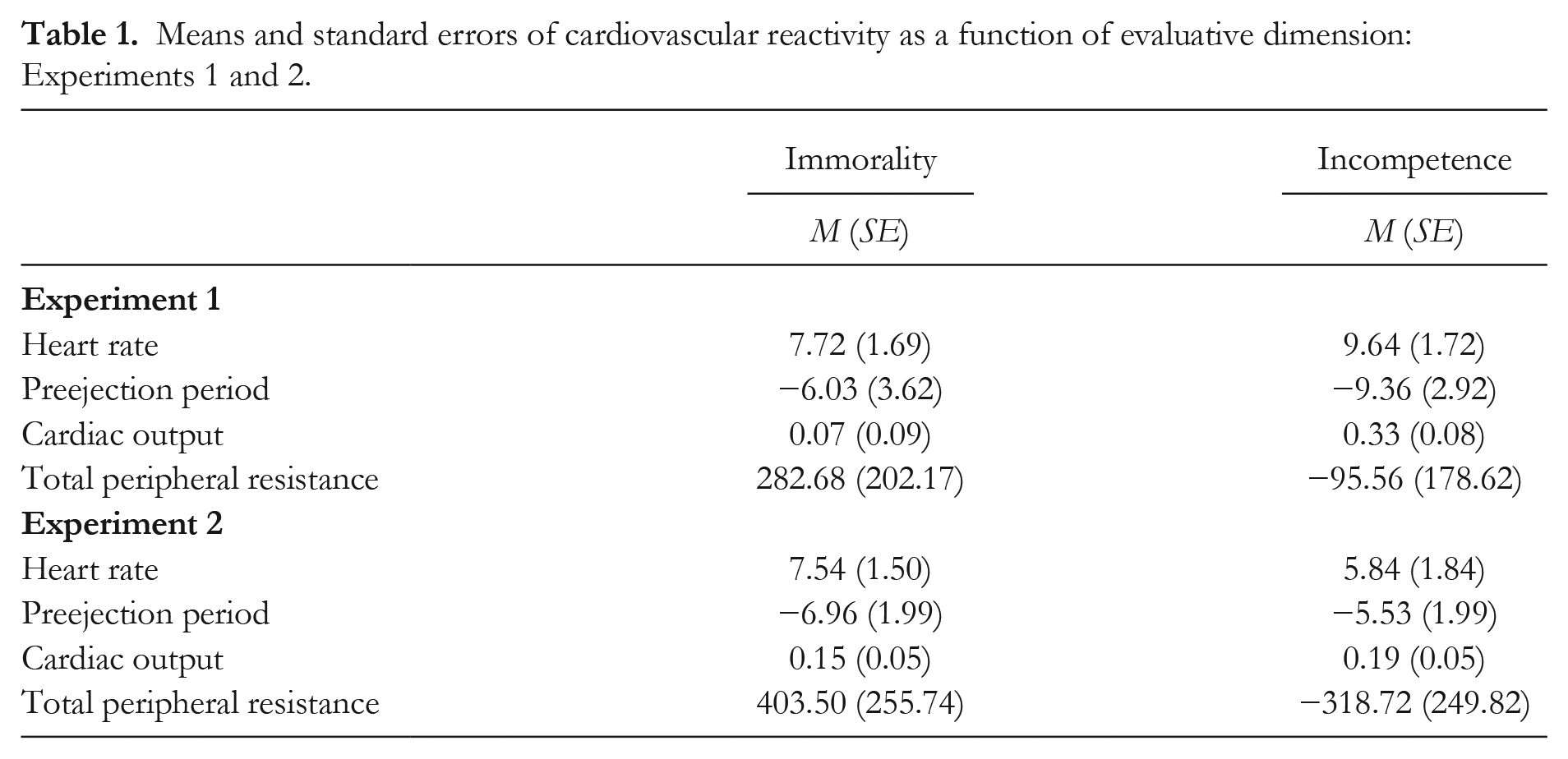
Following standard practice, we computed mean scores for HR, PEP, CO, and TPR for the last minute of the baseline and the first minute of the speech task. Across experiments, there were no significant baseline differences between the dimension conditions for HR (Fs < 0.77, ps > .38), PEP (Fs < 3.11, ps > .08), CO (Fs < 1.41, ps > .25), and TPR (Fs < 0.06, ps > .82). We then computed reactivity scores (Kamarck et al., 1992) by subtracting the baseline scores from the speech task scores (see Table 1). For each reactivity score, we transformed outliers (i.e., raw scores more than 3 SDs from the mean) to the most extreme score within 3 SDs above or below the mean. We then calculated combined threat–challenge indices (TCI) by calculating Z-scores of CO and TPR reactivity, then multiplying TPR by −1, and summing the result to the CO Z-score (Blascovich et al., 2004; Kassam et al., 2009; Seery et al., 2010). Higher scores on the resulting index—which maximizes the reliability of the cardiovascular measures (Seery et al., 2010)—indicate a greater challenge motivational state, whereas lower scores indicate a greater threat motivational state.
Means and standard errors of cardiovascular reactivity as a function of evaluative dimension: Experiments 1 and 2.
Task engagement
Overall, HR increased and PEP decreased significantly from zero (i.e., baseline) during the speeches in both conditions of Experiment 1 (ts > 3.48, ps < .001) and Experiment 2 (ts > 2.78, ps < .01), confirming sufficient overall task engagement and goal relevance. Importantly, there were no differences between conditions in HR and PEP reactivity (Fs < 1, ps > .44 for Experiment 1; Fs < 1, ps > .48 for Experiment 2).
Threat–challenge index
In order to increase statistical power, we pooled the data across both experiments. Subsequently, we estimated a mixed model with TCI as the dependent variable and dimension as the independent variable. We also allowed intercepts to vary across experiments (Experiment 1 and Experiment 2). As predicted, across both experiments, participants in the morality condition were more threatened (M = −0.42, SE = 0.27) than participants in the competence condition, who were relatively more challenged (M = 0.36, SE = 0.25), t(83) = 2.13, p = .036, 2 Cohen’s d = 0.46, 95% CI [0.03, 0.89] 3 (see Figure 1). The results did not vary as a function of experiment focusing either on the self or the ingroup. Thus, evaluating one’s own or an ingroup member’s behavior as immoral elicits threat rather than challenge in other group members.
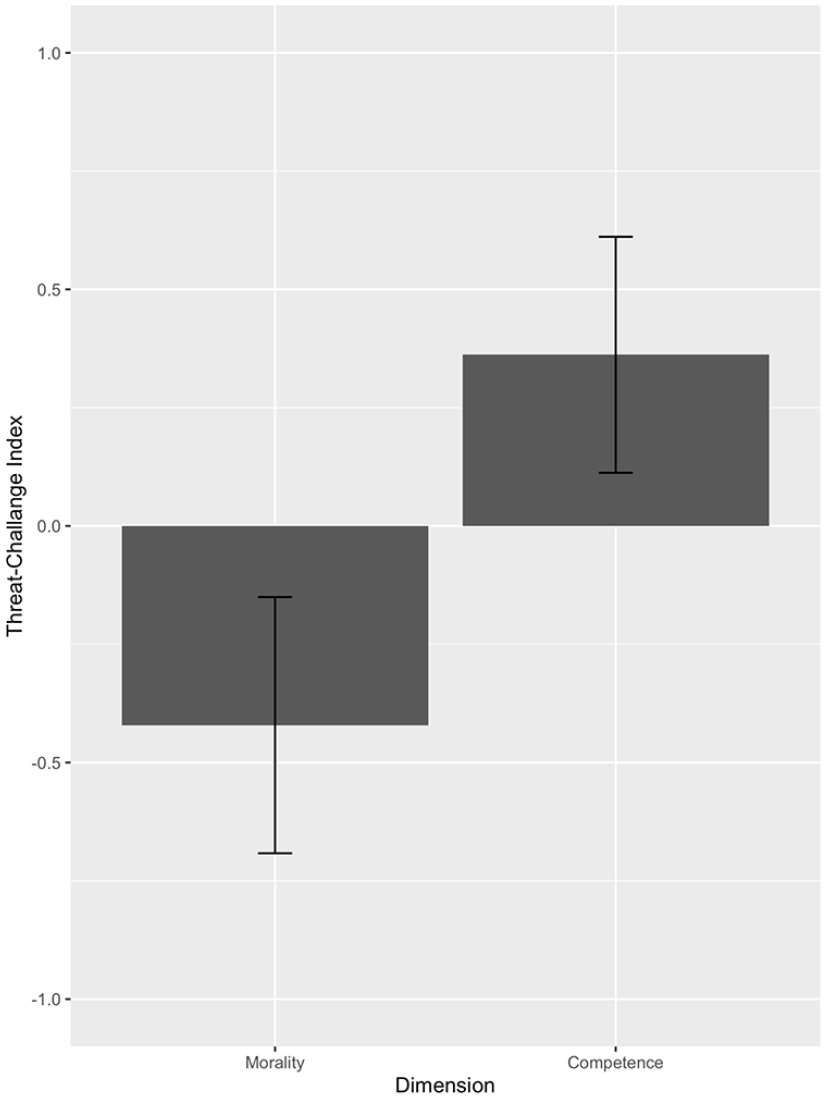
The pooled effect on threat–challenge index as a function of evaluative dimension of own/ingroup member’s prior behavior in a group context.
We also conducted separate analyses for each experiment. In Experiment 1, an independent samples t test indicated that participants in the morality condition (M = −0.56, SE = 0.38) were marginally more threatened than those in the competence condition (M = 0.35, SE = 0.38), t(41) = 1.72, p = .095, Cohen’s d = 0.52, 95% CI [0.09, 1.13]. We found the same pattern of results in Experiment 2; however, the effect of dimension did not reach significance, t(41) = 1.72, p = .209, Cohen’s d = 0.39, 95% CI [0.22, 0.99]; morality: M = −0.29, SE = 0.40; competence: M = 0.37, SE = 0.34 (see Figure 2a and 2b) .
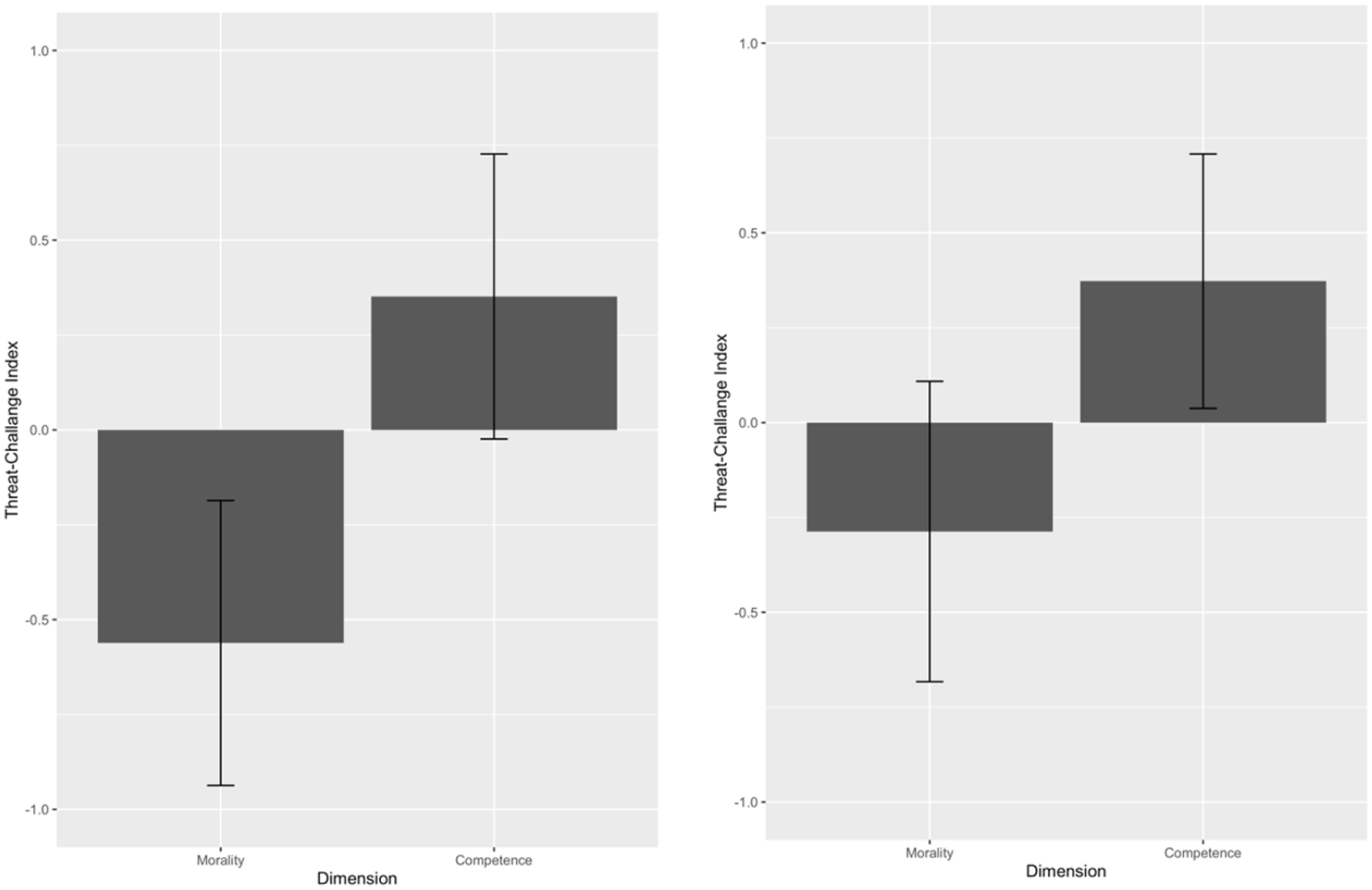
The threat–challenge index as a function of evaluative dimension of own prior behavior (Experiment 1, left figure) and ingroup member’s prior behavior (Experiment 2, right figure).
Self-reports
In Experiment 1, there were no differences between conditions in private collective self-esteem, F(1, 66) = 1.32, p = .25, while in Experiment 2, a marginally significant effect of dimension emerged, F(1, 41) = 3.59, p = .065, η2p = .08; participants in the morality condition reported slightly higher private collective self-esteem (M = 5.71, SD = 1.11) than participants in the competence condition (M = 5.04, SD = 1.20). Including collective self-esteem as a covariate in the analyses on the cardiovascular measures did not alter the effect of dimension on our dependent measures nor did it predict the dependent measures.
Regarding stability, as anticipated, participants in the morality condition of Experiment 1 were more inclined to think that their behavior would be perceived as stable by their fellow ingroup members (M = 4.68, SD = 1.09) than participants in the competence condition (M = 3.97, SD = 1.04), F(1, 66) = 7.66, p = .007, η2p = .10. Likewise, participants in the morality condition of Experiment 2 indicated that they perceived the behavior of Participant 4 to be somewhat more stable (M = 5.09, SD = 1.34) than participants in the competence condition did (M = 4.45, SD = 1.18), F(1, 41) = 3.07, p = .09, η2p = .07.
Finally, in Experiment 2, a repeated measures ANOVA with time of measurement (Time 1 and Time 2) as within-subject variable and dimension as between-subject variable on identification revealed a main effect of time of measurement: Group identification increased after the alleged group interaction (Time 1: M = 3.31, SD = 1.46; Time 2: M = 4.48, SD = 1.34), F(1, 41) = 22.03, p < .001, η2p = .35. The interaction between time of measurement and dimension was not significant, F(1, 41) = 1.60, p = .21, η2p = .04.
Discussion
In two experiments, we investigated how negative intragroup morality, versus competence, evaluations affect the motivational states of individual group members. In Experiment 1, we demonstrated that own prior behavior evaluated as immoral (as compared to incompetent) by others in a group context is perceived as more pervasive (i.e., stable) and induces a relative state of threat rather than challenge in a novel group context. We found similar effects for negative evaluations of another ingroup member’s behavior. In Experiment 2, another ingroup member’s behavior evaluated as immoral (vs. incompetent) elicited a relative threat rather than challenge response in novel group members.
These results extend prior work and are in line with a social identity perspective on morality that argues for a group-based analysis of how morality regulates social behavior (Ellemers & van den Bos, 2012). The current data support the notion that the relevance of moral judgments stems from their implications for group inclusion and acceptance (Leach et al., 2013; Van der Lee et al., 2018). Extending previous research that revealed the impact of moral versus competence ingroup norms, moral leadership, and ethical climates on behavioral choices (e.g., Ellemers et al., 2008; Giannella et al., 2022; Teresi et al., 2019), we assessed how moral judgments of individual behavior in an intragroup setting induce specific motivational states. The present results support the notion that morality is of particular importance to group members. That is, in Experiment 2, we demonstrated how someone’s prior behavior in relation to one’s social identity affects motivational states indicative of challenge and threat. Importantly, this was even the case when a moral transgression had occurred in the past and in a different group, while the current group was a rather trivial group (i.e., experimentally created; see also Bernstein et al., 2010). If the threat elicited by the mere presence of immoral ingroup members would impact on personal identity concerns, this should have decreased the willingness to identify with the group, as a way to dissociate the self from the immoral individual. However, group identification was retained and improved, even when the presence of an immoral ingroup member constituted a source of threat. Yet, it should be noted that in the current work we solely focused on an ingroup context. An interesting avenue for future research would be to make more direct comparisons between the current (ingroup) context and other social contexts (e.g., interpersonal, intergroup), where comparisons along morality and competence dimensions are also often made.
By examining the cardiovascular indices of motivational states, the current research also provides further insight into the psychophysiological processes elicited by moral judgments. Both studies showed that reminders of immorality (vs. incompetence) in a group context are threatening rather than challenging, indicating that morality judgments impede perceived coping abilities. This notion is further supported by our observation that group members perceive immoral behavior to be more pervasive than incompetent behavior. The more pervasive the focal behavior is perceived to be, the more effort is needed to change other people’s judgments, thereby hampering the ability to cope. This, in turn, has implications for the behavioral choices of group members and outcomes for the group. When group members experience threat rather than challenge, they become more rigid in their joint decision making (De Wit et al., 2012; Kassam et al., 2009), implying that they tend to hold on to their initial viewpoints rather than being open to change. Evaluations of immoral (vs. incompetent) behavior, which induce a state of threat rather than challenge, may consequently be less efficient in eliciting behavioral change, because threat tends to impede rather than foster attitudinal or behavioral adjustments. These findings corroborate and extend previous research illustrating the tendency for people to show defensive and self-justifying strategies in response to moral criticism that stand in the way of moral improvement and behavioral change (Ellemers & De Gilder, 2022; Rösler et al., 2021, 2023).
Considering the impact of morality on individuals’ self-image and motivation (e.g., Aquino & Reed, 2002; Ellemers et al., 2008), a plausible response to the immorality of an ingroup member would be to disengage from the group task and disidentify from the group, especially when group membership is relatively unimportant or trivial, which can be the case with experimental groups like those created in the current research. Our data rule out this alternative explanation, as identification even increased during the course of the experiment (see also Doosje et al., 1995), and private collective self-esteem was slightly raised in the morality condition. In addition, there were no differences between conditions in cardiovascular reactivity indicative of task engagement (increased HR, decreased PEP). Thus, participants remained attached to the group and engaged in the group task when morality was made salient, even when collaborating with an ingroup member who had previously displayed immoral behavior in a different group context elicited threat rather than challenge. This speaks to the diagnosticity of negative comments about one’s morality (e.g., Pagliaro et al., 2016) and implies that the impact of moral disapproval on group members’ motivational states crosses group boundaries: It spills over to other, novel groups in which the members did not directly suffer from the consequences of the moral transgression, and who might have different behavioral norms than those who deemed the behavior immoral in the previous group context.
A limitation of these studies might be that the novel groups in which we assessed group members’ motivational states were experimentally created in the lab and were not the same as the groups who voiced their moral disapproval in the first place. This may, however, at the same time, reflect the pervasiveness of moral criticism: Even in minimal groups—without clear norms—indicators of immorality elicit inefficient and counterproductive responses. Future research may extend these findings by assessing the impact of moral disapproval in ongoing and more essentialist groups (see e.g., Bernstein et al., 2010). In particular, future research may investigate how moral disapproval might spill over to groups with clear behavioral norms and regulations. This may shed more light on the motivational implications (e.g., disengagement after repeated or very strong threats; see also Hase et al., 2020) of voicing moral disapproval within and across group boundaries.
Group members critically evaluate the behavior of their fellow ingroup members in an attempt to elicit desirable behaviors that reaffirm the positive social identity (e.g., Levine & Moreland, 1994). From the perspective of the group, it might intuitively seem most effective to negatively evaluate their group members’ behavior in terms of morality rather than competence in order to foster behavioral change. Considering the importance of morality for the individual’s (e.g., Aquino & Reed, 2002) and group members’ motivation to adhere to moral (vs. competence) norms (Ellemers et al., 2008), this seems highly plausible. Yet, as we have argued and shown in the current research, communicating moral disapproval of the behavior of individual group members might actually be a counterefficient strategy to achieve behavioral change (see also Ellemers & De Gilder, 2022). Indeed, negative evaluations of group members’ behavior in terms of morality (vs. competence) elicit a motivational state of threat rather than challenge. Moral disapproval, thus, does not provide an easy tool for a group to shape the behavior of its members. When the aim is to motivate group members towards behavioral change, using moral disapproval might backfire and actually be counterproductive.
Footnotes
Acknowledgements
We thank Frank de Wit for his technical advice and support, and Jonne Tillema, Laura de Reus, and Alma Vermeulen for their assistance with data collection.
Funding
The author(s) received no financial support for the research, authorship, and/or publication of this article.
