



Abstract
Minority students’ belongingness on campus has become an emergent topic in psychological research. Past research has particularly focused on belonging uncertainty as a potential explanation for impaired belongingness in minority students. While this represents an important perspective, we argue that students of certain minority groups may also be more likely to be confronted with actual ostracism experiences on campus. Using structural equation modelling, we investigated associations between minority status, ostracism, and belongingness in an aggregated sample derived from two longitudinal survey studies (N = 973 students) with two time points (beginning of the first and of the second semester) at a German university. We show that student characteristics that are likely more visible (migration background with family ties to the Middle East, Africa, Southeast Asia, or Latin America) are linked to impaired belongingness both directly as well as indirectly through experiences of ostracism. In contrast, student characteristics that are less visible (such as parental education level) are directly associated with impaired belongingness but not with experiences of ostracism. Furthermore, we found that a migration background from the aforementioned regions indirectly predicted students’ well-being, dropout intentions, and actual dropout via the experience of ostracism and subsequent impaired belongingness. For parental education level, we only found indirect effects on students’ well-being via impaired belongingness. Our findings suggest that in addition to the existing focus on belonging uncertainty, there is a need to focus psychological research and educational practice on ostracism experiences that ethnic minority students face at university.
Keywords
Over the last century, educational initiatives and policy changes around the world have reshaped the global higher education sector. While universities had been exclusive institutions for the educational elite for a long time, an era of educational expansionism has reduced formal barriers to enrollment, which made higher education institutions more accessible to historically marginalized groups of student aspirants (Altbach et al., 2009; Trow, 2007). As a result, the diversity of the student population has grown worldwide (Gale & Parker, 2014; D. G. Smith, 2020). However, an increase in diversity does not automatically translate into a college culture of appreciation of students with a diverse background. Students that deviate from elitist groups often struggle in their transition to university, which has been shaped by norms and rules that are unfamiliar to them. Consequently, first-generation students (Stephens et al., 2015) and students from racial minorities (Walton & Cohen, 2011) often report impaired feelings of belongingness at university. This experience has been attributed to belonging uncertainty—that is, a state of uncertainty about one’s fit in academia (Walton & Cohen, 2007), which fuels personal misconceptions and enhanced sensitivity to personal misfit. Such an explanation of the phenomenon largely situates the source of the problem within the individual that experiences impaired belongingness, rather than in actual social rejection occurrences on campus. Here, we argue that taking such a viewpoint comes with the danger of neglecting the perspective of minority students as invalid and shifting blame for actual ostracism to its victims. We aim to show that not all ostracism experiences of minority students can be attributed to belonging uncertainty, and that groups that feel targeted by ostracism are at particular risk of dropping out of higher education.
Minority Status and Belonging Uncertainty
Research on belonging uncertainty is built on the assumption of a general need to belong, defined as a desire to feel accepted and valued by other individuals that is strongly tied to self-esteem, motivation, and well-being (Baumeister & Leary, 1995; Gailliot & Baumeister, 2007). In the higher education context, experiences of belongingness emerge when students form strong bonds with their academic peers (Maunder, 2018) and feel accepted by their academic institution (Ribera et al., 2017). Belongingness becomes particularly relevant during the transition to university, when freshmen students explore whether they fit into the social habitat provided by academia (Holmegaard et al., 2014; Meehan & Howells, 2019; Pym et al., 2011). Given that freshmen students cannot draw from personal experiences in the new setting, they have to infer their personal fit to academia based on culturally shaped conceptions and prototypes of successful students and academics (Janke et al., 2017).
Such conceptions and prototypes, however, pose a problem for minority students, who are generally well aware of (historic) disparities in their field of studies, like misrepresentation of their race or ethnicity (Grossman & Porche 2014; Howard, 2003; Stewart, 2008) or the mismatch between their habitus or family values and campus culture (Phillips et al., 2016; Stephens et al., 2012, 2015). This knowledge can raise doubts about one’s ability to fit into the social environment in academia, an experience that has been termed belonging uncertainty (Walton & Cohen, 2007). Researchers have argued that the mere experience of belonging uncertainty can fuel self-fulfilling prophecies, as minority students become more sensitive to subtle or ambiguous social cues that could be interpreted as indications of social rejection or misfit (enhanced rejection sensitivity sensu Downey & Feldman, 1996). This may subsequently promote social withdrawal, which can result in further rejection experiences (Walton & Cohen, 2011).
The hypothesis that belonging uncertainty can evoke rejection sensitivity has prompted a rich development of various interventions aiming to change the mindset of minority students (Walton & Cohen, 2011; Walton & Wilson, 2018). A strong focus on such interventions might imply that problems with experienced rejection on campus lie within the individual rather than within the institution. It carries the belief that minority students’ perception is somehow flawed, and that their impaired belongingness may not be the result of actual rejection but rather of anticipated rejection experiences, which were either not intended as such or even never happened at all. While subjective experiences are important, we believe that this perspective may not reflect the entire truth, and that particularly students from minorities endure both belonging uncertainty and actual ostracism on campus.
Only in Their Head?: How Migration Background Can Be Linked to Ostracism
Ostracism describes the painful experience of being rejected and ignored by others (Williams, 2009). Members of racial minorities might be particularly at risk of becoming targets of ostracism. This can be due to xenophobia and negative stereotypes, or due to barriers to interactions bound to language or culture (Carter-Sowell et al., 2021). Racism may bolster the attitude that ostracism of ethnically divergent persons is justified, as individuals feel threatened by them and do not believe that they fit into a group. However, (perceived) interaction barriers may even prompt individuals who generally do not embrace racist attitudes to exclude others. This can be the case if individuals feel that it would be too demanding to include a person in a group, for instance, because they feel they are less likely to comply with group norms or contribute to the success of the group (Rudert, Hales, & Büttner, 2021; Rudert, Keller, et al., 2020). Those perceived barriers to communication/cooperation can motivate majority group students to exclude peers who visibly differ from them, even if they think that diversity is desirable on a general level (see also Jaffé et al., 2019). This strongly reflects the principle of homophily, which is that similarity often breeds connection, and that homogenous grouping is more likely to occur than heterogenous grouping (McPherson et al., 2001).
Given that many university teachers as well as students openly express liberal attitudes and discourage xenophobia and racism, it can easily seem as if the climate at university must be inclusive and that institutional racism is not an issue (Wong et al., 2021). In consequence, this would mean that minority students would be to blame if they experienced belonging uncertainty and ostracism (see also Tate & Page, 2018; Zamudio & Rios, 2006). If minority students do report ostracism experiences, instructors may assume problems on an individual level that are either due to the individual’s behavior or—particularly in unclear, ambiguous cases—merely due to their perceptions rather than to institutional racism (see especially Bonam et al., 2019). If instructors are aware of research on belonging uncertainty (e.g., through media exposure), they might be prone to attribute ambiguous feelings of ostracism to the target of social exclusion. Consequently, instructors might aim to convince students that the awkward feelings of not belonging will go away if they think more positively and act more confidently (see Ikizer & Blanton, 2016). However, in cases in which there are actual factors contributing to ostracism experiences of minority students, this attenuation process is unlikely to happen (e.g., Güzel & Şahin, 2018). Thus, minority students may start to attribute their ostracism experiences internally, to feel that it is their fault that they are ostracized, and eventually to suffer the harsh consequences that ostracism poses on well-being and mental health.
Damage Done: Consequences of Ostracism and Belonging Uncertainty
Ostracism can severely impact well-being as it causes immediate experiences of existential threat (Williams, 2007, 2009) and directly threatens feelings of belongingness (Williams & Nida, 2011). This immediate response is so strong that it even occurs if one is ostracized by despised groups (Gonsalkorale & Williams, 2007) or by a computer program (Zadro et al., 2004). The temporal need-threat model of ostracism further postulates that this immediate threat to belongingness will have further consequences for well-being over time (Williams, 2009) and can foster social withdrawal (Ren et al., 2016). If ostracism continues for a long time, ostracized individuals may experience resignation, alienation, and helplessness (Riva et al., 2017), and be more prone to developing psychological illnesses such as depression (Rudert, Janke, & Greifeneder, 2021).
The potential consequences of ostracism strongly mirror consequences that have been attributed to belonging uncertainty. More specifically, belonging uncertainty contributes to the development of personal insecurities (Walton & Cohen, 2007) and impaired well-being (Suhlmann et al., 2018). Ultimately, belonging uncertainty also manifests in social withdrawal, going so far that it is directly associated with intentions to leave a certain environment. In the university context, this means that belonging uncertainty may facilitate intentions to drop out of higher education altogether (Höhne & Zander, 2019). Given the importance of dropout intentions as facilitators of the decision process (Bäulke et al., 2021), it stands to reason that belonging uncertainty may facilitate actual dropout.
The strong similarity in long-term consequences of ostracism experiences and those of belonging uncertainty is not surprising, because feelings of impaired belongingness are an immediate response to ostracism (Williams, 2009). Consequently, it may be particularly challenging to disentangle the impact of actual exclusion from the impact of belonging uncertainty for students that suffer ostracism. However, if experiences of ostracism were a core symptom of belonging uncertainty (because of increased rejection sensitivity), this would also mean that all students who suffer belonging uncertainty should report increased ostracism. For that matter, looking at different minority groups that are equally affected by belonging uncertainty, but not by ostracism, may help in shedding new light on the two pathways to impaired belongingness (belonging uncertainty and ostracism).
We particularly think that the visibility of minority status should impact whether students will be affected by ostracism on campus. For instance, a migration background can often be easily detected through personal characteristics (i.e., religious clothing, skin color) and thus may foster ostracism by students from the majority group. In contrast, students’ parental educational background is less visible. Students without family ties to academia (i.e., first-generation students) often experience a mismatch between their own upbringing and college culture, eventually leading to personal insecurities about academic fit, and belonging uncertainty (Phillips et al., 2016; Stephens et al., 2012). Given that parental educational status is difficult to detect by others, it is also unlikely to determine whether social interactions comes to pass. In other words, we assume that students’ parental educational background will not be associated with actual ostracism experiences. Similarly, we argue that migration background that is difficult to detect (e.g., because the migrant parents and consequently their children are phenotypically similar to the majority ethnicity of their host country) will less likely lead to ostracism than a highly visible migration background.
In sum, we argue that feelings of impaired belongingness are not simply caused by belonging uncertainty (which students from stigmatized racial minorities as well as students with low parental education may experience), but are also driven by actual ostracism incidents, which students from minorities with a more visible migration background experience to a stronger degree than students of majority ethnicities. Consequently, we expect both parental educational status and parental migration experiences to be directly linked to belongingness (effect of belonging uncertainty). However, we also expect that the link between parental migration experiences and impaired belongingness should be at least partly mediated by experienced ostracism for students whose parents migrated from regions in which the majority of the population differs visibly from that of the host country (effect of actual ostracism). We do not expect such a mediation for parental educational status (or a less visible migration background).
An American Problem?: Generalizability of Psychological Costs of Minority Status
While empirical research on minority students’ ostracism experiences is scarce, there is a plethora of studies on the impact of minority status on belongingness that have focused on U.S. American (higher) education institutions. Here, researchers have repeatedly shown impaired belongingness in Hispanic students (e.g., Dueñas & Gloria, 2017; O’Brien et al., 2020; Strayhorn, 2008), Native American students (e.g., J. L. Smith et al., 2014; Tachine et al., 2017), and Black students (e.g., Mallett et al., 2011; Rainey et al., 2018; Walton & Cohen, 2007, 2011). Overall, the dominance of research from the United States might make it seem as if belonging uncertainty, and by extension ostracism, of ethnic and racial minority students could be an U.S. American problem. However, as globalization has led to an increase in migration worldwide, there is also a higher number of students with migration backgrounds enrolling in higher education institutions around the world (Guruz, 2011).
For instance, migration has become a salient and widely debated topic in Western European countries (Helbling, 2014). The topic was strongly discussed in recent years after a new wave of immigration from economically less developed regions in Africa and Asia affected Europe (Dennison & Geddes, 2019; Grande et al., 2019). Public debates on immigration have fueled anti-immigration sentiments that can foster stereotyping and discrimination (Appel et al., 2015; Schmuck et al., 2017) as well as ostracism on a societal level (Krzyżanowski & Wodak, 2017; Rudert, Janke, & Greifeneder, 2017). In higher education, students with a migration background (i.e., whose parents migrated) may be at an even higher risk of suffering from ostracism than racial minority students in the United States, because they are strongly fragmented in different regions of origin. Additionally, majority group students could justify ostracism with impaired feasibility of cooperation due to anticipated differences in culture or language (Jaffé et al., 2019).
Within Western Europe, Germany is a particularly interesting country, as it has (a) substantial migration rates (Bertoli et al., 2016) and (b) experienced strongly populistic and racially charged debates on migration during a recent wave of immigration of refugees (Vollmer & Karakayali, 2018). Interestingly, pioneer research in the German higher education system has shown that interventions meant to target belonging uncertainty cause an immediate short-term boost in belongingness in students with a migration background (Marksteiner et al., 2019). This boost, however, petered out over time, with students with a migration background eventually reverting to lower levels of belongingness. In contrast, majority group students showed lasting positive intervention effects. These findings support the notion that belonging uncertainty may not be sufficient to explain impaired belongingness in students with a migration background. Here, we build on this research and further explore how ostracism experiences are linked to students’ migration background in the context of the German higher education system.
Research Questions
In the present contribution, we focus on the impact of two variables that should predict feelings of belongingness during the transition phase to university: As a first predictor, we investigated students’ migration background. We differentiate students according to regions of origin of their parents to make inferences about the “visibility” of the migration status (as our data set did not include information on actual ethnicity or race). We expected a negative association between students’ migration background and belongingness for students with parents from regions that (a) have been heavily stereotyped in the public debate such as the Middle East and Africa (Froehlich et al., 2022; Vollmer & Karakayali, 2018) and/or are (b) linked to visible marks of a migration background, such as Southeast Asia. We further expected this association to be at least partly mediated via a positive association of a respective migration background with ostracism. As a second predictor, we focus on students’ parental education level. Particularly, we assumed a direct positive association between having a continuing-generation status (at least one parent attained an academic degree) and belongingness at university. We did not expect associations between parental education level and ostracism.
We also assumed that students’ belongingness during the first semester should be positively linked to later well-being (Suhlmann et al., 2018), and negatively to later drop-out intentions (Höhne & Zander, 2019) as well as the actual likelihood of dropout, reflecting ultimate social withdrawal from higher education. Finally, a “visible” migration background should be indirectly linked to these outcome variables through experiences of ostracism and impaired belongingness, while parental education level should be indirectly linked to these outcome variables through impaired belongingness alone. The theoretical model that guided our investigations is depicted in Figure 1.
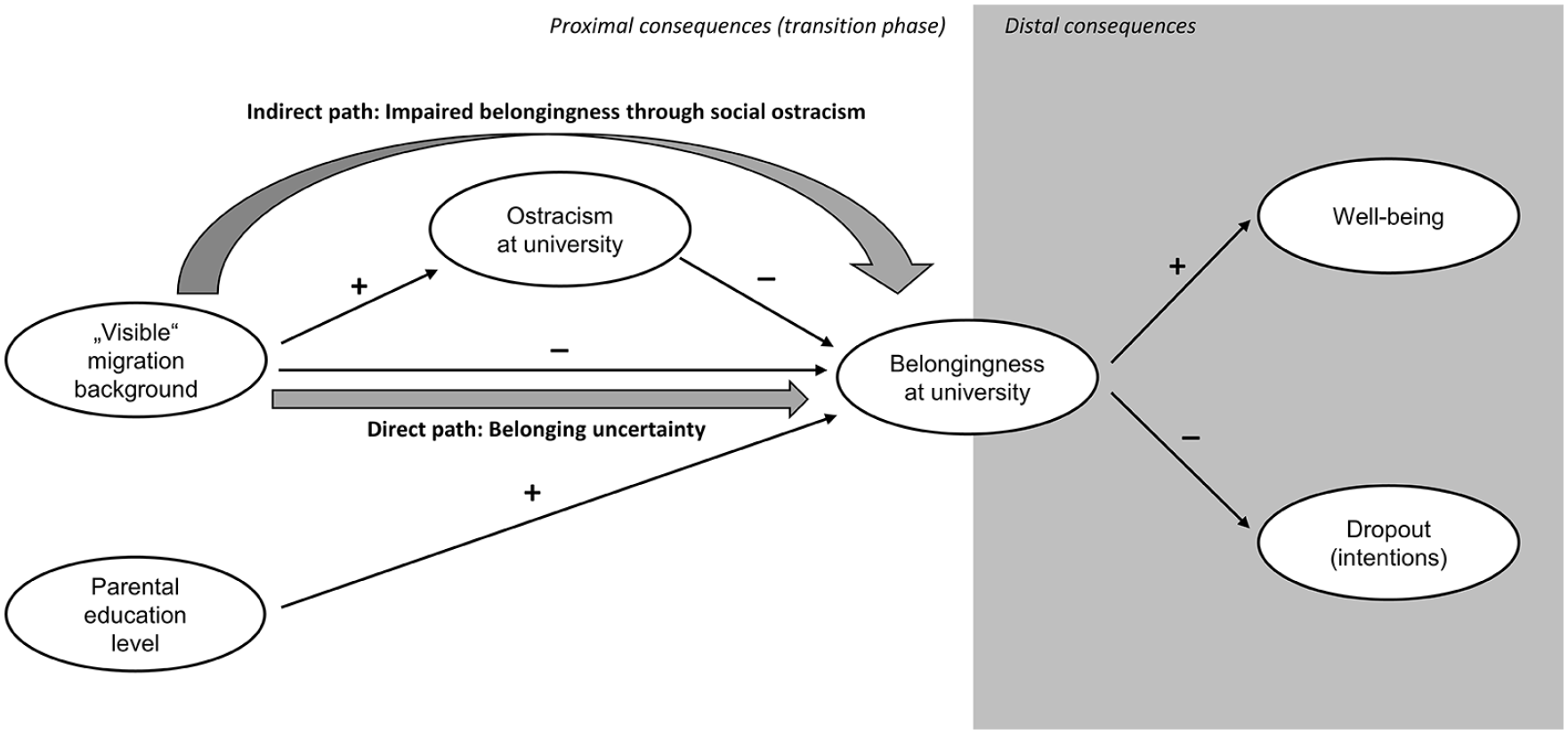
Theoretical model of the impact of students’ family background on belongingness, well-being, and dropout.
Method
We investigated our research questions using data from two longitudinal survey studies that had originally been conducted in consecutive student cohorts (class of 2018 and class of 2019) at a mid-sized German university. The original purpose of these studies was to validate new measurements for students’ motivation for enrollment and their interest–major fit (Janke et al., 2021). Conventional sensitivity analyses showed that analyzing effects in the subsample of 2018 with median group sizes of n = 16 (see Table 1) would have merely made it possible to detect medium to large group differences (d = 0.63) with sufficient power of 1 – β = .80. For the class of 2019, it would have been possible to detect medium effect sizes (median group size of n = 24; d = 0.52). Thus, we decided to aggregate both samples into one data set to increase the group sizes for different regions of parental origin (median group size of n = 24), which allowed us to detect small to medium effect sizes (d = 0.41) with sufficient power. Both original survey studies were characterized by a similar research design, consisting of two measurement points. The first measurement (T1) took place during the transition phase to university (about 1 month after the start of the first semester), whereas the second measurement (T2) took place at the start of the following semester.
Descriptives for the two cohorts from which the data were drawn.
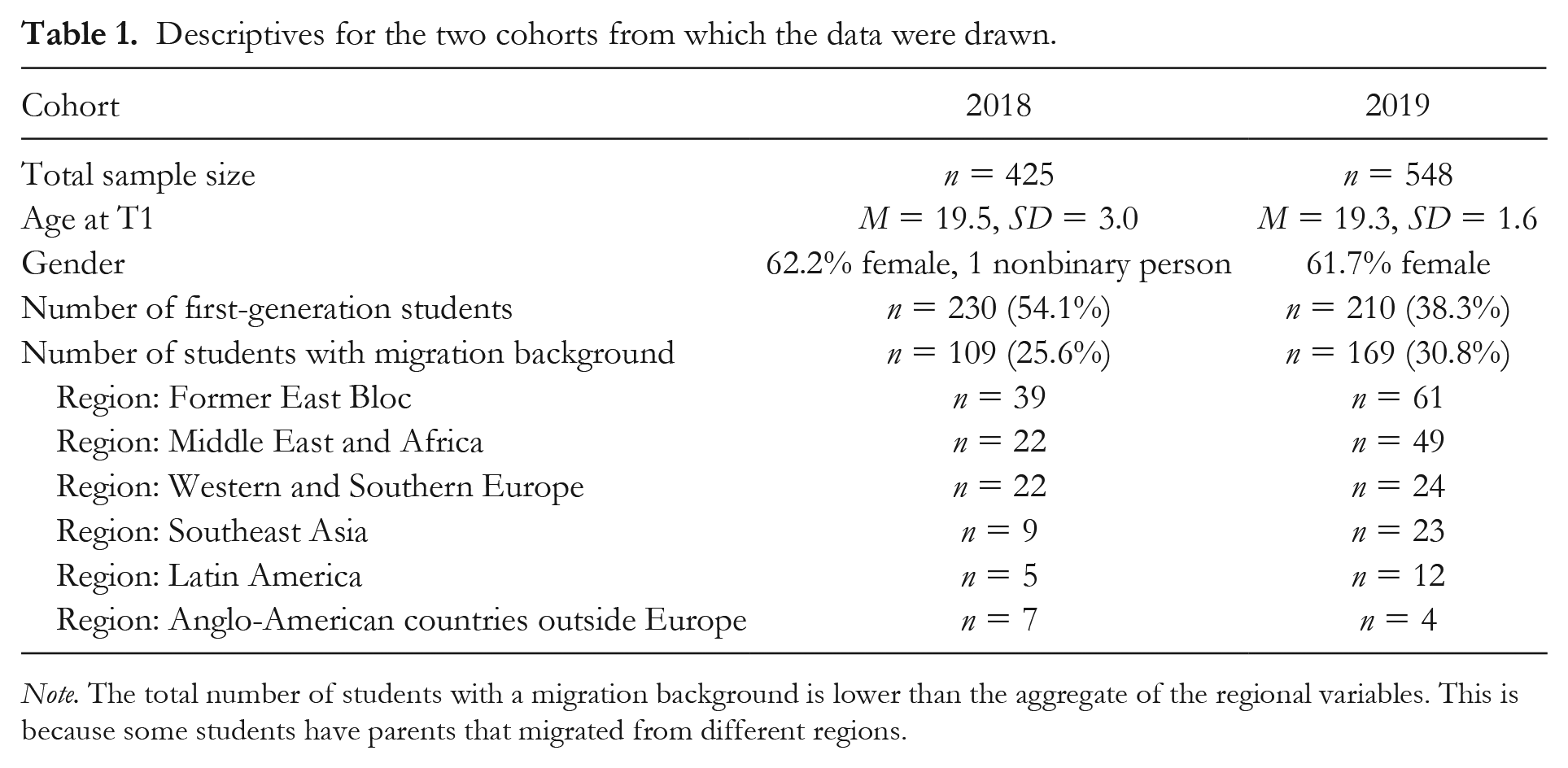
Note. The total number of students with a migration background is lower than the aggregate of the regional variables. This is because some students have parents that migrated from different regions.
Sample
We excluded students from data analysis that had previously been enrolled either in another study program at the same university or at another university (15.32% of the original sample) to ensure that students could not draw from prior experiences in higher education institutions when reflecting about their belongingness. Overall, our final sample consisted of 973 students (61.9% female; Mage = 19.40 years, SD = 2.31 years; see Table 1 for further information on the two subsamples). The participating students were enrolled in 20 different study programs within the fields of business administration, education, economics, humanities, information technology, and social sciences.
As participation in the survey study was voluntary, the data sets are characterized by a high attrition rate, with only 53.1% of the original sample participating at the second measurement point (nT2 = 456 students). Attrition analyses showed small systematic effects with Hotelling’s T = 0.14, F(2, 970) = 6.75, p = .001, η² = .01, reflecting that students who dropped out of the sample were more likely to report ostracism, F(1, 973) = 12.28, p < .001, η² = .01, and impaired belongingness at T1, F(1, 973) = 10.35, p = .001, η² = .01, compared to those who did not drop out of the sample. We also found that students who dropped out of the sample were less likely to be continuing-generation students, χ2(1) = 4.88, p = .027. We did not observe any further attrition effects for students’ migration background (smallest p = .132).
Measures
We measured social background, ostracism experiences, and feelings of belongingness at T1. In both cohorts, we also assessed students’ well-being at T2. In the class of 2019, we additionally measured dropout intentions at T2 and obtained information about dropout incidences for the participating students directly from student services (for all students who had participated at T1 and given their consent). 1 The Institutional Review Board (IRB) of the university of Mannheim approved the study design (EK Mannheim 17/2019).
Parental education level
We asked all participating students about the educational background of both their parents and aggregated the information in one dummy variable: Students with at least one parent with academic degree were coded as continuing-generation students (52.2% of the sample), whereas students with no parent with academic degree were classified as first-generation students (45.6% of the sample; 2.6% missing data).
Migration background
Participating students indicated the country in which their parents were born. In our sample, about 69.7% of the students had no migration background, whereas 11.3% reported having one parent who had migrated to Germany, and 17.3% reported that both parents had migrated to Germany (missing data for 1.7%). The countries of origin of the parents varied greatly. The most common countries were Turkey (at least one parent for 16.1% of all students with a migration background), Poland (at least one parent for 9.6% of all students with a migration background), and Russia (at least one parent for 8.6% of all students with a migration background). For further analyses, we used regional dummy variables to code the migration background of the students. As regions of origin, we differentiated between former Eastern Bloc countries (n = 100 students), the Middle East (including Turkey) and Africa 2 (n = 71 students), Western and Southern Europe (n = 46 students), Southeast Asia including China (n = 32 students), Latin America (n = 17 students), and Anglo-American countries outside Europe (n = 11 students). Figure 2 depicts the countries included in the respective dummies.
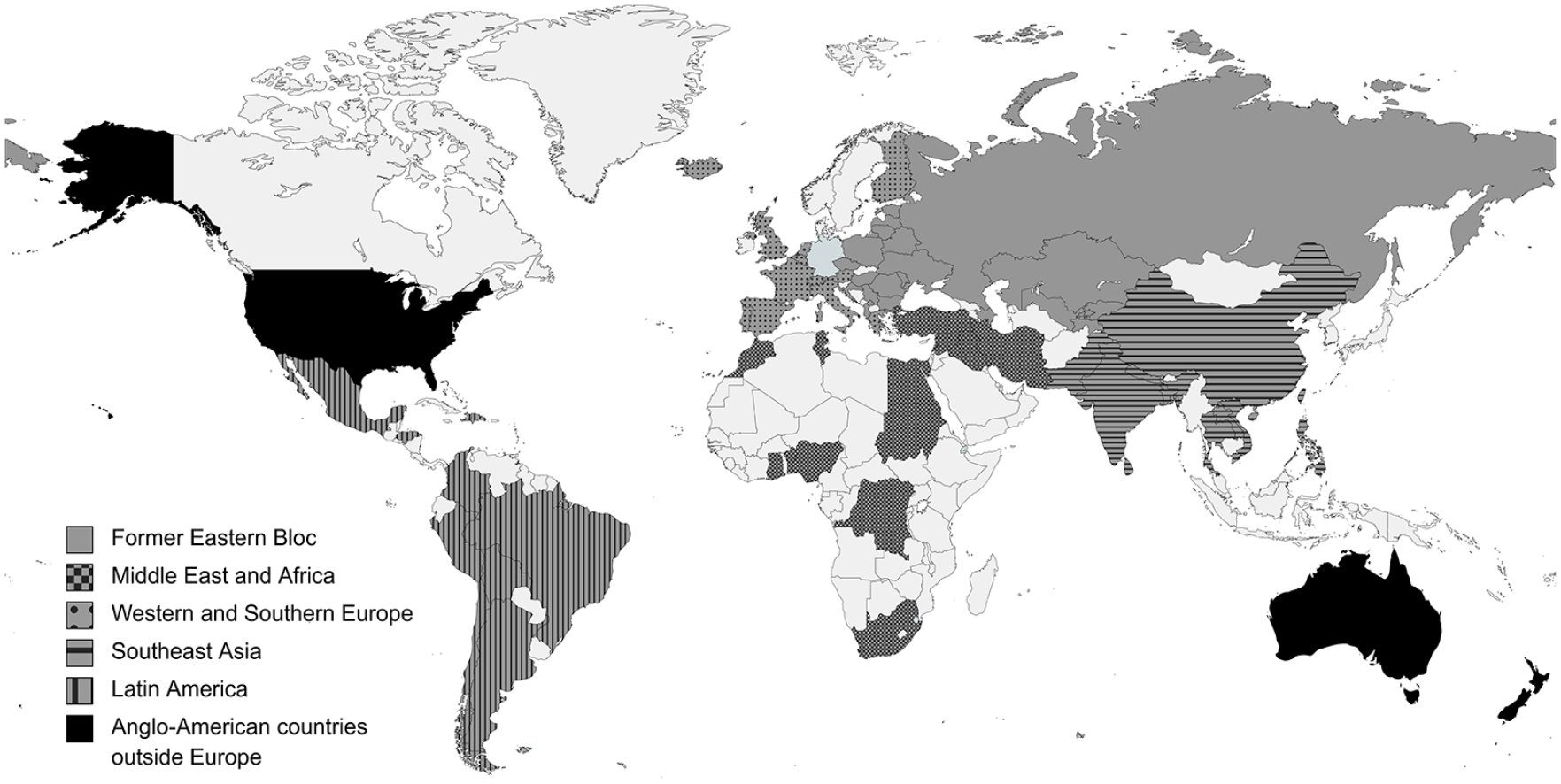
Illustration of the countries represented by the respective regional dummies.
Ostracism
We used the Ostracism Short Scale (OSS), a validated self-report measure for large-scale survey studies (Rudert, Janke, & Greifeneder, 2020; Rudert, Keller, et al., 2020) to measure the experience of being ostracized at university. The scale consists of four items, which we slightly adapted to the university context (e.g., “At university, others ignore me”). The scale showed a good internal consistency (α = .83). We used a 7-point Likert scale to assess the magnitude of the experience (1 = I do not agree at all, 7 = I very much agree).
Belongingness at university
Both data sets included six items measuring belongingness at university that had mostly been adopted from the German version of the School Belonging Scale used in the Program for International Student Assessment (see Marksteiner et al., 2019). We excluded two items from data analysis that directly referred to interactions or experiences with other students (“I am quick in finding friends at university” and “Other students seem to like me”) rather than subjective feelings of belongingness to the respective institution. The final item selection included one positively framed item (“I feel I belong at university”) and three items that more strongly reflected belonging uncertainty (“I feel like an outsider at university,” “I feel estranged and misplaced at university,” “I feel lonely at university”), which showed a high internal consistency (α = .85). All items were assessed with the same 7-point Likert scale as ostracism.
Well-being at university
We assessed students’ well-being at university with a validated German self-report scale (Fragebogen zur Studienzufriedenheit; Westermann et al., 1996). This questionnaire operationalizes three facets of student well-being with three subscales that each consist of three items: Satisfaction with the study content (e.g., “Overall, I’m satisfied with my current studies”; α = .82), frustration about study conditions (e.g., “I wish the study conditions at my university would be better”; α = .81), and experienced strain at university (e.g., “I often feel tired and tense because of my studies”; α = .78). The items for these three aspects of students’ well-being at university were measured with a Likert scale (1 = total disagreement, 7 = total agreement).
Dropout intentions
To assess the intention to drop out of university, we used a German scale that originally consisted of several subscales measuring different stages of the decision to drop out (Bäulke et al., 2021). The data set for the class of 2019 contained items assessing the first stage (first experiences of misfit; e.g., “At the moment, it occurs to me that studying does not suit me well”; α = .86) of this decision process as well as the last stage (final decision; e.g., “I have decided to quit my studies completely”; α = .80). Both scales consisted of three items, which were answered on a 7-point Likert scale (1 = disagree completely, 7 = agree completely).
Actual dropout
We derived the actual dropout/persistence as information about status of enrollment for the class of 2019 directly from the university services. The data were matched with the questionnaire data. We operationalized dropout as leaving a study program without finishing it—regardless of the reason behind this event (changing major, changing university, dropping out due to failing assessements, etc.). Note that the German higher education system typically lacks an orientation or introductory phase in which students can freely explore different majors. In contrast, students typically choose a major before entering university and are generally expected to finish this major. Given the lack of permeability between study programs, dropout is often related to substantial opportunity costs for the individual and considered a public cost for society, which is why it is generally considered as an event that is meant to be averted (Heublein, 2014). In total, 26 of the participating students in our sample had dropped out of their study program between T1 and T2 (5.0% of the sample derived from the class of 2019).
Analyses
We tested our hypotheses using latent structural equation modeling to reduce the impact of measurement error on the results. We used two separate latent structural equation models to test intermediate and indirect effects of parental education level and students’ migration background. In our first latent structural equation model (SEM 1), we investigated all variables that had been assessed in both student cohorts (i.e., family background, ostracism, belongingness, and well-being). Psychometric scales were measured as latent constructs using single items as indicator variables. For belongingness, we used the positively worded item as indicator variable so that positive values of the latent construct indicate higher belongingness. Family background variables (continuing-generation status, migration background by region) were included in the model as dummy variables. Note that in addition to the conceptual model depicted in Figure 1, the structural model also contained a direct path from parental education level to ostracism, to investigate whether any meaningful unexpected associations emerged in our data. Moreover, we controlled for cohort membership in the model to avoid misinterpretations of potential cohort effects. 3 We investigated both the direct effect of family background variables on belongingness and ostracism as well as indirect effects on well-being mediated by belongingness and ostracism.
In a second latent structural equation model (SEM 2), we investigated associations of family background with dropout intentions and actual dropout (not modeled as a latent construct as we only had one indicator variable; occurrence of dropout: yes/no). The latter variables were only assessed within the class of 2019, which is why these analyses were characterized by a reduced sample and, consequently, reduced power. Note that this limits our ability to detect effects particularly for regions of origin that were represented by small sample sizes. Associations between dropout and dropout intentions (experience of misfit, final decision) were not specified because we only had data on dropout intentions from one person who had in fact dropped out (in this case, between T2 and the retrieval of the data on dropout).
All analyses were carried out with Mplus Version 8.6 (Muthén & Muthén, 1998–2017). We used the weighted least squares means and variance adjusted estimator (WLSMV) with bootstrapping (10,000 bootstraps) to estimate model parameters and indirect effects. The WLSMV estimator is robust both to the inclusion of dichotomous model variables (indicators for the family background variables) as well as the use of nonnormal distributed variables. Furthermore, we used type = complex to account for Level 2 variance bound to the study programs in which the students were enrolled. Missing data were handled using pairwise deletion, which is the standard procedure for the WLSMV estimator. 4
As Mplus does not provide fit indices for models that combine the type = complex procedure and bootstrapping, we used a base model without bootstrapping to infer the model fit. The fit of the computed models was evaluated through a combination of fit (CFI, TLI) and misfit indices (SRMR, RMSEA). Our interpretation of these indices relies on established rules of thumb for cut-off values (Schermelleh-Engel et al., 2003). We distinguished between an acceptable model fit (CFI ⩾ .95, TLI ⩾ 0.95, RMSEA ⩽ .08, SRMR ⩽ .10) and a good model fit (CFI ⩾ .97, TLI ⩾ 0.97, RMSEA ⩽ .05, SRMR ⩽ .05). Our complete analysis scripts, comprehensive descriptions of item wording, outputs, and the relevant data for this contribution are provided at the Open Science Framework (OSF; https://osf.io/zmunf/).
Results
Zero-order correlations based on manifest sum scores and descriptive values for the different scales are depicted in Table 2. A first look at those zero-order correlations shows some initial trends. First, as expected, ostracism and belongingness at university were strongly related (r = −.69, p < .001). Second, both ostracism and belongingness at university at T1 were meaningfully linked to measures of well-being and dropout (intentions) reported at T2. Third, dropout intentions were rather low within our sample (M < 2.00 for both scales).
Descriptive statistics and zero-order correlations.
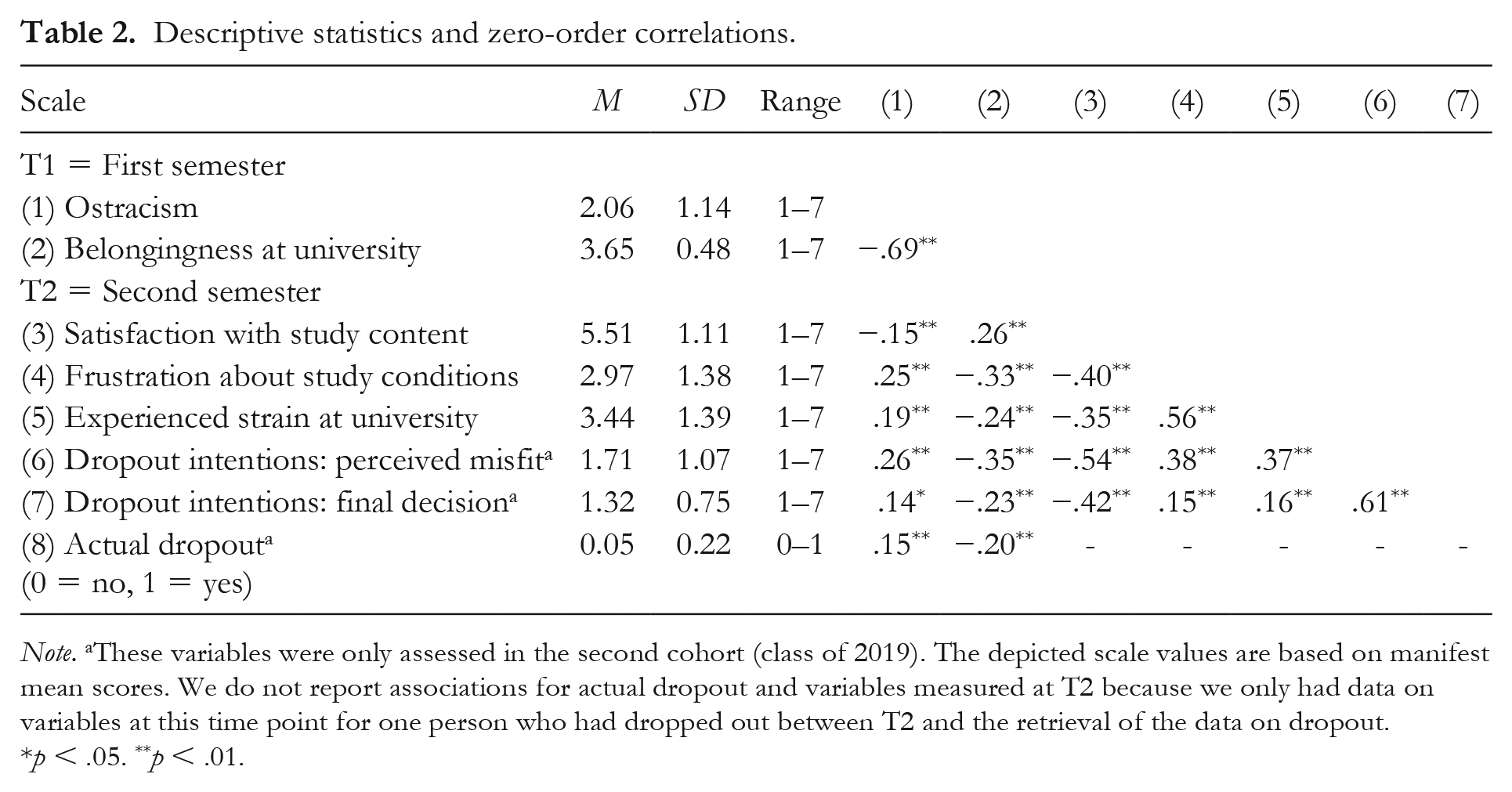
Note. aThese variables were only assessed in the second cohort (class of 2019). The depicted scale values are based on manifest mean scores. We do not report associations for actual dropout and variables measured at T2 because we only had data on variables at this time point for one person who had dropped out between T2 and the retrieval of the data on dropout.
p < .05. **p < .01.
SEM 1: Family Background, Ostracism, Belongingness, and Well-Being
The structural equation model that we applied to model associations between family background, ostracism, belongingness, and students’ well-being fitted the data well, χ2(250) = 348.96, p < .001, CFI = .98, TLI = 0.98, RMSEA = .02, SRMR = .08. The path structure is depicted in Figure 3. Looking at the direct paths, we observed that experienced ostracism was negatively predictive of belongingness at university. Belongingness at university, in turn, positively predicted all three measures of well-being at university.
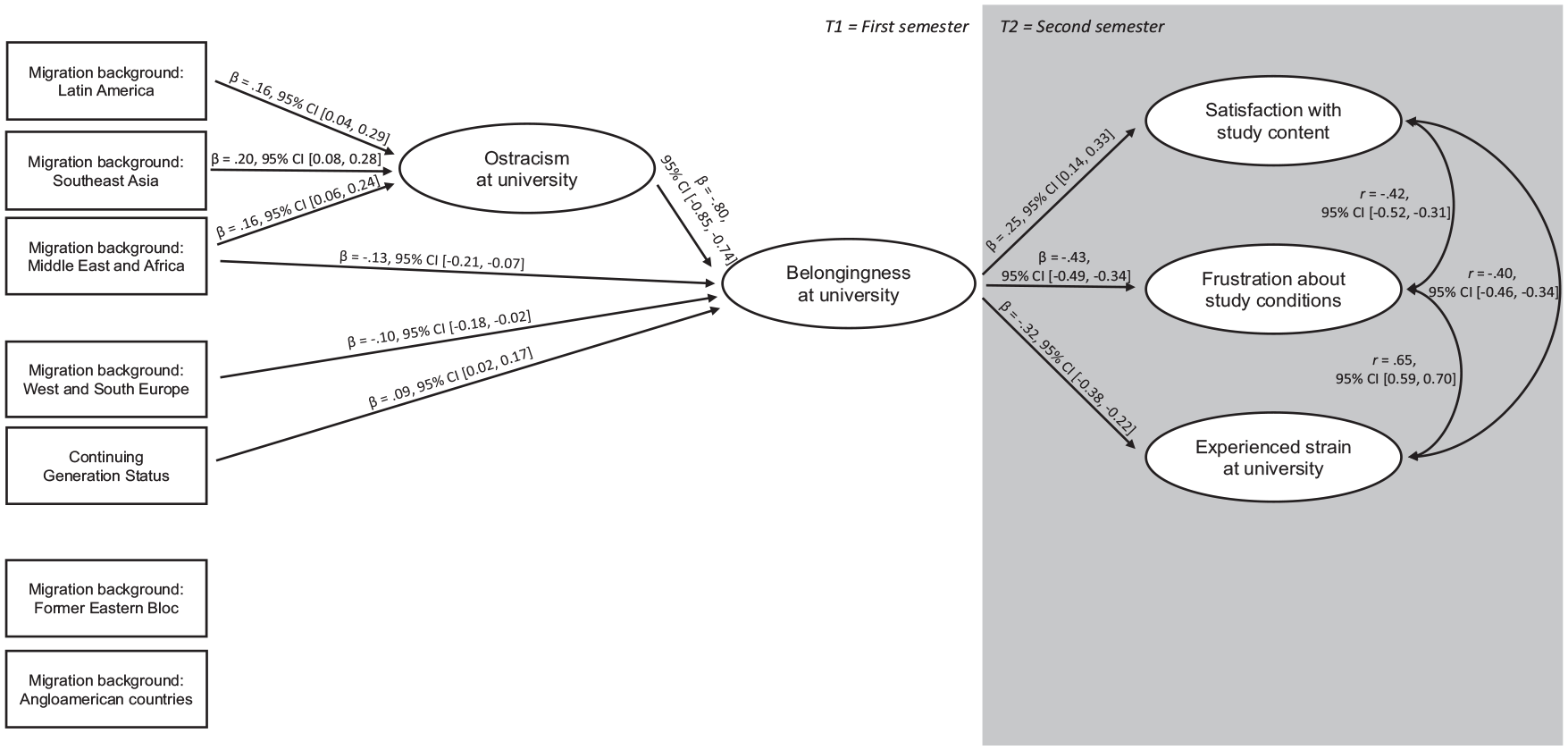
Structural equation model reflecting associations with well-being.
For students’ migration background, we found that regions of parental origin were differentially linked to ostracism and belongingness. In line with our hypotheses, we found elevated rates of ostracism experiences in students with parents who migrated from regions that are supposedly linked to visible markers of a migration background (Middle East and Africa, Southeast Asia, Latin America). This was not the case for students whose parents migrated from regions that were not strongly linked to such visible markers. Particularly, the largest regional migration background group from the former Eastern Bloc did not show any signs of elevated ostracism experiences (β = .02, 95% CI [−0.06, 0.14]). Furthermore, students whose parents migrated from the Middle East and Africa also reported an impaired sense of belongingness at university. Interestingly, this was also true for students with a migration background bound to Western and Southern Europe. Further investigations show indirect effects of a migration background on belongingness via experienced ostracism for students whose parents migrated from Latin America, Southeast Asia as well as the Middle East and Africa (see Table 3). We also found evidence for two pathways that linked a migration background to students’ later well-being at university: The first pathway reflects a mediation via belongingness at university and could be shown for students whose parents migrated from Western and Southern Europe as well as the Middle East and Africa. The second pathway reflects a doubly mediated path from a migration background through ostracism and then via belongingness at university. This path was present for students whose parents migrated from Latin America, Southeast Asia as well as the Middle East and Africa.
Indirect effects of family background on criteria derived from Model 1.
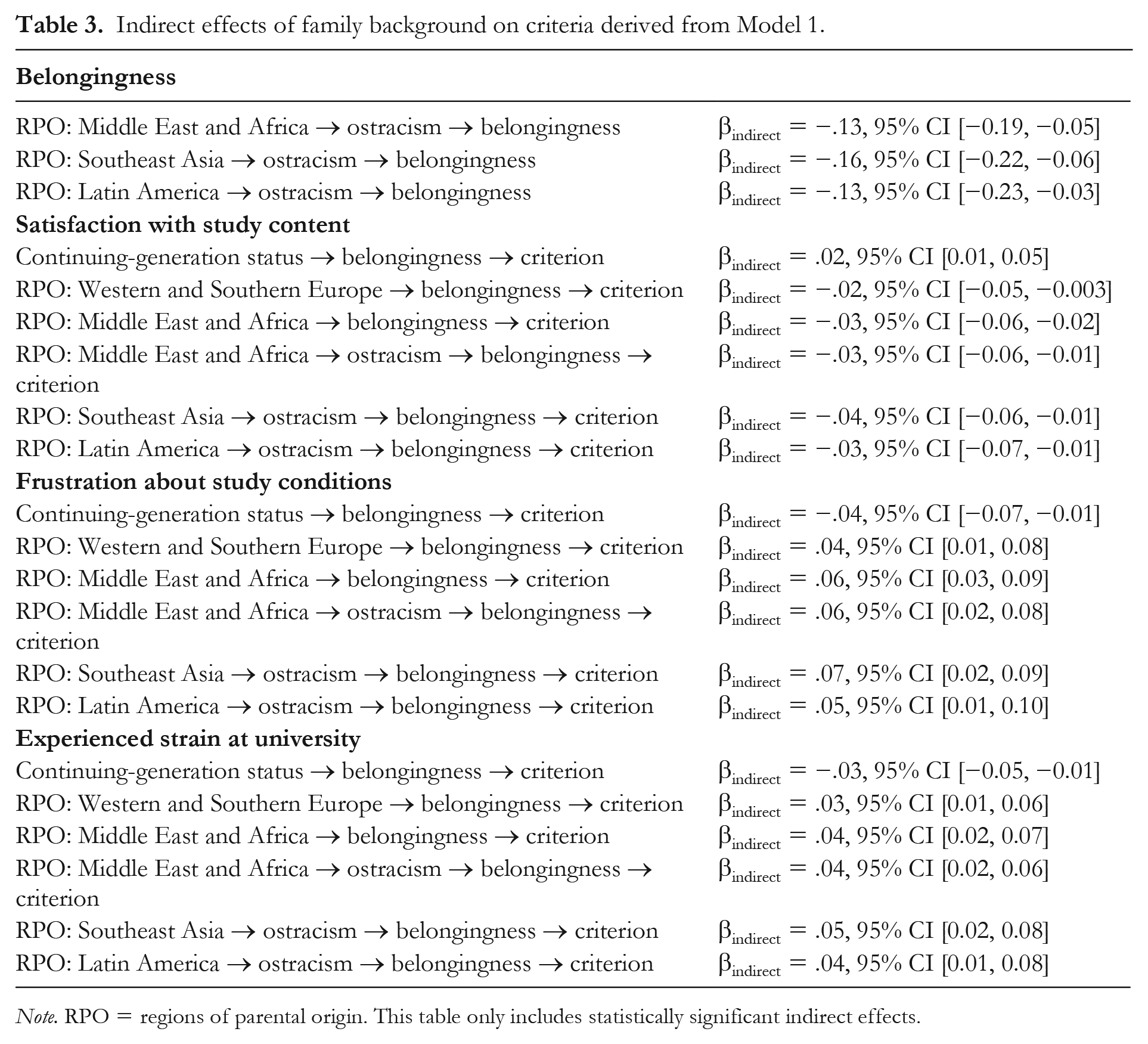
Note. RPO = regions of parental origin. This table only includes statistically significant indirect effects.
As for parental education level, we found a direct positive link of continuing-generation status to sense of belongingness, but no significant association with experienced ostracism (β = −.02, 95% CI [−0.08, 0.04]). Parental education level was, consequently, only associated with later well-being at university through belongingness but not via ostracism (absence of a doubly mediated path).
SEM 2: Family Background, Ostracism, Belongingness, and Dropout (Intentions)
The second structural equation model on family background, ostracism, belongingness, dropout intentions as well as actual dropout that was conducted in the reduced sample of the class of 2019 also reached a generally good model fit, χ2(177) = 195.58, p = .161, CFI = .99, TLI = 0.99, RMSEA = .01, SRMR = .09. In accordance with our hypotheses, belongingness at university during the first semester predicted both later dropout intentions and actual dropout (see Figure 4).
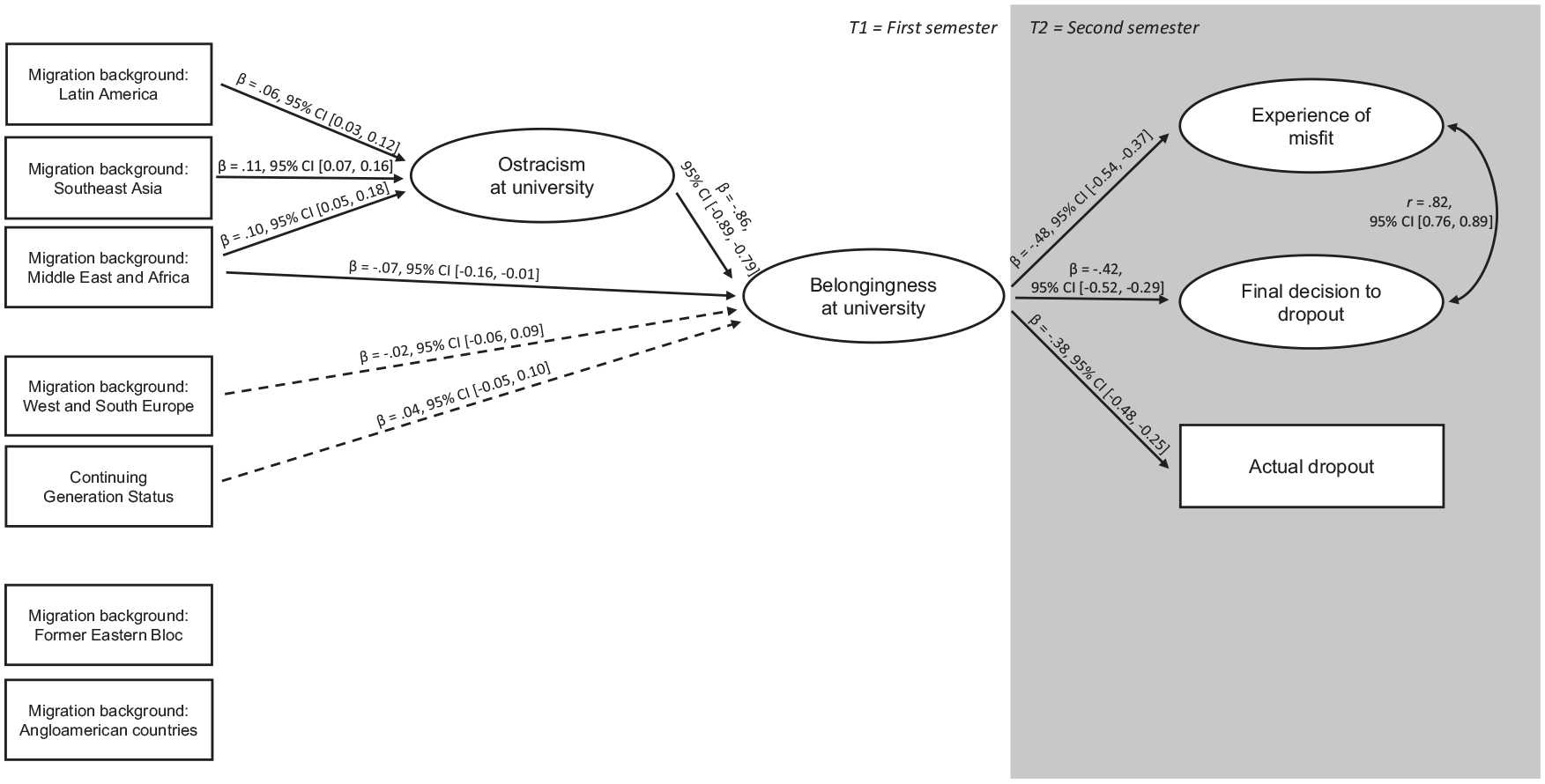
Structural equation model reflecting associations with dropout (intentions).
While the remaining path structure was generally robust and similar to that observed in the full sample, some direct associations did not reach statistical significance in the reduced sample: Particularly, this was true for the direct positive association between continuing-generation status and belongingness, and the association between a migration background from Western and Southern Europe and belongingness. Nevertheless, we still observed the indirect effects of a migration background tied to regions of Latin America, Southeast Asia as well as the Middle East and Africa both on dropout intentions and actual dropout. These associations were doubly mediated through ostracism and belongingness. Moreover, we once again observed simple mediation effects via impaired belongingness on dropout intentions and actual dropout for students whose parents migrated from the Middle East and Africa (see Table 4).
Indirect effects of family background on criteria derived from Model 2.
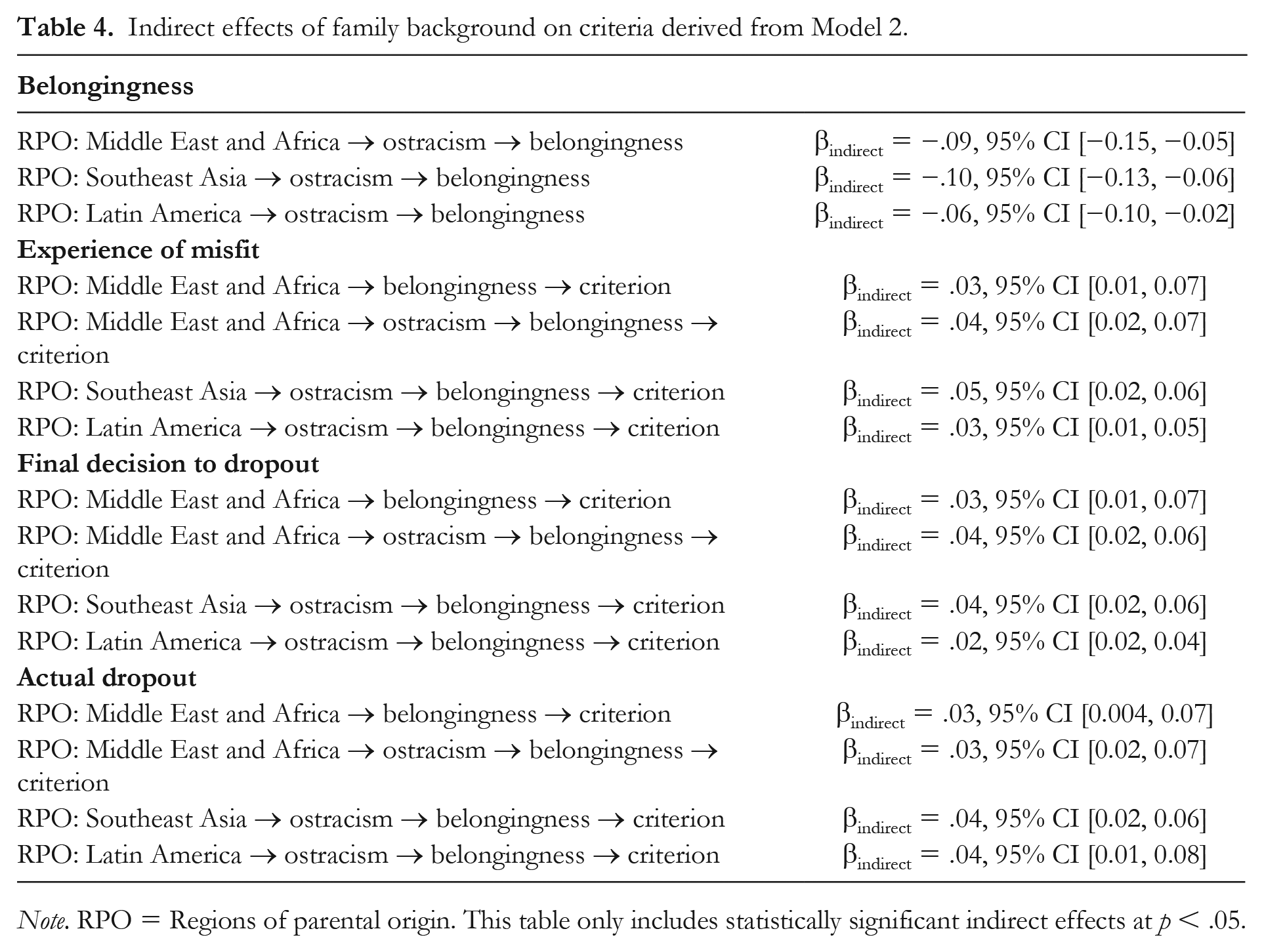
Note. RPO = Regions of parental origin. This table only includes statistically significant indirect effects at p < .05.
Discussion
In the present study, we aimed to provide new insights into whether and how students’ family background is related to feelings of belongingness at university, well-being, and students’ likelihood to drop out of their study programs. We found that more visible migration backgrounds (indicated by region of parental origin) were linked with elevated rates of ostracism experiences compared to less visible migration backgrounds. Particularly, family ties to the Middle East and Africa—a region that has both recently (Vollmer & Karakayali, 2018) and historically (Froehlich et al., 2022) been subject to strong negative sentiments within the general German population—showed both a direct association with impaired belongingness as well as an indirect effect via perceived ostracism. In contrast, we did not find associations with ostracism for students whose migration background is likely less visible, such as for students whose parents migrated from the former Eastern Bloc. Migration from the latter region often encapsuled ethnic Germans that lived in the perimeters of formerly communist countries such as the Soviet Union and that are difficult to differentiate from other German students (Kaucher et al., 2017). With this being said, we also observed associations between invisible personal characteristics such as parental education level with impaired belongingness. However, these associations were in fact not mediated via ostracism, suggesting that different pathways can lead to impaired belongingness in minority students. Regardless of whether impaired belongingness was a result of experienced ostracism or not, we found that experiencing such a negative state during the transition phase to university was a risk factor for the further trajectory of well-being and persistence at university. Weaker feelings of belongingness predicted lower satisfaction with the study content, more frustration with study conditions, more experienced strain, higher dropout intentions, and a higher likelihood to dropout of university. Our findings underline that especially minority students from marginalized communities (here, with a migration background tied to the Middle East and Africa) are at risk of experiencing such a negative trajectory.
Theoretical Implications
First and foremost, our findings indicate that (visible) dissimilarity to the majority group is associated with the likelihood of experiencing ostracism. Particularly, students with a migration background from Southeast Asia, Africa, the Middle East, or Latin America reported elevated rates of ostracism, while students from other minorities did not. Students from the described regions are most likely to differ visibly from the ethnic majority of German students. Especially the comparison between the two largest migration groups (Eastern Bloc vs. Middle East and Africa) indicates that whether we found those maladaptive associations of a migration background with ostracism depended on similarity with the majority ethnicity in Germany rather than on group size (and thus statistical power). This does not mean that students who cannot easily be detected as members of minorities do not doubt their belongingness. In fact, we found patterns of impaired belongingness for first-generation students as well as for students with family ties to other Western and Southern European countries. However, these students reported to doubt their belongingness in absence of any indication of elevated rates of reported ostracism experiences. In other words, doubting one’s place in academia can be the result of two distinct mechanisms (occurrence of “true” belonging uncertainty or actual ostracism).
Our results also suggest that these two mechanisms are not mutually exclusive, as family ties to the Middle East and Africa were both directly and indirectly linked to impaired belongingness. The observation that students belonging to this minority suffer from impaired belongingness on top of experiencing ostracism is well in line with findings showing their proneness to effects of identity threat (Froehlich et al., 2022).
The observed differential pathways to belongingness further demonstrated that it is important to investigate associations of different student characteristics in the same context. If student characteristics are analyzed in isolation, it becomes difficult to differentiate general phenomena (i.e., links between minority background and belonging uncertainty) from phenomena that are specific to a certain characteristic (i.e., family ties to a certain region are linked to experienced ostracism).
Taken together, our findings underline the notion that impaired belongingness and ostracism are often strongly intertwined but should be regarded as distinct phenomena. Researchers sometimes perceive ostracism as an aspect of impaired belongingness due to a strong association between the constructs that likely reflects the strong negative effect of ostracism on feelings of belongingness (Williams, 2009). However, using measures of ostracism to measure belongingness makes it difficult to disentangle effects of either variable. Some instruments, in fact, already include measures of ostracism or rejection as aspects of belongingness (e.g., Arslan & Duru, 2017; Malone et al., 2012), which blurs the line between causes of a psychological state and the state itself.
Notably, our research was conducted within a Western European country (Germany). In the past, the problematic implications of cultural and racial discrimination have been mostly discussed in the context of the U.S. American education system (Baker et al., 2018; Harper et al., 2009), which has led to ongoing discussions about campus culture (e.g., Dowd & Bensimon, 2015), psychological interventions (e.g., Walton & Cohen, 2011; Walton & Wilson, 2018), and systematic bias in instructors (e.g., Jacoby-Senghor et al., 2016). Empirical data on these debates are also often derived from the U.S. American cultural context and focus on U.S. American minorities (e.g., Black people, Hispanics). This discourse about racism in the United States has further been reflected in internationally viewed TV shows (e.g., Dear White People, Lovecraft Country; see Bavaro, 2018; Beck, 2020) and cinema blockbusters (e.g., We, Get Out; see Landsberg, 2018), which might enforce the simplistic view that struggles of minority students with campus culture are an U.S. American problem.
Studies like the present contribution challenge this perception by indicating that a migration background can evoke similar patterns of belonging uncertainty and ostracism in societies around the world. Given that our research was conducted in Germany, it provides important insights for Western European societies, which often face heated debates on immigration (Appel et al., 2015; Schmuck et al., 2017). While these debates tend to be driven by the perspective of majority group members on immigrants, we hope to provide additional insights from the point of view of the target group on the important issue of social exclusion in higher education systems.
Practical Implications
The notion that an impaired sense of belongingness of students with a migration background may be rooted in real ostracism experiences could also explain why prior studies (also conducted in German universities) have shown rebound effects for interventions aiming to reduce belonging uncertainty in students with a migration background (Marksteiner et al., 2019). This taps well into recent reflections that psychological interventions will only cultivate positive effects if they are planted in a fertile environment (Walton & Yeager, 2020). Interventions targeting misconceptions such as belonging uncertainty may be particularly helpful for first-generation students or students with a nonvisible migration background. In contrast, such interventions could backfire for students who are perceived as different, for instance, due to different skin color or indicators of a different culture (e.g., headscarves in Western European countries). While participating in interventions targeting belonging uncertainty might provide a short-term uplift for those students at first, they might also be quickly confronted with the harsh reality of ostracism experiences on campus. Critically, if students are previously informed that belonging uncertainty will normally fade away over time (a typical component of interventions targeting belonging uncertainty; Walton & Cohen, 2011), they could further internalize their experiences of exclusion. This experience of social misfit could eventually evoke and foster negative academic self-concepts and doubts about one’s capabilities to persist in academia.
Importantly, ostracism of minority students, and particularly of students with a migrant background, might not be the result of ill intent. Similarity breeds liking (Hampton et al., 2019) and, according to the principle of homophily, also connection (McPherson et al., 2001), which means that students prefer to engage with fellow students who are similar to them regarding their personal characteristics. Even though students may not aim to hurt others by actively excluding them, their preferences in choosing learning and working group members may lead them to unintentionally ignore and ostracize minority students. Research has shown that such exclusionary behavior is even shown by individuals who value diversity and embrace liberal and antiracist values (Jaffé et al., 2019). Additionally, research has demonstrated that ostracism experiences may be painful regardless of the underlying motivations: Particularly, attributing ostracism to nonpermeable group memberships such as race or ethnicity impedes recovery from ostracism episodes (Goodwin et al., 2010). However, unclear and ambiguous ostracism experiences during which individuals are not acknowledged at all can also be detrimental, and sometimes even worse than openly hostile rejection (Rudert, Hales, et al., 2017).
Taken together, this could mean that it is not sufficient to design interventions targeting the mindset of potential victims of social exclusion, but rather that it is important to find new ways to make majority students reflect on their social behavior and shape learning environments in ways that encourage students to form more diverse groups. On the institutional level, administrators may want to reconsider policies centering on color blindness that obfuscate the impact of diversity within learning environments at universities (Warikoo & De Novais, 2015). Contemporary research has suggested that a campus climate that directly addresses the need for inclusion and acknowledges culture as a resource can foster immigrant students’ belongingness at university and, as an indirect consequence, their life satisfaction (Schachner et al., 2019). A shift towards a positive diversity climate on campus may provide a deeper understanding of minority needs in majority group students and may help students with a migration background to voice their unique experiences without being devalued as individuals suffering from misconceptions.
On the individual level, university instructors could assist the development of inclusive heterogenous groups by randomly assigning students to work in groups in their courses (either for singular course sessions or the whole semester). As instructors may suffer under the same biases as their students, it may also be worthwhile to provide further sensitivity training at university. If instructors become more capable of detecting the signs of social exclusion in and outside of their course, they may also become more likely to help struggling disadvantaged students.
Limitations and Future Research
Overall, the observed associations between students’ background characteristics and their belongingness as well as experienced ostracism were rather small. One explanation for the small effect sizes could be that we had to rely on simplistic measures to operationalize educational background and immigration background, as the original data sets did not include more complex measures. In the same vein, our region coding is a mere proxy for the actual race or ethnicity of the students. While students whose parents migrated from Southeast Asia likely differ visibly from the ethnic majority in Germany, it also remains possible and plausible that this is not the case if the underlying migration background does not tie the students to ethnic groups native to the region (e.g., parents being descendants of people that originally migrated from Europe to Asia). As our data set did not include actual information on the self-ascribed race of the students, the observed associations are merely a first estimation of the actual effects of visible markers of an immigration background.
It should be noted that our data do not allow differentiation between objective exclusion experiences and the subjective interpretation of ambiguous behavior as exclusionary acts. Thus, we cannot rule out that ethnic minority students are merely more sensitive to (ambiguous) rejection experiences. We can also not disentangle whether effects of visible personal characteristics are due to these characteristics being more salient for others or due to these characteristics being chronically salient for oneself. Nevertheless, we think that there is good reason to assume that reported ostracism reflects real exclusionary behavior by majority group students, as previous research has shown that students are indeed less keen to interact with others that they perceive to be different from them (Jaffé et al., 2019). Future research into the sources of ostracism at university can help to further complement our findings. Our data are merely suitable to address perceptions of the targets of ostracism but not actual intent or the perspectives of sources of ostracism. It would be particularly interesting to further investigate under which conditions visible and invisible membership to minority groups motivates social exclusion. Respective findings could inform the development of effective interventions that target the sources of ostracism instead of the targets.
Further supplementing this research with observations of instructors and institutional data on reported ostracism incidents could also be of strong value. However, such data can be strongly biased due to observer bias and institutional racism. This is not only because it requires for institutions to be sensitive to exclusion but also because it requires targets of ostracism to report ostracism incidents. Even for drastic exclusionary acts fueled by racism, targets of ostracism may still fear to report the incident as such behavior may lead to further backlash and make it more difficult to connect with other peers. In sum, even though anonymous surveys are biased by the subjective perspective of the target, this sort of data at least enables targets to share their side of the story with no fear of repercussions and is thus best suited to detect ostracism experiences.
Finally, we observed small attrition effects for experienced ostracism as well as impaired belongingness, meaning that ostracized students were less likely to participate in the studies at the second time point. This selective dropout limits potential associations with outcome variables measured at the second time point. As a result, the calculated indirect effects may underestimate the importance of ostracism and belongingness as predictors of students’ well-being and persistence. Overall, our research should be interpreted in a greater framework of studies on the experiences of minority students in higher education. We are certain that this research framework strongly benefits from additional (replication) studies outside of the U.S. American educational system.
Conclusion
Our research shows that minority status is linked to impaired belongingness during the transition phase to university and indicates that, depending on the minority group, different processes may underlie this association. Particularly, the association between experienced ostracism and a possibly visible migration background (e.g., migration background tied to the Middle East and Africa, Southeast Asia, Latin America) is concerning. Taken together with emerging evidence for rebound effects of mindset interventions for students with a migration background, we would argue that higher education institutions should be cautious when discussing measures to combat belonging uncertainty on campus. Taking the stance that the victims of social exclusion must modify their mindset could inflict further harm. In contrast, it could be worthwhile to discuss and develop measures that make majority group students reflect upon their own exclusionary behavior and institutional racism in seemingly inclusive learning environments.
Footnotes
Acknowledgements
We thank Caroline Tremble for her valuable services in language editing.
Funding
The author(s) disclosed receipt of the following financial support for the research, authorship, and/or publication of this article: The presented research was made possible through a research grant by the Ministry of Science, Research and the Arts of the State of Baden-Württemberg to Stefan Janke.
