




Abstract
Unlike one-time lab manipulations of exclusion, in real life, many people experience exclusion, from others and from groups, over extended periods, raising the question of whether individuals could, over time, develop hypo- or hypersensitive responses to chronic exclusion. In Study 1, we subjected participants to repeated experiences of inclusion or exclusion (three Cyberball games, time lag of three days, N = 194; 659 observations). We find that repeatedly excluded individuals become hypersensitive to inclusion, but not to exclusion. Study 2 (N = 183) tested whether individuals with chronic experiences of real-world exclusion show hypo- or hypersensitive responses to a novel episode of exclusion. In line with Study 1, exclusion hurt to the same extent regardless of baseline levels of chronic exclusion in daily life. However, chronically excluded individuals show more psychological distress in general. We discuss theoretical and practical implications for dealing with chronically excluded individuals and groups.
Social exclusion (i.e., being left out by others) or ostracism (i.e., being excluded and ignored by others), intentionally or indiscriminately (e.g., Riva & Eck, 2016; Williams, 2009; Williams & Nida, 2022), 1 are common everyday experiences (e.g., Nezlek et al., 2012) that threaten fundamental psychological needs (e.g., Williams, 2009) with severe consequences for those excluded (e.g., Riva et al., 2017). Despite their everyday occurrence, most research focuses on the effects of brief, singular episodes of exclusion (e.g., Hartgerink et al., 2015). While such singular episodes may also occur in real life, in their everyday interactions individuals may experience exclusion frequently (e.g., Nezlek et al., 2012) and chronically. Chronic exclusion can be defined as exclusion that persists over a long period of time (Smart Richman & Leary, 2009); for instance, following the definition of chronic physical pain, three months or longer (Riva et al., 2017). In line with earlier conceptualizations, individuals suffering from chronic exclusion may experience a state of constant feelings of exclusion (Riva, Wesselmann, et al., 2014; see also Aureli et al., 2020). Some groups are especially at risk of being chronically excluded; for example, immigrants, asylum-seekers, or prison inmates (e.g., Aureli et al., 2020; Janke et al., under review; Marinucci et al., 2022; Marinucci & Riva, 2021a, 2021b). This raises the question of how chronic exclusion is experienced: do individuals get used to the sting of exclusion, or do the adverse effects of being excluded worsen with each new exclusion experience?
Severe exclusion may cause numbness to pain (e.g., Bernstein & Claypool, 2012). From this perspective, one could expect that chronic exclusion renders individuals hyposensitive to the impact of exclusion, resulting in a diminution in magnitude, in that exclusion is experienced as less severe when faced repeatedly. On the other hand, chronic exclusion may lead to a constant fear of exclusion (Riva, Williams, et al., 2014) which could render individuals hypersensitive to the impact of exclusion (e.g., Downey & Feldman, 1996), in that exclusion is experienced as more severe when faced repeatedly. Alternatively, there may be no effect of previous exclusion since exclusion effects have been demonstrated to be severe and robust (e.g., Hartgerink et al., 2015). To test all three assumptions, the present research investigates how repeated (Study 1) and chronic exclusion experiences (Study 2) affect individuals’ psychological distress after new instances of exclusion. As inducing chronic exclusion in laboratory contexts is next to impossible (Aureli et al., 2020), we use repeated exclusion (i.e., being excluded three times) as an approximation of chronic exclusion in Study 1, before we turn to chronic exclusion levels in daily life in the last three months in Study 2. In particular, we ask whether previously excluded individuals (Study 1: participants who were repeatedly excluded in an experiment, Study 2: participants who feel chronically excluded in their daily life) show hyposensitivity (and thereby less psychological distress), hypersensitivity (and thereby more psychological distress), or no change in response to new exclusion experiences.
Some individuals may be more or less sensitive to exclusion per se. For example, individual differences in rejection sensitivity that develop from negative childhood experiences may cause hypersensitivity to exclusion (e.g., Downey & Feldman, 1996). We therefore additionally test whether individual differences affect individuals’ psychological distress after being repeatedly or chronically excluded.
By investigating these questions, we bridge the current literature, which investigates mostly singular experiences of exclusion, with a reality where exclusion is likely experienced repeatedly (e.g., Nezlek et al., 2012).
Do Individuals Show Hyposensitivity or Hypersensitivity to Chronic Exclusion Experiences?
Williams (2009) conceptualizes reactions to exclusion to operate at three consecutive stages: the reflexive stage, which takes place as soon as exclusion is detected; the reflective stage, which follows the reflexive stage and is characterized by attribution and coping; and finally, the resignation stage, which is characterized by an increasing inability to cope with exclusion anymore and results in severe adverse psychological outcomes such as alienation, depression, feelings of unworthiness, and helplessness (e.g., Riva et al., 2017). Whereas the reflexive and reflective stages are conceptualized as proximal responses to one specific exclusion episode, the resignation stage describes distal responses to chronic exclusion. We here investigate psychological distress in the reflexive and reflective stage; specifically, we operationalize psychological distress as need threat (i.e., threats to the needs of belonging, control, self-esteem, and meaningful existence; see Williams, 2009), and negative emotions (i.e., anger, happiness (reverse coded), hurt feelings, anxiety, sadness, shame, and guilt; Buckley et al., 2004) after exclusion.
To our knowledge, it is unknown how individuals react to exclusion against the background of previous experiences of repeated or even chronic exclusion. Prior exclusion research allows deriving three alternative hypotheses, which we discuss in the following:
Hyposensitivity
Targets of chronic exclusion may experience less and less need threat following each exclusion episode, resembling a pattern of increasing hyposensitivity to exclusion. This may be due to two different processes: first, individuals may become numb to exclusion and, thus, hyposensitive to its impact. The numbness account aligns with findings showing that excluded individuals experience numbness to physical pain, especially after severe exclusion experiences (e.g., Bernstein & Claypool, 2012). This numbness might diminish the impact of chronic exclusion. MacDonald et al. (2005) found that individuals with a lower pain threshold were hyposensitive to exclusion, arguably to protect themselves from further harm. In a study of bullying victims that are frequently experiencing social pain, cardiovascular responses of bullied participants to exclusion were weaker than those of non-bullied participants (Newman, 2014). In a similar vein, Wesselmann et al. (2012) found that when lonely individuals tracked their emotional fluctuations, they showed less severe affective reactions to exclusion than non-lonely individuals. These findings support the hypothesis that numbness, or hyposensitivity, may have evolved as a protection system against chronic social pain from a chronically excluding social environment.
Second, apart from becoming numb to exclusion, individuals may also develop coping strategies to deal with exclusion. Such coping strategies may include changing one’s perspective by distracting oneself or reappraising the experience (e.g., Hales, Wesselmann, et al., 2016; Sethi et al., 2013). Other coping strategies may aim at restoring the threatened psychological needs, for instance, by reminders of belonging or by reminders of control (e.g., Timeo et al., 2019; Twenge et al., 2007; Zhou et al., 2009). Taken together, these findings suggest that chronically excluded people could become hyposensitive to protect themselves or because they develop successful coping strategies.
Hypersensitivity
Repeatedly or chronically excluded individuals may develop hypersensitivity to further exclusion, resulting in more psychological distress afterwards. Hypersensitivity may be observed because chronically excluded people develop a constant fear of further exclusion, which makes them hypersensitive to perceiving exclusionary threats and react more strongly to exclusion to prevent painful exclusion experiences (e.g., Riva, Wesselmann, et al., 2014; Riva, Williams, et al., 2014). Particularly, children exposed to rejecting parenting develop the expectation that others will reject them throughout their lives, making them hypersensitive to cues of rejection and exclusion in adulthood to prevent it (Downey & Feldman, 1996). Similar results were observed for chronically victimized individuals (e.g., Rosen et al., 2007; Ruggieri et al., 2013), lonely individuals (e.g., Gardner et al., 2005; Masten et al., 2012; Vanhalst et al., 2015), and bullying victims (e.g., Skuzińska et al., 2020).
Experimental evidence shows that participants who were increasingly rejected over time showed more negative reactions than participants who were consistently rejected from the beginning (Buckley et al., 2004, Study 2). Similarly, being fully excluded (i.e., receiving the ball twice at the beginning of an online ball-toss game and then never again) increases participants’ need threat more than being partially excluded (i.e., receiving the ball 20% of the time in a game with two other players; Williams et al., 2000).
Attributions also play a crucial role in perceptions of being excluded (Bernstein et al., 2018): being excluded once may be explained as unintentional, but being excluded repeatedly may be attributed as deliberate exclusion. The interpretation of exclusion motives affects the psychological impact on the target (e.g., Rudert & Greifeneder, 2016), and intentional exclusion could be perceived as more painful and threatening than unintentional exclusion (Gray & Wegner, 2008). Therefore, being excluded repeatedly may hurt more with every new exclusion experience because individuals may be more likely to conclude that the exclusion is intentional. Taken together, there is experimental evidence (e.g., Buckley et al., 2004, Study 2) suggesting that chronically excluded individuals may show hypersensitivity to experiences of exclusion because they constantly expect to be excluded (e.g., Downey & Feldman, 1996) or because repeated exclusion is interpreted as intentional (Gray & Wegner, 2008).
No Effect of Previous Experiences
Humans have an ostracism detection system that detects even minimal cues of exclusion and reacts with immediate need threat (Spoor & Williams, 2007). This immediate, reflexive reaction is strong across situations and individuals (e.g., Hartgerink et al., 2015; Williams, 2009) and has been documented even when individuals are excluded by a despised outgroup (e.g., Fayant et al., 2014; Gonsalkorale & Williams, 2007), a computer (e.g., Jauch et al., 2022; Zadro et al., 2004), or when they receive money for being excluded (van Beest & Williams, 2006). The ostracism detection system sets off a strong default reaction to exclusion cues, causing high levels of need threat after every exclusion experience (Spoor & Williams, 2007), plausibly regardless of previous exclusion experiences.
Experimental evidence corroboratively shows that individuals excluded two times in a row do not report increases in need threat compared to being excluded only once (Dahl et al., 2019; Tang & Richardson, 2013). Being excluded by humans first and then being excluded by a computer is also not more or less aversive than being excluded once (Tang & Richardson, 2013). Moreover, experimental evidence on rejection shows that participants’ reactions to being extremely rejected (i.e., participants were told that someone else definitely did not want to work with them) or moderately rejected (i.e., participants were told that someone else somewhat did not want to work with them) did not differ significantly (Buckley et al., 2004, Study 1; Leary et al., 1998). Taken together, these findings suggest that exclusion hurts similarly every time it occurs.
Do Individual Traits Affect Psychological Distress After a New Exclusion Episode in the Chronically Excluded?
Individual traits may act as moderators in changing psychological distress of chronically excluded individuals after new experiences of exclusion. For instance, hypersensitivity to new exclusion experiences may be only present in those chronically excluded individuals that have developed a higher rejection sensitivity in response to chronic exclusion. It is, therefore, crucial to consider these individual traits. We will look at four individual traits in particular:
Rejection Sensitivity
Rejection sensitivity may make individuals more sensitive to perceiving rejection and exclusion, and to reacting more intensely to it (e.g., Downey & Feldman, 1996; Rosen et al., 2007).
Hurt Proneness and Fear of Social Pain
Hurt-prone individuals may experience social pain frequently, which could foster the development of a defensive system against further experiences of social pain, and, thus hyposensitivity to social pain (e.g., Riva, Wesselmann, et al., 2014). At the same time, individuals with a higher fear of social pain show hypersensitive responses to being excluded (Riva, Williams, et al., 2014). We will consider both hurt proneness and fear of social pain as possible moderators.
Social Connection
People with more social connections might be better equipped to deal with exclusion as they have more relationships that could compensate for lost affiliation. Even if someone is chronically excluded in one context, they could have social connections in other contexts. Indeed, the sting of social exclusion may be alleviated by the availability of alternative supporting relationships (Smart Richman & Leary, 2009). We will consider basic relatedness and the number and quality of social interactions as two indicators of social connection.
Big Five Personality
Previous research linked lower levels of agreeableness, openness, and conscientiousness, and higher levels of neuroticism to more frequent exclusion experiences (e.g., Hales, Kassner, et al., 2016; Rudert et al., 2020; Rudert, Hales, et al., 2021). At the same time, personality may also shape the perception of exclusionary cues (Rudert et al., 2020). This means that people with certain Big Five personality traits could have a history of exclusion experiences and, at the same time, be more sensitive to exclusion.
The Present Research
We investigate whether experiences of exclusion render individuals hypo- or hypersensitive to further experiences of exclusion or whether there is no effect of previous exclusion experiences on psychological distress after further experiences of exclusion. Specifically, we test the following three competing hypotheses:
Hypothesis 1a: Individuals with previous experiences of exclusion (i.e., repeated or chronic) show less psychological distress after new exclusion episodes than individuals without such experiences (i.e., hyposensitivity).
Hypothesis 1b: Individuals with previous experiences of exclusion (i.e., repeated or chronic) show more psychological distress after new exclusion episodes than individuals without such experiences (i.e., hypersensitivity).
Hypothesis 1c: Psychological distress after a new exclusion episode is not affected by previous exclusion experiences (i.e., no effect).
Study 1 takes an experimental approach by subjecting participants to three time-lagged experiences of exclusion versus inclusion. Study 2 surveys individuals about their level of chronic exclusion in everyday life and then assesses their psychological distress after a single experience of exclusion versus inclusion. Both studies investigate individual differences as moderators.
Open Science Statement
Hypotheses, sample size, inclusion criteria, and analyses were pre-registered (Study 1: https://aspredicted.org/8vh2x.pdf, Study 2: https://osf.io/5fhyg?view_only=9aa5935f417a451e9c8ea61e7a4d7a94). 2 Materials, data, and analyses are available via https://osf.io./vunse/. Both studies were approved by the ethical committee at the University of Basel and the University Milano-Bicocca.
Study 1
Study 1 tests whether repeated exclusion or inclusion changes individuals’ psychological distress. In addition, we explore the moderating impact of individual traits.
Methods
Participants and design
UK participants from Prolific Academic participated in a “Longitudinal study on social interactions” over four time points, each three days apart. We ran a priori power analyses (R-package Superpower; Caldwell & Lakens, 2019) based on the smallest effect expected, which was a possible interaction effect of new social experience and time point (Hypothesis 1a and 1b). Anticipating a small to medium effect (f = .18; power > .90; alpha error = .05), and a medium correlation between time points, r = .50, a minimal sample size of 204 participants was required. We anticipated 10% drop-out per time point, thus, we aimed for 280 individuals for T1.
Individuals who indicated knowing Cyberball at T1 could not participate (n = 11). After applying all other pre-registered inclusion criteria (i.e., informed consent; passing attention checks; participating at all time points; reporting serious participation; see https://osf.io/vunse/ for all data exclusions), 194 participants were retained (55.70% female, 1 diverse, 1 undisclosed; Mage = 37.86, SD = 13.30, Range = 18–76 years). Participants were randomly assigned to a 2 (Repeated Experience at T2 and T3: Inclusion vs. Exclusion) x 2 (New Social Experience at T4: Inclusion vs. Exclusion) x 3 (Time Point: T2, T3, T4) mixed design. 3
Materials and procedure
To ensure comparability between time points, participants were asked to complete the study on the same weekday at each time point, in a pre-registered 12-hour time frame with one email reminder two hours before the deadline. Participation took, on average, 7.48 minutes (SD = 3.37) at T1, 5.60 minutes (SD = 3.73) at T2, 4.58 minutes (SD = 3.58) at T3, and 3.78 minutes (SD = 2.07) at T4.
T1: Eligibility screening and individual traits
At T1, we assessed participants’ eligibility and trait variables. In randomized order, we assessed rejection sensitivity with the Adult Rejection Sensitivity questionnaire (Berenson et al., 2009). This questionnaire describes nine situations involving a potential rejection (e.g., “You ask your parents or other family members to come to an occasion important to you”). For each situation, participants rate their concern about others’ reactions (1 = very unconcerned to 7 = very concerned) and their expectation of being rejected (1 = very unlikely to 7 = very likely). The rejection sensitivity index is the concern score, multiplied by the expectancy score (M = 13.70, SD = 5.21, Cronbach’s α = .70). We assessed participants’ level of connection with the 6-items basic needs satisfaction relatedness subscale (e.g., “I feel close and connected with other people who are important to me”; 1 = not at all to 7 = very much; Sheldon & Hilpert, 2012, M = 4.95, SD = 1.04, Cronbach’s α = .73), and Big Five personality traits with 15 items on 5-point continuous scales (1 = disagree strongly to 5 = agree strongly; Soto & John, 2017; Cronbach’s α = .49−.77).
T2 and T3: first and second Cyberball game—establishing repeated experience
At T2 and T3, participants played the ball-tossing game Cyberball (Williams et al., 2000; Williams & Jarvis, 2006).
Participants were informed that the other two players were pre-programmed. We opted for this procedure because deception would have meant leaving participants in the dark about the pre-programmed nature of the other players for several days and because the effects of Cyberball have been shown to be equally powerful even if the other players are said to be pre-programmed (Jauch et al., 2022; Zadro et al., 2004). Participants in the inclusion condition received an equal share of ball throws. Participants in the exclusion condition received the ball three times in the beginning of the game and then never again. After each Cyberball game, participants indicated their need satisfaction during the game, with four items (e.g., “During the game I felt . . .”; 1 = rejected to 9 = accepted”; Rudert & Greifeneder, 2016; Cronbach’s α = .97). We recoded need satisfaction to represent need threat, with higher scores representing a higher threat to belonging, control, self-esteem, and meaningful existence. After each game, we measured participants’ perception of their active participation in the ball-tossing (1 = not at all to 5 = very much), and the percentage of ball throws they had received. We also asked participants if they had played Cyberball in another study in the meantime.
T4: Third Cyberball game—new social experience
At T4, for half of the participants, current and previous game experiences were aligned (i.e., previously included participants were included; previously excluded participants were excluded). For the other half of the participants, the current game experience mismatched the previous experiences (i.e., previously included participants were excluded; previously excluded participants were included). T4 was the main measurement of interest as this represented a new social experience after the two repeated experiences before. The same variables as before were assessed (i.e., need threat, level of active participation, perceived ball throws in percent).
Analytic Strategy
For effect size indicators, we report β, ηp2, and Cohen’s d, each with 95%-confidence intervals (CI). As Null Hypothesis Significance Testing is not suited to test for the absence of an effect (e.g., Gigerenzer et al., 2004), we conducted exploratory Bayesian analyses using JASP (Jasp Team, 2019) to examine evidence in favor of null results. Throughout the manuscript, we report Frequentist and Bayesian analyses to test the hypotheses, followed by Frequentist analyses to explore the impact of individual traits.
Results
Do individuals show hyposensitivity or hypersensitivity to repeated exclusion experiences?
We test the effect of repeated experience (i.e., being repeatedly excluded vs. included) by comparing participants’ need threat after a new social experience (i.e., inclusion vs. exclusion) at the last time point (T4).
A 2 (Repeated Experience: Exclusion vs. Inclusion) x 2 (New Social Experience at T4: Exclusion vs. Inclusion) analysis of variance (ANOVA) shows a significant main effect of the new social experience at T4 on need threat, F(1, 190) = 652.51, p < .001, ηp2 = .77, 95% CI [.72, .81], a significant main effect of repeated experience on need threat, F(1, 190) = 6.96, p = .009, ηp2 = .04, 95% CI [0.002, .10], and a significant interaction, F(1, 190) = 10.99, p = .001, ηp2 = .06, 95% CI [.01, .13]. Figure 1 shows the need threat levels for each condition.
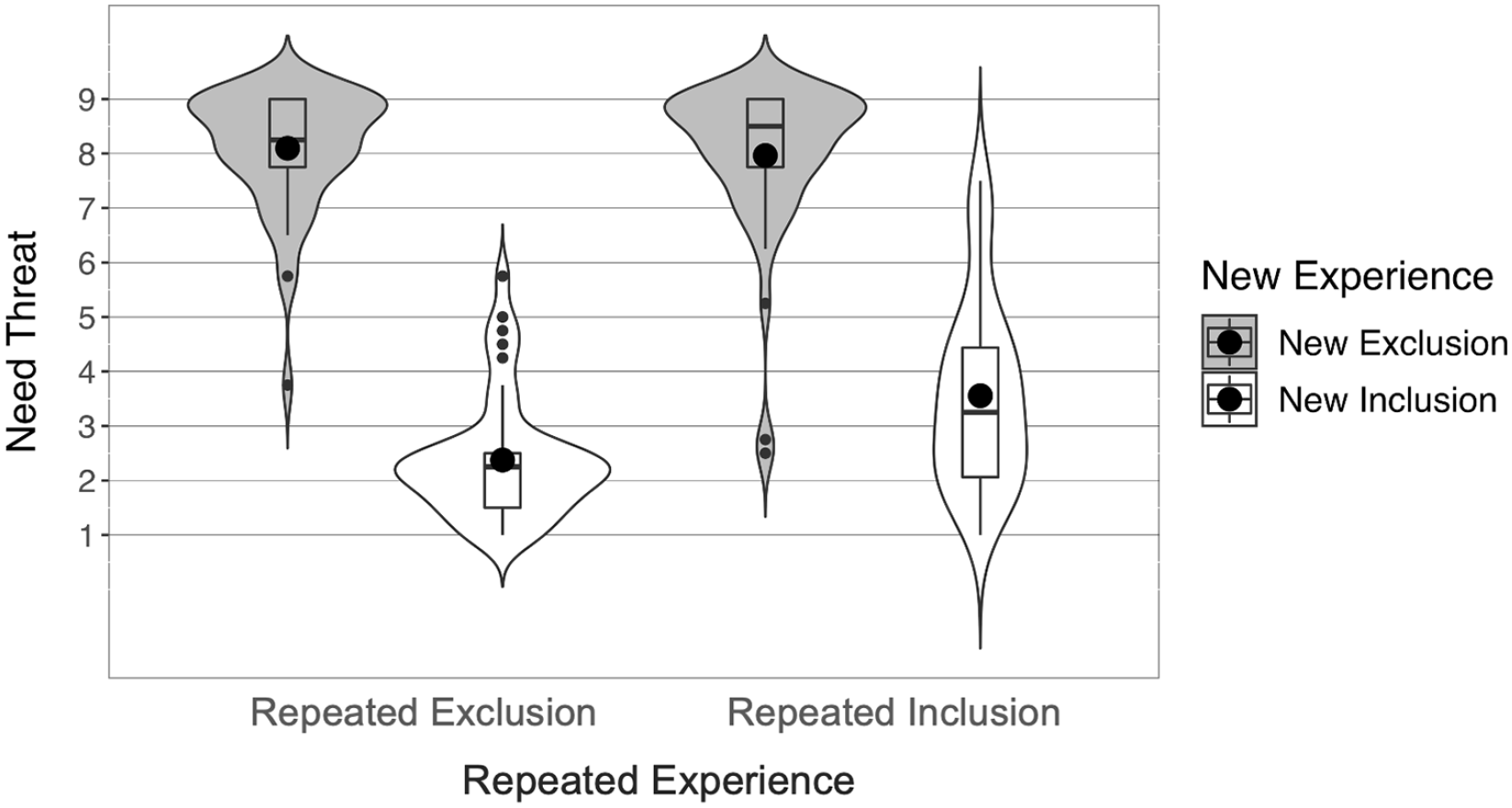
Need threat by social experience at T4 (new exclusion vs. new inclusion) and repeated experience at T2 and T3 (repeated exclusion vs. repeated inclusion) in Study 1.
Breaking down the interaction via simple main effects reveals large effects of inclusion versus exclusion at T4, both for participants who were repeatedly included, F(1, 99) = 193.00, p < .001, ηp2 = .661, 95% CI [.39, .59], and even larger effects for participants who were repeatedly excluded, F(1, 91) = 626.00, p < .001, ηp2 = .87, 95% CI [.69, .81].
Simple main effects show that in the group of participants who were included at T4, repeatedly excluded participants reported less need threat than repeatedly included participants (exclusion at T2 and T3, and inclusion at T4: M = 2.38, SD = 1.11 vs. inclusion at T2 and T3, and inclusion at T4: M = 3.56, SD = 1.71), F(1, 96) = 15.65, p < .001, ηp2 = .14, 95% CI [.04, .27], suggesting beneficial effects of being included after a history of repeated exclusion that go beyond the positive effects of being included without having such a history.
There was no significant effect of repeated experience when participants were excluded at T4, suggesting that previous experiences do not change need threat levels following a new exclusion experience (inclusion at T2 and T3 and exclusion at T4: M = 7.96, SD = 1.44 vs. exclusion at T2 and T3 and exclusion at T4: M = 8.10, SD = 1.10), F(1, 94) = 0.27, p = .608, ηp2 = .003, 95% CI [0, .06]. To quantify the evidence against an effect of repeated experience on need threat following exclusion at T4, we calculate a Bayesian two-sided t-test. This analysis reveals a BF01 = 4.14, indicating that the data obtained is around four times more likely under the null hypothesis (i.e., no difference between repeatedly excluded and repeatedly included participants after a new exclusion experience) than under the alternative hypothesis (i.e., hyper- or hyposensitivity).
Effects of exclusion over time
To test the effect of inclusion/exclusion over time, we compare the two groups Inclusion-Inclusion-Inclusion and Exclusion-Exclusion-Exclusion, over the three Cyberball games. A mixed-measures ANOVA with social experience (Inclusion vs. Exclusion) and time point (first vs. second vs. third game) reveals a significant main effect of social experience, F(1, 101) = 340.27, p < .001, ηp2 = .13, 95% CI [.69, .82], indicating that excluded compared to included individuals experienced more need threat. More importantly, there is also a significant main effect of time point, F(1, 202) = 3.10, p = .047, ηp2 = .030, 95% CI [0, .06], indicating that the effect of social experience changed over time. These main effects are qualified by a significant interaction effect, F(1, 202) = 3.25, p = .041, ηp2 = .03, 95% CI [0, .06], which indicates a different trajectory for being repeatedly included versus excluded. We decompose this interaction by investigating the effect of time point in each condition (see Figure 2): Exclusion similarly affected need threat at all three time points, F(2, 96) = 0.27, p = .761, ηp2 = .01, 95% CI [0, .03], suggesting that individuals became neither hyposensitive nor hypersensitive to exclusion with repetition.
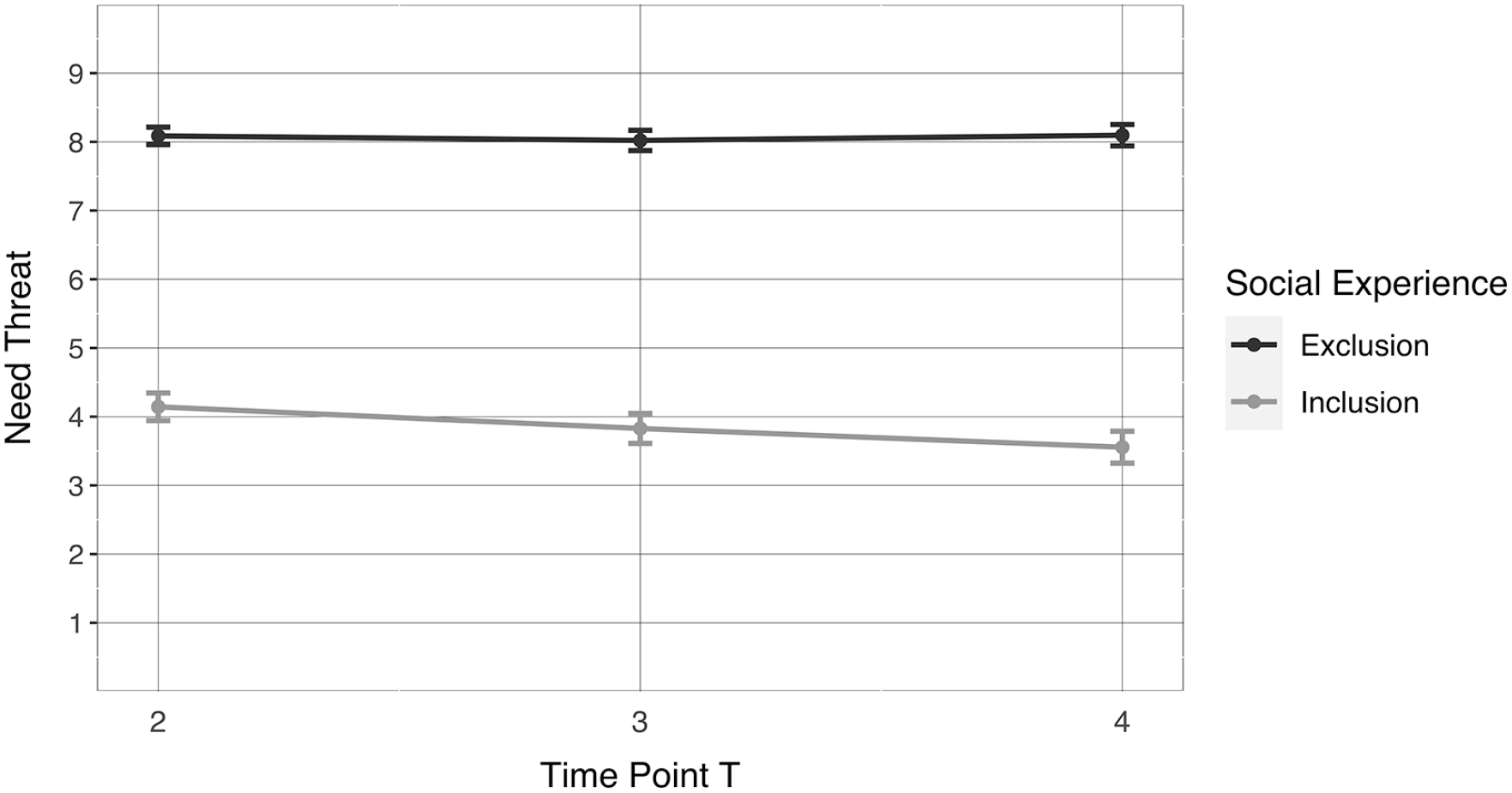
Need threat over time by social experience (exclusion at T2, T3, and T4 vs. inclusion at T2, T3, and T4) in Study 1.
Applying Bayesian analyses, a repeated-measures ANOVA with participants who were excluded three times reveals that the null model only containing the grand mean is superior to a model with time point as a predictor (BF01 = 12.08), indicating that it is around 12 times more likely that there is no effect of being repeatedly excluded on need threat compared to there being an effect of being repeatedly excluded. Post-hoc comparisons between the single time points reveal moderate evidence against a difference in need threat levels between T2 and T3 (BF01 = 5.36), T2 and T4 (BF01 = 6.41) and T3 and T4 (BF01 = 5.29).
In contrast, for the inclusion group, need threat significantly decreases with repetition, F(2, 106) = 4.32, p = .016, ηp2 = .08, 95% CI [0.002, .13], suggesting that there is a beneficial effect of repeated inclusion on need threat. Bonferroni-corrected paired t-tests between the single time points in the inclusion condition only revealed significant differences between T2 and T4, t(53) = 2.65, p = .032, d = 0.36, 95% CI [0.09, 0.65], but neither between T2 and T3, p = .393, d = 0.21, 95% CI [−0.07, 0.50], nor between T3 and T4, p = .339, d = 0.22, 95% CI [−0.04, 0.56], suggesting that the effects are negligible when comparing only two consecutive incidents of inclusion.
Do individual traits affect psychological distress after an additional experience of exclusion in the repeatedly excluded?
Exploratorily, we test the potential role of several individual traits on need threat following repeated exclusion. We test rejection sensitivity as a measure of sensitivity to exclusionary cues, basic need satisfaction relatedness as a measure of social connection, and the Big Five personality traits.
Among those that were excluded three times, we test the effect of time point x individual trait (mean-centered) on need threat in regression models. A significant two-way interaction would indicate a moderating effect of the respective trait. None of the interactions are significant (ps = .290–.930, see https://osf.io/vunse/ for complete outputs), suggesting that neither rejection sensitivity, nor relatedness, nor Big Five personality traits influenced the impact of repeated exclusion on need threat.
Study 2
Study 1 showed that repeated experiences of exclusion or inclusion did not change individuals’ psychological distress after a new exclusion experience, supporting Hypothesis 1c that psychological distress after exclusion will not change as a function of previous experiences (i.e., no hyper- or hyposensitivity to exclusion). However, being included after repeated exclusion elicits more need satisfaction than being included after repeated inclusion. Interestingly, this suggests that excluded participants may become hypersensitive to new experiences of inclusion. Further, this points to the power of inclusionary experiences in the same context for helping those that undergo repeated experiences of exclusion. Moreover, we found beneficial effects of repeated inclusion over time on need threat levels.
While being excluded from Cyberball repeatedly is certainly not a pleasant experience, it remains an approximation of the impact that more frequent or even chronic, prolonged experiences of real-life exclusion might have. Study 2 builds on Study 1 by focusing on real-life chronic exclusion that people experience in their daily lives. Rather than experimentally inducing repeated exclusion over time, we measure individuals’ baseline perception of being chronically excluded across various life contexts. Specifically, we investigate how individuals’ levels of chronic exclusion may impact their responses to a single episode of exclusion. Study 2 further extends Study 1 by considering whether real-life chronic exclusion experiences moderate the reflexive (i.e., immediate) and the reflective (i.e., short-term) responses to exclusion versus inclusion. We can thus investigate whether chronic exclusion impacts the recovery following exclusion, since coping mechanisms and attribution strategies occur primarily during the reflective stage (e.g., Timeo et al., 2019).
In addition, Study 2 tests whether individual traits moderate the influence of chronic exclusion on responses to a new experience of exclusion. Specifically, it could be that the hyper- or hyposensitivity effect of chronic exclusion shows only in people with high rejection sensitivity, high fear of social pain, high hurt proneness, or with few social connections, respectively (e.g., Downey & Feldman, 1996; Leary & Springer, 2001; Marinucci & Riva, 2021a; Riva, Williams et al., 2014).
Methods
Participants and design
An a priori power analysis conducted with G*Power (Faul et al., 2007) recommended a minimum sample size of 180 participants (power > .80; alpha error = .05) for detecting a medium effect size (f = .25) of a full anaylsis of covariance (ANCOVA) model with 3 degrees of freedom (1 for the main effect of the condition, 1 for the main effect of the predictor, and 1 for the interaction term). 4
Participants were recruited in social networks and via a snowball strategy. Consistent with Study 1’s inclusion criteria, we pre-registered to remove participants who already knew Cyberball (n = 6). After also removing those who failed attention checks (n = 30) and those who only accessed the survey (n = 349), 183 participants were retained (67.80% female, 2.2% no answer; Mage = 29.55, SD = 13.09, Range = 18–71 years). Participants were randomly assigned to a 2 (Social Experience: Inclusion vs. Exclusion)-between-subject experimental design.
Materials and procedure
Chronic exclusion
After providing demographic information, Chronic Exclusion in participants’ daily lives was measured using the 11-items Ostracism Experience Scale (Gilman et al., 2013). The scale assesses the overall, self-reported incidence of experiences of exclusion across a variety of real-life situations (e.g., “In general, others ignore me during conversation”; 1 = not at all to 5 = very much; M = 2.11, SD = 0.63, Range = 1–4.36, Cronbach’s α = .88; see https://osf.io/vunse/ for a histogram of chronic exclusion levels).
Individual trait moderators
Rejection Sensitivity was measured using the same Adult Rejection Sensitivity Questionnaire as in Study 1 (Berenson et al., 2009; M = 9.20, SD = 3.60, Cronbach’s α = .60). Hurt Proneness was measured using the six-items Hurt Proneness Scale (Leary & Springer, 2001) that assesses individual proneness and propensity in experiencing social pain (e.g., “My feelings are easily hurt”; 1 = not at all to 5 = very much; M = 3.42, SD = 0.82, Cronbach’s α = .81). Fear of Social Pain was measured using the 15-item Fear of Social Threat scale (Riva, Williams, et al., 2014), which asks individuals to rate the extent to which they are afraid of experiencing pain in various instances of socially threatening events (e.g., “being betrayed by someone important to you”, “being verbally abused by your boss”, “being left out of a group”; 1 = not at all to 5 = very much; Cronbach’s α = .91; M = 3.53, SD = 0.83). Lastly, we measured Social Connections using a listing procedure. Participants listed the initials of up to 20 people (e.g., friends, relatives, colleagues) with whom they had regularly interacted during the previous three months. Participants also rated how close they felt to each listed person (1 = not close at all to 5 = extremely close). The overall index of quantity and quality of social connections was computed by summing all closeness responses. Higher scores indicate more numerous and closer interpersonal connections (M = 41.41, SD = 17.62, Range = 8–91; see Marinucci & Riva, 2021a for a similar procedure).
Dependent variables
In the study’s second part, participants were randomly assigned to either the inclusion (n = 93) or the exclusion (n = 90) Cyberball condition. Immediately after the Cyberball manipulation, participants’ reflexive need threat was measured with the 12-item need threat scale (adapted from Gerber et al., 2017, Cronbach’s α = .81). The scale used three questions answered on a 5-point continuous scale (1 = not at all to 5 = extremely) for each of the four needs of belonging (e.g., “During the game I felt detached from the others”), self-esteem (e.g., “During the game I felt good with myself”), control (e.g., “During the game I felt unable to influence others’ actions”), and meaningful existence (e.g., “During the game I felt invisible”). Next, we measured reflexive negative emotions by asking participants to rate on a 5-point continuous scale (1 = not at all to 5 = extremely) the extent to which they felt anger, happiness (reverse coded), hurt feelings, anxiety, sadness, shame, and guilt during the game (Buckley et al., 2004; Cronbach’s α = .73). After answering scales unrelated to the present contribution, 1 reflective need threat (Cronbach’s α = .88) and reflective negative emotions (Cronbach’s α = .81) were measured with the same scales, but participants were instructed to answer based on how they felt in the present moment rather than during the game. As manipulation checks, participants rated how rejected and ignored they felt during Cyberball and estimated the percentage of ball throws received.
Results
Preliminary Analyses
Baseline levels of chronic exclusion did not differ across Cyberball conditions (p = .714). Compared to included participants, excluded participants felt more rejected (t(156.54) = −8.35, p < .001, d = −1.24, 95% CI [−1.56, −0.92]; MExclusion = 3.19 vs. MInclusion = 1.74), ignored (t(169.50) = −10.46, p < .001, d = −1.56, 95% CI [−1.89, −1.22]; MExclusion = 3.91 vs. MInclusion = 2.09), and estimated receiving fewer ball tosses (t(163.88) = 15.38, p < .001, d = 2.26, 95% CI [1.89, 2.63]; MExclusion = 6.54% vs. MInclusion = 24.57%).
Do Individuals Show Hyposensitivity or Hypersensitivity to Chronic Exclusion Experiences?
We test hypotheses H1a–c by conducting four multiple regression models 5 specifying the main effect of the social experience condition (0 = inclusion, 1 = exclusion), the Chronic Exclusion index (continuous variable), and their interaction, predicting reflexive need threat (Model 1), reflexive negative emotions (Model 2), reflective need threat (Model 3), and reflective negative emotions (Model 4, Table 1). For comparability between the studies, we report β and ηp2 as indicators of effect size.
Frequentist regression models of Study 2.
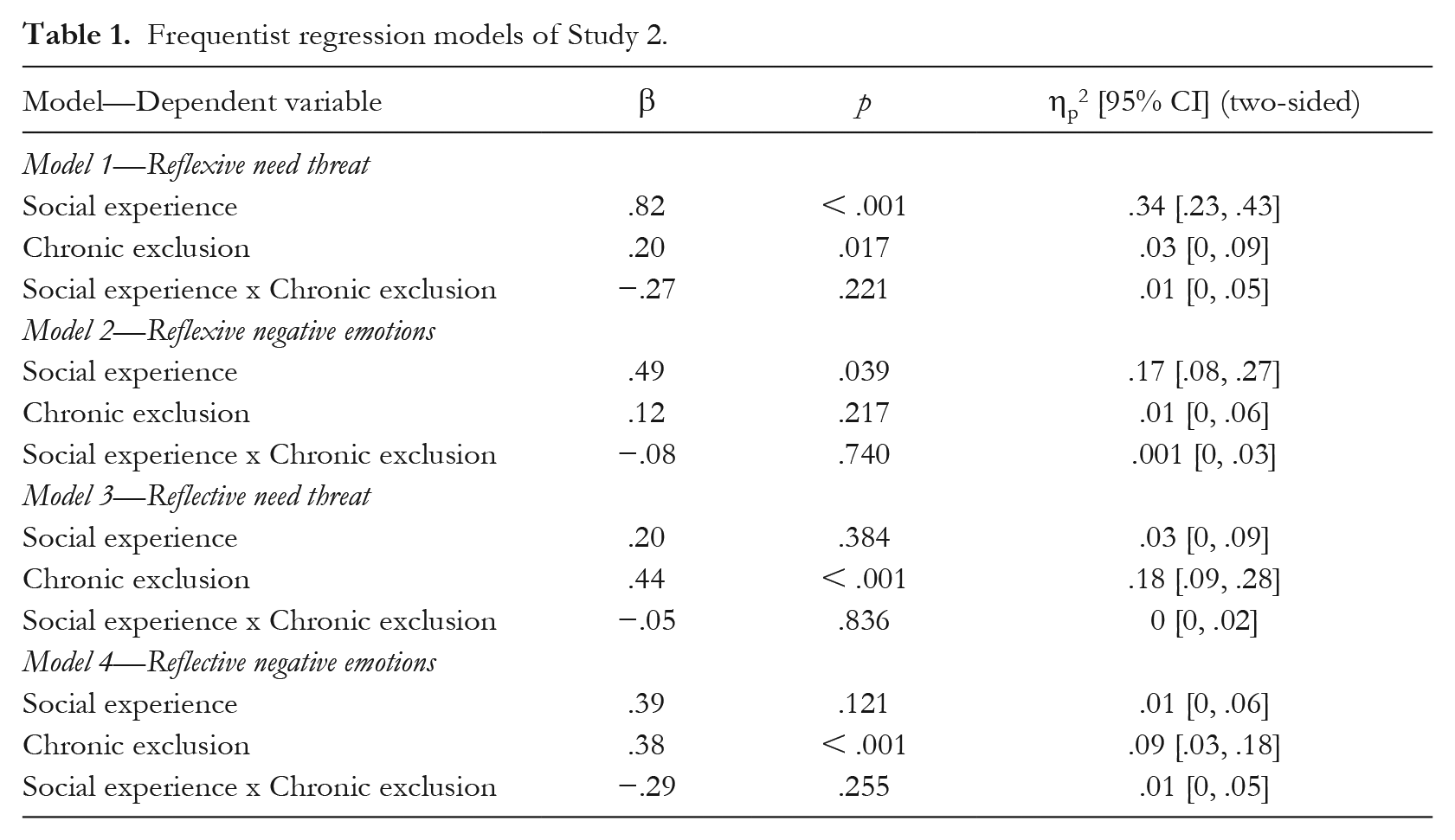
There are significant main effects of the social experience on the reflexive outcomes, meaning that excluded participants experienced significantly more negative emotions (M = 2.26, SD = 0.65) and need threat (M = 5.18, SD = 0.93) than included participants (negative emotions: M = 1.77, SD = 0.42; need threat: M = 3.85, SD = 0.98). However, there are no significant effects of the Cyberball manipulation at the reflective stage, neither on reflective need threat (MExclusion = 3.63, SD = 1.23 vs. MInclusion = 3.29, SD = 1.06) nor on reflective negative emotions (MExclusion = 1.99, SD = 0.72 vs. MInclusion = 1.84, SD = 0.62), suggesting that excluded participants had already recovered from Cyberball when the reflective responses were assessed.
Also, there are main effects of chronic exclusion levels: those with higher baseline levels of chronic exclusion report higher reflexive need threat regardless of Cyberball condition (β = .20, p = .017), but not higher reflexive negative emotions (β = .12, p = .217). Chronic exclusion levels also predict higher reflective need threat (β = .44, p < .001) and higher reflective negative emotions (β = .38, p < .001).
Results from all considered outcomes support the null hypothesis H1c, as shown by the non-significant interaction effects of Social Experience x Chronic Exclusion: need threat and negative emotions experienced during the game (i.e., reflexive) and shortly after it (i.e., reflective), are not influenced by the interaction of baseline levels of chronic exclusion and exclusion/inclusion in Cyberball. In other words, exclusion in Cyberball affects more versus less chronically excluded individuals to the same extent (all interaction effects p > .221; see Table 1).
The null hypothesis H1c is also supported by four Bayesian regressions in JASP: in all models, the Bayes’ factors speak against a model, including the interaction term between chronic exclusion and social experience (BF01 = 3.28 – 11.44). This means that models including the interaction term are 3.28 to 11.44 times less likely than simpler models, including only the main effects of social experience and/or chronic exclusion (see Table 2 for all Bayes’ factors).
Bayes Factors for regression models of Study 2.
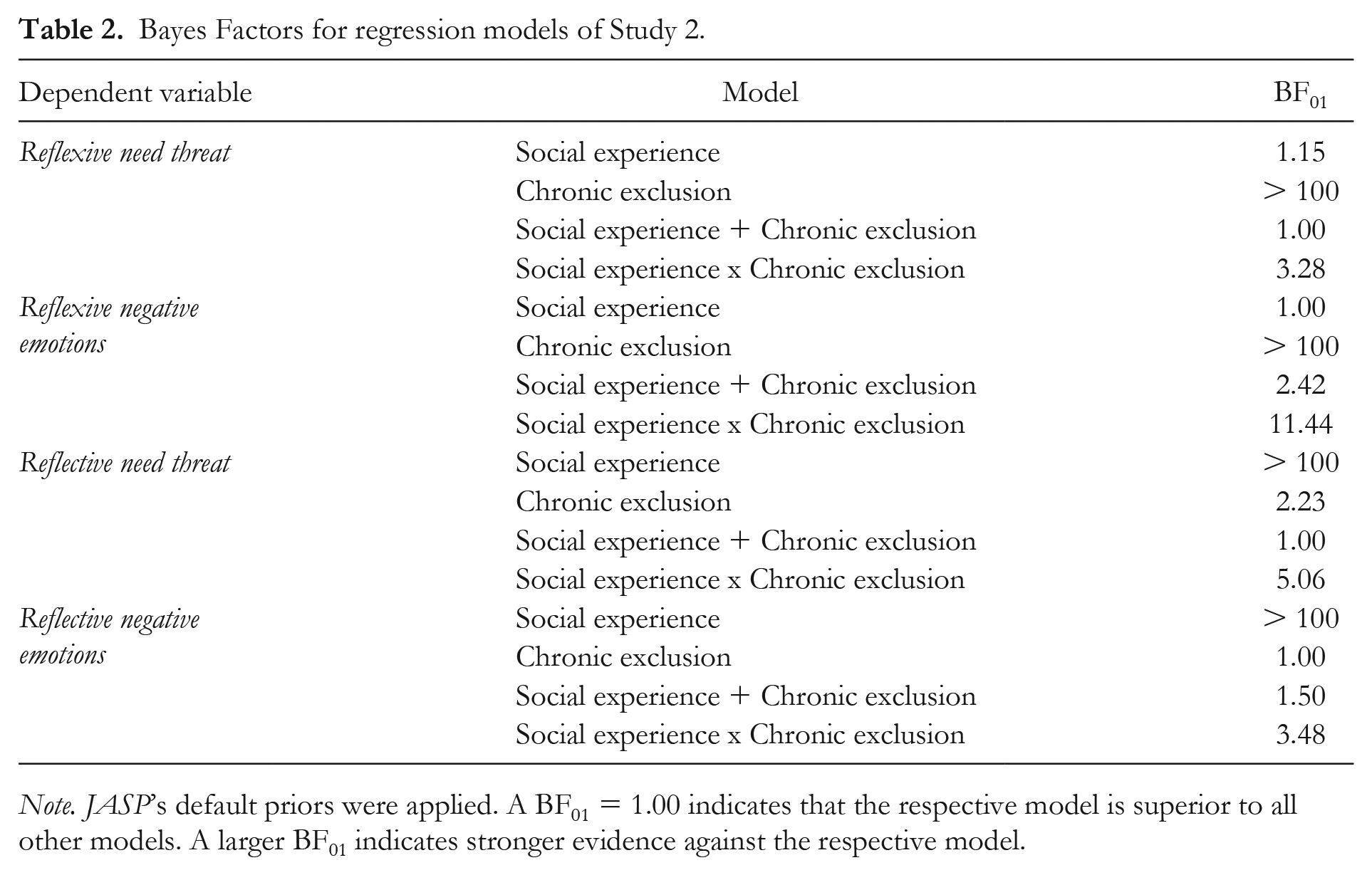
Note. JASP’s default priors were applied. A BF01 = 1.00 indicates that the respective model is superior to all other models. A larger BF01 indicates stronger evidence against the respective model.
Do Individual Traits Affect Psychological Distress After an Additional Experience of Exclusion in the Chronically Excluded?
Chronic exclusion does not influence individuals’ psychological responses to novel episodes of exclusion. We test if such a null effect could be explained by individual differences in rejection sensitivity, hurt proneness, fear of social pain, or social connections. Building on Models 1–4 (see Table 1), we exploratively test 16 multiple regression models that specify as predictors the main effect of the trait, the main effect of social experience (0 = inclusion, 1 = exclusion), the main effect of chronic exclusion, the 2 two-way interaction terms (Trait x Social Experience and Trait x Chronic Exclusion), and the three-way interaction (Trait x Social Experience x Chronic Exclusion), separately for each moderator (i.e., Models 1–4 with rejection sensitivity, Models 1–4 with hurt proneness, Models 1–4 with fear of social pain, and Models 1–4 with social connections). A significant three-way interaction term would indicate that individual traits influence whether chronic exclusion yields hyper- or hyposensitive responses to novel exclusion. However, none of the three-way interaction is significant (ps = .200 – .970, see https://osf.io/vunse/ for complete outputs), meaning that the traits did not meaningfully influence the possible impact of chronic exclusion on responses to further exclusion episodes.
General Discussion
Exclusion experiences surround us in our daily interactions: at work (e.g., Howard et al., 2020), at school (e.g., Hawes et al., 2012), at lunch (e.g., Büttner, Gloster, et al., 2021), on social media (e.g., Büttner & Rudert, 2022; Pancani et al., 2021, 2022), in intimate relationships (e.g., Zadro et al., 2008), and among friends and family (e.g., Babalola et al., 2021). So far, laboratory research has neglected to examine how repeated or even chronic exclusion experiences affect targets of exclusion. The present research tested how previous exclusion experiences in laboratory settings and daily life, impact psychological distress after a new exclusion episode. We find that previous exclusion experiences do not alter the painful experience of being excluded. Exclusion neither softens its sting nor is it more painful if encountered repeatedly or even chronically.
No Effect of Previous Exclusion Experiences
We find no effect of previous experiences of exclusion on the experience of a novel exclusion experience. Neither having experienced exclusion twice already in an experimental context nor feeling chronically excluded in daily life changed emotional responses to a novel exclusion experience. Exclusion was also not more or less hurtful when experienced after being included two times. Rather, exclusion was perceived as equally painful, regardless of previous and chronic experiences, immediately after the exclusion experience (i.e., reflexively) and after a short recovery period (i.e., reflectively). Repeated experiences of exclusion do not aggravate or lessen the pain of new exclusion experiences, even in the same context (i.e., three games of Cyberball) and possibly by the same perpetrators (i.e., it was apparent from participants’ comments in Study 1 that, even though participants were told that the other players were computer-generated, they imagined the Cyberball players as the same persons over the games).
Chronic Exclusion in Real Life Affects All Social Experiences
Interestingly, individuals’ level of chronic exclusion in their life has a main effect on emotional responses orthogonal to being excluded or included: if individuals feel chronically excluded in their life, they show more psychological distress in general, regardless of the experience they just had, especially in the reflective stage a few minutes after the social experience. This aligns with earlier research on depressed individuals’ emotional responses to social experiences that is equally negative regardless of whether the experience was inclusionary or exclusionary (Büttner, Rudert, et al., 2021). Depressive symptoms have been found to accompany the resignation stage (e.g., Riva et al., 2017; Williams, 2009). Our findings further align with the conceptualization of the resignation stage, stating that basic needs become chronically thwarted in people exposed to chronic exclusion so that any social experience might be met with more negative responses (Williams, 2009). However, while being excluded from Cyberball is an approximation to the impact that real-life exclusion might have, it is yet to be tested how individuals who feel chronically excluded in their life react to new, real-life exclusion experiences. Compared to Cyberball, real-life exclusion might be perceived as more severe, for instance, if the sources of exclusion are close others like friends, family, or one’s partner. Moreover, in contrast to repeated social exclusion, individuals suffering from chronic exclusion may experience a state of constant feelings of exclusion even in the absence of repeated, new instances of exclusion (Riva, Wesselmann, et al., 2014). This represents an interesting avenue for future research, for instance, using experience sampling of exclusion experiences of individuals with various levels of chronic exclusion.
No Moderation by Individual Differences
We examined individual trait moderators and ruled out that differences in rejection sensitivity, hurt proneness, fear of social pain, social connections, or Big Five personality affect the influence of previous and chronic exclusion experiences on psychological distress after novel exclusion episodes.
Beneficial Effects of Inclusion
Regarding the beneficial effects of inclusion, we find two things: One, inclusion after a history of being excluded two times is experienced more positively than experiencing inclusion after a history of being included two times. This could point to a hypersensitivity of excluded individuals to social inclusion: In line with the social monitoring system theory (Pickett & Gardner, 2005), individuals become more sensitive to social signals after exclusion. Further, our findings point to the powerful effects of being included again in the same context when suffering from previous exclusion in that context. An anecdote reported by Ren et al. (2017, p. 23) illustrates this point. In high school, a student smiled at social outcasts. After one such individual was absent for several months, the smiler received this note: Hi Maria, thank you for saving my life. I have never fit in and have felt like I didn’t deserve to be here anymore. I have no friends and my family doesn’t notice if I don’t come home. I thought I would be better off gone, so I took as many sleeping pills as I could. Before I started to drift away, I thought of you waving to me and giving me a smile and I called 911. Thought you should know why I was out of school. Thank you for your note.
As this anecdote illustrates, and in line with other empirical findings, inclusion could serve as a powerful antidote against the negative effects of previous exclusion experiences. For instance, being accepted by more people diminished the negative emotional responses to being excluded as well as post-exclusion aggression (DeWall, Twenge et al., 2010). In another experiment, being included after being excluded was more effective for restoring needs than waiting for the experiment to end (Zwolinski, 2014). However, we find this beneficial effect of inclusion only in Study 1, where inclusion followed after two experiences of exclusion in the same context (i.e., Cyberball). In Study 2, where inclusion in Cyberball followed after chronic experiences of exclusion in daily life, we do not find this beneficial effect of inclusion. Rather, individuals who feel chronically excluded in their lives show more psychological distress in general, even after inclusion, than individuals who experience less exclusion in their daily lives. We conclude from these diverging findings that the context and severity of exclusion may be decisive. Imagine someone who suffers from severe exclusion at work. If that person is then included in a game of ball-tossing between pre-scripted computer players, this cannot alleviate the pain of being constantly excluded at work. However, imagine this person would be included at work after having been excluded for a long time. Likely, this experience would create hope for that person and benefit their well-being. This pattern of results could also point to the role of the severity of experiences: One experience of inclusion in Cyberball may not be strong enough to make up for a history of real-life exclusion experiences, but could make up for a history of Cyberball-exclusion. Further, chronic real-life exclusion might have severe consequences, especially when the context cannot be easily left or if targets of exclusion depend on being a part of the group. This may be the case in work contexts (e.g., Rudert, Hales, et al., 2021) or if targets are excluded due to having a group membership that cannot be easily changed (e.g., Goodwin et al., 2010; Wirth & Williams, 2009). In addition, future research could expand on chronically excluded individuals’ social connections as a potential buffer against the negative effects of chronic exclusion. Individuals that are chronically excluded in one context, such as work, but belong to multiple groups (i.e., have a more complex social identity, Roccas & Brewer, 2002), could be better equipped to deal with chronic exclusion in the workplace compared to individuals with less complex social identities. This is in line with earlier work that attributing ostracism to a temporary (vs. permanent) group membership benefits recovery from ostracism (Wirth & Williams, 2009).
Two, we find small additive effects of repeated inclusion on need satisfaction over time. Given that humans are social beings (Baumeister & Leary, 1995), it may not surprise that repeated inclusion has beneficial effects. However, in line with previous research that found no additive effects of being included twice in a row (Dahl et al., 2019, Experiment 1; Tang & Richardson, 2013; Zwolinski, 2014), it was only after three inclusion experiences that need threat levels decreased significantly. Thus, the effects of repeated inclusion are rather small; however, in daily life, repeated experiences of inclusion may accumulate and contribute to self-esteem, achievement, health, and well-being (e.g., Greenaway et al., 2015; Steger & Kashdan, 2009; Walton & Cohen, 2007; Walton et al., 2012). Moreover, our finding that repeated inclusion has additive effects extends previous findings on acceptance: In an experiment, participants’ reactions to being extremely accepted (i.e., participants were told that someone else definitely wanted to work with them) or moderately accepted (i.e., participants were told that someone else somewhat wanted to work with them) did not differ significantly (Buckley et al., 2004, Study 1; Leary et al., 1998). Moreover, participants showed the same reactions to increasing acceptance over time as to constant acceptance (Buckley et al., 2004, Study 2). Arguably, this could mean that repeated inclusion has stronger effects than mere acceptance.
Limitations
A caveat to interpreting our findings is that the reflexive need threat levels following Cyberball in our studies were high, as is typical after Cyberball (see meta-analyses; e.g., Hartgerink et al., 2015). This might have rendered it difficult to find evidence for the hypersensitivity hypothesis at the reflexive stage. However, the reflective need threat levels were lower than the reflexive need threat levels because participants recovered. Still, there was no effect of chronic exclusion experiences on reflective outcomes. Reflective outcomes are typically more sensitive to moderation (Hartgerink et al., 2015), suggesting that there is also no hypersensitivity effect if need threat levels allow for an increase in need threat.
Moreover, we only measure psychological reactions to exclusion, not perceptions of exclusion. Obviously, the two are not the same, and perceptions of exclusion may shape the interpersonal reaction to exclusion (Smart Richman & Leary, 2009). The objectively same situation may be perceived as excluding by one individual but not by another, and the same perception of an exclusion situation may still cause one individual to react with greater pain than the other (e.g., De Panfilis et al., 2015). However, differences in perceptions of exclusion were likely captured in assessing individual differences; for instance, in rejection sensitivity.
Implications
Our findings may have important implications for two types of targets: first, for targets of bullying, the perpetrators and the bullying context are likely stable (e.g., workplace bullying or bullying at school), and targets have to face rejection and exclusion all the time. Second, our findings may also have implications for research on chronically excluded groups such as immigrants, asylum-seekers, or prison inmates (e.g., Aureli et al., 2020; Marinucci & Riva, 2021a, 2021b). These two types of targets may ultimately be most at risk for developing depression or even suicidal tendencies in response to chronic exclusion (e.g., Chen et al., 2020; Rudert, Janke, et al., 2021). Our findings highlight the need to help these targets, as it is apparent that exclusion does not soften its sting; thus, it is likely that targets do not develop effective coping mechanisms to prepare for repeated or chronic episodes of exclusion. Future research should be mindful of helping targets develop coping mechanisms, for instance, cognitive strategies of reappraisal (e.g., Sethi et al., 2013). Importantly, coping strategies against the impact of exclusion should be not only effective but also healthy in the long run since not all effective strategies may be beneficial for the target; for example, taking pain killers (e.g., DeWall, MacDonald et al., 2010), smoking cigarettes or marijuana (e.g., Deckman et al., 2014; DeWall & Pond, 2011), or drinking alcohol (e.g., Hales et al., 2015; Sprunger et al., 2020; but see also Fairbairn et al., 2021). Moreover, research on post-traumatic stress (Brewin et al., 2000) and research on victims of natural disasters (Zagefka, 2022) show that having to deal with adversities multiple times makes it harder to cope with new adverse experiences. In contrast, lay beliefs hold that victims will habituate to dealing with adversity, becoming hyposensitive over time. This belief, in turn, decreases the willingness to help victims (Zagefka, 2022). If the same is true for beliefs about excluded targets’ coping capacity, accurate information about how hurtful the experience of exclusion is for targets every time it occurs could help to raise awareness among bystanders and sources of exclusion.
Moreover, our findings point to the power of being included in the same context again after repeated experiences of exclusion. Future interventions should therefore target bystanders of exclusion, such as those who do not exclude or bully at school or work but merely do nothing. By educating bystanders about the power of inclusion experiences for the well-being of those that are chronically excluded, the targets’ pain may be alleviated, at least to some extent (see also Rudert et al., 2018).
Our findings also make a methodological contribution to the study of exclusion: To date, when researchers sample participants for exclusion research, they tacitly assume, or rely on participants’ self-report, that participants are naive with respect to the exclusion manipulation. The present findings suggest that naiveté does not need to be a pre-requisite for participation. Our results indicate that, if anything, effects might even get stronger due to the beneficial effects of inclusion after repeated exclusion and inclusion. In support of this conclusion, it is a particular advantage that the three time points in Study 1 were only three days apart, as memory will not have declined during that time. However, this conclusion is only valid for effects of repeated exclusion experiences on need threat; downstream effects on cognitive outcomes (e.g., attributions) or behavioral outcomes (e.g., aggression) remain unknown. Still, understanding reactions to exclusion based on previous exclusion experiences is the first step in understanding downstream consequences for cognitive and behavioral outcomes. For instance, the ostracism–aggression link seems mainly driven by the thwarted need for control (Ren et al., 2018). Potentially, studying the effects of previous exclusion experiences on aggression may have important implications for understanding case-study-links between chronic exclusion and extreme forms of aggression such as school shootings (e.g., Leary et al., 2003; Sommer et al., 2014) using an experimental approach.
Conclusion
Past experiences of repeated or chronic exclusion, in experiments and in the real world, do not lessen or aggravate the pain that is felt with a new episode of exclusion. However, a new episode of inclusion in the same context after repeated experiences of exclusion showed powerful beneficial effects. Moreover, in line with the conceptualization of the resignation stage, individuals who feel chronically excluded in their life show more psychological distress in general, regardless of whether their social experiences are inclusionary or exclusionary.
Footnotes
Acknowledgements
We would like to thank Nina Frings and Laura Mangold for assisting with data preparation.
Funding
The authors disclosed receipt of the following financial support for the research, authorship, and/or publication of this article: This research was supported by grant #P000PS_207236/1 from the Swiss National Science Foundation awarded to Christiane M. Büttner.
