




Abstract
The present study analyses perceived pressure to conform to minority group norms and examines its implications for identity (in-)compatibility among six immigrant groups in the Netherlands (N = 5,783). We analyzed whether orientation toward the majority and minority and the perceived diversity climate explained individual and group differences in perceived minority pressure. Subsequently, we estimated multigroup models to examine whether perceived pressure moderated the association between minority and majority identifications. We found substantial group differences in perceived pressure that were not well explained by orientation toward the majority and minority groups, or the perceived diversity climate. Immigrants who had spent a larger proportion of their life in the receiving society experienced more, but those who had more work experience in the Netherlands experienced less pressure. Perceived pressure was higher the more the Netherlands was perceived as hospitable for immigrants, but also at higher levels of perceived intergroup hostility. Minority and majority group identifications were negatively associated across all six immigrant groups, but only among the Moroccan-Dutch did perceived pressure significantly moderate this association. Specifically, identifications became more compatible (i.e., more positively associated) at lower levels of pressure, a trend that we also observed among all other groups except the Turkish-Dutch; yet in these groups the interaction, though similar in magnitude and direction, was not statistically significant. We concluded that minority group dynamics may contribute to the (in-)compatibility of multiple group identifications, but more research is needed to understand the group characteristics that explain perceived minority pressure and its implications for minority members’ identification patterns.
Immigrants often experience two worlds at the same time, one associated with the receiving or majority group, and the other related to their minority group membership. However, much psychological research on migrants (and minorities more broadly) focuses on how the majority group exerts pressure on them (e.g., discrimination, assimilation policies, identity denial, to name a few; Verkuyten, 2018), disregarding that minority groups, as any functional group (Tajfel & Turner, 1979), also exert pressure on their members. Accordingly, they monitor whether group members conform to acceptable behavior, which can be expressed as group policing or watching over one’s behavior (Cárdenas, 2019; Cárdenas et al., 2021).
In this article, we contribute to a growing understanding in social psychological literature that minority groups continue to contribute to immigrants’ experience in their new country. First, we examine how minorities’ experiences contribute to perceiving minority pressure. We specifically examine whether minority pressure varies as a function of individuals’ orientation toward the majority group and toward the minority group (e.g., Berry, 1997; Bourhis et al., 1997; Hutnik, 1991) as well as the perceived diversity climate in the receiving country. We examine these questions among representative samples of six minority groups with distinct migration histories in the Netherlands—Moroccans, Turks, Surinamese, Antilleans, Somalis and Poles—offering a rich descriptive account of group differences in perceived pressure.
Second, we examine how minority pressure relates to minority members’ ability to have dual identities (Fleischmann & Verkuyten, 2016). Previous research in European contexts has consistently found that national/majority identification and minority/ethnic identification are negatively related (i.e., a subtractive or conflict pattern of identification; e.g., Berry et al., 2006; de la Sablonnière et al., 2016). This negative association has been interpreted as signifying incompatibility between the two identities, or an inability to endorse both group identities with similar strength; nevertheless, there is also evidence of a positive association between identities (i.e., an additive or coherent pattern), which implies a sense of compatibility and similar strength between them (Cárdenas et al., 2019; de la Sablonnière et al., 2016; Fleischmann & Phalet, 2016). In line with previous research (Cárdenas et al., 2021), we test whether minority pressure is more likely among those who have embraced, experienced, and manifested their dual identities (i.e., associated with an additive pattern).
Minority Pressure
Majority–minority dynamics have been an important topic of study in social psychology. Most of this research is focused on how the policies (e.g., Verkuyten, 2008), attitudes (e.g., Esses et al., 2008), and behaviors (e.g., Albuja et al., 2019) of majority members impact the way minority members feel connected to and identify with the majority and minority members (e.g., Schmuck et al., 2017). In particular, discrimination has received wide attention (Esses, 2021) as a threat to immigrants’ identification patterns. For instance, across several European societies, Muslim immigrant minorities who perceived more frequent discrimination, or perceived more Islamophobia in their receiving country, identified more strongly with their ethnic minority and religious community, and less strongly with, or even disidentified from, the national identity of the receiving country (Fleischmann & Phalet, 2016; Kunst et al., 2012; Verkuyten & Martinovic, 2012; Verkuyten & Yildiz, 2007). The positive association between perceived discrimination and orientation toward one’s minority group, whether ethnically or religiously defined, can be explained by the rejection-identification model (Branscombe, Schmitt, et al., 1999). This model suggests that discrimination and other forms of unfair or hostile treatment based on group membership result in greater identification with the target group (e.g., Badea et al., 2011; Jasinskaja-Lahti et al., 2009; Verkuyten & Yildiz, 2007). Moreover, there is also evidence for rejection-disidentification, with migrants in Finland identifying less strongly as Finnish and evaluating the Finnish majority group less positively at higher levels of perceived discrimination (Jasinskaja-Lahti et al., 2009). This is echoed in multiple studies across a broad range of immigrant-receiving societies (e.g., Bobowik et al., 2017; Mähönen et al., 2010; Wiley, 2013). In terms of identity (in-)compatibility, there is evidence that national and minority identification become more negatively associated at higher levels of perceived discrimination, a pattern found using both cross-national comparative and longitudinal designs (Fleischmann & Phalet, 2016; Fleischmann et al., 2019).
While this research has enriched our understanding of the boundary conditions for immigrants’ identity compatibility, its focus on majority–minority relations has also distracted from studying intragroup minority dynamics (Verkuyten, 2018), and more specifically, how minority members perceive and experience pressure from their minority ingroup. The influence of minority and immigrant groups on their members (Lay & Nguyen, 1998) is present in many Western countries, as these minority groups engage in community-building and actions to maintain their heritage culture and norms (Berry et al., 2006). Family relations are a particularly important area for cultural maintenance in immigrant families, as is evident in the strong family influence on homeleaving decisions (Lou et al., 2012; Mitchell, 2004). Pressure to conform to immigrant group norms in terms of the age of and reason for leaving the parental home tend to be particularly strong for minority women who are constructed as bearers of an ethnic culture imported from the homeland and conserved in time (Das Gupta, 1997). Accordingly, minority groups are not only physically present in the lives of minority members, they also play an important psychological role. They communicate normative expectations and reactions to normative and nonnormative behavior via norm talk (e.g., Keblusek et al., 2017) and make assumptions about one’s identity when nonnormative behavior is displayed (Howard et al., 2021), thus being an important source of self-relevant information for minorities (e.g., Abbey, 2002; Lay & Nguyen, 1998; Leach & Smith, 2006; Zagefka & Brown, 2005). Minority groups are also an important source of information via social comparisons. For instance, Mexican migrants born outside the United States preferred to compare themselves to other Spanish-speaking migrants than to English-speaking migrants and the national group (U.S.-born English speakers; Franzini & Fernandez-Esquer, 2006). In a similar vein, among Vietnamese-Canadians, hassles from the minority group were found to be a stronger predictor of depression than majority-related hassles (Lay & Nguyen, 1998). Given minority groups’ ability to exert normative pressure and their potential importance as relevant ingroups, migrants’ perceived minority pressure can play an important role in their everyday life. For instance, in Sunni Muslim dual identifiers (e.g., Muslim-Dutch and Muslim-German), greater dual identification was associated with greater endorsement of minority rights, particularly among those who perceived strong pressure from other Muslim minority members (Cárdenas, 2019).
Despite the theoretical importance of perceived minority pressure, very little is known about the characteristics and behaviors that might elicit minority pressure, or of its potential consequences for a minority member’s dual identity. In what follows, we first describe how migrants’ orientations toward the majority and minority groups, and toward diversity, relate to minority pressure.
Majority and Minority Orientations and Minority Pressure
Two key issues in the acculturation literature are orientation toward the majority and toward the minority (e.g., Berry, 1997). Orientation toward the majority and the minority groups can be assessed by asking minority members about the extent to which they engage with their cultural groups (e.g., Ryder et al., 2000), but also by examining whether minorities have, over their life course, been in contexts that afford them opportunities to be in contact with and adopt/maintain the culture of their groups (e.g., group- and individual-level variables; Berry, 1997). Since minority pressure is likely to be the result of having and engaging in these afforded opportunities, we took the latter approach in our conceptualization (and measurement) of orientation toward majority and minority groups. Specifically, we examined minority members’ orientations by accounting for indicators that capture lifelong opportunities to orient themselves toward the majority and minority groups: proportion of years spent in the country of migration, work experience in the new country, contact with the majority and minority groups, as well as competency in the languages of the majority and minority groups.
Those who have spent a greater proportion of life in the country of migration have had greater opportunities to be acculturated in the receiving country, in contrast to being enculturated in the culture of origin before migrating. This is particularly relevant for second-generation immigrants, who have spent all their life in their parents’ receiving country and hence have had more exposure to the majority culture (Portes & Rumbaut, 2005) and see it as a more psychologically relevant group (e.g., Deaux et al., 2007). Similarly, migrants who have worked for more years in the receiving country are more likely to have had greater contact with the majority group, participate in work-related activities with them, know the system of the receiving country, and be generally more oriented toward the majority group (Martinovic, et al., 2015). In terms of contact, contact with the majority is one of the main acculturation issues as described by Berry (1997), and is often assessed in acculturation measures (Ryder et al., 2000). Thus, greater contact with either majority or minority groups reflects individuals’ opportunities (and in some cases willingness) to orient themselves toward these groups. Language competency is critical to meaningfully engage with and orient oneself toward either majority or minority groups; in turn, a lack of language skills needed for communication with both groups is associated with more bicultural stress (Romero & Roberts, 2003). Majority groups argue that without a functional level of language proficiency migrants are not able to contribute to the receiving society and grow in it (Yağmur & van de Vijver, 2012). Minority groups make a similar argument, with a minority language often being a necessary condition to fully participating in the social and cultural life of the minority group (Martinovic et al., 2015). From both the majority and minority group perspectives, language competency offers migrants access to aspects of the group’s culture that would be otherwise more difficult to engage in.
Based on the social identity approach (Tajfel & Turner, 1979; Turner et al., 1987), and identity performance research more specifically (Klein et al., 2007), we expected that greater orientation toward both the majority and the minority groups would be associated with greater minority pressure. Specifically, individuals who are oriented toward both groups may be more likely to display behaviors that demonstrate their dual membership (e.g., Keblusek et al., 2017). These are observed and noted upon by majority and minority members and are therefore subject to normative control by both groups along with implicit and explicit (dis)approval when behaving in (or out of) line with group expectations. In terms of minority ingroup dynamics, derogatory terms like “banana,” “bounty bar,” or “coconut” (i.e., being, respectively, “yellow,” “black,” or “brown” on the outside but white on the inside) are sometimes used to (dis)qualify minority members who are perceived by their minority coethnics to be “acting white.” In the Dutch context, minority members who are perceived to be assimilated and out of touch with their immigrant origin are sometimes referred to as verkaasd, its literal translation being that they have turned into cheese. Importantly, this form of minority normative control is likely to emerge to the extent that individuals have oriented themselves toward the majority and minority groups over their life course. Being strongly oriented toward the majority group may bring about the behaviors that are criticized by minority groups, yet this criticism can only be articulated as normative pressure when individuals are oriented toward minority members. We therefore expected that greater orientation toward the majority (H1) and the minority group (H2) would be associated with greater minority pressure to conform.
Perceived Diversity Climate and Minority Pressure
The perceived diversity climate in the receiving country may also be important in understanding the experience of minority pressure. Being in a country with a negative climate toward diversity may be experienced as a threat to one’s ingroup, which, based on the social identity approach (Tajfel & Turner, 1979; Turner et al., 1987), activates the need to protect and affirm the group, sometimes with antisocial forms of affirmation (Lüders et al., 2016). A threat to the standing of one’s group also motivates individuals who care for their group to see it as more homogenous and cohesive (Doosje et al., 1995) and potentially to engage in group policing that will enforce this cohesive vision. In contrast, being in a context that emphasizes multiple cultures living together harmoniously can result in lower intergroup tensions (e.g., Leslie et al., 2020) and may be less likely to trigger ingroup protective tendencies such as normative pressure. A positive diversity climate enables minority groups to express and experience their culture without fear of prejudice and discrimination, which can reduce the need for minority groups to exert conformity pressure on their members. Thus, perceiving that the receiving country has a positive climate toward diversity can minimize the threat to the minority group, and in so doing, decrease the need to exert pressure on its members to act in line with minority group norms (the threat hypothesis: H3a).
However, it is also possible that a positive climate toward diversity may be associated with strong institutional and normative structures for minority groups, structures that, when in place, can be used to exert stronger pressure on its members. Specifically, multiculturalism and other diversity-affirming policies not only promote an ideology of openness to diversity in the general population, but they also provide the structures for minority groups to emerge and become established within a majority group (Koopmans et al., 2005). For example, the history of pillarization in the Netherlands has allowed Muslim minorities to create physical and social spaces for their religious practices (Rath et al., 1996). Institutionalization and sociopolitical contexts also play an important role in the way minority groups experience and express their identities (Fleischmann & Phalet, 2016). In terms of minority pressure, a culture of openness to diversity and its accompanying political institutions may have allowed the minority group to flourish and put in place the necessary normative and social structures (religious meetings, cultural festivals, etc.) that favor the expression and therefore the perception of minority pressure. Thus, perceived openness to diversity may be associated with greater minority pressure (the institutionalization hypothesis: H3b).
In line with our multidimensional conceptualization of orientations toward majority and minority groups, we examined perceived diversity of climate with a wide set of indicators: perceived hospitability of the receiving country, perceived tension between groups in the receiving country, and perceived discrimination. These reflect individuals’ perceptions that their group, being a cultural minority, is accepted by, living in harmony (vs. in tension) with, and valued (vs. discriminated) in the receiving country, with previous research suggesting that these are interrelated (Guimond et al., 2013; Ng Tseung-Wong & Verkuyten, 2018). We also assess personal attitudes toward cultural diversity, as these are likely to be influenced by the broader context’s culture of openness, with individuals who experience more openness to diversity in their immediate context being more likely to endorse such attitudes (Guimond et al., 2013).
Minority Pressure and the Patterns of Identification
Like the potential antecedents of minority pressure, its potential consequences for minority members’ identification patterns have also received little attention. Nevertheless, there is growing evidence that experiencing normative pressure from minority groups impacts migrants’ behaviors and attitudes (Cárdenas, 2019). In line with this growing topic of research, we investigated the potential implications of minority pressure for minority members’ ability to identify with both majority and minority groups.
On the one hand, minority pressure may be a form of identity threat, in that it may undermine one’s identity representations of “being both” and result in identifying either as a majority or a minority group member. This is akin to experiencing majority discrimination: both discrimination and minority pressure originate from one’s (potential) ingroups, both imply that one is not really an “acceptable” (i.e., typical) group member and hence both can be a form of identity threat (Branscombe, Ellemers, et al., 1999). Since discrimination is associated with “choosing” one group over another, that is, distancing oneself from the perpetrating group (de Vroome et al., 2014; Hutchison et al., 2015; Martinovic & Verkuyten, 2012; Wiley et al., 2021) while increasingly identifying with the targeted minority group (Branscombe, Schmitt, et al., 1999; Giamo et al., 2012), minority pressure may also make it difficult to simultaneously identify with both groups. Specifically, if minority pressure threatens one’s potential dual identity, then it may be associated with a subtractive (or conflicting) identification pattern, whereby the majority and minority identification are negatively related (Cárdenas et al., 2019; de la Sablonnière et al., 2016; Fleischmann & Phalet, 2016). This is also echoed in bicultural identity research, where immigrants who experience their multiple identities as conflicting rather than harmonious, and distant rather than blended, struggle to achieve an integrated identity (Benet-Martínez & Haritatos, 2005). Similarly, identity integration is theorized to occur to the extent that identity conflict has been resolved (Amiot et al., 2007).
On the other hand, minority pressure may result when individuals who identify similarly with both groups (i.e., the additive or coherent pattern of identification; for dual identities, see also Amiot et al., 2007; Benet-Martínez & Haritatos, 2005) simultaneously display cues associated with the majority and minority groups. Individuals embody their social identities, particularly when these are important to them (Tajfel & Turner, 1979; Turner et al., 1987), and among minority groups, those individuals who give importance to both majority and minority groups are probably displaying evidence of their two group memberships (Cheryan & Monin, 2005; Hogg & Giles, 2012; Keblusek et al., 2017; Wiley & Deaux, 2010). In so doing, they become vulnerable to criticism from the minority (and majority) group for attempting to be both.
In a previous study, we (Cárdenas et al., 2021) have examined these contrasting hypotheses. We tested whether identity misgivings—a specific form of minority pressure (being considered “too much” like a majority or a minority group member)—are associated with an additive or subtractive pattern. In two studies among migrants in the Netherlands, we found support for an additive pattern when being perceived as being “too Dutch” (Study 1) and “too much like a minority member” (Study 2), suggesting that those who identified strongly with both their majority and minority groups (i.e., with a strong dual identification) were also more likely to perceive that others were apprehensive about their group membership. Given this previous evidence, in the present study we expected that feeling pressured to follow the norms of the group—another form of minority pressure—would also be accompanied with a positive association between identities (i.e., a strong dual identification: H4).
Context of the Study
We examine our research questions among six minority groups in the Netherlands, namely first- and second-generation immigrants from Turkey, Morocco, Suriname, the Dutch Antilles and Aruba, Poland, and Somalia. The first four groups make up the largest ethnic minority groups in the Netherlands. Turkish and Moroccan communities (including local-born second and third generations) count upwards of 400,000 members, the Surinamese community is slightly smaller with about 350,000 members, and the Antillean/Aruban community is the smallest with about 160,000 members. The group of Polish immigrants has increased rapidly since 2004 and now counts approximately 200,000 members. The Somali community is the smallest with only about 40,000 members (~0.2% of the Dutch population; CBS, 2020).
Immigrants from Turkey and Morocco arrived initially as labor migrants during the post-WWII economic boom, and later brought over family members and new partners (Vermeulen & Penninx, 2000). Both groups are characterized by high levels of socioeconomic deprivation (Heath et al., 2008) and, being predominantly Muslims, they are also the most problematized in public debates on diversity (Shadid, 2006). While being similar on several counts, Turkish and Moroccan communities in the Netherlands differ in levels of community cohesion, with stronger orientations toward the minority community (e.g., more coethnic voluntary associations) in the case of Turkish migrants, and more individualistic outlooks and a lesser orientation toward the ethnic community among Moroccans (e.g., Fennema & Tillie, 1999); moreover, Moroccans rank lower than Turkish minorities in the perceived ethnic hierarchy: the social representation of Dutch minorities by the majority, which reflects desired social distance (Hagendoorn, 2001; Verkuyten et al., 1996).
Compared with Turkish and Moroccan minorities, migrants from the former Dutch colonies of Suriname and the Dutch Antilles have higher levels of social and cultural integration (Huijnk & Dagevos, 2012). In terms of socioeconomic positions, they are also better off than Turkish and Moroccan labor migrants, while still facing disadvantage compared with the Dutch majority (Huijnk & Andriessen, 2016). Polish newcomers mainly migrated for economic purposes and, due to their recent arrival and geographic concentration in specific areas, they generally have little Dutch language skill and contact with majority members. They are predominantly Catholic and more religious than the more secularized Dutch majority population (Dagevos, 2011). The Somali migrant group arrived in the Netherlands as refugees, including a considerable number of unaccompanied minors. The combination of the refugee experience with racial and religious difference (most Somalis being Muslims) has resulted in the particularly deprived social positions of this minority group (Andriessen et al., 2017).
The context of our study allowed us to examine minority pressure among immigrant groups that differed in their migration motives, group size, cultural distance from the majority, and socioeconomic status in the Netherlands. While group differences in the mean levels of perceived minority pressure might be expected based on these differential group characteristics, we explored whether our theoretical expectations were replicated among these very distinct migrant communities.
Method
Participants and Procedure
We made use of the 2015 edition of the Survey Integration Minorities (Sociaal en Cultureel Planbureau [SCP], 2015). The data included a representative sample of six immigrant groups living in the Netherlands (n Moroccans = 951; n Turks = 920; n Surinamese = 1,045; n Antilleans/Arubans = 1,112; n Somalis = 626; n Poles = 1,129) giving a total sample of N = 5,783, including first- (73.1%) and second-generation migrants (26.9%). The data were collected in 2015 using a mixed-mode design: first participants were approached via the web (46.83% of all responses), which was supplemented by a face-to-face interviews in case prospective participants did not complete the questionnaire online. The sample was supplied by Statistics Netherlands and supplemented with a reserve sample to ensure a minimum of 900 participants per migrant group (except for Somalis due to their group size). More detail on the data collection is available in the technical report (SCP, 2015). Participants varied in terms of age (15–24 years of age = 21.7%; 25–34 years of age = 27.5%; 35–44 years of age = 21.3%; 45–54 years of age = 15.4%; 55–64 years of age = 8.5%; 65–74 years of age = 4.1%; 75 years of age or older = 1.5%), with slightly more women (54.8%) than men (45.2%) in our sample.
Measures
Minority Pressure
We measured minority pressure with one item using a Likert-score ranging from 1 = Totally agree, to 5 = Totally disagree 1 : “Within the [origin] community you are often put under pressure to stick to the rules and customs of the [origin] group.” The question was reverse coded so that higher values reflected greater perceived pressure. Each participant’s origin group (e.g., Turkish, Somali) was inserted in the questions when the item was presented. 2
Orientation Toward Majority Group
Orientation toward the majority group was assessed with four measures: proportion of life spent in the receiving country, the number of years worked in the receiving country, national language competency, and contact with the majority group. The proportion of life spent in the receiving country was the proportion of years spent in the Netherlands over age (based on the mean of the age category). 3 Participants also directly reported the number of years worked in the receiving country. For national language competency, participants reported whether they had difficulty conversing in Dutch (1 = I do not speak Dutch; 4 = No, never), understanding Dutch newspapers, letters, or brochures (1 = Yes, a lot; 3 = No, never), and writing in Dutch (1 = Yes, a lot; 3 = No, never). These items were standardized to create a mean score of national language competency (alpha = .90). Contact with the majority group was assessed by asking participants how often they had contact with Dutch friends and acquaintances (1 = Every day; 5 = None/less than once a year), with Dutch neighbors (1 = Every day; 5 = None/less than once a year), with Dutch people in general (1 = A lot; 4 = None), and how much time participants spent with Dutch people in their free time (1 = A lot; 3 = None). All items were recoded and standardized (given their different scales) to create a mean score of contact with the majority group (alpha = .76).
Orientation Toward Minority Group
Two variables were used to examine participants’ orientation toward the minority group: origin language competency, and contact with the minority group. Origin language competency was assessed by asking participants whether they spoke the language spoken in their country of origin (1 = Yes; 2 = A little; 3 = No). Those who reported speaking the language, were further asked how often they had difficulty conversing in the language spoken in their country of origin (1 = Often; 2 = Sometimes; 3 = Never). These two items were combined such that 0 = No competency in this language (based on the first item); 1 = Often; 2 = Sometimes; 3 = Never (based on the second item). Contact with the minority group was assessed with three items that asked how often participants had contact with their family in their country of origin, neighbors from the minority group, and friends or acquaintances from the minority group (1 = Every day; 5 = None/less than once a year; alpha = .60).
Perceived Diversity Climate
To examine the way individuals think about and experience ethnic diversity in Dutch society, they were asked about the perceived hospitability of the receiving country, the tension in the receiving country, discrimination, and their personal attitude toward cultural diversity. Unless mentioned otherwise, the items for these scales were recoded so that higher scores always represented greater agreement with the questions. Perceived hospitability of the receiving country was measured with four items that asked, “In the Netherlands, your rights as immigrants are respected”; “The Netherlands is a hospitable country for immigrants”; “The Netherlands is open to the cultures of immigrants”; and “As an immigrant, you get all the opportunities in the Netherlands.” All items were measured with a five-point Likert-scale (1 = Totally agree; 5 = Totally disagree; alpha = .83). To measure perceived tension in the receiving country, participants were asked how strong the tension between Dutch people and immigrants was (1 = No tension at all; 10 = A lot of tension). To measure perceived discrimination, participants were asked how often they think Dutch people discriminate against immigrants, against their minority group, and against them personally (1 = Never; 5 = Very often). We created a mean of these items to measure perceived discrimination (alpha = .82). Lastly, participants’ attitude toward cultural diversity was assessed with the statement, “It is good if a society consists of people from different cultures,” using the five-point Likert-scale (1 = Totally agree; 5 = Totally disagree).
Identification with Majority and Minority Groups
Identification with both groups was assessed by asking to what extent participants saw themselves as Dutch and as members of their origin group (ranging from 1 = Very strongly to 5 = Not at all). These items were recoded so that higher scores represented greater identification.
Demographic Variables
We controlled for two demographic variables to take compositional differences between immigrant-origin groups into account: their sex (1 = male, 2 = female) and their level of education. Education was classified based on the broad International Standard Classification of Education levels as having completed primary (early childhood education to lower secondary education), secondary (upper secondary education and post-secondary nontertiary education), or tertiary (short-cycle tertiary education to doctoral studies) levels of education.
Plan of Analysis
The goal of this research was to 1) examine how orientation toward the majority group (H1), toward one’s minority group (H2), and the perceived diversity climate (H3a and H3b) related to individual differences in perceived minority group pressure across different migrant groups in the Netherlands; and 2) test whether greater perceived minority group pressure made the association between identification with majority and minority groups more positive (H4). To test H1 to H3, we performed a regression analysis with pressure as the criterion variable, and the measures of orientation toward the majority group, toward the minority group, and perceptions of diversity climate as predicting variables. We then used an analysis of covariance (ANCOVA) to perform a comparative analysis and explore whether the six different immigrant groups in our sample differed from each other in their perceived pressure once these predictors of pressure were accounted for.
To test H4, we conducted a regression analysis with Dutch identification as the criterion and added the interaction between minority pressure and identification with the minority group. We performed a multigroup analysis with minority group as the grouping variable and tested whether a model that considered the associations between pressure, minority-, and majority group identification to be equal across all groups (constrained model) fitted the data better than a model in which these associations were allowed to differ across groups (unconstrained model).
Results
Preliminary Analysis
While there were few missing cases per variable (with only 6.91% missing in the pressure variable), the total amount of missing data would have resulted in losing 12.12% of the sample when applying listwise deletion. To address this, and given that data were not missing completely at random (MCAR; Little’s MCAR (828) = 2276.01, p < .001), a multiple imputation procedure was employed using SPSS version 25 when performing regressions and ANCOVAs (Tabachnick & Fidell, 2021). Given that Mplus is well equipped to manage missing data with full information maximum likelihood, missing data were not imputed for multigroup path models (Muthén, & Muthén, 2017).
Descriptive Analyses
Table 1 shows the means of the variables of the study, and Table 2 the correlations, separately for each minority. The mean of perceived minority pressure was slightly below the neutral midpoint of the scale across the six groups except for Somalian migrants, indicating that participants perceived a slight absence rather than presence of minority pressure across most minority groups. In terms of orientations, one mean that seemed stronger compared with the others was attitude toward cultural diversity, indicating that most participants agreed that cultural pluralism is good for society. In terms of identification, Moroccan, Polish, Somali, and Turkish participants reported stronger minority than majority group identification (the four ts > 15.40, ps < .001). In contrast, post-colonial minorities (Surinamese and Antilleans/Arubans) reported very similar levels of majority and minority group identification, with majority identification being somewhat higher than minority identification (the two ts > 3.98, ps < .001).
Descriptive Statistics by Immigrant Group.
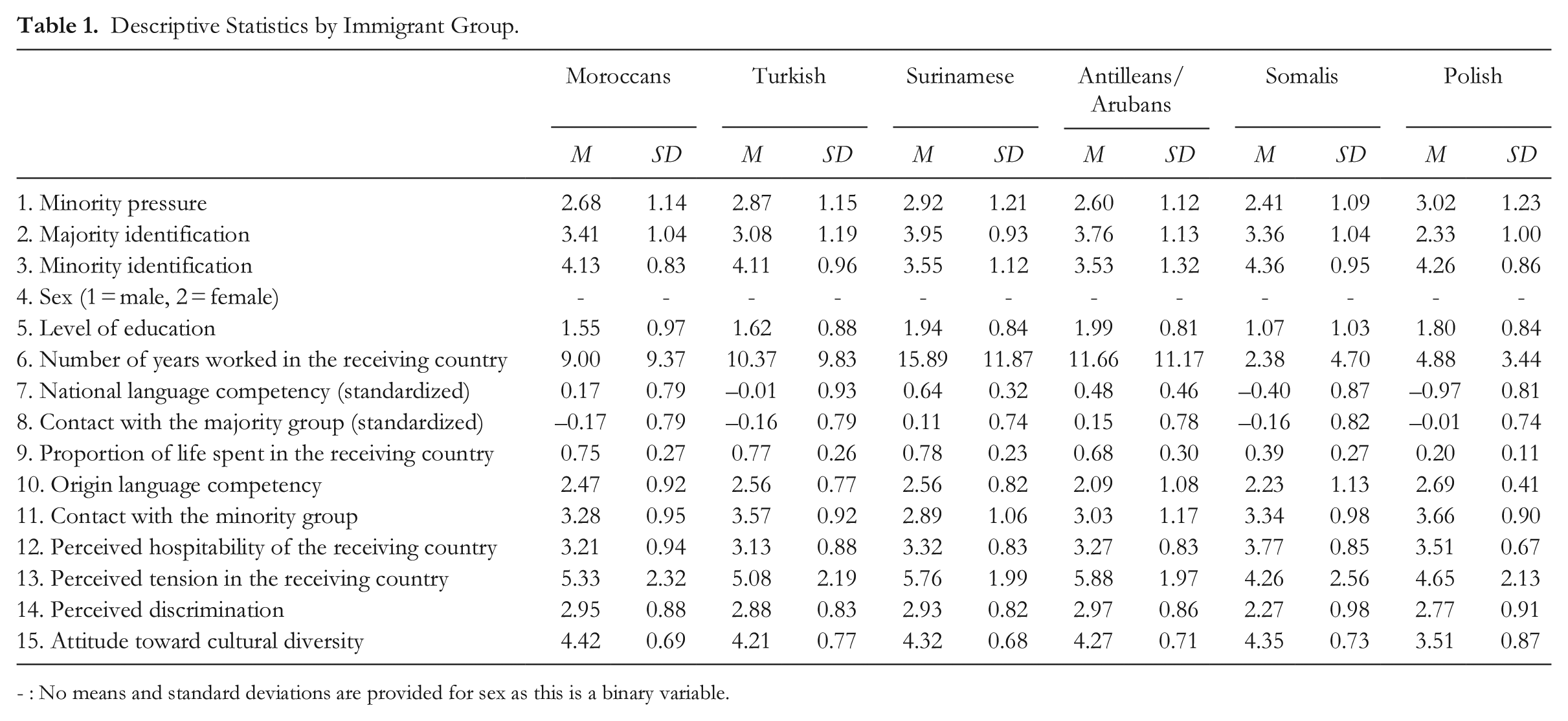
- : No means and standard deviations are provided for sex as this is a binary variable.
Correlation Between Main (Minority Pressure, Majority Identification, Minority Identification) and Explanatory Variables.
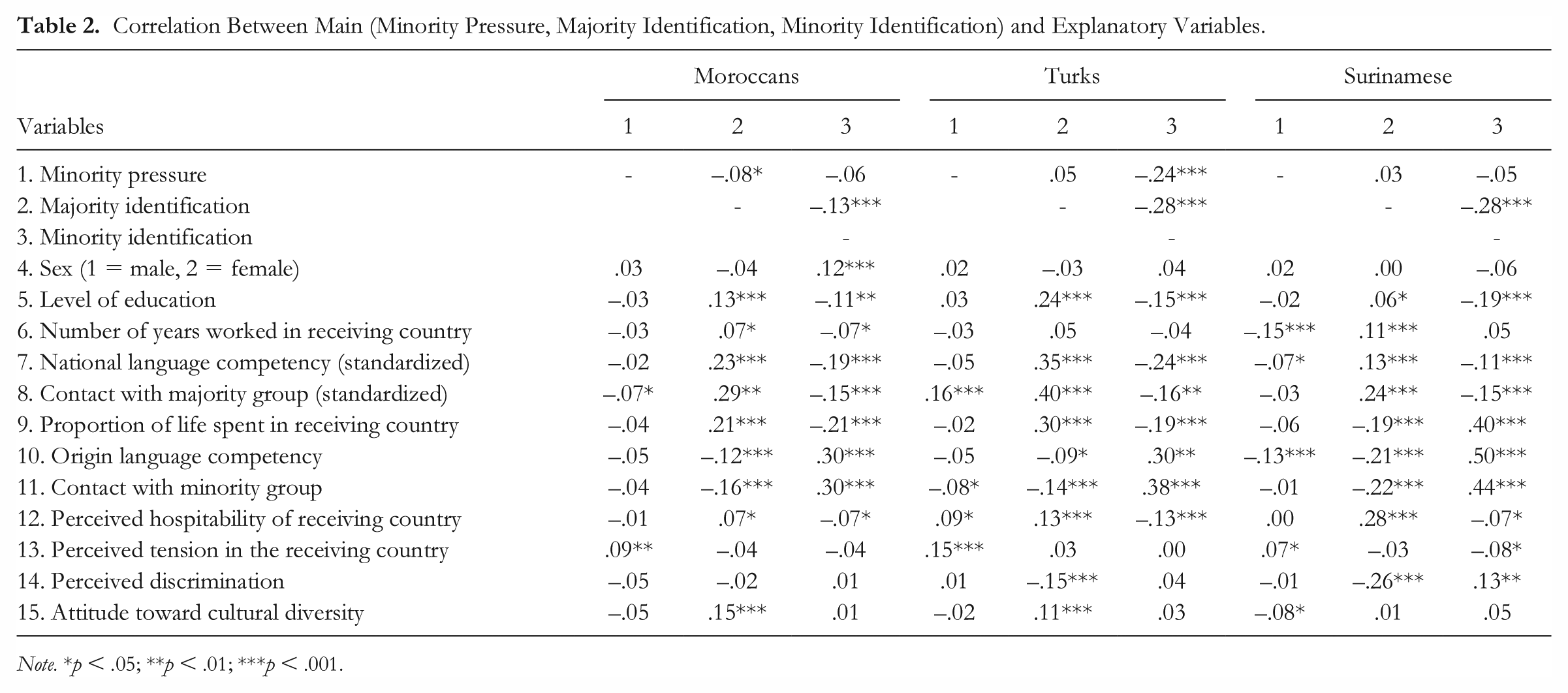
Note. *p < .05; **p < .01; ***p < .001.
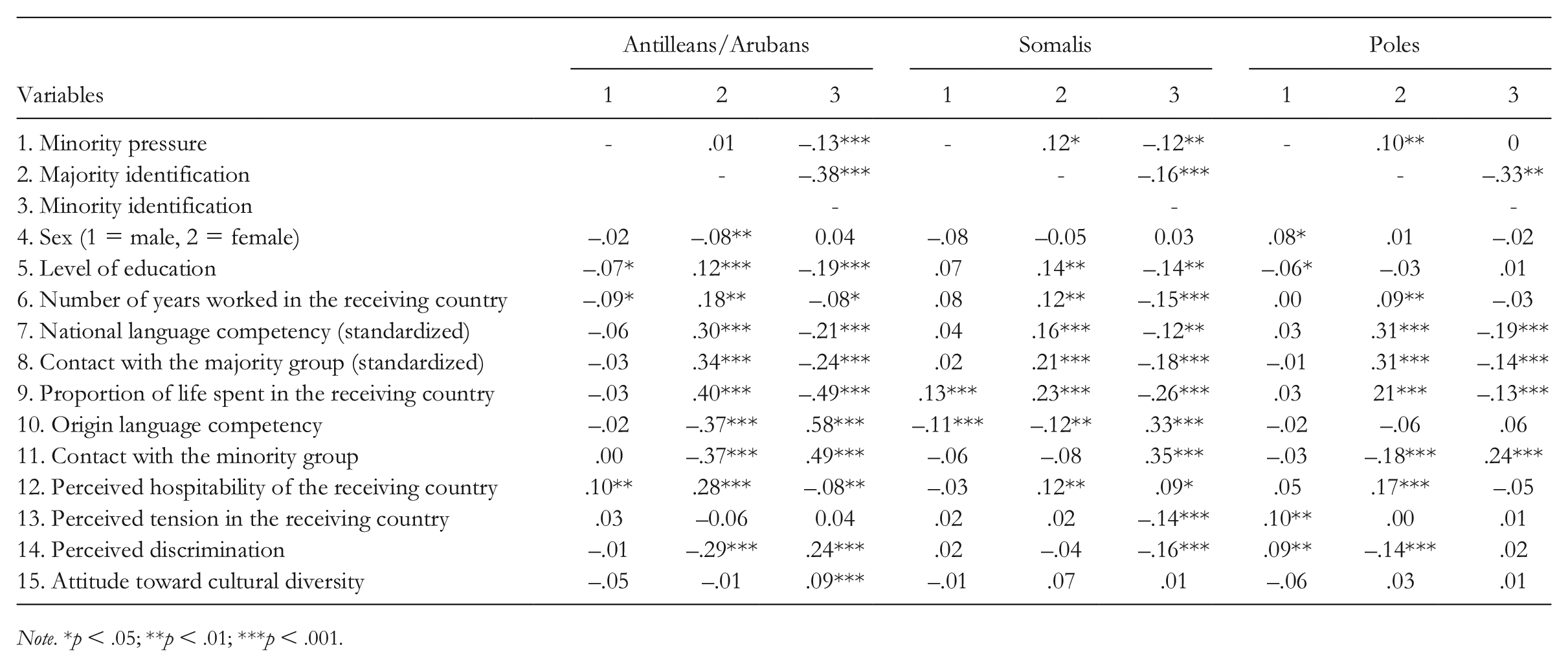
Note. *p < .05; **p < .01; ***p < .001.
Most of the correlations in Table 2 between minority pressure and the explanatory variables (i.e., orientation toward the majority group, orientation toward the minority group, and perceived openness to diversity) were small (all rs < .18), and none were significant across all groups. Majority and minority group identification were generally negatively related to each other, but for some groups more strongly so (e.g., Antilleans/Arubans) than for others (e.g., Moroccans). Interestingly, most correlations between the explanatory variables and majority identification mirrored those between the explanatory variables and minority identification.
Predicting Perceived Pressure
To test H1 to H3, a linear regression was undertaken in SPSS. 4 As illustrated in Table 3, participants with lower levels of education experienced greater pressure, potentially because they obtained more employment opportunities in their minority community. Beyond demographic variables, in line with H1, a greater proportion of life spent in the receiving country was associated with more perceived pressure from the minority group, suggesting that participants who had spent the majority of their lives in the receiving country may also display more behaviors that elicit minority pressure. However, unlike we hypothesized (H1), other forms of orientation toward the majority were associated with less pressure. Specifically, those who had more opportunity for contact through more years worked in the receiving country perceived less minority pressure. The time spent in employment alongside the majority culture may put these individuals in fewer situations where they experience minority pressure.
Regression of Minority Pressure.
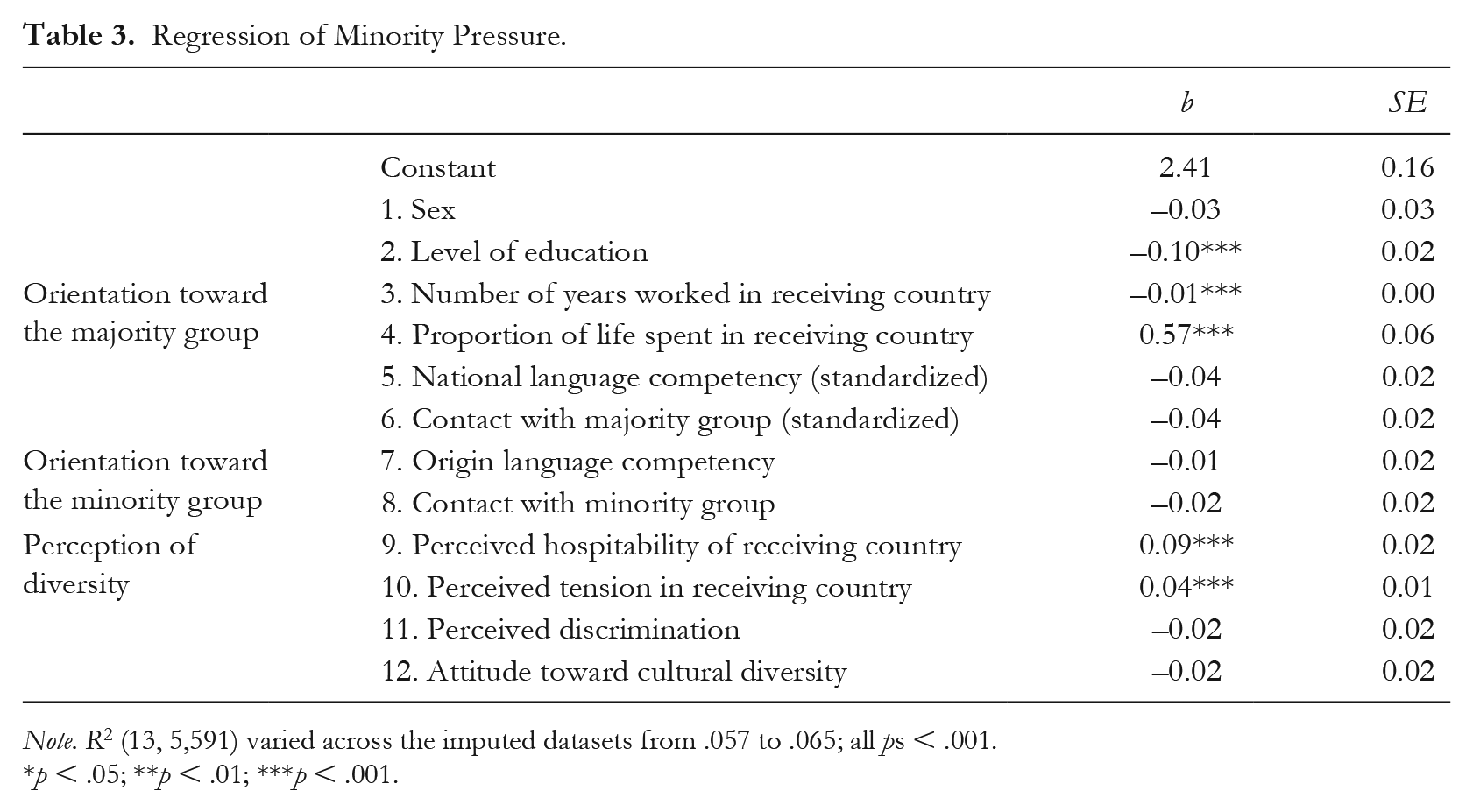
Note. R2 (13, 5,591) varied across the imputed datasets from .057 to .065; all ps < .001.
p < .05; **p < .01; ***p < .001.
Concerning orientation toward the minority group, neither origin language competency nor contact with the minority group were significantly associated with minority pressure. This was contrary to H2 and indicated that perceptions of minority pressure may not necessarily be driven by being oriented toward the minority group when simultaneously accounting for orientation toward the majority and toward diversity. Lastly, in line with the institutionalization hypothesis (H3b), perceived hospitability of the receiving country was associated with greater minority pressure. However, in line with the threat hypothesis (H3a), greater tension between ethnic groups was accompanied by more minority pressure.
Having accounted for the main explanatory factors of minority pressure, we tested whether the six immigrant groups differed from each other in levels of perceived pressure after controlling for these explanatory variables. An ANCOVA (in SPSS) tested the differences in group pressure among the immigrant groups while controlling for the variables that significantly predicted pressure. As ANCOVAs are not equipped to consider multiple imputations, the pooled results of the imputation are presented below. As illustrated in Table 4, of the previously identified explanatory variables, the two assessing orientation toward the majority group (i.e., years worked in the receiving country, and proportion of life spent in the receiving country) and the two assessing perceived diversity climate (i.e., perceived hospitability and perceived tension in the receiving country) continued to predict differences in minority pressure across groups. Importantly, these statistical effects were relatively small, compared with the effect of minority group differences. To examine which groups differed from each other, Tukey post hoc analyses were performed. As can be seen in Table 5, Antilleans/Arubans experienced the least pressure, while Somalis experienced the most. The means of perceived pressure of the remaining groups were between the values of these groups. Somalis and Turks experienced similar pressure, and Turks also experienced similar levels of pressure to Moroccans. Somalis, Turks, and Moroccans experienced more pressure than Polish, Surinamese, and Antilleans/Arubans, these three not being significantly different from one another.
Results From ANCOVA of Minority Pressure.
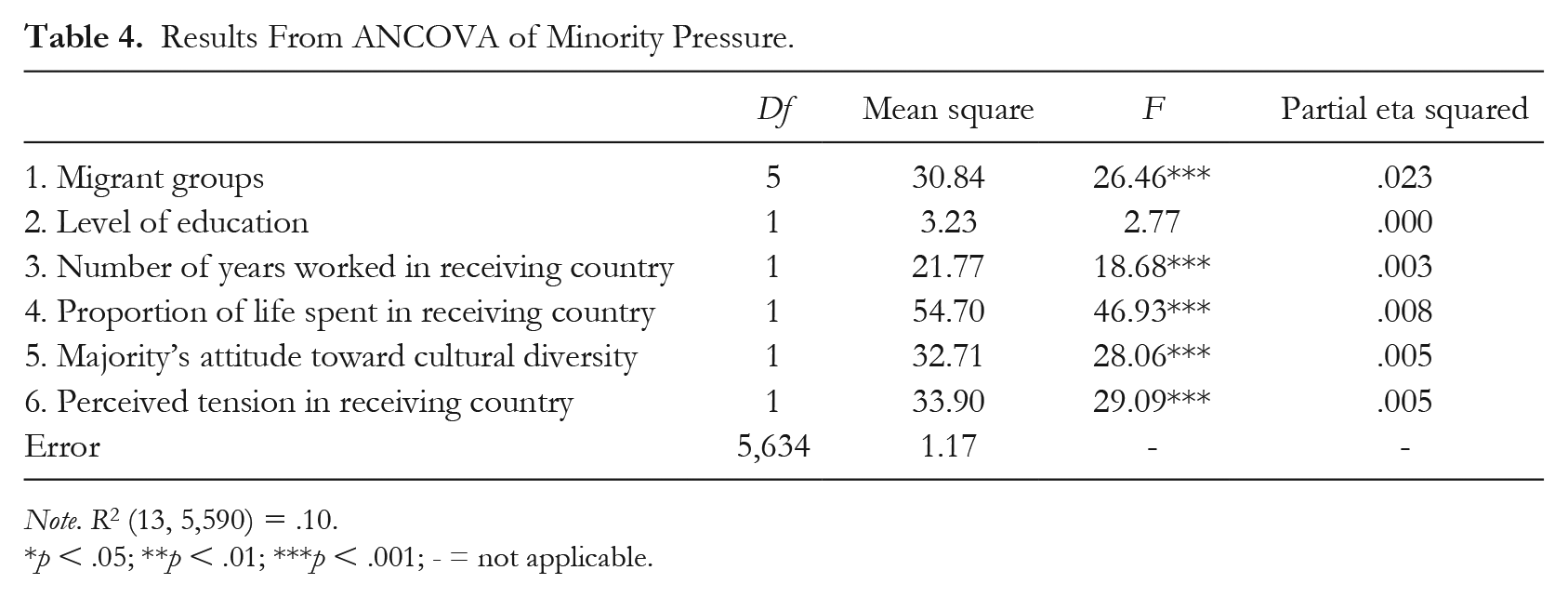
Note. R2 (13, 5,590) = .10.
p < .05; **p < .01; ***p < .001; - = not applicable.
Adjusted Means of Pressure per Group.
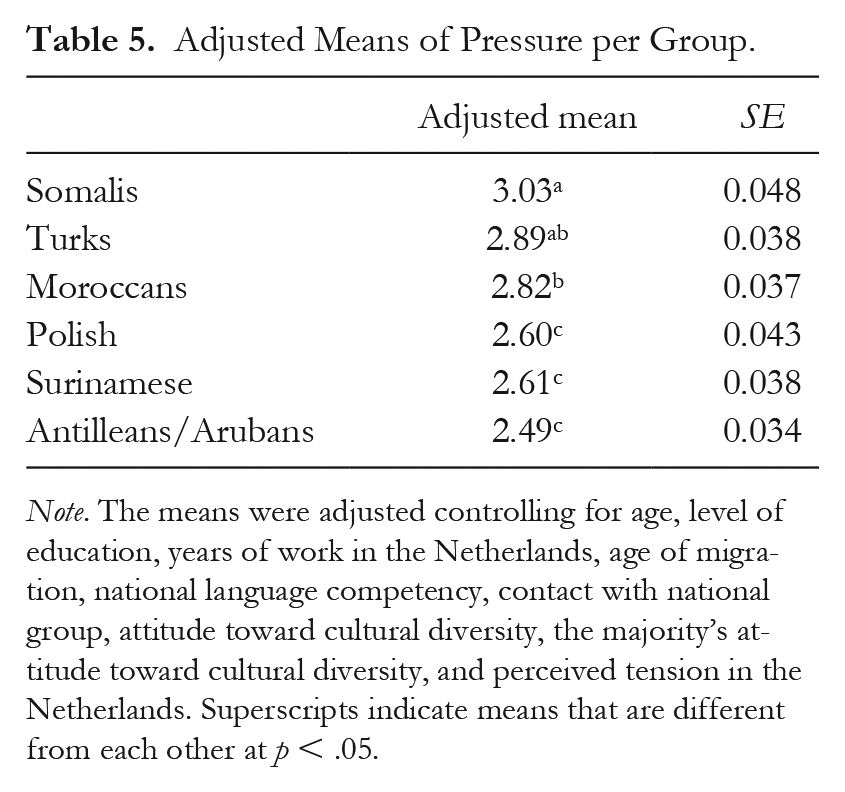
Note. The means were adjusted controlling for age, level of education, years of work in the Netherlands, age of migration, national language competency, contact with national group, attitude toward cultural diversity, the majority’s attitude toward cultural diversity, and perceived tension in the Netherlands. Superscripts indicate means that are different from each other at p < .05.
In summary, we found minimal support for H1 (only for proportion of life spent in the receiving country) and no support for H2. In fact, contrary to H1, orientation toward the majority group in terms of years worked in the receiving country was more commonly associated with less perceived minority pressure. We also found partial evidence for H3b (the institutional hypothesis, with the majority’s attitude toward cultural diversity) but also partial support for H3a (the threat hypothesis, with perceived tension in the receiving country). Moreover, we found evidence that different migrant groups experienced different levels of pressure beyond individuals’ orientations toward the majority group and perceived diversity toward the group.
The Relation Between Minority and Majority Group Identification: The Moderating Role of Pressure
To test whether the relation between majority and minority identification was moderated by minority pressure, such that the relation would become more positive as pressure increased (H4), a multigroup regression analysis was conducted in Mplus with majority identification as dependent variable and origin country as grouping variable. 5
The constrained model had acceptable fit: χ2 (40) = 150.26, p < .001, root mean square error of approximation (RMSEA) = .053 [0.045, 0.063], comparative fit index (CFI) = .89, standardized root mean square residual (SRMR) = .027, with the CFI slightly below what is recommended. Table 6 shows that when the groups are constrained to have the same paths, individuals with stronger minority identification identified less with the majority group. Neither perceived pressure nor its interaction with minority identification predicted majority identification. This first constrained model was compared with a second model in which the effects of minority identification, minority pressure, and their interaction were allowed to vary across groups. This second model (χ2 (25) = 70.07, p < .001, RMSEA = .043 [0.031, 0.055], CFI = .96, SRMR = .017) had a significantly better fit: (Δχ2 (8) = 80.19, p < .001) compared with the constrained model, with the CFI within standards, indicating that this model should be favored over the constrained model. An examination of the associations across groups (Table 6) revealed two sets of findings.
Moderation Analyses Predicting Identification With Majority Group.
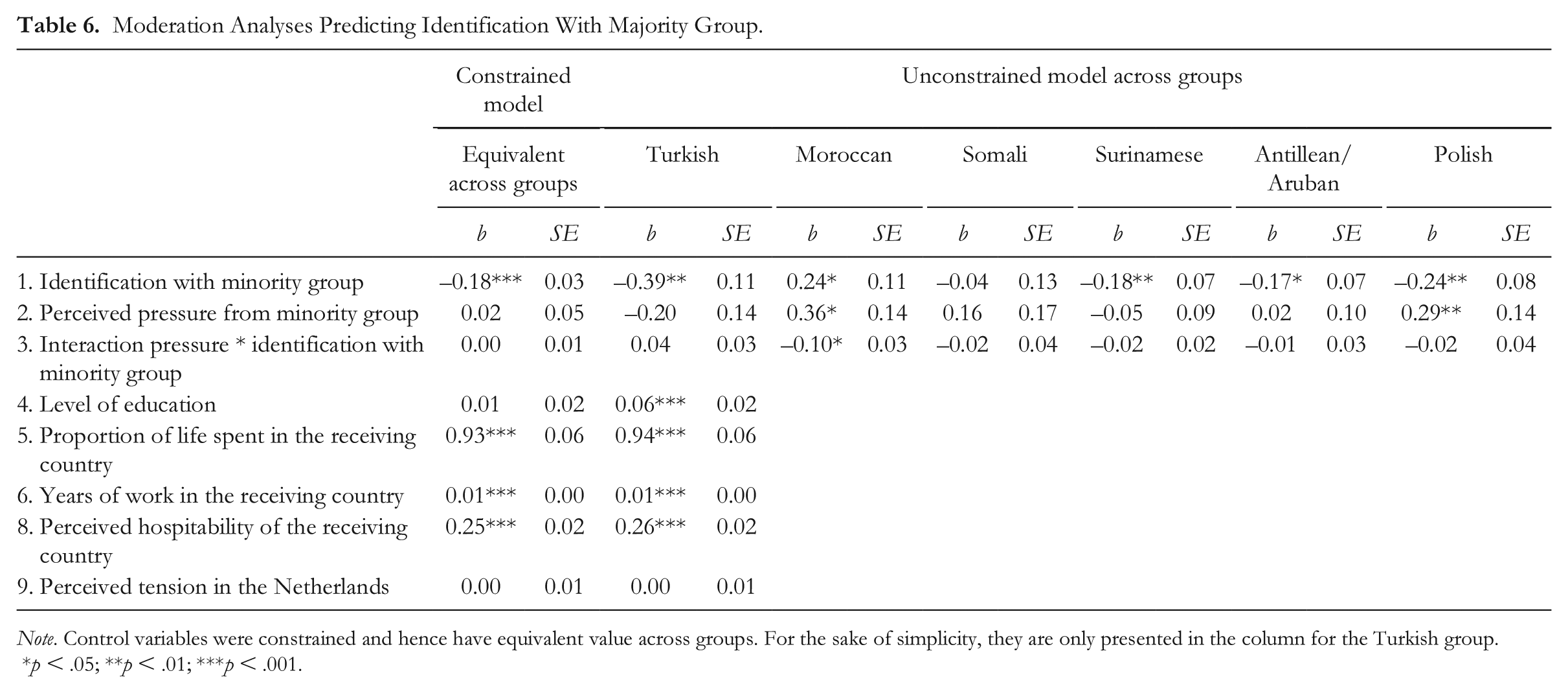
Note. Control variables were constrained and hence have equivalent value across groups. For the sake of simplicity, they are only presented in the column for the Turkish group.
p < .05; **p < .01; ***p < .001.
First, contrary to what was expected (H4), the association between identifications was negative under high minority pressure across all minority groups. Second, the interaction between minority identification and pressure was significant only for Moroccans. Again, contrary to what was hypothesized (H4), and as illustrated in Figure 1, the association between group identifications became more positive as individuals experienced less minority pressure. In Figure 2a to 2c, we see that Somalis, Arubans/Antilleans, and Polish, respectively, tended to follow a similar pattern in that the largest negative slope was for those who experienced greater minority pressure, though their interaction was not significant. Overall, and in opposition to H4, we observed that for Moroccans, lower pressure was associated with a more positive association between identities. For all other groups, the nonsignificant interaction between minority pressure and minority group identification suggested that the identification pattern remained subtractive regardless of minority pressure (again, contrary to H4).
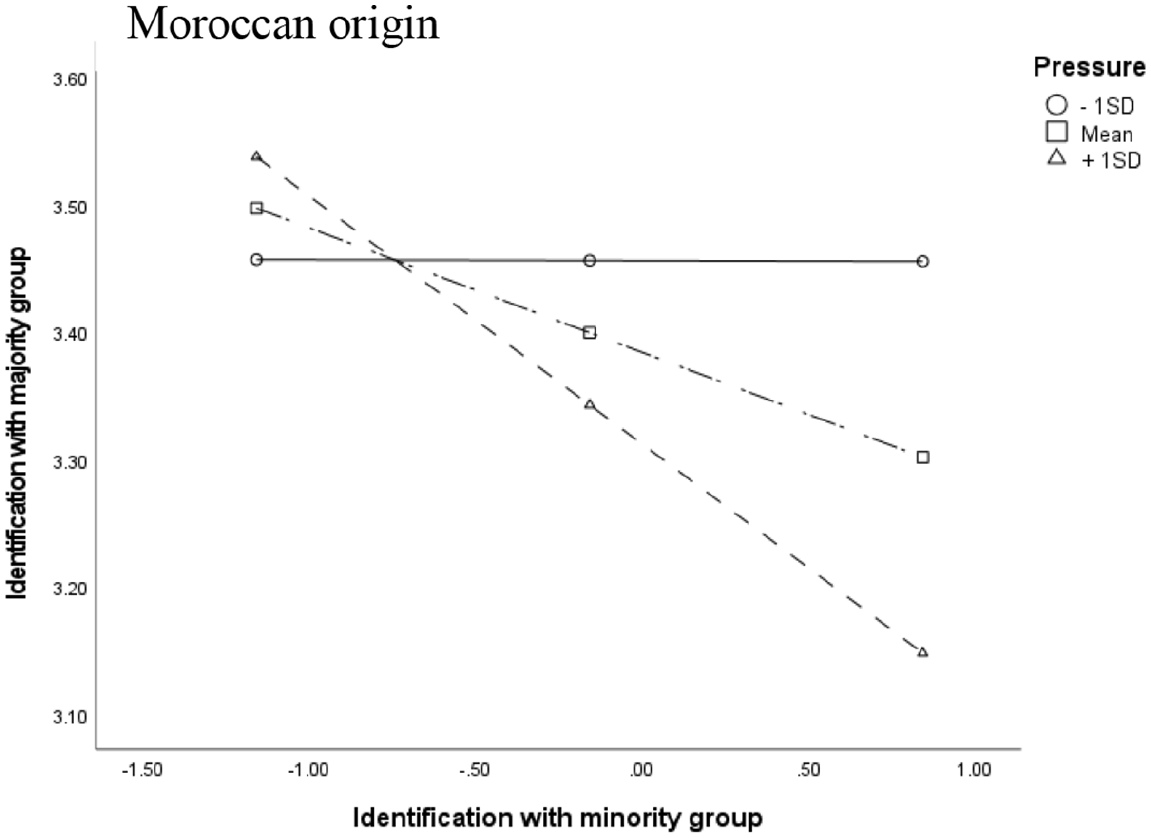
Interaction for Moroccans.
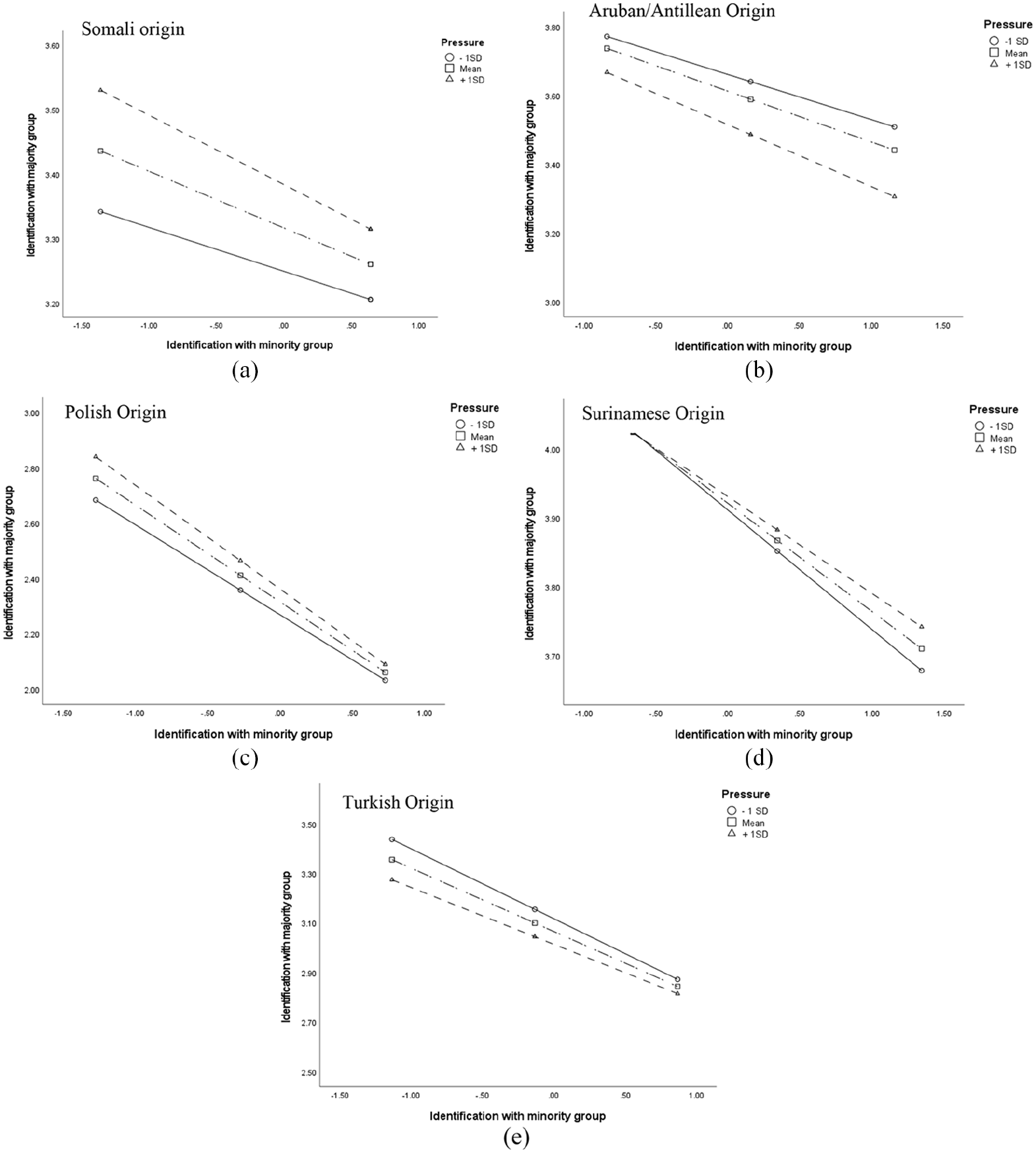
Interactions for (a) Somalis, (b) Arubans/Antilleans, (c) Poles, (d) Surinamese, and (e) Turks.
Discussion
In this study, we sought to examine how minority members’ orientations and perceptions of diversity were associated with perceived pressure to conform to minority group norms, and its potential consequences for identity processes. To do this, we employed a large representative sample of six immigrant-origin groups, which enabled us to test variations in the degree of pressure these groups experienced. Additionally, we examined the role of experienced minority pressure for minority members’ patterns of identification, specifically the association between their minority and Dutch identification (cf. Fleischmann & Phalet, 2016). Whereas most previous research focuses on the role of intergroup relations with the majority and how this impacts identification patterns among immigrant-origin minorities, our study adds to previous literature with its focus on within-minority dynamics.
Regarding our first research aim, we found that differences in orientations toward the minority group were unrelated to the perception of minority pressure. Against our expectations (H2), those who were more proficient in the origin language and had more contact with minority group members—and who therefore might spend more time with, and be more sensitive toward normative messages shared within the minority community—did not experience more pressure. This null finding also implied that a lack of origin language skill and coethnic contact were not necessarily met with sanctions from the minority group in this context (e.g., norm talk or other forms of policing of ingroup boundaries; Keblusek et al., 2017). In contrast, minority members’ orientations toward the majority group were related to perceived pressure, but the direction of the association was not always in line with our expectations. In line with H1, proportion of life spent in the receiving country was associated with more perceived pressure, suggesting that individuals who have spent a greater majority of their lives in the receiving country have adopted the cultural behaviors and norms of this country, and may be displaying them more often, thus eliciting greater minority pressure. Arguably, the proportion of life spent in the Netherlands indicated a generational difference, which suggested that second-generation migrants (and those who migrated at younger ages) may be more prone to perceiving minority pressure from what first-generation migrants interpret as conventional social relations (Deaux, 2006).
However, and in contrast to H1, other aspects of majority orientation—specifically, a longer work history in the Netherlands—was associated with less minority pressure. This unexpected finding suggests that more time spent with majority members resulted in fewer opportunities to be subjected to minority pressure, and thus that a stronger orientation toward the majority group may make minority members less sensitive to intragroup dynamics within their minority group.
In terms of perceived diversity climate, we found evidence for H3b, with perceived majority attitudes toward cultural diversity being associated with greater minority pressure. This supported the institutionalization hypothesis, that openness to diversity in the majority group enabled political and social institutions of minority groups, which also offered the space and social structure for the expression of minority pressure. However, as participants perceived more tension between different groups, they were also more likely to perceive pressure from minority groups, in line with H3a. The positive relations between minority pressure and both openness and tension may reflect the ambiguity that often comes with being in a pluricultural society, and that having groups coexist can often be accompanied with tensions between them. In contrast, a context in which tensions exist without institutional support may reflect an assimilationist society that solely threatens minority groups and their identities. Further research is necessary to understand how different aspects of perceived openness toward cultural diversity, including those not measured in this study (e.g., multiculturalist policies, tolerance), relate to minority pressure.
Interestingly, we found considerable differences between the six immigrant-origin groups when exploring their respective ingroup pressure. Moreover, these differences were not substantially reduced when accounting for minority members’ sociodemographic background, orientations toward the majority, and openness to diversity. This implied that the available measures did not fully capture group differences in perceived minority pressure, and that future research should address the sources of the group differences we have unearthed.
Previous comparisons of Turkish and Moroccan communities in the Netherlands suggested that the former is more socially cohesive (e.g., Fennema & Tillie, 1999). Our findings were not in line with this notion, as we found that individuals from Turkish and Moroccan origins did not differ in terms of experienced pressure. The highest levels of pressure were found among the smallest immigrant-origin community, the Somalis, who are most vulnerable and have a particularly low status in the Netherlands. Moreover, the larger comparative scope of our analysis documented that the levels of minority pressure were still relatively high among Turkish- and Moroccan-Dutch, compared with Surinamese, Antillean/Aruban, and Polish minorities. These group differences might be related to differences not currently accounted for, such as differential migration motives and histories, differences in group size, and the geographic concentration of minority groups. A large minority group that is more dispersed across the country might exert less pressure on members than a small group that is residentially concentrated in specific areas; these structural factors, which have an impact on language vitality (Giles et al., 1977), may also impact a minority group’s ability to influence their members through normative pressure. Another factor that could be examined in future research is the level of social cohesion in the origin country and among minority members (e.g., Cheong, 2007) and how cohesiveness at both levels (majority and minority groups) may relate to perceived minority pressure. In any event, we interpret the group differences in perceived minority pressure as the starting point for future research into the reasons why group dynamics vary in this respect, and not as a sign of inherent and essential cultural differences between immigrant-origin groups.
Regarding our second research aim, the analyses showed no support for H4, that greater perceived pressure to conform to minority group norms is associated with an additive or coherent pattern of identification. Nevertheless, our multigroup analyses revealed both similarities and differences between groups. In all six groups, we found a subtractive or conflicting pattern of identification (i.e., negative association between identities) at high levels of pressure. For most of these groups (minorities with an Antillean/Aruban, Polish, Somali, Surinamese, or Turkish background), the association remained negative at all levels of minority pressure, which implied that, for these groups, perceived pressure was unrelated to their identification patterns. However, for Moroccan-Dutch, the associations between identities were less negative as minority pressure decreased, contradicting H4. The association between Dutch and Moroccan identification even turned positive when they perceived little pressure to conform to Moroccan group norms. These results suggested that, in this group, normative pressure acted similarly to discrimination from majority members, in that perceived pressure is experienced as a threat to one’s dual membership and is hence associated with a subtractive (instead of an additive) pattern. This also suggested that harmonious and blended multiple identification is more difficult to achieve in some groups when minority groups are emphasizing conformity—which presumably limits their members’ opportunities to enact and identify with their minority and Dutch identity simultaneously (Klein et al., 2007; Wiley & Deaux, 2010).
The finding that minority pressure was associated with a greater subtractive pattern among some groups also reflects earlier research on the role of majority group attitudes and behaviors for minority members’ identification patterns, where perceptions of discrimination (Fleischmann & Phalet, 2016; Fleischmann et al., 2019) and lack of subgroup respect (Fleischmann & Verkuyten, 2016) were found to undermine the positive association between minority members’ identifications. Together, these results indicated that acceptance of the more complex, blended identity structures of dual identifiers can occur within both majority (as demonstrated by previous research) and minority groups (as illustrated in ours). Our study, focusing on identification patterns as outcome, thus ties in with other work examining the consequences of patterns of identification for outcomes such as school achievement, where dual identifiers have been found to be more susceptible to stressors such as perceived discrimination and stereotype threat (Baysu & Phalet, 2019; Deaux, et al., 2007) as well as identity conflict (Spiegler et al., 2021). Altogether, this is an important contribution to the burgeoning literature on multiple identification and biculturalism, which has identified many benefits of “being both” in terms of, for instance, cognitive flexibility (e.g., Spiegler & Leyendecker, 2017), social networks (e.g., Jugert et al., 2018), and intergroup relations (Levy et al., 2017). Our findings add more support to the claim that, while being potentially beneficial and productive, more complex identity representations and group orientations are structured by majority and minority group dynamics.
Strengths and Limitations
By making use of the existing Survey Integration Minorities (2015), we were able to benefit from nationally representative and large-scale comparative data from six immigrant-origin groups, contributing to the external validity of the present research. This, however, also has its limits. Specifically, we had single-item measures for social identification. However, the use of single items to measure identification is not uncommon in large-scale research (e.g., Fleischmann & Phalet, 2016) and a single item can reliably measure social identification (Postmes et al., 2013). The limitations in the available measures were probably more severe for the key construct under study, perceived minority pressure, which we also assessed with a single item. A larger number of measures would have allowed us to examine the measurement equivalence across groups in more detail, and to explore which aspects contributed more or less to a sense of being put under pressure by fellow minority group members. Future research could develop more fine-grained measures of minority pressure, as well as other, less negatively valenced types of intragroup dynamics (e.g., explicit affirmation of more complex identity constructions; cf. Fleischmann & Op de Weegh, 2021). This type of work would also benefit from more information about the specific group context, such as coethnic residential concentration, the presence of enclave-like economic structures, and a group’s position in the perceived ethnic hierarchy (Verkuyten et al., 1996). In sum, both small-scale studies that focus on a particular minority group in a particular context, as well as the large-scale comparative research of which the current study is an example, can contribute to our understanding of how and when these understudied intraminority group dynamics matter.
Conclusion
Altogether, our research demonstrated the need to better understand the sources and consequences of minority pressure. While a stronger orientation toward the majority group is associated with less minority pressure, elements of a positive diversity climate appeared to increase its presence. Importantly, immigrant-origin communities differed in the level of pressure to conform to group norms that their members experienced, demonstrating great intergroup variability. Although perceived pressure is not the only factor that contributes to subtractive or conflicting identification patterns (cf. Cárdenas et al., 2019; Fleischmann & Phalet, 2016), we found this pattern at high levels of perceived pressure among Moroccan-Dutch, and a tendency for this, though not significant, among three other groups. This finding ties in with previous work focusing on majority–minority group dynamics and suggests that minority communities also contribute to the perceived incompatibility of multiple identities. For the documented benefits of dual identification to be reaped, both majority and minority groups need to open up the definition of their group and accept dual identifiers as equal, rightful, and full-fledged rather than uncommitted, liminal, or half-hearted members.
Supplemental Material
sj-docx-1-gpi-10.1177_13684302221138035 – Supplemental material for “They Keep an Eye on You”: Minority Pressure and its Implications for Dual Identity Among Six Immigrant Groups in the Netherlands
Supplemental material, sj-docx-1-gpi-10.1177_13684302221138035 for “They Keep an Eye on You”: Minority Pressure and its Implications for Dual Identity Among Six Immigrant Groups in the Netherlands by Diana Cárdenas and Fenella Fleischmann in Group Processes & Intergroup Relations
Footnotes
Authors’ note
Fenella Fleischmann is now affiliated to University of Amsterdam, Amsterdam, the Netherlands.
Funding
The author(s) declared the following potential conflicts of interest with respect to the research, authorship, and/or publication of this article: The first author was supported during this research by a scholarship (Fonds de recherche du Québec: Société et culture), grant number: 2018-B3-209603.

Supplemental material
Supplemental material for this article is available online.
Notes
Author biographies
References
Supplementary Material
Please find the following supplemental material available below.
For Open Access articles published under a Creative Commons License, all supplemental material carries the same license as the article it is associated with.
For non-Open Access articles published, all supplemental material carries a non-exclusive license, and permission requests for re-use of supplemental material or any part of supplemental material shall be sent directly to the copyright owner as specified in the copyright notice associated with the article.
