



Abstract
We describe a team game that implements a social dilemma between ingroup cooperation and defection by self-enriching outgroup exchange. We test hypotheses derived from social identity theory about how group status and belief about individual mobility and group mobility affect exchange behavior. We ran 60 experimental team games between rich and poor groups under one of four experiment conditions in a fully crossed design, manipulating the presence or absence of individual mobility and group mobility beliefs. Each game was played over 10 rounds in which participants generated wealth for self or group by allocating tokens to either the ingroup or outgroup bank or to outgroup individuals. We identify 10 exchange strategies via latent class analysis and show how class membership and resulting perceptions of group trust are predicted by the experimental conditions. The results show that rich status and individual mobility promote defecting exchanges with outgroup individuals, and that behavior under individual mobility beliefs weakens ingroup trust. In contrast, intergroup competition of the group mobility condition did not affect ingroup cooperation versus defection or trust.
Keywords
Belonging to a group can result in conflicts between personal interests, group interests, and even the collective interest of society as a whole. Choices must be made to balance these conflicting interests. In some situations, such as when nations are at war, groups require large sacrifices, which their members willingly offer. In other situations, individuals might defect or even capitulate en masse. Group members collectively benefit from self-sacrificing behavior, and thus self-interests are often well-served by ingroup cooperation (De Dreu et al., 2014). However, the success of the group as a whole, and the individual motivation to sacrifice for the collective, are undermined by traitors, spies, informants, and others who seek to enrich themselves by collaborating with outgroups. Groups therefore often prohibit intergroup collaboration and ostracize those who practice it (cf. Feinberg et al., 2014).
Research on social dilemmas has been primarily concerned with the conflict between self-interest and group interest (Van Lange et al., 2013) and how both can be secured through sacrificial “parochial altruism,” favoring ingroup members over outgroup members in exchange, trust, and generosity (Balliet et al., 2014; Rusch et al., 2016). This article focuses attention on exchange with an outgroup and the dilemma that can arise between altruistic cooperation with the ingroup and self-enriching collaboration with outgroup individuals. We describe an experimental team game developed to investigate the conditions under which group members will pursue self-interested exchanges with outgroup members at the expense of the ingroup. The game allows participants to: (a) collectively enrich themselves by investing in an ingroup bank; (b) act generously by donating to an outgroup bank; or (c) personally enrich themselves by trading with outgroup individuals. We study the allocation strategies used by members of experimentally constructed rich and poor groups in team games played under conditions favoring either intragroup or intergroup competition.
Groups, Situations, and Cooperative Exchange
An extensive literature on “parochial altruism” has shown that individuals cooperate more readily with ingroup than outgroup members in a variety of trust games and social dilemmas (Balliet et al., 2014). For example, in a rare field experiment, Goette et al. (2006) found that Swiss military trainees were more willing to cooperate in a simultaneous prisoner’s dilemma with randomly assigned members of their own platoon than with partners from other platoons.
The underlying motives for parochial altruism have been hotly debated (Rabbie et al., 1989; Turner & Bourhis, 1996). Social identity theorists attribute ingroup favoritism to the dynamics of social comparison and ingroup identification, whereas critics have argued that its provenance is ultimately in self-interest. Bounded reciprocity theory argues that social categorization affects intragroup interdependencies, promoting an expectation that ingroup members will be favored. Individuals conform to this expectation for the fear that they will be punished and will suffer reputational and economic penalties if they do not (Yamagishi & Kiyonari, 2000; Yamagishi & Mifune, 2016). When the expectation to profit from ingroup altruism is removed, the preference for the ingroup over the outgroup disappears (Jordan et al., 2017) and we may even observe traitorous self-interested cooperation with outgroup members (Gaertner & Insko, 2000; Locksley et al., 1980; Rabbie et al., 1989).
Expectations of ingroup reciprocity and the resulting levels of ingroup cooperation also depend on intergroup interdependencies; that is, situated relations between groups (De Dreu et al., 2020). Intergroup competition, for example, raises the stakes for self-interested behavior, which could result in a catastrophic loss for the group as a whole. If soldiers in battle fail to sacrifice personal interest for the group, their losses in defeat may far exceed the individual costs of cooperation (cf. Dawes, 1980). Researchers have used team games to study such intergroup interdependencies. One paradigm involves creating multi-level social dilemmas in which group members engage in simultaneous intragroup and intergroup competition. In intergroup prisoners’ dilemmas, for instance, individual players are tempted to withhold contributions to the group’s cause, but such “free-riding” or defection risks greater losses if it spreads and causes the team to lose the intergroup competition. There is ample evidence that intergroup competition and conflict promote intragroup cooperation, enhancing parochial altruism (Erev et al., 1993; Gunnthorsdottit & Rapoport, 2006; Halevy et al., 2012). Intergroup competition can also foster “outgroup spite,” which is costly individual behavior aimed at actively harming the outgroup (Weisel & Zultan, 2021).
Bornstein’s (2003) review showed that the level of ingroup cooperation depends on the structural characteristics of the intergroup competition. Individuals are almost twice as likely to cooperate with ingroup members in an intergroup than single-group prisoners’ dilemma game (Bornstein & Ben-Yossef, 1994), and are far more likely to cooperate with fellow ingroup members in intergroup prisoner’s dilemma games with all-or-nothing “step-level” rather than continuous payoffs (Bornstein, 1992). Recent work has unpacked some of the moderators of this effect (Sheremeta, 2018). Individuals are more willing to self-sacrifice for the group for reasons of ingroup defense than for outgroup aggression (De Dreu et al., 2016), and egalitarian groups are more easily and successfully able to cooperate than hierarchically structured groups (Van Bunderen et al., 2018). Violations of ingroup cooperation norms in the context of intergroup conflict elicit “moral emotions” of anger and guilt (Puurtinen & Mappes, 2009) and promote costly punishment of ingroup members, which can ultimately benefit the group’s competitive advantage (Sääksvuori et al., 2011).
Taken as a whole, this work shows strong bias toward ingroup cooperation, which is strengthened when competitive intergroup relations create a sense of common fate and alter the payoff structure. The research also describes the conditions under which group members will pursue selfish interests rather than altruistic cooperation. However, this literature says almost nothing about outgroup cooperation. The literature on parochial altruism, ingroup favoritism, and bounded reciprocity focuses almost entirely on ingroup exchange, reputation, trust, and punishment. Similarly, the literature on intergroup competition has focused primarily on the effects of cooperation among individuals within variously structured and motivated groups. Consideration of interactions with outgroups has been limited to either universal cooperation with the entire social collective or costly acts of aggression on behalf of the ingroup (Aaldering et al., 2018; Weisel & Zultan, 2021; see reviews by De Dreu et al., 2020, 2022). Cooperation between individual members of different groups has largely fallen off the radar.
Social Status and Individual and Group Mobility Belief Systems
Social identity theory describes the structural conditions that define intergroup interdependencies and influence levels of ingroup favoritism (Tajfel & Turner, 1979, 1986). First, the theory situates intergroup competition in the context of existing social hierarchies where groups compete for the top spot. According to the theory, high-status groups derive subjective (and material) benefit from downward intergroup comparisons and exhibit ingroup bias and strong identification as they are motivated to secure their position. Many studies have confirmed the expectation that “high-status members tend to favour their own group over a lower status group but that low-status members tend to either show favoritism toward the higher status out-group over their own group or show no differential favouritism” (Bettencourt et al., 2001, p. 522; Mullen et al., 1992).
This group status effect is moderated by sociostructural conditions that impact “individuals’ belief systems about the nature and the structure of the relations between social groups in their society” (Tajfel & Turner, 1979, p. 35). The belief that the status hierarchy is illegitimate erodes ingroup favouritism among high-status group members and strengthens ingroup favouritism among low-status group members, who challenge the status hierarchy (Ellemers et al., 1993). Under these conditions, members of high-status groups may even demonstrate outgroup favouritism, either for “compensatory” motives, seeking to correct the injustice (Durrheim et al., 2016; Rubin et al., 2014; cf. Cambon & Yzerbyt, 2018), or as an attempt to reintroduce hierarchy by promoting dependence among low-status individuals on the benevolence of high-status group members (Dixon et al., 2012; Jackman, 1994).
We examine these expectations using asymmetrical team games in which members of a small rich group compete with members of a larger poor group. Given that the relative advantage versus disadvantage is unearned—it is imposed by the experimenters—we expect allocations to be dominated by illegitimacy beliefs, and so predict the following:
Hypothesis 1. Members of the rich group will give a greater proportion of their resources to poor outgroup individuals than poor-group members will give to rich outgroup members.
Social identity theory describes two other belief systems that affect biases in intergroup interaction, namely beliefs about individual mobility (IM) and group mobility (GM). IM beliefs arise where group boundaries are deemed to be permeable and individuals believe that there is a possibility of being able to exit the low-status group and join the high-status group. This belief system is associated with intragroup competition among low-status group members, disidentification with the low-status group, and bias in favor of the high-status group (Ellemers et al., 1990, 1993, 2004; Jackson et al., 1996). Under these conditions we expect that members of low-status groups will cooperate with members of high-status groups to outcompete peers in gaining individual “promotion” to the high-status group. Although most research has focused on minority groups, we expect that downward social mobility beliefs will also foster intragroup competition among high-status groups as their members try to avoid being ejected from their group and banished to the low-status group.
Hypothesis 2: IM beliefs will strengthen intragroup competition within both the rich and poor groups, decreasing investment in the ingroup bank and increasing (self-interested) allocations to out-group individuals.
GM beliefs characterize situations in which the social hierarchy is perceived to be unstable and group status is experienced as being insecure. This occurs when the status hierarchy is threatened or challenged, exposing the potential for change in the groups’ relative statuses (Tajfel & Turner, 1979). GM beliefs are often accompanied by perceptions of illegitimacy among members of low-status groups who then band together to compete with the high-status group by actively challenging the social hierarchy (Rubin et al., 2014; Turner & Brown, 1978). Social instability motivates intergroup competition among high-status groups, promoting ingroup favoritism and conflict with low-status groups.
Hypothesis 3: GM beliefs will strengthen intergroup competition and ingroup cooperation within both the rich and poor groups, increasing investment in the ingroup bank and decreasing (self-interested) allocations to outgroup individuals.
The three hypotheses above involve behaviors of self-enriching giving to outgroup individuals and/or cooperative giving to the ingroup bank. We expected that our third allocation option—giving to the outgroup bank—would be relatively infrequent, because the value given would be lost to the individual and their group, with no guaranteed returns. It thus satisfies neither the motive for ingroup cooperation nor direct self-interest. We expected that intergroup competition of the GM condition would further militate against outgroup bank giving, but that rich individuals would use it to signal benevolent generosity toward the poor.
Hypothesis 4: Allocations to outgroup banks (a) will be much smaller than allocations to ingroup banks and outgroup individuals; (b) especially in the GM condition; (c) but will be employed more frequently by members of the rich group than the poor group.
Exchange Strategies
Multiple contending behavioral norms and expectations can apply in exchange situations (e.g., Xiao & Bicchieri, 2010). Participants in minimal group studies, for example, selected allocation strategies to maximize, variously, ingroup profit, group differences, joint profit, fairness, or a combination of these goals (Diehl, 1990). Some situations allow individuals to balance contending demands by switching tactics over the course of time. Hodges and Geyer (2006) analyze the results of Asch’s classic conformity studies in these terms. Instead of enacting conformity to peer pressure, Hodges and Geyer (2006, p. 13) argue that Asch’s participants were using one of three composite strategies, defined roughly by how many conforming responses were made (few or none, some but not too many, and many). Each strategy reflects a value-pragmatic resolution of the contending values of social solidarity (agreeing with erring peers) and truth telling, enacted over the rounds of the experiment.
These observations caution against the dangers of interpreting average scores, which can mask competing strategies when consolidated in the aggregation. As Hodges and Geyer (2006) argue about the Asch study, different subgroups of the participant sample may find different solutions to the competing demands of a given situation. The overall response pattern of each subgroup represents a composite strategy for resolving conflicting goals, which we should preserve rather than reducing to a mean response for the condition. For example, giving half of one’s allocation to the ingroup bank may represent an equitable 50:50 split across groups, but the intent of the strategy would depend on whether the remaining 50% goes to outgroup individuals, the outgroup bank, or a combination of both. We use compositional analysis and latent class (or profile) analysis to identify composite allocation strategies reflecting different combinations of allocations to the ingroup and outgroup banks and to outgroup individuals. This method captures how participants combine their behaviors to satisfy different demands over the course of a game, inductively identifying distinct strategies or classes of behavior.
Trust
Exchange strategies allow individuals to project the kind of person they are by building exchange relationships with other players. Over the course of several rounds, an individual may try to build a positive reputation with ingroup members by supporting a cooperative norm of giving to the ingroup bank. The same participant may also make allocations to the outgroup to establish relationships and to elicit reciprocation from outgroup members.
We expect that, generally:
Participants will trust ingroup members more than outgroup members (Brewer, 2008).
Allocations to outgroup individuals will strengthen interpersonal trust with outgroup individuals (Tanis & Postmes, 2005).
Generalized indirect exchange enacted by contributing to ingroup bank will be more powerful in strengthening ingroup trust than reciprocated exchange with outgroup individuals (Molm et al., 2007).
Accordingly, we propose the following four hypotheses:
Hypothesis 5: Ingroup favoritism: On average, ingroup members will be trusted more than outgroup members.
Hypothesis 6: Given that we expect the rich to donate more to the poor than the poor will donate to the rich (Hypothesis 1), we expect the rich to be rated as more trustworthy by the poor than the poor are rated trustworthy by the rich (see Hackel & Zaki, 2018).
Hypothesis 7: Given that we expect intragroup competition in the IM condition to decrease allocations to the ingroup bank and increase allocations to outgroup individuals (Hypothesis 2), we expect IM beliefs to weaken ingroup trust.
Hypothesis 8: Given that we expect intergroup competition in the GM condition to increase allocations to the ingroup bank and decrease allocations to outgroup individuals (Hypothesis 3), we expect GM beliefs to strengthen ingroup trust.
Method
Sample and Design
Four hundred and eighty student volunteers participated in the study, but one withdrew, 1 leaving a final sample of 479 (151 females, 325 males, 3 of undisclosed gender; mean age = 22.08, SD = 2.86). Participants were recruited by advertising the study in university residences. Volunteers were randomly assigned to one of four experimental conditions, in which they participated in a two-group, eight-player game (see below). There were 60 games in total, 15 games in each condition.
To investigate how “belief systems” of IM and GM affect cooperation within and between groups, each game was played under one of four experimental conditions in which the two experimental factors, IM and GM, were manipulated orthogonally in a fully crossed design.
Two-Group Experimental Game
We created an asymmetric team competition to study how IM and GM beliefs affect the extent to which group members invest in their own group’s bank (cooperation) or make personally profitable exchanges with individual members of the other group (defection). The game included a larger poor group (n = 5, starting balance 100) and a smaller rich group (n = 3, starting balance = 200), each with their own bank. Each game was played over 10 rounds in which participants had to allocate 10 (poor group) or 20 (rich group) tokens per round. 2 In each round, the entire quota of 10 or 20 tokens was distributed across the ingroup bank, outgroup bank, and outgroup individuals. Each player decided how much to allocate to each recipient
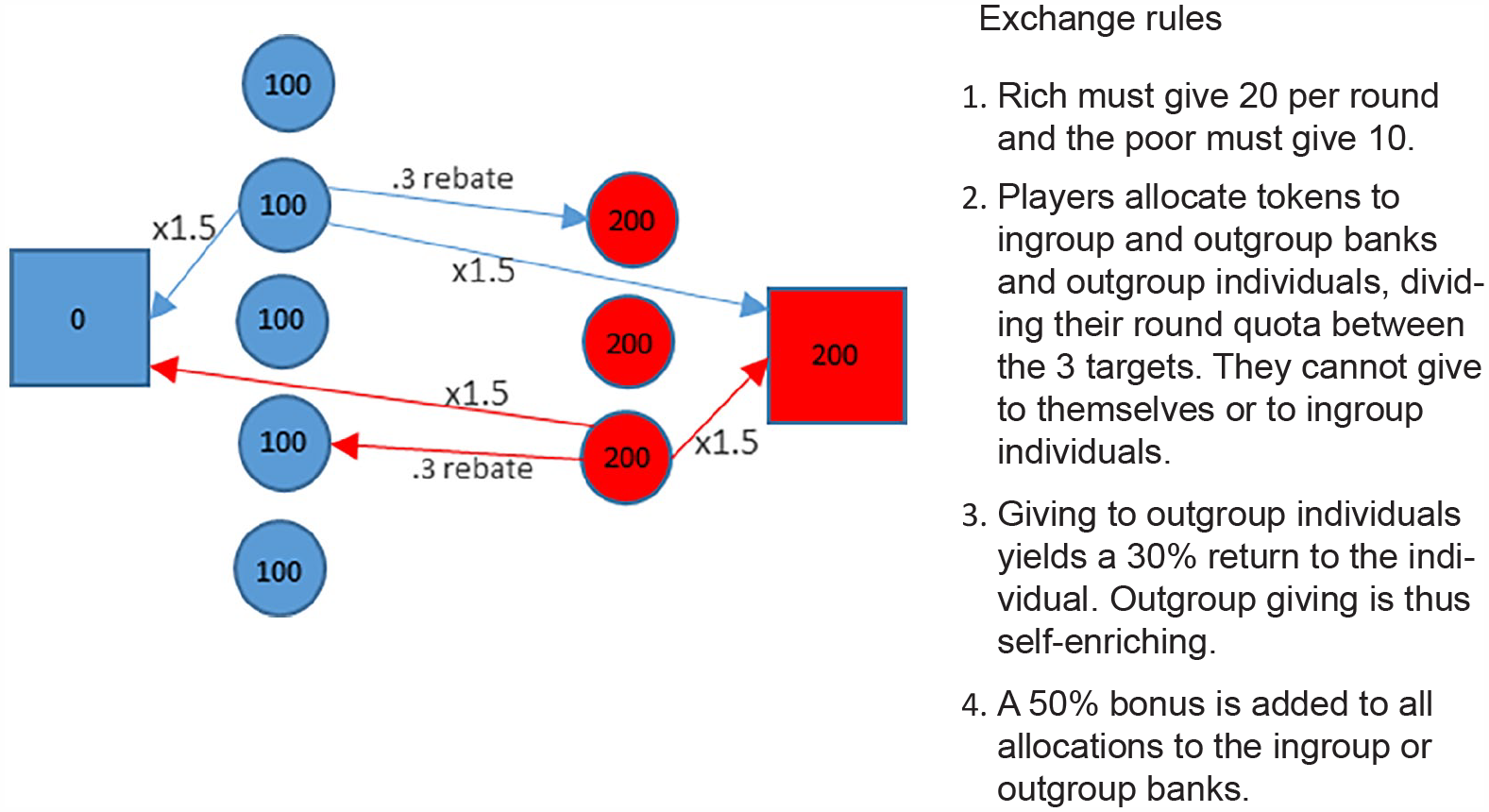
The Two-Group Inequality Commons Game Starting Setup and Rules.
We set up the interdependence structure of the game by implementing a set of bonuses and rebates. Allocations to banks were multiplied by 1.5 and the total was shared equally by members of the group to whom the bank belonged. Allocations to outgroup individuals resulted in a 30% rebate to the individual donor. Giving to outgroup members was the only way for participants to increase their personal token balance relative to other members of their ingroup. We therefore set up our experiment so that individuals could benefit personally by making direct exchanges with outgroup members, they could increase collective wealth by investing in the ingroup bank, or they could act generously by giving to the outgroup commons. The most profitable strategy was full allocation to their ingroup bank by all group members, but individuals were tempted to defect by making profitable individual allocations outside the group while the rest of the group invested in the group bank. These three allocations could elicit reciprocal cooperation. Giving to the ingroup bank would indirectly benefit the individual by creating norms and expectations for cooperation. Giving generously to the outgroup bank could elicit reciprocal favors from outgroup members in subsequent rounds. Giving to outgroup individuals could potentially trigger interindividual reciprocity. Firgure 1 illustrates the game setup.
Procedure
In line with social identity theory (Tajfel & Turner, 1979), the IM beliefs communicated to participants included the idea that group boundaries were permeable and that, depending on their individual wealth, they could potentially leave (or be ejected from) their group and join the other group to share in the outgroup bank’s wealth or poverty. The GM condition encouraged intergroup competition by conveying the belief that the status hierarchy was unstable and that the initial advantage of the rich could be transferred to the poor.
These game conditions were communicated to participants via the following instructions at the outset of the game, and then again after every second round of play.
IM beliefs: Participants were informed that the “poorest rich group member” will automatically swap places with “the richest poor group member at the end of the game and share in the relevant bank.” This incentivized beating other ingroup members (by exchanging with outgroup individuals), to win and gain promotion from the poor group and avoid losing and being demoted from the rich group. It also incentivized winning poor-group members and losing rich-group members to give to the outgroup bank.
GM beliefs: Participants were told of “a possibility of a revolution” whereby the “poor bank” will receive the total amount of “experimental dollars” in the “rich bank” at the end of the game so that the poor group becomes the rich group. This change in group status was described vaguely as occurring if “the poor bank grows at a faster rate than previous games as well as faster than the concurrent growth of the rich bank.” This incentivized team winning for both groups, achieved by making allocations to their ingroup bank rather than the outgroup bank or outgroup individuals.
IM plus GM. Participants were given both instructions and were told that if this “revolution” fails to take place, the “poorest rich group member” will swap places with “the richest poor group member at the end of the game and share in the relevant banks.” This incentivized both ingroup and intergroup competition, but also incentivized winning poor-group members and losing rich-group members to give to the outgroup bank.
No mobility. Participants received no instruction about IM or GM.
The games terminated before any IM or GM changes were actually made.
The games were hosted on the VIAPPL experimental platform (see www.viappl.org), and were played in a computer laboratory where each participant was allocated to a private cubicle. After logging onto VIAPPL, participants undertook a dot estimation task which was the ostensible grounds for their group allocation (in reality, allocation was random). They were then given game instructions and played a two-round trial game which gave them an opportunity to learn the game rules. They then completed a questionnaire, played the 10-round game, performed a trust rating task, and completed a post-game questionnaire. Participants had an opportunity to communicate after every second round, either through inter-individual chat, or by broadcasting to the ingroup, or to all participants. The games lasted between 40 and 60 minutes. Participants were paid a flat rate incentive of R40 (about US$3) at the conclusion of the study.
During the rounds, the VIAPPL interface showed all participants, the banks, and all participant and bank current balances. A round summary screen was displayed for 30 seconds after each round, showing all allocations made in the round and the resulting round balances. To minimize end-of-game effects, we did not tell the participants how many rounds they would play.
The study was approved by the Human Sciences Research Ethics Committee of the University of KwaZulu-Natal (approval number HSS/0448/019M). All the participants gave written informed consent; they were anonymous in the game environment; and they were free to leave the experiment whenever they chose.
Results
We normalized the data for the rich and poor groups by transforming amounts allocated to the ingroup bank, outgroup bank, and outgroup individuals in each round into proportions of the total possible amount that could be awarded (since members of the poor group could award 10 units and members of the rich group 20 units per round). The transformed allocations in each round for each individual could thus range between 0 and 1 for each of the 3 recipient categories (ingroup bank, outgroup bank, and outgroup individuals), but together they summed to 1. We then summed these proportions over the 10 rounds, creating 3 allocation variables that could range from 0 to 10. Overall, more was allocated to outgroup individuals (M = 5.34, SD = 2.73), than to ingroup banks (M = 3.91, SD = 2.76), with only a small allocation to the outgroup bank (M = 0.75, SD = 1.12).
Our data were compositional, with dependencies between the amounts given to the ingroup bank, outgroup individuals, and the outgroup bank. Because participants were required to share their full allocation of tokens between the three targets each round, the higher the allocation to one target, the fewer tokens remained to be allocated to the others. Compositional data analysis is a recognized method of dealing with such a dependency (see Filzmoser et al., 2018). We performed compositional analysis for the present data by creating two orthonormal isometric logratio (ILR) pivot coordinates from the three components of the composition (see Dumuid et al., 2020; Filzmoser et al., 2018, p. 49). 3 Pivot coordinates are log-ratios of different composition component pairs (or combinations of pairs). We dealt with the problem of computing logarithms of zero values by adding a constant .05 to all values. We computed the first pivot (z1), as the natural logarithm of the ratio of the amount given to the outgroup bank versus the geometric mean of the allocations to the other two targets. The first pivot thus represented the relative dominance of outgroup bank giving within the composition. For the second pivot (z2), we computed the natural logarithm of the ratio of the amount given to outgroup individuals versus the amount given to the ingroup bank. High scores on the second pivot represented the predominance of self-interest (giving outgroup individuals) over collective ingroup interest (giving ingroup bank).
Once we had computed the ILR pivot scores, we conducted multi-level latent profile analysis (LPA) on them to identify clusters of individuals with similar allocation strategies (Collins & Lanza, 2011). Our thinking was that these clusters would group together individuals who used similar combinations of allocation to the three targets over the course of the game. The clusters thus represent distinct strategies of play, and we could model the distribution of these allocation strategies across our experimental conditions by treating the variables constituting the experimental conditions as covariates in the LPA. We also selected this approach for statistical, interpretive reasons. First, the distributions of ILR pivot scores were zero inflated, with many targets (especially the outgroup bank) receiving zero allocations from many game players. LPA mixture models accommodate this non-normality better than linear regression models do. Second, ILR coordinates tend to be highly intercorrelated (see Dumuid et al., 2020). Including both our pivots ILRs in a multi-linear model would make the model difficult to interpret, whereas LPA yields readily interpretable solutions of allocation strategies that can be described precisely in terms of all three constituent components.
We ran multi-level latent profile models using Latent Gold software (Vermunt & Magidson, 2016). Table 1 describes our model building process. We first ran a set of 12 models to identify the number of latent classes that best fits the scores on the two ILRs. The aim was to identify the simplest (lowest number of parameters) good-fitting model (with lowest Bayesian Information Criteria [BIC] and Akaike’s Information Criteria [AIC] statistics), with the least error (lowest bivariate residual values and classification error and highest entropy R2) (see Table 1). Although the 7-cluster model provided a parsimonious solution with good fit, the 10-cluster model provided the best overall fit with low classification error (compare models #7 and #10 in Table 1). Next, we extended the models to include latent classes of games to accommodate dependence among players within games who influence each other (this can happen in many ways; for example, by imitation or reciprocation). The 60 games of our experiment were essentially a clustering structure. The 2-group-class, 10-cluster model provided a better fit than the 10-cluster model (compare AIC and AIC3 of models #10 and #13), and it also had lower BIC and AIC statistics and classification error than the more complex models with 3- and 4-group classes (models #14 and #15). In stage three, we added the covariates—status, IM and GM—to the model to determine whether they predicted membership of the 10 clusters of individuals and 2 groups of games. We added the main effects to start with, and then added the interactions. Only the main effects were significant and a model with main effects only was a better fit than the model with two-way interactions (compare models #16 and #17).
Model Building Goodness-of-Fit Tests.
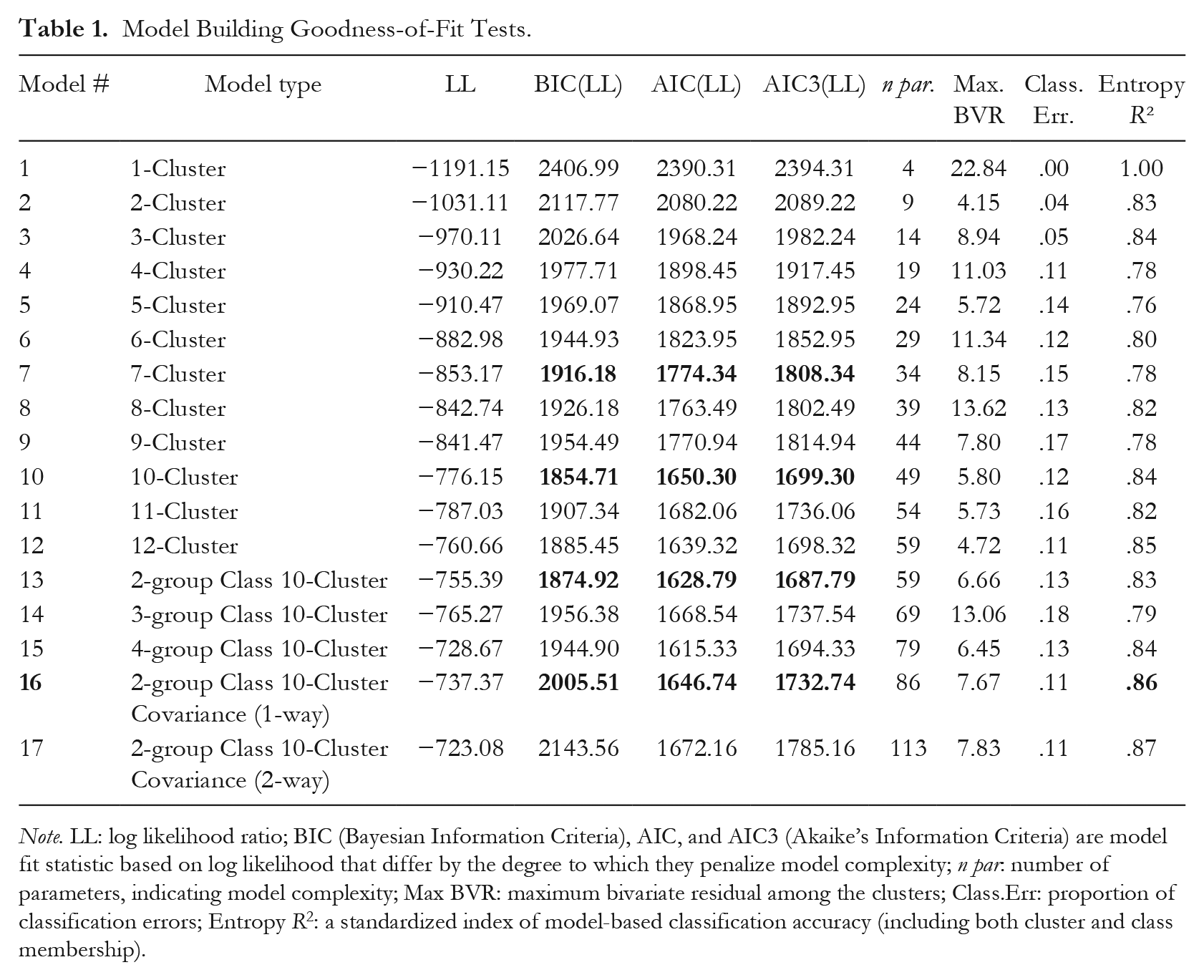
Note. LL: log likelihood ratio; BIC (Bayesian Information Criteria), AIC, and AIC3 (Akaike’s Information Criteria) are model fit statistic based on log likelihood that differ by the degree to which they penalize model complexity; n par: number of parameters, indicating model complexity; Max BVR: maximum bivariate residual among the clusters; Class.Err: proportion of classification errors; Entropy R2: a standardized index of model-based classification accuracy (including both cluster and class membership).
Even though our model with covariates (#16) had a lower log-likelihood ratio and lower classification error than the model without covariates (#13) it had many more parameters (86 vs. 59) and the AIC and BIC statistics indicated a less parsimonious fit. This suggests redundancy in the model that arises because our covariates predict the clusters. These are the effects of interest since they provide an indication of how the experimental conditions affect allocation strategies. We thus report the results for model #16, to show how allocation strategies differ across the levels of the three covariates.
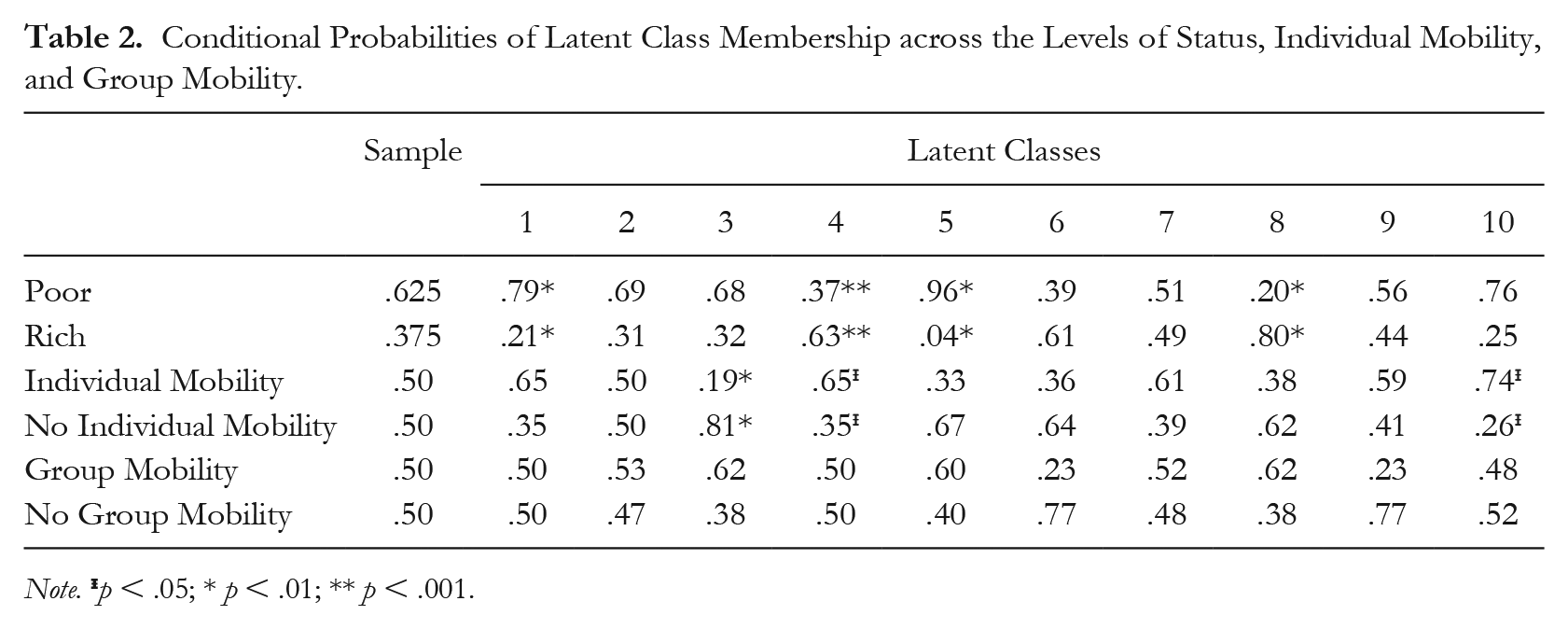
In confirmation of the measurement model, the mean scores on both the z1 (Wald χ2 = 1483.46; df = 9, p < .0001) and z2 (Wald χ2 = 4529.41; df = 9; p < .0001) pivot coordinates reliably differentiated latent class membership. The covariate analysis showed that latent classes of allocation strategies were significantly predicted by the level of Status (Wald χ2=38.75; df = 9; p < .0001) and IM (Wald χ2 =26.43; df = 9; p < 0.0017) but not GM (Wald χ2=13.67; df = 9; p < 0.13). The overall class probabilities and the conditional posterior class probabilities across the levels of the covariates are reported in Table 2.
Conditional Probabilities of Latent Class Membership across the Levels of Status, Individual Mobility, and Group Mobility.
Note.
We then decomposed the strategies represented by the 10 clusters to show their constituent composition components by computing the mean amounts given to the ingroup and outgroup banks and outgroup individuals for the participants assigned to each cluster. This allowed us to interpret the results in terms of the (easier to understand) characteristic allocations of each strategy rather than the log-transformed ILR scores. Figure 2 represents the allocation strategies for each class in terms of the mean summed proportion of tokens given to the three targets over the 10 rounds of the game.
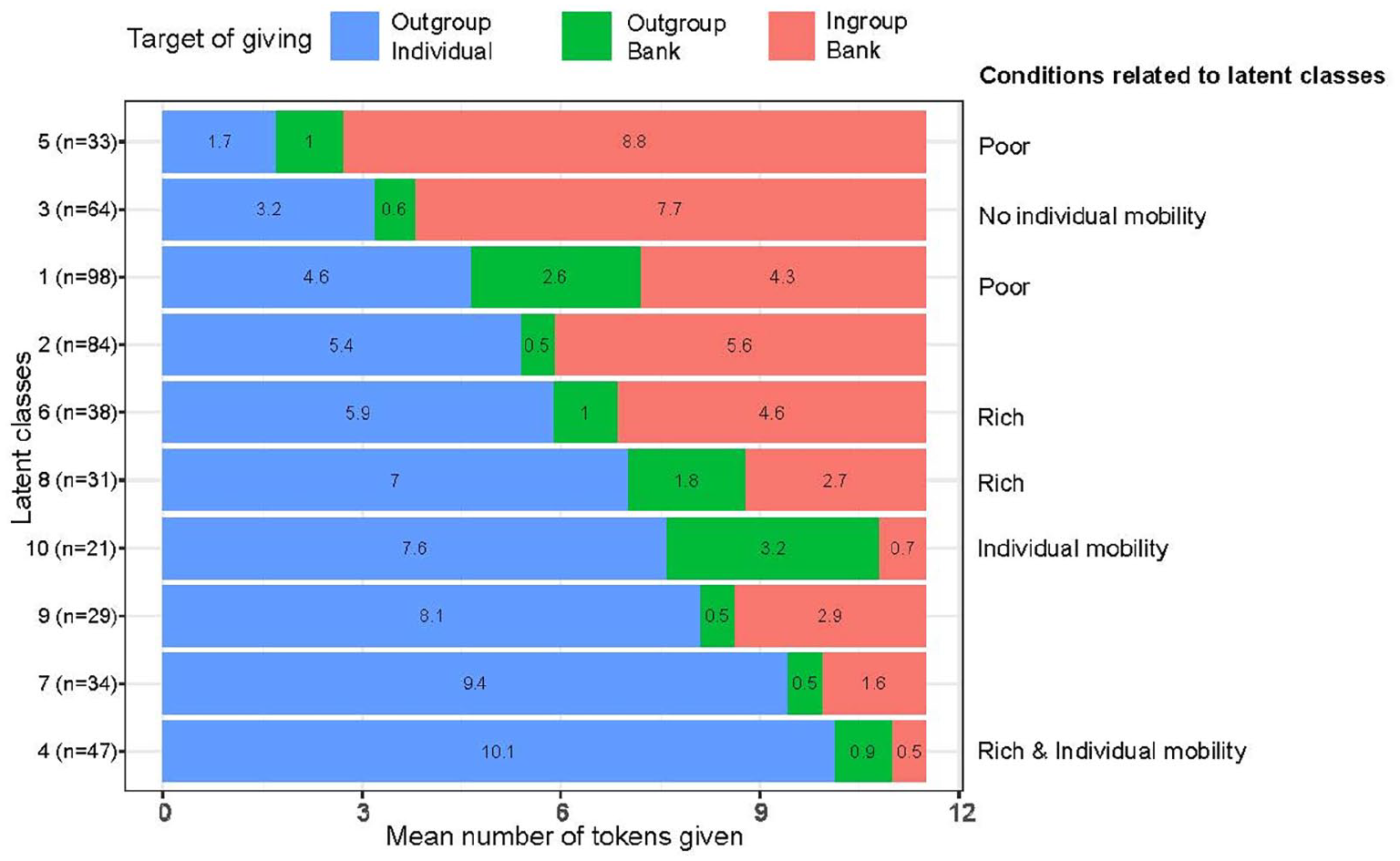
The Compositions that Define the Allocation Strategies for 10 Latent Classes
The classes in Figure 2 are displayed in rank order of giving to outgroup individuals, representing highest level of cooperation with the ingroup at the top and highest levels of defection from the ingroup toward the bottom. The exceptions are classes 1 (the modal class) and 10, which reflect strategies with higher levels of giving to the outgroup bank. Thus, although there were quantitative differences between the classes, the three-part composition also reveals qualitative differences between classes, which are well captured by latent profile analysis (Collins & Lanza, 2011).
The modal class (Class 1) represents a fairness strategy, sharing tokens between the targets. This strategy was used more frequently by the poor players (see Table 2) and represents a poor group strategy of balanced defecting from the ingroup. The high level of ingroup giving in Class 5 represents a poor group strategy of cooperation. The strategies used by the rich appear toward the bottom of the figure, indicating much higher levels of giving to outgroup individuals, supporting Hypothesis 1, that rich-group members will give a greater proportion of resources to poor outgroup individuals than poor-group members give to rich outgroup individuals. At one extreme, those who defected almost entirely (Class 4) were nearly always rich-group members, but the rich also used strategies that included cooperation with the ingroup (Class 6) and cooperation with the ingroup balanced with generosity toward the poor group’s bank (Class 8). In all cases, these rich strategies were characterized by a majority share of the allocation going to outgroup individuals.
The significant effect for IM provides evidence in favor of Hypothesis 2, that IM beliefs will strengthen intragroup competition, decreasing investment in the ingroup bank and increasing (self-interested) allocations to outgroup individuals. IM promotes defection from the ingroup as represented by classes 10 and 4, which allocate very little to the ingroup bank. These strategies of defection are differentiated by strategic giving to the outgroup bank. As hypothesized (H2), an IM belief system promotes competition between group members. Whereas Class 4 represents individually targeted outgroup giving in hopes of reciprocation, Class 10 also includes substantial contributions to the outgroup bank, possibly as a method to elicit reciprocation or in belief that they would benefit from outgroup bank investments if they changed groups. In contrast, on the other extreme, Class 3 represents a strategy heavily weighted in favor of ingroup giving, characteristic of games without IM.
The main effect for GM was not significant, contradicting the expectation of Hypothesis 3 that GM beliefs would strengthen intergroup competition and ingroup cooperation, increasing investment in the ingroup bank and decreasing (self-interested) allocations to outgroup individuals.
Finally, the results supported Hypothesis 4a, that allocations to outgroup banks will be much smaller than allocations to ingroup banks and outgroup individuals, but, contrary to Hypothesis 4b, outgroup bank giving was not strengthened by the GM condition, and was not more frequently used by the rich (Hypothesis 4c). To the contrary, the strategies with the highest giving to the outgroup banks were more likely to be used by the poor (Class 1) and less likely to be used by those in the mobility condition (Class 10).
After completing 10 rounds of exchange, participants rated how much they trusted each player in the game on a scale from 1 (low trust) to 10 (high trust). We conducted a mixed linear model analysis to test hypotheses 5 to 8, examining the effect of Trust Group (ingroup vs outgroup), Status, IM and GM on the trust scores across the 60 games. A nested random effect for individuals within games improved the model fit over the model with an intercept term only (LR χ2(1) = 65.43, p < .0001), showing the utility of modeling random effects. We then assessed models with a four-way and all the three-way interactions, but found that these did not improve the fit over a model with all the two-way interactions (four- vs. three-way interactions LR χ2(1) = 2.88, p > .089; three-way vs. two-way interactions LR χ2(4) = 4.01, p > .40), whereas the model with all the two-way interactions did significantly improve the fit over the model with just main effects (LR χ2(4) = 34.83, p < .001).
In the model with two-way interactions, the main effect for Trust Group was significant (LR χ2(1) = 69.08, p < .0001). As hypothesized (H5), ingroup members (M = 6.05, SD = 0.15) received higher trust ratings that outgroup members (M = 4.92, SD = 0.15). There was one significant interaction involving Trust Group with IM (LR χ2(1) = 26.75, p < .001). Follow-up post-hoc tests of this interaction showed that trust in the ingroup was greater when there was no IM (t(56) = 2.84, p < .007), but this was not the case for trust in the outgroup (t(56) = 1.91, p > .061). These results are depicted in Figure 3. These results support the expectation of hypothesis 7, that IM beliefs would weaken ingroup trust. The means for ingroup trust in Figure 3 indicate that the ingroup defection promoted by IM eroded ingroup trust. The absence of significant interactions between Trust Group and Status and Trust Group and GM do not support the expectations described in Hypothesis 6 (the rich will be rated as more trustworthy by the poor than the poor are rated trustworthy by the rich) and Hypothesis 8 (GM beliefs will strengthen ingroup trust).
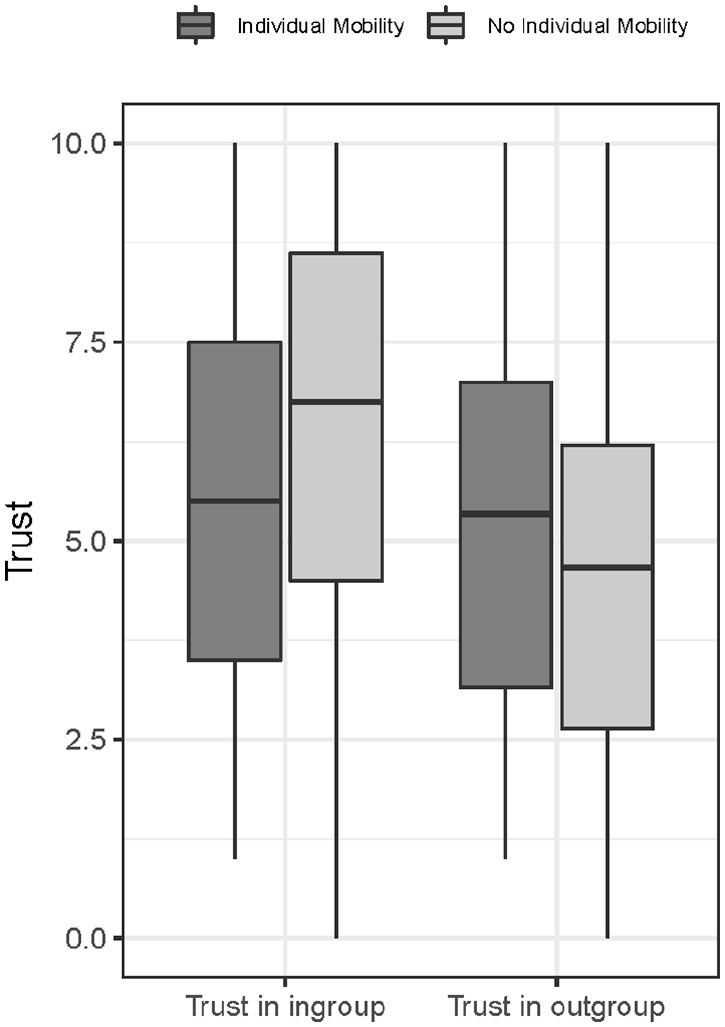
Trust Ratings of Ingroup and Outgroup Members by Individual Mobility
We examined the patterning of trust across the 10 classes of exchange strategy, using a mixed linear model analysis to determine whether cluster membership predicted ingroup and outgroup trust scores. As with the trust analysis above, we fit nested random effects for individuals within games. As above, the main effect for Trust Group was significant (ingroup members were trusted more than outgroup members), but there were no reliable differences in trust scores across the 10 clusters, and the interaction between Trust Group and Cluster Number was not significant. However, the experiment was likely underpowered to detect effects across 10 latent classes.
Discussion
Defecting from the ingroup to participate in self-enriching exchanges with outgroup members is a strategic option available to individuals in intergroup contexts. While pursuing such self-interested strategies, these individuals may still hope to reap rewards from the ingroup investments of others members of their group. However, if too many in the group pursue self-interest in this way, the group as a whole will lose its competitive edge in relation to other groups in society, resulting in collective losses. The behavior of individuals may thus affect intergroup relations of power, cooperation, and competition (cf. De Dreu et al., 2020).
Social identity theory specifies group status and mobility conditions that influence levels of ingroup favoritism (Tajfel & Turner, 1979, 1986). In particular, it claims that two “belief systems”—of IM and GM—affect the degree to which individuals are prepared to sacrifice for their groups or pursue self-interest. When group boundaries are permeable, low-status-group members pursue self-interest by developing relationships with high-status groups in an effort to exit the low-status group. When boundaries are impermeable, unstable, or illegitimate, group hierarchy promotes intergroup competition. This strengthens ingroup cooperation as the low-status group challenges the status quo and the high-status group defends it.
Numerous experiments have confirmed these predictions using evaluative measures of ingroup and outgroup favoritism (Ellemers, 1993) or one-shot allocation studies (Diehl, 1990; Tajfel et al., 1971). In contrast, team game experiments present participants with the social dilemma of contributing to the group cause or defecting by keeping resources for themselves. The results of these studies support the idea that intergroup competition promotes intragroup cooperation in interactions over time (Balliet et al., 2014; Bornstein, 2003).
The present study made two central changes to the team game experimental paradigm to test the IM and GM hypotheses of social identity theory. First, instead of defection from the ingroup by withholding resources for oneself, we gave participants opportunities to enrich themselves through defecting acts of exchange with outgroup members. Second, to simulate the asymmetry of real-world inequality, the game included an advantaged minority and a disadvantaged majority. Status and group size were confounded in the experiment as they are in the real world. As a consequence, individuals in the smaller rich-status groups would have a higher chance of moving between groups in the IM condition than members of the poor groups. However, the failure to find an interaction between status and IM suggests that the rich were not motivated by fewer rivals to invest more than the poor-group members in ingroup competition to exit their group.
In addition, we argued for the need to respect the compositionality of the allocation data. The structural interdependencies of compositional data make it possible to observe more than one thing at a time. The amount given to a bank, for example, also reflects the amount withheld. The dependence is often treated as an analytic nuisance and ignored (at cost! See Filzmoser et al., 2018), but we sought to retain the compositionality of the data to identify allocations strategies. As Hodges and Geyer (2006) argued in their re-interpretation of Asch’s data, individuals enacted different behavioral responses, conformity, and truth telling, over the course of the experiment to satisfy two conflicting interaction demands. Rather than focus on conformity, they showed that participants used one of three composite behavioral strategies enacted over the rounds of the experiment. Likewise, we used latent profile analysis to identify empirically distinct combinations of allocation to the ingroup and outgroup banks and to outgroup individuals (represented in Figure 2). Each latent class represents a patterned way of balancing contending norms and interactional demands over the course of the game.
Our results showed that individuals adopted allocation strategies ranging from those that prioritized ingroup giving to those that favored giving to members of the outgroup. There were also qualitative differences between strategies, with two involving relatively high levels of giving to the outgroup bank. Mostly, participants balanced ingroup cooperation with self-enriching defection.
As hypothesized (H1), the rich were more likely than the poor to employ behavioral strategies that prioritized giving to the outgroup individuals. There are a number of possible explanations of this result. The material advantage of the rich may lend a sense of group advantage that allows rich individuals to spend more resources competing with each other; or perhaps the rich-group members gave more to outgroup individuals than poor-group members because they were competing with fewer ingroup rivals Alternatively – following Mary Jackman’s (1994) “velvet glove” hypothesis – the rich may favor intergroup exchanges, encouraging cross-group reciprocation from poor-group members, thus undermining solidarity among the poor. Finally, the results may reflect compensatory, corrective responses to perceived illegitimate intergroup inequality (see Bettencourt et al., 2001; Durrheim et al., 2016; Rubin et al., 2014). However, this final possibility seems unlikely given that the rich were least likely to make allocations to the outgroup bank, which represent outgroup generosity without immediate returns that enrich the giver in comparison with ingroup peers. Surprisingly, we found that it was the poor, rather than rich, who used generous outgroup giving. The modal strategy overall, most often employed by the poor, allocated about 25% to the outgroup bank. Whether this was motivated by a sense of exchange fairness—that is, sharing between targets—or was a strategic attempt to elicit reciprocation from the outgroup is impossible to tell.
We hypothesized (H2) that the IM belief system would weaken cooperation with the ingroup, prompting self-enriching exchanges with outgroup individuals and competition between ingroup members. The results supported this hypothesis. Participants in the IM condition used strategies dominated by outgroup individual giving (at the bottom of Figure 2), whereas participants in the no mobility condition used ingroup cooperative strategies (at the top of Figure 2).
Unexpectedly, the GM belief system did not affect latent class membership (H3). Generally, team game experiments show that intergroup competition promotes intragroup cooperation. By contrast, our implementation of group competition as the possible reversal of status between rich and poor groups did not affect ingroup cooperation. Whereas social identity theory maintains that intergroup competition is motivated by the desire for positive distinctiveness, not material gain, it is possible that the GM effect depends on tokens having monetary value.
As hypothesized (H4a), allocations to the outgroup bank made up the lowest proportion of each allocation strategy, but this was not affected by GM (H4b) and, contrary to expectation (H4b), higher levels of giving to the outgroup bank featured in the modal poor-group strategy, but much less so among the rich-group strategies (see Figure 2). Participants in the IM condition predominated in the smallest latent Class 10, which included the highest levels of giving to the outgroup bank. The reasons for these allocations to the outgroup bank in these conditions are unclear, but the result suggests that the allocation strategy is used neither as outgroup generosity among the rich (H4c) nor as an investment in the outgroup by individuals destined to move in the GM condition (H4b).
After the final round of exchange, we asked participants to rate how much they trusted each other player in the game. As hypothesized (H5), these ratings showed an ingroup favoring bias, with ingroup members being trusted more than outgroup members (cf. Foddy et al., 2009; Tajfel & Turner, 1979). The results also supported Hypothesis 7, that high levels of defection in the IM condition would weaken ingroup trust. As shown in Figure 3, ingroup defection in the IM condition eroded ingroup trust relative to the no IM condition. Contrary to our expectations, status (H6) and GM (H8) did not affect trust ratings.
The present study has demonstrated the value of using experimental team games to investigate the dynamics and effects of traitorous, self-enriching interactions with outgroup members. Our results confirmed the status and IM hypotheses of social identity theory, but not the GM hypothesis. Our failure to find a GM effect may be attributable to the vague description of the conditions that prompt GM, giving participants a lower sense of control over GM than IM. Our results also need to be evaluated in light of the central limitation of the study. As is often the case in multi-level designs, our experiment was likely underpowered at the game level, which was compounded by the large number of latent classes in our best-fitting model. As a consequence, we may have been unable to detect small but reliable differences in some instances, including the GM manipulation and the ways the classes predicted trust ratings.
