



Abstract
Communication between police and community is an inevitable part of policing. Core narratives—subjective, internal, sense-making processes that can shape behavior—that police officers hold related to communication can influence police–community interactions. There is no known research on core narratives related to police officer communication. To begin to fill the gap, this paper reports the analysis of in-depth interviews conducted to investigate how police officers understand police–community relations and the nature of encounters with community members. Communication emerged as an important theme. Five communication core narrative themes were identified: communication as central, advocacy, cover, withholding, and connection. Four of the core narrative themes were abstracted into two dimensions along which the characteristics of the communication varied. Understanding the core narratives influencing officer intergroup communication can help researchers and practitioners see the larger implications of communication, an essential component of policing and police–community relationships, and its connection to officer behavior.
Keywords
Introduction
Interactions between police and the communities they serve are primarily intergroup interactions (Giles et al., 2021), as the individuals involved in the interaction identify as and are identified as members of different groups (Charman, 2017; Tajfel & Turner, 2004). Intergroup communication happens when people in a social interaction communicate with each other based, at least in part, on their group membership rather than their personal identity (Dragojevic & Giles, 2014). Intergroup communication between police officers and the community is an inevitable and essential part of policing. It is estimated that upwards of 98% of police work involves verbal communication with the public (Thompson & Jenkins, 2013).
Research has shown that the actions of officers during interactions have a major impact on how police are perceived (Bolger & Walters, 2019; Tyler, 2004). Research on police-initiated contact finds that fair and courteous treatment, providing reasons for being stopped, and explaining their rights to civilians all contribute to satisfaction with police-initiated encounters (Quinton et al., 2000; Stone & Pettigrew, 2000). For both citizen-initiated and police-initiated contact, perceptions of police behavior during a contact situation are the greatest predictors of civilian satisfaction with the encounter (Skogan, 2005). Furthermore, the use of fair procedures and citizen perceptions of fair treatment by police lead to improved perceptions of police (e.g., Tyler, 2001, 2005), the perception of fair treatment by police advances the mindset that police officers have a legitimate authority as agents of the law (Sunshine & Tyler, 2003; Tyler & Wakslak, 2004), and conceptions of officer behavior and of how a person was treated during interactions with authorities are linked to evaluations of officer legitimacy (Cox & White, 1988; Tyler & Huo, 2002). Lastly, poor communication skills, specifically disrespectful or antagonistic interactions, were found to be the biggest reported complaint regarding police behavior (Giles et al., 2006).
While officer behavior, specifically communication, is an important part of police work and a critical factor in how civilians feel about their experience with police, it is also clear that officers often engage in ways that are not conducive to a positive experience. Furthermore, these problematic behaviors have been more pronounced with certain groups. Researchers found a disparity in officer treatment of Latino and White individuals, as evidenced by differences in officer communication behaviors during traffic stops (Giles et al., 2012). A systematic analysis of transcriptions of audio from body-worn camera footage found that police officers spoke less respectfully to Black community members than to White community members during traffic stops (Voigt et al., 2017). Findings of racially disparate communications by police are complemented by a large body of rigorous research showing racial disparities favoring Whites in police stops, searches, and use of force (Charbonneau & Glaser, 2020; Fagan & Geller, 2020; Geller et al., 2021; Glaser, 2015; Knox et al., 2020; Pierson et al., 2020). These findings reveal that police officers tend to be influenced by attitudes and beliefs about themselves and the social context when interacting with community members from various racial and ethnic groups. However, we can only infer from officers’ communications and behaviors what psychological sense-making processes are influencing officer actions. By interviewing officers, asking them directly about how they think about their community interactions, we seek to determine the extent to which officers’ thoughts about their roles interact with the situations in which they encounter civilians and affect how they act.
Understanding how people make sense of their social situations and personal identity helps in predicting their behavior (Walton & Wilson, 2018). A range of terms have been used to describe the psychological sense-making phenomena that can shape behavior, including core narratives (Wilson, 2011), subjective construals (Ross & Nisbett, 1991), and mindset (Dweck, 2008). Mindsets, which are views we adopt of ourselves (Dweck, 2008), are potentially powerful mechanisms guiding our thoughts and actions in everyday life. Some work has been done to explore the police officer mindset (see Hill & Giles, 2021). As a policing best practice, the President’s Task Force on 21st Century Policing (2015) recommended that police officers embrace a “guardian,” rather than a “warrior,” mindset. A guardian mindset has been defined as prioritizing service and valuing the actions associated with positive contact (McLean et al., 2020; Stoughton, 2014). While some research has been done to identify police officer mindsets toward their work (McLean et al., 2020; Paoline et al., 2021), there is limited research on police attitudes broadly (Frank & Brandl, 1991; Worden, 1995), and no known research on police core narratives regarding intergroup interactions.
The book Redirect (Wilson, 2011) discusses core narratives and successful attempts to redirect them when they create barriers to healthy living. For example, in a series of studies, researchers were able to identify and redirect core narratives about intergroup interactions from “[the outgroup] won’t like me” to “we often get along better than I expect,” which had a positive effect on the number of intergroup friendships among Black and White college students (Mallett et al., 2008, 2010). In another study focused on personal well-being, researchers found that individuals who had core narratives related to meaning, purpose, and hope were better able to handle setbacks and negative life events (Wiggins et al., 1992). In this case, the core narrative shift would be from something like “there is no meaning/life is meaningless” to “there is meaning (to my life or in this event).”
Distinct from mindsets, core narratives include interpretations people have constructed of their social world as well as personal views they have adopted about themselves (Wilson, 2011). Within the context of policing, guardian and warrior mindsets are views police officers adopt about themselves that are likely to impact their behavior. Similarly, subjective construals in the context of policing are the ways a police officer understands a social situation, and how that understanding is likely to impact behavior. Core narratives combine both views of the self and the subjective interpretations of the social situation to explain behavior. Because they involve both beliefs about the self and the social environment, core narratives can play a useful role in understanding communication behavior, a central component in police–community relations. An investigation of core narratives offers promise to elucidate the nature of police–community interactions, which are laden with group identification and contextual factors.
This paper examines one important factor in how police officers make sense of intergroup interactions: communication. Specifically, this research explores police officer interpretations of communication during encounters with community members. Using a qualitative interview process, we investigate how police officers understand and use communication, the impact of those interpretations on police–community encounters, and we begin to explore, empirically, police officer core narratives related to intergroup communication.
Methods
The data presented in what follows are drawn from a larger qualitative study that explored factors influencing police officer core narratives in police–community interactions. A qualitative design using semistructured, in-depth interviews was employed to collect data. A preliminary analysis, a common practice in qualitative research (Miles & Huberman, 1994), indicated that communication, specifically narratives or interpretations connected to communication, played a central role in officer understanding of situations and behaviors. The purpose of this study is to generate insight, grounded in the interview data, into the factors shaping police officer understandings of communication in officer–civilian contact encounters, and explore how those interpretations might be connected to officer behaviors and the overall outcomes of the interactions. Thematic analysis (Braun & Clarke, 2006) was used to better understand the phenomenon and identify coherent themes within the data.
Recruitment and Sampling
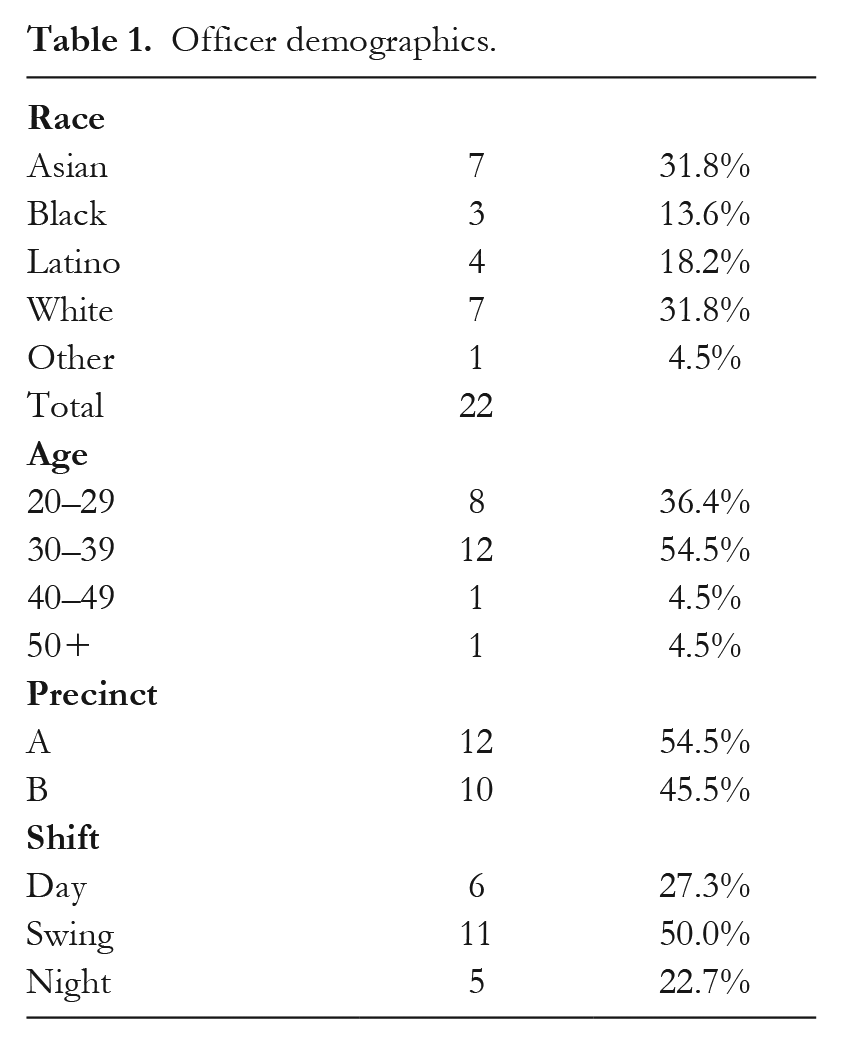
This research was approved by the institutional review board (IRB) of a large university in the Western United States. The lead researcher (first author) recruited potential participants from a police department in a diverse metropolitan area in California. The police department provided the lead researcher with a list of the names, email addresses, precincts, districts, beats (if applicable), and shifts for all police officers involved in community-facing activities (N = 435). This list included patrol officers as well as officers involved in special assignments (e.g., K9 units). Officers were randomly contacted from a list stratified by precinct. The list was stratified by precincts to account for the relatively rigid boundary that exists between the two precincts. While officers often leave their beats to respond to calls for service, they rarely leave their precinct. The department maintains one station in each precinct, where officers start and end their shifts, which creates an additional separation between officers by precincts. A total of 193 officers were contacted over a 6-month period. In total, 22 officers (11.4% of those contacted) accepted the invitation and were interviewed. There is no known research evidence on optimal participation rates for in-person interviews in qualitative research such as this. However, available research finds between 15 to 60 interviews is the norm (Saunders & Townsend, 2016), and suggests that between 20 to 30 interviews is optimal (Marshall et al., 2013). Twelve of the officers interviewed were from Precinct A, and 10 interviewed officers were from Precinct B.
Data Collection
Data collection took place from February to September 2020. The lead researcher developed the semistructured interview protocol used in this study. The protocol consisted of 23 open-ended questions plus follow-up questions across seven aspects of police work: role/duties, skills/values, control, impact of the job, community, contact, and safety/threat. An additional eight open-ended questions were added to the survey at two separate time points; these questions were related to two specific events: (a) COVID-19 and (b) the murder of George Floyd by a police officer in Minneapolis, MN and the resulting nationwide protests it sparked. Protest policing is a challenge in itself (den Heyer, 2020; Glaser & Lim, 2020; Nassauer, 2019); with the 2020 protests being about policing itself and widespread, there was good reason to expect this was highly salient to police and would affect their interactions with community members (Pryce & Gainey, 2022).
Results outlined in what follows include officer responses across the seven aspects that related to regular police work and the two additional aspects that relate to specific issues. The first three interviews were conducted in person; two at public cafes and one at a police station. Since the COVID-19 pandemic ended the possibility of in-person interviews, the other 19 interviews were conducted over the phone. No substantial changes in officers’ willingness to be interviewed or in what they shared were noticed in the transition from in-person to phone interviews. Interviews ranged from 40 minutes to 1 hour and 41 minutes, with an average length of 1 hour and 9 minutes. For information on officer demographics, see Table 1.
Officer demographics.
Data Analysis
Interviews were audiotaped with the consent of the officers, and the recordings were transcribed by the lead researcher with the assistance of transcription software. Participant names and all identifying information of the officers or others were removed in transcription. Pseudonyms are used in this paper to protect participant confidentiality. Using thematic analysis, the process was guided by two questions: (a) What is the role of communication in police–community contact experiences; and (b) what factors influence and are influenced by officer communication? All interviews were used in the analysis. Interviews were reviewed line by line and labeled with open codes as they emerged. For example, when asked about strategies used to gain control of a situation, one officer responded: A lot of times I just won’t speak first. So, just let things unfold. I’ll arrive, and sometimes there will be a pause of what’s gonna happen next. And I won’t say anything, just to see. Because that gives you a lot of information itself. Who might be the most dominant person in the scenario, and who might be the dominant aggressor in a fight, with things like that. And it lets you assess more. So for me, I might stay quiet. (Interview; February 8, 2020)
Using open coding, the passage above was labeled, “observing.” The passage was also coded as “control.” Open codes were then grouped into categories to the extent that codes showed a relationship or were interconnected. In qualitative analysis, categories answer the question, “What is going on here?” and represent central ideas in the textual data (Strauss & Corbin, 1998). In this analysis, the categories that emerged reflected the themes presented next.
Results
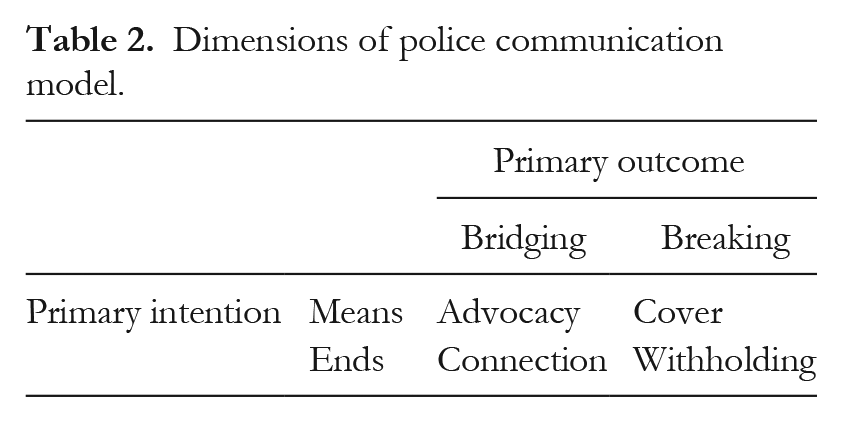
Five themes relating to the role of intergroup communication in community interactions emerged from the analysis. One overarching theme is communication is central to police–community interaction. Four additional themes reflecting different purposes of communication are (a) communication as advocacy, (b) communication as cover, (c) communication as withholding, and (d) communication as connection. These four themes were abstracted into two dimensions: intentions and outcomes, yielding a two-by-two model with one theme in each cell (see Table 2). Dimensions reflect the range along which the general properties of the themes vary (Strauss & Corbin, 1998). In the intentions dimension, thematic variation ranges from using communication as a means (to accomplish some other goal) to using communication as an end (communication is the goal). In the outcomes dimension, variation ranges from communication that bridges police–civilian intergroup relations to communication that breaks down police–civilian intergroup relations. “Communication is central” emerged as a fundamental organizing principle in police–civilian intergroup interaction. Given its centrality for police work, “communication is central” stands outside of the intentions and outcomes framework.
Dimensions of police communication model.
Not all policing communication intentions and outcomes fall within this framework, which focuses on communication that intends to, or results in, improving or deteriorating police–civilian intergroup interactions. For example, in a car accident, an officer can collect statements and provide a written report of events without engaging any of the themes identified in this study. For this study, this type of encounter is described as static with inert communication choices, and these were not explored in detail during this study. When static encounters were shared by officers, it was most often in the context of their description of daily duties.
Communication is Central
Communication was not one of the specific nine aspects (role/duties, skills/values, control, impact of the job, community, contact, safety/threat, COVID-19, and social unrest) included as focus areas in the interview survey protocol. However, communication quickly emerged as central to police work, with officers describing the numerous ways it was involved in their day-to-day duties: As an important value and an important skill; a method of creating positive contact experiences; a mechanism for improving community relationships; a tool for control and to create safety in contact situations; and a way for officers to feel more positive about their work. Often, when officers brought up communication, it was in a way that illustrated its centrality across various dimensions of the work. For example, when asked what values the best police officers have, one officer responded: I think to communicate. I’ve seen some great officers that I respect a lot be excellent speakers and be able to . . . there’s this idea of talking people into handcuffs, or talking people out of arguments, or talking people out of long-standing feuds . . . and I’ve witnessed some officers be able to do that, and I think it’s a really, really, good value to have. You could be the smartest guy on the street, you could be the toughest guy on the street, but if you can’t talk to anybody, [it] doesn’t really matter. (Interview; May 12, 2020)
The officer makes clear that communication can be a method of mediation, problem solving, and creating safety, but does so within the context of a question on values, which conveys these characteristics are of central importance. The idea of “talking people into handcuffs” reflects the use of communication as an alternative to the use of force. Using communication as an alternative to force is supported institutionally by many police departments through training in strategies like “verbal judo,” a form of tactical communication aimed at gaining compliance (Thompson & Jenkins, 2013). Tactical communication strategies appeared again when officers were asked about skills. For example, one officer said: I tend to think of skills as more of a technical issue. So, that would be being able to drive well, various tactics, and procedures. If you’re really interested in doing your job well, you will learn how to be more adept in communications. That includes reading what kind of situation you have with both verbal and nonverbal communication, and trying to get at what’s the real problem. Because, oftentimes, people will tell you what they want as opposed to telling you what the problem is, and you can’t always give people what they want. That’s where listening and discernment really come [in handy]. (Interview; May 11, 2020)
Here, again, communication seems to be viewed as something with application across the roles and responsibilities of an officer. When asked about important skills, this officer took a step back and positioned communication as essential to the job, beyond the technical and tactical nature of most skills (e.g., driving well). Even among officers without a clear regard towards communication, there was an awareness of it as a tool for control and safety. For example, when asked how he gained control of a situation, one officer said: You’ve got to use your big boy voice. If you come across as timid, scared, afraid, or new, they will eat you alive. So, it’s confidence and taking control, speaking in a clear, direct voice, telling people what you want. When other officers get on scene, start delegating so you get things done. The cover officers are going to take witnesses, victims, or even suspects, separate everyone, and start talking to them. The quicker you can get this stuff done, the less time they have to lie to you. (Interview; February 25, 2020)
It was clear from the interview that, outside of issuing verbal commands, this officer was not inclined towards communication. However, this officer did view verbal commands as important in investigation and in gaining control, which they associated with personal safety. So, while communication choices were limited for this officer, they did situate communication across multiple aspects of their work, indicating its importance to the job more broadly.
Lastly, communication was seen as a central factor in creating positive contact encounters, and positive contact is interconnected with officer well-being. When asked about a contact experience, one officer shared an encounter that began negatively but ended differently: We ended up having a one-on-one conversation and I felt empathy [for her]. I was like, “I wholeheartedly feel bad for you, and I’m sorry that you are in this situation, that you lost your job, and it’s going to be hard to feed your kids, and now your car is getting taken away. This is not Officer Lee now, this is Lucas.” We ended up having a conversation that started off with a citizen yelling profanities at me to her shaking my hand. It felt good. (Interview; August 18, 2020)
Through a conversation, this officer was able to better understand the emotional distress a person exhibited upon their arrival. The additional context resulting from the choice to have a conversation transforms the encounter and facilitates the officer’s positive emotional assessment of the event. Recent research supports the connection between positive contact and officer well-being, indicating positive interactions can improve officer well-being by mitigating distrust, cynicism, and detachment (Burke, 2020). In sum, communication is a core component that threads together various elements of the officer experience: values, skills, community relationships, contact, safety, well-being, and control.
Communication as Advocacy
The advocacy theme is communication as a means that often results in bridging. In advocacy, officers are using communication to influence the perspective of a person or group. In this form of communication, officers might use communication methods similar to connection (e.g., a conversation). What differentiates the two themes is the objective of the communication. Communication characterized as advocacy is motivated by a desire to improve perceptions of police. As Maguire (2021) makes clear, communication plays a central role in community policing, and police officers involved in community-facing activities are de facto agents of public relations. Some officers in this study saw this type of engagement as a form of community policing. When asked about police–community interactions, one officer said: I think that it would be reasonable under many circumstances for police officers to divulge a little information. [Residents] want to know and that’s part of engagement. It’s not just about having coffee with a cop at Starbucks. The only people who are coming to that are people who already like the cops. You can talk to somebody who doesn’t have a strong opinion of police in their area. I’ve approached people and said, “Hey, do you want to know what’s going on here?” Invariably people say, “Yeah, for sure.” I’ll explain, “this is what we have here.” You’re not giving up names. You’re not divulging any personal information. You’re not doing anything that’s going to harm the investigation. You’re just telling people what’s going on in their neighborhood. It increases their engagement, even if just slightly. (Interview; May 14, 2020)
This officer makes a link between communicating and community engagement focusing on how communication can be a tool for improving police–community interactions and relationships.
One police officer talked about sharing information with an angry bystander who didn’t understand why the police were arresting a person with a mental health problem. He said: I tried my best to educate her and be transparent as far as tactics, why we were standing the way we were standing, and what the next step was as far as getting him assistance. We’re trained to do a quick psychological evaluation based on observations. Then we wait on a more trained medical staff person to show up and give him more resources and the help he needs. I took that opportunity to break down different stereotypes and stigmas she had and be transparent and educate her on the situation. (Interview; August 29, 2020)
When asked if he thought his explanations affected the angry bystander, the officer responded, “She thanked me for talking to her. I was like, that’s awesome. I felt maybe that’s one person I got through to. Maybe she’ll go tell her friends and spread the word [that] all cops aren’t horrible people.” (Interview; August 29, 2020).
Through engagement, this officer was able to overcome the anger of the civilian. We can also see from the officer’s description that, as an opportunity to educate the bystander, the exchange had a directionality. For advocacy, the officers give and the civilian receives, and while there can be a back-and-forth, the police officer remains the authority and communication is an exercise of that authority.
Communication as Cover
The cover theme is communication as a means that often results in a breakdown of police–community interactions. In communications characterized as “cover,” officer motivations for engagement remain intentionally obscured. If and when the officer’s true motives become clear, the individual involved in the incident often becomes upset, and the situation deteriorates. When asked about a time when a situation shifted from positive to negative, one officer said: We’re engaging somebody, we’re waiting on the cover before we attempt to put them in handcuffs because we know they’re the person that was involved. So, we’re talking to them. They’re open, we’re having a good conversation, then the cover unit comes. Now, [it’s] turn around, put your hands behind your back. They don’t understand the fact that from the get go that they were gonna be detained or placed under arrest, and what we were doing was stalling. (Interview; May 10, 2020)
The sudden shift from “a good conversation” to being put in handcuffs is surprising and confusing for the person in the exchange. This combination can and often does contribute to a breakdown. When asked about an encounter that deteriorated, one officer said: For domestic violence calls, we try to come in low. Unless it’s an active fight, you talk to the person, you’re establishing a connection. And you know, based on the call details, that this person is going to go to jail. It sucks because they feel like you betrayed them. You’re talking to them, you’re saying, “I’m connecting with you, I agree with you,” and then you put them in handcuffs. It immediately breaks that bridge. And now the person is swearing at you. How do you smooth that over? I don’t know if you can smooth it over. (Interview; July 6, 2020)
Communication strategies that we categorize as “cover,” position police in a difficult space. Many officers were aware of the dubious advantage of this strategy and conveyed a sense that the advantage is double-edged. This strategy assists an officer in maintaining control and, to some extent, safety. However, communication strategies with a cover motivation can lead to greater conflict in the contact encounter, to longer term damage to police–community relationships, and to negative impacts on officer well-being.
Communication as Withholding
The “withholding” theme is communication as an end that often results in a breakdown of the police–community interaction. Withholding is characterized by intentionally not sharing information. Multiple officers made clear that there are situations where one cannot or should not share information because doing so would impede an investigation or could harm the individual(s) involved in the encounter. In these situations, officers make the conscious choice to withhold. For example, one officer said: There are certain situations and conditions where you cannot tell the suspects why they’re being detained. There are certain things that you cannot mention to suspects, because if they have a warrant or if they’re wanted for a shooting, the investigators tell us do not Mirandize the suspects, do not mention the case to them at all. They’re wanted. There are certain situations where we cannot be as transparent as we can. There are serious crimes that investigators would not want us to tell the suspect when they’re being detained, which creates that situation where you cannot actually tell them what’s going on. (Interview; May 20, 2020)
In withholding communication encounters, officers make the choice not to share information, and this choice can lead to a breakdown of the encounter. When asked about the steps they take to establish control, one officer shared a story of an incident where they arrested someone for a sensitive issue: He steps out of the apartment, and we arrest him on suspicion of felony child abuse. His brother and another relative lived next door. Next thing you know, they are challenging the legality of our arrest and demanding to know why we are arresting him. In a less incendiary kind of accusation, I might have told them exactly what was going on. But I’m not going to potentially slander someone by calling them a child abuser. So, I told them that he was being arrested and that he was going to be taken downtown to the police department for an interview, and that he would be able to call as soon as he was booked, so actually got to the jail. And that wasn’t good enough. The bottom line is that I have to treat the suspect in an ethical manner, and I am not going to tell somebody, tell the neighborhood, tell a family member that this guy’s being accused of child abuse. I’m just not going to do that. (Interview; May 11, 2020)
This officer’s response points towards a willingness to share information but, given the sensitive nature of the arrest, a conscious decision not to share it. Officers can withhold information for a number of reasons. In this case, withholding reflects a communication decision that prioritizes ethical considerations, even at the expense of a breakdown in the encounter.
Communication as Connection
The connection theme is communication as an end that often results in bridging. For example, when asked to describe a situation that ended more positively than it began, one officer described an exchange that occurred while serving a search warrant: Her mother had died earlier that morning. What a horrible day. She’s screaming, saying that we’re going to have to shoot her because she’s trying to push her way through and we’re trying to make sure she doesn’t go back in the house. It started off that she’s very upset, she’s verbally aggressive, and at the end, I was helping her pick out her mother’s funeral outfit. She was like, “thank you. I appreciate you.” It’s almost like she saw me outside of my uniform, like she saw me as a person. I think a lot of people are mad at your uniform, not necessarily you. (Interview; September 1, 2020)
When asked what happened to make the encounter shift, the officer continued: Just talking, letting [the person] vent, letting out her feelings, and trying to talk to her on a personal level. So, she eventually calmed down and we’re just having normal conversations. Search warrants take a long time, so we’re just standing there staring at each other for a while. I might as well start a conversation, “oh, what’s this picture from?” You kind of use whatever you have in front of you and start conversations, and it ends up that she feels comfortable. (Interview; September 1, 2020)
Importantly, the officer’s initial engagement could be seen as a form of de-escalation (communication with distinct ends). It is the engagement after the civilian calmed down that is characterized as connection. There is a mutuality to the second part of this exchange, where the officer listens and also engages. In this example, the conversation ended with the civilian feeling more comfortable, but it was clear from the officer that comfort was not their primary objective for engaging in conversation, rather, comfort was the outcome of a primary objective to have a personal conversation.
In another situation, an officer expanded on how, primarily through listening, they were able to build a connection with a person: The citizen was distraught because his car had been stolen and was in a car accident. He was brought to tears because it was his work truck, so all of his tools were in it. He explained how he had run-ins with police, and how he was finally doing right for himself, and for this to happen was really upsetting. So, I was an ear for him. I said, “Well, it’s already a great thing that you’ve turned your life around. I’m a firm believer that everything happens for a reason.” I said, “Something better will happen.” He said, “I’ve been trying to reach out to my family but no one seems to be giving me a call back.” While I was at the computer processing his information for the report, he got a phone call that one of his family members had a spare car, that they were going to let him use it, and that his job was going to be replacing all of the tools. He said thank you [to me]. I said, “For what, sir? I just took your report.” He said, “For listening.” He went on and on and I didn’t interrupt. I sat there and listened. They say we’re not social workers, but sometimes people just need an ear to vent. (Interview; September 2, 2020)
In this encounter, the officer centers the experience of the civilian and listening is seen as part of the role and function of the job. The officer’s incorporation of broader supportive aspects into their role points towards a willingness to expand the service role of police beyond traditional definitions.
Discussion
The interviews in this study centered on the daily experiences and role of police officers, with a focus on the meanings and inferences police officers form while communicating with members of the community they serve, their communication core narratives, and how those core narratives shape behavior and outcomes. In this section, we discuss the results in the broader context of policing. The communication we examine in this paper happened within a context of the capacity of police to use coercive force (Bittner, 1970). An important question to include then is, what are the constraints on communication, given the role and function of policing? A focus on communication in policing, absent the larger context of use of force, can decenter power and lead to erroneous or inaccurate exploration of the results.
An important concept that emerged from the analysis is the way the communication can preserve or disrupt existing power dynamics between police and the community. In three of the four communication themes identified in this paper (advocacy, cover, and withholding), communication maintains existing power dynamics between police and civilians. While advocacy, cover, and withholding are forms of communication in that they involve the giving and receiving of information (or not, in the case of withholding), only one communication theme, connection, represents communication able to disrupt existing power dynamics.
Connection communication disrupts power dynamics because the primary objective of the officer is a mutual and relational exchange. In connection, officers center the relational components of their role and do so in a way that attempts to build reciprocal pathways for intergroup interaction. The creation of a mutual and relational exchange balances the interaction between police and civilians, even within a context of policing. Of course, officers always maintain the option of coercive force. However, through connection, officers make a choice to build a social situation with civilians where power, and therefore force, is sidelined.
The context of policing requires power disparities, and power disparities are not conducive to the development of the kind of healthy, long-term relationships police officers need. Given the ongoing community demands for police reforms, a focus on practices that build healthy, long-term relationships with the community is warranted. The disruption of power dynamics places connection in a unique position, as connection communication may have the greatest potential to transform police–community relationships in the long term. While the inherent power disparities within policing cannot be erased, connection communication centers on relational aspects of policing, allowing officers to occasionally transcend their “uniform.” For officers who see their work as more than law enforcement, connection provides a method to enact those aspects of the job that can lead to more lasting and durable gains in police–community relationships.
That both connection and advocacy are on the bridging side of the outcome dimension means that officers are able to accomplish bridge building through communication while maintaining existing power dynamics. Advocacy is positioned in a communication-control space. Advocacy uses communication as a tactic with the goal of improving civilian perceptions of police. Unlike connection, the other bridging theme, the objective of advocacy communication is not to connect, although connection might occur. This is because advocacy communication builds relationships between police and community in a one-directional manner instead of a mutual or reciprocal manner. Here, police officers can and do listen to the people with whom they are interacting, but the objective to improve perceptions interferes with the ability to create a mutual exchange. Advocacy provides police officers an opportunity to share their perspective, inform, and educate people in intergroup interactions, and that process can feel good for both police officers and the civilians involved. Respectful engagement even without an authentic commitment to reciprocity is a step in the right direction for many police departments. In fact, this is the basis for the procedural justice approach, which asks officers to adopt certain principles related to building better relationships (Kunard & Moe, 2015). People want authentic engagement, even, and perhaps especially, with police officers. However, unless the officer also takes the steps to engage in reciprocal and relational communication, the engagement remains rooted in existing power dynamics.
“Cover” is perhaps the most problematic of the communication themes. A form of deceit, cover leverages police–civilian power disparities, very often leads to deterioration in police–civilian interactions, and has the potential to have long-term negative effects on police–community relations. The intentional obscuring of objectives makes information asymmetries—and therefore, the power imbalances between police and the community—apparent, and it can forge a kind of misrepresentation of their actions and intentions, creating distrust. A vicious cycle gets created. To the extent that civilians feel they have been deceived, they will be less likely to engage with officers, and disengagement makes it harder for officers to do their job and makes the role of policing less safe. Even if officers are unaware of the deceptive nature of the exchange, they may become discouraged by the negative reactions and the longer term implications of the breakdown. Thus, while cover communication might help an officer maintain control or compliance in the immediate situation, it undermines long-term goals.
Most officers are not predisposed to manipulate the civilians with whom they interact. Rather, most officers express a desire for positive interactions and a concern when situations deteriorate. The complexity of policing means it is likely there will be situations where officers need to use deceit. However, given the unintended and harmful consequences of cover communication, these communication strategies should be assessed in greater detail, and limited in their use.
Withholding is perhaps the simplest of the communication strategies police can employ. For many officers, decisions to withhold information are guided by knowledge of departmental policy or legal code—this externalizes the decision, making it easier for officers to make what might otherwise be a difficult decision. Despite the clarity of the choice officers have, withholding can and often does result in breaking down the encounter. Perhaps this is because, like cover, withholding reinforces the information asymmetries between police and community.
Information disparities are endemic to policing. However, there are actions that officers can take to attempt acknowledging or redistributing power imbalances, and thereby improving intergroup interactions. For example, an officer can share their reasons for not sharing information, informing civilians of the policy or law that prevents information sharing. This acts as an acknowledgement of the civilian’s desire to know, and even if the civilian is not able to get what they want, they are recognized by the officer. Additionally, officers can take steps to share what they can more frequently, which puts a decision to withhold in a different context and builds an atmosphere of reciprocity among police and the communities they serve. Sharing what they can when they can, creates space for officers when they choose to withhold and have that choice be received with more understanding by members of the community. By making their process more transparent, officers extend respect and good will to community members, which they can leverage in future communication choices.
Limitations and Further Research
The findings from this study should be considered in the context of its limitations. The interviews were of a small sample of police officers from only one police department. While the number of interviews in the study is within the optimal range, only 11% of the officers contacted agreed to an interview. The characteristics of this (or, for that matter, any) police department and the community it serves are not necessarily representative of policing or police officers in other locales. Furthermore, the interview environment, which varied, can have a major influence on the quality and characteristics of the data collected. Three of these interviews were conducted in person. The remaining 19 interviews were conducted over the phone. The lack of face-to-face interaction and other interpersonal constraints of the phone interview process likely affected the quality of the interviews.
The use of the thematic analytic method allowed for relatively flexible and responsive exploration and analysis. However, subjective interpretations cannot be fully eliminated in thematic analysis. Nevertheless, given the lack of research in this area, we felt that qualitative methods—specifically, asking police officers to describe and explain a variety of interactions and their subjective experience of them—offered the greatest potential at this stage to gain fundamental understanding of the undetermined ways officers construct and act on their attitudes towards community contact.
Much more research is needed to investigate, expand upon, and fully develop the communication framework outlined in this study. Specifically, more research that observes communication between police and community in the field or in naturalistic discourse is essential. The communication themes identified in this paper point towards central factors shaping how police officers understand and interpret intergroup communication. To the extent that we can understand how officers interpret communication, we can begin to map out the core narratives officers hold related to it (e.g., communication is a way to maintain safety). Core narratives guide individuals’ interpretations of events and their role in the social context. To the extent that we can understand police officer core narratives related to their work more broadly (e.g., “I create safety by controlling the situation”), we might be able to redirect officers towards more accommodative communication behaviors and more positive community relations through small alterations in core narratives.
Understanding the central nature of communication to policing can guide researchers and practitioners in the development and testing of methods for promoting effective officer–civilian communication and relations. It can also help guide research on the impact of communication changes in departmental culture and community perceptions. To that end, we are conducting in-depth interviews and surveys of community members to gain understanding of their perspectives on police communication and community relations. As the construals of communication during intergroup encounters are more fully fleshed out, researchers can link communication narratives to officer mindsets and policing outcomes—such as use of force and community perceptions—to understand how changes in this central component of policing affect important policing outcomes. Further research should address how police–civilian communication dynamics moderate the potentially beneficial effects of intergroup contact. Specifically, police–community contact, like other forms of intergroup contact, holds promise to reduce intergroup misunderstanding and bias, especially if conditions for optimal contact are met (e.g., Pettigrew et al., 2011), but because group status matters (Tropp & Pettigrew, 2005), methods to minimize, if not neutralize, status differentials should be tested.
Conclusion
This research explores police officer approaches to communication during encounters with community members, and how these approaches are shaped by officer beliefs about themselves and their social context. Five themes relating to the role of communication in community contact emerged from the analysis: (a) communication is central, and communication leads to (b) connection; (c) advocacy; (d) cover; and (e) withholding. Additionally, the communication themes were abstracted into two dimensions—intentions and outcomes—along which the characteristics of communication varied. In the intentions dimension, communication varies by its objective—communication as an end or as a means. On the second dimension, the themes vary by the outcomes of the communication, where we differentiate between communication that builds versus breaks connections.
The communication that we examine in this study, which occurs during police–civilian interactions, happens within the context of unusual power disparities and the capacity of police to use coercive force. Accordingly, when doing the analysis, we strived to factor in the constraints on communication resulting from the role and function of policing.
Cover is perhaps the most problematic of the communication strategies that emerged from the analysis. This strategy leverages the police–civilian power disparities, very often leads to deterioration in police–civilian interactions, has the potential to have long-term negative impacts on police–community relations, and can diminish the well-being of civilians as well as officers. An implication of cover communication is the fostering of a vicious cycle where civilians feel they might be lied to, so will be less likely to engage with officers, and this disengagement makes it harder for officers to do their job and makes the role of policing less safe. Like cover, advocacy views intergroup communication as a means to an end, albeit a more positive end. The use of communication as a means to an end—as in advocacy and cover—devalues the relational component of policing, even if it can, like advocacy, build bridges. While potentially sacrificing short-term goals, communication strategies that prioritize longer term relationship building will ultimately lead to more lasting gains in police–community relationships. Withholding is the simplest of the communication strategies police can employ. A form of communication as an end, withholding can, and often does, result in breaking down the encounter. However, by making their process more transparent, officers can leverage the professionalism (e.g., respecting privacy) this theme often reflects. Lastly, connection communication centers the relational components of the police role. Connection is the only form of communication that disrupts the power dynamics of policing by creating a mutuality between the officer and the civilian, which allows for equal status, one of the conditions that optimizes the prejudice-reducing effects of intergroup contact (Pettigrew et al., 2011). If police officers and police departments want to create long-term, healthy relationships with the community they serve, connection provides a strategy to move in that direction. Communication is central in all intergroup relations and it plays an especially impactful role in policing. Despite its central importance, communication in policing remains critically understudied. Ongoing analysis of the role of intergroup communication in law enforcement has considerable cross-cutting potential for researchers and practitioners focused on advancing interdisciplinary knowledge and practices in these essential, intersecting, and urgent societal domains.
Footnotes
Acknowledgements
We are very grateful to Rebecca Tran for her excellent research assistance, and to Nikki Jones for her helpful comments on an earlier draft.
Funding
The author(s) received no financial support for the research, authorship, and/or publication of this article.
