



Abstract
This research examines gender-based helping behavior from a social dominance perspective. We focused on the interplay between the gender of a prospective donor and the gender of the recipient in shaping donation decisions in contexts that either empower recipients or not. In two studies (N = 866), male (but not female) donors chose to donate less often (Study 2) and to give lower amounts (Studies 1–2) to women in need than to men when donations were made in a potentially empowering context – a business context (e.g., donating to a person whose shop burned down), than in a nonempowering context – a domestic context (e.g., donating to a person whose house burned down). Lack of empathy for the female recipient among men partially mediated this gender–donation bias effect (Study 2). These findings suggest that men are less likely to help women in situations that empower women and challenge the existing gender hierarchy.
Previous theorizing (Croft et al., 2021; Eagly, 2009) and empirical work (e.g., Eagly & Crowley, 1986; Shnabel et al., 2016) on gender roles and prosociality point to male chivalry—men’s tendency to provide supportive and protective forms of help to women—as a common helping trajectory through which women often receive nonempowering forms of help from men. However, the question of whether male chivalry towards women would extend to situations where the help may empower its female recipients remains open. Building on research within the framework of social dominance theory (Pratto et al., 2006; Sidanius & Pratto, 1999)—according to which dominant group members are motivated to reinforce group-based hierarchies in response to situations that disrupt them—we argue that men’s tendency to provide help to women is likely to be limited to the extent it may undermine their own position in the existing hierarchy. To test this proposition, we focused on charitable behavior as an example of helping behavior that has the potential to empower its recipients, contingent on the context in which it is provided (Alvarez et al., 2018; Becker et al., 2019). Specifically, we compared giving situations that reinforce or challenge gender-based hierarchies to examine whether male donors would give less to women in need when donations are made in a context that empowers women.
Gender Roles and Helping Behavior
According to social role theory (Eagly, 1987), gender roles are defined as shared expectations about traits and behaviors that apply to individuals based on their socially identified gender, and that originated from observations of men’s and women’s behaviors. These roles are often described along two prominent dimensions, such that women are ascribed communal traits (e.g., being caring, nurturing, sensitive), while men are ascribed agentic traits (e.g., being courageous, assertive, dominant; Wood & Eagly, 2012). These roles also produce different forms of prosocial values and behavior for men and women. Women tend to engage in more communal forms of helping behavior (e.g., providing emotional support), while men tend to engage in agentic forms of helping behavior (e.g., performing heroic acts in emergencies; for reviews, see Croft et al., 2021; Diekman & Clark, 2015; Eagly, 2009).
Besides the helper’s gender, the gender of the recipient also shapes helping behaviors in ways that align with gender roles. Specifically, a meta-analysis on gender and helping behavior found that men, more than women, were more likely to help female recipients but not male recipients (Eagly & Crowley, 1986), thus pointing to male chivalry as a highly prevalent form of help. Chivalrous helping builds on the combination of paternalistic assumptions that men should direct benevolent, polite, and heroic kinds of help towards women (Glick & Fiske, 2001), and that women are in great need of help (Wakefield et al., 2012). Chivalrous types of help provided by men to women usually do not empower women. By addressing the female recipient’s immediate needs, these gestures highlight the male helper’s generosity and superior skills and knowledge, while leaving the female recipient in her inferior, dependent position (Chernyak-Hai et al., 2017; Ruiz, 2019). For example, providing an immediate solution to a problem at hand (i.e., dependency-oriented help) instead of teaching a principle or method that will empower women in similar situations in the future (i.e., autonomy-oriented help) (Shnabel et al., 2016).
Whereas previous research has demonstrated that chivalrous behavior mostly occurs when men provide nonempowering forms of help to women, the question of whether and under which circumstances men’s willingness to provide help to women would extend to contexts where the form of help may empower its recipient has yet to be examined. In the present research, we aimed to fill this gap in the literature. We build on social dominance theory to derive predictions as to how men and women are likely to respond to requests for help by men and women in need, in situations that may empower the recipient.
A Social Dominance Perspective on Gender Relations
According to social dominance theory (Pratto et al., 1994; Sidanius & Pratto, 1999), members of dominant groups aim to reinforce the existing social hierarchy and behave in ways that promote this goal (e.g., Kteily et al., 2011), especially in response to threats to existing hierarchies (e.g., Chow et al., 2013; Quist & Resendez, 2002). In the context of prosocial behavior, dominant group members are reluctant to provide empowering forms of help to subordinate group members (e.g., autonomy-oriented help), and instead use defensive forms of helping (e.g., dependency-oriented help) in response to threats to the stability of the existing social hierarchy (Halabi et al., 2008; Nadler et al., 2009).
One way in which group-based social hierarchies are classified is as a patriarchal system in which men have disproportionate social and political power over women (Sidanius & Veniegas, 2001). In this view, men as a dominant group are generally motivated to behave in ways that reinforce the gender hierarchy, especially in situations that challenge it (e.g., Bareket & Shnabel, 2020; Hoover et al., 2019; Netchaeva et al., 2015). Based on this reasoning, we theorized that men should be less likely to help women in situations that empower women because this would challenge the existing gender hierarchy.
We focused on monetary donations, a type of support that can empower its recipients by providing them with financial resources to have more power and control over their situation (Bekkers & Wiepking, 2011; Vohs et al., 2006). However, the extent to which monetary donations empower recipients is contingent on their potential to produce social change (for similar arguments in the context of refugees and poor communities, see Alvarez et al., 2018; Becker et al., 2019; Jackson & Esses, 2000). Thus, we explored two contexts of requests for monetary donations; namely, the domestic context, which is less likely to produce social change and therefore less empowering to female recipients, and the business context, which is more likely to produce social change and therefore more empowering to female recipients.
In daily life, more paid work is carried out by men, while more domestic work is carried out by women (Bureau of Labor Statistics, 2021). This differentiation by gender and context reinforces normative perceptions that business contexts, which govern over financial resources and enable independence and power (Child, 1972; Magee & Galinsky, 2008) are prototypical of men, while domestic contexts are prototypical of women (Cejka & Eagly, 1999; Wood & Eagly, 2012). Women who violate proscriptive norms about how women should not act in these contexts challenge the normative beliefs that reinforce social hierarchies (Rudman et al., 2012). Thus, women requesting business donations could pose a threat to the gender hierarchy as this could signal their attempt to acquire resources, independence, and power in this context, while a similar request by women in a domestic context would not pose such a threat since it aligns with women’s traditional role. Hence, we predicted that men would be less willing to donate to women in need (than to men in need) when the donations are made in a business context, but not when donations are made in a domestic context.
By contrast, we did not expect women to be reluctant to provide empowering forms of help to other women. According to social dominance theory, the motivation of disadvantaged group members to reinforce existing hierarchies is weaker than that of advantaged group members (Levin & Sidanius, 1999; Pratto et al., 2006), and under some circumstances, disadvantaged group members may even want to change the status quo to improve their group’s position (for a review, see Dovidio et al., 2009). Consistent with this reasoning, recent findings indicate that women, compared to men, are often less likely to exhibit a gender bias against women in evaluations, promotions, and hiring decisions in diverse competitive fields (for a review, see Roper, 2019).
Possible Underlying Mechanisms
In the present research, we explored potential underlying mechanisms driving the hypothesized gender–donation bias effect, based on previous research on charitable behavior (Ein-Gar & Levontin, 2013; Kogut, 2011b) as well as research on gender stereotypes (Eagly et al., 2019) (see Study 2 for the list of mechanisms). However, our findings were only compatible with one mechanism; namely, empathy for the recipient. Although empathy is typically defined in the literature as either a cognitive ability or an emotion (Hall & Schwartz, 2019), the lay definition tends to consider empathy for another person as a combination of experience sharing, perspective taking, and compassion (Depow, 2019). Similarly, in the literature on prosocial behavior, empathy is usually defined as an attempt to take the recipient’s perspective and imagine how that person feels in a given situation (Batson, 2016; Batson & Ahmad, 2009). Social psychological research on altruism has highlighted the role of empathy as a motivator of helping behavior (Dovidio et al., 1991; Piliavin et al., 1969), and has specifically shown that empathy is directly related to the perceiver’s decision to offer help (Batson et al., 1991, 1997). Findings on empathy in the context of gender have suggested that although career women are perceived as highly capable (Eckes, 2002), agentic women in general (such as women who show dominant or assertive behaviors, or those who take leading positions) are liked less and elicit less sympathy and warmth than men with the same behaviors (for a meta-analysis, see Williams & Tiedens, 2016). By integrating these findings with social dominance theorizing, we predicted that female recipients in a business (compared to a domestic) context would elicit less empathy among prospective male donors than male recipients would in this context, which in turn would result in donating less money to them.
The Present Research
In two studies, we tested the hypothesis that male donors would exhibit a gender bias against women seeking donations in an empowering context (a business context), compared to a nonempowering context (a domestic context), but that female donors would not exhibit this bias. In both studies, we used an experimental design in which we assigned male and female participants to view donation appeals from men and women in a donation context that was either business (i.e., a person whose shop burned down) or domestic (i.e., a person whose house burned down). The appeals (from male and female recipients) were presented as either separate (Study 1) or joint (Study 2) evaluations. Charitable behavior was then assessed using two donation indicators: donation choice (i.e., male vs. female recipient; Study 2) and donation amount (Studies 1–2). In Study 2, we also explored the role of empathy for the recipient as a potential mediator underlying the hypothesized gender–donation bias effect.
Data files and full protocols for these studies can be accessed through the Open Science Framework (https://osf.io/y65wr/).
Study 1
The goal of Study 1 was to test the hypothesis of a gender–donation bias in a business versus a domestic donation context. Participants were presented with a donation appeal from a man or woman in need in a donation context that was either business (i.e., a person whose shop burned down) or domestic (i.e., a person whose house burned down). After reading the appeal, participants indicated the amount of money they would be willing to donate from a potential raffle prize. We expected a three-way interaction between donation context (domestic vs. business), recipient’s gender (man vs. woman), and donor’s gender (man vs. woman), such that men (but not women) would donate lesser amounts of money to a female (but not a male) recipient when the donation appeal was in a business (but not a domestic) context.
Method
Participants
Since we did not have prior data to estimate the hypothesized three-way interaction effect size, we set the sample size to be at least 70 participants per cell. A sensitivity analysis (Faul et al., 2009) for a 5% level of significance and a power of 80% indicated that this sample size was sufficient to detect the minimum effect of f = .12, and the observed effect, f = .14, exceeded this minimum value. The sample was composed of 566 American men (n = 284; Mage = 36.30, SD = 9.62) and women (n = 282; Mage = 38.35, SD = 10.77), who were recruited through Prolific to participate in a study in exchange for US$0.80 and participation in a raffle where they could potentially win five $10 prizes.
Procedure
The participants were told that the study was designed to examine decision-making processes related to donations on digital platforms. They were randomly assigned to one of the four experimental conditions in a 2 (donation context [domestic, business]) × 2 (recipient’s gender [man, woman]) between-subjects design. Participants first read an excerpt from a newspaper article about a spate of wildfires across the country that destroyed houses (domestic condition) or shops (business condition) (https://osf.io/y65wr/). Then, participants read a donation appeal that was allegedly posted on a charity crowdfunding platform aligned with their assigned condition. Specifically, the donation appeal was either from a victim whose house or whose shop had burned down. Depending on the recipient’s gender condition, the donation request was posted by either a male or a female recipient (with a gender-matching name). Note that in the business condition, to avoid confounding effects related to perceptions of femininity or masculinity connected to certain kinds of shops, we intentionally described the shop in general terms, rather than mentioning a specific kind of shop.
Participants then indicated the amount of prize money they would donate (if they won the raffle) on an 11-point Likert scale ($0 = do not want to donate, $10 = want to donate the entire amount). Finally, all participants reported their demographics and were debriefed.
Results and Discussion
Donation amount
A 2 (donation context [domestic, business]) × 2 (recipient’s gender [man, woman]) × 2 (donor’s gender [man, woman]) between-subjects ANOVA was conducted with donation amount 1 as the dependent variable. Neither the main effects nor any of the two-way interactions were significant (ps > .073). Importantly, consistent with the hypothesis, the three-way Donation Context × Recipient’s Gender × Donor’s Gender interaction was significant, F(1, 558) = 8.40, p = .004, ηp2 = .02 (see Figure 1).
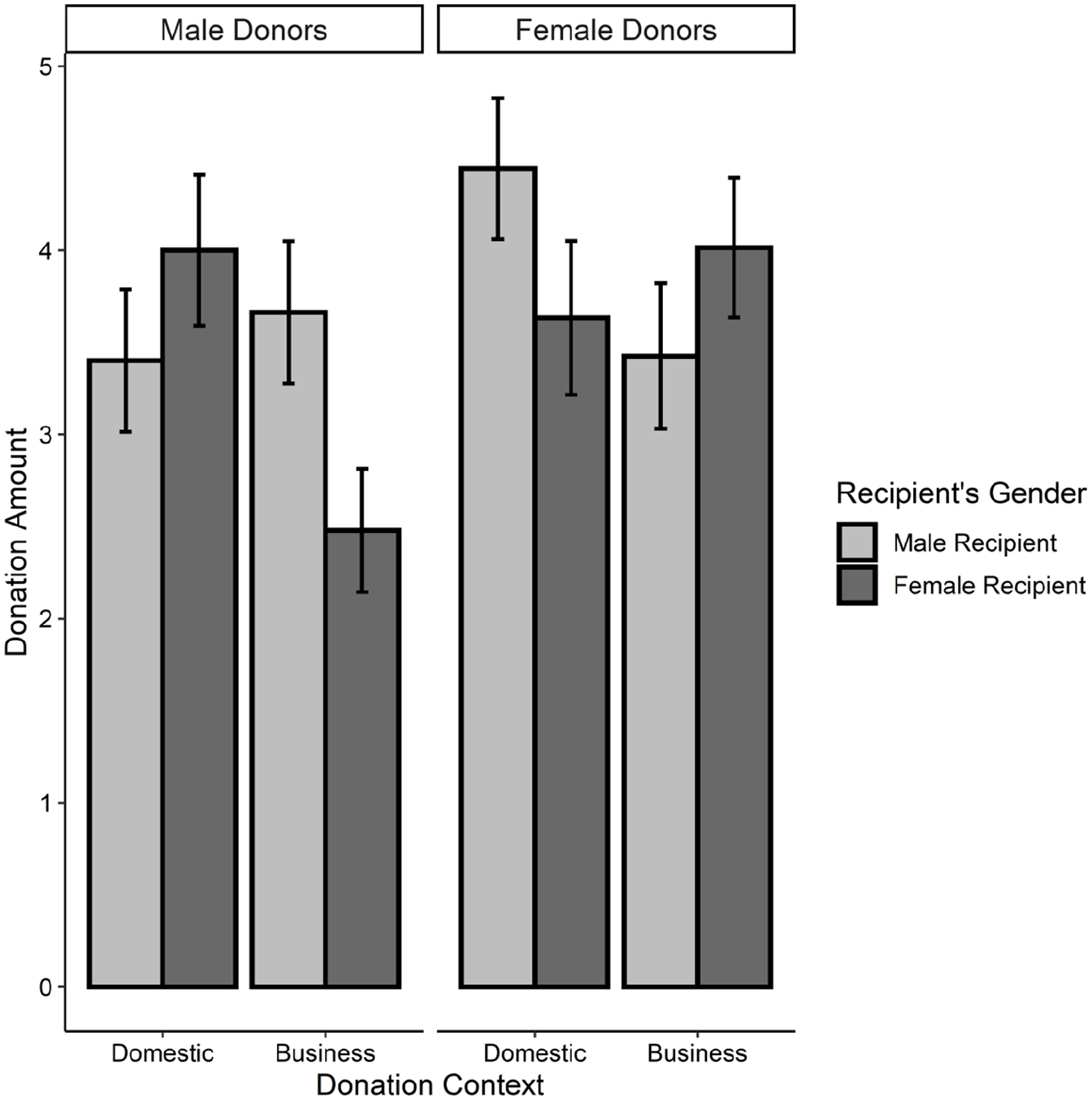
Mean donation amounts as a function of donation context, recipient’s gender, and donor’s gender: Study 1.
To determine whether the three-way interaction took the predicted form, we conducted two separate two-way ANOVAs, one for each donor’s gender. The analysis for male participants indicated no main effects of recipient’s gender or donation context (ps > .100). As expected, the two-way Donation Context × Recipient’s Gender interaction was significant, F(1, 280) = 5.45, p = .020, ηp2 = .02. Pairwise comparisons revealed, as expected, that when male participants responded to a donation appeal in a business context, they donated lower amounts to a female recipient (M = 2.48, SD = 2.78) than to a male recipient (M = 3.66, SD = 3.26), F(1, 280) = 4.73, p = .030, ηp2 = .02. By contrast, when the donation appeal was in a domestic context, male participants donated similar amounts to both female (M = 4.00, SD = 3.53) and male recipients (M = 3.40, SD = 3.24), F(1, 280) = 1.25, p = .265, ηp2 = .004. As an alternative way to interpret this interaction, pairwise comparisons also revealed that male participants donated lower amounts of money to female recipients when the donation request was in a business context compared to a domestic context, F(1, 280) = 7.98, p = .005, ηp2 = .03. By contrast, male participants donated similar amounts to male recipients in both business and domestic contexts, F(1, 280) = 0.23, p = .629, ηp2 = .001.
In line with our theoretical rationale, the analysis for female participants indicated that the main effects of recipient’s gender (p = .780), donation context (p = .421), and the two-way Donation Context × Recipient’s Gender interaction (p = .077) did not reach significance.
Overall, the results of Study 1 confirmed the hypothesis that men, but not women, would exhibit a gender bias against women (but not men) in terms of donation amounts in a business but not a domestic context.
Study 2
The main goal of Study 2 was to extend the generalizability of the Study 1 findings. In particular, Study 1 provided initial evidence for a gender bias in men’s donation behavior towards women in a business context. However, in Study 1, the two appeals (from a male or a female recipient) in each donation context (domestic or business) were viewed in isolation and evaluated by different people. Study 2 was designed to examine whether a gender–donation bias in male donors would emerge in a joint evaluation in which a male recipient and a female recipient were presented simultaneously and evaluated comparatively, either in a business or a domestic context.
This design allowed us to examine the two stages of the donation decision: To whom participants chose to donate (a male or a female recipient) in each donation context, and how much money was donated to each recipient. We expected the gender bias to emerge in both stages of the donation decision. First, we expected a two-way interaction between donation context and donor’s gender, such that male (but not female) participants would be less likely to choose to donate to the female recipient than to the male recipient when the donation appeal was in a business (but not a domestic) context. Second, consistent with Study 1 findings, we expected a three-way interaction between donation context, the chosen recipient’s gender, and the donor’s gender, such that male (but not female) participants would donate less money to a female (but not a male) recipient in a business (but not a domestic) context.
Another goal of Study 2 was to explore possible mechanisms driving the gender–donation bias effect, based on previous research on charitable behavior (Ein-Gar & Levontin, 2013; Kogut, 2011b) as well as research on gender stereotypes (Eagly et al., 2019). The main mechanism we considered was participants’ empathy for the recipient, a primary motivator behind prosocial behavior (e.g., Batson et al., 1991) that is especially relevant to the negative emotions agentic women may evoke among male prospective donors (Williams & Tiedens, 2016). Other possible mechanisms included perceived donation efficacy (i.e., donors need to feel that their personal donation indeed contributes to the cause; Cryder et al., 2013) as well as perceptions of the recipient’s neediness, capability, agency, and future need for help.
Method
Participants
As in Study 1, we set the sample size to be at least 70 participants per cell for the main donation choice analysis. A sensitivity analysis for a 5% level of significance and power of 80% indicated that this sample size was sufficient to detect the minimum effect of OR = 1.34, and the observed effect (OR = 1.35) exceeded this minimum value. The sample was composed of 300 male (n = 135; Mage = 22.82, SD = 2.88) and female (n = 165; Mage = 21.74, SD = 2.21) students, who were recruited through a university subject pool to participate in a study in exchange for course credit and a raffle ticket (two 50 new Israeli shekels [NIS; about $15] prizes).
Procedure
Participants were assigned to one of two donation context conditions. As in Study 1, participants read an excerpt from a newspaper article about a spate of wildfires that was framed either in a domestic or a business context. Afterward, they were presented with two donation appeals (allegedly posted on a charity crowdfunding platform). Depending on the experimental condition, both appeals were either in a domestic context (i.e., two victims whose houses burned down) or in a business context (i.e., two victims whose shops burned down). One appeal was posted by a man and the other by a woman, both seeking help. Note that because the two appeals were presented side by side on the same page, it was important to create a distinction between them (beyond the recipient’s gender) to bolster credibility. Thus, in contrast to Study 1, in the business condition, each shop referred to a different but presumably gender-neutral type of shop (i.e., a film or a clock shop). The type of shop was counterbalanced across the appeals.
Participants were asked to indicate to whom they would prefer to donate (the male or the female recipient) if they won the raffle prize. This decision served as the first dependent variable. After making their decision, participants indicated the amount of money they wanted to donate to the recipient of their choice (the scale ranged from 0 to 50 NIS), which served as the second dependent variable.
Afterward, participants were asked to respond to several questions on their general impression of their chosen donation recipient, as well as the considerations that guided their decision. These questions measured the explored mediators. One item measured empathy for the recipient (adapted from Cryder et al., 2013; “To what extent do you feel empathy for [recipient’s name]?”) using a 7-point scale (1 = not at all, 7 = very much). Additional items measured perceived donation efficacy and perceived recipient’s neediness, capability, agency, and future need for help (for more details, see the Study 2 protocol, available at https://osf.io/y65wr/). Finally, participants reported their demographics and were debriefed.
Results and Discussion
Donation choice
A logistic regression with recipient (male recipient coded as 0, female recipient coded as 1) as the dependent variable was conducted. The predictors were donation context, donor’s gender, and their two-way interaction. Results of the regression analysis are presented in Table 1. As shown in Table 1, the effects of donation context and donor’s gender were not significant. As predicted, the two-way interaction was significant. Simple effects analysis revealed that in the business context, female recipients were chosen less than male recipients by male donors (n = 28; 45%) compared to female donors (n = 56; 64%), B = 0.38, SE = 0.17, z = 2.23, p = .026. By contrast, in the domestic context, there was no significant difference between male donors (n = 45; 62%) and female donors (n = 39; 51%) in the frequency of choosing a female recipient over a male recipient, B = −0.22, SE = 0.17, z = −1.35, p = .176 (see also Table 2 for frequencies of donation choices). As an alternative way to interpret this interaction, simple effects analysis for donation context revealed only marginal effects. Specifically, male participants tended to choose the female (vs. male) recipient less in the business context compared to the domestic context, B = −0.33, SE = 0.18, z = −1.91, p = .057. By contrast, female participants tended to choose the female (vs. male) recipient more in the business context compared to the domestic context, B = 0.27, SE = 0.16, z = 1.68, p = .093.
Results of logistic regression analysis on donation choice: Study 2.
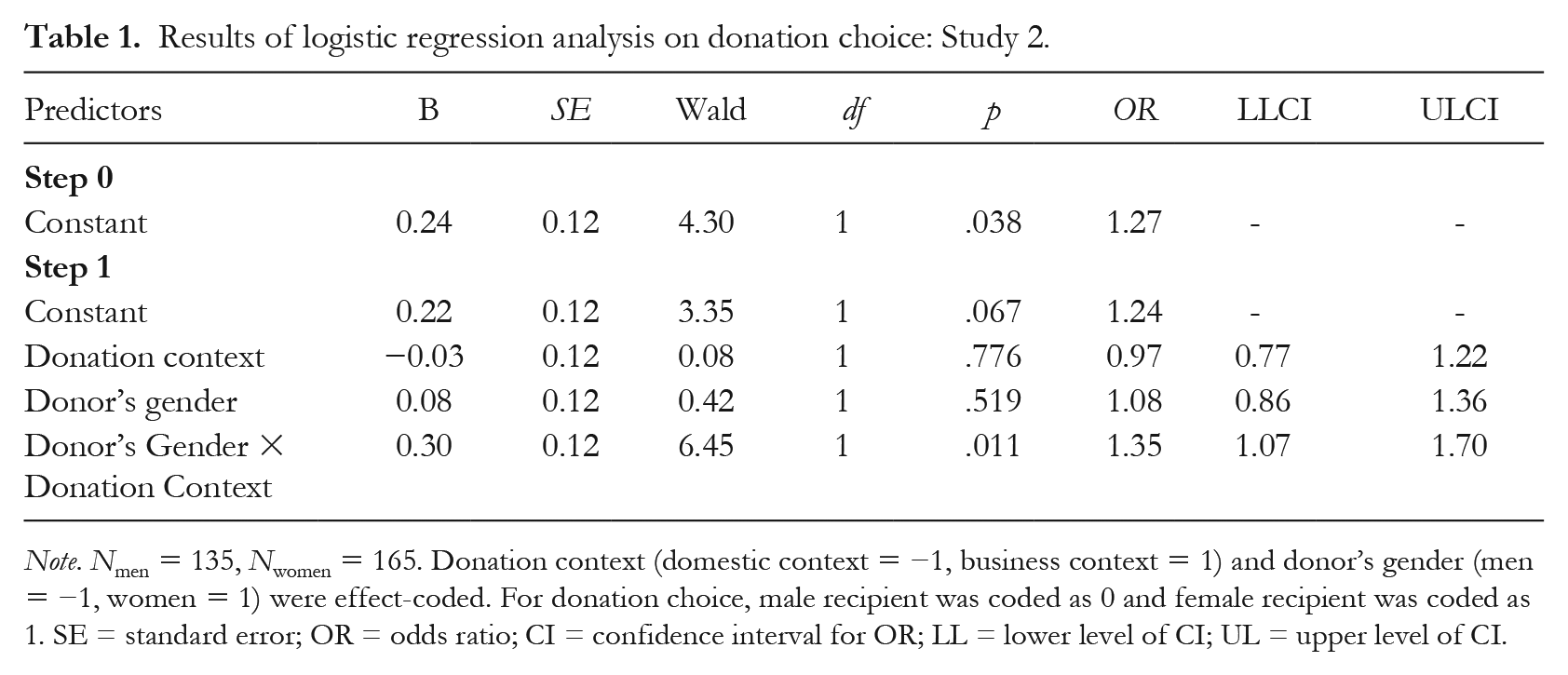
Note. Nmen = 135, Nwomen = 165. Donation context (domestic context = −1, business context = 1) and donor’s gender (men = −1, women = 1) were effect-coded. For donation choice, male recipient was coded as 0 and female recipient was coded as 1. SE = standard error; OR = odds ratio; CI = confidence interval for OR; LL = lower level of CI; UL = upper level of CI.
Frequencies of donation choices as a function of donation context and donor’s gender: Study 2.
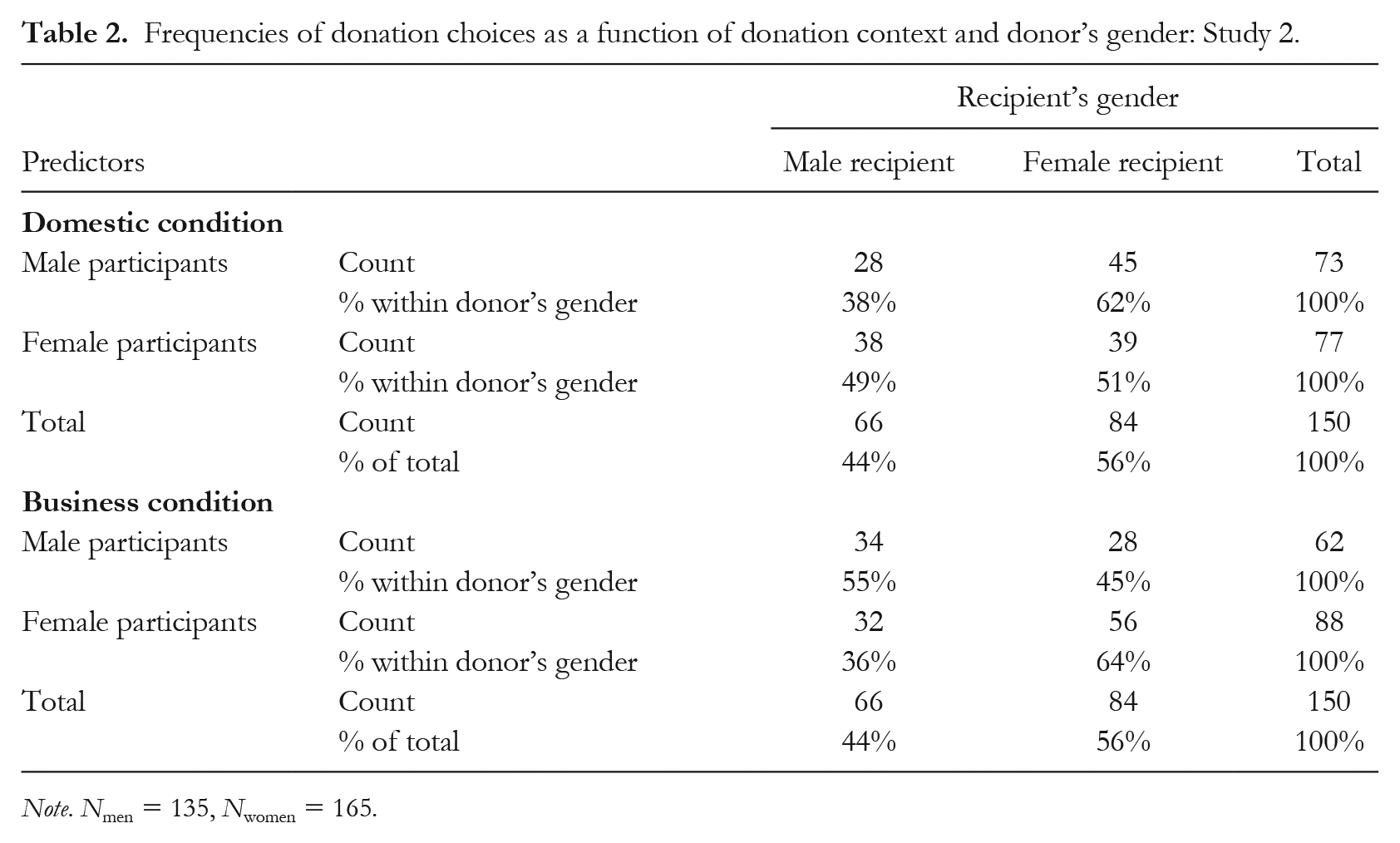
Note. Nmen = 135, Nwomen = 165.
Donation amount
To test whether the results of Study 1 were conceptually replicated, we also conducted a 2 (donation context [domestic, business]) × 2 (the chosen recipient’s gender [man, woman]) × 2 (donor’s gender [man, woman]) between-subjects ANOVA with donation amount as the dependent variable. The main effect of recipient’s gender, as well as the two-way interactions, were not significant (ps > .054). The main effects of donation context (p = .011) and donor’s gender (p < .001) were significant, and were qualified by a significant three-way Donation Context × Recipient’s Gender × Donor’s Gender interaction, F(1, 292) = 6.13, p = .014, ηp2 = .02 (see Figure 2).
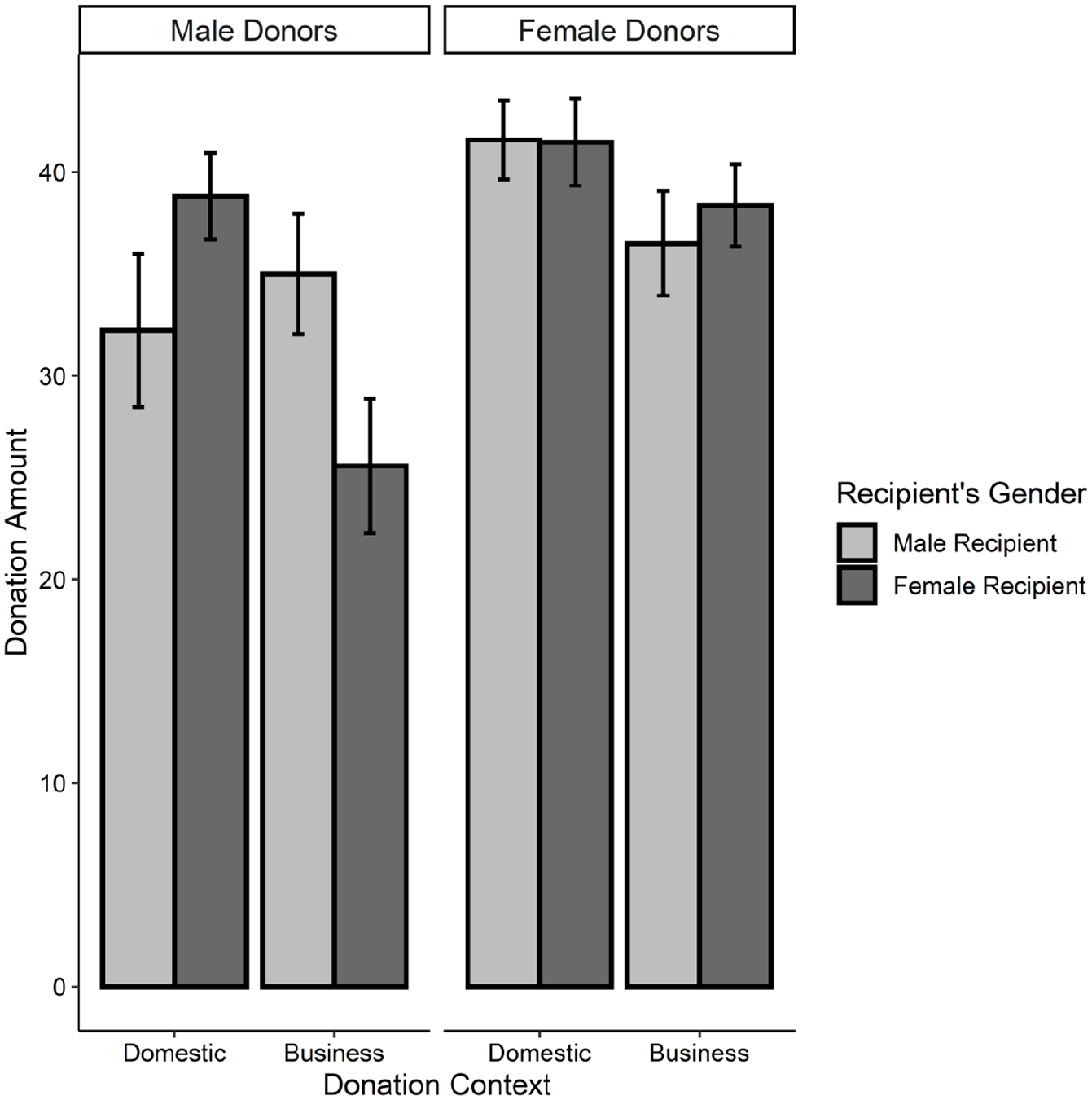
Mean donation amounts as a function of donation context, recipient’s gender, and donor’s gender: Study 2.
To determine whether the three-way interaction took the predicted form, we conducted two separate two-way ANOVAs, one for each donor’s gender. The analysis for male participants indicated no main effects of recipient’s gender and donation context (ps > .082). As expected, the two-way Donation Context × Recipient’s Gender interaction was significant, F(1, 131) = 7.24, p = .008, ηp2 = .05. Pairwise comparisons revealed that male participants in the business context donated lesser amounts to female recipients (M = 25.57, SD = 17.49) than to male recipients (M = 35.00, SD = 17.28), F(1, 131) = 4.73, p = .032, ηp2 = .04. By contrast, in the domestic condition, male participants donated similar amounts to female (M = 38.82, SD = 14.32) and male (M = 32.21, SD = 19.90) recipients, F(1, 131) = 2.61, p = .109, ηp2 = .02. As an alternative way to interpret this interaction, pairwise comparisons also revealed that male participants donated lower amounts of money to female recipients when the donation request was in a business context than in a domestic context, F(1, 131) = 10.49, p = .002, ηp2 = .07. By contrast, male participants donated similar amounts to male recipients in both business and domestic contexts, F(1, 131) = 0.41, p = .522, ηp2 = .003.
In line with the hypotheses, the analysis for female participants indicated that the main effects of recipient’s gender (p = .695) and donation context (p = .066) as well as the two-way Donation Context × Recipient’s Gender interaction (p = .656) were not significant.
Conditional indirect effects
For each of the variables explored as mechanisms, we tested for a conditional indirect effect, and found that only empathy for the recipient of choice significantly mediated the obtained three-way interaction on donation amount. For the sake of brevity and conceptual clarity, we report and discuss the results solely for this variable (https://osf.io/y65wr/).
We conducted a moderated moderated mediation analysis (Hayes, 2017) using Hayes’s (2021) macro (Model 12 with 95% bias-corrected confidence intervals based on 5,000 bootstrap samples), which makes it possible to test models in which the moderation of the indirect effect by one variable is dependent on a second moderator. The results of the analysis (see Table 3) indicated that the indirect effect of the three-way Donation Context × Recipient’s Gender × Donor’s Gender interaction on donation amount through empathy was significant, B = 0.65, SE = 0.34, 95% CI [0.01, 1.34]. Thus, when opting to donate to a female recipient, male donors felt less empathy when she was presented in a business context than in a domestic context, B = −0.32, SE = 0.16, t(292) = −2.03, p = .044, 95% CI [−0.62, −0.01]. This lower level of empathy, in turn, predicted male donors’ lower donations to the female recipient, B = 4.42, SE = 0.65, t(291) = 6.48, p < .001, 95% CI [2.93, 5.50]. Donation context did not influence male donors’ empathy when the recipient was a man (p = .341), or female donors’ empathy for either recipient gender (ps > .070).
Moderated moderated mediation analysis: Study 2.
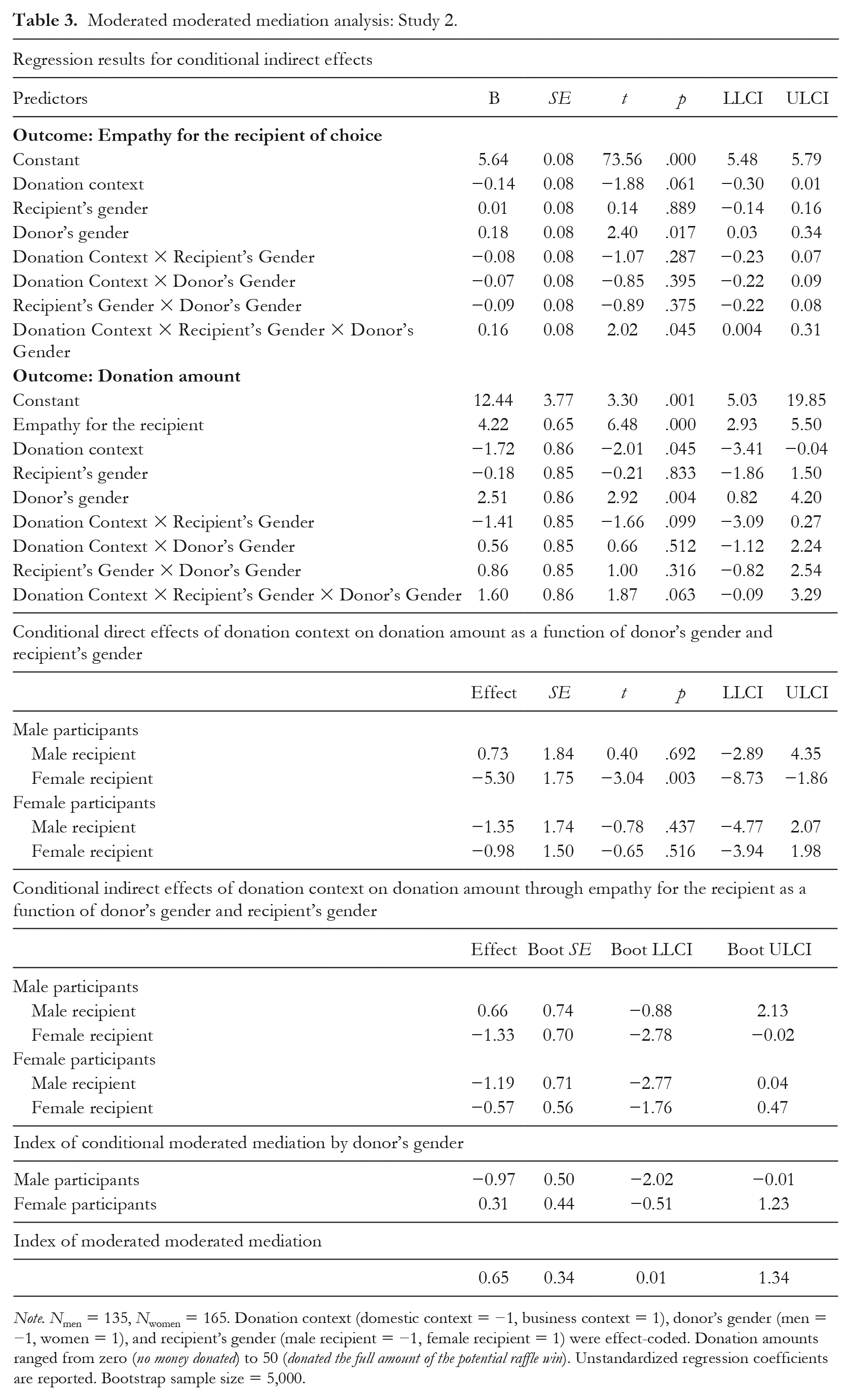
Note. Nmen = 135, Nwomen = 165. Donation context (domestic context = −1, business context = 1), donor’s gender (men = −1, women = 1), and recipient’s gender (male recipient = −1, female recipient = 1) were effect-coded. Donation amounts ranged from zero (no money donated) to 50 (donated the full amount of the potential raffle win). Unstandardized regression coefficients are reported. Bootstrap sample size = 5,000.
Overall, consistent with Study 1, the results of Study 2 supported the hypothesis of a gender bias in male donors’ charitable decisions. Thus, Study 2 extends the generalizability of Study 1 findings by showing that this bias occurs not only when appeals are evaluated separately by different people, but also in joint evaluations in which both recipient genders are evaluated comparatively. Thus, unlike previous research showing that individuals make more reasoned decisions in joint than in separate evaluation modes (for a review, see Bazerman & Moore, 2013; for an example in a gender bias context, see Bohnet et al., 2016), the gender–donation bias effect persisted even when the comparison was obvious and available to the donor.
Underscoring the robustness of the findings, Study 2 indicated that the gender–donation bias effect occurred in both stages of the decision process. Specifically, donation decisions can best be described as a two-stage process that first involves the decision of whether to donate and to whom, and then the decision as to the amount of the donation (Dickert et al., 2011). Research linking gender-related factors to the provision of help in general (e.g., Nadler et al., 1984), and to monetary decisions in particular (e.g., Kemp et al., 2013), has mostly focused on each of these decisions separately. Study 2 showed that a gender bias in donations occurs not only when donors decide how much to donate, but also when they are faced with a direct choice of recipient.
The finding that female recipients were chosen less than male recipients in a business context by male donors (45%), compared to female donors (64%), does not allow us to rule out the possibility that this effect was driven by women’s positive in-group bias rather than men’s gender bias against women. However, according to the overall pattern of findings for choice decisions and donation amount decisions across both studies, the gender bias among male donors is more prevalent and consistent than a gender bias among female donors. Specifically, men’s donation amounts to female recipients in the business context were significantly lower than their donations to male recipients in the same context, as well as lower than their donations to female recipients in the domestic context. By contrast, female participants donated similar amounts to male and female recipients across the two studies.
Study 2 also pointed to empathy as a mechanism underlying the gender–donation bias effect, consistent with research on the role of empathy in determining charitable behavior (e.g., Cryder et al., 2013; Ein-Gar & Levontin, 2013; Kogut, 2011b). Although the amounts were a function of choice (i.e., participants donated money to the person of their choice), empathy levels were still relatively low among men who chose to donate to a female recipient in a business context. This finding may imply that male donors’ tendency to choose to help a female recipient did not stem from empathy per se, but rather from the need to do the “right thing” based on social norms and values (Bekkers & Wiepking, 2011), which, in this case, was assumed to be supporting a woman in need.
However, it should be noted that empathy as well as two other constructs that assessed potential mediators (i.e., perceived capability of the recipient and perceived future need for help) were measured with a single item. Thus, the results pertaining to empathy as well as the null results for these two other mediation models should be interpreted with caution given the psychometric limitations associated with single-item measures (see Fuchs & Diamantopoulos, 2009). Moreover, to assess empathy, participants were directly asked to rate their feelings of empathy for the recipient (as in Cryder et al., 2013). Given the multiple definitions of the term empathy, which include cognitive and emotional components (Hall & Schwartz, 2019), the participants may have interpreted this item in different ways. Future research should further examine the role played by empathy in accounting for the gender–donation bias by assessing specific components of empathy, and also explore other possible mechanisms.
General Discussion
We presented two studies supporting the hypothesis that men exhibit a gender bias against businesswomen in their charitable behavior. Study 1 found that male (but not female) donors donated lesser amounts to female recipients than to male recipients when the appeal was in a business versus a domestic context. Study 2 further revealed that when donors were able to choose a recipient in a business (compared to a domestic) context, female recipients were chosen less often than male recipients by male donors compared to female donors. Study 2 also replicated Study 1 findings pertaining to a gender bias in donation amounts and showed that this occurred even in a choice setting where the two recipients, a man and a woman, were presented in a comparative mode. This study also pointed to empathy as a mechanism underlying this effect.
Theoretically, this research contributes to the integration of theorizing and empirical work on gender roles and prosociality (Eagly, 2009) and social dominance (Sidanius & Pratto, 1999). The findings demonstrate that women do not always receive more help from men, as previously suggested (Eagly & Crowley, 1986). Rather, the findings indicate that men are reluctant to offer help when it empowers women and thus challenges the existing social hierarchy, as in the case of monetary donations in business contexts. Moreover, even when men do decide to donate to businesswomen in need, thus helping them to “survive,” the amount of money donated is lower than to businessmen, thus preventing women to thrive. Hence, an important contribution of this work lies in showing that the gender–donation bias effect constitutes a psychological barrier to helping businesswomen in need, which, unlike more blatant barriers (e.g., negative reactions to career women; Masser & Abrams, 2004), seemingly involves cooperation and kindness. Examining these ostensibly positive mechanisms is critical because they are harder to identify than overtly hostile ones (Barreto & Ellemers, 2005) and are sometimes more damaging (Becker & Wright, 2011).
The finding that women did not exhibit a donation bias against other women is consistent with social dominance theorizing about the asymmetrical motivations of disadvantaged and advantaged group members (Pratto et al., 2006). At first glance, this finding may seem inconsistent with empirical evidence within the framework of system justification theory (Jost et al., 2004; Jost & Hunyady, 2005), which suggests that members of disadvantaged groups may also share perceptions and motivations justifying the status quo, even at considerable cost to their fellow group members or themselves. Indeed, empirical evidence has suggested that women are susceptible to the allures of system-justifying practices, such as endorsing complementary stereotypes (Jost & Kay, 2005) or engaging in self-objectification (Calogero & Jost, 2011). However, women are also more ambivalent than men about the status quo, especially in relation to gender discrimination (Jost & Burgess, 2000), as they navigate conflicting personal and ideological motivations. Empirical findings that women are less likely than men to exhibit a gender bias against other women in diverse competitive fields support this reasoning (for a review, see Roper, 2019).
The findings are consistent with previous works on gender gaps in venture funding, in which female entrepreneurs raised less money than their male counterparts (e.g., Balachandra, 2020; Kanze et al., 2018, 2020; for a meta-analysis, see Geiger, 2020). Although the stereotype of businesswomen’s competence (Eckes, 2002) applies to both business donations and venture funding, the main motivation for investment is financial (i.e., return on investment), whereas, for donations, the motivation is altruistic (i.e., does not involve financial incentives) and also relates to donation efficacy (i.e., donors need to feel that their personal donation can make a positive contribution to the cause; Cryder et al., 2013). Thus, the findings extend previous research on venture funding by showing that a gender bias against businesswomen occurs not only when financial interests are involved, but also when the motivation to support women in need is seemingly altruistic in nature.
In practical terms, the findings have implications for policymakers interested in developing interventions to reduce gender bias in charitable behavior. Specifically, the findings suggest that, in addition to targeting the traditional areas in which businesswomen are discriminated against (e.g., at the workplace: Heilman & Caleo, 2018; in funding contexts: Kanze et al., 2018), interventions should also target biases in prosocial behavior; for example, by raising awareness of the existence of such biases and educating about the negative implications they have for businesswomen (see Zawadzki et al., 2012).
Limitations and Future Directions
The present research has some limitations that suggest several future research directions. First, the scope of the investigation was limited to donation decisions in the context of fires. Future research could strengthen the generalizability of the conclusions by examining whether the gender–donation bias effect also occurs in other contexts, such as cases in which the recipients can be blamed (or not) for their misfortune (e.g., Kogut, 2011a). This includes business owners who made risky decisions or poor market forecasting. Moreover, although we aimed to simulate charitable giving in real-life crowdfunding platforms (e.g., gofundme.com, justgiving.com), the testing of our hypothesis using solely online hypothetical scenarios poses a limitation to the generalizability of the findings. Hence, future research should test whether a gender–donation bias also occurs in face-to-face donation appeals (e.g., Lindskold et al., 1977) or in actual donations (using real data from donation platforms; e.g., Tracy et al., 2018).
Finally, although we theorized that the gender–donation bias effect may stem from hierarchy-enhancing motives, further research is necessary to fully test this prediction. On a dispositional level, one possible moderator may be individual differences in the donor’s social dominance orientation (SDO; Pratto et al., 1994); namely, the preference for hierarchy (vs. equality) within any social system. Individuals who are high on SDO tend to adopt sexist ideologies (Pratto et al., 2000; Sibley et al., 2007) and behave in ways that reinforce the existing gender hierarchy (e.g., express prejudice against women in the workforce; Christopher & Wojda, 2008). Another related moderator may be the donor’s endorsement of hostile sexism, which reflects a view of women as competitors who seek to gain dominance and control over men (Glick & Fiske, 2001), which has been found to predict negative reactions to career women (Masser & Abrams, 2004), greater acceptance of gender income inequality (Connor & Fiske, 2019), and lesser willingness to support women’s organizations (Ford et al., 2008). Thus, male donors who endorse such ideologies may exhibit a stronger gender–donation bias effect. Future research could also experimentally manipulate the motivation to reinforce the gender hierarchy among men (e.g., Bareket & Shnabel, 2020), to test whether it would exacerbate the gender–donation bias effect as a defensive response to the threat (see Nadler et al., 2009).
Conclusion
Despite the dramatic progress toward gender equality in the last half century and the growing endorsement of egalitarian values in Western societies (Scarborough, 2019), trends towards equality in recent decades have slowed down or even stalled (England et al., 2020). To some extent, this is because subtle forms of bias still operate in gender relations (e.g., Handley et al., 2015), especially in the context of prosocial behavior (e.g., Bareket et al., 2021; Shnabel et al., 2016). Building on a social dominance perspective, the current studies provide initial evidence for a gender bias against businesswomen in men’s charitable decisions, a context that involves seemingly cooperative rather than oppressive intentions. Increasing men’s and women’s awareness of this bias may contribute to its reduction (e.g., Devine et al., 2017). Given its potentially adverse effects on women’s advancement in business contexts (for a review, see Filut et al., 2017), this is an important social goal.
Footnotes
Data accessibility

Funding
The author(s) disclosed receipt of the following financial support for the research, authorship, and/or publication of this article: This work was supported by the Israel Science Foundation (Grant No. 471/19 to Danit Ein-Gar; Grant No. 114/21 to Orly Bareket).