



Abstract
COVID-19 has plagued the globe since January 2020, infecting millions and claiming the lives of several hundreds of thousands (at the time of writing). Despite this, many individuals have ignored public health guidance and continued to socialize in groups. Emergent work has highlighted the potential role that ideology plays in such behavior, and judgements of it. In response to this contemporary cultural phenomenon, we tested whether judgements of those allegedly flouting the guidance on social distancing were influenced by an interaction between the ideologies of those providing judgements and those allegedly breaking the rules. Our data suggest that judgements of those flouting social distancing guidance are influenced by ideology in a symmetrical way. That is, both liberals and conservatives condemn outgroup flouting more than ingroup flouting. We discuss this finding in the context of theoretical work into ideological symmetries, and the implications of growing ideological polarization in contemporary Western democracies.
Introduction
The coronavirus disease 2019 (COVID-19) has spread globally at an alarming rate, infecting millions of people and killing up to 1% of those who contract it (Chen et al., 2020; Rajgor et al., 2020). Responses to the virus internationally have varied in scope, severity, and general epidemiological approach, from widespread testing and tracing in South Korea to gradations of citizen lockdowns in China, Italy, the UK, and the US (Baird, 2020; Graham-Harrison & Kuo, 2020; Public Health England, 2020; Sohrabi et al., 2020; World Health Organization, 2020). These approaches each place a unique set of behavioral restrictions and guidance for citizens in each country, with varying levels of compliance.
High-profile cases of flouting public health recommendations have been reported in various American states wherein more stringent lockdowns have been mandated. Fears related to the economic implications of lockdowns (as opposed to fear of the virus) as well as ideologically based preferences for self-determination, temperamental difficulties with impulse control, and a rejection of scientific advice appear to be the core motivations for wilfully breaking commands to stay indoors (Brzezinski et al., 2020; Kuiper et al., 2020). In the UK, several government officials have been found to be acting against their own advice. Advisors in England and Scotland have resigned (and, in one high-profile case, not resigned) their positions, and members of the British Parliament have been found to be travelling between their constituencies and second homes in other parts of the country.
Some of the most notable examples of guidance flouting have appeared to have political implications. On March 23, 2020, Dominic Cummings (formerly a senior advisor to British Prime Minister Boris Johnson) travelled more than 250 miles to his parents’ home with his children after his wife developed symptoms of COVID-19, contravening orders about how households should self-isolate indoors for 14 days in such circumstances. The response to Cummings’s actions illuminated and reexaggerated ideological divisions related to the Brexit issue. That is, Cummings was a leading figure in the British vote to leave the European Union (EU) in 2016 (Fuller, 2017), and thus proleave individuals tended to support Cummings’s flouting of the isolation guidelines, while those favoring a “remain” vote called for his resignation/firing. Similar observations of mixed responses were present when Labour Party members and scientific advisors were found to be flouting the guidance on self-isolation and travel restrictions.
Starting on the other side of the Atlantic Ocean, there was an emergence of global protests against alleged systemic racism in response to the death of George Floyd in Minneapolis in May 2020, and a reemergence of the Black Lives Matter (BLM) movement. This, then, offers a unique moment in history within which to examine the relative strengths of two competing forces in support (or opposition) to mass protests. That is, while recent research has found that fear of COVID-19 predicts greater adherence to and support of social distancing and virus-mitigating behaviors (Harper et al., 2020), a desire or perceived duty to act altruistically is also linked to both this outcome (Brooks et al., 2020; Everett et al., 2020; Oosterhoff & Palmer, 2020; Pfattheicher et al., 2020) and engagement in and support of social justice and environmental causes (e.g., Cartabuke et al., 2019; Gkargkavouzi et al., 2019). Further, while active social justice protesters are typically characterized by a future-oriented nature (Shavit et al., 2014), it was believed at the beginning of the pandemic that engaging in mass gatherings might increase the rates of COVID-19 infection in the immediate term, which subsequently increases the likelihood of an exaggerated virus-related death rate. Simultaneously, counter-protests against the BLM movement occurred. In doing so, both sides of the political spectrum have ignored guidance at the individual level, and protested in large numbers during the pandemic, contrary to governmental and public health guidance on slowing the spread of COVID-19. It may be that judgments of those engaging in such flouting behaviors, both at an individual level (e.g., visiting family or taking trips during lockdowns) and at a mass participation level (e.g., protests during an eased lockdown, while still contravening social distancing guidance), are driven by the selective activation of moral attitudes (Grant & Smith, 2021; Packer et al., 2021; Yudkin et al., 2021).
In this paper, we diverge from the majority of existing research emerging about citizens’ personal behavioral changes in response to COVID-19, and instead focus on their responses to examples such as these, where others act against government guidelines. Specifically, we will begin to apply established work on ingroup love and outgroup derogation to this novel political and public health context.
Ingroup Love and Outgroup Derogation: A Primer on Motivated Partisan Cognition
A range of empirical and polling data have demonstrated a growing degree of polarization across modern Western democracies (Finkel et al., 2020). Political partisans increasingly dislike each other (Lelkes, 2016), sort themselves into distinct communities both online (Colleoni et al., 2014; Huber & Malhotra, 2017) and in terms of physical residential areas (Enos, 2017), and avoid each other’s viewpoints (Frimer et al., 2017). Such homologous communities lead to fewer opportunities for encountering ideological outgroup members, either directly by experience or indirectly via cross-partisan media (Bakshy et al., 2015), with a range of downstream effects for intergroup relations and political cognition.
Although distance between ideological groups may appear incidental due to partisans sorting themselves into communities at the group level, some studies have suggested that individual partisans also avoid outgroup members in a conscious and motivated manner. In separate studies, Boutyline and Willer (2017) and Frimer et al. (2017) report similar data that suggest that an individual’s motivation for maintaining certainty and a clear sense of reality leads them to purposefully avoiding ideological outgroup members. That is, partisans often believe that hearing from outgroup members will challenge their worldview, lead to self-doubt, and contribute to a sense of uncertainty about the world. As such, they avoid engaging with such outgroup members to maintain a consistent worldview. However, this process inevitably leads to intergroup conflict by partisans needing to infer each other’s motivations for disagreement due to a lack of objective evidence (Graham et al., 2012; Harper & Fido, 2021). Such inferences are typically based on stereotypes that enhance perceptions of difference (rather than being reflective of actual difference) between political groups, which subsequently serve to exaggerate hostility and intolerance between partisans (Brandt, 2017; Crawford, 2014; Ditto et al., 2019; Lees & Cikara, 2020; Wilson et al., 2020).
These processes bolster feelings of ingroup positivity while fostering resentment towards those who (or who are perceived to) comprise the outgroup. Research has found that individuals who place a greater moral value on their own group’s views than those of others (commonly operationalized as collective narcissism) are more sensitive to perceived threats from outgroups (e.g., Golec de Zavala et al., 2009; Marchlewska et al., 2020; Zemojtel-Piotrowska et al., 2021), and are quick to respond punitively to them in an effort to bolster the status of the ingroup. At its root, this reflexive approach to punishment may be caused by a fundamental misunderstanding of outgroup members (Harper & Fido, 2021), the motivations for their actions, and a desire to create a clear, consistent, and strong worldview among the ingroup. As such, it is of little surprise that individuals are often quick to punish outgroup members for rule breaking while responding more leniently towards ingroup members when making snap judgments. This reflexive punishment process—which we explore within the context of the COVID-19 pandemic—allows partisans to maintain a strong sense of moral superiority while derogating outgroups as deviant or immoral. This process is reflexive in that it happens automatically (intuitively) rather than deliberatively. For example, partisans making decisions under time or cognitive pressures are more likely to punish outgroup members than ingroup members for the same moral transgression (Yudkin et al., 2016).
Ideology and Its Link to (Judgments of) Following and Flouting COVID-19 Guidance
Although motivated cognition in the political domain is a well-established phenomenon, there have been few opportunities to explore it within an unfolding social context that is not explicitly political. That is, general elections typically provide a backdrop for studying motivated cognition in this area, but we might expect motivated cognition in such contexts. In this paper, we use the COVID-19 pandemic as an ostensibly nonpolitical issue to explore how people respond to ingroups and outgroups engaging in behavior that could be perceived as breaking official guidance and increasing the risk of worsening the pandemic. Our use of “ostensibly” is key here. Although the COVID-19 virus (along with most health issues) is nonpolitical when considered in isolation (e.g., from the perspective of symptomatology and disease prevention), we are aware that the virus, like most issues in contemporary democracies, has become politicized. This has led to differing degrees of adherence to public health guidance and governmental support as a function of ideology (Christiansen et al., 2020; Gollwitzer et al., 2020; Kushner Gadarian et al., 2020; Pennycook et al., 2021). We do not believe that this politicization of the virus means that COVID-19 (as a virus in-and-of itself) is political, but it does make it a suitable candidate topic for exploring the emergent effects of ideology within an unfolding social context.
A small number of psychological studies have explored why people might (not) follow public health guidelines in the context of COVID-19. For example, greater intentions to engage in social distancing and more regular handwashing have been found to be associated with altruistic motivations to prevent harm among vulnerable populations (Brooks et al., 2020; Everett et al., 2020; Oosterhoff & Palmer, 2020; Pfattheicher et al., 2020) and a fear of contracting the virus (Harper et al., 2020). Owing to the apparent deontological motivations of positive behavior change to stop the spread of COVID-19 (Everett et al., 2020), other studies have looked at the moral roots of engaging with health advice and media stories about the virus, some of which have links to political or ideological orientations.
Unexpectedly, Harper et al. (2020) reported no effects of intuitive moral foundations on behavior change after controlling for fear of the virus. They similarly found no effect of political orientation, which led to the conclusion that the pandemic may act as a trigger for political partisans to acknowledge their shared humanity and begin to reduce the modern trend of increasing polarization driven at least in part by the availability of hyper-partisan online media (van Bavel & Pereira, 2018). However, subsequent research taking place as the pandemic developed uncovered ideological differences in beliefs about the virus, attitudes toward lockdowns and other preventative behaviors (e.g., lower use of face coverings or engagement in physical distancing among conservatives), and levels of approval for government responses to the COVID-19 situation (Christiansen et al., 2020; Gollwitzer et al., 2020; Kushner Gadarian et al., 2020; Pennycook et al., 2021). These differences appear indicative of motivated ideological responses, with those previously voting for the current government expressing more support for their pandemic responses (see Pennycook et al., 2021). Of course, there may be an effect here in that the left-leaning federal Canadian Government appears to have handled the pandemic better than the right-leaning governments of the US and UK that were incumbent at the beginning of the pandemic, though the ingroup/outgroup argument still applies in this interpretation.
In this work, we are less interested in group-level behavioral changes in response to the pandemic and more so on potentially ideologically motivated judgments of others who flout national guidance. Specifically, we designed a study to examine the relative effects of potentially stable predictors of such judgments (e.g., fear of COVID-19; Harper et al., 2020), and other more volatile predictors, such as motivated ideological cognition (Kushner Gadarian et al., 2020). That is, while fear of COVID-19 may produce a baseline level of support for social distancing guidelines due to concerns about the broader social spread of the virus, actual responses to those acting against these (in a way that risks increasing transmission rates) may be subject to change as a function of the congruence between the participant and flouters’ ideological position (Yudkin et al., 2021). In accordance with research into ideological (a)symmetries (Jost, 2017), it may be expected that those on the political right will be more punitive towards those who act counter to the guidance, as this group is more likely to respond negatively to rule breakers (Frimer et al., 2014). However, we also know that conservatives are less likely to adhere to pandemic-mitigating behaviors themselves (Christiansen et al., 2020; Gollwitzer et al., 2020; Kushner Gadarian et al., 2020), which may also be reflected in their judgments of others who also flout public health guidance.
In line with previous research into ideologically motivated cognition and reflexive punishment, however, we are principally interested in Participant Ideology × Flouter Affiliation interactions when predicting judgments, while controlling for fear of COVID-19 and moral intuitions. In doing so, we sampled both individual-level (e.g., family visits during lockdowns) and collective action flouting (e.g., participation in mass protests) as stimuli so as to minimize the effects of moral concerns about specific moral causes or political figures confounding our results. That is, we wanted to use a range of individual and group-based stimuli so that any effects that we found were not due to single ideological issues (i.e., views about BLM) or specific individuals (e.g., Dominic Cummings), and instead were based on an average of the ideological valence of the given stimuli. Previous research that has examined ideological (a)symmetries using a range of ideologically salient stimuli, alongside situational outcome measures, typically reports how ideological partisans respond to ingroups and outgroups in symmetric ways (for a review, see Harper, 2020). For this reason, we expect to find a symmetry in our data, with ideological conservatives responding more leniently to ostensibly conservative-aligned rule breakers, and ideological liberals responding more leniently to ostensibly liberal-aligned rule breakers.
Methods
Participants
Prior to collecting any data, we conducted an a priori power analysis to determine our target sample size using G*Power (Faul et al., 2009). The effect size (f2 = .15) for this analysis was based on previously observed ideological differences in attitudes and behaviors related to COVID-19 (Pennycook et al., 2021). This effect size was input into the power analysis with the following input parameters: α = .05, power = .95, predictors = 10. The power analysis result suggested that N = 172 participants are required in this study to detect significant predictors. However, we sought a sample significantly higher than this (approximately 300) in order to meet analytic rules of thumb, and match the sample sizes of comparable studies in the area of ideological judgments of news stories and intergroup relations (e.g., Crawford, 2014; Frimer et al., 2017; Nam et al., 2013).
In recruiting our sample, we targeted open online discussion forums, posting advertisements on community Facebook pages and Reddit boards related to survey research, UK politics, and COVID-19 news (e.g., r/SampleSize, r/Coronavirus, r/ukpolitics, r/UKLabour, r/brexit). Advertising on community boards avoided potential biases in advertising on personal social media feeds, which may have an academic and ideological bias in line with our own political views. In line with our preregistration, we stopped collecting data after overrecruiting on our power analysis (at 492 survey link clicks), and then cleaned the data taking into account the eligibility criteria of an age of above 18 years and self-declared residence in the UK (reduced N = 473). We then removed participants who failed to complete any of the outcome measures (related to judgments of guidance flouting), which left a final sample of 266 participants (59% female; Mage = 40.65 years, SD = 14.55). This final figure represents an inclusion rate of 57%, and is above the minimum number required, as per our power analysis. We explored any differences between those who comprised our final sample and those who did not complete the necessary measures for inclusion. Completers were marginally older than noncompleters (M = 37.83, SD = 14.45), t(445) = 2.03, p = .043, d = 0.20. There was also a slight underrepresentation of Brexit voters (comparative to those who voted to remain in the EU referendum of 2016) in the completing sample, χ2(2) = 7.00, p = .030, φ = .13. There were no other demographic differences in terms of sex, ethnicity, self-reported ideological orientation, or political party preferences between the two groups.
The vast majority (96%) identified as White in terms of their ethnicity. In terms of voting history, 26% voted for the Conservative Party in 2019, 45% for the Labour Party, 22% for another party, and 8% did not vote at all. In the 2016 referendum on EU membership, 31% voted to leave, 55% to remain, and 14% did not vote. We also asked for participants’ voting intentions if the referendum were to be run again, with a slight shift in attitudes towards remain (though this mainly came from those who did not vote in the original referendum). These voting data indicate a leftward skew in our sample when compared to the voting landscape of the UK as a whole. All participants were naïve to the precise research questions and planned analyses when completing the survey.
Materials
Demographics
Participants were asked to provide information about their sex, age, ethnic background, self-placement on the ideological spectrum (1 = very liberal, 9 = very conservative), and past voting behavior in British elections (the 2019 general election and the 2016 EU referendum).
Judgments of lockdown transgressions
In order to obtain judgments of those who flouted lockdown and social distancing rules, we used 10 news stories (published in the national British press) as experimental stimuli. Of these, five were related to individual-level breaches (two enacted by Conservative Party affiliates, two enacted by Labour Party affiliates, one apolitical control example) and five were related to group-based breaches (two enacted by conservative groups protesting against Black Lives Matter, two enacted by liberal groups affiliated to Black Lives Matter, one apolitical control example). The apolitical controls were the breaking of social distancing rules by a professional footballer (individual level) and the flocking of Britons to a popular beach (group level). All source stories are available on our Open Science Framework (OSF) project page (https://osf.io/u2ezy/?view_only=f545a9cdf60d4bcbb8aa30f2410b9825).
Our principal outcomes for study were self-reported responses to each of these news stories, which we obtained by asking the following six questions, with the wording of the items slightly adapted on the basis of whether an individual or a group of people was the target of the news story:
The person [people] in this news story was [were] wrong to do what they did.
The person [people] in this news story probably had a good reason for breaking lockdown rules.
This person [people] should resign or be fired from their position[s].
This news outlet is probably biased against the person [people] they are talking about.
I believe this news story.
This story is fake news.
For each item, participants rated their level of agreement using a 6-point scale that was anchored from 1 (strongly disagree) to 6 (strongly agree). Items 2 and 5 were reversed-scored before averages across Items 1–3 (our “pure condemnation” outcome), and 4–6 (our “perceived media bias” outcome) were separately computed. Of note, this splitting of the outcome scale into two variables represents a deviation from our preregistered analysis plan and was motivated by responses from reviewers to earlier iterations of the paper.
Moral foundations
Moral intuitions were measured using the Moral Foundations Questionnaire (MFQ; Graham et al., 2009). This is a 32-item measure consisting of a range of items that originally examined the endorsement of five moral foundations (care/harm, fairness/reciprocity, authority/respect, ingroup/loyalty, purity/sanctity; six items per foundation). The measure is divided into two sections: relevance (16 items, asking about the relevance of different issues when making a moral decision; e.g., “Whether or not someone acted unfairly”; fairness foundation) and propositions (16 items, asking participants their level of agreement with a range of moral statements; e.g., “I am proud of my country’s history”; loyalty foundation). Two items on the MFQ were fillers: “Whether or not someone was good at math” (Section 1) and “It is better to do good than to do bad” (Section 2), designed to catch random and careless responding patterns. These items are not included in the scoring of the scale. Each item was rated on a 6-point scale (0 = not at all relevant, 5 = extremely relevant [Section 1]; and 0 = strongly disagree, 5 = strongly agree [Section 2]). Responses are averaged for each moral foundation, with higher scores indicating greater levels of endorsement. In our analysis, we used the three-factor structure of the MFQ proposed by Harper and Rhodes (2021). This structure comprises clusters of moral beliefs that pertain to “traditionalism,” “compassion,” and “liberty.” The reanalysis of the MFQ was driven by a series of studies citing the measure’s questionable psychometric properties, with the three clusters being meaningfully associated with political outcomes (i.e., self-reported ideological placement and voting history; Harper & Rhodes, 2021).
Fear of COVID-19
The Fear of COVID-19 Scale (FCV-19S; Ahorsu et al., 2020) was used to assess this construct. This brief measure consists of seven items (e.g., “It makes me uncomfortable to think about coronavirus-19”) asking participants to rate their agreement with each statement on a 5-point ordinal scale (1 = strongly disagree, 5 = strongly agree).
Lockdown adherence and support
We used separate four-item scales created for the purposes of this study to measure support for COVID-19 lockdowns (e.g., “Some form of lockdown is necessary to address the spread of COVID-19”; α = .85) and adherence to lockdown rules when they were enforced (e.g., I have not been outside for any other reason than a brief exercise break or for food shopping since the beginning of the COVID-19 lockdown”; α = .86). For each of these items, participants rated their level of agreement using a 6-point ordinal scale (1 = strongly disagree, 6 = strongly agree). Average subscale scores were computed, with high scores corresponding to more support for lockdowns and more adherence to lockdown rules.
Procedure
Upon clicking the link to the survey (advertised in the locations described previously), participants first read information about the study and affirmed their consent to take part. They first provided their demographic information before completing the MFQ, FCV-19S, and lockdown support and adherence measures in a randomized order. The ordering of the items within each of these scales was randomized in order to reduce any bias introduced by the ordering or clustering of items. Following this, participants read the 10 experimental news stories, again in a randomized order, and responded to the outcome judgment questions for each. Upon completing the study, all participants were comprehensively debriefed. This procedure was approved by an institutional review committee and followed British Psychological Society ethical guidelines throughout.
Preregistered Data Analysis Plan
We preregistered our data analysis plan at OSF, where data and code are also available (https://osf.io/u2ezy/).
Results
We used R (R Core Team, 2012) and lme4 (Bates et al., 2012) to perform a linear mixed effects analysis. We used participants and story as random intercepts, and random slope terms were not included in the model if they led to a singular fit (Barr et al., 2013). Descriptive statistics and internal consistency coefficients for all measures are reported in Table 1. Correlations between these are detailed in a correlation matrix (Figure 1).
Descriptive statistics and internal consistency for measured variables.
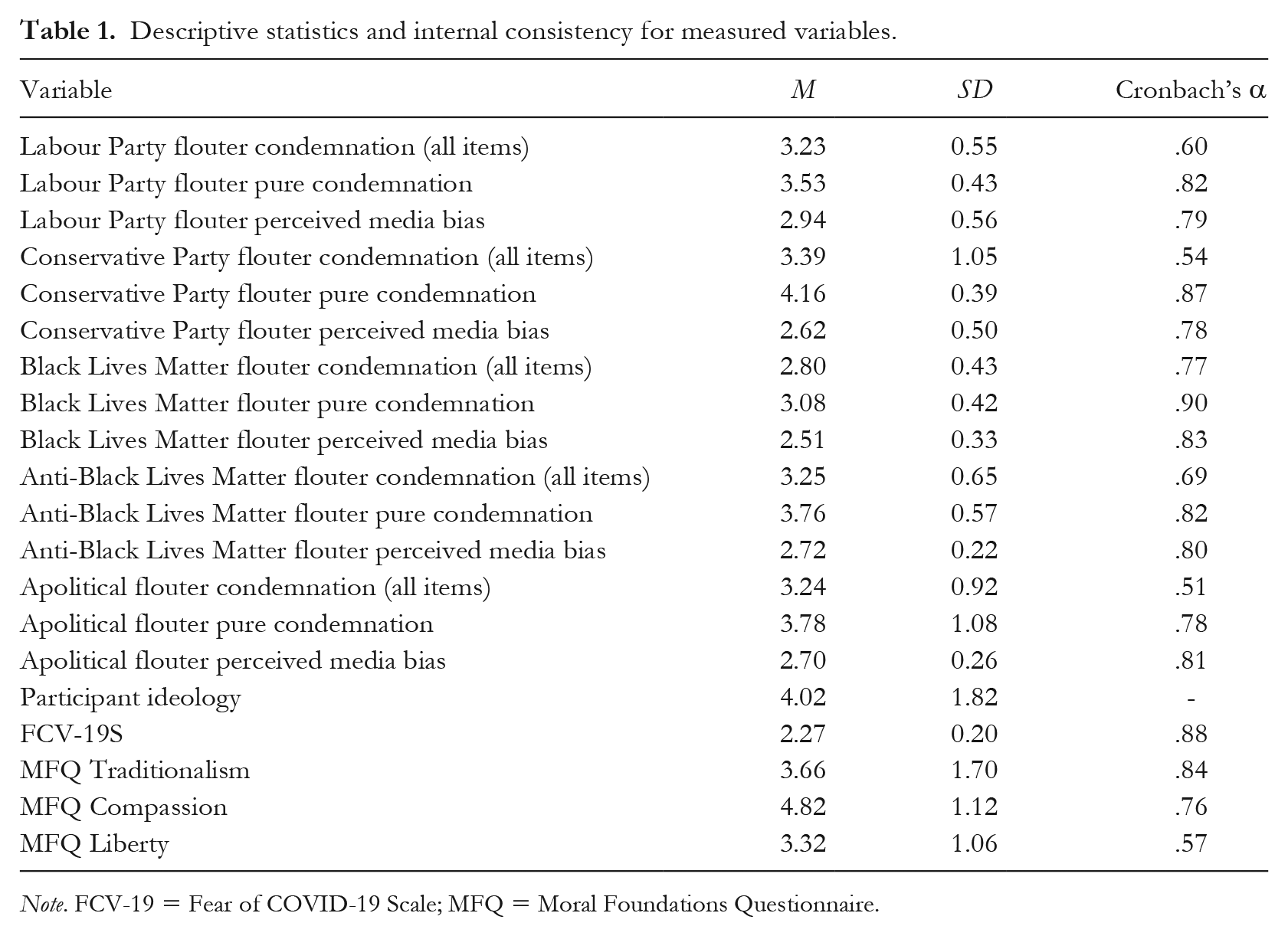
Note. FCV-19 = Fear of COVID-19 Scale; MFQ = Moral Foundations Questionnaire.
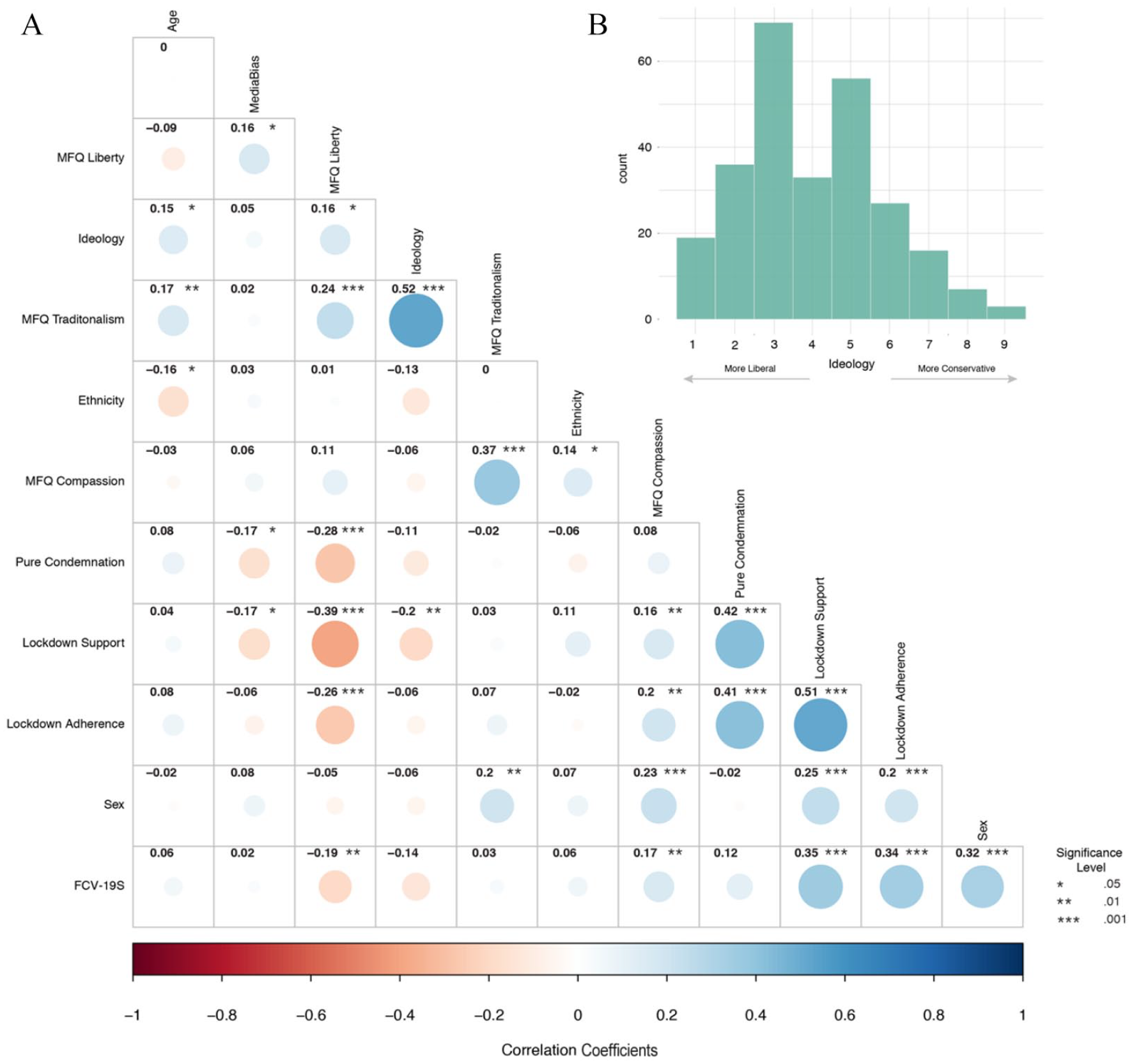
(A) Cluster plot of correlation coefficients for all variables used in the analyses, and (B) histogram detailing a slight liberal skew for reported ideology.
Splitting Condemnation
We preregistered this study with the aim of using our averaged condemnation measure as the (only) outcome variable. During the review process of this paper, however, we were encouraged by reviewers to perform these analyses separately for two variables by splitting condemnation into a new “pure” condemnation measure and a new variable that we call “media bias.” We were also asked to only present the “pure condemnation” results in the paper, and to move the preregistered “general condemnation” model results and those for “media bias” to an online supplement. This supplement is available on the project’s OSF page (https://osf.io/u2ezy/).
We created a linear mixed effect model to predict a “pure” condemnation of breaking lockdown guidance (an average of Items 1–3 of the outcome measure), entering sex, age, ethnicity, and flouter’s affiliation as fixed effects; the FCV-19S, participant ideology, and three MFQ domains as fixed effects; and the critical interaction between flouter ideology and participants’ political leaning as predictors. Visual inspection of residual plots did not reveal any obvious deviations from homoscedasticity or normality; p values were obtained by likelihood ratio tests of the full model with the effect in question against the model without the effect in question.
The full model explained the data well with R2GLMM(m) = .26 and R2GLMM(c) = .45. The predictors are presented in Table 2 and Figure 2. To assess the effect of the interaction between participants’ political leaning and flouter affiliation, we created a reduced model without this interaction term. This model reduced the amount of variance explained to R2GLMM(m) = .15 and R2GLMM(c) = .32, respectively. As such, the interaction term significantly improved the model in terms of variance explained, χ2(4) = 396.63, p < .001.
Linear mixed effects model predicting COVID-19 guidance flouting (pure) condemnation.
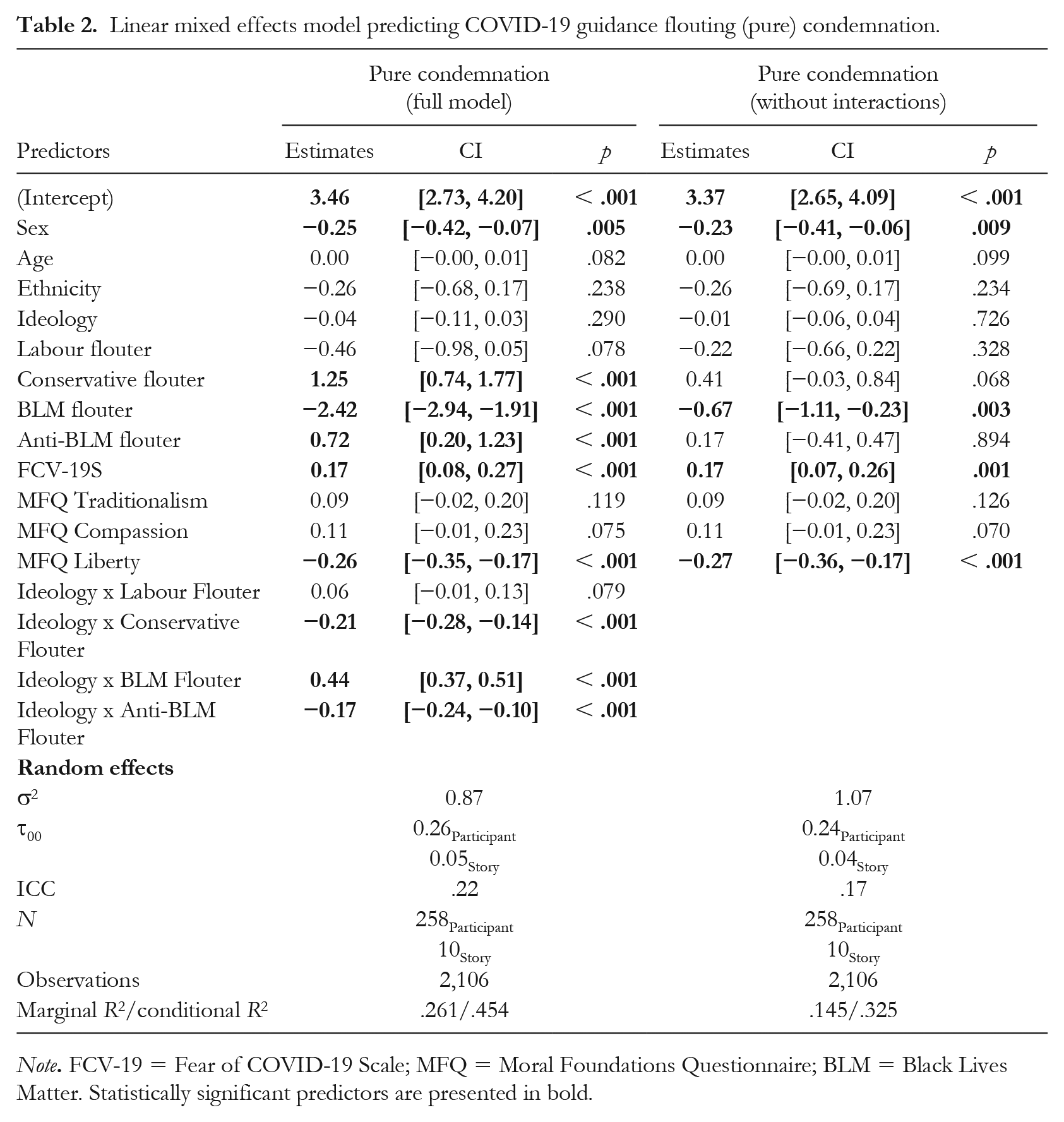
Note. FCV-19 = Fear of COVID-19 Scale; MFQ = Moral Foundations Questionnaire; BLM = Black Lives Matter. Statistically significant predictors are presented in bold.
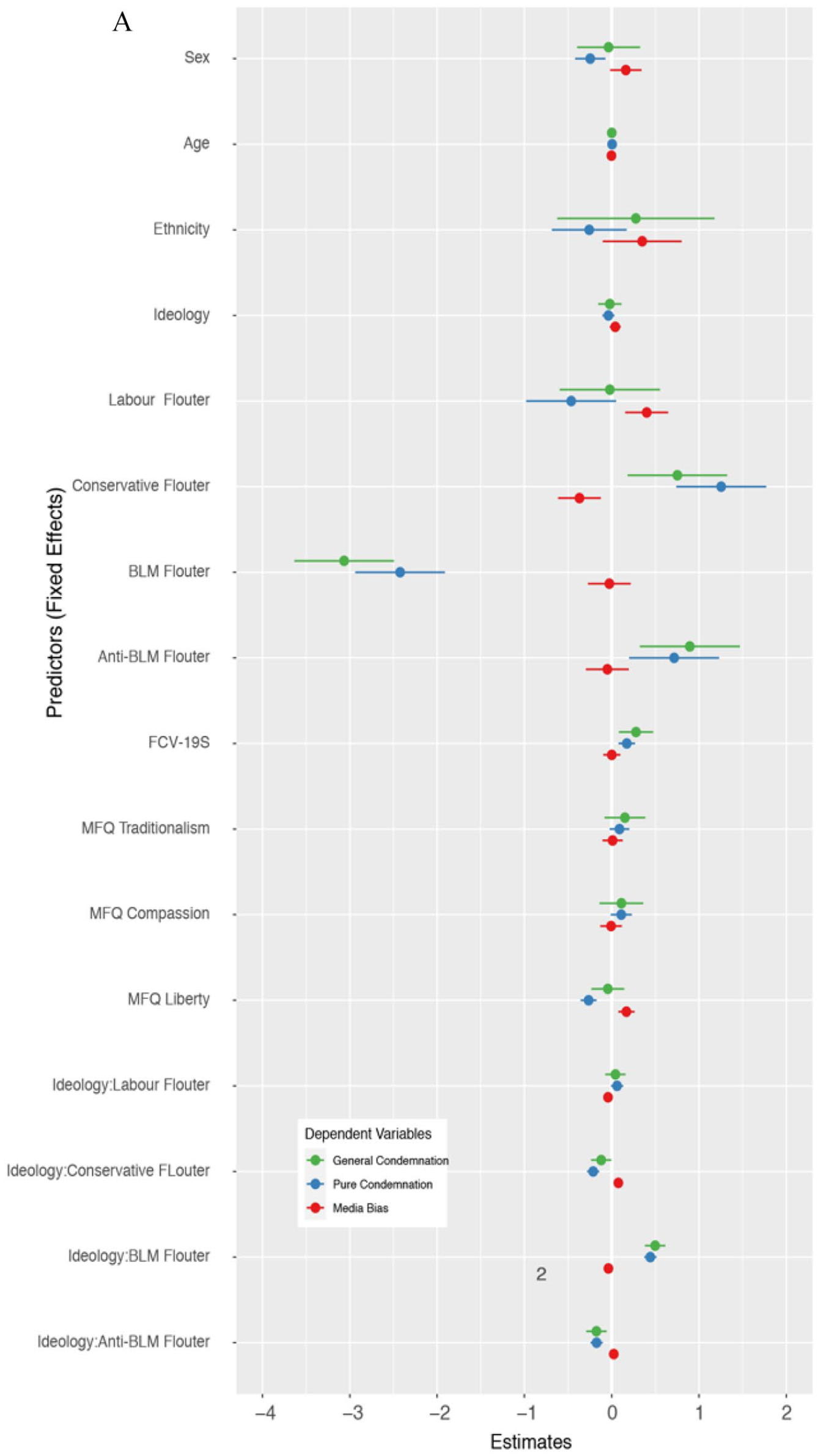
Ordered plot of standardized regression estimates predicting general condemnation (green), pure condemnation (blue), and perceived media bias (red).
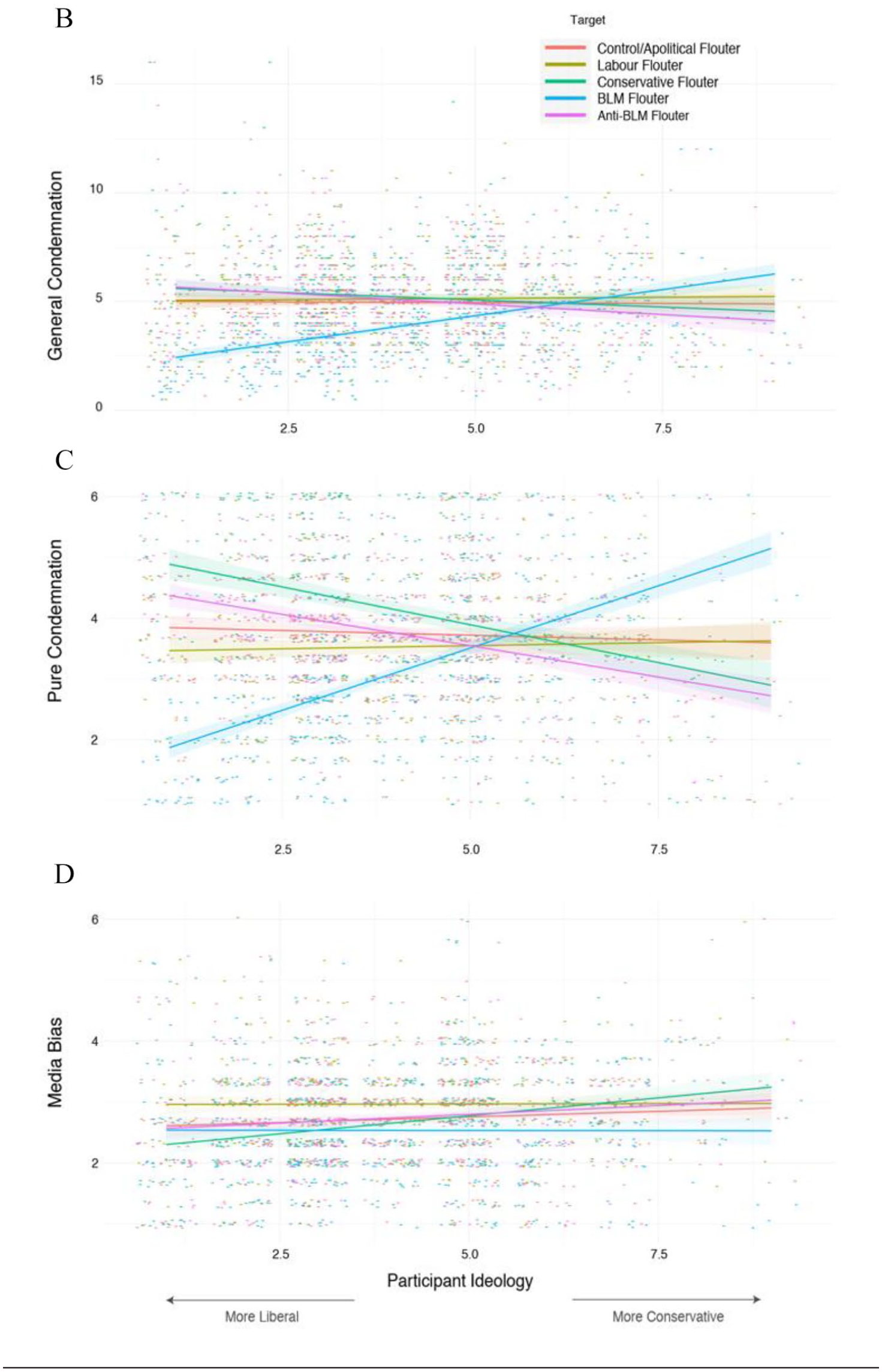
Interaction plot depicting the relationship between participant ideology (conservatism) and condemnation.
Consistent with the ideological symmetry hypothesis, higher levels of self-reported conservatism were associated with greater levels of condemnation of Black Lives Matter protesters, and higher levels of self-reported liberalism were associated with greater levels of condemnation when flouters were affiliated with the Conservative Party or were protesting in opposition to the Black Lives Matter movement (see Figure 2, Panel C). Analyzing main effects within the model away from the interaction, male participants and those placing a moral emphasis on liberty were less likely to condemn guidance flouting in general, whereas those with a greater level of fear of COVID-19 expressed more condemnation. At the individual scenario level, the sample generally condemned the flouters associated with both the Conservative Party and anti-BLM protests more, and pro-BLM protesters less.
These findings generally mirror the results of the preregistered analysis of general condemnation (see OSF supplement at https://osf.io/u2ezy/). However, what is clear here is that the effect is much clearer in this analysis (when a “pure” condemnation outcome is used) than when all outcome measure items were averaged (see Figure 2, Panel C).
Discussion
In this study, we sought to explore the potential for ideologically motivated responding to the flouting of COVID-19 social distancing guidelines, and to examine whether such responding was symmetric across the ideological spectrum. Owing to the revised nature of the outcome (i.e., the splitting of a single “condemnation” variable into “pure condemnation” and “perceived media bias”), our discussion will predominantly focus on the “pure condemnation” outcome, as perceptions of media bias were a post hoc outcome created as a result of reviewer feedback, and as such are not central to our a priori research aims.
As main effects, and using the politically unaffiliated condition as a reference, more condemnation was expressed against those who were affiliated with the Conservative Party (consistent with public outcry over the Dominic Cummings scandal) and those who protested against the Black Lives Matter movement. In contrast, significantly less condemnation was directed towards Labour Party affiliates and those who were protesting in favor of the Black Lives Matter movement. However, our research is more squarely focused on the interaction between flouter and participant ideology. Partially consistent with the ideological symmetry hypothesis (Ditto et al., 2019), we found that ideological self-placement predicted different responses to the breaking of social distancing guidance. Specifically, more ideologically conservative participants expressed greater levels of condemnation when those flouting the guidelines were protesting in favor of the Black Lives Matter movement, and those with a more liberal ideological outlook were more condemning of contraventions committed by members of the Conservative Party and those protesting against the Black Lives Matter movement. The only place where we did not see an interaction was in relation to the Labour Party flouter (p = .079). One possible explanation for this is that there are multiple “liberal” parties in the UK (e.g., Labour, the Liberal Democrats, the Green Party, Scottish National Party, Plaid Cymru), and so liberal ideological orientation does not automatically translate to Labour Party support in the same way that conservative self-identification logically facilitates support for the Conservative Party. Further, given the high-profile nature of cases such as that involving Dominic Cummings, it may be that the interaction effect between participant ideology and the Conservative Party flouter condition is driven by an availability heuristic (Schwarz et al., 1991) and the emotional valence of such widely discussed cases. The Labour Party flouting cases have not been so widely promoted within the media, and as such perhaps do not carry the same emotional weight as those involving people associated with the Conservative Party. However, there was widespread coverage of both pro- and anti-BLM protests. As such, where the cognitive availability and knowledge of the flouting case can be assumed to be equal, we see a clear cross-over interaction between participant and flouter ideology, with condemnation being contingent on the level of ideological (in)congruence of these factors.
These results were present when controlling for politically and psychologically relevant constructs, including moral foundations (Harper & Rhodes, 2021) and fear of COVID-19 (Ahorsu et al., 2020). Specifically in relation to these variables, fear of COVID-19 was associated with a greater level of condemnation of those acting against social distancing guidance. This is consistent with previous work that argued how fear of the virus may functionally motivate prosocial behaviors such as increased rates of handwashing and social distancing (Harper et al., 2020). In the current context, however, we might argue that fear of COVID-19 not only motivates oneself to behave responsibly, but also leads to an expectation of others to do the same. This is consistent with Everett et al.’s (2020) work on moral messaging about health compliance in the pandemic, in which it was reported that deontological messaging emphasizing a moral duty to act responsibly was the best predictor of public health compliance. From a moral standpoint, only the liberty cluster of Harper and Rhodes’s (2021) revised Moral Foundations Questionnaire was significantly associated with judgements of those flouting the guidance, with more endorsement of liberty-related moral statements predicting less condemnation. This is indicative of those endorsing liberty as a fundamental moral foundation being averse to restrictions on freedom of association. This is also a positive finding from a methodological perspective, in that this result indicates the revised Moral Foundations Questionnaire demonstrates concurrent validity with ostensibly nonpolitical outcomes.
The lack of effect of ideological self-placement on the condemnation of guidance flouting is at odds with some emerging work into political responses to the COVID-19 pandemic (i.e., that liberals appear to take COVID-19 more seriously than conservatives as a public health issue, and yet show ingroup leniency when judging people breaking distancing guidelines). For example, Kushner Gadarian et al.’s (2020) work demonstrated how liberals and conservatives differed on their beliefs about the virus and their intentions to engage in health promoting behaviors. That is, conservatives were less likely than liberals to view the virus as a serious problem, and more likely to oppose social distancing policies and lockdowns. This work was supplemented by Pennycook et al.’s (2021) analysis of the ideological roots of behavior change and governmental support, which found that those who voted for the current governments in the UK, Canada, and the US were more likely to express support for their handling of the pandemic. The differences in the ideological leanings of each of these governments (liberal in Canada, and conservative in the UK and the US) suggest that these trends may be less to do with an ideological tendency and more with a motivated impulse to bolster the reputation of one’s own “side.” However, an alternative hypothesis might be that the better Canadian outcomes of the pandemic (fewer than 27,000 deaths at the time of writing, compared to 624,000 in the US and 131,000 in the UK) may reflect the greater level of seriousness with which the governing Liberal Party treated the pandemic. A direct test of the “seriousness of thought” and “ingroup cheerleading” hypotheses would be a useful addition to the literature.
Irrespective of the specific reasons for governmental support, our research was focused on participant perceptions of others’ behavior during the pandemic. As opposed to the uncovering of asymmetries being the bedrock (and perhaps even the aim) of political psychology (as argued by Jost, 2017), we believe that by altering the ideological salience of stimuli it is possible to observe behavioral symmetry across the ideological spectrum (see also Brandt, 2017; Brandt & Crawford, 2019; Crawford, 2014; Elad-Strenger et al., 2020; Harper, 2020; Kessler et al., 2015). In the current study, we have been able to uncover a seemingly ideologically motivated double standard in judgements of COVID-19 rule breaking in the context of social distancing. This double standard appears to have been driven by the ideological affiliation to those flouting distancing guidance, and rooted in the moral congruence between the flouters’ moral beliefs and those of our participants. This internal calculation of moral congruence shifts the balance of support for or against such guidance transgressions. That is, one might assume that people’s judgements of those breaking social distancing guidance in the context of a global pandemic would be consistent across contexts. However, we found that participants moderated their judgements as a function of the ideological or moral positioning of those involved in the rule breaking. While previous research has demonstrated such ideological symmetries in viewpoint expression in relatively low-stakes contexts (e.g., feeling thermometers about particular social groups; e.g., Brandt, 2017), the data presented here suggest that these symmetries extend to contexts with starker consequences. That is, if individuals are accepting of large-scale protests or small-scale gatherings among their ideological peers in the context of a global pandemic, this (by extension) means that they are accepting an increased risk of infectious transmission, putting people at risk of contracting an illness that has killed millions of people worldwide, and affected many millions more (see Johns Hopkins University’s Coronavirus Resource Center at https://coronavirus.jhu.edu/map.html). Although this discussion may sound hyperbolic, we are not insinuating that extreme ideological partisans are responsible for the spread of COVID-19 nor that they are consciously encouraging its transmission. We are, however, highlighting the risks of hyper-partisanship and ideologically motivated double standard in a time of global virus transmission, and urge researchers to examine ways in which health messages might reduce the effects of such psychological processes, even when important social justice movements become increasingly prominent.
The data for perceptions of media bias were less striking but do still support an ideological motivation account. That is, the increased perceptions of media bias for stories about Labour Party flouters, and the decreased perceptions of media bias for stories about Conservative Party flouters, both as main effects, are consistent with the general ideological skew of the sample (for experimental data showing ideologically motivated judgments of media legitimacy, see Harper et al., 2019). The significant interaction between participant ideology and flouter affiliation in relation to the Conservative Party flouter stories is consistent with ideological conservatives perceiving greater levels of media bias in stories that target their political “side” for negative attention. This trend mirrors social movements in relation to the emergent use of the label “fake news” within mainstream society, with conservatives being more likely to dismiss ideologically incongruent news (particularly those negative about causes or figures associated with their side of the political spectrum) as illegitimate (Farhall et al., 2019). Similar to the motivated account, those who demonstrated a higher endorsement of the cluster of MFQ items related to liberty were also more likely to perceive bias in media reporting of flouters, irrespective of their affiliation. This suggests an attribution of bias that may be rooted in perceptions of the incongruence of moral beliefs between those high liberty endorsers and the mainstream media. Although this perceived media bias variable was not a key target of our analysis, we believe that these data raise interesting possibilities for future research, where the source of a story or its linguistic characteristics might be manipulated to test judgments about its legitimacy in various ideological groups.
Critics of our work may cite the experimental stimuli chosen as a limitation of this study. We share these concerns, and encourage conceptual replications of this study in other political contexts. For example, we chose stories about the high-profile Black Lives Matter protests as examples of flouting social distancing guidance. These protests were contrasted with anti-Black Lives Matter protests in our design. Some may argue that we should expect differences in judgements of these protests, as one (the former) is more morally legitimate than the other. We do not disagree with this observation about the morality of such protests, and it is possible that pro- and anti-BLM protesters were judged predominantly on the basis of their ideological positions (e.g., views about the police, support and opposition to historical statues, or engagement in public disorder). However, our outcome questions were specifically related to the flouting of social distancing guidelines in the context of a global viral pandemic. An additional limitation may be centred on the praising of some BLM protesters for their adherence to mask wearing, which shows some awareness and mitigation of virus transmission. This was not something that we controlled for, and future work may wish to experimentally manipulate news stories in relation to contextual details such as these to test for their effects on social judgments. Steps should also be taken to pretest stories for their moral salience, general acceptability, and perceived political leaning before proceeding to data collection. This is a process that we did not undertake at the commencement of this work. Relatedly, future work might wish to explicitly name what phenomena participants are judging. In our outcome measure, items such as “The person [people] in this news story was [were] wrong to do what they did” and “The person [people] in this news story probably had a good reason for breaking lockdown rules” could plausibly be interpreted as either judgments of the flouting of public health guidance or as support for social movements related to social inequalities. As such, conceptual replications may also wish to examine whether the effects reported in this paper remain when using news stories about less morally salient political gatherings (e.g., party conferences or conventions) as stimuli.
Our work used an exclusively UK-based sample owing to our geographical location and our awareness of high-profile cases of rule flouting. It is unclear whether these trends would be replicated in other political contexts without new data. We might expect similar trends in comparably polarized countries (e.g., the US) or countries that have demonstrated similar ideological effects within the context of COVID-19 (e.g., Canada). However, whether pandemic-relevant ideologically motivated behavior expresses itself in less polarized (or indeed less democratic) countries remains a largely unexplored area of research.
In this work, we have shown that ideological symmetries exist not only in the context of feeling thermometers (Brandt, 2017), self-reported evaluations of scientific results (Washburn & Skitka, 2018), and a hypothetical avoidance of opposition voters’ views (Frimer et al., 2017). We have demonstrated that partisans are also motivated to bolster members of their own “side” in the context of a global pandemic by making more lenient judgments of public health guidance transgressions, even when such bolstering risks accelerating the transmission of a virus like COVID-19. Studies such as these highlight the pervasiveness of ideological motivations, and their potential implications. We encourage scholars in the areas of motivated cognition and political psychology to establish ways to reduce the effects of ideological bias in decision-making across the political spectrum, with a view to enhancing consistency in decision making about important social issues in the general population.
Footnotes
Data availability
Materials, data, and code are available at the OSF (https://osf.io/u2ezy/) as well as our preregistered data analysis plan ( ).
).
Funding
The author(s) received no financial support for the research, authorship, and/or publication of this article.
Supplemental material
Supplemental material for this article is available online.