




Abstract
Membership change has been found to stimulate collective idea generation but to not always benefit group creativity—the generation of final outcomes that are novel and useful. Based on motivated information processing theory, we propose that membership change challenges group members to generate more ideas, but that this only contributes to group creativity when members have high levels of prosocial motivation and are willing to process and integrate each other’s ideas. In a laboratory study of 56 student groups, we found that incremental, but not radical, idea generation mediated the positive effect of membership change on group creativity, and only when group members were prosocially motivated. The present study points to different roles of incremental versus radical ideas and underscores the importance of accounting for prosocial motivation in groups for reaping the benefits of membership change in relation to group creativity.
Keywords
Membership change—having old members leave and/or new members join a group—is a prevalent phenomenon among all types of groups (Ziller, 1965). Although it can disrupt group routines (Moreland & Levine, 1982), membership change can potentially stimulate creative activities; newcomers are often viewed as “fresh blood” who bring in new perspectives and prevent groups from rigid thinking (Ziller, 1965; Ziller et al., 1962). Indeed, membership change has been found to stimulate collective idea generation (e.g., Choi & Thompson, 2005; Gruenfeld et al., 2000). In particular, groups experiencing membership change tend to generate a larger number and more diverse ideas as compared to those with stable memberships (Choi & Thompson, 2005; Nemeth & Ormiston, 2007).
However, group creativity, defined as the joint generation of novel and useful outcomes by a group of people (Hoever et al., 2012), does not end with idea generation. Rather, creative ideas generated in a group have to enter the collective process of idea evaluation, selection, and integration in order to be developed into a final group product, such as a report, prototype, or marketing campaign (Girotra et al., 2010; Harvey & Kou, 2013; Kohn et al., 2011; Rietzschel et al., 2006). Fruitful idea generation alone does not guarantee group creative success. For example, creative ideas that are too extreme may be abandoned in the implementation stage (Gruenfeld et al., 2000), and group members may fail to recognize or select the most creative ideas (e.g., Rietzschel et al., 2006). Thus, the question of whether the positive effect of membership change on idea generation extends to (final) group creative outcomes is vital to the group creativity literature.
In this paper, we draw on motivated information processing in groups (MIP-G) theory (De Dreu et al., 2008, 2011; Nijstad & De Dreu, 2012) to examine two questions: (a) under which conditions does membership change contribute to (final) group creative outputs, and (b) what is the role of idea generation in this process? MIP-G theory suggests that group creativity requires epistemic motivation to drive members to engage in in-depth information processing, but also prosocial motivation to stimulate members to work interdependently and in the interest of the group (Bechtoldt et al., 2010). We propose that membership change stimulates idea generation, because the presence of newcomers triggers collective reflection and epistemic effort to comprehend the task and generate new ideas (heightened levels of epistemic motivation; Choi & Thompson, 2005). However, we further propose that integrating these ideas into a final group product depends on the extent to which members are motivated to collectively process and integrate them. Based on MIP-G theory, we predict that membership change will stimulate idea generation, but that this only translates into high levels of group creativity when group members have high prosocial motivation.
This perspective suggests that the effect of membership change on group creativity essentially boils down to the question of how creative ideas are used and integrated into a final group product. In this respect, it is important to note that not all ideas are created equal, but that they vary from minor adaptations (incremental ideas) to radical breakthroughs (radical ideas), depending on their relative originality as compared to existing ideas (Janssen, 2003; Silva & Oldham, 2012). Radical (vs. incremental) ideas represent groundbreaking ways to solve problems and are often viewed as more risky and costly. This distinction is vital, because people tend to comprehend, process, and utilize incremental and radical ideas differently (Berg, 2016; Criscuolo et al., 2017; Damanpour, 1988; Janssen, 2003; Mueller et al., 2012). In general, the creativity literature suggests that the selection and implementation of radical ideas is more challenging (e.g., Girotra et al., 2010), and that processes may be different where incremental versus radical ideas are concerned. We therefore take this distinction into account.
In sum, we propose a moderated mediation model (see Figure 1) in which membership change stimulates (incremental and radical) idea generation, which, in turn, translates into group creativity depending on the prosocial motivation of group members. As such, this research contributes to the membership change literature, suggesting conditions under which newcomers stimulate not only idea generation but also the creativity of a final group product. It also contributes to the group creativity literature and motivated information processing theory by more closely considering the distinction between incremental and radical ideas.
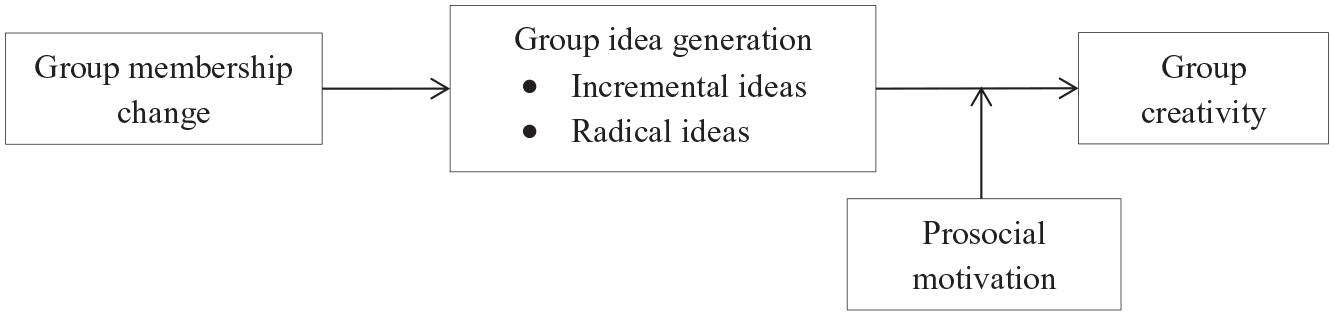
Conceptual model.
Theory and Hypotheses
Group Membership Change and Idea Generation
Following earlier work, group creativity in this paper is defined as the generation of novel and useful outcomes by group members working together (Hoever et al., 2012). We distinguish group creativity from idea generation because a (final) creative outcome—such as a report, solution, or campaign—is likely to contain several ideas. Furthermore, group creativity does not only involve idea generation but also idea processing, selection, development, and application in a final group outcome (see also Girotra et al., 2010; Harvey & Kou, 2013; Kohn et al., 2011; Rietzschel et al., 2006).
Past research has proposed that membership change can stimulate idea generation because membership change challenges members in two ways. On the one hand, newcomers bring new ideas and diverse perspectives to a group (Choi & Levine, 2004; Levine et al., 2003), which can stimulate the group to generate more ideas (Dugosh et al., 2000; Simonton, 2003). On the other hand, the presence of newcomers inspires old members to reflect on their previous ways of working, which stimulates their own epistemic process (Choi & Thompson, 2005; Ziller et al., 1962). Thus, groups that have experienced membership change have been found to generate more ideas than stable groups (Choi & Thompson, 2005; Nemeth & Ormiston, 2007). This effect is not only due to newcomers bringing in new ideas but also to old-timers becoming more creative after membership change (Choi & Thompson, 2005).
Motivated Information Processing Theory
In this paper, we apply motivated information processing in groups (MIP-G) theory to understand the relationship between membership change, idea generation and team creativity. MIP-G theory proposes that group creativity benefits from group members having high levels of epistemic motivation to excel at complex cognitive tasks and high levels of prosocial motivation to work closely together in the interest of the group (De Dreu et al., 2008, 2011; Nijstad & De Dreu, 2012). Epistemic motivation refers to a willingness to expend effort to achieve thorough and rich understandings of the group and the group task. Epistemic motivation should benefit idea generation because it leads group members to consider multiple perspectives and not be satisfied with only a few or obvious ideas. Indeed, evidence suggests that groups generate more ideas (e.g., Chirumbolo et al., 2005) and also ideas that are more original (e.g., Bechtoldt et al., 2010) when group members have high, rather low, levels of epistemic motivation.
MIP-G theory further suggests that epistemic motivation alone is not enough to achieve high group creativity. Rather, prosocial motivation is also required, which refers to members prioritizing group outcomes over individual outcomes. Prosocial motivation ensures that members pay attention to each other’s ideas and integrate available ideas from other members in a cooperative way to achieve group success. Previous research suggests that prosocial motivation is required for groups to fully reap the benefits of high epistemic motivation (Bechtoldt et al., 2010) and of independent thinking (Bechtoldt et al., 2012). Applied to the context of membership change, in the following, we suggest (a) that membership change is likely to raise group members’ epistemic motivation, and that this will stimulate the generation of both incremental and radical ideas, but (b) that this will only lead to creative (final) outcomes when prosocial motivation is high, and (c) that these processes may differ for incremental versus radical ideas.
Membership Change and Radical Versus Incremental Ideas
Despite its relevance, research on membership change has not made the distinction between incremental and radical ideas. As noted, radical ideas differ substantially from existing ones and represent fundamental changes, whereas incremental ideas are adaptations and modifications of existing ideas and contain only minor changes (Dewar & Dutton, 1986; Madjar et al., 2011). This distinction is important, first because any change brought about by newcomers in existing practices or ideas can be incremental or radical: ideas that are introduced after the arrival of a newcomer may be fairly similar to previous ideas in that group (incremental) or can be completely different from previous ideas in that group (radical). Second, because research suggests that people treat incremental and radical ideas differently, it likely matters whether the arrival of a newcomer leads to the generation of incremental or more radical ideas (e.g., Girotra et al., 2010).
We propose that the arrival of a newcomer drives group members to reconsider their existing ways of working, and to more in-depth and less habitual processing of both existing and new information; in MIP-G terms, the presence of a newcomer will raise the epistemic motivation of group members. There are two reasons for this. First, the entry of a new member is a change to the group that will inevitably require adaptation by old members. New members will have new and unknown characteristics, and it is not a priori known how newcomers will behave in the context of the group. Group adaptation to new and partly unknown circumstances benefits from high epistemic motivation and reflection (Randall et al., 2011), and the uncertainty and disruption of routines associated with a change in group membership are likely to trigger reflection among old members to deal with changed circumstances (Moreland & Levine, 1982; Rink et al., 2013).
Second, with the presence of newcomers, old members have to explain their approaches, tasks, and ways of working to newcomers. They may also have to (re)evaluate and compare different ideas and make changes to their approach. Some research has suggested that even if newcomers have no intention to produce changes to the group or their perspective is not so novel, their presence can still motivate group members to think of changes (Levine et al., 2003; Phillips et al., 2009). Due to perceived dissimilarity, group members should realize the need for updating available information or routines in their group to complete tasks; thus, they will communicate more to expose different viewpoints and to get a comprehensive understanding to fulfill group tasks. This effect of membership change on group reflexivity translates into increased levels of epistemic motivation compared to groups with no membership change. In sum, after membership change, group members will have high epistemic motivation to carefully think about their current condition and assess the changes that newcomers may bring. Stable groups, in contrast, are more likely to keep their previous ways of working without much reflection.
In turn, such reflection is likely to stimulate idea generation. On the one hand, the arrival of newcomers invites group members to review current group objectives, work routines, and ideas, because it inevitably requires the introduction and explanation of the task, and of existing group processes and working styles, to newcomers (Choi & Thompson, 2005; Gruenfeld et al., 2000). This is likely to result in adjustments and revisions of existing practices and ideas (Summers et al., 2012), mainly in the form of incremental new ideas. On the other hand, newcomers can bring knowledge and ideas to the group that are different from existing ones (Choi & Thompson, 2005), which may directly contribute to group goals (Marks et al., 2001). Relying on such novel inputs may drive the group to discard existing ideas and suggest new approaches to promote group creative outputs (West, 1996, 2003; see also Choi & Levine, 2004; Kane et al., 2005), which can result in major changes (i.e., radical new ideas). We therefore propose:
Hypothesis 1a: Membership change increases the generation of incremental new ideas.
Hypothesis 1b: Membership change increases the generation of radical new ideas.
Translating Idea Generation Into Group Creativity
Translating (radical or incremental) ideas into group creative outcomes does not occur automatically. New ideas need to be selected (or discarded), developed, and integrated in a final product. However, group members often are not willing to combine different ideas into a single outcome (Stasser & Titus, 1985), and may fail to recognize the connection between disparate ideas (Mumford & Gustafson, 1988). Synthesizing ideas can be particularly difficult for diverse groups (e.g., when newcomers and old-timers in a group hold different paradigms and mindsets), as members lack a shared understanding of group goals. Group membership change, which creates perceived differences, unfamiliarity, or even lack of trust among members (van der Vegt et al., 2010), therefore brings challenges in translating ideas into group creativity.
According to the MIP-G theory, members should have high prosocial motivation—the desire to benefit the group instead of individuals—to produce creative outcomes. First of all, people with high prosocial motivation are more willing to take different ideas and perspectives into account, and spend more effort on processing and utilizing them (Bechtoldt et al., 2010). Such increased openness to ideas leads individuals to explore opposing perspectives, which increases the potential that ideas of good quality are selected and adopted. Second, prosocial motivation leads members to prioritize group outcomes above individual needs and to work closely together towards a group goal (e.g., producing a creative outcome; Bechtoldt et al., 2010; De Dreu, 2007). Therefore, members care about group products and interpersonal processes, and strengthen within-group cooperation. If such prosocial motivation is lacking, group members may not attend to or integrate other members’ inputs in group processes and outcomes (De Dreu et al., 2000). Also, as prior studies suggest, group members tend to evaluate information thoroughly and utilize ideas that are more relevant to them (e.g., Kane et al., 2005). Thus, prosocial motivation encourages group members to process and consider ideas stimulated by newcomers and implement these ideas in a synergetic way. Thus, membership change may benefit group creativity by stimulating idea generation, but this only translates into high group creativity when prosocial motivation is high.
However, these processes may critically depend on the nature of the ideas generated. Specifically, we argue that incremental ideas are more likely to be accepted and used in a final group product than radical ideas. First, it is usually easier to comprehend and adopt incremental ideas because they do not differ much from previous (known) ideas. By comparing minor adaptations with existing routines, group members can see without great effort to what extent the new ideas improve old ones and whether they are worth pursuing further. Therefore, incremental ideas should be easily accepted and utilized by groups (Kane, 2010), because it is relatively clear that they will contribute to the creativity of group outcomes. Second, converting ideas into group outputs requires members to recognize similarities among different ideas (Harvey, 2013). Compared to radical ones, incremental ideas are by nature more linkable with existing ideas, and are thus more likely to be utilized for group outputs. Third, incremental new ideas build upon existing ones, and such convergent processes (i.e., the further development of existing ideas) have been found to be important for group creativity (Harvey, 2013; Kohn et al., 2011). In sum, it is not very costly or risky to implement incremental new ideas that are developed based on existing ones (Madjar et al., 2011), yet this may lead to the further development of existing ideas and therefore enhance group creativity (Harvey, 2013). We therefore propose:
Hypothesis 2: Membership change is positively associated with group creativity through the generation of incremental ideas, and this indirect effect is stronger when prosocial motivation is high rather than low.
As to the impact of membership change on group creativity via radical idea generation, the situation is more complex. We will therefore approach the role of radical idea generation in a more explorative way. On the one hand, it is possible that prosocial motivation drives group members to be more open to radical ideas as a result of increased involvement in group processes. This may increase the chance that radical ideas are processed and utilized. Yet, on the other hand, considering the substantial changes that radical ideas imply, they may not be easily integrated into a group product, even when prosocial motivation is high. Besides, as a result of inherent risks in radical ideas, it is often difficult to determine whether they would yield better outcomes than existing ones (see also Dewett, 2004; Sethia, 1989). As such, and because the inclusion of radical new ideas involves major adaptations to a group’s plan, members may feel reluctant to adopt them even when prosocial motivation is high (see also Baer, 2012; Mueller et al., 2012). Given these contrasting perspectives, we do not formulate a hypothesis about the relation between radical idea generation and group creativity, and rather examine this in a more exploratory way.
Method
We tested our hypotheses in a laboratory setting to observe the causal effects of membership change and prosocial motivation on group idea generation and the creativity of a final product. We thus manipulated membership change and prosocial motivation at the group level, coded (radical and incremental) idea generation using video recordings, and assessed group creativity by coding a final group product.
Sample and Research Design
We used a 2 (group membership change: yes vs. no) × 2 (prosocial motivation: high vs. low) between-groups design for this study. One hundred and eighty-six students (85 males, 101 females) at a Dutch university participated in this study in exchange for €8.00 or course credit. Participants were randomly assigned to 62 groups of three members. We had to drop three groups from the sample because they did not believe our manipulation of prosocial motivation (see Manipulation Checks), and three further groups because videos were not recorded due to a technological failure, leaving a final sample of 56 groups. A sensitivity power analysis using G*Power (Faul et al., 2007) revealed that our sample size of 56 groups (α = .05, 1 − β = .80) can detect small to medium effects of f = 0.43.
Each group was instructed to complete a poster design task that was adapted from previous studies on group creativity (Adarves-Yorno et al., 2007; Harvey, 2013). We videotaped groups to measure idea generation during task performance, and trained raters that were blind to the purpose of this study to assess creativity of the end product (a poster). The task consisted of two stages. In the first stage, each group brainstormed for 10 minutes; then in the second stage, group members worked on the poster design for another 20 minutes.
Procedure
To manipulate membership change, we arranged two groups to work on the task simultaneously. Upon arrival, six participants were randomly assigned to two different groups to work in two adjacent experimental rooms that were identical in their layout. In each group, members were randomly seated at a rectangular table. Participants received a colored tag (one yellow, one green, and one red) and were instructed to pin it on their clothes. This allowed group members to distinguish the other members. Next, the experimenter explained the poster design task. Three participants worked as a group to design a poster for a fictitious charity organization called Animal Rights Protection (ARP, for short). Through printed materials, participants learned that ARP focused on a variety of animal rights issues such as wildlife hunting, habitat loss, and stray animal adoption. The goal was to design creative posters for ARP to attract donations or volunteers, and participants were instructed to be both original and practical in their design. Participants also learned that during the task one member might be switched with someone from the other group. They were informed that whether there would be a member switch and who would be switched would be announced after the brainstorming part (i.e., after the first stage of the task).
Before working on this task, groups first performed a 5-minute ice-break activity in order to get acquainted with each other. Participants introduced themselves to their group mates and wrote down as many similarities as possible among their home cities or countries on a piece of paper. They were also asked to think of a group name and a slogan together. After this, participants started the first stage, during which they brainstormed together for 10 minutes to generate ideas for their posters. One piece of paper was provided to participants to take notes and draft designs. Group members discussed how they would like to design the poster; after this brainstorming stage ended and before the start of the second stage, the experimenter interrupted the groups and administered the membership change and prosocial motivation manipulations. Next, groups received materials for crafting a poster, including one piece of A2-sized blank paper, six pieces of A4-sized colored paper, two scissors, two pots of glue, several colored markers, and one ruler. Then the experimenter set the stopwatch and groups started the second stage. Groups were allowed to continue brainstorming during the second stage, and were instructed to finish their poster designs within 20 minutes. Upon completion of the task, participants filled out a short questionnaire independently (without interaction with others), then they were debriefed and thanked.
Manipulations
Group membership change
In the membership change condition, both groups working in parallel were informed that members who held a green tag would be exchanged immediately after the brainstorming part. Right after groups finished the brainstorming part (i.e., the first stage), the experimenter walked the newcomers with green tags to their new groups (in the adjacent room) and then instructed groups to complete the poster-making part (i.e., the second stage) together. In the control condition (without membership change), two parallel groups in adjacent rooms remained unchanged throughout the task. However, in both the membership change and the no change conditions, the experimenter entered the room, ended the first part of the task, introduced the manipulation of prosocial motivation, and provided groups with the materials to make the poster.
Prosocial motivation
We manipulated prosocial motivation via collective rewards after the brainstorming stage and the membership change manipulation but before the poster-making stage (see also Bechtoldt et al., 2010). This manipulation aligns with previous studies that suggested that granting collective rewards motivates group members to achieve collective instead of individual goals (Wageman & Baker, 1997). Collective rewards imply that individual members rely on each other to obtain them (van der Vegt et al., 1998; van der Vegt & Janssen, 2003), and thus drive group members to work together to achieve group objectives (Harrison et al., 2002). In the high prosocial motivation condition, the experimenter introduced an extra monetary bonus of €20.00 for each member (€60.00 total) that would be awarded to groups that scored in the top five of most creative posters. Groups in the low prosocial motivation condition did not receive any information about collective rewards.
Measures
Radical and incremental idea generation
The groups focused on various topics concerning animal rights protection, such as wildlife hunting, stray animals, cruel treatment of animals, and habitat destruction. Within each broad theme (e.g., habitat destruction), participants also provided various “stories” to convey through their poster, such as polar bears “crying” on melting ice or tigers losing their home. This variety of stories enabled us to differentiate between radical and incremental ideas generated in the second part of the experiment (i.e., after the manipulation of membership change). Radical new ideas were operationalized as ideas that had not been proposed by members of the group during the preceding brainstorming stage, and incremental new ideas were operationalized as ideas that evolved from ideas that had already been proposed in the brainstorming stage of the group. Thus, the distinction between radical and incremental ideas was based on relative rather than absolute novelty.
For example, in one group, one member suggested drawing a picture of a zoo, where a lion was looking sad while people were taking pictures and kids were throwing things. We coded this as a radical new idea because similar ideas had not been proposed before that. Following this idea, another member suggested drawing a city next to the zoo, which indicated that people could walk back to their own homes. Because this idea built on a previous one, we coded it as an incremental idea. In another example, one member of a group proposed to draw an animal that was already extinct or that was going to be extinct in a couple of years. This was a radical new idea because similar ideas had not been proposed before in this group. After that, another member proposed to draw stray animals. Because this idea was not formed based on a previous one, it was also coded as a radical idea.
To obtain objective measures of group idea generation, we coded incremental and radical idea generation in the second part of the task (i.e., after the membership change manipulation), based on the video recordings. Two research assistants blind to the research purpose transcribed the video recordings in such a way that it was possible to track “who said what.” Next, one research assistant marked all text excerpts as either incremental adaptations or radical changes. To check coding reliability, the second assistant coded all transcripts following the same approach. The two raters showed substantial agreement in their coding of the number of incremental adaptations (ICC = .80) and radical changes (ICC = .61; see Landis & Koch, 1977, for generally accepted reliability criteria). Because these excerpts did not only contain radical or incremental ideas about the content of the posters but also other suggestions—such as suggestions about idea implementation, task arrangement, and coordination (see also Jackson & Poole, 2003)—one coder refined coding further and coded only the incremental and radical ideas about poster design and content. A third research assistant, blind to the research purpose, coded a random selection of 13 groups’ transcriptions (21% of total groups) to establish reliability. The two raters showed substantial agreement in their coding of the number of incremental ideas (ICC = .85) and radical ideas (ICC = .97), following generally accepted criteria (Landis & Koch, 1977). We used the number of incremental and radical ideas to capture idea generation in the second stage of the task (i.e., the poster-making part).
Idea acceptance
In addition to testing our primary hypotheses, we also conducted exploratory analyses on the role of prosocial motivation in groups’ acceptance of generated ideas. We proposed that prosocial motivation encourages group members to process and integrate new ideas and work for group goals rather than individual gains, and that such acceptance of ideas would benefit group creativity. To examine this, we coded the number of generated ideas that were finally incorporated into group products. We therefore counted the total number of accepted ideas generated during the second stage of the task (i.e., the poster-making part), and labeled them as accepted incremental ideas and accepted radical ideas, respectively. We also established whether an accepted idea was suggested by an old-timer or a newcomer.
Group creativity
Creativity refers to the generation of products that are both novel and useful (Amabile et al., 1996). In our study, creative posters should be both original and effectively attract the audience (i.e., useful), a requirement that was clearly communicated to participants at the beginning of the task. In previous studies, these two dimensions have often been examined separately in problem-solving tasks in which novel solutions should also be useful (e.g., Bedell-Avers et al., 2008). Considering that the effect of membership change and prosocial motivation on creativity may be due to either the novelty or the usefulness, or both, we analyzed group creativity as the mean score of novelty and usefulness, and also analyzed novelty and usefulness as separate outcome variables.
Two different raters coded group creativity in terms of the usefulness and novelty of submitted posters. This ensured the independence of our coding of idea generation and group creativity, and avoided common source bias. Based on Amabile’s (1982) consensual assessment technique (Amabile, 1982), we developed a 3-point scale with 12 items (from 1 = “low to 3 = “high”). This scale was used to capture both the novelty and usefulness of designed products, and is similar to scales used in previous creativity research (e.g., Harvey, 2013). Six items measured poster usefulness (e.g., “The poster attracts the audience’s attention to animal rights protection issues effectively”; α = .72), and six items measured poster novelty (e.g., “The physical appearance of the poster looks original”; α = .79). Two raters first independently assessed 10 posters (approximately 17% of all posters) that were randomly drawn from the total. Discrepancies were discussed and resolved to establish a common understanding of the rating scale. Subsequently, two raters scored all posters based on the revised rating scale (see Appendix A). The two raters reported highly consistent ratings on poster usefulness (ICC = .89, p < .01; Shrout & Fleiss, 1979), as well as on poster novelty (ICC = .81, p < .01). Novelty and usefulness were found to be weakly correlated (r = .15, p = .26).
Control variable
The generation of ideas after membership change and the creativity of final products might be influenced by ideas generated before newcomers joined the group (i.e., in the brainstorming stage). We therefore controlled for the total number of incremental and radical ideas that groups generated in the first stage and labeled it as idea generation in Part I.
Results
Manipulation Checks
Three groups in the high prosocial motivation condition discussed the study purpose and expressed serious doubts about the existence of the collective reward (e.g., “we will never receive the 60 euros”). Because these participants explicitly stated that they were not convinced of the existence of rewards, we dropped those three groups from further analyses. Furthermore, we postulated that collective rewards (vs. no rewards) would motivate group members to work collectively, to care more about fulfilling group goals, and to be more willing to attend to others’ ideas or viewpoints. As a result, group members should pay more attention to others and should be more willing to help integrate others’ ideas to achieve collective goals. Therefore, to test the prosocial motivation manipulation, we examined differences between the two conditions in terms of how much attention was paid to others’ contributions.
In the posttask questionnaire, all participants rated each other to indicate the extent to which each of the other two members received attention from their group mates (on a 5-point scale adapted from Cheng et al. [2013]). We aggregated the individual-level data to the group-level data. A positive intraclass correlation (ICC1 = .64, ICC2 = .84; F = 6.40, p = .01, N = 177) indicated that the group was the appropriate level of analysis. An ANOVA (at the group level) on participants’ ratings of the attention paid to others yielded a significant main effect for the prosocial motivation condition (F = 4.82, p = .03, N = 59), confirming that groups in the reward condition reported higher scores on attention paid to others (M = 4.25, SD = 0.41) than did groups in the no-reward condition (M = 4.01, SD = 0.40).
In terms of the membership change manipulation, the recorded videos of the experiment showed that all groups in the membership change condition were aware of the presence of newcomers. In all cases, old-timers introduced themselves to the newcomer proactively, which validated the manipulation of membership change. Furthermore, drawing from MIP-G theory, we argued that membership change increases group members’ epistemic motivation to process information and generate ideas. Because group members with high epistemic motivation spend more effort to achieve a deep and thorough understanding of the task or problem (De Dreu et al., 2011; Nijstad & De Dreu, 2012), we used the amount of time that groups spent on task reflection as a behavioral measure of epistemic motivation. A research assistant measured the discussion time (in minutes) that groups used before they started implementing ideas into actions in the second part of the task. Results suggested that groups in the membership change condition devoted more time to reflection (M = 6.22) than those without membership change (M = 3.14, F = 15.00, p < .001, N = 59). This provided indirect evidence that groups in the membership change condition showed more task reflection and had higher epistemic motivation.
Descriptive Statistics
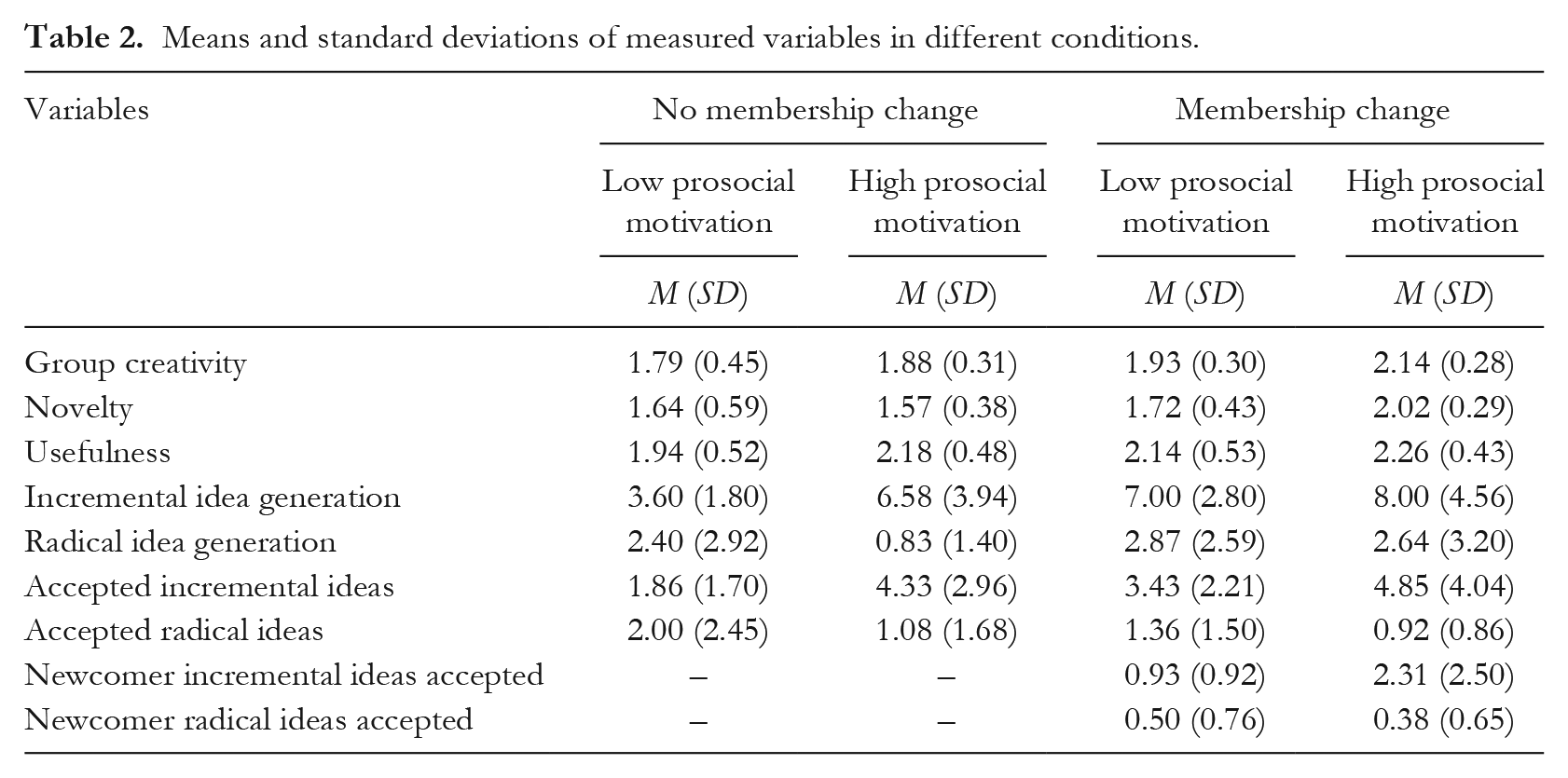
Means, standard deviations, and correlations of all reported variables are displayed in Table 1. 1 The means and standard deviations of measured variables in each condition, including group creativity and the generation and acceptance of incremental and radical ideas are summarized in Table 2.
Means, standard deviations, and correlations of variables a .
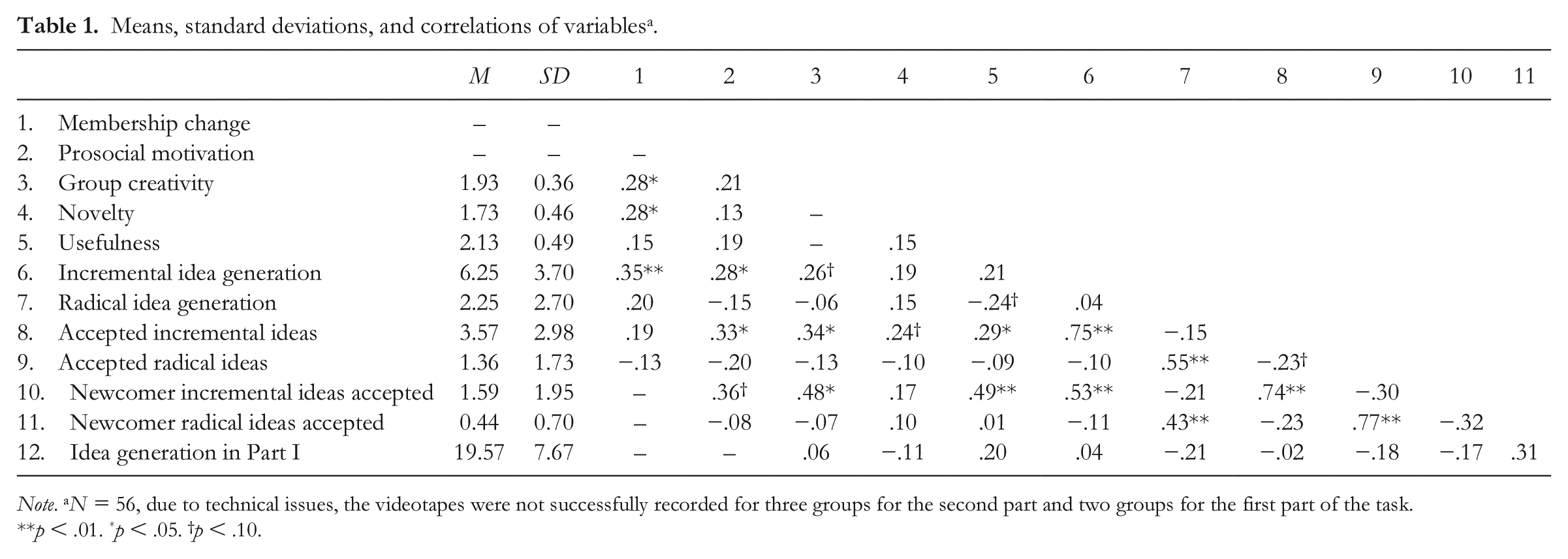
Note. aN = 56, due to technical issues, the videotapes were not successfully recorded for three groups for the second part and two groups for the first part of the task.
p < .01. *p < .05. †p < .10.
Means and standard deviations of measured variables in different conditions.
Hypothesis Testing
We first conducted regression analyses to test the effects of membership change on group idea generation using SPSS with 5,000 bootstrapping iterations, and computed 95% bias-corrected confidence intervals. Results suggested that membership change was positively related to the generation of incremental ideas (B = 0.70, SE = 0.26, p = .01, R2 = .13, 95% CI [0.19, 1.22]), whereas it was not related to the generation of radical ideas (B = 0.35, SE = 0.26, p = .18, R2 = .07, 95% CI [−0.17, 0.88]). These results supported Hypothesis 1a—that membership change would increase the generation of incremental ideas. However, Hypothesis 1b was not supported. The presence of newcomers did not trigger the generation of radical ideas.
Second, Hypothesis 2 predicted that the generation of incremental ideas would mediate the positive effect of group membership change on group creativity, but only when prosocial motivation was high. To test Hypothesis 2, we ran a moderated mediation analysis with 5,000 bootstrapping iterations using the PROCESS macro in SPSS (Model 14; Hayes, 2012), and computed 95% bias-corrected confidence intervals. Results are summarized in Table 3.
Bootstrapping results for moderated mediation models via incremental idea generation.
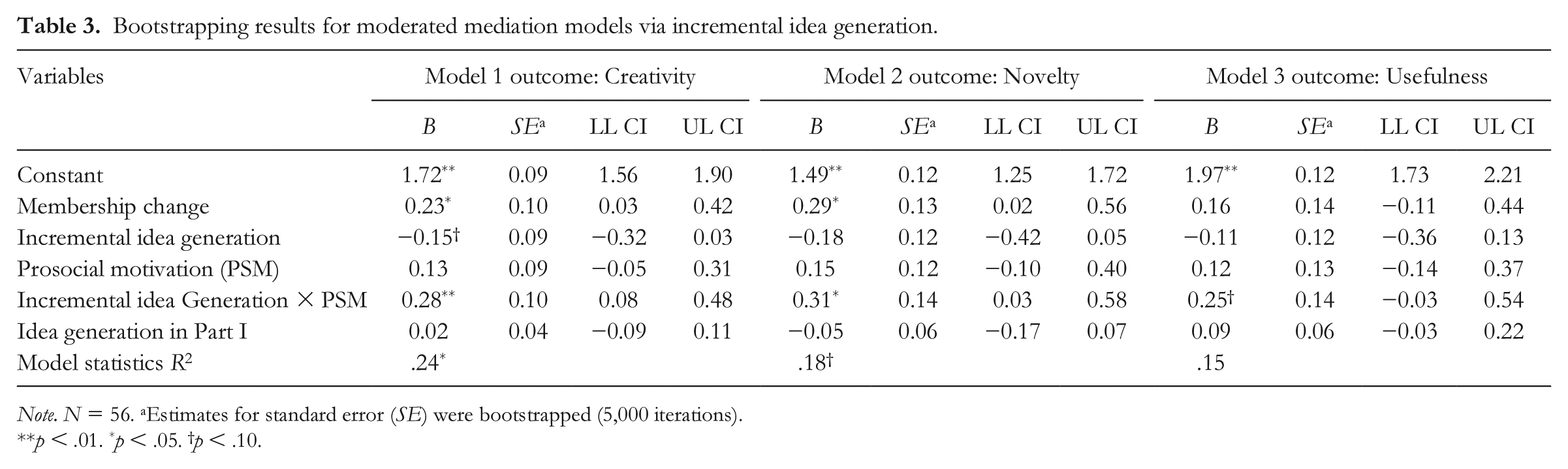
Note. N = 56. aEstimates for standard error (SE) were bootstrapped (5,000 iterations).
p < .01. *p < .05. †p < .10.
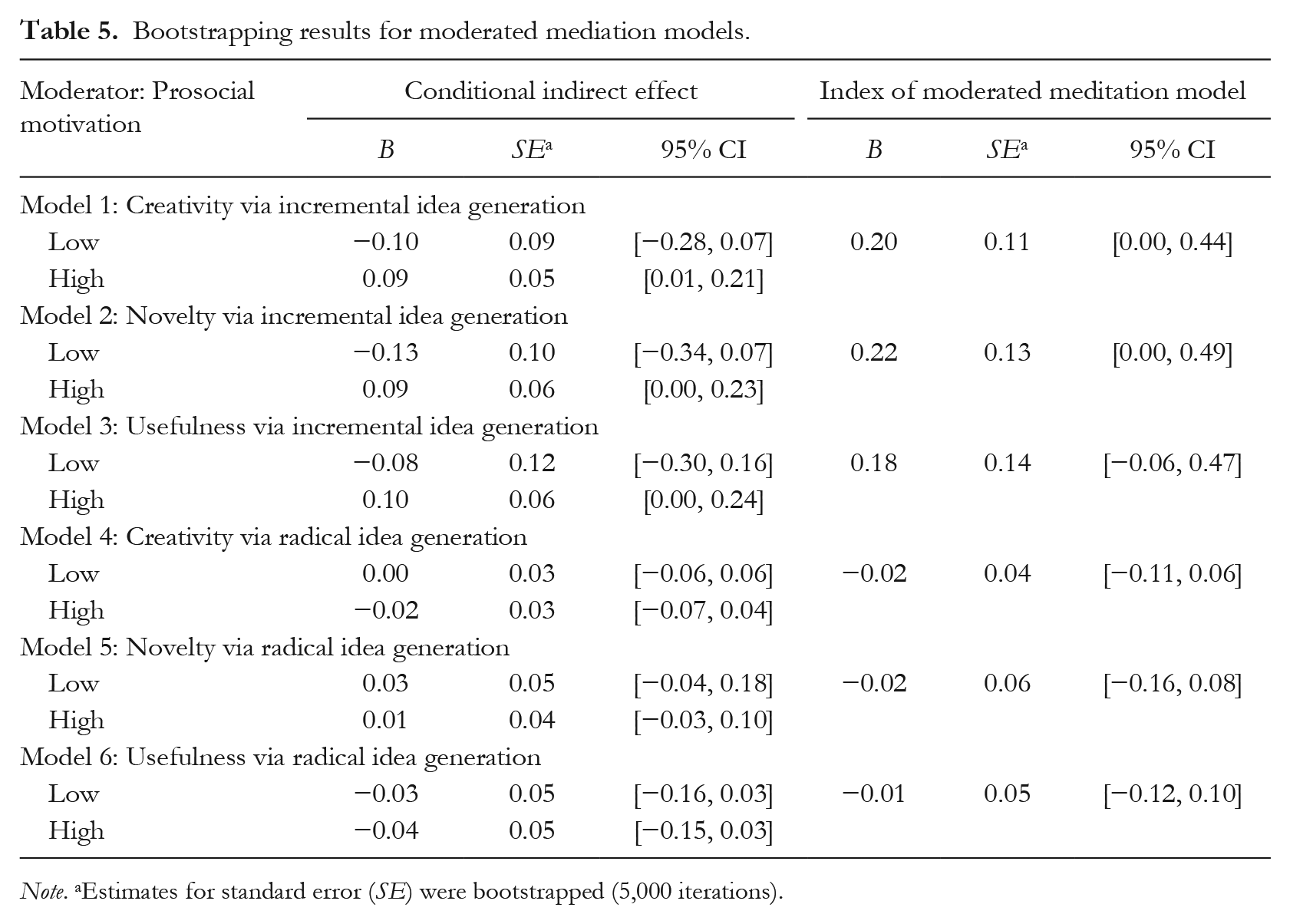
Results (see Table 3, Model 1) revealed that the effect of incremental idea generation on creativity depended on prosocial motivation: the interaction effect of incremental idea generation and prosocial motivation on group creativity was significant (B = 0.28, SE = 0.10, p = .01, R2 = .24, 95% CI [0.08, 0.48]). Furthermore, prosocial motivation significantly moderated the indirect effect of membership change on group creativity via incremental idea generation, with a significant index of moderated mediation at 0.20 and a confidence interval that did not include zero (SE = 0.11, 95% CI [0.00, 0.44]). Therefore, the moderated mediation hypothesis (Hypothesis 2) was supported. In particular, when prosocial motivation was low, the indirect effect of membership change on creativity through incremental idea generation was negative but not significant (B = −0.10, SE = 0.09, 95% CI [−0.28, 0.07]). By contrast, when prosocial motivation was high, the indirect effect was significant and positive: in this condition, membership change increased the generation of incremental ideas, which positively influenced group creativity (B = 0.09, SE = 0.05, 95% CI [0.01, 0.21]; see Table 5, Model 1).
In addition, we also examined the proposed effects on the novelty and usefulness of posters separately, to explore which of these two dimensions was more strongly affected by membership change and prosocial motivation. As results in Table 3 show (Model 2), the interaction effect of incremental idea generation and prosocial motivation on novelty was significant (B = 0.31, SE = 0.14, p = .03, R2 = .18, 95% CI [0.03, 0.58]). Furthermore, prosocial motivation significantly moderated the indirect effect of membership change on novelty via incremental idea generation. The index of moderated mediation was significant, as the 95% confidence intervals did not include zero (B = 0.22, SE = 0.13, 95% CI [0.00, 0.49]). In particular, when groups had low prosocial motivation, the indirect effect of membership change on novelty through incremental idea generation was negative but not significant (B = −0.13, SE = 0.10, 95% CI [−0.34, 0.07]). By comparison, when prosocial motivation was high, membership change was more likely to have a positive effect on novelty via incremental idea generation (B = 0.09, SE = 0.06). The 95% confidence interval for the indirect effect included zero [−0.00, 0.23] (see Table 5, Model 2), but the 90% confidence interval did not [0.01, 0.21]).
In terms of usefulness, results (see Table 3, Model 3) suggested that the interaction effect of incremental idea generation and prosocial motivation was not significant (B = 0.25, SE = 0.14, p = .08, R2 = .15, 95% CI [−0.03, 0.54]). The 95% confidence interval for the index of moderated mediation included zero [−0.06, 0.47] (see Table 5, Model 3). Thus, no support was found for the moderating role of prosocial motivation in the indirect effect of membership change on usefulness through incremental idea generation.
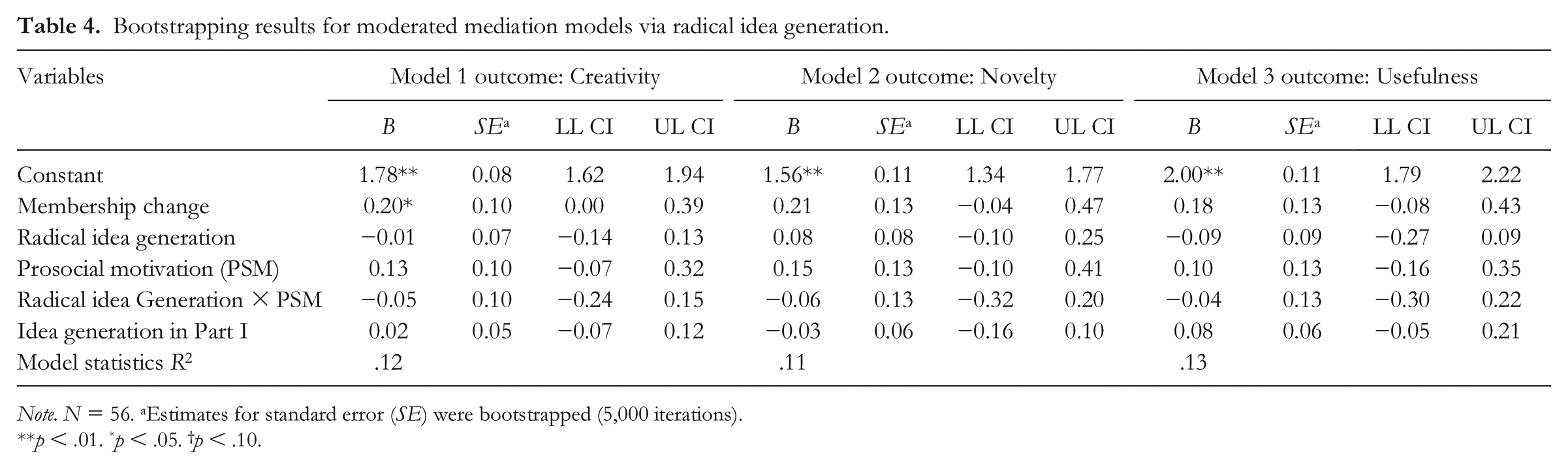
We also performed moderated mediation analyses with radical idea generation as the mediator. However, the interaction effect between prosocial motivation and radical idea generation on group creativity was not significant (B = −0.05, SE = 0.10, p = .63, R2 = .08, 95% CI [−0.24, 0.15]; see Table 4, Model 1). The indirect effect of membership change on group creativity through radical idea generation was not significant at either low (B = −0.002, SE = 0.03, 95% CI [−0.06, 0.06]) or high prosocial motivation (B = −0.02, SE = 0.03, 95% CI [−0.07, 0.04]). The confidence interval of the indirect effect included zero (SE = 0.04, 95% CI [−0.11, 0.06], see Table 5, Model 4). In addition, the interaction effect of radical idea generation and prosocial motivation was not significant for novelty (B = −0.06, SE = 0.13, p = .65, R2 = .11, 95% CI [−0.32, 0.20]) nor for usefulness (B = −0.04, SE = 0.13, p = .77, R2 = .13, 95% CI [−0.30, 0.22]; see Table 4, Models 2 and 3). Neither did we find an indirect effect on novelty (SE = 0.06, 95% CI [−0.16, 0.08]) or on usefulness (SE = 0.05, 95% CI [−0.12, 0.10]; see Table 5, Models 5 and 6).
Bootstrapping results for moderated mediation models via radical idea generation.
Note. N = 56. aEstimates for standard error (SE) were bootstrapped (5,000 iterations).
p < .01. *p < .05. †p < .10.
Bootstrapping results for moderated mediation models.
Note. aEstimates for standard error (SE) were bootstrapped (5,000 iterations).
In summary, we found evidence for the moderating role of prosocial motivation in the indirect effect of membership change on group creativity through incremental idea generation. The effect mainly worked for the novelty rather than the usefulness dimension of group creativity. In addition, membership change did not lead to the generation of more radical ideas, and radical idea generation did not contribute to group creativity, neither under low nor under high prosocial motivation. 2
Supplementary Analyses
Acceptance of ideas
We argued that prosocial motivation benefits group creativity because it encourages groups to take different (particularly incremental) ideas into account and use these ideas for group products. However, our primary analysis does not speak to the incorporation of incremental ideas in the final group products. We therefore examined the indirect effect of prosocial motivation on the creativity (novelty and usefulness) of group products through the acceptance of incremental (vs. radical) ideas. We ran mediation analyses with 5,000 bootstrapping iterations using the PROCESS macro in SPSS (Model 4; Hayes, 2012), and computed 95% bias-corrected confidence intervals. Similar to the previous analysis, we controlled for the total number of ideas generated in the first task stage. The sample size for these analyses was 53 groups. 3
First, a significant positive relationship was found between prosocial motivation and the acceptance of incremental ideas during the second stage of the task (B = 0.67, SE = 0.27, p = .02, 95% CI [0.13, 1.20]). We also found a significant positive relationship between the acceptance of incremental ideas and group creativity (B = 0.11, SE = 0.05, p = .03, 95% CI [0.01, 0.22]). The 95% confidence interval for the indirect effect did not contain zero (B = 0.08, SE = 0.05, 95% CI [0.001, 0.18]). Results indicated that prosocial motivation increased the acceptance of incremental ideas generated during the second stage of the task, which in turn benefited group creativity.
We also performed mediation analyses on novelty and usefulness. Results suggested that the acceptance of incremental ideas was not related to the novelty of posters (B = 0.09, SE = 0.07, p = .18, 95% CI [−0.04, 0.23]). The indirect effect between prosocial motivation and novelty through the acceptance of incremental ideas was .06 and was not significant (SE = 0.06, 95% CI [−0.02, 0.19]). By contrast, the acceptance of incremental ideas was marginally and positively related to the usefulness of posters (B = 0.13, SE = 0.07, p = .05). The 95% confidence interval for the indirect effect contained zero [−0.00, 0.27]. However, the indirect effect was marginally significant, p < .10, 90% CI [0.01, 0.19]. Although the evidence is not very strong, results imply that prosocial motivation was more likely to benefit usefulness rather than novelty by stimulating more acceptance of incremental ideas.
Second, we did not find a relationship between prosocial motivation and the acceptance of radical ideas (B = −0.36, SE = 0.27, p = .19, 95% CI [−0.91, 0.19]). The acceptance of radical ideas was also not related to creativity (B = −0.03, SE = 0.05, p = .59, 95% CI [−0.13, 0.08]), novelty (B = −0.04, SE = 0.07, p = .55, 95% CI [−0.18, 0.09]), or usefulness (B = −0.02, SE = 0.07, p = .81, 95% CI [−0.15, 0.12]). The 95% confidence intervals for all indirect effects included zero (−0.06 < LL CI < −0.03, 0.05 < UL CI < 0.09). Together, results demonstrated that prosocial motivation increased the acceptance of members’ incremental (but not radical) ideas, which in turn benefited especially the usefulness aspect of group creativity.
Acceptance of newcomers’ ideas
The previous results raised the question of whether newcomers’ ideas in particular were accepted and integrated into the group’s final product. We argued that for groups with high levels of prosocial motivation, members would be more willing to accept and combine newcomers’ ideas. We therefore examined the mediating effect of acceptance of newcomers’ ideas on the relationship between prosocial motivation and group creativity (novelty and usefulness). For groups in the membership change condition (N = 27), we ran a mediation analysis with 5,000 bootstrapping iterations using the PROCESS macro in SPSS (Model 4; Hayes, 2012), and computed 95% bias-corrected confidence intervals. We again controlled for the total number of ideas generated in the first task stage.
First, these analyses suggested that prosocial motivation exerted a positive effect on the acceptance of newcomers’ incremental ideas (B = 0.83, SE = 0.37, p = .03, 95% CI [0.07, 1.59]), and that the acceptance of newcomers’ incremental ideas was positively related to group creativity (B = 0.15, SE = 0.06, p = .02, 95% CI [0.03, 0.27]). The confidence interval for the indirect effect did not include zero [0.001, 0.30], suggesting that the acceptance of newcomers’ incremental ideas translated the positive effect of prosocial motivation on group creativity.
In addition to creativity, we performed analyses on novelty and usefulness. Results revealed that the acceptance of newcomers’ incremental ideas was not related to novelty (B = 0.002, SE = 0.08, p = .98, 95% CI [−0.17, 0.17]), but it was positively related to poster usefulness (B = 0.29, SE = 0.09, p = .003, 95% CI [0.11, 0.48]). The indirect effect of prosocial motivation on novelty was 0.00 (SE = 0.07, 95% CI [−0.12, 0.16]). By comparison, the indirect effect of prosocial motivation on usefulness was 0.24 (SE = 0.13, 95% CI [0.02, 0.52]), suggesting that accepting newcomers’ incremental ideas translated the positive effect of prosocial motivation mainly into poster usefulness.
Second, we found no support for the mediating role of acceptance of newcomers’ radical ideas in the relationship between prosocial motivation and group creativity. Results revealed that prosocial motivation did not influence the acceptance of newcomers’ radical ideas (B = −0.32, SE = 0.39, p = .41, 95% CI [−1.12, 0.48]). The acceptance of newcomers’ radical ideas did not influence creativity (B = 0.02, SE = 0.06, p = .79, 95% CI [−0.11, 0.15]), novelty (B = 0.06, SE = 0.08, p = .45, 95% CI [−0.10, 0.22]), or usefulness (B = −0.02, SE = 0.10, p = .82, 95% CI [−0.24, 0.19]). The 95% confidence intervals for all indirect effects included zero (−0.19 < LL CI < −0.12, 0.02 < UL CI < 0.09). Together, results demonstrated that high prosocial motivation led to more acceptance of newcomer’s incremental (but not radical) ideas, which in turn benefited mainly the usefulness aspect of group creativity.
Discussion
Previous research suggested that new members can contribute to a group’s idea repository, but it was less clear how membership change can shape the creativity of a final group product, such as a report, prototype, or campaign. Drawing on motivated information processing in groups (MIP-G) theory (De Dreu et al., 2008), the aim of the present research was to investigate the relationship between membership change, two types of idea generation (incremental vs. radical), and group creativity. It was predicted that membership change would be positively related to idea generation (both incremental and radical), but that idea generation would only benefit creativity when prosocial motivation of group members was high. Using a task in which groups designed a poster in the laboratory, we found that membership change stimulated the generation of incremental ideas. Furthermore, incremental idea generation mediated the positive effect of membership change on group creativity (i.e., creativity of the final output—the poster), but only when groups were prosocially motivated (i.e., could earn a reward when producing the most creative poster). These findings are consistent with MIP-G theory’s suggestion that prosocial motivation is needed to turn ideas into high-quality (creative) output.
Our study, however, did not find a relationship between membership change and the generation of radical ideas, and suggested that membership change exerted different effects on the two types of ideas. It seems that although the presence of newcomers may inspire groups to have new ideas, those ideas were mainly minor adaptations to existing ideas. These results suggest that groups are not likely to give up existing thoughts, or that newcomers may feel reluctant to introduce ideas that are completely different to those existing in their new groups. We also did not find support for the influence of radical idea generation on group creativity. This is likely the case because this type of ideas are much harder to incorporate in a final product, at least within the limited time frame of the experiment. When (radical) ideas are ignored or discarded, they exert little impact on the creativity of a final product, and this does not seem to depend on groups’ level of prosocial motivation.
Our supplementary analysis revealed that prosocial motivation plays a role in encouraging groups to incorporate incremental ideas into the group product. We found that prosocial motivation elevated the number of incremental ideas that were used in the posters, which in turn benefited their creativity. This finding is consistent with MIP-G theory, suggesting that group members with high prosocial motivation are more willing to consider different ideas and combine them in a synergetic way. Importantly, such an effect was also found for the incremental ideas generated by newcomers. Incorporating newcomers’ ideas contributed to group outcomes, suggesting a direct role for newcomers in enhancing group creativity.
In addition to group creativity, we also examined the novelty and usefulness of groups’ products separately, and results suggested potentially different mechanisms for novelty and usefulness. We found that membership change was more likely to increase the novelty of team products under high prosocial motivation, and that this positive effect was translated via the generation of incremental ideas. The positive influence of prosocial motivation, on the other hand, mainly worked on the usefulness of group products, and this effect was translated via the acceptance of members’ incremental ideas (among all groups), including those of newcomers (among membership change groups). Interestingly, to boost novelty, groups did not necessarily need to accept and incorporate as many ideas as possible into group products. In other words, it does not seem the case that the more ideas are accepted, the higher the novelty of posters. One possible reason is that groups incorporated a small number of ideas to enhance novelty. As more ideas were generated, the chance that groups encountered a few good ideas was higher. However, in terms of usefulness, it seemed important to incorporate more incremental ideas, including ideas suggested by newcomers. It is likely that details and minor adaptations regarding usefulness can be easily recognized and utilized. The more ideas were included, the more likely that groups covered every aspect to make the poster more useful. It should be noted, however, that this interpretation is speculative and that, in general, effects on novelty and usefulness were in the same direction (and only differed in terms of their relative strength).
Theoretical Implications and Future Directions
These results have implications for various literature fields. First, most previous research on membership change and group creativity has focused on idea generation (e.g., Choi & Thompson, 2005; Nemeth & Ormiston, 2007). This paper extends this work and examines the complete path from group membership change to group creativity via idea generation. Results suggest that new ideas inspired by newcomers do not always guarantee the achievement of creative outcomes. Rather, this relation depends on group members’ prosocial motivation and the type of ideas concerned (incremental vs. radical).
Second, our study explores the relationship between group membership change and group creativity from a motivational perspective.The MIP-G theory assumes that the combination of high epistemic motivation and high prosocial motivation leads to the highest creativity outcome, as compared to other combinations (Nijstad & De Dreu, 2012). This study provides new evidence for this prediction and indicates that the MIP-G model makes valid predictions in dynamic group contexts with changing group membership. Our research suggests that group creativity requires the combination of diverse inputs (as stimulated by newcomers) and high cooperation to ensure that these inputs are actually transformed into group creativity (also see Bechtoldt et al., 2012). The importance of raising both epistemic and prosocial motivation is even more salient for unstable groups with creative tasks. Specifically, our research emphasizes the role of prosocial motivation (via collective rewards) as a contextual factor in the processing and integration of ideas to achieve high-quality group outcomes. Therefore, the MIP-G model offers a solid theoretical foundation to explore the effects of newcomers on group creativity. Future research can further explore MIP-G and creativity in dynamic contexts.
Third, our paper has implications for research on group creativity and draws attention to the nature of creative ideas (i.e., incremental vs. radical). Incremental and radical ideas present different challenges for groups, and the nature of those ideas is related to the way in which groups evaluate, select, and integrate them. Our research suggests that the nature of creative ideas should be taken into consideration when the creativity of a final product is assessed. We did not find an effect of membership change on the generation of radical ideas, and radical idea generation was not related to group creativity, even when group members were prosocially motivated. Clearly, future research should pay attention to the nature of creative ideas and further explore the relationship between radical and incremental idea generation and group creativity. For example, research can examine the conditions under which radical idea generation does contribute to group creativity. One possibility is that radical ideas are more likely included when a group is under pressure and has performed poorly in the past (cf. Choi & Levine, 2004), because poor past performance may signal that radical change is needed.
Fourth, the finding that especially incremental idea generation was positively related to group creativity (under high prosocial motivation) resonates with recent findings on the importance of idea development. For example, Harvey (2014) has proposed that groups do not necessarily need a large number of ideas to be creative, but rather need to synthesize their different perspectives. Similarly, Kohn et al. (2011) found that combining and integrating existing ideas could contribute to group creativity. Together with the current findings, this suggests that it is important that groups develop, combine, and integrate their ideas. Rather than coming up with many radical different ideas, working on and refining existing ideas could be the best way to achieve creative outcomes in many situations.
Finally, the current paper highlights that group members’ motivation to work collectively on group products is essential to achieve group-level creativity. Collective rewards, which induce outcome interdependence among group members, remind members of their common goals and unify their efforts (Courtright et al., 2015). Other types of interdependence might also influence the relationship between membership change and group creativity via prosocial motives, such as task or resource interdependence (Courtright et al., 2015; Kerrin & Oliver, 2002). Future research is encouraged to investigate this. Moreover, the need for cooperation and for divergent thinking within groups creates a potential tension between two activities. Group members may disagree whether they should devote more resources to combining ideas into outcomes or take time to generate more ideas. Our paper implicates that prosocial motivation may ease the tension to some extent by encouraging individuals to work together. It would be fruitful for researchers to investigate how such tensions influence group-level processes and what factors allow groups to deal productively with these tensions.
Practical Implications
One clear implication for organizations is that group creativity can benefit from membership change. However, membership change is more likely to have these benefits when organizations adopt collective rewards or other types of group-based performance assessment that encourage interdependent efforts from all members. Managers can use collective rewards as an intervention to improve the synergetic process of group creativity. Moreover, we may infer that incremental and radical ideas affect group creativity in different ways, and managers need to pay attention to the roles of different types of ideas. Furthermore, our study may also imply that work groups need to pay more attention to the incremental ideas generated by newcomers and try to integrate more of those ideas into group products. For managers, one way to achieve this is to increase members’ prosocial motivation, for example, via collective rewards.
Limitations
As is generally the case with laboratory research, the generalizability of the present findings to the real world is limited. For example, we operationalized membership change by letting one member leave the group and at the same time adding a new member to that group (i.e., member replacement). However, in a real work context, different types of membership change are possible (e.g., adding a member, downsizing). Moreover, our participants were students sharing fairly homogeneous backgrounds, whereas newcomers in organizations can vary more. We also used a specific task, and our groups worked together for only a short amount of time. However, even though our laboratory environment is clearly a simplification as compared to the real world, it does allow for causal conclusions and precise observations of group processes. Future work may examine the effects of membership change within actual groups in organizations.
Relatedly, we compared a condition with collective rewards (high prosocial motivation) with a condition without rewards (low prosocial motivation). It can be argued that effects were not due to the collective nature of the reward, but rather to the presence of a performance reward in the first place, and that individual rewards may have yielded the same effects. We chose not to use individual rewards in the present study (e.g., as a control condition) because when groups produce a single product (a poster in this case), it is not clear what exactly should be rewarded at the individual level. Moreover, if the mere presence of a performance reward motivated our participants to be more creative, one would expect a main effect of performance rewards on creativity rather than an interaction with idea generation or the pattern of moderated mediation that we found. We therefore believe that it is in fact the collective nature of the reward that stimulated cooperation and allowed groups to better use the creative ideas that were generated. It would be interesting though to examine the effects of individual-level rewards. For example, this may impact the degree to which different members’ ideas are incorporated into a final product.
Another limitation is that we manipulated prosocial motivation via collective rewards, but we did not measure or manipulate prosocial motivation directly in our study. However, past research has often used group-based outcomes (vs. individual-based outcomes) to stimulate prosocial behaviors (e.g., Harrison et al., 2002). Besides, collective rewards have been widely considered as a strong factor to stimulate participants’ prosocial motivation in many studies (Bechtoldt et al., 2010), and we found that collective rewards increased participants’ attention to and utilization of other members’ input. Similarly, we assumed that membership change has positive effects because it stimulates reflection and epistemic motivation. Although further evidence supported this stimulating role of membership change in epistemic processes (i.e., more time and effort devoted to discussion and reflection), we did not directly measure epistemic motivation in this study. Future studies may want to capture prosocial and epistemic motivation directly or manipulate them in other ways.
Conclusion
We found that group members need to be motivated to work cooperatively together to benefit from membership change and achieve high group creativity. We further found that the nature of generated ideas matters in channeling the influence of membership change to group creativity: incremental, but not radical, idea generation benefited the creativity of a final group product. As such, these findings suggest that cooperation is key to groups’ creative success, especially in dynamic conditions of membership change.
Footnotes
Appendix A
Acknowledgements
We thank Yan Shao, Sara van Es, Lineke Oegema, Taylor Hodges, Paul Broekema, and Koen Vlaar for their help with data coding.
Funding
The author(s) disclosed receipt of the following financial support for the research, authorship, and/or publication of this article: This research was supported by a grant (453-15-002) from the Netherlands Organization of Scientific Research (NWO) awarded to Bernard A. Nijstad.
