



Abstract
To stop the spread of the Coronavirus, people must avoid infection risk. Given widespread skepticism regarding information concerning the Coronavirus received from authorities, one potentially important pathway to estimate the infectiousness of one’s group members could be through gossip (i.e., information about an absent target). Infection risk is reflected by both infection status and adherence to social distancing norms. In hypothetical scenarios (N = 837), participants received gossip that we manipulated to describe a group member’s infection status and/or norm adherence. Results showed people tended to believe gossip and that gossip influenced behavioral intentions to avoid and punish targets of gossip as well as the perception of targets. We conclude that gossip, while potentially unreliable, could affect how people treat group members. We discuss how gossip could alleviate the Coronavirus crisis by contributing to slowing the Coronavirus’s spread, as well as exacerbate it through increased social exclusion based on unverified information.
Keywords
The rapid spread of the Coronavirus (COVID-19) has led to detrimental outcomes worldwide: over 72 million people have been infected and 1.6 million deaths have been reported as of December 14, 2020 (Google News, 2020). The Coronavirus crisis has caused a specific type of information to become very important for people: Knowing what infection risk others present is crucial to avoid infection and, thus, to prevent the spread of the virus. It is especially relevant to have this information about members of one’s own social group as virus contagion is most likely to occur between people who are in close contact (CDC, 2020; L. Wang et al., 2020).
The most straightforward information pertaining to infection risk concerns group members’ current infection status: individuals who are currently infected with a communicable disease are the most contagious and therefore pose the highest infection risk. More indirectly, if group members violate the novel behavioral norms that are based on scientific evidence and implemented as preventive measures by governments (such as keeping social and physical distance, Hale et al., 2020, see also Fehr & Fischbacher, 2004), this should also present cues to increased infection risk (e.g., Courtemanche et al., 2020; Doung-ngern et al., 2020). This is because their failure to adhere to the imposed social norms to prevent infection increases the likelihood that they are indeed infected and might thus pose an infection risk, even if no further information about infection status is available.
Despite the importance of information on the infection risk that group members pose, official information (i.e., information from authorities such as governments) on whether others in one’s social group are infected, is extremely hard to obtain. Although several governments (aim to) employ smartphone applications reporting contact with an infected person (European Commission, 2020), such applications are problematic because they often collide with privacy regulations, rely on voluntary disclosure of infection following testing (which is often not sufficiently available; Kuchler, 2020; Manski & Molinari, 2021; Maxmen, 2020; Pettit et al., 2020), and only alert people after infection risk (Abeler et al., 2020; Parker et al., 2020; Zastrow, 2020). In addition, information about group members who do not adhere to the novel norms, and who thus could pose an infection risk, is arguably even more difficult to obtain, as it is virtually impossible to continuously monitor the behavior of all group members.
Moreover, even if official information regarding who poses an infection risk would be available, it would likely be met with skepticism. For example, President Trump stating that the coronavirus is the Democrats’ “new hoax” (Milman, 2020; see also Mian & Khan, 2020). Such skepticism is comparable to any other type of information that is more objective and/or scientific and is derived from official sources and institutions (Gauchat, 2012; Nature, 2017; Pittinsky, 2015; Rutjens, Heine, et al., 2018).
This limited availability of and skepticism towards official information makes it likely that people acquire essential information about infection risks from other, less official sources. Research indicates that gossip represents one of the most important sources to map information about others in one’s social group (Dunbar, 2004; Giardini & Wittek, 2019; Hannerz, 1967; Rosnow, 1977). Thus, gossip might be an alternative source of information for people to estimate Coronavirus infection risk. Here, we, therefore, investigate how people respond to gossip containing information that pertains to Coronavirus infection risk. Below, we first discuss why official information about Coronavirus infection is often met with skepticism. Then, we discuss why gossip could form an alternative source of information about infection risk. Finally, we introduce the current study and hypotheses.
Official information about coronavirus infection risk is met with skepticism
Not only is objective information with regard to the infection risk that others pose often hard to obtain, but people can also have several reasons to be skeptical of scientific findings and the policy measures that follow from them. Among these reasons are (political and religious) ideological and motivational reasons (for a review, see Rutjens, Heine, et al., 2018). The prescriptive behavioral norms to prevent the spread of the Coronavirus that have been forwarded by scientific and policy institutions, such as social distancing, isolation, and lockdowns, often present a salient conflict with people’s (ideological) beliefs and needs, such as the need for social interaction and economic freedom (Baumeister & Leary, 1995; Blancke et al., 2015; Lewandowsky & Oberauer, 2016; Rossen et al., 2015; Rutjens, Heine, et al., 2018). Moreover, the nature of scientific information (e.g., a degree of uncertainty about exact effects, potentially conflicting findings) seems to add to the confusion in the current crisis, as many authorities present different measures and inconclusive statements (e.g., statements on the necessity of total versus partial lockdowns or the effectiveness of mask-wearing; Feinberg & Willer, 2011; Nagler et al., 2020; Rutjens et al., 2013; Rutjens, Heine, et al., 2018). Taken together, these factors cause scientific information that could inform people about the risk of infection with the Coronavirus to be met with a skepticism characteristic of the current times (Rutjens, Heine, et al., 2018). This is recently exemplified by decreased willingness to adopt newly developed vaccines for the Coronavirus (Lazarus et al., 2020; Lewis, 2020). As such, we are facing a situation in which precisely the information that currently is most important for people to navigate their social environment (i.e., information about infection risk), is met with skepticism if it is even possible to obtain.
Gossip as an alternative source of information about Coronavirus infection risk
Gossip, defined as a sender communicating to a receiver about a target who is absent or unaware of the content (Dores Cruz, Nieper, et al., 2020) is one of the most prevalent forms of everyday communication within social groups (e.g., Dores Cruz, Thielmann, et al., 2020; Dunbar et al., 1997; Robbins & Karan, 2019). Gossip has been argued to allow group members to map each other’s characteristics that are otherwise difficult to ascertain (e.g., because it is impossible to constantly observe all others directly). As such, it allows groups to identify members who violate group norms (Dunbar, 2004; Hannerz, 1967; Nowak & Sigmund, 2005; Piazza & Bering, 2008). Building on this, the information gossip provides helps people to adapt their behavior towards group members they might interact with; gossip information informs receivers which group members to interact with and help, and which ones to avoid, or even punish (Feinberg et al., 2014; Stadler, 2003; Wu et al., 2016). Taken together, gossip allows information about group members to spread, fostering within-group relations, such as bonding, norm-setting, and regulation of in/exclusion, and as such is an important group process (Baumeister et al., 2004; Beersma & Van Kleef, 2011; Dunbar, 2004; Ellwardt et al., 2012; McAndrew, 2019; Ouwerkerk et al., 2005; Peters et al., 2017).
In the current Coronavirus crisis, gossip could serve as a means to transmit cues about infection risk to group members, allowing them to map this risk in their social group. Research has shown that people value the information transmitted via gossip; in times of crisis, people were found to prefer information from friends and family to information derived from official sources (Williams et al., 2018). Furthermore, theory on the human behavioral immune system proposes that people have an evolved tendency to avoid the risk of infectious disease, which means that they are inclined to avoid and/or otherwise respond negatively in terms of perceptions and emotions to disease cues, such as individuals posing infection risks (i.e., individuals who could be contagious; Miller & Maner, 2012; Schaller & Park, 2011; Stevenson et al., 2011; Tybur et al., 2013; van Leeuwen & Petersen, 2018). Building on these findings and theory, we propose that people should be sensitive to receiving cues regarding the infection risk another person poses via gossip.
If gossip indeed serves as a source of information to estimate infection risks within a group by communicating group members’ current infection status and/or adherence to novel group norms meant to reduce the spread of the virus, this can lead to both positive and negative outcomes. On the one hand, a potential positive outcome is that information about others’ Coronavirus infection status and adherence to the novel social norms spread through gossip may allow people to avoid infection risks. Previous research points to the possibility that gossip can communicate information about these two infection risk cues (Dunbar, 2004; Piazza & Bering, 2008). Communication about others’ infection status (or at least inferred infection status based on symptoms or cues) has been theorized to be aimed at, and lead to, changes in behavior and perceptions to avoid infection (Schaller, 2006). In particular, gossip is frequently used to communicate about norm violators (Beersma & Van Kleef, 2012; Dores Cruz et al., 2019; Dunbar, 2004; Feinberg et al., 2012; Molho et al., 2020). Individuals who are, through gossip, portrayed as violating group norms, are perceived negatively in terms of sociability, morality, and competence (Baum et al., 2018; Dores Cruz, Thielmann, et al., 2020; van der Lee et al., 2017). However, norm violations could have a positive impact on dominance perceptions of the violator due to signaling power (Dores Cruz, Thielmann, et al., 2020; Stamkou et al., 2014; Van Kleef et al., 2011, 2015). In turn, people refrain from helping and avoid others who are depicted negatively in gossip (Baum et al., 2018; Dores Cruz, Thielmann, et al., 2020; Feinberg et al., 2014; Sommerfeld et al., 2007), which could be related to disease-avoidance mechanisms (Faulkner et al., 2004). This indicates that gossip about infection status and/or norm violations could have positive consequences for gossip receivers and entire social groups; by reducing interaction with those that spread the virus, gossip receivers can prevent the virus from spreading further.
On the other hand, however, a potential negative outcome of gossip receivers uncritically accepting gossip information (which, after all, may be false; Fonseca & Peters, 2018; Peters & Fonseca, 2020), and allowing it to affect their perceptions of others and behaviors toward them, may be undesirable social exclusion/isolation of group members (e.g., Baum et al., 2018; Dores Cruz et al., 2019; Stadler, 2003). Gossip about contagious infectious diseases has been shown to contribute to social stigmatization of individuals suffering from them, as well as to ostracism and bullying of the targets of gossip (Crothers et al., 2009; Feinberg et al., 2014; Pinto et al., 2010; Smith et al., 1999; Stadler, 2003). Similarly, this has been found for people perceived as violating group norms (Dores Cruz et al., 2019; Faulkner et al., 2004; Feinberg et al., 2014). This, in turn, can lead to intragroup conflict, loneliness, and, over time, poorer health outcomes of targets (e.g., Banerjee & Rai, 2020; Holt-Lunstad et al., 2015; Williams, 2007; Xiang et al., 2020). The current novel social distancing norms have already been argued to pose a threat to both mental and physical health (Marroquín et al., 2020; Mattioli et al., 2020; Taquet et al., 2020). If people respond to gossip about being infected with the Coronavirus or not adhering to social norms by shunning gossip targets, these effects may be exacerbated (Goyal et al., 2020; Mamun & Griffiths, 2020; Miller, 2020; Torales et al., 2020; C. Wang et al., 2020). During the pandemic, we have seen examples of this, for instance, the increased racism, antagonism, and exclusion of minorities (Budhwani & Sun, 2020; Devakumar et al., 2020; Nature, 2020).
Therefore, it is important that gossip receivers critically evaluate gossip and scrutinize it to prevent detrimental consequences (Fonseca & Peters, 2018; Hess & Hagen, 2006; Smith, 2014). Yet, research indicates people are unlikely to be skeptical about information they receive via gossip. In experimental settings, people have been shown to be very likely to believe and act upon, information about others’ norm violations acquired via gossip (e.g., Fonseca & Peters, 2018; Laidre et al., 2013; Sommerfeld et al., 2007). This has also been found to apply to gossip about norm violations people have access to in their everyday lives (Dores Cruz, Thielmann, et al., 2020). Thus, even though they tend to be skeptical about official information, people might unskeptically follow information received through social channels.
Current study
To examine how gossip relevant to the Coronavirus shapes participants’ social responses towards targets, we presented participants with a scenario in which they received gossip about a group member describing their infection status (infected vs. recovered vs. no information) and adherence to social distancing norms (violated vs. adhered vs. no information). We expect receiving gossip describing infection status and adherence to norms to lead receivers to perceive targets as more contagious and to be more intent to avoid them, with targets described as infected and having violated norms eliciting the strongest responses. Furthermore, being infected by itself is unlikely to be seen as socially reprehensible, yet violating norms should be. Therefore, we expect gossip about norm violations to lead receivers to perceive targets as less sociable, moral, and competent (but more dominant); and to be more intent to punish them. Taken together, we propose that people can use gossip to track infection risk and adapt their behavior towards gossip targets and advance the following hypotheses (preregistered at https://osf.io/zbnu6): 1
Gossip receivers perceive targets described as infected and violating norms as most contagious, followed by targets described solely as infected or violating norms, followed by targets about whom gossip contains other combinations of information.
Gossip receivers intend to avoid targets described as infected and violating norms most, followed by targets described solely as infected or violating norms, followed by targets about whom other combinations of infection or norm gossip are provided.
Gossip receivers intend to punish targets described as violating norms more than targets described as adhering to norms and targets about whom no norm gossip is provided.
Gossip receivers perceive targets described as violating norms as less moral, less sociable, less competent but more dominant than targets described as adhering to norms and targets about whom no norm gossip is provided.
In addition to testing these hypotheses, we explored to what extent gossip receivers perceived the information received through gossip as true (i.e., perceived veracity). We also examined whether perceived gossip veracity moderated gossip receivers’ behavioral responses (i.e., whether gossip would have weaker behavioral intentions to the extent that its veracity was questioned).
Method
Participants
To reach our preregistered sample size of 837 participants, we recruited a total of 862 participants from the United States using Amazon’s Mechanical Turk (Buhrmester et al., 2011), of whom 25 were excluded for failing an attention check as specified in the preregistered exclusion criteria. 2 Power analysis indicated that to detect a small to medium effect size for main effects and interactions (f = 0.175) between the conditions with 90% power and a type 1 error rate of 0.002 3 with nine groups required a total sample size of 837 participants (Faul et al., 2007).
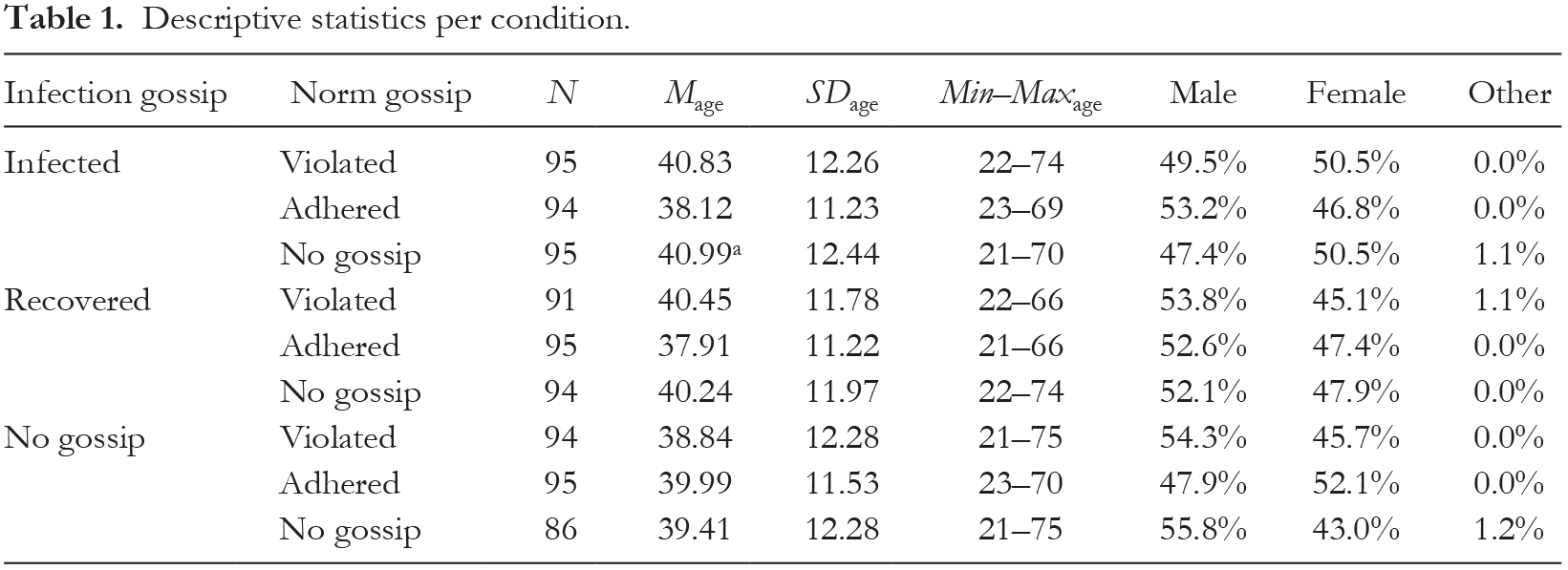
Of the final sample, 51.9% were male (47.8% female; 0.4% other), with ages ranging from 21 to 75 years (M = 39.6, SD = 11.9). 4 Participants were paid $1.81 for their participation. In a 3 × 3 full factorial between-subjects design, participants were randomly assigned to receive gossip about a target’s infection status (infection gossip: infected vs. recovered vs. no infection gossip) as well as the target’s adherence to social distancing norms (norm gossip: violated vs. adhered vs. no norm gossip; for an overview see Table 1; demographics did not significantly differ across conditions ps > .575).
Descriptive statistics per condition.
Materials
Gossip scenario
Participants read a scenario in which a friend (i.e., the sender) shares gossip with them about a group member (i.e., the target), referred to as Robin without specifying their gender (for the full scenarios, see https://osf.io/237ts/). The gossip differed on two factors. First, we manipulated infection gossip by either describing the target as having recovered from infection with the Coronavirus and being healthy (recovered condition), as being actively infected with the Coronavirus and showing symptoms (infected condition), or by providing no information on the target’s infection status (no infection gossip condition; intended to serve as a neutral control). Second, we manipulated norm gossip by either describing the target as having adhered to social distancing norms (adhered condition), as having violated social distancing norms (violated condition), or by providing no information on the target’s social distancing norm adherence (no norm gossip condition, intended to serve as a neutral control). Each participant read one of nine possible combinations of gossip.
Contagiousness perception of the target
We measured perceptions of how contagiousness participants perceived the target to be with the item “Robin is contagious”. This item was rated on a seven-point scale ranging from 1 (not much) to 7 (very much).
Behavioral intentions towards the target
We measured how participants intended to behave towards the target on two composite scales (adapted from Dores Cruz, Thielmann et al., 2020). A first composite (interact, avoid, exclude, select, shun) measured intentions to avoid the target (e.g., “I would avoid Robin”; α = .86). A second composite (harm, confront, punish, report for punishment) measured intentions to punish the target (e.g., “I would punish Robin”; α = .87). 5 For an overview of all items, see https://osf.io/237ts/. All items were rated on a seven-point scale from 1 (completely disagree) to 7 (completely agree).
Person perception of the target
We measured perceptions of the target using the stem “Robin is . . .” followed by words describing person perception dimensions (adapted from Abele et al., 2016; Leach et al., 2007). With three items each, we measured how participants perceived the target’s morality (e.g., “sincere”; α = .90), sociability (e.g., “friendly”; α = .93), competence (e.g., “skilled”; α = .93), and dominance (e.g., “dominant”; α = .77). All items were rated on a seven-point scale ranging from 1 (not much) to 7 (very much).
Perceived veracity of the gossip
We also measured the extent to which participants perceived the gossip as true using a single item (“To what extent do you think the information is true”; Dores Cruz, Thielmann et al., 2020; Hess & Hagen, 2006). This item was rated on a seven-point scale ranging from 1 (definitely false) to 7 (definitely true).
Procedure
First, participants completed an informed consent form. After accepting the human intelligence task (HIT) on Amazon’s Mechanical Turk, participants read one of nine gossip scenarios and were instructed to vividly imagine the described situation. We then measured their contagiousness perceptions of the target described in the scenario, their perception of the gossip’s veracity, their intended behavioral responses to the target described in the scenario, and their person perception of the target described in the scenario. 6 At the end, participants were debriefed and thanked for their participation. Participation took on average 16.53 minutes.
Statistical analyses
To test our hypotheses, we used 3 (infection gossip: recovered vs. infected vs. no infection gossip) × 3 (norm gossip: violated vs. adhered vs. no norm gossip) factorial ANOVAs. To exploratively test interaction effects including veracity, we used ANCOVA analyses including interactions between infection gossip, norm gossip, and veracity as the covariate. To follow up significant effects, we used planned comparisons using Bonferroni corrections to test our hypotheses (for interaction effects: infected and violated vs. all other combinations of gossip as well as either infected or violated vs. all other combinations excluding infected and violated 7 ). Furthermore, we used post hoc tests with a Bonferroni correction to compare all conditions (see online supplementary materials). Analyses and graphs were prepared using JAMOVI (The Jamovi Project, 2020) and R (R Core Team, 2019) with the packages “GAMLj” (Gallucci, 2019), “tidyverse” (Wickham et al., 2019), “emmeans” (Lenth, 2019), “ggpubr” (Kassambara, 2020), and “ggpattern” (FC, 2020).
Results
Contagiousness perception of the target of gossip
Results showed a large main effect of infection gossip, F(2, 828) = 281.51, p < .001, η2partial = .40. People perceived targets described as infected as significantly more contagious than targets described as recovered (z = 19.42, p < .001, Cohen’s d = 1.64) and targets about whom no infection gossip was provided (z = 21.45, p < .001, Cohen’s d = 1.82). In addition, results showed a medium to large main effect of norm gossip, F(2, 828) = 34.93, p < .001, η2partial = .08. People perceived targets described as having violated norms as significantly more contagious than targets described as having adhered to norms (z = 7.44, p < .001, Cohen’s d = 0.63) and targets about whom no norm gossip was provided (z = 6.99, p < .001, Cohen’s d = 0.60).
Importantly, as predicted, results showed that these effects were qualified by a significant interaction effect, F(4, 828) = 4.98, p < .001, η2partial = .02. Supporting Hypothesis 1, planned comparisons showed that people perceived targets described as infected and having violated norms (Minfected-and-violated = 6.53, SE = 0.17) as significantly more contagious than targets described with all other combinations of gossip (Mall-other-conditions = 4.22, SE = 0.06; z = 13.04, p < .001, Cohen’s d = 1.42), as well as that people perceived targets described as either infected or having violated norms (Minfected-or-violated = 5.35, SE = 0.08) as significantly more contagious than targets described with all other combinations of gossip excluding infected and violated norms (Mother-conditions = 3.10, SE = 0.08; z = 18.94, p < .001, Cohen’s d = 1.39). This indicates that people perceive cues from gossip and translate those into contagiousness perceptions fitting with the described infection risk.
The interaction is depicted in Figure 1. This figure and explorative simple effects analyses 8 show that contagiousness perceptions are high when the target is described as infected regardless of norm gossip. That is, there was no effect of norm gossip when the target was described as infected, F(2, 828) = 1.47, p = .231, η2partial < .01. When the target is not described as infected, contagiousness perceptions were relatively lower. However, for targets not described as infected, contagiousness perceptions increased when targets were described as having violated norms. That is, there was an effect of norm gossip when the target was described as recovered, F(2, 828) = 18.90, p < .001, η2partial = .04, or when no infection information was provided, F(2, 828) = 24.01, p < .001, η2partial = .05.
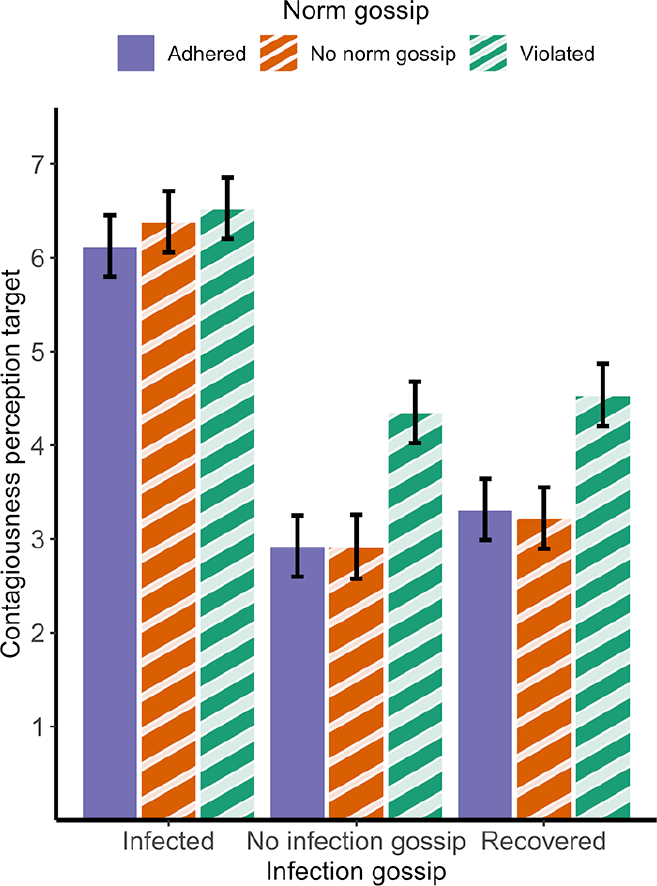
Interaction of infection gossip and norm gossip on contagiousness perceptions of the target.
Behavioral intentions towards the target of gossip
Intentions to avoid the target
First, results showed a large main effect of infection gossip, F(2, 828) = 90.05, p < .001, η2partial = .18. People intended to avoid targets described as infected significantly more than targets described as recovered (z = 8.93, p < .001, Cohen’s d = 0.75) and targets about whom no infection gossip was provided (z = 13.12, p < .001, Cohen’s d = 1.11). In addition, results showed a large significant main effect of norm gossip, F(2, 828) = 188.35, p < .001, η2partial = .31. People intended to avoid targets described as having violated norms significantly more than targets described as having adhered to norms (z = 18.22, p < .001, Cohen’s d = 1.54) and targets about whom no norm gossip was provided (z = 14.87, p < .001, Cohen’s d = 1.26).
Importantly, as predicted, results showed that these effects were qualified by a significant interaction effect, F(4, 828) = 15.65, p < .001, η2partial = .07. Supporting Hypothesis 2, planned comparisons showed that people intended to avoid targets described as infected and having violated norms (Minfected-and-violated = 5.52, SE = 0.12) significantly more than targets described with all other combinations of gossip (Mall-other-conditions = 4.07, SE = 0.04; z = 11.13, p < .001, Cohen’s d = 1.21) as well as that people intended to avoid targets described as either infected or having violated norms (Minfected-or-violated = 4.98, SE = 0.06) significantly more than targets described with all other combinations of gossip excluding infected and violated norms (Mother-conditions = 3.17, SE = 0.06; z = 20.75, p < .001, Cohen’s d = 1.52). This indicates that people derive infection risk cues from gossip and translate those into intentions to avoid the target that fit the infection risk described in gossip statements.
The interaction is depicted in Figure 2. This figure and explorative simple effects analyses 9 show that intentions to avoid the target are high when the target is described as having violated norms regardless of infection gossip. That is, norm gossip had a smaller effect when the target was described as infected, F(2, 828) = 15.75, p < .001, η2partial = .04. This effect became stronger when the target was not described as infected. That is, there was a larger effect of norm gossip when the target was described as recovered, F(2, 828) = 64.32, p < .001, η2partial = .13; or when no infection information was provided, F(2, 828) = 138.56, p < .001, η2partial = 25.
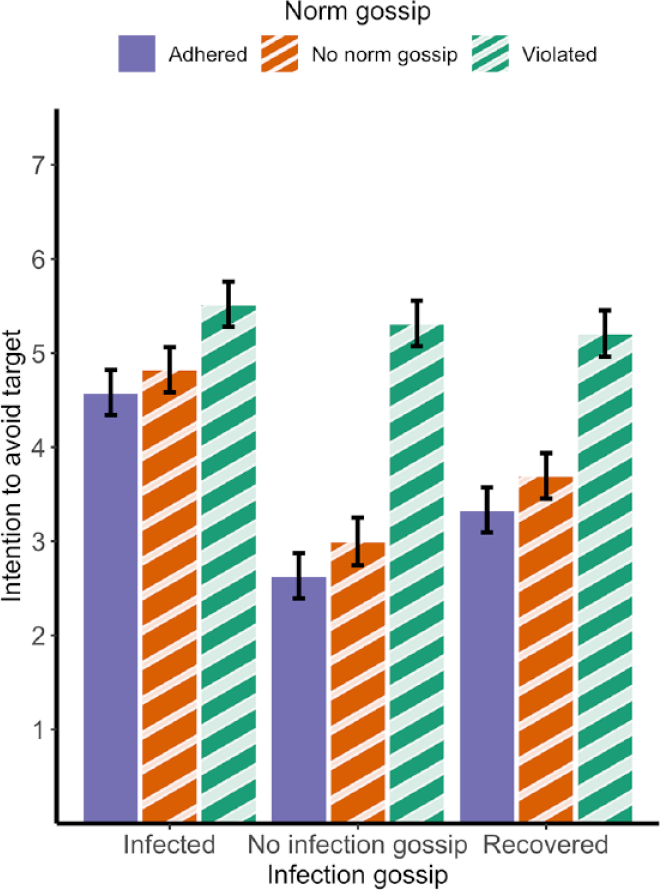
Interaction of infection gossip and norm gossip on intentions to avoid the target.
Intention to punish the target of gossip
Results showed no main effect of infection gossip, F(2, 828) = 0.41, p = .667, η2partial < .01, but a medium-sized main effect of norm gossip, F(2, 828) = 24.40, p < .001, η2partial = .06. There was no significant interaction, F(4, 828) = 0.83, p = .507, η2partial < .01. Supporting Hypothesis 3, planned comparisons showed that people intended to punish targets described as having violated norms (M = 2.25, SE = 0.07) significantly more than targets described as having adhered to norms (M = 1.63, SE = 0.07; z = 6.25, p < .001, Cohen’s d = 0.53) and targets about whom no norm gossip was provided (M = 1.67, SE = 0.07; z = 5.82, p < .001, Cohen’s d = 0.50). This indicates that people are only more likely to punish targets described as violating norms regardless of infection status. Note, however, that people seemed hesitant to punish targets of gossip as indicated by relatively low scores overall.
Person perception of the target
Results are shown in Table 2. On all perceptions, we found a significant main effect of norm gossip (large for morality, sociability, and competence; small to medium for dominance). There were no significant main effects of infection gossip nor significant interaction effects. Cohen’s d for the planned comparisons between norm violations conditions are also depicted in Table 2. Supporting Hypothesis 4, gossip receivers perceived targets described as having violated norms as less moral, sociable, and competent than targets described as having adhered to norms, and as less moral, sociable, and competent than targets about whom no norm gossip was provided. However, counter to Hypothesis 4, gossip receivers perceived targets described as having violated norms as less, not more, dominant than targets described as having adhered to norms, and as no more or less dominant than targets about whom no norm gossip was provided. This indicates that people are only more likely to negatively perceive targets described as violating norms regardless of infection status.
Summary of norm gossip and infection gossip effects on person perception.
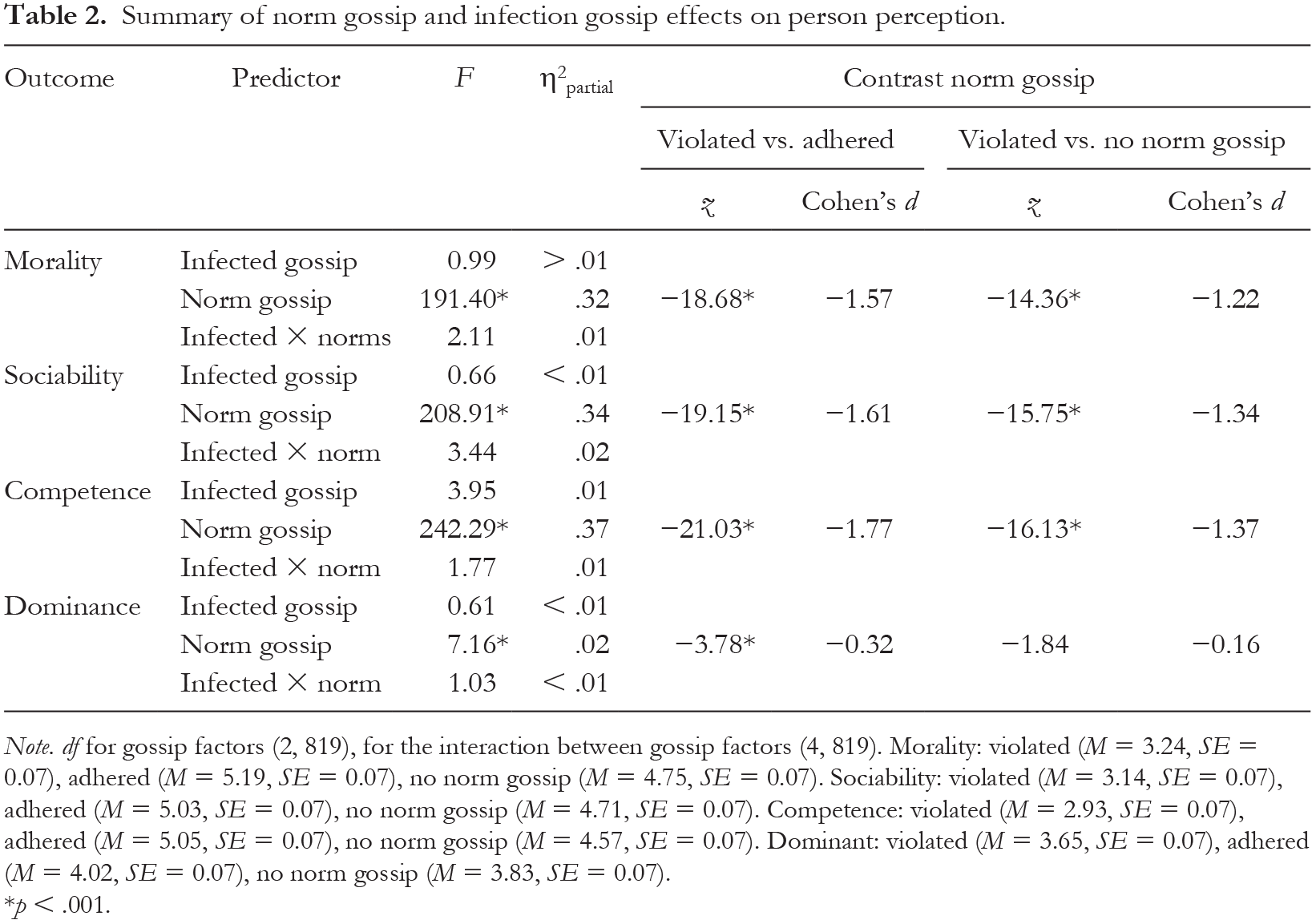
Note. df for gossip factors (2, 819), for the interaction between gossip factors (4, 819). Morality: violated (M = 3.24, SE = 0.07), adhered (M = 5.19, SE = 0.07), no norm gossip (M = 4.75, SE = 0.07). Sociability: violated (M = 3.14, SE = 0.07), adhered (M = 5.03, SE = 0.07), no norm gossip (M = 4.71, SE = 0.07). Competence: violated (M = 2.93, SE = 0.07), adhered (M = 5.05, SE = 0.07), no norm gossip (M = 4.57, SE = 0.07). Dominant: violated (M = 3.65, SE = 0.07), adhered (M = 4.02, SE = 0.07), no norm gossip (M = 3.83, SE = 0.07).
p < .001.
Perceived veracity
We explored the extent to which participants perceived the gossip they received as true. Participants largely perceived gossip to be true across conditions (M = 5.62, SD = 1.19, Median = 6, Mode = 6). Results showed no main effect of infection gossip, F(2, 828) = 1.31, p = .269, η2partial < .01; no main effect of norm gossip, F(2, 828) = 0.82, p = .439, η2partial < .01; nor a significant interaction, F(4, 828) = 0.60, p = .664, η2partial < .01. This indicates that people generally believed the gossip to be true, regardless of the gossip information they received.
Moreover, we tested whether perceived veracity moderated the effects of infection and norm gossip on behavioral intentions. For an overview of the tested models, see Table 3. (We present the effects on contagiousness perceptions of the target and person perception of the target in the online supplementary materials.)
Moderating effect of perceived veracity on contagiousness perception and behavioral intentions.
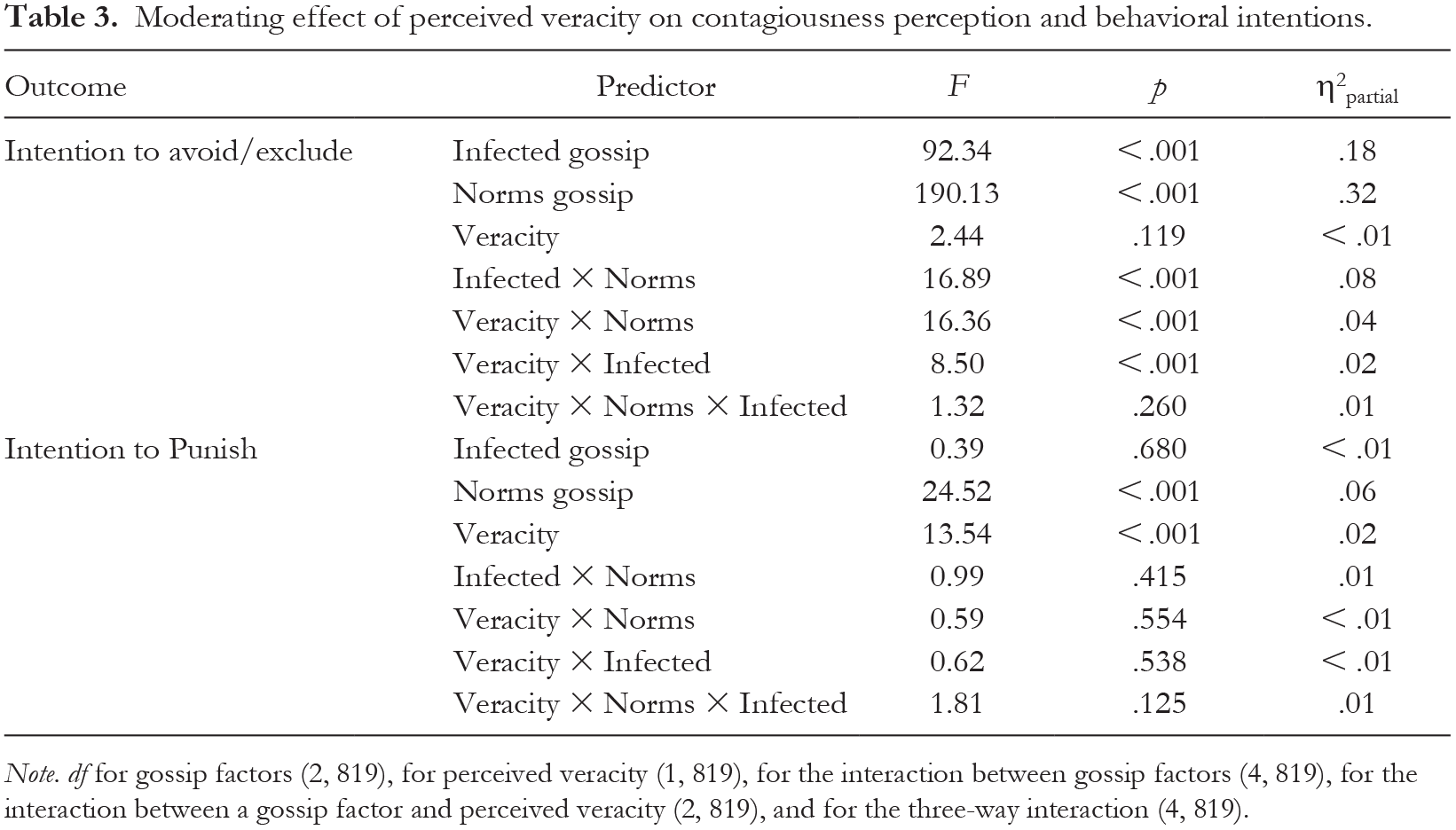
Note. df for gossip factors (2, 819), for perceived veracity (1, 819), for the interaction between gossip factors (4, 819), for the interaction between a gossip factor and perceived veracity (2, 819), and for the three-way interaction (4, 819).
First, for intentions to avoid the target, results showed significant two-way interactions between perceived veracity and both norm and infection gossip (see Figure 3). Importantly, simple effects analyses showed the effect of infection gossip on intention to avoid the target was significant for participants with relatively low perceived veracity, F(2, 819) = 32.88, p < .001, η2partial = .07; mean perceived veracity, F(2, 819) = 92.34, p < .001, η2partial = .18; and relatively high perceived veracity, F(2, 819) = 68.40, p < .001, η2partial = .14. Contrast analyses showed that receivers intended to avoid targets described as infected more than targets described as recovered when perceived veracity was high (mean +1SD; z = 9.21, p < .001, Cohen’s d = 1.10) and at the mean (z = 8.84, p < .001, Cohen’s d = 0.75), but less when low (mean −1SD; z = 3.35, p = .005, Cohen’s d = 0.40), and more than targets about whom no infection information was provided when perceived veracity was high (mean +1SD; z = 10.65, p < .001, Cohen’s d = 1.28), at the mean (z = 13.35, p < .001, Cohen’s d = 1.14), and low (mean −1SD; z = 8.06, p < .001, Cohen’s d = 1.00). This indicates that although we observe an interaction with veracity that impacts the magnitude of the effect of infection gossip, it remains significant in the expected direction. When perceived veracity of gossip is low, infection gossip still influences intentions to avoid targets.
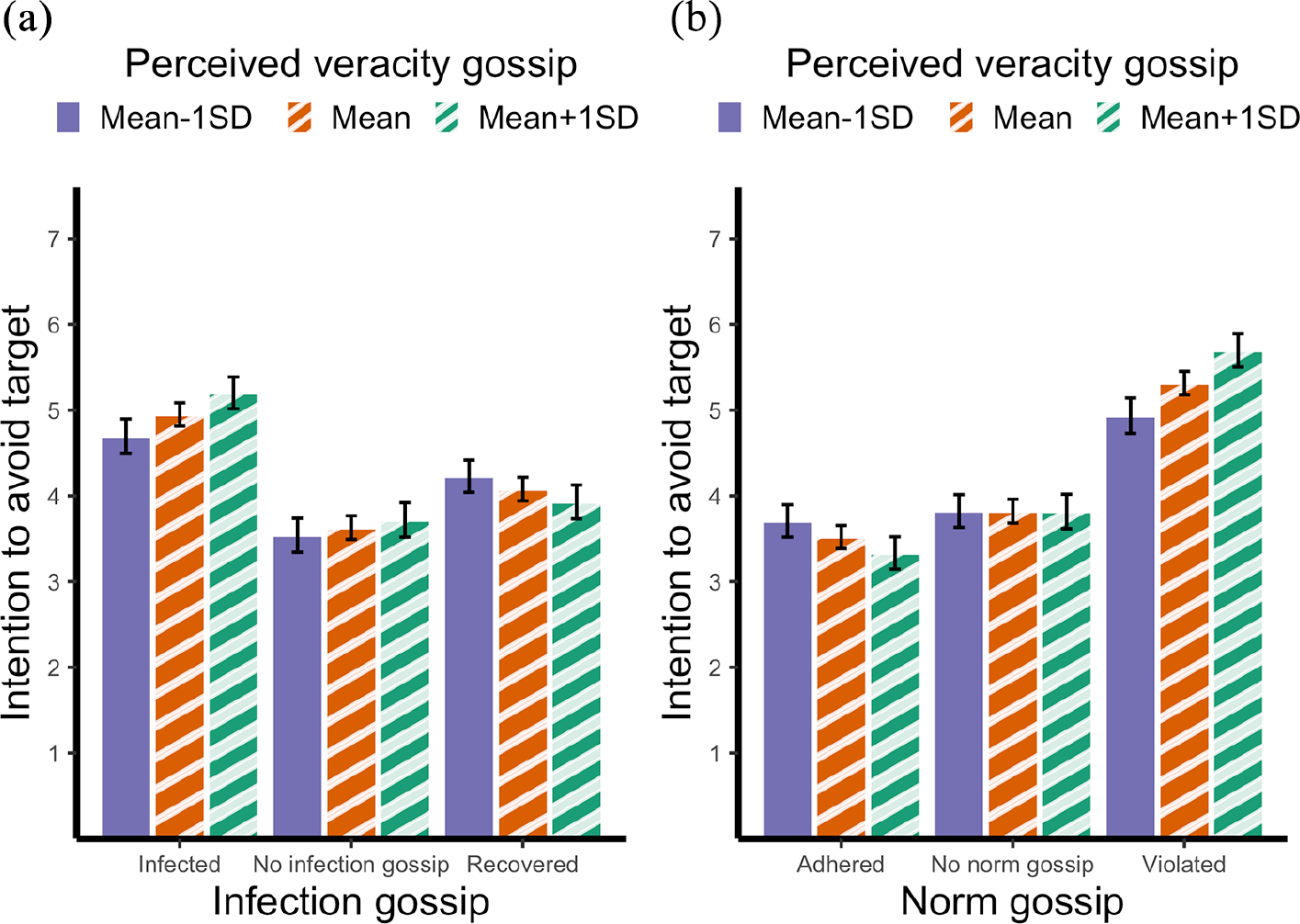
Interaction of veracity and (a) infection gossip and (b) norm gossip on behavioral intentions to avoid the target.
Likewise, simple effects analyses showed that norm gossip had a significant effect for participants with relatively low perceived veracity, F(2, 819) = 43.82, p < .001, η2partial = .10; mean perceived veracity, F(2, 819) = 190.13, p < .001, η2partial = .32; and relatively high perceived veracity, F(2, 819) = 160.96, p < .001, η2partial = .28. Contrast analyses showed that receivers intended to avoid targets described as having violated norms more than targets described as having adhered to norms when perceived veracity was high (mean +1SD; z = 17.12, p < .001, Cohen’s d = 2.03), at the mean (z = 18.27, p < .001, Cohen’s d = 1.55), and low (mean −1SD; z = 8.62, p < .001, Cohen’s d = 1.06), and more than targets about whom no norm information was provided when perceived veracity was high (mean +1SD; z = 13.17, p < .001, Cohen’s d = 1.62), at the mean (z = 15.04, p < .001, Cohen’s d = 1.29), and low (mean −1SD; z = 7.76, p < .001, Cohen’s d = 0.96). This indicates that although we observe an interaction with veracity that impacts the magnitude of the effect of norm gossip, it remains significant in the expected direction. When perceived veracity of gossip is low, norm gossip still influences intentions to avoid targets.
Together, these findings do not only show that gossip receivers tend to believe gossip regardless of the content, but also that even if people are relatively more skeptical about the veracity of the gossip information, they still base their behavioral responses towards the target on the information received via gossip.
Second, for intentions to punish the target, there was a main effect of veracity but no significant interactions. This main effect showed that people who perceived gossip as more true were less willing to punish the target, b(se) = −0.12(0.03), t(819) = 3.68, p < .001. It seems that people who believe gossip are less intent to act on gossip with direct, potentially costly punishment. A potential explanation could be that while information describing high infection risk (i.e., being infected and having violated norms) increases punishment intentions when believed more, gossip describing low infection risk (adhering to norms, having recovered, or no information) decreases punishment when believed more. Averaging over conditions reveals only this negative effect (see the online supplementary materials).
Discussion
The current study set out to investigate the social consequences of information related to Coronavirus infection risk that is received through gossip. We investigated responses to gossip received from a member of one’s social group that contained cues about the infection risk posed by another group member. That is, the gossip provided information about whether the target group member was infected with the Coronavirus and/or adhered to social distancing norms. We found that, overall, gossip receivers responded strongly to gossip that carried cues to the risk of infection in our hypothetical scenarios, despite the possibility that gossip information is inaccurate.
In line with our expectations, gossip receivers perceived targets as most contagious and wanted to avoid them most when they were described as having violated norms and as being infected with the Coronavirus, followed by targets described as having violated norms or being infected with the Coronavirus. Infection information seemed especially relevant to contagiousness perceptions as targets described as infected were seen as highly contagious regardless of how they were described in terms of norm adherence.
In contrast, gossip about targets’ norm adherence information seemed especially relevant for receivers’ behavioral intentions, as receivers were shown to be strongly intent on avoiding targets who were described as having violated norms, regardless of their described infection status. Further supporting the latter, and as expected, gossip receivers perceived targets described as having violated norms negatively on essential person perception dimensions (low in morality, sociability, competence, and unexpectedly dominance; Abele et al., 2016; Fiske et al., 2007; Pinto et al., 2010). A potential reason for these norm violations decreasing dominance could be that such violations are mostly perceived as harmful for others as opposed to providing benefits, the latter is found essential for status and power affordances (Durkee et al., 2020; Van Kleef et al., 2012). Extending to behavioral intentions, people were more intent on punishing targets described as having violated norms. Punishment intentions were unrelated to the target’s described infection status, which fits the idea that infection is not morally reprehensible in itself, but norm violation is (e.g., Van Kleef et al., 2015).
However, it is important to note intentions to punish were generally low. This could indicate that, while people do react strongly to violations of the novel norms to slow the spread of the Coronavirus in terms of contagiousness perceptions, general person perception, and intentions to avoid targets of gossip, engaging in punishment of others about whom one has learned through gossip that they are violating norms, is a step too far. This could reflect the stronger tendency for people in everyday life to be unwilling to engage in direct punishment of peers, as this could be confrontational and/or costly. Instead of direct punishment, people have been shown, rather, to engage in indirect strategies, such as harming the norm offenders’ reputation and avoiding interactions, or entrusting institutions to intervene (Guala, 2012; Molho et al., 2020). Moreover, in the context of our study (preventing Coronavirus infection), it is possible that indirect strategies that do not involve contact with the offender are better suited to avoiding risks of infection, and that punishment of targets, therefore, was found to be relatively undesirable.
Whereas gossip could thus be informative for infection risk perceptions and associated with behavioral intentions that could help people reduce infection risk, it is important to note here that information received via gossip can be false (Fonseca & Peters, 2018; Peters & Fonseca, 2020). We exploratively examined perceived gossip veracity and found that gossip receivers largely perceived gossip as true, regardless of the information it contained. Thus, our data provide little evidence that people show skepticism towards information received via gossip. While individuals who were somewhat skeptical (i.e., perceived gossip as less true) showed weaker responses to targets of gossip, the patterns of findings we observed were consistent with our hypotheses even for these more skeptical gossip receivers. So even when the perceived veracity of gossip information was low, receivers still responded to the infection cues gossip contains: receivers still perceived targets described as posing greater infection risk as contagious and low in morality, sociability, competence, and dominance and indicated stronger intentions to avoid and punish targets described as posing a greater infection risk.
Contributions and implications of the current findings
Supporting theories on the human behavioral immune system (e.g., Miller & Maner, 2012; Schaller & Park, 2011; van Leeuwen & Petersen, 2018), our findings signal that people are potentially highly attuned to cues that signal risk of infection with the Coronavirus. People in our hypothetical scenarios had strong negative reactions to group members who could potentially infect them. This highlights the psychological impact of the Coronavirus in terms of the fear of infection and associated risks (Conway III et al., 2020; Goyal et al., 2020; Mertens et al., 2020; Ren et al., 2020; C. Wang et al., 2020). People could perceive cues to the risk of infection with the Coronavirus not only in direct information about infection but could also recognize that group members’ behaviors could increase infection risk. In the current pandemic, those who violate norms intended to slow the spread of the virus are indeed likely to pose a stronger infection risk (CDC, 2020; L. Wang et al., 2020). In sum, our findings indicate that people could perceive infection risks tied to behavior, potentially even when only relayed through gossip, and could attach social consequences that – arguably – match the posed risks to this.
Another implication of our findings is that information regarding infection cues can not only be obtained by actively observing group members, but could potentially also be obtained through gossip (cf. Dunbar, 2004). Our results indicate that gossip related to the Coronavirus (i.e., targets being either infected with the virus or having violated relevant social norms) might be very consequential for its targets: they could be perceived negatively and could even suffer social exclusion and punishment. This resonates with research on the stigmatization of infectious disease patients, which could indicate that the social exclusion that for example HIV patients experience is motivated by the avoidance of infection risks (Smith et al., 1999; Stadler, 2003; van Leeuwen & Petersen, 2018).
A third implication of our findings is that the social norms that follow from measures to prevent the spread of Coronavirus seem to be very salient to people and that violations of these norms can evoke strong responses. This is in line with literature on more established social norms, such as contributing to public goods (e.g., taxes and other forms of cooperation) and behaving politely (e.g., not littering or respecting others), and could indicate these novel norms are becoming established (Balafoutas & Nikiforakis, 2012; Baumeister et al., 2004; Beersma & Van Kleef, 2012; Bernhard et al., 2006; Dores Cruz et al., 2019; Dores Cruz, Thielmann, et al., 2020; Eriksson et al., 2017; Fehr & Fischbacher, 2004; Feinberg et al., 2014; Peters et al., 2017; Van Kleef et al., 2011). On the other hand, these results are somewhat surprising in terms of the severity of the behavioral responses people indicated. There seems to be no general consensus, but rather debate and even skepticism about the exact social norms that are needed to contain the spread of the Coronavirus (e.g., social distancing guidelines and the strictness with which norms are imposed vary from country to country, anti-lockdown protests are occurring frequently; Dyer, 2020; Fetzer et al., 2020; Georgiou et al., 2020; Nature, 2017; Reuters, 2020). Our results, nonetheless, show that the participants in our sample relied heavily on (potentially false) gossip information about the extent to which others adhere to these novel social norms and that this had a strong impact on their perceptions and intentions for behavior.
These potential behavioral responses could have major consequences for gossip targets, as gossip receivers in our hypothetical scenarios reported to be willing to avoid, exclude, and punish group members if they ostensibly did not adhere to the novel social distancing norms (interestingly, this was regardless of whether targets were depicted as being infected with the Coronavirus or not). It is possible that the strong influence of norm violations could arise from both a fear of infection as well as a general negative reaction to norm violators (Dores Cruz, Thielmann, et al., 2020; Eriksson et al., 2017; Leask et al., 2006; Thornhill & Fincher, 2014; van Leeuwen & Petersen, 2018). In terms of the current crisis, the potentially strong impact of gossip information about Coronavirus-related norm violations could feed into the concerns of scholars warning of a loneliness pandemic (Banerjee & Rai, 2020; Holt-Lunstad et al., 2015; C. Wang et al., 2020; Xiang et al., 2020).
Finally, our findings could indicate that people might readily base their judgment of others in their social network on gossip that is potentially unreliable when it communicates information that is relevant to avoiding infection with the Coronavirus. Gossip receivers in our hypothetical scenarios were generally likely to believe the gossip information they received and even for receivers being relatively skeptical about the veracity of the gossip (i.e., perceiving it as less true), gossip affected behavioral intentions towards targets. This is especially interesting in light of studies that show that people can be very skeptical toward official information, albeit for various reasons (Ditto et al., 2003; Pittinsky, 2015; Rutjens, Heine, et al., 2018; Rutjens, Sutton, & van der Lee, 2018). We found no indication of such skepticism in our study, in which participants received information from “a friend who told them”. This potentially points to the power that gossip could have to spread (fake) news through a network that might impact group processes (Altay et al., 2020; Baum et al., 2018; Dunbar, 2004; Ellwardt, 2019; Fine & Rosnow, 1978; Hannerz, 1967; Hess & Hagen, 2006; McAndrew & Milenkovic, 2002).
Limitations and future research directions
First, a limitation of the current study is that participants received gossip in hypothetical scenarios. Rather than measure actual behavior, we measured how participants indicated they would behave towards a fictive, unknown target of the gossip. The use of experimental scenarios is common in the gossip literature because it allows a high degree of experimental control, places the gossip in an ecologically valid setting, and avoids the ethical concerns which spreading real gossip and associated behavior would entail (Dores Cruz et al., 2019; Hauke & Abele, 2020). Nonetheless, generalizing beyond the scenario and to real behavior should be done cautiously. Previous literature indicates that behavioral intentions do not always match actual behavior (e.g., Ajzen et al., 2004; Sheeran & Webb, 2016). It is therefore possible that intentions reported in our hypothetical scenarios do not translate completely to behavior in the current Coronavirus crisis. Future research could test this further in, for example, studies using confederates, experimental games, or by observing everyday gossip and its behavioral consequences (see, e.g., Dores Cruz, Thielmann, et al., 2020; Feinberg et al., 2014; Feinberg et al., 2012; Molho et al., 2020; Peters et al., 2017). In the current pandemic, where information on others’ infection status is valuable but hard to obtain, going beyond the lab to observe how information flows through different, potentially more noisy sources (e.g., infection cues could be less clear than in the manipulated content in our study), is worthwhile. This could provide valuable insight into how and if such information impacts behavior in groups that can alleviate or exacerbate the current crisis.
Second, it could be argued that the fact that in our study, gossip was ostensibly communicated to participants by a friend could have lowered skepticism towards the information. If, for example, an outgroup member had communicated the information, this could have increased skepticism among receivers (e.g., Hornsey & Esposo, 2009). However, gossip from outgroup members about others in one’s group or social network is rare (Dores Cruz, Thielmann, et al., 2020; Grosser et al., 2010; McAndrew et al., 2007). Moreover, in the current pandemic, it could also be seen as containing less diagnostic information about infection risk as most infections happen in close contact (CDC, 2020; L. Wang et al., 2020). Nevertheless, future studies could explore to what extent the relationship between the gossip sender and receiver moderates the impact of gossip.
Third, in our study, we did not compare the effects of gossip information and information from more official sources, but rather only studied gossip as a source of information. While information about specific individuals is most likely spread through social groups via more informal channels such as gossip (Dores Cruz, Nieper, et al., 2020; Dunbar, 2004; Hannerz, 1967), in some cases, information pertaining to infection risk can be communicated through more objective sources. Contact tracing apps are becoming more common across countries and could provide official information on the infection status of people one encounters, which often are group members (European Commission, 2020; Zastrow, 2020). Whereas our findings show the impact of gossip information, we cannot compare this impact to the impact information from other sources might have. To better understand the role of different information sources in the current pandemic, future research could examine whether gossip has more or less impact on behavioral responses and target perceptions than other types of information, as well as examine differences in skepticism towards different types of information (e.g., the official information described above or information acquired through direct observation of infection cues, see, e.g., Schaller & Park, 2011).
Finally, to efficiently manage group processes in the pandemic, future studies could explore how groups, and societies at large, can profit from the benefits of gossip while mitigating negative consequences. This could be achieved by making people aware of the fact that the information received through unofficial sources, such as gossip from group members, may be wrong and thus promote “skepticism strategies” that enable veracity checks. These checks could consist of combining the information received from multiple gossip sources and considering the relationship between senders, receivers, and targets that could be associated with gossip senders’ motives (Dores Cruz, Thielmann, et al., 2020; Hess & Hagen, 2006; Laidre et al., 2013; Sommerfeld et al., 2008).
Conclusion
All in all, our findings point to the possibility that people use gossip to estimate infection risk and that they could do this in ways that reflect threats as described in the information that is available to them. Their perceptions of individuals depicted in gossip as posing an infection risk are affected by gossip, as are their behavioral intentions towards gossip targets. This means gossip could be a positive force in the current crisis; people could harness gossip as part of the behavioral immune system to avoid infection risks posed by other group members. However, estimates of infection risk and associated social responses may be flawed if the information gossip contains is inaccurate. Despite this, skepticism towards gossip seems low and of little impact on social responses. The uncritical stance that participants in our study displayed toward information received from gossip, combined with the strong behavioral responses based on it, could have detrimental and unjustified consequences for targets. Thus, gossip could both play a part in alleviating the current crisis by contributing to slowing the spread of the virus as well as potentially exacerbate the current crisis through increased social isolation of group members based on unverified information. In other words, gossip might be a sharp sword, but it needs to be wielded with care.
Supplemental Material
sj-pdf-1-gpi-10.1177_1368430221991232 – Supplemental material for Gossip about Coronavirus: Infection status and norm adherence shape social responses
Supplemental material, sj-pdf-1-gpi-10.1177_1368430221991232 for Gossip about Coronavirus: Infection status and norm adherence shape social responses by Terence D. Dores Cruz, Romy van der Lee and Bianca Beersma in Group Processes & Intergroup Relations
Footnotes
Funding
The authors disclosed receipt of the following financial support for the research, authorship, and/or publication of this article: All authors acknowledge funding from an ERC Consolidator Grant (#771391) awarded to Bianca Beersma. Terence D. Dores Cruz additionally gratefully acknowledges funding from the Graduate School of Social Sciences at the Vrije Universiteit Amsterdam.

Data availability statement
Supplemental material
Supplemental material for this article is available online.
Notes
References
Supplementary Material
Please find the following supplemental material available below.
For Open Access articles published under a Creative Commons License, all supplemental material carries the same license as the article it is associated with.
For non-Open Access articles published, all supplemental material carries a non-exclusive license, and permission requests for re-use of supplemental material or any part of supplemental material shall be sent directly to the copyright owner as specified in the copyright notice associated with the article.
