




Abstract
Social identity exploration is a process whereby individuals actively seek information about their group membership and show efforts to understand its meaning. Developmental theory argues that exploration-based ingroup commitment is the basis for outgroup positivity. We tested this notion in relation to national identity and attitudes towards immigrants. The results of five experimental studies among German adolescents and early adults (N = 1,146; 16–25 years) and one internal meta-analysis suggest that the positive identification–prejudice link is weaker when participants are instructed to explore the meaning of their identity (Study 1). This is not mediated via self-uncertainty (Study 2), but via a reduction in intergroup threat (Study 3) and an increase in deprovincialization (Study 4). In addition, identity exploration enabled strong identifiers to oppose descriptive ingroup norms (Study 5). We conclude that identity exploration can contribute to a further understanding of the identification–prejudice link.
Keywords
National identification refers to a person’s attachment and sense of belonging to a national group. Strong national identification is linked to political trust, support of welfare state policies, and subjective well-being (Berg & Hjerm, 2010; Hjerm & Schnabel, 2012; McLaren, 2017; Reeskens & Wright, 2011), but also to negative attitudes towards ethnic minority groups and immigrants (J. S. Jackson et al., 2001; Luedtke, 2005; Pettigrew et al., 2007). However, in some cases, there is no link between national identification and outgroup negativity, and there have even been cases in which stronger national identification has been associated with outgroup positivity (Citrin et al., 2012; J. S. Jackson et al., 2001; Smeekes et al., 2011). These divergent findings can be explained by different contents and roots of ingroup identification. For example, national identification can take the form of national glorification and blind patriotism with the related outgroup negativity, or can consist of national attachment and constructive patriotism that is not associated with outgroup negativity (e.g., Blank & Schmidt, 2003; de Figueiredo & Elkins, 2003; Kosterman & Feshbach, 1989; Wagner et al., 2012). National identification can further originate from frustrated needs with the related defensiveness and collective narcissism, or rather be based on need satisfaction with a confidently held positive evaluation of one’s national group membership (Golec de Zavala et al., 2013; Hamer et al., 2018; Jordan et al., 2005).
In addition to this research on the importance of the specific content of national identity and the motivational roots of national attachment, it is possible to consider the process by which individuals explore, form, and maintain their national identity. Following Marcia’s (1966) adaptation of Erikson’s (1968) theory of psychosocial development, developmental research has focused on exploration and commitment as two processes for understanding the formation of ethnic, racial, and national identities (Umaña-Taylor et al., 2014). Developmental models argue that strong ingroup identification encourages positive intergroup attitudes, subject to ingroup identification being based on identity exploration, a process whereby individuals actively seek and incorporate information about their group membership and show efforts to understand its meaning (Marcia, 1966; Phinney et al., 1997). An abundance of developmental research has examined the beneficial effects of identity exploration for well-being, sociocultural adjustment, and health (Rivas-Drake et al., 2014), but the part of the theory that predicts more positive intergroup relations is underresearched (for exceptions, see Phinney et al., 2007; Spiegler et al., 2016; Whitehead et al., 2009). Moreover, little is known about the underlying mechanisms and circumstances in which identity exploration contributes to more positive intergroup attitudes.
Based on identity developmental theory, we experimentally examined the predictions that identity exploration moderates the positive identification–prejudice link (Study 1); that lower self-uncertainty (Study 2), reduced intergroup threat (Study 3), and stronger deprovincialization (Study 4) mediate this effect; and that identity exploration enables strong identifiers to oppose negative ingroup norms (Study 5). We conducted our research among ethnic Germans who reported on their national identification and attitudes toward immigrants. Germany is an interesting national context for our research questions as the identification–prejudice link is especially strong in Germany compared to other European countries (Pehrson et al., 2009; Pettigrew et al., 2007). Furthermore, we focused on 16- to 25-year-old adolescents and emerging adults, as national identity development takes place during high school and the college years (Barrett, 2007; Phinney & Ong, 2007).
A Developmental Perspective on Ingroup Identity and Outgroup Attitudes
In his classic book on The Nature of Prejudice, Allport (1954) argued that positive ingroup attachment is beneficial for outgroup tolerance. A secure sense of ingroup belonging can form the psychological basis for an open attitude toward others. Developmental approaches suggest that this secure sense of self is the result of an exploration process whereby individuals try to understand how their group membership impacts their life and establish a clear sense of ingroup belonging and commitment based on that understanding (Marcia, 1966; Phinney et al., 1997). Identity exploration typically involves seeking information and experiences that are relevant to one’s group membership via a range of activities such as reading, thinking, and talking about the customs, traditions, and culture of the ingroup (Syed et al., 2013). Individuals can also identify strongly with their ingroup without identity exploration but, in that case, they have no in-depth knowledge about the meaning of their group membership and how it affects their decisions and life chances.
Today there is hardly any evidence for the hypothesis that exploration-based ingroup commitments allow individuals to be more open towards others. In one study, Latino and Asian American adolescents were found to have more positive attitudes toward ethnic outgroups when they had high ethnic ingroup commitment and identity exploration, whereas those with high commitment and low identity exploration had more negative outgroup attitudes (Phinney et al., 2007). Another study showed that ethnic identity exploration promotes positive outgroup attitudes among Latino, Asian, and European American adolescents via a secure attachment to one’s ethnic identity (Whitehead et al., 2009). Finally, Turkish-German ethnic minority adolescents showed less ingroup bias when they identified strongly as Turkish and identity exploration was high, but showed more ingroup bias when they identified strongly and identity exploration was low (Spiegler et al., 2016). Our first prediction examined in Study 1 is that identity exploration weakens the identification–prejudice link (see Figure 1a).
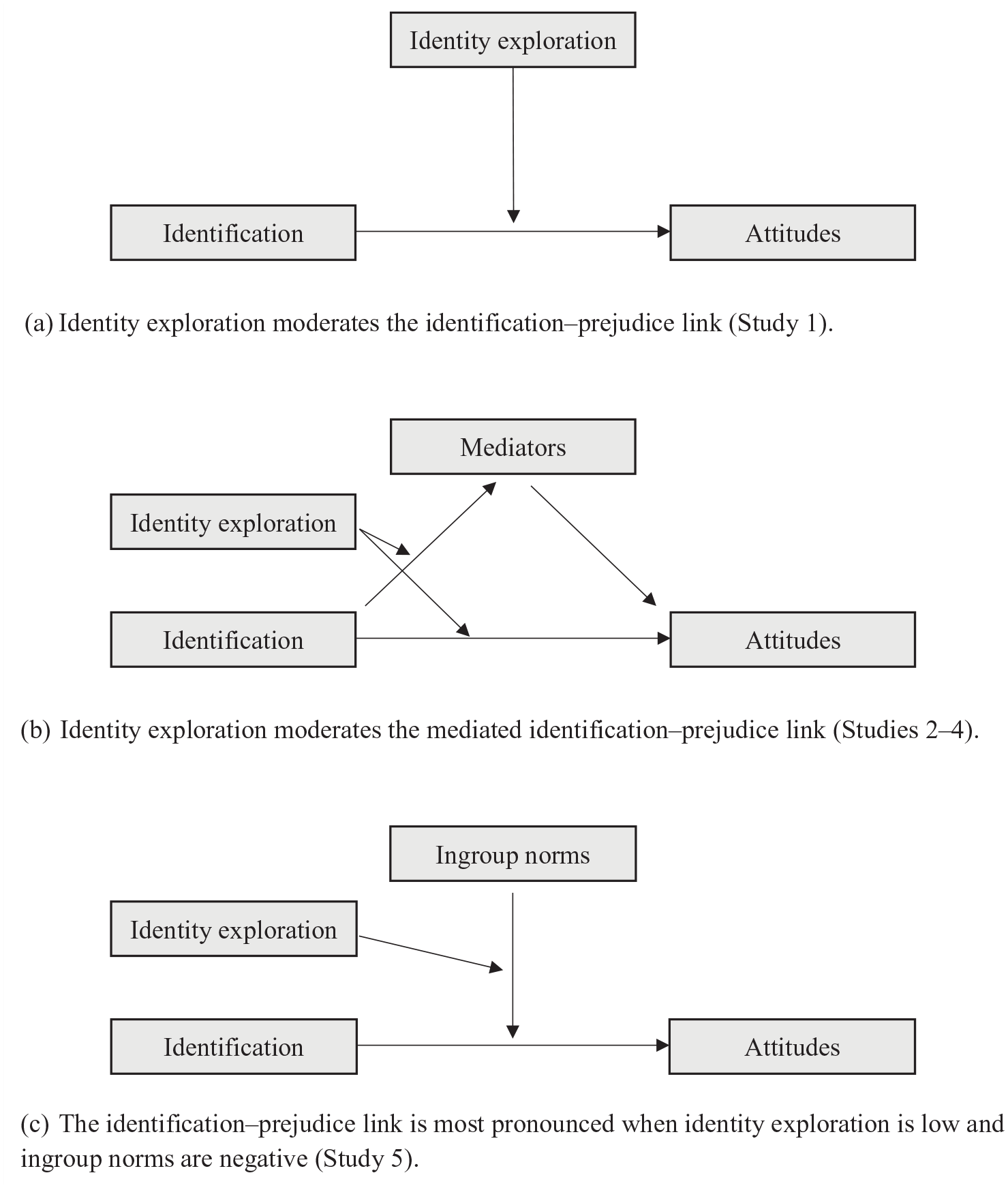
Overview of studies and conceptual models.
Self-Uncertainty, Outgroup Threat, and Deprovincialization
Exploration-based ingroup commitment is argued to result in a more secure and achieved identity, with the related feelings of self-certainty, higher resilience to intergroup threats, and lower glorification of the ingroup (Cichocka, 2016; Marcia, 1966; Phinney et al., 2007). In turn, these three aspects should result in more positive outgroup attitudes.
Self-uncertainty is a psychological state that involves feeling uncertain about oneself, one’s life, and one’s future (De Cremer & Sedikides, 2005). People high in self-uncertainty tend to strengthen their ingroup identification to reduce self-uncertainty (for a meta-analysis, see Choi & Hogg, 2020). Therefore, strong identifiers are likely to experience less self-uncertainty than weak identifiers. Lower self-uncertainty, in turn, decreases discrimination (Grieve & Hogg, 1999), compensatory conviction (McGregor & Marigold, 2003), extremist beliefs (Hogg & Adelman, 2013), and negative reactions towards others (Sekerdej et al., 2018; van den Bos, 2009). This indicates that identification has a positive indirect effect on outgroup attitudes via reduced self-uncertainty. Developmental work adds to this by arguing that strong identifiers with high levels of identity exploration experience less self-uncertainty than strong identifiers with low identity exploration, because exploration contributes to a more secure, stable, and achieved ingroup identity (Marcia, 1966; Phinney et al., 2007).
An explored ingroup identity does not only imply a secure sense of the self and one’s group, but also a lower vigilance to intergroup threats and the related concerns about the collective well-being of one’s group (Cichocka, 2016). Strong group identifiers with high identity exploration should therefore be less anxious and less affected by social and cultural changes than strong identifiers who lack a solid understanding of their group membership (Marcia, 1966; Phinney et al., 2007). This is supported by research on “insecure” and “secure” identities (J. W. Jackson & Smith, 1999) that are both characterized by strong ingroup attachments. However, individuals with an “insecure” identity are more likely to experience dependency, a lack of control, and intergroup competition, which makes them more susceptible to forms of outgroup threat. In contrast, individuals with a more “secure” identity feel more independent, experience more control, and perceive intergroup relations as less competitive.
Furthermore, identity exploration can be expected to promote a less grandiose or more nuanced perspective on the national ingroup. The notion of deprovincialization has been put forward in social psychology and does not imply ingroup distancing (lower ingroup identification) but signifies a constructive reappraisal of the national ingroup (Pettigrew, 1997). It concerns a less parochial worldview whereby ingroup traditions, norms, and values are not considered to be the only way to deal with the social world. Like cultural humility (Hook et al., 2013) and intellectual humility (Hook et al., 2017), deprovincialization implies an openness to see things in a less ingroup-centric way. Identity exploration is expected to encourage individuals to have a more critical and constructive orientation to their ingroup by putting their own cultural standards into perspective. Prior research has shown, for example, that identity exploration is linked to more mature intercultural thinking and an increased awareness of the complexity of ethnic differences (Phinney et al., 2007). Thus, exploration is likely to promote a reappraisal of ingroup norms and standards (higher deprovincialization), resulting in higher outgroup tolerance (Martinovic & Verkuyten, 2013).
The Role of Ingroup Norms
Norms are commonly understood as the unwritten rules shared within a social group (Legros & Cislaghi, 2020), whereby injunctive norms refer to what is considered (un)acceptable behaviour (what ought to be) and descriptive norms to what most group members actually do (what is). People tend to think and behave in terms of ingroup norms when they identify as ingroup members (Turner et al., 1987). In the case of prodiversity norms, people have more positive attitudes towards immigrants (Hjerm, 1998; Smeekes et al., 2011; Wright et al., 2012), whereas antidiversity norms make outgroup negativity more acceptable and likely (Christ et al., 2014; Crandall et al., 2002; De Tezanos-Pinto et al., 2010; Sechrist & Stangor, 2001), especially among strong identifiers (Nickerson & Louis, 2008). Moreover, strong identifiers with low identity exploration are more rigid and rule obedient, which makes them more likely to comply with the norms and expectations of the ingroup (Rahimi & Strube, 2007; Soenens et al., 2005). However, strong identifiers with high identity exploration might oppose negative ingroup norms, as exploration encourages independent thinking and decision-making (Marcia, 1966). Thus, identity exploration is likely to promote resilience to negative ingroup norms that otherwise would make the link between national identification and negative attitudes toward immigrants stronger.
Overview and Hypotheses
We conducted five experimental studies to investigate whether, how, and when identity exploration attenuates the positive association between national identification and negative attitudes towards immigrants. In Study 1, we examined if identity exploration moderates the national identification–prejudice link (Figure 1a), and we expected this link to be weaker among participants with high identity exploration. In Studies 2 to 4, we focused on how identity exploration affects self-uncertainty (Study 2), outgroup threat (Study 3), and deprovincialization (Study 4) as three possible mechanisms underlying the identification–prejudice link. In each of these studies we tested a moderated mediation model (Figure 1b). In Study 2, we hypothesized that identification leads to lower self-uncertainty when identity exploration is high. Low uncertainty, in turn, was expected to be associated with more positive attitudes towards immigrants. In Study 3, we expected strong national identifiers with high identity exploration to be less threatened by immigrants than strong identifiers with low identity exploration, which, in turn, would be associated with more outgroup positivity. In Study 4, we tested if exploration unfolds its beneficial effects on outgroup attitudes by increasing deprovincialization. Finally, we investigated in Study 5 whether strong identifiers with high identity exploration are more likely to resist negative descriptive ingroup norms than strong identifiers with low identity exploration (Figure 1c).
Study 1
We first examined whether experimentally induced identity exploration moderates the link between national identification and attitudes towards immigrants. We asked participants to describe an experience in which they learned something about their German identity or that helped them understand what being German means. As this manipulation does not only involve exploration but also thinking about one’s ingroup, we further aimed to demonstrate that exploration, rather than ingroup membership salience, alters the identification–prejudice link. To do so, we added a third experimental condition in which ingroup membership, but not identity exploration, was made salient. Finally, we investigated whether identity exploration promotes ingroup distancing, by reassessing ingroup identification at the end of the study. This allowed us to examine the possibility that exploration affects identification rather than having an impact on the identification–prejudice link.
Methods
Power analysis
Power analyses were conducted in G*Power (Faul et al., 2007). A minimum of 196 participants was required to have an 80% probability to observe a small to medium interaction effect (f2 = .05, numerator df = 2) at a significance criterion of .05. The data were collected by students for a course, and the time frame was restricted to 4 weeks.
Sample and procedure
The sample included 174 Germans (21.3% male; Mage = 21.93 years, SDage = 2.18, range: 16–25). 1 Of the participants, 4% went to school, 16% had lower secondary education, 60.9% had a higher secondary degree, and 19% had a university degree. The study was conducted online, advertised via social media, and participants were asked to further distribute the link to the study.
Design
The experiment had a two-factor, between-subjects, random design with national identification (measured as a continuous variable) and identity exploration manipulated (exploration vs. salient group membership vs. control). Participants were randomly assigned to one of the three experimental conditions. At the end of the study, participants were debriefed and provided with contact information.
Measures and manipulation
If not stated otherwise, participants were asked to indicate their agreement with items on a 5-point scale (1 = totally disagree, 5 = totally agree). The description of the measures reflects the order of assessment. A list of the scales and items we used across the studies is available online (see Appendix A in the supplemental material).
Identification with Germans
National identification was measured with seven items (Phinney, 1992; Phinney & Ong, 2007); for example, “I have a strong sense of belonging to Germans” (α = .90).
Experimental manipulation
Participants in the exploration condition were asked to describe a past experience in which they learned something about their German identity or an experience that helped them understand their German identity. Participants in the salient group membership condition were asked to describe a past experience in which they were aware of their German identity. To maintain the focus on the self and the past, we asked participants in the control group to describe a typical morning when they have been in school (see Appendix B in the supplemental material). As manipulation checks, we assessed identity exploration at the end of the study with five items (e.g., “I have often talked to other people to learn more about Germans”; Phinney, 1992; Phinney & Ong, 2007; α = .77). In addition, we asked two research assistants, blind to our research question, to rate the essays of participants in the exploration and salient group membership conditions on an 8-point Likert-type scale (1 = exploration very low, 8 = exploration very high; see Appendix C in the supplemental material). The research assistants were consistent in their ratings (r = .67, p < .001), so we combined their scores to calculate participants’ level of other-rated identity exploration.
Attitudes toward immigrants
Attitudes toward immigrants were measured with a feeling thermometer that ranged from 1 to 100, with higher values indicating more positive attitudes.
Identification with Germans (posttest)
We reassessed identification with Germans at the end of the study with the three items from the Commitment Subscale of the Multigroup Ethnic Identity Measure-Revised (MEIM-R; Phinney & Ong, 2007). Cronbach’s alpha was α = .82.
Results
Manipulation checks
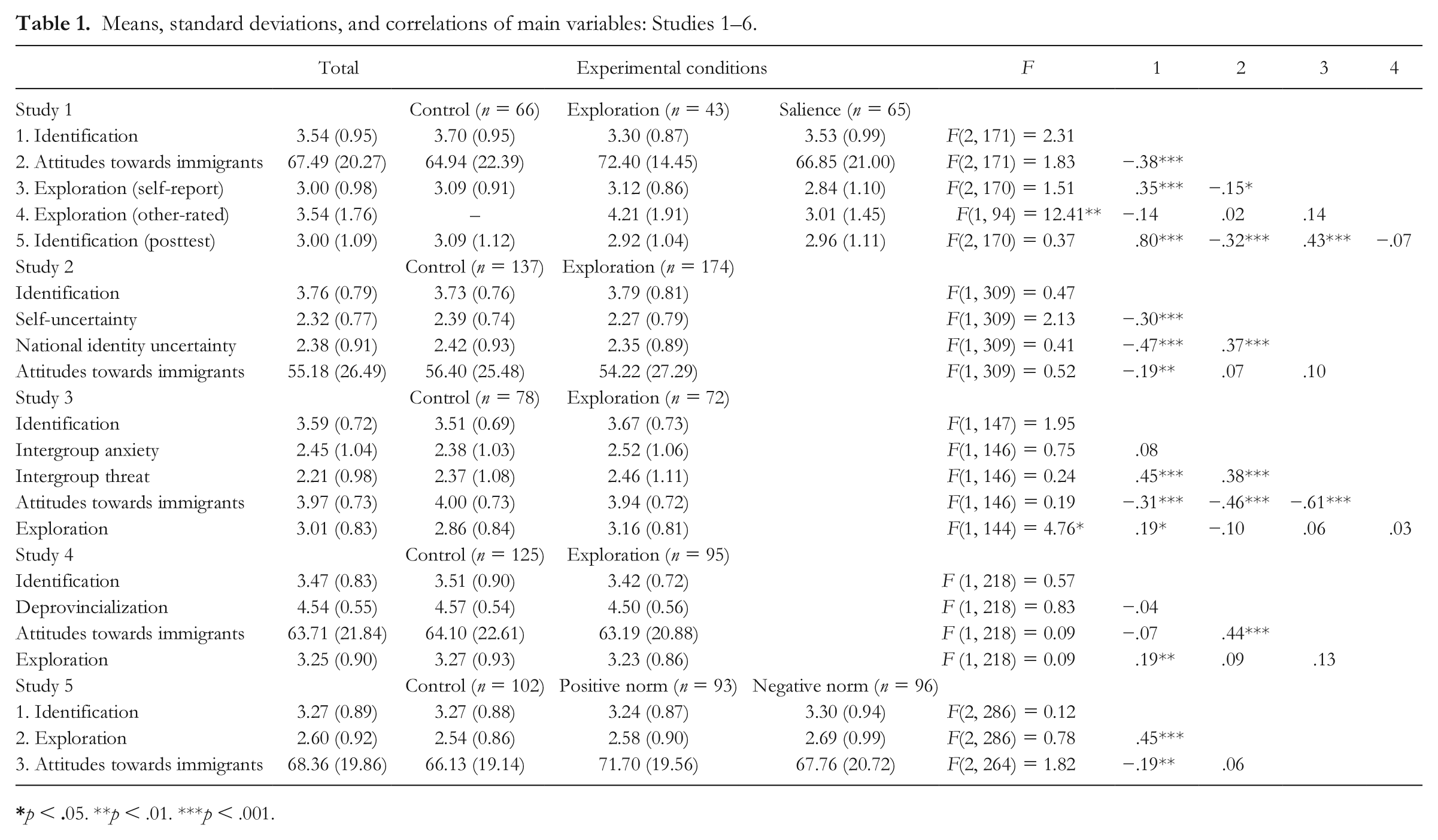
Participants in the exploration condition did not report higher identity exploration at the end of the study than participants in the salient group membership condition or the control group (see Table 1). However, the external ratings indicated that participants in the exploration condition expressed more profound views and a greater understanding of their German identity than participants in the salient group membership condition, M = 4.21, SD = 1.91 and M = 3.01, SD = 1.45, respectively; F(1, 94) = 12.41, p = .001, d = 0.73.
Means, standard deviations, and correlations of main variables: Studies 1–6.
p < .05. **p < .01. ***p < .001.
Preliminary analyses
Table 1 displays the means, standard deviations, and correlations of the main variables. We found no differences between the experimental groups in terms of posttest German identification: control group: M = 3.09, SD = 1.12; exploration condition: M = 2.92, SD = 1.04; salient group membership condition: M = 2.96, SD = 1.11; F(2, 170) = 0.37, p = .691, d = 0.16, suggesting that identity exploration is unlikely to reduce prejudice via ingroup distancing.
Main analyses
To examine the joint effect of national identification and identity exploration on outgroup attitudes, we tested a multicategorical moderation model with the PROCESS Version 3.3 macro for SPSS, using 10,000 bootstrapped samples (Model 1; Hayes, 2017). The control group was used as reference category against which we compared the exploration and salient group membership conditions. The detailed findings are reported online (see supplemental material).
There was a main effect of identification, b = −11.76, SE = 2.44, p < .001, 95% CI [−16.58, −6.94], indicating that higher identification with Germans was linked to more negative feelings toward immigrants. However, identification and exploration interactively predicted feelings towards immigrants, b = 8.67, SE = 4.10, p = .036, 95% CI [0.58, 16.77], whereas identification and salient group membership did not, b = 5.33, SE = 3.40, p = .118, 95% CI [−1.37, 12.04]; joint ∆R2 = .03. This means that the conditional effect in the exploration condition was significantly different from the conditional effect in the control group, while the conditional effects in the salience condition and the control group were similar. A closer look at these effects (see Figure 2) supported our hypothesis that national identification is negatively linked to outgroup attitudes in the control group, b = −11.76, SE = 2.44, p < .001, 95% CI [−16.58, −6.94], and in the salience condition, b = −6.43, SE = 2.36, p = .007, 95% CI [−11.09, −1.77], but not in the exploration condition, b = −3.09, SE = 3.30, p = .350, 95% CI [−9.60, 3.42]. To examine if the conditional effect in the exploration condition was significantly different from the conditional effect in the salience condition, we repeated the analysis using the exploration condition as reference category. There was no significant interaction between identification and exploration, b = 3.34, SE = 4.06, p = .411, 95% CI [−4.67, 11.35], indicating that the conditional effects in the exploration and salient membership conditions were similar.2, 3
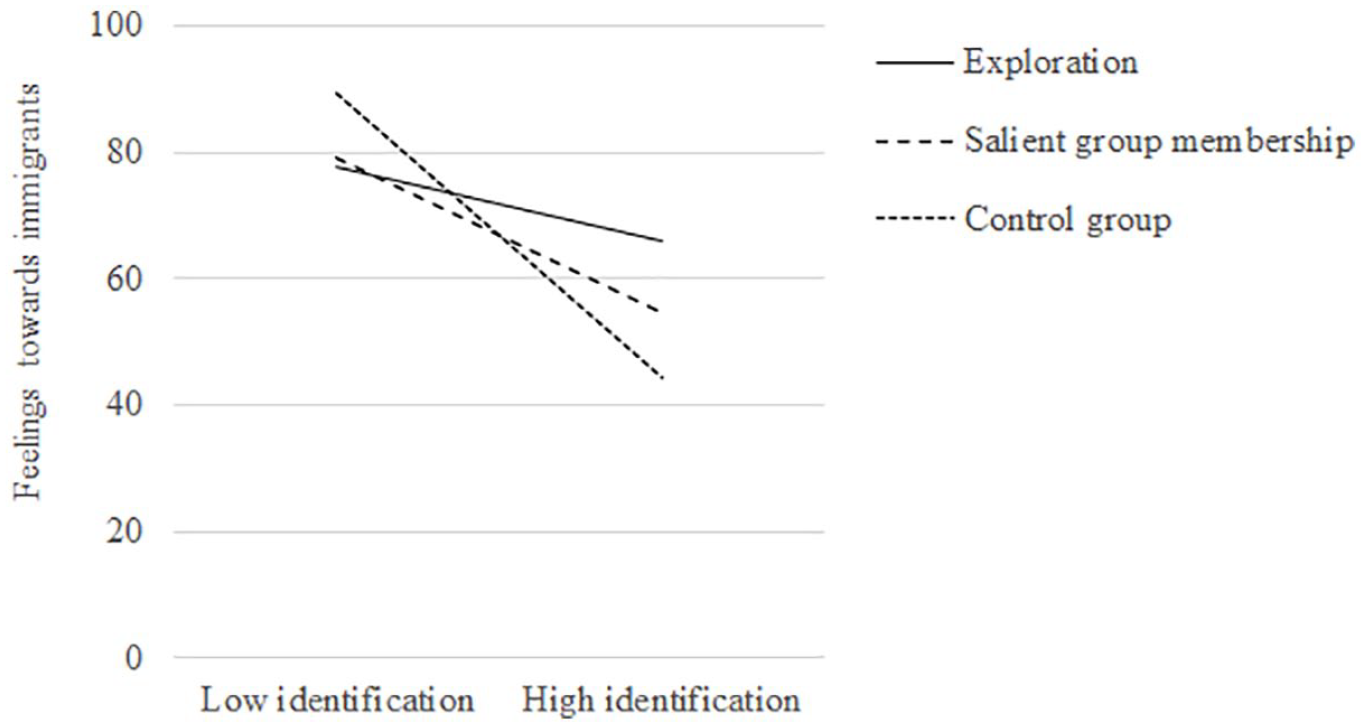
Interaction effect of national identification (±2 SD) and experimental condition on feelings towards immigrants.
Discussion
Study 1 showed higher identification with Germans to be associated with more negative feelings toward immigrants, but that induced national identity exploration eradicated the identification–prejudice link and allowed strong identifiers to be more open towards immigrants. This supported our hypothesis and is in line with research using cross-sectional survey data (Phinney et al., 2007; Spiegler et al., 2016; Whitehead et al., 2009). The results for the ingroup salience condition further indicated that salience alone did not eliminate the identification–prejudice link. However, the effects of experimentally induced exploration and ingroup salience were statistically similar, which makes sense, given that exploration is not possible without an elevated focus on the ingroup. A limitation of Study 1 might be that our manipulation did not have a significant impact on self-reported identity exploration at the end of the study. However, the external ratings of research assistants indicated higher identity exploration in the essays of participants in the exploration condition compared to the salient group membership condition. Nevertheless, externally rated exploration was not high, with an average around the midpoint of the rating scale. This encouraged us to use a slightly different manipulation in the following studies.
Overview of Studies 2–4
We moved on to investigate whether identity exploration improves attitudes towards immigrants by reducing self-uncertainty (Study 2) and intergroup threat (Study 3), and by increasing deprovincialization (Study 4). Studies 2–4 were online experiments with a two-factor, between-subjects, random design with national identification (measured as a continuous variable) and experimental condition manipulated (identity exploration vs. control). Rather than recalling a previous identity exploration experience as in Study 1, we instructed participants in Studies 2–4 to describe what it means for them personally to be German and how being German has influenced their lives. Participants in the control condition received no task (see supplemental material). Table 1 shows the descriptive statistics for Studies 2–4. In each study, we estimated a moderated mediation model using the PROCESS macro for SPSS and 10,000 bootstrapped samples (Model 8; Hayes, 2017). We tested whether identity exploration attenuates the identification–prejudice link via the specified mediator (see Figure 1b).
Study 2
Methods
Power analysis
We determined the sample size for each component of the indirect effect (i.e., Paths A and B in the mediation) and used the largest sample size to plan the study. An appropriate sample size for the effect of uncertainty on outgroup attitudes (Path B) was 55, given a significance criterion of .05 and an 80% probability to observe a small effect (f2 = .14, numerator df = 1). However, 292 participants were needed to observe a small interactive effect as in Study 1, given an 80% probability (f2 = .03, numerator df = 1, α = .05). To compensate for a potential loss of participants based on the criteria specified in Study 1, we aimed for a sample of 320.
Sample and procedure
The final sample included 311 participants (33.9% male; Mage = 21.28, SDage = 2.65; range: 16–25). Of the participants, 8.4% went to school, 36% had lower secondary education, and 55.7% had a higher secondary degree. We recruited participants via Respondi, an online platform for data collection, and they received €1.20 as compensation. Participants were told that there were two independent studies, one about “German identity” and one about “social media and attitudes towards social issues.” The so-called first study included the identification measure, the experimental manipulation, and the uncertainty measures, presented in that order. Attitudes towards immigrants were assessed in a “second” study in between other questions about social media, politics, economics, and environmental issues that served as filler items.
Measures
The measure for national identification (α = .88) was identical to that in Study 1. Self-uncertainty was measured with six self-developed items based on Hohman and Hogg (2015; see supplemental material); for example, “I am unsure about myself” (α = .83). For exploratory reasons, we included a measure of national identity uncertainty (see supplemental material). Attitudes towards immigrants were measured as in Study 1.
Results
The results of the main analyses (see supplemental material) indicated that the direct negative effect of national identification on attitudes towards immigrants, b = −6.54, SE = 2.96, p = .028, 95% CI [−12.35, −0.72], did not differ across conditions (p = .878). Identification was negatively related to self-uncertainty, b = −0.17, SE = 0.08, p = .040, 95% CI [−0.33, −0.01], but condition moderated the identification–self-uncertainty link, b = −0.21, SE = 0.11, p = .047, 95% CI [−0.42, −0.00]; ΔR2 = .01. The conditional effects (see Figure 3) showed that identification was negatively linked to self-uncertainty in both experimental conditions, but the effect was stronger in the exploration condition, b = −0.38, SE = 0.07, p < .001, 95% CI [−0.52, −0.25], compared to the control condition, b = −0.17, SE = 0.08, p = .040, 95% CI [−0.33, −0.01]. This indicates that stronger ingroup identification is linked to less self-uncertainty, especially when identity exploration is high, which was in line with our assumption. However, self-uncertainty was not related to attitudes towards immigrants (p = .799), which is why the conditional indirect effects were also not significant.
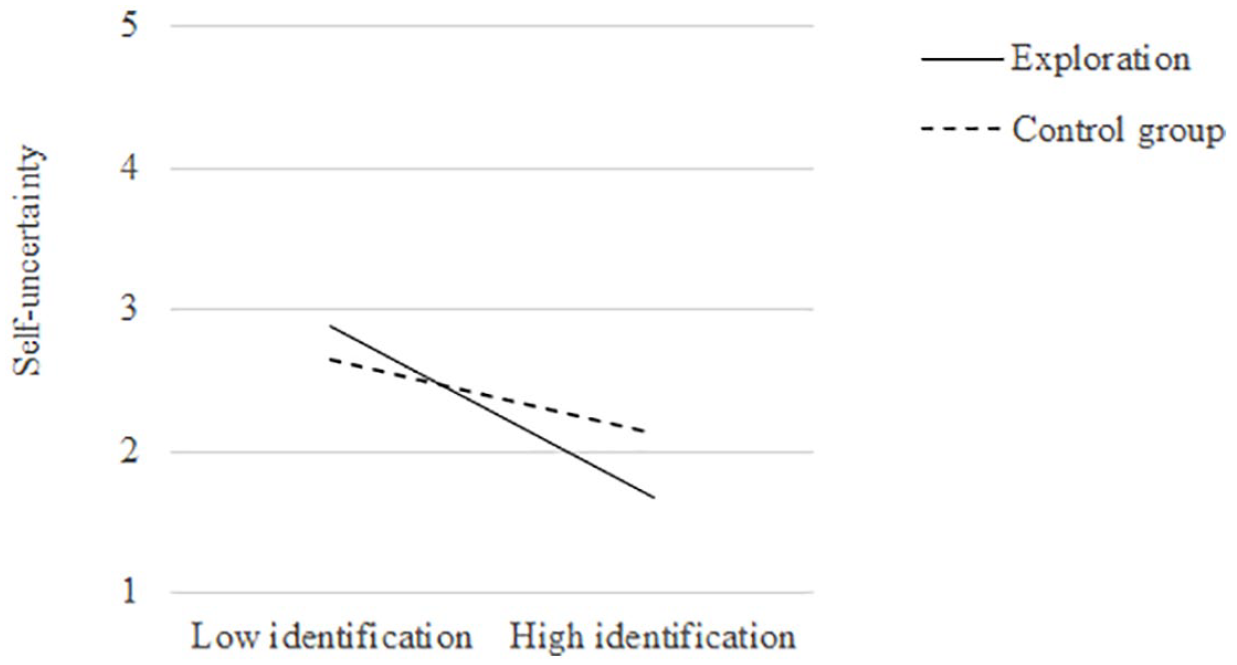
Interaction effect of national identification (±2 SD) and experimental condition on self-uncertainty.
Discussion
The findings of Study 2 supported the hypothesis that strong identifiers with high identity exploration experience less self-uncertainty than strong identifiers with low identity exploration. However, the joint effect of national identification and identity exploration on outgroup attitudes was insignificant, as condition did not moderate the direct or indirect effects. An explanation might be that we did not assess attitudes immediately after the manipulation as in Study 1, but rather separately in a “second” study among a set of filler items. In addition, self-uncertainty did not predict outgroup attitudes, for which there are various possible explanations. First, self-uncertainty is more strongly associated with identification (and, we expect, attitudes) if it is psychologically more real than in experiments that induce task-related uncertainty (Choi & Hogg, 2020). Second, our sample included primarily women whose self-uncertainty has recently been shown to be unrelated to outgroup attitudes (Dahl et al., 2019). Third, the link between self-uncertainty and outgroup attitudes might not be as straightforward as hypothesized. Prior research showed, for example, that self-uncertainty promotes prejudice among people with a high (but not low) need for cognitive closure (Brizi et al., 2016) and high (but not low) authoritarian attitudes (Rieger et al., 2017). Therefore, we investigated in Study 3 if identity exploration affects other processes underlying the identification–prejudice link, such as forms of intergroup threat (Berry, 2013; Stephan et al., 2002).
Study 3
Methods
Power analysis
An appropriate sample size for the effects of intergroup threat and anxiety on outgroup attitudes (Path B) was 68, given a significance criterion of .05 and an 80% probability to observe small effects (f 2 = .15, numerator df = 2). However, a minimum of 292 participants was required to have an 80% probability to observe an interactive effect as in Study 1 (f 2 = .03, numerator df = 1, α = .05). This was not achieved as the data were collected by students for a course, and data collection had to end after 4 weeks.
Sample and procedure
The final sample included 150 Germans (33.6% male; Mage = 22.27, SDage = 2.32; range: 16–25). Of the participants, 7.5% went to school, 16.2% had lower secondary education, 62.3% had a higher secondary degree, and 14% had a university degree. The procedure was identical as that in Study 1.
Measures
National identification was measured as in Study 1 (α = .86). Outgroup threat was assessed with six items (e.g., “Immigrants are a threat to the German culture,” “Immigrants are increasing the amount of crime in Germany”; α = .90; Stephan et al., 1998; Velasco González et al., 2008). Intergroup anxiety was measured with three items that asked participants how they would feel when interacting with an unfamiliar immigrant. The anxiety-related feelings were uncertain, awkward, and anxious. Response options ranged from 1 (not at all) to 6 (very much). Means were calculated whereby higher values indicated more intergroup anxiety (α = .81). Attitudes towards immigrants were measured with seven items adapted from the Other-Group Orientation Scale (Phinney, 1992); for example, “I enjoy being around immigrants” (α = .85). Identity exploration was assessed as in Study 1 (α = .76).
Results
Manipulation check
Condition had an effect on identity exploration, with participants in the experimental condition reporting more identity exploration than participants in the control group, M = 3.16, SD = 0.80 and M = 2.86, SD = 0.84, respectively; F(1, 144) = 4.76, p = .031, d = 0.36.
Main analyses
We estimated a model in which intergroup anxiety and threat were both added as mediators of the identification–prejudice link. Intergroup anxiety and threat predicted negative attitudes towards immigrants, b = −0.19, SE = 0.05, p < .001, 95% CI [−0.28, −0.09] and b = −0.34, SE = 0.06, p < .001, 95% CI [−0.46, −0.23], respectively. The direct effect of national identification on outgroup attitudes was insignificant (p = .323) and not moderated by condition (p = .733). National identification, condition, and the national identification x condition interaction did not predict intergroup anxiety (ps ⩾ .142), which is why the conditional indirect effects via intergroup anxiety were not significant (see supplemental material). However, identification and condition interactively predicted intergroup threat, b = −0.45, SE = 0.20, p = .027, 95% CI [−0.85, −0.05]; ΔR2 = .03. The conditional effects (see Figure 4) showed that identification was negatively and significantly related to threat in both the control group, b = 0.86, SE = 0.15, p < .001, 95% CI [0.57, 1.15], and in the experimental group, b = 0.41, SE = 0.14, p = .004, 95% CI [0.13, 0.69], but the effect in the control group was stronger, which supported our hypothesis. The indirect effects via threat were significant in the control group, b = −0.30, SE = 0.07, 95% CI [−0.43, −0.18], and in the experimental condition, b = −0.14, SE = 0.05, 95% CI [−0.25, −0.05], and the difference between the conditional indirect effects was significant, b = 0.16, SE = 0.07, 95% CI [0.03, 0.31].
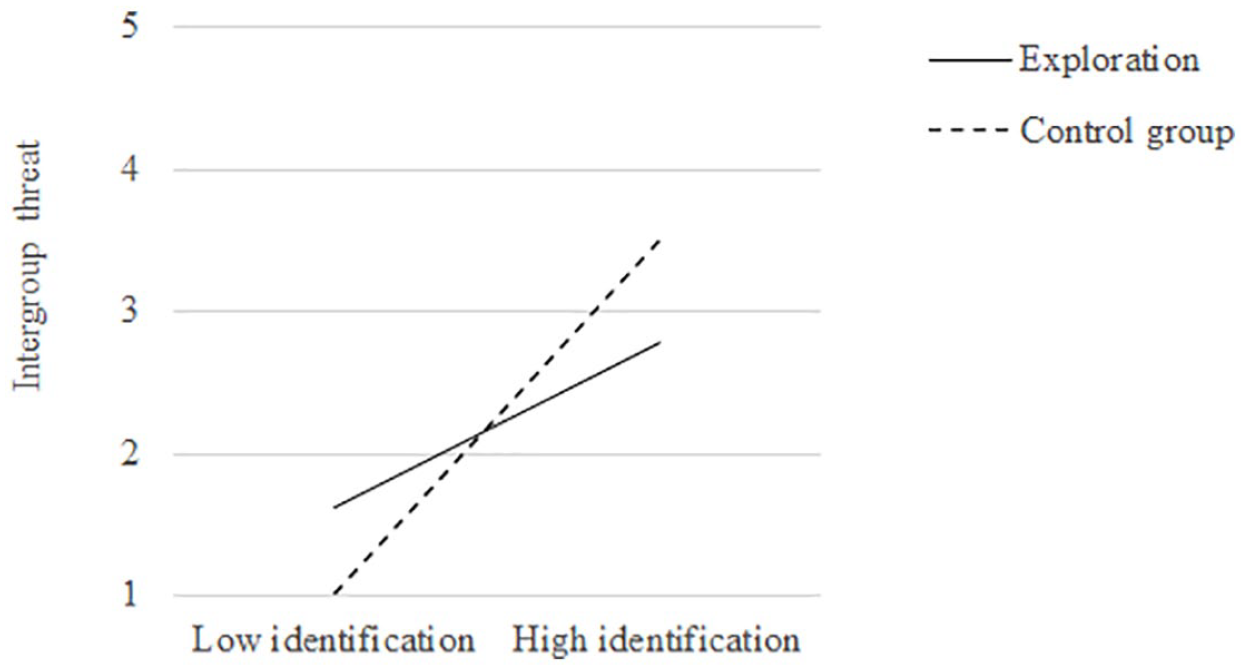
Interaction effect of national identification (±2 SD) and experimental condition on intergroup threat.
Discussion
Study 3 showed that induced identity exploration can improve strong identifiers’ attitudes towards immigrants by lowering intergroup threat, but not intergroup anxiety. Intergroup anxiety refers to a fear to be hurt, misunderstood, or rejected by outgroup members (Stephan, 2014). An effective way to reduce intergroup anxiety is positive intergroup contact, which provides people with a behavioural repertoire, knowledge, and confidence to successfully manage intergroup interactions (Pettigrew & Tropp, 2008). Identity exploration, as manipulated in our research, is a more inward-looking task with no immediate benefits for interpersonal competencies and skills. It is however possible that exploration has an indirect effect on intergroup anxiety via threat (Riek et al., 2006). Thus, future studies might want to test an alternative model in which group-level and individual-level threats are consecutive mediators, with threat preceding anxiety. 4 The findings also indicate that identity exploration might increase threat (on a low level) among weakly identified participants. This is of interest for interventions using identity exploration to improve intergroup attitudes, as it suggests that learning about one’s group membership without the comfort of a clear sense of belonging can, at least temporarily, increase susceptibility to forms of outgroup threat. Finally, it is of interest to note that the identification–prejudice link via threat did not fully disappear in the exploration condition. This means that strong identifiers with high identity exploration still experienced more intergroup threat than weak identifiers.
Study 4
Study 4 was designed to examine whether experimentally induced identity exploration promotes deprovincialization (i.e., a reappraisal of ingroup norms and standards), resulting in higher outgroup tolerance.
Methods
Power analysis
Fifty-five participants were required to observe an effect of deprovincialization on outgroup attitudes with an 80% probability (f 2 = .15, numerator df = 1, α = .05). However, 264 participants were required to detect a small interaction effect as in Study 1 with an 80% probability (f 2 = .03, numerator df = 1, α = .05).
Sample and procedure
The final sample included 220 German psychology students (22.3% male; Mage = 22.30, SDage = 2.13; range: 16–25), who received course credit for their participation.
Measures
National identification (α = .89) was assessed as in Study 1. Deprovincialization was measured with four items taken from Martinovic and Verkuyten (2013); for example, “One should always nuance one’s own worldview and not make it sacred” (α = .72; see Appendix A in the supplemental material). Attitudes towards immigrants and identity exploration were assessed as in Study 1.
Results
Manipulation check
Participants in the experimental condition and control group did not differ in terms of identity exploration, F(1, 218) = 0.09, p = .762. Given that the manipulation was successful in Study 3, we proceeded with our analyses, but we discuss the mixed results of our manipulation checks in detail in the General Discussion section.
Main analyses
The results (see Appendix D in the supplemental material) indicated that the direct effect of national identification on attitudes towards immigrants, b = −3.61, SE = 1.96, p = .068, 95% CI [−7.48, 0.26], the moderation of the direct effect by condition, b = 6.76, SE = 3.46, p = .052, 95% CI [−0.06, 13.57], and the link between identification and deprovincialization, b = −0.10, SE = 0.06, p = .061, 95% CI [−0.21, 0.01], failed to reach statistical significance, but higher levels of deprovincialization predicted more positive attitudes, b = 16.61, SE = 2.43, p < .001, 95% CI [11.81, 21.40]. Moreover, condition moderated the link between identification and deprovincialization, b = 0.22, SE = 0.10, p = .020, 95% CI [0.04, 0.41]; ΔR2 = .03. A look at the conditional effects (see Figure 5) showed no significant association between identification and deprovincialization in both experimental conditions. However, whereas identification was negatively related to deprovincialization in the control group, b = −0.10, SE = 0.06, p = .061, 95% CI [−0.21, 0.01], identification was positively related to deprovincialization in the experimental group, b = 0.12, SE = 0.08, p = .126, 95% CI [−0.03, 0.28]. We further found a negative and significant indirect effect of national identification on outgroup attitudes via deprovincialization in the control group, b = −1.70, SE = 0.95, 95% CI [−3.75, −0.04], which was nonsignificant in the exploration condition, b = 2.01, SE = 1.57, 95% CI [−1.35, 4.98]. The difference between the conditional indirect effects was significant, b = 3.71, SE = 1.84, 95% CI [0.08, 7.33].
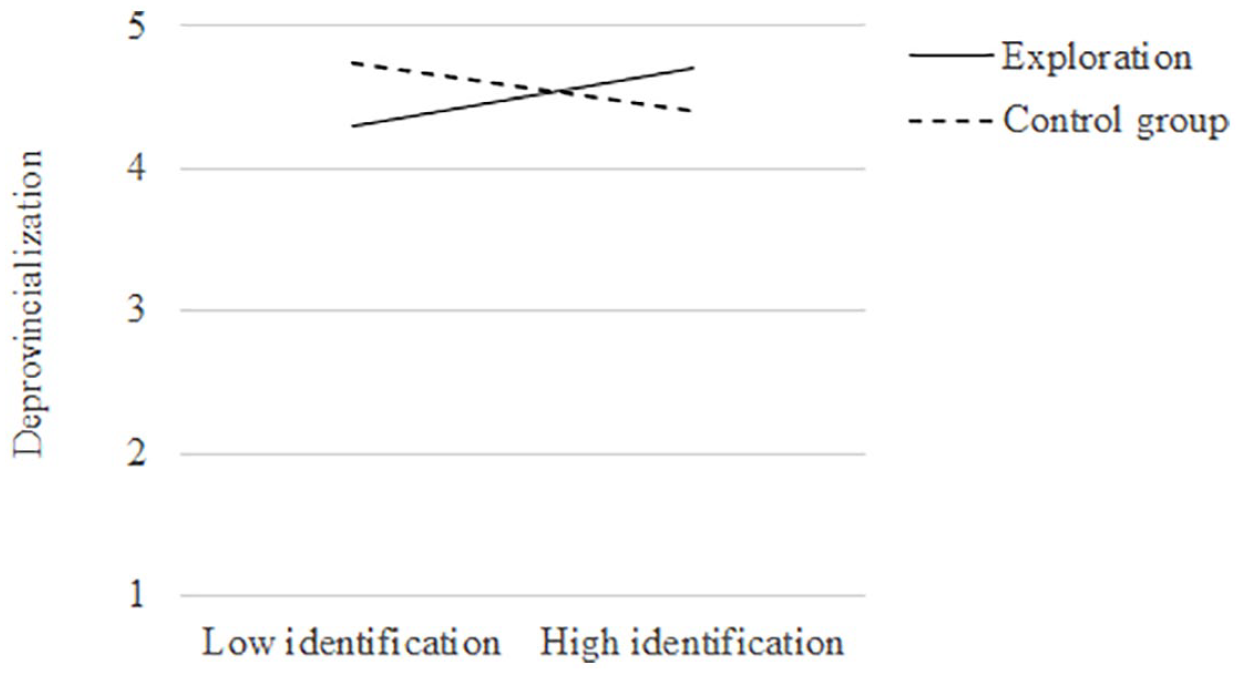
Interaction effect of national identification (±2 SD) and experimental condition on deprovincialization.
Discussion
Study 4 showed that stronger national identification was linked to more negative outgroup attitudes via decreased deprovincialization, but this effect disappeared when participants were instructed to explore the meaning of their identity. Experimentally induced identity exploration can therefore erase the negative effect of identification on outgroup attitudes via deprovincialization, which supported our hypothesis. The findings further indicated that weakly identified participants in the exploration condition reported less deprovincialization than weakly identified participants in the control group. This means that the task—thinking about the meaning of your ingroup identity—prompts weakly identified individuals to, at least temporarily, become more ingroup-centric.
Study 5
In Study 5, we aimed to investigate the circumstances under which identity exploration is most beneficial. Therefore, we manipulated negative descriptive ingroup norms. We hypothesized that strong identifiers with high identity exploration are more likely to resist negative ingroup norms than strong identifiers with low identity exploration. In addition, we explored how strong identifiers with high identity exploration behave in a context in which positive ingroup norms prevail. In contrast to Studies 1–4, identity exploration was measured instead of experimentally induced.
Methods
Power analysis
A minimum of 325 participants was needed to have an 80% probability to observe a small interaction effect (f2 = .03, numerator df = 2, α = .05). Students collected the data for a course and, due to the course structure, data collection had to end after 4 weeks.
Sample and procedure
The final sample included 291 Germans (32.6% male; Mage = 21.88, SDage = 2.45; range: 16–25). Of the participants, 5.4% went to school, 31% had lower secondary education, 62.2% had a higher secondary degree, and 1.4% did not indicate their degree. The procedure was identical to that in Study 1.
Design
The online experiment had a three-factor, between-subjects, random design with national identification and identity exploration (measured as continuous variables) and descriptive ingroup norms manipulated (positive vs. negative vs. control).
Measures and manipulation
National identification (α = .87) and identity exploration (α = .78) were measured as in Study 1. Descriptive ingroup norms were manipulated via bogus information about a survey that found clear results for either widespread positive or negative attitudes towards immigrants among Germans. Participants read: “The Bertelsmann Stiftung recently asked 1,000 Germans about their attitudes towards immigrants. The results are very clear. Most of the German respondents had negative [positive] attitudes towards immigrants.” The text was supported with a pie chart showing that 75% of the survey participants reported negative (positive) attitudes towards immigrants, 18% positive (negative) attitudes, and 7% neutral attitudes. Participants in the control group received no information (see Appendix B in the supplemental material). Attitudes towards immigrants were measured as in Study 1.
Results
To examine if the combined effect of national identification and identity exploration on outgroup attitudes depends on the normative context, we tested a three-way interaction model using 10,000 bootstrapped samples (PROCESS Model 3; Hayes, 2017). Identification was specified as predictor, exploration as continuous moderator, experimental condition as multicategorical moderator with the control condition as the reference group, and feelings towards immigrants as the outcome.
The three-way interaction between national identification, identity exploration, and negative norms was significant, b = 7.08, SE = 3.33, p = .034, 95% CI [0.52, 13.64], but the three-way interaction between national identification, identity exploration, and positive norms was not, b = 0.40, SE = 3.40, p = .906, 95% CI [−6.29, 7.09] (see supplemental material). This indicates that the combined effect of identification and exploration was similar for participants in the positive norm and control conditions. Therefore, we combined the positive norm and control conditions, and repeated the analysis. The three-way interaction between identification, exploration, and condition was significant, b = 6.72, SE = 2.75, p = .015, 95% CI [1.31, 12.13]; ΔR2 = .02 (see Appendix D in the supplemental material). The conditional effects are shown in Figure 6. In the negative norm condition, stronger national identification was linked to more negative outgroup attitudes when identity exploration was low (−1 SD), b = −8.41, SE = 3.13, p = .008, 95% CI [−14.58, −2.24], but not when exploration was high (+1 SD), b = −3.53, SE = 3.43, p = .304, 95% CI [−10.29, 3.23]. This suggests that identity exploration attenuates the identification–prejudice link when ingroup norms promote negative attitudes toward the outgroup, which is in line with our assumptions. However, when the ingroup norm was positive or not mentioned, stronger national identification was not linked to outgroup attitudes when identity exploration was low (−1 SD), b = −3.01, SE = 2.12, p = .157, 95% CI [−7.19, 1.17], and but was linked to more negative attitudes when exploration was high (+1 SD), b = −10.43, SE = 2.60, p < .001, 95% CI [−15.56, −5.30].
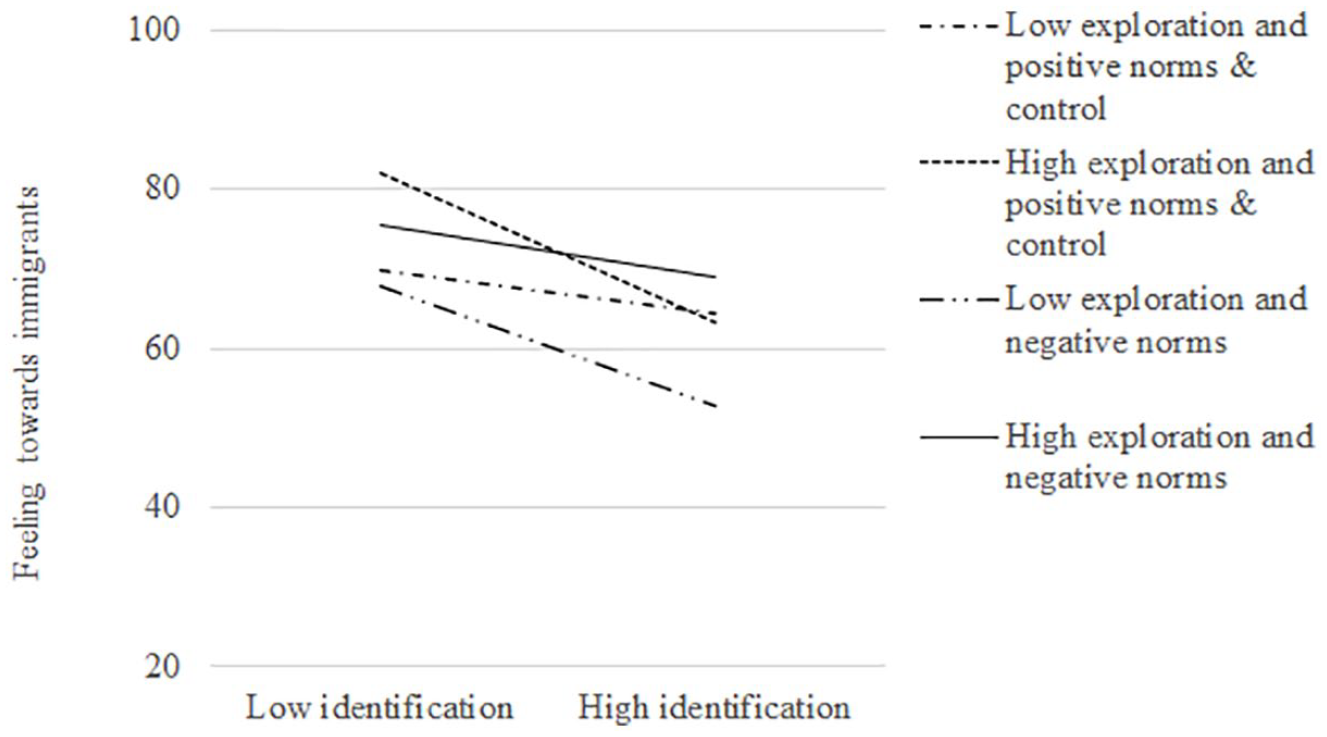
Interaction effect of national identification (±1 SD) and identity exploration (±1 SD) on feelings towards immigrants depends on ingroup norms (Study 5).
Discussion
The findings of Study 5 supported the hypothesis that higher levels of ingroup identification are not linked to more norm-consistent negative attitudes towards immigrants when national identity exploration is high. Thus, high levels of exploration seem to allow higher identifiers to resist negative ingroup norms. However, national identification was not linked to more norm-consistent positive outgroup attitudes when identity exploration was low. This was probably caused by two competing effects, as strong identifiers with low identity exploration are a) likely to have negative outgroup attitudes and b) likely to adhere more to positive ingroup norms (or social desirability demands in case of no explicit norms). We suggest that both of these effects cancelled each other out. More surprising was the finding that higher identification was linked to more negative outgroup attitudes, despite a prevailing positive ingroup norm, when exploration was high. Thus, strong identifiers with high identity exploration seemed to oppose positive descriptive ingroup norms. A possible explanation is that strong identifiers with high identity exploration use attitude expression to achieve a sense of uniqueness and independence (Christensen et al., 2004). The pattern of findings in the negative and positive norm conditions suggests that people with high identity exploration are dissenting from their ingroup’s (negative or positive) norms when they are strongly identified with the group. Thus, identity exploration allows high identifiers to deviate from descriptive group norms. Actively seeking information about one’s group membership and trying to understand its meanings might imply being more alleviated from normative expectations and pressure.
Summary of Findings
We pooled the results from Studies 1–5 in a mini meta-analysis, which has the advantage of increased statistical power. It further provides a concise statistical integration of our findings and a more conclusive report on the interactive effect of national identification and identity exploration. For the mini meta-analysis, we repeated the analyses of Studies 2–4 without the mediators and with outgroup attitudes as outcome variable. This has two reasons. First, attitudes are our variable of interest. Second, self-uncertainty and intergroup anxiety were insignificant mediators of the identification–prejudice link. We further used the standardized regression coefficients of the interaction effects because outgroup attitudes were measured with different scales across the studies. We ran a fixed-effect model with the metafor package (Viechtbauer, 2010), following the guidelines of Harrer et al. (2019). The results of the meta-analysis are shown in Figure 7. Out of seven samples, four revealed a statistically significant effect, and there was clear evidence for the presence of a true effect, β = .19, 95% CI [0.08, 0.31], indicating that higher identity exploration weakens the identification–prejudice link.
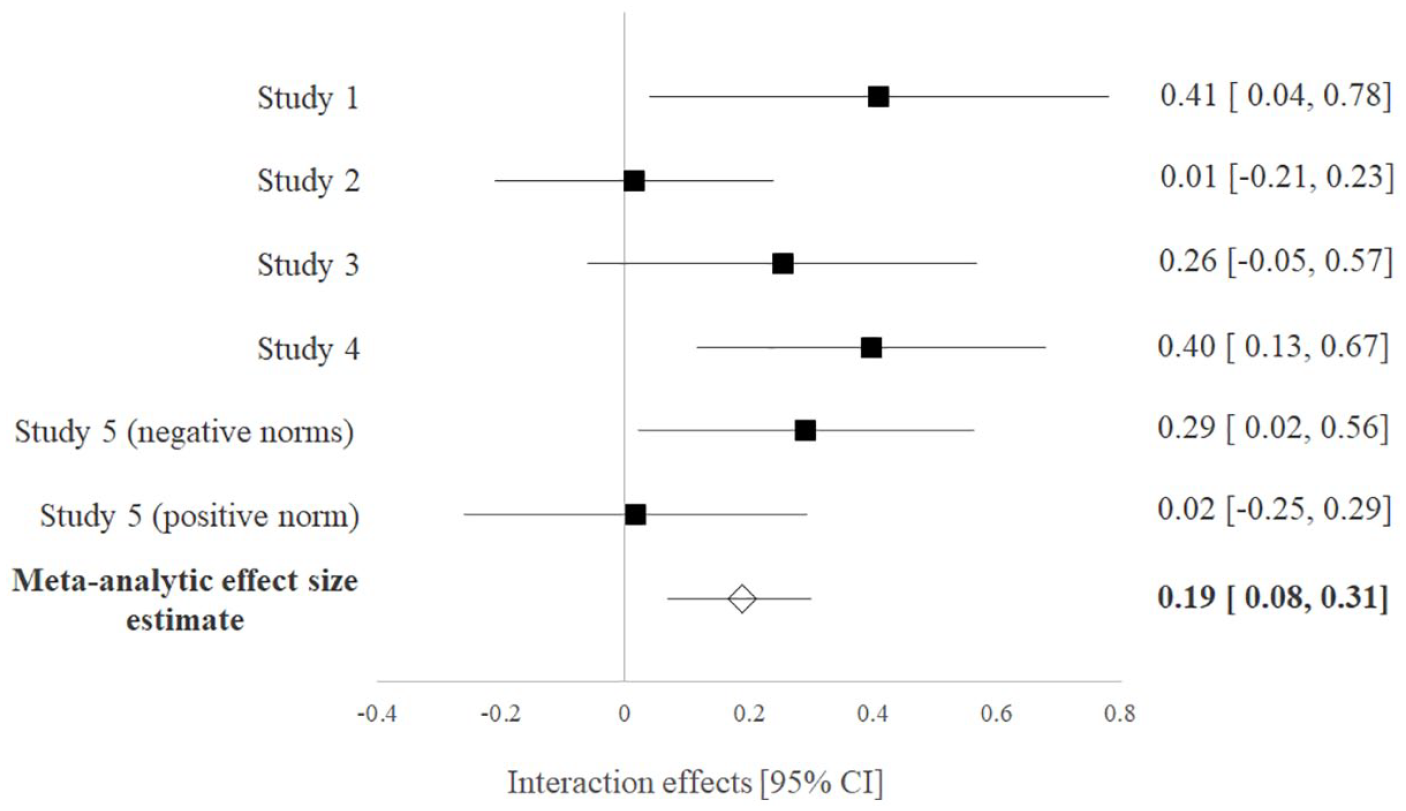
Results of the internal meta-analysis.
General Discussion
Prior research indicates that strong national identifiers are more prejudiced toward immigrants and foreigners (Pehrson et al., 2009; Pettigrew et al., 2007). We have complemented this research by experimentally testing the theoretical reasoning derived from the developmental perspective that focuses on people’s identity exploration and efforts to understand the meaning of their group membership (Marcia, 1966; Phinney et al., 1997). The results of five studies and an internal meta-analysis showed that experimentally induced identity exploration alleviated the identification–prejudice link and allowed strong identifiers to be more open towards immigrants. This was not mediated via reduced self-uncertainty and intergroup anxiety, but via reduced intergroup threat and increased deprovincialization. Strong identifiers with high identity exploration also opposed negative ingroup norms more strongly than strong identifiers with low identity exploration. In the following paragraphs, we discuss our findings and outline limitations and directions for future research.
Our findings showed that identity exploration, but not ingroup salience, weakened the national identification–prejudice link. More specifically, we showed in Study 1 that the link between identification and prejudice disappeared when participants thought of a prior experience in which they learned something about their group membership, whereas the identification–prejudice link remained significant among participants who thought of a prior experience in which their group membership was salient. Both conditions increased participants’ self-awareness, as their group membership became the object of attention. But only self-focused attention in combination with a focus on identity exploration had beneficial effects on outgroup attitudes. This complements prior research showing that individuals led to focus their attention on the ingroup are more biased and prejudiced towards outgroups (for a meta-analysis, see Mullen et al., 1992).
Our experimental studies provide compelling evidence that identity exploration weakened or eradicated the identification–prejudice link. However, there was one negative result. The findings of Study 2 supported the idea that exploration-based ingroup commitments decrease self-uncertainty. There was, however, no evidence that exploration moderated the identification–prejudice link. This can be attributed to a methodological difference, as attitudes were assessed with delay only in this experiment, or to the notion that negative results become increasingly likely when multiple studies investigating the same hypothesis are performed (Lakens & Etz, 2017).
Our manipulation checks yielded mixed evidence for our manipulation. This might be explained by differences in study designs, but also by the relatively high levels of identity exploration in the control groups and the absence of a true low identity exploration condition (which appears difficult to realize). In addition, we instructed participants to think about the meaning of their ingroup membership. Thus, the exploration is invited and situational, and may not be adequately captured by the MEIM-R (Phinney & Ong, 2007), which assesses more regular and habitual aspects of identity exploration.
Finally, our findings on identity exploration offer an alternative way to promote more positive outgroup attitudes, which is typically achieved via intergroup contact (Pettigrew & Tropp, 2008). Such an alternative is of interest when contact is not possible or desired. It is important to note that identity exploration was not linked to greater ingroup distance (i.e., reduced ingroup identification). There was, for example, a positive correlation between identity exploration and national identification across studies. Moreover, we showed in Study 1 that exploration had no effect on a posttest measure of identification. This highlights that identity exploration does not disconnect people from their ingroup nor makes them less positive toward it. It does however change the way people relate to outgroups.
Limitations and Directions for Future Research
Despite the innovative theoretical approach and overall strengths of our research (e.g., multiple studies, and a focus on underlying mechanisms and conditions), there are limitations which call for future research. First, our findings may be specific to the national context where the research was conducted. Due to Germany’s history, identity exploration might have reduced prejudice by inducing feelings of historical group-based guilt. This means that identity exploration might have less of an effect (or different effects) in other national contexts. Moreover, the experiments were conducted during or shortly after the so-called refugee crisis in Germany, which may have increased the salience of ethnic group membership. Therefore, our findings may not apply to national contexts where ethnic group membership is less salient among majorities.
A second limitation is that we cannot shed light on how best to promote identity exploration, but prior research indicates that a focus on ingroup disadvantages and achievements over time is more likely to decrease prejudice than a focus on ingroup advantages and comparisons with outgroups (Branscombe et al., 2007). Moreover, exploration might be beneficial by focusing individuals on the cognitive aspects of their group identity rather than its emotional parts (Ellemers et al., 1999). This may distinguish identity exploration from self-affirmation and, in particular, group affirmation, which can increase outgroup negativity (Ehrlich & Gramzow, 2015). Finally, from a developmental perspective, identity exploration is a gradual process that typically takes time. This means that a repeated encouragement to get involved with the ingroup’s culture, history, and traditions can be expected to have stronger positive effects on outgroup attitudes than a short experimental manipulation.
A methodological limitation of our research is that we did not test the mediators in a single study. As a result, the relative magnitudes of the specific indirect effects could not be assessed (Preacher & Hayes, 2008). In addition, we cannot speak about the causal ordering of the mediators and outcomes. Although our predictions were theoretically derived and in line with previous empirical findings, it is, for example, possible that outgroup attitudes caused a change in threat or deprovincialization rather than only the other way around.
A final issue is that the findings in Study 5 suggest that identity exploration allows high identifiers to deviate from descriptive group norms, negative or positive ones. Trying to understand how one’s group membership impacts one’s life and establish a clear sense of ingroup belonging based on that understanding might make it possible to take a more independent position in relation to ingroup expectations. This could also mean, for example, that the content of national identity in Study 1 involved nationalistic ingroup norms, and that identity exploration reduced the impact of these norms on prejudice toward immigrants. Future research could examine whether identity exploration shows similar group-deviating effects for injunctive norms, or rather whether exploration leads higher identifiers to conform to these norms that do not depend on the number of ingroup members adhering to them.
Conclusion
Social identification fosters cooperative behaviours, social cohesion, and psychological well-being but also ingroup bias, prejudice, and discrimination. The benefits of strong social identification together with the potentially harmful side effects for intergroup relations have raised the question of whether strong identification is inevitably linked to prejudice and discrimination. Our research indicates that we need to consider how social identities develop to increase our understanding of the identification–prejudice link. We showed that the harmful side effects of strong identification are diminished among individuals who have a strong sense of belonging to their group and high identity exploration. The latter involves an active engagement with the ingroup and a motivation to learn and reflect upon the meaning and implications of one’s group membership. Therefore, our findings suggest that intergroup relations cannot only be improved via perspective-taking, cross-cultural learning, or intergroup contact, but also via the exploration of one’s own group membership.
Supplemental Material
sj-pdf-1-gpi-10.1177_1368430221990093 – Supplemental material for National identity exploration attenuates the identification–prejudice link
Supplemental material, sj-pdf-1-gpi-10.1177_1368430221990093 for National identity exploration attenuates the identification–prejudice link by Olivia Spiegler, Oliver Christ and Maykel Verkuyten in Group Processes & Intergroup Relations
Footnotes
Funding
The author(s) disclosed receipt of the following financial support for the research, authorship, and/or publication of this article: This research project was funded by a Feodor Lynen Research Fellowship from the Alexander von Humboldt Foundation awarded to Olivia Spiegler.

Supplemental material
Supplemental material for this article is available online.
Notes
References
Supplementary Material
Please find the following supplemental material available below.
For Open Access articles published under a Creative Commons License, all supplemental material carries the same license as the article it is associated with.
For non-Open Access articles published, all supplemental material carries a non-exclusive license, and permission requests for re-use of supplemental material or any part of supplemental material shall be sent directly to the copyright owner as specified in the copyright notice associated with the article.
