




Abstract
Bicultural identity orientations have rarely been examined in relation to both perceived discrimination and psychological distress. Furthermore, these constructs have usually been studied in isolation, but their intersection is essential for understanding intercultural relations in multicultural societies. Using cross-sectional data from 1,143 Canadian undergraduate students from immigrant families, this study explored the relationship between perceived discrimination and psychological distress, and how bicultural identity orientations might mediate this relationship. The structural equation modeling results indicated that perceived discrimination was associated with higher levels of psychological distress and hybrid, monocultural, alternating, and conflicted orientations, but lower levels of complementary orientation. Alternating and conflicted orientations were related to higher psychological distress, whereas the other orientations were not. Alternating and conflicted orientations mediated the relationship between perceived discrimination and psychological distress, whereas the other orientations did not. The findings are discussed in light of theories on identity integration, rejection–identification, and acculturation.
Ethnic minority populations are rapidly increasing in many developed countries such as the United States (United States Census Bureau, 2017), Australia (Australian Bureau of Statistics, 2013), and Canada (Statistics Canada, 2017d), largely because of immigration. According to the United Nations Population Division (Population Division, Department of Economic and Social Affairs, 2019), international migration has consistently increased since 1990, and the total number of migrants, including immigrants, is now over 271 million people. Although the cultural diversity resulting from widespread immigration has many sociopsychological benefits, it has its own challenges (Berry, 1998). One such challenge relates to discrimination against immigrants, which has consequences for immigrants’ psychological well-being.
Past research provides clear evidence that discrimination has a negative effect on immigrants’ well-being (de Freitas et al., 2018). While discrimination is unambiguously harmful, less is known about the mechanisms that amplify or attenuate its damaging effects. One line of research suggests that how people respond to discrimination depends on their social identities. It is argued that social identity could serve as either a buffering or a risk factor, such that when a group membership provides people with a positive social identity through existential meaning and social support, it has positive effects on well-being; however, when it does not provide a positive social identity or when that social identity is threatened through, for example, discrimination, it has negative effects on well-being (Haslam et al., 2018).
Consistent with this line of research, scholars have examined ethnic identity as an intermediary that mitigates and national identity as an intermediary that aggravates the negative effect of discrimination on well-being (Cvetkovska et al., 2020; Hakim et al., 2018). Drawing on the social identity framework (Tajfel & Turner, 1979; Turner et al., 1987), Branscombe et al. (1999) referred to the intermediary role of ethnic identity as the rejection–identification effect. They argued that when individuals are rejected due to their group membership, they identify more strongly with their group to restore their self-esteem, which in turn mitigates the negative effects of rejection. Building upon Branscombe et al.’s (1999) rejection–identification model, Jasinskaja-Lahti et al. (2009) referred to the intermediary role of national identity as the rejection–disidentification effect. They argued that when minorities are rejected by majorities because of their subgroup membership, they disidentify from the superordinate national group, which in turn aggravates the negative effects of rejection.
Some studies have supported the rejection–identification and rejection–disidentification models. However, other studies have failed to support or, at best, have provided inconsistent support for these models (Bobowik et al., 2017; Donovan et al., 2013), indicating that they do not always give a full account of the nature of the discrimination–well-being relationship. For example, examining the associations between perceived discrimination, ethnic identity, and depressive symptoms among ethnic minority youth in the United States, Donovan et al. (2013) found that ethnic identity did not affect the role of discrimination in depression. As Donovan et al. (2013) pointed out, “it is possible that ethnic identity does not affect the outcomes of [perceived discrimination] for ethnic minorities in isolation and, instead, works in conjunction with other variables not tested, like . . . other forms of identity” (p. 410). In fact, most of the existing research on this topic has focused on the role of either ethnic or national identity, often with the assumption that these identities have an independent or reciprocal relation. Cultural psychologists and intercultural communication scholars interested in bi- and multiculturalism, however, have argued that the relations between immigrants’ identities can be more complex than has hitherto been recognized (Wiley et al., 2019), and we suggest that it may be this complexity, as reflected in bicultural identity, that can better account for the discrimination–well-being relationship.
Bicultural Identity
A bicultural (or multicultural) identity orientation can be defined as the manner in which a person living in a bi- or multicultural context construes their identification with at least two (and possibly more) ethnocultural groups 1 with which they potentially have sociocultural ties. This construal is nuanced by the nature of the relations between the two groups, whether they are relatively positive or negative, egalitarian or hierarchical, and so on. It provides a frame of reference, or orientation, within which to understand and express one’s relationship to those groups. Bicultural identities can be configured within the self-concept in a variety of ways, such that identification with the heritage and mainstream ethnocultural groups could be construed as distinct categories, conflictual entities, compartmentalized facets, complementary aspects, or integrated forms (among other possibilities). It is important to acknowledge that individuals who live in bicultural contexts could claim identification with only one of their potential reference groups; that is, they could adopt a monocultural orientation by minimally incorporating or even rejecting aspects of the other cultural group. Also, biculturality can be understood as more than the relative degree of identification with the mainstream and heritage groups; although one person might feel they belong to two distinct groups to varying degrees, another might feel their identity is more than the sum of heritage and mainstream identities, constituting a hybrid or “third-culture” identity.
Models of Multidimensionality of Bicultural Identity
Several models of bi- or multicultural identity have been proposed. One early framework for understanding bicultural identity as a multidimensional construct is the bicultural identity integration (BII) model (Benet-Martínez & Haritatos, 2005). The model maintains that bicultural identities vary along two dimensions: cultural harmony and cultural blendedness. Cultural harmony represents the extent of perceived harmony versus conflict between the two cultures, whereas cultural blendedness represents the extent of perceived overlap versus distance between the two cultures.
Several scholars have argued that bicultural identities are more complex than the BII model suggests. Building upon Amiot et al.’s (2007) cognitive-developmental model of social identity integration (CDSMII), which draws on the social identity framework (Tajfel & Turner, 1979; Turner et al., 1987), Yampolsky et al. (2016) proposed two additional dimensions: categorization and compartmentalization. Categorization refers to identification with one culture over the other, while compartmentalization refers to keeping both cultural identities separate within the self and identifying with one culture at a time through the suppression or concealment of the other identity that does not match a given social context. Combining Berzonsky’s (1989) and Schwartz’s (2005) developmental models of identity with Berry’s (1997) bidimensional model of acculturation, Ward et al. (2018) introduced two bicultural identity styles as strategies to negotiate cultural identities: hybrid and alternating. Hybrid identity style reflects the degree to which cultural identities are merged and interconnected in a way that fits the individual’s general context, whereas alternating identity style reflects the degree to which the individual goes back and forth between cultural identities depending on the particular social situation. In other words, while hybrid identity style denotes the process of choosing desirable elements of two cultures and blending them together to form a new identity that suits the individual across situations in the integration process, alternating identity style denotes the process of choosing desirable elements of one culture over the other according to different needs, expectations, or norms of specific situations. Although interrelated, both hybrid and alternating identity styles are different from integration, such that the motivation for integration is an antecedent of these cultural identities (Ward et al., 2018). Specifically, the desire to achieve integration activates these identities, which then determines whether both cultures are united or separated in the individual’s self-concept.
Extending Benet-Martínez and Haritatos’s (2005) model through insights gained from focus-group interviews with persons living in diverse bicultural contexts, Comănaru and her colleagues (Comănaru, 2009; Comănaru et al., 2018) developed a model of bicultural identity orientations (BIOs) that included five dimensions: hybridity, monoculturalism, alternation, complementarity, and conflict. Similar to several of the dimensions described by the prior models, conflict indicates a perception of incompatibility between the two cultural identities, monoculturalism indicates identification with only one culture, hybridity indicates a blend of the two cultural identities, complementarity indicates a sense of compatibility between the two cultural identities, and alternation indicates situational switching of the two cultural identities. Although we sometimes use the two terms interchangeably in this paper, alternation is conceptualized differently from Yampolsky et al.’s (2016) notion of compartmentalization, in that alternation does not assume that situational shifts of ethnic identity are necessarily problematic (Zhang & Noels, 2013), but rather linked to dynamic adaptation to meet situational norms and needs, as articulated by Clément and Noels (1992; Noels & Clément, 2015) in their situated ethnic identity theory, and in several other frameworks of intercultural communication (e.g., Collier & Thomas, 1988; Kim, 1988). We adopted the BIOs model in the present study because, in these early days of theorizing around biculturality, this model provides a comprehensive assessment of different bicultural identity orientations, including dimensions articulated by other scholars in the area.
Bicultural Identity Orientations and Well-Being
Berry (1997) suggested that individuals differ on the extent to which they are motivated to identify with and participate in the heritage culture versus the mainstream culture. Accordingly, he proposed four acculturation strategies, one of them being biculturalism or integration. Integration, which is the most common strategy adopted by acculturating individuals (Sam & Berry, 2006), refers to a strong tendency towards both the heritage and mainstream cultures. While it is related to bicultural identity, integration as an acculturation strategy differs from integration for managing multiple identities. Integration in the acculturation literature does not address the issue of blending different cultures together, but integration in the bicultural identity literature, including Comănaru et al.’s (2018) model, involves the process of choosing and creating a new identity that is a mix of different cultures.
Berry (1997) argued that an acculturation strategy in which two cultures are integrated is a healthier acculturation strategy than either choosing one culture over another or rejecting both cultures. Extrapolating to identity, one might expect that a hybrid or complementary bicultural identity would likewise be associated with better well-being than other identity orientations. In a meta-analysis of over 80 studies, Nguyen and Benet-Martínez (2013) provided support for this argument. However, they also found that when only studies assessing biculturalism as a unidimensional construct (e.g., collapsing across cultural identity scores to obtain a single index of acculturation) were included in the analysis, the meta-analytic effect disappeared. This finding suggests that specific orientations of bicultural identity can be differentially associated with well-being. Recent research provides evidence for this suggestion. Hybrid or complementary orientation is related to better well-being, whereas monocultural, alternating, and conflicted orientations are related to poorer well-being (Schwartz et al., 2019; Schwartz et al., 2015; Ward et al., 2018; Ward et al., 2011; Yampolsky et al., 2013, 2016).
Bicultural Identity Orientations and Discrimination
Given that specific bicultural identity orientations have distinct relationships with well-being, it is important to understand what factors make bicultural individuals tend towards one orientation over the others. Discrimination can be one such factor, as suggested by previous theory and research. Benet-Martínez and Haritatos (2005) argued that acculturative stress, including discrimination, could be an antecedent of bicultural identity orientations. Amiot et al. (2007) argued that perceptions of threat and status differences between cultural groups, which are integral parts of discrimination, could affect bicultural identity orientations. Recent empirical research provides support for these arguments. For example, Yampolsky and Amiot (2016) found that discrimination was associated with stronger compartmentalization. Similarly, Ferrari et al. (2019), Huynh et al. (2018), and Ward et al. (2011) indicated that discrimination was related to stronger conflicted orientation. Categorical (i.e., monocultural) and hybrid orientations were found to be not associated with discrimination (Jack, 2018; Yampolsky & Amiot, 2016). However, it is likely that a monocultural orientation is positively, but hybrid and complementary orientations are negatively, related to discrimination. Theory and empirical evidence support this reasoning. Studies based on the rejection–identification and rejection–disidentification models (Branscombe et al., 1999; Jasinskaja-Lahti et al., 2009) indicate that when bicultural individuals, particularly ethnic minorities and immigrants, experience discrimination, they tend to identify with their ethnic group and disidentify from the national group (Cvetkovska et al., 2020; Hakim et al., 2018), suggesting that discrimination promotes a monocultural orientation. In their formulation of the BII, Benet-Martínez and Haritatos (2005) presented discrimination as a risk factor that could hinder reconciling identities, implying that discrimination undermines hybrid and complementary orientations.
The Present Study
Different orientations of bicultural identity have rarely been examined simultaneously in relation to discrimination and well-being. As outlined before, there is evidence to support the possibility of distinct and direct pathways between specific bicultural identity orientations, discrimination, and well-being. However, it is important to note that many studies have not found or have found inconsistent relationships between some of these constructs (Huynh et al., 2018; Ward et al., 2018; Yampolsky & Amiot, 2016; Yampolsky et al., 2016), which requires further investigation. Moreover, no previous study has tested bicultural identity as an intermediary between discrimination and well-being, except for Ferrari et al. (2019). Examining the associations between discrimination, bicultural identity, and depression among immigrants in Italy, Ferrari et al. (2019) showed that discrimination predicted lower BII, which in turn predicted higher depression. However, they assessed bicultural identity as a singular construct (with BII blendedness and BII harmony combined), failing to account for the role of different orientations. Therefore, the extent to which specific bicultural identity orientations serve as an intermediary between discrimination and well-being remains unclear. To fill this gap in the literature, we aimed (a) to examine the direct associations between discrimination, bicultural identity orientations, and well-being, and (b) to test an indirect association between discrimination and well-being through bicultural identity orientations.
We focused on group rather than personal discrimination because research shows that immigrants tend to perceive more discrimination against their group than themselves (Berry & Sabatier, 2010). This tendency, also known as the personal–group discrimination discrepancy (Taylor et al., 1990), is attributed to such motivational factors as the denial of personal discrimination and the exaggeration of group discrimination. It is argued that people might deny personal discrimination to avoid the pain of rejection, and exaggerate group discrimination to direct attention to the problems of their group (Taylor et al., 1993). Studies have mostly examined the effect of personal discrimination on well-being (Schmitt et al., 2014), making it difficult to establish the importance of group discrimination. In contrast with personal discrimination, group discrimination provides insight into perceived societal norms regarding discrimination towards that group. Furthermore, it is group discrimination that promotes group-based responses, such as collective action tendencies among disadvantaged-group members (Wright et al., 1990), arguably because discrimination affects social rather than personal identity (Brewer, 1991). Given our interest in bicultural identity, which is an aspect of social identity, we studied group discrimination as an antecedent of identity and well-being. Finally, because we focused on negative affectivity to assess well-being (Bradburn, 1969), we framed this construct as psychological distress. The proposed theoretical model is given in Figure 1. We expected that,
H1: Perceived discrimination would be related to greater psychological distress.
H2: Perceived discrimination would be related to stronger monocultural, alternating, and conflicted orientations, but weaker hybrid and complementary orientations.
H3: Hybrid and complementary orientations would be related to lower psychological distress, while monocultural, alternating, and conflicted orientations would be related to higher psychological distress.
H4: Perceived discrimination would be indirectly related to higher psychological distress through increased monocultural, alternating, and conflicted orientations, but reduced hybrid and complementary orientations.
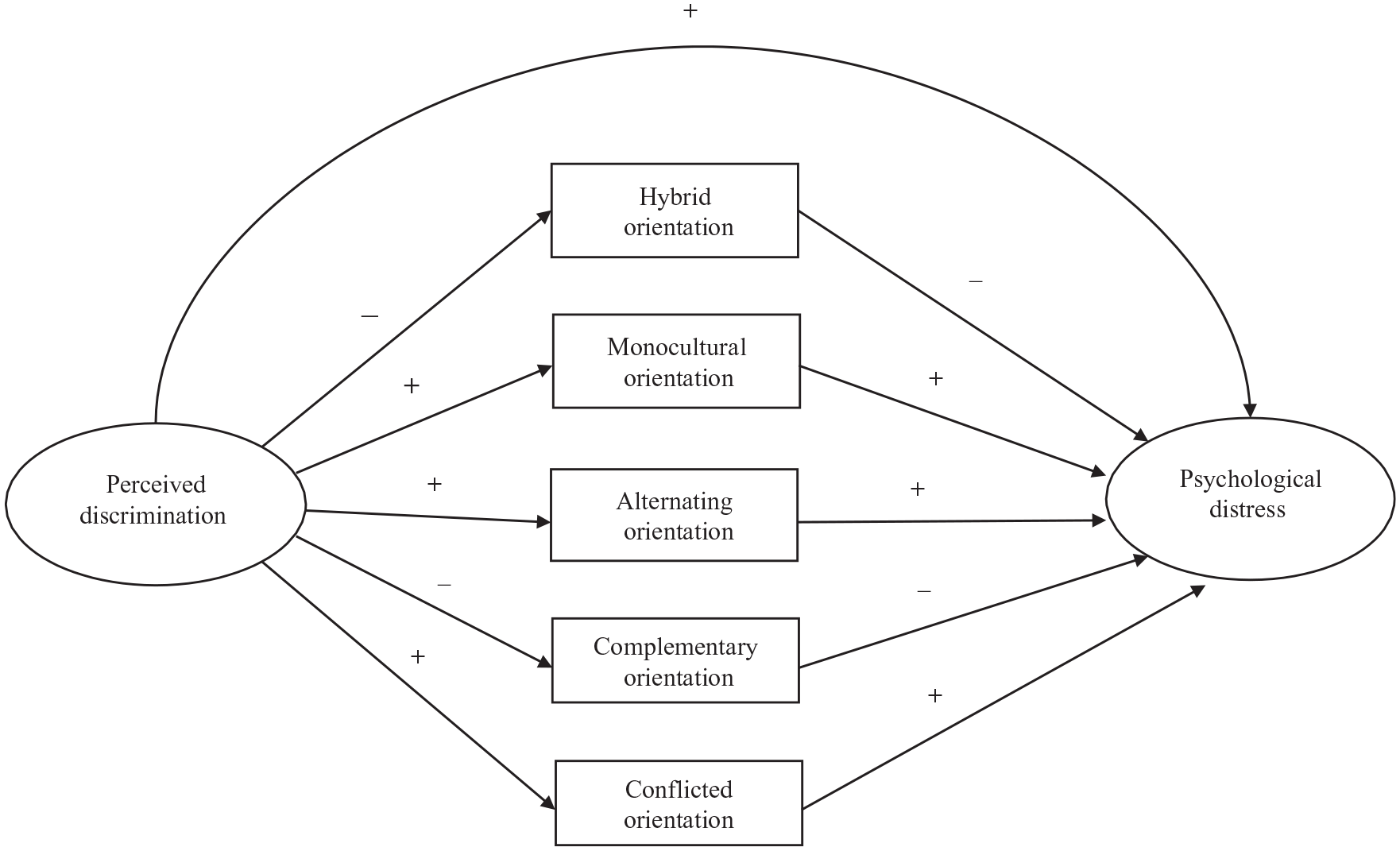
The proposed model.
Method
Procedures
This study was part of a larger investigation examining the intercultural interactions and experiences of individuals from immigrant backgrounds. Potential participants were identified through a prescreening test of undergraduate students taking introductory psychology courses at a large Western Canadian university. According to Statistics Canada (2017a), the city in which the study was conducted has a population of nearly 1 million people, with 67.2% nonimmigrants, 30.0% immigrants, and 2.8% nonpermanent residents. Although less than Toronto (46.1%) and Vancouver (40.1%), it is similar to several other large Canadian cities in that almost a quarter of its citizens are recent immigrants (23.8%), which approximates the national average (21.9%; Statistics Canada, 2017d). Approximately half of the population is of European descent (55.8%), and the other half consists of people who have origins in other parts of the world: East, South, and Southeast Asians (25.4%), including Chinese (7.4%), Indians (7.4%), and Filipinos (6.2%), constitute the largest ethnic minority groups in the city (Statistics Canada, 2017a). Following Toronto (51.37%), Vancouver (48.8%), and Calgary (33.71%), the city has the fourth highest proportion of visible minorities (28.06%) of major Canadian cities, which is just slightly higher than the national average (22.27%; Statistics Canada, 2017c).
Based on their responses to a question asking whether they, their parents, or grandparents had been born outside Canada, volunteers were invited to participate in the study. Those who agreed to participate filled out an online survey in small-group testing sessions that lasted 45–50 minutes. The study was approved by the institutional ethics review committee at the University of Alberta. Participants were compensated with partial course credit for their collaboration. The data were collected across 2 academic years, from 2017 to 2019.
Participants
The initial sample included 1,402 participants. Two hundred forty‑four participants were excluded from the sample because they were international students. An additional 15 participants were excluded either because their citizenship status in Canada was unknown (n = 6) or because they did not complete the survey (n = 9). The final sample consisted of 1,143 participants (66.4% females) who were Canadian citizens (84.8%) or permanent residents (15.2%). Their ages ranged from 17 to 52 years (M = 19.18, SD = 2.65), with 97.1% being younger than 25 years old.
Participants were either first-, second-, or third-generation immigrants. The first-generation participants comprised the largest proportion of the sample (54.3%). Most of these participants (94.8%) migrated to Canada before the age of 18. The mean age at immigration was 9.20 years (SD = 5.36), and the mean length of residence in Canada was 10.34 years (SD = 4.70). The second largest group of participants was second-generation immigrants, constituting 41.4% of the sample. Of these, 18.7% had only one parent born outside Canada, while the rest had both parents born outside Canada. The remaining 4.3% of the sample were third-generation immigrants who were born in Canada to two Canadian-born parents but had at least one foreign-born grandparent.
Participants came from diverse ethnic, religious, and linguistic backgrounds. Almost 20% (18.3%) of the sample identified as Chinese, 13.9% as Indian, 11.7% as Filipino, 5.7% as Pakistani, 5.0% as Korean, 3.9% as Vietnamese, and the rest as members of other ethnic groups such as British, German, Lebanese, Nigerian, Polish, and Ukrainian. Most participants (64.6%) identified with a religious group, with Christian (54.0%), Muslim (20.5%), Sikh (8.8%), Hindu (6.6%), and Buddhist (6.5%) as the most reported identities among these participants. One third of the sample (37.5%) indicated that their native language was a language other than English, 26.2% indicated English as their native language, and 36.3% indicated that they had two or more native languages, one of them being English.
Measures
Perceived discrimination
Perceived discrimination was measured using seven items adapted from previous research (Taylor et al., 1990). On 6-point scales (1 = never, 6 = always), participants rated the extent to which their ethnic group experienced discrimination by Canadians due to the following reasons: (1) racial characteristics, (2) cultural practices, (3) newcomer status to Canada, (4) language skills, (5) religious faith, (6) clothing or other aspects of dressing, and (7) sex/gender. The items produced a reliable measure of perceived discrimination, with a Cronbach’s alpha of .90. Using the item-to-construct balance method (Little et al., 2002), the items were parceled to create three indicators for the latent perceived discrimination variable. The first parcel included three items (1, 7, 3), the second and third parcels included two items (2 and 5; 6 and 4, respectively).
Bicultural identity orientations
Bicultural identity orientations were assessed using the 20-item Bicultural Identity Orientation Scale (Comănaru et al., 2018). The scale consisted of five subscales evaluating five orientations of bicultural identity: hybrid, monocultural, alternating, complementary, and conflicted. Each orientation was measured with four items. Sample items include: “I feel my identity is a mix of two cultures” (hybrid), “If I were born again, I’d choose to be part of only one cultural group” (monocultural), “I often find myself switching between cultures in different situations” (alternating), “Although they are different, the two cultural groups I identify with go well together” (complementary), and “There is a conflict within myself between the two cultures I belong to” (conflicted). Participants rated their agreement with each statement on 7-point Likert scales (1 = strongly disagree, 7 = strongly agree). Cronbach’s alphas across the subscales ranged from .72 to .89. Mean scores were computed for each subscale, which were entered as observed variables into the analyses.
Psychological distress
Psychological distress was evaluated using the 21-item version of Lovibond and Lovibond’s (1995) Depression Anxiety Stress Scales. The scale comprised three seven-item subscales, each measuring the dimensions of depression, anxiety, and stress. On 4-point scales (1 = never, 4 = almost always), participants rated how frequently they experienced the symptoms of depression (e.g., “I felt down-hearted and blue,” “I felt that life was meaningless”), anxiety (e.g., “I felt scared without any good reason,” “I was aware of dryness of my mouth”), and stress (e.g., “I found it difficult to relax,” “I tended to overreact to situations”) over the past week. Cronbach’s alphas were .90, .83, and .85 for depression, anxiety, and stress, respectively. Mean scores were computed for each subscale, which were used as three indicators of the latent psychological distress variable.
Analytic Plan
Preliminary analyses were conducted in SPSS Version 26. Major analyses were conducted in Mplus Version 8, using structural equation modeling (SEM) with maximum likelihood estimation. We note that SEM cannot provide causal evidence for the modeled relationships (MacCallum & Austin, 2000), as causal evidence requires the existence of temporal precedence and the elimination of alternative explanations. However, SEM is still useful for applying theoretical models to observed correlational data and has many advantages over the other regression-based procedures (Kline, 2016). For example, it allows for a simultaneous and holistic analysis of the direct and indirect associations between latent and observed variables while accounting for control variables. In addition to testing multiple paths in one analysis, it also allows for error terms and interrelated variables to covary with one another. Because of such advantages that are consistent with our research question, we employed SEM in the current study.
Consistent with the two-step modeling approach (Anderson & Gerbing, 1988), the measurement model was first tested using confirmatory factor analysis (CFA) with unit loading identification. Once the measurement model was found satisfactory, then the structural model was tested. To test the structural model, direct paths were added from perceived discrimination to psychological distress, from perceived discrimination to bicultural identity orientations, and from bicultural identity orientations to psychological distress. In this step, the demographic variables of age, sex (coded as 0 = female vs. 1 = male), ethnicity (dummy-coded as 0 = Asian vs. 1 = other), religious belief (coded as 0 = believer vs. 1 = nonbeliever), religious identity (dummy-coded as 0 = Christian vs. 1 = other), citizenship status (coded as 0 = Canadian citizen vs. 1 = permanent resident), and immigration generation (dummy-coded into two variables as 0 = first generation vs. 1 = other, and 0 = second generation vs. 1 = other) were added as control variables to the model. Following the multiple-indicators multiple-causes approach (Bollen, 1989), all focal variables were regressed on the control variables. Nonsignificant paths from the control variables were removed from the model, one by one, to preserve model parsimony.
Given that chi-square (χ2) is sensitive to large sample sizes and can indicate a poor fit even when the model is well specified (Marsh et al., 2004), multiple fit indices such as root-mean-square error of approximation (RMSEA), standardized root-mean-square residual (SRMR), comparative fit index (CFI), and Tucker–Lewis index (TLI) were also used to evaluate the model fit. A nonsignificant chi-square, values of .05 or smaller for RMSEA and SRMR, and values of .95 or higher for CFI and TLI indicate good fit (Hu & Bentler, 1999). Residuals and modification indices were examined to identify localized areas of misfit, and to include additional paths that would improve the global fit. The fit of nested models was compared using the chi-square difference test. A significant Δχ2 indicates that the model fit is improved by including additional paths. After establishing the structural model, the indirect paths from perceived discrimination to psychological distress through bicultural identity orientations were tested with bootstrapping procedures, where a confidence interval (CI) not including zero indicates a significant indirect effect (MacKinnon et al., 2004).
While testing for mediation or indirect effects is common in social psychological research (Pek & Hoyle, 2016; Rucker et al., 2011), there is emerging literature criticizing the use of mediation in cross-sectional studies (Maxwell & Cole, 2007; O’Laughlin et al., 2018). It is argued that mediational models are causal processes that develop over time and thus require time precedence. As such, the use of mediation is suggested to be limited to longitudinal designs because cross-sectional designs can sometimes fail to capture true indirect effects and lead to biased results. Nevertheless, some methodologists, like Hayes (2018), do not deem it problematic to conduct a mediation analysis with cross-sectional data, acknowledging that the existence of an indirect effect is not proof of causality. Therefore, though we use mediation analysis in the current study, readers should note that a significant indirect effect implies that a temporal or causal relation is only one possible reason for the associations between variables, and that longitudinal data will be needed to further test such a claim.
Results
Preliminary Analyses
Descriptive statistics and bivariate correlations for the study variables are presented in Table 1. Participants reported low levels of perceived discrimination, depression, anxiety, and stress. With regard to bicultural identity orientations, they reported high scores on hybrid, complementary, and alternating orientations, but low scores on conflicted and monocultural orientations. A one-way repeated-measures analysis of variance with Greenhouse–Geisser correction was performed to compare the means for bicultural identity orientations. The results revealed a significant difference between the means, F(2.42, 2755.84) = 1,317.98, p < .001, η2 = .54. Post hoc tests with Bonferroni correction showed that there was a significant difference between each pair of orientations (ps < .001), meaning that hybridity was the most strongly endorsed orientation among the participants, followed by complementary, alternating, conflicted, and monocultural orientations.
Descriptive statistics and bivariate correlations for study variables (n = 1,143).
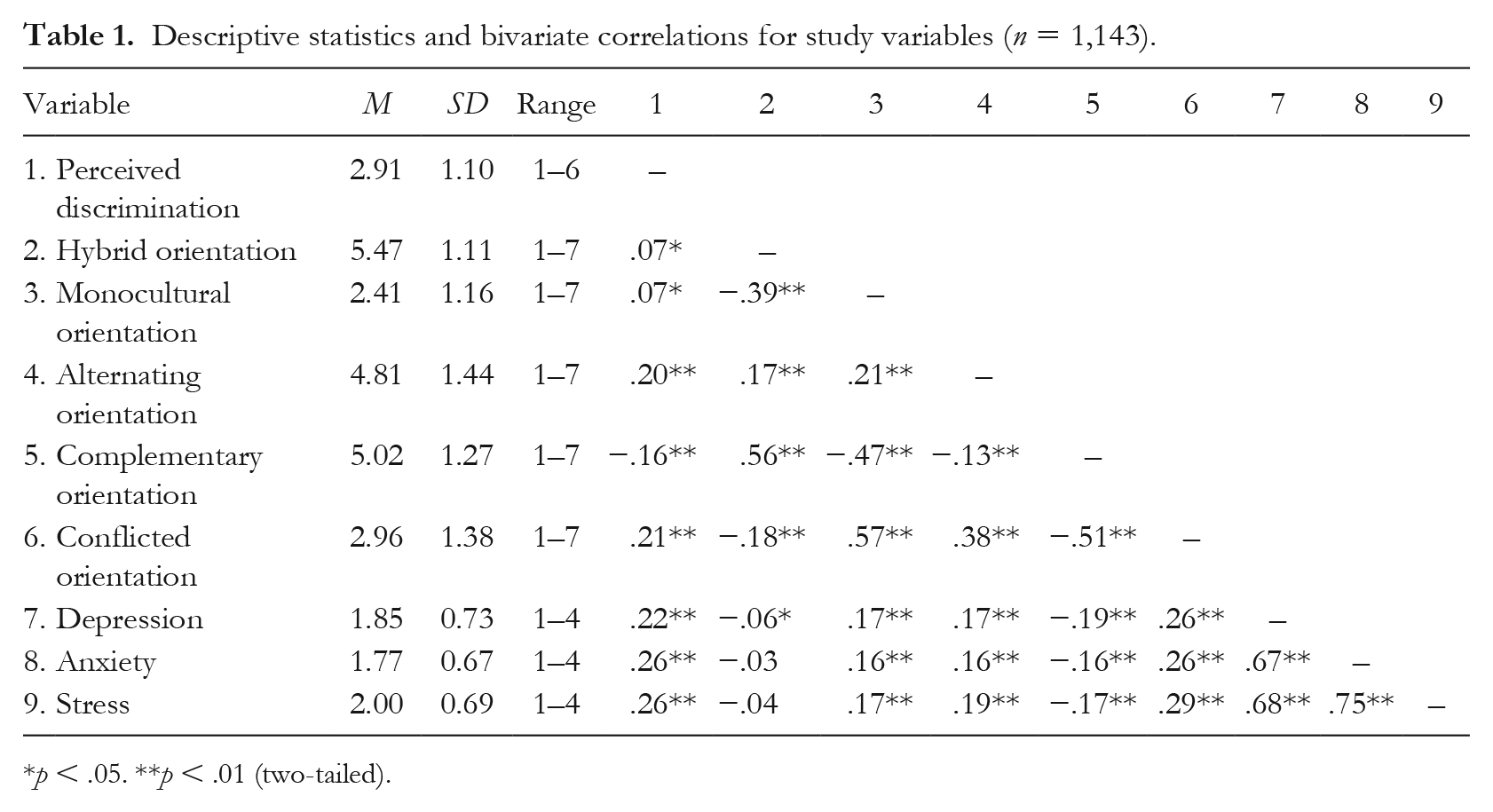
p < .05. **p < .01 (two-tailed).
Perceived discrimination was positively correlated with psychological distress variables. While perceived discrimination was negatively correlated with complementary orientation, it was positively correlated with the other orientations. Hybrid and complementary orientations were negatively—whereas monocultural, alternating, and conflicted orientations were positively—correlated with psychological distress variables. Bicultural identity orientations and psychological distress variables were also each correlated with one another.
Major Analyses
Measurement model
The results of CFA showed that the measurement model fit the data very well, χ2(8) = 11.35, p = .18, RMSEA = .02, 90% CI [0.00, 0.04], SRMR = .01, CFI = .99, TLI = .99. An examination of the individual indicators revealed that the standardized item loadings ranged from .77 to .90 for perceived discrimination, and from .78 to .87 for psychological distress (ps < .001), meaning that all loadings exceeded the recommended .71 threshold (Kline, 2016).
Structural model
The results of SEM indicated poor fit to the data, χ2(82) = 1,869.38, p < .001, RMSEA = .14, 90% CI [0.13, 0.14], SRMR = .10, CFI = .71, TLI = .61. An examination of residuals and modification indices suggested that adding correlational paths between bicultural identity orientations could substantially improve the model fit. Therefore, a revised model was tested with these covariances added. The revised model proved a good fit to the data, χ2(72) = 224.48, p < .001, RMSEA = .04, 90% CI [0.04, 0.05], SRMR = .03, CFI = .98, TLI = .96, accounting for 19% of the variance in psychological distress. The chi-square difference test showed that the revised model fit the data better than the original model, Δχ2(10) = 1,644.90, p < .001. The final model is depicted in Figure 2.
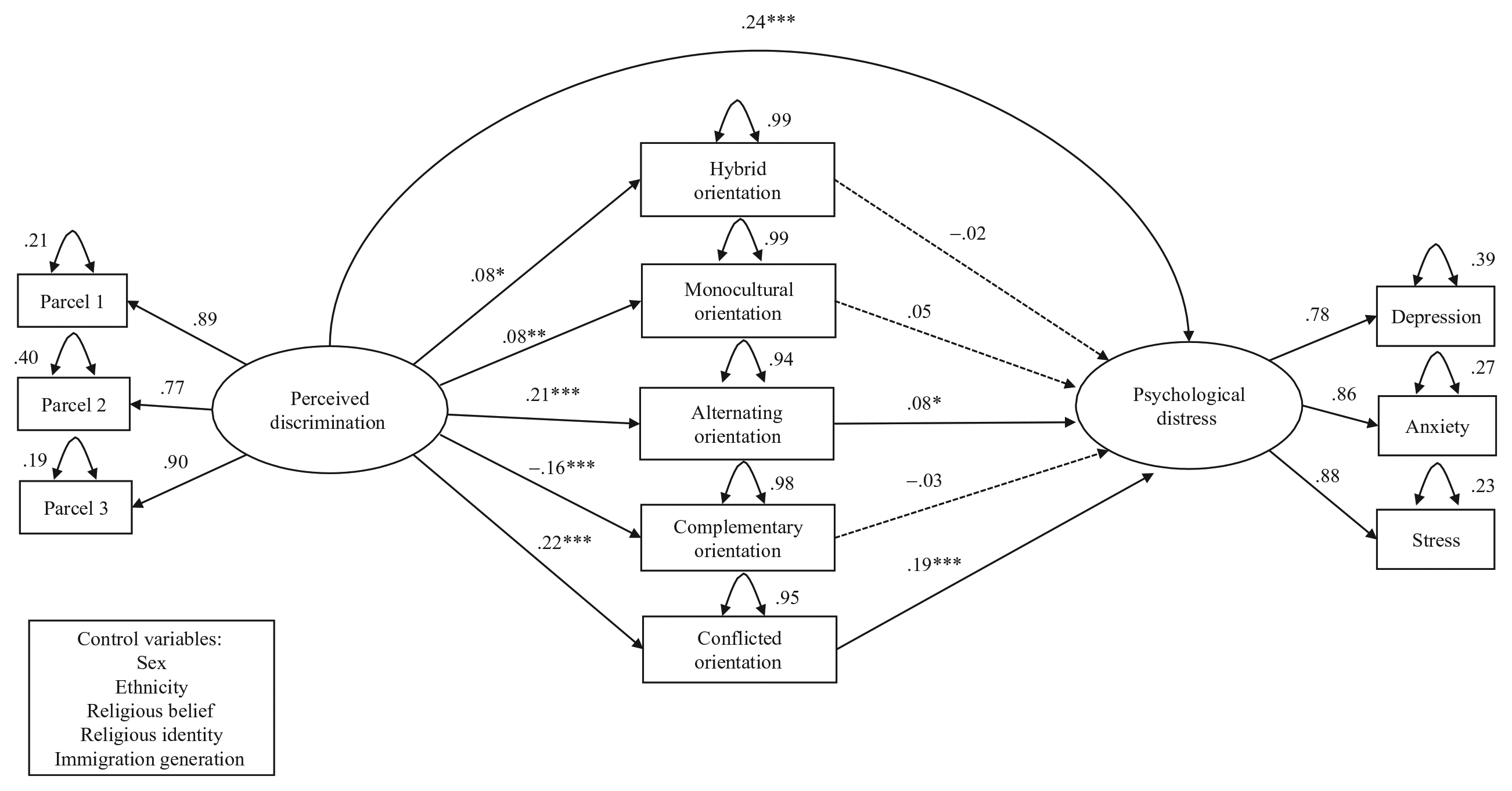
The final model (n = 1,143).
The modifications to the covariances among bicultural identity orientations revealed that conflicted orientation was correlated with higher levels of monocultural and alternating orientations (β = .58 and β = .35, ps < .001, respectively), but lower levels of hybrid and complementary orientations (β = −.20 and β = −.49, ps < .001, respectively). Complementary orientation was correlated with stronger hybrid orientation (β = .58, p < .001), but weaker monocultural and alternating orientations (β = −.47, p < .001 and β = −.10, p < .01, respectively). Alternating orientation was correlated with greater hybrid and monocultural orientations (β = .15 and β = .20, ps < .001, respectively), which were negatively correlated with each other (β = −.40, p < .001).
In terms of the control variables, the paths from age and citizenship status were entirely trimmed from the analyses because they were not related to any focal variable. Being female was associated with higher levels of perceived discrimination and psychological distress (β = −.20 and β = −.12, ps < .001, respectively), whereas being male was associated with stronger monocultural orientation (β = .10, p < .001). Being Asian was related to greater perceived discrimination (β = −.20, p < .001) and stronger alternating orientation (β = −.09, p < .01), whereas being non-Asian was related to higher psychological distress (β = .11, p < .001). Believing in a religion was predictive of greater perceived discrimination and stronger endorsement of hybrid orientation (β = −.25 and β = −.07, ps < .01, respectively). Believing in a religion other than Christianity was associated with greater perceived discrimination (β = .25, p < .001). Finally, being second- or third-generation immigrant was related to greater perceived discrimination (β = .06, p = .045), whereas being first-generation immigrant was related to stronger alternating orientation (β = −.07, p < .01).
As presented in Figure 2, results pertaining to the hypotheses indicated that perceived discrimination was associated with weaker complementary, but stronger hybrid, monocultural, alternating, and conflicted orientations. Perceived discrimination was also associated with higher psychological distress. Alternating and conflicted orientations were related to higher psychological distress, but hybrid, monocultural, and complementary orientations were not related to it.
Indirect effects
The indirect effects from perceived discrimination to psychological distress were simultaneously tested using 2,000 bootstraps and bias-corrected 95% CIs (Preacher & Hayes, 2008). Two indirect paths were found significant. First, the perceived discrimination → alternating orientation → psychological distress path was significant, β = .02, p < .05, 95% CI [0.00, 0.03]. Second, the perceived discrimination → conflicted orientation → psychological distress path was significant, β = .04, p < .001, 95% CI [0.02, 0.07]. These findings mean that a 1 SD unit increase in perceived discrimination is associated with a .02 and .04 SD unit increases in psychological distress through the prior effect of perceived discrimination on alternating and conflicted orientations, respectively, holding the other orientations and the control variables constant. The remaining three indirect paths were not significant.
Discussion
There has been plenty of interest in the mechanisms whereby discrimination affects well-being, with much research focusing on the role of social identity, especially ethnic and national identity (Cvetkovska et al., 2020; Hakim et al., 2018). Far less is known, however, about how people configure their multiple identities, and how different identity configurations relate to discrimination (Yampolsky & Amiot, 2016) and well-being (Arias-Valenzuela et al., 2019). Furthermore, no previous research has explored if specific bicultural identity orientations uniquely mitigate or aggravate the effect of discrimination on well-being. This study advances our knowledge of bicultural identity orientations by (a) examining the direct associations between perceived discrimination, bicultural identity orientations, and psychological distress, and (b) investigating how perceived discrimination indirectly affects psychological distress by increasing or reducing bicultural identity orientations.
Consistent with the accumulated research indicating that discrimination has adverse effects on immigrants’ well-being (de Freitas et al., 2018), we found that discrimination was predictive of higher distress. Given that we focused on group rather than personal discrimination, this finding suggests that not only personal but also group discrimination is a notable risk factor threatening well-being. Before elaborating on the direct and indirect associations of bicultural identity orientations with discrimination and distress, we discuss tendencies toward and interrelations among bicultural identity orientations to better interpret the results.
Tendencies Toward Bicultural Identity Orientations
Berry (1997) claimed that integration would be the preferred acculturation strategy among immigrants. Subsequent research provided evidence for this claim (Berry et al., 2006), and our study provides further evidence. We found that hybridity and complementarity, which might be considered as two possible identity integration strategies, 2 were the most strongly endorsed orientations by the participants. This tendency can be attributed to contextual factors. Consistent with Berry’s (1997) proposition that immigrants tend to pursue an integration strategy when the level of prejudice in society is low, this tendency could be a result of the low level of discrimination reported by the participants. This low level of perceived group discrimination is perhaps not surprising, given the relatively welcoming environment for immigrants in Canada, an ethnically diverse country where multiculturalism is an important, long-standing federal policy (Noels & Berry, 2016). It can be argued that national programs on migration and ethnocultural diversity promote a sense of integration among immigrants to Canada. This explanation agrees with evidence that higher BII is associated with more culturally diverse social networks (Mok et al., 2007).
Personal factors might also help explain this tendency. We found that believing in a religion was associated with stronger hybridity. It can be suggested that being a believer predicts hybridity because believers are more likely to seek support from religious institutions that can provide their members with a social connection to both the heritage and host communities (Steffen & Merrill, 2011), which facilitates integration. In line with research showing that the relationship between religious identity and acculturation is dependent on the nature of intercultural relations (Phalet et al., 2018), it can also be suggested that the relatively positive social encounters between immigrants and Canadians (indicated by low levels of discrimination) enable a compatible religious identity that is adaptive in the acculturation process. However, it should be noted that the religion–acculturation relationship is more complex than we suggest because there is also evidence indicating that religiosity fuels a monocultural rather than bicultural orientation (Goforth et al., 2014).
In addition to hybridity and complementarity, alternation was also endorsed by the participants, though not so strongly as the other two. This relatively moderate rating replicates the results of Comănaru et al. (2018). Examining bicultural identity orientations of immigrants to Canada, Comănaru et al. found that participants reported greater hybridity and complementarity than alternation, and these were more strongly endorsed than monoculturalism and conflict. The fact that alternation was concurrently endorsed with hybridity and complementarity can be interpreted as follows: Immigrants living bicultural lives navigate between the two cultures as they integrate their two identities to achieve compatible acculturation. Further replicating Comănaru et al., the endorsement of alternating orientation was related to immigration generation, such that being a first-generation immigrant predicted stronger alternation. This finding is in line with previous research (Ward et al., 2018) and supports Berry’s (1997) theorizing that preferences for acculturation strategies might change across generations.
Interrelations Among Bicultural Identity Orientations
Conflict was positively related to monoculturalism and alternation. This finding parallels prior research indicating that lower BII harmony (greater conflict) relates to higher alternation (Schwartz et al., 2019; Ward et al., 2018), and supports Roccas and Brewer’s (2002) theorizing that alternation implies conflict. Different from Ward et al. (2018), who found no relation between conflict and hybridizing, we found a negative relation between the two. Similar to Ward et al.’s (2018) finding that lower conflict is linked with higher BII blendedness (greater integration), however, we also found a negative relationship between conflict and complementarity. The fact that conflict was in a negative relation to hybridity and complementarity can be attributed to the fact that hybridity and complementarity were positively interrelated, suggesting that the two may indicate an integrative acculturation strategy. Contrary to conflict, complementarity was negatively related to monocultural and alternating orientations, which confirms the findings of Comănaru et al. (2018).
Alternation was positively connected to hybridity and monoculturalism. These results are in line with those of Yampolsky et al.’s (2016) study, which showed that compartmentalization was positively interrelated with integration and categorization dimensions of multicultural identity. As for the relationship between hybridity and monoculturalism, the relation was negative, further confirming the findings of Comănaru et al. (2018). In fact, all results concerning the correlations among bicultural identity orientations replicated those of Comănaru et al., with only one exception: Whereas the previous did not find a correlation between alternation and hybridity, the present study showed a positive correlation between the two. This finding coincides with prior work indicating that hybridity or integration and alternation or compartmentalization dimensions of bicultural identity are positively interrelated (Schwartz et al., 2019; Yampolsky et al., 2016).
The finding that alternation was linked to higher hybridity presents potential avenues for future research. One aspect of alternation relates to cultural frame-switching, which refers to the experience of changing one’s mindset from one cultural knowledge system to another in response to situational cues (Hong et al., 2000; West et al., 2017). Another aspect of alternation relates to the suppression or concealment of one’s cultural identities while frame-switching (Yampolsky et al., 2016). In a similar vein, using a situated identity approach, Zhang and Noels (2013) found that situational switching was not associated with distress as long as the person felt they were being true to their authentic self. Whereas frame-switching is considered to be adaptive for bicultural people (Benet-Martínez et al., 2006), suppressing or concealing social identities is considered to be stressful (Madera et al., 2012). As such, the distinction between these two aspects may offer further insights into the relationship between alternation and hybridity.
Discrimination and Bicultural Identity Orientations
Identity integration theories propose discrimination as a risk factor that may hamper reconciling identities (Amiot et al., 2007; Benet-Martínez & Haritatos, 2005). Supporting these theories, research has shown that discrimination predicts lower BII (Ferrari et al., 2019; Huynh et al., 2018). Consistently, we found that discrimination was linked with weaker complementary orientation, meaning that the perception that Canadians discriminate against the heritage group undermined the sense of compatibility between the two cultural identities. Inconsistently, however, discrimination predicted stronger hybrid orientation at both the bivariate and multivariate levels of analysis. This opposite finding can be explained with the rejection–identification effect (Branscombe et al., 1999). It is possible that being rejected by one of the two cultural groups facilitates identification with both groups, but in different ways than in contexts where there is greater intergroup harmony. In the case where identification with both groups is problematic (due to stigma from either reference group), bicultural people may select aspects of each culture and create a new, third-culture hybrid identity to accommodate both groups. Some empirical evidence supports this contention. For example, assessing bicultural identity in a similar way to hybrid orientation, Wiley (2013) showed among Latinos in the United States that rejection from other Latinos increased bicultural identity. This inconsistency requires more research to reveal the complexity of the discrimination–identity integration relationship.
We found that discrimination was associated with stronger monocultural orientation. This finding converges with the rejection–identification and rejection–disidentification models (Branscombe et al., 1999; Jasinskaja-Lahti et al., 2009). These models posit that minorities tend to identify with their ethnic group and disidentify from the national group when they are rejected by the latter. Following this position, it can be argued that perceiving discrimination from the host society prompts immigrants to be heritage-oriented, monocultural individuals. Although this reasoning is consistent with studies indicating that discrimination is related to weaker identification with multiple groups (Grant, 2007; Lalonde et al., 1992), there is also research showing no relation between discrimination and a categorical (i.e., monocultural) identity orientation (Yampolsky & Amiot, 2016), which warrants further investigation. It could simply be that because current assessments of monocultural identity do not indicate a specific ethnocultural group, respondents may vary in how they interpret the items. A better measurement strategy for monoculturality would be to use separate dimensions that specify each reference group.
Similar to monocultural orientation, discrimination was also associated with stronger alternating and conflicted orientations, suggesting that discrimination triggers a motive to switch between, and a sense of conflict about, two cultural identities. These findings align with identity integration perspectives. Benet-Martínez and Haritatos (2005) predict that discrimination lowers identity integration; that is, it increases identity conflict. Relying on Benet-Martínez and Haritatos, Amiot et al. (2007) argue that discrimination facilitates identity alternation. Both perspectives have been supported by previous studies (Ferrari et al., 2019; Yampolsky & Amiot, 2016), and our study provides further support.
Bicultural Identity Orientations and Distress
Contrary to extant research indicating that hybrid or complementary orientation is related to better well-being (Schwartz et al., 2019; Ward et al., 2018) whereas monocultural orientation is related to poorer well-being (Yampolsky et al., 2016), we did not find a relationship between these orientations and psychological distress. Although bivariate correlations revealed that there were significant associations among these constructs in the expected direction, those associations were attenuated in the multivariate model. The reduction of those associations suggests that alternating and conflicted orientations have greater predictive power over hybrid, monocultural, and complementary orientations because both alternating and conflicted orientations were associated with psychological distress.
Previous theorizing argues that integrating identities should predict better well-being because it involves identity reconciliation that promotes greater self-coherence (Amiot et al., 2007; Benet-Martínez & Haritatos, 2005). Conversely, our findings showed that hybrid and complementary orientations, both of which involve identity reconciliation, were not related to psychological distress. It could be the case that we could not obtain the expected relationship because we focused on negative rather than positive affectivity when assessing well-being. There is some empirical evidence supporting this contention. For example, Ward et al. (2018) found that although a hybrid identity style was associated with greater life satisfaction, which is part of positive affectivity, it was not associated with psychological distress. This finding suggests that the hybrid orientation–well-being relationship could be more complicated than has heretofore been considered, and that hybrid orientation could be differentially related to positive and negative affect. This contention, however, warrants further systematic research.
Studies based on Berry’s (1997) acculturation model suggest that bicultural-identified immigrants report better well-being than monocultural-identified immigrants (Baker et al., 2012; Zhang et al., 2018). Studies based on identity integration approaches (Amiot et al., 2007; Benet-Martínez & Haritatos, 2005) corroborate these findings, indicating that monocultural orientation of bicultural identity is related to lower self-esteem (Comănaru et al., 2018) and higher negative affect (Yampolsky et al., 2016). However, we found that monocultural orientation was not associated with psychological distress, though it was correlated with higher depression, anxiety, and stress at the bivariate level. This finding can be seen as evidence that monoculturalism is not necessarily detrimental. It is clear from prior work that people lose out on the psychological benefits of biculturalism when they have a monocultural tendency (Nguyen & Benet-Martínez, 2013). However, our study suggests that this tendency is not the unhealthiest attitude because it does not predict higher psychological distress. Supporting this argument, Yampolsky et al. (2013) found that monocultural-oriented individuals performed better in narrative coherence, which can be considered as an indicator of well-being, than alternation-oriented individuals. Given these findings, further research is warranted to establish the role of monoculturalism in well-being.
We found that alternating orientation was related to higher psychological distress. This finding is divergent from research that assessed alternation differently than we did. For example, in a dairy study that focused on daily fluctuations in cultural orientations, Schwartz et al. (2019) showed that these fluctuations (analogous to an alternating orientation) were not related to well-being. In a series of studies that focused on identity variation across different social situations, Noels and colleagues indicated that variations in identity were associated with better well-being in some conditions (Noels & Clément, 2015; Zhang & Noels, 2013). Our finding, however, converges with research that assessed alternation in a similar way that we did (Ward et al., 2018; Yampolsky et al., 2016) and provides evidence for Roccas and Brewer’s (2002) theorizing on social identity complexity, which argues that alternation is problematic in and of itself. Our finding suggests that although alternation can be functional in some psychological domains, such as linguistic code-switching (Myers-Scotton, 1993) and cultural frame-switching (Benet-Martínez et al., 2002), it can be detrimental as an identity orientation. More research on when and why alternation may have salutogenic or pathogenic effects is needed.
Roccas and Brewer (2002) argued that “[i]ndividuals who adopt this [alternating identity] strategy have a sense of competence in both cultures but also an awareness of conflict between cultures that renders biculturalism sometimes problematic” (p. 93). Supporting this argument, conflicted orientation was related to higher psychological distress. This finding is consistent with the accumulated research on Benet-Martínez and Haritatos’s (2005) construct of BII, on which lower scores reflect a conflictual bicultural identity. Benet-Martínez et al. (2006) showed among Chinese Americans that lower BII was related to more cognitive dissonance, which relates to poorer well-being (Nor & Smith, 2019). Examining BII of Italian transracial adoptees, who experience biculturalism in comparable ways to immigrants, Manzi et al. (2014) indicated that lower BII predicted more behavioral problems. Corroborating these studies, our study suggests that a conflicted identity can pose challenges for immigrants in affective in addition to cognitive and behavioral domains.
Overall, these findings underline the fact that being bicultural does not necessarily mean benefiting from biculturalism, as suggested by prior work (Nguyen & Benet-Martínez, 2013). The psychological benefits or downsides of biculturalism are rather nested in how individuals conceive of their identities. In this respect, our findings do not align with Berry’s (2013) proposition of alternation and merging as two forms of biculturalism to achieve a healthy cultural adaptation. Although there is empirical evidence supporting this proposition (Stuart & Ward, 2011), we found that alternation was related to higher psychological distress, whereas hybridity was not related to it. As such, our study suggests that neither alternation nor merging operates in the way proposed by Berry (2013), and thus calls for a theoretical refinement to our understanding of biculturalism as an acculturation strategy (Boski, 2008).
The Intermediary Role of Bicultural Identity Orientations
A notable finding from this study was that two of the five bicultural identity orientations emerged as distinct mechanisms whereby discrimination affected well-being. Specifically, discrimination was uniquely associated with increased alternating and conflicted orientations, which in turn predicted higher psychological distress, after accounting for the role of all other orientations and control variables. The null indirect effect of hybrid, monocultural, and complementary orientations can be attributed to the fact that they were not related to psychological distress. Given that no previous study simultaneously tested multiple dimensions of bicultural identity as an intermediary between discrimination and well-being, we made an important contribution to the literature.
Our findings were similar to those of Ferrari et al. (2019) in that we found conflicted orientation to be an intermediary between discrimination and well-being. These findings support Benet-Martínez and Haritatos’s (2005) theorizing that external and internal factors play a role in bicultural identification. Benet-Martínez and Haritatos argued that individuals low in BII are particularly sensitive to tensions between cultural orientations. Following this argument, it can be suggested that discrimination, as an external factor, promotes a sense of internal conflict in bicultural individuals, which in turn undermines their well-being. In other words, bicultural identities and their consequences are not only embedded within individuals but also dependent upon contextual pressures like negative intercultural relations.
Contrary to Ferrari et al. (2019), who assessed bicultural identity as a singular construct, we acknowledged the multidimensionality of bicultural identity, which yielded an additional indirect effect of alternating orientation. One possible explanation for this effect can be based on Amiot et al.’s (2007) CDSMII. Different from intergroup theories of social identity that conceive of identity changes as occurring in shorter terms, CDSMII proposes that identity changes develop over time, at four stages. Of these, the compartmentalization stage is particularly relevant to the effect of alternating orientation. At this stage, bicultural individuals retain multiple identities within the self, experience no conflict between them, and switch between them depending on the context. Building upon this theorizing, it can be concluded that discrimination, as a contextual factor, prompts immigrants to alternate between their identities and thus prevents them from proceeding to the final stage of identity integration, which ultimately inhibits their well-being. This conclusion, however, should be interpreted with caution because research supporting CDSMII relies largely on cross-sectional designs that fail to explain how bicultural individuals integrate multiple identities into their self-concept at different times under different situations. We need further evidence for the CDSMII from longitudinal studies with a contextual and developmental approach.
Limitations
Longitudinal studies indicate that discrimination leads to poorer well-being (English et al., 2014) and changes in identification (Ramos et al., 2012), and that those changes in identification lead to mental health outcomes (Schwartz et al., 2015). Although these studies provide empirical evidence for the directionality of our model, we could not determine causality because of our cross-sectional design. Future studies might benefit from using a cross-lagged or longitudinal design to identify the reciprocal or causal relationships among discrimination, identification, and well-being. A second limitation relates to the characteristics of the sample. Participants were Canadian undergraduate students with an immigrant family background, which may limit the applicability of the findings to the general immigrant population in Canada. Nevertheless, census data show that over half of the immigrants who landed in Canada between 2011 and 2016 had at least an undergraduate degree (Statistics Canada, 2017b), suggesting that our sample could be representative of immigrants to Canada in terms of educational background. Third, we used self-report measures that are usually prone to social desirability bias (Paulhus, 1984), which may contaminate responses, especially on publicly sensitive issues like discrimination and well-being (Williams & Mohammed, 2009). Future research is suggested to use narratives, diaries, or social networks to overcome the limits of self-report measures in assessing these constructs (Doucerain et al., 2017). Finally, the items measuring monocultural orientation focused on identification with one cultural group, without distinguishing between the heritage and mainstream cultures. Therefore, we cannot know which culture was the predominant group for the participants. Given that an orientation toward the heritage culture over the mainstream culture, or vice versa, may have different intergroup implications (Bagci & Canpolat, 2020), future research can utilize a monoculturalism measure that differentiates between the two cultures. Such a measure would enable us to see how discrimination from the mainstream group relates to different cultural orientations of one’s predominant identification.
Future Directions
This study provides a foundation for future research in the emerging field of bicultural identity orientations. While we studied discrimination from Canadians toward the heritage group, research suggests that immigrants can also experience discrimination from their in-group because of adopting the language, culture, and values of the host society (Wiley, 2013). Given that people might react differently in response to such discrimination (Jetten et al., 2006), future studies should examine how discrimination from one’s in-group affects bicultural identity orientations. Whereas we focused on consequences of discrimination for well-being, studies indicate that discrimination also has implications for intergroup relations (Jasinskaja-Lahti et al., 2012), including intraminority relations (Craig & Richeson, 2012). Therefore, future studies may investigate how discrimination relates to majority–minority and minority–minority attitudes in conjunction with bicultural identity orientations.
Implications
Findings from this study have potential implications, especially in educational and work settings. The finding that perceived discrimination was associated with higher psychological distress suggests that even group discrimination, let alone personal discrimination, can have detrimental effects on immigrant students’ mental health. Therefore, it is important for educational professionals to acknowledge that discrimination, whatever its type and magnitude, is a risk factor affecting immigrant students’ well-being. Given that these students tend to avoid seeking mental help due to stigmatization (Cheng et al., 2013), it is critical for support providers to pay attention and reach out to them. In light of the finding that perceived discrimination was indirectly related to psychological distress through its direct relationship with alternating and conflicted orientations, counselors may consider how to support more positive identity orientations. Promoting bicultural competence, for example, might be helpful for immigrant students to negotiate conflicts between their identities (Wei et al., 2010).
Conclusion
This study sheds light on the effect of perceived discrimination on psychological distress among Canadian university students from immigrant families, with a focus on the intermediary role of bicultural identity. Given the scale of international migration worldwide, and the increasing number of immigrants in Canada, this research is timely and of the utmost sociopolitical importance. The findings highlighted the importance of alternating and conflicted bicultural identities as potential risk factors affecting immigrants’ mental health in the face of discrimination. Practitioners who work with immigrant students might benefit from these findings by, for example, exploring how to reduce feelings of cultural conflict.
Footnotes
Funding
The author(s) disclosed receipt of the following financial support for the research, authorship, and/or publication of this article: Financial support for this project was provided by the Social Sciences and Humanities Research Council of Canada to the second author.
