




Abstract
In Western societies, generalized prejudice and anti-Muslim sentiments can be major drivers of the rejection of Muslim religious practices. However, people can also reject such practices for other reasons, such as concerns about civil liberties or the secular nature of the state. With national samples of German and Dutch majority members (N = 3,703), we used a multiple-acts-multiple-actors design to simultaneously examine attitudes toward four religious practices of three religious groups. Latent profile analysis revealed a subgroup of people that used a double standard and more strongly rejected Muslims than Christians and Jews engaging in the same practices (discriminatory rejection, 16.3%). However, four other subgroups responded to the practices independently of religious group (equal acceptance, 18.3%; equally moderate, 35%; equal rejection, 17.3%; and partial equal rejection, 13.1%). The five subgroups differ on key psychological correlates and self-reported reasons for rejection. We conclude that a multiple-acts-multiple-actors design provides a more nuanced understanding of how majority members evaluate Muslim minority practices in Western nations.
Muslim religious practices, 1 such as wearing a headscarf, building of minarets, ritual slaughtering of animals, or Islamic education in primary schools, are often rejected by the public in Western societies (Carol et al., 2015). Many studies have found Islamophobia or anti-Muslim prejudice as an important reason why majority group members reject such practices (e.g., Helbling, 2014; Oskooii et al., 2019; Saroglou et al., 2009). Theoretically, this explanation is in line with social psychological literature on target-group prejudices (e.g., anti-Muslim sentiments, anti-immigrant attitudes) underlying majority members’ negative reactions towards specific minority practices and rights (Verkuyten, 2021; Wagner et al., 2021). However, people may reject specific practices for other reasons that are unrelated to group-based prejudice. For example, an atheist may reject Islamic primary schools, but simultaneously reject any kind of religious education. Similarly, an animal rights activist may not only reject ritual slaughter of animals among Muslims, but also among any other group based on their principled considerations about animal welfare. In such cases, focusing only on people’s rejection of a certain practice can miss out on their nuanced responses to outgroup practices. Theoretically, this would make it difficult to understand those situations in which people disapprove of specific outgroup beliefs and practices, but not of the outgroup as a category of people (i.e., Muslims). In the current research, we use a person-centered approach to simultaneously consider majority group members’ acceptance or rejection of multiple religious practices, and how these responses may vary depending on whether Christians, Jews, or Muslims engage in them.
Generalized Prejudice
The literature on generalized prejudice (e.g., Allport, 1954; Bergh & Akrami, 2016; Hodson & Dhont, 2015; Meeusen et al., 2018) suggests that rejection of outgroup practices and rights often reflects a general dislike of minority outgroups, and can also be used to justify anti-minority feelings (Crandall & Eshleman, 2003). The proposition of generalized prejudice was developed around the notion that prejudices towards different target outgroups have a common component, especially prejudices towards marginalized groups (Bergh et al., 2016; Zick et al., 2008). In addition to this shared aspect of prejudice, it has been argued that there is also a specific component unique to the target groups (Akrami et al., 2011; Meeusen et al., 2017). For example, in the U.S. context, an empirical distinction was found between people’s attitudes toward categories that are defined by racial, ethnic, and religious background and their attitudes towards dissenting cultural groups, with anti-Muslim sentiments being connected to both attitudes (Kalkan et al., 2009; see also Petersen et al., 2011).
However, there are two main shortcomings of this literature that we consider in the current study. First, the work on generalized and target-specific prejudice focuses on attitudes towards outgroups as groups of people and tends to ignore how people evaluate different outgroup practices and beliefs. Seeing all rejection of dissimilar practices through the lens of prejudice can miss out on the practice-specific aspect of rejection and thus on the practice-related variance in outgroup attitudes (Adelman & Verkuyten, 2020; Chanley, 1994; Dangubić et al., 2020a). Anti-Muslim sentiments might not only reflect generalized and target-specific prejudice, but also practice-based disapproval. Furthermore, practice-based disapproval does not have to reflect generalized or target-specific prejudice, because people might have other reasons for rejecting specific minority practices in society. Disapproval and rejection might arise from principled commitments and basic and values that have little to do with prejudicial feelings. For example, rejection of Muslim minority practices might stem from the endorsement of liberal and secular principles (e.g., Bilodeau et al., 2018; Sniderman & Hagendoorn, 2007; van der Noll & Saroglou, 2015; see also Bobocel et al., 1998). The antipathy of generalized and target-specific prejudice might differ from the negativity of practice-based disapproval, and the considerations behind rejection of specific practices might differ from the justifications to express prejudice (Verkuyten et al., 2020).
Second, research testing generalized prejudice theory predominantly uses a variable-centered approach in examining correlations between attitudes towards various targets and their underlying common (latent) factor (e.g., Akrami et al., 2011; Bergh et al., 2016; Meeusen et al., 2017). However, a strong correlation does not necessarily indicate generalized negativity but might indicate general positivity or an overall relatively neutral stance towards various target groups and their practices: “In other words, the [variable-centered] analyses are blind to the magnitude (or even existence) of prejudice across target groups” (Meeusen et al., 2018, p. 646). Furthermore, variable-centered approaches risk overlooking the possibility that people combine their evaluations in different ways, resulting in subgroups of individuals with distinct constellations of ratings (Dangubić et al., 2020b; Meeusen et al., 2018). A person-centered approach, such as latent profile analysis, enables a theoretically more nuanced and qualitatively different understanding of the ways in which outgroup prejudice and the disapproval of outgroup practices are organized within individuals (Osborne & Sibley, 2017). For example, generalized prejudice, anti-Muslim sentiments, and secular principles might all underlie disapproval and rejection of Muslim minority practices, but these factors might be combined in different ways within individuals. Therefore, we consider whether there are subgroups of individuals that differ not only on their prejudicial feelings towards various (non)religious groups, but also on their national identification, open-minded thinking style (Stanovich & West, 1997), and endorsement of secularism and civil liberties (Imhoff & Recker, 2012; Verkuyten et al., 2019). These constructs are central in many studies on attitudes toward Muslim minorities and (in)tolerance more generally, but have not been examined simultaneously in relation to people’s evaluations of multiple religious groups and multiple religious practices. Additionally, using an open-ended format, we investigated subgroup differences in self-reported reasons for rejecting Muslim minority practices.
The aim of the current study, conducted with national samples of German and Dutch majority group participants, is to go beyond the generalized and target-specific prejudice explanations for the rejection of specific outgroup practices by aiming to provide a more nuanced understanding of the rejection of Muslim minority practices. We use a multiple-acts-multiple-actors research design in which multiple religious groups and multiple religious practices are considered simultaneously (Dangubić et al., 2020a). Specifically, we examine acceptance of four religious practices enacted by Jewish minority members, in addition to Muslim minorities and the Christian majority. The rejection of both Jews and Muslims (but not Christians) engaging in similar religious practices might indicate a minority bias (Bergh et al., 2016) in which people apply a double standard by accepting the majority group (Christian) and rejecting minority groups (Jews and Muslims). In contrast, the rejection of only Muslims engaging in these practices might indicate anti-Muslim sentiments in which people apply a double standard by allowing religious practices for Jews and Christians while rejecting these practices for Muslims.
Multiple Acts and Multiple Groups: Possible Latent Profiles
Latent profile analysis is a person-centered approach that seeks to identify unobserved subgroups of individuals that qualitatively differ on the particular ways in which they combine or organize, for example, their evaluation of different groups and of different practices (Osborne & Sibley, 2017). For example, person-centered research examining people’s attitudes towards various minority outgroups found five prejudice patterns that could not be organized along a linear continuum of a more-versus-less prejudiced dispositions (Meeusen et al., 2018). In addition to a general negative subgroup, there was a moderate subgroup, a general positive subgroup, and also a subgroup that was only prejudiced towards ethnic minorities and a subgroup that differentiated between ethnic outgroups. Further, research on political tolerance of various groups and various practices demonstrated that there are four latent classes of tolerance (McCutcheon, 1985). In addition to subgroups of individuals who were consistently positive or consistently negative across practices and minority groups, there were also individuals who accepted some groups and some practices but rejected others (see also Adelman & Verkuyten, 2020; Dangubić et al., 2020b; Mather & Tranby, 2014). Thus, a person-centered approach allows us to investigate whether the acceptance of different religious practices for different religious groups is combined in distinctive ways within various subgroups of individuals, which is reflected in distinct latent profiles.
When different religious groups are considered, it is possible to examine whether people respond to these groups in a consistent way by accepting or rejecting a specific religious practice (actor consistency), or rather apply a double standard by rejecting the practice for Muslim minorities but not for other religious groups (actor inconsistency). While an actor-inconsistent pattern of response indicates discriminatory evaluation of Muslims that likely reflects prejudice towards this group, an actor-consistent pattern of response suggests more general reasons for rejection or acceptance (Dangubić et al., 2020a; Mondak & Hurwitz, 1998). Additionally, when different religious practices are considered, it is possible to examine whether people evaluate various religious practices in a similar way (act consistency) or rather differentiate between these practices by accepting some and rejecting others (act inconsistency). Furthermore, considering both different religious practices (multiple acts) and different religious groups (multiple actors) allows us to assess whether an actor-(in)consistent pattern of responses generalizes across practices or is specific to a particular one. For example, it is possible that people use a double standard for one practice but not another: rejecting Muslim but not Christian and Jewish religious symbols, while accepting religious education in public schools for all religious groups.
When multiple acts and multiple actors are considered simultaneously, there are four possible logical combinations of responses depending on whether people display consistency or inconsistency across acts and actors. This results in the theoretical expectation that there are five different profiles (see Table 1). The first combination consist of responses in which people display consistency across actors and across acts by either rejecting all acts for all religious groups (equal rejection profile) or rather accepting all acts for all groups (equal acceptance profile). The former response pattern might, for example, be the result of concerns about the secular nature of public institutions or having a more general prejudicial or antireligious orientation, and the latter pattern might be due to endorsing civil liberties or having an open-minded and proreligious orientation (Dangubić et al., 2020a).
Possible combinations of the multiple-acts-multiple-actors approach and their interpretation.
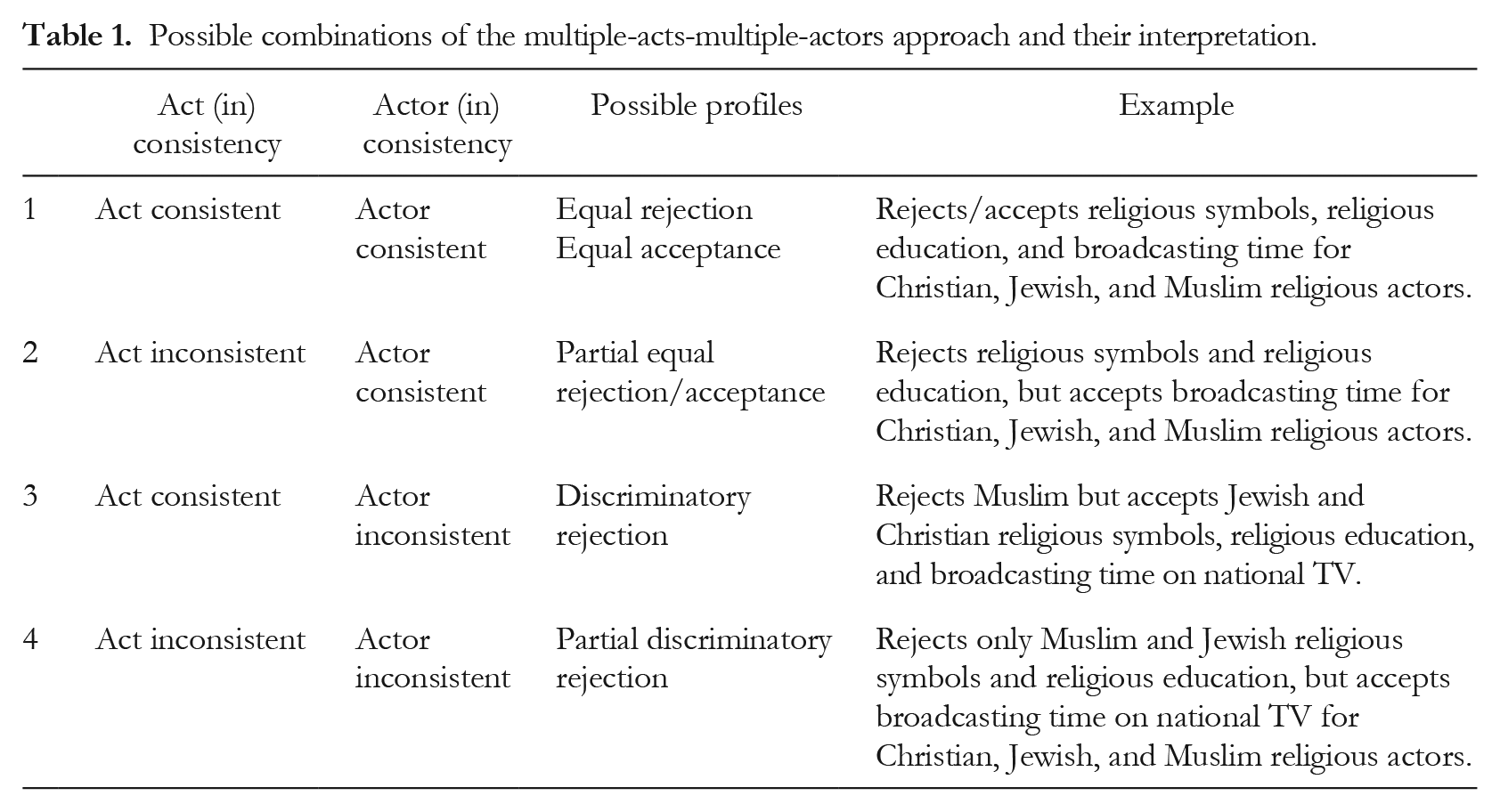
The second possible combination consists of responses where people are inconsistent across acts but consistent across actors. This pattern of a partial equal rejection implies that for all religious groups, some practices are rejected (e.g., religious education in public schools) and others accepted (e.g., wearing of religious symbols). Thus, people do not use a double standard by differentiating between actors, but base their responses on the nature of the practices in question (Gibson & Gouws, 2003; Petersen et al., 2011). As different practices can trigger different considerations and concerns, differentiation in the acceptance of these practices indicates that respondents take the specific act into account and that their response is not only driven by generalized or target-specific prejudice (Dangubić et al., 2020a).
The third possible combination consists of responses in which people are inconsistent across actors but consistent across acts. This use of a double standard indicates discriminatory rejection in which one is, for example, intolerant of practices by Muslim minorities but not by Christians or Jews. Thus, within this profile, individuals use a double standard to the disadvantage of Muslims, which suggests anti-Muslim rather than generalized prejudice (Dangubić et al., 2020a; Mondak & Hurwitz, 1998).
The fourth possible pattern of responses is when people display inconsistency both across acts and across actors. This pattern of a partial discriminatory rejection implies that individuals respond in a differential way to different religious groups depending on the specific practice. For example, it is possible that people discriminate against Muslims when asked about religious education in schools, but discriminate against Jews when asked about religious symbols, or even reject religious symbols for all three religious groups involved. In general, the existence of this subgroup suggests a complex interplay between generalized and group-specific prejudices and other reasons.
With a person-centered approach using national samples in two European nations, we examined whether the expected five profiles (equal rejection, equal acceptance, partial equal rejection, discriminatory rejection, and partial discriminatory rejection) do indeed exist within the population, and how many majority members demonstrate these specific patterns of responses.
Validation of the Possible Profiles
Beyond identifying various subgroups of individuals, and as a matter of construct validity (Osborne & Sibley, 2017), we further examine whether the subgroups differ in meaningful ways on several key variables, namely general feelings towards (non)religious groups, national identification, endorsement of secularism and civil liberties, open-minded thinking style, and religious affiliation. This further allows us to test the theoretical proposition that the rejection of Muslim minority practices does not have to reflect generalized or group-specific prejudice.
Feelings towards (non)religious groups
Prejudicial feelings towards religious groups in general and/or towards Muslims in particular can underlie the rejection of Muslim religious practices (e.g., van der Noll & Saroglou, 2015). Research has found that those who harbor negative feelings towards Muslims are more likely to reject Muslim minority practices (e.g., Helbling, 2014) or use a double standard by rejecting Muslims engaged in specific practices but not Christians (e.g., Bilodeau et al., 2018). However, the reverse does not have to be the case and, to our knowledge, no study has empirically examined how feelings towards nonbelievers and other (non-Muslim) religious groups relate to the rejection of Muslim practices. By examining feelings towards these other groups alongside feelings towards Muslims, it is possible to determine if rejection of Muslim practices reflects anti-Muslim attitudes or general antireligion attitudes. Positive feelings towards nonbelievers and negative feelings towards religious groups can reflect a negative view of religion per se (Bullivant & Lee, 2016). It is reasonable to assume that this will underlie the rejection of religious practices in general and not only of Muslims. In contrast, prejudicial feelings towards Muslims are likely to be associated with (partial) discriminatory rejection of Muslim practices only. Therefore, we expect that individuals who more strongly reject Muslims than Jews or Christians who engage in similar religious practices (discriminatory profile and partial discriminatory profile) will be more likely to be characterized by relatively negative feelings towards Muslims as a group. In contrast, those who respond to the three religious groups in a consistent way (equal rejection or partial equal rejection) are more likely to be characterized by relatively strong and generalized negative feelings towards both Muslim and non-Muslim religious groups, and positive feelings towards nonbelievers.
Religious affiliation
According to Social Identity Theory, being a member of a group tends to lead to favoring one’s ingroup over relevant outgroups (Tajfel & Turner, 1979). Religious affiliation might evoke this ingroup-favoring pattern of responses whereby, for example, West European majority members favor Christian religious practices and do not accept similar Muslim practices. In contrast, for individuals who are not religiously affiliated, all religious groups represent a religious outgroup and they might be more likely to reject religious practices regardless of the religious group. Therefore, we expect that individuals who show a (partial) discriminatory profile of Muslim rejection are more likely to be affiliated with Christianity (the largest religious group in the sample). In contrast, those who respond to different religious actors in a consistent way, by showing an equal pattern of rejection, are more likely to be religiously nonaffiliated.
National identification
There is a large literature that links identification with one’s nation to negative attitudes towards minority outgroups, including Muslim minorities (e.g., Badea et al., 2018; Mummendey et al., 2001). For example, research in different countries has found that higher national identifiers are more likely to have negative attitudes towards Islam and Muslims (e.g., Uenal et al., 2021), and that stronger national identification is related to stronger rejection of Muslim minority practices (e.g., Gieling et al., 2014). National identifiers tend to focus on the meaning, value, and continuation of the national culture, and Muslims can be perceived as the typical “other” and Islam as a religion that is incompatible with the Western way of life (Sniderman & Hagendoorn, 2007). This makes it likely that individuals who demonstrate a (partial) discriminatory pattern of Muslim rejection are characterized by relatively high levels of national identification. In contrast, those who respond to different religious groups in a consistent way, by showing a (partial) equal pattern of rejection or acceptance, are more likely to be characterized by lower levels of national identification.
Secularism
Secularism entails the notion that religion should be separated from civic affairs and the state (Zuckerman et al., 2016). As such, secularism forms a basis for rejecting all religious practices in the public domain (Imhoff & Recker, 2012). There is empirical evidence that secularism predicts rejection of Muslim religious practices over and above anti-Muslim sentiments and negative feelings towards religious groups more generally (Aarøe, 2012; Breton & Eady, 2015; van Bohemen & Kemmers, 2011). Also, those who more strongly endorse secularism are more likely to equally reject both Christian and Muslim practices (Bilodeau et al., 2018; Dangubić et al., 2020a; van der Noll & Saroglou, 2015). Given that secularism entails rejection of religious practices more generally, individuals who have an (partial) equal pattern of rejection—actor consistent and act (in)consistent—are expected to be characterized by relatively strong endorsement of secularism, compared to individuals who show a (partial) discriminatory pattern of rejection.
Civil liberties
The endorsement of civil liberties is one of the key reasons to accept minority groups and their practices, and there is empirical evidence that it is associated with acceptance of Muslim religious symbols (Saroglou et al., 2009), lack of support for banning headscarves (van der Noll, 2014), and positive attitudes towards the wearing of Muslim veils (Gustavsson et al., 2016). The endorsement of civil liberties entails a general acceptance of others to live the life as they see fit, which means that it is likely that individuals who show a group-consistent pattern of acceptance—actor consistent and act (in)consistent—are characterized by relatively strong endorsement of civil liberties, compared to individuals who show a (in)consistent pattern of rejection.
Open-minded thinking
Open-minded thinking entails a predisposition to consider alternative reasons and arguments that are typically not aligned with one’s own beliefs (Stanovich & West, 1997). This type of thinking has been found to be associated with tolerance (Marcus, 2020; Witenberg, 2019). Open-minded individuals are more likely to accept different practices and beliefs (Butrus & Witenberg, 2015) and different cultural groups (Korol, 2017). Given that open-minded thinking is associated with tolerance and the tendency to seriously consider alternative ways of life, we expect that the subgroup of individuals who show a group-consistent pattern of acceptance—actor consistent and act (in)consistent—is more likely to be characterized by open-minded thinking compared to individuals who show (in)consistent patterns of rejection.
Self-reported reasons to reject Muslim practices
In addition to the aforementioned factors, majority members might also have their own subjective reasons for rejecting specific Muslim practices that do not fully correspond to the proposed theoretical constructs (Reja et al., 2003). Examining self-reported reasons is an additional way to investigate the meaningfulness of differentiating between separate subgroups in a latent profile analysis. Thus, we explored whether the subgroups of individuals differ in a meaningful way on their self-reported reasons for rejecting specific Muslim minority practices.
The Current Study
Using a multiple-acts-multiple-actors design and latent profile analysis, we go beyond the existing research on generalized and group-specific prejudice by examining the most common ways in which majority group members combine their acceptance or rejection of different religious practices (wearing religious symbols, following religious education, providing broadcasting time for religious organizations on national TV, and banning women from boards of religious organizations) for different religious groups (Christians, Jews, and Muslims). Specifically, we are interested in examining the approximate percentages of majority group members who show one of the five likely combinations of (in)consistency across the multiple acts and multiple actors. Additionally, and for further validating the profiles, we examine whether these subgroups of individuals differ in meaningful ways on several key constructs: feelings towards (non)religious groups, religious affiliation, national identification, endorsement of secularism and civil liberties, and open-minded thinking, as well as in terms of their self-reported reasons to reject Muslim practices.
We used data from large national samples of German and Dutch majority members. Germany and the Netherlands are historically Christian nations, but have increasingly become secular (De Hart, 2014; Evans, 2019). However, these countries also differ in important ways. Whereas in the Netherlands all religions are equally supported by the state, in Germany, only Christians and Jews are considered legitimate partners of the state (Carol et al., 2015; Kortmann, 2012). However, in practice, equal status is sometimes denied to Islam in the Netherlands, whereas in Germany, Islam is becoming more of a legitimate partner of the state (Carol et al., 2015). In both countries, Islam is the second largest religion, with Muslims comprising ~5% of the population, whereas Judaism is followed by less than 1% of the population (Haug et al., 2008; Schmeets, 2016). Whereas the Jewish minority has a long history in Europe and was traditionally perceived as a typical “other” (Nachmani, 2017), in recent political rhetoric and public debates in both countries, reference to the country’s Judeo-Christian identity and tradition has become increasingly common, particularly in contrast to Islam (Kluveld, 2016). Muslims as an immigrant-origin group are predominantly perceived as the prototypical “outsider” (Sniderman & Hagendoorn, 2007). Research demonstrates that prejudice towards Muslims is more widespread than prejudice towards Jews in these countries (Wike et al., 2019; Zick et al., 2011). Germany and the Netherlands are thus similar and different in various ways. Although West European country differences in attitudes towards religious groups and their practices are very small (Carol et al., 2015), we nevertheless controlled for country in the statistical analyses and also explored country similarities and differences.
Method
Data and Sample
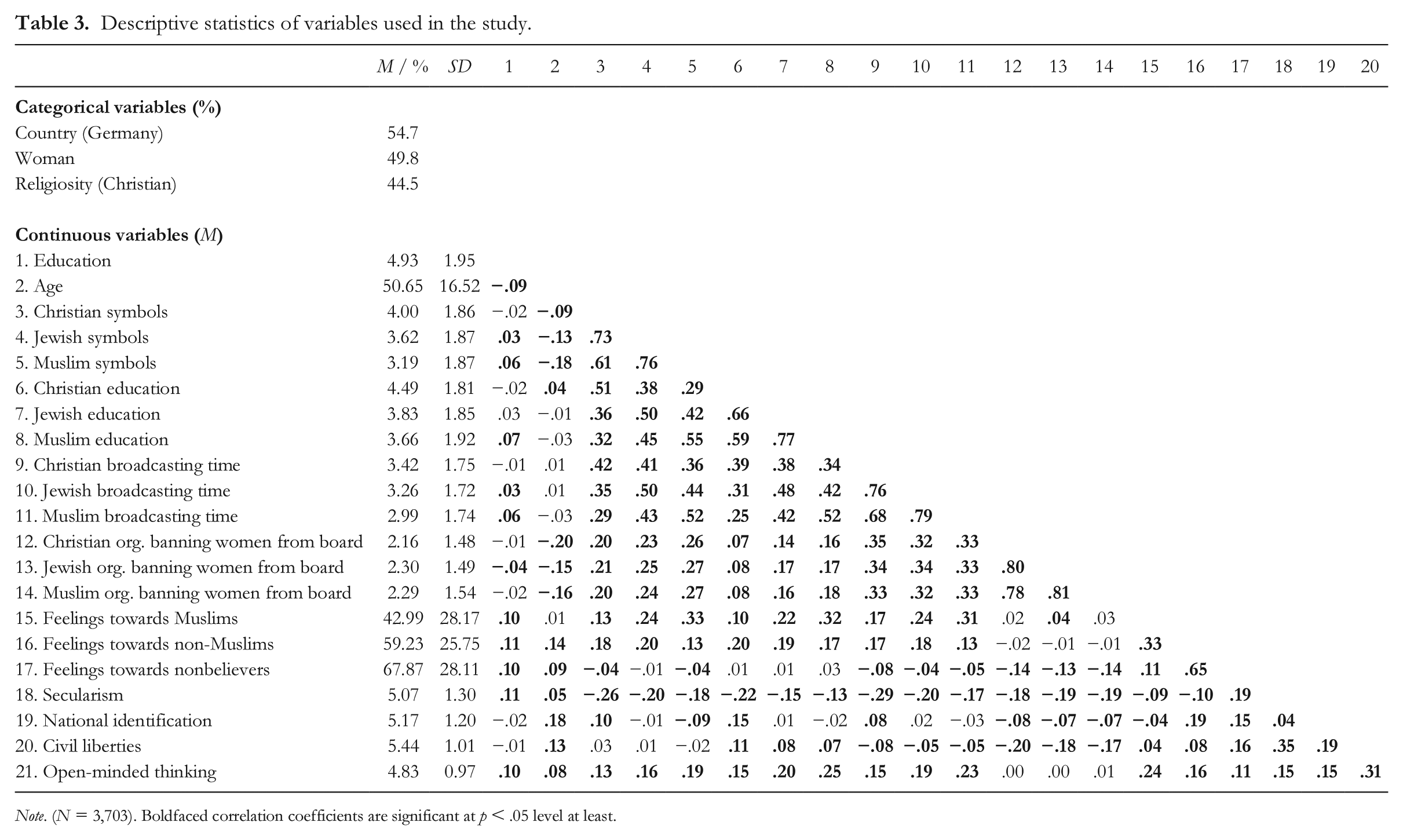
Data were collected in May and June 2019 by a professional survey company that maintains large representative panels of Dutch and German adult majority members. In the Netherlands, a sample was compiled via a stratification procedure based on gender, age, education, household size, and region. Population data for the selection criteria were derived from the annual report of the Central Bureau for Statistics in the Netherlands. In Germany, population data were derived from the MiniCensus (Statistisches Bundesamt, 2016) and used to compile a national sample of the German majority population aged 18 years and older via a stratification procedure based on age, gender, and education. In both countries, only respondents with two ethnic Dutch/German parents were invited to participate. In total, 3,762 respondents completed the online anonymous questionnaire. Respondents who reported being affiliated with Islam or Judaism, or who indicated they had given a wrong response when asked to explain why they rejected one of the Muslim practices, were excluded from the analysis (n = 59). Our data did not contain any missing values. Thus, the analytical sample consisted of 3,703 respondents (54.7% German; see Table 3). Participants’ average age was 50.65 years (SD = 16.52; see Table 3), and 49.8% were female.
Measures
Multiple-acts-multiple-actors design
Respondents were presented with a randomized set of 12 items to assess their acceptance of four broad religious practices enacted by Christians, Jews, and Muslims. Based on previous research (e.g., Dangubić et al., 2020b; Sleijpen et al., 2020), the selected religious practices are sufficiently publicly visible and much debated in Western Europe. Importantly, the selected practices were ones that apply to and are meaningful for all three religious groups (e.g., Karpov & Lisovskaya, 2008). The chosen practices were: “In public schools, teachers should be allowed to wear visible [Christian/Jewish/Islamic] symbols,” 2 “Public schools should be able to offer [Christian/Jewish/Islamic] religious lessons for those who want them,” “[Christian/Jewish/Islamic] organizations should have their own broadcasting time on national TV,” and “[Christian/Jewish/Islamic] organizations may refuse women on their board.” Responses were given on 7-point scales (1 = strongly disagree, 7 = strongly agree).
Feelings towards (non)religious groups
Participants indicated on the widely used 100-point feeling thermometer scale how they felt towards the groups of Muslims, Catholics, Protestants, Jews, and nonbelievers in the Netherlands/Germany. Respondents were instructed that higher scores reflect warmer feelings, a score of 50 indicates neutral feelings, and lower scores reflect colder feelings. Since intercorrelations between feelings towards the non-Muslim religious groups (Catholics, Protestants, and Jews) were strong (ranging from .68 to .78), 3 an average score was used (α = .89).
Endorsement of secularism
Participants indicated their level of agreement (7-point scales) with four items based on research by Breton and Eady (2015): “Religion should be limited to private life as much as possible,” “The separation of church and state is of the utmost importance,” “Society is better off when people are less religious,” and “Society should not be based on religious principles.” The items formed a reliable scale (α = .80) and were averaged.
National identification
Participants answered (on 7-point scales) the following two items: “I identify with [Germany/the Netherlands]” and “I feel connected to other [Germans/Dutch].” The two items were strongly correlated (r = .70), and an average score was used.
Open-minded thinking
Participants indicated their level of agreement (7-point scales) with four items adapted from the Actively Open-Minded Thinking Scale (Stanovich & West, 1997): “I usually try to understand beliefs and behaviors that I find wrong and reject,” “I always try to consider whether there are good reasons for accepting cultural differences or not,” “I usually try to find a balance between what I find unacceptable and the freedom of other people to live the way they want,” and “I always try to understand why people sometimes do very different things from what I personally think is right and good.” The items formed a reliable scale (α = .79) and were averaged.
Endorsement of civil liberties
Endorsement of civil liberties was also measured (7-point scales) with four items based on Gustavsson and colleagues (2016): “Individual freedom is the most important principle in society,” “Freedom of expression is the foundation of an open society,” “In society, everyone must have the freedom to be themselves,” and “Individual rights, rather than group rights, should form the basis of society.” The items formed a reliable scale (α = .79), and an average score was used.
Religious affiliation
Respondents were asked to indicate whether and with which religious denomination they were affiliated. Religious affiliation was recoded into a dichotomous variable (1 = religiously affiliated with a Christian denomination, 0 = not religiously affiliated, affiliated with a non-Christian denomination other than Islam or Judaism, or not revealing religious affiliation). 4
Reasons to reject Muslim practice(s)
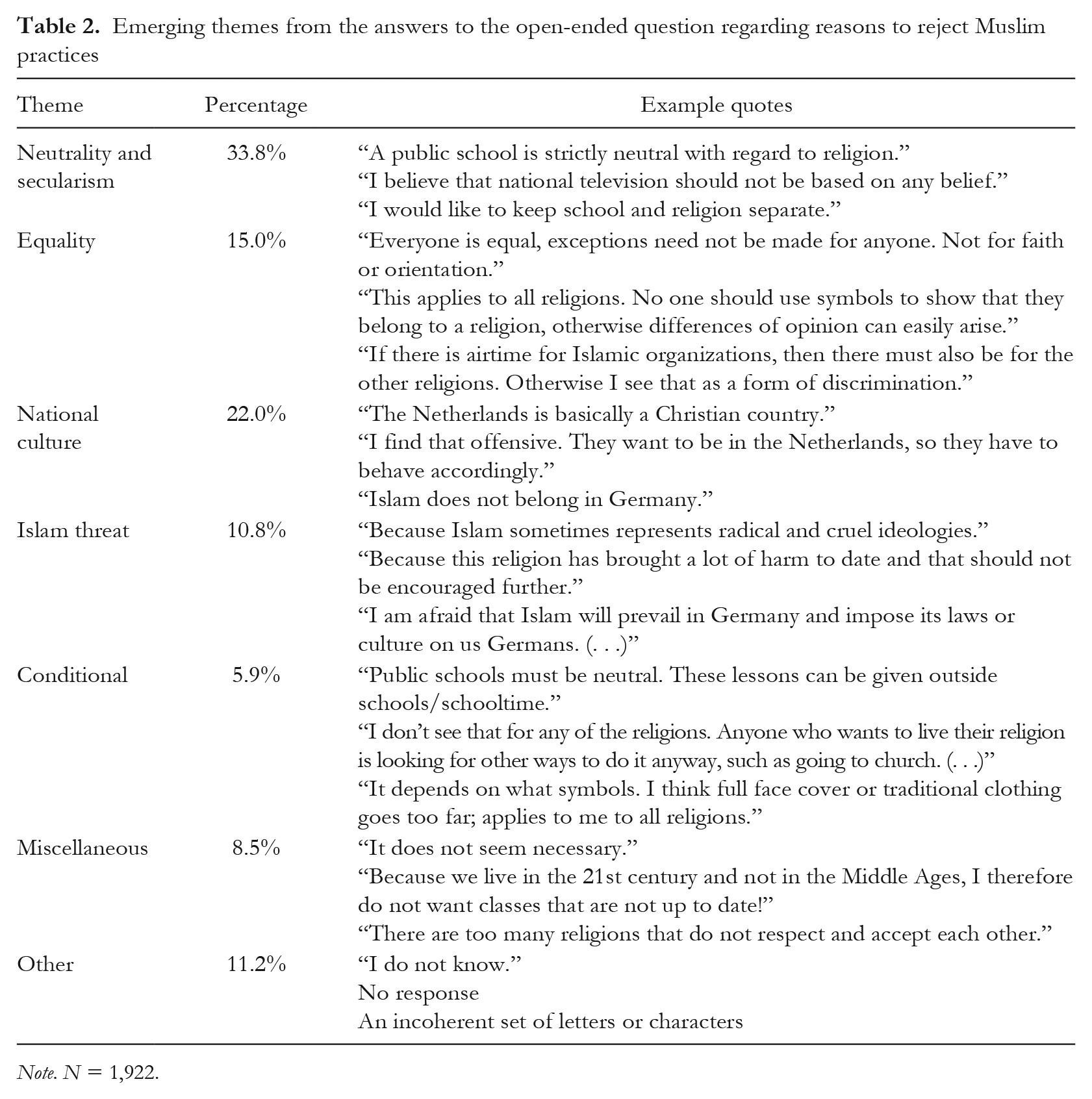
Participants who disagreed (< 4 on the 7-point scale) with a particular Muslim minority practice being allowed were subsequently asked in an open-ended question to explain their reason for this: “Could you briefly explain why you do not agree that [a practice randomly inserted]?” When participants rejected several Muslim practices, they were randomly asked about one of the practices. In order to classify the answers into broader themes, first an inductive coding system was developed by rereading and discussing a random selection of the responses. This resulted in a coding scheme with seven categories, and two researchers independently classified the responses into these categories with an intercoder reliability coefficient (Cohen’s kappa) ranging from 0.75 to 1.00. 5 For each of the codes, we created a dichotomous variable indicating whether a respondent mentioned a specific reason (1) or not (0). Table 2 shows the seven themes, with several examples and corresponding percentages. 6
Emerging themes from the answers to the open-ended question regarding reasons to reject Muslim practices
Note. N = 1,922.
First, the neutrality/secularism category (mentioned by ~34% of respondents) entails explanations that refer to the secular nature of the state and that public education and the media must be religiously neutral. Second, the equality category (15%) entails explanations in terms of all religions having to be equally represented or having the equal right to their own schools/media. Third, the national culture category (22%) entails references to the Christian or ethnic Dutch/German nature of the country and the related demands on Muslims to assimilate. Fourth, the Islam threat category (~11%) contains explanations that criticize Islam and present Muslims as a security and symbolic threat to society. Fifth, the conditional category (~6%) entails answers explaining that one does not always reject the practice, because it depends on the circumstances and conditions. Sixth, the miscellaneous category (~9%) contains other, less frequently employed reasons for rejection that could not be classified in any of the previous categories. Seventh, the “other” theme (~11%) contains answers in which respondents expressed their uncertainty about why exactly they rejected a practice, did not respond, or provided an incoherent set of letters. 7
Control variables
Four control variables were used in the analyses. Three of these were standard, individual-level control variables: age (continuous variable), gender (1 = women, 0 = men and other 8 ), and education (1 = no/only primary school, 7 = master’s degree at [applied] university level), which was treated as a continuous variable similarly to other research in the Netherlands (e.g., van de Werfhorst & van Tubergen, 2007). In addition, we controlled for possible country differences (1 = Germany, 0 = the Netherlands). Findings for the control variables are reported in the supplemental material, and country similarities and differences are also discussed in what follows.
Analysis
First, latent profile analysis (LPA) was used to identify the optimal number of distinct subgroups of individuals based on their acceptance or rejection of different religious practices for the three religious groups. Models from one to eight profiles were fitted. All the models were fitted under the most parsimonious parametrization, where item variances are estimated to be equal across profiles, and covariances are constrained to zero. Thus, only the mean vectors for each profile were considered. In order to ensure that the likelihood function converged to global, instead of local maxima solution (Nylund-Gibson & Choi, 2018), 5,000 sets of random starts and 500 final stage optimizations were used.
Second automatic, three-step multinomial logistic regression (Asparouhov & Muthén, 2013) was used to assess the likelihood of being classified into one of the identified profiles as a function of thermometer feelings towards Muslims, non-Muslim religious groups, and nonbelievers; religious affiliation; endorsement of secularism and civil liberties; national identification; open-minded thinking; and the control variables. In the automatic three-step approach, first, an unconditional model is estimated taking into account only latent profile indicators. Subsequently, profile membership is corrected for the classification error and predicted on the indicated correlates. For this part of the analysis, all continuous variables were standardized.
In the third part of the analysis, using the three-step approach for distal outcomes (Lanza et al., 2013), we tested if the profiles differed in terms of the self-reported reasons to reject Muslim practices. This approach also takes into account the uncertainty regarding each individual’s true profile membership.
R software was used for data preparation (Version 4.0.0; R Core Team, 2020), and Mplus was used for the main analysis (Version 8.2; Muthén & Muthén, 1998–2017).
Results
Descriptive Statistics
Table 3 shows the descriptive findings for all the variables. 9 On average, respondents agreed that public schools should offer Christian religious education, and were neutral towards Christian religious symbols in schools. In contrast, all remaining practices were, on average, rejected as their means were significantly below the midpoint of the scale (ps < .001).
Descriptive statistics of variables used in the study.
Note. (N = 3,703). Boldfaced correlation coefficients are significant at p < .05 level at least.
More than 90% of respondents were negative or neutral towards either Christian, Jewish, or Islamic religious organizations banning women from their boards (see Figure A1 in the supplemental material), which indicates a high degree of actor-consistent rejection. The great majority of respondents (75%) who were asked to subsequently explain their rejection in relation to Muslim organizations mentioned that the practice goes against the principle of gender equality. The very small variances and high actor-consistent rejection means that the attitude towards this practice was more of a constant and, therefore, we did not consider it in the latent profile analysis.
Latent Profile Analysis
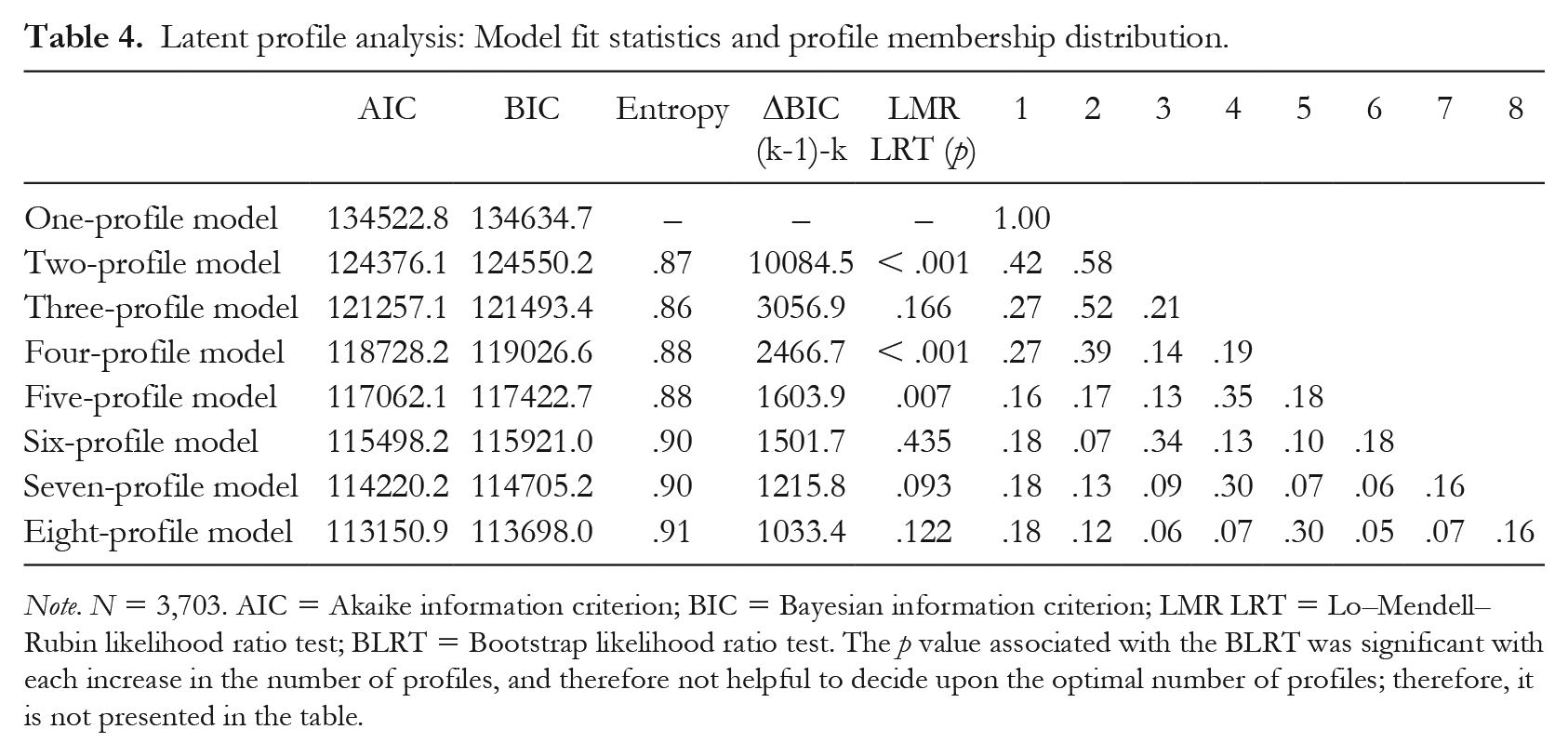
Table 4 shows model fit statistics and subgroup membership distributions for models with up to eight profiles. Eight profiles was chosen as the upper limit for parsimony reasons, as extracting too many profiles might result in spurious solutions (Osborne & Sibley, 2017). To determine the optimal number of profiles, three statistical criteria were used: Akaike information criterion (AIC), Bayesian information criterion (BIC), and Lo–Mendell–Rubin likelihood ratio test (LMR LRT), which indicates whether a k-profile solution significantly improves model fit upon the k-1 profile solution (Lo, Mendell, & Rubin, 2001). In addition, the number of participants per profile and their theoretical interpretability were considered.
Latent profile analysis: Model fit statistics and profile membership distribution.
Note. N = 3,703. AIC = Akaike information criterion; BIC = Bayesian information criterion; LMR LRT = Lo–Mendell–Rubin likelihood ratio test; BLRT = Bootstrap likelihood ratio test. The p value associated with the BLRT was significant with each increase in the number of profiles, and therefore not helpful to decide upon the optimal number of profiles; therefore, it is not presented in the table.
Each additional profile resulted in a decrease in AIC and BIC. However, the decrease in BIC from four to five profiles was higher (ΔBIC = 1603.91) than the decrease from five to six profiles (ΔBIC = 1501.74). Also, whereas the five-profile solution resulted in an additional, qualitatively different profile compared to the four-profile solution (see Figure B1), the six- and seven-profile model solutions contained additional profiles that were just a variation of one of the profiles of the five-profile model (i.e., a variety of the partial equal rejection subgroup; see Figures B2 and B3 in the supplemental material). In addition, LMR LRT indicated that adding the sixth or seventh profile did not significantly improve the model fit. Furthermore, the models with six and seven profiles contained a relatively small number of individuals (less than 10%). Based on statistical criteria, profile size and interpretability, as well as model parsimony, we opted for the five-profile solution. The entropy of the five-profile model was high (entropy = .88), which indicates high precision in classifying respondents into one profile and not another (Nylund-Gibson & Choi, 2018).
Figure 1 shows the five identified profiles along with their labels and percentages. The first profile (equal acceptance, 18.3%) consists of individuals who tended to accept all religious practices for all three religious groups. The second profile (equally moderate, 35%) consists of individuals who tended to respond around the neutral midpoint by neither accepting nor rejecting any of the religious practices for all three groups. The third profile (discriminatory rejection, 16.3%) consists of individuals who tended to respond in a discriminatory way by more strongly rejecting the three practices when enacted by Muslims compared to Christians or Jews. The fourth profile (equal rejection, 17.3%) consists of individuals who consistently rejected all practices for all three religious groups. The fifth profile (partial equal rejection, 13.1%) consists of individuals who rejected only one religious practice (broadcasting time on national television), but did so consistently for all three religious groups.
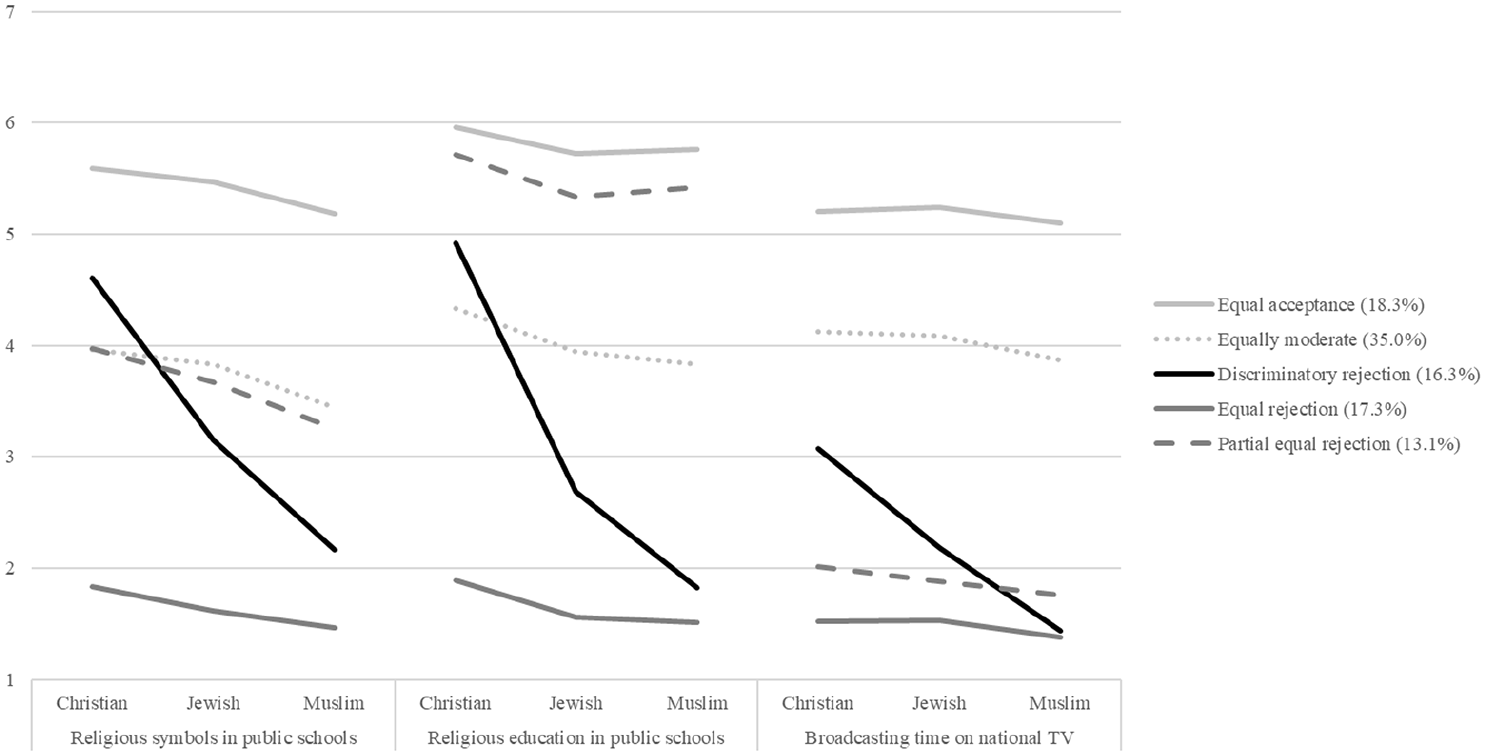
Latent profile analysis: Five-profile model.
To summarize, the findings of the latent profile analysis show that around 1 in 5 majority group members applied a double standard by more strongly rejecting particular practices when Muslim actors were involved, which suggests anti-Muslim prejudice. The other four subgroups of individuals responded in relatively consistent ways across the different actors. Two of these subgroups rejected some or all of the practices, but did so equally for the three religious target groups.
Validation of the Profiles
We further examined the meaningfulness of the five profiles by investigating how they differ on several key characteristics. Table 5 presents the results of multinomial logistic regression in which the equally moderate (Model A), partial equal rejection (Model B), equal rejection (Model C), and discriminatory rejection (Model D) models were used as reference categories. Overall, the results show that the five profiles significantly and meaningfully differ from each other.
Results of multinomial logistic regression analysis.
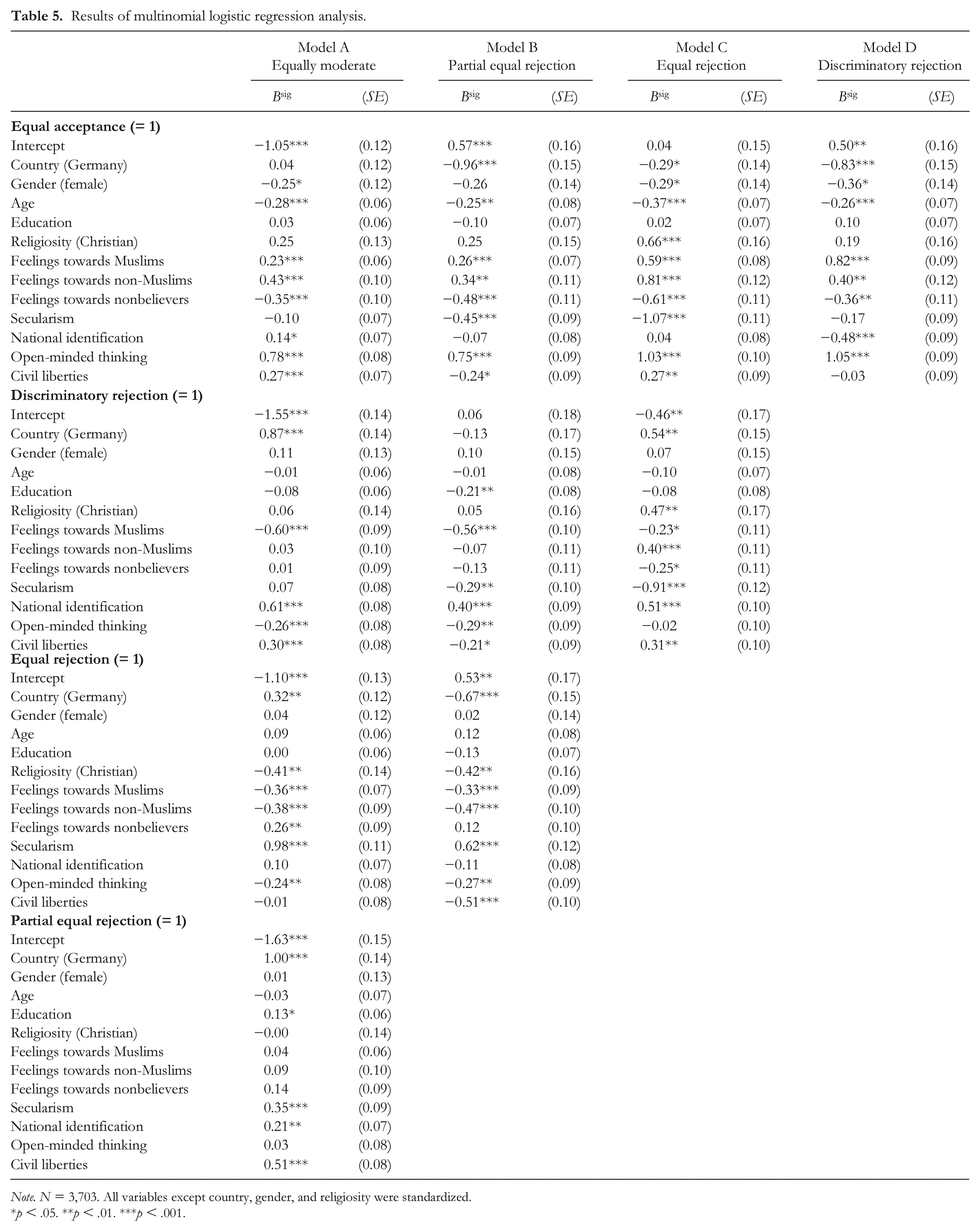
Note. N = 3,703. All variables except country, gender, and religiosity were standardized.
p < .05. **p < .01. ***p < .001.
First, individuals within the equal acceptance subgroup had more positive general feelings towards Muslims and non-Muslim religious groups, and more negative feelings towards nonbelievers, compared to all other subgroups. Further, they were more likely to score high on open-minded thinking and more likely to be Christian than the equal rejection subgroup. In addition, they were more likely to endorse civil liberties compared to the equally moderate and equal rejection subgroups, but less so compared to the partial equal rejection subgroup. Being religious and valuing civil liberties in combination with open-minded thinking and positive feelings towards Muslims and non-Muslim religious groups seem to characterize individuals who accept all practices for all three religious groups.
Second, individuals within the discriminatory rejection subgroup had more negative feelings towards Muslims and more strongly identified with the nation compared to all the other subgroups. Further, they were less likely to score high on open-minded thinking compared to the equally moderate, equal acceptance, and partial equal rejection subgroups. Strong identification with one’s nation and prejudicial feelings towards Muslims seem to make individuals within the discriminatory rejection subgroup apply a double standard by more strongly rejecting similar practices enacted by Muslims compared to Christians and Jews.
Third, individuals within the equal rejection subgroup endorsed secularism more strongly, had less positive feelings towards non-Muslim religious groups, and were less likely to be affiliated with Christianity compared to all the other subgroups. Further, they had more positive feelings toward Muslims than the discriminatory rejection subgroup, but less so compared to the remaining three subgroups. In addition, they had more positive feelings towards nonbelievers than the equal acceptance, equally moderate, and discriminatory rejection subgroups, and were less likely to endorse civil liberties. Not belonging to a Christian denomination, having negative feelings towards Muslims and towards non-Muslim religious groups but positive feelings towards nonbelievers, and strongly endorsing secularism but not civil liberties seem to make individuals within the equal rejection subgroup reject all practices for all three religious groups.
Fourth, individuals within the partial equal rejection subgroup endorsed civil liberties more strongly than all the other subgroups. Further, they more strongly endorsed secularism than the equally moderate, equal acceptance, and discriminatory rejection subgroups, but less strongly than the equal rejection group. Also, they were more likely to score high on open-minded thinking than the equal rejection and discriminatory rejection subgroups, but less likely to do so than the equal acceptance subgroup. This pattern of findings suggests that individuals within the partial equal rejection subgroup are simultaneously considering both principles of civil liberties and secularism, which makes them accept some but reject other religious practices, but in a similar way for all three religious target groups.
Fifth, individuals within the equally moderate subgroup had more positive feelings toward Muslims and were more likely to score high on open-minded thinking than the discriminatory or equal rejection subgroups, but less so than the equal acceptance subgroup. Further, they endorsed secularism less strongly than the equal rejection or partial equal rejection subgroups, but more strongly than the equal acceptance subgroup. In addition, they had more positive feelings towards non-Muslim religious groups and more negative feelings towards nonbelievers when compared to the equal rejection subgroup, whereas the opposite was the case when compared to the equal acceptance subgroup. This pattern of findings indicates that the equally moderate subgroup responded to key characteristics in a “neutral” way, just as they did on the items about religious practices of the different religious groups.
Reasons to Reject Muslim Practices
To further examine whether the subgroups differed in a meaningful way, we examined the self-reported reasons for rejecting specific Muslim minority practices. Figure 2 shows the percentage of individuals who mentioned a particular reason within the following four profiles: discriminatory rejection, equal rejection, partial equal rejection, and equally moderate. 10 Individuals within the equally moderate and the equal rejection subgroups were more likely than other subgroups to explain their rejection by mentioning that state institutions should be neutral or by referring to secular principles (neutrality or secularism, 80% and 50% respectively). These findings are in line with the strong endorsement of secularism of the equal rejection subgroup found in the previous analysis.
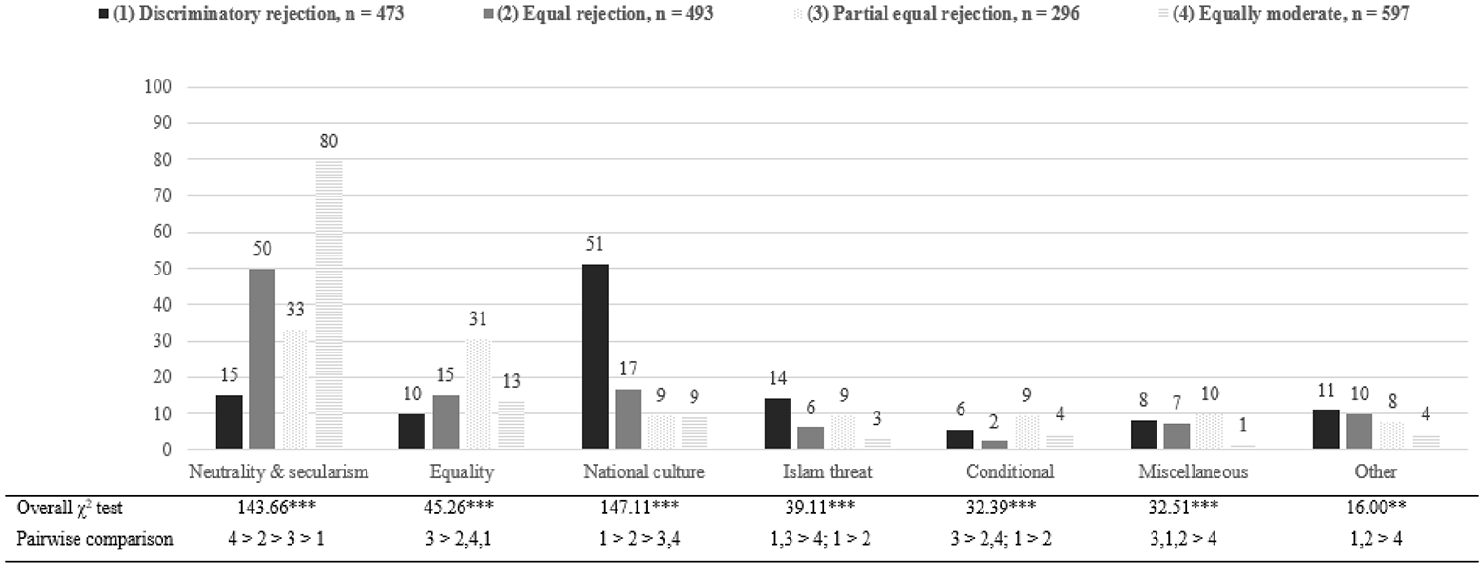
Spontaneously mentioned reasons to reject Muslim practices per profile.
Individuals within the partial equal rejection subgroup were more likely than other profiles to explain their rejection in terms of the need to treat all religious groups equally and allow them to practice their own religion (equality, 31%), or that practices should be allowed only under certain conditions (conditional, 9%). These findings are in line with this subgroup’s group-consistent rejection or acceptance of the practices for all three religious groups, and their open-minded thinking by weighing different principles.
Individuals within the discriminatory rejection subgroup were more likely than other subgroups to explain their rejection by making references to Dutch/German traditions and values (national culture, 51%) and by criticizing Islam (Islam threat, 14%). These findings are in line with this subgroup’s relatively strong national identification and prejudicial feelings towards Muslims as a group.
Country Comparison
The country main effects (see Table 5) indicate that German compared to Dutch participants were more likely to display discriminatory or partial equal rejection, whereas Dutch participants were more likely to display equal acceptance or an equally moderate pattern of responses. To test for country differences in latent profile solutions, an unconstrained model allowing variances, means, and proportions to vary across the two countries and a model whereby means were constrained to be equal across countries were estimated (see Table G1 in the supplemental material). Although the BIC of the constrained model increased slightly, suggesting that there are differences in means between countries, both models were good in terms of distinguishing individuals (similar entropy > .90). To qualitatively examine possible country differences further, a model with five profiles was estimated for the Dutch (Figure G1) and German (Figure G2) samples separately. The model with five profiles for Germany is the same as the model with five profiles already discussed. In the Netherlands, a variation of the partial equal rejection profile appeared instead of a discriminatory rejection subgroup. Discrimination appears to be less strong in the Netherlands than in Germany, and Dutch participants were less likely to be classified in the discriminatory rejection profile compared to people from Germany (12% vs. 20%).
Discussion
The acceptance of Muslim minority practices within Western liberal democracies remains a strongly contested topic. In line with theory and research on generalized prejudices that have proposed a distinction between a common negative component that can be generalized across outgroups and a target-specific component (Akrami et al., 2011; Bergh & Akrami, 2016; Meeusen et al., 2017), research demonstrates that prejudice and anti-Muslim sentiments are important explanations for the rejection of these practices (e.g., Helbling, 2014; Lajevardi & Oskooii, 2018). However, the antipathy of generalized and group-based prejudice might differ from the negativity of practice-based disapproval, and people might also demonstrate generalized positivity or relative indifference (Meeusen et al., 2018). We examined these possibilities with a multiple-acts-multiple-actors design and a person-centered approach. This allowed us to identify subgroups of individuals that differ on how they combine their evaluations of multiple religious practices for multiple religious groups (Muslims, Jews, and Christians), and to examine if these subgroups differ in meaningful ways on anti-Muslim prejudice and self-reported reasons for rejecting Muslim practices, as well as other key characteristics. The findings showed that there were five subgroups, which corresponds with previous person-centered research on attitudes towards religious minority group practices (Dangubić et al., 2020a,b) and towards different minority outgroups (Meeusen et al., 2018).
In line with theoretical and empirical research that emphasizes the role of anti-Muslim prejudice in rejecting Muslim religious practices (e.g., Helbling, 2014; Saroglou et al., 2009), about 1 in 6 people in the population displayed a discriminatory pattern of rejection. Specifically, these individuals demonstrated target-specific prejudice in employing a double standard by more strongly rejecting the same practices enacted by Muslims than by Christians or Jews. Individuals within this subgroup were characterized by prejudicial feelings towards Muslims as a group and showed strong national identification. In their self-reported responses, they criticized Islam and referred to the importance of maintaining national traditions and values. These findings correspond with research showing that a sense of national belonging and prejudicial feelings towards Muslims underlie intolerance of Muslim practices (Saroglou et al., 2009; Uenal et al., 2021).
However, a large majority of the population did not use a double standard but rather displayed actor-consistent and act-(in)consistent patterns of responses. This suggests that these individuals are guided by other reasons for rejection than anti-Muslim prejudice per se. About 1 in 6 individuals displayed an equal rejection pattern by rejecting all practices for all three religious groups, which suggests generalized or common religious prejudice. These individuals were characterized by negative feelings towards both Muslim and non-Muslim religious groups, and positive feelings towards nonbelievers. They were also less likely to be religiously affiliated and displayed strong endorsement of secular principles. Their strong endorsement of secularism was also reflected in the fact that individuals within this subgroup spontaneously mentioned neutrality and secularism as the main reasons for rejecting Muslim practices.
In contrast to subgroups that rejected various practices, around one fifth of the population accepted all practices (except banning women from religious boards) for all religious groups involved (equal acceptance), which indicates a generalized tendency to value all religious groups. Individuals within this subgroup were more likely to be religiously affiliated, to have positive feelings towards Muslims as well as non-Muslim religious groups, to be open-minded, and to value civil liberties more than those who rejected all practices. These findings are in line with previous research showing that being religious and having positive feelings towards religious outgroups underlie acceptance of religious practices (Dangubić et al., 2020a). Further, these findings corroborate the proposition that endorsement of civil liberties and open-minded thinking are important aspects of intergroup tolerance (Marcus, 2020; Verkuyten et al., 2019).
However, two other findings suggest that a strong endorsement of civil liberties in itself is not a guarantee that all practices will be accepted, and that there are limits to what people tolerate (Gibson, 2005; Verkuyten et al., 2021). First, around 1 in 7 individuals displayed a partial equal rejection pattern of responses by accepting some practices and rejecting others, but equally for all three religious groups. The existence of this subgroup most clearly indicates that there can be practice-based variance in ratings that does not reflect generalized or target-group-specific prejudice. Although individuals within the partial rejection subgroup strongly endorsed civil liberties and accepted some religious practices (e.g., religious education in public schools), they were also strongly in favor of secularism which probably made them reject other practices (e.g., broadcasting time on national television). The two principles of civil liberties and secularism might be relevant simultaneously and combined in various ways in people’s thinking (Dangubić et al., 2020a; Peffley et al., 2001).
Second, a large majority of the population rejected the exclusion of women from the boards of religious organizations, independent of religious group. Such a practice was perceived to go against the principle of gender equality and therefore considered unacceptable regardless of who engaged in it. This indicates that even those who are strongly in favor of individual freedoms do not accept practices that go against the equality principle (Verkuyten & Yogeeswaran, 2017). Furthermore, it also indicates that those who discriminated against Muslims also used general moral principles for rejecting, for all groups, a practice that was considered unfair (Hirsch et al., 2019).
Around a third of the population responded in a neutral fashion by neither clearly rejecting nor accepting the practices, but this was similarly done for all three religious groups (equally moderate). There are several possible reasons for finding this relatively large subgroup, which was also found in person-centered research on the evaluation of seven minority target groups (Meeusen et al., 2018). Substantially, it might mean that many people do not have very strong views on whether specific religious practices should or should not be accepted. This corresponds to the notion that the social attitudes of some people are unstable and not clearly rooted in deep convictions or beliefs (Zaller, 1992). A substantial part of the population might genuinely not have strong views on these sorts of societal issues (Sturgis et al., 2014). Further, many people in the Netherlands and Germany are not, or not very, religious (Pew Research Center, 2018). In the equally moderate subgroup, secularism and state neutrality were the most prominent reasons for rejecting one of the Muslim practices. These findings suggest that highly correlated ratings of various target groups and practices do not have to reflect generalized prejudice but can also indicate indifference (Meeusen et al., 2018).
However, there might also be methodological reasons for the relatively large equally moderate subgroup. For example, it might indicate a tendency to respond in a socially desirable way (Nadler et al., 2015). The provision of complete anonymity in online surveys tends to minimize social desirability pressures on self-report measures (Lautenschlager & Flaherty, 1990; Stark et al., 2019), as was found in a survey-embedded experiment in Germany and the Netherlands (Bamberg & Verkuyten, 2021). However, complete anonymity might decrease participants’ motivation to respond carefully and thoughtfully (Lelkes et al., 2012). The reason is that anonymity removes any sense of accountability for one’s answers, and thereby the level of cognitive engagement, which can result in responding similarly on different questions and choosing midpoint response categories in particular (Krosnick, 1999). Furthermore, although the order of the questions was randomized, it is possible that participants gave similar average ratings for all groups and practices in order to appear consistent (Schuman & Presser, 1996).
We expected to find a subgroup of individuals that displayed partial discriminatory rejection (inconsistency across acts and across actors), but this was not the case. There are many possible ways in which individuals can display a partial discriminatory rejection pattern of responses, and there are probably not enough respondents displaying a similar pattern that is sufficiently distinct from the other subgroups identified in the latent profile analysis.
Limitations
Despite its unique design and novel contribution to the social psychological literature on generalized prejudice and attitudes towards Muslim minorities, we like to briefly mention four limitations of the current work with potential directions for future research. First, it might be that the discriminatory rejection of Muslims stems not only from anti-Muslim prejudice but also from prejudice toward religious minority groups. Individuals who showed discriminatory rejection not only rejected practices when engaged in by Muslims, but also showed this tendency in relation to Jews. A more detailed consideration of practices that are relevant only for Muslim and Jewish minorities (e.g., ritual slaughtering of animals; male circumcision) as well as for Christian minorities (e.g., Orthodox Protestants; Sleijpen et al., 2020) could provide more insight into whether majority group members harbor specific negative feelings towards Muslims as a group, or negative feelings towards religious minority groups, or towards religious groups more generally.
Second, although we went beyond the extaning research by using a multiple-acts-multiple-actors design, we asked about four religious practices. However, the findings of latent profile analyses are sensitive to the practices considered, and different profiles might emerge if different practices are considered. For instance, the consideration of more demanding issues (e.g., only halal food at schools; wearing of burqas) could result in skewed distributions of answers with different profiles as a consequence. However, here, we had to use practices that would map onto all three religious groups and which are not unique to any one group. Nevertheless, further research is needed to test whether the findings replicate across a range of other Muslim minority practices.
Third, to test whether people discriminate against Muslims or rather respond in an actor-consistent way, we focused on broad practices that are meaningful and relevant as well as sufficiently comparable across the religious groups. However, it is still possible that some participants perceived some religious practices differently depending on the religious group involved. This is especially likely when asked about religious symbols, whereby participants might for example have a burqa in mind for Muslims and a yarmulke for Jews. If this was the case, this might imply that those who rejected Muslim but accepted Jewish symbols did not discriminate against Muslims but rather evaluated different practices differently. However, on the open-ended question, only around 6% of respondents classified in the discriminatory rejection group had some form of veiling in mind when rejecting Muslim religious symbols. Furthermore, additional analyses showed that the findings were robust when the items regarding religious symbols were excluded (see Figure H1 in the supplemental material). Yet, future research could aim to provide more details about the various practices or ask participants what they have in mind in relation to different groups. The open-ended question focused on the rejection of Muslim practices, and we do not know whether people have similar reasons for rejecting non-Muslim practices.
Fourth, the questions we used were part of a large-scale data collection in which various researchers cooperated. This inevitably meant that only a limited number of constructs could be considered. Future research could examine additional constructs to further validate the different profiles, such as authoritarianism, feelings of threat, and intergroup contact (Adelman & Verkuyten, 2020; Meeusen et al., 2017; Uenal et al., 2021). Furthermore, future research could examine whether the five profiles found generalize to other countries and to other religious target groups. The profiles were largely similar in Germany and the Netherlands but there was also a notable difference with Dutch people being less likely to fall into the discriminatory rejection profile. One possible reason for this difference is that, compared to Germans, the Dutch are less likely to perceive Muslim minorities as a threat, which has been found in previous research (Erisen & Kentman-Cin, 2017). The Dutch might be more familiar with religious diversity because of their tradition of pillarization that encompassed the division of society along religious and cultural lines.
Conclusion
Plural societies face the challenge of accommodating diverse beliefs and practices. It is around concrete practices that debate and disagreement exist, and ways of life can collide. We tried to advance the theoretical and empirical literature on generalized prejudice and attitudes towards Muslim minorities by using a person-centered approach and considering multiple religious practices and multiple religious actors. Such a multiple-acts-multiple-actors design makes it possible to go beyond the generalized and group-specific prejudice explanations for the rejection of minority practices by providing a more nuanced understanding of the various reasons for accepting or rejecting Muslim minority practices harbored by different subgroups of the population. We identified five subgroups in two countries that were meaningfully different on various relevant characteristics. In contrast to the variable-centered approach, we focused on the different constellations of attitudes within individuals, and therefore provided a more complete and integrated description of the relevant considerations that individuals have. People have a general inclination to consistently (dis)like religious outgroups, differentiate their evaluation of these groups, and may also have reasons to disapprove of specific outgroup practices.
We found that, for the majority of individuals, the rejection of Muslim practices is not only, or simply, a reflection of generalized prejudice or prejudicial feelings towards Muslims as a group, and that other reasons such as concerns for the secular nature of the state and civil liberties can be involved. We also found that some practices that go against equal rights (e.g., banning women from boards) or that are potentially more publicly visible and influential (e.g., broadcasting time on national TV) are more readily rejected, independently of the religious target group.
Theoretically, understanding different forms of rejection and the associated reasons is important as it allows us to develop a more nuanced comprehension beyond the roles that generalized and group-based prejudice play. Thus, it would benefit the field to take its focus beyond prejudice as the predominant explanation for people’s disapproval and dislike of minority practices and to recognize that there can be different motivating reasons and considerations that are differently organized within individuals. Prejudiced people are likely to reject minority practices, but that does not mean that everyone who rejects practices is prejudiced. A focus on specific practices and people’s reasons to accept or reject them makes more targeted interventions possible. For example, whereas an emphasis on the importance of civil liberties might result in more acceptance of Muslims among those who endorse secular principles and have antireligious attitudes (equal rejection), such an intervention is not likely to be successful among those who reject Muslims despite their strong endorsement of civil liberties (partial equal rejection). A focus on prejudice and prejudice reduction is clearly important but the disapproval of specific minority beliefs and practices can have other reasons that are not only theoretically relevant but also relevant for applied reasons. Taken together, this research provides a valuable approach for future research in the field of intergroup relations.
Supplemental Material
sj-docx-1-gpi-10.1177_13684302211067967 – Supplemental material for The rejection and acceptance of Muslim minority practices: A person-centered approach
Supplemental material, sj-docx-1-gpi-10.1177_13684302211067967 for The rejection and acceptance of Muslim minority practices: A person-centered approach by Marija Dangubić, Kumar Yogeeswaran, Maykel Verkuyten and Chris G. Sibley in Group Processes & Intergroup Relations
Footnotes
Funding
The author(s) disclosed receipt of the following financial support for the research, authorship, and/or publication of this article: The work was supported by European Union’s Horizon 2020 research and innovation programme [grant agreement number: 740788].

Supplemental material
Supplemental material for this article is available online.
Notes
References
Supplementary Material
Please find the following supplemental material available below.
For Open Access articles published under a Creative Commons License, all supplemental material carries the same license as the article it is associated with.
For non-Open Access articles published, all supplemental material carries a non-exclusive license, and permission requests for re-use of supplemental material or any part of supplemental material shall be sent directly to the copyright owner as specified in the copyright notice associated with the article.
