




Abstract
In two experiments, we examined how men respond to women who either challenge or legitimize societal gender inequality, and how gender identification moderates these responses. We hypothesized that men feel less threatened by women who legitimize (vs. challenge) the gender hierarchy, and evaluate these women more positively. To investigate these expectations, we assessed self-reports (Studies 1 and 2) and cardiovascular threat/challenge responses (Study 2). Both studies showed that men experience less negative emotions when presented with a woman who legitimized (vs. challenged) the gender hierarchy. Moreover, among men with a relatively high gender identification, a woman who challenged the gender hierarchy elicited a physiological response pattern indicative of threat, whereas a woman who legitimized the gender hierarchy elicited a pattern indicative of challenge. Results are discussed in terms of social identity theory, status threat, and self-distancing behavior.
Women remain underrepresented in political and economic decision-making positions. Despite gender equality policies, and the fact that women’s progress in the job market gradually increased over the past decades, women are still lagging behind men in leadership positions. Within the largest companies of the European Union, women account for only 29% of board members, 7.5% of board chairs, and 5.5% of CEOs (European Commission, 2019). Increasingly, women (and men) voice their opinion about gender inequality and whether and how measures should be taken to address these inequalities. Gender equality debates can also be threatening for men as they may experience the improvement of women’s opportunities in the labor market as a (status) loss for men (Kuchynka et al., 2018; Scheepers, 2009, 2017; Scheepers & Ellemers, 2019; Scheepers et al., 2009). In the context of these societal discussions about gender equality, in two experimental studies we investigate men’s emotional and physiological responses to gender (in)equality messages, especially when voiced by women. More specifically, whether men are threatened by women who advocate social change but less so by women who legitimize the gender hierarchy.
Men’s Responses to Gender Hierarchy Changes
Research demonstrates that people’s responses toward signs of inequality can broadly be divided into two categories: challenging or legitimizing the status quo. According to social identity theory (Tajfel & Turner, 1986), high-status group members (e.g., men) are most likely to legitimize the status quo and respond defensively to social change to protect their group’s relative high status. Conversely, low-status group members (e.g., women) are more likely to challenge the status quo and support social change to improve their group’s status.
However, not all men legitimize, and not all women challenge the status quo. How high- and low-status group members cope with social identity threat depends on how strongly they identify with their group (Ellemers et al., 1999, 2002). Especially people who strongly identify with their group are motivated to protect and improve their group’s image when under threat (Ellemers et al., 1997; Ouwerkerk et al., 2000). People who identify less strongly with their group are less concerned about their ingroup, less inclined to categorize themselves and others based on it (Domen et al., 2020), and tend to focus on their individual outcomes, even at the expense of their group (Ellemers et al., 1997).
The knowledge base on how women cope with social identity threats stemming from low-status (e.g., gender) inequality is relatively large (e.g., Derks et al., 2016; Faniko et al., 2021; van Laar et al., 2019; van Veelen et al., 2020). Women show divergent responses to gender inequality depending on their level of gender identification (i.e., the extent to which the social category “women” forms an important part of their identity). Highly gender-identified women are typically more motivated to challenge the gender hierarchy to stand up for the collective interest of women (e.g., collective action, supporting affirmative action programs or gender quotas; Derks et al., 2016; Fieck et al., 2020; Gordijn et al., 2006; Iyer & Ryan, 2009). In contrast, low gender-identified women are more likely to legitimize the gender hierarchy to gain acceptance from the high-status group (i.e., men) and to follow an individual mobility strategy to climb up the societal ladder (self–group distancing or “queen bee phenomenon”; e.g., Derks et al., 2016; Ellemers et al., 2004; van Laar et al., 2019; van Veelen et al., 2020; Veldman et al., 2020). Relatively less is known about how men respond to women’s responses to gender inequalities, which is the key goal of this research.
While smaller, an emerging empirical knowledge base on how high-status group members (i.e., men) cope with social identity threats stemming from status inequality shows that changes to the status quo are threatening to members of dominant groups (Branscombe et al., 1999; Doosje et al., 1998; Gordijn et al., 2006; Lowery et al., 2006; Radke et al., 2020; Scheepers & Ellemers, 2005), and to men specifically in response to potential changes to the gender hierarchy (Dambrun et al., 2004; Iyer & Ryan, 2009; Maass et al., 2003). Men’s responses to gender inequality also depend on their level of gender identification. The possibility of social change can lead to status threat in men and other dominant group members, leading to defensiveness and negative responses (Dover et al., 2016; Scheepers, 2009, 2017; Scheepers & Ellemers, 2019; Tajfel & Turner, 1979, 1986). Research showed that when high-status group members experience threat to their group’s status, they show more negative attitudes and behavioral tendencies towards members of the low-status group (Maass et al., 2003; Riek et al., 2006). These defensive responses to status threat are most likely among men with a relatively high gender identification (Maass et al., 2003; Scheepers & Ellemers, 2005), while men with a relatively low gender identification are more likely to limit or contradict their group’s interest, to disengage from other men they deem sexist, and to support affirmative action initiatives (Branscombe et al., 1999; Doosje et al., 1998; Gordijn et al., 2006; Lowery et al., 2006).
Following this reasoning, when gender inequality is made salient, men, especially those highly gender-identified, will most likely prefer messages that legitimize the status quo (no social change) over messages that “rock the boat” (possible social change).
Men’s Responses to Women Who Challenge Versus Legitimize the Gender Hierarchy
We also disentangle the effects of what is said (message: challenging/legitimizing the gender hierarchy) from who says it (messenger: woman/man). Advantaged group members (e.g., men) show diverging responses to collective action tendencies of disadvantaged group members (e.g., women), ranging from passivity to taking action on behalf of the disadvantaged group (e.g., Craig et al., 2020). In the current studies, we particularly focus on men’s responses to women who challenge versus legitimize the gender hierarchy. How men perceive, evaluate, and respond to women who challenge or legitimize the gender hierarchy is of particular interest, since men still hold societies’ high-status positions. Therefore, whether men support or resist claims about gender (in)equality voiced by women has important consequences for the effectiveness of social change (Cihangir et al., 2014; Connell, 2005; Czopp & Monteith, 2003; Czopp et al., 2006; Drury & Kaiser, 2014; Eliezer & Major, 2012; Gulker et al., 2013; Plaut et al., 2011).
When men are asked to think about gender inequality, their vigilance to women’s opinions is likely high, since discussing intergroup disparities in intergroup contexts increases the salience of social hierarchy tensions (Hogg & Turner, 1987), makes people more sensitive to outgroup (vs. ingroup) criticism (intergroup sensitivity effect; Hornsey et al., 2002), and increases high-status group members’ awareness of being evaluated for their attitudes and behaviors in this debate (Vorauer & Kumhyr, 2001). Since advantaged group members generally prefer to cherish the stability of the social system that benefits them (Saguy et al., 2008; Sidanius & Pratto, 2001; Wright, 2001), for men, claims about the need for social change are particularly threatening when such claims are made by women. Arguably, a woman who legitimizes the gender hierarchy can be comfortable for men, since men might feel relieved when women “agree” that the gender hierarchy is legitimate and change is not necessary.
We also contrast how men respond to women versus men voicing their opinion on gender inequality. While women who challenge the gender hierarchy are likely to be threatening for men (especially for those highly gender-identified), men who challenge the gender hierarchy may be less threatening: they may be seen as less offensive and, for men, it is socially desirable to come across as egalitarian rather than sexist (Becker & Barreto, 2014; Plant & Devine, 1998). Moreover, while women who legitimize the gender hierarchy may deflect some of men’s experienced threat when discussing gender equality, other men who legitimize the gender hierarchy may actually be seen as more negative. Research shows that men who explicitly legitimize the gender hierarchy are seen as more unsympathetic and sexist (Sterk et al., 2018), and as contaminating the group’s positive image (“black-sheep effect”; Abrams et al., 2000; Khan & Lambert, 1998; Marques & Paez, 1994; Marques & Yzerbyt, 1988; Smith, 2014).
Taken together, we predict that when men are presented with possible gender hierarchy changes, they may experience (psychophysiological) stress responses indicative of threat, especially when they are highly gender-identified and even more so when it is women who challenge the gender hierarchy. By contrast, interactions with women who legitimize the gender hierarchy may alleviate threat. As a downstream consequence, we further expect men to evaluate women more positively when women legitimize versus challenge the gender hierarchy.
The Current Research
In the current research, we examine how men respond to people who challenge or legitimize the gender hierarchy. To test our predictions about messenger’s gender, in Study 1, we measured men’s self-reported status-loss concerns, stress, emotions, and attitudinal responses to either a male or a female messenger who either challenged or legitimized the gender hierarchy. In Study 2, we zoomed in on responses to female messengers who challenged or legitimized the gender hierarchy and measured, in addition to self-reports, cardiovascular markers of challenge and threat motivational states (Blascovich, 2008; Blascovich & Mendes, 2010; Blascovich & Tomaka, 1996; Seery, 2011).
Previous work using both self-report and physiological measures to examine intergroup interactions showed interesting discrepancies between these measures: while intergroup interactions tend to elicit threat on a physiological level, explicit evaluations are often more positive, probably due to self-representational concerns or as a way of coping with the negative situation by denying its impact (Blascovich et al., 2002). The added value of physiological measures is therefore to index motivational states in a more implicit and continuous way, instead of solely relying on deliberation or possible inaccurate retrospective evaluations. Although physiological measures provide insight into general motivational and emotional states, they provide no insight into what drives these motivations. In combination, physiological and self-report measures thus draw a more complete picture of the psychology of intergroup interactions, as they simultaneously provide insight into subtle motivational states driving (nonverbal) behavior as well as into (the adaptation of) expressed attitudes.
Across studies, we operationalized threat in different ways: we used self-report measures of status threat, appraisal of the situation (demands vs. resources), and negative affect. In Study 2, we also measured threat (vs. challenge) using cardiovascular markers. We tested the following preregistered hypotheses. 1 First, we expected men to report more status threat, stress, and negative emotions and attitudes, and to show more cardiovascular signs of threat (vs. challenge) toward a female messenger who challenges versus legitimizes the gender hierarchy (Hypothesis 1). Second, we expected men to report less status threat, stress, and negative emotions and attitudes toward a messenger who legitimizes the gender hierarchy when the messenger is female rather than male (Hypothesis 2). Finally, we expected the effects described in Hypotheses 1 and 2 to be stronger among men with a relatively high, compared to relatively low, gender identification (Hypothesis 3).
All studies were conducted with approval of the Ethics Committee of the Faculty of Social and Behavioral Sciences of Utrecht University. 2
Study 1
Method
Participants and design
Male students were recruited from the online platform Prolific and received payment for participation. The study had a 1 (gender identification, standardized, continuous) x 2 (messenger gender: male/female) x 2 (message: hierarchy legitimizing/challenging) between-participant design. Power analyses based on an alpha of .05, power of 0.80, and a medium effect size of f = .25 resulted in a required sample size of N = 240 (G*Power 3; Faul et al., 2007). Anticipating data loss, we recruited 256 participants. Due to age restrictions (< 18 years; n = 2), failed attention checks (n = 6), and noncompletion (n = 4), we excluded 12 participants. The final data set included 244 male students (Mage = 21.15, SD = 3.07; 94.7% British nationality).
Procedure and manipulations
After providing consent, participants filled in several demographics (e.g., gender, age, nationality) and gender identification questions (embedded in student identification filler items). Next, participants read a text about gender inequality (see Appendix B), which indicated that more actions to improve women’s career opportunities are currently taken, but that opinions differ on whether these actions should be taken. Afterwards, participants were asked to what extent they thought measures should be taken to improve women’s career opportunities.
Subsequently, participants were asked to form an opinion on the subject and to write a short opinion text. Participants were informed that before writing their text, they would receive the opinion text of a previous participant. Participants then completed a first round of stress items (pre-task). Subsequently, participants had 1 minute to prepare their text, after which they were randomly presented with a (bogus) opinion text of a man or a woman who challenged (e.g., “I do think men and women have unequal opportunities”) or legitimized (“I don’t think men and women have unequal opportunities”) the gender hierarchy, depending on condition (see Appendix C). Messenger gender was manipulated by a male/female first name (i.e., Ryan/Anna) and a male/female silhouette icon as the profile picture.
Participants then received 2 minutes to write their text and were told that it would be shown to a future participant. Subsequently, participants filled in manipulation check questions, questions on their emotional state, experienced stress (post-task), attitudes towards the messenger, and personal and group status threat. Lastly, participants were probed for suspicion and debriefed.
Measurements
All items were measured 3 on a 7-point scale (1 = not at all, 7 = completely), unless indicated otherwise.
Gender identification
Gender identification was measured using five items (e.g., “Being a man is important to me,” “I identify with other men”; 1 = totally disagree, 7 = totally agree; Leach et al., 2008).
A priori opinion
Participants’ initial thoughts about whether measures should be taken to improve women’s career opportunities were measured on a scale from 0 (no measures necessary) to 100 (measures definitely necessary).
Experienced stress
Participants were asked “How stressful do you expect the upcoming task to be?” (pre-task) and “How stressful was the task you just completed?” (post-task; Tomaka et al., 1993).
Manipulation check
Participants were asked to what extent they thought the messenger stated that he/she “thought men and women have equal opportunities,” “thought the different career paths of men and women are fair,” and “felt the need to do something about the situation regarding gender inequality” (reverse-scored; α = .92).
Emotions
Participants’ emotional state during the task was measured using seven positive and eight negative emotions (“During the task I felt . . .” e.g., “relaxed,” “enthusiastic,” “worried,” “tense”).
Evaluation of the messenger
Participants were asked how “social,” “moral,” “competent,” “intelligent,” and “ambitious” they thought the messenger was (Leach, 2006; Leach et al., 2007).
Status threat
We measured to what extent participants believed that women’s advancement was threatening for themselves (two items) and for men in general (two items; e.g., “I think the advancement of women is threatening for me/men,” ‘I worry about my own/the career chances of men in general”; 1 = totally disagree, 7 = totally agree).
Credibility materials
Participants were asked to what extent they thought the information text on gender inequality and the opinion text of the other participant were credible.
Results
Unless indicated otherwise, data were analyzed using general linear model (GLM) with gender identification (standardized, continuous), messenger gender (male/female), and message (status legitimizing/challenging) as factors. All main, two-way, and three-way interaction effects were included. Significant interactions with gender identification were further probed with simple slope analyses for high (+1 SD) and low (−1 SD) identifiers separately (Aiken et al., 1991; Preacher et al., 2006). Table 1 shows descriptive statistics of all variables.
Means, standard deviations, and correlations of all measures: Study 1.
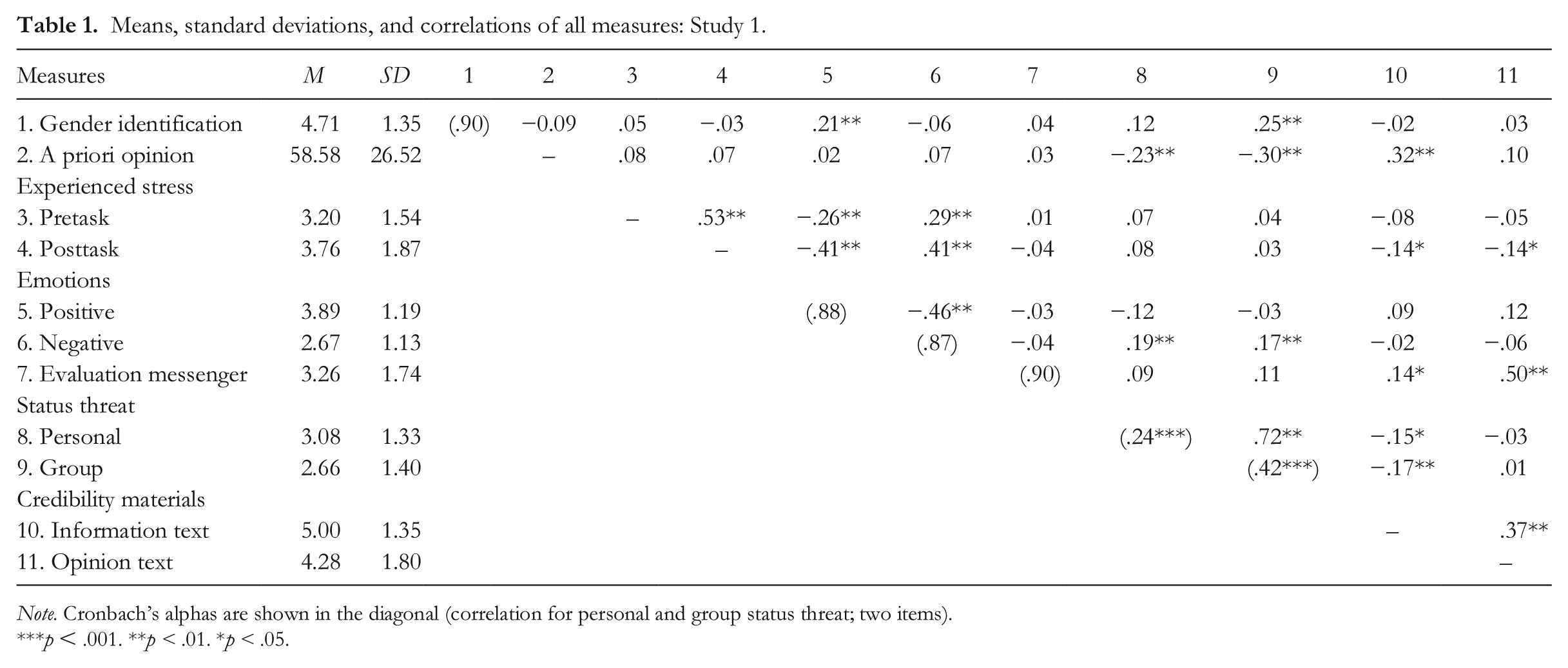
Note. Cronbach’s alphas are shown in the diagonal (correlation for personal and group status threat; two items).
p < .001. **p < .01. *p < .05.
Preliminary analyses
Credibility materials
Respondents in all four conditions rated the used materials as similarly credible, Fs < 1.42, ps > .234, and, on average, scores were all around or above scale midpoint.
A priori opinion
Respondents scored above scale midpoint on the extent to which they thought measures should be taken to improve women’s career opportunities (M = 58.58, SD = 26.52), t(243) = 34.50, p < .001. The large range (0–100) and standard deviation indicate some ambiguity toward the subject and room for persuasion. Unexpectedly, there was a small a priori difference between message conditions; already before the manipulation, respondents were more of the opinion that measures should be taken to improve women’s career opportunities in the conditions where the messenger legitimized versus challenged the gender hierarchy (Mlegitimizing = 61.99, SE = 2.37; Mchallenging = 55.10, SE = 2.39), F(1, 236) = 4.19, p = .042, partial η² = .02. We therefore controlled for this a priori difference in the main analyses. Results without controlling for this a priori difference were virtually identical to those reported next, in the sense that all effects that are (non)significant remain (non)significant and the general pattern of means was similar (for results, see Appendix D).
Manipulation check
The manipulation worked as intended: there was a main effect of message, F(1, 240) = 408.40, p < .001, partial η² = .63. Respondents in the legitimizing gender hierarchy conditions were more of the opinion that the messenger legitimized the gender hierarchy (Mlegitimizing = 5.78, SD = 0.12) than respondents in the challenging gender hierarchy conditions (Mchallenging = 2.45, SD = 0.12). There was also a Message x Messenger Gender interaction effect, F(1, 240) = 4.87, p = .028, partial η² = .02, such that particularly in the challenging gender hierarchy condition, the message was perceived to challenge the gender hierarchy more strongly when communicated by a woman (Mwoman = 2.14, SD = 0.17; Mman = 2.77, SD = 0.17), F(1, 119) = 6.89, p = .010, partial η² = .06.
Main analyses
How do men experience the situation?
Experienced stress
Repeated measures analyses with message, messenger gender, and gender identification as between-subject factors, and time of measurement (stress pre- vs. post-test) as within-subject factor showed a marginally significant main effect of time of measurement, with higher self-reported stress levels after than before writing the opinion text, F(1, 236) = 27.74, p = .064, partial η² = .01. Interestingly, a significant interaction effect between time of measurement and messenger gender revealed that the increase in stress was particularly strong for men who were presented with the opinion of a woman, regardless of what that opinion was (female messenger: Mbefore = 3.25, SE = 0.14; Mafter = 4.02, SE = 0.17; male messenger: Mbefore = 3.15, SE = 0.14; Mafter = 3.49, SE = 0.17), F(1, 236) = 4.11, p = .044, partial η² = .02. We found no evidence in support of Hypotheses 1 and 2 nor evidence for a moderation effect of gender identification (Hypothesis 3).
Emotions
For negative emotions, analyses showed an interaction effect between messenger gender and message only, F(1, 235) = 9.28, p = .003, partial η² = .04 (all other Fs < 3.86, ps > .051). As can be seen in Figure 1, and in support of Hypothesis 1, men reported more negative emotions when presented with a woman who challenged (M = 3.05, SE = 0.14) compared to legitimized the gender hierarchy (M = 2.55, SE = 0.14), F(1, 119) = 6.27, p = .014, partial η² = .05, and compared to a man who challenged the gender hierarchy (M = 2.35, SE = 0.14), F(1, 117) = 12.02, p = .001, partial η² = .09. In contrast to Hypothesis 2, the legitimizing male messenger condition (M = 2.73, SE = 0.14) did not differ from the legitimizing female messenger condition, F(1, 119) = 0.75, p = .389, partial η² = .01. Finally, there was no evidence for moderation by gender identification (Hypothesis 3).
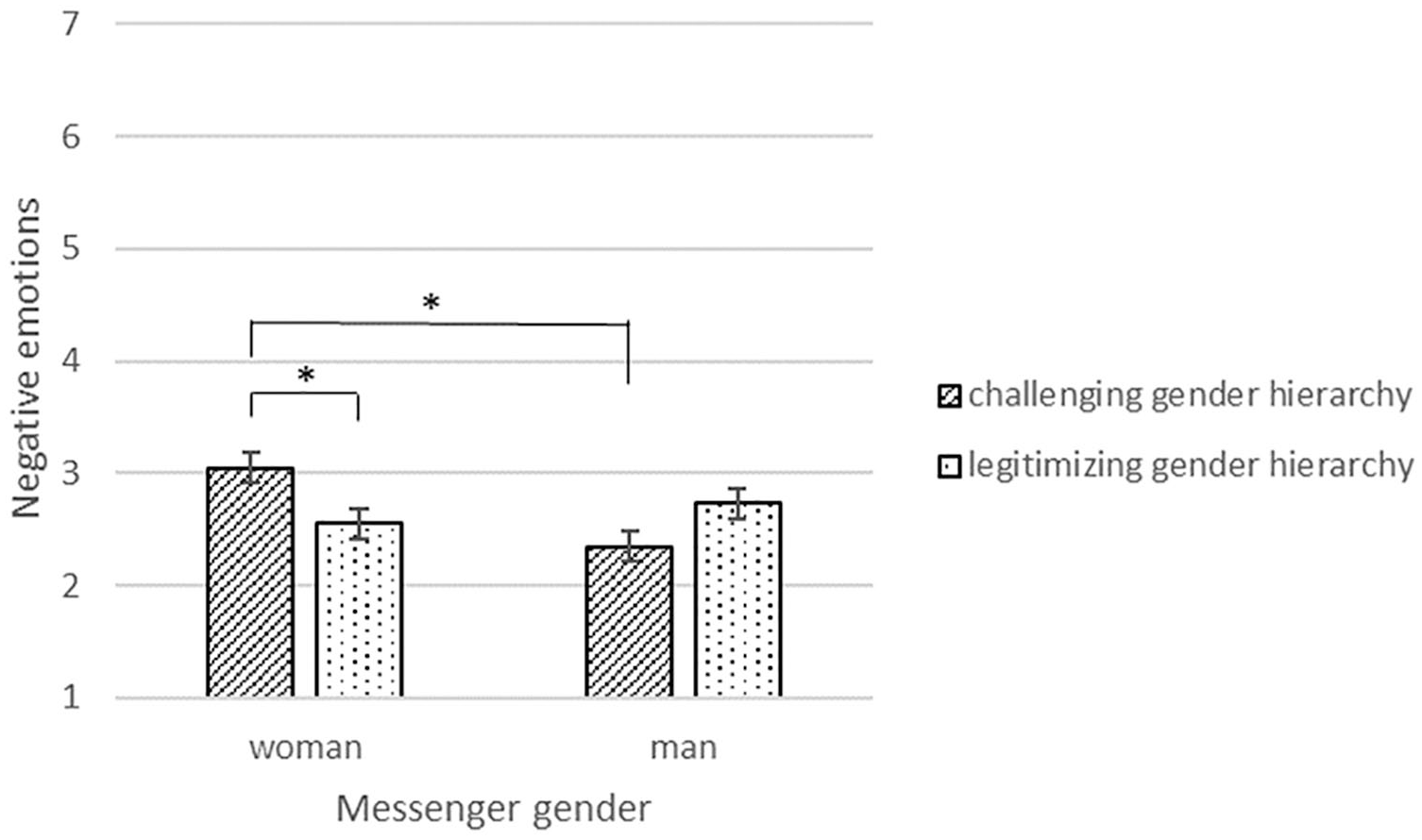
Reported negative emotions when confronted with a male or female messenger who challenged or legitimized the gender hierarchy: Study 1.
There were no significant differences between conditions in positive emotions reported (all Fs < 3.12, ps > .079), but there was a main effect of gender identification: High identifiers reported more positive emotions than low identifiers, B = 0.13, SE = 0.15, F(1, 235) = 10.60, p = .001, partial η² = .04.
Status threat
In contrast to Hypotheses 1 and 2, we did not find significant effects of messenger gender and message on men’s personal or group status threat nor did we find evidence for moderation by gender identification (Hypothesis 3). We did find a main effect of gender identification: Higher gender identification predicted a higher concern for group status loss, B = 0.26, SE = 0.17, F(1, 235) = 13.97, p < .001, partial η² = .08, but not for personal status loss, B = −0.05, SE = 0.17, F(1, 235) = 2.20, p = .140, partial η² = .01.
How do men evaluate the messenger?
As can be seen in Figure 2, respondents held the least positive attitudes toward the man who legitimized the gender hierarchy. Analyses indicated a main effect of messenger gender, F(1, 235) = 10.35, p = .001, partial η² = .04, which was qualified by a Messenger Gender x Message interaction effect, F(1, 235) = 3.99, p = .047, partial η² = .02. In contrast to Hypothesis 1, there was no indication that respondents evaluated a female messenger more positively when she legitimized rather than challenged the gender hierarchy, F(1, 119) = 0.18, p = .669, partial η² = .00. In support of Hypothesis 2, when respondents were presented with a messenger who legitimized the gender hierarchy, this person was evaluated more positively when it was a woman than when it was a man (Mman = 4.09, SE = 0.14; Mwoman = 4.88, SE = 0.16), F(1, 119) = 11.44, p = .001, partial η² = .09. Moreover, with regard to male messengers, respondents held less positive attitudes toward the man who legitimized rather than challenged the gender hierarchy (Mlegitimize = 4.09, SE = 0.14; Mchallenge = 4.59, SE = 0.15), F(1, 117) = 6.54, p = .012, partial η² = .05. When the gender hierarchy was challenged, respondents did not differ on their positive attitudes toward the woman versus the man (Mwoman = 4.78, SE = 0.16; Mman = 4.59, SE = 0.15), F(1, 117) = 0.84, p = .362, partial η² = .01.
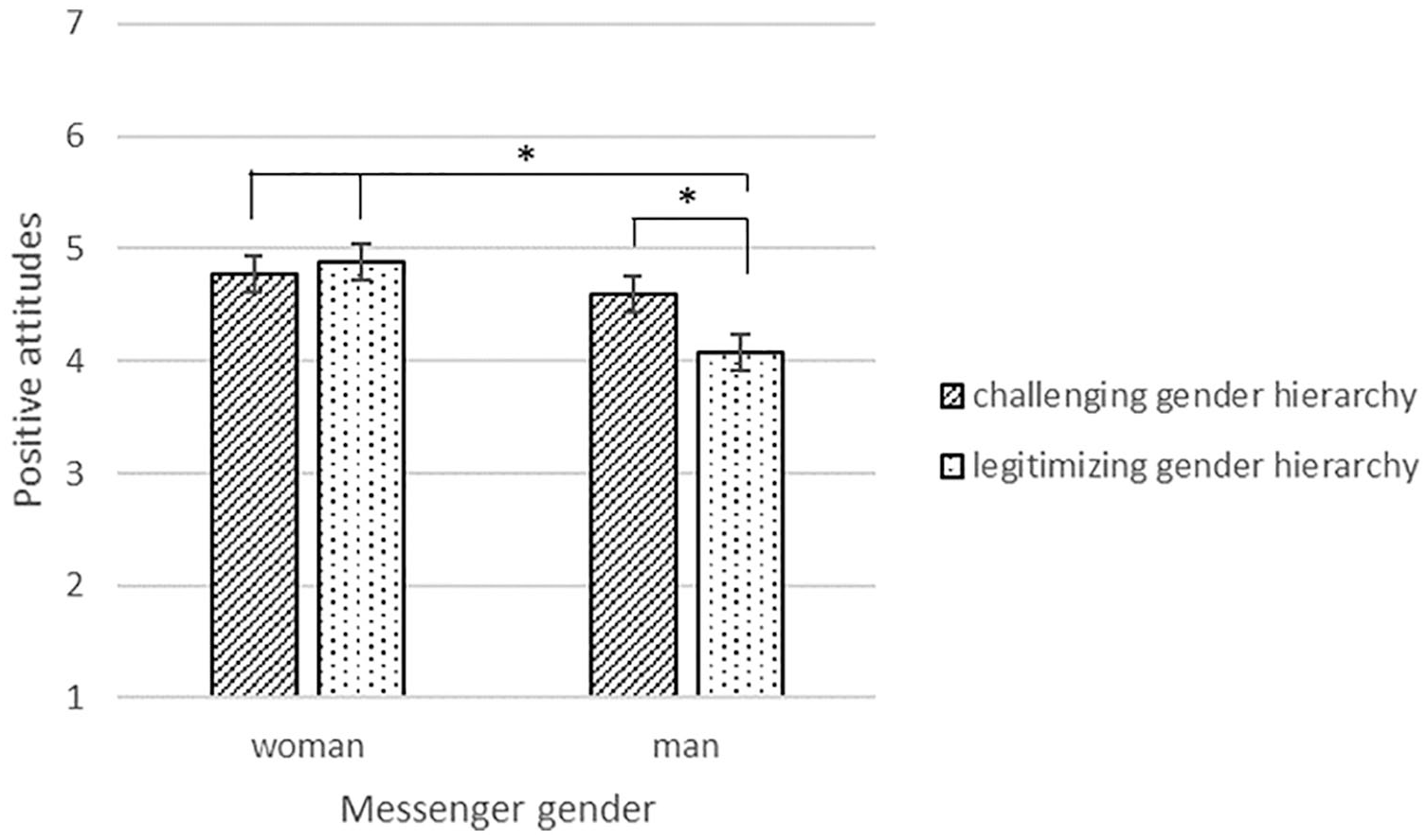
Positive evaluations of male or female messenger who challenged or legitimized the gender hierarchy: Study 1.
In contrast to Hypothesis 3, the mentioned two-way interaction was not further qualified by gender identification. There was, however, a Message x Gender Identification effect, F(1, 235) = 6.14, p = .014, partial η² = .03 (see Figure 3). Low identifiers evaluated messengers more positively when they challenged rather than legitimized the gender hierarchy (Mlegitimizing = 4.22, SD = 0.16; Mchallenging = 4.84, SD = 0.16), F(1, 236) = 7.56, p = .006, partial η² = .03. No such effect was found among high identifiers (Mlegitimizing = 4.74, SD = 0.16; Mchallenging = 4.54, SD = 0.16), F(1, 236) = 0.78, p = .379, partial η² = .00.
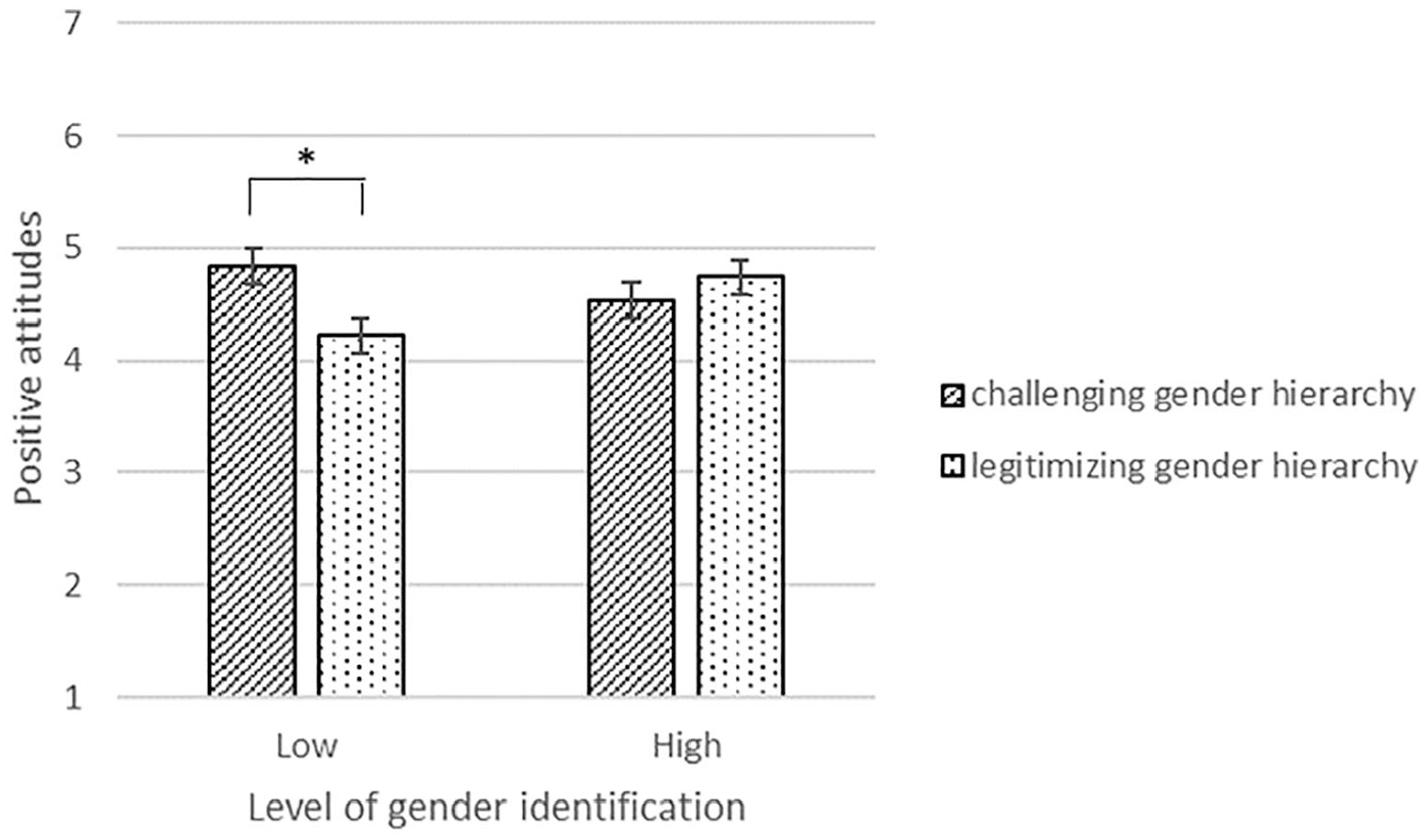
Positive evaluations of the messenger for respondents with relatively low (−1 SD) and high (+1 SD) gender identification in the challenging and legitimizing gender hierarchy conditions: Study 1.
Discussion
Study 1 examined men’s responses to male and female messengers who legitimized or challenged the gender hierarchy. Results suggest that self-reported stress increased when men actively reflected on gender inequality. Furthermore, men reported higher stress levels after being presented with a woman’s opinion on gender inequality than a man’s. Moreover, in support of Hypothesis 1, we found evidence that men experienced less negative emotions when a female messenger legitimized rather than challenged the gender hierarchy; however, these lower negative emotions did not translate into more positive evaluations of the female messenger who legitimized (vs. challenged) the gender hierarchy. In line with Hypothesis 2, we found that male messengers who legitimized the gender hierarchy were evaluated more negatively than female-legitimizing messengers. In combination, these results provide initial evidence that for men reflecting on gender inequality, a woman who legitimizes (vs. challenges) the gender hierarchy can alleviate threat, while another man who legitimizes the status quo does not, and is even evaluated negatively for making such claims.
In contrast to Hypothesis 3, we did not find any evidence that the predicted effects were moderated by gender identification. We did find that high (vs. low) gender-identified men reported a higher concern for group status loss. By contrast, low gender-identified men held more positive attitudes toward messengers who challenged the status quo. Although these effects are in keeping with basic premises of social identity theory and the current research, we did not find evidence that gender identification interacted with messenger gender.
Although we found some support for our hypotheses on negative emotions, the effects were less strong on the more specific measures of self-reported stress and status threat. The latter may not be entirely surprising given the difficulty of capturing the concept of threat with self-report measures. People may not always be aware of threat, and when they are, they may respond defensively on self-report measures (e.g., deny threat) or adjust their answers out of social desirability (Blascovich & Mendes, 2000). Furthermore, it now remains unclear whether self-reported stress is negative or positive stress (i.e., threat or challenge). Therefore, to obtain more evidence for the role of threat, in Study 2 we measured this concept using more implicit physiological measures based on the biopsychosocial model of challenge/threat (BPS-CT; Blascovich & Mendes, 2000; Blascovich & Tomaka, 1996). This allows us to investigate men’s physiological state during task performance, as well as their explicit evaluations afterwards.
Study 2
In Study 2, we specifically focused on female messengers and examined men’s responses to a woman who either challenged or legitimized the gender hierarchy. In the current studies, men might not be aware or not willing to admit being opposed to gender equality and, as a result, explicitly state not to be threatened by social change; however, unconsciously, they may still display signs of threat. Since it is difficult to measure this threat through explicit measures, we used physiological ones to investigate both unconscious stress responses and consciously (adapted) expressed attitudes.
According to the BPS-CT model, people evaluate the demands (e.g., required effort, uncertainty) of a motivated performance situation, and the resources to deal with these demands (e.g., skills, support; Blascovich, 2008; Blascovich & Mendes, 2000; Blascovich & Tomaka, 1996; Seery, 2011; Wormwood et al., 2019). The ratio of perceived demands and resources either results in a state of challenge (i.e., resources outweigh demands) or a state of threat (i.e., demands outweigh resources). Threat and challenge motivational states can be seen as similar to “positive” and “negative” forms of stress, which, at the physiological level, is indicated by a more or less efficient cardiovascular (CV) response pattern.
The BPS-CT model distinguishes between threat and challenge motivational states based on cardiac output (CO; the amount of blood pumped by the heart in 1 minute) and total peripheral resistance (TPR; vascular resistance: resistance of the blood vessels to blood flow). Challenge is indicated by relatively high CO and low TPR, while threat is indicated by relatively low CO and high TPR. While a challenge CV pattern typically facilitates performance (Behnke & Kaczmarek, 2018; Blascovich et al., 2004; Hase et al., 2018; Kassam et al., 2009; Mendes et al., 2007), a threat CV pattern can, in the long run, lead to impaired health (Blascovich, 2008; Hase et al., 2020).
Conceptually, the CV markers of threat (and challenge) are connected to the self-report measures of threat we used in both studies. Most directly, the items measuring demands and resources cover the appraisal component of challenge and threat. More indirectly, the status threat measure can also be related to these appraisals, as status threat may induce feelings of insecurity, which is an important demand component in the BPS-CT. Finally, negative affect has been conceptualized as an “affective cue” (Blascovich & Mendes, 2000) that facilitates the development of a CV threat pattern. Thus, although the self-report measures cover different operationalizations of threat, conceptually, they can all be related to each other, as well as to the CV threat pattern described by the BPS-CT.
To measure motivational states of challenge and threat, we created a motivated performance situation resembling day-to-day encounters where people discuss social change with others. Therefore, we asked male participants to voice their opinion on this in a short speech. Before participants gave their speech, they watched a recorded speech of an ostensibly fellow participant.
Method
Participants and design
Participants were male students at a Dutch university who received payment or course credit for participation. The study had a 1 (gender identification, standardized, continuous) x 2 (message: hierarchy legitimizing/challenging) between-participant design. Power analyses based on an alpha of .05, power of 0.80, and an effect size of f =.37 (based on Does et al., 2012; Scheepers, 2009), resulted in a required sample size of N = 84. Anticipating data loss, we recruited 103 male students (Mage = 22.19, SD = 2.63). Participants with missing scores on CO, TPR, pre-ejection period (PEP), or heart rate (HR) due to signal loss or poor signal quality were excluded from the analyses of that specific CV measure. This resulted in a difference in included participants between the physiological (N = 100) and self-report (N = 103) data analyses.
Procedure
Participants were assigned a computer in the lab. After consent was obtained, we applied the sensors for physiological recording. Next, participants filled in the same pre-measures as in Study 1. Participants were asked to sit as still as possible while their voice and video were recorded during the remainder of the experiment.
Participants watched a 5-minute aquatic video during which, baseline physiological readings were taken. Subsequently, participants were randomly presented with a movie clip showing either a woman who legitimized (n = 51) or challenged (n = 52) the gender hierarchy. Participants did not know that the speeches only featured women. In both conditions the speeches were identical to the opinion texts of the messengers in Study 1 (see Appendix C). Next, participants were given 1 minute to prepare their own speech (i.e., speech preparation period), followed by 2 minutes to give their own speech in front of a webcam (i.e., motivated performance situation for CV responses). Their speech would ostensibly be shown to another participant (unspecified gender) in the study.
Subsequently, participants completed the same self-report measures as in Study 1. Lastly, the experimenter removed the physiological recording sensors, probed participants for suspicion, and debriefed them. Participation took about 60 minutes.
Psychophysiological measures
Impedance-cardiographic signals (ICG), electrocardiographic signals (ECG), and blood pressure (BP) were continuously measured during the experiment using a Biopac MP150 system (Biopac Systems, Goleta, CA). Psychophysiological data were recorded and stored using Acqknowledge software (Biopac Systems, Goleta, CA) and further scored and quantified using the Physiodata toolbox (see https://physiodatatoolbox.leidenuniv.nl) in MATLAB. In addition to CO and TPR to differentiate between threat and challenge, we measured heart rate (HR) and pre-ejection period (PEP; measure of ventricular contractility) to establish task engagement—a key aspect of motivated performance and necessary to interpret CO and TPR regarding challenge and threat (Blascovich et al., 2004; Kassam et al., 2009). Task engagement is indicated by increased heart rate (HR) and decreased pre-ejection period (PEP) compared to baseline.
We examined cardiovascular activity compared to baseline during the 1-minute preparation period and the first minute of the speech. Because challenge habituates quicker than threat, cardiovascular responses are typically only examined during the first minute of a motivated situation. In addition, we focused on the speech preparation period to control for metabolic demands and somatic activity during speech delivery, to obtain a more “pure” measure of the psychology of challenge and threat (Hase et al., 2019; Mendes et al., 2002; Moore et al., 2015). Following common procedure in research on the BPS-CT model, extreme scores (defined as 3.3 SD above/below the mean or p = .001 in a normal distribution) were winsorized by recoding them to a value of 1% higher/lower than the next nonextreme value (Lamarche et al., 2020; Scheepers, 2009; Seery et al., 2004).
In addition to analyzing CO and TPR as separate indices of challenge and threat, we calculated a combined threat–challenge index (TCI) by converting CO and TPR reactivity scores into z-scores, multiplying TPR by −1, and summing the result to the CO z-score. Higher values on the resulting index indicate a stronger challenge motivational state, whereas lower values indicate a stronger threat motivational state (Blascovich et al., 2004; Kassam et al., 2009; Lamarche et al., 2020; Mendes et al., 2007; Seery et al., 2009; Weisbuch et al., 2009).
Self-report measures
The self-report measures were identical to those in Study 1 (see Table 2).
Means, standard deviations, and correlations of all measures: Study 2.
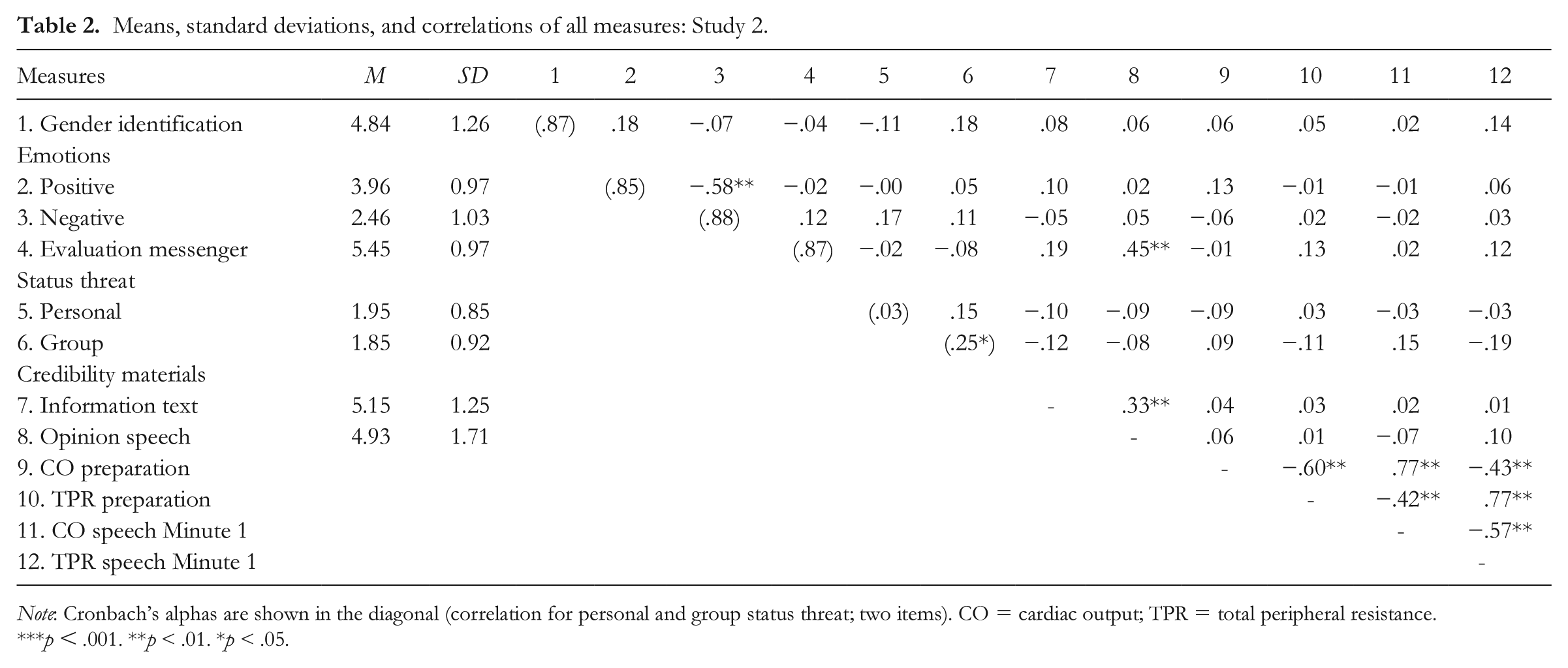
Note: Cronbach’s alphas are shown in the diagonal (correlation for personal and group status threat; two items). CO = cardiac output; TPR = total peripheral resistance.
p < .001. **p < .01. *p < .05.
Results
Data were analyzed using similar analysis techniques as in Study 1.
Preliminary analyses
Credibility materials
First, respondents rated the information text on gender inequality as highly credible, and there were no significant differences between conditions (Mlegitimizing = 5.02, SE = 0.18; Mchallenging = 5.27, SE = 0.18), F(1, 100) = 1.05, p = .307, η² = .01. Second, although respondents rated the speech of the messenger as highly credible, respondents in the legitimizing gender hierarchy condition rated the speech as somewhat less credible than those in the challenging gender hierarchy condition (Mlegitimizing = 4.59, SE = 0.24; Mchallenging = 5.28, SE = 0.24), F(1, 100) = 4.25, p = .042, η² = .04.
Manipulation check
The manipulation worked as intended: respondents in the legitimizing condition were more of the opinion that the female messenger legitimized the gender hierarchy than respondents in the challenging condition were (Mlegitimizing = 6.15, SE = 0.15; Mchallenging = 2.35, SE = 0.15; α = .85), F(1, 99) = 339.65, p < .001, partial η² = .77.
How do men experience the situation?
Emotions
In support of Hypothesis 1, and in line with the results of Study 1, respondents who were presented with a woman who challenged the gender hierarchy reported more negative emotions than respondents who were presented with a woman who legitimized the gender hierarchy (Mchallenging = 2.73, SE = 0.14; Mlegitimizing = 2.18, SE = 0.14), F(1, 99) = 7.77, p = .006, partial η² = .07. Also in line with the results of Study 1, no significant effects were found for positive emotions, F(1, 99) = 2.57, p = .112, partial η² = .03. In contrast to Hypothesis 3, we found no significant main or interaction effects of gender identification.
Status threat
In contrast to our hypotheses, but in line with results of Study 1, we did not find any effects of message on men’s self-reported status threat. However, in line with results of Study 1, higher gender identification predicted a higher concern for group status loss, B = 0.22, SE = 0.14, F(1, 99) = 3.75, p = .056, partial η² = .04, but not for personal status loss, B = 0.07, SE = 0.13, F(1, 99) = 0.71, p = .403, partial η² = .01.
Psychophysiological challenge and threat responses
As intended, there were no between-condition baseline differences in CV responses (all Fs < 0.38, all ps > .542).
Participants showed significant increases in HR and decreases in PEP (compared to baseline level) during speech preparation and during the first minute of the speech, indicating overall task engagement, all ts > |8.84|, all ps < .001, which allows us to further analyze threat and challenge responses. There were no effects of gender identification and message on HR and PEP reactivity (all Fs < 0.68, all ps > .412).
During speech preparation, there was a significant Gender Identification x Message interaction on the TCI, F(1, 96) = 8.28, p = .005, partial η² = .08 (see Figure 4). In line with Hypotheses 1 and 3, men with relatively high gender identification showed the strongest tendency towards threat when presented with a woman who challenged the gender hierarchy, and the strongest tendency towards challenge when presented with a woman who legitimized the gender hierarchy. The effect of message was significant among high-identified men, F(1, 96) = 6.67, p = .011, partial η² = .07, but not among low-identified men, F(1, 96) = 2.23, p = .139, partial η² = .02. Moreover, when presented with a woman who challenged the gender hierarchy, low-identified men showed a response indicative of challenge, while high-identified men showed a response indicative of threat, F(1, 48) = 5.29, p = .026, partial η² = .10.
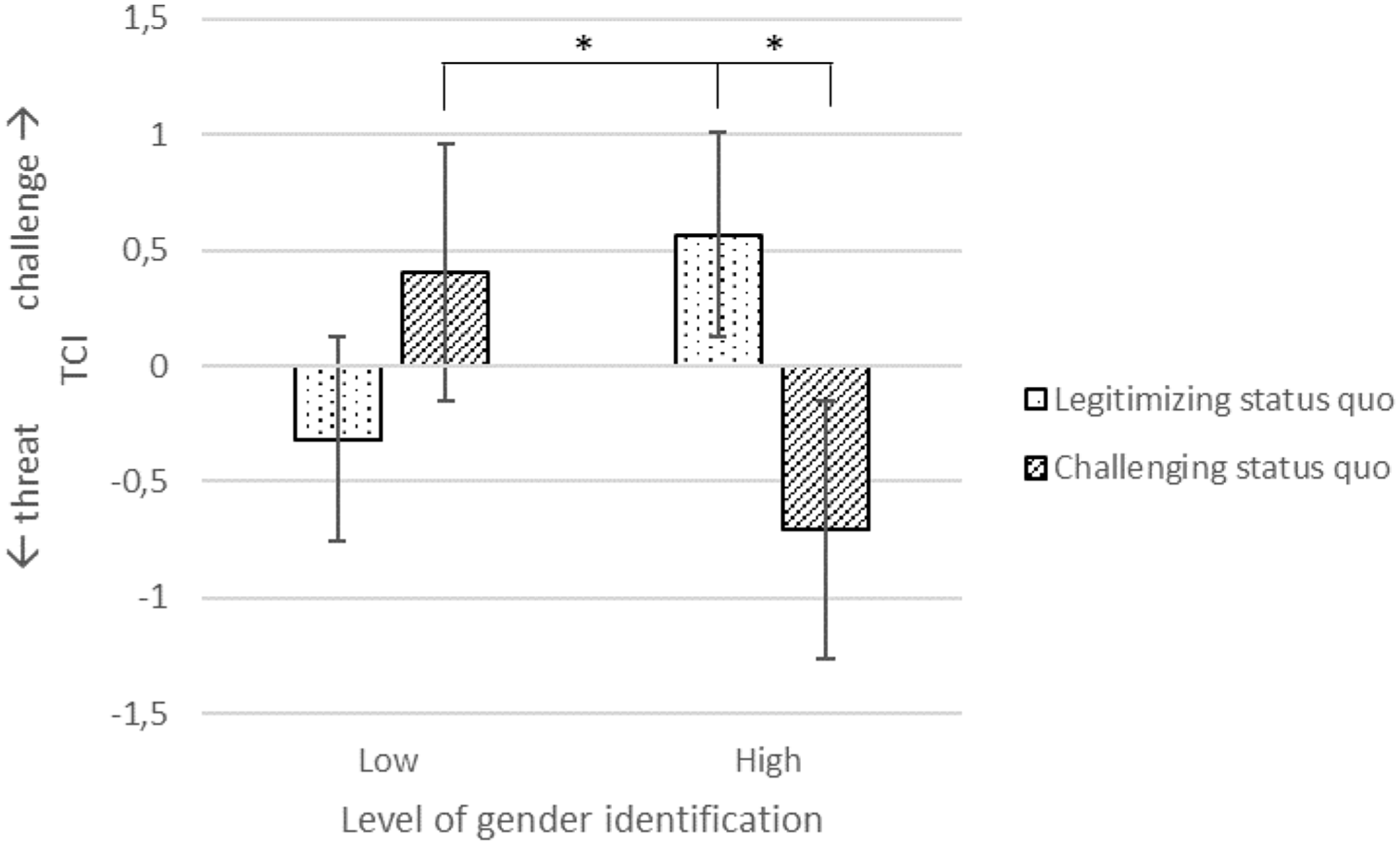
TCI during speech preparation for respondents with relatively low (−1 SD) and high (+1 SD) gender identification in the legitimizing and challenging gender hierarchy conditions: Study 2.
Separate analyses of TPR and CO showed that the interaction between message and gender identification was significant on both indicators of the TCI, FTPR(1, 96) = 7.70, p = .007, partial η² = .07; FCO(1, 96) = 6.85, p = .010, partial η² = .07. As can be seen in Table 3, the patterns of CO and TPR underline the conclusions drawn based on the TCI.
TPR and CO reactivity and threat/challenge index (TCI) during speech preparation and the first speech minute for respondents with relatively low (−1 SD) and high (+1 SD) gender identification in the legitimizing and challenging gender hierarchy conditions: Study 2.
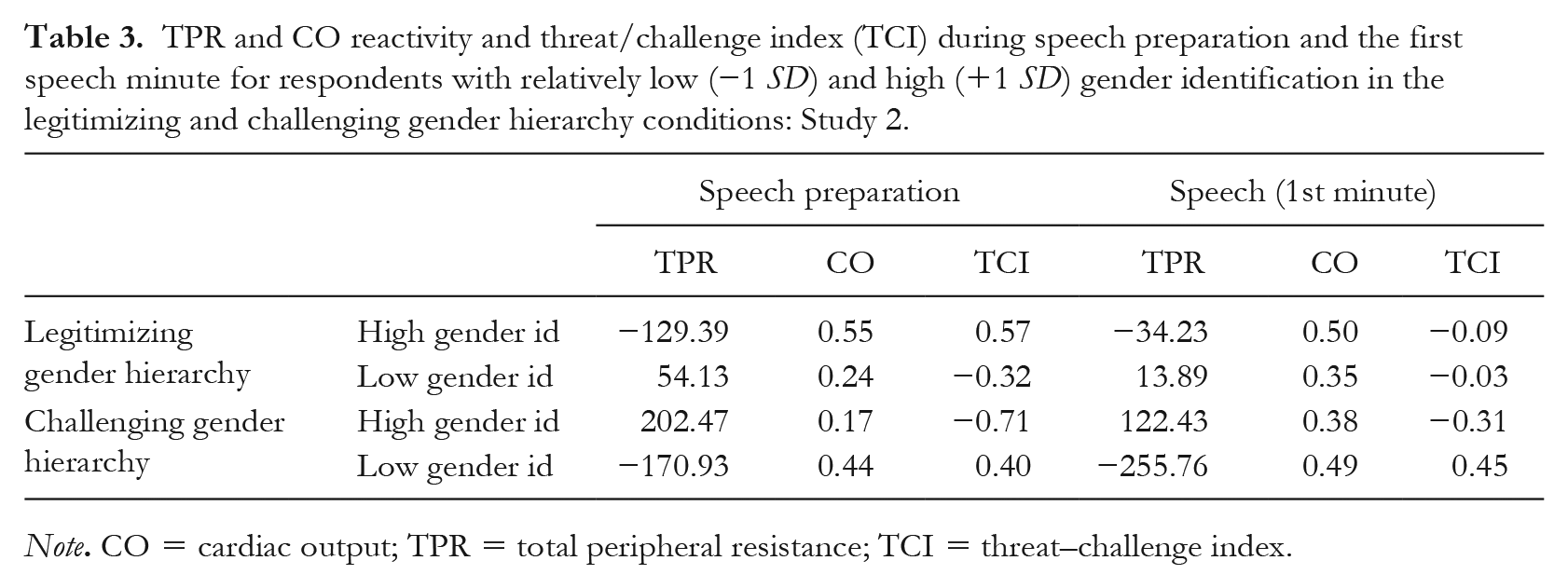
Note. CO = cardiac output; TPR = total peripheral resistance; TCI = threat–challenge index.
During the speech, analyses revealed no significant effects on the TCI. However, analyses on the indicators of the TCI (TPR and CO) revealed a significant interaction between gender identification and message for TPR, F(1, 96) = 4.73, p = .032, partial η² = .05. Recall that (contrary to the TCI) decreased TPR is indicative of challenge, while increased TPR is indicative of threat. As depicted in Figure 5, and similar to the responses found during speech preparation, when presented with a woman who challenged the gender hierarchy, highly identified men showed increased TPR (indicative of threat), while low-identified men showed reduced TPR (indicative of challenge); this difference between low and high identifiers was significant, F(1, 48) = 7.24, p = .010, partial η² = .13.
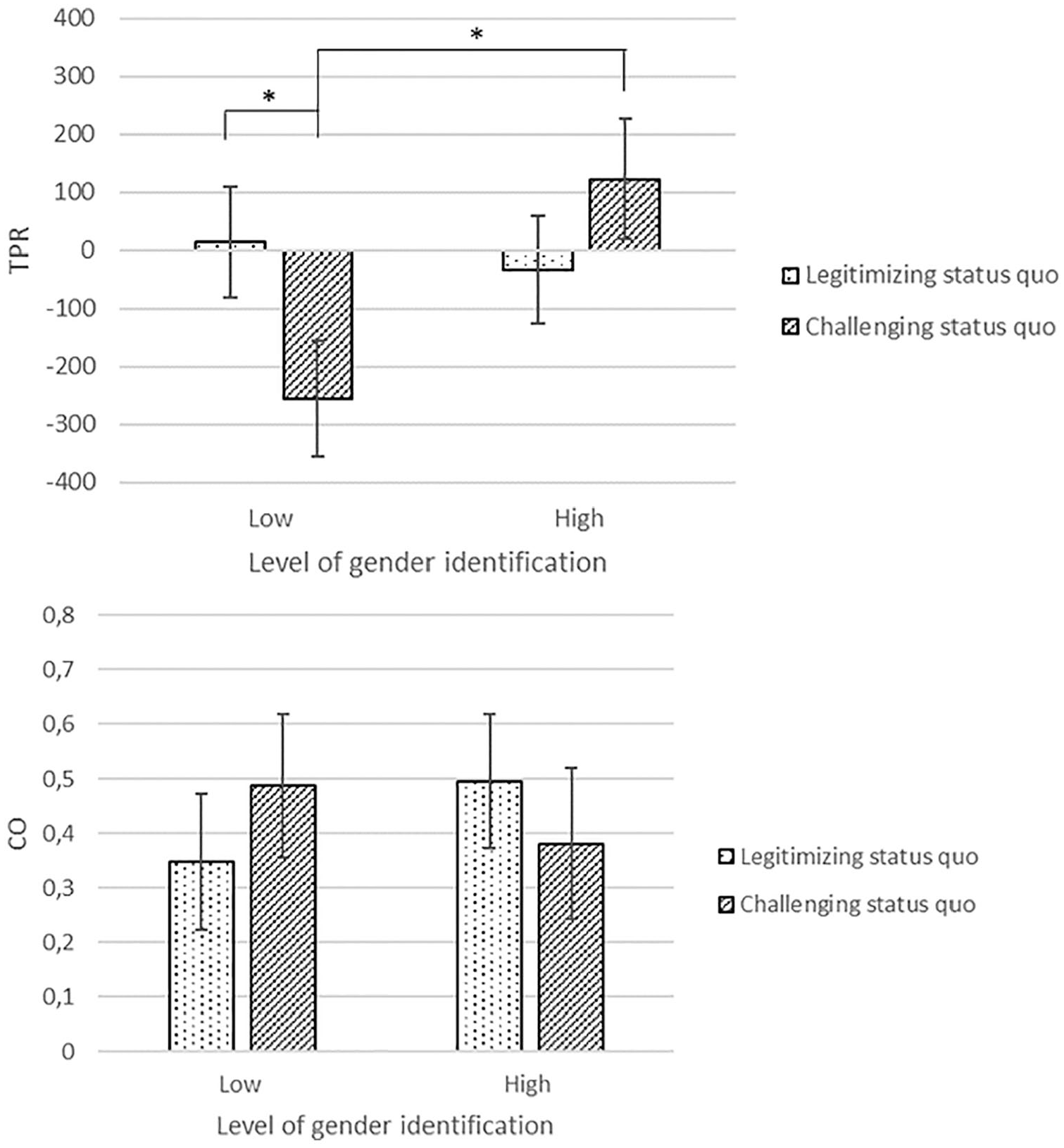
TPR and CO reactivity during the speech task (first minute) for respondents with relatively low (−1 SD) and high (+1 SD) gender identification in the legitimizing and challenging gender hierarchy conditions: Study 2.
How do men evaluate the messenger?
In contrast to Hypothesis 1, respondents evaluated the female messenger who challenged the gender hierarchy more positively than the female messenger who legitimized the gender hierarchy (Mlegitimizing = 5.25, SE = 0.14; Mchallenging = 5.66, SD = 0.13), F(1, 99) = 4.64, p = .034, partial η² = .05. This difference was partly due to the fact that participants thought that the speech of the woman who challenged the gender hierarchy was more credible (see preliminary analyses); indeed, after controlling for speech credibility, we found no differences in positive attitudes toward both messengers (Mlegitimizing = 5.33, SE = 0.12; Mchallenging = 5.57, SD = 0.12), F(1, 97) = 1.72, p = .193, partial η² = .02. In contrast to Hypothesis 3, and in contrast to the results of Study 1, we found no significant effects of gender identification.
Discussion
Study 2 yielded evidence for our prediction that some men prefer women who legitimize rather than challenge the gender hierarchy, namely high gender-identified men. Similar to Study 1, and in keeping with Hypothesis 1, women who legitimized (vs. challenged) the gender hierarchy elicited less negative emotions in men. Moreover, on a physiological level, highly gender-identified men responded with challenge to a woman legitimizing the gender hierarchy, and with threat to a woman challenging the gender hierarchy, in line with hypotheses 1 and 3. In both studies, we find that highly identified men reported more concern about their group’s status than men with lower gender identification. Possibly, meeting a woman who legitimizes men’s high status helps to cope with group status threat. Moreover, low-identified men responded with challenge when presented with a woman who challenged the gender hierarchy. However, this effect was less strong, as it was only visible on one physiological indicator. These results suggest that, for highly identified men, it can be beneficial for their cardiovascular health (Blascovich, 2008), and smooth interpersonal interactions (Mendes et al., 2007), to interact with women who legitimize rather than challenge gender inequality, as this allows men to engage in discussions about gender inequality in a challenge, rather than a threat, motivational state.
Against predictions, we found no evidence that women who legitimized (vs. challenged) the gender hierarchy were evaluated more positively on an explicit level; in fact, Study 2 showed that women who legitimized the gender hierarchy were actually evaluated as less credible and less positively than women who challenged the status quo. As such, whereas it seems that women who legitimize the gender hierarchy elicit less negative emotions on an explicit level, and on a more implicit level even induce challenge among highly identified men when preparing to voice their opinion about gender inequality, we did not find evidence that this could directly benefit these women in terms of how they were evaluated afterwards. Finally, note that the effect size on cardiovascular responses was somewhat smaller than found in prior studies (Does et al., 2012; Scheepers, 2009). This might be due to a more complex procedure in our experimental set-up, which demanded a lot from respondents. We warrant that future research including cardiovascular responses borrowing from this design might opt for a more conservative effect size, as also more recent work on status threat and cardiovascular responses found a small to medium effect size (f = 0.18; Dover et al., 2016).
General Discussion
The present research aimed to investigate how men respond to women’s opinions that either challenge or legitimize the current gender hierarchy. Specifically, we examined whether men experience more negative emotions and attitudes, and more (cardiovascular) threat, when presented with women who challenge (vs. legitimize) the gender hierarchy. We furthermore examined whether these responses were more pronounced among highly gender-identified men.
Men’s Responses to Women
In two studies, we found that men explicitly report more negative emotions when presented with women who challenge (vs. legitimize) the gender hierarchy. Study 1 revealed that this effect only occurred for female but not male messengers: Whereas women who challenged (vs. legitimized) the gender hierarchy elicited significantly stronger negative emotions in men, no such difference was found when the messenger was male. Furthermore, CV responses in Study 2 showed that highly identified men showed a pattern of threat when presented with women who challenged the gender hierarchy, and a pattern of challenge when presented with women who legitimized the gender hierarchy. In addition, we found that low-identified men explicitly reported more positive evaluations of messengers (men and women) who challenged (vs. legitimized) the gender hierarchy, and showed a CV pattern of challenge when presented with women who challenged the gender hierarchy. Together, these results suggest that for highly gender-identified men, but not for low gender-identified men, an interaction with women who challenge the gender hierarchy can be uncomfortable since it destabilizes the high-status position of men. This concern might be alleviated when highly gender-identified men interact with women who legitimize the gender hierarchy.
A key factor that contributes to the slow progress in reducing gender inequality is status stress experienced by high-status groups (such as men) in the prospect of social change (Jetten et al., 2017; Maass et al., 2003; Scheepers & Ellemers, 2019). Adding to the current knowledge base, this work shows the crucial role of the message (challenging/legitimizing) and the messenger (woman/man) in the social inequality debate. Results of our studies suggest that status stress might have emerged when women’s challenging messages acted as a cue of unstable status differences and, in turn, induced defensive responses in (highly identified) men, while such stress was alleviated when women legitimized the current gender hierarchy.
We did not find differences in self-reported positive attitudes men held toward women who legitimized versus challenged the gender hierarchy. This could be explained by the fact that, for men, it is socially desirable to come across as nonsexist and egalitarian (Becker & Barreto, 2014; Plant & Devine, 1998). We recommend further research to examine the robustness of the effects we found, to investigate whether men indeed do not have more positive attitudes toward women who legitimize versus challenge the gender hierarchy.
Men’s Responses to Men
We found indication that, for men, it may actually be detrimental to legitimize the gender hierarchy. In line with predictions, men who legitimized the gender hierarchy were evaluated less positively than women voicing the same message, and men who challenged the gender hierarchy. This suggests that men and women are not held to the same standards, and that what is acceptable or even beneficial for women to say is evaluated quite differently when it comes from a man (Bowles et al., 2007; Heilman & Chen, 2005).
The findings of Study 1 thus also shed light on how men judge fellow ingroup members who either challenge or legitimize the gender hierarchy. In keeping with previous research, similar behavior is often labeled as sexist when it comes from a man, but not when it comes from a woman (Baron et al., 1991), and “sexist” men (i.e., those legitimizing the gender hierarchy) are typically judged more negatively than more progressive men (i.e., those questioning the gender hierarchy; Branscombe, 1998). The latter is also in line with “black sheep effect” research (e.g., Marques et al., 1988; Marques & Paez, 1994), the effect that negatively behaving ingroup members are judged more negatively than outgroup members performing the same behavior. Our findings also support the idea that it might not be socially desirable for men to openly claim to be against social change (i.e., legitimize current gender inequalities), while women can still “get away with” this.
Physiological and Self-Report Measures
Our results provide evidence of the benefits of physiological measures in addition to self-report ones of stress and threat. In keeping with previous work on intergroup interactions (Blascovich et al., 2002), we observed a discrepancy between physiological and self-report measures. First, the effects of gender identification were most pronounced on the physiological measures of threat, not on self-report measures. Second, while women who challenged the status quo were evaluated rather positively on self-report measures (and equally positively as women who legitimized the status quo), at an implicit physiological level, they still elicited threat in highly identified men.
These discrepancies can be due to the strategic adaptation of self-report responses (social desirability concerns). Displaying a progressive explicit attitude might be the norm but, especially among the current student population, the prospect of change with all its uncertainties may still result in a physiological threat response. Another explanation might be that men’s positive attitudes towards women who challenge the status quo are genuine, but that they still experience physiological threat due to the uncertainty accompanying change, or due to worries to be viewed as sexist (for low gender-identified men). Furthermore, high gender-identified men are in a rather precarious situation: On the one hand, they may be most concerned about status loss, on the other hand, responding to threat with sexism or explicitly voicing concerns may also harm the image of their group (especially in populations in favor of social change).
Implications for Gender Inequality
These results might have implications in relation to benefits for women who display “queen bee” behaviors—such as denial of the existence of gender inequality, lack of support for gender diversity interventions, and legitimizing the current gender hierarchy—in interactions with men in male-dominated environments (Derks et al., 2016). By adjusting to the male-dominated environment (i.e., to fit in with men), women aim to achieve benefits for their individual careers. Adding to this work, these studies showed another incentive for women to legitimize the current gender hierarchy instead of “rocking the boat”: Women who challenged the status quo elicited more negative emotions and physiological threat in highly identified men. Thus, to avoid negative or defensive responses from men, it might be more convenient for women to explicitly accept the gender hierarchy and downplay gender inequality than to advocate social change. Although the current studies did not show that this resulted in more positive explicit evaluations of women who legitimize the gender hierarchy, other research suggests that it may still be beneficial, as these women are more likely to be selected for jobs and promotions (e.g., Faniko et al., 2021). We encourage further research to investigate whether men’s threat/challenge responses result in behavioral consequences for women.
Conclusion
Men respond more negatively toward women who challenge, compared to legitimize, the gender hierarchy. Conversely, men respond more negatively toward men, compared to women, who legitimize the gender hierarchy on an explicit level. It thus can be beneficial for women to legitimize the gender hierarchy and, in fact, they seem to “get away with it,” while for men this is socially undesirable. Although legitimizing the gender hierarchy might have personal benefits for women, it results in maintaining the gender hierarchy. Thus, legitimizing the gender hierarchy justifies the current system and inactivates men to (actively) support gender equality initiatives. While challenging the gender hierarchy comes with a cost for women personally, it can have great impact to effectively elicit social change by activating men to pursue gender equality.
Supplemental Material
sj-pdf-1-gpi-10.1177_13684302211042669 – Supplemental material for It’s a man’s world; right? How women’s opinions about gender inequality affect physiological responses in men
Supplemental material, sj-pdf-1-gpi-10.1177_13684302211042669 for It’s a man’s world; right? How women’s opinions about gender inequality affect physiological responses in men by Ilona Domen, Daan Scheepers, Belle Derks and Ruth van Veelen in Group Processes & Intergroup Relations
Footnotes
Funding
The author(s) disclosed receipt of the following financial support for the research, authorship, and/or publication of this article: This work was supported by a Vidi grant (452-14-010) from The Netherlands Organization for Scientific Research (NWO) awarded to Belle Derks.

Supplement Material
Supplemental material for this article is available online.
Notes
References
Supplementary Material
Please find the following supplemental material available below.
For Open Access articles published under a Creative Commons License, all supplemental material carries the same license as the article it is associated with.
For non-Open Access articles published, all supplemental material carries a non-exclusive license, and permission requests for re-use of supplemental material or any part of supplemental material shall be sent directly to the copyright owner as specified in the copyright notice associated with the article.
