




Abstract
Individuals engage in a variety of behavioral responses to cope with the COVID-19 pandemic, from complying with or transgressing against physical distancing regulations, to stockpiling or prosocial behavior. We predicted that particularly descriptive social norms are important in driving pandemic-related behavior as they offer guidelines in times of insecurity and crisis. To investigate this assumption, we conducted a longitudinal survey with two measurement points (n = 1,907) in Germany during the spring of 2020. Results show that descriptive norms (perceived behavior of close others) positively predicted future transgression against distancing regulations, stockpiling, and prosocial behavior over time. In our analysis, we account for previous behavior as well as other potential predictors (subjective threat, personality). In sum, our findings highlight the power of descriptive norms in increasing compliance with pandemic-related regulations and promoting future prosocial behavior.
Keywords
In the wake of the COVID-19 health crisis, societies had to implement measures to slow down the spread of the pandemic. Aside from locking down institutions and businesses, one of the most notable changes in people’s daily lives were regulations to reduce physical contact that came into effect in many countries in spring 2020. Within days, governments imposed regulations that, for instance, restricted social gatherings and confined social interactions in public to clearly defined physical distances (Hale et al., 2021). In the weeks following the restrictions, individuals’ compliance varied: Some meticulously adhered to the new rules, while others transgressed against the restrictions (e.g., see Lehrer et al., 2020, regarding statistics for Germany). At the same time, societies experienced a surge of stockpiling (Arafat et al., 2020; Baddeley, 2020). Despite repeated admonitions from authorities to the public, grocery stores struggled for several weeks to comply with a skyrocketing demand for supplies such as canned goods, pasta, flour, toilet paper, disinfectants, and hand soap. Yet, whereas some individuals seemed more concerned about their own safety and less about the common good, others actively chose to engage in prosocial behavior at their own expense, sometimes even risking their own health (Abel & Brown, 2020; Han et al., 2021). These individuals, for instance, engaged in neighborhood help (e.g., carrying out tasks for older people), donated to Corona help funds, or took part in digital public action (e.g., by offering online courses or support). When focusing on future waves of the COVID-19 pandemic or other upcoming health crises, it is of paramount importance to understand which factors contribute to whether individuals engage in desirable or nondesirable response to the pandemic. Here, we argue for, and empirically substantiate, the importance of descriptive social norms as a powerful predictor of the three mentioned pandemic-related behaviors: compliance with imposed regulations, stockpiling, and engagement in prosocial behavior. Using longitudinal data collected at the beginning of the lockdown in March 2020 in Germany, we demonstrate that descriptive social norms predict individuals’ future behavior, and that the strength of the associations between descriptive norms and behavior is much more pronounced than other factors deemed as relevant (i.e., personality, subjective threat).
The Influence of (Descriptive) Social Norms During the COVID-19 Pandemic
Social norms are important drivers of social behavior and behavioral intent (Fishbein & Ajzen, 1977). They represent shared mental representations of appropriate situational behavior within groups or societies (Aarts & Dijksterhuis, 2003), and can be explicitly stated or implicitly develop over time out of individuals’ interactions (Cialdini & Trost, 1998). Individuals follow social norms for a variety of reasons: to coordinate with others, to demonstrate their group membership and affirm their social identity, to resolve uncertainty, and to avoid external sanctions or internal discomfort such as guilt (Gelfand & Jackson, 2016; Morris et al., 2015). Especially in times of crisis, groups and societies tend to have a stronger norm orientation, and individuals strife to coordinate with others in order to face the threat (Roos et al., 2015).
Importantly, one can distinguish between injunctive and descriptive social norms (Cialdini & Trost, 1998; Morris et al., 2015). Injunctive norms specify what “ought” or “should” be done and can take many forms ranging from implicit moral expectations to explicitly formalized regulations. For instance, during the COVID-19 pandemic, regulations introduced by governments with regard to hygiene and distancing can be understood as an example of highly explicit, formalized injunctive norms. In contrast, descriptive social norms are defined by the perceived prevalence of behavior that other people show in a respective situation. Regarding COVID-19-related behaviors, this may be the frequency or duration individuals assume others practice when, for example, washing their hands or wearing masks in public or complying with social distancing regulations. As injunctive and descriptive norms are likely both powerful influences on individuals’ behavior during a pandemic, we discuss both from a theoretical perspective here, albeit the present study focusses on the assessment of descriptive norms only.
Injunctive and descriptive norms may often work in tandem, with everyone expecting others to adhere to explicitly stated rules. More often than not, descriptive and injunctive norms will also inform each other. For instance, frequently observed behavior may become a moral expectation and eventually a formalized rule. Vice versa, individuals may also derive assumptions about common behavior from what they believe to be moral or allowed (Eriksson et al., 2015; Morris et al., 2015). Yet there are situations in which injunctive and descriptive norms do not align. This may be especially true for situations of rapidly changing injunctive norms, such as during the COVID-19 pandemic. From one day to the next, behavior that had been previously highly appropriate and desirable from a normative perspective was now prohibited (e.g., physical contact in the form of a handshake or hug). This resulted in situations in which injunctive and descriptive norms were at odds. As previous research has demonstrated, in such situations, the impact of descriptive norms will often outweigh injunctive norms. A highly salient explicit rule that is in stark contrast to descriptive norms can paradoxically even foster undesirable behavior by drawing further attention to the mismatch (Cialdini et al., 1990; Keizer et al., 2011). In the present contribution, we thus focus on the role of descriptive social norms during the pandemic.
Descriptive social norms are most powerful in situations characterized by a high level of uncertainty (Gelfand & Harrington, 2015), as they offer guidelines for how to best behave in a particular situation. More precisely, descriptive norms potentially allow individuals to draw both functional inferences about beneficial behavior (e.g., behavior that may reduce one’s risk of getting infected), but also injunctive inferences about behavior that will or will not be frowned upon by others (Eriksson & Strimling, 2015). At least in Western societies, the COVID-19 health crisis is without precedent for most of the affected citizens, who are thus more likely to experience a strong sense of uncertainty and to act in accordance with descriptive norms to cope with the situation. Thus, individuals who assume that close others are complying with distancing regulations or engaging in prosocial behavior are supposedly more likely to do the same (Abel & Brown, 2020; Kuiper et al., 2020).
Several empirical studies in the context of the COVID-19 pandemic have already provided correlational evidence for associations between descriptive norms and compliance with physical distancing, stay-at-home orders, and hygiene measures (Farias & Pilati, 2020; Goldberg et al., 2020; Reinders Folmer et al., 2020, 2021; van Rooij et al., 2020). Those studies also indicate that the reference point of those norms seems to matter: While the (assumed) behavior of family and friends predicted individuals’ behavior, individuals’ assumption of how compliant people were in general was not predictive of their own behavior (Farias & Pilati, 2020; Lees et al., 2020; Nivette et al., 2021).
The present contribution adds to the research on associations between descriptive social norms and pandemic-relevant behavior and extends it in three important ways. First, most studies on descriptive norms have merely investigated cross-sectional associations between descriptive norms and the respective behavior during the pandemic (Rudert et al., in press). However, cross-sectional associations cannot reflect the true predictive power of the observed variables for future behavior. Especially when focusing on behavior, researchers might overestimate the effects of certain antecedents if they do not account for previous behavior, which is usually the best predictor of future behavior (Ouellette & Wood, 1998). Moreover, cross-sectional associations do not allow for investigations of temporal order. From a theoretical perspective, it makes sense to presume that social norms precede behavior (Fishbein & Ajzen, 1977). However, the reverse temporal order is also possible, with individuals attempting to justify their own behavior and possibly falling for a false consensus bias by overestimating the representativeness of their own behavior (Mullen et al., 1985). To overcome this limitation, we provide longitudinal data collected at the onset of governmental regulations meant to combat the spread of the pandemic in Germany. Our analyses account for the impact of previous behavior, and further investigate the temporal order of descriptive social norms and engagement in the respective pandemic-related behaviors.
Second, previous studies have been limited to assessing compliance with explicit governmental regulations (i.e., hygiene measures, physical distancing, contact reduction). These behaviors all have in common that they were directly bound to very explicit injunctive norms. Disobeying these injunctive norms was deemed as highly undesirable by health organizations and often even prohibited by governments. Direct sanctions through the executive forces, such as the police and judicial bodies like courts, likely maximize the impact of injunctive norms and potentially make it easier to control these behaviors through governmental action. However, voluntary behavior that is not restricted or facilitated through the rule of law is also important to mitigate the impact of a pandemic. Particularly, it makes a strong difference if individuals only comply with rules or choose to engage in prosocial action such as helping and supporting others. In addition, individuals that stockpile essential goods may (likely unwillingly) worsen the impact of the pandemic on public health, and create distrust and insecurities in a time of crisis. We are not aware of any studies that have investigated the effects of descriptive norms on such less explicitly regulated or ambiguous behaviors during the pandemic. Given that there were no official sanctions for stockpiling or for not engaging in active prosocial behavior in most countries, descriptive norms might play a more important role in predicting these behaviors than in predicting compliance with mandatory physical distancing regulations.
Third, while descriptive norms are a powerful influence on individuals’ behavior, their impact might differ depending on dispositional factors. One such factor is individuals’ self-construal (Markus & Kitayama, 1991). Self-construal refers to the concept that individuals have of their own self in relation to others, and is usually distinguished in one’s interdependent and independent self-construal. Individuals with a strong interdependent self-construal define themselves mainly via their social relationships and place high importance on others’ opinion and approval. Thus, an association between descriptive norms and behavior should be particularly strong for individuals with a highly interdependent self-construal (Torelli, 2006; van Hooft & De Jong, 2009; Ybarra & Trafimow, 1998). In contrast, individuals with a strong independent self-construal define themselves via their unique abilities and traits. Consequently, associations between descriptive norms and behavior might be less pronounced for these individuals, who might prefer to rely on their own judgment of the situation.
Other Influences on Behavioral Responses: Personality and Subjective Threat
In addition to social norms, behavioral responses to the pandemic might also be preceded or associated with factors situated less in the individuals’ social environment but more in individuals’ specific dispositions and in the way in which they subjectively construe the pandemic. In the present contribution, we additionally investigate whether personality as well as subjective threat predict individuals’ responses to the pandemic. Importantly, we assume that descriptive norms will still be a powerful driver of individuals’ behavior, even when controlling for these two factors.
Regarding personality, particularly honesty-humility (i.e., the tendency to be fair and genuine when dealing with others) from the HEXACO personality model (Ashton & Lee, 2007) is typically negatively related to antisocial, rule-violating, and selfish behavior (Zettler et al., 2020). Thus, humble and honest individuals might be more likely to comply with physical distancing regulations (Twardawski et al., 2021; Zettler et al., 2021) and less likely to engage in stockpiling (Columbus, 2021).
Another powerful motivator to engage in protective measures may be the experience of threat. Individuals differ on how much they worry about the spread of the infection, that is, their level of subjective threat (Dryhurst et al., 2020). Thus, individuals who feel that they and their community are strongly threatened by the pandemic and that physical distancing represents an effective measure of protection, might be more likely to comply with the regulations (Harper et al., 2020; Kuiper et al., 2020; Zickfeld et al., 2021). In addition, they may also be more likely to engage in stockpiling in order to be sufficiently prepared to cope with the consequences of the pandemic (Garbe et al., 2020). In contrast, individuals who believe that the pandemic represents no severe threat may feel that physical distancing is unnecessary and an unwarranted infringement of personal rights, and thus may be less likely to comply with distancing regulations. The same persons might be less likely to engage in stockpiling as well as in prosocial behavior, as they see no necessity for doing so. Importantly, research has demonstrated that subjective threat is influential only if individuals believe in the effectiveness of the promoted protective measures (Witte & Allen, 2000). In many countries, official institutions such as governments and the media have strongly promoted and encouraged physical distancing as a means to deal with the pandemic, while trying to discourage stockpiling (Bish & Michie, 2010; Han et al., 2021). Thus, subjective threat might be particularly effective in increasing compliance and desirable behavior for people with high trust in institutions, but less so for individuals with low trust in institutions, who do not believe in the effectiveness of the promoted measures.
Research Question
We investigated, in a longitudinal study, whether descriptive social norms regarding physical distancing, stockpiling, as well as prosocial behavior predict individuals’ respective behaviors a few weeks later. We assume that individuals who believe, for instance, that others transgress against physical distancing regulations should more often transgress against such regulations in the future themselves. In addition, we further assessed personality and subjective threat, assuming that descriptive norms would still predict future behavior when controlling for these two factors. In line with previous research, we assume that honesty-humility should negatively predict future transgressions against physical distancing as well as stockpiling. Furthermore, subjective threat should be negatively associated with future transgressions against physical distancing, and positively associated with stockpiling and prosocial behavior. We further conducted some exploratory analyses regarding (a) associations between behavior and other personality dimensions and (b) moderation of individuals’ self-construal and trust in institutions on the associations between norms and future behavior, as well as between threat and future behavior.
Method
We conducted a longitudinal survey study with two measurement points. The study started on March 26, 2020, 4 days after the German government had imposed nation-wide rules making physical distancing mandatory (e.g., no meetings of more than two people from different households, requirement to keep a minimum distance of 1.5 meters in public). The study was approved by the Institutional Review Board (IRB) of the University of Koblenz-Landau (framework: “Psychological Effects of the COVID-19 Pandemic”; IRB No. 2020_255) and preregistered on AsPredicted.org (https://aspredicted.org/c3fa4.pdf). 1 Our complete analysis scripts, outputs, and data are available on the Open Science Framework (https://osf.io/tsaeh/).
Participants
The survey was advertised as a study on psychological consequences of the COVID-19 pandemic. We used a snowball sampling strategy to reach a high number of participants over a short time period. As a starting point, the survey was distributed via occupational and recreational mailing lists, as well as regional and occupational Facebook groups by members of the research team. Members of these mailing lists and Facebook groups were asked to share the study link within their own social networks. In addition, the survey information was spread through a press release of the University of Koblenz-Landau that was picked up by several newspapers. Requirements for participation were a minimum age of 15 years and residing in Germany at the time of the survey. The first measurement point was between March 26 and April 2, 2020. Participants were invited via email to participate in the second measurement wave between April 16 and April 23, 2020. At the end of the second measurement point, participants could choose to take part in a lottery in which they could win €50.00 or, alternatively, donate the money to a corona relief fund.
In total, 1,907 individuals participated during the first measurement point, out of which 1,342 persons also responded to the second questionnaire (dropout rate = 29.63%). 2 We could match the data of both measurement points for 97.09% of the participants taking part in the second measurement point. Of all participants, 76.5% were women, 22.6% were men, 10 participants were gender-diverse, and seven participants chose not to respond (Mage = 36.35, SD = 13.44, range: 16–89). Most participants (81.2%) had a general qualification for university attendance or a higher education degree.
Measures
We measured stable dispositions such as personality, self-construal, and trust in institutions at the first measurement point only, whereas all variables that directly referred to the pandemic (pandemic-related behavior, descriptive norms, subjective threat) were assessed at both measurement points. Unless stated otherwise, items were aggregated to scale values.
Measurement Point 1
Personality
Personality was assessed with the Brief HEXACO Inventory (BHI), a 24-item version of the HEXACO Personality Inventory (De Vries, 2013). The BHI assesses honesty-humility (α = .41), emotionality (α = .53), extraversion (α = .45), agreeableness (α = .42), conscientiousness (α = .54), and openness (α = .45), with four items each (5-point scale; 1= strongly disagree, 5 = strongly agree). The rather low measures for internal consistency (α = .41 to .54) are in line with previously observed scale characteristics (Desrochers et al., 2019). These coefficients are likely due to a strong heterogeneity of the items, which assess several subfacets of the six personality dimensions and must be interpreted alongside a strong retest reliability (> .70 over a 2-month period) and convincing associations with other measures indicating the same dimensions (De Vries, 2013). As such, measures of internal consistency likely underestimate the reliability of the scale.
Self-construal
Independent (α = .70; e.g., “I prefer to be self-reliant rather than depend on others”) and interdependent self-construal (α = .79; e.g., “I will sacrifice my self-interest for the sake of my group”) were assessed with six items each (7-point scale; 1 = strongly disagree, 7 = strongly agree; Gudykunst, 2004).
Trust in institutions
Trust in institutions was assessed by asking participants to indicate their trust in the federal government, the state government, the local government, parliaments, politicians, political parties, daily newspapers, public broadcasting, private broadcasting, Germany’s economic system, Germany’s health system, and scientists (α = .89; 4-point scale; 1 = no trust, 4 = strong trust).
Measurement Points 1 and 2
Prosocial behavior
To assess prosocial behavior during the crisis, participants were asked whether, within the previous 7 days, they had engaged in neighborhood help (e.g., grocery shopping for older people, childcare, walking dogs, running errands), had engaged digitally (e.g., by offering webinars or online support), had donated money to a corona-related help fund, had donated blood, or had not engaged in prosocial behavior at all (a single-choice item for each). Participants further had the option to add other prosocial behaviors as a write-in, although due to low content validity in responses, 3 we did not include them in the analyses. At the second measurement point, we added whether participants had engaged in sewing masks for others, as an additional answer option. As individuals rarely engaged in more than one or two prosocial activities at a time (only 1.6% at T1 and 3.2% at T2), we aggregated items to a dichotomous measure indicating whether individuals had engaged in any prosocial behavior or not.
Stockpiling
Participants were asked whether the following items described their behavior within the previous 7 days: “I bought more food (e.g., canned food, pasta, flour) than I would normally do” and “I bought more hygiene articles (e.g., toilet paper, soap, disinfectants) than I would normally do” (5-point scale; 1 = not at all, 5 = very much; ρT1 = .80, ρT2 = .78).
Transgressions against physical distancing
Participants were asked with six items whether, within the previous 7 days, they had transgressed against current regulations about physical distancing: meeting with another person outside of their household without occupational necessity; staying with large groups or in public places; visiting or getting visited by family members and friends older than 65 years; not paying attention to keep a minimum distance of 1.5 m from other persons in public; only restricting themselves if there was an explicit regulation; knowingly deviating from rules to reduce social contact (5-point scale; 1 = not at all, 5 = very often; αT1 = .58, αT2 = .65).
Descriptive norms
Using similar items as those used to evaluate stockpiling (ρT1 = .93, ρT2 = .92), transgressions against physical distancing (αT1 = .83, αT2 = .81), and prosocial behavior (αT1 = .70, αT2 = .70), participants were asked how often close others (family, friends, acquaintances) would engage in those behaviors (7-point scale; 1 = very rarely, 7 = very often).
Subjective threat
Subjective threat was assessed with three items: “Thinking about the COVID-19 pandemic makes me feel threatened/insecure/powerless” (5-point scale; 1 = not at all, 5 = very much; αT1 = .81, αT2 = .83).
Analytic Strategy
We analyzed the data in three steps. First, we investigated the predictive power of descriptive norms while controlling for the influence of personality and subjective threat, as well as previous behavior. To this aim, we included descriptive norms, personality, and subjective threat as well as the three self-reported behaviors measured at T1 simultaneously as predictors of self-reported behavior measured at T2 in a structural equation model. Controlling for self-reported behavior measured at T1 allowed us to detect the influence of the predictor set on change in self-reported behavior at T2, and reduced method bias, which could have contributed to higher zero-order associations between descriptive norms and self-reported behavior due to similar item wording.
Second, we conducted a latent cross-lagged panel analysis to dissect true temporal effects from cross-sectional associations, while controlling for the constructs’ relative stability. In these models, descriptive norms measured at T1 were used as predictor variables both for descriptive norms measured at T2 (construct stability) as well as behavioral variables measured at T2 (temporal effect of descriptive norms). Similarly, behavioral variables measured at T1 were introduced into the model as predictors for behavioral variables measured at T2 (construct stability) and descriptive norms measured at T2 (temporal effect of behavior). We also allowed for undirected paths between the constructs within each measurement point (cross-sectional associations). We conducted separate analyses for each behavioral variable and the corresponding descriptive norm; thus, three cross-lagged panel analyses for descriptive norms. We also conducted three additional cross-lagged panel analyses for each behavioral variable and subjective threat.
Third, in an exploratory analysis, we investigated the impact of the potential moderator variables—independent and interdependent self-construal, and trust in institutions—on the association between the three descriptive norms and the respective associated self-reported behaviors, as well as between threat and all three self-reported behaviors, in 18 moderation models (one per possible moderation = 3 moderators x 2 predictors x 3 behavioral criteria).
All analyses were conducted with Mplus Version 7.2 (Muthén & Muthén, 1998–2015). We applied the full information maximum likelihood methodology (FIML) to handle missing data when estimating the model parameters. We used the weighted least squares means and variance adjusted estimator (WLMSV) for all models that included prosocial behavior, due to the dichotomous nature of the measure (Muthén et al., 1997). For all other models, we used the robust maximum likelihood estimator (MLR), which allows robust estimations of model parameters despite deviations in multivariate normality (as it was the case for all behavioral measures). All conducted models were saturated because we accounted for all associations between predictors as well as between criteria. This means that the models automatically showed a perfect overall fit to the covariance matrix, which is why we do not report model fit indices.
Results
Descriptive statistics and zero-order correlations with the behavioral criteria are shown in Table 1. Expanded raw zero-order correlation tables showing associations between predictor variables for each measurement point are provided as supplemental material (https://osf.io/tsaeh). In general, participants reported rather low levels of stockpiling and transgression against physical distancing regulations, while about half of the participants had engaged in some form of prosocial behavior (T1 = 48.7%, T2 = 51.7%).
Descriptive statistics and zero-order correlations of all variables with the behavioral criteria measured at T2.
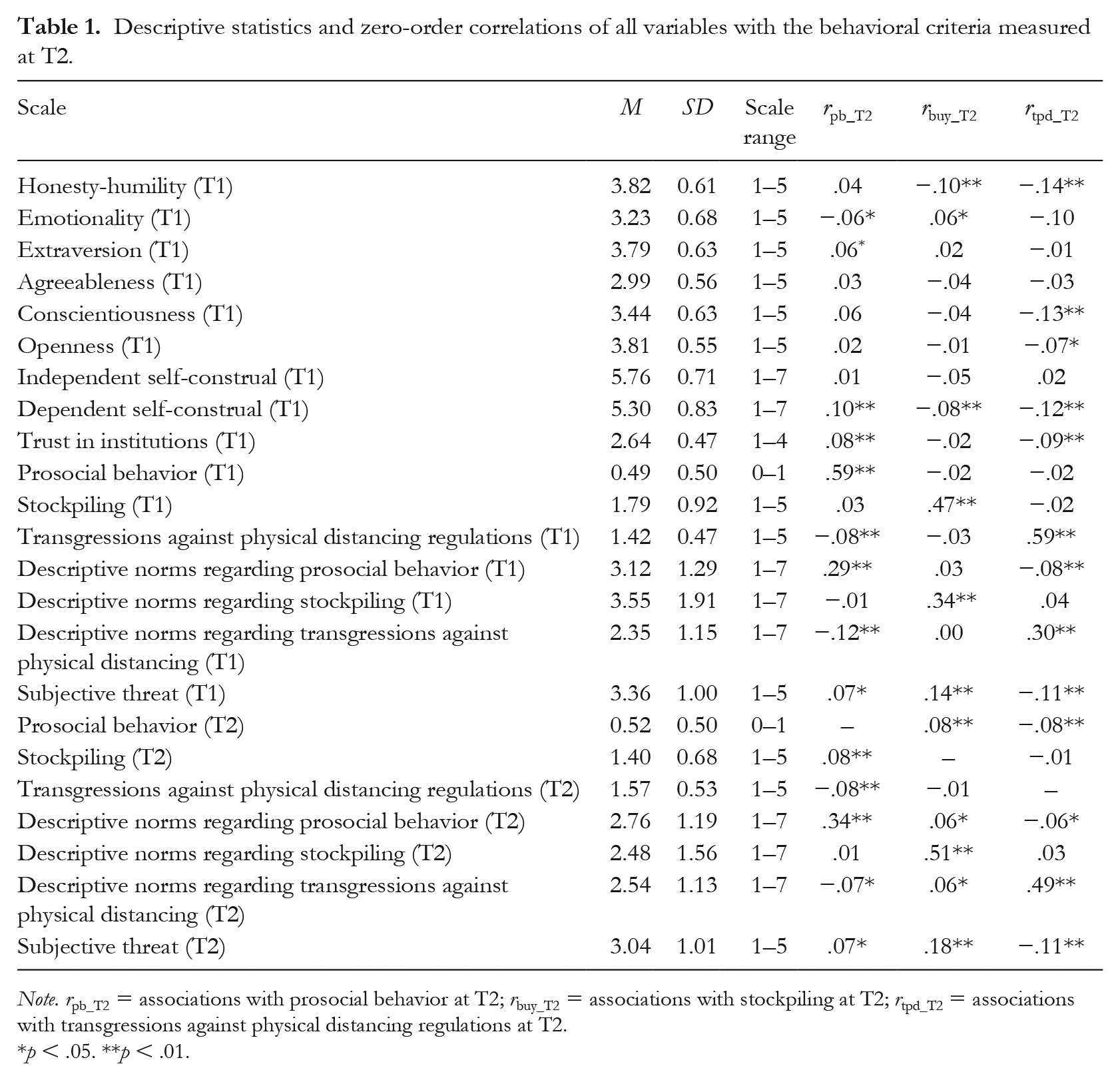
Note. rpb_T2 = associations with prosocial behavior at T2; rbuy_T2 = associations with stockpiling at T2; rtpd_T2 = associations with transgressions against physical distancing regulations at T2.
p < .05. **p < .01.
Step 1: Predictive Power of Descriptive Norms, Personality, and Threat
Results of the structural equation model are depicted in Table 2. Overall, the strongest predictor of self-reported behavior measured at T2 was previous behavior measured at T1, followed by the descriptive norm regarding this behavior measured at T1. This was true for prosocial behavior, stockpiling, and transgressions against physical distancing regulations. Additionally, perceived threat at T1 positively predicted engagement in prosocial behavior and negatively predicted transgressions against physical distancing regulations at T2. We also found a few associations for personality traits with self-reported behavior when controlling for other predictors: More specifically, honesty-humility negatively predicted stockpiling at T2. Furthermore, emotionality positively predicted transgressions against physical distancing regulations at T2, whereas conscientiousness negatively predicted such transgressions at T2. It should be noted that, aside from the stability coefficients, descriptive norms about stockpiling and prosocial behavior measured at T1 were the strongest predictor of behavior at T2 in the tested set (β = .13 and .16)
Direct effects derived from the conducted structural equation model.
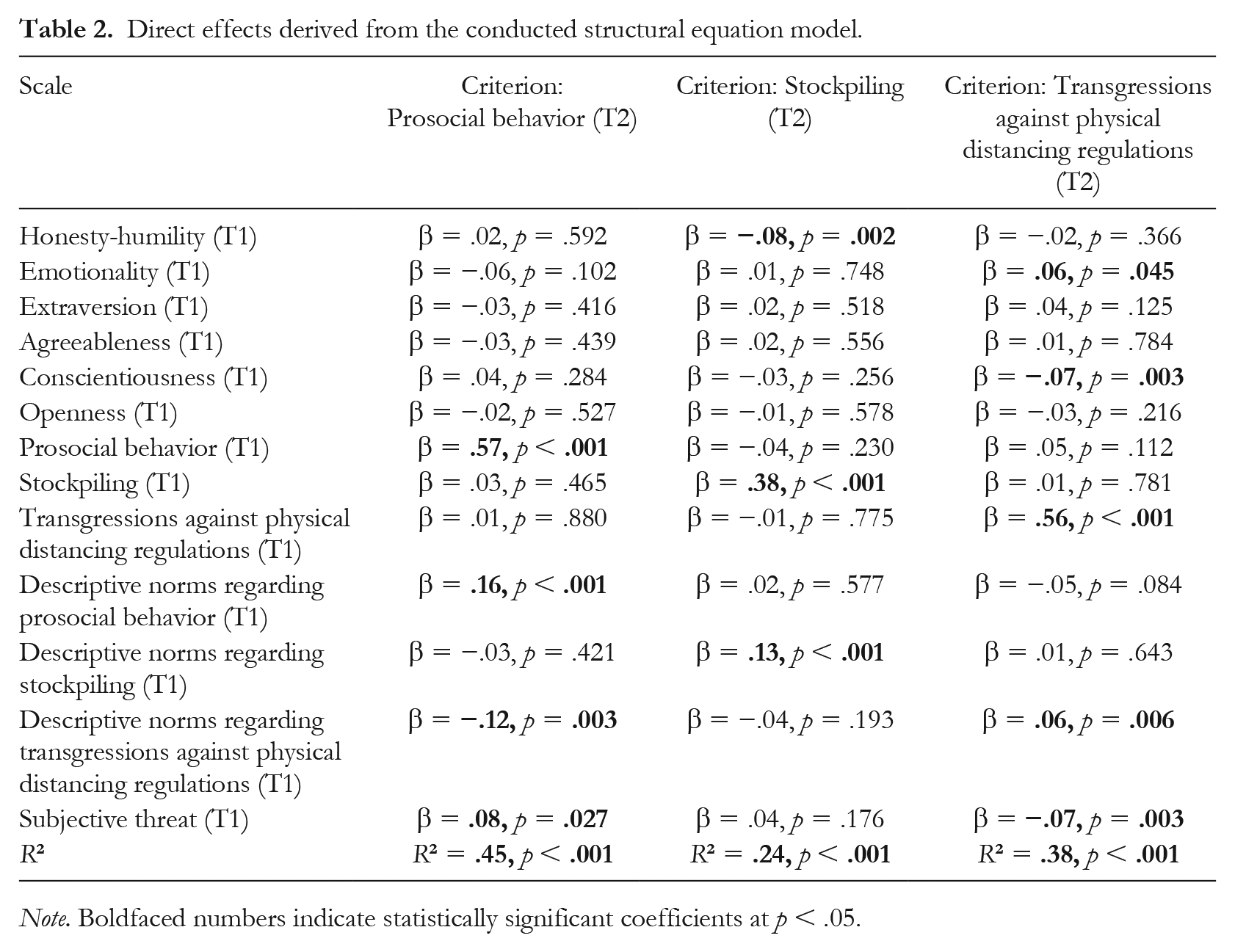
Note. Boldfaced numbers indicate statistically significant coefficients at p < .05.
Step 2: Temporal Directions Behind the Observed Associations
We calculated cross-lagged panel models to further qualify the temporal direction of the associations of self-reported behavior with descriptive norms and threat. The model’s results of the association between behavior and descriptive norms are shown in Figure 1. There was a similar result pattern for all three behaviors: Descriptive norms at T1 predicted behavior at T2, but reported behavior at T1 also predicted reported descriptive norms at T2. The results of the cross-lagged panel models on the association between subjective threat and self-reported behavior (depicted in Figure 2) showed fewer distinct cross-paths for subjective threat than for descriptive norms. Subjective threat at T1 positively predicted prosocial behavior and negatively predicted transgressions against physical distancing regulations at T2, but not vice versa. Interestingly, stockpiling at T1 positively predicted subjective threat at T2, in absence of the reversed effect.
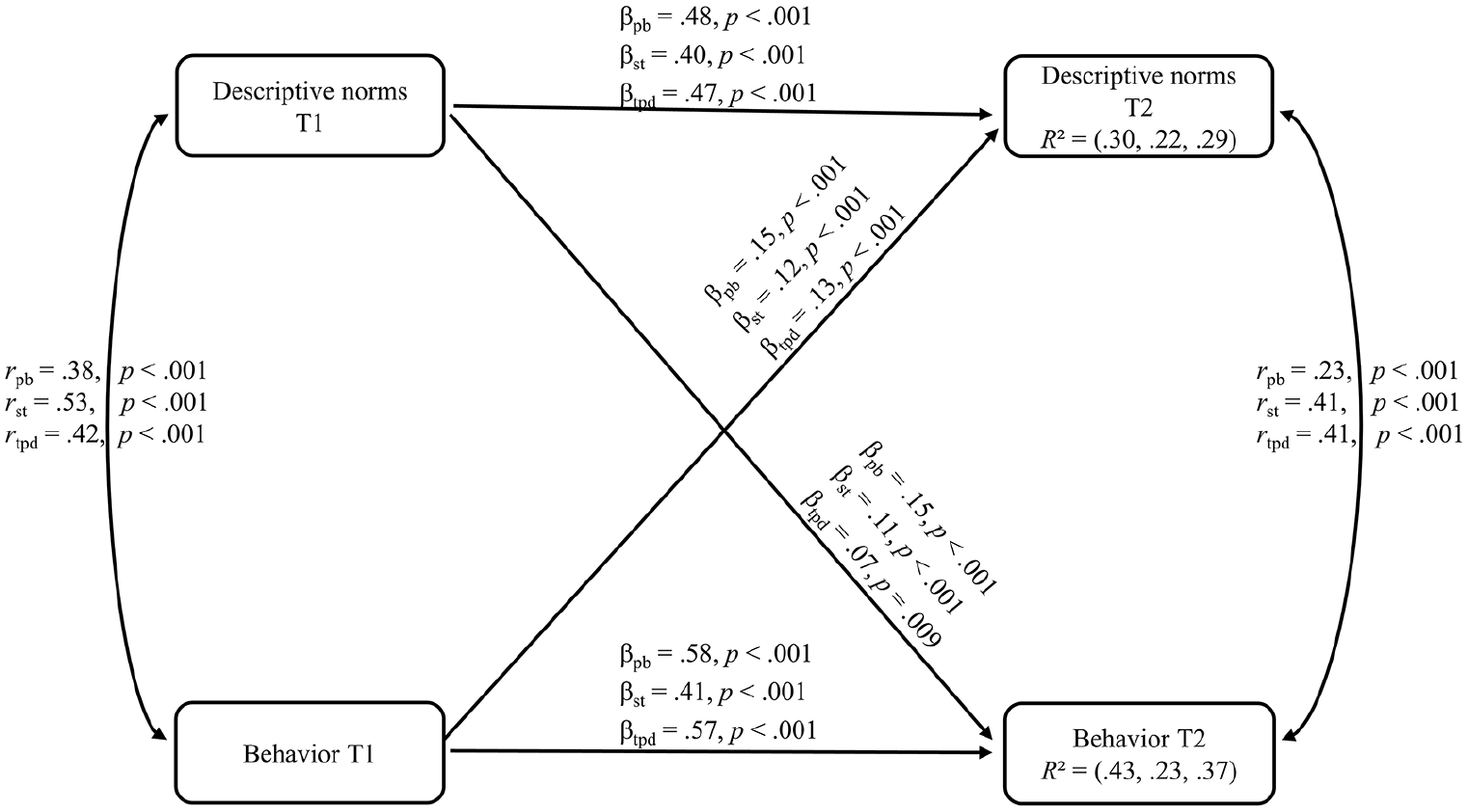
Cross-lagged panel model on descriptive norms and behavior.
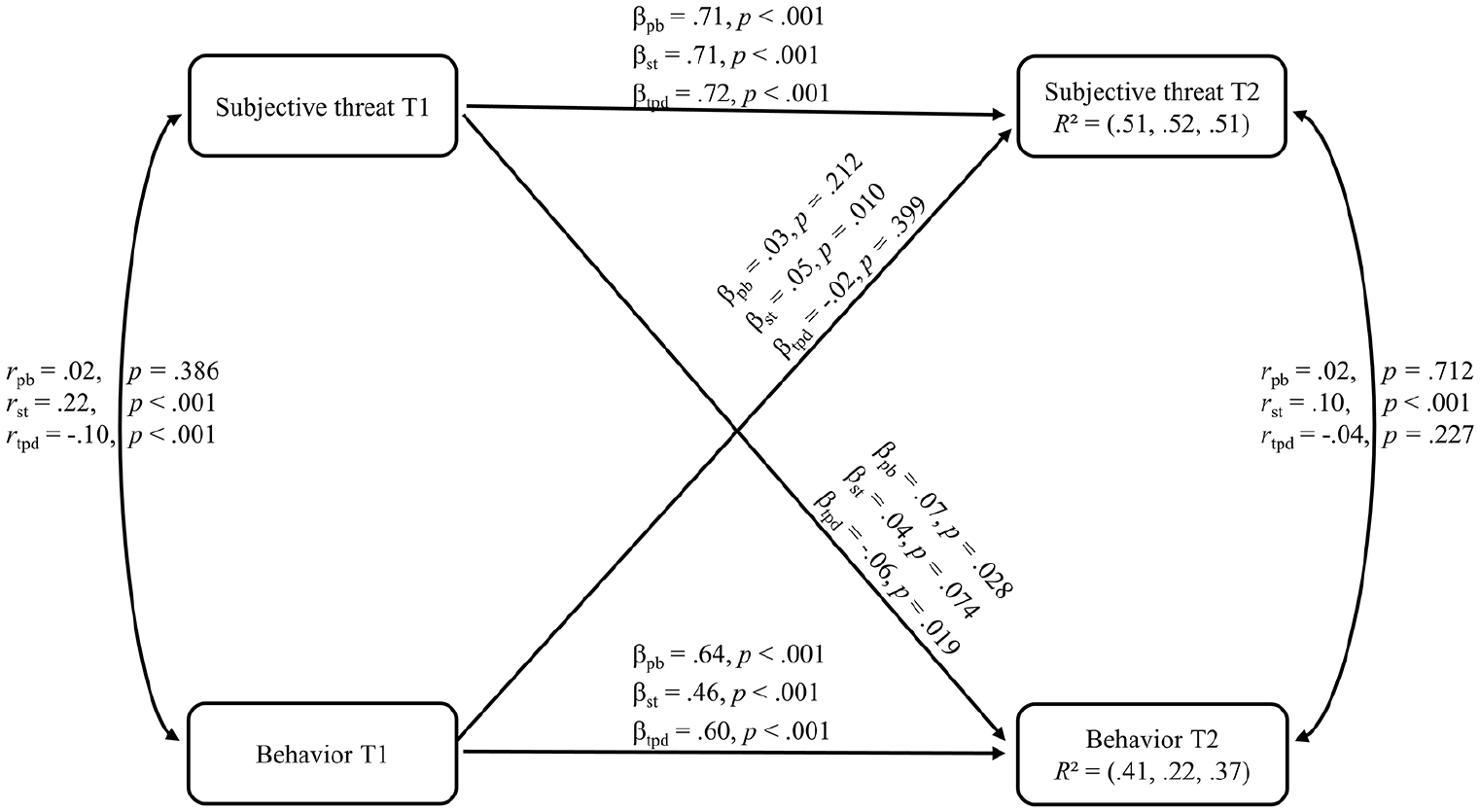
Cross-lagged panel model on subjective threat and behavior.
Step 3: Moderation Effects by Self-Construal and Trust in Institutions
Neither the strength of independent and interdependent self-construal nor trust in institutions moderated any relationships. This was true for associations between descriptive norms and behavior (smallest p = .094), as well as for associations between perceived threat and behavior (smallest p = .076). However, there were small direct effects on behavior for interdependent self-construal (four out of six moderation models) and trust in institutions (three out of six moderation models). Yet, when conducting an additional exploratory structural equation model adding the moderator variables to the predictor set used in Step 1, only the (negative) association between interdependent self-construal and transgressions against physical distancing regulations was statistically significant (β = −.05, p = .030).
Discussion
A variety of behavioral responses could be observed during the beginning of the COVID-19 pandemic: Some individuals complied with the new regulations about physical distancing or engaged in prosocial behavior, others transgressed against the restrictions or engaged in stockpiling. In a longitudinal study during the onset of governmental regulations to combat the spread of the pandemic in Germany, we found that descriptive social norms predicted individuals’ compliance with social distancing, their engagement in stockpiling, as well as prosocial behavior a few weeks later. These associations remained stable even when controlling for personality, subjective threat, as well as individuals’ previous behavior. Descriptive norms were the strongest predictor of future behavior (aside from previous behavior), which was especially true for descriptive norms regarding stockpiling and prosocial behavior. In contrast, dispositional variables such as personality showed only negligible effects on future behavior, and individual differences (self-construal, trust in institutions) did not moderate any associations between descriptive norms and behavior during the pandemic.
Predictive Power of Descriptive Norms
Overall, behavior was highly consistent between both measurement points, reinforcing the notion that previous behavior predicts later behavior (Ouellette & Wood, 1998). When accounting for previous behavior, we consistently found that descriptive norms—that is, participants’ perception of how close family and friends behaved during the pandemic—were the strongest predictor for all three observed behavior measures a few weeks later. Importantly, descriptive norms showed specific associations with the respective future behavior (e.g., descriptive norms regarding stockpiling at T1 predicted stockpiling behavior at T2), and were generally not predictive of other behavior. The only exception was that descriptive norms regarding transgressions against physical distancing also (negatively) predicted future prosocial behavior. One possible explanation could be that people are more eager to help others if they feel that other individuals comply with social contracts and do not transgress against regulations. Interestingly, descriptive norms regarding stockpiling and prosocial behavior were more strongly associated with the respective future behaviors than descriptive norms regarding physical distancing. This might be due to fewer ambiguities related to the physical distancing regulations. Those regulations can be understood as clearly communicated injunctive norms that can result in official sanctions in the form of fines for individuals who do not comply. In contrast, stockpiling and not engaging in prosocial behavior represent more ambiguous behaviors and thus might be more strongly driven by descriptive norms. On a similar note, it is interesting to speculate whether individuals used the behavior of close others primarily to draw functional inferences (“How do I best prepare for the pandemic and reduce my risk of infection?”) or injunctive inferences (“How do I behave so others will not frown upon my behavior?”). While we did not assess data on individuals’ respective cognitive processes, one might speculate that functional inferences and the desire to decrease one’s risk may have been dominant in the beginning of the pandemic, with injunctive inferences becoming more important as the pandemic continued and ideological debates about its severity and the appropriateness of the measures dominated the societal discourse.
In addition to descriptive norms predicting future behavior, behavior also predicted self-assessed descriptive norms a few weeks later. Two potential reasons come to mind. First, individuals might influence close others to adopt certain behaviors, just as close others might influence them in return. Second, individuals overestimate how common their own behaviors or attitudes are, a cognitive bias termed consensus bias (Mullen et al., 1985). Especially when engaging in behavior officially labeled as a transgression, individuals might be motivated to justify it stating that “everyone else does it, too.” This bias may not only impact present perceptions of descriptive norms but also fester over time insofar as individuals interpret subsequent social situations through the lens of their own previous behavior. For instance, individuals that stockpiled toilet paper might be more likely to notice others buying toilet paper as well, and interpret such behavior as stockpiling.
We further assessed individuals’ self-construal as a potential moderator of the association between descriptive norms and behavior but found that it contributed little to explaining behavior. This was also true for other dispositional factors within our study (HEXACO personality dimensions, trust in institutions). One possible explanation for these comparably small effects compared to the larger effects of descriptive norms might be that events such as the COVID-19 pandemic represent extreme and, for many individuals, unique situations they never had to cope with before. Consequently, dispositions that might explain individual differences in daily behavior might be less relevant when individuals search for mechanisms to cope with a crisis situation such as the current pandemic (Zajenkowski et al., 2020).
However, in addition to descriptive norms, subjective threat predicted future prosocial behavior and transgressions against physical distancing. The effect of subjective threat might be more pronounced when accounting for personal beliefs about the effectiveness of pandemic-related behavior (although trust in institutions did not moderate the association between threat and behavior). If individuals believe that they can efficiently cope with the threat, this should motivate protective behavior. Yet individuals may engage in denial or other coping behaviors if they feel that a threat cannot be averted (Witte & Allen, 2000). Interestingly, our longitudinal analyses suggest that stockpiling predicted perceived threat rather than the other way around. This finding stands in stark contrast to the assumption that threat would lead to stockpiling, which has been derived from cross-sectional evidence on the association between the two variables (see Garbe et al., 2020, for data assessment of the same period as our first measurement point). Thus, a reduction in threat might not automatically reduce stockpiling, and respective measures might need to tackle other factors like descriptive norms, for instance.
Strengths and Limitations
While the COVID-19 pandemic has sparked a surge of research (Rudert et al., in press), many of the first studies investigating associations between behavioral responses and situational or dispositional predictors have been cross-sectional. Thus, they do not allow for conclusions about temporal order, and overestimate the predictive power of the investigated variables. Using a longitudinal survey design and cross-lagged panel analyses allowed us to overcome these limitations and provide more accurate estimations of how subjective construals of the pandemic predict future behavior during the crisis. The large sample size further allowed us to detect even small effects.
We note that our study is characterized by some specifics that limit the generalizability of our findings. We conducted our survey at a specific point in time (spring 2020, following the introduction of pandemic-related regulations) within a specific cultural context (Germany). As the pandemic unfolds, we see that nations differ vastly on their political response (Hale et al., 2021), and that certain stages of the pandemic might also be associated with different perceptions and responses in the public (e.g., Lehrer et al., 2020). Specifically, the onset of the crisis was characterized by strong political unity between different political camps and parties in Germany (Merkel, 2020), which might have limited the impact of divergent political views or ideologies. Political ideologies might have become more influential at later stages of the pandemic, or in countries in which belief in the severity of the pandemic became a political issue right away. In sum, we think that our findings need to be situated within a larger research framework on predictors of pandemic-related behavior in different countries and at different points in time. Although only looking at cross-sectional associations regarding physical distancing norms, other studies from Brazil (Farias & Pilati, 2020), the Netherlands (Reinders Folmer et al., 2021), and the US (Reinders Folmer et al., 2020; van Rooij et al., 2020) found similar associations between descriptive norms and compliance with regulations.
It is also important to note that our convenience sample was not representative of the German population and was specifically characterized by an overrepresentation of women and highly educated individuals. This and other characteristics of our sample might have affected the frequencies of the observed behaviors. Particularly, frequencies of stockpiling or transgressions against physical distancing regulations were comparably rare, which might have led to an underestimation of effect sizes. A representative sample of the population might have potentially resulted in more variance and thus even stronger effects. Moreover, attrition in our study was at least partly bound to the personality characteristics of conscientiousness and honesty-humility. As a result, the parameter estimations for these variables might be less reliable than for other variables.
Finally, while the results of the cross-lagged panel analyses extend our understanding of the temporal order of social norms and behavior, temporal order is a precondition but not a proof of causation. We cannot rule out that both social norms and the investigated behaviors might be affected by third variables. However, given that our predictions were grounded in well-established theories from social psychology, it appears fruitful to consider the possibility that the longitudinal associations may indeed reflect causality for the social norm–behavior link.
Practical Implications
In addition to previous recommendations on how to increase compliance with measures (e.g., by increasing individuals’ empathy; see Pfattheicher et al., 2020), here we present findings highlighting the importance of perceived descriptive norms for individuals’ behavior. As such, policymakers might be well advised to consider the power of descriptive norms if they want to ensure compliance with physical distancing regulations and promote prosocial behavior while discouraging stockpiling. If undesirable behavior is frequently made salient in one’s close surroundings, individuals might perceive that undesirable behavior represents the descriptive norm and change their own behavior accordingly. Over time, those descriptive norms (“no one is doing that here”) might even turn into (informal) injunctive norms such that individuals dismiss compliance with official regulations as irrational and exaggerated.
From a normative perspective, political leaders and media figureheads might thus wish to act as role models (Valente & Pumpuang, 2007) by complying with policy measures meant to mitigate the pandemic (e.g., wearing masks, using hand sanitizer, abstaining from large political gatherings). However, given the particular importance of descriptive norms regarding the behavior of close others (compared to the general population; e.g., Farias & Pilati, 2020), it might be even more important for policymakers to motivate their followers to become role models themselves within their respective communities. Our results underline the importance of establishing strong descriptive norms within communities, rather than solely communicating about potentially harmful effects of transgressions against regulations. Thus, communication should ideally focus on highlighting positive examples (Abel & Brown, 2020), and also encourage individuals to share and talk about engagement in desirable behavior, following the principle of “do good and talk about it.”
Furthermore, policymakers might attempt to correct individuals’ assumptions about descriptive norms (Morris et al., 2015). Media in Germany as well as in other countries have frequently covered protests of antiregulation movements, who were also often subject of political debates and talk shows. While understandable from a democratic standpoint, this might unduly heighten the salience and spread of these ideas and make people feel that noncompliance with regulations is more frequent than it actually is. Thus, provided that the majority of individuals is in fact showing compliance with injunctive norms (Schultz et al., 2007), it might make sense to shift the focus of the conversation to compliant individuals rather than to the minority who does not comply. Again, this might work better within smaller or close groups or communities in which a strong shared social identity can be created (Gelfand & Jackson, 2016). If people feel that “we” are complying with the regulations and putting in effort to support others and fight the pandemic together, they are much more likely to do so as well.
Conclusion
Descriptive norms—perceived behavior of close others—measured at the beginning of the first lockdown during the COVID-19 pandemic, predicted whether individuals transgressed against physical distancing regulations, engaged in stockpiling, or showed prosocial behavior a few weeks later. These associations are unparalleled by the predictive power of other variables within our model, besides previous behavior. Subjective threat further predicted future prosocial behavior and transgressions against physical distancing regulations, whereas dispositional factors were mostly negligible when predicting future behavior. In sum, this pattern of results points to the strong power of descriptive social norms in driving individuals’ behavior during the pandemic.
Footnotes
Acknowledgements
We would like to thank Sophia Oelmaier and Rasmus Möring for their assistance with programming, data collection, and preparation of the data set; and Isabel Thielmann and Mathias Twardawski for their helpful comments on the questionnaire.
Funding
The author(s) received no financial support for the research, authorship, and/or publication of this article.

Supplemental material
Supplemental material for this article is available online.