




Abstract
The rising partisan animus between Democrats and Republicans has significant consequences for American society, both political and nonpolitical. The present study used two preregistered randomized controlled designs to investigate whether scalable meditation interventions could reduce affective polarization, relative to baseline scores measured 1 week earlier, in American adults (Study 1: N = 353; Study 2: N = 246) who affiliated with either the Democratic Party or the Republican Party. The results suggest that a brief befriending meditation can reduce affective polarization between Democrats and Republicans by increasing positive feelings relatively more for the political outgroup than the political ingroup.
The United States has become increasingly divided along partisan lines. The discrepancy between how American adults feel about their own political party and the political party opposed to their own—a phenomenon known as affective polarization—has grown significantly in recent decades. For example, on a scale ranging from cold (0) to warm (100), the difference between mean in-party feeling and mean out-party feeling has risen from 27.0 in 1978 to 45.9 points in 2016 (Boxell et al., 2020). The widening partisan division has largely been driven by increasingly negative out-party feelings, which in turn have been fueled by substantive changes in the political and media environments (Iyengar et al., 2019). Given that a well-functioning democracy requires a certain degree of respect and civility between political opponents, the high levels of affective polarization in the United States could have serious implications.
The evidence to date suggests that the rising partisan animus between Democrats and Republicans has both political and nonpolitical consequences (Druckman et al., 2020a; Iyengar et al., 2019; McConnell et al., 2018). For instance, affective polarization has been shown to shape beliefs about ostensibly apolitical issues such as responses to a pandemic (Druckman et al., 2020b); increasingly negative out-party feelings have increased voting along party lines and have discouraged elected officials from working with members of the opposing party (Abramowitz & Webster, 2016); and partisan animosity has undermined the level of trust toward the government, especially when the political outgroup has been in power (Hetherington & Rudolph, 2015). Hence, it is vital to better understand the causes of affective polarization and, perhaps more importantly, to investigate which interventions can reduce it.
Previous Psychological Approaches to Reducing Affective Polarization
Previous research suggests that psychological interventions can reduce affective polarization in the United States. For example, Levendusky (2018) found that priming American national identity, thereby making a superordinate group identity more salient than partisan identity, decreased affective polarization between Democrats and Republicans (see also Levine et al., 2005). The priming of national identity could be used as an effective strategy to reduce affective polarization among partisans, but it also has the potential to exacerbate affective polarization toward nonnationals, such as undocumented immigrants (Wojcieszak & Garrett, 2018). It may therefore be valuable to consider other psychological interventions to reduce affective polarization.
An alternative approach that holds promise is imagined intergroup contact (Crisp & Turner, 2009), which involves imagining positive interactions with one or more outgroup members. The approach has demonstrated effectiveness in improving intergroup attitudes and has recently also been shown to reduce affective polarization between Democrats and Republicans (Miles & Crisp, 2014; Warner & Villamil, 2017; see also Bond et al., 2018), with perceived commonality between the self and the political outgroup as an important underlying mechanism (Warner et al., 2020; Wojcieszak & Warner, 2020). It might be difficult, however, to get partisans with high levels of affective polarization to voluntarily imagine positive interactions with the political outgroup. Other psychological interventions that might be more easily accessible should therefore be investigated.
Meditation Practices and Affective Polarization
There has recently been an upsurge of interest in mindfulness meditation (Simonsson, Martin, & Fisher, 2020), with mindfulness-based programs reported in the education system, the workplace, the military (Creswell, 2017), and parliaments around the world (Bristow, 2019). The practice of mindfulness meditation involves bringing an open and nonjudgmental attention to present-moment experiences (Kabat-Zinn, 2003), which facilitates emotion regulation and may reduce negative outgroup attitudes through lower intergroup anxiety (Price-Blackshear et al., 2017). It has been shown to increase prosocial behavior (Donald et al., 2019) and has also been suggested as a possible tool to attenuate affective polarization in the United States (Klein, 2020). While the effect of mindfulness meditation on affective polarization remains untested, Petersen and Mitkidis (2019) found no evidence of an association between trait mindfulness and political tolerance (a construct that is conceptually linked to affective polarization) nor an effect of a brief mindfulness meditation on political tolerance. The authors suggested that the results may be different with prolonged training in mindfulness meditation or with other types of meditation that are more oriented toward facilitating feelings of compassion for others. Indeed, trait compassion and similar constructs such as empathic concern have been associated with more positive and reconciliatory attitudes in intergroup settings (Klimecki, 2019), which indicates that compassion could play an important role in reducing affective polarization (but see also Simas et al., 2020).
Another type of meditation that has also been taught in parliaments—as part of an 8-week mindfulness-based program—is befriending meditation (Williams & Penman, 2011). The key difference between befriending meditation and mindfulness meditation is that the former involves cultivating a sense of kindness and goodwill toward oneself and others, whereas the latter involves paying attention, in a particular way, to the present moment. Befriending meditation may therefore influence affective polarization through the same mechanism as imagined intergroup contact. Like imagined intergroup contact, befriending meditation engages the imagination and involves bringing different types of people to mind, including people who may be perceived as difficult or challenging. The difference between these approaches is that befriending meditation involves directly generating a sense of kindness and goodwill toward whoever has been brought to mind, while imagined intergroup contact interventions involve imagining positive interactions with one or more outgroup members. Previous research has shown that befriending meditation and similar practices such as loving-kindness and compassion meditation can strengthen compassion toward others (Galante et al., 2014), increase perceived commonality between the self and others (Kok & Singer, 2017), and boost positivity toward strangers who were not brought to mind during the meditation (Hutcherson et al., 2008). Indeed, positive attitudes toward one outgroup may positively influence attitudes toward other outgroups (Pettigrew, 2009; van Laar et al., 2005), and could therefore make befriending meditation a suitable intervention to reduce affective polarization.
Research from recent population studies shows an overall increase in meditation use in the United States (Black et al., 2018; Clarke et al., 2018), with millions of Americans voluntarily choosing to meditate. Given that this is not true for the other psychological approaches designed to reduce affective polarization, it does suggest meditation might be a more scalable intervention. Here, we therefore investigate the effects of brief meditation interventions on affective polarization between Democrats and Republicans.
The Present Research
Our overarching hypothesis was that compassion reduces affective polarization, while mindfulness does not. We tested this hypothesis by (a) examining the naturally occurring relationships between affective polarization, trait compassion, and trait mindfulness, and (b) directly influencing compassion and mindfulness by having participants complete either a befriending meditation or a mindfulness meditation. Building on prior work (Klimecki, 2019; Petersen & Mitkidis, 2019), we hypothesized that trait compassion but not trait mindfulness would be negatively associated with affective polarization in American adults who affiliated with either the Democratic Party or the Republican Party. We also hypothesized that a brief befriending meditation would reduce affective polarization between Democrats and Republicans.
In Study 1, using an online sample of American adults, we assessed whether individual differences in trait compassion and trait mindfulness were associated with preintervention variation in affective polarization. We also investigated whether participants randomly assigned to complete a brief befriending meditation would exhibit a greater reduction in affective polarization, relative to baseline levels measured 1 week earlier, than participants who completed a brief mindfulness meditation or listened to a talk on the topic of mindfulness meditation. In Study 2, using a separate online sample of American adults, we only compared the impact of a brief befriending meditation on affective polarization with that of the control task (listening to a talk on the topic of mindfulness meditation). We did not ask any participants to complete a mindfulness meditation in Study 2. Finally, by pooling the data from Study 1 and Study 2, we conducted additional exploratory analyses to test whether the effects varied across measurements of affective polarization or self-identified political affiliation.
Study 1
Materials and Methods
The study (hypotheses, design plan, sampling plan, variables, and analysis plan) was preregistered on the Open Science Framework (https://osf.io/qscfk). Sample size was determined using a power analysis (G*Power Version 3.1.9.2; Faul et al., 2007). A sample size of 243 participants (81 per condition) achieves 80% power to detect a small effect (effect size f = 0.10, partial η2 = .01) with an alpha of .05. Hence, the aim was to recruit 450 participants in total at Time 1, with 150 participants per condition, assuming that not all would complete the second part of the study.
Participants
Participants were recruited on Prolific Academic (https://app.prolific.co). We used the custom prescreening function to only recruit American citizens over 18 years of age who spoke English and who affiliated with either the Democratic Party or the Republican Party. Stratified random sampling was used to ensure we had approximately equal numbers of Democrats and Republicans, as Democrats tend to be overrepresented on online platforms (Arechar & Rand, 2020; Paolacci & Chandler, 2014). Two hundred and twenty-five Democrats and 226 Republicans completed the first part of the study on March 17, 2020; 81.78% of the Democrats and 77.88% of the Republicans completed the second part of the study 1 week later, over a 2-day period from March 24 to 26, 2020. The participants who failed the attention checks were removed, leaving the final number of participants at 353 (172 females, 178 males, and three who preferred not to provide gender information; 182 Democrats, 171 Republicans; age range: 18–76 years, M = 37.15, SD = 13.05). All participants gave informed consent and provided demographic information (age, gender, education, meditation experience, first language, and whether they have asthma) through Qualtrics (https://www.qualtrics.com/), the platform used to collect the data for the study. The participants were naïve to the purpose of the experiment and were simply told that the aim was to “expand the existing knowledge in the fields of mindfulness, compassion, and political attitudes.” All participants were paid £1.00 for participating in the first session and £3.00 for participating in the second session.
Design and procedure
We utilized a longitudinal randomized controlled design to assess the causal effects of meditation practices on affective polarization. Specifically, we examined whether mindfulness and/or befriending meditation reduced affective polarization, relative to baseline scores measured 1 week earlier. Changes in affective polarization over time were compared to a control condition, in which participants listened to a talk about mindfulness meditation, to ensure that fluctuations were not due to a temporal confound. The current study therefore had three between-subject factors (mindfulness, befriending, control) and two within-subject factors (time: preintervention, postintervention). Randomization checks confirmed that the between-subject conditions were balanced on demographic, political, trait, and polarization variables (see online supplemental material).
Preintervention stage
In the preintervention stage (Time 1), participants were asked to indicate their political party affiliation (Democrat, Republican, independent, other, none), and answered five items designed to assess how strongly they identified with that party (e.g., “How important is your identity as a Democrat to you?”; Druckman & Levendusky, 2019). They were also asked to complete two questionnaires to examine their levels of trait mindfulness (Cognitive and Affective Mindfulness Scale-Revised; Feldman et al., 2007) and trait compassion (Santa Clara Brief Compassion Scale; Hwang et al., 2008).
Affective polarization was then assessed using three validated measures that are all strongly related to one another (Druckman & Levendusky, 2019): a feeling thermometer (asks respondents to rate how cold or warm they feel toward Democratic and Republican voters [party candidates, elected officials]); a trait rating measure (asks respondents to rate how well positive traits—such as intelligence, honesty, and generosity—and negative traits—such as hypocrisy, selfishness, and meanness—describe the two parties’ voters [party candidates, elected officials]); a trust measure (asks respondents how much of the time they think they can trust the two parties’ voters [party candidates, elected officials] to do what is right for the country). Our preregistration specified that we would specifically ask participants to rate each party’s voters on these three measures. After submitting the preregistration but before collecting the data, we decided to also assess participants’ feelings, trait ratings, and trust toward party candidates and elected officials, as done by Druckman and Levendusky (2019). We analyzed these two sets of data separately and note in the Results section that the preregistered analysis (i.e., the analysis of affective polarization when participants are asked to focus on voters) is confirmatory, while the analysis of participants’ feelings, trait ratings, and trust toward party candidates and officials must be considered exploratory.
Intervention stage
One week later (Time 2), participants were invited to complete the second part of the study in which they were randomly assigned to one of three conditions (mindfulness, befriending, control). Participants in the mindfulness condition listened to a 10-minute guided mindfulness meditation (focused on sounds and thoughts). In the recording, they were instructed to (a) settle into a comfortable posture, (b) bring awareness to sounds for a few minutes, (c) bring awareness to thoughts for a few minutes, and (d) bring awareness to their breath and body in the last moments of the guided meditation. Participants in the befriending condition listened to a 10-minute guided befriending meditation. In the recording, they were instructed to (a) settle into a comfortable posture, (b) bring kindness and friendship to themselves by silently saying: “May I be free from suffering, may I be happy and healthy, may I have ease of being,” (c) bring to mind a loved one and wish them well in the same way, (d) bring to mind a stranger and wish them well in the same way, (e) bring to mind a difficult person and wish them well in the same way, (f) extend kindness and friendship to all living beings and wish them well in the same way, and (g) bring awareness to their breath and body in the last moments of the guided meditation. Participants in the active control condition listened to a 10-minute audio recording about mindfulness meditation. In the recording, they were educated about mindfulness meditation and the evidence to date on the neuroscience of mindfulness and the efficacy of mindfulness-based programs. The word mindfulness was never mentioned in the mindfulness condition, but it was mentioned repeatedly in the talk about mindfulness meditation, which was focused on the concept (rather than the practice) of mindfulness. The audio recording for the control condition was a combination of talks by Professor Mark Williams, who has delivered mindfulness teachings to British politicians together with Chris Cullen from the Oxford Mindfulness Centre (Bristow, 2019). The audio recordings used in the mindfulness and befriending conditions were also recorded by Professor Mark Williams and were derived from Mindfulness: A Practical Guide to Finding Peace in a Frantic World (Williams & Penman, 2011), which forms the basis of an eight-week mindfulness course that has been taught in the UK Parliament. After listening to the audio recording, participants were assessed on the three affective polarization measures (the feeling thermometer, the trait rating measure, and the trust measure).
Attention checks
In the preintervention stage, participants were presented with one attention check question embedded in the trait mindfulness questionnaire, “Please select the disagree option for this question,” and one embedded in one of the trait rating measures, “Please click very well.” Participants who did not give the desired responses to these questions (n = 32) were not invited to complete the second part of the study. 1
In the second part of the study, participants were presented with an attention check that followed the audio recording to which they had been assigned: mindfulness condition (“During the audio recording, I was instructed to. . .”; 1 = focus on sounds and thoughts, 2 = recite a mantra, 3 = stretch my body), befriending condition ( “During the audio recording, I was instructed to. . .”; 1 = generate feelings of kindness toward myself and others, 2 = memorize numbers and dates, 3 = stretch my body), control condition (“During the audio recording, I learnt about. . .”; 1 = mindfulness and meditation, 2 = sports and gymnastics, 3 = politics and law). Participants who gave the wrong answer on these questions (n = 5) were excluded from data analyses, as were those who gave the same answer for every item on the trait mindfulness questionnaire (as this included reverse-coded items).
Manipulation check
After listening to the audio recording to which they had been assigned, all participants also completed a manipulation check: “How much did you generate feelings of kindness and goodwill toward others during the recording you listened to?” and “How much did you focus on the present moment during the recording you listened to?” Responses were rated on a 5-point Likert scale (1 = not at all, 5 = very much). Participants in the befriending condition were expected to provide higher scores on the kindness question than participants in the other two conditions, while those in the mindfulness condition were expected to provide higher scores on the presence question.
Statistical analyses
As specified in our preregistration, we computed composite measures of affective polarization for each time point. Aggregating numerous closely linked measures of the same latent construct can reduce measurement noise (Rushton et al., 1983), increase test–retest reliability (Eisenberg et al., 2019), and alleviate the need for researchers to conduct multiple statistical tests. We based our decision to aggregate affective polarization scores on the feeling thermometer, trait rating, and trust measures on previous research showing that these three measures are strongly correlated with one another (Druckman & Levendusky, 2019).
To compute the composite affective polarization scores, we first created a net trait rating for each group of voters per participant by subtracting the sum of the negative traits from the sum of the positive traits, consistent with earlier studies (Druckman & Levendusky, 2019; Iyengar et al., 2012). Next, ratings on the feeling thermometer, net trait rating, and trust measure were standardized. Note that we did not state that we would do this in our preregistration, however, standardization was necessary as the ratings were provided on different scales. Specifically, we linearly scaled scores on each measure onto a 0 to 100 scale. Affective polarization scores on each measure at each time point were then computed by calculating the difference between participants’ rating of their own party’s voters and their rival party’s voters. We then aggregated these three measures separately for each time point to produce a Time 1 and Time 2 composite affective polarization measure. A reliability analysis performed on the Time 1 data revealed that this composite measure has good internal consistency (Cronbach’s alpha = .86, average interitem correlation = .67; all interitem correlations are reported in the supplemental material). We repeated these steps using participants’ feelings, trait ratings, and trust toward each party’s candidates and elected officials to create a second composite measure of affective polarization with a different target (Cronbach’s alpha = .85, average interitem correlation = .66).
To test our first preregistered hypothesis—that trait compassion, but not trait mindfulness, negatively correlates with preintervention affective polarization scores—we assessed the bivariate (Pearson) correlations between baseline (Time 1) composite affective polarization scores, trait mindfulness scores, and trait compassion scores. We also assessed the partial correlation between baseline composite affective polarization scores and trait mindfulness, controlling for trait compassion, and the partial correlation between baseline affective polarization scores and trait compassion, controlling for trait mindfulness.
To test our second preregistered hypothesis—that befriending meditation reduces affective polarization more than mindfulness meditation or listening to a talk about mindfulness meditation—we tested whether there was an effect of the meditation practice condition on composite affective polarization change scores. In a slight deviation from the analysis plan set out in our preregistration, we calculated the change in affective polarization by subtracting the Time 1 affective polarization composite scores from the Time 2 scores. We then performed a one-way ANOVA on these change scores, with the meditation practice condition entered as the between-subject factor. The rationale for deviating from the preregistered analysis plan as well as the results of the preregistered analysis are reported in the supplemental material.
Results
Confirmatory analyses
Correlations between baseline affective polarization, trait mindfulness, and trait compassion
Our overarching hypothesis was that feeling compassion reduces affective polarization, while being mindful does not. We therefore investigated the naturally occurring relationship between reported trait compassion and preintervention composite affective polarization scores (based on ratings of Democratic and Republican voters), to test whether people with higher trait compassion scores exhibit lower levels of affective polarization. Contrary to our hypothesis, a one-tailed bivariate (Pearson) correlation did not reveal a significant relationship between trait compassion and baseline levels of affective polarization, r(353) = .04, p = .257. There was also a nonsignificant relationship between reported trait mindfulness and baseline affective polarization, r(353) = −.06, p = .140. A one-tailed partial correlation between trait compassion and baseline affective polarization revealed that this null finding held when controlling for trait mindfulness, rpartial(350) = .04, p = .237; and a one-tailed partial correlation between trait mindfulness and baseline affective polarization, controlling for trait compassion, also showed no significant association, rpartial(350) = −.06, p = .132.
Effects of meditation practices on affective polarization
As a manipulation check, we assessed whether the befriending meditation induced feelings of compassion more than the mindfulness meditation and the control task. A one-way ANOVA revealed a significant effect of the meditation practice condition on how much participants generated feelings of kindness and goodwill toward others while listening to the audio recording, F(2, 352) = 20.44, p < .001, ηp2 = .11. Post hoc Tukey’s honestly significant difference (HSD) tests demonstrated that participants in the befriending condition reported generating more compassion (M = 3.73, SD = 1.01) than participants in the mindfulness condition (M = 2.94, SD = 1.15, p < .001) and those in the control condition (M = 3.01, SD = 1.00, p < .001). We also tested whether the mindfulness meditation was more effective at inducing a mindful state than the befriending meditation and the control task. A one-way ANOVA revealed that the meditation practice condition did not have a significant effect on how much participants reported focusing on the present moment while listening to the audio recording, F(2, 352) = 0.56, p = .570, ηp2 = .003, suggesting that participants who completed the mindfulness meditation were not more likely to have entered a mindful state than those in the befriending and control conditions.
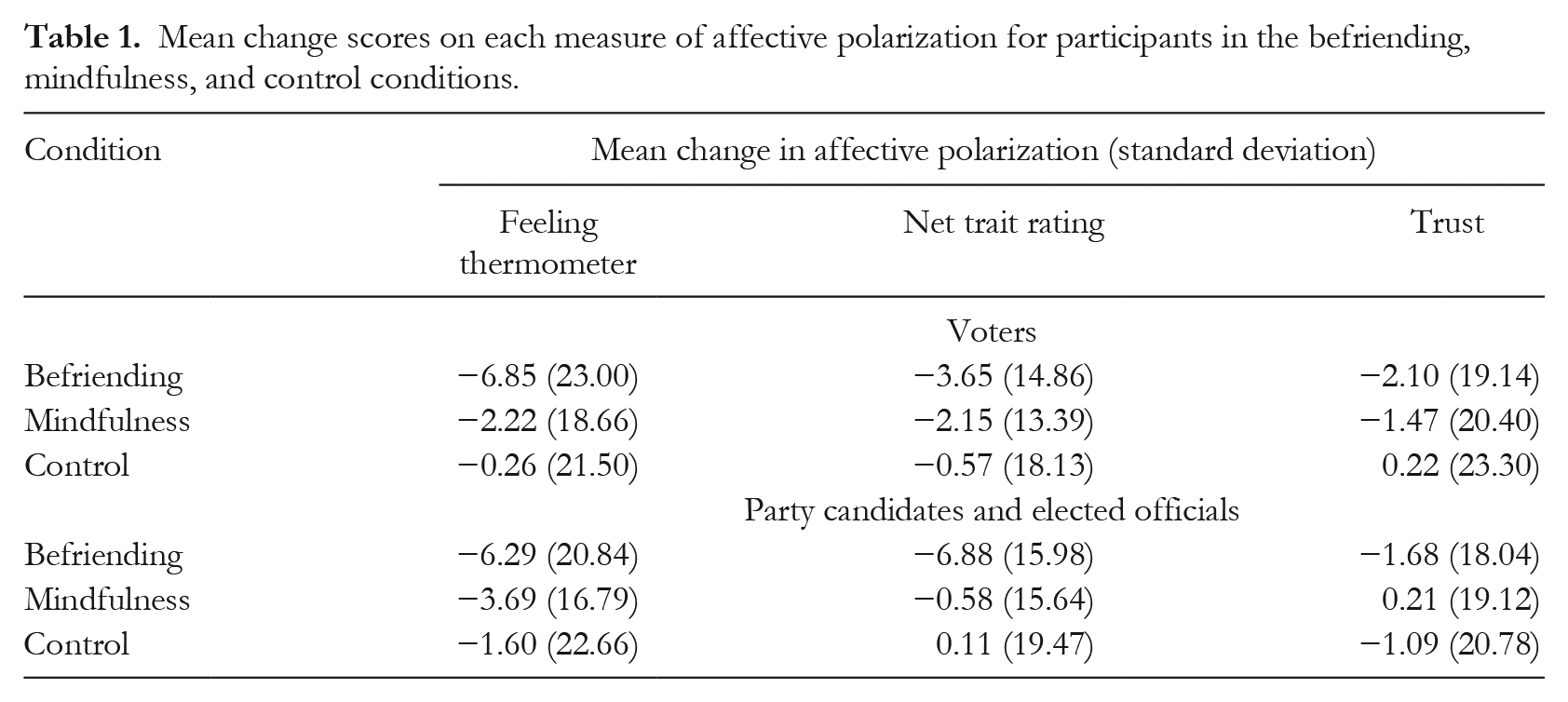
We then tested whether the meditation practices reduced levels of affective polarization. Specifically, we assessed whether pre- to postintervention changes in the composite affective polarization scores (based on ratings of Democratic and Republican voters) varied between meditation practice conditions. A one-way ANOVA revealed a marginal but not significant effect of meditation practice condition on these change scores, F(2, 352) = 2.59, p = .076, ηp2 = .02 (see Table 1).
Mean change scores on each measure of affective polarization for participants in the befriending, mindfulness, and control conditions.
Exploratory analyses
We repeated the aforementioned analyses using the composite affective polarization scores comprised of participants’ ratings of Democratic and Republican candidates and elected officials, as a robustness check. Again, we found no relationship between trait compassion and baseline levels of affective polarization, r(353) = .06, p = .135, even when controlling for trait mindfulness, rpartial(350) = .06, p = .124. Nor was there a correlation between trait mindfulness and baseline affective polarization, r(353) = −.05, p = .199, or a partial correlation between these two variables when controlling for trait compassion, rpartial(350) = −.05, p = .182.
We did, however, find a significant effect of meditation practice condition on the pre- to postintervention change in composite affective polarization scores. A one-way ANOVA revealed a significant effect of meditation practice condition on affective polarization change scores, F(2, 352) = 3.66, p = .027, ηp2 = .02. Post hoc Tukey’s HSD tests indicated that participants in the befriending condition exhibited a greater reduction in affective polarization (M = −4.95, SD = 12.69) than those in the control condition (M = −0.86, SD = 14.30, p = .038) and a marginally greater reduction than those in the mindfulness condition (M = −1.35, SD = 10.91, p = .075). There was no difference in change scores between the mindfulness condition and the control condition (p = .953). Thus, although our confirmatory analyses did not produce significant results, we did find some evidence to support the hypothesis that befriending meditation influences affective polarization.
Closer inspection of the change scores suggested that befriending meditation may not affect all measures of affective polarization equally. Table 1 suggests that there was little change between Time 1 and Time 2 affective polarization scores on the trust measure, both when participants rated parties’ voters and when they rated parties’ candidates and elected officials, while there was pre- to postintervention movement in the expected direction on the feeling thermometer and the net trait rating measure. Moreover, although the three Time 1 affective polarization measures showed good internal consistency and were strongly related to one another, the internal consistency of the change scores (Time 2 scores minus Time 1 scores) was low and the interitem correlations were weak, both when participants rated each party’s voters (Cronbach’s alpha = .47, average interitem correlation = .23) and when they rated each party’s candidates and elected officials (Cronbach’s alpha = .40, average interitem correlation = .18).
Discussion
In Study 1, confirmatory analyses found that affective polarization was not significantly associated with trait compassion or trait mindfulness, and that a brief befriending meditation had a marginal but not significant effect on affective polarization when Democratic and Republican voters were the target of the ratings. However, exploratory analyses found that a brief befriending meditation significantly reduced affective polarization when Democratic and Republican candidates and elected officials were the target of the ratings, which provided some evidence to support the hypothesis that befriending meditation influences affective polarization.
In addition to the confirmatory and exploratory analyses, change scores in Table 1 indicate that the effects of a brief befriending meditation varied across the measurements of affective polarization (feeling thermometer, net trait rating, trust measure), with the largest changes observed on the feeling thermometer. In Study 2, we therefore tested whether the befriending meditation caused a pre- to postintervention reduction in affective polarization, relative to an active control condition, on the feeling thermometer only.
Study 2
Materials and Methods
The study was preregistered on the Open Science Framework (https://osf.io/sd3uf). Sample size was determined with a power analysis (G*Power Version 3.1.9.2; Faul et al., 2007). We entered the mean change scores on the feeling thermometer for participants in the befriending condition and the control condition of Study 1 (Mbefriending = −6.85, Mcontrol = −0.26), as well as the standard deviations of these change scores (SDbefriending = 23.00, SDcontrol = 21.50), into the power analysis and found that a sample size of 284 participants would achieve 80% power to detect an effect size d = 0.30, with an alpha of .05. We therefore recruited 350 participants in total at Time 1, assuming that the dropout and exclusion rates would be similar to those in Study 1.
Participants
The recruitment procedure was the same as that for Study 1, except that participants who completed Study 1 were prevented from also taking part in Study 2. Participants were paid £0.50 for participating in the first session and £2.00 for participating in the second session (the compensation was slightly less than in Study 1 because questions were removed, thus the time it took to complete the study was shortened). One hundred and seventy-five Democrats and 175 Republicans completed the first part of the study on December 2, 2020; 74.29% of the Democrats and 79.43% of the Republicans who completed the first part also completed the second part of the study 1 week later, over a 3-day period from December 9 to 11, 2020. Due to a technical error in the recruitment process, 18 participants who had not completed the first session took part in the second session of the study. These participants, as well as those who failed attention checks, were excluded from the analysis, leaving the final number at 246 (123 females, 120 males, two identified as “other” when asked about gender, and three preferred not to provide gender information; 125 Democrats, 121 Republicans; age range: 18–96 years, M = 34.18, SD = 12.77).
Design and procedure
As in Study 1, we used a longitudinal randomized controlled design to investigate whether reductions in affective polarization over time were greater for participants who completed a brief befriending meditation than for those who listened to a talk about mindfulness meditation. We did not include a mindfulness meditation condition in this study and therefore had a mixed design with two between-subject factors (befriending, control) and two within-subject factors (time: preintervention, postintervention).
Preintervention stage
In the preintervention stage (Time 1), participants were asked to indicate their political party affiliation (Democrat, Republican, independent, other, none), and answered five items designed to assess how strongly they identified with that party (e.g., “How important is your identity as a Democrat to you?”; Druckman & Levendusky, 2019). Trait mindfulness and trait compassion were not recorded in this study.
Participants then rated Democratic and Republican voters as well as party candidates and elected officials on the feeling thermometer, trait rating measure, and trust measure, as in Study 1. Our preregistration specified that we would focus the confirmatory analysis on participants’ ratings of each party’s voters on the feeling thermometer, however, we decided to collect data on all three measures (with both voters as well as party candidates and elected officials specified as the target) to allow for further exploratory analyses.
Intervention stage
One week later (Time 2), participants were invited to complete the second part of the study in which they were randomly assigned to one of two conditions (befriending, control). Participants in the befriending condition listened to a 10-minute guided befriending meditation, while those in the control condition listened to a 10-minute talk about mindfulness meditation. The audio clips were the same as those played to participants in the befriending and control conditions in Study 1.
Attention checks
In the preintervention stage, participants were presented with an attention check question embedded in one of the trait rating measures, “Please click very well.” In the second session, participants were presented with an attention check immediately after the intervention to ensure they had listened to the audio clip. The question asked and the response options were the same as those for Study 1. Participants who gave the wrong answer on these questions (n = 3) were excluded from data analyses, as were those who failed the attention check question in the first session (n = 21).
Manipulation check
After listening to the audio recording to which they had been assigned, all participants also completed a manipulation check. The question asked and the response options were the same as those for Study 1.
Statistical analyses
As specified in our preregistration, in this study our focal measure of affective polarization was built using participants’ ratings on the feeling thermometer only. Specifically, we subtracted participants’ ratings of outgroup voters from their ratings of ingroup voters, separately for each time point. Change scores were then computed by calculating the difference between Time 1 and Time 2 affective polarization scores. An independent samples t test was conducted to test our preregistered hypothesis that participants in the befriending condition would exhibit a greater reduction in affective polarization than those in the control condition.
Results
The results of the independent samples t test indicated that there was a significant difference in change scores between conditions, t(244) = 2.47, p = .014, d = 0.31. As hypothesized, there was a greater reduction in affective polarization for participants who completed the befriending meditation (befriending condition: M = −6.55, SD = 19.74) than for those who listened to the talk about mindfulness meditation (control condition: M = −0.65, SD = 17.83; see Figure 1). This finding held when participants who failed attention checks were not excluded (see supplemental material). This suggests that befriending meditation does influence affective polarization when the difference in feelings toward ingroup and outgroup voters is used as the dependent variable.
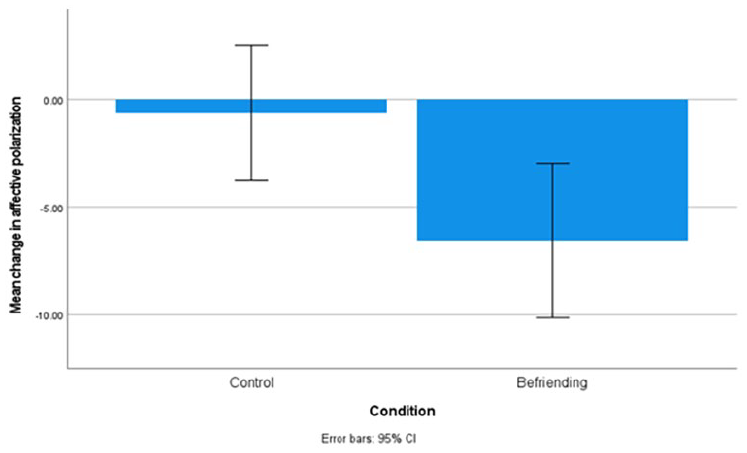
Change in affective polarization over time by condition.
Discussion
In Study 2, our confirmatory analysis found that a brief befriending meditation significantly reduced affective polarization, relative to an active control condition, as measured by the feeling thermometer only. While the findings are novel, the results are broadly in line with those from studies that have used similar practices to reduce prejudice and intergroup bias in other contexts (Berger et al., 2018; Kang et al., 2014).
The results from these two studies still leave many questions unanswered. Given that Study 1 and Study 2 used the same befriending and control conditions, it was possible to pool the data from the two studies to increase the sample size and allow additional exploratory analyses to be conducted beyond the overall intervention effect (Bangdiwala et al., 2016).
Pooling Data from Study 1 and Study 2
We pooled the data from Study 1 and Study 2 to answer two additional questions. The first is whether the effect of befriending meditation on affective polarization varies depending on the instrument used to measure it. Study 2 showed that befriending meditation reduces the difference in feelings toward ingroup and outgroup voters, while (as shown in Table 1) it may have less (or no) effect on how much members of rival groups trust each other. The second so far unanswered question is whether the effect of befriending meditation on affective polarization differs for Democrats and Republicans. While political affiliation has not yet been investigated as a moderator in meditation research, there are several neurocognitive and personality differences across the political spectrum that could possibly influence individual responses to meditation interventions (Amodio et al., 2007; Carney et al., 2008; Jost et al., 2003). For example, conservatives tend to value ingroup loyalty more than liberals (Graham et al., 2009) and may therefore respond differently to the instructions to bring kindness and friendship toward the various target categories (oneself, a loved one, a stranger, a difficult person, all living beings) in a befriending meditation.
Methods
Data from Study 1 and Study 2 were pooled to conduct additional exploratory analyses. We excluded participants who failed attention checks, using the same criteria as used in the respective study, and those from Study 1 who were assigned to the mindfulness condition, as there was no mindfulness condition in Study 2.
We computed change scores on each measure of affective polarization. As in Study 1, we built a net trait rating score for each group of voters per participant by subtracting the sum of the negative traits from the sum of the positive traits. We then standardized the feeling thermometer, net trait rating, and trust measures by linearly scaling the ratings on each measure onto a 0 to 100 scale. Affective polarization scores on each measure at each time point were computed by calculating the difference between participants’ rating of their own party’s voters (as well as candidates and elected officials) and their rival party’s voters (and candidates and elected officials). Lastly, we computed the change in affective polarization on each measure by subtracting Time 1 scores from Time 2 scores.
Results
Effects of befriending meditation on different measures of affective polarization
To test whether befriending meditation reduced affective polarization on some measures more than others, we entered the change scores from all six affective polarization measures (feeling thermometer, net trait rating, and trust differences for voters, and candidates and elected officials) into a 2 (target: voters, candidates and elected officials) x 3 (measure: feeling thermometer, net trait rating, trust) x 2 (meditation practice condition: befriending, control) x 2 (study number: 1, 2) mixed ANOVA. The target and measure were entered as within-subject factors, while meditation practice condition and study number were entered as between-subject factors.
The results revealed a main effect of meditation practice condition, F(1, 476) = 11.71, p = .001, ηp2 = .02, a main effect of the measure used to record affective polarization, F(2, 475) = 9.86, p < .001, ηp2 = .04, and an interaction between meditation practice condition and measure, F(2, 475) = 3.31, p = .037, ηp2 = .01. The main effect of meditation practice condition indicated that, when collapsing the data across the other independent variables, participants who completed the befriending meditation exhibited a greater reduction in affective polarization (M = −4.31, SE = 0.74) than those who completed the control task (M = −0.77, SD = 0.73). The main effect of the measure demonstrated that, when collapsing the data across the other independent variables, the pre- to postintervention change scores varied depending on which instrument was used to record affective polarization. Post hoc Bonferroni-corrected pairwise comparisons revealed that change scores on the trust measure (M = −0.26, SE = 0.76) were smaller than those on the feeling thermometer (M = −4.29, SE = 0.81, p < .001) and the net trait rating measure (M = −3.08, SE = 0.64, p = .003), while there was no difference between the change scores on the feeling thermometer and the net trait rating (p = .584). The interaction between meditation practice condition and measure was characterized by differences between the befriending and control conditions on the feeling thermometer change scores, F(1, 476) = 13.64, p < .001, ηp2 = .03, and the net trait rating change scores, F(1, 476) = 8.01, p = .005, ηp2 = .02, but not on the trust change scores, F(1, 476) = 0.48, p = .487, ηp2 = .001. This suggests that befriending meditation reduces affective polarization on the feeling thermometer and the net trait rating but does not influence how much Democrats and Republicans trust outgroup voters as well as party candidates and elected officials relative to the same ingroup targets. There was no main effect of target (i.e., voters vs. party candidates and elected officials), F(1, 476) = 0.93, p = .336, ηp2 = .002, or study number, F(1, 476) < 0.01, p = .980, ηp2 < .001, on affective polarization change scores. All other two- and three-way interactions were not significant (p values > .05). There was a marginal four-way interaction between meditation practice condition, measure, target, and study number, F(2, 475) = 3.02, p = .050, ηp2 = .01.
Effects of befriending meditation on affective polarization in Democrats and Republicans
In all previous analyses, we combined data from participants who affiliated with the Democratic Party or the Republican Party. Here, we tested whether befriending meditation impacts these two groups to different extents. If so, we should observe an interaction between meditation practice condition and participants’ political affiliation.
As the previous analysis showed that befriending meditation influenced affective polarization on the feeling thermometer and the net trait rating but not on the trust measure, we did not include the change scores on the trust measure in this analysis. Entering the four change scores of interest (pre- to postintervention changes in affective polarization on the feeling thermometer and the net trait rating when participants rated voters as well as candidates and elected officials) into a 2 (meditation practice condition: befriending, control) x 2 (political affiliation: Democrat, Republican) x 2 (study number: 1, 2) MANOVA revealed a main effect of meditation practice condition, F(4, 469) = 4.69, p = .001, ηp2 = .04, no main effect of political affiliation, F(4, 469) = 1.06, p = .374, ηp2 = .01, and no interaction between meditation practice condition and political affiliation, F(4, 469) = 0.13, p = .972, ηp2 = .001. This suggests that the effects of befriending meditation on affective polarization did not vary by political affiliation. There was also no main effect of study number, F(4, 469) = 1.27, p = .281, ηp2 = .01, a marginal but not significant interaction between meditation practice condition and study number, F(4, 469) = 2.04, p = .088, ηp2 = .02, and no three-way interaction, F(4, 469) = 0.23, p = .919, ηp2 = .002.
Discussion
Using pooled data from Study 1 and Study 2, exploratory analyses found that the effects of a brief befriending meditation on affective polarization did not differ between Democrats and Republicans. The effects did, however, vary across the measurements of affective polarization; befriending meditation only reduced affective polarization more than the control task on the feeling thermometer and the net trait rating measure. The trust change scores did not vary between conditions, which suggests that a brief befriending meditation does not necessarily decrease the difference in trust toward the political outgroup and ingroup. Befriending meditation does, on the other hand, increase positive feelings toward, and perceptions of, the political outgroup more than the political ingroup.
General Discussion
The present research builds on previous literature by testing whether meditation interventions can reduce affective polarization in American adults who affiliate with either the Democratic Party or the Republican Party. Across two studies, we found evidence that a brief befriending meditation reduces affective polarization between Democrats and Republicans by increasing positive feelings and trait perceptions relatively more for the political outgroup than the political ingroup. While exploratory analyses found varying effects of the befriending meditation across measurements of affective polarization, the effects did not differ between Democrats and Republicans. Taken together, the findings in the present study are the first to identify a causal relationship between a brief befriending meditation and affective polarization.
While affective polarization was not significantly associated with baseline levels of trait compassion, a brief befriending meditation significantly reduced affective polarization between Democrats and Republicans. The measurement of trait compassion evaluates compassion toward others more generally and does not measure intergroup feelings of compassion. It may therefore be less useful in understanding affective polarization than a variable that is more specific about intergroup feelings. For example, previous research has shown that different types of meditation can increase perceived commonality between the self and others (Kok & Singer, 2017), which has recently also been shown to mediate the effects of imagined intergroup contact on affective polarization (Wojcieszak & Warner, 2020). Future research should investigate whether perceived commonality between the self and the political outgroup, rather than general feelings of compassion, might mediate the effects of a brief befriending meditation on affective polarization.
The results from the two studies are particularly promising considering the increasing popularity of meditation and the scalability of meditation interventions. For example, between 2012 and 2017, the percentage of meditation practitioners in the United States increased ninefold for children (0.6% to 5.4%) and threefold for adults (4.1% to 14.2%; Black et al., 2018; Clarke et al., 2018). Recent evidence also suggests that meditation-based apps have become the most common way of learning to meditate (Simonsson, Fisher, & Martin, 2020), which demonstrates the promise of meditation as a scalable intervention.
The present research project utilized a rigorous research design to assess the effects of mindfulness and befriending meditation on affective polarization, but there are several important points to consider when interpreting the results. First, the sample was not representative of the American adult population, participants self-selected into the study, and the study took place during the coronavirus disease (COVID-19) outbreak. The same effects might therefore not be present in a different sample or at a different time point, which limits the generalizability of the findings. Second, this research assessed the immediate effects of 10-minute meditation interventions. As such, further empirical work is needed to test whether changes in affective polarization caused by befriending meditation are sustainable over longer periods of time. We speculate that longer, more regular practice would be required for this intervention to generate deeper, more lasting change. Third, both studies in this paper utilized within-subject, repeated-measures designs, which may introduce order effects and/or increase demand characteristics. However, by introducing a week-long gap between the preintervention stage (in which we recorded baseline measures) and the intervention stage (in which we applied the intervention and measured affective polarization once more), we reduced the possibility of demand characteristics that may have resulted from participants providing responses on the same measures twice. It is important to note that participants may still have been able to discern the link between the befriending meditation instructions and the measures of affective polarization. Future studies should therefore utilize research designs that further minimize the effect of demand characteristics (e.g., lagged designs that consider the lasting effects of meditation interventions).
In sum, the findings suggest that even a brief online befriending meditation can reduce affective polarization between Democrats and Republicans by increasing positive feelings and trait perceptions relatively more for the outgroup than the ingroup. The results contribute to the existing scientific literature and provide support for the benefits of befriending meditation in political contexts, which opens the possibility of a new subfield at the intersection of the contemplative and political sciences.
Supplemental Material
sj-pdf-1-gpi-10.1177_13684302211020108 – Supplemental material for Love thy (partisan) neighbor: Brief befriending meditation reduces affective polarization
Supplemental material, sj-pdf-1-gpi-10.1177_13684302211020108 for Love thy (partisan) neighbor: Brief befriending meditation reduces affective polarization by Otto Simonsson, Jayanth Narayanan and Joseph Marks in Group Processes & Intergroup Relations
Footnotes
Author contributions
The first author conceptualized the study and developed the hypotheses; The first and third authors designed and preregistered the study; The third author analyzed the data with assistance from the first author; the first and third author wrote the manuscript, with inputs from the second author; the third author supervised the study.
Ethical approval
All procedures performed involving human participants were in accordance with the ethical standards of the 1964 Helsinki Declaration and its later amendments or comparable ethical standards. The study was approved by the Research Ethics Committee of the Department of Sociology (DREC) at the University of Oxford.
Funding
The author(s) disclosed receipt of the following financial support for the research, authorship, and/or publication of this article: This study was funded by  and the Singapore Ministry of Education Academic Research Fund Tier 1 (T1 17/2019/115), and by the National University of Singapore Research Fund to J. N.
Informed consent
Informed consent was obtained from all individual participants included in the studies.
Data accessibility statement
Supplemental material
Supplemental material for this article is available online.
Notes
References
Supplementary Material
Please find the following supplemental material available below.
For Open Access articles published under a Creative Commons License, all supplemental material carries the same license as the article it is associated with.
For non-Open Access articles published, all supplemental material carries a non-exclusive license, and permission requests for re-use of supplemental material or any part of supplemental material shall be sent directly to the copyright owner as specified in the copyright notice associated with the article.
