




Abstract
We suggest that intentionality attributed to dissenting behavior in intergroup contexts (e.g., exposing one’s country’s secrets) may be conceptualized as benefitting one of four social circles. Two social circles exclude the perceiver: (a) the actor him/herself and (b) the outgroup affected by the behavior; and two circles include the perceiver: (c) the ingroup of both the perceiver and the actor and (d) humanity as the ultimate collective including both ingroup and outgroup. We further suggest that adopting different beneficiary attributions depends on the perceivers’ social identity complexity (Roccas & Brewer, 2002), which refers to an individual’s representation of their multiple social identities on a continuum from highly overlapping to highly differentiated (i.e., simple vs. complex social identity). Perceivers are more likely to attribute dissent behavior to social circles that exclude (rather than include) themselves the simpler their social identity; such exclusive attributions lead to harsher moral judgements, expressed as punitiveness.
People defy group expectations and disobey group norms for various reasons—seeking to increase personal gain, out of concern for the group, or due to moral convictions (Jetten & Hornsey, 2014). But how are such behaviors perceived and judged, and what can explain differences in judgments among ingroup members? We propose that ingroup members vary in the intentions they attribute to the same dissenting behavior, and that these attributions influence their moral judgements. We further suggest that how individuals represent their multiple social identities (i.e., social identity complexity) plays an important role in interpretations of and punishment for dissent.
We focus on dissent expressing criticism of or even weakening the ingroup in an intergroup context. Examples may include criticizing the behavior of the ingroup towards an outgroup, or refusal to contribute to ingroup efforts vis-à-vis an outgroup. Such behaviors not only challenge group cohesion but also blur the distinction between the ingroup and outgroup.
We join contemporary work conceptualizing attributions of intentionality in terms of beneficiaries (Arieli et al., 2019); that is, the social circles perceived as gaining the most from the actions. The attributed beneficiaries may include or exclude the perceiver him/herself. We further suggest that an underlying mechanism accounting for the adoption of different beneficiary attributions depends on how the perceivers represent their own multiple social identities on a continuum from highly overlapping to highly differentiated identities, namely, their social identity complexity (Roccas & Brewer, 2002).
Attributions of Intentionality
Classic research on attribution (e.g., Jones & Davis, 1965; Kelly, 1973) has proposed models predicting whether a behavior can be attributed to internal versus situational factors. This research consistently found that people readily attribute the behavior of others to internal causes (e.g., Uleman et al., 2008). More recent research has stressed the importance of going beyond the person/situation distinction, elaborating on intentionality. Once a behavior is deemed intentional, the question of its underlying intentions arises (Malle, 2011). The presumed intentions underlying an action are crucial to understanding its meaning (Korman & Malle, 2016) and guide people’s reactions towards it (Balliet et al., 2011; Malle, 2011). The same behavior can be judged more or less harshly (Rothgerber, 2014), with intentionality playing a key role in moral judgements and blame (Alicke et al., 1990; Malle et al., 2014), especially when the behavior is distinctive or inconsistent (Olcaysoy Okten & Moskowitz, 2018). Information on intentionality is actively sought when making moral judgements of blame (Guglielmo & Malle, 2017), and individuals are assumed to be morally responsible and blameworthy only when they are perceived as having intended the behavior that affected the well-being of others (Black, 2016). We propose a model linking attributed intentions and moral judgments.
Focusing on perceived intentionality of dissenting behavior in an intergroup context, we suggest that such behavior may be interpreted in terms of the social circles that the actor supposedly intended to benefit through his/her actions. For example, citizens interpret the actions of political leaders as expected to benefit a wide range of beneficiaries (e.g., the leader, the nation, the actor’s party or political wing, and humanity; Arieli et al., 2019). We analyze the (in)compatibilities between the interests of the perceiver and those attributed to the actor, distinguishing beneficiaries inclusive of the perceiver from beneficiaries exclusive of the perceiver.
Perceiver-Inclusive and Perceiver-Exclusive Beneficiary Attributions in an Intergroup Context
To define the social circles the dissenter may be perceived as wanting to benefit, we draw on nested social dilemmas as a model of intergroup relations. In the classic dilemma (Bornstein, 2003; Wit & Kerr, 2002) and its variants (e.g., Aaldering et al., 2018), individuals are required to make a choice that reflect their intentions: (a) serving their own selfish interest, (b) putting the interest of their ingroup over their own interests, or (c) benefitting the collective that includes both ingroup and outgroup. Nested social dilemma thus captures individuals’ own intentions in terms of the social circles they benefit.
Drawing on this model, we conceptualize attributed intentionality by suggesting that, in an intergroup context, perceivers attribute intentionality to actors in terms of the perceived social beneficiary. The relevant beneficiary attributions are comprised of four social circles: the actor herself (i.e., egoistic), the actor’s ingroup, the specific outgroup involved in the intergroup behavior, and humanity as the ultimate collective including the ingroup and outgroup.
Our conceptualization allows a concurrent analysis of the interests of the perceiver and those attributed to the actor (see Figure 1). From the point of view of ingroup perceivers, advancing the interests of the ingroup or those of the larger collective (i.e., humanity) is compatible with their own interests, as they are included in these circles and gain from actions intended to benefit them. In contrast, should the actor’s intentionality be attributed to advancing his or her own egoistic interests or the interests of an outgroup, social circles which exclude the perceiver from the intended beneficiaries, the actor’s interests are incompatible with those of the perceiver.
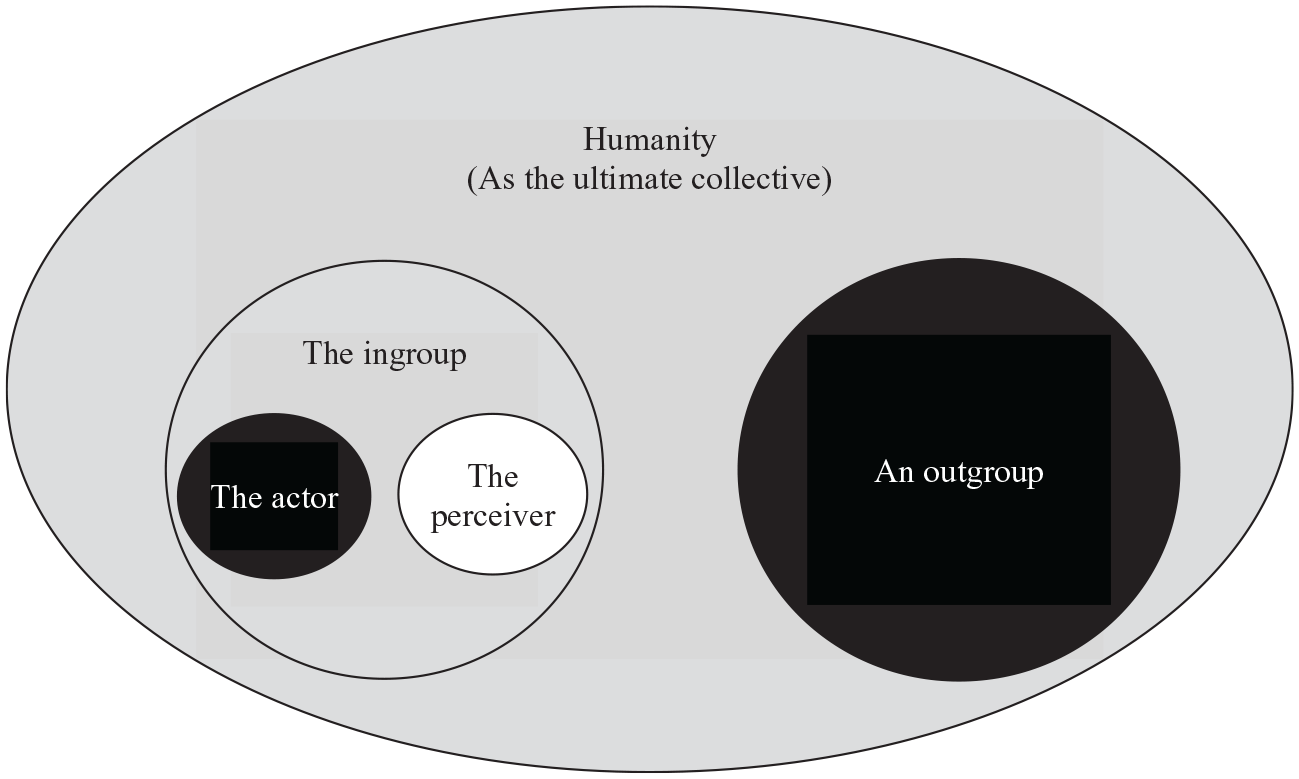
Compatibilities and incompatibilities of perceivers’ interests and beneficiaries attributed to actors’ intentionality: perceiver-inclusive attributions (in grey) and perceiver-exclusive beneficiaries (in black).
Such compatibilities and incompatibilities of interests are expected to translate into moral judgements and be expressed in the level of punitiveness sought. Building on past research relating intentionality to moral judgement and blame (Alicke et al., 1990; Malle et al., 2014; Rothgerber, 2014), we hypothesized that attributing an actor’s behavior to the intention to benefit herself or an outgroup (i.e., beneficiaries exclusive of the perceiver) would result in harsher judgements than would be the case when attributing the behavior to the intention to benefit the ingroup or humanity (i.e., beneficiaries inclusive of the perceiver). Consider, for example, the case of a citizen who publicizes his country’s plans to develop a nuclear weapon. This behavior could be attributed by a fellow ingroup member to the wish of the dissenter to benefit himself if the behavior is perceived as motivated by an interest in gaining publicity or tangible rewards. The dissent behavior may be attributed to the wish to benefit an outgroup, should it be perceived as disengagement from the dissenter and the perceiver’s group, expressed as assisting an enemy. Neither of these attributions serve the interests of the perceiver. They are thus likely to draw negative moral judgements, which will be reflected in a call for harsher punishment. The same behavior could be attributed to the wish to benefit the group of the dissenter and the perceiver (the ingroup), if the behavior is perceived as motivated to rescue the nation from involvement in dangerous plans, or to the wish to benefit humanity, if it is perceived as aimed at preventing a nuclear disaster. The latter attributions would draw positive moral judgments, which are expected to be reflected in a reduced urge for punishment; they emphasize that the dissenter wishes to benefit social groups of which the perceiver is a member (the ingroup or humanity) and, hence, indirectly promote the interests of the perceiver. Supporting our rationale, past studies have shown that individuals judged to be motivated by the wish to benefit social circles other than the ingroup had lower status, less access to resources, and less influence than those who were judged as motivated by the wish to benefit the ingroup (e.g., Ridgeway, 1982; Willer, 2009).
Social Identity Complexity, Beneficiary Attributions, and Moral Convictions
We offer social identity complexity as a factor explaining the likelihood of making inclusive versus exclusive attributions. Social identity complexity refers to how people represent their multiple group memberships (Roccas & Brewer, 2002). Representing multiple identities as highly overlapping results in a relatively simple identity structure, in which memberships in different groups converge to form a single homogeneous ingroup. Representing multiple identities as different and nonoverlapping reflects a complex, differentiated combination of social identities in which one’s multiple ingroups are conceptualized as heterogeneous.
Consider the example of Jack and Jill who are American, White, and Christian. Jack’s subjective representation of the three groups is highly overlapping. That is, when he thinks about an American, he pictures a person who is also White and Christian. Holding a simple social identity, for Jack, a person who is an ingroup member on one dimension of categorization (e.g., national identity) is also an ingroup member on all other dimensions of categorization (e.g., religious identity). A person not considered to be an ingroup member on one dimension of categorization is also not considered to be an ingroup member on all other important dimensions of categorization. Jill is a member of the same groups as Jack. Unlike Jack, however, Jill perceives the three ingroups as only partially overlapping. Her representation of Whites includes both Americans and non-Americans; her representation of Americans includes both Christians and non-Christians. Thus, Jill has a complex social identity. This results in blurred distinctions between ingroups and outgroups (Roccas & Brewer, 2002). The same person (e.g., a Muslim American) could be simultaneously an ingroup member on one dimension of categorization (national identity) and an outgroup member on a different dimension (religious identity).
Past research has confirmed that social identity complexity is associated with important intra- and intergroup structures. Higher social identity complexity among immigrants is associated with higher identification with the host nation (Verkuyten & Martinovic, 2012) and increased tolerance towards outgroup members (Brewer & Pierce, 2005; Miller et al., 2009; Roccas & Brewer, 2002; Schmid et al., 2009). Higher social identity complexity enhances interpersonal trust, especially trust in outgroup members (Xin et al., 2016), and thus naturally contributes to interethnic contact by reducing distinctiveness threat (Maloku et al., 2018). Importantly, identity complexity not only challenges social interaction, but also influences social perception (Bodenhausen, 2010). Social identity complexity also reduces ingroup bias (Schmid et al., 2009), increases positivity of intergroup attitudes (Knifsend & Juvonen, 2013), and mediates the effect of neighborhood diversity on ingroup bias (Schmid et al., 2013).
We suggest that social identity complexity influences the intentionality people attribute to the behavior of group members, such that higher complexity leads to higher attributions of inclusive beneficiaries. Identity addresses not only the “who am I?” question, but also questions on the nature of ingroups (i.e., “who are we?”). People with a simple social identity think of their multiple ingroups as overlapping, with clear-cut distinctions between “them” and “us.” When they attribute intentionality, a behavior that benefits “them” is not likely to benefit “us.” Therefore, a simple social identity reduces the likelihood of adopting inclusive beneficiary attributions to behaviors which overtly benefit an outgroup. In contrast, people with a complex social identity are aware that the boundaries between their multiple ingroups are more flexible and almost every social category is partially relevant to their own self-definition, blurring the distinction between “them” and “us.” As such, a behavior perceived as benefitting “them” is likely to be interpreted as aiming to help some part of one’s complex social identity (“us”). Thus, the more complex one’s social identity, the more likely a person is to form inclusive beneficiary attributions, perceiving even dissenting behavior of a group member as potentially aimed to benefit “us.”
The Current Research
Integrating attribution theory and social identity complexity, Figure 2 presents our full theoretical model of beneficiary attributions. We present the four beneficiary attributions relevant to the intergroup context, looking at social identity complexity as an antecedent, and at moral judgement reflected in punitiveness as a consequence, of the attributions made. We hypothesize that:
H1: (a) Attributing a behavior to the wish to promote the actor him/herself or the outgroup (i.e., perceiver-exclusive beneficiary attributions) is related to harsher punitiveness, whereas (b) attributing a behavior to the wish to promote the interests of the ingroup or humanity (i.e., perceiver-inclusive beneficiary attributions) is related to less harsh punitiveness.
H2: The more complex a perceiver’s social identity, (a) the less likely he/she is to make self and outgroup attributions (i.e., perceiver-exclusive beneficiary attributions) and (b) the more likely s/he is to make ingroup and humanity attributions (i.e., perceiver-inclusive beneficiary attributions).
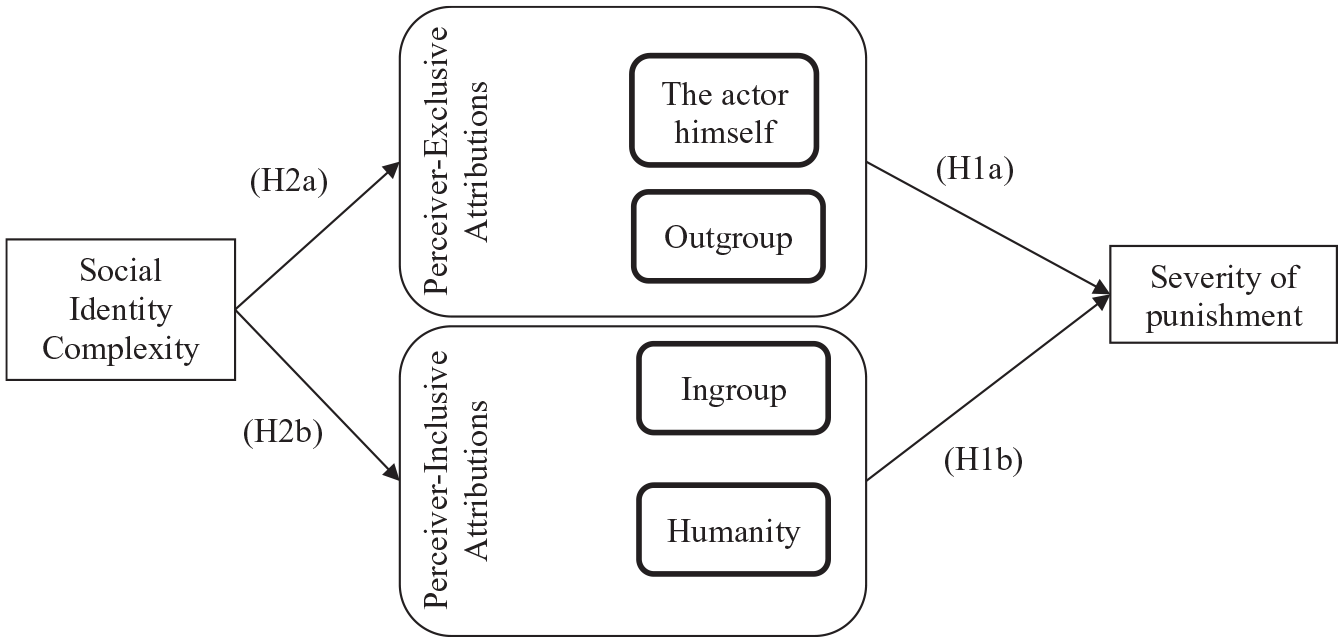
Model of perceiver-inclusive and perceiver-exclusive beneficiary attributions for dissenting behavior of fellow group members.
To validate our model of four beneficiaries, we present a pilot study in which we analyzed the content of participants’ answers to an open question about their attributions. We then present three studies. In Studies 1 and 2 we tested the full model presented in Figure 2, using a correlational design to test for the associations between social identity complexity, the four attributions, and punitiveness. In Study 3 we experimentally manipulated social identity complexity to test for its effects on attributions and punitiveness.
To increase the generalizability of this work and to test the robustness of the findings, we investigated two different dissenting behaviors. The first was the case of people refusing to participate in military service even though such service is mandatory (pilot study and Study 1). Our studies were conducted in Israel, which has a system of compulsory universal conscription. We focused on selective conscientious objectors: people who are willing to serve in the army but refuse to serve outside the pre-1967 borders. 1 The second behavior was the case of a person who revealed national military secrets to the foreign press (Studies 2–3). See Appendix A in the supplemental material for background information on the two contexts. All research materials and data are available at DOI 10.17605/OSF.IO/37URW.
Pilot Study
The main goal of the pilot study was to verify the proposed classification of four beneficiary attributions in our model. The participants were 99 university students (73.6% female; Mage = 30.13, SD = 8.83). They were presented with a vignette describing a person who completed his mandatory 3-year military service in a field unit, but after joining the mandatory reserve corps, refused to serve outside the pre-1967 borders. The participants were asked to make inferences regarding “Whom did the actor wish to benefit with this behavior?” Two independent judges classified the responses into one of five categories: self, outgroup, ingroup, humanity, or other. The two judges agreed on 86% of the responses. Disagreements were resolved by a third judge. Most responses (75.8%) were classified as one of the four categories in our model. For example, “himself” or “his family” were coded as “self”; “Arabs” or “Palestinians” were coded as “outgroup”; “Jews” or “Israel’s international relations” were coded “ingroup”; and “world peace” or “pacifism” were coded as “humanity.” An additional 10% of the responses mentioned groups which could be viewed as either ingroup or outgroup, depending on the self-categorization of the participant (e.g., supporters of left-wing political parties are ingroup members for participants who support left-wing political parties, but are outgroup members for participants who oppose these parties). Other responses (8%) referred to personal views and beliefs in a way that did not allow us to distinguish between self and humanity, but were clearly one of either (e.g., “He wanted to benefit his own views and principles”). The remaining inferences (8%) were classified as “other.”
Study 1
The pilot study provided support for the natural use of the four beneficiary attributions suggested in our model. We next sought to test the full model, with antecedents and consequences of those attributions (see Figure 2). We investigated the dissenting behavior of refusing to serve in the military.
Method
Participants and procedure
The participants were 237 university students (86.5% female; Mage = 21.5, SD = 2.54), all native Jewish Israelis. They were asked about their reactions to people who refuse to serve outside the pre-1967 borders during their mandatory army service (see Appendix A in the supplemental material). Participants completed the measures in the following order: Social identity complexity, attributions, beliefs regarding the proper punishment, and background information. Participation was voluntary and anonymous. Participants received course credit or a coffee voucher.
Measures
Social identity complexity
We used the measure of overlap between multiple ingroups developed by Roccas and Brewer (2002). Twelve items assessed the extent of perceived overlap between each pairing of ingroups in each direction of comparison (e.g., “Of people who are Israeli, how many are also university students?”; “Of people who are university students, how many are also Israeli?”). Judgments were made on a 10-point scale (1 = very few, 5 = about half, 10 = all). An index of perceived overlap (i.e., simple identity) was created by calculating the mean rating of overlap between ingroups (i.e., average of all the items). To simplify interpretation of results, we reversed the scores so that high values indicated higher complexity of the social identity (α = .82).
Attributions
Participants indicated their agreement with a list of items on a 7-point scale (1 = strongly disagree, 7 = strongly agree). Three items measured attributions to the motivation to benefit oneself (e.g., “People who refuse to serve in the [occupied] territories only care about themselves”; α = .76); the outgroup (e.g., “People who refuse to serve in the [occupied] territories want to help the Palestinians to reach their goals”; α = .76); the ingroup (e.g., “The refusal to serve in the [occupied] territories is motivated by one’s love for Israel”; α = .76); and humanity (e.g., “People who refuse to serve in the [occupied] territories care about the suffering of all human beings”; α = .67).
Punitiveness
Participants indicated their agreement, on a 7-point scale (1 = strongly disagree, 7 = strongly agree), with four statements about the appropriate punishment for the deviant group member (e.g., “The punishment for refusing to serve in the army is too mild,” “The phenomenon of refusal to serve in the army is out of control and must be restrained”). We averaged the four items to create an index of punitiveness (α = .78).
Results and Discussion
Table 1 presents the means, standard deviations, and zero-order correlations among the four attributions, punitiveness, and social identity complexity. Participants made perceiver-exclusive attributions (self and outgroup) significantly more than perceiver-inclusive ones (ingroup and humanity), F(1, 236) = 19.29, p < .001, η2p = .08, 95% CI [0.71, 1.87]. The pattern of intercorrelations among the four attributions was consistent with our theoretical model, with positive intercorrelations between the two perceiver-exclusive attributions (oneself and outgroup; r = .55) and between the two perceiver-inclusive attributions (ingroup and humanity; r = .63). All other intercorrelations among the four attributions were negative (rs range: −.46 to −.31; all ps < .05). Controlling for participants’ political orientation (on a left–right continuum) did not change most correlations (see Table S1.1).
Means, standard deviations (in parentheses), and correlations among attributions, punitiveness, and social identity complexity: Study 1.
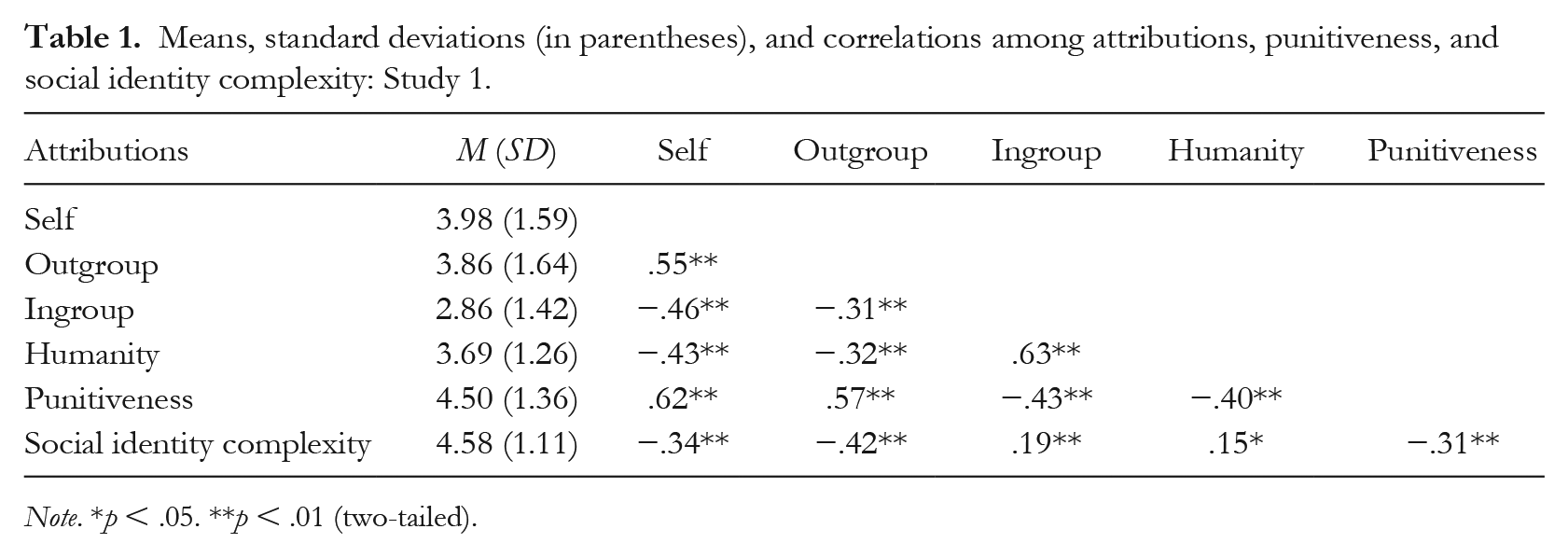
Note. *p < .05. **p < .01 (two-tailed).
Attributions, punitiveness, and social identity complexity
As hypothesized (H1), punitiveness correlated positively with attributing the dissenting behavior to exclusive attributions—the wish of the actor to benefit herself (r = .62) or the outgroup (r = .57). Punitiveness correlated negatively with attributing the behavior to the wish to benefit inclusive attributions—the wish of the actor to benefit the ingroup (r = −.43) or humanity (r = −.40; all ps < .05). For regression analysis predicting punitiveness from all four attributions simultaneously, see Table S1.2. Also as hypothesized (H2), social identity complexity correlated negatively with exclusive attributions of dissenting—the desire of the actor to benefit himself (r = −.34) or the outgroup (r = −.42). Conversely, complexity correlated positively with inclusive attributions—attributing these actions to the desire to benefit the ingroup (r = .19) or humanity (r = .15; all ps < .05).
As shown in Table 1, social identity complexity correlated negatively with support for harsh punishment (r = −.31 p < .05). We used PROCESS (Model 4) extension to SPSS (Hayes & Preacher, 2014) for explorative analysis, testing the mediating role of each of the four attributions on this association. We report 95% confidence intervals with 5,000 samples. To provide a deeper picture of the results and allow for the identification of marginally significant results, we report 90% confidence intervals with 10,000 bootstrap samples for all studies in the supplemental material (see Table S3). Significant mediation effects emerged for both perceiver-exclusive beneficiary attributions (egoistic: 95% CI [−0.35, −0.15]; outgroup: 95% CI [−0.38, −0.19]) and for both perceiver-inclusive beneficiary attributions (ingroup: 95% CI [−0.18, −0.02]; humanity: 95% CI [−0.14, −0.02]). Together, these analyses indicate that social identity complexity predicts the intentionality attributed to dissent, which in turn predicts level of punitiveness.
In sum, the findings support our theoretical model (see Figure 2): participants distinguished among the four types of beneficiary attributions for the dissenting behavior in a pattern consistent with compatibility and incompatibility between the perceiver’s own interests and the intentions attributed to the actor. Furthermore, social identity complexity correlated positively with making perceiver-inclusive attributions and negatively with making perceiver-exclusive attributions, which in turn predicted the harshness of the punishment perceived as appropriate for the dissenting behavior.
Study 2
Study 2 aimed to test the robustness of the findings by investigating the model with a different form of dissent. We studied the attributions and judgements made regarding a person who revealed important Israeli military secrets. Whereas Study 1 focused on the intentionality attributed to a refusal to contribute to the ingroup (the case of conscientious objectors), Study 2 focused on the intentionality attributed to an action of disloyalty (disclosure of national secrets). Both cases challenge or weaken the ingroup in the imminent context of an intergroup conflict, one by refraining from action, the other by engaging in action. Both cases received media coverage and evoked strong responses. To further verify the robustness of our findings, we employed diverse methodologies to capture social identity complexity.
Method
Participants and procedure
The design of this study was the same as that of Study 1. Two samples were collected, using different methodologies to capture social identity complexity. The participants were university students, all native Jewish Israelis (Sample 1: N = 111, 49.5% female, Mage = 25.27, SD = 4.80; Sample 2: N = 106, 82.9% female, Mage = 26.58, SD = 4.49). Participants in both samples were asked about their reactions to a person who revealed important Israeli military secrets (see Appendix A, in the supplemental material). They completed the questionnaires voluntarily and anonymously, for course credit, and in the same order as in Study 1.
Measures
Social identity complexity (Sample 1)
See Study 1 (α = .66).
Social identity complexity (Sample 2)
Research on identity threat has proposed that self-concept maps can serve as an additional indicator of social identity complexity (Gresky et al., 2005). We focused on self-concept maps in which the nodes represented identities (e.g., Israeli, student, single), and the lines connecting them represented the perceived interrelations between the identities. Participants were instructed that concept maps allow one to depict thoughts on a topic by drawing labeled nodes and linking them with lines. They were then asked to draw a self-concept map that would represent the answer to the question: “Who am I?” At the center of the page, there was a circle labeled “me.” Complexity scores were computed by summing the number of lines that connected the nodes.
Attributions
The questionnaire started with a short description of the case of a person who provided secret information to a foreign newspaper. We used slightly rephrased items and added four new items such that each attribution was measured with four items, yielding adequate reliabilities in both samples: self (α = .
Punitiveness
See study 1 (α = .61 and α = .63 for Samples 1 and 2, respectively).
Results and Discussion
Table 2 presents the means, standard deviations, and zero-order correlations among social identity complexity, the four attributions, and punitiveness. Again, consistent with the dissent entailed in the behavior described, participants made perceiver-exclusive attributions (self, outgroup) significantly more than perceiver-inclusive ones (ingroup, humanity); Sample 1: F(1, 110) = 57.96, p < .001, η2p = .35, 95% CI [2.40, 4.08]; Sample 2: F(1, 105) = 364.77, p < .001, η2p = .78, 95% CI [5.36, 6.60]. The pattern of intercorrelations among the four attributions was also similar to that in Study 1, and consistent with our model. The two perceiver-exclusive attributions were positively correlated (the actor himself and the outgroup: r = .27 and r = .34 for Samples 1 and 2, respectively), as were the two perceiver-inclusive attributions (ingroup and humanity: r = .84 and r = .74 for Samples 1 and 2, respectively). All other intercorrelations between the four attributions were negative (all ps < .05). Controlling for participants’ political orientation (on a left–right continuum) did not change most of these effects (see Table S2.1).
Means, standard deviations (in parentheses), and correlations among attributions, punitiveness, and social identity complexity a : Study 2.
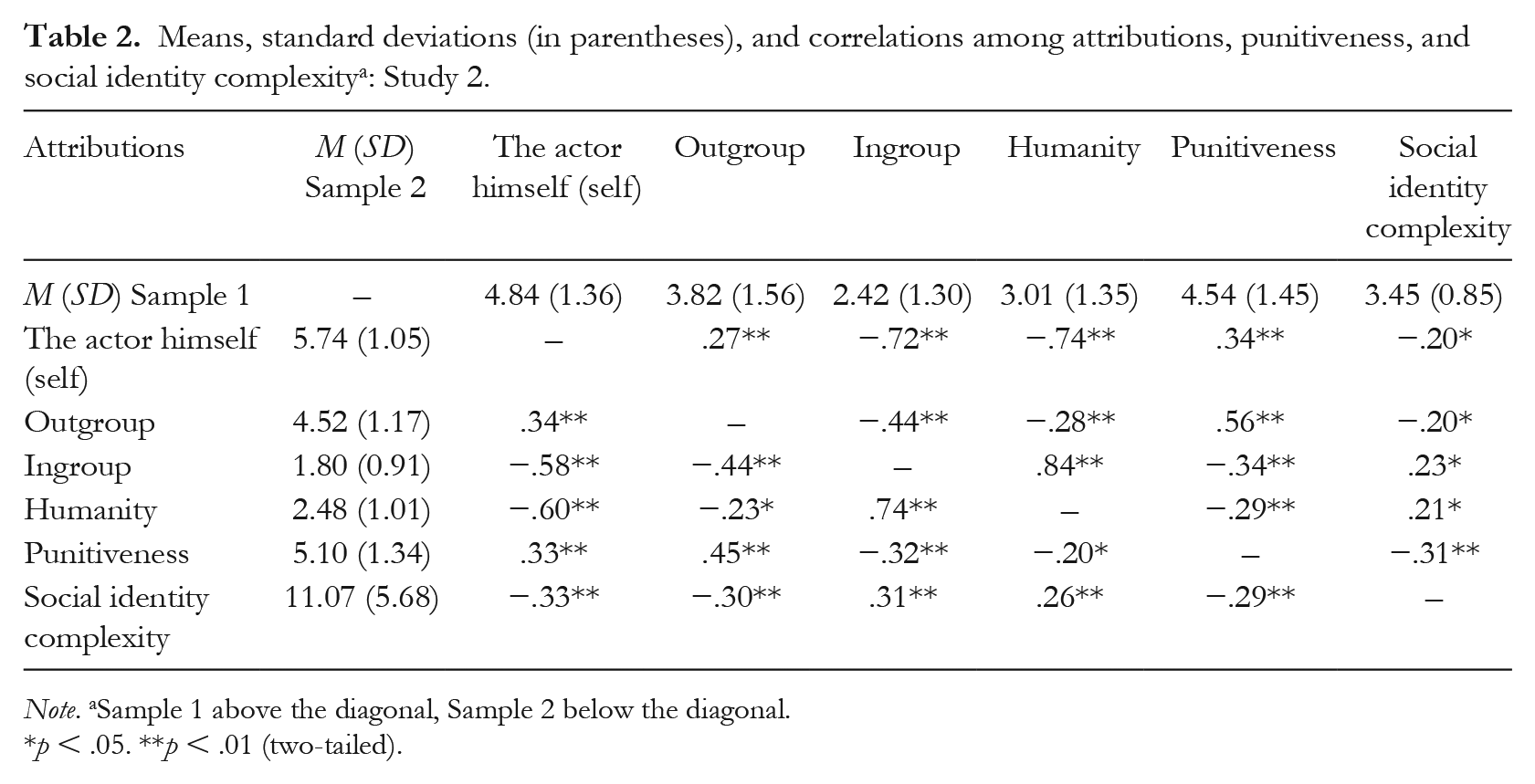
Note. aSample 1 above the diagonal, Sample 2 below the diagonal.
p < .05. **p < .01 (two-tailed).
As hypothesized (H1), punitiveness correlated positively with perceiver-exclusive attributions (self: r = .34 and r = .33 for Samples 1 and 2, respectively; outgroup: r = .56 and r = .45 for Samples 1 and 2, respectively) and negatively with perceiver-inclusive attributions (ingroup: r = −.34 and r = −.32 for Samples 1 and 2, respectively; humanity: r = −.29 and r = −.20 for Samples 1 and 2, respectively; all ps < .05). For regression analysis predicting punitiveness from all four attributions simultaneously, see Table S2.2.
Also as hypothesized (H2), social identity complexity was negatively correlated with perceiver-exclusive attributions (the desire to benefit the actor himself: r = −.20 and r = −.33 for Samples 1 and 2, respectively; the desire to benefit the outgroup: r = −.20 and r = −.30 for Samples 1 and 2, respectively) and positively correlated with perceiver-inclusive attributions (the desire to benefit the ingroup: r = .23 and r = .31 for Samples 1 and 2, respectively; the desire to benefit humanity: r = .21 and r = .26 for Samples 1 and 2, respectively; all ps < .05).
As shown in Table 2, and replicating the findings of Study 1, social identity complexity correlated negatively with support for harsh punishment (r = −.31 and r = −.29, p < .001 for both samples). We followed the same exploratory procedure used in Study 1 for testing the mediating role of each of the four beneficiary attributions in the association between social identity complexity and punitiveness. Attributing intentionality to the wish of the actor to benefit himself mediated the association between social identity complexity and punitiveness in both samples (Sample 1: 95% CI [−0.01, −0.22]; Sample 2: 95% CI [−0.04, −0.01]). Similarly, attributing intentionality to the wish to benefit the outgroup mediated the association between social identity complexity and punitiveness in both samples (Sample 1: 95% CI [−0.01, −0.39]; Sample 2: 95% CI [−0.05, −0.01]). Attributing intentionality to the wish to benefit the ingroup mediated the association between social identity complexity and punitiveness in Sample 1: 95% CI [−0.01, −0.25]. This effect was not significant at the 95% level in Sample 2: 95% CI [−0.04, −0.00]. Attributing intentionality to the wish to benefit humanity did not mediate the association between social identity complexity and punitiveness in any of the samples (Sample 1: 95% CI [0.00, −0.21]; Sample 2: 95% CI [−0.02, 0.00]). See Table S3 for analysis including 90% confidence intervals.
In sum, testing our hypotheses with a different dissenting behavior and a different measure of social identity complexity yielded a pattern of results largely replicating that of Study 1. The findings in both the samples of Study 2 were consistent with our model (see Figure 2), indicating its robustness across measures and contexts.
Study 3
Studies 1 and 2 employed a correlational design, showing that social identity complexity is correlated positively with perceiver-inclusive and negatively with perceiver-exclusive attributions. We next sought to establish the causal effect of social identity complexity on the four beneficial attributions. To this end, we devised a procedure encouraging individuals to think of their self-concept in either a simple or complex way. In addition, we sought to disentangle the effect of complexity due to social identity from alternative effects. We reason that it is the complexity of people’s own identity that enables them to expand their view of the social circles benefitting from the dissent to include the perceiver’s own social circles (ingroup and humanity). One may wonder, though, whether the willingness to make perceiver-inclusive attributions is limited to people’s identity, as opposed to any object, or whether it is limited to the complexity of the social identity, as opposed to general cognitive complexity (for a recent review on cognitive complexity, see Woodard et al., 2021). That is, the more complex one’s thought, the more one is willing to accept what may be seen as less evident beneficiaries. To rule out these alternative explanations, we used a similar procedure to manipulate two other forms of complexity: nonhuman complexity and complexity that is social but not related to identity. We hypothesize that,
H3a: Participants in the high social identity complexity condition would attribute the dissenting behavior less to perceiver-exclusive attributions and more to perceiver-inclusive attributions than participants in the low social identity complexity condition. In addition, the former would support less harsh punishment than the latter.
H3b: The differences in attributions and punitiveness between high and low complexity conditions would be evident for social identity complexity, but not for nonhuman complexity or for social complexity that is not identity-related.
Method
Participants and procedure
The participants were 165 university students (82.5% female; Mage = 27.80, SD = 6.62) randomly assigned to one of six experimental conditions. We aimed to recruit roughly 30 participants for each condition. A sensitivity power analysis using G*Power (Faul et al., 2007) indicated that this sample size allowed for the detection of a medium effect size (f = .22) at 80% power (α = .05). Participants read instructions for drawing a concept map according to their experimental condition (see following lines), and then drew the map. After this manipulation, participants completed the attribution and punitiveness questionnaires. They participated voluntarily and anonymously for course credit.
Measures
Complexity manipulation
Similar concept maps to those used to measure social identity complexity in Study 2 were used to manipulate complexity. In the low complexity conditions, participants were instructed to draw maps depicting fundamental information with few central nodes and few connections. In the high complexity conditions, participants were instructed to draw maps depicting extensive information with many nodes and connections. Participants were then presented with an illustrated example of either low (maximum four nodes) or high (minimum 20 nodes) complexity, depending on experimental conditions.
In the social identity complexity condition, the examples presented a center node labeled “me” and four other nodes in the simple condition, or 24 other nodes in the complex condition. These branched out from the center node and were labeled with social identities relevant to the participants in the sample (e.g., Israeli, student, Jewish, single). Participants then drew their own social identity concept map. In the nonhuman complexity condition, the examples presented a center node labeled “animals” and four or 20 other nodes branching out from the center node labeled with relevant examples (e.g., mammals, birds, reptiles, fish). Participants then drew a concept map of “furniture.” In the social, non-identity-related complexity condition, the examples presented a center node labeled “Jonathan Smith” and four or 20 other nodes branching out from the center node labeled with relevant examples (e.g., Christian, American, single, student). Participants then drew the concept map of a character about which they had extensive information (e.g., a character from a novel or from a TV series).
Attributions
See Sample 2 of Study 2 (the actor: α = .90; the outgroup: α = .87; the ingroup: α = .89; humanity: α = .80).
Punitiveness
See Sample 2 of Study 2 (α = .67).
Results and Discussion
Means and standard deviations across experimental conditions are presented in Table 3. To test the effectiveness of the manipulation, we compared the number of lines drawn by participants in the low and high complexity conditions for each of the complexity types. The comparisons confirmed that the manipulation was successful. Participants in the simple social identity condition drew fewer lines (M = 4.20, SD = 1.41) than did participants in the complex social identity condition (M = 21.54, SD = 21.54), F(1, 155) = 46.40, p < .001, η2p = 9.17, 95% CI [12.31, 22.37]. Participants in the simple nonhuman condition drew fewer lines (M = 5.36, SD = 5.02) than did participants in the complex nonhuman condition (M = 27.17, SD = 16.26), F(1, 155) = 85.42, p < .001, η2p = .36, 95% CI [17.15, 26.48]. Participants in the simple social, non-identity-related condition drew fewer lines (M = 5.21, SD = 3.38) than did participants in the complex social, non-identity-related condition (M = 18.48, SD = 8.67), F(1, 155) = 30.48, p < .001, η2p = .16, 95% CI [8.52, 18.01].
Means and standard deviations (in parentheses) of complexity (measured as number of lines), attributions, and punitiveness for each of the experimental conditions: Study 3.
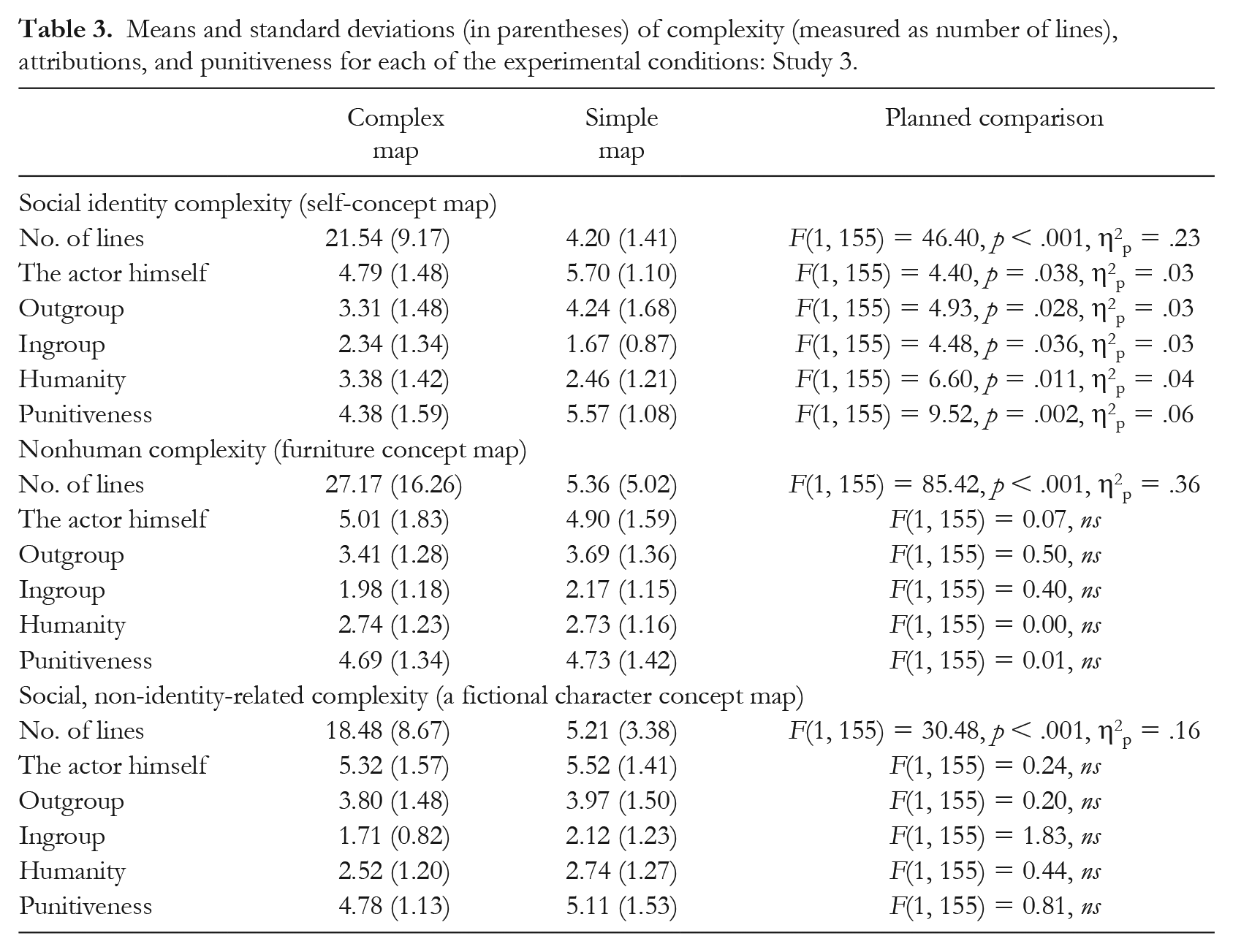
We now report the results of the hypothesized comparisons in the social identity conditions, followed by comparisons in the other complexity conditions in which differences were not expected. ANOVA with planned comparisons conducted using the LMATRIX command in SPSS confirmed that, as hypothesized, manipulating the complexity of participants’ social identity affected the four attributions. Participants in the simple social identity condition attributed the dissenting behavior to the actor’s wish to benefit himself (M = 5.70, SD = 1.10) and the outgroup (M = 4.24, SD = 1.68) more than did participants in the complex condition; actor himself: M = 4.79, SD = 1.48, F(1, 155) = 4.40, p = .04, η2p = .03, 95% CI [−1.78, −0.06]; outgroup: M = 3.31, SD = 1.48, F(1, 155) = 4.93, p = .028, η2p = .03, 95% CI [−1.75, −0.10]. Conversely, participants in the complex social identity condition attributed the behavior to the wish to benefit the ingroup (M = 2.34, SD = 1.34) and humanity (M = 3.38, SD = 1.42) more than did participants in the simple condition; ingroup: M = 1.67, SD = 0.87, F(1, 155) = 4.48, p = .036, η2p = .03, 95% CI [0.05, 1.30]; humanity: M = 2.46, SD = 1.21, F(1, 155) = 6.56, p = .011, η2p = .04, 95% CI [0.21, 1.62]. Finally, participants in the complex social identity condition were more lenient with punishment than participants in the simple social identity condition (M = 4.38, SD = 1.59 and M = 5.57, SD = 1.08, respectively), F(1, 155) = 9.52, p = .002, η2p = .06, 95% CI [−1.97, −0.43].
Focusing only on the two social identity conditions (simple vs. complex), the exploratory testing of the indirect effect of social identity complexity on punitiveness was conducted with four separate analyses using PROCESS Model 4. The effect was significantly mediated by egoistic attribution (95% CI [−0.98, −0.02]) but not for outgroup attribution (95% CI [−0.80, 0.04]). And it was significantly mediated by both inclusive beneficiary attributions (ingroup: 95% CI [−0.99, −0.03]; humanity: 95% CI [−0.71, −0.02]).
We did not expect, nor did we find, differences in punitiveness between the high and low nonhuman complexity conditions, F(1, 155) = 0.01, ns, or between the high and low social, non-identity-related complexity conditions, F(1, 155) = 0.81, ns. Similarly, no differences between the simple and complex conditions were expected or found for the four attributions comparing those conditions considering nonhuman complexity or social, non-identity-related complexity (see Table 3). Considering the nonhuman and non-identity-related conditions as potential “control” conditions for identity complexity, the effect seems to be driven by harsher punitiveness in the simple identity condition rather than lenient punitiveness in the complex condition. This may reflect the strength of the simple versus complex manipulation. However, this pattern was not hypothesized, and should be interpreted with caution and studied further.
The findings of Study 3 strengthen our argument that the complexity of an individual’s social identity is a critical factor in shaping their reaction to dissenting behavior. How participants thought about their identity affected their reactions: participants who were induced to represent their identity in a complex fashion tended to attribute the dissenting behavior more to the wish to benefit perceiver-inclusive beneficiaries (both ingroup and humanity) and less to the wish to benefit perceiver-exclusive beneficiaries than did participants who were induced to represent their identity simply. The former group was also more lenient towards the dissenting group member. These findings are consistent with those of Studies 1 and 2, and complement them by showing that reactions to a dissenter can be affected by temporarily changing the complexity in which people construe their self-concept (but not other non-identity-related complexity).
General Discussion
We sought to uncover the intentions attributed to dissenting behavior in an intergroup context, focusing on dissent that challenges or weakens the ingroup, such as criticizing the ingroup or refusing to contribute to it. Concentrating on the point of view of the perceiver, we argue that when attributing intentionality to such behavior, perceivers ask themselves two core questions: “Who benefits from this behavior?” and “Am I included in the beneficiaries?” We further examined the influence of social identity complexity on the attributions made, showing its relationship to the different attributions, which, in turn, predicted harshness of judgment of the dissenting actor (see Figure 2).
In all three studies, participants tended to perceive the dissenting behavior as intended to benefit social circles that excluded them (the actor himself or the outgroup) more than social circles that included them (ingroup or humanity). These consistent findings call for further consideration. Models of attribution (e.g., reviewed in Gilbert, 1998; Reeder, 2013; Trope, 1986) indicate that individuals do not thoroughly consider all possible attributions, but rather focus on few explanations that sufficiently match the circumstances. Consistently, our findings suggest that individuals do not consider all social circles, but rather focus on perceiver-exclusive attributions in the contexts investigated. As these attributions come to mind more easily, one could perhaps consider them as “default” attributions, making perceiver-inclusive attributions “nondefault.”
Importantly, the complexity of an individual’s social identity was related to the adoption of different attributions: simple social identity was positively related to adopting perceiver-exclusive attributions, whereas complex social identity was positively related to adopting perceiver-inclusive attributions. These hypothesized associations were confirmed in studies using a correlational design (Studies 1 and 2), employing two different measures of social identity complexity (a measure of overlap and a measure of self-concept maps), and referring to two different dissenting behaviors (refusing to help the ingroup and criticizing it). They were further confirmed in an experiment (Study 3) lending support to the causal effect of the complexity of social identity (and not other forms of complexity) on beneficiary attributions and punitiveness. While we did not hypothesize a direct effect of social identity complexity on punitiveness nor an indirect effect mediated by the attributions, we provided exploratory analyses. Our results show consistent mediating effects of the four beneficiary attributions (of the 16 mediation effects, 13 are significant at the 95% confidence level, and 15 are significant at the 90% level; see Table S3).
The Role of Social Identity Complexity
Understanding the role of social identity complexity in the attribution of intentionality is important because it links a person’s cognitive representation of their social realm to their interpretations of the behaviors performed by members of their ingroup. Importantly, social identity complexity is a basic psychological construct that transcends a specific social context. It does not refer directly to dissent, criticism, loyalty, or other constructs whose content overlaps with the behavior of ingroup members. Accordingly, the measurement of complexity is not contextualized in a specific set of identities, but rather reflects how people construe the interrelationships among their multiple ingroup memberships.
We found that the complexity of the social identity is not only related to, but also causally affects, the adoption of inclusive and exclusive attributions. The more complex one’s social identity, the more one accepts the complexity of the social realm and is ready to accept various interpretations, to the extent that a behavior deviating from the group’s expectations (and even weakening or challenging the group) may be more readily viewed as intending to benefit the ingroup and humanity.
Social identity complexity is probably not the sole factor affecting beneficiary attributions. Study 3 ruled out general cognitive complexity. Future research could investigate further potential factors such as personal values, traits, or motivations like social dominance orientation. For example, individuals who emphasize universalist values may be more susceptible to the effect of social identity complexity, whereas those with a high social dominance orientation may be relatively immune and unaffected by it. Future studies can also extend the investigation of the role of social identity complexity in attributions of intentionality and moral judgement to social contexts other than dissent and for reactions other than punitiveness.
Beneficiary Attributions
Building on the notion of attributions of intentionality, we proposed that individuals attribute intentionality in terms of beneficiary social circles. The content of these social circles is context-dependent. Here, focusing on dissenting behaviors in a context of intergroup conflict, we proposed that in this context there are four relevant social circles: the actor him/herself, the outgroup, the ingroup, and humanity. Supplementary regression analysis predicting punitiveness from all four attributions showed that attributions of self and outgroup explain most of the variance in punitiveness, further strengthening the notion that they serve as “default” attributions in the contexts investigated (see Tables S1.2 and S2.2).
Other social circles may be relevant in other contexts. For example, studying intentionality of nondissenting behavior of political leaders, Arieli et al. (2019) presented six nested beneficiary attributions, including humanity and own (egoistic) interests but also the interests of the party and more. Future studies could extend the investigation of beneficiary attributions exploring, for example, what determines which social circles are considered potential beneficiaries in different contexts. Note that humanity, as the ultimate collective, includes the ingroup and the outgroup but also other groups. Future studies could investigate whether behaviors are also attributed to benefit concrete collectives, and whether these attributions follow the inclusive/exclusive logic presented here.
We asked here how dissenting behavior is perceived and judged, investigating two forms of dissent in Israeli society. Accordingly, all participants were Israeli students, likely to be aware of these events. Future studies could investigate the generalizability of our findings to other forms of dissent and based on other samples. The question arises whether a behavior is considered dissent if it is perceived as aiming to benefit the ingroup or humanity. More generally, this raises questions of whether there is agreement on how a specific behavior in a specific context is perceived.
The current research has implications for theory development in other areas of group processes. For example, research has indicated the importance of attributions in determining reactions to people who criticize the ingroup (Hornsey, 2005). Criticism is more readily accepted if people perceive the critic as loyal; that is, when they believe that the critic identifies with the group and has its best interest at heart (Hornsey, 2005; cf. Hollander, 1958). Thus, people are consistently less resistant to criticism from ingroup than from outgroup members (Hornsey & Imani, 2004; Sutton et al., 2006). The present research can contribute to the study of group criticism, moving from the basic distinction between the wish to harm or help the group to consider intentions in terms of the wish to benefit different social circles.
Punishment as Moral Judgement
We treated moral judgement, expressed as punitiveness, as resulting from adopting different beneficiary attributions and suggested that the judgement depends on the self-interest of the perceiver. Our research joins the investigation of (attributed) intentionality and moral judgement. While this research often focuses on the actor and how his/her characteristics influence how s/he is judged (Uhlmann et al., 2015), we analyzed the perceiver and how his/her social identity complexity determines judgement.
All three studies focused specifically on punishment; however, other conceptualizations of moral judgement, such as blame and permissibility, are affected by different antecedents (Cushman, 2008). Future studies could explore the role of beneficiary attributions in other conceptualizations of moral judgement. Past research pointed to gender differences in relying on consequential reasoning in moral judgement (Indick et al., 2000). Some of our samples were predominantly female. Future studies could seek to replicate our findings with a higher proportion of male participants.
We adopted a correlative approach linking moral judgement with the four beneficiary attributions. We rationalized that judgements are derived from attributions and not vice versa. Future research is needed to establish the causal link. Similarly, we derived our hypothesis on the links between moral judgement and both perceiver-inclusive and perceiver-exclusive attributions (H2a and H2b) assuming a single underlying psychological mechanism derived from congruencies with the perceivers’ self-interests. Future studies may seek additional mechanisms to differentiate between the effects of the specific attributions – differentiating self from outgroup and ingroup from humanity. Postulating additional mechanisms may then further differentiate between inclusive and exclusive attributions. Focusing on additional conceptualizations of moral judgements may facilitate such theorizing.
Our research also contributes to the understanding of the lay view on the role of punishment. Individuals prefer to punish in the hope of minimizing future transgressions (the deterrence rationale) but actually punish to restore the balance of the moral scale (just deserts rationale; Carlsmith et al., 2002) and may even derive pleasure from punishing (Carvalho & Chamberlen, 2018). We showed that punitiveness is generally harsher the more the behavior is interpreted as aiming to benefit perceiver-exclusive beneficiaries. Yet, there were differences in the two contexts investigated. The association between punitiveness and the two perceiver-exclusive attributions was similar when considering selective conscientious objectors (Study 1). However, the association of punitiveness with attributing to the actor the intent of benefiting himself was smaller than the association with attributing the intent of benefiting the outgroup when considering the exposure of military secrets (Study 2). Future studies could further investigate when people judge an actor’s selfishness as more or less moral.
Individuals differ on their support for punitive responses. For example, harsher punitiveness is associated with lower need for cognition (Sargent, 2004) and with personality traits (Colémont et al., 2011; Volk et al., 2019). Social identity complexity has been linked with acceptance of diversity (Brewer, 2010) and tolerance of outgroups (Brewer & Pierce, 2005). Our research also shows that it is correlated with what may be considered another form of intolerance: punitiveness towards dissenting behavior. The higher the complexity, the lower the punishment sought. A general pattern emerges—the more complex one’s own social identity, the more tolerant and accepting one is of others and of others’ actions.
Conclusions
The attributions people make regarding the behavior of others directly affect their reactions towards them. It is therefore important to understand the content of these attributions, their antecedents, and consequences. The current research takes a first step in this direction by systematically mapping the possible attributions in terms of relevant social circles, distinguishing between perceiver-exclusive and perceiver-inclusive attributions, and examining whether social identity complexity can underlie these attributions and the consequent moral judgements. The specific set of relevant attributions and their classification as inclusive versus exclusive is context-dependent, but the proposed model relating social identity complexity to beneficiary attributions is likely to transcend intergroup contexts.
In the current era, everyone can participate in negotiating the interpretation of “reality,” and masses of opinions—about right and wrong, sanctions and praises—matter now more than ever. The attributions that people make about the actions and intentions of others become crucial. We suggest that raising people’s social identity complexity (e.g., through images in social media) may encourage people to consider a wider set of attributions—in our case, diverse circles of beneficiaries. Consequently, they may adopt a more tolerant approach towards others’ actions, even in the case of dissenting behaviors.
Supplemental Material
sj-pdf-1-gpi-10.1177_13684302211019479 – Supplemental material for Inclusive and exclusive beneficiary attributions: The role of social identity complexity in interpretations of and punishment for dissent
Supplemental material, sj-pdf-1-gpi-10.1177_13684302211019479 for Inclusive and exclusive beneficiary attributions: The role of social identity complexity in interpretations of and punishment for dissent by Sonia Roccas, Adi Amit, Shani Oppenheim-Weller, Osnat Hazan and Lilach Sagiv in Group Processes & Intergroup Relations
Footnotes
Acknowledgements
We thank Noam Keshet, Sharon Arieli, Hagar Briliant-Melamed, and Maayan Shabo-Sayag for their help in data collection.
Authors’ Note
Osnat Hazan is currently affiliated with Tel Aviv University.
Funding
The author(s) disclosed receipt of the following financial support for the research, authorship, and/or publication of this article: This research was supported by Israel Science Foundation Grant 785/03 to Sonia Roccas and Grant 604/20 to Adi Amit.

Supplemental material
Research materials and data are available at DOI 10.17605/OSF.IO/37URW. Supplemental material for this article is available online.
Notes
References
Supplementary Material
Please find the following supplemental material available below.
For Open Access articles published under a Creative Commons License, all supplemental material carries the same license as the article it is associated with.
For non-Open Access articles published, all supplemental material carries a non-exclusive license, and permission requests for re-use of supplemental material or any part of supplemental material shall be sent directly to the copyright owner as specified in the copyright notice associated with the article.
