




Abstract
In this article, we examine the roles of social dominance orientation (SDO) and ecological dominance orientation (EDO) as predictors of climate change risk and threat perceptions and associated pro-environmental policy support. EDO is a novel measure that we devised based on social dominance theory to assess general preferences for an anthropocentric, hierarchical arrangement between humans, non-human animals, and the natural environment. Across two pre-registered studies (N = 715; USA and Germany) our results indicate that SDO and EDO are uniquely associated with decreased support for climate change mitigation policies benefitting humans, non-human animals, and the natural environment. These relationships in turn are partially mediated by decreased climate change risk and threat perceptions. We successfully replicate our findings using a more behavioral measure as dependent variable. Notably, using a more behavioral measure (Study 2), EDO was significantly associated with pro-environmental behavior but not SDO, when threats are accounted for as mediators.
Reports on the impact of climate change on planetary health are distressing (e.g., IPCC, 2014). Notably, climate change itself is an unintended yet irrefutable consequence of humans’ disproportionate ecological dominance, i.e., the extent of humans’ control over – and unsustainable exploitation of – resources impacting all areas and ecosystems of the Earth’s environment (e.g., Díaz et al., 2019; Whitmee et al., 2015). Yet, despite being one of the most important anthropogenic societal challenges of our time, public perceptions of and engagement with climate change reveal great variation in regard to acknowledging the urgency and severity of the issue (Lee et al., 2015; Leiserowitz, 2005). Previous studies indicate that a sense of feeling threatened by climate change seems pivotal for increasing pro-social and pro-environmental attitudes and behaviors aimed at mitigating the consequences of global warming (e.g., van der Linden et al., 2015). However, previous research also shows that individuals differ greatly in their climate change risk and threat perceptions (e.g., Hoffarth & Hodson, 2016; van der Linden, 2015; Uenal, Sidanius, Roozenbeek, & van der Linden, 2020). Therefore, a better understanding of individual difference variables influencing risk and threat perceptions seems important to increase public engagement with and individual responsibility to act on climate change.
In this article, we focus on the roles of social dominance orientation (Pratto et al., 1994) and ecological dominance orientation (Uenal, Sidanius, & van der Linden, 2020), as such individual difference variables potentially explaining variation in risk and threat perceptions and, in turn, endorsement of mitigation policies. Social dominance orientation (SDO) is a well-established, domain-specific individual difference variable assessing preferences concerning the hierarchical structure of human societies (Sidanius et al., 2017). Although SDO is primarily theorized to explain relationships among human social groups (e.g., racism, sexism; social dominance theory, SDT; Sidanius & Pratto, 1999), an increasing number of studies indicate an inverse relationship between SDO and pro-environmental attitudes associated with climate change (e.g., biodiversity loss, climate change denial; Jylhä et al., 2020; Uenal, Sidanius, Roozenbeek, & van der Linden, 2020). More specifically, these findings indicate that the more individuals prefer hierarchically organized societal arrangements in which some groups are on top and others on the bottom, the less they show pro-social attitudes benefitting humans as well as non-human animals, or the natural environment (e.g., racism, speciesism, anthropocentrism; Costello & Hodson, 2010; Dhont et al., 2016; Hyers, 2006; Jylhä & Akrami, 2015; Milfont et al., 2013; Stanley & Wilson, 2019).
While previous research shows much promise in explaining individual-level differences in risk and threat perceptions and associated pro-environmental attitudes as a function of SDO, it has at least three limitations the present work attempts to correct. First, the role of ecological dominance orientation, i.e., a general preference for an anthropocentric, hierarchical arrangement between humans, non-human animals, and the natural environment, remains understudied (cf. Uenal, Sidanius, & van der Linden, 2020). Previous research has explained the relationship between SDO and attitudes towards non-human animals and the natural environment via hierarchy-legitimizing myths as an intermediary link (e.g., Milfont et al., 2013; Milfont & Sibley, 2014). In contrast to these explanations, we propose that a complementary integration of previous findings into SDT is viable. Specifically, we propose that – similar to SDO – preferences for ecological dominance might represent a psychologically meaningful entity in and for itself, capturing a broader relational perspective in which different forms of communal arrangements between humans, non-human animals, and the natural environment are conceptualized. In other words, we argue that, in addition to the previously proposed linkage between SDO and attitudes pertaining to the interspecies and human–environment domains via support for hierarchy-legitimizing myths, ecological dominance – due to its more holistic focus on intraspecies, interspecies, and human–environment relations – might qualify as an independent psychological predictor of beliefs and behaviors across relational domains. Second, previous research has yet to examine the role of climate change risk and threat perceptions potentially mediating the relationship between social and ecological dominance orientations and pro-environmental attitudes (cf. for SDO see: Uenal, Sidanius, Roozenbeek, & van der Linden, 2020). Third, previous studies thus far have predominantly relied on non-behavioral measures (cf. Milfont et al., 2018).
The research reported here is designed to fill some of these lacunae. We set ourselves three primary tasks. First, we propose an expansion of social dominance theory by the concept of an anthropocentric hierarchical axis, and develop and investigate a dedicated measure to assess this axis, labeled the Ecological Dominance Orientation (EDO) Scale. This measure is devised to assess a general preference for an anthropocentric and hierarchical arrangement between humans, non-human animals, and the natural environment. Second, we test our assumption that the relationship between SDO and EDO on the one hand and pro-environmental attitudes on the other will be mediated by climate change risk and threat perceptions. Third, we aim to replicate our findings in a different national context, using a more behavioral measure aimed at assessing support for climate change mitigation policies. Thus, the goal of this article is to advance previous research on the relationships between SDO, EDO, and climate change related attitudes and behavior by investigating a previously untested psychological mechanism, i.e., climate change risk and threat perceptions as mediating pathway. Moreover, we add to previous research by using a behavioral measure of environmentalism (i.e., signing online petitions).
Exploiting Nature, Animals, and Humans: A Social and Ecological Dominance Perspective
Extensive research has shown that the hierarchical nature of social arrangements has a profound impact on how we perceive and treat other human beings (e.g., Fiske, 1992; Mazur, 2005; Sidanius & Pratto, 1999). A plethora of studies demonstrate that humans perceive the social world through hierarchy-shaped glasses and behave accordingly, often to the detriment of social equilibrium (e.g., Chiao et al., 2008; Kteily & Richeson, 2016; Mattan et al., 2017). In fact, the cognitive representation of social rank and dominance has been shown to be predictive of outcomes of conflicts of interest in infants as young as 10 months (e.g., Thomsen et al., 2011).
Social dominance orientation (SDO) is an individual difference construct designed to assesses the degree to which individuals generally endorse or oppose community arrangements where some social groups dominate others (Sidanius & Pratto, 1999). It is a relatively stable trait reliably varying in human populations (Fischer et al., 2012; Kunst et al., 2017), and highly predictive of a multitude of antisocial attitudes and behaviors such as sexism, racism, and support for intergroup exploitation and violence (Kleppestø et al., 2020). Individuals high in SDO have been shown to be less empathic and less pro-socially inclined towards social groups which are perceived as lower-ranked, even if they are under threat and in need of assistance (Costello & Hodson, 2011; Sidanius et al., 2013). SDO is furthermore a reliably gendered phenomenon, with males consistently displaying higher average SDO levels than females (Sidanius et al., 2017).
While social dominance theory (Sidanius & Pratto, 1999) has been developed with a primary focus on human intergroup relations, more recently, a growing number of studies have expanded this large corpus of results by showing that a general preference for hierarchically organized social arrangements, as captured by SDO, also shapes attitudes towards interspecies (human–non-human animals) and human–environment relations as well (for overviews see, Caviola et al., 2019; Stanley & Wilson, 2019). Resembling findings in the intraspecies domain among humans (conspecific: intragroup, intergroup relations), previous studies have shown an inverse relationship between SDO and pro-social attitudes towards non-human animals and the natural environment (e.g., Becker et al., 2019; Costello & Hodson, 2010; Dhont & Hodson, 2014; Dhont et al., 2016; Everett et al., 2019; Graça, 2020; Hoffarth et al., 2019; Hyers, 2006; Jylhä & Akrami, 2015; Milfont et al., 2013; Milfont & Sibley, 2014). For example, previous research has consistently shown that SDO is associated with lower levels of environmentalism (e.g., Milfont et al., 2018), with climate change denial (e.g., Jylhä et al., 2020), and also with decreased climate change threat perceptions (Uenal, Sidanius, Roozenbeek, & van der Linden, 2020).
To accommodate these findings with classical SDT, previous researchers have proposed to extend predictions based on SDT to include interspecies and human–environment relations in addition to intergroup relations among humans by means of intermediary variables. For example, Hyers (2006) has proposed that the effects of SDO should generalize beyond the domain of intergroup relations among humans and onto the interspecies domain via support for hierarchy-legitimizing myths which sanction and justify the exploitation of non-human animals (see also, Costello & Hodson, 2010; Jackson & Gibbings, 2016). In the same vein, Milfont and colleagues (2013) have proposed an extension of SDT by positing that SDO should be associated with negative attitudes towards the natural environment via “support for ideologies or myths promoting the exploitation of natural resources and human hierarchical dominance over nature” (p. 1128). Similarly, Dhont et al. (2016) have proposed the Social Dominance Human–Animal Relations Model (SD-HARM) to explain the relationship between SDO and attitudes across human intergroup relations as well as human–animal relations via the same (hierarchy-legitimizing) socio-ideological beliefs. For example, Dhont and Hodson (2014) have proposed and successfully tested human supremacy beliefs (HSB) as a mediating link between SDO and speciesism.
Despite conceptual differences, these models and approaches converge on hierarchy-legitimizing myths as an intermediary link between SDO and attitudes towards non-human animals and the natural environment. Indeed, SDT posits that individuals scoring relatively high in SDO will show increased support for beliefs, ideologies, and policies which favor their own social standing and relative rank-position in a given social hierarchy (e.g., capitalism, classicism, nationalism, etc.). As such, previous research has analyzed hierarchy-enhancing beliefs and negative attitudes towards non-human animals and the natural environment solely as downstream consequences of social dominance orientation.
We concur with these basic assumptions that SDO can generalize onto the interspecies and human–environment domains via hierarchy-legitimizing myths (e.g., Dhont et al., 2014; Milfont et al., 2013; Milfont & Sibley, 2014). In contrast to these explanations, however, we propose a complementary integration of previous findings into SDT. Specifically, we propose that preferences for ecological dominance – similar to SDO – might constitute a psychologically meaningful construct, which is distinct from domain-specific constructs such as SDO, human supremacy beliefs (Dhont & Hodson, 2014), and an anthropocentric perspective on nature (Dunlap et al., 2000; Milfont & Duckitt, 2010) in that it captures an overarching and generalizing hierarchical perspective encompassing the relationships between humans, non-human animals, and the natural environment. In order to investigate this proposition, we present our theoretical arguments upon which we base our novel approach.
According to social dominance theory (SDT), the concomitance of an asymmetric power distribution as a function of differential physical, cognitive, or behavioral characteristics in conjunction with respective fitness advantages can function as sufficient motivation for the emergence of hierarchically stratified arrangements between human groups. In this vein, the original formulation of SDT – focusing solely on the domain of intraspecies relations among humans – identifies the categories of age, sex, and so-called arbitrary sets of differences (e.g., race, ethnicity, nation) as the principal hierarchical axes, along which power differences are associated with an asymmetrical distribution of relative rank-position and access to commodities and power (Sidanius & Pratto, 1999).
In addition to these three original axes (i.e., ageism, sexism, racism), we propose to investigate a potential fourth axis of hierarchical differentiation, which we refer to as the anthropocentric hierarchical axis. In contrast to the original hierarchical axes which focus on human intergroup relations, the anthropocentric hierarchical axis pertains to observable power differences between the human species and non-human species (i.e., speciesism) and the natural environment (i.e., anthropocentrism). More specifically, the purview of the anthropocentric hierarchical axis is a more holistic relational framework in which different forms of communal arrangements between humans, non-human animals, and the natural environment are conceptualized. An anthropocentric hierarchical axis would allow us to theoretically expand SDT-based predictions concerning human perceptions, beliefs, attitudes, and behavior to non-human animals and the natural environment, and thus conceptually integrate recent findings in this area without necessarily relying on intermediary links (i.e., hierarchy-enhancing myths). Looking at this from a more expansive perspective, humans, as a species, possess a wide array of cognitive and behavioral abilities (e.g., flexible large-scale cooperation; Handley & Mathew, 2020; Harari, 2014) which uniquely enables humans to exert relatively high control and dominance over their environments as compared to non-human species (e.g., warfare, domestication of non-human animals; Alexander, 1990; Wrangham & Glowacki, 2012; Zefferman & Mathew, 2015). Importantly, this extraordinary ability to control and dominate non-human species and the natural environment is inextricably associated with a reproductive advantage for humans and, therefore, represents a fitness-optimizing capability. Hence, in light of SDT reasoning, the two main premises (i.e., asymmetric power distribution and associated fitness-advantage) for the potential emergence of hierarchically organized communal arrangements are evident in the context of interspecies and human–environment relations. Therefore, when viewed through an SDT lens, the theoretical postulates for an anthropocentric hierarchical axis are satisfied.
Further supporting our contention of ecological dominance motives as an independent psychological entity, converging evidence from various scientific disciplines indicates that the increasing ability of the human species to control and influence ecological habitats to their advantage (i.e., subsistence technologies) coalesces with transformational shifts in the specific parameters of how humans organize in different forms of communal arrangements (Lenski & Lenski, 1987). More specifically, findings in paleoanthropology, evolutionary and organizational psychology, and ethnology suggest that with the proliferation of the human species in its ability to control its ecological environments, the prevalence of social competition (Flinn et al., 2005) and dominance-deference-based group conflicts increased (Manson & Wrangham, 1991; Mazur, 2005; Wrangham, 1999). In response to the increased ecological dominance and the resulting prevalence of social competition and conflict, the emergence of more hierarchically organized communal arrangements would represent a fitness-increasing adaptation if it would more effectively address recurring problems associated with intra- and intergroup conflicts such as communal stability, agility, and agency. Indeed, previous research has shown that a more hierarchical organization of social entities can facilitate group cohesion and productivity (Magee & Galinsky, 2008), maximize the effectivity of resource allocation (Sapolsky, 2005), and enhance defensive as well as offensive capabilities of human and non-human animal groups against potential adversaries (Allen & Jones, 2014; Mitani et al., 2010). As such, more hierarchically organized communities appear to increase reproductive group fitness (Halevy et al., 2011). Thus, with increasing ecological dominance, a more hierarchically organized form of communal arrangement seems to function as an adaptation designed to establish, maintain, and potentially expand ecological dominance (Tooby & Cosmides, 2010). Importantly, these findings also suggest a co-evolution between ecological dominance and more hierarchically organized forms of social arrangements. Consequently, a relationship between social dominance motives, and perceptions and behaviors pertaining to the natural and non-human animal domains (i.e., fitness-relevant resources) is conceivable. Given the large swath of time in which human–animal and human–environment interactions evolved within co-dependent relational frameworks, the anthropocentric dominance axis might also be deeply ingrained and therefore measurable.
In light of this, we argue that a general preference for (or opposition to) the hierarchical organization of communal arrangement among humans, as captured by SDO, might represent a psychological adaptation to increased ecological dominance motives by facilitating the enforcement and maintenance of hierarchically organized intra- and intergroup arrangements on the psychological level. This perspective on social dominance motives as an adaptive response to ecological dominance aligns with SDT’s original proposition that SDO emerged more clearly with a shift from subsistence-based economies (hunter-gatherer societies) to more sophisticated forms of production (horticultural, advanced agricultural, agrarian, and industrial societies; Lenski, 1984; Sidanius & Pratto, 1999). 1
Based on this reasoning, we posit three overarching hypotheses:
In support of the hypothesized relationship between ecological dominance and social dominance motives, previous research has shown that the degree of hierarchical stratification of societies and associated levels of SDO within these societies increases as a function of ecological stressors such as increased social inequality, political instability, and territorial threat (e.g., Kunst et al., 2017). Further supporting our proposition on the hypothesized relationship between ecological dominance and social dominance motives, previous research has shown that, for example, human supremacy beliefs (e.g. “Animals are inferior to humans”; Dhont & Hodson, 2014), and an anthropocentric perspective on nature (“Humans were meant to rule over the rest of nature”; New Environmental Paradigm Scale, Dunlap et al., 2000) positively correlate with SDO (Jylhä & Akrami, 2015). To the best of our knowledge, however, there is no validated scale that assesses ecological dominance as a pre-dispositional psychological factor that is conceptualized as a predictor of attitudes, beliefs, and behaviors pertaining to intraspecies, interspecies, and human–environment relational domains. Previous measures such as the Human Supremacy Beliefs Scale (Dhont & Hodson, 2014) and the Anthropocentrism (sub-)Scale (Dunlap et al., 2000; see also Milfont & Duckitt, 2010) are conceptualized as beliefs and attitudes. As such, they are theorized to be downstream consequences of individual difference variables such as SDO. Thus, due to the absence of such an instrument, previous research in this area has depended on a combination of disparate items belonging to a variety of attitudinal scales (e.g., nature dominance; Jylhä & Akrami, 2015). In light of this, as a first goal, we set out to create such a well-calibrated and theoretically anchored scale.
To assess our contention that ecological dominance orientation is a theoretically meaningful and statistically distinct phenomenon, we devised a practical measure designed to capture ecological dominance motives by means of a brief, intuitive, and face-valid assessment technique. Our measure, the Ecological Dominance Orientation Scale (EDO), uses the popular graphical description of the dichotomy between an eco-centric vs. an anthropocentric perspective on the relationship between humans, non-human animals, and the natural environment (see Figure 1). 2
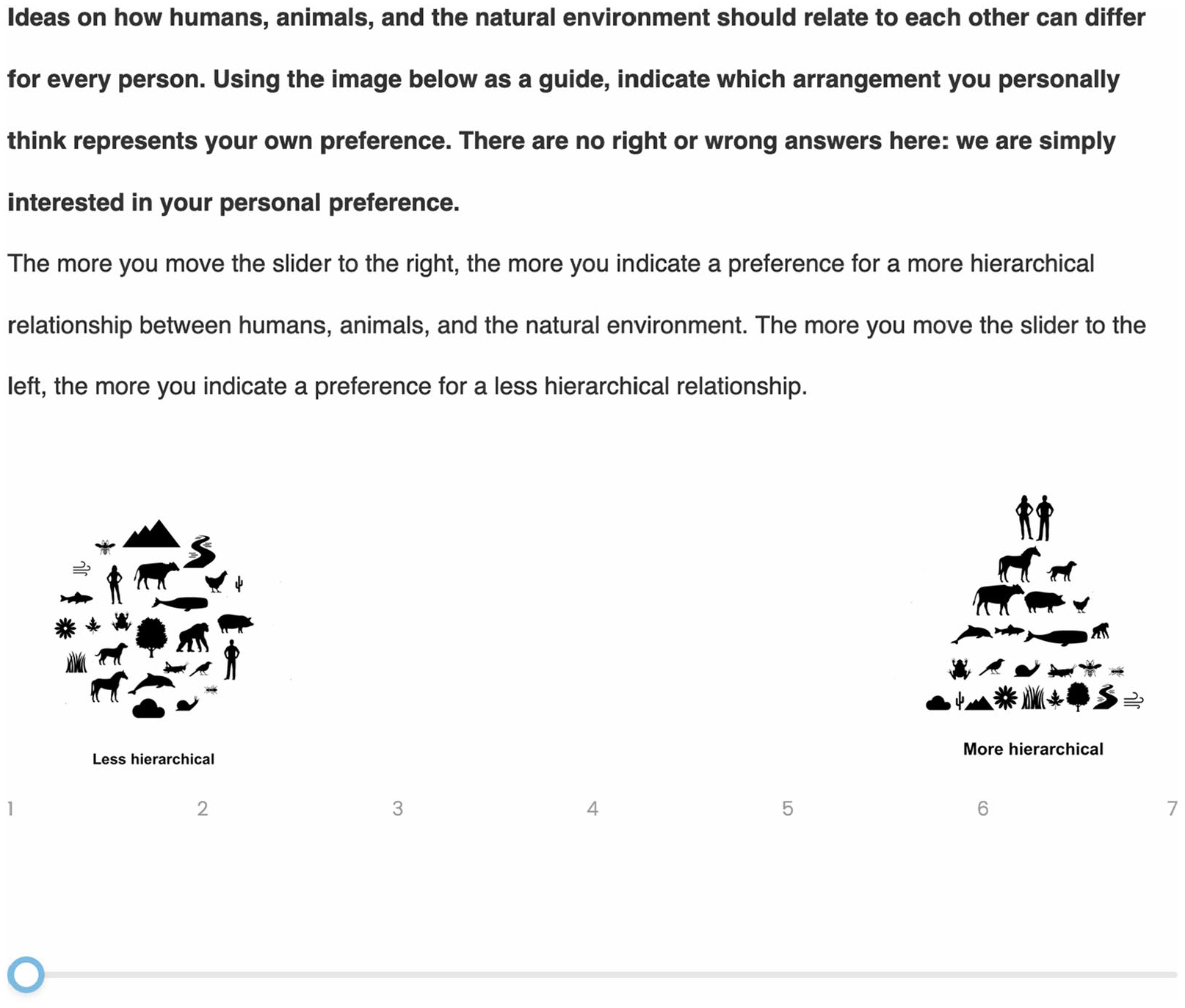
Ecological Dominance Orientation Scale.
The eco-centric perspective is depicted on the one side in the shape of a non-hierarchical and egalitarian arrangement between humans, non-human animals, and the natural environment (circle form). The anthropocentric perspective on the other side is depicted in the form of a clearly recognizable, hierarchically organized arrangement in form of a pyramid in which humans are situated above non-human animals and nature; participants are asked to indicate, with a continuous slider below the image, their preference for a more (anthropocentric) or less hierarchical (eco-centric) arrangement between the different species. Theoretically, our novel measure captures an important characteristic of different forms of communal arrangements. The two images conjure an explicit dichotomy between a more egalitarian arrangement on the one side, with no visible indication of rank-order between the iconic elements; and a clearly non-egalitarian form of arrangement with an unambiguous visual indication of rank-ordering as depicted in the form of a pyramid on the other side. These visual features are accompanied by sub-captions conveying the intended significance linguistically as well.
Preliminary Research
To test our hypotheses and in order to gauge the psychometric qualities of our EDO Scale, we tested its convergent, discriminant, and predictive validity as well as its temporal stability in a set of preliminary studies (Uenal, Sidanius, & van der Linden, 2020). Supporting our contention that SDO and EDO are closely related to each other (H1), across two studies (N = 1312; USA & UK), we show that SDO and EDO are indeed strongly associated with each other (raverage = .45, two-way zero-order correlation). Moreover, in line with our reasoning (H2), across two studies we show that both SDO and EDO scores are significantly higher on average among male participants compared to female participants. Importantly, following our theoretical arguments (H3), we also reasoned that EDO – due to its more holistic focus on intraspecies, interspecies, and human–environment relations – might represent a psychologically meaningful entity in its own right. Indeed, in line with our hypothesizing, across two studies, we show that EDO significantly and uniquely associated with our dependent variables (i.e., modern sexism, modern racism, speciesism, dehumanization, anthropocentrism) controlling for the effects of SDO, right-wing authoritarianism (RWA; Altemeyer, 1996), human supremacy beliefs (HSB; Dhont & Hodson, 2014), and political orientation. These findings support our contention that EDO is not merely a facet of SDO. In contrast to EDO, the HSB construct did not show a significant association with modern racism and modern sexism and was only predictive of speciesism and anthropocentrism, ceteris paribus. Lastly, mirroring SDO, we hypothesized EDO to be a relatively stable construct that persists over time and found support for this expectation with a significant and high test–retest correlation coefficient (r = .81, p < .001; four-week interval). In sum, our results demonstrate that EDO (a) shapes attitudes in a similar fashion both within and between different relational domains (i.e., intergroup, interspecies, human–environment relations), (b) is uniquely predictive of numerous socially consequential attitudes across relational domains (i.e., modern sexism, modern racism, speciesism, anthropocentrism) over and above established measures of beliefs and personal ideology, and (c) is reliable over time (Uenal, Sidanius, & van der Linden, 2020).
Overview of Hypotheses and Studies
Based on this reasoning and our preliminary results (Uenal, Sidanius, & van der Linden, 2020), we propose the following hypotheses:
We tested our hypotheses in two pre-registered studies 3 across two different national contexts (N = 715, USA & Germany). Both studies were approved by the Department of Psychology ethics committees at the University of Cambridge and Harvard University. In Study 1, we tested whether climate change risk and threat perceptions would mediate between SDO, EDO, and pro-environmental attitudes (e.g., climate change mitigation policy support) in the USA. In Study 2, we aimed at replicating the results of Study 1 in another national context (Germany) and by employing a more behavioral measure (i.e., signing online petitions) as a dependent variable. For each study, the required sample sizes were calculated via power analyses individually to meet a 95% chance to observe a hypothesized effect. Detailed power analysis calculations for each statistical analysis are included in the supplemental online material (S1). All measures, conditions, quality checks, and data exclusions for each study are reported in the respective method sections and in the supplemental online material (S1 and S2).
Study 1
Methods
Participants
The present study (see: https://aspredicted.org/blind.php?x=92x2dc) was pre-registered. We recruited 420 participants in the USA using PROLIFIC Academic in April 2020. Participants were asked to answer an attention check question by choosing one specific answer option at the beginning of the survey. Participants who failed the quality check were excluded. In total, 22 participants were removed due to failing the attention check, resulting in a final sample size of 398. The sample consisted of 44.5% women and the average age was 38.31 years (SD = 11.73). Detailed descriptive statistics and power analyses are provided in the supplemental online material (S1 and S2).
Instruments
All measures were scored on a seven-point scale ranging from 1 (strongly disagree) to 7 (strongly agree) unless indicated otherwise. The following measures were presented to participants block-wise in the same order as shown further below. Importantly, the SDO and EDO measures were presented in randomized order to participants to avoid priming effects. For the same reason, we also randomized the order of the climate change risk and threat perception items, and the climate change mitigation policy support items pertaining either to humans, non-human animals, or the natural environment.
Social Dominance Orientation (SDO)
Social dominance orientation was assessed through use of the six-item SDO6 Scale (Pratto et al., 1994; i.e., “Some groups of people are just more worthy than others”; “To get ahead in life, it is sometimes necessary to step on other groups”; “Some groups of people are simply inferior to other groups”; “Superior groups should dominate inferior groups”; “We must increase social equality” [reverse scored]; “It would be good if all groups could be equal” [reverse scored]; “No one group should dominate in society” [reverse scored]; α = .89).
Ecological Dominance Orientation (EDO)
We measured ecological dominance orientation (EDO) using our novel one-item iconographic scale accompanied by guiding instructions (see Figure 1). 4
Climate Change Risk and Threat Perceptions
Climate change risk and threat perceptions were assessed with nine items using adapted versions of previously used items (Leiserowitz, 2005; van der Linden, 2015) such that we assessed climate change risk and threat perceptions pertaining to either humans, non-human animals, or the natural environment with three items each individually (e.g., “How serious of a threat do you think that climate change is to the natural environment [humans; animals]?”) on a seven-point scale ranging from 1 (not serious at all) to 7 (very serious). The results of an exploratory factor analysis (EFA) with the measured items yielded one factor which explained 84.22% of the variance (eigenvalue = 7.58) in total (see S3 in the supplemental online materials), representing climate change risk and threat perceptions across all relational domains (α = .97). Following these results, we computed one construct.
Climate Change Mitigation Policy Support
Support for climate change mitigation policies pertaining to humans, non-human animals, and the natural environment was assessed with six items in total (two for each relational domain) adapted from Kteily et al. (2016; e.g., “We should urge Congress to increase federal funding for the protection of the natural environment [animals, human beings] from climate change”). The results of an EFA with the measured items yielded one factor which explained 73.35% of the variance (eigenvalue = 4.40) in total (see S3 in the supplemental online materials), representing support for climate change mitigation policies across all relational domains (α = .93). Following these results, we computed one construct.
Demographic Information and Control Variables
To account for potential confounding variables, we have further included the following questions and items: age, gender, highest education level attainment, household income, current employment status, ethnicity, and political orientation on a seven-point scale ranging from 1 (very liberal) to 7 (very conservative).
Results and Discussion
Descriptive Statistics
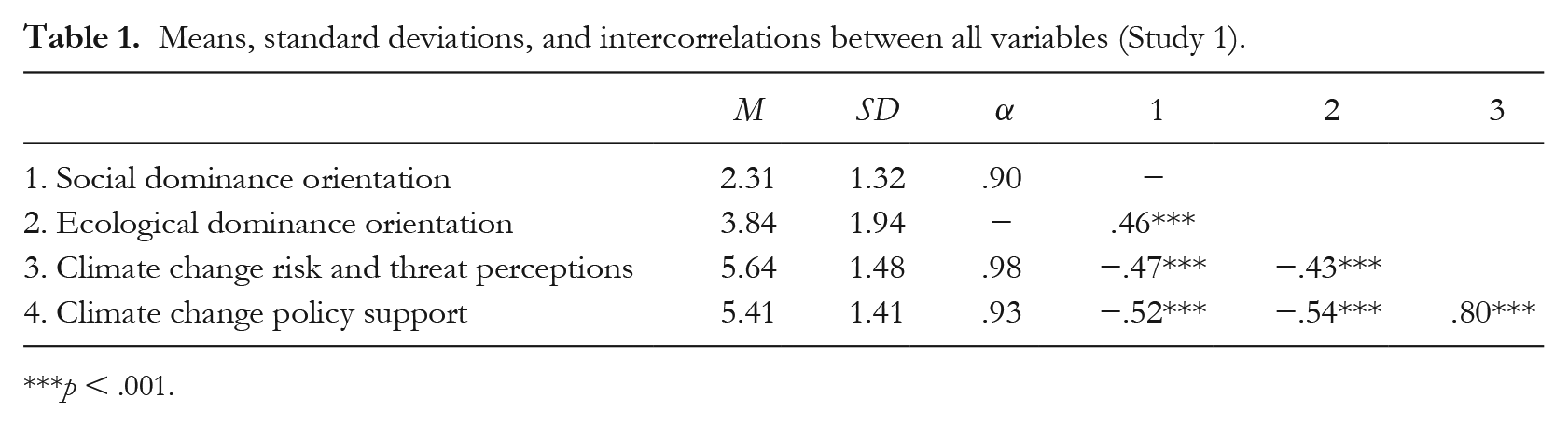
Table 1 shows the mean scores, standard deviations, and intercorrelations among all variables assessed in Study 1. More detailed results on the intercorrelations for each relational domain individually are provided in the supplemental online materials (see Table S4).
Means, standard deviations, and intercorrelations between all variables (Study 1).
p < .001.
As hypothesized (H1), SDO and EDO were positively and significantly correlated (r = .46, p < .001; two-tailed zero-order correlation), supporting our expectation that a preference for a hierarchical arrangement between humans, as captured by SDO, is mirrored in the preference for an anthropocentric and hierarchical arrangement between humans, non-human animals, and the natural environment (see Table 1). Moreover, in line with our reasoning, both SDO and EDO were inversely associated with climate change risk and threat perceptions (H3) as well as with support for climate change mitigation policies (H4; see Table 1). Moreover, in line with previous research, climate change risk and threat perceptions were significantly and positively correlated with support for climate change mitigation policies (Leiserowitz, 2005; van der Linden, 2015). Next, we tested whether both SDO and EDO were more pronounced among male participants compared to female participants by comparing the mean values of the respective variables in a series of one-way ANOVAs. Indeed, in line with our hypothesis (H2), males showed significantly higher SDO and EDO compared to female participants (see Table 2).
ANOVAs SDO and EDO as a function of sex (Study 1).
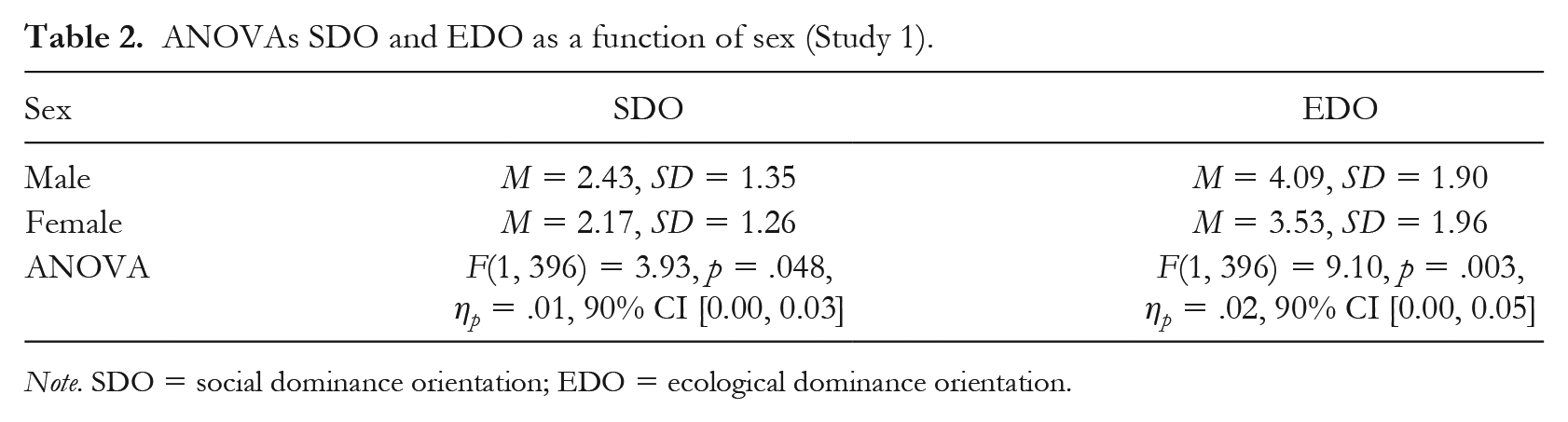
Note. SDO = social dominance orientation; EDO = ecological dominance orientation.
Mediation Model
Next, we tested our hypotheses (H5 and H6) that the effects of both SDO and EDO on climate change mitigation policy support would be mediated via climate change risk and threat perceptions. To this end, we conducted a path-model analysis with SDO and EDO as predictors, climate change risk and threat perceptions as mediator, and climate change mitigation policy support as dependent variable (see Figure 2). Predictors were centered around the mean, and participants’ gender and political orientation were entered as control variables. Due to space considerations, we present more detailed results on risk and threat perceptions for each individual relational domain in the supplemental online materials (see S5 and Table S6).
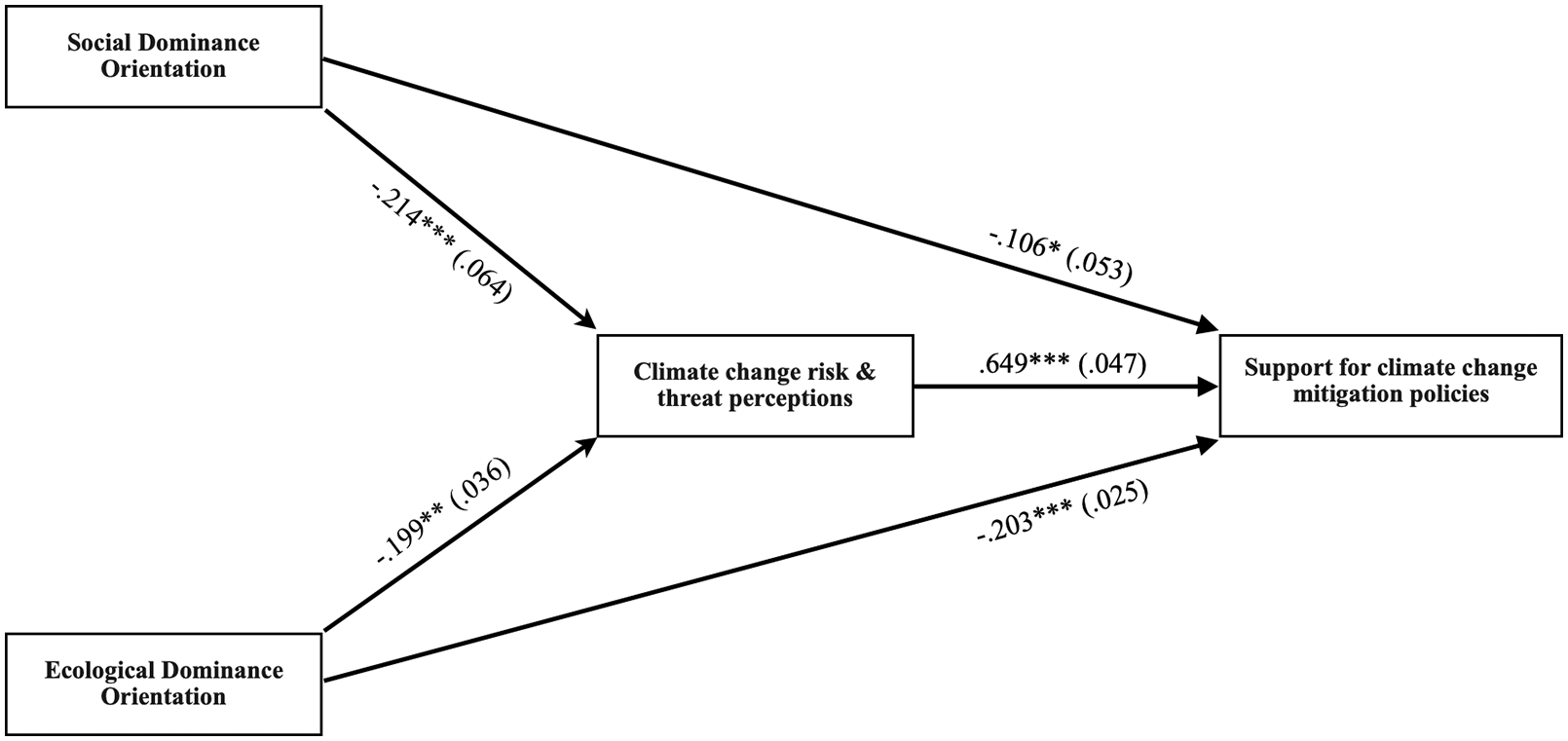
Path diagram model with estimated standardized coefficients (direct effects) with bootstrapped standard errors in parentheses. Continuous predictors were mean-centered. Political orientation and gender were entered as covariates (not displayed in figure).
In line with our expectations, SDO was negatively associated with climate change risk and threat perceptions (B = −0.214, SEBoot = 0.064, p < .001, 95% CIBoot [–0.367, –0.115]) and climate change mitigation policy support (B = −0.106, SEBoot = 0.053, p = .033, 95% CIBoot [–0.218, –0.009]). In the same vein, EDO was also negatively associated with climate change risk and threat perceptions (B = −0.199, SEBoot = 0.036, p < .001, 95% CIBoot [–0.221, –0.081]) and climate change mitigation policy support (B = −0.203, SEBoot = 0.025, p < .001, 95% CIBoot [–0.197, –0.097]). Political orientation was also negatively associated with climate change risk and threat perceptions (B = −0.338, SEBoot = 0.049, p < .001, 95% CIBoot [–0.382, –0.190]) but not with climate change mitigation policy support (B = −0.037, SEBoot = 0.028, p = .282, 95% CIBoot [–0.085, 0.025]). Gender showed no significant association with any variable (see Table 3).
Decomposition of standardized direct and indirect effects on policy support, with bootstrap standard errors in parentheses (Study 1).
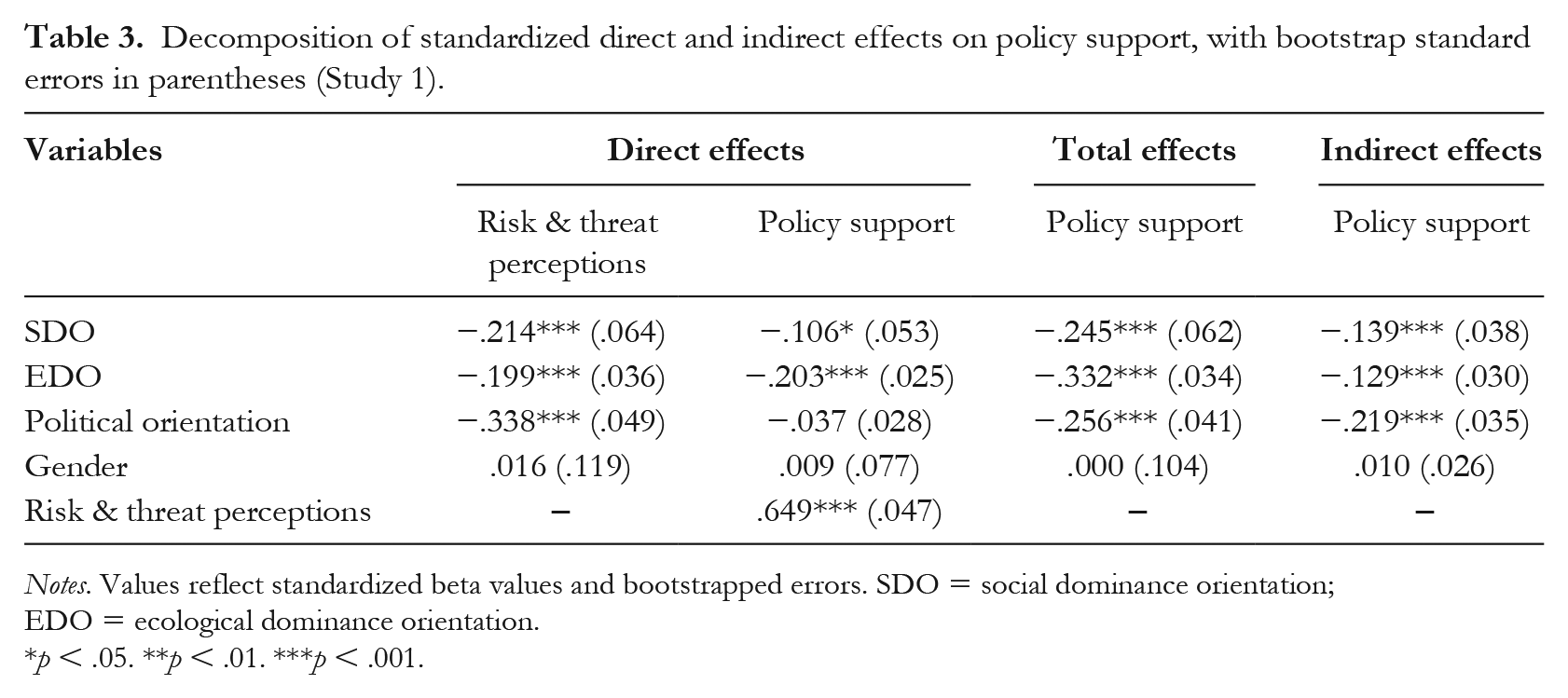
Notes. Values reflect standardized beta values and bootstrapped errors. SDO = social dominance orientation; EDO = ecological dominance orientation.
p < .05. **p < .01. ***p < .001.
To assess the mediating role of climate change risk and threat perceptions on the relationships between the predictor variables and the dependent variable, the total effects of the predictors were further decomposed into direct and indirect effects.
In line with our expectations (H5), in the full model, R2 = .70, F(5, 392) = 136.09, p < .001, climate change risk and threat perceptions partially mediated the relationship between both SDO and EDO and support for climate change mitigation policies in the expected directions. Specifically, for SDO, the indirect pathways through climate change risk and threat perceptions (B = −0.139, SEBoot = 0.038, p < .001, 95% CIBoot [–0.219, –0.069]) was significant, indicating partial mediation (see Table 3). For EDO, the indirect pathways through climate change risk and threat perceptions (B = −0.129, SEBoot = 0.030, p < .001, 95% CIBoot [–0.188, –0.066]) were also significant, indicating partial mediation (see Table 3). In line with our hypothesis (H6), our results indicate that the effects of SDO on EDO on climate change mitigation policy support via climate change risk and threat perceptions held, controlling for political orientation and gender. Political orientation also showed an indirect negative effect on our DV (B = −0.219, SEBoot = 0.034, p = .000, 95% CIBoot [–0.285, –0.151]). Gender did not show any significant effect (see Table 3). We also tested whether removing the covariate variables (gender and political orientation) would change the direction and significance of effects. Removing the covariates did not substantially change the direction or the significance of the presented results.
Study 2
The results in Study 1 fully supported our hypotheses. Therefore, the main goal of Study 2 was to replicate our findings from Study 1 within a different national context and using a more behavioral measure as the dependent variable.
Methods
Participants
To replicate and generalize the findings of Study 1, we collected a German sample to complete our pre-registered study (see: https://aspredicted.org/blind.php?x=m4xm2j). We recruited 330 participants in Germany using PROLIFIC Academic in May 2020. Following the same procedure as in Study 1 and in line with our pre-registration specifications, a total of 13 participants were removed due to a failed attention check resulting in a final sample size of 317. The sample consisted of 45.1% women and the average age was 37.86 years (SD = 11.47). Detailed descriptive statistics and power analyses are provided in the supplemental online materials (S1 and S2).
Instruments
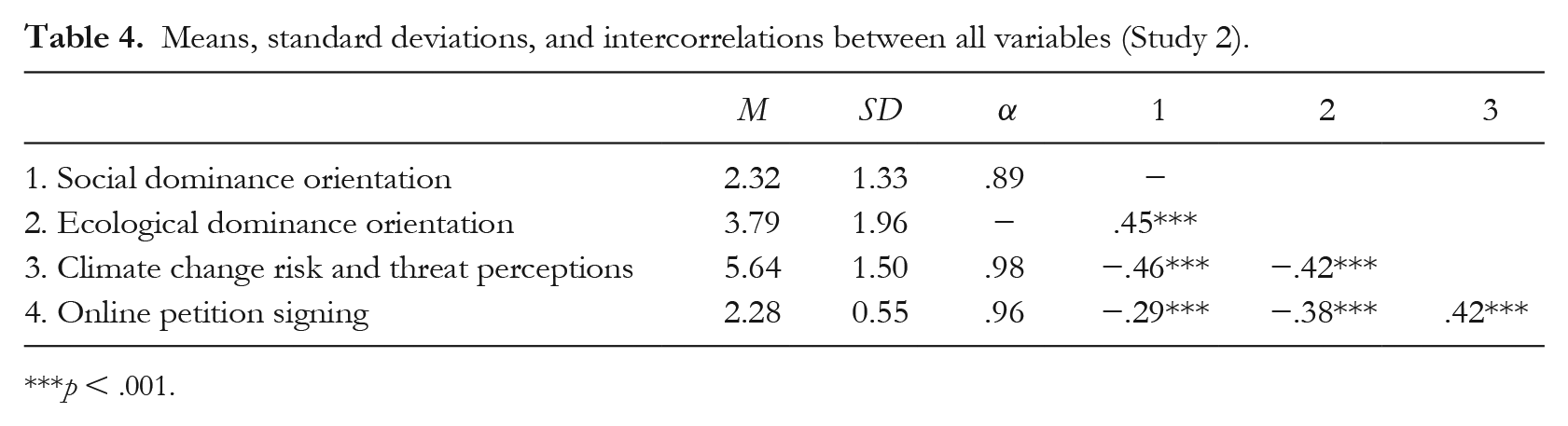
Study 2 was mainly a replication of Study 1 with the addition of one new behavioral measure as presented below. Importantly, in contrast to Study 1, in Study 2, we presented the SDO measure at the end of the survey. This allowed us to fully rule out the possibility of SDO driving the effects on our DVs rather than EDO alone. Descriptive statistics for each variable are provided in Table 4.
Means, standard deviations, and intercorrelations between all variables (Study 2).
p < .001.
Ecological Dominance Orientation (EDO)
We measured ecological dominance orientation using our novel iconographic scale as in Study 1 including the scale instructions (see Figure 1).
Climate Change Risk and Threat Perceptions
Climate change risk and threat perceptions were assessed with the same nine items used in Study 1 (e.g., “How serious of a threat do you think that climate change is to the natural environment [humans; animals]?”; α = .98; see EFA results in S7 in the supplemental online materials) on a seven-point scale ranging from 1 (not serious at all) to 7 (very serious).
Signing of Pro-Environmental Online Petitions
As a more behavioral measure of climate change mitigation support, instead of the policy support items in Study 1, we adopted a measure from a study by Kteily et al. (2016). This measure is a multi-item behavioral measure in which participants are asked whether they agree to be added as a signatory in different (realistic, but fictional) online petitions via their associated PROLIFIC ID. Participants were provided with three options: support, non-support, or non-inclusion (e.g., “Add my PROLIFIC ID to the petition”, scored as 3, “Add my PROLIFIC ID in opposition to the petition”, scored as 1, or “Do not add my PROLIFIC ID to the petition”, scored as 2). The content of the petitions is similar to the items in Study 1 (see supplemental online material S7.1 for additional information on this measure) and pertains to urging members of parliament to enact measures to mitigate climate change related negative consequences for either humans, non-human animals, or nature (e.g., “Urge members of parliament to increase federal spending on combating global climate change for the protection of the natural environment [animals, humans]”). The results of an EFA with the measured items yielded one factor which explained 81.69% of the variance (eigenvalue = 5.72) in total (see S7 in the supplemental online materials), representing signing online petitions related to climate change mitigation policies across all relational domains (α = .96). Following these results, we computed one construct.
Social Dominance Orientation (SDO)
Social dominance orientation was assessed as in Study 1 through use of the six-item SDO6 Scale (Pratto et al., 1994; α = .89).
Demographic Information and Control Variables
The same demographic information as in Study 1 was assessed for Study 2: age, gender, highest education level attainment, household income, current employment status, ethnicity, and political orientation on a seven-point scale ranging from 1 (very liberal) to 7 (very conservative).
Results and Discussion
Descriptive Statistics
Table 4 shows the mean scores, standard deviations, and intercorrelations among all variables assessed in Study 2. More detailed results on the intercorrelations for each relational domain individually are provided in the supplemental online materials (see Table S8).
Replicating our findings in Study 1, SDO and EDO were positively and significantly correlated with each other (r = .45, p < .001) (H1) and both negatively correlated with climate change risk and threat perceptions and online petition signing (H3 and H4). Climate change risk and threat perceptions were positively and significantly associated with online petitions signing (see Table 4). Next, to investigate our hypothesis on the expected gender differences, we tested both SDO and EDO across genders by comparing the mean values of the respective variables in a series of one-way ANOVAs. Replicating the results of Study 1, males showed significantly higher SDO and EDO levels compared to female participants (H2; see Table 5).
ANOVAs SDO and EDO as a function of sex (Study 2).
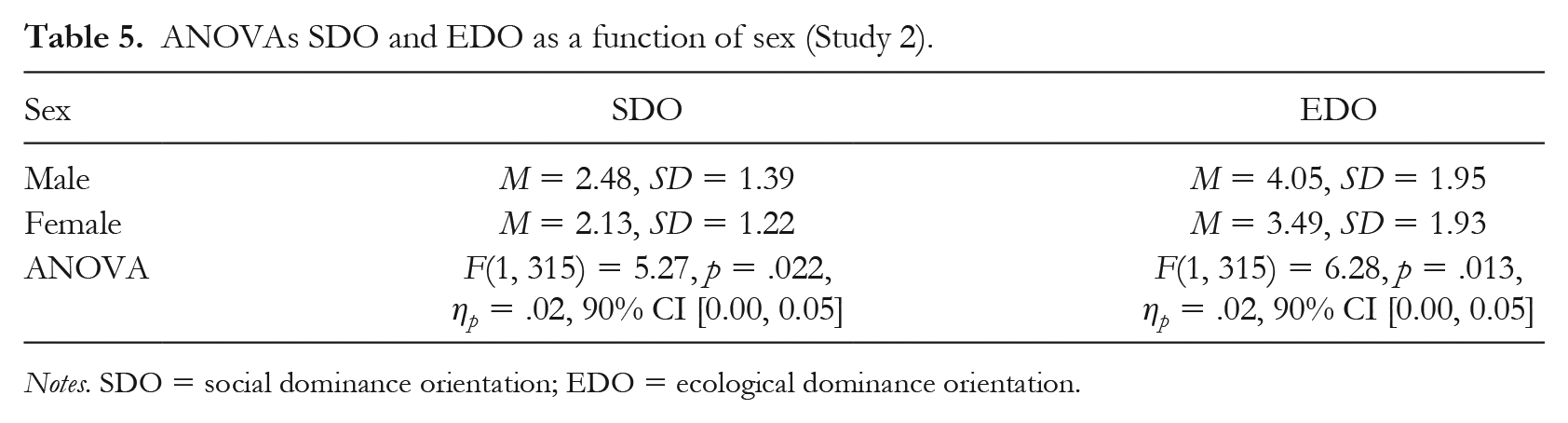
Notes. SDO = social dominance orientation; EDO = ecological dominance orientation.
Mediation Model
Next, we tested our hypotheses (H5 and H6) that the effects of both SDO and EDO on our behavioral dependent variable, i.e., signing of online petitions would be mediated via climate change risk and threat perceptions. As in Study 1, we conducted a path-model analysis with SDO and EDO as predictors, climate change risk and threat perceptions as mediator, and signing of online petitions as dependent variable (see Figure 3). Predictors were centered around the mean, and participants’ gender and political orientation were entered as control variables. Due to space considerations, we present more detailed results on risk and threat perceptions for each individual relational domain in the supplemental online material (see S9 and Table S10).
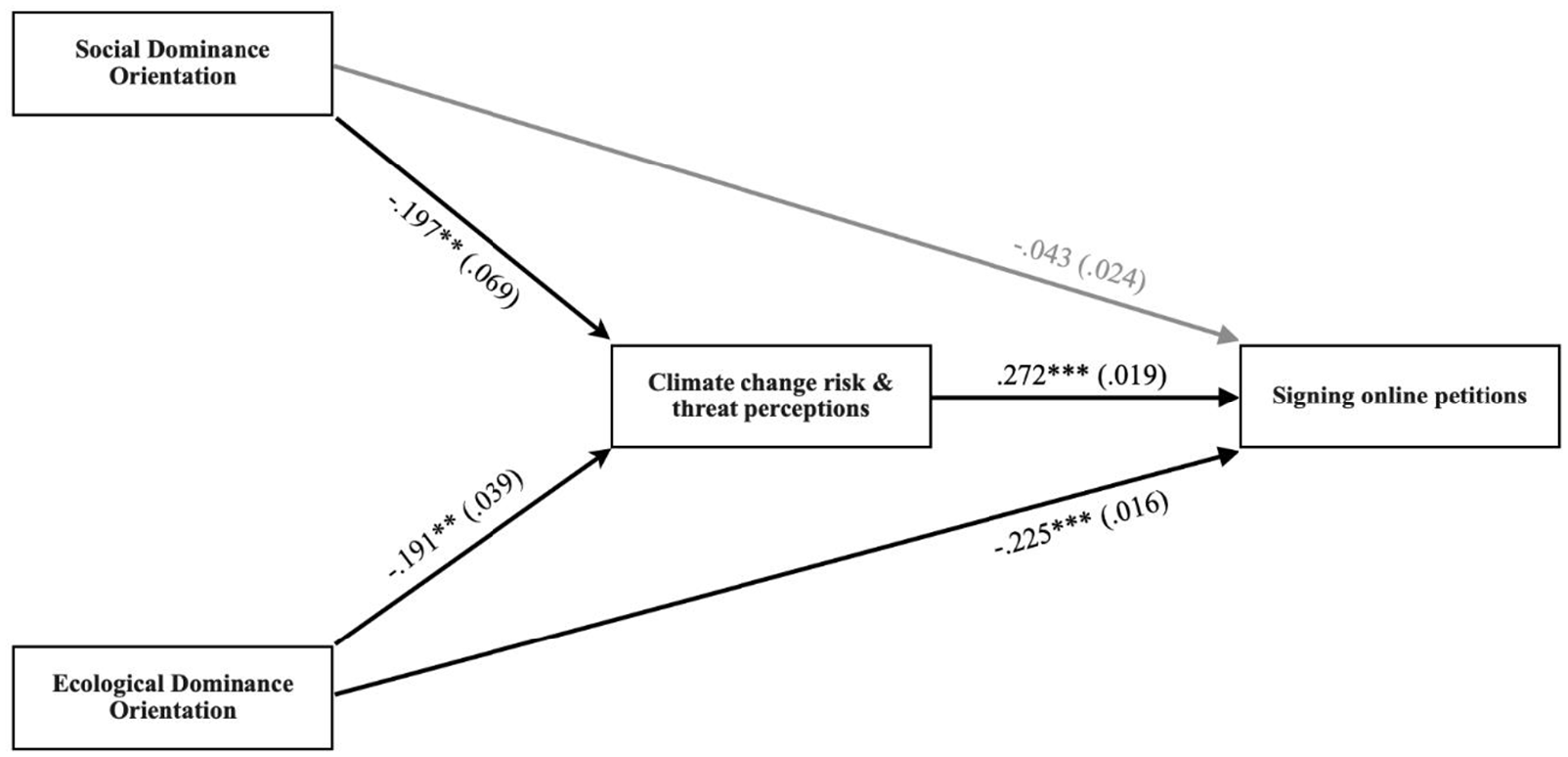
Path diagram model with estimated standardized coefficients (direct effects) with bootstrapped standard errors in parentheses. Continuous predictors were mean-centered. Political orientation and gender were entered as covariates (not displayed in figure). Non-significant paths are marked grey.
Successfully replicating our results in Study 1, SDO was negatively associated with climate change risk and threat perceptions (B = −0.197, SEBoot = 0.069, p = .001, 95% CIBoot [–0.360, –0.086]). However, SDO showed no significant association with our behavioral dependent variable (B = −0.043, SEBoot = 0.024, p = .463, 95% CIBoot [–0.064, 0.029]). In contrast, as in Study 1, EDO was negatively associated with climate change risk and threat perceptions (B = −0.191, SEBoot = 0.039, p < .001, 95% CIBoot [–0.224, –0.069]) as well as with signing of online petitions (B = −0.225, SEBoot = 0.016, p < .001, 95% CIBoot [–0.093, –0.032]). Political orientation was again negatively associated with climate change risk and threat perceptions (B = −0.360, SEBoot = 0.056, p < .001, 95% CIBoot [–0.417, –0.196]) but not with signing of online petitions (B = −0.069, SEBoot = 0.018, p = .239, 95% CIBoot [–0.057, 0.014]). Gender showed no significant effect on any variable (see Table 6).
Decomposition of standardized direct and indirect effects on signing online petitions, with bootstrap standard errors in parentheses (Study 2).
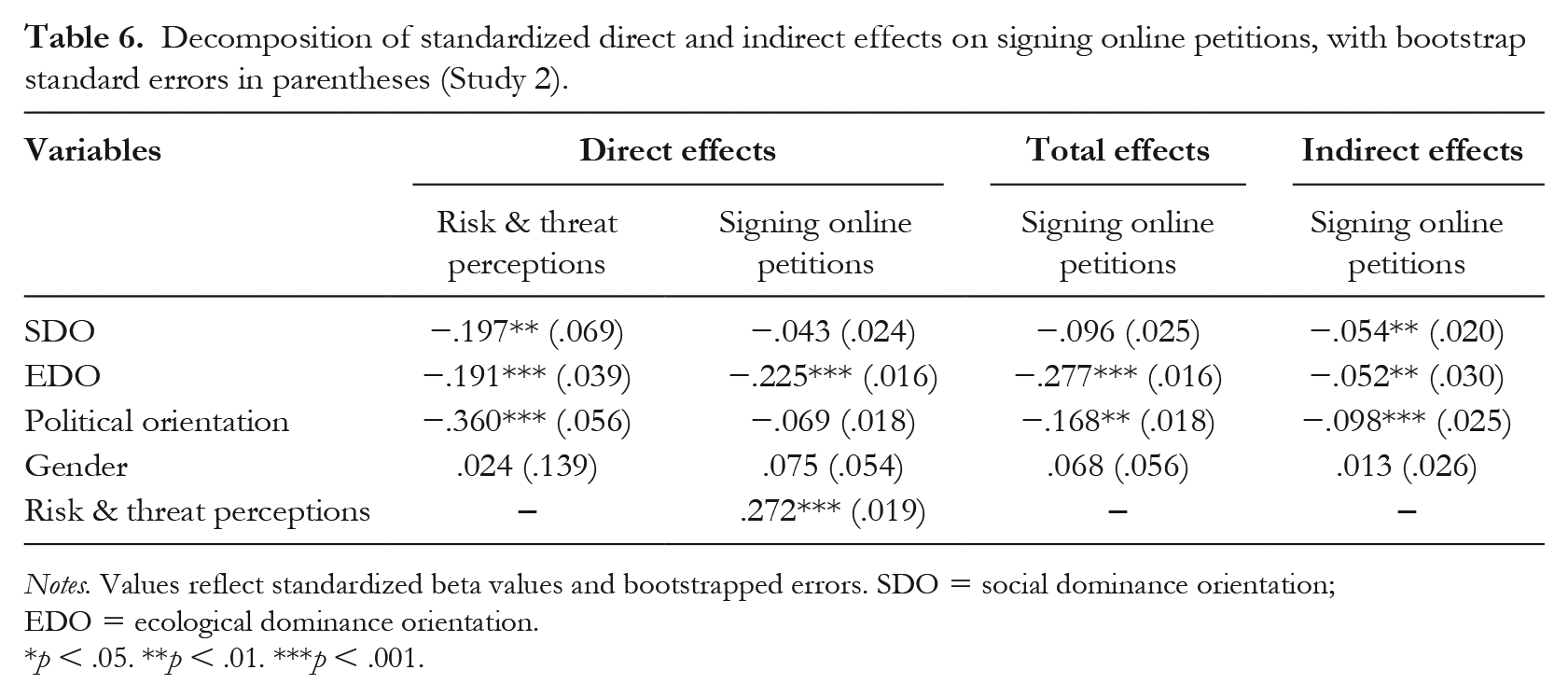
Notes. Values reflect standardized beta values and bootstrapped errors. SDO = social dominance orientation; EDO = ecological dominance orientation.
p < .05. **p < .01. ***p < .001.
To assess the mediating role of climate change risk and threat perceptions on the relationships between the predictor variables and the dependent variable, the total effects of the predictors were further decomposed into direct and indirect effects.
In line with our expectations (H5), in the full model, R2 = .23, F(5, 311) = 19.91, p < .001, climate change risk and threat perceptions partially mediated the relationship between both SDO and EDO and signing online petitions in the expected directions. Specifically, for SDO, the indirect pathways through climate change risk and threat perceptions (B = −0.054, SEBoot = 0.020, p = .005, 95% CIBoot [–0.099, –0.019]) were significant, indicating partial mediation (see Table 6). For EDO, the indirect pathways through climate change risk and threat perceptions (B = −0.052, SEBoot = 0.016, p = .002, 95% CIBoot [–0.085, –0.022]) were significant also indicating partial mediation (see Table 6). In line with our hypothesis (H6), our results indicate that the effects of SDO on EDO on signing online petitions via climate change risk and threat perceptions held, controlling for political orientation and gender. Political orientation had also shown an indirect negative effect (B = −0.098, SEBoot = 0.025, p = .002, 95% CIBoot [–0.154, –0.052]) on our DV via our mediator. Gender did not show any significant effect (see Table 6). As in Study 1, removing the covariates did not substantially change the direction or the significance of the presented results.
General Discussion
Although climate change risk and threat perceptions are a potent predictor of pro-environmental attitudes (e.g., Leiserowitz, 2005), individuals show great variation in the extent to which they perceive and act upon climate change risk and threat perceptions (e.g., van der Linden et al., 2015). In the present work, we investigated social dominance orientation (SDO) and ecological dominance orientations (EDO) as predictors of climate change risk and threat perceptions and pro-environmental attitudes and behavior. In contrast to previous research which explained the nexus between SDO and attitudes towards non-human animals and the natural environment via intermediary constructs (e.g., hierarchy-enhancing myths; Dhont & Hodson, 2014; Milfont et al., 2013), here, we proposed a complementary novel approach. Specifically, we proposed to extend classical social dominance theory (SDT, Sidanius & Pratto, 1999) by adding a fourth dimension of hierarchical differentiation: an anthropocentric hierarchical axis. In contrast to the classical axes of hierarchical differentiation (i.e., age, sex, arbitrary sets [e.g., race, ethnicity]), the purview of the anthropocentric hierarchical axis is a more holistic relational framework in which different forms of communal arrangements between humans, non-human animals, and the natural environment are conceptualized. This expansion allowed us to theoretically extend SDT-based predictions concerning human perceptions, attitudes, and behavior to non-human animals and the natural environment without necessarily resorting to further intermediary variables. To this end, we developed a novel measure, the Ecological Dominance Orientation (EDO) Scale, as a means of assessing the validity of the proposed anthropocentric hierarchical axis and set out to empirically test this proposition. In two studies, across two different national contexts, we found empirical support for our hypotheses. By expanding social dominance theorizing and connecting it to perceptions and behaviors concerned with non-human animals and the natural environment, we contribute to a small but growing literature on how preferences for hierarchy and dominance shape perceptions and responses concerned with anthropogenic challenges across relational domains, i.e., intraspecies, interspecies, and human–environment relations.
Social and Ecological Dominance Orientations: Two Sides of the Same Coin?
Synthetizing classical social dominance theory with theoretical insights and findings from paleoanthropological, evolutionary, environmental, and organizational psychological studies we hypothesized that – similar to SDO – ecological dominance might qualify as an independent psychological entity in and of itself. Our theoretical contention is anchored in two distinct lines of reasoning. First, research in paleoanthropology, evolutionary and organizational psychology, and ethnology suggests that social dominance motives seem to have evolved concurrently with and partly in reaction to ecological dominance motives (Alexander, 1990; Flinn et al., 2005; Halevy et al., 2011; Magee & Galinsky, 2008; Mazur, 2005; Sapolsky, 2005; Tooby & Cosmides, 2010). Second, in line with SDT reasoning, we have argued that interspecies and human–environment relations satisfy the two main theoretical premises for the potential emergence of hierarchically organized communal arrangements, namely the concomitance of an asymmetric power distribution and associated fitness-advantages. Therefore, when viewed through an SDT lens, the theoretical postulates for ecological dominance motives are satisfied. To assess our contention that ecological dominance orientation is theoretically meaningful and a psychologically distinct entity, we devised and validated a practical measure designed to capture ecological dominance motives by means of a brief, intuitive, and face-valid assessment technique, the Ecological Dominance Orientation (EDO) Scale. The EDO Scale uses the popular graphical description of the dichotomy between an eco-centric vs. anthropocentric perspective on the relationship between humans, non-human animals, and the natural environment as a bi-polar continuous scale with each pole representing either a hierarchical or non-hierarchical arrangement (see Figure 1). Closely resembling social dominance orientation, we defined ecological dominance orientation as a general preference to establish and maintain an anthropocentric and hierarchical arrangement between humans, non-human animals, and the natural environment. As such, we theorized EDO as an independent predictor of attitudes, beliefs, values, and behaviors encompassing intergroup, interspecies and human–environment relations.
Using our novel measure, across two studies we demonstrate that preferences for hierarchical communal arrangements – both social and ecological dominance – generalize across relational domains. As hypothesized, we found a significant positive association between SDO and EDO. Moreover, congruent with social dominance theory and consistent with associated preliminary results (Uenal, Sidanius, & van der Linden, 2020), across two studies, both SDO and EDO are significantly more pronounced among males than among females. Furthermore, in line with our theorizing, across both studies, we demonstrate that both SDO and EDO are negatively associated with support for climate change mitigation policies. Also, consistent with our expectation and in line with associated research (Uenal, Sidanius, Roozenbeek, & van der Linden, 2020), individuals high in both SDO and EDO showed decreased climate change risk and threat perceptions. Partially as a result of decreased climate change risk and threat perceptions (i.e., partial mediation), individuals high in SDO and EDO were less inclined to endorse efforts meant to mitigate the harmful effects of human exploitation of the natural world. Moreover, we expected that both SDO and EDO would significantly predict support for climate change policy via risk and threat perceptions, controlling for the effects of political orientation and gender. Indeed, both SDO and EDO independently predicted support for climate change policies holding these factors constant and accounting for the mediated effects. Thus, EDO significantly and uniquely predicted our outcome variable over and above the effects of SDO and risk and threat perceptions. These findings suggest that EDO is not merely a facet of SDO but uniquely relates to outcome measures of interest. Notably, in Study 2, when we used a more behavioral measure of pro-environmentalism (i.e., signing ostensibly real online petitions) we found that EDO, but not SDO, was significantly associated with decreased pro-environmental behavior. While the zero-order correlations clearly indicate that SDO was significantly associated with pro-environmental behavior, when EDO and climate change risk and threats were accounted for, SDO no longer showed a significant association. This result further corroborates the unique predictive power of EDO. The non-significant association between SDO and our dependent variable (Study 2) is also in line with previous studies on SDO conducted in Germany and other countries with relatively low levels of social inequality, which have shown that SDO shows context-dependent effect sizes (e.g., Cohrs & Asbrock, 2009; Milfont et al., 2018). Lastly, in accordance with previous research, climate change risk and threat perceptions are highly predictive of support for climate change mitigation policies across both countries analyzed (Leiserowitz, 2005; van der Linden et al., 2015).
In sum, our results suggest that preferences for hierarchical communal arrangements seem to generalize by shaping perceptions, attitudes, and behaviors similarly across relational domains. With the development of the EDO measure, its preliminary validation, and its theoretical embedding into social dominance theory, we offer a practical and efficient way to investigate the effects of both social and ecological dominance orientations influencing human perceptions, attitudes, and behaviors across relational domains.
Limitations and Future Directions
Notwithstanding the contributions of the present research, some limitations and questions require further examination. First, chief among these limitations is the need for additional studies further gauging the psychometric properties of our novel scale by testing its discriminant, convergent, and incremental validity. To this end, in a related set of studies, we have tested the convergent, discriminant, and predictive validity of EDO with encouraging results (Uenal, Sidanius, & van der Linden, 2020). Second, despite the obvious advantages of a brief, intuitive, and face-valid measure of ecological dominance orientation such as the one proposed here, a well-validated, multi-item measure which taps into the more complex nomological network of attitudes and beliefs associated with preferences for (or opposition to) a hierarchical arrangement between humans, non-human animals, and the broader natural environment holds merit. Third, relying on only correlational data, no causal claims can be made, and we do not, at any point suggest causality based on the presented results, including the mediation analyses. To assess causality, future studies which employ experimental (malleability and causality) and longitudinal designs are required. Fourth, our present focus on EDO and SDO is not meant to imply that all phenomena related to social and ecological dominance can be solely understood or reduced to individual differences. In fact, social dominance theory posits that personal preferences for hierarchy and power (SDO) as well as other individual difference variables must be considered within their socio-ecological contexts because individual psychological mechanisms and socio-ecological structures are dynamic and entangled processes. Future research should analyze both SDO and EDO in conjunction with macro-structural factors (e.g., Gelfand et al., 2011) and undertake cross-cultural comparisons (for SDO see, e.g., Fischer et al., 2012; Kunst et al., 2017). Fifth, while our focus was largely on the phylogenesis of social and ecological dominance motives, research on the ontogenesis of social and ecological dominance motives will help to disentangle the effects of socialization vs. inheritance on the prevalence and development of SDO and EDO (for SDO see Kleppestø et al., 2019; Thomsen et al., 2011). Sixth, this research has utilized the SDO6 construct as criterion variable. However, more recent research indicates that SDO is better conceptualized as consisting of two distinct sub-components (i.e., SDO-Dominance and SDO-Egalitarianism; Ho et al., 2015). Future research should explore EDO in relation to this new measurement of SDO7. Seventh, while we believe that the cross-national approach taken in this study is a strength, the results should also be interpreted in light of some limitations. For example, although PROLIFIC samples are arguably more representative than traditional social psychological samples, these samples are not nationally representative.
Supplemental Material
sj-pdf-1-gpi-10.1177_13684302211010923 – Supplemental material for Social and ecological dominance orientations: Two sides of the same coin? Social and ecological dominance orientations predict decreased support for climate change mitigation policies
Supplemental material, sj-pdf-1-gpi-10.1177_13684302211010923 for Social and ecological dominance orientations: Two sides of the same coin? Social and ecological dominance orientations predict decreased support for climate change mitigation policies by Fatih Uenal, Jim Sidanius and Sander van der Linden in Group Processes & Intergroup Relations
Footnotes
Acknowledgements
We would like to express our gratitude to our colleagues Ulrich Klocke (Humboldt University of Berlin), Laura Scholaske (DeZIM Institute Berlin), Kirsti Jylhä (Institute for Future Studies), Rakoen Maertens (University of Cambridge), and the Cambridge University Social Decision-Making Lab, as well as to the anonymous reviewers and the Associate Editor in charge at GPIR for their valuable feedback.
Author Contributions
F.U. and J.S. designed the research, F.U. conducted the analysis. F.U. wrote the initial draft with inputs from J.S. and S. v. d. L.
Data Sharing
Please contact the PI for data accessibility.
Ethical Approval
This study was approved by Harvard University-Area Committee on the Use of Human Subject and the Cambridge University Ethics Committee.

Funding
The author(s) received no financial support for the research, authorship, and/or publication of this article.
Supplemental material
Supplemental material for this article is available online.
Notes
References
Supplementary Material
Please find the following supplemental material available below.
For Open Access articles published under a Creative Commons License, all supplemental material carries the same license as the article it is associated with.
For non-Open Access articles published, all supplemental material carries a non-exclusive license, and permission requests for re-use of supplemental material or any part of supplemental material shall be sent directly to the copyright owner as specified in the copyright notice associated with the article.
