




Abstract
People are quick to form impressions of others’ social class, and likely adjust their behavior accordingly. If social class is linked to prosociality, as literature suggests, then an interaction partner’s class should affect prosocial behavior, especially when costs or investments are low. We test this expectation using social mindfulness (SoMi) and dictator games (DG) as complementary measures of prosociality. We manipulate target class by providing information regarding a target’s (a) position on a social class ladder, and (b) family background. Three studies using laboratory and online approaches (Noverall = 557) in two nations (the Netherlands [NL], the UK), featuring actual and hypothetical exchanges, reveal that lower class targets are met with greater prosociality than higher class targets, even when based on information about the targets’ parents (Study 3). The effect of target class was partially mediated by compassion (Studies 2 and 3) and perceived deservingness of the target (Study 3). Implications and limitations are discussed.
People’s prosocial behavior is influenced by their prosocial tendencies as well as by the features of the situation, one of which is the nature of the interaction partner. Impressions of interaction partners are quickly made, including assessments of social class (Bjornsdottir & Rule, 2017; Kraus et al., 2017). While prosocial orientations have been viewed as one of the key dimensions of social class (Piff & Robinson, 2017), little work has investigated how impressions of others’ social class influence prosocial behavior. Some preliminary findings suggest that higher class targets elicit lower prosocial behavior (Van Doesum et al., 2017), but these findings were based on U.S. samples only, in a series of online studies with hypothetical decisions made based on direct information about the target’s socioeconomic status. More specific and extended information is required to generalize this effect across nations and experimental paradigms. To investigate if similar patterns emerge in different countries and under realistic conditions, we designed three studies in which we operationalized low-cost prosociality using social mindfulness (e.g., Van Doesum et al., 2013) and incentivized dictator games (e.g., Engel, 2011) in laboratory and online settings. Moreover, social class was operationalized in terms of direct individual socioeconomic status as well as indirect parental information. We also examined whether other-regarding motives like compassion and deservingness explain varying levels of target-specific prosociality.
Social Class and Prosociality
Operationalizing social class is notoriously difficult. Based on existing literature, we take two complementary approaches to do so. First, we describe social class in terms of a person’s wealth, education, and occupational prestige relative to others (Piff & Robinson, 2017). This operationalization puts hierarchy at the center of social class, which resonates with the widely used metaphor of a social ladder on which some are placed at the bottom, some in the middle, and others at the top (Adler et al., 2000). In our first two studies, we use the social ladder metaphor to measure and manipulate social class.
Our second approach uses aspects of class culture (Bourdieu, 1997; Dietze & Knowles, 2016). Indeed, certain hobbies and preferences (e.g., in terms of art, music, or food) and backgrounds (e.g., educational and occupational prestige) delineate an individual’s social class. Such preferences and backgrounds tend to be similar within families (e.g., Bartels et al., 2002). Hence, parental class provides information regarding one’s own class. In our third study, we accordingly operationalize social class by using information about parents.
Low-Cost Prosociality
There are many ways to be prosocial without having to invest much. For example, imagine two friends, Bill and Adrian, getting ready to order dessert in an Italian restaurant when the waiter informs them that there is only one portion of tiramisu left, but plenty of lemon pie. If Bill orders the tiramisu, he limits Adrian’s choice; if he orders the lemon pie, he preserves Adrian’s choice. The latter is prosocial, the former proself. This example illustrates how people can be socially mindful, or be “thoughtful of others in the present moment, and consider . . . their needs and wishes before making a decision” (Van Lange & Van Doesum, 2015, p. 18). The construct of social mindfulness has thus been operationalized as “making other-regarding choices involving both skill and will to act mindfully toward other people’s control over outcomes” (Van Doesum et al., 2013, p. 86).
Social mindfulness can reveal itself in the extent to which people leave or limit choice to others. The social mindfulness (SoMi) paradigm, accordingly, models a dyadic situation in which people choose from different sets of products among which one is unique (Van Doesum et al., 2013; see Figure 1). Reasoning that having choice is generally construed as desirable (Aoki et al., 2014; Leotti & Delgado, 2011), and that leaving choice to others procures reciprocated generosity (Kardas et al., 2018), not removing the unique product for the other is considered prosocial.
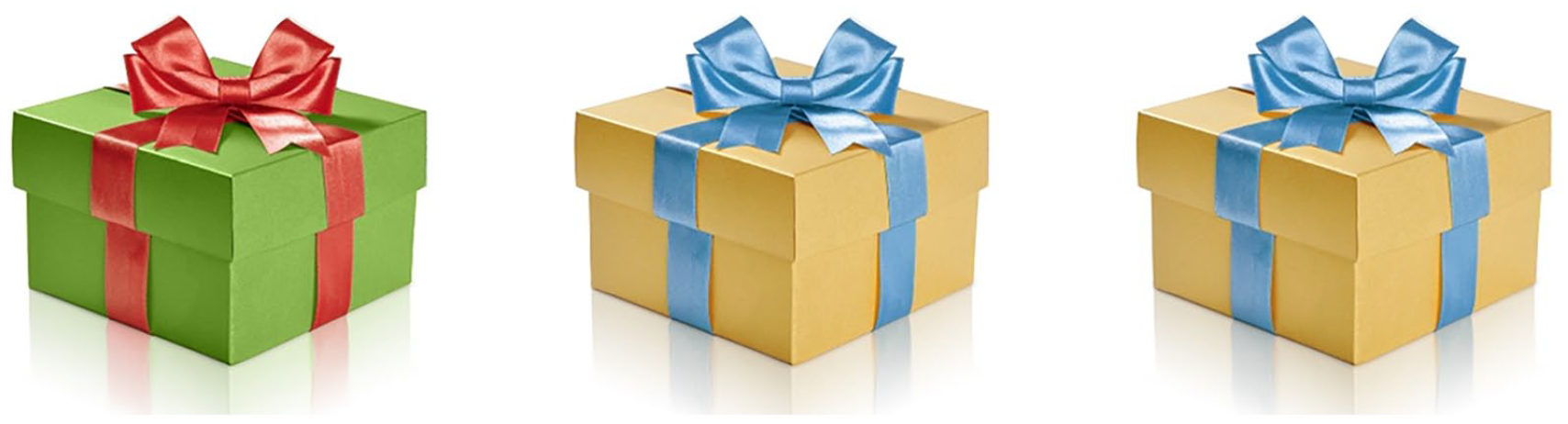
Example of an experimental SoMi trial.
As described by Van Doesum et al. (2013), this paradigm is inspired by the pen-choice measure used to examine unique/minority versus majority preferences in cross-cultural (Kim & Markus, 1999) and social class research (Snibbe & Markus, 2005; Stephens et al., 2007). Yamagishi et al. (2008) demonstrated that responses vary as a function of whether others are present; the SoMi paradigm turns this measure into a dyadic social decision-making task by focusing on how leaving or limiting choice for others has social consequences. This has been validated in many studies. For example, people choose more often the nonunique item if there is a second person present (Van Doesum et al., 2018), and SoMi is a better predictor of actual helping behavior than a range of demographic variables like age, gender, religiosity, or political orientation (Manesi et al., 2019).
Research has shown that social mindfulness is associated with active more than reactive cooperation (Van Doesum et al., 2020). The predictive validity of the SoMi paradigm has been further examined in various domains, including intergroup relations and organizational behavior (Mischkowski et al., 2018; Song et al., 2018; Van Doesum et al., 2016). Moreover, social mindfulness follows neural activity patterns that are consistent with prior neuro-economic research on prosocial decisions (Lemmers-Jansen et al., 2019; Lemmers-Jansen et al., 2018), and acting socially mindful has been found to promote cooperative behaviors in others (Dou et al., 2018).
Prosociality can also be assessed using a dictator game (e.g., Piff et al., 2010), which has been widely used as a measure of generosity (Engel, 2011). In this game, the dictator (i.e., a decision-maker dictating the outcome) decides how much they and another person will receive from a pool of money or points. The other person, the recipient, has to accept the decision of the dictator. The more the dictator allocates to the recipient, the more prosocial the dictator is considered to be (e.g., Hoffman et al., 1996). Personality as well as features of the situation influence decisions in dictator games. For example, people are more generous to others they think are more deserving (Engel, 2011). Similarly, people like to have information about the deservingness of the recipient to help make their decision (Thunström et al., 2016). A benefit of assessing prosociality using the dictator game (as opposed to social mindfulness) is that participants make deliberate decisions with real monetary consequences, even when small.
More or Less
How would other people’s social class guide one’s prosocial behavior? Extant literature suggests two possible ways. On the one hand, prior research documented implicit, but not explicit, prorich attitudes (Horwitz & Dovidio, 2017), and in medical settings, higher class patients were treated more favorably by their doctors (Umbenhauer & DeWitte, 1978; Willems et al., 2005). Fitting this line of reasoning, theorizing on system justification processes suggests that lower class others could be held responsible for their own position (Jost et al., 2004), and thus seen as less deserving of favorable treatment. A contrasting pattern could be anticipated, however, on the basis of prior studies indicating that low-power targets received better offers in an ultimatum game due to a social responsibility mindset (Handgraaf et al., 2008), and low-income (but not low-SES) targets were favored as bargaining partners based on fairness principles (Holm & Engseld, 2005). Furthermore, poor or low-status recipients received more in dictator games, motivated by solidarity or altruism (Bader & Keuschnigg, 2020; Brañas-Garza, 2006; Liebe & Tutic, 2010).
The aforementioned studies illustrate the complexity of the effect of others’ social class on prosocial behavior. Importantly, however, these studies were not aimed at social mindfulness. For that purpose, the guiding expectations for the current research can best be derived from van Doesum et al. (2017), who reported four consecutive studies in which lower class targets elicited greater social mindfulness than higher class targets, irrespective of the perceiver’s own class. Following that research, we expect monotonic increases in prosociality as a function of a target’s social class.
One of the explanatory perspectives Van Doesum and colleagues (2017) offered was a general feeling of fairness. We aimed to substantiate this notion. There are many ways to promote fairness, of which, establishing wealth equality would be the most intuitive and straightforward. However, equal wealth distributions are very hard to establish, and people generally still prefer a certain amount of wealth inequality (Norton & Ariely, 2011). Moreover, equality is not the only form of fairness. When given the opportunity to acknowledge imbalance in small and low-cost prosocial gestures, people may still seek fairness in more equity or need-based distributions (cf. Messick, 1995; Zhao et al., 2017). As one aspect of fair treatment, deservingness is important in common fairness models (Heuer et al., 1999). Hence, we expected greater perceived deservingness to be associated with greater prosociality, as manifested in low-cost behaviors like social mindfulness and small-stakes dictator games.
Another aspect of fair treatment is compassion. Compassion is felt for those in need or suffering, and is generally linked to prosocial behavior (Goetz et al., 2010; Piff & Moskowitz, 2017; Stellar et al., 2012; Sznycer et al., 2019). It is also a common response to witnessed fairness violations (e.g., McCall et al., 2014), and can be understood as a social mentality (Gilbert, 2019). Therefore, we examined compassion as a potential mediator for the effect of target class on prosocial behavior. Although Van Doesum et al. (2017) did not detect such mediation, basic stereotypical dimensions of warmth and competence could alternatively explain different behavior toward different social groups (Fiske, 2018; Jenkins et al., 2018). Hence, we explored these and other fundamental other-oriented perceptions, including similarity.
Current Research
We investigated the effects of target class on prosociality and explored mechanisms potentially underlying these effects. Specifically, we examined compassion, deservingness, similarity, warmth, and competence. Across studies, we expected to find greater prosociality towards lower class targets. In Studies 1 and 2, we operationalized prosociality using social mindfulness. To describe the (imaginary) targets, we chose average names and physical characteristics. In Study 3, we used a series of dictator games with anonymous but actual exchanges (deferred in time). Studies 1 and 3 were conducted in the laboratory, and Study 2 was conducted online. Previous studies investigating how social mindfulness varies as a function of target social class were based on U.S. samples only (Van Doesum et al., 2017); to test if these findings replicate in different societies, two samples were collected in the Netherlands (Studies 1 and 3), and one sample was collected in the UK (Study 2). All studies were approved by the respective universities’ ethics review boards. Furthermore, the studies contained some additional measures that did not pertain to the current research question and are not reported here (e.g., demographic information like work or student loans, or target personality assessments and liking [Study 2]). All data, materials, and code are available at DataverseNL using the following link: https://doi.org/10.34894/UTNPJ4.
Study 1
Recent reports suggest that class categorization in the Netherlands is derived from personal, economic, cultural, and social capital rather than from economic inequality. Next to a strong difference between high and low class, faultlines for the middle class seem less strict; researchers speak of a “club sandwich structure” in which firm top and bottom layers embrace four softer and less strictly defined inner segments (Vrooman et al., 2014). Therefore, we expected to find the strongest differences between lower class and higher class targets. For comparison with prior research (Van Doesum et al., 2017) and to explore effects for middle-class targets, we still distinguished between three different categories of target social class (lower, middle, higher). We hypothesized that participants would be more prosocial toward lower class targets, especially when compared to the higher class target, but less when compared to the middle-class target. To explore potential explanations, we included perceptions of similarity, warmth, and competence.
Participants and Design
We enrolled 123 (29 male) individuals at the social psychology laboratory of a large Dutch university. Participants were between 17 and 73 years old, Mage = 21.63 (SD = 8.21). Data collection ended after 2 weeks of scheduled laboratory time. The sample mainly consisted of undergraduate students, and all were included in the analyses. 1 Participants were randomly assigned to one of three conditions in which they imagined interacting with a lower class, middle-class, or higher class target. At α = .05, sensitivity analysis showed that this sample size provided 80% power to detect a medium sized effect of f = 0.29 (G*Power; Faul et al., 2009).
Procedure and Measures
Participants first completed the MacArthur Scale of Subjective SES (Adler et al., 2000) to assess their own social class. For this measure, participants saw a picture of a ladder and were asked to, [T]hink of this ladder as representing where people stand in the Netherlands in terms of education, income, and job status, where the people who are the worst off are on the bottom, and the people who are the best off are on the top.
Participants then indicated where they would position themselves relative to these people (9-point scale). 2 The sample mean was well above the scale midpoint, Mladder = 6.47, SD = 1.30, t(122) = 12.54, p < .001, as was expected, given the relative overrepresentation of high-SES students in college environments (Walpole, 2003) and the fact that higher education is generally seen as a sign of higher social class. Participants also provided standard demographic information, including sex and age. To validate and compare results with previous studies using social mindfulness, we assessed social value orientation (SVO) using the SvoSlider (Murphy et al., 2011), in which social preferences were measured across six items in which participants indicated preferences between various hypothetical payoffs that varied in how much was allocated to oneself versus an unspecified other. More money for the other reflects higher SVO. Scores from low to high indicate competitive, individualistic, prosocial, or altruistic orientations, respectively.
The ensuing screen introduced “Johan,” the (imagined) partner for the next task. Across conditions, Johan was described as a White male in his 40s, with blond hair and blue eyes, 1.80 m tall and weighing about 76 kg. Conditions only varied with regard to Johan’s position on the SES ladder. In the lower class condition, Johan was “at the second lowest position on the ladder when it comes to education, income, and job status relative to people in the Netherlands,” while being at “the middle position” or the “second highest position” in the middle-class and higher class conditions, respectively. This information was complemented by a picture of the ladder indicating the corresponding position.
Serving as manipulation checks, participants subsequently estimated the target’s monthly gross household income in steps of €250, employment (yes/no, and if yes, quality of the job, scored on a 10-point scale), education level (7-point scale from grade school to PhD), the car he drives (old and beat up to new and fancy), and the neighborhood he lives in (not so nice to very nice; 5-point scales). Participants also rated Johan on the potential mediators warmth (friendly, well-intentioned, trustworthy, warm, good-natured, and sincere; α = .90) and competence (competent, confident, capable, efficient, intelligent, and skillful; α = .92), rated on a scale from 0 (not at all) to 100 (extremely; Fiske et al., 2002), and indicated felt similarity to the target (“How similar to Johan do you picture yourself to be?”; 7-point scale).
Participants then completed the dyadic SoMi task (Van Doesum et al., 2013) while holding Johan in mind as their interaction partner, or “the other.” In 12 experimental and 12 control trials, participants could select one of three or four items as the first of two people choosing items without replacement. Some experimental trials included one unique item and two identical items (e.g., one green wrapped box and two gold wrapped boxes; see Figure 1), while others included one unique item and three other identical items (e.g., one green apple and three red apples). Control trials involved two versus two (when there were four items in a trial) or three identical items (when there were three items). All trials were offered in fully randomized order, with the products randomly placed on a horizontal line on screen. Social mindfulness was calculated as the proportion of socially mindful (i.e., nonunique) choices in the experimental trials. This ended the procedure, and participants were debriefed, thanked, and paid or assigned course credit.
Results
Manipulation checks suggested that participants perceived the different targets as intended. Higher class targets were seen as living in a better neighborhood, driving a better car, having a better education and a better job, and earning more than middle-class or lower class targets (see Table 1 for means and differences). At bivariate level, social mindfulness was positively correlated with SVO, r(123) = .27, p = .002, and own class (ladder), r(123) = .19, p = .036, and negatively with competence, r(123) = −.24, p = .007; warmth and similarity were not associated with social mindfulness (see Table 2 for correlation tables per study).
Means and standard deviations of manipulation checks and mediators: Study 1.
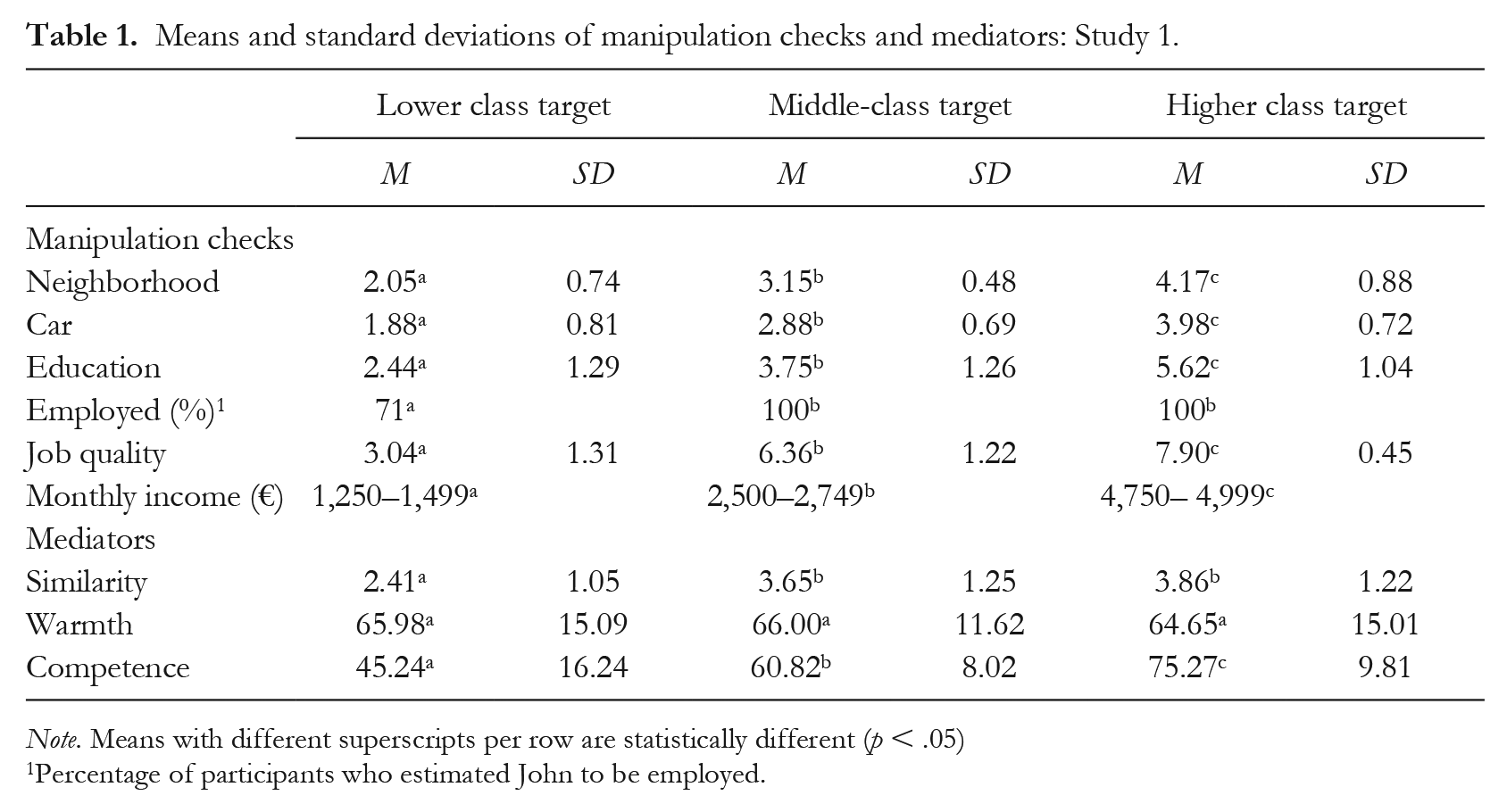
Note. Means with different superscripts per row are statistically different (p < .05)
Percentage of participants who estimated John to be employed.
Correlation tables.
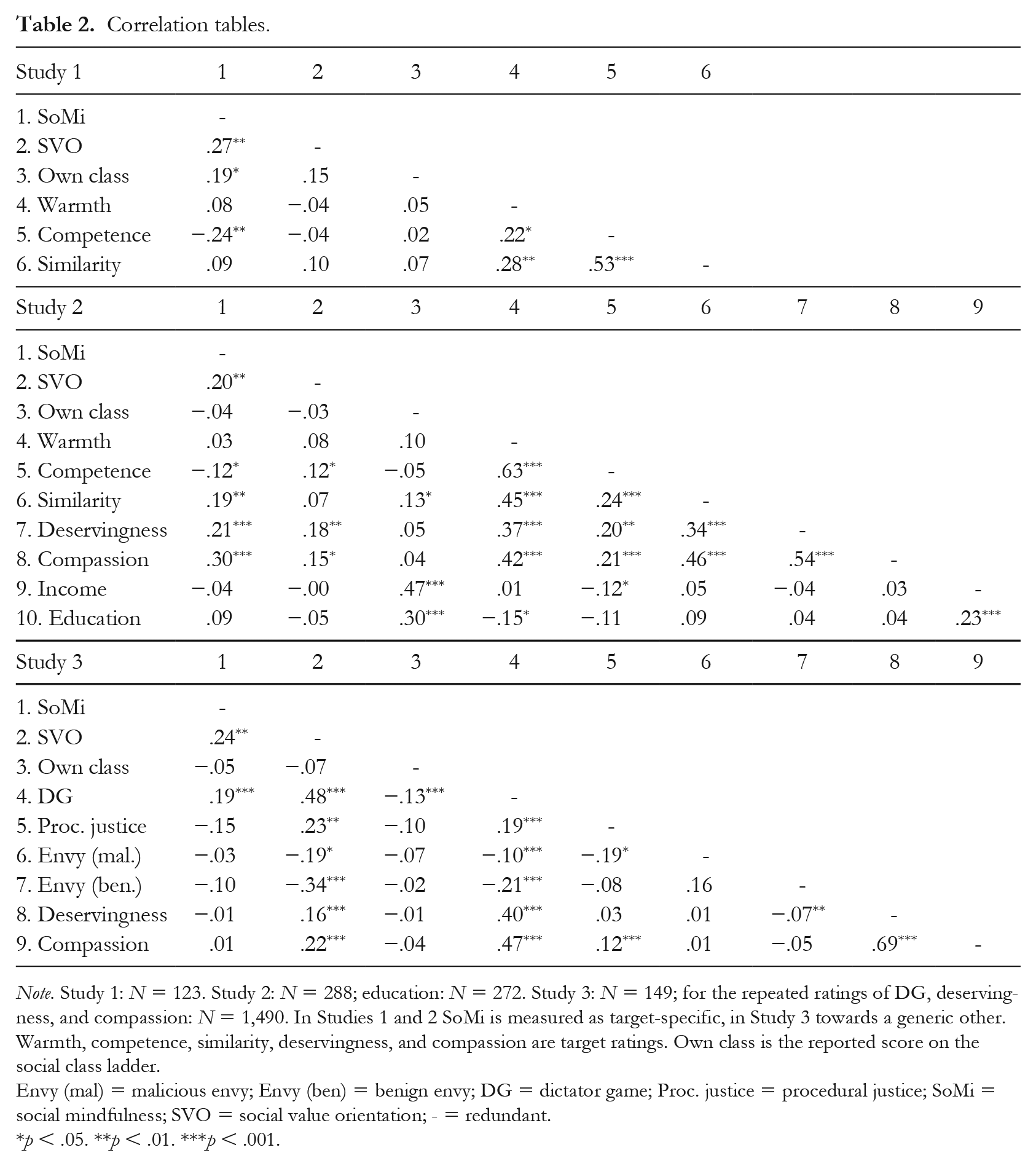
Note. Study 1: N = 123. Study 2: N = 288; education: N = 272. Study 3: N = 149; for the repeated ratings of DG, deservingness, and compassion: N = 1,490. In Studies 1 and 2 SoMi is measured as target-specific, in Study 3 towards a generic other. Warmth, competence, similarity, deservingness, and compassion are target ratings. Own class is the reported score on the social class ladder.
Envy (mal) = malicious envy; Envy (ben) = benign envy; DG = dictator game; Proc. justice = procedural justice; SoMi = social mindfulness; SVO = social value orientation; - = redundant.
p < .05. **p < .01. ***p < .001.
Testing our main prediction in a general linear model, target class showed the expected main effect on social mindfulness, F(2, 120) = 4.43, p = .014, η 2 = .07. In line with previous findings, pairwise comparisons (Least Square Differences) showed that the lower class target (Mlow = 0.83, SD = 0.16) elicited greater social mindfulness than the higher class (Mhigh = 0.74, SD = 0.19), p = .024, 95% CI [0.01, 0.17] or middle-class target (Mmiddle = 0.72, SD = 0.20), p = .006, 95% CI [0.03, 0.19]. The mean score for the middle-class target was the lowest, but did not statistically differ from the higher class target, p = .597, 95% CI [−0.10, 0.06] (see Figure 2). Similar to prior research (Van Doesum et al., 2017), support for the unique contribution of the target-class effect was found when it remained present while controlling for own class (ladder), SVO, age, and gender, F(2, 116) = 5.54, p = .005, η 2 = .07.
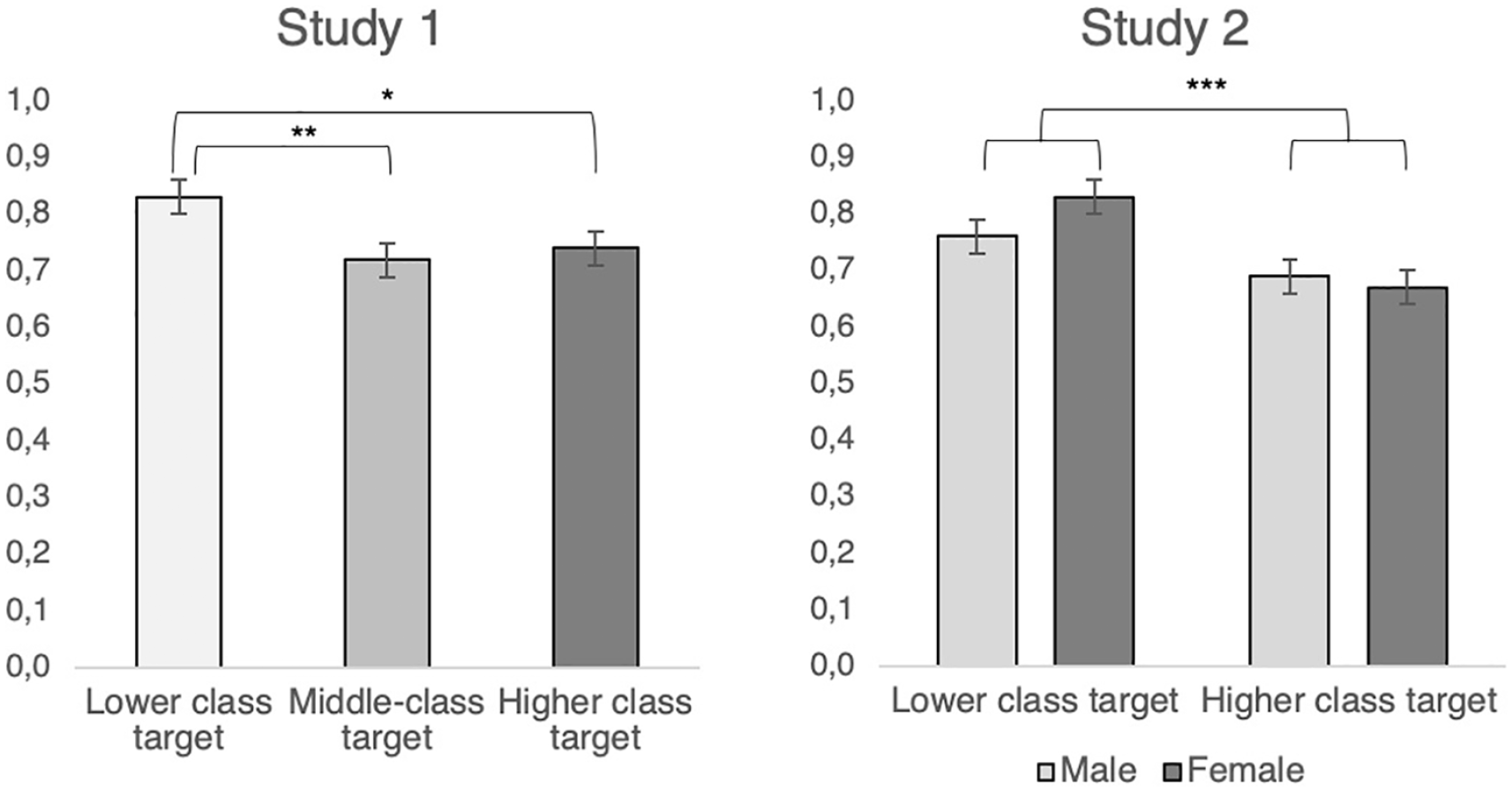
Main effects of target class on social mindfulness: Studies 1 and 2.
Next, we explored possible mediating effects of target impressions. Target class affected perceived similarity and competence, but not warmth; participants felt most similar to the higher class and middle-class targets, and rated the higher class target as most competent (see Table 1). We combined these three potential mediators (i.e., parallel mediation) using the PROCESS macro (Version 3.4.1; Hayes, 2018). Given the positive association between SoMi and the social ladder, we controlled for own class (ladder). However, own class did not significantly affect prosociality or any of the mediators in this model. The model furthermore showed that the effect of target class on prosociality was indirectly affected by both competence (negatively) and similarity (positively) ratings, as the relevant confidence intervals did not include zero (see Table 3). The indirect effects were strongest for the comparison between lower class and higher class targets. Thus, feelings of similarity indirectly dampened the target-class effect by strengthening prosociality (especially for the lower class target), whereas competence ratings weakened it. Perceived warmth did not contribute, however.
Relative direct and indirect effects: Study 1.
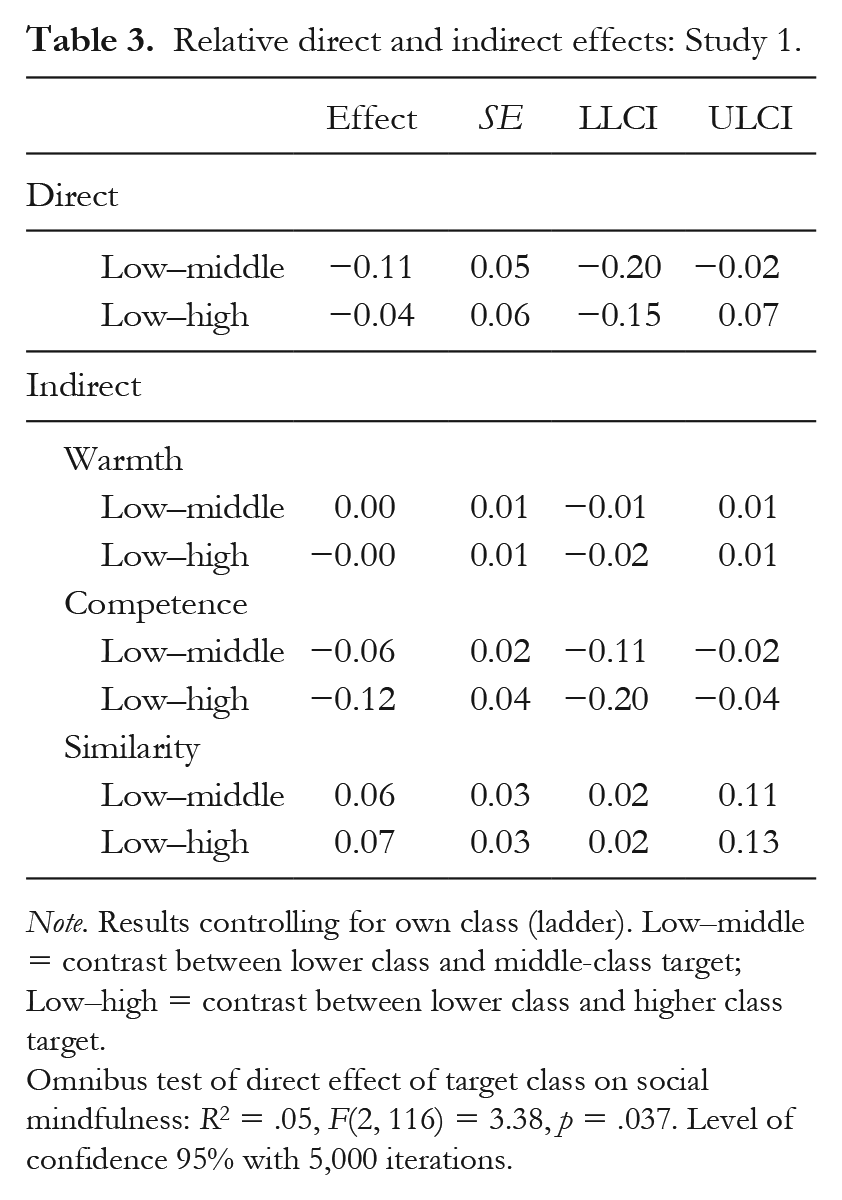
Note. Results controlling for own class (ladder). Low–middle = contrast between lower class and middle-class target; Low–high = contrast between lower class and higher class target.
Omnibus test of direct effect of target class on social mindfulness: R2 = .05, F(2, 116) = 3.38, p = .037. Level of confidence 95% with 5,000 iterations.
Discussion
Replicating previous findings (Van Doesum et al., 2017), we found that lower class targets elicited greater prosociality than higher class targets. However, we did not detect differences in prosociality toward middle-class and higher class targets. A possible explanation is the high self-reported social class within this sample, reflected in high felt similarity to middle-class and higher class targets. We found indirect effects through such similarity ratings, strengthening the direct effect of target class. The effect of target class was dampened, however, by competence ratings, in the sense that higher class targets were rated as more competent, in turn leading to a less prosocial treatment.
These findings indicate that target evaluations may have driven the results, but ratings of similarity and competence are rather distant, emotion-neutral assessments of the target. However, prosocial behaviors towards others might also be more affect-driven (e.g., Leiberg et al., 2011). We thus expanded our scope to see if compassion and deservingness could provide more clarification. To further address potential cultural differences, we turned to the UK.
Study 2
British culture is often seen as strongly shaped by social class (e.g., Manstead, 2018). Traditionally, the British divide society in terms of upper, middle, and lower class, and examples of the vast influence of strict class divides are plentiful throughout history. However, the contemporary emphasis on social class is less on the traditional differences between middle class and lower class than on hierarchical differentiations between the top (the haves) and the bottom (the have nots), with five fuzzy categories in the middle (Savage et al., 2013). We examined if results observed in the Netherlands would hold in the UK, at the same time sampling a more general population. Because we were mainly interested in comparing lower and higher class targets in terms of prosocial behavior, and to ensure sufficient statistical power, we did not include a middle-class target. Based on Study 1 and previous findings, we expected that the lower class target would elicit more prosociality.
Additionally, we explored if target gender would affect prosocial decisions. This could follow from findings that low-income women received higher offers than low-income men in a bargaining situation, possibly explained by helping norms that prioritize women over men in critical situations (Holm & Engseld, 2005). But given that social class is applicable across sexes, we did not anticipate that gender would interact with target class regarding prosociality. Finally, we examined if emotionally involved assessments of compassion and perceptions of deservingness would mediate effects of target class on prosocial behavior.
Participants and Design
Study 2 was conducted online on Prolific Academic (e.g., Peer et al., 2017). For sufficient statistical power (cf. Van Doesum et al., 2017, Study 4), we planned a sample of 300 participants. Three hundred and three UK residents participated; 15 failed a manipulation check and were excluded from analyses. The final 288 participants (119 male; 91.0% Caucasian) ranged in age from 17 to 72 years (Mage = 34.00, SD = 10.98). Regarding education, one participant (3.0%) reported primary school or lower, 30.6% completed secondary education, 45.5% held a bachelor’s degree, 15.6% a master’s degree, 2.4% a doctoral degree, and 5.6% did not report. Participants were randomly assigned to conditions in a 2 (target class: higher, lower) x 2 (target gender: male, female) between-participants design with SoMi as dependent variable. Setting the alpha at .05, sensitivity analysis showed that this provided us with 80% power to detect a small to medium sized effect of f = 0.16 (G*Power; Faul et al., 2009).
Procedure and Materials
Similar to Study 1, we measured subjective SES using the social class ladder (Adler et al., 2000). On average, participants positioned themselves at the middle rung (Mladder = 5.07, SD = 1.59), which, in contrast to Study 1, did not differ from the midpoint of the scale, t(287) = 0.71, p = .481. Objective SES was assessed through income and education. Annual household income was measured categorically in steps of £5,000, ranging from £10,000 or below to £200,000 or above. Our sample showed a median annual household income between £30,000 and £34,999 (Mincome = £35,000–£39,999), and a bachelor’s degree as median educational attainment (16 did not report). Subjective social class (ladder) and objective social class (income, education) were positively correlated: r(288) = .47, p < .001, and r(272) = .30, p < .001, respectively. Echoing Study 1, the SvoSlider measure (Murphy et al., 2011) was used to assess social value orientation.
Similar to Van Doesum et al. (2017), but adapted to the UK, participants read a brief description of a male or a female target who was either of lower or higher social class. In the male target condition, participants were asked to imagine a White male in his mid-40s, named John. He was 6 ft 0 in. tall (1.83 m), weighed about 198 lb (90 kg), and had dark blonde hair and blue eyes. In the female target condition, they imagined a White female in her mid-40s, named Susan. She was 5 ft 5 in. tall (1.66 m), weighed about 163 lb (74 kg), and had dark blond hair and blue eyes. In the higher class condition, participants read that John or Susan was placed on the second highest position of the social class ladder when it came to education, income, and job status relative to people in the UK. In the lower class condition, participants read that John or Susan was placed on the second lowest position of the social class ladder. Additionally, participants saw a picture of a ladder that showed the rung where John or Susan stood (either the second highest or the second lowest position). Next, participants performed the SoMi task as described in Study 1.
Participants then evaluated the target (John or Susan, “or someone like him/her”) in terms of similarity (three items; e.g., “How similar do you think you are to. . .?”; α = .86), deservingness (“How much do you think that . . . deserves some good things in life?”), compassion (“How much compassion do you feel for. . .?”), warmth (friendly, well-intentioned, trustworthy, warm, good-natured, and sincere; α = .84), and competence (competent, confident, capable, efficient, intelligent, and skillful; α = .91; Fiske et al., 2002).
Results
Social judgments and target perceptions
Preliminary analyses showed that the lower class target was evaluated higher on deservingness and compassion, and lower on competence; warmth did not differ. In contrast to Study 1, participants perceived the lower class target as more similar to themselves than the higher class target. Means and standard deviations are summarized in Table 4. At the bivariate level, social mindfulness was significantly correlated with perceived similarity, r(288) = .19, p = .002; compassion, r(288) = .30, p < .001; and perceived deservingness, r(288) = .21, p < .001 (see Table 2).
Means and standard deviations of target ratings: Study 2.
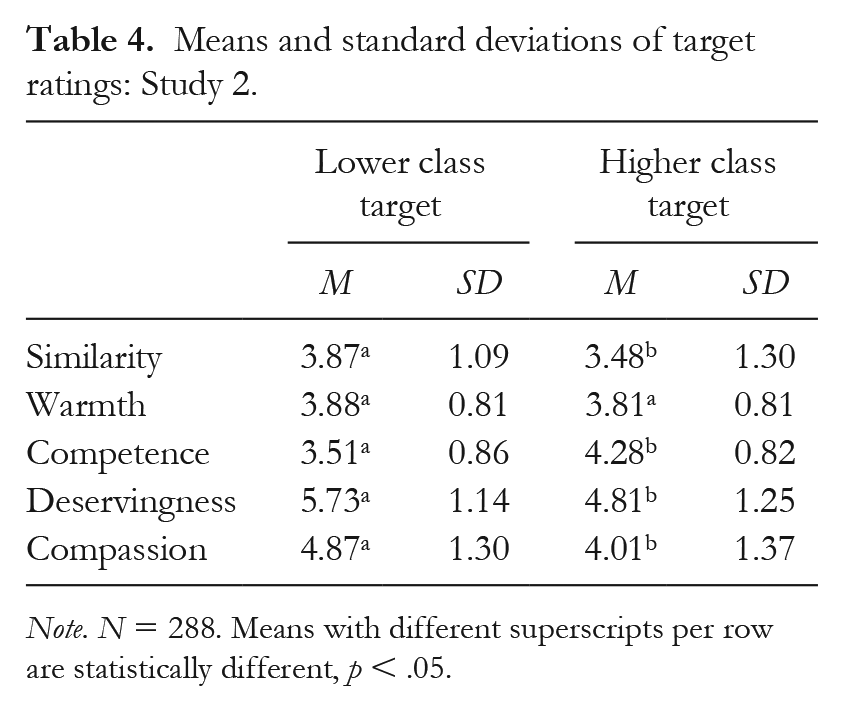
Note. N = 288. Means with different superscripts per row are statistically different, p < .05.
Social mindfulness
A 2 (target class: higher, lower) x 2 (target gender: male, female) ANOVA with social mindfulness as the dependent variable revealed a significant main effect of target class on social mindfulness, F(1, 284) = 18.47, p < .001, η 2 = .06. Replicating Study 1 and in line with previous research (Van Doesum et al., 2017), lower class targets (Mlow = 0.80, SD = 0.21) were treated more prosocially than higher class targets (Mhigh = 0.68, SD = 0.26), difference 95% CI [0.07, 0.18]. Target gender did not moderate this effect, F(1, 284) = 1.67, p = .197, η 2 = .01, nor did target gender have a main effect on social mindfulness, F(1, 284) = 0.72, p = .398, η 2 = .00; Mmale target = 0.73, SD = 0.23; Mfemale target = 0.75, SD = 0.26. Similar to Study 1, the effect of target class on social mindfulness remained after controlling for subjective social class (ladder), income, education, social value orientation, gender, and age, F(1, 262) = 18.19, p < .001, η 2 = .06. 3
Mediation analyses
Having observed that higher class targets were met with less prosociality, we set out to test potential mediators. Using the PROCESS macro (Hayes, 2018), we first tested indirect effects of target class on social mindfulness through compassion and deservingness. Although we did not find an association between own class and prosociality here (see following lines), we did in Study 1. Therefore, we controlled for own social class (ladder) to preclude confounding. Results are summarized in Table 5. We did find support for indirect effects, but only the individual 95% confidence interval for compassion did not include zero [−0.06, −0.02]. To check for alternative explanations, we ran a second model with perceived similarity, warmth, and competence as mediators. With 95% confidence intervals for the total indirect effect including zero [−0.08, 0.01], this analysis suggested no mediation overall. Note, however, that the 95% confidence interval for perceived similarity did not include zero [−0.04, −0.00]. Thus, we ran a third model pitting compassion against perceived similarity as mediators. Results showed a significant indirect effect of compassion, 95% CI [−0.06, −0.01], but not of perceived similarity, 95% CI [−0.02, 0.00]. Therefore, we conclude that the effect of target class on prosociality was most strongly explained by compassion.
Direct and indirect effects of target class on prosociality: Study 2.
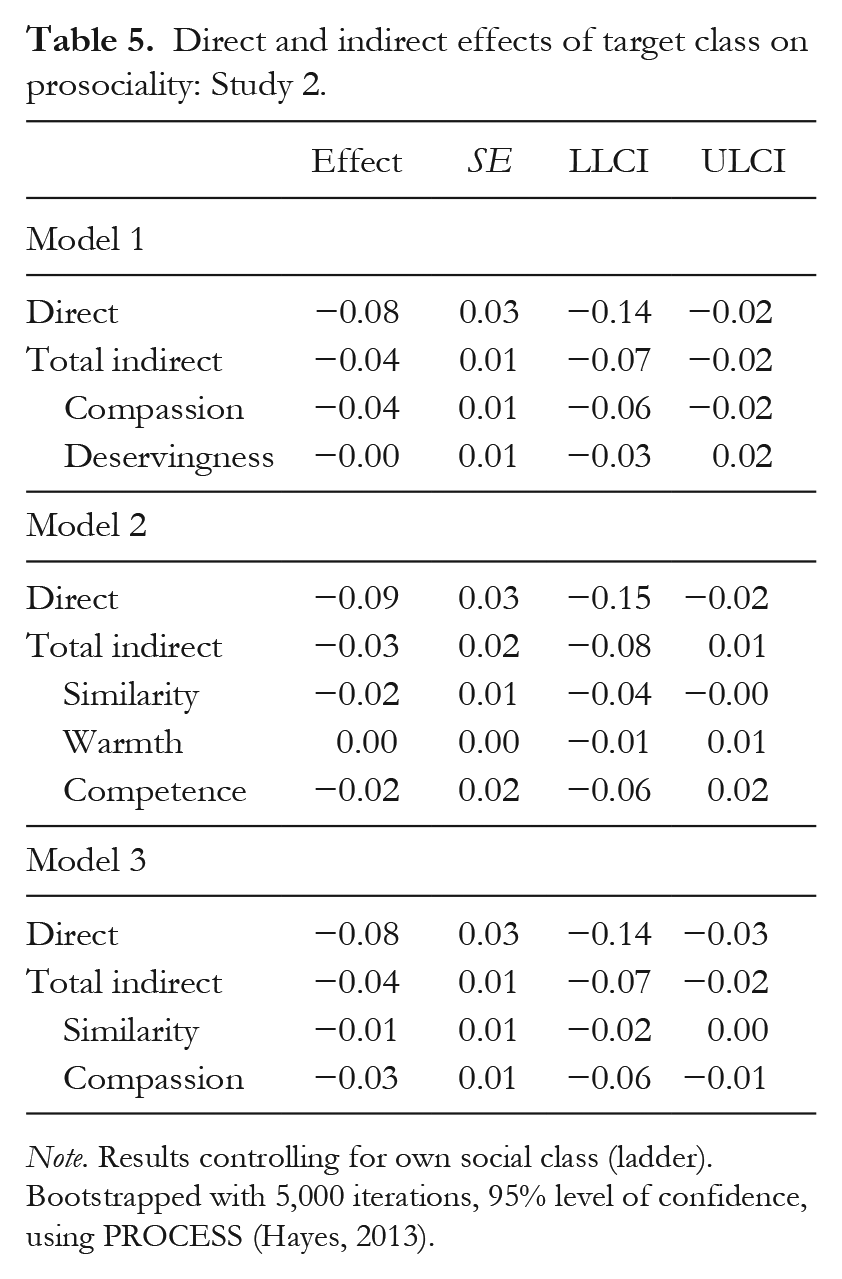
Note. Results controlling for own social class (ladder). Bootstrapped with 5,000 iterations, 95% level of confidence, using PROCESS (Hayes, 2013).
Own social class and prosociality
Additionally, we explored possible relations between own social class, individual prosocial orientation (SVO), and social mindfulness (SoMi; see Table 2 for details). SoMi and SVO were positively correlated, r(288) = .20, p = .001. SVO was not associated with subjective social class (ladder), income, or education. Unlike Study 1, SoMi was also not associated with subjective social class, income, or education.
Discussion
Similar to Study 1, lower class targets elicited greater prosociality than higher class targets. Target gender did not affect prosociality, nor did own social class. Class perceptions thus seem to impact the level of target-specific prosocial behavior similarly in the UK as in the Netherlands and the US. Further, affective responses like compassion appear to drive this effect more strongly than distant assessments of similarity or competence. However, our conclusions are limited by the fact that we operationalized prosociality using social mindfulness in hypothetical interactions. In Study 3, we examined whether the same pattern would emerge when people are asked to make real monetary allocations between themselves and others.
Study 3
Study 3 was a laboratory study conducted in the Netherlands. Instead of social mindfulness, we used decisions in a dictator game as the dependent variable (e.g., Piff et al., 2010). Given that people tend to be more generous to those they find to be deserving (Engel, 2011), we again investigated perceived deservingness, and assessed compassion for the targets. Both perceived deservingness and compassion may be part of a broader concern for behaving justly, however. To focus on target-specific perceptions, we controlled for participants’ general sense of procedural justice when making their decisions (e.g., Estévez et al., 2013). Finally, lower class targets can elicit greater prosociality, as we argue here, but higher class targets can also elicit lower prosociality; negative emotions like spite or envy may indeed be part of the underlying motivational complex. To control for envy, we assessed benign and malicious envy (e.g., Lange & Crusius, 2015; van de Ven et al., 2009). Especially a general tendency for malicious envy would indicate spite and suggest discounting prosociality toward higher class targets.
We used a two-phased design to collect responses from participants in actual yet time-separated interactions. The binary structure was designed to gather standardized and anonymized stimulus material regarding the targets, and to prevent direct contact and reciprocity motives to confound the results. In Phase 1, we collected information from volunteers who would be recipients in a dictator game to take place in the laboratory at a later point in time; in Phase 2, we recruited participants for a laboratory study involving a sequence of one-shot dictator games with different recipients who were described by the information collected in Phase 1. Both dictators and recipients were offered the randomly selected monetary allocation of one of the dictator games in Phase 2; decisions in Phase 2 thus had direct financial consequences for all involved.
For the actual interactions in Study 3, we measured, rather than manipulated, target class. Given the demographics of the Dutch student sample from Study 1, we did not expect to find great variance in positions on the SES ladder (subjective class) or income and/or education (objective class). Furthermore, the SES ladder has been effective in many studies but is not without limitations (Dietze & Knowles, 2016). Therefore, we conceptualized social class from a broader cultural background perspective (e.g., Bourdieu, 1997). Specifically, we reasoned that parents influence the social class of their offspring in important ways, especially among students who have not completed education, developed a career, or earned their own money in a steady profession yet (e.g., Andres et al., 2007; von Stumm et al., 2010). Results from Study 1, where we observed a strong correlation between estimated parental income and participant’s subjective position on the social ladder, r(86) = .42, p < .001, are consistent with this idea. However, a potentially effective way of establishing social class in this environment may go beyond parental income to consist of their education, hobbies, and occupation (as a proxy for cultural capital). To our knowledge, such a conceptualization has received little empirical attention thus far. To operationalize this innovative approach, we collected information on education, profession, and hobbies of the recipient’s parents in Phase 1 (cf. Oakes & Rossi, 2003).
Phase 1
In Phase 1, we collected information from 80 individuals (62 females) who volunteered to be recipient in a dictator game. These were mainly students (71), Mage = 22.58, SD = 6.69, although ages ranged from 18 to 57 years. After having been told that they could receive €0.00–5.00 depending on the decisions in the laboratory at a second phase of the study, and having provided informed consent, participants used designated spaces on a standardized form (single sheet) to report their age, gender, and whether they were a student (yes/no), without any further identifying information (no names). More importantly, they described their parents’ level of education, job, and hobbies, specified for both father and mother. The completed target sheets were used as stimulus material in Phase 2. The information on the sheets was rated on social class level (on a 10-point scale: 1= low, 10 = high) by three independent judges (α = .94), and converted into a single social class score per target (ranging from 3.00 to 8.67; Mtarget class = 6.65, SD = 1.21). 4 This linear approach reflected the general expectation that lower class targets would elicit greater prosociality.
Phase 2
Participants and design
For Phase 2, we recruited 157 individuals at a large Dutch university (different from Study 1), who were mainly students. Data collection was planned for 150 participants and/or 2 weeks of scheduled laboratory time. Due to computer malfunction, three participants could not finish the study; their scores were not included. Additionally, five individuals participated both as dictator and recipient. Data from these individuals were excluded from analyses. Our final sample therefore included 149 participants (113 females) between 16 and 51 years old, Mage = 21.63 (SD = 4.17). In a mixed between- and within-participants design, participants played 10 consecutive dictator games with 10 different targets of varying social class. Sensitivity analysis including all predictors showed that our sample provided us with 80% power to detect small to medium effects, ρ 2 = 0.09, α = .05 (G*Power; Faul et al., 2009).
Procedure
Upon arrival in the laboratory, participants were guided to closed cubicles equipped with computers. Participants then received two folders, one of which contained the information sheets of 10 randomly selected targets collected in Phase 1; the other was marked “finished.” They were asked to leave the folders closed until instructed otherwise. The experimenter started the experiment on the computer and left the cubicle. First, we collected some standard demographics, and asked the same information from the participants we had requested from the targets in Phase 1. Then we introduced the dictator game (e.g., Kahneman et al., 1986) by telling participants that they would play the game 10 consecutive times with different and independent others as target.
The task was explained as a money allocation task in which participants could divide €5.00 between themselves and another participant, in steps of €0.20. Possible allocations ranged from 1 (I get €5.00 and the other gets €0.00) to 26 (I get €0.00 and the other gets €5.00). To prevent participants from choosing heuristically for an even split, an equal distribution was not possible; higher values meant more money for the other and thus greater prosociality. Participants were told that they and the other person would actually receive the outcome of one randomly drawn game, but were not informed about names or identities. We also emphasized that recipients would not hear who had made the decision; decisions thus were real yet anonymous for both dictator and recipient.
Next, participants were instructed to take the first sheet from the folder with the information of the first recipient/target. We asked them to study this information carefully, and to take their time to develop a clear and vivid picture of this person. After having done so, participants indicated their preferred allocation on the computer, stored the finished sheet in the second folder, and took the next sheet from the first folder. This process was repeated until all 10 decisions were made. Outcomes of four decisions were missing due to inconsistent entries or other nonretraceable issues.
Trait-level social mindfulness (SoMi) was added as a control variable. It was assessed like before, but now with a generic, unknown other in mind (i.e., not target-specific). Social value orientation (SVO) and subjective social class (SES ladder) were measured in the same way as in the previous two studies. Like Study 1 and similar to the targets, but unlike Study 2, the ladder mean was above the scale midpoint, Mladder = 6.42, SD = 1.45, t(148) = 11.99, p < .001. Next, we assessed how much compassion participants felt for each of the targets (one item), and how much they thought this person would deserve some extra things in life (deservingness; one item). To explore and control for perceived justness of decisions overall, we adapted seven items of the Procedural and Distributive Justice Scale (Estévez et al., 2013; e.g., “I treated all others equally”) answered on a 5-point scale (1 = strongly disagree, 5 = strongly agree; α = .82). For similar exploratory reasons, general envy was measured using the Benign and Malicious Envy Scale (BeMas; Lange & Crusius, 2015), consisting of two subscales: benign envy (five items; e.g., “When I envy others, I focus on how I can become equally successful in the future”; α = .82) and malicious envy (five items; e.g., “I wish that superior people lost their advantage”; α = .77), both scored on a 5-point scale (1 = totally disagree, 5 = totally agree). Participants were then debriefed, thanked, and paid or given course credit.
Results
To provide a first overview, we computed zero-order correlations (see Table 2). Trait-level SoMi was positively correlated with SVO, r(149) = .24, p = .004, and the dictator game, r(1490) = .19, p < .001, but not with own social class (ladder), procedural justice, or benign and malicious envy, deservingness, or compassion. SVO correlated positively with procedural justice, r(149) = .23, p = .006; deservingness, r(1490) = .16, p < .001; and compassion, r(1490) = .22, p < .001; and negatively with benign and malicious envy, r(149) = −.34, p < .001, and −.19, p = .020, respectively. Own social class correlated negatively with the dictator game, r(1490) = −.13, p < .001.
To test the effect of target class on prosociality, we used a linear mixed model in which dictator game allocations were regressed on target class. The model included random intercepts for participants, which modeled the fact that multiple decisions from the same participant were not independent; and random slopes for target class, which modeled the variability in the effect of the manipulation across participants. The target was allotted between €2.00 and €2.20, on average. Results revealed the predicted effect of target class on prosociality, b = −0.78, F(1, 613.58) = 90.20, p < .001, 95% CI [−0.95, −0.62], indicating that lower target class was associated with greater prosociality. In line with the previous studies, this effect remained when controlling for SoMi, procedural justice, benign and malicious envy, and own class (ladder), F(1, 722.89) = 93.85, p < .001, 95% CI [−0.94, −0.63]. The effect of SoMi was significant, b = 4.94, t(95.75) = 2.69, p = .008, as was that of benign envy, b = −0.94, t(175.50) = −2.60, p = .010, and procedural justice b = 1.01, t(97.71) = 2.11, p = .038; own class was marginally significant, b = −0.49, t(94.92) = −1.98, p = .051, and malicious envy was nonsignificant, b = −0.22, t(96.39) = −0.46, p = .645. Adding SVO to the model, b = 0.24, t(105.55) = 7.15, p < .001, did not alter the target-class effect, but washed out the significant effects of all the other control variables.
We next tested whether compassion and deservingness ratings (entered in parallel) mediated the relation between target class and dictator game allocations using the MLMED macro (Hayes & Rockwood, 2020). This revealed within-subjects indirect effects for both compassion (mediated effect = −0.17, SE = 0.04, 95% CI [−0.25, −0.11]) and deservingness (mediated effect = −0.32, SE = 0.05, 95% CI [−0.43, −0.23]). Contrast analysis showed that deservingness had the strongest effect; difference = −.15 [−0.29, −0.02]. For parameters and a visual representation, see Figure 3.
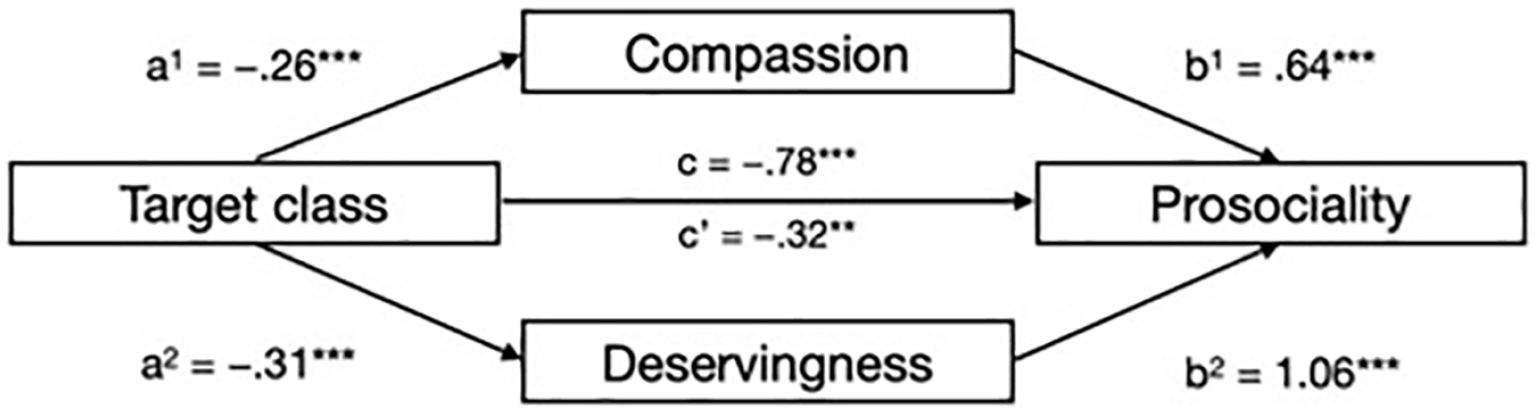
Mediation of the effect of target class on prosociality through compassion and deservingness: Study 3.
Discussion
Strikingly, information about the education level, occupation, and hobbies of a target’s parents evoked similar target-class effects on prosociality as seen in Studies 1 and 2. Study 3 also shows that greater prosociality elicited by lower class targets is not limited to social mindfulness, but extends to a more traditional operationalization of prosociality like the dictator game. Note that incentives were on the low end of the participants’ budget. The endowment to be shared was small even for the participating students, setting the absolute maximum individual gain at €5.00 when being fully selfish, which only happened in about 11% of the decisions. Also note that participants in Phase 2 were always paid a standard show-up fee, securing financial compensation regardless of bonus payments. Hence, cooperation in the game as designed here was low-cost, and conclusions must be interpreted as such. The main difference with SoMi is that the outcome of the dictator game is defined in terms of actual money instead of leaving or limiting choice. Because general concern with procedural justice or trait-level envy—both benign and malicious—did not disturb this effect, it can be seen as a truly other-dependent phenomenon. This was underscored by the influence of compassion and deservingness in determining the impact of target class on prosocial behavior.
Further, deservingness was positively associated with social mindfulness in Study 2, but did not mediate the effect of target class. In Study 3, however, deservingness showed the strongest mediation effect. One explanation may be found in the different outcome measures. Social mindfulness reflects prosocial attitudes in which communicated compassion is meaningful for interpersonal interactions without economic exchanges. In the context of actual prosocial behavior as measured in Study 3, perceived deservingness may provide a realistic motivation to determine how much money to give to others. Another explanation may be that people find deservingness to matter more if lower social class can be attributed to parental background, and not to individual SES, for which one can be held responsible to some extent.
General Discussion
In three studies, we found that lower class targets elicited greater prosociality than higher class targets, shaped by compassion and, under circumstances, perceived deservingness. This effect was found across different cultures, experimental settings, class conceptualizations, and outcome measures. Importantly, conclusions apply to low-cost prosociality as measured using social mindfulness and a low-stakes dictator game. Although envy cannot be ruled out as an explanation for this pattern, the role of compassion and the lack of difference in prosociality between middle-class and higher class targets in Study 1 suggest increased prosociality towards lower class targets rather than decreased prosociality towards higher class targets. These findings confirm, qualify, and extend previous research (Van Doesum et al., 2017). The social class of interaction partners indeed helps to shape the decision of how to divide money or whether to leave choice or not; hence, of how prosocial to be.
Theoretical Implications
One of the notable contributions of the current research is the finding that limited parental information elicits comparable target-class effects as previously found using explicit personal information (Study 3). This confirms that subtle information suffices to convey one’s social class (e.g., Bjornsdottir & Rule, 2017; Kraus et al., 2017). More importantly, it also tells that social background still determines perceived social class even in the current time frame, without directly having to look at personal wealth. This may help explain why, for example, social class mobility is slower, more difficult, and less prevalent than people often think (e.g., Kraus & Tan, 2015). Sartorial symbols (wearing a suit) or individual behavior (going to the opera) are easily adjusted to one’s income or other financial resources, but parental education and social background cannot be altered.
In Study 3, deservingness and compassion both mediated the effect of target class on prosociality. Perceptions of deservingness can be relatively value-free, but compassion may contain a moral component (Haidt, 2003). It is typically motivated by the wish to improve the well-being of someone in need or even alleviate suffering (Goetz et al., 2010; Sznycer et al., 2019), and is driven by concern for others: “Compassion involves a consideration of other people’s values, beliefs, needs and wants in terms of which their suffering can be understood and hence be shared” (Carr, 1999, p. 411). That is not the same as pity, as this emotion is more self-centered and has more negative connotations, at least in daily life (Florian et al., 1999). Nonetheless, when it comes to giving money or goods, showing compassion still means walking a fine line between being helpful and being condescending by placing oneself above others. That participants gave slightly more money to lower class targets does not necessarily imply that the latter are seen as deeply suffering or should feel like they do; it merely suggests that such differentiating behavior has a compassionate relational aspect that needs to be considered when further examining the dynamics of interclass encounters (cf. rational compassion; Bloom, 2017).
Limitations
We emphasize that our findings and conclusions only pertain to low-cost prosociality in which the material outcome is not the key issue. The situation is likely to be different when interactions become more costly. Beyond our scope, future research could test for thresholds in the monetary outcome, after which patterns of prosociality start to shift from what we found here; the current research may eventually apply more to acts of kindness than to sacrifice regarding lower class targets. And even though interactions in Study 3 were incentivized, they occurred between participants who would not meet each other before, during, or after the procedure. Our conclusions thus pertain to what people may do in situations where they can stay anonymous, without having to think about any positive or negative personal consequences when facing others from higher or lower social class. Future research could investigate if patterns would hold in concrete face-to-face interactions. Such a study could also include a measure of envy of the targets. Here, we assessed envy at perceiver trait level, and not as a state. To better distinguish between upregulating prosociality for lower class partners and downregulating it for higher class individuals, research could examine if and how target-specific envy affects prosociality in direct interpersonal encounters.
Even though we did sample from two different cultures, both of these cultures are Western and affluent. Being lower class does not necessarily mean that one lives below the poverty line. If class divides become so strong that the poverty line can be used as a division, deliberations on interpersonal justice will give way to more economic decisions that are focused on survival. Cross-cultural research could examine if and how this impacts target-class-based prosociality. Another approach could focus on cultures where class boundaries are more fixed and (even) less permeable than the ones we sampled here.
Conclusion
Social class remains a reason to sort others into groups (Stubager et al., 2018), and class-based inequality keeps permeating society in many different ways. Even though perfect equality might seem like the fairest situation, people actually tend to prefer moderate levels of economic inequality (Norton & Ariely, 2011). Moreover, reducing such inequalities is, at least in the short run, not a realistic option, which we will not discuss here. But, as we showed, there are other ways to address inequality that focus on content and quality of personal relations rather than on the division of goods and resources. Small expressions of social mindfulness or other forms of low-cost prosociality serve well to at least show one’s intention to balance the moral scale.
Footnotes
Acknowledgements
We thank Adinda van den Broek, Eva Lammers, Amber Tempelaars, and Teun Rookus for their help in developing the studies and collecting the data.
Author’s Note
Niels J. Van Doesum and Eric Van Dijk are also affiliated with Knowledge Centre Psychology and Economic Behaviour.
Funding
The author(s) disclosed receipt of the following financial support for the research, authorship, and/or publication of this article: Research was supported in part by the Dutch Research Council (Nederlandse Organisatie voor Wetenschappelijk Onderzoek) under Grant No. 022.003.040.
