



Abstract
Online communication is increasingly associated with growing polarisation in society. In this research, we test a dual-pathway model of online polarisation via intergroup and intragroup interaction of supporters of opposing ideological camps on YouTube. The interaction occurs over a video parody promoting a campaign to change the date of Australia Day celebrations, a divisive issue entailing contrasting narratives about Australian identity, meanings of Australia Day, and interpretations of colonial history. To capture ideological polarisation, we conducted computerised linguistic analysis of polarised talk in the form of comments and replies (N = 1,027) from supporters and opponents of the campaign. The indicators used to capture polarisation are social identification, position certainty, and psychological distance (as reflected by increased anxiety and hostility). Our results show that most polarisation (in the form of increased hostility) occurs in conditions of expression of outgroup dissent (the intergroup interaction pathway) and the most debated content on the online forum revolves around themes relevant to group identity. In addition to contributing to the understanding of group process in an online context, another key contribution of this research is providing a theory-driven method and blueprint to detect polarisation in social media data.
We live in an increasingly polarised world, where contrasting narratives about social reality divide societies into opposing (and often mutually exclusive) ideological camps. Divides driven by support for different political parties (political polarisation) are becoming less relevant, while issue-based polarisation which transcends political affinities seems to be a key driver of the current state of fragmentation in Western societies – as for example in Britain, it is the people’s positions on Brexit rather than political party identification that drives the polarisation in the country (Duffy et al., 2019). This societal fragmentation is replicated in the online domain (e.g., Facebook and Twitter) where the tendency to cluster according to ideological preferences seems to be even more accentuated (Bakshy et al., 2015, Barberá, 2015; Gaines & Mondak, 2009).
We propose that polarisation between groups from opposing ideological camps, in the specific context of online communication, can be understood as driven by both intragroup and intergroup mechanisms, whereby ingroup members interact online with other ingroup members, and with outgroup members, respectively. In this article, we test the proposition that these different types of online interactions represent two different pathways to polarisation. The intragroup pathway is exemplified in recent studies that have focused on the dynamics of echo-chambers in the online domain, and which emphasise the impact of ingroup interactions between group members (Himelboim et al., 2013; Quattrociocchi et al., 2016). However, the internet also provides opportunities for people to interact with others who are outside their own ideological echo-chambers. This latter type of interaction represents the intergroup pathway. In the current research, we use social interaction data extracted from YouTube to study the effects of both intragroup and intergroup online interactions on polarisation.
We refer to polarisation in terms of “ideological polarisation”, a concept that incorporates aspects of political polarisation (defined as an expanding ideological gap between groups and increased interpersonal separation between opponents, see Harel et al., 2020) and affective polarisation (a construct derived from social identity theory, to explain partisan divides as underpinned by an increasing divergence in affect towards the ingroup and outgroup, Iyengar & Westwood, 2015; Tajfel, 1970; Tajfel & Turner, 1979). Thus, we draw upon on a view of polarisation as rooted in ideological conflict but driven by social identity processes. By doing so, we argue that polarising online debates emerge around themes that are fundamental to the self-definition of the respective groups in conflict.
Contrasting Narratives Underpinning Polarisation in Opposing Ideological Camps
At a basic level, many forms of group behaviour can be understood as attempts by group members to change the world according to a particular (collectively shared) narrative about social reality. Such narratives can divide societies because they propose conflicting and often mutually exclusive versions of social reality, as for example in the contrasting narratives driving the climate change divide (Bliuc et al., 2015; Hoffman, 2011). Collective narratives can be understood as coherent stories about social reality that are congruent with particular sets of values and systems of beliefs, reflecting alternative world views about how the world should be and effectively dividing the society into opposing ideological camps (Bliuc et al., 2007; McGarty et al., 2009). Such narratives can help us understand consensus within a group, that is, the “truth” upon which group members agree (Bessi et al., 2015). They can inform our understanding of the core beliefs and values of a particular group or, put differently, they can shape the content of a particular social identity with its associated values, beliefs, and behaviour-prescribing norms (Livingstone & Haslam, 2008).
While contrasting narratives can form the basis of societal fragmentation within opposing ideological camps (at the intergroup level), they can also provide the basis of consensus and unification within a group (at the intragroup level). Here, in seeking to understand how polarisation occurs in the context of intergroup conflict between people from opposing ideological camps, we focused on the contested understanding and the associated narratives about the Australian national identity. A key issue that Australians from opposing ideological camps debate about online is the celebration of Australia Day on January 26. The January 26 commemoration marks the landing of the first British fleet on Australian shores in 1788. There is one narrative that identifies the arrival of the fleet led by Arthur Phillip as an invasion legitimatised by British imperialist rule, representing the beginning of the dispossession and genocide of the Indigenous people in Australia (Maddison, 2012). Supporters of this narrative advocate for changing the date of the national day via a campaign known as “Change the date”.
An alternative narrative (endorsed by the current Australian government) construes this particular date as the day when modern Australia was founded (through colonisation nevertheless) and advocates for maintaining the date as it is. These two narratives are also aligned to contrasting understandings and definitions of the Australian national identity (Bliuc et al., 2012). In particular, people who identify as Australian may support different versions of this social category – on one hand, a nationalistic version with its core values linked to race, ethnicity, and religion (i.e., British, white, Christian) aligned to support for maintaining the current date to celebrate Australia Day, and choosing to overlook the significance of the date for Indigenous Australians. On the other hand, Australians may identify with a more inclusive version of the national identity (Reicher et al., 2006), supporting cultural diversity and more sensitive towards issues pertinent to Indigenous Australians. This version of national identity is aligned to support for a change of date (Maddison, 2012; Moran, 2011; Pakulski & Tranter, 2000). Thus, support or opposition to the “Change the date” campaign cannot be solely explained by reference to social categories based on political orientation or cultural belonging. Instead, in this context, we can conceptualise the intergroup conflict driving the debate as conflict between two opposite ideological camps based on shared views about what being a “true” Australian means (Bliuc et al., 2012; Reicher et al., 2006).
Online Ideological Polarisation on YouTube
Rapid advances in information and communication technologies have enabled us to live highly connected lives in which finding like-minded people – those who share our views about the world – is only a few clicks away. As a result, people can choose to primarily interact online with others who share their views, or, when engaging with social and political issues, with those who belong to the same ideological camp as them (social interactions at an intragroup level). Where people are only exposed to information from the ingroup, “echo-chambers” can form (Bakshy et al., 2015). Platforms such as Twitter and Facebook, where exposure to similar ideas is embedded in their core functionality, provide ideal conditions for the formation of echo-chambers (Barberá et al., 2015; Himelboim et al., 2013) and further polarisation (Barberá et al., 2015; Bessi et al., 2015; Conover et al., 2011).
According to classic research in social psychology, polarisation can occur via increased intragroup interaction where group discussion on contentious issues results in division within the group and a shift to the extreme group positions (Moscovici & Zavalloni, 1969). In other words, group polarisation occurs when members of a deliberating group move towards a more extreme point in the direction of the initial position of the group, so that, for example, members of an anti-abortion group discussing the issue of abortion, will become more extreme in their views after the discussion (Sunstein, 2008; see also Myers & Bishop, 1970). The same polarising effect can be observed in online interactions occurring in echo-chambers. In echo-chambers, beyond the shift in the initial position, polarisation seems to lead to a decreased likelihood to interact with outgroup members (Quattrociocchi et al., 2016) and the formation of “identity bubbles” (Kaakinen et al., 2020; Oksanen et al., 2020). The polarisation of attitudes in echo-chambers is well-illustrated by research on the far-right in which online participation in radical echo-chambers (such as neo-Nazi and white supremacist forums) led to changes in group norms and increased unification at the intragroup level (Bliuc, Betts, Faulkner, et al., 2020; Bluic et al., 2019; Bliuc, Betts, Vergani, et al., 2020; Wojcieszak, 2010; for a review see Bliuc et al., 2018).
While user-driven spaces with restricted/members-only forums such as Facebook and discussion groups are best suited to encourage echo-chambers and therefore intragroup interaction, content-driven sites such as online open discussion sites are ideal platforms for intergroup communication. In particular, there are many (content-driven) online spaces that encourage interaction between people from opposing ideological camps. Such online spaces post contentious content which is debated by online users who identify with a particular ideological camp (or opinion) in relation to the issue. For example, an online news article on the pro-life movement would likely draw users who identify either as pro-life or pro-choice, so that its comments section would represent a platform for both intragroup and intergroup interaction (i.e., interactions between both users who agree and between users who disagree on the issue of abortion).
In echo-chambers, polarisation occurs because of political homophily via both intragroup influence and restricted access to diverse views (Vaccari et al., 2016). However, exposure to diverse views does not necessarily represent an antidote to polarisation. On the contrary, exposure to diverse and, in particular, opposing views of an ideological outgroup can be seen as another pathway to polarisation – that is, polarisation via intergroup interaction (Bail et al., 2018; Pauwels & Schils, 2016). When interacting with people with opposing views, polarisation occurs through a process of “disconfirmation bias” (see Karlsen et al., 2017; Taber et al., 2009) when people become stronger in their beliefs after being presented with counterarguments from an outgroup.
Indicators of Ideological Polarisation
Our understanding of polarisation is drawn from definitions of political and affective polarisation and can be operationalised as both ideological and psychological distancing between people from opposing ideological groups (see also similar conceptualisations of opinion polarisation from physical statistics, Castellano et al., 2009). Social interaction in conditions of ideological intergroup conflict can result in polarised social identities (including in online contexts, see Pauwels & Schils, 2016) because the groups are each fighting for their own cause – emphasising and exacerbating intergroup differences (Bliuc et al., 2012; Bliuc et al., 2015). This is because, according to the social identity approach (SIA, Tajfel & Turner, 1979; Turner et al., 1987) in contexts of intergroup conflict group identities become more salient, a process which in turn leads to group members’ adoption of stereotypical group behaviour and expression of social identification (Turner et al., 1987). This ideological distancing will therefore manifest as increased identification with the respective group (Bliuc et al., 2015) and increased certainty and confidence about the group position (Bliuc et al., 2007; Holtz & Miller, 2001; Holtz & Nihiser, 2008). In ideological camps defined by a particular position which is in opposition to the outgroup, disagreement with the outgroup is expected, so intergroup interaction should further increase group identification via increased position certainty (Feixas & Winter, 2019; Holtz & Miller, 2001; Holtz & Nihiser, 2008; Turner & Tajfel, 1986). Psychological distancing, on the other hand, as increasing opposition between ingroup and outgroup, can be captured by collective emotions such as hostility and intergroup anxiety, which can arise as a result of perceived threat (in this case, symbolic) from interaction with outgroup members (Stephan & Renfro, 2002; Stephan & Stephan, 1985; Stephan et al., 2017). In this context, the construct of psychological distance applies to intergroup processes, therefore differing from alternative conceptualisations where psychological distance refers to an individual process of affective detachment where people tend to “psychologically remove themselves from emotionally painful events” (Cohn et al., 2004; Pennebaker & King, 1999).
Present Research
In the current research, we aim to address the question of what happens in online spaces when people interact outside their echo-chambers; that is, in virtual spaces where they can interact with both people who share their views and people who have opposing views to their own. We seek to test the effects of both intragroup and intergroup interaction on polarisation, therefore, we used YouTube to examine social interactions occurring at both levels. YouTube is particularly well suited for this type of inquiry as it is a platform that, by design, can engage users from opposite ideological camps through the distribution of controversial socio-political video content. Unlike social networking sites such as Facebook and Twitter where the focus is on the relationships between users, YouTube is focused on content viewing (de Bérail et al., 2019; Khan, 2017), with the option to react to the content and also interact with other users by commenting and replying to comments of the other users.
The main objective of our study is to test a dual-pathway model to ideological polarisation in an online context; a first pathway to polarisation being via intragroup interactions with ingroup members (i.e., similarly to processes occurring within echo-chambers), with a second pathway being via intergroup interactions with outgroup members. We investigate these pathways in an online context where online users from opposing ideological camps are exposed to both ingroup consensus and outgroup dissent (Burke & Goodman, 2012; Grauwin & Jensen, 2012; Liu & Srivastava, 2015; Guo & Harlow, 2014; Harlow, 2015). In our study, we captured polarisation by focusing on three key dimensions of polarised talk: (a) social identification with one ideological camp; (b) certainty (of the ideological position of the respective camp); and (c) psychological distance from the opposed ideological camp (increased anxiety, hostility). More specifically, we sought to test the general prediction that those dimensions of polarisation are increased by both online social interactions between people from opposing camps (i.e., interaction in the context of intergroup dissent) and online interaction with people from the same camp (i.e., interaction in the context of intragroup consensus). Furthermore, intergroup conflict between groups drawn from opposing ideological camps is likely to be an identity-driven process where issues with direct relevance to the group’s self-definition are the most debated. From this, it follows that the most polarising topics that the opposing sides of a conflict engage with would likely be most directly pertinent to each group’s identity.
However, different indicators of group polarisation would be differently affected by intragroup versus intergroup interactions. In particular, it was expected that intragroup interaction (interaction in the form of intragroup position validation and endorsement) would primarily lead to increases in position certainty or self-defining belief validation (H1), while intergroup interactions (interaction in the form of expressing and endorsing intergroup dissent) would most likely lead to increases in social identification (as captured by the use of pronouns) and psychological distance as captured by anxiety, hostility and use of swear words (H2). In addition, it is expected that the most debated themes on the online forum will be pertinent to group identity, that is, polarisation will mostly occur in clusters debating these themes (H3).
By focusing on online contexts of interaction, we can test this dual-pathway model of polarisation where polarisation occurs in the conditions of intergroup conflict via online social interaction within and between opposite ideological camps. In other words, we examine interaction at intragroup level (in the context of consensus within the ingroup) and intergroup level (in the context of dissent with the outgroup) by focusing on social interactions between two groups drawn from opposing ideological camps on YouTube. The specific issue that is debated here is about changing the date for Australia Day (i.e., supporting versus being opposed to the “Change the date” campaign). However, the real basis of division that drives the polarisation in this case is conflict about competing narratives about Australian national identity. This conflict divides Australian society into opposing ideological camps which are distinct psychological groups that endorse alternative narratives about the meaning of the Australian national identity with corresponding contrasting interpretations of historical events.
Method
Data Collection
We extracted anonymous comments and replies to comments that were posted in response to a pro #ChangeTheDate video titled “Australia Day (Piracy parody)” (The Juice Media, 2017, Figure 1) on YouTube. The video was produced by The Juice Media (http://www.thejuicemedia.com.au), an independent online media website, and posted on YouTube on January 24, 2017. The video is a parody of anti-piracy video popular in Australia in the 2000s (http://www.youtube.com/watch?v=HmZm8, The Juice Media, 2017), and makes parallels between Australia Day commemorations and celebrating historical disasters and atrocities such as September ’11, Hiroshima and the Holocaust (i.e., historical dates of human atrocity).
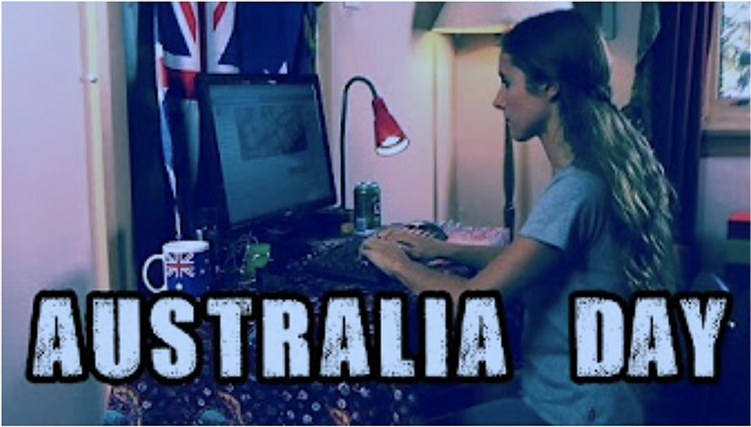
Screen capture of the “Australia Day (Piracy parody)” video on YouTube.
As of March 2020, the video had a total of 155,374 views and had generated 4.3K likes and 4.1K dislikes, 1 million views and 9K shares on Facebook. Data were collected and analysed at the level of contribution, not the contributor. From the total of 1,415 contributions (comments and replies) from 646 users, only the comments and replies that could be categorised as either in favour of or against the campaign were retained for the analysis (a total of 1,027; N comments = 434 and N replies = 593). Seventy-six comments were categorised as being in favour of the “Change the date” campaign (contributed by the supporters of the campaign) and 358 as being against the campaign (contributed the opponents of the campaign), while 265 replies were in favour of the campaign and 328 against.
Coding Process
Two of the researchers conducted the coding of the comments and posts as either being in favour of or against the “Change the date” campaign, an approach drawn from previous research on racism that used similar categorisations of online posts (Bliuc et al., 2012; Faulkner & Bliuc, 2016). First, the criteria of categorisation were discussed to ensure that both coders had the same understanding of the categorisation criteria. That is, the posts (comments and replies) were assessed as to whether they contained either agreement/expressions of positive attitude or disagreement/expressions of negative attitude towards:
(a) the campaign (e.g., pro-campaign content: “totally agree with this. This is why i don’t celebrate Australia day (. . .)” versus anti-campaign content: “Absolute crap. Throw some lamb on the barbie and shut the f** up.”);
(b) the particular historical narrative endorsed by each of the two camps (e.g., pro-campaign content: “What you’re celebrating is mass murder of traditional owners of this land. You owe it to yourselves to better educate yourself of Australia’s past (. . .)” versus anti-campaign content: “f** you this was the day cap cook landed not the day we colonised”);
(c) the members of the outgroup (e.g., pro-campaign content: “You have angered the mindless nationalists. Keep up the good work. They only respond like this to that which they fear - namely the education of their peers.” versus anti-campaign content: “You hate Australia Day so much? That terrible day when those nasty Brits arrived? Fine, get rid of those clothes and put a loincloth back on. Centrelink payments? Stop taking those too. Get rid of your cars, stop using all that lovely medicine, abandon your houses and go back deep into the bush where you can live as your uncivilised people once did, you wouldn’t last two minutes.”).
Initially, about 10% of all contributions were coded in a joint session that allowed the coders to discuss the contributions they were uncertain about and agree on the categorisation. This session was followed by independent coding by each of the coders of the remaining contributions. The process concluded with a final session where the codes were reviewed and any discrepancy in coding resolved. At the end of this process, some of the contributions were excluded from the analysis, that is, those including either content about the artistic quality of the video (or the lack of it) or ambiguous content unrelated to the campaign.
Study Design
The naturalistic context of the online interaction in the form of comments and replies to the YouTube video advocating for the “Change the date” campaign provided ideal conditions (harder to achieve in a traditional lab environment) to test how indicators of polarisation are affected by both intragroup and intergroup interaction. In particular, comments made in response to the video could be classified as either in favour of the campaign (i.e., context of intragroup validation/expressing consensus) or against the campaign (i.e., context of intergroup contestation/expressing dissent). Replies made in response to comments could be also classified as either in favour of or against the campaign, but the possibility to express agreement to comments against the campaign provided an additional level of interaction – going beyond expressing consensus or dissent towards the campaign, there is the possibility of both endorsing dissent (replies opposing the campaign) and endorsing consensus (replies in favour of the campaign). Therefore, the structure of the online interactions provided conditions for four types of interactions on the YouTube video:
Expressing consensus (direct intragroup validation: comments in favour of the campaign)
Expressing dissent (direct intergroup contestation: comments against the campaign)
Endorsing consensus (indirect intragroup validation: replies in favour of the campaign)
Endorsing dissent (indirect intergroup contestation: replies against the campaign)
This created four types of interactions, and two independent variables for our analyses: group categorisation (by position towards the campaign: pro-campaign/position validation versus anti-campaign/position contestation) and type of contribution (comment versus reply).
The dependent variables were the indicators of polarisation in the form of identification, position certainty, and psychological distance (captured by anxiety, hostility and use of swear words). To find the most polarising themes in the online forum, we identified the most debated comments (those comments that generated the most replies) for analysis.
Measures
We used the Linguistic Inquiry Word Count software (LIWC, Pennebaker et al., 2015) to process the textual data in the online contributions and create quantitative variables to capture polarisation. The software automatically scans the chosen text (i.e., the comment or reply) for words and phrases that are present in the LIWC 2015 dictionary (lexicon) and provides a score to indicate the percentage of words in that text that are in specific dictionary word categories. The word categories include both linguistic categories (e.g., pronouns) and psychological dimensions (e.g., affect, cognition, drives, etc.). LIWC has been used in numerous studies to measure various dimensions within different samples and the psychometrics of word categories were found to be valid (for a review see Tausczik & Pennebaker, 2010).
Social Identification
We used the LIWC subcategories of first-person plural pronouns (e.g., we, our, us), and third-person plural words (e.g., they, their, they’d) to capture social identification with the respective ideological camps. The use of words that capture intergroup (“us versus them”) language as indicating social identification is consistent with previous research (Smith, Gavin, & Sharp, 2015; e.g., Bliuc et al., 2019; Bliuc et al., 2018; Bliuc et al., 2017; Faulkner & Bliuc, 2018).
Position Certainty
The LIWC category of certainty was used as a positive indicator (e.g., always, never) of position certainty, while tentativeness was used as a negative indicator (e.g., maybe, perhaps).
Psychological Distance
Three indicators of psychological distance were used: anxiety, anger, and use of swear words (the latter two to capture hostility). We used the LIWC category anxiety (e.g., worried, fearful). For hostility, we used the LIWC categories anger (e.g., hate, kill, annoyed), and swear words (e.g., f***, damn, sh**).
Data Analysis
The structure of online interactions between users on YouTube creates conditions for four types of interactions, and two independent variables for our analyses: group categorisation (by position on the campaign: pro-campaign/position validation versus anti-campaign/position contestation) and type of contribution (comment versus reply). Means, standard deviations (SD), and correlations were calculated for all variables. Mean differences in the indicators of polarisation across the four types of interactions were compared using the open-source statistical software JASP (JASP Team, 2020).
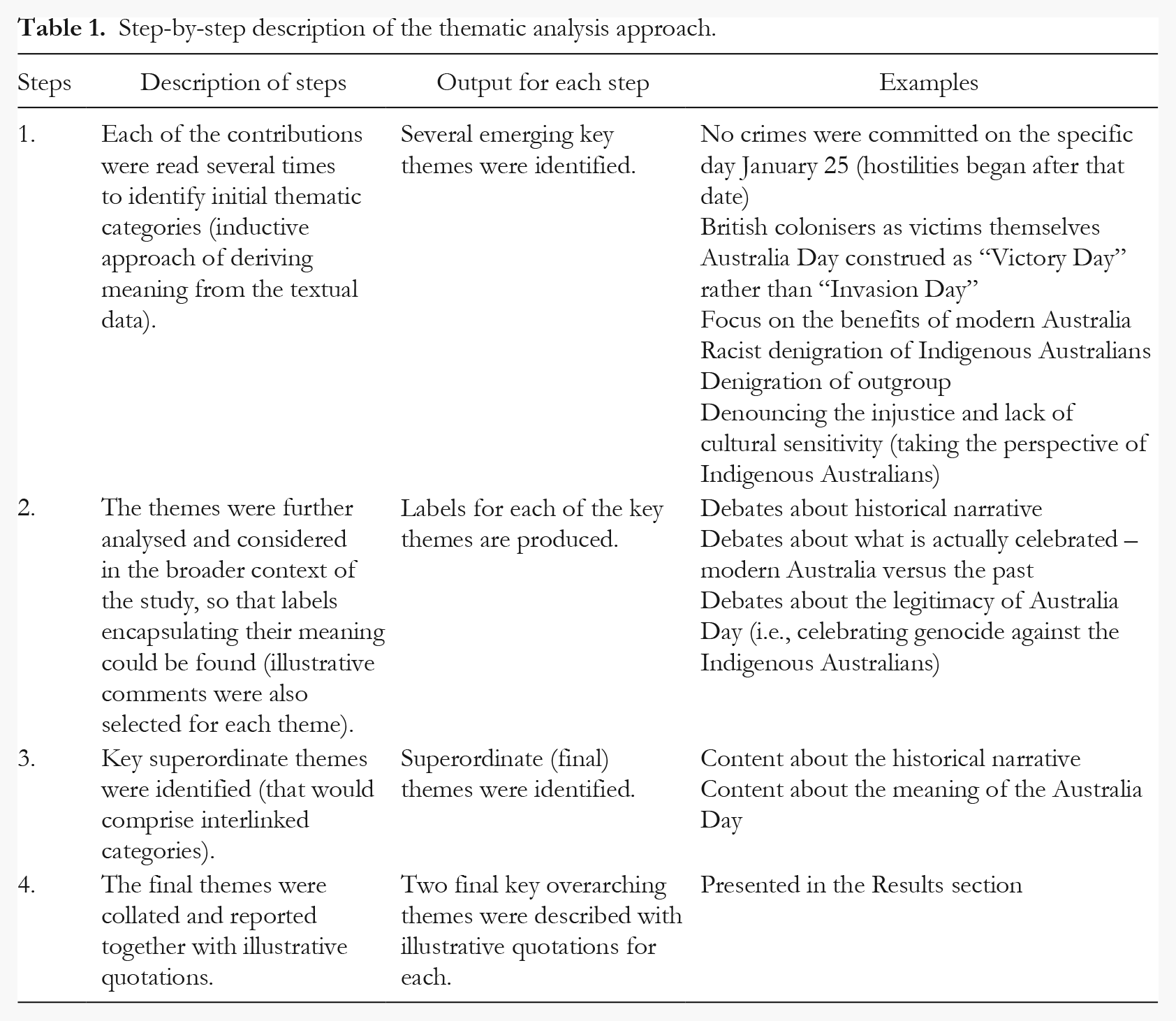
In addition to the quantitative analysis, to determine whether the most debated themes on the online forum are pertinent to group identity (H3), the text of comments that generated the most replies were collated and analysed using an approach derived from thematic analysis (based on the steps outlined by Braun & Clarke, 2006). In particular, the analysis of the qualitative data was structured into several steps as illustrated in Table 1.
Step-by-step description of the thematic analysis approach.
Results
Preliminary Analyses
Across both comments and replies, the mean number of words for contributions made by supporters and opponents of the campaign were similar (N supporters = 341, M = 54.196, SD = 82.478, range from 1 to 806; and N opponents = 686, M = 50.063, SD = 69.135, range from 1 to 782 for opponents). The descriptive statistics (means, standard deviations and Pearson’s correlations) for all the dependent variables (i.e., we, they, certainty, tentativeness, anxiety, anger and swear words) are shown in Table 2.
Means, standard deviations and correlations for all indicators of polarisation across the sample (N = 1,027).
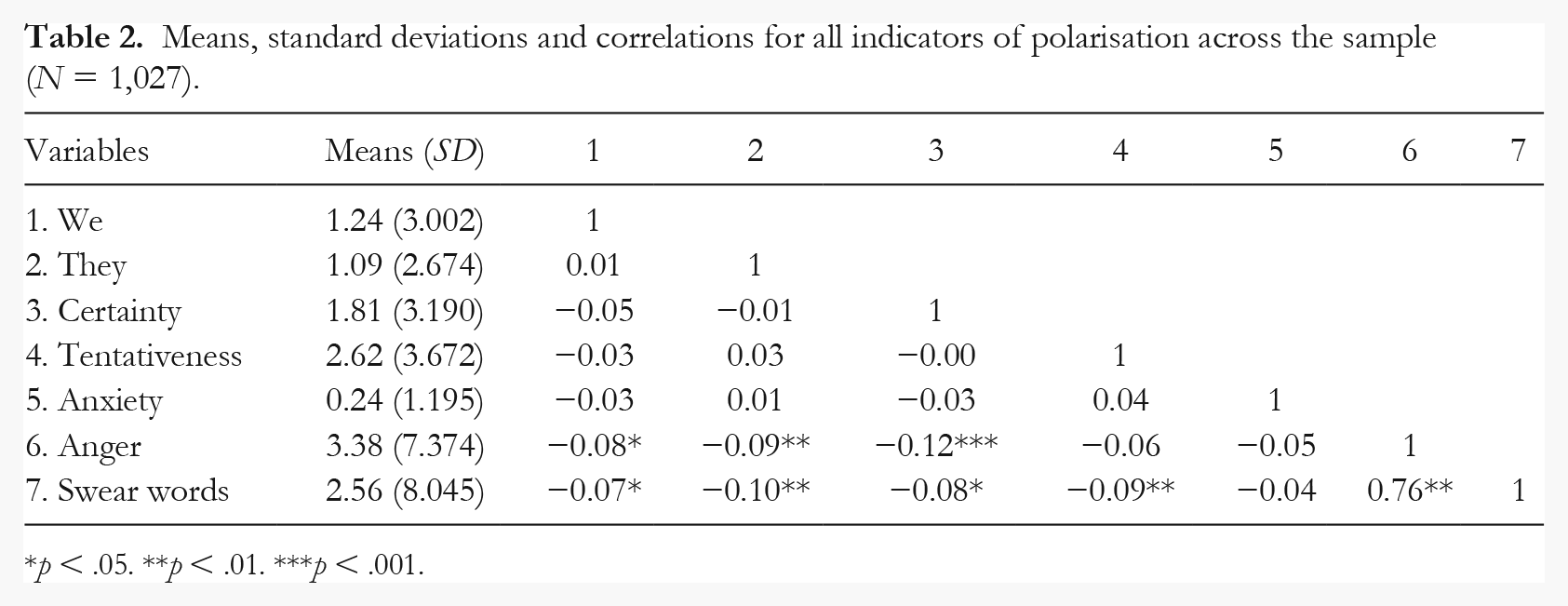
p < .05. **p < .01. ***p < .001.
Main Analyses
The Effects of Type of Social Interaction on Polarisation
We conducted a MANOVA to test whether intragroup and intergroup interactions resulted in relative differences in polarised talk, indexed by expressions of ingroup identification (as captured by the use of “we” and “they” pronouns), certainty (as captured by the use of certainty and tentativeness linguistic categories), and psychological distance (as captured by the use of anxiety, anger, and swear words categories).
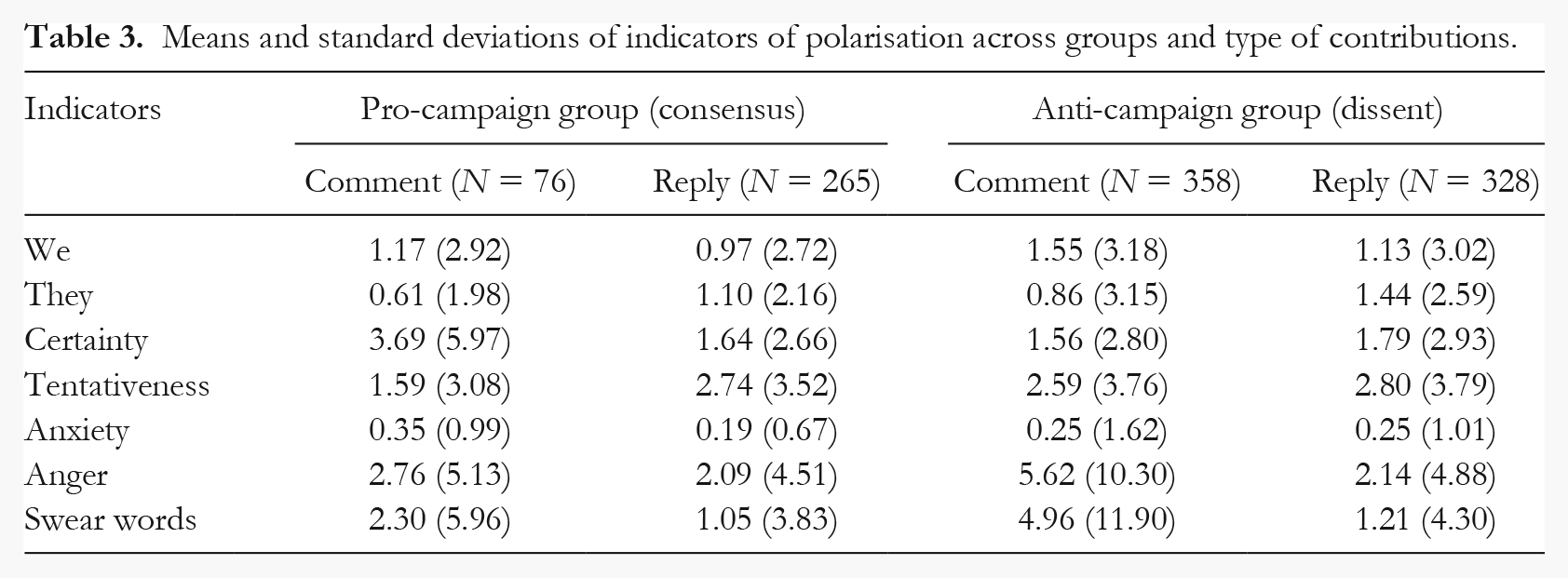
In the MANOVA, we entered group categorisation (by position on the campaign: pro-campaign/position validation versus anti-campaign/position contestation) and type of contribution (comment versus reply) as independent variables. The assumption of homogeneity of covariance was violated (Box’s χ² = 1549.700, p < .001), so we report Pillai’s trace values in addition to Wilks Λ. The analysis shows a significant multivariate effect for the interaction between group categorisation and type of contribution (Wilks Λ = .969, p < .001; TracePillai = .031, p < .001). Both group categorisation and the type of contribution had significant separated effects on the dependent variables (Wilks Λ = .977, p = .001; TracePillai = .023, p < .001 and Wilks Λ = .943, p < .001; TracePillai = .57, p < .001, respectively). As a follow-up to the MANOVA, a series of one-way ANOVAs were conducted on each of the dependent variables. Means and standard deviations both across comments and replies and across pro-campaign and anti-campaign contributions are reported in Table 3. F-values with corresponding effect sizes for all the indicators are reported in Table 4.
Means and standard deviations of indicators of polarisation across groups and type of contributions.
Univariate effect sizes and F-statistics associated to group, type of contribution, and group*type of contribution interaction.
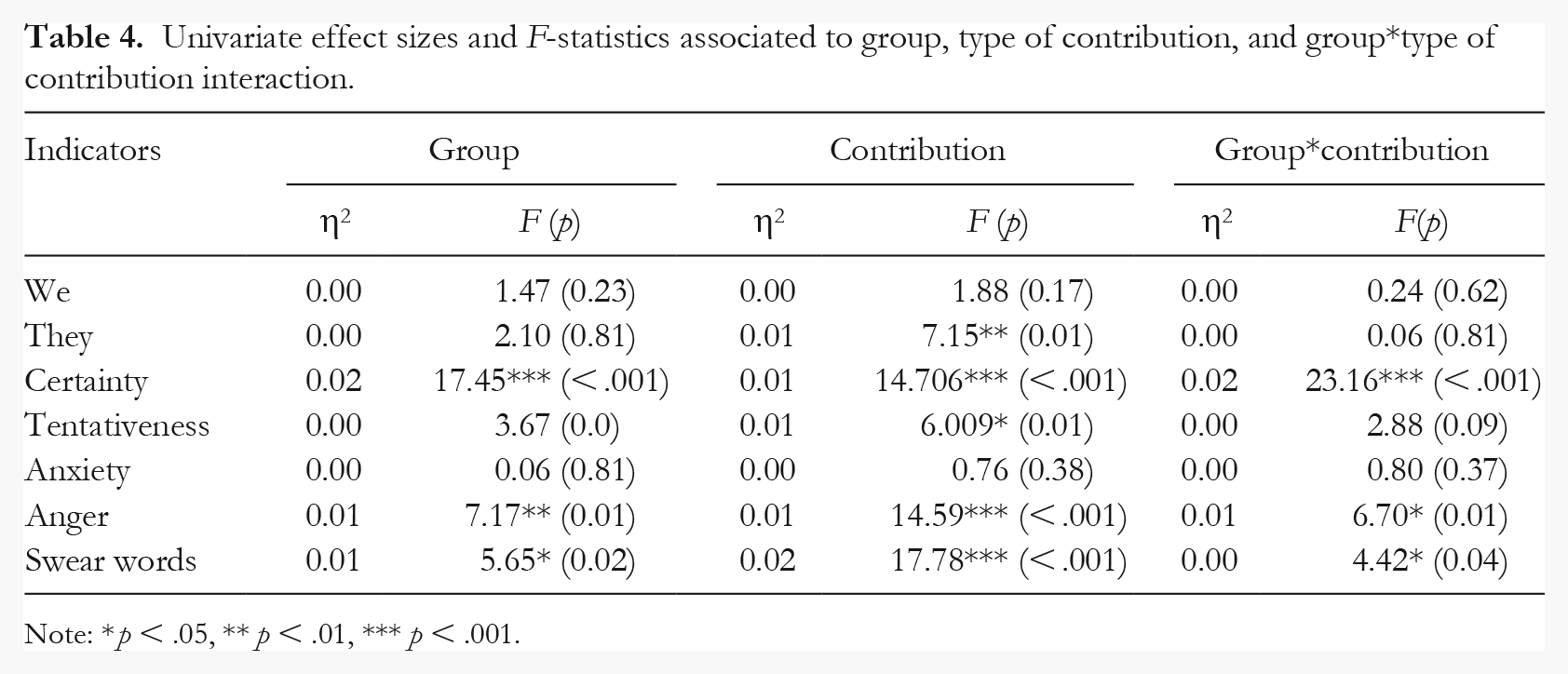
Note: * p < .05, ** p < .01, *** p < .001.
Post hoc analyses were conducted to examine individual mean difference comparisons across the groups and different types of contributions. The assumption of homogeneity of variance was violated for most of the variables so, unless specified otherwise, Games-Howell post hoc comparisons are used. We found a mixed pattern of differences in levels of all the indicators of polarisation across groups and different types of contributions with the exception of anxiety (which did not significantly vary across groups and types of contributions).
Identification
No significant differences were found between levels of use of first-person plural pronouns (e.g., “we”) across contributions from the pro-campaign versus anti-campaign groups. However, the use of these pronouns was significantly higher in comments than in replies (Mdiff = 0.427; t = 2.227, ptukey = .026, Cohen’s d = 0.142), suggesting that online contributors tended to focus on the ingroup (rather than the outgroup) when expressing their ingroup opinion. Significant differences were found in the use of third-person plural pronouns (e.g., “they”), which was significantly higher in replies compared to comments (Mdiff = −0.477; t = −2.742, ptukey = .006, Cohen’s d = 0.176), suggesting that references to outgroup (as “they”) were higher when the ingroup position was endorsed (in replies), rather than when group position was expressed (in comments). However, there was no significant simple interaction effect found for both the use of “we” and “they” pronouns.
Position Certainty
Certainty tended to be higher in posts from the pro-campaign group compared to the anti-campaign group, but the difference did not reach significance (Mdiff = 0.428; t = 1.856, ptukey < .064, Cohen’s d = 0.128). There was no significant difference between levels of certainty in comments versus replies. In the case of tentativeness (as a negative indicator of position certainty) the assumption of homogeneity of variance was met, so we report results of standard post hoc comparisons. Tentativeness was higher in replies compared to the comments (Mdiff = −0.678; t = −2.451, ptukey = .014, Cohen’s d = 0.097), but they were no significant differences between levels of tentativeness across groups (Mdiff = −0.530; t = −1.917, ptukey = .056, Cohen’s d = 0.046). One simple interaction effect was significant, showing that tentativeness in the pro-campaign comments was significantly lower than in anti-campaign replies (Mdiff = −1.208; t = −2.589, ptukey = .048, Cohen’s d = 0.346). These findings suggest that in direct expressions of group position (in comments), there are lower levels of tentativeness than in replies when the group position is endorsed, and this effect is maintained in expressions of group position in the pro-campaign camp (in comparison to when anti-campaign group position is endorsed in replies).
Anxiety
For anxiety, the assumption of homogeneity of variance was met, so we report results of standard post hoc comparisons that show that anxiety did not significantly differ between comments and replies (Mdiff = 0.079; t = 0.874, ptukey = .382, Cohen’s d = 0.034), and between pro-campaign and anti-campaign contributions (Mdiff = 0.022; t = 0.239, ptukey = .811, Cohen’s d = 0.021). No interaction effects were significant.
Hostility
Anger was higher in contributions from the anti-campaign group (Mdiff = −1.716; t = −4.222, ptukey < –0.002, Cohen’s d = 0.254) and higher in comments than in replies (Mdiff = 3.002; t = 5.976, ptukey < .001, Cohen’s d = 0.395). Three simple interactions were also significant. That is, anger was significantly higher in anti-campaign comments compared to pro-campaign comments (Mdiff = −.2.861; t = −3.146, ptukey = .009, Cohen’s d = 0.349), in anti-campaign comments compared to pro-campaign replies (Mdiff = 3.530; t = 6.050, ptukey < .001, Cohen’s d = 0.499), and in anti-campaign comments compared to anti-campaign replies (Mdiff = 3.481; t = 6.326, ptukey < .001, Cohen’s d = 0.441). The use of swear words was higher in comments than in replies (Mdiff = 3.354; t = 5.986, ptukey < .001, Cohen’s d = 0.399), and in contributions from the anti-campaign group compared to those from the pro-campaign group (Mdiff = −1.838; t = −4.300, ptukey < .001, Cohen’s d = 0.253). Again, three simple interactions were significant, the use of swear words being significantly higher in anti-campaign comments compared to pro-campaign comments (Mdiff = −32.565; t = −2.676, ptukey = .038, Cohen’s d = 0.418), to pro-campaign replies (Mdiff = 3.908; t = 6.139, ptukey < .001, Cohen’s d = 0.282), and anti-campaign replies (Mdiff = 3.746; t = 6.239, ptukey < .001, Cohen’s d = 0.442 ). These findings show that intergroup interaction (and in particular in the conflict conditions present when anti-campaign expressions of group position were made) resulted in increased psychological distance as captured by increased hostility in polarised talk.
Thematic Analysis of the Most Debated Comments
To examine whether the most debated themes in polarised talk are pertinent to group identity (H3), we analysed the content of comments that received five or more replies, that is, from a total of 434 comments only 20 received five or more replies. The number of replies for these comments ranged from five to 123 (M = 27.65, SD = 32.43). From these comments, three comments were in favour of the campaign and 27 against. The description of the final themes that emerged from the analysis of the most contentious comments is presented below. Two inter-related key themes were identified: one about the interpretation of the historical narrative regarding the arrival of the first fleet to Australia, and the second about the contested meanings of Australia Day. In line with our predictions, both these themes were debated by using identity-related arguments that were promoting contrastive versions of the Australian identity in a similar way to that found in previous research on the differing meaning of social identity content (Bliuc et al., 2012; Reicher et al., 2006). Table 5 summarises the key themes emerging from the analysis of the most debated comments together with the specific arguments used for each and corresponding illustrative quotations.
Key thematic categories in the most debated comments and illustrative quotations.
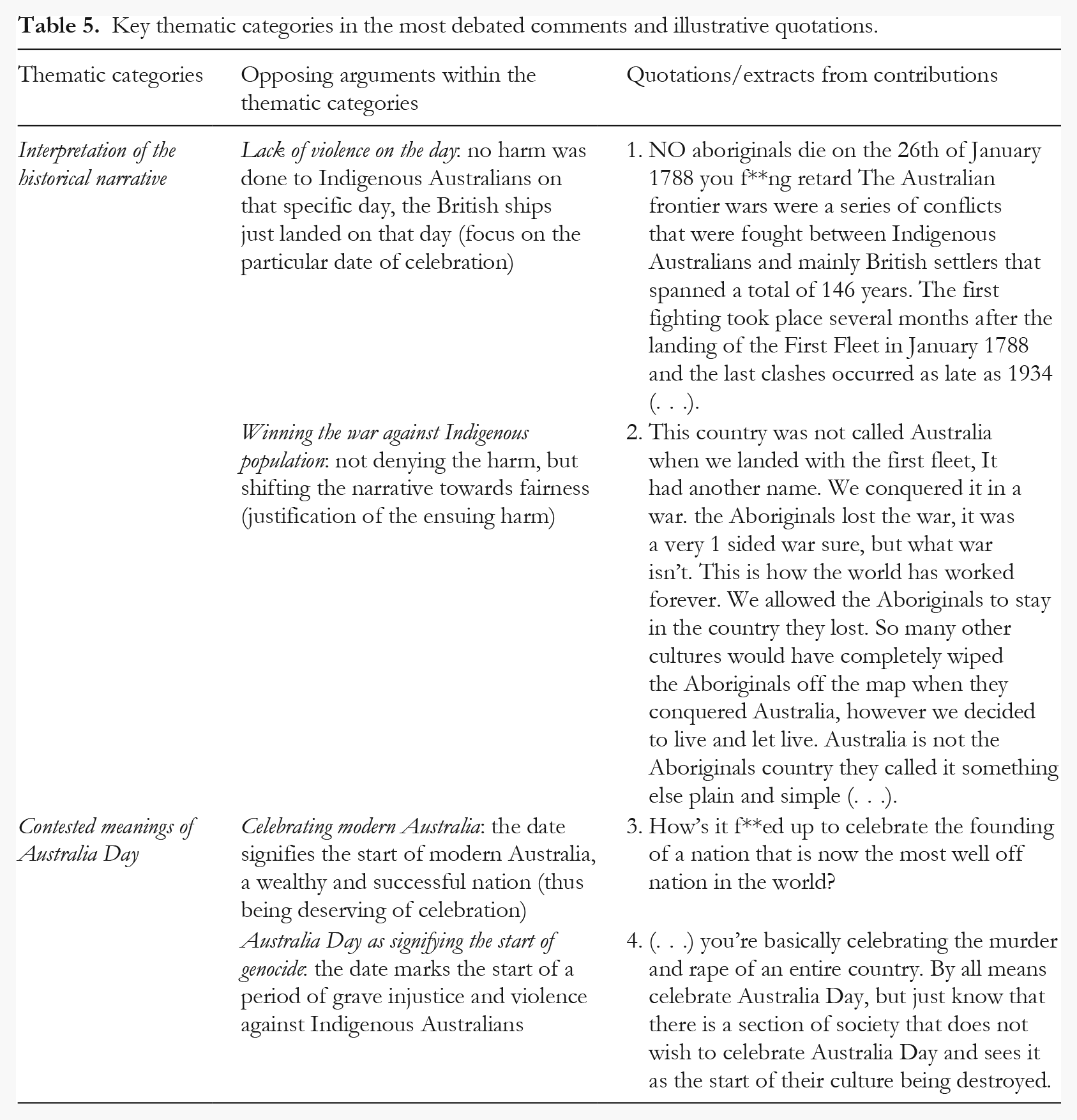
Most narratives about the historic truth were based on the argument that no harm was done to the Indigenous population on that specific day, but this version is contested in contributions that suggest that it does not really matter what happened on that day – the reality is that it marked the beginning of a period of injustice and violence against the Indigenous population. More extreme versions of this narrative see Australia as a country that was conquered through a war which was lost by the original inhabitants (see Extract 2 in Table 5).
The meaning of Australia Day on that particular date was construed in contrasting narratives as either marking the start of a period of grave injustice and violence against Indigenous Australians or marking the start of modern Australia, a wealthy and successful nation (thus being deserving of celebration). This narrative in particular seemed to be linked to the most blatant racist content against Indigenous Australians (in arguments that suggested that as recipients of welfare, Indigenous Australians have the most to gain from the modern state). A less blatantly racist version of this narrative was around calls for unity in celebrating Australia, so that the meaning of Australia Day can be seen as being about celebrating modern Australia not the past (see Extract 4 in Table 5).
Importantly in the context of our predictions (and in particular H3), both of these themes are directly relevant to definitions of the Australian identity and entail distinct values, norms, and emotions. That is, one of the narratives about the historical events around January 26 promotes a version of history about the roots of Australian identity where colonisers had nothing to be feel guilty about (either violence was not committed or if it was, the violence was justified). At the same time, the opposing narrative assigns blames to the colonisers, but at the same time extends the definition of what it means to be Australian by including the Indigenous population. A similar process could be seen in the case of the contrasting narratives about the meaning of the celebration. Again, one narrative promoted an exclusive focus on the present and future of the country, so Australia Day was construed as a celebration of the benefits of modern Australia, while ignoring the past (a positive image of Australian identity is endorsed). The opposing narrative was more focused on the past and promoting reparation for the injustice and harm done to Indigenous Australians by the British colonisers (this narrative recognised the past wrongdoings and proposes a version of national identity that acknowledges guilt and apology).
Discussion
The key aim of this study was to test a dual-pathway model of polarisation that would capture how ideological polarisation can occur both via intragroup interaction (position validation by ingroup) and intergroup interaction (position contestation by outgroup). Specifically, we expected that intragroup interactions would mostly increase confidence in the group position (position certainty, H1), while intergroup interactions would mostly increase ingroup identification (via increased social identity salience due to the intergroup context and increased group-defining position certainty) and group differences resulting in increased psychological distance (as captured by anxiety, hostility, and use of swear words, H2). Interaction was conceptualised as online communication between contributors from opposing ideological camps, so it was also expected that, in terms of the content of communication, the most debated themes would be relevant to the group’s identity (H3). Thus, by analysing the most debated content in the online forum, we expected to be able to detect specific identity-relevant markers of polarised talk in this specific context.
These propositions were tested in opposing ideological camps formed around contrasting narratives about national identity in Australia. That is, we examined differences in polarised talk (captured by linguistic indicators of identification, certainty, tentativeness, anxiety, and hostility – anger and swearing) across different types of social interactions about the “Change the date” campaign in Australia. Our argument was that public division driven by this campaign represents more than a conflict of opinions about when to celebrate Australia Day. Rather, in line with previous work, it encapsulates conflict between psychologically meaningful social identities that are aligned to particular social categories, but are not reducible to these (Bliuc et al., 2019; Bliuc et al., 2015).
The online context of social interactions in response to a YouTube video supporting the “Change the date” campaign in Australia provided ideal conditions to test our theoretical assumptions as captured by the effects of naturalistic interactions between supporters and opponents of the campaign on the indicators of ideological polarisation. That is, comments from supporters of the campaign made directly in response to the video represented intragroup validation (expressing group position as intragroup consensus) while comments from opponents of the campaign represented intergroup invalidation (expressing group position as intergroup dissent). The way in which YouTube is designed to provide opportunities to users to engage with comments, created an opportunity for us to examine the effects of conditions in which there is an indirect expression of intragroup validation and intergroup invalidation. In particular, replies in favour of the campaign were used to endorse consensus (indirect intragroup validation), while replies against the campaign were used to endorse dissent (indirect intergroup invalidation). Thus, this (naturally occurring) structuring of the online social interaction data enabled us to compare different pathways to polarisation and their differential effects on polarised talk in real supporters and opponents of a campaign addressing core defining issues about what a modern Australian national identity may entail. The affordances in study design and data collection provided by this specific online context highlight the value of online platforms, and suggest there may be an important role to be played by such platforms, particularly in regard to theory testing that goes beyond the lab.
In relation to our hypotheses, the support provided by our results is mixed. That is, we found a main effect of the interaction between group and type of contribution on polarisation indicators, suggesting that polarisation is indeed affected by the type of the interactions between members of opposing ideological camps. However, the simple effects of these interactions on various indicators were mixed. In particular, we found that the indicators of hostility (anger and use of swear words) were highest in conditions of direct expression of intergroup dissent. That is, when people interacted with content that contradicted their ingroup ideology, expressions of hostility were at their highest (not surprisingly, higher than in comments and replies from the pro-campaign group, but also higher than anti-campaign replies/expression of endorsement of dissent). In line with our predictions, ingroup position validation (in the form of decreased tentativeness only) was increased in conditions of intragroup validation (when expressing consensus with the ingroup in the form of comments in favour of the campaign). However, contrary to our prediction, group identification as captured by the use of first-person and third-person plural pronouns did not vary across the contributions from different groups (between supporters and opponents of the campaign) in either comments or replies. Rather, our findings suggest that there was a focus on “us” as a collective entity (as reflected in the use of first-person plural pronouns) in conditions of expressing the group’s ideology (rather than when endorsing it). Also, anxiety (as one indicator of psychological distancing) did not significantly change across conditions.
Overall, we found that it is mostly intergroup interaction, when direct dissent is expressed, that drove polarisation, in particular in the form of increased hostility. While this study used a relatively small sample and focused on a specific context, these findings are consistent with research from communication science on online political newsgroups reporting showing that discussion tends to happen between clusters of like-minded groups (via intergroup processes) rather than within these clusters (via intragroup processes, see Kelly et al., 2005). This preference for such discussion may be driven by a motivation to deliberate, debate, and argue rather than agree with others, which is particularly salient in the case of emotionally charged and controversial socio-political issues (Yardi & Boyd, 2010).
Our analysis of qualitative data supports the prediction that the content in the most polarising contributions (most debated comments) consists of core arguments about group identity. Also consistent with previous research on social identity content, our analysis shows that a single social category (e.g., Australian national identity) can incorporate different sets of beliefs, values and associated norms, and therefore division and conflict can occur as a result of contestation of the very basis of the social category (Bliuc et al., 2012; Reicher et al., 2006). Put simply, we show that division and intergroup conflict can occur because of dissent around the meaning of a social category. Furthermore, our findings suggest that debates around the meaning of Australian national identity in this case, were likely conducive of further polarisation between competing groups. Ideally, this theoretical point would be further tested in studies using experimental designs (so causality can be clearly established by investigating whether debates on identity-relevant issues lead to further polarisation between members of opposing groups).
Despite the affordances provided by the online context of our study, there are several limitations imposed by this same context. For instance, our findings are based on the study of polarisation processes in the specific context of online debates about a particular political issue in a particular cultural context; that is, the legitimacy of celebrating Australia’s national day on January 26. We believe, however, that given that the indicators of polarised talk that we used in this study, and the theoretical basis for our hypotheses, are independent of the socio-political context under investigation, it is possible that the same processes and patterns of results can be observed in other contexts. Indeed, we argue that it is likely these findings would apply to other debates about divisive issues in society (including debates about the meaning of national identity but extending beyond these), but future studies should firmly establish whether this is the case. Furthermore, in the current research, these debates are generated by exposure to one video that promotes the “Change the date” campaign. If this research is seen as analogous with studies conducted in the laboratory, this would be the equivalent of drawing conclusions based on a single study. Therefore, we recommend that our propositions should be further tested in the future by (a) using larger samples of online textual data, (b) conducting further studies using similar designs, and (c) using additional indicators and measures of polarisation. These recommendations would also help address the issue of the relatively small magnitude of the effects that we found.
Conclusion
In sum, we found that in an online context of debates around national identity, intergroup interactions increase hostility, while intragroup interactions decrease tentativeness in expressions of group position (in comments). Our qualitative analysis of the most debated contributions suggests that identity debates are at the core of polarised talk in the context of our study. The key implication here is that there appears to be a dual pathway to polarisation but that intergroup and intragroup interactions have varied effects on different indicators of polarisation. Overall, the present study demonstrates that supporters and opponents are not just individuals who hold competing views about what it means to be Australian; rather, they are individuals who belong to distinct and opposing psychological groups that endorse contrasting narratives about Australian identity. Thus, when they interact online they reproduce patterns that may occur within and between other groups in conflict (such as racist and activist groups, see Bliuc et al., 2019; Bliuc et al., 2018; Faulkner & Bliuc, 2018; Smith et al., 2020).
One of the key contributions of this article is that we provide a theory-driven method and blueprint to capture polarisation in social media data. Considering potential applications of our findings, the current study contributes to understanding how online content about a divisive issue (in the context of Australia in this case) brings together members of opposing ideological camps who engage in different types of social interactions within their ingroup and with the outgroup. Online platforms such as YouTube support intergroup communication and provide a platform for potential (cross-group) social learning (Guilbeault et al., 2018), so they can be seen as valuable opportunities for social scientists to study such communication in vivo.
