




Abstract
This survey experiment examined the role of prejudice and moral licensing as two moderators of the secondary transfer effect (STE) of positive and negative intergroup contact. We collected a quota-randomized sample of 299 majority Finns (52.6% female; experimental condition: n = 118, control condition: n = 181) in order to test whether moral credentials prevent attitude generalization (from primary towards secondary outgroup), particularly among prejudiced individuals. The results showed that STEs of both positive and negative contact were prevented among more prejudiced majority group members who had the possibility to obtain moral credentials in the moral licensing task. These results point at the unstable nature of attitude generalization in STE among prejudiced individuals and at the potential of a normative moral act to intervene into the generalization of intergroup attitudes following intergroup contact. We discuss these findings in relation to the literature on moral licensing and moral reinforcement, framing them in the context of an integration of contact research and research on morality in general.
Research has provided impressive evidence for Allport’s (1954) contact hypothesis, affirming that positive interactions between members of different groups can lower prejudice. However, it is impossible to have meaningful contacts with all stigmatized groups in society. Therefore, research has investigated whether the effects of contact with a primary (i.e., contacted) outgroup generalize to more positive attitudes towards secondary (i.e., uncontacted) outgroups, an effect that Pettigrew (1997, 1998, 2009) labelled “secondary transfer effect” (from now on STE).
Despite converging evidence supporting the existence of STE across different contexts (e.g., Schmid et al., 2012), research suffers from two important gaps. Scholars have mostly focused on processes driving the STE of positive contact, with attitudes towards the primary outgroup (POG) as the main mediator (Lolliot et al., 2013; Vezzali & Stathi, in press), but overlooked the STE of negative contact as well as the boundary conditions of STE in general (that is, the moderators; e.g., Lolliot, 2017; Pettigrew & Hewstone, 2017). In this study, we fill these voids by studying the STEs of both positive and negative contact. In addition, we test two potential new moderators of STE, namely, moral credentials and initial prejudice.
Research on contact and morality has been largely unconnected (for exceptions, see Brambilla, Hewstone, & Colucci, 2013; Vezzali et al., 2017, 2019). In this study, we focus on moral licensing (Monin & Miller, 2001). Moral licensing is the inhibition of a subsequent moral act (i.e., displaying lower prejudice towards the target’s outgroup) following an initial moral act (i.e., acting impartially towards a minority target in a normative situation) through the acquisition of moral credentials. We further suggest that the ramifications of moral licensing can interfere with the transfer of the outcomes of contact with an outgroup to a secondary, uncontacted outgroup.
Second, research shows that, in contrast with Allport’s (1954) initial concerns, contact effects are stronger for individuals with higher prejudice (Hodson et al., 2017). Moreover, moral licensing is also rather a characteristic of prejudiced individuals (see Effron et al., 2009). In this study, we thus test initial prejudice as a factor that creates conducive conditions for moral licensing to prevent a STE. Based on research on confirmation bias (Klayman & Ha, 1987) and impression motivation (Chaiken et al., 1996), we suggest that individuals may use moral credentials as a means to confirm their preexisting beliefs of being moral and unbiased towards minority group members. We tested our hypotheses with a survey experiment in a quota-randomized sample of Finnish adults.
Secondary Transfer Effect
Allport (1954) suggested that a person who is prejudiced towards one outgroup is probably also prejudiced towards other outgroups—a phenomenon later recognized as generalized prejudice (e.g., Akrami et al., 2011; Duckitt & Sibley, 2007)—and that intergroup contact has a potential to reduce prejudice. These ideas prompted Pettigrew (1998, 2009) to capitalize on the potential of intergroup contact; not only does it improve attitudes towards a primary outgroup, but it can also extend to secondary outgroups, leading to the introduction of “secondary transfer effect” (STE).
The meta-analysis by Pettigrew and Tropp (2006) found that STE was an understudied topic, with only 18 tests from 12 studies. Nevertheless, there is now solid evidence for STE and attitude generalization (Pettigrew, 2009) as its underlying mechanism provided by correlational (Brylka et al., 2016; Lissitsa & Kushnirovich, 2018; Schmid et al., 2012; Schmid et al., 2014; Tausch et al., 2010, Studies 1–3; Vezzali et al., 2019; Vezzali & Giovannini, 2012), longitudinal (Eller & Abrams, 2004, Study 1; Mähönen & Jasinskaja-Lahti, 2016; Pettigrew, 2009; Tausch et al., 2010, Study 4; van Laar et al., 2005), and experimental (Harwood et al., 2011; Shook et al., 2016) studies.
In this study, we test the conditional STE of both positive and negative contact. Lolliot (2017) has pointed out that with its focus on the beneficial effects of contact, contact theory, including STE research, has been characterized by positivity bias. Research on negative contact has been scarce. It has shown that while the effect of negative contact seems to mirror the positive effect of positive contact, that is, to predispose to more prejudice (Aberson, 2015; Barlow et al., 2012; Stephan et al., 2002), negative contact is, however, qualitatively different from positive contact (see Graf & Paolini, 2017).
Moreover, research on whether STE also occurs for negative contact is only just emerging, although extant evidence seems to point to this direction. Meleady and Forder (2018) found evidence for what they called “avoidance generalization effect,” whereby negative contact with a primary outgroup was associated with reduced intentions to have contact with secondary outgroups. Lissitsa and Kushnirovich (2018) found, however, evidence for the STE of positive but not negative online contact when considering the relationship of Israeli Jews (majority) with Israeli Palestinians (minority) and by testing generalization to non-Israeli Palestinians (secondary outgroup). Brylka et al. (2016) and Mähönen and Jasinskaja-Lahti (2016) have studied the secondary transfer effect of positive and negative contact with the national majority (Finns) on immigrants’ (Estonians and Russians) attitudes towards each other. While they found initial support for the STEs of both positive and negative contact in their cross-sectional study (Brylka et al., 2016), in a longitudinal two-wave design, only the STE of positive but not of negative contact emerged (Mähönen & Jasinskaja-Lahti, 2016). Finally, research on the moderators of STE, especially those of the STE of negative contact, is even more in its infancy. In this study, we suggest taking a closer look at moral licensing and initial prejudice as factors influencing the secondary transfer effect of both positive and negative contact.
Acquisition of Moral Credentials Through a Moral Act: The Moral Licensing Effect
Recent research has shown the central role that morality plays in impression formation and self-presentation (Brambilla et al., 2011; Brambilla et al., 2012; Pagliaro et al., 2013) as a means to communicate one’s positive image to others. Individuals fear being considered immoral and untrustworthy (Rodriguez Mosquera et al., 2002) more than being considered, for instance, incompetent or unsociable (Pagliaro et al., 2016).
Morality also affects interpersonal (Brambilla et al., 2016) and intergroup behavior (Brambilla, Sacchi, et al., 2013; Vezzali et al., 2019). Brambilla, Hewstone, and Colucci (2013) have shown that people are less motivated to interact with targets depicted as lacking moral qualities than with those depicted as highly moral. Moreover, morality has been increasingly connected with prejudice. For example, Pacilli et al. (2016) found that, in the political domain, ingroup identification predicts animalistic dehumanization of the outgroup through the mediation of perceived moral distance between the ingroup and the outgroup. Further, Forsberg et al. (2019) have suggested that generalized prejudice is rooted in a tendency to engage in moral dichotomization (i.e., a tendency to divide people into distinctly moral categories). This provides a rationale to expect morality to also play a role in the effect of intergroup contact (for initial evidence, see Brambilla, Sacchi, et al., 2013; Vezzali et al., 2019).
The inclusion of moral considerations as a factor modifying contact effects may significantly contribute to the understanding of the intention to behave morally, particularly in highly normative intergroup situations (e.g., Kaiser & Scheuthle, 2003). Moral outlook is partly a reflection of internalized and perceived social norms, and the more morally relevant a situation is, the more pronounced is its role in the prediction of intergroup outcomes (Kaiser & Scheuthle, 2003). In order to gain moral accountability and to align to the norms of fairness, people not only justify their prejudices to themselves (Crandall & Eshleman, 2003), but are also motivated to suppress and skill in suppressing prejudice (Crandall et al., 2002).
In line with this, Monin and colleagues suggested that people are particularly worried about their own moral self-regard—that part of the self-concept that indicates the extent to which people think of themselves as a moral person in a particular situation (e.g., Monin & Jordan, 2009). Nevertheless, Monin and colleagues (Monin & Jordan, 2009; Monin & Miller, 2001) documented that bolstering people’s moral self-regard can also liberate them to act in more morally problematic ways in the future. In their work on the so-called moral credentials, participants had the opportunity to engage publicly in moral behavior on one relevant dimension (prejudice). For example, they were able to select an outstanding African American applicant (compared to other White applicants) in a job selection task. In this way, people could acquire moral credentials as nonracist. Interestingly, the authors noticed that this acquired token liberated participants to display an otherwise problematic response later on. In fact, in a second and unrelated job application task, they were more likely to show prejudicial tendencies by not selecting the best qualified African American applicant. This indicates that a former moral act may be detrimental for subsequent behavior, by licensing ethically questionable behavior. This phenomenon has later been referred to as the moral licensing effect (Blanken et al., 2015).
Research evidence supporting the moral licensing phenomenon starts to accumulate (also in domains unrelated to intergroup relations; for a meta-analysis, see Blanken et al., 2015). For example, adopting Monin and Miller’s (2001) research design, Effron et al. (2009) found that those respondents who identified as democrats and indicated that they would support Barack Obama instead of John McCain in presidential elections also showed more ingroup favoritism in the subsequent task (i.e., hired a White police officer more often than they hired a Black police officer). The tendency to favor one’s ingroup did not emerge in the group that did not have the possibility to acquire moral credentials in the first task.
However, the results of two meta-analyses have shown that the effect size of moral licensing is quite modest (Blanken et al., 2015; Simbrunner & Schlegelmilch, 2017). It has also been noted that in some of the studies, initial imagined or actual moral behavior led to more and not less moral behavior (e.g., Carrico et al., 2018; Simbrunner & Schlegelmilch, 2017; Tasimi & Young, 2016; Young et al., 2012). Contradictory to moral licensing effect, this research rather supports the notion of moral consistency (Mullen & Monin, 2016) or even suggests the possibility of a reverse effect of a moral act, which Young et al. (2012) called moral reinforcement (for a review, see Mullen & Monin, 2016).
Considering the difficulties in some previous studies to replicate moral licensing effects (e.g., Blanken et al., 2014) and the publication bias in the field (Blanken et al., 2015), there is a need to better understand the conditions under which moral licensing (or moral reinforcement) occurs, as well as its consequences for intergroup relations. In this study, we consider the extent to which moral licensing depends on prejudice and shapes (i.e., moderates) contact effects in terms of attitude generalization to uninvolved outgroups (i.e., STE). It should be noted that this study analyses different aspects and role of morality than the few studies that have merged contact and morality research before (Brambilla, Hewstone, & Colucci, 2013; Brambilla, Sacchi, et al., 2013; Vezzali et al., 2017; Vezzali et al., 2019). In those studies, contact changed the perceived morality of the outgroup. In this study, in contrast, we consider the consequences of a personal act of morality. In other words, we do not test whether contact changes perceived morality (of the self or of the outgroup); rather, we examine whether an intervening act of morality performed by the individual changes the direction of contact effects.
Importantly, we expect this moderation to occur depending on the initial level of prejudice displayed by participants. There is some preliminary evidence of initial prejudice being a moderator of the effect of moral credentials. In Effron et al.’s (2009) study, moral licensing (racial bias in charity after showing support for Obama) was observed only among the most prejudiced individuals, while the support for racial minorities of moderately prejudiced individuals did not differ from that in the control group. Moreover, there was a trend towards the finding that unprejudiced individuals showed more support for racial minorities after the task. These results suggest that the same moral actions may enable individuals to exhibit later behaviors consistent with their initial attitudes. Therefore, it may be that acting morally translates into moral licensing for prejudiced individuals who hold the underlying goal to discredit outgroups, while it translates into moral consistency or reinforcement for unprejudiced individuals, who confirm their moral identity. In this study, we take one step further and suggest that initial prejudice and moral licensing work in concert in shaping STEs of both positive and negative contact.
The Present Study
This study builds on current research on the secondary transfer effect of intergroup contact (STE; Pettigrew, 2009), and on research on moral licensing (Monin & Miller, 2001), consistency (Mullen & Monin, 2016), and reinforcement (Young et al., 2012), and examines the joint effect of initial prejudice and moral acts on STE. The theoretical model of the study is presented in Figure 1.
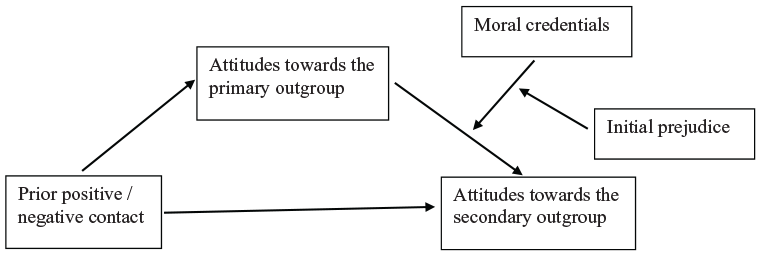
Theoretical model of conditional STE.
First, we investigated the role of the main mediator emerging from STE research, that is, attitude generalization (Lolliot et al., 2013; Vezzali & Stathi, in press). Based on the literature presented before, positive contact should be associated with more positive attitudes towards the secondary outgroup via more positive attitudes towards the primary outgroup (H1a), whereas negative contact should be related to more negative attitudes towards the secondary outgroup via more negative attitudes towards the primary outgroup (H1b).
Second, as the main research question, we studied whether STEs of positive and negative contact are moderated by initial prejudice and morality exhibited in a moral act. Note that in this study we were not interested in contact effects per se, but on whether they generalize to uninvolved outgroups, depending on our two hypothesized moderators. Therefore, once the effects of contact with the primary outgroup on attitudes towards the secondary outgroup were established, we tested whether the generalization of these attitudes stemming from contact occurs depending on moral behavior whose effects might in turn be determined by initial levels of prejudice. Therefore, we assessed a double moderation (of moral behavior and initial prejudice) of the path from the mediator (attitudes toward the primary outgroup) to the dependent variable (attitudes toward the secondary outgroup).
In regard to the STE of positive contact, we investigated whether a moral act, that is, choosing the best qualified job applicant with an immigrant origin, would result in moral licensing among prejudiced individuals, thereby limiting the positive effect of contact to attitudes towards the primary outgroup only (i.e., inhibiting the generalization of the positive effects of positive intergroup contact). In contrast, moral credentials among those with lower initial prejudice would serve as a means to increase expectancy-based attitude accessibility (Descheemaeker et al., 2017) and thus to show moral consistency or reinforcement (H2a).
Concerning the conditional STE of negative contact, it was difficult to make specific predictions, as previous research on the STE of negative contact in general, and conditional STE of negative contact in particular, is almost nonexisting. Following the rationale provided for positive contact, we argue that acquisition of moral credentials may provide the normative contact that determines the direction of effects for high- and low-prejudiced individuals. Specifically, for high-prejudice individuals, acquiring moral credentials may provide the means for perceiving the self as nonracist, in some way “clearing” the self and allowing negative contact to exert stronger effects. In other words, moral licensing should lead to stronger effects of negative contact for individuals high in prejudice. In contrast, for low-prejudice people, moral licensing would make social norms against prejudice accessible, thus blocking the effects of negative contact. In other words, we expect that low-prejudice individuals will show a lower generalization of the effects of negative contact when they acquire moral credentials (H2b).
Moreover, considering that prior negative contact has also been shown to affect the relation between positive contact and outgroup attitudes (Graf & Paolini, 2017) and vice versa (Paolini & McIntyre, 2019), ignoring it might lead to a single factor fallacy and distort the results (Pettigrew & Tropp, 2006). To account for this, we conducted tests of the STE of positive and negative contact by including (a) negative contact as a control variable in the model of the STE of positive contact and (b) positive contact in the model of the STE of negative contact, with both models being mediated by attitude generalization and moderated by moral act and initial prejudice. In order to further provide a more conservative test of our hypotheses, we also controlled for the quantity of initial contact with the secondary outgroup. As stated before, one important critique to STE is that the effects are driven by a process of self-selection, whereby individuals with more contact with the primary outgroup also have more contact with the secondary outgroup (which may explain at least in part attitudes towards the secondary outgroup; e.g., Lolliot, 2017; Lolliot et al., 2013). By partialling out the effects of contact with the secondary outgroup, our findings will reflect the “pure” effect of contact with the primary outgroup and of the other variables investigated.
Finally, we also acknowledge that attitude generalization in STE may depend on the outgroups in question (Harwood et al., 2011; Pettigrew, 2009). In this study, Finnish adults (i.e., majority group) served as the participants, whereas the primary and secondary outgroups were two of the most prominent immigrant groups in Finland (i.e., minority groups). Specifically, we considered immigrants with Russian and Somali backgrounds, which are culturally different but quite similarly (negatively) viewed by the Finnish majority in terms of status (Jaakkola, 2009). By counterbalancing the outgroups, we were able to rule out the possibility that our findings would be dependent on group-specific attitudes.
Method
Participants
In December 2018, 361 majority Finns (i.e., Finnish citizens with either Finnish or Swedish as their mother tongue; 52.6% female; Mage = 47.01 years, SD = 10.59) completed an online survey in exchange for a small amount of money (approx. €1.00) redeemable for gift cards. A private research company collected the data from a large respondent pool consisting of Finnish people. In order to test our predictions—we planned to use multiple regressions with up to 11 predictors, including covariates and interactions—the number of participants was set between 200 and 350 to obtain a sample allowing a power of .80 to detect a small (f2 = .05) to medium (f2 = .10) effect size. Quota randomization (i.e., the demographically matched subsamples) was applied to allocate participants into the different conditions. After some exclusions (see details in what follows), the final sample consisted of 299 respondents (54.5% female; Mage = 46.87 years, SD = 10.62).
Design and Procedure
Participants filled in measures of initial attitudes towards the primary outgroup as well as measures of positive and negative contact with the primary outgroup. Then, they engaged in the experimental manipulation. Participants in the experimental group could acquire moral credentials by hiring an individual belonging to the primary outgroup, while participants in the control group did not have this possibility. Finally, they completed measures of attitudes towards the primary and secondary outgroups. Primary and secondary outgroups were counterbalanced, so that both outgroups served as primary outgroup for half of the sample and as secondary outgroup for the other half.
In the moral task, participants had to make a hiring decision in which they indicated which of five presented applicants they would choose for a position in a large IT company. The task was similar to the one used in Monin and Miller’s (2001) Study 2. Respondents received a brief description of male candidates, including their names, mother tongues, ages, degrees, and previous experiences in the field in years. In all conditions, the fourth applicant was the most qualified: he had a doctoral degree in economics and IT as well as 6 years of experience in the field. The manipulated variable was the ethnic background of the star candidate: in the control condition, the star applicant was a candidate with a traditional Finnish name and Finnish as their mother tongue, whereas in the experimental condition, the star applicant was a member of the assigned primary outgroup with a traditional Somali (Russian) name and Somali (Russian) as their mother tongue. All other applicants were prototypical Finns. Since in moral licensing effect individuals feel that they are licensed to behave dubiously after a moral act (Effron & Conway, 2015), we assessed the effectiveness of the manipulation by asking respondents to report how moral they felt after the experimental manipulation. Finally, we measured attitudes towards the primary and the secondary outgroups.
Final Sample
Due to the fact that only participants who chose the immigrant candidate could be credentialed by choosing him, we excluded 46 participants (nPOG-African = 22; nPOG-Russian = 24) who did not choose the star applicant in the experimental condition; there was no difference by condition, χ2(1, n = 361) = 0.81, p = .37. After this, we further removed 16 participants due to responding not feeling moral in the manipulation check question. The retained sample thus consisted of 299 respondents, of whom 118 were in the experimental and 181 in the control condition.
Measures
Unless otherwise indicated, all items were measured using Likert scales (1 = not at all, 5 = very much).
Initial attitudes towards the primary outgroup (administered before the experimental manipulation)
We used the General Evaluation Scale (Wright et al., 1997), in which we asked participants to evaluate the outgroup on six pairs of adjectives: negative–positive, cold–warm, suspicious–trusting, hostile–friendly, contemptible–respectable, disgusting–admirable (the response scale varied from 1 = very much [negative adjective] to 5 = very much [positive adjective]). The items were averaged, with higher scores reflecting more positive initial attitudes towards the primary outgroup (α = .93).
Contact with the primary outgroup
Four items measured the quantity of prior positive contact, and four items the quantity of prior negative contact. Contact was measured as follows (see Kauff et al., 2016): “How much positive [negative] contact do you have with immigrants with African [Russian] origins [at home, in your free time, at school, or working place]?” For positive contact, the four items were averaged, with higher scores reflecting more contact with the primary outgroup (α = .86). Due to the high skewness (g1 = 0.99) of the negative contact scale, the scale was recoded into a dummy variable (0 = no negative contact, 1 = some negative contact). 1
Attitudes towards primary and secondary outgroups
We employed a single item, the widely used feeling thermometer (Converse et al., 1980). Participants were asked about their general feelings towards the primary outgroup (immigrants with African [Russian] origins) and the secondary outgroup (immigrants with Russian [African] origins). The response scale ranged from 0 (extremely negative) to 100 (extremely positive). The measure reflects the affective dimension of prejudice, which is central to the concept of attitudes (Dixon et al., 2012) and to the prediction of actual discrimination (see meta-analysis by Talaska et al., 2008), and which is also the most responsive to the effect of intergroup contact (Tropp & Pettigrew, 2005).
Control variables
Contact with the secondary outgroup was controlled for, as suggested by many researchers (e.g., Lolliot et al., 2013; Pettigrew, 2009; Tausch et al., 2010). In order to avoid multicollinearity caused by the overlap of two contact measures, we measured the quantity and not the quality of contact with the secondary outgroup with a single item: “In your everyday life, how much contact do you have with immigrants with African [Russian] origins?” In addition, the opposite quality of contact with the primary outgroup (see the measure in the previous lines) was controlled for in the analyses. Finally, educational level (0 = no university degree, 1 = university degree) was controlled for, as it has been shown to have an impact on prejudice (e.g., Wagner & Zick, 1995).
Data Analysis
We conducted mediation analyses (for STE) as well as multiplicated moderated mediation process analyses (for STE moderated by moral act and initial prejudice) using the PROCESS tool for SPSS (Models 4 and 18, respectively; see Hayes, 2017, 2018). We assessed the strength and significance of the indirect effects with 95% bias-corrected bootstrap confidence intervals based on 10,000 bootstrapped resamples (see Hayes, 2018). Preliminary checking of the data indicated a violation of the homoscedasticity assumption, which is why we conducted the analyses with heteroskedastic-consistent standard error estimators (HC3; see Hayes, 2018; Hayes & Cai, 2007).
Before testing our hypotheses, we checked whether STE (PROCESS Model 14) and the effect of moral act on STE (PROCESS Model 18) depend on the outgroups (0 = immigrants with African background, 1 = immigrants with Russian background) studied. Results did not reveal statistically significant effects of counterbalancing primary and secondary outgroups on the STEs of positive contact (B = 1.12, SE = 1.52, 95% CI [−1.85, 4.11]) and negative contact (B = −0.91, SE = 1.97, 95% CI [−4.85, 3.05]), nor on the effect of moral act on positive (B = −4.43, SE = 3.68, 95% CI [−12.24, 2.31]) and negative (B = 3.99, SE = 4.70, 95% CI [−4.54, 13.98]) contact. Based on these results, this variable is not discussed further.
In order to test the main research question, moderated mediation analyses with multiple moderators (moral credentials and initial prejudice) were conducted (PROCESS Model 18). The models represented multiplicative moderation models in which the interaction between the two moderators is included (Hayes, 2018). This is considered to be a more parsimonious way to show how the moderators together interact with the focal predictor and each other, to predict the outcome and to avoid confounding of interaction effects as compared to using separate models or subgroups analysis (Hayes, 2018).
Effects resulting from expected three-way interactions were interpreted based on the bootstrap confidence intervals using the percentile method. Three values along the moderator (i.e., initial prejudice) are probed, corresponding to the 16th (negative attitudes), 50th (neutral attitudes), and 84th (positive attitudes) percentiles of the distribution, as recommended by Hayes (2018). As compared to ±1 SD comparison points, examining percentiles gives us the opportunity to test the hypotheses related to the role of high prejudice in conditional STE and guarantees that the probing points are always within the observed range of the data. It also enables us to quantify the steepness of the bend in the regression line more precisely in subsamples with low, medium, and high values on the moderator, which may also evidence curvilinearity (Hayes, 2017).
Results
Means, standard deviations, and standard errors of the variables are shown in Table 1. The percentage of participants with some experiences of negative contact with the primary outgroup was 63.7% (experimental group 66.7%; control group 60.8%), with the rest of the participants reporting no experiences of negative contact.
Means, standard deviations, and standard errors by condition.
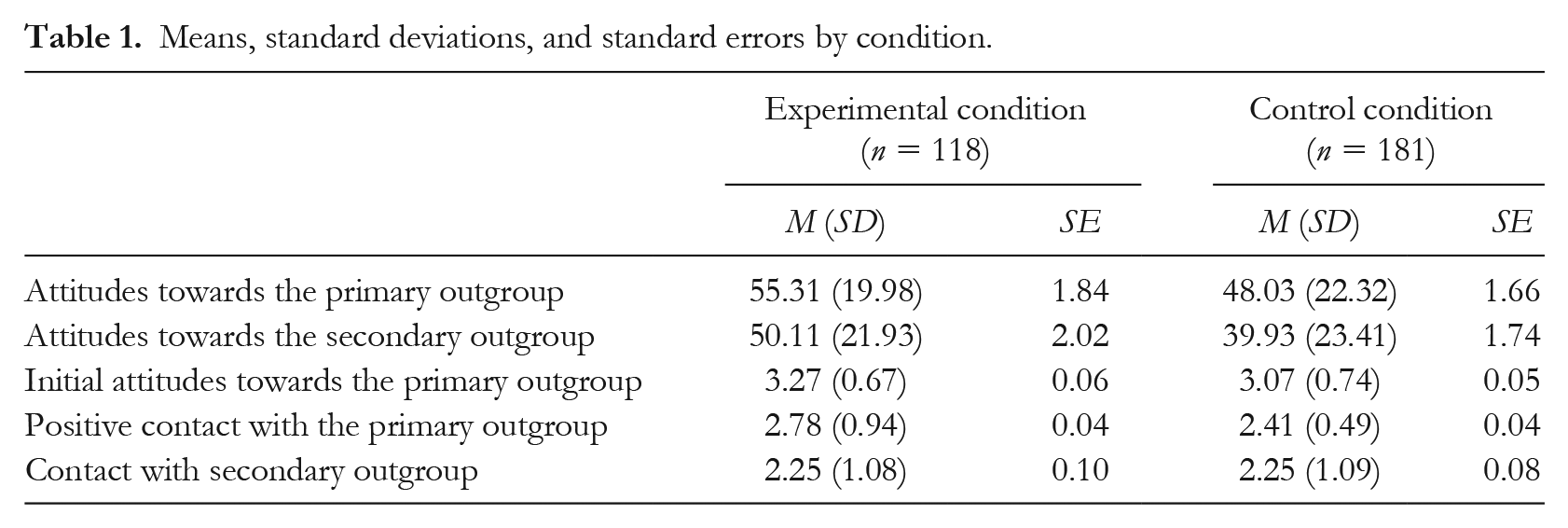
Preliminary tests of the effect of the manipulation showed that after the manipulation, participants in the experimental condition had more positive attitudes towards the primary, t(297) = 2.87, p = .004, and the secondary outgroup, t(297) = 3.77, p < .001, than participants in the control condition. In Table 2, we present Pearson correlations and point-biserial correlations (for a binary variable of negative contact) computed for the experimental and the control conditions separately.
Correlations (Pearson r) and point-biserial correlations (rpb for negative contact with the primary outgroup) between the variables studied in the experimental and control groups separately.
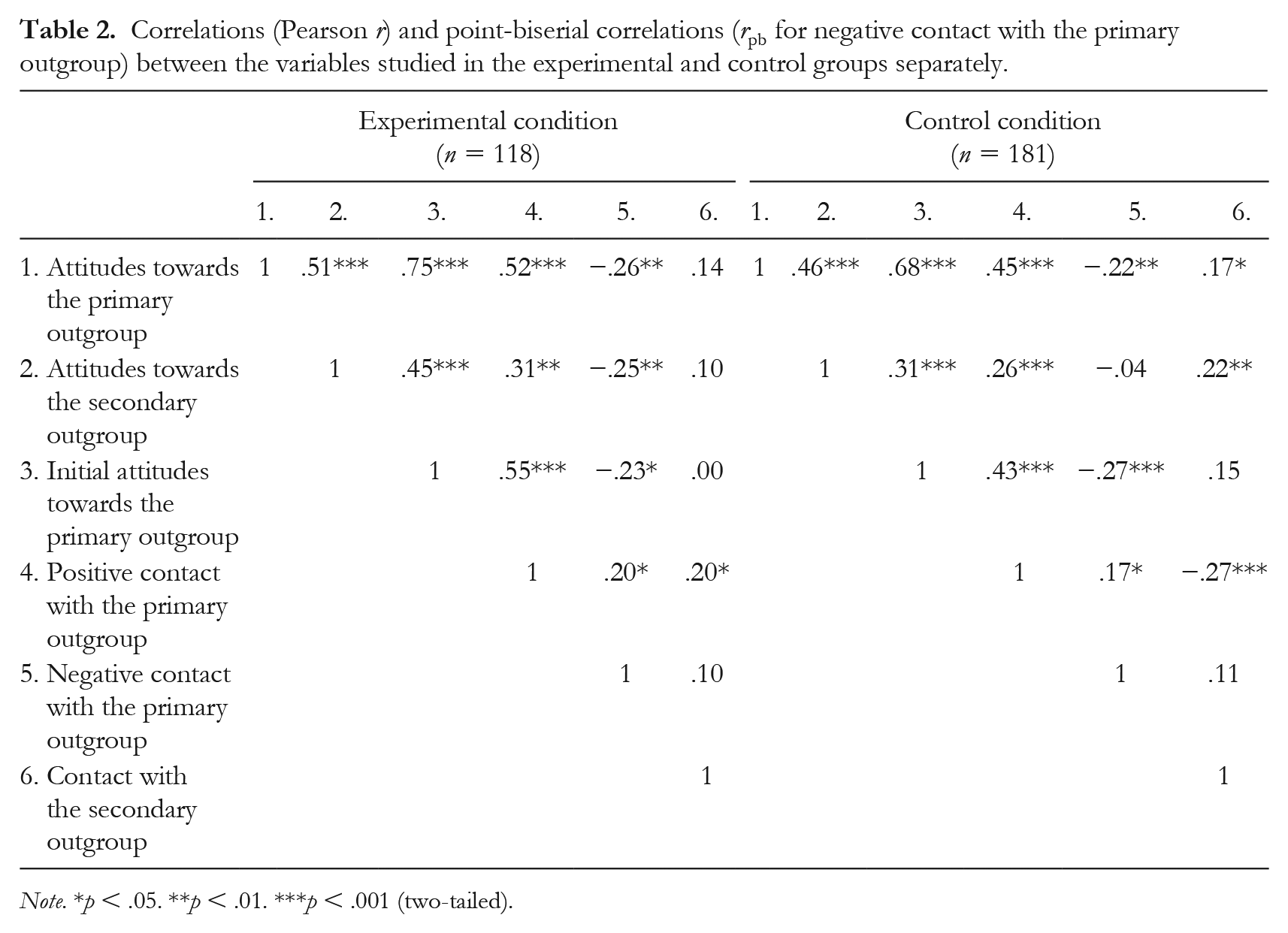
Note. *p < .05. **p < .01. ***p < .001 (two-tailed).
Secondary Transfer Effect
Results of mediation analyses (PROCESS Model 4 with attitudes towards the secondary outgroup [y] being regressed on contact [x] mediated by attitudes towards the primary outgroup [m], and with the opposite quality of contact with primary outgroup, quantity with secondary outgroup, and education as covariates) replicated the STE of both positive and negative contact through attitude generalization (see Table 3).
Secondary transfer effects of positive and negative contact with primary outgroup (CPOG) via attitude generalization—from attitudes towards primary outgroup (POG) to attitudes towards secondary outgroup (SOG).
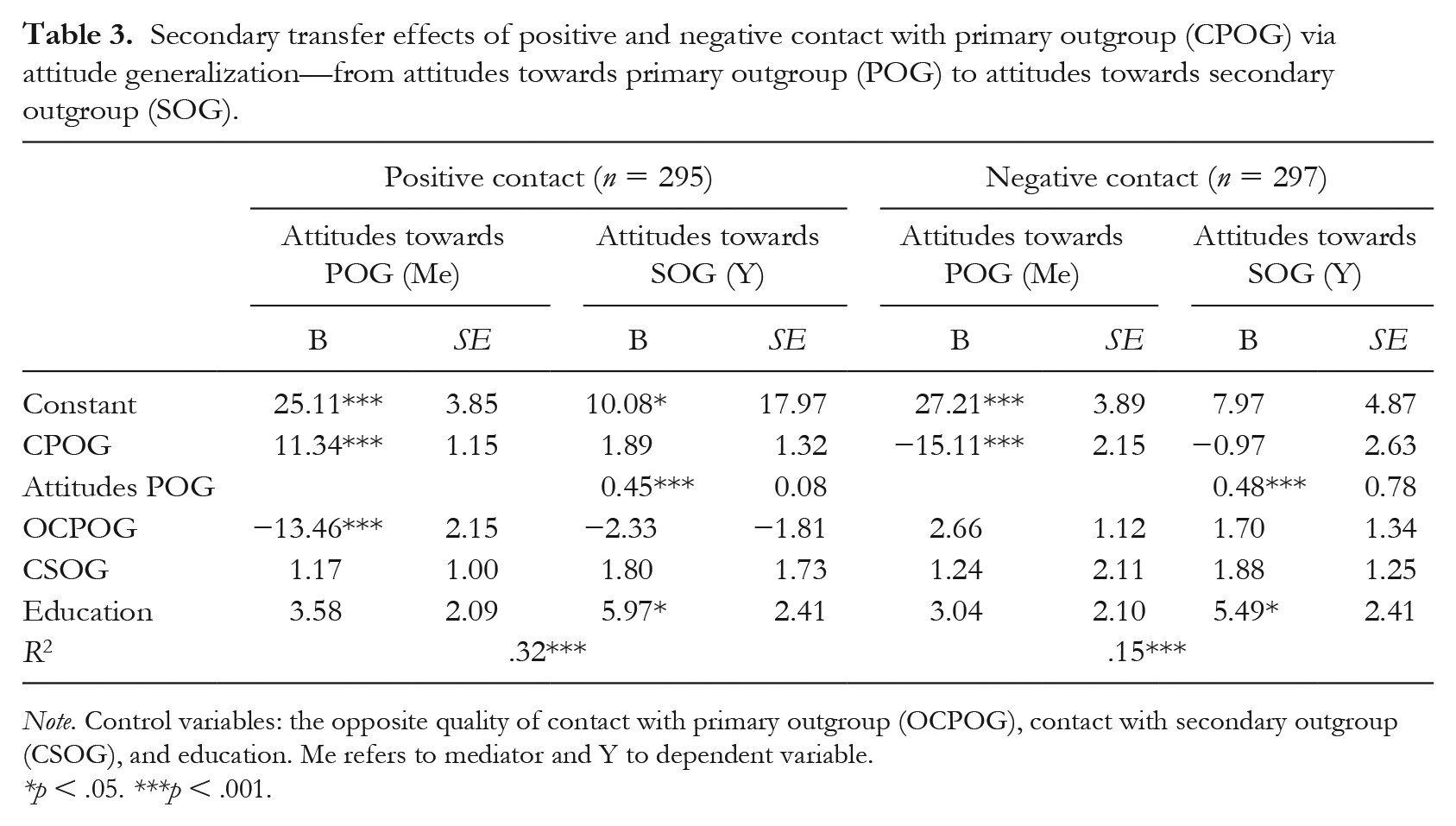
Note. Control variables: the opposite quality of contact with primary outgroup (OCPOG), contact with secondary outgroup (CSOG), and education. Me refers to mediator and Y to dependent variable.
p < .05. ***p < .001.
Specifically, controlling for negative contact, prior positive contact was associated with more positive attitudes towards the primary outgroup, which was further associated with more positive attitudes towards the secondary outgroup. Controlling for positive contact, prior negative contact, in turn, was associated with more negative attitudes towards the primary outgroup, which further predicted more negative attitudes towards the secondary outgroup. With direct effects of positive and negative contact with primary outgroup on attitudes towards secondary outgroup being not significant, significant indirect effects of contact on attitudes towards the secondary outgroup via attitudes towards the primary outgroup emerged for both positive (B = 5.08, SE = 0.93, 95% CI [3.32, 6.95]) and negative (B = −7.32, SE = 1.52, 95% CI [−10.51, −4.52]) contact mediation models, supporting both H1a and H1b. In regard to control variables, there was only a significant effect of education on attitudes towards the secondary outgroup in both models, indicating that higher educated participants had more positive attitudes towards the secondary outgroup.
Conditional STE
In our main analysis (PROCESS Model 18), we tested whether STEs of positive and negative contact depend on condition (moral act) and participants’ initial attitudes towards the primary outgroup. Results are presented in Table 4, and conditional indirect effects of contact, which shed light on the boundaries of STE, are presented in Tables 5 and 6 for positive and negative contact, respectively.
Conditional secondary transfer effects of positive and negative contact with primary outgroup (CPOG) via attitude generalization—from attitudes towards primary outgroup (POG) to attitudes towards secondary outgroup (SOG)—by condition (C; moral licensing) and initial prejudice (IP).
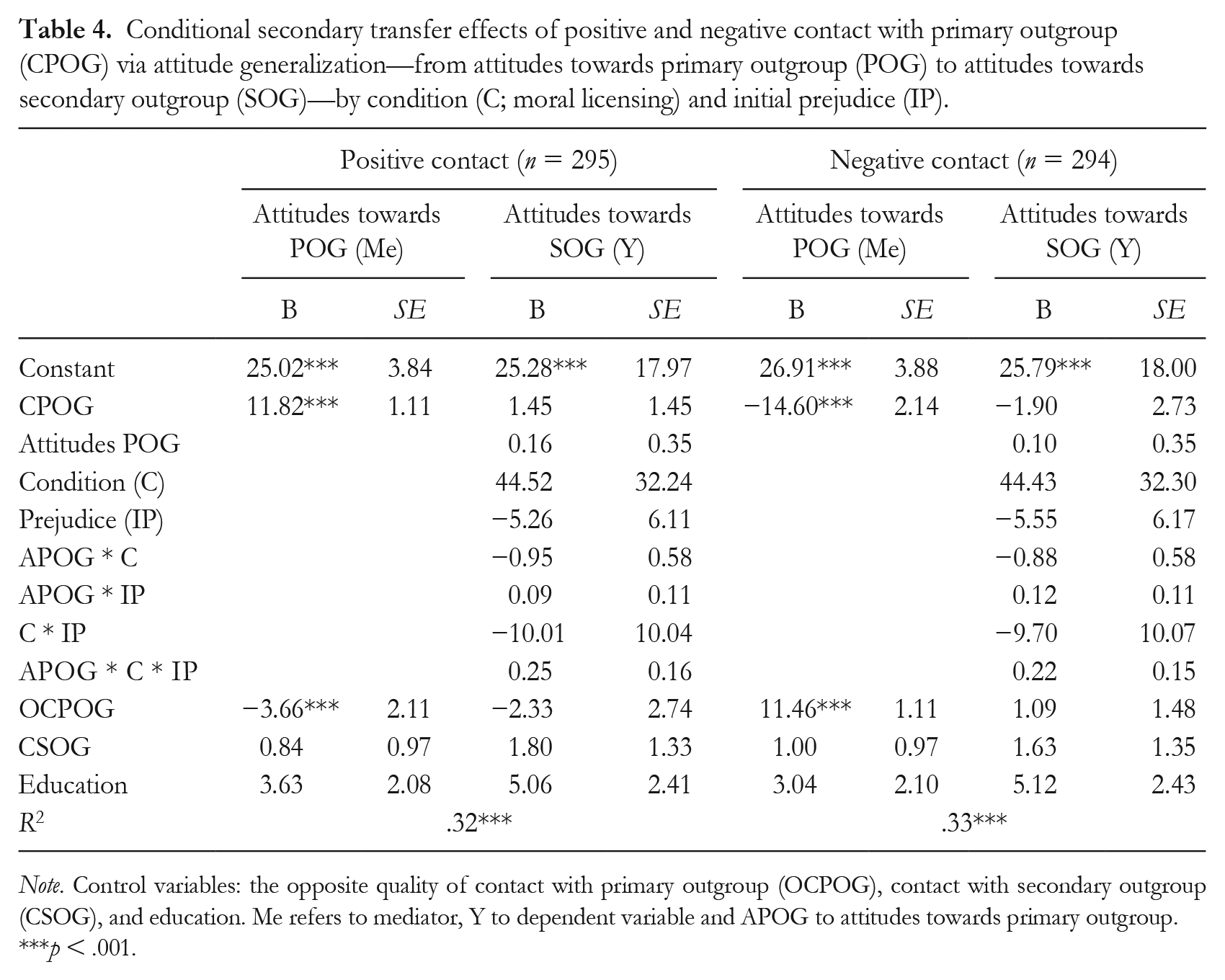
Note. Control variables: the opposite quality of contact with primary outgroup (OCPOG), contact with secondary outgroup (CSOG), and education. Me refers to mediator, Y to dependent variable and APOG to attitudes towards primary outgroup.
p < .001.
Attitudes towards the secondary outgroup via secondary transfer effect of positive contact moderated by moral licensing and initial attitudes (n = 295).
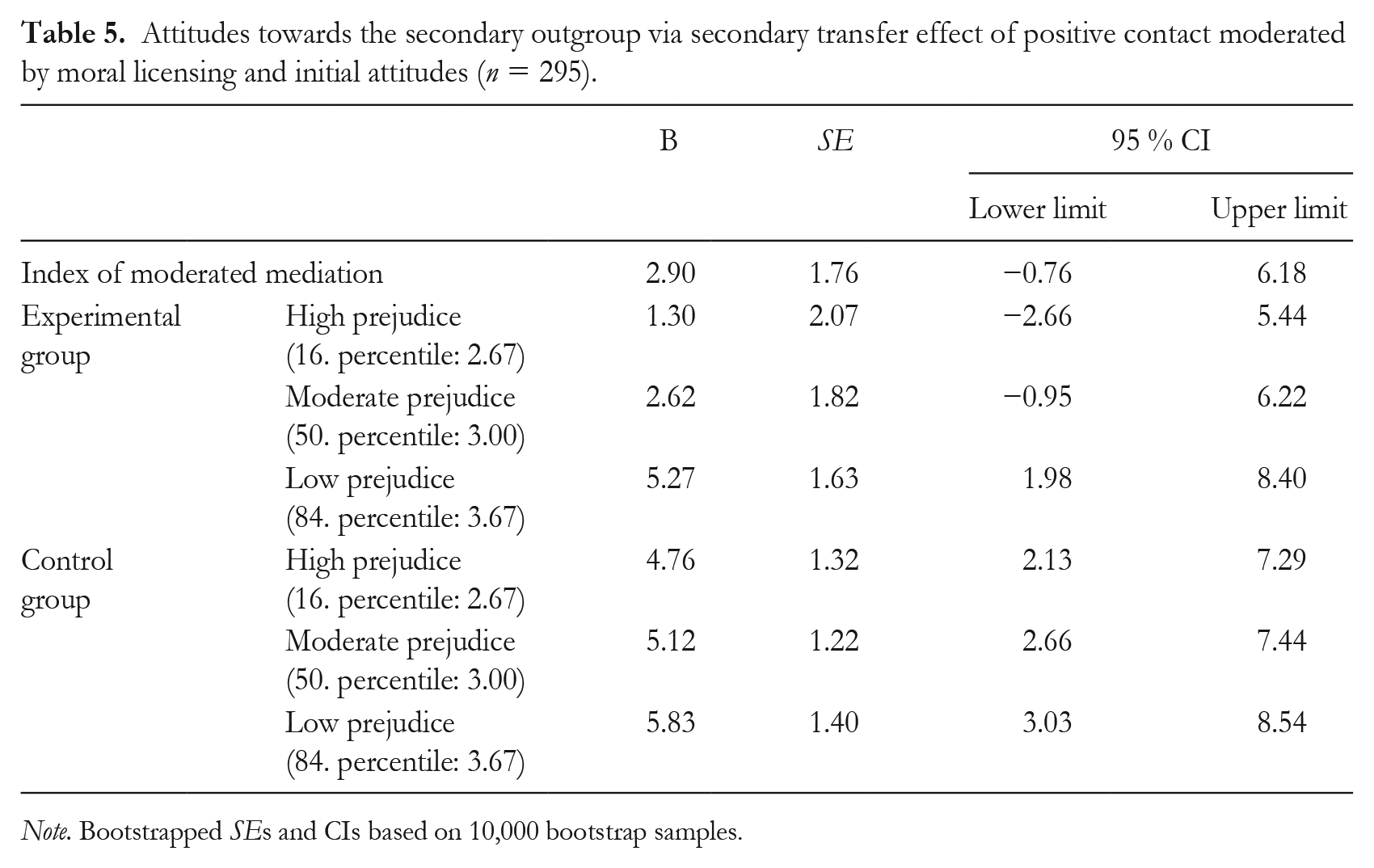
Note. Bootstrapped SEs and CIs based on 10,000 bootstrap samples.
Attitudes towards secondary outgroup via secondary transfer effect of negative contact moderated by moral licensing and initial attitudes (n = 294).
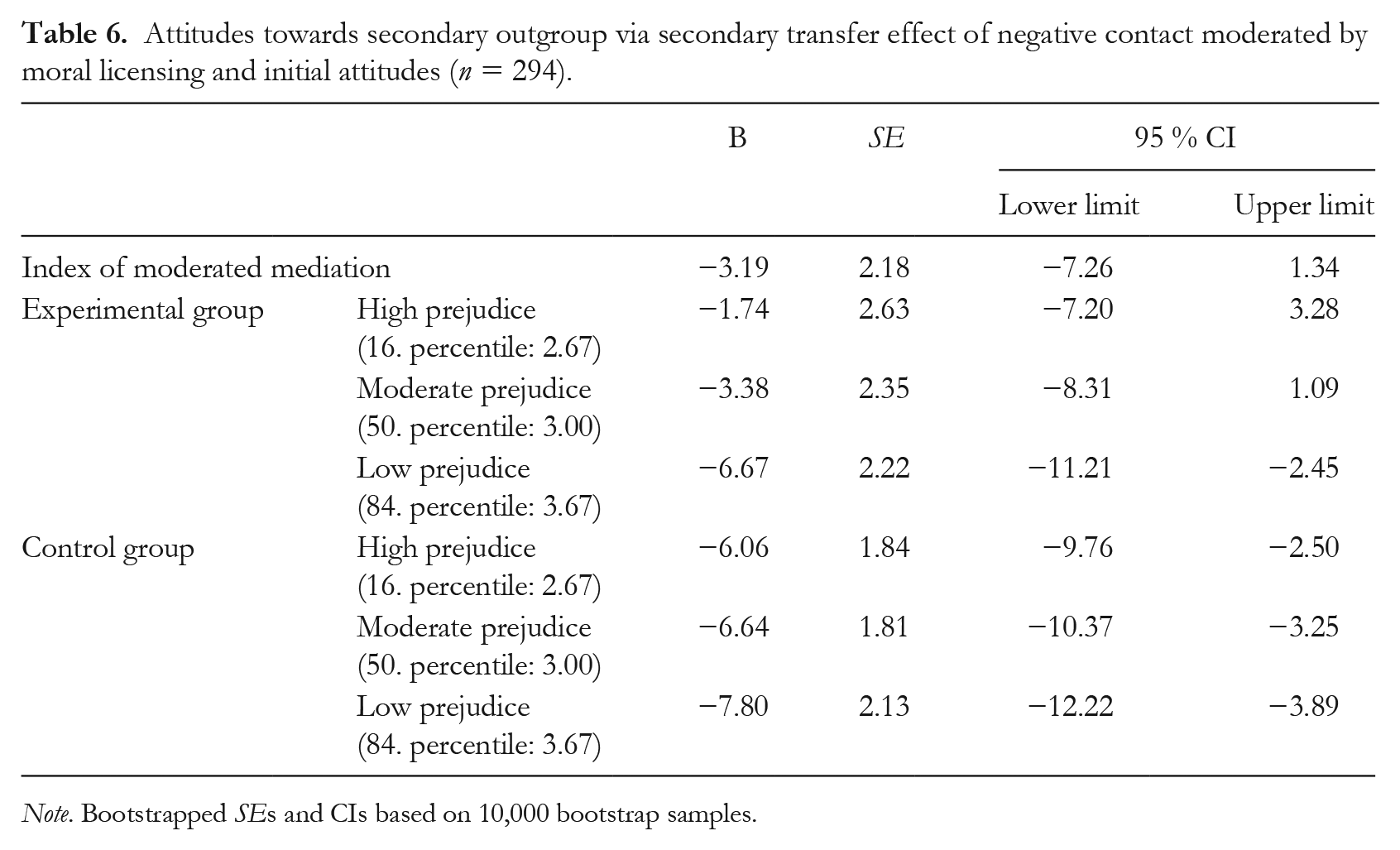
Note. Bootstrapped SEs and CIs based on 10,000 bootstrap samples.
Contact with the primary outgroup was the only significant predictor of attitudes towards the primary outgroup. The expected three-way interaction between contact, condition, and initial attitudes towards the primary outgroup was nonsignificant for both positive and negative contact (see Table 4). This may have been due to the sample size that just reached the minimal requirements to reach the determined effect size, the nonlinearity involved in the associations, as well as to the difficulty of finding complex interactions when using measured variables (McClelland & Judd, 1993).
Because ours was a specific hypothesis-driven research, we decided to decompose the three-way product and look at the indirect effects of contact via attitude generalization among participants with three different levels of initial prejudice (low, moderate, high) in two study conditions (see Tables 5 and 6).
In the model with positive contact as independent variable (see Table 5), the positive effect of prior positive contact with the primary outgroup generalized to attitudes towards the secondary outgroup in both conditions, except for participants in the experimental group (moral act) with initially moderate to high prejudice (50. percentile and below) towards the primary outgroup. In these subgroups, moral licensing effect was evident, as the positive effect of contact was limited only to attitudes towards the primary outgroup, which was also the target group of the moral act. All other participants exhibited intergroup attitudes consistent with their positive contact experiences regardless of whether they had a possibility to obtain moral credentials or not (i.e., they showed moral consistency). Thus, results are generally consistent with H2a, although a significant three-way interaction would have provided full support. The model explained 37% of variance in attitudes towards the secondary outgroup.
In contrast with expectations, we found similar results for the STE of negative contact (see Table 6). Again, the negative effect of prior negative contact with the primary outgroup generalized to attitudes towards the secondary outgroup in both conditions except for participants in the experimental group with initially moderate to high prejudice (50. percentile and below) towards the primary outgroup. In these subgroups, similarly to positive STE and against our hypothesis H2b, STE of negative contact was also blocked by the performed moral act. In other words, attitudes towards the secondary uncontacted outgroup among more prejudiced individuals with moral credentials diverged from their negative contact experiences with the primary outgroup. The model explained again 37% of variance in attitudes towards the secondary outgroup, and the result is again tentative due to the absence of a significant three-way interaction effect.
Finally, the models of unconditional and conditional STE produced the same results also without controlling for the effects of education, opposite quality of contact with the primary outgroup, and contact with the secondary outgroup.
Discussion
The aim of this study was to examine two factors that may inhibit or fuel the emergence of the STE of positive and negative contact: moral licensing and initial prejudice. First, consistent with existing literature (see Lolliot et al., 2013; Vezzali & Stathi, in press), we found evidence for STE via the process of attitude generalization for both positive and negative contact. In other words, we found an indirect association between positive contact and positive attitudes towards the secondary outgroup, and between negative contact and negative attitudes towards the secondary outgroup through positive and negative attitudes towards the primary outgroup, respectively. This result adds to the scarce evidence on the STE of negative contact (see Lolliot, 2017) and on attitudes generalization as the underlying process of both positive and negative STE (see Brylka et al., 2016).
Moreover, we identified some important boundary conditions of STE. Namely, we obtained indications that a moral act, in concert with initial prejudice towards the primary outgroup, can intervene in STE. Specifically, STE via attitude generalization was prevented among participants who held more negative attitudes towards the primary outgroup and had a chance to obtain moral credentials by favoring the outgroup member. Instead, STE occurred in all the other conditions, that is, for low-prejudice individuals and for high-prejudice individuals when there was no possibility for moral licensing.
The interpretation of these findings depends on whether the STE of positive or negative contact is in question. In the case of positive contact, more prejudiced individuals can use the acquisition of moral credentials for impression formation and to justify why they do not generalize contact experiences outside the categories actually involved in contact. There is evidence that individuals may harbor ambivalent attitudes towards the outgroup and manifest prejudice in socially acceptable ways (Mucchi-Faina et al., 2009; Pettigrew & Meertens, 1995). According to the aversive racism framework (Dovidio & Gaertner, 2004), individuals reject blatant prejudice and do not discriminate when a social norm against discrimination is salient. However, when a social norm against discrimination is not salient and individuals can attribute discriminatory attitudes or behaviors to something other than racism, they feel legitimated to discriminate. This is in line with Crandall et al.’s (2002) and Monin and Jordan’s (2009) suggestions that high suppressors of prejudice are acute norm followers, and that particularly prejudiced individuals may rely on moral licensing as a means to appear nonprejudiced. When a social norm of fairness is not salient, individuals do not need to preserve their moral regard as nonprejudiced persons, and they feel “allowed” to discriminate. Therefore, moral licensing “frees” prejudiced individuals from social norms, favoring discrimination.
Our results concerning conditional negative STE showed that the mechanism and boundaries might be similar to those in positive STE, though with different ramifications for intergroup relations. Namely, against our expectations, there were indications that the STE of negative contact could also be blocked by moral licensing among high-prejudice individuals, indicating an asymmetrical influence of performing a moral act on STE: moral licensing for positive STE, and moral reinforcement or consistency for negative STE. Namely, prejudiced individuals may search for confirmation of their negative expectancies anchored to their negative contact experiences and negative attitudes towards the primary outgroup. However, the strong moral norm and subsequent moral behavior favoring outgroup members may intervene and act against the effect of negative contact, thereby also inhibiting a negative STE. Meleady et al. (2019) argued that contact that challenges stereotypic expectations should promote a processing style that avoids the use of immediately and habitually accessible knowledge. It seems that moral norms and instigated moral intergroup behavior may challenge the intergroup attitudes of prejudiced individuals and prevent the STE of their negative contact experiences.
These are tentative results, as previous research on moderators of negative contact is scarce (Lolliot, 2017). Paolini and colleagues (Graf & Paolini, 2017; Paolini et al., 2010; Paolini et al., 2014) argued that membership salience might be a key factor in understanding the effects of negative contact and in explaining the stronger effects that have sometimes been found for negative rather than for positive contact (e.g., Barlow et al., 2012; but see Árnadóttir et al., 2018; Bagci & Turnuklu, 2019). Negative contact has been shown to be associated with category salience (e.g., Árnadóttir et al., 2018; Dhont & van Hiel, 2009, Study 2; Mähönen et al., 2013; Wang et al., 2019) more than positive contact. It is therefore possible that moral licensing prevents attitude generalization of negative STE among prejudiced individuals: they are aware of group memberships but find themselves in an intergroup situation contradicting their experiences and experience-based expectations. Our findings may thus refer to moral reinforcement of prejudiced individuals with a negative intergroup contact history.
Our study sheds some light on and clarifies the dynamics involved in the moral licensing phenomenon. It seems that moral licensing could have extended ramifications. While in moral licensing research (e.g., Effron et al., 2009; Effron et al., 2012; Kouchaki, 2011; Merritt et al., 2012; Monin & Miller, 2001) moral licensing effect is typically negative and tested only in relation to the primary outgroup, we obtained indications that moral licensing effect can be positive and extend to the secondary outgroup. Moreover, we showed that it only occurs when generalized prejudice steps in. Namely, in our study, moral credentials reinforced positive attitudes towards both primary and secondary outgroups (diminished specific prejudices) among participants. Though contrary to Monin and Miller’s (2001) study, this result is in line with previous studies suggesting that moral credentials do not necessarily lead to more negative attitudes and behaviors, as they might serve as a prime of positive intergroup relations and improve group-specific attitudes (Nelson & Norton, 2005; Tasimi & Young, 2016; Young et al., 2012).
In this study, we were not interested in attitudes resulting from moral licensing per se; instead, we examined how positive and negative contact differentially result in a possible STE depending on moral licensing (and initial prejudice). Our results show that the moral licensing effect may be far more reaching than previously thought, as its ramifications could be seen in reactions towards groups beyond the primary contact: moral licensing counteracted the effects of contact and prevented (for high-prejudice individuals) attitude generalization to uninvolved (secondary) outgroups. We are inclined to suggest that our results show the instability of both positive and negative STE among highly prejudiced individuals, and the potential of a moral act to intervene in the generalization of prejudice. This could explain why it is not uncommon that people justify their prejudices by referring to their prior positive encounters with and acts towards some particular minority groups.
This study is not without limitations. First, it is not a randomized trial, and therefore causal inferences are not possible. Second, although the pattern of findings was generally consistent with our expectations, the expected moderated mediation indices did not reach statistical significance. Larger samples would be more likely to detect complex three-way interactions, which are especially difficult to obtain with the use of measured variables (McClelland & Judd, 1993). Also, for both positive and negative contact, we expected a difference in only one out of six cells (three levels of prejudice by two experimental conditions), which lowered the likelihood of finding a significant interaction. Note that we decomposed interactions justified by very specific theory-driven hypotheses (at least in the case of positive contact). The absence of a significant moderated mediation effect does not detract from the fact that STE was blocked in four out of the 12 possible combinations of results.
Third, we assessed contact with the secondary outgroup with a measure of contact quantity without including a measure of contact quality. This was done for conceptual and methodological reasons. Conceptually, we aimed to partial out previous exposure to the secondary outgroup independently of its valence, and contact quantity should provide this measure. Second, we aimed to avoid multicollinearity of the independent measures. However, in order to be more conservative, future studies might consider including a measure of both positive and negative contact with the secondary outgroup.
Despite these limitations, our findings add to the scarce literature on the integration between contact research and research on morality. The literature has shown that, generally, contact benefits more high-prejudiced individuals such that contact effects on reducing prejudice are stronger for individuals with more negative outgroup attitudes (Hodson et al., 2017). The present findings contribute to this literature in a novel way, by showing how the acquisition of moral credentials can prevent attitude generalization of positive and negative contact for more prejudiced individuals. Based on the present results, we argue that, although contact can be more beneficial for more prejudiced individuals, these individuals are also those that may find subtle ways to avoid these beneficial effects, such as using the acquisition of moral credentials as an excuse not to reduce generalized prejudice. The present findings also sensibly extend the literature on morality and, specifically, on moral licensing. In addition to providing converging evidence for the relevance of moral licensing in the intergroup relations domain, they show that moral licensing is relevant to prejudice reduction, and provide a bridge between literature on morality and research on subtle and modern prejudice, such as aversive racism (Dovidio & Gaertner, 2004). Future research is, however, needed to understand the boundary conditions of STE, to expand the research on the STE of negative contact, and to show how morality can fuel it or rather be instrumentally used to justify existing discrimination and inequality.
