




Abstract
In this paper we present three studies that address the difference between physical and psychological groups, the conditions that create a transformation from the one into the other, and the psychological processes underlying this transformation. In Study 1 we demonstrate correlations between shared social identity, desired physical proximity to others, and positive emotions in the company of others. Study 2, employing a between-subjects design, finds that an event that creates shared fate, such as the breakdown of a train, leads to greater comfort in social interactions (e.g., ease of conversation) and comfort in sensual interactions (e.g., tolerance of physical touch) with other passengers, and that this occurs through an increase in shared social identity but not through social identification. Study 3 obtains similar findings using a within-subjects design. In combination, these studies provide consistent evidence for the role of shared social identity in the emergence of psychological groups from physical groups.
Keywords
Introduction
I do not know how many honourable members travel, as I do, on trains. I travel regularly on them and I see all the little business men with their calculators working out their cash flow forecasts and I see frowning people glaring at each other. They are Thatcherite trains—the trains of the competitive society. On the way from Chesterfield the other day the train broke down and suddenly everything seemed to change. Somebody came into the carriage and said, “Would you like a cup of tea from my Thermos?” People looked after each other’s children, and after a young couple had been speaking to me for perhaps half an hour, I asked them, “Have you been married long?” They replied, “We met on the train.” Another woman asked somebody, “Will you get off at Derby and phone my son in Swansea, because he will be worried?” By the time we got to London we were a socialist train.
For many years, we have used this anecdote in talks and in lectures to illustrate a foundational issue in social psychology: what is a social group? More specifically, it speaks to the distinction between a physical and a psychological group: the former, an agglomeration of people at the same point in space and time; the latter, a set of people who think of themselves in terms of membership of a common social category (Reicher, 2011; Turner, 1982). Thus, within a physical group, one may have no psychological groups (as in people crammed into a railway carriage but thinking of themselves as individuals), one psychological group (as when a breakdown creates a common sense of being aggrieved commuters let down by the train company), or even multiple psychological groups (as when supporters of rival teams are travelling home from a game on the same train). What is more, as people shift from being psychologically separate individuals, even though physically gathered together, to sharing a common social identity, so behaviour shifts. People start attending to each other, talking to each other, perhaps even sharing their flask of tea. Estrangement gives way to intimacy.
The anecdote always elicits a knowing smile from audiences. It works well as an illustration of the difference between mere physical copresence and psychological groupness (and of cognitive/behavioural shifts which flow from psychological group membership) because the experience is familiar to so many. Yet an anecdote is not science. At first, we assumed that there must already be a systematic body of evidence addressing the emergence of psychological groups from physical groups and demonstrating the differences between the two. But as we searched, we discovered that it does not exist. Given the importance of the distinctions, it is urgent that the gap is filled—and this paper reports three studies aimed at doing so.
On Shared Social Identity and Group Behaviour
For sure, there is a plethora of research that bears on the questions we have raised. Most obviously, there is now some 40 years of research demonstrating the transformative power of social identity processes in groups (for summaries, see Postmes & Branscombe, 2010; Reicher et al., 2010). Whereas early work focussed on cognitive and behavioural shifts, more recent work has addressed emotional shifts (Parkinson et al., 2005) and—of particular relevance here—changes in social relations. When it comes to explaining these latter changes, we argue, the key psychological construct is shared social identity. Shared social identity leads to trust, respect, cooperation, help, and support between group members—in sum, a shift towards intimacy (Neville & Reicher, 2011; Reicher & Haslam, 2010; Tyler & Blader, 2001). It is the basis for effective coaction in the group (Drury & Reicher, in press).
Given the centrality of this construct, it is important to provide a clear definition and to distinguish it from cognate constructs. Shared social identity refers to a set of people who view each other as members of a common social group. In colloquial terms, it refers to a sense of “we-ness.” It is therefore not just about the ways I view the group. In this it differs from the concept of entitativity, which refers to the perception of the group as a coherent entity (Lickel et al., 2000). Nor is it just about how we view ourselves. In this it differs from the concept of social identification, which refers to the perception of oneself as a member of a social category (Tajfel, 1978). Rather, shared social identity is a reflexive construct that combines both elements. It is about seeing myself and seeing others as united through belonging to a common category, and about assuming others do likewise. Because I see others as fellow group members, I am intimate with them; because I assume others see me as a fellow group member, I assume they will be intimate with me. Together, these constitute the glue that allows group members to work together effectively.
Despite the significance of these distinctions, they are not always clearly observed. Even within the social identity literature, social identification and shared social identity are not always distinguished from each other. And yet a simple pair of examples illustrates how different they are, and how they have very different consequences in terms of how one relates to others.
So, to start, imagine that you are in a bar watching election results. Your political social identity would be highly salient and would strongly shape your cognitions about the information that was conveyed. But you might feel no shared social identity with the others who are present—either bored by the results or supporting the other side. You would have no sense of affinity to them and no pleasure in their company. By contrast, imagine being at a political rally of your favoured party and candidate. Here, not only would your political identity be salient, but you would also have a sense of common identity with others at the rally. You would feel both affinity and positivity at their shared enthusiasm related to your shared politics.
But the issues with shared social identity are not only conceptual. They are also empirical. Such work, as has previously been done into the impact of shared social identity on relational shifts in groups, generally either contrasts the behaviour of individuals who do or do not identify with the group, or contrasts the way we treat ingroup members to the way we treat outgroup members. It does not specifically contrast physical and psychological groups by showing what happens when shared social identity emerges amongst those who are already gathered together.
One exception to this lies in recent social identity analyses of behaviour in emergencies and disasters. Here, it has been argued that such events often lead to a sense of common fate and thereby shared social identity amongst gatherings of people, and that the solidarity that is generated from this makes survivors both resilient and effective (Drury, 2012, 2018; Drury et al., 2009). Another exception lies in work on religious mass gatherings such as the hajj to Mecca and the Magh Mela in Allahabad, Northern India. Again, the argument has been that the event itself creates shared social identity (here, because people assume that those who are copresent in a highly charged religious space are common devotees) and this leads to a number of consequences including cooperation, mutual solidarity, and a positivity towards the presence of others (Alnabulsi & Drury, 2014; Alnabulsi et al., 2018; Hopkins et al., 2019; Hopkins et al., 2015; Khan et al., 2015).
But while it gets closer to the topic of the current paper, previous work still does not quite demonstrate that events which produce shared social identity transform a physical into a psychological crowd, with transformed emotions and social relations as well as cognitions. Some of the work is qualitative and some is correlational. Neither can therefore establish systematic causal pathways. Moreover, as with the wider social identity literature, most studies fail to make a clear distinction between strength of identification and shared social identity as the root of transformation.
In sum, while there is ample work that suggests the emergence of shared social identity as the critical factor in turning a physical group into a psychological group, there are no clear studies to demonstrate that it is the case. What is lacking is a set of studies that (a) demonstrate the impact of shared social identity on intragroup relations; (b) demonstrate that the key variable leading to intimacy with and positivity towards others in a psychological group is shared social identity rather than simply strength of identification; and (c) demonstrate that the emergence of shared social identity in a physical group transforms those present into a psychological group in which individuals are positive and supportive towards each other.
The Present Research
This paper addresses these research gaps in three studies that employ a visualisation paradigm, adapted from Garcia et al. (2002) and Levine and Crowther (2008), in which participants are asked to imagine travelling on a crowded train. Study 1 measures their sense of shared social identity with their fellow travellers and how this relates to their affect/desired proximity towards these others. Studies 2 and 3 then examine the impact of a shared event (train breakdown) on both shared social identity with fellow travellers and passenger strength of identification, along with the respective ability of these variables to predict the quality of relations amongst passengers. Study 2 employs a between-subjects design. Study 3 employs a within-subjects design and therefore directly addresses the transformation of social relations within the same set of participants.
Study 1
In Study 1 we employ a correlational design to pilot the imaginary crowded train carriage paradigm, and to explore the relationships between shared social identity, affect, and desired physical proximity within the visualised crowd. In this study participants imagine that they are on a crowded train with England football (soccer) fans. We expect that participants who have a strong sense of shared social identity with these fans will imagine their fellow passengers as being part of their social self rather than other, and that this will be related to a more positive experience and less desire for “personal space.” We therefore expect shared social identity to positively correlate with positive affect, and to negatively correlate with negative affect and with desire for greater physical distance from other passengers.
Method
Participants
Fifty-three students at the University of Sussex participated in the study. Their ages ranged from 18 to 48 (M = 25.64, SD = 8.68; 34 female, 19 male). Participants were not paid for taking part in the study. A power analysis was not conducted for Study 1 as it functioned to pilot the visualisation paradigm.
Measures
The complete items used in all three studies are available as supplemental material.
Shared social identity
Shared social identity was measured using eight items adapted from Leach et al.’s (2008) group solidarity, identity centrality, and individual self-stereotyping dimensions, such that items specifically referred to shared identification with others within the crowd (e.g., “I have a lot in common with the football fans who were on the train carriage with me in my visualisation”; α = .88). All items used a 7-point Likert-type scale (1 = strongly disagree, 7 = strongly agree).
Desired distance
Three novel items measured desired distance from other crowd members, with higher scores indicating a desire for more space (e.g., “I would have preferred to have been standing further away from the football fans on the carriage in my visualisation”; α = .77).
Positive and negative affect
Participants’ subjective positive and negative affect were measured using the 20-item Positive and Negative Affect Schedule (PANAS; Watson et al., 1988) by indicating the extent to which various words represented their current affective state (1 = very slightly or not at all, 5 = extremely). The positive items (e.g., “enthusiastic”; α = .78) and the negative items (e.g., “scared”; α = .81) were summed into separate scores out of 50.
Procedure
Based on the procedure described in Levine and Crowther (2008), participants were invited to take part in a study purportedly investigating how images are conjured in the mind. Potential participants were approached by a member of the research team outside the university library. Only people who were sitting alone were approached to ensure that participants did not confer with one another when completing the tasks. Having given consent to take part, participants were requested to work through the pen-and-paper study materials in the order in which they were presented, and to complete the study alone. Participants were asked to visualise the following scenario in as much detail as possible, and to spend 2 minutes writing down anything from their visualisation which they thought was important:
You have been employed as an intern. Your boss has invited you to join him to watch the upcoming England v Belarus World Cup qualifying match at Wembley Stadium. He has given you a free ticket and has arranged to meet you at the stadium. You are travelling to Wembley on the London Underground. Imagine that you are standing in a crowded train carriage. The carriage is packed full with England fans who are chanting loudly. There are people in front of you, behind you, and to your sides.
Following this task, participants were prompted to complete the questionnaire with the shared social identity, desired distance, and affect items.
Results
Age did not significantly correlate with any of the other variables and so is excluded from the analysis. There was a significant effect of gender on shared social identity such that male participants (M = 3.13, SD = 1.03) reported higher scores than females (M = 2.22, SD = 1.01), t(51) = 2.91, p = .005, d = 0.84. Consequently, gender is controlled for in the analysis.
Descriptive statistics and correlations
Table 1 shows the descriptive statistics and partial correlation matrix (controlling for gender) for the four variables measured after the visualisation task. As expected, high levels of shared social identity with the England supporters on the train carriage were associated with high levels of positive affect, r(50) = .45, p = .001, 95% CI [0.13, 0.66], and low levels of negative affect, r(50) = −.51, p < .001, 95% CI [−0.67, −0.31]. As predicted, shared social identity was also significantly negatively associated with desire for greater physical distance from other passengers, r(50) = −.61, p < .001, 95% CI [−0.77, −0.42].
Study 1 descriptive statistics and partial correlations (controlling for gender).
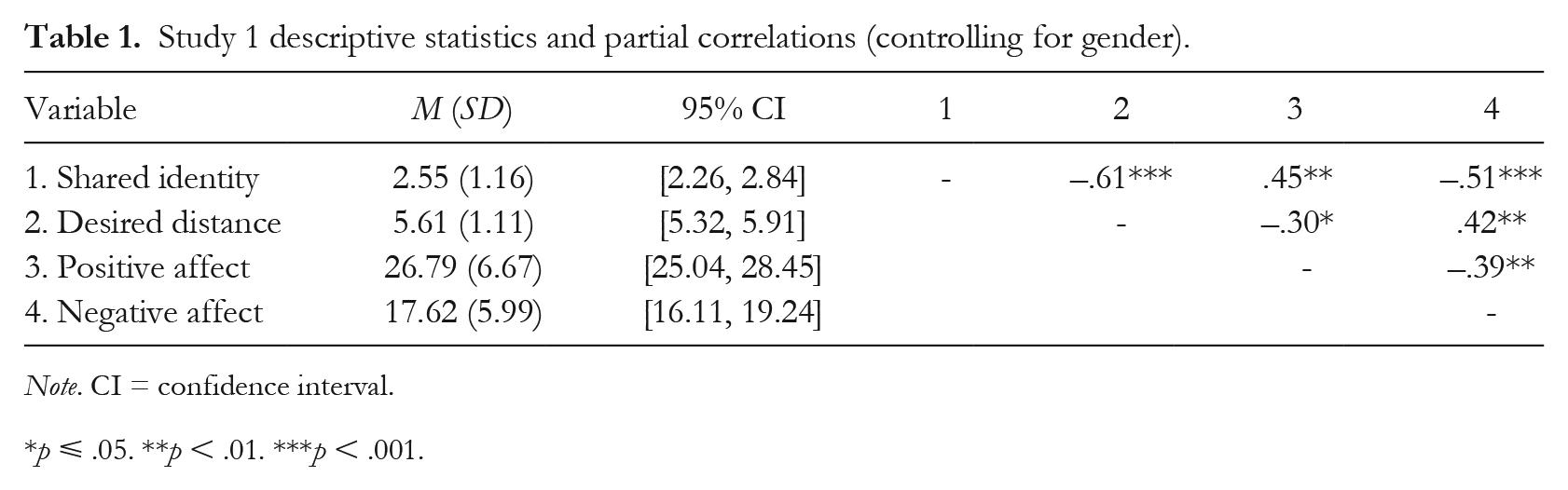
Note. CI = confidence interval.
p ⩽ .05. **p < .01. ***p < .001.
Discussion
The results of this study support all three of our hypotheses. First, a sense of shared social identity with fellow passengers was positively associated with positive emotions. Second, it was negatively associated with negative emotions. Third, it was negatively associated with desire for greater personal space. It is important to stress here that our measure of shared social identity was explicitly to do with a sense of connection to other passengers (England football fans) rather than strength of association with the England football fan category.
However, there are obvious limitations to the study. One is the correlational design, which does not allow us to draw conclusions about the direction of the association between variables. It is plausible, for instance, that those who were feeling positive and who were content being close to others were more inclined to express a sense of association with fellow passengers. The second limitation is that, although our measure of shared social identity addresses commonality more than strength, it only looks at participants’ own perceptions rather than addressing meta-perceptions (i.e., the extent to which people see other group members as perceiving everybody to be fellow group members) which, as we have explained, is a key part of the shared social identity construct. What is more, we do not contrast shared social identity to social identification and so cannot show that it is the former rather than the latter which affects social relations.
Finally, gender differences in the study may have been a consequence of the gendered nature of the paradigm. First, the participants’ boss was male and their invitation to socialise outside of work may have evoked different reactions in different participants. Second, given that football crowds are predominantly male, it is expected that participants imagined the gender distribution of passengers in their train carriage to be similarly male dominated. These limitations will be addressed in the subsequent studies.
Study 2
In Study 2 participants were again asked to imagine themselves in a crowded train carriage, but this time the study was based on the anecdote with which we started this paper. That is, using a between-subjects design, shared social identity was manipulated by whether or not participants were informed that their train had broken down resulting in a long delay. This manipulation is consistent with previous research identifying shared fate as an antecedent to shared self-categorisation (Drury et al., 2009; Turner, 1981; Turner et al., 1987). This study also differed from Study 1 in that we included a measure of strength of identification as a passenger as well as shared identification with others, in order to directly compare the role of these variables.
If, as predicted, shared social identity with fellow passengers is higher following a train breakdown, then, in the breakdown condition (as opposed to the nonbreakdown condition), we would expect a positive transformation of social relations such that passengers will be more at ease socially interacting with one another (e.g., engaging in conversation), and will have a greater tolerance of “sensual” interaction with passengers (e.g., being physically pressed against one another, smelling others’ body odours, sharing a bottle of water with others).
We therefore hypothesised that there will be main effects of condition on shared social identity, comfort in social interactions, and comfort in sensual interactions such that all three variables will be greater in the breakdown than in the nonbreakdown condition.
We also hypothesised that shared social identity (but not strength of identification) will predict comfort with both social and sensual interactions.
We further hypothesised that there will be indirect effects of shared social identity on the relationship between condition and comfort with the two forms of interaction. However, we did not expect a similar indirect effect of strength of identification.
Finally, we made no hypotheses regarding the positive affect variable. While shared social identity and positive affect were positively related in Study 1, the nature of the experimental manipulation is likely to complicate this relationship in Study 2. This is because, in addition to any positive effects it might have, the high shared social identity condition in the current study is one in which passengers are told that their journey is delayed, most likely having negative affective consequences. We cannot say how these various positive and negative impacts will balance each other out.
Method
Participants
Students from the University of St Andrews were offered the chance to participate in the study through online university notices. As an incentive, participants could enter into a prize draw to win one of two £50.00 vouchers. Based upon an effect size d = 1.18 from a previous study that used shared fate to manipulate shared social identity (Drury et al., 2009), power analysis using G*Power (Faul et al., 2009) indicated that a minimum of 40 participants was required for the current study with α = .05 and power = .95. One hundred and seventeen participants took part with an age range of 18 to 56 (M = 22.24, SD = 4.66). Thirty participants identified their gender as male, 86 as female, and one as “other.”
Design
The study used a between-subjects design such that 47 participants were randomly allocated to the nonbreakdown condition and 70 to the breakdown condition. Two further participants in the nonbreakdown condition were excluded for abandoning the survey halfway through. The imbalance of sample sizes between the two conditions was significantly different from the expected equal split, χ2 (1, N = 115) = 5.44, p = .02, suggesting an issue with the online randomisation process. However, there were no significant differences in age or gender between the two conditions, and the sample sizes in each condition were adequate to achieve the required power.
Procedure
The study was advertised to participants as an exploration of how people experience using public transport. After consenting to take part in the study, participants read the following instructions:
This study requires you to imagine that you are taking a train journey. Please try to picture yourself in the scene, and think carefully about how you would act and feel at each stage. We are particularly interested in how you imagine yourself relating to the other passengers on the train. The train is very crowded with other passengers, and you are forced to stand in the aisle. You do not know or recognise any of the other passengers on the train.
These instructions were accompanied by a photograph from the perspective of someone standing in a crowded train carriage to help participants visualise the situation. At this point, participants who had been allocated to the breakdown condition were additionally told that, Halfway through your journey the train unexpectedly slows down and stops in the countryside. There are no stations nearby. After a few minutes there is an announcement by the train company that the train has broken down, and that a replacement service will be provided within 15 minutes. However, after an hour the replacement train has still not arrived.
Those in the nonbreakdown condition received no such additional information.
Following their instructions, participants were asked to spend 2 minutes describing their imagined experience on the train, including their mood and how or if the passengers were interacting, before proceeding to the questionnaire measures.
Measures
The questionnaire originally had 40 items that related to shared social identity (six), strength of passenger identification (three), identity salience (one), general positivity (three), positivity in social relations (three), helping scenarios (three), comfort with passenger interaction scenarios (seven), quality of social relations (13), and physical density (one). However, due to substantial overlap between the scales, we analysed the items using varimax rotated principal axis factoring. Eleven factors with an eigenvalue greater than 1 were extracted. The first five factors grouped items in a way that made conceptual sense for the study, and their items and reliabilities are reported in what follows. All items used a 7-point Likert scale (1 = totally disagree, 7 = totally agree) unless otherwise stated.
Shared social identity with other passengers
Four novel items were included (e.g., “I feel a sense of ‘shared identity’ with the other people on the train”; α = .84). A fifth item which loaded onto the same factor was excluded because it referred to intimacy (an expected consequence of shared social identity rather than shared social identity per se). Two of the four items referred to metaperceptions regarding other passengers’ sense of shared social identity (e.g., “All the passengers feel ‘in it together’”).
Social identification as a passenger
This was measured using three items adapted from Cameron (2004; e.g., “My identity as a passenger is important to me”; α = .83).
Comfort with social interaction with passengers
Three novel items were included (e.g., “How comfortable would you feel starting a conversation with one of the other people in the carriage?”; α = .82; 1 = not at all comfortable, 7 = very comfortable).
Comfort with sensual interaction with passengers
Four novel items were included (e.g., “The person in front is [also] forced into physical contact with you. They are sweating through their clothing and the back of their wet t-shirt touches you. How comfortable are you with this?”; α = .69). A fifth item which loaded onto the same factor was excluded because it referred to a “sense of ease interacting with the other passengers” and thus potentially represented a form of social rather than sensual interaction.
Positivity
Three novel items were included (e.g., “This train journey has been largely positive”; α = .86).
Results
Age significantly correlated with comfort with social interaction with passengers, r(110) = .23, p = .01, 95% CI [0.00, 0.39], and is therefore included as a covariate in the analysis.
There were significant gender differences in positivity and comfort in sensual interaction with other passengers (all ps < .05), and so gender is included as a covariate in the analysis.
Descriptive statistics
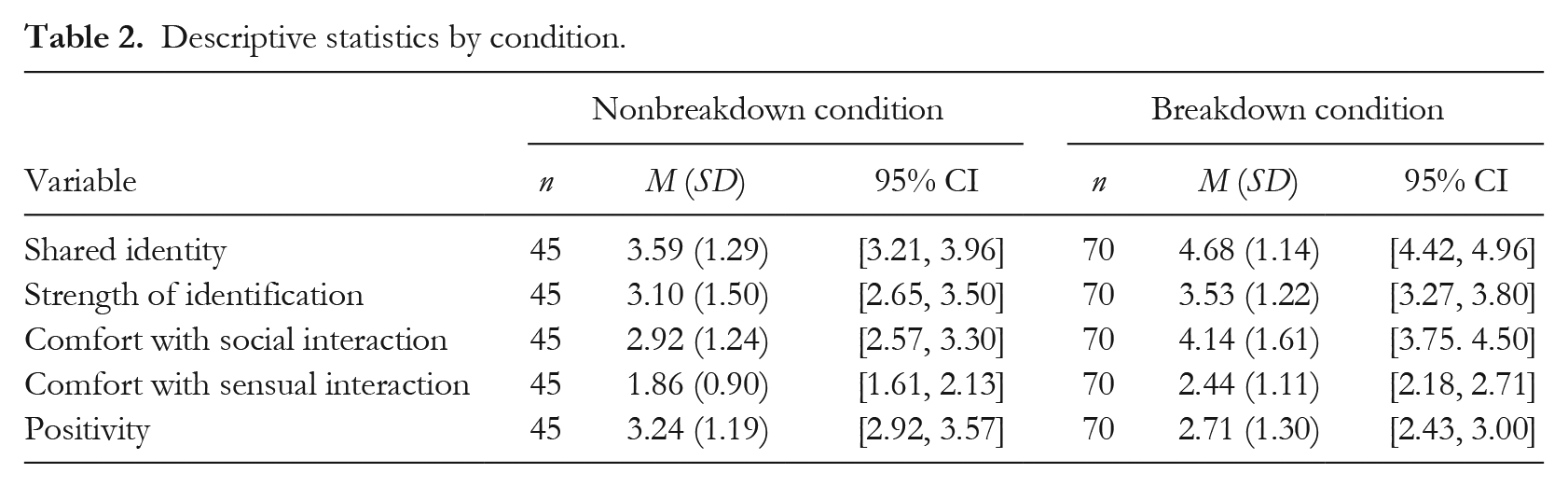
Table 2 presents descriptive statistics for each variable.
Descriptive statistics by condition.
Main effects
Between-condition differences were analysed using a one-way MANCOVA with gender and age as covariates. Using Hotelling’s trace statistic, there was a significant effect of experimental condition on the dependent variables, T = 0.52, F(5, 104) = 10.84, p < .001, η2p = .34. To examine how the dependent variables differed between experimental conditions, separate univariate ANCOVAs controlling for gender with a Bonferroni correction (α = .01) were conducted.
There were significant effects of experimental condition on shared social identity, F(1, 108) = 21.29, p < .001, η2p = .17, controlling for gender, F(1, 108) = 1.00, p = .32, η2p = .01 and age, F(1, 108) = 1.00, p = .32, η2p = .01; comfort with social interaction, F(1, 108) = 22.68, p < .001, η2p = .17, controlling for gender, F(1, 108) = 7.78, p = .01, η2p = .07 and age, F(1, 108) = 6.78, p = .01, η2p = .06; and comfort with sensual interaction, F(1, 108) = 16.25, p < .001, η2p = .13, controlling for gender, F(1, 108) = 14.52, p < .001, η2p = .12 and age, F(1, 108) = 0.95, p = .33, η2p = .01. There were nonsignificant effects of experimental condition on social identification as a passenger, F(1, 108) = 2.28, p = .13, η2p = .02, controlling for gender, F(1, 108) = 1.08, p = .30, η2p = .01 and age, F(1, 108) = 0.56, p = .46; and on positive affect, F(1, 108) = 3.38, p = .07, η2p = .03, controlling for gender, F(1, 108) = 9.68, p = .002, η2p = .08 and age, F(1, 108) = 4.96, p = .03.
Predicting comfort in interaction
Shared social identity and social identification as a passenger were simultaneously entered into regression equations to predict comfort with social and sensual interactions with other passengers. Controlling for gender (B = −0.58, SE = 0.31, t = −1.88, p = .06) and age (B = 0.08, SE = 0.03, t = 2.60, p = .01), shared social identity (B = 0.41, SE = 0.11, t = 3.64, p < .01) but not social identification as a passenger (B = −0.03, SE = 0.11, t = −0.28, p = .78) significantly predicted comfort with social interaction, R2 = .19. Similarly, controlling for gender (B = −0.60, SE = 0.21, t = −2.90, p = .01) and age (B = −0.02, SE = 0.02, t = −0.93, p = .36), shared social identity (B = 0.24, SE = 0.08, t = 3.24, p = .002) but not social identification as a passenger (B = −0.09, SE = 0.07, t = −1.20, p = .23) significantly predicted comfort with sensual interaction, R2 = .17.
Indirect effects
Hayes’s (2017) PROCESS Version 3.0 Model 4 was used to test the indirect effect of shared social identity on the relationship between experimental condition (0 = nonbreakdown, 1 = breakdown) and comfort with social interaction. Results were based on 10,000 percentile bootstrap resamples with 95% confidence intervals and controlled for age. The total effect (TE), TE = 1.21, SE = 0.28, 95% CI [0.04, 0.58] and direct effect (DE), DE = 0.93, SE = 0.30, 95% CI [0.33, 1.53] were both significant. The indirect effect (IE) = 0.29, SE = 0.14, 95% CI [0.04, 0.58] was also significant, indicating mediation. An alternative model in which shared social identity was replaced by social identification as a passenger produced a nonsignificant IE = −0.001, SE = 0.05, 95% CI [−0.13, 0.11].
Similarly, we tested the indirect effect of shared social identity on the relationship between experimental condition and comfort with sensual interaction using the same parameters except that we controlled for gender rather than age. While both the TE and DE were significant, TE = 0.69, SE = 0.19, 95% CI [0.31, 1.06]; DE = 0.56, SE = 0.21, 95% CI [0.15, 0.97], the IE was not, IE = 0.12, SE = 0.09, 95% CI [−0.05, 0.31]. An alternative model in which shared social identity was replaced by social identification as a passenger produced a nonsignificant IE = −0.02, SE = 0.03, 95% CI [−0.09, 0.04].
Discussion
Study 2 sought to extend Study 1 by manipulating shared social identity with the other passengers. This was achieved through invoking shared social identity with others in the crowded train carriage by informing some participants that their train had broken down and that no progress was being made in the provision of a replacement service. Study 2 also extended the previous study in two other ways.
On the one hand, we examined a greater range of social relations to the other (comfort in social interaction and comfort in sensual interaction) as well as general positivity. On the other hand, we examined the role of social identification as a passenger as well as shared social identity in order to examine more definitively whether it is the latter which is critical to our outcome variables.
As we hypothesised:
There were significant main effects of the experimental manipulation such that shared social identity, comfort in social interaction, and comfort in sensual interaction were all higher in the breakdown than the nonbreakdown condition. There was no main effect on participants’ social identification as passengers.
Regression analyses demonstrated that shared social identity, and not social identification as passengers, predicted comfort with both forms of interaction.
There was an indirect effect of shared social identity on the relationship between breakdown condition and comfort in social interaction. The equivalent indirect effect for sensual interaction was not significant but was close to being so (95% LCI = −0.05). There were no such indirect effects of social identification as passengers.
When it came to positive affect, there was no effect of condition or of shared social identity. This is hardly surprising since, as we previously pointed out, the shared social identity condition is confounded with the fact that one’s train has broken down and one faces a long delay. The analyses controlled for age—which correlated with comfort with social interaction—and gender, as male participants scored higher on both positivity and comfort in sensual interaction. The age correlation was likely the consequence of an outlier, as the correlation became nonsignificant if the oldest participant was excluded from the analysis. The gender differences may be a result of female discomfort in imaging close physical proximity on the train with unknown men.
Overall, then, this study gets much closer to the difference between a physical and a psychological group, which has been the focus of this paper. But there is one critical aspect of the phenomenon that it does not capture. That is, the transformation in our relations to others that occurs when an event (such as a train breakdown) leads us to develop a sense of shared social identity with others. To capture that, a within-subjects design is required in which participants transition between nonbreakdown and breakdown contexts. Such is the rationale for Study 3.
Study 3
This final study is identical to Study 2 except for the use of a counterbalanced within-subjects design. That is, participants imagine two train journeys, one of which does not involve a breakdown and the other of which does involve a breakdown. However, to rule out a simple order effect, half of the participants imagined the nonbreakdown condition first and the other half imagined the breakdown condition first.
Our hypotheses are the same as for Study 2. That is, we expected there to be main effects of breakdown condition on shared social identity, comfort in social interactions, and comfort in sensual interactions such that all three variables will be greater in the breakdown than in the nonbreakdown condition. We expected shared social identity, and not social identification as a passenger, to predict comfort with both forms of interaction. Moreover, we predicted that there will be indirect effects of shared social identity on the relationships between condition and comfort with social and sensual interactions. Following Study 2, we did not expect a significant effect of condition on positive affect.
Method
Participants
Undergraduate psychology students attending the University of St Andrews were offered the chance to participate in the study for course credits. Based on the effect size of η2p = .17 in Study 2 for the experimental manipulation on shared social identity, power analysis using G*Power (Faul et al., 2009) indicated that 66 participants were required for the current study with α = .05 and power = .95. However, due to the more complex design which included within-subjects indirect effect analysis, it was decided to recruit 100 participants. Participant ages ranged from 17 to 29 (M = 19.14, SD = 1.84). Fifty people (11 male, 39 female) took part in each of the counterbalanced condition orders.
Design
The study used a counterbalanced mixed within-subjects design such that all participants were asked to imagine two train journeys, one in which their train broke down and one in which it did not. Half of the participants had the breakdown condition followed by the nonbreakdown condition. The other half had the nonbreakdown condition followed by the breakdown condition. The study was completed online.
Measures
All questionnaire items were the same as in Study 3. All measures in both conditions had α ⩾ .70.
Procedure
The procedure was the same as in Study 2, except that participants were told that their trip had two parts and they would change trains halfway through. This served to create two train journeys, one for each experimental condition. Participants were randomly assigned to have their imaginary train breakdown in either their first or second journey. At the end of the first journey, participants were told that they were the only passenger from the first train to catch the second, and that they did not know or recognise any of the other passengers on the new train. This information was designed to prevent residual shared social identity with the passengers from the first journey. The descriptions of each train journey were accompanied by one of two images of a crowded train carriage. The order of these crowd images was randomised.
Results
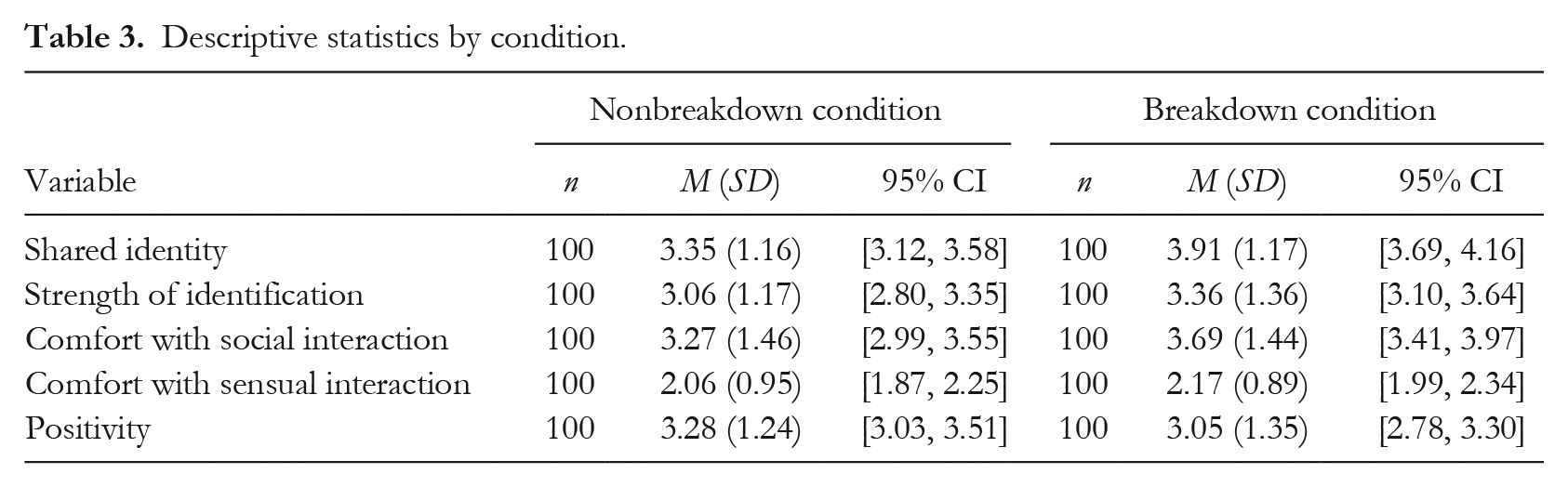
There were no significant effects of gender or age and so these are excluded from the analysis. Table 3 presents the descriptive statistics for the nonbreakdown and breakdown conditions.
Descriptive statistics by condition.
Repeated-measures MANOVA
Condition order and crowd image were included as between-subjects factors. Using Pillai’s trace, there was a significant within-subjects effect of condition, V = 0.21, F(5, 92) = 4.93, p = .001, η2p= .21, but the within-subjects interactions between condition, condition order, and crowd image were not significant. Separate univariate tests with a Bonferroni correction (α = .01) revealed significant within-subjects main effects of condition on shared social identity, F(1, 96) = 21.10, p < .001, η2p = .18, social identification as a passenger, F(1, 96) = 8.13, p = .01, η2p = .08, and comfort with social interactions, F(1, 96) = 12.92, p = .001, η2p = .12. All three variables were greater in the breakdown condition (see Table 3.). The within-subjects main effects of condition on comfort with sensual interactions, F(1, 96) = 2.88, p = .09, η2p = .03, and positive affect, F(1, 96) = 3.28, p = .07, η2p = .03, were nonsignificant. There were no significant within-subjects interactions between condition, condition order, and crowd image of the crowded train carriage.
Using Pillai’s trace, there was a significant between-subjects effect of condition order, V = 0.14, F(5, 92) = 2.99, p = .02, η2p = .14. Separate univariate tests with a Bonferroni correction (α = .01) revealed a significant between-subjects effect of condition order on shared social identity, F(1, 96) = 15.20, p < .001, η2p = .14, such that shared social identity was greater for participants who imagined the nonbreakdown condition before the breakdown condition. There were no other significant between-subjects effects of condition order. There were no significant between-subjects effects of crowd image, or of the interaction between condition order and crowd image.
Predictors of comfort in interaction
To test whether shared social identity or social identification as a passenger best predicted comfort in social and sensual interactions, both variables were simultaneously entered into a regression equation to predict each form of interaction in each experimental condition. Shared social identity, B = 0.69, SE = 0.11, t(97) = 6.37, p < .001, but not social identification as a passenger, B = 0.15, SE = 0.10, t(97) = 1.48, p = .14, predicted comfort with social interaction in the nonbreakdown condition, R2 = .37. Similarly, shared social identity, B = 0.66, SE = 0.11, t(97) = 6.01, p < .001, but not social identification as a passenger, B = 0.08, SE = 0.09, t(97) = 0.88, p = .44, predicted comfort with social interaction in the breakdown condition, R2 = .31. Shared social identity, B = 0.28, SE = 0.08, t(97) = 3.40, p = .001, but not social identification as a passenger, B = −0.02, SE = 0.08, t(97) = −0.20, p = .85, predicted comfort with sensual interaction in the nonbreakdown condition, R2 = .12. Neither shared social identity, B = 0.15, SE = 0.08, t(97) = 1.94, p = .06, nor social identification as a passenger, B = 0.02, SE = 0.07, t(97) = 0.26, p = .79, predicted comfort with sensual interaction in the nonbreakdown condition, R2 = .05.
Indirect effects of shared social identity
Montoya and Hayes’s (2017) MEMORE macro was used to test two within-subjects mediation models with experimental condition as the independent variable, shared social identity as the mediator, and comfort with social and sensual interactions as the outcome variables. Results based on 10,000 percentile bootstrapped samples indicated a significant indirect effect of experimental condition on comfort with social interactions through shared social identity, B = 0.40, SE = 0.09, 95% CI [0.18, 0.62], p < .01. 1 The total effect, B = 0.42, SE = 0.13, p < .01, was significant, while the direct effect, B = 0.02, SE = 0.10, p = .81, was nonsignificant. Results based on 10,000 percentile bootstrapped samples indicated a significant indirect effect of experimental condition on comfort with sensual interactions through shared social identity, B = 0.16, SE = 0.05, 99% CI [0.06, 0.30], p < .01. 2 The total effect, B = 0.11, SE = 0.07, p = .13, and direct effect, B = −0.05, SE = 0.07, p = .45, were nonsignificant.
Discussion
In Study 3 we used a within-subjects rather than a between-subjects design to examine the impact of a train breakdown on shared social identity and on social and sensual relations with fellow passengers. However, the results were very similar and largely supported our hypotheses.
Shared social identity and comfort with social interactions with fellow passengers were higher in the breakdown condition than in the nonbreakdown condition. Shared social identity and not social identification as a passenger predicted comfort with both forms of interaction in both conditions (with the exception of comfort with sensual interactions in the breakdown condition, in which neither predictor was significant but shared social identity was marginal). Moreover, there were significant indirect effects of shared social identity on the relationship between experimental condition and comfort with both social and sensual interactions. These results suggest that when participants imagined their train breaking down, there was a consequent increase in shared social identity with their fellow passengers, and that this shared social identity led to an increase in comfort with interacting socially with fellow passengers. Finally, there was no significant effect of condition on positive affect—possibly because any positive effect of high shared social identity on affect in the breakdown condition was offset by the negative effect of being subject to a long delay.
In terms of our predictions, then, the only difference in results between Studies 2 and 3 was the failure, this time, to find increased comfort in sensual interactions in the breakdown condition. Although the differences are in the expected direction, the means are uniformly low (around 2 on a 7-point scale). This is not surprising, perhaps, given that we describe such interaction not only in terms of touching strangers, but in terms of contact with their sweaty bodies. Perhaps this is setting the bar a little too high in terms of expecting changes.
Finally, it is worth noting an order effect for shared social identity in our findings. That is, scores in the breakdown condition were higher when this came after the nonbreakdown condition rather than before. This may be put down to a contrast effect. When coming after the alienating experience of being crowded in a carriage with others without any basis for a connection, the impact of coming together through the shared experience of a breakdown is particularly apparent—more so than when the breakdown comes first and one has nothing in mind to compare it with.
This is obviously speculative. What is clear, however, is that the condition in which shared social identity is at its highest and comfort in interaction at its strongest is the condition which most closely approximates the real-life scenario which inspired this research—one in which people start off distant from each other but become intimate after a train breakdown.
General Discussion
Summary of Findings and Implications
The three studies reported in this paper combine to tell a clear and coherent story about the role of shared social identity in the transformation of a physical into a psychological group. To summarise:
In Study 1 we show that measured shared social identity is associated with positive emotions and desire to be physically close to others.
In Study 2 we show that manipulated higher shared social identity results in more intimate social and sensual relations with others who are copresent, but that higher social identification as a passenger is not associated with more intimate relations of either sort.
In Study 3 we show that the emergence of higher shared social identity with others transforms both social and sensual relations with others who are copresent, and that this is due to an increase in shared social identity, not increased social identification as a passenger.
In combination, these results suggest, first, the importance of making a strong conceptual distinction between physical and psychological groups, and also between social identification and shared social identity. Second, they show that physical groups can transform into psychological groups and point to the importance of understanding the conditions under which such transformations occur. Third, they show how experiences that are shared amongst a set of people can lead to the formation of a psychological group. Fourth, they point to the importance of shared social identity—and not social identification—as the key psychological construct underlying psychological group formation.
This is not to suggest that social identification is irrelevant to group formation and group processes. On the one hand, the concept of shared social identity incorporates the notion of social identification but extends it: it is not just about my perceptions of self (I am a category member) but also of others (they are also category members), and it is not just about my perceptions (how I see category memberships) but also about my metaperceptions (how I see others as seeing category memberships). These extensions equally differentiate shared social identity from constructs such as entitativity (Lickel et al., 2000). What is more, it is this multilevel sense of “we-ness” which leads people to support and have a sense of being supported by others, and therefore to act together as a group (Drury & Reicher, in press).
On the other hand, social identification may be sufficient to produce certain aspects of group behaviour, but not all. Thus, in this paper we have concentrated on relations with and actions towards others in the group which are more likely to depend on how we see them as well as how we see ourselves—that is, shared social identity. But the process of self-stereotyping and acting in terms of group norms and values can occur when social identity is strong, irrespective of how we define others (Turner, 1982; Turner et al.,1987), and I can behave in terms of group membership even in the complete absence of others (Spears & Lea, 1994).
We do not aim to dismiss the importance of social identification, then. Rather, our findings suggest the need to pay more attention to the distinction between a social identity being strong and being shared, along with the different ways these are implicated in group processes. Indeed, beyond our core issue of how psychological and physical groups differ and how the former emerges from the latter, one of the more general contributions of this paper to the study of groups is to clarify this distinction.
Limitations
For all the clarity of our findings, there are clearly limitations to each of our individual studies, which have already been raised in the respective discussion sections. Moreover, there are a number of inconsistencies of method between the studies which need to be highlighted. However, these can be seen as more of a strength than a weakness given that the general relationship between shared social identity and the emergence of psychological groups remains consistent even when we use somewhat different measures of shared social identity and also of “groupness”: positivity and desired proximity in Study 1, comfort in social and sensual relations (as well as positivity) in Studies 2 and 3.
Additionally, though, there are limitations which are common across all three studies. The most obvious of these is that we are dealing with imagined rather than real scenarios and with reported rather than actual behaviours. In large part this was due to the sheer practical and ethical difficulties of arranging controlled studies involving real train breakdowns (and, what is more, however many people were involved, the interdependence of data would mean that each breakdown could only constitute one data point).
Our work, then, draws on a long tradition of visualisation research in social psychology and more specifically in research on supportive social relations in groups (e.g., Garcia et al., 2002). What is more, there is evidence that reported behaviour in such research matches actual behaviour in real situations. This is not only true in relation to help giving (Baron & Miller, 2000; Levine et al., 2005) but also to other phenomena studied here such as proximity to others (Novelli et al., 2010) and emotional positivity towards the proximity of others (Reicher et al., 2016). So, while there would obviously be merit in complementing the present studies in real-world situations and using behavioural measures, we can nevertheless be confident in the validity of our findings.
As noted previously, the football crowd and social invitation by a male boss used in the Study 1 paradigm led to gender differences in participant responses. Moreover, Studies 2 and 3 involved the (imagined) prospect of being pressed against strangers of both genders in a crowded train carriage. While the analysis controlled for gender in Studies 1 and 2 (there were no significant gender differences in Study 3), future research should seek to develop paradigms which are less gendered. In addition, both Studies 2 and 3 used a negative scenario—a crowded train breaking down—in order to manipulate shared social identity. Future research may wish to explore the possibility of using positive scenarios to bring a physical crowd of individuals together as a psychological group.
Finally, although our experimental manipulations were designed to increase shared social identity by invoking a sense of shared fate with other passengers (Drury, 2012, 2018; Drury et al., 2009), shared fate was not actually measured quantitatively. However, participants’ qualitative responses to the visualisation task suggested that shared fate was an important factor. For example, a participant in the Study 2 breakdown condition reported a “greater sense of unity between all as the delay has affected everyone on the train in the same way.” Future research should measure shared fate more systematically as both a manipulation check and as a mediator in the proposed model to confirm this process.
To conclude, then, we started this paper with an anecdote that goes to the heart of the transformative experience when psychological groups emerge out of physical groups. We now, for the first time, have systematic evidence documenting that transformation and clarifying that the creation of shared social identity is the underlying psychological process. When events lead people to think less in terms of “I” and more in terms of “we,” a mere physical assembly of individuals turns into a mutually supportive psychological group.
Supplemental Material
Appendix_-_Scales – Supplemental material for Shared social identity transforms social relations in imaginary crowds
Supplemental material, Appendix_-_Scales for Shared social identity transforms social relations in imaginary crowds by Fergus G. Neville, David Novelli, John Drury and Stephen D. Reicher in Group Processes & Intergroup Relations
Footnotes
Acknowledgements
The authors wish to thank Ken Mavor, Amanda Montoya, and Sam Pehrson for their advice on aspects of the statistical analysis included in this paper.
Funding
The author(s) disclosed receipt of the following financial support for the research, authorship, and/or publication of this article: This research was supported by ESRC Postgraduate Studentships for the first (PTA-030-200600100) and second authors (PTA-031-200500096), and an ESRC research grant for the third and fourth authors (ES/N01068X/1).

Supplemental material
Supplemental material for this article is available online.
Notes
References
Supplementary Material
Please find the following supplemental material available below.
For Open Access articles published under a Creative Commons License, all supplemental material carries the same license as the article it is associated with.
For non-Open Access articles published, all supplemental material carries a non-exclusive license, and permission requests for re-use of supplemental material or any part of supplemental material shall be sent directly to the copyright owner as specified in the copyright notice associated with the article.
